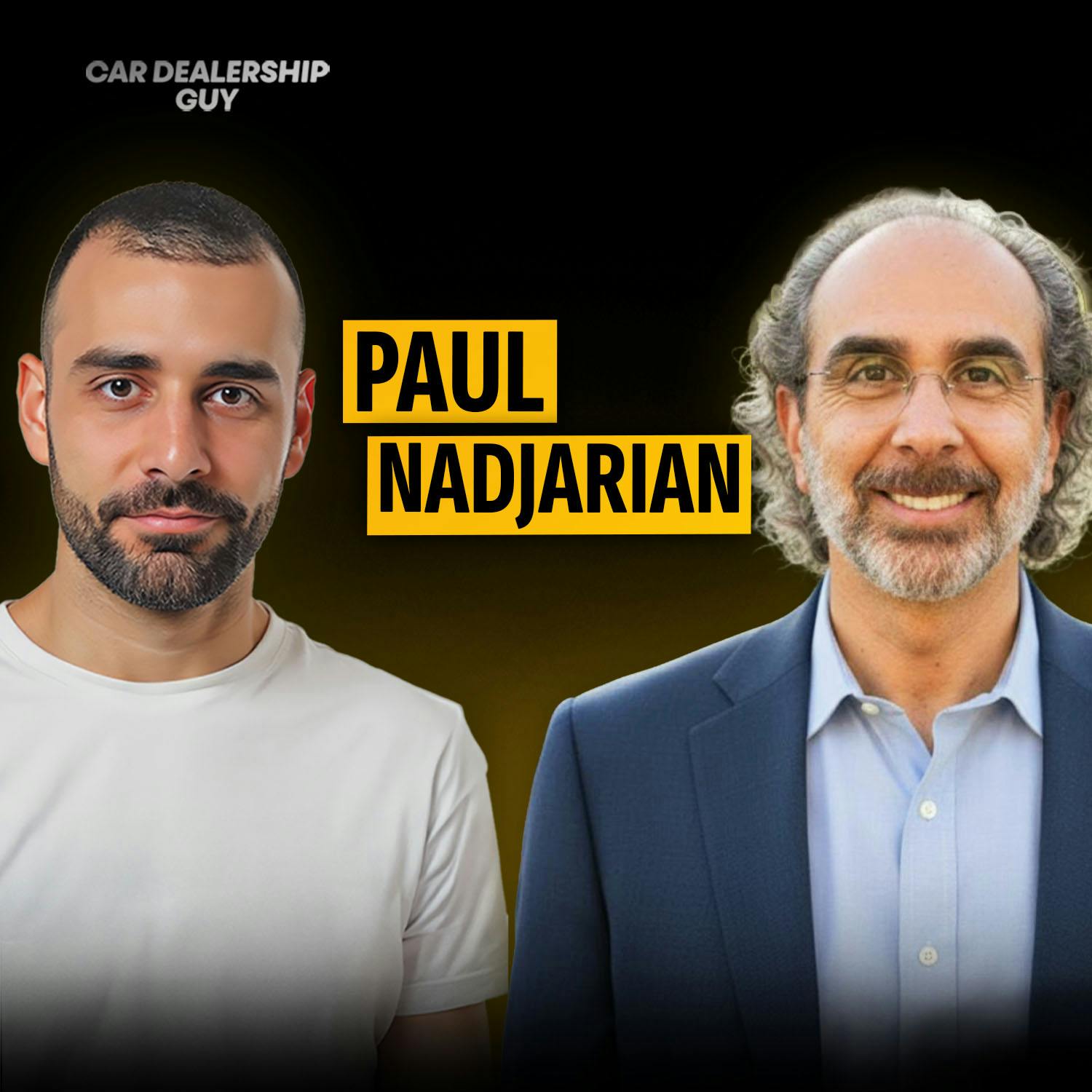
Paul Najarian, Chief Product Officer at Carfax, discusses how dealers can shift from one-time sales to building long-term customer loyalty using vehicle history data and intelligent automation. He highlights Carfax's evolution from providing reports to creating a trusted used car marketplace and a car care app with over 50 million users. Paul introduces the concept of 'homegrown' cars—vehicles sold and serviced by the same dealer—which tend to sell faster and at higher margins. The episode emphasizes the importance of retention, service lane visits, and leveraging data-driven tools like Carfax Lifetime and Carfax CarCare to increase repeat business and profitability.
Today I'm joined by Paul Nadjarian, Chief Product Officer at Carfax.
We break down why the smartest dealers are shifting from one-time gross to lifetime value, how vehicle history data closes the trust gap with consumers, and why “homegrown” inventory is becoming the most profitable used-car strategy.
Paul also explains how automation and consumer signals are quietly driving higher service retention and better acquisition decisions without adding dealer workload.
This episode is brought to you by:
1. Lotlinx - Meet LotGPT, your AI Inventory Strategist built exclusively for car dealers. Fluent in your market, your dealership, and your inventory, LotGPT analyzes live inventory, real-time market supply, and shopper demand to surface risk and opportunity VIN by VIN. It reveals competitive insights, shopper behavior, and pricing dynamics, and even identifies underperforming VDPs with merchandising recommendations to boost conversion without cutting price. Put LotGPT to work for your dealership today, totally free, @ https://lotlinx.com/LotGPT/.
2. Podium - Podium, the AI platform trusted by one in three dealerships. Podium helps dealers consolidate sales, service, messaging, and voice into one connected system that actually runs the work. If your AI isn’t driving real outcomes, it’s time to take a closer look @ https://www.podium.com/car-dealership-guy.
3. Carfax - Drive long-term customer loyalty with CARFAX. Visit @ https://carfax.com/CDG to learn more.
Check out Car Dealership Guy’s stuff:
For dealers:
CDG Circles ➤ https://cdgcircles.com/
Industry job board ➤ http://jobs.dealershipguy.com
Dealership recruiting ➤ http://www.cdgrecruiting.com
Fix your dealership’s social media ➤ http://www.trynomad.co
Request to be a podcast guest ➤ http://www.cdgguest.com
For industry vendors:
Advertise with Car Dealership Guy ➤ http://www.cdgpartner.com
Industry job board ➤ http://jobs.dealershipguy.com
Request to be a podcast guest ➤ http://www.cdgguest.com
Topics:
07:30 Why Gross Per Deal Is the Wrong Metric
10:25 The Inventory That Sells Faster and Makes More
12:40 The 19-Point Service Retention Gap
13:00 Miss Year One… Lose the Customer
28:00 The 20% Lift from Trust-Based Messaging
28:15 The 30% Lift from Coordinated Messaging
31:30 The Goldmine Most Service Lanes Ignore
33:20 The Used Car Section That Outsold the Rest
38:36 Without Loyalty, Dealer Economics Collapse
Car Dealership Guy Socials:
X ➤ x.com/GuyDealership
Instagram ➤ instagram.com/cardealershipguy/
TikTok ➤ tiktok.com/@guydealership
LinkedIn ➤ linkedin.com/company/cardealershipguy
Threads ➤ threads.net/@cardealershipguy
Facebook ➤ facebook.com/profile.php?id=100077402857683
Everything else ➤ dealershipguy.com
"Today I'm joined by Paul Najarian, Chief Product Officer at Carfax."
Carfax is a company that tells you the history of a used car, like if it had any accidents or how many people owned it before.
Carfax is a company that provides vehicle history reports to consumers and dealers, helping them understand a used car's past including accidents, ownership, and service records.
OEM means the company that originally makes the cars or parts you buy, like Ford or Toyota.
OEM stands for Original Equipment Manufacturer, referring to the companies that produce vehicles or vehicle parts that are sold under the brand of the car manufacturer.
"that thinks new car margins are going to miraculously expand suddenly."
New car margins are the amount of money a dealer earns when they sell a brand-new car.
New car margins refer to the profit dealers make from selling new vehicles, which can be affected by manufacturer pricing, incentives, and dealer markups.
"which all brings us back to retention, how that's increasingly the most important thing for a dealer."
Dealer retention means how well a car dealer can keep customers coming back to buy or service their cars.
Dealer retention refers to the ability of car dealerships to keep customers coming back for service, repairs, or future vehicle purchases, which is crucial for their long-term profitability.
"But he basically said, Yossi, we don't look at just gross profit per vehicle. We look at, and again, this is not the exact word to use,"
This means how much money a car dealer makes from selling a car before adding other things like trade-ins or fees.
Gross profit per vehicle refers to the basic profit a dealer makes on selling a car before accounting for additional costs or revenues from related transactions.
"We basically look at fully loaded profit per vehicle. Oh, he called it super PVR."
This means how much money a dealer really makes from selling a car, including extras like trading in your old car or selling you extra services.
Fully loaded profit per vehicle is a comprehensive measure of profit that includes all sources of income related to a car sale, such as trade-ins, financing, add-ons, and extended warranties.
"Now, when that consumer is ready, they wanna take that car in on trade, right? And sell them another car."
When you want to buy a new car, you can give your old car to the dealer instead of selling it yourself. The dealer then lowers the price of the new car by how much your old car is worth.
A trade-in is when a customer offers their current vehicle to a dealership as part of the payment towards purchasing another car. The dealership appraises the trade-in vehicle and applies its value to the new purchase.
"we're calling a homegrown car. And that's gonna show up on the Carfax report very soon"
A homegrown car is a car that has been bought and looked after mostly by the same dealer, which usually means it's been taken care of well.
A 'homegrown car' refers to a vehicle that has been sold and serviced primarily by the same dealership, indicating consistent maintenance and potentially better care history.
""what percent of a dealer's used car inventory is actually homegrown? That's a good question for a dealer.""
Homegrown inventory means used cars that the dealer got from people trading in or selling nearby, not from big auctions. These cars might be easier to trust because the dealer knows where they came from.
Homegrown inventory refers to used cars that a dealership acquires through trade-ins or local purchases rather than sourcing from auctions or other dealers. It often indicates vehicles that have been maintained or inspected by the dealership itself.
"but you service that car for at least 75% of the service history of that car."
Service history is like a report card for a car that shows all the times it was checked or fixed. It helps buyers know if the car was taken care of.
Service history refers to the documented record of maintenance and repairs performed on a vehicle over its lifetime. It helps verify that the car has been properly maintained, which can affect its reliability and resale value.
"because you're a new car customer to begin with."
A new car customer is a person who buys brand new cars from a dealer instead of used ones.
A new car customer is someone who primarily buys new vehicles from a dealership rather than used cars. Dealerships often prioritize retaining these customers for repeat sales and service.
"Well, because once you see how these cars sell on your used car lot, because they sell typically at a higher margin"
A used car lot is a place where people sell cars that have been owned before. Dealers buy and sell these cars to make money.
A used car lot is a dealership or location where pre-owned vehicles are sold. Inventory turnover and profit margins on these lots are important for dealer profitability.
"which is the co-branded version of Carfax CarCare that a dealer can offer a consumer, when they buy a new car and they're using Carfax CarCare to come in for service, because it's helping them maintain their car, remind them when they need to come in, Carfax is sending that out co-branded with the dealer."
Co-branded means two companies work together and put their names on the same product or service to help customers.
Co-branded refers to a product or service that is jointly branded by two companies, in this case, Carfax and a car dealer, to provide a combined offering to customers.
"That's Lot GPT. It's the industry's first AI-powered inventory strategist built specifically for car dealers."
It's a smart computer program that helps car dealers figure out which cars to sell and when, by looking at lots of information about the cars and buyers.
An AI-powered inventory strategist uses artificial intelligence to analyze car dealership inventory, pricing, market trends, and shopper behavior to optimize sales and inventory management.
"VIN by VIN, no digging through reports, no guesswork."
A VIN is like a car's fingerprint, a special number that tells you everything about that specific car. It helps people know where the car came from and if it has any problems.
VIN stands for Vehicle Identification Number, a unique code assigned to every motor vehicle for identification purposes. It helps track the vehicle's history, specifications, and ownership.
"I think the other thing that dealers are doing today is dealers are building a CDP where they understand the behavior of consumers."
A CDP is a tool that helps car dealers keep track of what customers like and do, so they can send better messages and offers.
CDP stands for Customer Data Platform, a system used by dealers to collect and analyze customer information to better understand consumer behavior and improve marketing efforts.
"...a lot of those cars are gonna end up coming through your service lane. You know, I do wonder if the..."
A service lane is the place at a car dealer where cars get fixed or checked to make sure they work well. It's like a car doctor's office.
The service lane at a dealership is the area where vehicles are brought in for maintenance, repairs, and inspections. It's often where used cars are inspected and serviced before being sold or returned to customers.
"...every dealer under the sun puts some premium on vehicles that, they know the history of them, they have experience with them."
A dealer premium means the car seller might charge more money for a car if they know it well or think it's special. It's like paying extra for something you trust.
A dealer premium is an additional amount a car dealer charges for a vehicle based on factors like known history, condition, or demand. Dealers may price cars higher if they have experience with the vehicle or know its background well.
"you know, Toyota Corollas are available in my area to buy."
The Toyota Corolla is a small car that many people buy because it is reliable and doesn't use much gas. It's a good choice if you want a car that is easy to take care of.
The Toyota Corolla is a popular compact car known for its reliability, fuel efficiency, and affordability. It has been one of the best-selling cars worldwide for decades.
"If the dealer's listed with us, his listings are already included."
Dealer inventory means the cars a car dealer has to sell right now. You can look at these cars online to see what's available.
Dealer inventory refers to the cars that a dealership currently has available for sale. This inventory can be exposed online to potential buyers through various platforms.
Why Gross Per Deal Is the Wrong Metric
The Inventory That Sells Faster and Makes More
The 19-Point Service Retention Gap
Miss Year One… Lose the Customer
The 20% Lift from Trust-Based Messaging
The 30% Lift from Coordinated Messaging
The Goldmine Most Service Lanes Ignore
The Used Car Section That Outsold the Rest
Without Loyalty, Dealer Economics Collapse
Select text to request an explanation
CDG Circles signups are back open.
If you want to learn from the best dealers in the country,
this is the digital peer group where it happens.
Over 3,000 dealership rooftops represented.
Recent dealer-only conversations
include Stellantis acquisition caps, AI selection
and integration, pay plan revamps, cooling new car sales,
used car sourcing strategies, and more.
Don't miss it.
Join us now at cdgcircles.com.
That's the feedback they're giving us.
That consumers are very interested in a car
that was sold and service at that dealership
because they feel the dealership knows the car.
And the reality is it's not a feeling.
The dealer knows the car.
Today I'm joined by Paul Najarian,
Chief Product Officer at Carfax.
Dealers are facing a growing trust gap in thinner margins,
forcing a shift away from one-and-done transactions
toward long-term customer value.
Paul breaks down how vehicle history data,
service habits, and intelligent automation
are helping dealers retain customers,
build homegrown inventory, and buy better-used cars
directly from their service lanes.
A big thank you to our sponsors
for making this episode possible.
Lotlinks, Podium, and of course Carfax.
And now let's get into the show.
Paul Najarian on the CDG podcast.
Hey, Yossi.
How are you, man?
Good to have you on.
Thanks so much.
I got a fresh cut before this podcast.
I feel good.
We were rehearsing your last name
right before I pressed record.
So, you know, I tried to pull off
the authentic pronunciation in Najarian.
But, you know, I sort of got it.
Close.
It's pretty close.
I love it.
What's up, man?
Good to have you on.
You've done a pretty tremendous job.
And of course, it's a team effort,
but, you know, you've led
your Chief Product Officer today at Carfax.
And, you know, I personally,
I built a managed marketplace
or called it vertically integrated.
So, I know it's difficult to build
an online marketplace.
Of course, you have the power of the Carfax brand.
You took Carfaxed car listings 2.0
from four to 25 million visitors,
which I found, you know, pretty remarkable.
We'll talk about what that meant
and how you did that and what it means for dealers.
I think that's ultimately where we want to get to.
But there's a lot to talk about.
Let's start with you.
Paul, you...
So, first of all, let's table set your roots.
You are actually a founder.
Carfax acquired your company, Mojo Motors.
Is that correct?
Yeah, that's right, about 10 years ago.
Incredible.
Can you tell us about that experience?
Why acquire your used car marketplace 10 years ago?
How has that led you to what you're doing today at Carfax?
Yeah, no, I think at my company,
we had figured out a few things,
which was how can you really give consumers
a great experience and give them a shopping tool
that actually helps them tremendously,
more of a tool than just an advertising marketplace.
And so we figured out how to build that relationship
with consumers.
We got a lot of evidence around that.
But when we partnered with Carfax,
and I brought the team here,
it was really partnering with a brand
that consumers trusted,
and this amazing information Carfax had on used cars.
So then we basically rebuilt listings at Carfax,
leveraging that brand
and the amazing history data Carfax had
to offer the market a unique solution,
to offer a customer something unique
that could be focused on the history of the vehicle
as the foundation,
because the reality is when it comes to used cars,
history matters.
History impacts the price.
It really is foundational.
The other thing we did is,
we were very strict about what we put
on the listing market place on what we didn't put there.
For example, we didn't put any banner ads from anybody.
We still don't have banner ads from anybody on the site.
And the reason we do that is because the site stays consistent
and clear on the inventory itself,
which really is what consumers want
and actually is what dealers want too.
Dealers want customers to see their inventory
and engage with it.
I'm on it right now, and yes, I do see that.
There are no banner ads.
When you think about supporting dealers
in this upcoming era,
so you obviously have access to lots of data
and I think anyone or many people know at this stage
that in the AI era,
data is what makes something valuable
and can provide a better experience.
How do you think about the needs of dealers
and that does evolving?
You went from, I would say being,
and I'll give you a dealer perception
and you can correct me if I'm wrong,
you were just a, over a decade ago,
just listing our vehicle history reports.
That evolved into a used car marketplace
along with a car care app,
which I believe has over 50 million users today.
We'll talk about what that does for dealers.
How do you think about the evolving needs of dealers?
What's next?
If in 2015, the company focused on starting
with vehicle listings and evolved into ownership,
what's the next need for the dealer?
Yeah, our evolution was, we provided the report,
then we provided a destination for listings
and then car care is really a relationship with consumers.
And I do think the future of the dealership
is a relationship that's based on loyalty.
So how can the dealer build trust with the consumer
and provide the consumer good information
in order for that consumer to see the dealer
as their automotive partner?
So that is key.
So I think the most successful dealers you will see
have a really high level of loyalty at the dealership
because people just keep going back to them
over and over again.
So I think that's the future for the dealers.
And if you take a look at all these more advanced solutions
that the dealers are looking at,
all the data, all the AI and everything else,
it really is to provide a more personalized,
smarter, better experience for consumers
and to actually drive that spin wheel of loyalty over time.
Cause that's really, truly what makes the business successful.
Well, I think on the loyalty front for a second,
it's clear new vehicle production,
all the OEMs have already re-forecasted it down
for the remainder of the year.
Yeah, I don't think there's any dealer out there
that thinks new car margins are going to miraculously
expand suddenly.
So that is just going to continue
to be a point of pressure for dealers,
which all brings us back to retention,
how that's increasingly the most important thing
for a dealer.
Can you retain that customer?
You know, I just had a great conversation
with Mike Maruni, former CEO of AutoNation
and currently head of Maruni USA.
He's got eight dealerships.
And one of the really important parts
of the conversation was when we discussed
just profitability customers.
And I forget how Mike referred to this,
but I'll just explain it, I'll paraphrase.
But he basically said, Yossi,
we don't look at just gross profit per vehicle.
We look at, and again, this is not the exact word to use,
but I'll use mine.
We basically look at fully loaded profit per vehicle.
Oh, he called it super PVR.
And I said that makes a lot of sense
because if you buy a car for me today,
maybe I only make $1,000 on this deal.
It's a short deal, but you trade in something
where I'll make on that.
And then that vehicle is a local deal.
It's a local customer, so they come in for service.
There's lifetime value, right?
And so I think increasingly every dealer,
if a dealer today is not looking at every customer
as if I'm a lifetime value perspective,
you're leaving money on a table
and you're hurting your business.
So brings me back to you.
You just spoke about what it meant
like about retention, loyalty.
What's your thought on what I just said there?
And I wanna get to how you're supporting that.
Yeah, no, I mean, it totally connects with me.
In fact, we named our solution Carfax Lifetime
as a result of what you just described.
And it really is about the whole cycle.
So let's just define what loyalty is first.
When a dealer sells a new car to a customer,
they need to get that customer back into the service lane
to come back to that dealership
and then keep them coming back.
And over time, they're building a relationship
with that consumer coming back.
Now, when that consumer is ready,
they wanna take that car in on trade, right?
And sell them another car.
That is a definition of loyalty.
The car they take in on trade,
we're calling a homegrown car.
And that's gonna show up on the Carfax report very soon
where we're gonna actually identify those cars,
which means the dealer sold the car
and the dealer serviced it
for at least 75% of its service.
Interesting.
So that's a new, like identifier
that you're putting out there.
So we're gonna actually label those cars
because that indicator is an indicator of the cycle.
And the real question is what percent
of a dealer's used car inventory is actually homegrown?
That's a good question for a dealer.
That's a good question for them to know.
We have, in all the major markets in the country,
we've done rankings by OEM to list like all the Ford dealers
and how they rank on homegrown inventory
at their dealership.
And the Carfax reps are in the field,
have those rankings, any dealer can ask them for it
and be able to see it.
But if you think about that indicator,
that means not only sold a car,
but you service that car for at least 75%
of the service history of that car.
And then you've taken that car back in on trade,
which means most likely you sold that person
another new car,
because you're a new car customer to begin with.
But Paul, why do I need that on the Carfax?
Like why do I care as a dealer for that to be on the Carfax?
Well, because once you see how these cars sell
on your used car lot,
because they sell typically at a higher margin
than they sell faster than the other inventory,
then you're gonna wanna identify those cars at acquisition
so you know what the car is when you're buying it.
And what about the consumer perception?
Because I feel like I will know
that that's a homegrown car
because I'll have the customer data if they come in.
But is the impact on a consumer,
have you found that consumers are willing to pay more for that
when they're shown something like this on a report?
I'm curious if there's any consumer data.
We've run some tests in the field with a few dealer groups
and that's the feedback they're giving us
that consumers are very interested in a car
that was sold and service at that dealership
because they feel the dealership knows the car.
And the reality is it's not a feeling.
The dealer knows the car.
Yeah, it's true.
It's data, it's there.
It's a reality.
So those are the best cars in the minds of the consumer
and that's the feedback we've gotten from the test dealers
that have been testing it on our behalf.
So that really is kind of the entire cycle.
And so the solutions that we've put together
which we call Carfax Lifetime really drive that whole cycle.
And that is a higher level partnership with Carfax.
And so that partnership is,
we have probably over 6,000, 7,000 dealers,
something like that that are on that partnership today.
And so we have plenty of data to show the benefits of it.
And so I can just give you one example of that.
So when we take a look at consumers
that use Carfax CarCare,
which is the co-branded version of Carfax CarCare
that a dealer can offer a consumer,
when they buy a new car and they're using Carfax CarCare
to come in for service,
because it's helping them maintain their car,
remind them when they need to come in,
Carfax is sending that out co-branded with the dealer.
They're typically those folks
at 76% return rate in the first year
to the service department.
When they have Carfax CarCare as an app installed
under phone.
Yep, 76% return rate in the first year.
If they don't, it's 57% return rate in the first year.
So you can see the lift that you're getting
in just that return in the first year
to the service department.
If you can't get them back in the first year,
you're not gonna get them back in the second.
This episode is brought to you by Lotlinks.
What if you had a strategist
that could actually look at your inventory,
your pricing, your market, and real shopper behavior,
and then tell you exactly what to do next?
That's Lot GPT.
It's the industry's first AI-powered inventory strategist
built specifically for car dealers.
It analyzes your VIN level data
and surfaces which vehicles are at risk,
where the opportunity is in your market
and what actions you should take.
VIN by VIN, no digging through reports, no guesswork.
And the best part, it's free for dealers.
Just head to lotlinks.com slash Lot GPT
and request access or click the link
in the show notes below.
Tell me more about that one second.
So if I'm a Carfax dealer today,
which there are many listening to this right now,
you're saying that you have a co-branded program
called Carfax Carcare,
where we get this app into the hands of my customers
and it helps bring them back to my dealership.
Can you walk me through that?
How do I get them to download the app?
Yeah, why do they come back?
Just give me all the steps here.
You don't even need to get them to download the app.
You just partner with Carfax
and we basically co-branded with you,
Carfax and the dealership.
We invite those customers to join Carfax Carcare
and there's benefits to joining.
They get to see a free Carfax report in their vehicle
as long as they own it.
They also get a dashboard each month, which is holistic.
If you go to the app store and download Carfax Carcare,
you'll see what I'm talking about.
Just put in your VIN and you'll see a dashboard.
So that dashboard tells them everything they need to know.
It tells them when they need their maintenance,
when the registration's due, admissions.
It tells them everything,
whether or not they have any recalls
because we're integrated with all the OEMs for that info.
So we are alerting them on a monthly basis
and the thing about it you'll see is that
what we figured out is that we,
because of the brand and the trust
that we've built over time,
we had the opportunity to build a healthy habit
with consumers.
What do you mean by that?
So habits are really powerful, okay?
They're good habits and they're bad habits.
I fully agree with that.
We talked about this all the time,
I'm a cardio-ship guy and putting out content
at the same time, at the same day
and I believe in consistency.
Totally, totally.
So that habit is actually,
and the healthy habits are really good for people.
So the healthy habit is we pushed this dashboard
that was in the app to people on a monthly basis
and we saw that 50 to 60% of the people
were looking at it every month
and that rate didn't go down over time.
So built a habit, that open rate is very high
in the industry and people are just seeing
what's going on with my car on a monthly basis
and it gives them a countdown of what's due when.
And so then you have the opportunity
to build a relationship through this trusted brand
and the co-branding with the dealer
and get that customer to pay attention
to come back and get the work done.
And so that is driving this healthy habit over time.
And so what we're seeing is that the dealers
that are on that partnership program
anywhere from 40 up to 55% of the ROs each month
are a Carfax CarCare user coming back.
So the ROs that they're writing each month.
And so it's just a matter of it's good for the consumer
and it's good for that consumer's vehicle to be maintained.
It keeps the vehicle safe
and it actually enhances the value of the vehicle.
So, and it's good for the dealer too
because they get to see that customer over and over again
and it's driving that cycle that you and I talked about.
Like the life.
And I want to stay on the topic of service here
and what you just discussed.
I'm looking at circles
and I'm reading questions from dealers and comments.
Someone asked is checking other dealers
if they're using what's called Carfax Service for Life
Carfax Service Marketing.
Is that, are they referring to this?
Or is it something different?
No, it's basically our service marketing program.
It leverages a co-branded version of Carfax CarCare.
It's called Carfax for Life.
That's probably what they're calling it.
And so it really is intended to help you as the dealer
get folks back into service,
keep them coming back to service.
So then you have the opportunity to trade that person
into another vehicle and then get the car in on trade
and hopefully that car is a homegrown vehicle.
Okay, so I think that aligns well
with just the trends of the industry
and what dealers need, right, retention, loyalty.
Who keeps the customer information?
What happens to that?
Well, the dealer is leveraging Carfax
like they would leverage any other marketing company, right?
When you leverage a vendor to send out marketing for you,
you provide information that vendor
and that vendor sends it out.
So all we require to be able to invite those people to join
is an email address in the VIN.
So then we can actually invite them to join Carfax CarCare.
Now, when they join with that co-branded dealer invite,
that dealer is marked as their favorite within the app.
So the dealer is always in the app with them.
Again, it's completely co-branded
and Carfax is managing the platform on behalf of the dealer,
but the dealer is marked as that favorite
for that consumer and that vehicle.
Once they're marked as a favorite of that dealer,
they can't be marked as their favorite someplace else
on that vehicle.
So it's an opportunity for the dealers
to get their customers marked as favorites
in that application and for them to keep coming back to them.
Paul, what's this 50 million number?
Is that your user base on Carfax today?
So that is consumers that have Carfax CarCare
that actually have a VIN in the garage.
And it's actually, it's 54 million now
and there's 84 million VINs in all those garages.
Okay, please go ahead.
It's material, right?
I mean, so it's, I'd say so.
Yeah, I mean, let's just say it works, okay?
So if it didn't work, it wouldn't scale, right?
So anything that scales significantly works.
And the reality is when you take a look at it,
it's one in four licensed drivers in this country
and 84 million VINs is more than one in four VINs.
The other thing about it is that the people
that are leveraging and using this
are typically spending more money on services
than the people that don't use it, right?
Because you're really getting the folks
that are gonna really do a better mindful job
because they wanna leverage a tool to do it
and they want the trust and the information.
The dealer is your customer
and you have access here
to 54 million consumers and growing.
That's a very material number, as you mentioned.
What type of behavior can you incentivize
with all this, just this massive consumer base
and your relationship with dealers?
You just mentioned the car care
and having that lifetime relationship.
But what else can you do, right?
If I am right now, if we are in like a dealer,
your dealer advisory panel, right?
10 dealers, 10 top dealers from the country
who are using this and we're having a conversation,
you're ahead of product.
What type of behavior are we trying to incentivize here?
Like what does that evolution look like?
What should I expect?
Well, I think where we're heading in the evolution
is that we are partnering with the dealer
in order to help them be more successful.
So what we will do is figure out
how can we help the dealer in different aspects
of their business and that cycle we talked about.
So I'll just give you one example
and this is like a future item.
So obviously, we have a lot of people on Carfax.
We have a lot of people in Carfax.com
and a lot of people within car care.
We have signals that let us know
whether or not someone is in market or not.
But they're signals that'll let us know that.
And so based on those signals,
that's information that we have that we can use
in order to prompt people to take action because of it.
And so that prompting to take action
could be helpful to the dealer
because we would be prompting
with that partner dealer's inventory to say,
hey, there's a signal here, we're seeing it,
that this person could be in market soon.
Well, let's prompt with that partner dealer's inventory
and those favorites that he has within car care.
And so we're pulling intelligently
from the dealer's inventory on an automated basis,
intelligent basis and prompting the consumer
with that specific dealer's inventory
for that favorite that they have.
So it is a intelligent, automated system
in order to be helpful to a consumer.
If a consumer finds it helpful,
then we're interested in doing it
because if you're more helpful to a consumer,
they're more likely to transact.
And so they have to trust you,
they have to have confidence in you
and you have to be helpful
and quite honestly, you need to be likable.
If you're not likable, you're probably
in a little rule of life right there.
Yeah, exactly.
But if you're those things,
and so we actually work hard on likability,
believe it or not, that's why we have Carfox
because Carfox is trustworthy, likeable,
good information, great experience.
And so we're leveraging it.
And again, the purpose is to partner with the dealer
in order to help the dealer's business.
And the reality is consumers need to trust
and we're the trust partner.
The dealer is the automotive partner for that consumer,
but we're the trust partner.
Let's talk more about the dealer.
So as you were speaking,
I'm putting kind of keywords you're saying
and I'm throwing them up in circles
and I wanna see what people are saying.
So I can't find a distinct pattern
across dealers who are using this program successfully.
It seems like all different types of dealers.
I just read about a rural dealer.
We actually have a rural dealer channel
and someone is being doing,
this program has been successful for them.
So my question to you is,
what are the best performing dealers
on this program doing?
Like the top 5%, right?
What are they doing that's unique, different, better?
What can you recommend to someone listening
to get better overall performance?
Yeah, I think one of the most important things
the dealer needs to do is they have to collect
accurate information from the consumer
as when it comes to contact info.
You wouldn't believe how poor the contact info is
at a lot of dealerships.
So part of getting a consumer to give you
a good piece of contact info
so you can actually get in touch with them
is that they need to trust you're not gonna spam them, right?
And the reality is that more when it comes to communications
is not more, it's like less is more.
So you gotta figure out how to get really, really clean
and good contact info on your consumers.
I think the other thing that dealers are doing today
is dealers are building a CDP
where they understand the behavior of consumers.
So if you're on Carfax Lifetime,
that higher level partnership with Carfax,
part of what we're doing is we're providing you
information on all your favorites that are in CarCare,
which there are dealers that have 20, 30,000 favorites
just so you know.
And we're letting you know what is due
on that dashboard each month
so then you can coordinate your activities on it.
And so we're gonna release that,
I think within the next couple months.
So dealers can actually put that in their CDP.
So they would be able to put that in their CDP
and that information could be part of what makes
their information better for their direct mail campaigns
or their own campaigns.
That's a good strategy right there
and that's very applicable.
But wait, what specific information can dealers extract
into their CDP?
Yeah, so if you go to Carfax CarCare,
you download it and like upload your VIN
or your license plate, just scan your license plate
with the camera, it just uploads.
Yeah, you'll see a dashboard.
So everything that could be due on that dashboard,
we'll let you know the date that it's coming due, right?
And we'll let you know whether or not
that customer has a recall, right?
So we'll let you know all those things
because the reality is that if you're sending direct mail out
when it doesn't need to go out or it shouldn't go out
and it makes you kind of look silly because it's not due
because we know it because right now we collect
service events at 95,000 different shops in the United States.
So if you get a sense, it's like the grand majority
of the services that are going on out there.
We have a very good sense of what's due and not due.
So you could actually control your direct mail spend better
by understanding what's truly due
and only sending out based on what's due.
You could also coordinate better.
So we ran a study and I'll give you a sense of the study.
It was with a larger organization.
And basically what the study did is it carved out
like 15% of the folks where the dealer only sent
their service marketing and then 15% of the folks,
they turned off their service marketing
and then we sent the co-branded Carfax CarCare notifications
and then for 70% of it sent both
but it was coordinated when we sent both.
In other words, they were coordinating off
our better information on what to send and when to send it.
So the bump from only the dealer sending it
to only Carfax sending it was, I have it here,
it was a 20% bump, 20% lift.
20% lifting customers coming back into service?
Service visits, yeah, 20% lift.
Now when you, when both did it together coordinated,
it lifted another 30%, right?
What drove that as a higher volume
or why did that, why would it lift the conversion even more?
It's just touch points from the trusted source Carfax
but then the automotive partnered the dealer as well.
Got it, right?
So the co-branded Carfax and the dealer co-branded
was the trust communication
and that was a 20% lift on its own
but then when both did it together, it lifted more.
So what's the story?
The story is simple, it's a partnership
and when we work together as partners,
we get a much better result
than any of us working individually.
So the key is for us to partners with the dealers
with these solutions, but then also provide them benefits
that they can put into their CDP
so then they can leverage that better information
for their direct mail and their communications as well.
This episode is brought to you by Podium.
If you're like most dealers,
you've probably tried some version of AI by now.
The real question, is it actually doing the work
or just answering with generic messages?
In our CDG circles groups,
I keep seeing Podium come up
when dealers are talking about vendors
and it's not hype.
It's because they're meeting the needs of dealers right now.
One in three dealerships is already using Podium
and thousands of their customizable AI agents
are actively running sales and service workflows every day.
What makes them different
is they're not just another AI add-on.
They consolidate sales, service, messaging
and especially voice into one customizable platform
so you're not stacking a bunch of disconnected systems
and let's be real.
The phone is still where a lot of money is won or lost.
Podium's voice AI books, appointments,
routes calls correctly and escalates
when it should based on your dealership's playbooks.
If your AI isn't driving real outcomes,
it might be worth a look.
Check out podium.com slash CDG
or click the link in the show notes below.
If a dealer just heard that, you say that
and they're like, I want to try that.
Specifically the service market and you just mentioned,
how do they go about doing that?
Everyone has a Carfx rep.
Just call them up, tell them I want Carfx lifetime
and I want the additional product that I have.
So that's part of lifetime, understood?
Yeah.
What I want to understand is one of the biggest challenges
which is in a secret or surprise in the industry
is just use car acquisition today, more than ever.
How can you use that to acquire more cars?
Like is there a path?
Is there something that you can do
leveraging all this information
to help dealers acquire more used cars?
Yeah, definitely.
So one of the things that we're developing,
we'll start testing with dealers here in short order
is providing them a solution
where they can identify those cars
on an automated basis in the service lane.
Because those are the vehicles
that are making appointments or coming into the service lane
and when they check in or when there's an appointment
to know that the car is homegrown
and know the different attributes on the car.
So the right person at your dealership
can actually try to buy that vehicle.
And I know there's lots of systems to do that today
but there really is,
like dealers don't necessarily do a good job
acquiring inventory out of the service lane.
And part of it is that if we have a piece of inventory
that's unique and that service lane that's homegrown
and it's gonna do very well on the used car lot,
then the used car team is very motivated
in order to be able to get those vehicles.
So it changes the dynamics.
So those sorts of solutions are coming
and just identifying the vehicles
and knowing which vehicles are or aren't,
whether you're at,
I mean, if you ran into one at auction,
that might be kind of unique, right?
Unless you're at very high, high volume storage,
the auction in your backyard.
But the reality is a lot of those cars
are gonna end up coming through your service lane.
You know, I do wonder if the,
with the homegrown vehicles to,
we all, every dealer under the sun
puts some premium on vehicles that,
they know the history of them,
they have experience with them.
But like you said, they sold it or taken it back, right?
You have a little bit more just information.
And so you put some premium cause it de-risks it.
The question is what type of premium,
if you identify that in the service lane,
what type of premium can you put on that vehicle?
That's, you know, really reflective of what it's worth.
And then does that eventually yield
in increased volume of acquisitions from the service lane?
Like, is that enough?
Does that move the needle enough
to actually generate more acquisitions for you or not?
That's a question I would ask.
Yeah, well, the feedback we got from the tests we did
with the dealer group around this concept
was in the positive direction of those results.
So what they saw was that they were actually
able to acquire more vehicles.
So their acquisition rate out of the service lane went up.
And then the vehicles that they did acquire
that were homegrown, they created a homegrown section
in the parking lot, right?
That was just the homegrown cars tagged as such.
And those cars sold faster at a higher margin
than the other vehicles because they were able to explain
to a customer what homegrown is.
And once they were able to explain it,
the customer was like, well, yeah, I want a car like that
because you guys sold it and you guys serviced it.
And, you know, it's more trustworthy to me as a customer.
And when we take a look at the big data,
cause we have the big data to take a look at,
we can actually identify cars that are homegrown
and we can identify, are they selling at a higher rate
on average than other similar vehicles?
And there is a, currently there is a bump
without them being badged or tagged.
They actually sell at a higher rate.
And so it's what your instinct that the dealer kind of knows
that this is a better vehicle,
it's gonna sell better, people are gonna want it more
is showing up in the numbers already, and it's not badged.
So once it is badged, then I think it just enhances it
because it drives up the transparency
of what that car truly is.
A lot of dealers are asking today about, you know,
GEO, right, the modern SEO, but for LLMs,
for Chad GPT and how do I SEO that?
How do I do that?
Given your, well, given your, given the brand
that you have and just a plethora of data,
have you thought about this, right?
Like, can you get dealers better integrated
by way of your data or however, into the LLMs?
Generally speaking, is this a topic that's come up
in your conversations and how to best, you know,
leverage it with dealers and Carfax?
Yeah, well, we're already doing it.
Any dealer that's on Carfax listings
is included in our Carfax Chad GPT app.
So what's happening is the dealer's inventory,
if they're listed with us, within Chad GPT,
if someone searches, there's a window that pops up
that actually shows them the listings
and it shows them like a search results page
and they're able to navigate that inside of Chad GPT
and be able to identify a vehicle
that are interested right there.
But that's only if the consumer actually downloads
that GPT or activates it, right?
They could just be on Chad GPT and just like ask,
you know, what, you know, Toyota Corollas are available
in my area to buy.
And it will suggest the Carfax app and there it is.
If the dealer's listed with us,
his listings are already included.
So it's kind of like, you know,
how does the dealer expose his inventory to the LLMs?
Well, we're doing it for them already.
Just all they have to do is be on our listings product
and it's already happening.
So Paul, before we wrap up,
talk to me about the next 24 months
of just consumer trust and automotive.
I would say if you put aside the, you know,
Carvanas, the Carmaxes, right, the big box,
well-branded national chains that have spent just,
you know, hundreds of millions,
if not billions on marketing at this point,
there isn't really a dominant consumer facing
auto retail brand or more dominant than Carfax.
I think that's pretty obvious, it feels to me.
And so when you think about that power of responsibility,
whatever you want to call it,
like how do you think about the next 24 months
and just how this continues, you know,
your impact on auto retail, right?
What you can impact consumer expectation.
I'm asking you, I'm clear kind of fully loaded question,
but I'm just curious, I want to tap into your brain
about what does the future look like?
No, I think we decided over the past year
that the future for us is this deeper Carfax
lifetime partnership with dealers
that we're really focusing on loyalty,
partnering with the dealer, that's the path.
We're looking to be a partner
and that partnership is us delivering the trust
and the information via the brand
and all this information we have
and all the intelligence we've built
and then the dealer being the automotive partner
for that customer and together, like I said,
together we're going to perform like much better.
And so it really is saying, yes,
the Carfax brand is very powerful,
we have all this info.
When you have all this unique info in today's day and age,
you can do these amazing things that we're doing, right?
So, you know, going from four to 25 million,
there's going from 5 million to 54 million consumers
in car care, that audience, those are amazing things
and that happens with the brand and the information.
But then what we're realizing is
that we need that partnership with the dealers
in order to really truly launch and help their business
when it comes to loyalty.
Because loyalty, quite honestly,
you'll see it is the key to the dealer's success
and profitability and longevity.
So without loyalty, things tend to unwind over time.
And so, and I think the dealers in every market,
they know the other dealers in the market
or it could be them themselves who are the loyalty dealer.
And so we're looking to help all dealers be the loyal dealer.
Great, great point to end the podcast.
So that's a well said, Paul, thank you so much.
Very insightful and couldn't agree more
that it's about retention and loyalty in this world
more than ever, especially coming off the last,
you know, three, four years where sales were through the roof
and, you know, that didn't have to be the most,
the top focus, but that's not the world we're in today.
So Paul and Jerry, we'll keep tabs
on your progress here and your evolution.
You've done a great job.
The proof is in the pudding and the numbers don't lie, right?
You've grown tremendously on the listings and the car care.
So keep doing what you're doing.
And thanks for coming on and sharing with our audience.
So Paul and Jerry and Chief Product Officer at Carfax.
Thank you so much.
Appreciate your time with you.
All right, hope you enjoyed that episode.
Please give the podcast a rating.
Consider subscribing to the show
and check the show notes for links to what we talked about.
Thanks for tuning in.
I'll see you guys next time.
Request an explanation for:
1 cars
1 cars featured
Request an Explanation
Heard something you'd like explained? We'll add it to this episode.
Sign in to request explanations for terms you heard.
Want to learn more?
Browse our glossary for plain-English explanations of automotive terms, jargon, and concepts.
See something that's not quite right? Our annotations are AI-generated and can sometimes miss the mark.
Click the flag icon on any annotation to suggest a correction.