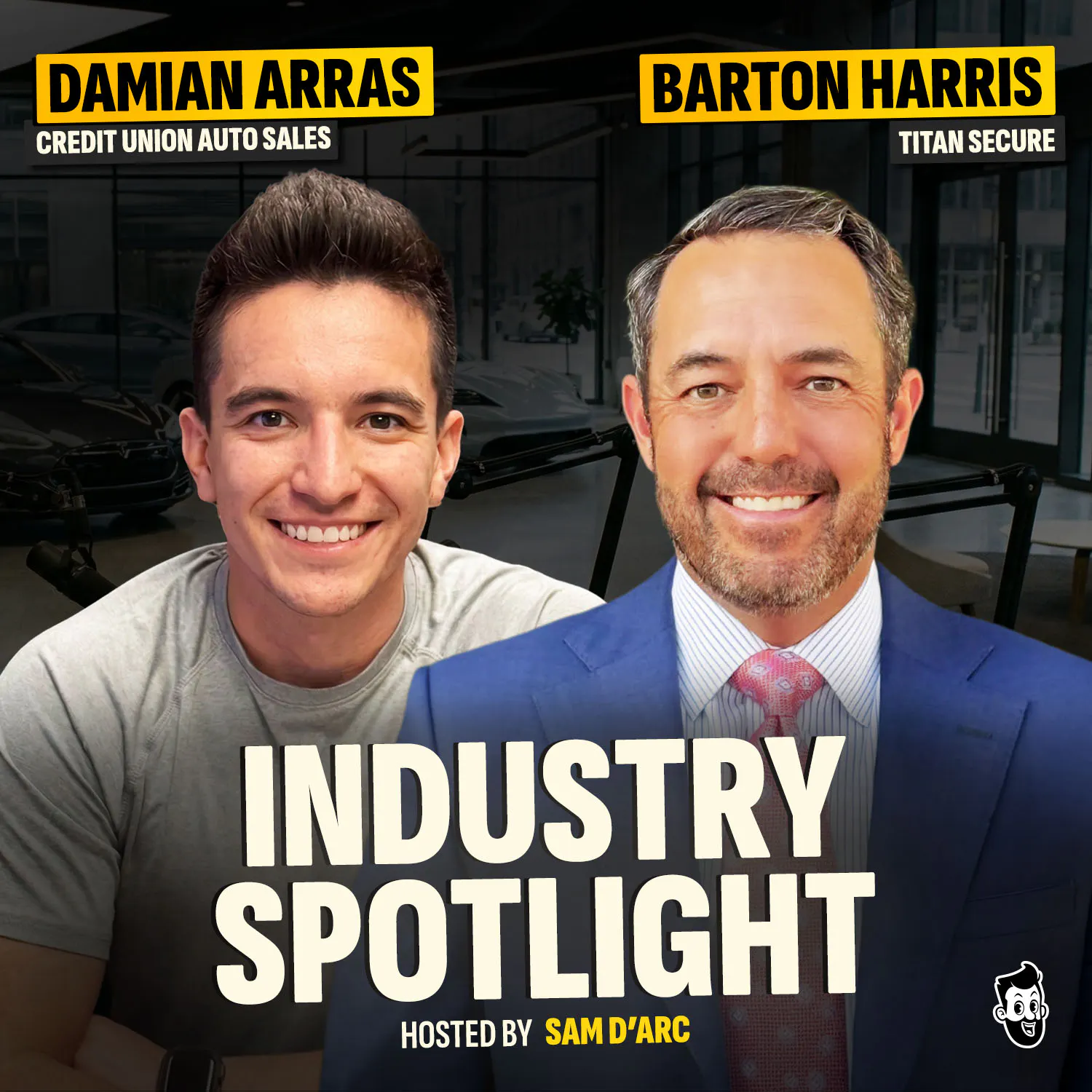
Credit Union Auto Sales in Albuquerque, New Mexico, battled repeat lot theft—thieves breaking in, stealing keys, using cars for drug activity, and then ditching them—while police and courts struggled with repeat offenders. Instead of relying on GPS recovery or etching, the dealer adopted Titan Secure’s prevention-focused system that locks vehicles during closed hours and can disable ignition/fuel if tampering occurs. The fitment is handled on consignment, with a reinsurance-style reserve structure to help offset insurance costs. The episode also highlights a partnership with law enforcement using bait cars to make arrests without high-speed chases.
In this episode of the Industry Spotlight, joining host Sam D’Arc are Damian Arras, General Sales Manager at Credit Union Auto Sales, and Barton Harris, Chief Revenue Officer of Titan Secure, to discuss a South African-inspired prevention model that stops vehicle theft before a car ever crosses the curb.
Damien shares how his New Mexico dealership eliminated losses by shifting from reactive GPS tracking to proactive ignition and fuel-cut technology.
Barton explains how this "prevention-first" approach secures inventory in high-crime areas while creating a significant F&I revenue stream with a 90% plus customer penetration rate.
The conversation also highlights how "bait car" technology is helping local law enforcement catch repeat offenders without the danger of high-speed chases.
Have questions about Titan Secure? Reach out to Barton Harris directly:
Cell: 480.392.6620
Email: [email protected]
This episode of the Car Dealership Guy Podcast is brought to you by Titan Secure.
Titan Secure - Titan Secure is a multi-layered vehicle theft prevention system built specifically for automotive retailers. Dealers protect their inventory, gain real-time inventory intelligence, and implement a reinsurance-friendly profit center that goes far beyond traditional GPS recovery solutions. Learn more @ https://carguymedia.com/3PsN5Ju.
Check out Car Dealership Guy’s stuff:
For dealers:
CDG Circles ➤ https://cdgcircles.com/
Industry job board ➤ http://jobs.dealershipguy.com
Dealership recruiting ➤ http://www.cdgrecruiting.com
Fix your dealership’s social media ➤ http://www.trynomad.co
Request to be a podcast guest ➤ http://www.cdgguest.com
For industry vendors:
Advertise with Car Dealership Guy ➤ http://www.cdgpartner.com
Industry job board ➤ http://jobs.dealershipguy.com
Request to be a podcast guest ➤ http://www.cdgguest.com
Topics:
03:25 Why A 2:00 AM GPS Alert Is Completely Useless.
05:00 The Judge Who Praised A Thief For Logging Into Zoom.
07:35 When Your Inventory Becomes Uninsurable.
09:45 Why One Dealer Refuses To Play Vigilante.
13:45 The $0 Fix That Ends Dead Inventory Loss.
16:20 The Insurance Lie Every Dealer Believes.
18:55 Why Car Companies Might Want Theft To Happen.
35:00 The Two-Minute Blackout That Terrified A Dealer.
39:25 The Ride-Along That Exposed Auto Theft's Dark Secret.
Car Dealership Guy Socials:
X ➤ x.com/GuyDealership
Instagram ➤ instagram.com/cardealershipguy/
TikTok ➤ tiktok.com/@guydealership
LinkedIn ➤ linkedin.com/company/cardealershipguy
Threads ➤ threads.net/@cardealershipguy
Facebook ➤ facebook.com/profile.php?id=100077402857683
Everything else ➤ dealershipguy.com
"this episode, learn how one dealer frustrated with ramp and auto theft implemented a South African solution in New Mexico, not just to deter theft, but prevent it."
This episode is about stopping cars from being stolen. The focus is on preventing theft at the dealership, not just dealing with it after the car is already gone.
The episode is centered on preventing auto theft from dealership lots. In this context, the key idea is stopping theft before a stolen vehicle can leave the property, rather than only responding after the fact.
"Joining the show today, Damien Aras, General Sales Manager, Credit Union Auto Sales and Barton Harris, Chief Revenue Officer, Titan Secure. Props to Titan Secure for supporting today's content. Let's get into it. Damien, welcome to the show. Tell us who you are and what you do."
GSM means General Sales Manager. It’s a leadership job that runs the dealership’s sales side, so the person can talk about how changes affect day-to-day operations.
“GSM” stands for General Sales Manager, a leadership role responsible for overseeing the dealership’s sales department. In interviews like this, the GSM perspective often focuses on process, staffing, and how changes impact sales operations.
"Joining the show today, Damien Aras, General Sales Manager, Credit Union Auto Sales and Barton Harris, Chief Revenue Officer, Titan Secure. Props to Titan Secure for supporting today's content."
Titan Secure is the company sponsoring/supporting this episode. Since the show is about stopping theft at dealerships, it’s probably connected to security tools or services.
Titan Secure is named as a supporter of the episode, and it’s likely tied to the security theme (vehicle or lot protection). Listeners may want to know it as the brand/company associated with the theft-prevention discussion.
"and you're in New Mexico and the dealership is called Credit Union Auto Sales for us auto dealers that get beat up by credit unions every now and again."
Credit Union Auto Sales is the name of the dealership being interviewed. It’s important because the episode is about how this specific dealer approached theft prevention.
Credit Union Auto Sales is the dealership name discussed in the episode. It’s relevant because the conversation ties the dealership’s identity and business model to how they handle pricing, buying processes, and likely security partnerships.
"And as far as as the name goes, you know, we got together with the previous owner, you know, he got together the credit unions and the marketing team. They made CU auto sales, which stands for the Credit Union Auto Sales."
A credit union is like a bank, but it’s owned by its members. Dealers sometimes partner with credit unions so customers can get car loans more easily.
Credit unions are member-owned financial institutions that often offer auto loans with competitive rates. In dealership discussions, “credit union auto sales” usually means the dealer works with credit unions to arrange financing for customers.
"Our biggest thing
[176.8s] here is you have a thief of opportunity who's typically on
[179.3s] drugs. They'll break into a car, they'll steal a vehicle,"
This means the thief steals because the chance is there—like a car is easy to access. If the car lot isn’t secure, it becomes an easy target.
“Theft of opportunity” describes crimes where the thief targets an easy, available target rather than a highly planned operation. In the segment, it’s linked to quick break-ins and rapid abandonment, which makes deterrence and lot security critical.
"A few days later, I get a call from, from, I think it was BCSO actually that they have the person. They went ahead and they boxed them in, you know, they try to escape"
“Boxed them in” means police surrounded the suspect’s car so they couldn’t drive away. It’s a common way to stop someone without a long chase.
“Boxed them in” describes a police tactic where multiple vehicles position to block escape routes. In the transcript, it’s used to explain how officers attempted to stop the suspect after the stolen car was located.
"So as far as cost goes for repeated, repeated theft here, our biggest thing is, you know, the insurance of course"
Car theft is when someone steals a vehicle. For a dealership, it’s expensive because the car is gone and the insurance company may charge more afterward.
Car theft is a major risk for dealerships because stolen inventory creates direct financial losses and can trigger higher insurance costs. High local theft rates can also worsen insurer risk assessments for specific areas.
"the insurance of course the premiums skyrocket, you know, not only for ourselves, if a customer gets a car stolen, the same thing goes with them. You know, but especially for dealership insurance"
Insurance premiums are what you pay to keep insurance coverage. If more cars get stolen, the insurance company charges more, so the dealership’s costs go up.
Insurance premiums are the recurring payments a dealership (or a customer) makes to keep coverage active. When theft claims rise, insurers often increase premiums, which can become a major operating cost for dealerships.
"So what we went out looking is I went ahead and, you know, looked
online and I saw Lowjack. I saw Apex, CarRX. I saw all these
different, you know, manufacturers."
LoJack is a tracking system that can help find a stolen car. The idea is that if a car gets taken, you can locate it faster.
LoJack is an aftermarket vehicle tracking and recovery system designed to help locate stolen vehicles. Dealerships may use it to improve recovery chances and reduce the likelihood of a car leaving the lot.
"…strip the car down to the frame in three hours and all the parts are interchangeable, right? So as a company…"
The speaker says the parts from one car can be used on another similar car. That makes it easier for thieves to profit because they can sell or reuse the components.
“Parts are interchangeable” suggests thieves can swap or reuse components across vehicles of the same model family, making theft more profitable and efficient. This is a key reason high-volume models and common parts catalogs attract organized theft.
"It's all it's all about the integration process, right? So what we know to be true in the franchise world..."
They’re talking about how the security system is connected and set up to work with the car. Good integration is what makes the protection actually work when someone tries to steal a car.
“Integration process” here refers to how the dealership security solution connects with the vehicle and dealership systems. The speaker frames it as the key to ensuring the security system can detect theft attempts and respond reliably.
"And so there can be some friction between a franchise store and an OEM about making sure that a customer is registering with with the connected solution."
OEM just means the car maker itself. They’re involved in how the car’s connected features are set up, and that can affect dealer security systems.
OEM stands for “Original Equipment Manufacturer,” meaning the automaker that builds the vehicles. The speaker notes potential friction between the dealer/franchise and the OEM when it comes to getting the customer registered with the connected solution.
"...about making sure that a customer is registering with with the connected solution. We're not selling a duplication. We sit on top of everything that the OEM is doing."
This means the car is connected to a service that can send alerts and data. The idea is to use that connection to improve security, not replace everything the car maker already does.
A “connected solution” is a telematics/connected-car service that links the vehicle to a backend system for monitoring, alerts, and security workflows. The speaker contrasts their approach with “selling a duplication,” implying they build on top of what the OEM already provides.
"We throw a GPS in there because we want we want that customer..."
GPS helps the system know where the car is. If the car gets stolen, GPS tracking can help find it.
GPS (Global Positioning System) provides the vehicle’s location using satellite signals. When paired with a tracking module, it enables real-time or historical location reporting for security and recovery.
"...geofences, speed alerts, trip history, all these things, we offer all that."
Speed alerts are warnings when a car goes faster than a set limit. Fleet managers use them to monitor driving.
Speed alerts are notifications generated when a vehicle exceeds a set speed threshold. They’re commonly used in telematics systems to monitor driving behavior and enforce rules for fleets.
"...geofences, speed alerts, trip history, all these things, we offer all that."
Trip history is a log of when the car was driven and where it went. It can be useful if something goes wrong.
Trip history is a record of vehicle trips captured by telematics, typically including start/stop times, routes, and duration. It helps with auditing usage and investigating incidents.
Brand
VW
"...and we're completely approved of VW. So you got the OEM saying, you know, this is great..."
“VW” means Volkswagen, and they’re saying the system is approved for that brand too. That’s meant to make it seem safer and more reliable across different cars.
“VW” refers to Volkswagen, mentioned as another approval/compatibility endorsement. In dealership theft-prevention discussions, OEM approval is often used to reassure buyers that the solution won’t interfere with normal vehicle operation.
"...If it works that well and to be able to shut a vehicle down so it won't move. Why don't the OEMs just include a standard equipment on on dealer lots?"
They’re asking why car makers don’t put the anti-theft feature on the cars from the factory. If theft is a big problem, it would make sense to have it right away at the dealership.
This refers to the idea of OEMs equipping vehicles with anti-theft technology before they ever reach dealerships. It’s a policy/strategy concept: if theft is widespread, building the protection into the vehicle could reduce losses and potentially insurance costs.
"from 8 o'clock at night to 7 o'clock in the morning, the vehicles automatically lock. So they lock. We don't have to worry about it. ... It's automated and in the mornings, it's unlocked."
Instead of someone manually locking cars every night, the system does it on a set schedule. That way the cars are secured automatically and consistently.
An automated lock/unlock schedule uses the security system’s timing rules to control when vehicles are locked. This reduces reliance on staff remembering to lock cars and helps ensure consistent security coverage overnight.
"[1421.4s] protocols and things in place that have to be met before we [1425.4s] sign off on this. The system has to perform perfectly in order"
“Sign off” means someone officially approves that everything is set up correctly. It helps make sure the system is reliable and accountable.
“Sign off” means formal approval that the installation and system performance meet required standards. For dealer deployments, sign-off is important to reduce liability and ensure the anti-theft system works as advertised.
"[1444.6s] we have no credibility. So Damien, do you put this on all [1447.5s] units? Do you put it on high value inventory? How do you"
“High value inventory” means the expensive cars on the lot. Those are often targeted first, so dealers may protect them first.
“High value inventory” means the most expensive vehicles on the lot, which are typically the most attractive to thieves. Dealers may prioritize anti-theft devices on these cars first to maximize protection and cost-effectiveness.
"So so I'm just thinking this through use car pricing is so competitive right now. You're an independent."
Use car pricing is what dealers charge for used cars. If the market is competitive, dealers may have to price more aggressively to sell quickly.
Use car pricing is the pricing strategy for pre-owned vehicles, driven by market demand, competition, and the dealer’s acquisition costs. When the market is competitive, dealers may need tighter pricing to move inventory.
"So I'm just thinking this through use car pricing is so competitive right now. You're an independent. So, you know, a franchise dealer would say, Hey, you're a little bit of a disadvantage in use car acquisition."
Use car acquisition is how a dealer sources pre-owned inventory—through buying trades, purchasing wholesale cars, or other channels. Acquisition strategy affects pricing, selection, and ultimately profitability.
"On our other show daily dealer, we'd ask you all about your acquisition model and where you get your best trade ins and whatnot."
Trade-ins are vehicles customers give to the dealer when purchasing another car. Dealers rely on trade-ins as a major source of used inventory, and the quality/volume of trade-ins can strongly affect used-car pricing.
"By the way, if we ever lose a car, I'm going to cover half of the first claim."
A claim is a request for payment under an insurance or coverage agreement after a covered loss occurs. The speaker references covering “half of the first claim,” which is a way to allocate responsibility for early losses.
"Now I know that you work for Zurich for a long period. I did. Yeah. 17 year history."
Zurich is an insurance company. The speaker is saying they have long experience with how insurance and reinsurance work.
Zurich is a major global insurance company. The speaker mentions working for Zurich for 17 years, using that credibility to explain how the Edge program and reinsurance positioning work.
"...my question to dealers is when was the last time a vendor just came in and said hey what you want..."
A vendor is a company that sells goods or services to dealerships (like software, insurance-related services, or security/tracking solutions). The speaker’s point is about vendors coming in with solutions tailored to the dealer’s actual problems rather than generic pitches.
"...you go to NADA and the big laugh for me is if you buy everything in NADA your business is going to be up 5 million percent you're going to be broke in 90 days."
NADA is a pricing guide dealers use to estimate what a car is worth. The point here is that using it blindly doesn’t automatically make a dealership profitable.
NADA refers to the National Automobile Dealers Association, which publishes vehicle pricing guides used by dealers to estimate values. The speaker is criticizing a strategy of pricing strictly to NADA as if it guarantees profitability.
"Yeah I think globally we're somewhere between 30 and 35,000. So Sam the thing is is we we have intentionally moved at a very slow pace right as a CRO I can tell you and that's a cool title but as the guy that's as a guy that's running sales right now Sam I am not going to measure"
CRO is a job title—usually “Chief Revenue Officer.” It’s the person focused on making sure the business brings in money, and they’re saying they’re not measuring success by one simple number.
CRO usually means “Chief Revenue Officer,” a senior executive role focused on driving revenue growth. The speaker uses it to explain how they’re pacing adoption and not judging success by a single metric.
"I could check the cameras if my motion alerts didn't go off for some reason too. That's the other thing is"
Motion alerts are warnings that something moved near the car. If the motion sensor doesn’t trigger, the dealer can still check the cameras to be sure.
“Motion alerts” are sensor-driven alerts triggered by movement near the vehicle or within a monitored zone. They’re often used to catch suspicious activity, and the speaker notes they can fail, so cameras provide backup verification.
Why A 2:00 AM GPS Alert Is Completely Useless.
The Judge Who Praised A Thief For Logging Into Zoom.
When Your Inventory Becomes Uninsurable.
Why One Dealer Refuses To Play Vigilante.
The $0 Fix That Ends Dead Inventory Loss.
The Insurance Lie Every Dealer Believes.
Why Car Companies Might Want Theft To Happen.
The Two-Minute Blackout That Terrified A Dealer.
The Ride-Along That Exposed Auto Theft's Dark Secret.
Select text to request an explanation
Hey everybody, welcome to another episode of the car dealership
guy industry spotlight. I'm your host Sam dark and coming up
this episode, learn how one dealer frustrated with ramp and
auto theft implemented a South African solution in New Mexico,
not just to deter theft, but prevent it. Learn why he says
dealers today might be focused on the wrong theft solution.
Don't track that stolen vehicles that leave the lot prevent
it from ever crossing the curve, plus how that dealership is
helping local law enforcement catch bad actors in the process.
Joining the show today, Damien Aras, General Sales Manager,
Credit Union Auto Sales and Barton Harris, Chief Revenue Officer,
Titan Secure. Props to Titan Secure for supporting today's content.
Let's get into it. Damien, welcome to the show. Tell us who you
are and what you do. Hi, my name is Damien Aras. I'm the GSM
here at CU auto sales. So I do a little bit of everything at
the store. I love the name. So you're an independent auto
dealership and you're in New Mexico and the dealership is
called Credit Union Auto Sales for us auto dealers that get beat
up by credit unions every now and again. Tell us, how did you
come up with the name Credit Union Auto Sales? I love it.
So back in the 90s when we first started back in 1994. So we've
been around for 31 years now.
Long time. The credit unions got together. They wanted a place
that they could send their members where everybody gets a
good deal where the buying process is, you know, relatively
easy from start to finish for most customers. It's about an
hour or so once they decide, yes, this is the vehicle I want.
And as far as as the name goes, you know, we got together with
the previous owner, you know, he got together the credit unions
and the marketing team. They made CU auto sales, which stands
for the Credit Union Auto Sales. And then also at the time
they partnered with a new car side called Credit Union Auto
Services. And they would be the only broker in New Mexico. So
we broke our deals for years. Unfortunately, since COVID
that's that portion of it. I don't want to wait.
Yeah, unfortunately, just inventory issues and the market
has changed.
Yeah, what a creative naming strategy for a used car dealership
and I'm sure you guys capitalized well on that for a long time.
And you continue to have success. You and I talked backstage.
We both share a common challenge and I'm excited for this episode
for that reason. In New Mexico in the area you are theft is a
significant issue and you've been hit by it just as hard as
we have it. Ziggler Auto Group. Tell us a little bit about
the problem of theft people stealing your vehicles.
So of course with, you know, new technology that comes with
the thieves coming out with the latest and greatest stuff to be
able to steal vehicles. So that's the biggest thing here in
Albuquerque. The thieves of opportunity here are the biggest
problem. So we don't have issues with people that are looking
for certain vehicles and they're taking them out and they're
trying to ship them out somewhere. Our biggest thing
here is you have a thief of opportunity who's typically on
drugs. They'll break into a car, they'll steal a vehicle,
they'll do drugs in it and then they ditch them.
Wow. They typically do get found as far as that goes. So the
GPS isn't too major of an issue here.
Especially because the drug is, you know, the drugs in the
vehicle once they smoke meth in it, you know, smoke back
whatever it is. It's so it is a total loss at the end of the
day. So our big thing is to prevent it in the first place
from happening because, you know, getting a notification at
2am that, you know, one of my cars is driving off a lot.
Doesn't do much. Yeah, doesn't do much.
So it's interesting. The other area where we share a common
challenge is it sounds like your area is one of the top in the
nation for theft. The Chicago land has also been that particularly
through COVID and you mentioned to me backstage that the cops
don't really get that aggressive at going after these
vehicle thefts. What's the problem with that? Why can't you
get the cops to go after the cars once they're stolen?
So the big thing, you know, I know that the cops would love
to be able to arrest these guys, you know, and book them and
put them through due process where, you know, they do get
booked. They, you know, get thrown in jail for however amount
of time it is, especially because the amount of reoffenders
that we have is pretty insane. So that's the big thing is, you
know, we had a vehicle that was stolen and it was a 2024
Chrysler 300. It had 2000 miles on it. It was a very, very nice
vehicle. And unfortunately, it was stolen off a lot came in
that morning and saw that it was gone. So I went ahead and
called the police put in the stolen report. A few days
later, I get a call from, from, I think it was BCSO actually
that they have the person. They went ahead and they boxed them
in, you know, they try to escape, they, you know, hit the
cars on both sides. So the car was, you know, damaged
significantly. There was drugs, you know, drug residue in the
vehicle as well. By the time, you know, we looked at it. And
my big eye opener with our judicial system and how it is
very criminal friendly is, you know, I was on the zoo meeting
with, with the court system. And, you know, the judge is
talking to the person that stole the car. And this was her
third stolen vehicle. You know, so it's not, it's, it's not
something that was, you know, new for her. It wasn't her first
time she just happened to, you know, steal a car. So this is
her third time. And the judge is talking to her like she's a
child. You know, and this is a real woman and she's telling
her, Oh, well, good job on being on time. And, you know,
you're going off to your pre court stuff. So that's great.
And I'm thinking this is just insane. Like this is her third
time stealing a car and you're praising her for being able to
log in on her computer. So it's just, it just was baffling to
me. You know, afterwards, I know the officer that was on the
line, you know, he said, it's just so frustrating that we,
you know, do the work to get these guys to catch them. And
unfortunately, you know, they get let out the same day. And
that's the biggest issue we have.
And we saw that a lot in the Chicago land as well. The
issues of repeat offenders, even a little bit of organized
crime. We had one instance during COVID where they, they
took a safe out of the dealership. They broke into it,
stole a bunch of keys. We actually surrounded the lot with
vans to prevent them from coming back and getting anything
else. And with police on the lot, bad guy comes back, tries
to drive out with another vehicle was prevented because we
had blockers. Bad guy in front of cops gets out of the vehicle
and runs to another stolen vehicle in the road and makes a
getaway. And you know, nobody, no chase ensued. And it's
frustrating, Damon, because I think most people don't
understand the true cost of this type of theft to the average
business owner. It's significant, especially a small
business owner, even a large business owner, your insurance
rates, I would assume are impacted by what are some of
the costs to the business and the product that you offer to
your consumer of theft, repeated theft over a period of
time. So as far as cost goes for repeated, repeated theft
here, our biggest thing is, you know, the insurance of course
the premiums skyrocket, you know, not only for ourselves,
if a customer gets a car stolen, the same thing goes with
them. You know, but especially for dealership insurance
and in Albuquerque, we already pay very high insurance
rates, because we are very high for car theft, very
concourse. So that was the big thing is that, you know, the
insurance premiums kept skyrocketing to a point where,
you know, the last vehicle that we had stolen, we just, you
know, ate the loss. Just because it was one of the things
that we couldn't afford for the insurance to keep going up
and keep having claims and potentially get dropped for the
amount that we have.
Your inventory could be uninsurable and then you're out
of business. And I think every large business owner in the
automotive world has faced that reality that you've got to do
something to address this significant and severe theft. And
so you went out searching for a solution and you found an
unusual solution. Tell us, tell us what you did to try to
resolve this issue of repeated theft. You had five vehicles
stolen in a short period of time and you said enough is
enough.
Exactly. So what we used to do is we used to sell etch. So we
would etch all the vehicles in the event that the vehicle was
stolen. They would go ahead and, you know, wait 30 days.
And like I said, in New Mexico, typically the recoveries, you
know, are going to be pretty quick because they're thieves of
opportunity, just looking for a ride across town so they can
do drugs in a car, do some crime and then ditch it. So the
payout was never something that was a value, you know, to the
customers. In my opinion, the reinsurer program for that,
which is what we did, paid out in five years. So, you know,
the reinsurance was one of the things that, you know, took a
while for us to, you know, to get it paid out on as well. So
what we went out looking is I went ahead and, you know, looked
online and I saw Lowjack. I saw Apex, CarRX. I saw all these
different, you know, manufacturers. I looked into it
and my biggest thing is is preventing the car from leaving
my lot in the first place, especially because the police
don't respond typically to any kind of crimes that aren't serious.
So somebody's not getting, you know, robbed by a gun at gunpoint,
you know, something major, the police just aren't going to
respond. They don't respond to car accidents anymore just
because they're so busy with the high crime in Albuquerque in
general that they just don't have time to do that. So in my
opinion, it's a savior for me because I live, you know, five
minutes away from the store and if I get a GPS notification
that the vehicle is getting stolen, you know, I'd probably
It's too late.
Exactly and try to do a little bit.
What are you going to do?
I'm unfortunately, that's not the smart thing to do. So we
needed a solution that actually prevented anything from leaving
the law in general. We looked into different kill switches.
You know, we looked into alarm systems, fiber alarms, different
kind of stuff and Titan, the way that they work is just so
unique that I do have access to my fleet. So as far as test
drive goes as if my texts are taken out cars, you know, on
test drives, I can actually see how they're driving the
vehicles. It gives me a diagnostic report as well of, you
know, their driving capabilities. So, you know, as far as
it goes, the package was much better for us.
So Damien enter Barton Harris, Chief Revenue Officer Titan
secure Barton Damien calls you up and says, look, we're in one
of the highest crime areas in the country. Vehicles are being
stolen and they're the bad people are engaging in criminal
acts in the vehicles. We don't care about getting notification
once the vehicle is stolen. We want to solve this problem
before it ever leaves the lot and you said we can help with
that. What made you think different about theft prevention
not just GPS, but preventing it before it ever starts and how
do you how did you achieve that Barton? It's interesting Sam.
I've worked for three of the largest GPS providers and they
really do provide a great service. So this this is this is
not set up to to speak poorly about competitors in our
industry. But I have to be honest in in my history at GPS.
I was morally conflicted morally conflicted because we didn't
address the root cause of the issue. Our parent company is
is the VA group out of South Africa. Titan was not born in
a think tank. So not a bunch of people sit around going, hey,
what can we do to go sell another product to car dealers
who get up hit up 5 to 10 times a week minimum for the next
latest and greatest, right? Yeah, we were victims in South
Africa of carjackings and auto theft. And just to be clear,
Damien might think that Albuquerque and Pueblo, Colorado
and Chicago land hold the trophy for auto theft. You're not
even not so not so South Africa is the number one most
volatile environment for auto theft in the world hands down
and a lot of it has to do with corruption. They're using
military grade jamming equipment to steal cars in Toyota's
wisdom because the taxi system are all Sienas. They love to go
to go get a Hilux, which is the equivalent of a of a Tacoma
and they can strip the car down to the frame in three hours
and all the parts are interchangeable, right? So as a
company, we were victims of theft and we own and operate 22
verticals and unrelated industries. And so what they
said is they said we're not going to do this for this this
recovery stuff anymore. And in fact, in South Africa, you
have to have two GPS is on your car qualify for financing
insurance before you take delivery. Wow. Okay, so we talk
about preloads in the states. Everybody's going to preload
a GPS and they got to be two different ones in two different
locations. So we developed it internally and it solved our
issues. And then all of a sudden the word got out and people
are like, Well, wait a minute, if I don't have to worry about
recovery, I can just park my car. I'm interested in this and
we're proud to say in four years of business, we've never had
a vehicle stolen. We've never had a vehicle moved. That is a
very powerful that value proposition to anybody and it's
that's a huge value prop. All this is is a paradigm shift. I
remember when I started when I left Berkshire Hathaway and
went to work for a GPS company, everybody was still talking
about alarms. This is eight, nine, 10 years ago, right? Now
we transition to where everybody talks about GPS, but
there's going to be a likely transition to a prevention
model model. So for Damian, it was a very simple and easy
thing. What's the issue? I just need to lock my car down. Okay,
great. I've got that covered. I need a highly tangible unique
product to sell to my customers. I'm like, Okay, well, I got
that. And then the last thing is I said Damian operationally
speaking, how would you like for us to handle this? And he's
like, Well, what do you mean? I said, Well, we hire our own our
own W2 fitment engineers. They're going to come out and put
the systems in on the off chance. Somebody doesn't buy it.
We're going to remove it so you don't have a dead cost drive
off, right? If you have an identity theft situation, we're
going to we're going to assume liability for that and we're
going to assume liability for any stolen vehicle on your lot.
Right? Alright, so so so walk me through this. Damian has his
lot. He's got vehicles parked out there and your claim is the
bad actors can come on the lot can try to steal the vehicle
and break into the store. They can get the keys. They can have
a key sitting in hand and they're going to get in the car
and in our world, the car driving off the lot triggers an
alarm and then we go into action right had a security like
we have a whole process. We don't talk about it publicly,
but we have a process. You're saying the better thing is to
make sure that vehicle never rolls off the lot. How do you
make sure that a bad actor with a key in hand and an intent
to remove that vehicle from your lot can't get it off the
lot? It's all it's all about the integration process, right?
So what we know to be true in the franchise world where even
with independence or use cars is there's a lot of replication,
right? And so there can be some friction between a franchise
store and an OEM about making sure that a customer is
registering with with the connected solution. We're not
selling a duplication. We sit on top of everything that the
OEM is doing. We use factory pins, relays, etc. And we pin
this in directly to the car. We've even sourced all of the
tape that's used by the different manufacturers so that
when we place the system in the car, there's there's nothing
that identifies that it's even there. And when they get in,
there's no ignition and in the event that there was a car
jack a car jacking situation. We can remotely cut the fuel
to the vehicle. We throw a GPS in there because we want we want
that customer, especially on the use side to have those
telematics features, but everything you see from my
competitors, geofences, speed alerts, trip history, all
these things, we offer all that. That's already there. But
what we're saying is is just park your car lock it up and
just come back to it. We would much rather see someone have
to replace a window than to go through the brain damage of
working with their insurance carrier. And as far as we can
say about insurance, I live in people say, well, I got in
great insurance. Insurance never makes you whole. They love
your premiums. They hate your payouts. So again, it was a
paradigm shift built in a very volatile environment somewhere
else in proven in the worst environment in the world to then
bring that solution here. There there is an issue with that
where we're just trying to do things differently. Sam, you
should never have to recover a car. You should never have to
recover a car. It doesn't matter if you get the car back. I
don't know what it costs you and I don't know what it cost
your auto group for the recovery process. The labor time,
the brain damage, the headaches. Why is this car here? That
that we need to show up to a dealership to sell cars. That's
our number one deal. We need to sell parts, service and cars.
So so the bad actor comes on the lot to do anything as a key
in hand and attempts to initiate ignition and it just won't
start. No, I'm sorry. We take him six hours to rewire the
vehicle. Wow. And I'm I can't and I'm not going to and I mean
you wouldn't go to a Michelin star restaurant and ask for the
recipe for the turtle suit. But I can tell you our fitment
engineers go through a very rigorous training process. We
have documentation library on how to put these systems in on
over 300 cars. It doesn't matter. We put them in Rolls Royces.
We put them in Ferraris and we we put them in just regular
domestics. The other great thing about this is and the OEMs
won't admit to this, but we're approved by Teacote and which
is the Toyota Council of Technology Excellence in South
Africa and we're completely approved of VW. So you got the
OEM saying, you know, this is great and shame on the OEMs
for not having this. But that's, you know, that's another
Yeah, so I have a question Barton. If it works that well and
to be able to shut a vehicle down so it won't move. Why don't
the OEMs just include a standard equipment on on dealer
lots? If theft is becoming such a significant issue, that
would be a great tool for OEMs to include. Yeah, I guess I
guess Kean and I need to ask that question that $9 million
settlement. Yeah, here's here's the thing. I think anything
that rolls off and is off of an assembly line. I think I
think we don't give thieves enough credit for their
innovation. I think if thieves spent more time working on
whatever craft interests them besides crime, they'd be highly
Yeah, yeah. Right. No question. Yeah. So the bottom line is
this. I don't think the OEMs are what will do this. I think
the OEMs work work in a passive reactionary sense. We're going
to be in a proactive sense and I also believe that manufacturers
are fine if their cars get stolen. They make a lot of money
selling parts and if car doesn't isn't recovered, they're happy
to sell another vehicle. So it's nothing against them. I just
think on a scale of what they sell, we sell 15 million new
cars and 30 or 35 million used cars in the United States. I
mean, it may never get there. You know, the difference is
is we've figured out we've figured out a way to protect
customers and the bottom line is there may not be 100%
adoption, but I can assure you when I talk to people that have
our system, it's the peace of mind. It's not the I need a speed
alert. It's a I just want to park my car and not worry about
it. Yeah. So without giving away the secret sauce because I do
get that bad actors listen to the show. You don't want to have
them tell what how it all works, but I assume there's some
so is there a dashboard or something on your end Damien
where you can designate the times that you're closed or what
what indicates to the vehicle into the system that you're
closed and ready to go in business or you're you're
ready. You're closed and you're you're the vehicle needs to go
secure mode or its daytime and customers could be test driving
and sales people could be moving the vehicle.
Yep. So they do have a dashboard and it is one of the most
intricate dashboards. It shows me location of the vehicles on
the lot very location of the vehicles that are off the lot.
And then we have a geofence around the property. So at
well, we just changed it because of summer hours, but from
8 o'clock at night to 7 o'clock in the morning, the vehicles
automatically lock. So they lock. We don't have to worry about
it. I don't have to lock them every night myself. It's automated
and in the mornings, it's unlocked. So by the time my
techs get here, they can go ahead and start cars with no
issues whatsoever.
Huh. Is is I want to ask this only because I've seen this
come up in other products. You're you're installing a device
into the vehicle. Are there any OEM implications where an OEM
could come back and say, Hey, this is going to avoid the
manufacturer warranty or hey, somebody's been playing with the
vehicle and so we're not going to cover it the same way we
normally would.
What are the implications of that Barton? Well, so we know we
know for certain that OBDs are or that GPS devices are installed
through the OBD. It might be thrown on the post on a on a
battery or you know, if they're if they're if they're getting
crazy, they could cut into the factory wiring harness or use a
t-tap system. Yeah, we use pins and relays through the brain
of the car and then our system sits on that and interacts with
that to disengage the starter and the fuel pump when the
vehicle is locked. Okay. Okay. So there's nothing egregious
that's that's that's done to the vehicle that would raise any
any issues at all. You're not cutting a wiring harness. Absolutely
not plugging into the OBD port. The idea that the dealer would
be responsible for for the fitment of this is completely
eliminated here because I know for my time in GPS, the one car
that we absolutely needed to connect to we had connection
issues and we love our technicians, but they everybody
has a tendency to short short the install over time. We have
to go back and do corrections. So that's right. Our fitment
engineers stay at Damien's dealership from from bell
to bell six days a week. They manage all of the batteries
because it doesn't matter what reports or data we provide to
the dealer. They get enough reports and data from everybody.
So we handle all of that. We're starting the cars. If they're
not busy, Damien has effectively picked up a W2'd employee
from Titan Secure at no cost to him. And if we can be very
clear on this, we do this on consignment. So this is a Pego
model. So use all of our items. So any of the inventory lot
management features that you see from any of our competitors
in the GPS world. We're going to do all the exact same thing.
The big deal for us is you can either open our app as a manager
at the end of the night and hit one button and everything
shut down in case we catch a late deal. And then as you come
in, it auto unlocks and with the with the sales guy doesn't
have to do is he doesn't have to interact with the system to
disrupt the sale. And the other part of that is the sales
guy never has to worry about a dead battery when it goes to
car. So and I think what we find with dealers is they've
never had visibility. Then they blame the GPS for the low
batteries. No, you just never had visibility in your cars.
So we just we just manage all that from from from the start
in and every day. How long from a timing perspective does it
take the installer to install the unit on the vehicle?
Yeah, 45 minutes to an hour. Okay. Okay. It's that it's that
intricate. And when I'm when I mean intricate, we we have
protocols and things in place that have to be met before we
sign off on this. The system has to perform perfectly in order
for it to work and protect the dealer and the dealer's most
important folks, his customers. He's the he's the one on the
front lines talking to the customers. I'm not right. Yeah,
so we have to have something that performs as advertised or
we have no credibility. So Damien, do you put this on all
units? Do you put it on high value inventory? How do you
decide which vehicles get this? So all of my vehicles get it.
So everything that we're going to be keeping that we're going
to be retelling, it gets put on. The great thing is that it's
on consignment. So at the end of the day, it doesn't cost me
anything out of pocket up from. However, we have, you know,
I mean, right now, we're at about 95% close rate on it.
Customers really see the value in it. And what it really
does for them and the peace of mind alone is huge because,
you know, when I'm one of those guys out in the middle of the
night, I'll wake up and I'll be like, Oh, did I lock my truck
and then I'll go and I'll make sure, you know, that it's locked
and just because in New Mexico, it's notorious thing car theft
and it doesn't matter where you're at. You know, the nicer
parts of town, of course, that's these are going to get the
nicer vehicles. So that's what they're going to, you know, try
to go for.
Yeah, that is it. So so I'm just thinking this through use car
pricing is so competitive right now. You're an independent.
So, you know, a franchise dealer would say, Hey, you're a
little bit of a disadvantage in use car acquisition. On our
other show daily dealer, we'd ask you all about your acquisition
model and where you get your best trade ins and whatnot, but
we know it's a competitive marketplace. So I'm not going
to ask on this show pricing because Barton will get those
questions outside of this. But I'm going to make the assumption
that if you're putting on every single vehicle, you've got to
be able to charge enough for the upsell in the finance office
and at that penetration where it's got to be a decent F and I
revenue generator. What does the close rate look like? What is
the pitch in the finance office look like that gets customers
to see the value in the product?
Oh, yeah, definitely. So as far as the reserve goes, we're at
about a $340 reserve on the unit. It is a portfolio program
or a reinsured program as well. We use portfolio for warranties,
for example, how about in a year? You know, so it's much better
as far as the, you know, any program out there in my opinion.
Yeah, one of the best and as far as the value goes, you know,
we close 95% of them. So what we explain to customers is
everybody knows, you know, everybody knows somebody in
Africa that has had a vehicle stolen or they've had one
themselves. I can't tell you the amount of customers I have
that come in after getting vehicle stolen and the biggest
thing they found them, but, you know, they've been, you know,
See something that's not quite right? Our annotations are AI-generated and can sometimes miss the mark.
Click the flag icon on any annotation to suggest a correction.