“Q2 deliveries” means how many cars a company delivered to customers in the second quarter of the year. It’s one of the main ways people judge whether a carmaker is selling and building enough cars.
“Bubble taxi” is a nickname for a Tesla autonomous ride-hailing vehicle. The idea is that it could pick up passengers like a taxi without a human driver, and the hosts say it’s expanding to Miami.
The BMW iX is an electric SUV from BMW. The podcast mentions it while talking about what BMW has recently shown or unveiled. It matters because it’s one of BMW’s main EV offerings in this category.
The Chrysler Pacifica is a minivan. It’s made for carrying people and cargo comfortably, especially for families. The podcast brings it up because it’s sold or known in parts of Australia and the Asia-Pacific region.
The third row is the back row of seats in a three-row SUV. It’s usually the tightest row, so changes to the car’s size or seat design can make a big difference in how comfortable it is.
Wheelbase is how long the car is from front wheels to rear wheels. If that distance is stretched, it usually gives more room inside, which can help the back seats feel less cramped.
Captain’s seats are two separate seats instead of one wide bench. In the middle row, that can make it easier to get to the back and can make the rear seating area feel more comfortable.
The Tesla Model X is a Tesla SUV with a third row of seats. Here they’re talking about how different seat configurations (six vs seven seats) can make the back feel less cramped.
The Rivian R1S is an electric SUV with three rows of seats. They’re comparing how the third row feels—specifically that a bench-style third row can feel tighter than individual seats.
Term
captain shares
They mean “captain’s chairs,” which are individual seats in the middle row instead of one long bench. Individual seats can make it easier to get in and out and can feel less cramped.
Here “bench” means the third row is one long seat for multiple people. That layout can make it harder to move around and can feel tighter than separate seats.
The Tesla Model Y is an electric SUV. They’re talking about the optional third row—how it was only offered briefly in North America—and how making the vehicle about seven inches longer improves third-row room, but it’s still tight.
Term
premium version
“Premium version” just means a higher trim level. In this case, it decides what features you get, so it changes how you should think about the price.
Term
lunch edition
This sounds like a special package or edition of the car. The host is saying it bundles certain upgrades, so it affects what you’re actually paying for.
FSD is Tesla’s software that helps the car drive more on its own. The host is talking about whether it’s included for free at first or you have to pay for it later.
Tesla Cybertruck is Tesla’s angular, pickup-style electric vehicle, and the host uses it as an example of a prior launch where FSD was included. The comparison is about how Tesla’s packaging strategy changes what you get at purchase time versus later subscriptions.
“Starting price” means the lowest price you can pay for that version of the car. The host is using it to show the deal isn’t as cheap as some people thought.
Term
convertive pricing
The host is talking about comparing prices between countries. Because taxes and pricing rules differ, the same car can cost very different amounts depending on where you live.
EPA is the U.S. government’s testing standard for how far an EV can go on a charge. When you see “EPA range,” it’s a common reference number people use to compare different electric cars.
Concept
delivery in a quarter
“Deliveries in a quarter” is how automakers report how many vehicles reached customers during a specific three-month period. It’s a key metric for EV makers because it reflects real-world sales momentum, not just production.
Here, “production” means how many cars the company made. The host compares it to deliveries to show whether cars were sitting in inventory or moving out to customers.
“Demand” means how many people want to buy these cars. The host argues that demand improved because gas prices changed, making EVs relatively more attractive.
Electric vehicles are cars that use electricity from a battery instead of buying gas. The host is saying people wanted EVs more when gas felt expensive or unreliable.
Energy storage means big battery systems that save electricity for later. The host is saying Tesla is also delivering more of these battery systems, not just cars.
Gigawatt-hours are a unit for how much energy a battery system can store and deliver. The bigger the number, the more electricity the storage setup can provide.
Mega Packs are Tesla’s big battery systems for storing lots of electricity. They’re used for things like helping the electric grid stay stable when demand changes.
That means the company’s stock price fell hard right after the news came out. The host is saying investors weren’t satisfied, even though the delivery numbers were better than expected.
Valuation is basically what the market thinks the company is worth. The host is saying Tesla’s stock price reflects big future hopes, not just how many cars were delivered this quarter.
Robot taxis are self-driving cars that would pick up passengers like a rideshare, without a human driver. The host is saying investors price Tesla based on the chance this becomes real soon.
It means how many cars the company actually delivered to customers in that time period. Analysts watch it because it affects sales and future expectations.
Term
sell on the news
“Sell on the news” is a market behavior where investors buy ahead of a catalyst (like delivery results) and then sell after the news becomes public. It’s not an automotive term, but it’s directly tied to how Tesla’s delivery headlines can move the stock.
A geofence area is a virtual “zone” on a map. The car’s system uses it to know where it’s allowed to work—so when the geofence gets bigger, the feature can be used in more places.
Supervised self-driving is when the car drives in a limited way, but you still have to watch closely. You’re responsible for taking over if the system can’t handle a situation.
Term
safety is the bottleneck
They’re saying the hardest part isn’t getting the software to work at all—it’s proving it’s safe enough to let it operate widely. Until that’s solved, they can’t scale up confidently.
Waymo is a company that builds self-driving technology and runs robotaxi services in some cities. The host mentions it to compare how fast Tesla can scale similar services.
Hardware three is the computer inside the Tesla that runs the self-driving software. If you have a different hardware generation, you may get different features or updates at different times.
Term
order three owners
This is about Tesla customers who bought a Model 3 expecting certain self-driving features. The speaker thinks the company is using software updates to keep those customers satisfied for now.
“Level 2” is an SAE driving automation level where the car can control steering and speed, but the human driver must continuously supervise and take over when needed. Calling it “low level two” emphasizes it’s not operating like higher automation levels that reduce driver responsibility.
“V14 light” sounds like a trimmed-down software update—basically a smaller set of self-driving features than the full version. It still adds some helpful functions, but it’s not the most advanced one.
Automated parking is when the car helps you park by steering itself into the spot. You still watch what’s happening, but it reduces how much you have to do.
Term
cement parking
The transcript likely means a specific parking feature, but the exact wording is unclear. The speaker is talking about parking and reversing help the car can do.
This means the car handling tricky road situations—like merging into traffic or taking the correct branch when the road splits. Those maneuvers are hard for driver-assist systems because other cars and lane choices matter a lot.
A class action lawsuit is when a lot of affected people team up in one legal case. In this context, it’s about owners seeking compensation because they believe Tesla’s claims about what their cars could do weren’t delivered.
Concept
retrofit all the cars
A retrofit means updating cars after they’ve already been sold. Here, the hosts doubt Tesla can realistically retrofit everyone’s cars, so they expect owners to focus on getting money back instead.
Term
reimbursed
Here, “reimbursed” means getting your money back. The hosts are saying some owners don’t want to upgrade to a new car, so they want compensation instead.
Term
supervised cell driving
“Supervised” refers to a driving mode where the system can assist or perform tasks, but a human driver is still expected to monitor and be ready to take over. The hosts are arguing that Tesla’s “on supervised” capability claims don’t hold up as promised, which is why owners may seek compensation.
Resell value is what you can sell the car for later. If something changes about the car’s situation or reputation, it can affect that future selling price.
An arbitration clause is a rule in a contract that says if there’s a dispute, you don’t go to regular court—you go to arbitration instead. Arbitration is usually handled privately and can be harder to challenge.
Opt out means you choose not to follow a rule in a contract. Here, it means you can choose not to accept the arbitration requirement after you get the car.
The Tesla Model S is an electric luxury car. Here it’s mentioned because the owner of a Model S used the opt-out process to challenge Tesla in the class action.
Term
full-cell driving add-on
This sounds like a paid software/feature upgrade you could add when buying the car. The host is saying the plaintiff paid extra money for it, and that figures into the lawsuit.
Autopilot is Tesla’s system that helps the car drive. It can take over some tasks like steering and speed, but it’s still not fully autonomous in all situations.
A driver-assistance system is tech that helps you drive, like steering or speed help. You’re still responsible for the car, and the system can still make odd mistakes.
This phrase describes a pattern where a company forecasts lower results than it ultimately achieves. In auto/EV reporting, it often shows up as beating production or delivery guidance.
The Rivian R2 is a future electric SUV/truck from Rivian that’s expected to cost less than their current models. The host is saying they think Rivian will have trouble keeping up with demand for a while.
LiDAR is a sensor that uses lasers to measure how far away things are. It helps the car “see” the world in 3D so it can understand obstacles and road layout more accurately.
“Full self-driving” means the car is trying to do most of the driving by itself. Even then, it usually still needs the driver to supervise and it can struggle in tricky situations.
Vehicle to X means the car can share electricity with other places, like your home or the power grid. Instead of just charging, it can also send power out.
Vehicle to grid means the EV can send electricity back to the power company’s grid. Whether it works depends on the car’s setup and the local power system.
Vehicle to home means the EV can run parts of your house using its battery. You usually need the right adapter/inverter so the power is usable indoors.
120 volts is a standard household electricity level in North America. The host is basically saying the car can output power at that level, but they were expecting a higher-voltage option.
240 volts is a higher household electricity level often used for bigger appliances. The host is saying they wanted the EV’s power output to match what homes typically use.
The Chevy Bolt is an electric car from Chevrolet. The host is using it as an example of an EV that can do the kind of power-sharing they’re waiting for.
Term
self-driving stuff
“Self-driving stuff” means the car’s automated driving features. The host is saying one brand’s system works better and more reliably than the other’s.
For an electric car, the battery is the big pack that stores electricity. A “bigger battery” usually means you can go farther before needing to recharge.
“Off road” means driving on rough or unpaved surfaces. The point here is that the car is claimed to handle that kind of terrain better than you’d expect.
“Guidance” here means the company’s prediction for how many vehicles it expects to deliver in the future. If that forecast goes up, it can make investors feel more confident.
“Ramp up” means the company gradually increasing production of a new car after launch. A “smooth ramp up” suggests they expect it to scale without major delays or shortages.
Car
BMW iX5
The BMW iX5 is BMW’s next electric SUV. They’re saying it’s been fully revealed, and that BMW is also rolling out a newer generation of vehicles with it.
WLTP is a Europe-wide testing standard used to estimate how far a car can go on a charge. It’s often different from U.S. EPA estimates, so the numbers don’t always match exactly.
A heads-up display is a screen that shows important driving info right in front of you, usually on the windshield. That way you don’t have to look down at the dashboard as much.
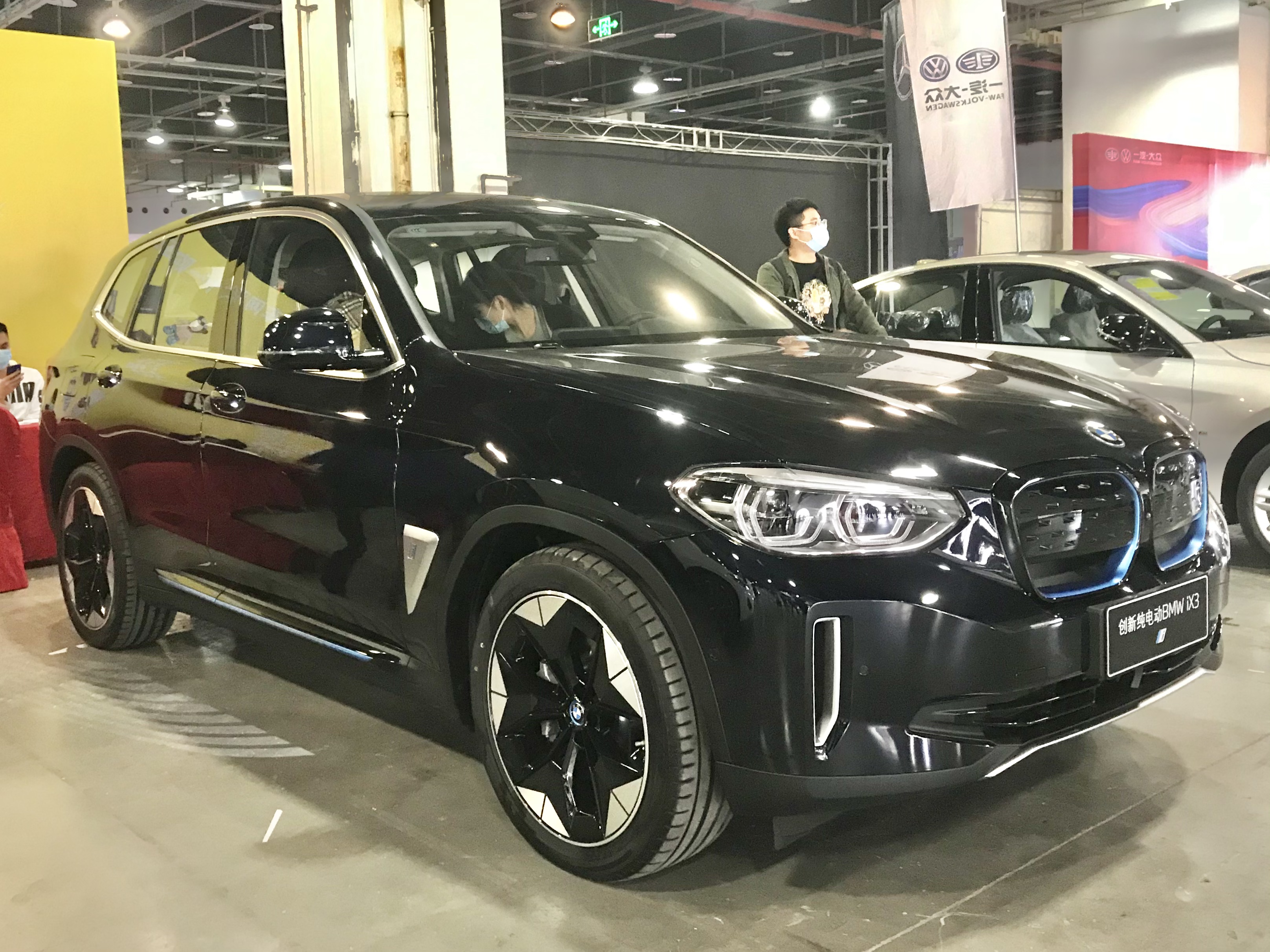
The iX3 (G08) is BMW’s electric SUV. The podcast is mainly talking about how much it costs and that it can be expensive. It’s mentioned as a price reference point for what you might pay for an EV in this size class.
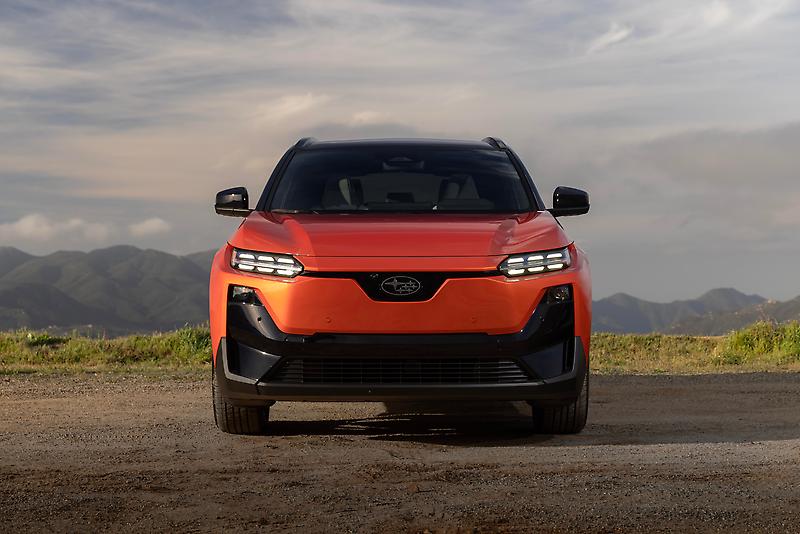
The Subaru Trailseeker is an electric Subaru meant to keep the brand’s outdoorsy vibe. The host compares how fast it is, how much it can tow, and how big it is versus another Subaru EV.
The Subaru Uncharted is a Subaru vehicle. The podcast says it still feels like a Subaru, meaning it matches the brand’s typical style and driving feel. It’s mentioned because the host previously reviewed similar models positively.
Term
0 to 16, 4.3 seconds
This is an acceleration test from a standstill to a low speed (16 mph). It’s meant to show how quickly the car feels responsive in normal driving.
For EVs, “range” means how far the car can go on one full charge. It’s an estimate, and real results change with speed, temperature, and how you drive.
Term
parametric view monitor
A parametric view monitor is an advanced camera display system that overlays or adjusts the view using vehicle-specific parameters (like position and geometry) to make it easier to judge space around the car. It’s meant to improve visibility for parking and low-speed maneuvering.
“20-inch wheels” means the wheel size is 20 inches across. Bigger wheels can change how the car rides—sometimes it feels firmer, depending on the tires.
A 120-volt AC outlet is like the kind of plug you’d find in a home. It lets you power small devices from the car, usually through an inverter inside the EV.
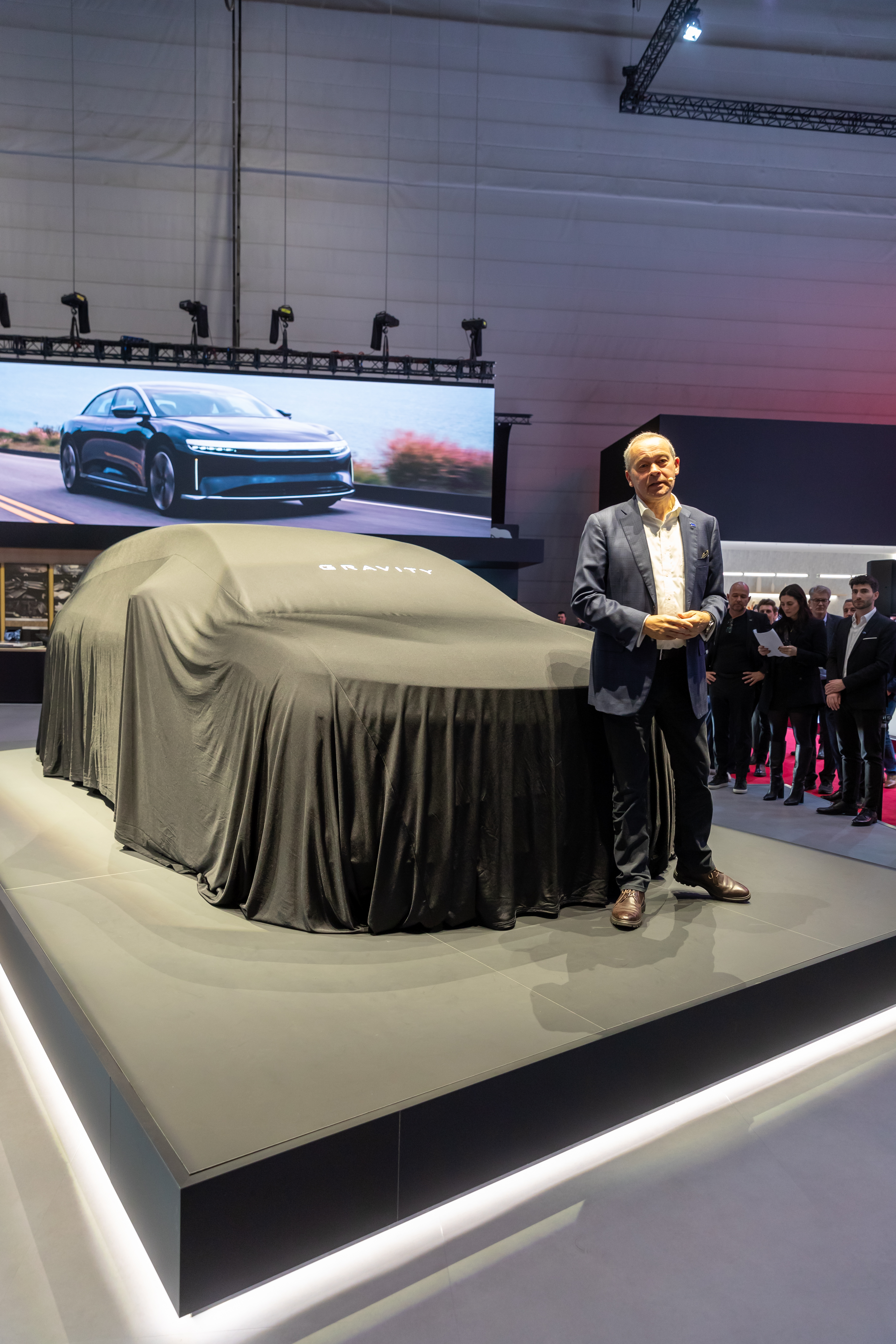
The Lucid Gravity is an electric SUV from Lucid. The podcast mentions it because Lucid has been dealing with problems, and the Gravity hasn’t been enough to fix those issues. It’s discussed in terms of how the company is doing and how the vehicle is progressing.
Alexander Debok is the person the hosts say is joining Lucid as the CFO. The CFO role is the finance leadership job, and the host mentions his prior experience at a major auto-parts supplier.
A Tier 1 Automotive supplier is a company that delivers complete systems or major components directly to automakers (not to smaller sub-suppliers). These suppliers often handle high-integration parts like electronics, modules, or powertrain-related systems.
Person
Raja Ramana Macha
Raja Ramana Macha is described as joining Lucid as the CTO. The CTO is the top tech leader, usually responsible for engineering and technology direction.
Person
Billy A's
“Billy A’s” is said to be joining Lucid as chief customer officer. That’s a leadership role focused on how the company serves customers, including marketing and sales strategy.
A chief digital officer is a top executive in charge of a company’s software and digital systems. In this case, the role is connected to Lucid’s AI/taxi plans.
AI autonomy means using AI software to help the car drive more on its own. How “hands-off” it gets depends on the system and what it’s allowed to do.
LIVE
One, we are live for a new episode of Electric Podcasting.
I'm Fred Lambert, your host.
And as usual, I'm joined by Seth Wintraub.
How are you doing this week, Seth?
I'm good.
All right.
I hope you are because it's a big week.
It's the first week of the quarter, first week of the quarter.
We get a lot of data, sales data.
We're going to go through that with Tesla and Rivian or two or two main, um, you
know, EV only manufacturer in North America, big quarters for both of them.
A big beat for both of them, especially Tesla.
But before that, uh, we're going to talk about the model YL launching in the US.
So that's big news, uh, expansion of the bubble taxi into Miami, V 14 light FSD
launching all on or three cars.
Um, then we're going to talk about also Rivian, like I said, BMW IX five was
fully unveiled this week after weeks of teasing.
It looks like another solid, very solid entry from BMW with their new class generation.
Um, the trail seeker, we get the Subaru's pricing on is on it in the US lucid.
Uh, we also going to discuss their, their sales number, but mainly the, the
bigger story that overshot shadow all of the sales number and production numbers
was the, um, big overall of the entire leadership from the new CEO coming in.
And then we're going to finish up with a quick word about the electric American
solar challenge coming in at the end of the month.
Uh, Aaron did a nice little report on that for us with all the schedule and everything.
So if you're in Minnesota around the time, it's, uh, um, it's worth checking out.
I'll see the next generation of engineers.
All right, uh, let's start with the model YL.
If I have a new mouse, she's thinking on, uh, all right.
So it is not, not that much new information here, uh, with the, with the YL,
because we already knew quite a bit.
It was launched last year in China first and since I expanded in other market
in Australia and elsewhere in, uh, Asia and Pacifica.
So we know about it quite a bit.
It's unlike the previous, you know, third row model Y, which was on the same exact
frame, which was extremely, it was basically a joke of a third row.
Um, now you have an extended wheelbase.
It's not that much extended.
It's not that much bigger, but it's at the very least usable.
And, uh, Tesla also, uh, did something else that, that, that helped quite a bit
is that it's not a seven-seater.
It's a six-seater with captain seats in the middle, like the picture that you see
right now.
So what does that mean is that the, the space in the middle, uh, does give you
a little bit roomier feel, uh, the people in the back and at least like extend
one of their legs a little bit.
It, it doesn't sound that much, but it's big because obviously it, even though
it's a bigger wheelbase, it's still extremely small over third row.
Uh, we've seen probably the pictures that on social media, when it launched in
China, where people were like, uh, taking picture with the, the trunk open, where
you could see the full head, like getting over.
Yeah.
Yeah.
It's not, it's not a massive third row, but it's usable, especially for children.
Yeah.
I had a six-seat model X and it was way, way, way less claustrophobic in the back
than, uh, for instance, the seven-seat, uh, Rivian, uh, R1S, like having that third
row being a bench is way, way, way worse than the, the captain shares for the
people in the back.
Yeah.
For, for the feeling, right?
So it's a, it's a feeling of claustrophobia because you feel stuck in that.
You're locked in, like you literally cannot get out unless someone, like lets you
out, if there's someone in the audience you can reach in, but if there's someone
in the front seat, they can lock you in, if you want, uh, in the second row seats.
So that's not the case here at least.
So yeah, you're right.
For the feeling of claustrophobia, it helps quite a bit.
So yeah, it's seven inches, uh, longer than the, uh, the, the regular model Y.
So if you know, if you, if you've seen like the, I mean, you, you'd be one of the
rare person because the model Y, uh, third row was only briefly available in North
America was quickly canceled, but, uh, you can imagine with seven more inches, what,
what it does, like it's helps a lot, but still makes it for a small third row.
So really the, the bigger news is the price that the, the big information is the price.
That's the first thing that we learn.
Uh, so the model YL is only available in the premium version and there's, there's
a lunch edition.
So the lunch edition package, you know, all the main features like the, the bigger
wheels, uh, uh, what else is there?
All, all the driver that's come with the premium.
Um, yeah, there's one year of FSD.
So the previous launch version that Tesla released, uh, had like FSD included, like
in the cyber truck, for example, like that, that was nice.
Cause obviously that was worth like $8,000 at a time.
Uh, but now with the, the subscription base, I mean, technically it's
worth $1,200 cause it's, it's $1,200 a month for the subscription base.
So it's not, it's not that big of an upgrade.
And the starting price is $62,000.
So it's, uh, it's a little bit more expensive than people thought cause
it's literally more expensive than a wide performance.
Um, it's, um, you know, the equivalent in China, I think I put, uh, the
pricing equivalent somewhere in there.
Uh, yeah, people were expecting closer to $54,000.
If you look at convertive pricing in Australia, for example, which gets
the Chinese model, obviously, uh, which is not the case in the U S.
So you, you see the difference.
You see, if you don't have access to the Chinese vehicle, even from American
automaker like Tesla, uh, it hurts.
So we'll, we'll see.
Like you do get, uh, I'm sure the post-launch edition is going to be cheaper,
but, uh, it doesn't look like it's going to be 54, probably like closer to
58, um, maybe 57 would be nice.
But, uh, you know, there, there's pent up the men and Tesla is taking
advantage of it.
So I understand that.
Uh, but then it's going to be interesting to see how popular that's
going to be, uh, after the, the launch edition and the pent up them and is
working through in what pricing they end up at.
Because if you compare, like right now an EV nine for a third row SUV, I think
it's a lot more attractive than this.
And that starts at 55.
So it's going to be cheaper, most likely even after the launch edition is done.
Uh, the ionic nine also, uh, an interesting option.
We reviewed it recently and it was a lot to like about this vehicle.
And it gets, uh, same, same range also because the, the EV nine is
300 and four miles on EPA, 335 for the ionic nine.
Uh, but it is more expensive 59, but still less expensive than the
launch edition.
So, so right now personally, I would go with those rather than more YL unless
you're in love with FSD, which a lot of people are, but yeah.
And within the Tesla community, a lot of people are, I think people
misunderstand like wider market that it's not that big of a feature of it.
I know you love it too.
I love it as well, but, uh, it's a kind of a premium thing.
All right, delivery results from Tesla for Q, uh, Q two, uh, they are, they
are beating records, 480,000 delivery in a quarter, uh, beating expectation
by quite a bit, although I put the caveat on the expectation cause, uh, you
know, the, the Wall Street, the Tesla shared expectation was 406,000 deliveries.
That's what Tesla, the company compiled the consensus.
They call it the Bloomberg consensus, which is the more widely used was
trending 96, which was pretty bad.
I mean, I think at this point it's fair to say that we, you don't really
need to use that cause they were so far off.
My, my own expectation was 450,000.
So I was a lot closer, but I was still off by, by, by quite a bit.
Um, and my, my expectation was higher than most primarily because Tesla
ended Q one with 50,000 extra units that they hadn't delivered.
Uh, so that, that will boost a quarter, quarter bit.
And sure enough, this has delivered a lot more vehicles than the, uh, they
produced this quarter.
So they produced 451,000 vehicles and delivered 480,000.
So that's, um, you know, 29,000 more positive move of 29,000.
But if you remember last quarter, that still means that they are about 20,000
off of unsolved vehicles.
So, you know, even though it's good, it's not, it's not great either.
They're still up.
However, the demand as improved considerably.
There's no doubt about it.
Most primarily because of, uh, of the, uh, situation with the, the, the gas
prices, obviously, especially in Europe and, um, in the U S it helped quite a bit also.
Now that has calmed down quite a bit, but I mean, if people are smart, which is
not always the case, you, uh, you have to think that this is not going to be the
last war over gas and that it's not going to be the last, you know, major
geopolitical event that's going to affect, uh, gas prices.
So I, I think it normally, and, and we've seen this out of like Trek cause we've,
we've been around for quite a bit and we've been through some of these
crisis and we've seen quite an uptick in demand with each one of those.
And normally, even though there is, um, a peak that is not sustained, obviously,
and I think we've seen that peak last month or maybe especially like, you know,
end of May, early June, there was a lot of demand for electric vehicles because of
that, uh, it goes down a bit, but it's still, it's sustained over time at a
higher level than prior because a lot of people are like, they're tired of
getting screwed over every time they go to the gas station.
So hopefully that even, even if it helped us at the last quarter, I think it's
going to continue going forward, maybe not at a crazy rate like that.
Um, but yeah, Tesla is now, you know, closer to their goal of, uh, delivering
2000000 units this year, but they still have quite a bit of a second
half of the, of the year to get there because they are, they're, they're far
off of a million still.
Uh, we got some data on the energy storage as well at this and now, uh,
uh, disclosed with, with those production and delivery numbers for electric
vehicles and it's a 13.5.
So also a great result there, a big jump over last year of 9.6.
Uh, it looks to be about Tesla's, uh, level now a quarter to quarter to be able
to deliver 13, 14 gigawatt hours of, of energy storage, mainly mega packs, but
also some, some power wall mix in there.
So a recovery from Tesla, but 11 of the interesting thing though said, I
know you don't follow the Tesla stock as much these days, but, um, a big
big way down eight, 80,000 beat over the Bloomberg consensus, uh, you know,
70 something beat over the, the 7,000 units plus beat over the, the Tesla
compile consensus and the stock crash of seven or 8% after the results.
Was it a big short guy?
The great, great timing from Michael Burry to be honest.
He started right at the top.
For 16, I think, and now it, now it's below four.
So, you know, great call on Burry's part.
Of course, you know, it's paper gain until you sell, but whatever.
Um, the, what I found interesting by this is like, I have to give it to
Tesla shareholders now.
They are right.
Tesla is not a car company.
It doesn't matter that they beat by like 20% the,
the results, the, the expectations cause this, the, the, the, the stock crashes.
Uh, so it's, uh, yeah, I, I, the only thing I see that could have happened
that, that is not explained by, by that, by the fact of, I mean, obviously
the logic is Tesla is still extremely overvalued as a car business.
So, um, the, the, the, the expected value, the valuation is in the expectation
that this delivers on the robot taxis and optimists and all that.
So I do agree that beating by beating expectation by 80,000 units delivered
doesn't do much to justify the valuation.
So it makes sense that it would also go down.
But at the same time, the only, the, the, it's still a net positive on this,
those financials, like they're going to have a much better quarter.
Thanks to these 80,000 vehicles that apparently Wall Street didn't expect.
Um, more like 30,000 for me, but still the only other thing that I would explain
this is like the stock went up quite a bit earlier this, this week.
So did someone already knew the numbers?
Whisper number me.
Yeah.
Whisper number went quite a bit up, people invested and then, uh, sell on the news.
Like that, that happens also quite a bit.
But again, I mean, the, the, like, uh, Troy Tess like, uh, Tesla 466 the day before.
So good on any was the closest I've seen.
Uh, so, so even, even those that were the most optimistic of the quarters,
this does still blow them out and the stock crash still.
So yeah, something to keep an eye on.
Uh, all right.
The, um, the news this morning is that Tesla launched in Miami, Florida.
Let us launch rule tax, you should say, but, um, yeah, as you see from my headline here,
Tesla maps a tiny rule tax season in Miami was still can scale in Texas.
That's, you know, that, that sums up my, my sentiment about this because it's hard for
me to get excited about this just because of we already seen what Tesla does with the
rule taxi in Texas where regulations are not a problem at all.
They launched a year ago, they've grew these geofence area, like the,
this is a small one, by the way, in Miami, it's like, it's tiny compared to Waymo's.
Like it's just a little bit of West Miami and, and that's about it.
There's no Miami beach downtown or anything like that.
But, um, Tesla, Tesla is able to do that quite easily.
Like the expended the geofence area in Austin, the launching Austin, the launching, um, Dallas.
But the actual service of having, you know, a real fleet of vehicle on supervised deployed
at scale, they haven't been able to do in a year.
So they were doing the easy thing instead of doing the hard thing of, you know,
figuring out the safety level, which, which is the bottleneck.
I mean, I've been saying it for a year, being called an aider and everything,
but Elon confirmed it at the last earnings call that safety is the bottleneck.
So until they figured that out, they can launch, you know, the dozen city have a tiny geofence
area, three cars running, um, which, you know, it's easy to keep the, the, the, the safety levels
there when you have just a few equaling rather than actual scale rebels wrote taxi service,
like Waymo already does in all those markets.
So I, uh, the, the real thing when it gets exciting is when Tesla can actually like
start thousands and thousands of rides per week, which is not something we're seeing right now at all.
Um, another thing that is like bittersweet for me is the rollout of FSDV 14 light that's come.
So, you know, I want to give them credit.
It is progress.
It is, you know, better features for hardware three owners, which have been neglected quite a bit.
But at the same time, I just, I cannot get excited for it because I know what this really is.
And what this really is is a stalling tactic to make things right with order three owners,
which were sold on supervised self-driving.
And they've admitted, uh, at least Elon has admitted on two different occasions over the last year
that they won't be able to deliver that on other cars.
And the consolation, the, um, the, what, what, what they get instead,
these owners is a light version of something that it's also not unsupervised self-driving,
which is V14, which I have V14 for on my, on my order four cars.
And I had for the last few months and I think it's an extremely impressive product.
Kudos for Tesla for developing that.
However, it is not unsupervised self-driving.
It's very much a low level two system and much of the value in what Tesla sold to owners
is in the unsupervised part of things.
So yeah, it's, it's a bummer.
That's not happening.
But V14 light brings, um, it's still a little bit too early to say like just how close of the
performance in terms of like the, you know, the day-to-day driving is compared to V14,
but it does bring new features like automated parking.
And, um, I did put the release and that was earlier in the week.
So, um, in there, automated parking.
And there was another thing too.
I think it's the cement parking and on parking and reversing capabilities,
mergers and forks that was already in there and V12.
But yeah, it's, I'm looking forward to it.
But obviously it's not as exciting as getting a version for hardware version for version of
FSD, although that's also not autonomous software either.
So yeah, I think the rollout right now is limited to, uh, to just, uh, you know, the
early adopters of Tesla, the, the green lit, uh, influencers and all that.
So it should come to your car in the coming weeks.
I would assume if everything goes well, but yeah, it's like that.
But I think, I think the, the other thing that's interesting with this,
now we're going to discuss it in the next, I don't know if it's the next one or next article,
we can jump to the next article anyway.
Oh, it is the next one.
The other things that does, does is like, okay, now this is the end for hardware for,
like, this is the best it gets.
You get, you know, V14 light, a light version of something that's not on supervised.
So now the class action lawsuits are rolling in because Tesla is basically admitting like,
this is the best you get.
You won't get on supervised.
And the thing that we've been asking forever is like, what's the plan?
Tesla has put a bunch of things out there like saying that they're going to retrofit all the cars.
I've always said, I don't think this is realistic at all.
They, you know, they talked about giving a discount for someone to upgrade.
But again, not everyone wants to upgrade their car because like the Tesla screw them over is
like, now you want me to buy another of your car?
Like not everyone wants that.
So a lot of people just want to be reimbursed, compensated.
And the big one that I've been seeing for years, and we've seen some great development in Europe
with the class action.
And now this is a new one in the US that we're discussing this week,
is that they need to look at people being compensated even if they didn't buy FSD.
Because the promise is that your car, whether you buy FSD or not,
has the odd word in it necessary to achieve on supervised cell driving.
And now that's confirmed to be untrue and people that affects the valuation of the vehicle,
that affects the market, the resell value, people need to be compensated for that.
And now there's a new class action that's popping up in the US,
Waller versus Tesla, Northern District of California, that's trying to bundle a bunch of
different complaints against Tesla into a larger class action lawsuit for all Tesla owners from
oddware one to oddware three.
Because we need to, you cannot forget that we talk about oddware three because that's the bulk
of it.
But you know, there was the oddware one, oddware two of 2.5 and three.
And yeah, the lawsuit is one of the most complete one that I've seen today that
take into account everything that I just said, which is not always the case.
Though it also works around a bunch of things, especially like the problem with arbitration.
Tesla has kind of seen this coming and they forced arbitration on their contracts
in the vehicle sold in the US.
Now, this is not enforceable everywhere, I think.
And I'm not, I should say classic disclosure.
I'm not a lawyer, check with the lawyer first.
But my understanding is that this is not enforceable everywhere.
And you also can opt out of that arbitration after the delivery.
So the name Plensif in the class action is a good example.
David Weiler from Frankfurt Connecticut who bought his model S in June 2020 for $82,000,
roughly $7,000 at the time for the full-cell driving add-on.
And then in July 6, I think you have a few months, a few weeks to opt out.
He opt out of his arbitration clause with Tesla.
So now it enables him to lead that lawsuit here.
Yeah, what's funny is that Electric and myself are cited in the lawsuit like a dozen times.
So they definitely follow our writing on this.
And where did I put the quote?
Even I forgot that I said that, but now that I read it,
I remember even saying it on the podcast.
They use my quote here.
They use a bunch of example from our articles in terms of Tesla
being misleading with the reporting, but also on the performance itself.
I don't even see where I put it in there.
But I'm going to paraphrase it.
It's something like FSD drives a 14-year-old that's just started to learn how to drive
and sometimes do hard drugs.
They actually quoted that in the complaint.
I mean, I think I'm pretty well positioned to comment on this.
Like I've tested every version of Autopilot and FSD since it came out.
Not all point version of FSD 13, let's say, but that's about it.
So and I can tell you also I'm honest about it right now.
It drives a lot better than a 14-year-old on drugs.
It's 16-year-old on ad-vils.
You cannot even make that comparison anymore because it's so precise most of the time that
it drives like a very good driver, like a very professional driver.
But it does very weird and stupid decision every now and again, every few thousand miles,
so it's not human-like in that sense.
I mean, plenty of drivers make mistakes frequently.
However, the scenarios, the decision making that leads to those errors
are not comparable to a human driver who's learning.
So in other sense, in some ways, it's way better.
In other ways, it's way worse than a human driver.
All right, we're going to move on from Tesla.
We have a bunch of other news to discuss.
We are 25 minutes into the podcast.
If you guys have questions for us because we are live, we can answer them live.
I see that we already have Dan that's here.
We have Skeptik, Carl, William.
Thanks guys for joining us live.
If you guys have questions for us about any of the topics we're discussing today
or any other topics that we would like to set an expert take on,
you can put it in the comment section below.
We want to get to it in just a few minutes.
But Rivian said that's where your article this week.
Rivian had a pretty good quarter when it comes to deliveries and production.
Yeah, they under promise and over deliver.
It's kind of weird.
Electric vehicle manufacturers aren't typically in that market anymore.
I think it wasn't a huge beat,
but the fact that they're making more cars
than they thought they were going to be able to
and they're selling every single one of them,
that's got to be good news for Rivian people.
And I personally believe that the R2,
they're going to sell everyone they can make for the foreseeable future.
The only caveat there is that they have a new hardware
and new LiDAR coming out at the end of the year.
So the early adopters are probably like me myself.
I have a reservation for an R2.
I'm not jumping on that because I would rather wait for the hardware
that can do full self-driving.
And also the other thing that kind of bothers me about Rivian
and I could throw Tesla into this as well
is that they've been promising this vehicle to grid, vehicle to X,
vehicle to home thing for so long.
And they do have a, you can run 120 volts out,
but they've been promising 240 volts.
You can use it like a generator.
You can use it with third party stuff.
They've been promising this for years.
And again, this time I was expecting to see it at the R2 launch
and they were like, yeah, it's still coming.
I'm sorry, I'm not going to give you a pass on that anymore.
You're late.
The Chevy Bolt can do that.
If the Chevy Bolt can do it, you can figure it out.
So those are the two things I'm kind of waiting for.
Also Rivian's self-driving stuff is not quite as robust,
obviously as Tesla's.
So that's another consideration.
But my drive of the R2 is like, oh, wow, this is a really,
really amazing vehicle.
And it can do kind of everything the Model Y can do.
It's got a little bit bigger battery and it can also go off road.
So that's what you get.
Yeah, I agree with everything you just said.
So in terms of actual numbers, the company produced 12,613 vehicles
during the second quarter and delivered 12,194.
So yeah, basically even there, which is really good.
But the news that people really welcome and send the stock higher
was that the Outlook, the guidance for 2026 has been raised
from 62,000 to 67,000 units delivered to 65,000 up to 70,000.
So I think if I understand correctly in your report,
they haven't disclosed the R2 deliveries for the quarter, which
understand the ball.
Like I think they were like three weeks into the launch of the vehicle.
But the guidance, the updated guidance,
hopefully points to them seeing the potential for a smooth ramp up
of the R2 into the second half of the year.
Does that make sense?
That's what I've kind of read into that as well.
Okay.
Moving on, the BMW iX5 has been fully unveiled.
And BMW is doing something with their new generation,
the new class of vehicle coming out.
The iX5, this is the new iX5, but with now the electric powertrain.
So BMW is investing heavily into this format of multiple powertrain per model.
But there doesn't seem to be that big of a compromise with them.
However, the big headline range that we see, like the 525 miles range,
700 and that's like 750 kilometers.
Yeah, that's WLTP, but still they are aiming to have 435 miles EPA.
So these crazy range come from not necessarily incredible efficiency,
but giant battery packs.
So this European version of the iX5 get 141 kilowatt hour battery pack.
Like this is bigger than a Cybertruck, I think.
And they're going to get an even bigger one for the US launch with the 435 miles range
with 144 kilowatt hour battery pack.
So this is massive.
It is massive.
It doesn't look like that big of a vehicle either.
Yeah.
Yeah, it's in a SUV.
It's a full-size SUV looks like.
But yeah, it's huge.
There's no doubt about it.
The design, everyone knows I'm not the biggest fan of the BMW design.
I think the beaver teeth with the new class has been modified a bit.
And I think it's not as bad for sure.
These X headlights, I don't know about shoe set, but they just don't do it for me.
But the form factor looks amazing, to be honest.
Like the actual body of the vehicle looks great.
It's just these little details that just, it hurts me.
Like look, from the back, you know, from the side, from the back looks great.
Anything from the front, I think is fine.
Yes, these, you know, the grille and these lights is just, it's hard.
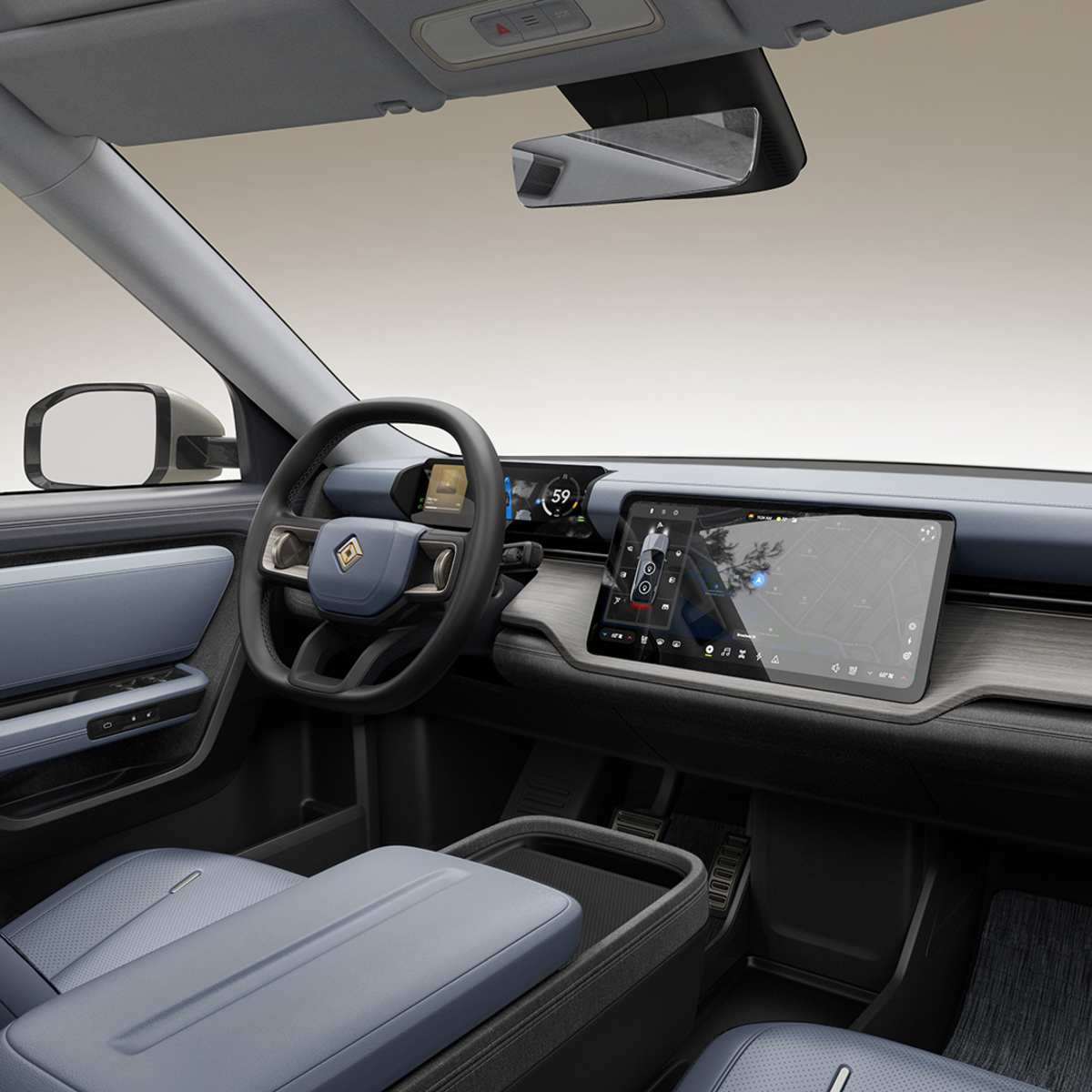
And then the same thing with the interior.
So interior, first look, the heads-up display.
I've talked about it quite a bit since first experiencing this in the Xiaomi,
YU7.
I love this format.
They call it the heads-up display, but it's really just a display that's
all the way down the dash, all the way down the bottom of the windshield.
And I think this is a great format.
I think this is going to be very popular in the future.
We've seen already like a few models, a few automakers adopting this.
However, the center display for me makes no sense.
Like the angles, the cut corners there is just, nah, it just doesn't do it for me.
The steering wheel is sick, though.
Steering wheel is sick.
Those seats, I mean, I haven't tried them, but it's confusing.
Oh, it looks like, you know, Lizzie Boy's in front of them.
So that's great.
I wonder how much it costs extra to make the screen,
like a trapezoid or parallelogram or something?
It has to cost more.
Like it has to be fully custom.
They do not, no one is making that like off the shelves.
All right.
So, you know, specs, amazing through the roof on this,
a few design things that just are hurting me like I don't mind them.
And then the price, it is going to be expensive.
Like the iX3, like we said, it's on the IRN2 with 61,000.
So this is going to be more expensive.
It's expected to be, you know, in the 70, $75,000 range when it comes to Europe.
And it's going to be coming to the US by the end of the year.
It's going to be built at the Spartanburg plant in the US.
So this is obviously in the bigger SUV.
So they want, the US is a target market for them.
But it does look like BMW has something when it comes to their EVs.
It's just like, I wish they would just tighten up that design.
The Subaru Trailseeker has gotten a price in the US.
It's, you know, it's been touted as like the first real, like Subaru Electric,
like the first electric vehicle from Subaru that feels like a Subaru.
After the Saltera and the Uncharted,
even though we had, we reviewed positively the Uncharted.
Yeah, Uncharted was a man.
Yeah. So this 0 to 16, 4.3 seconds, 75 horsepower,
3,500 pounds of towing capacity compared to the Saltera.
It's six inch longer, an inch taller.
So, you know, some off-roading potential in there.
In 74.7 kilowatt hour battery pack for up to 281 miles of range,
which, you know, is not bad, especially when you look at the price on this,
which is starting at $39,995.
So for the premium trim, $40,000, it's, you know, it's not a bad price at all.
You can get the Trailseeker limited for $44,000,
which has a premium arm and cordon audio, a parametric view monitor,
20 inch wheels, heated rear seat, leather wrap steering wheel,
and it comes with a 120-volt AC power outlet in the back.
Feels like these sort of things should be standard.
And it's so useful, I just make it standard.
But yeah, not a bad entry point for the Trailseeker.
Maybe, maybe it's going to sell in Colorado, you know,
the incentive there is, and it's already like their popular market.
Yeah, Vermont.
Yeah, Vermont as well.
All right, Lucid, overall, it's an entire C-suit under the new CEO earlier.
And last week, we talked about the layoffs.
They were, earlier this year, there was a 12-person staff layoff.
Then last week, there was an 18-person staff layoff.
The second one coming after the appointment of Suvio Napoli, the new CEO coming in.
And Lucid is having some issues.
Like the gravity, we know the gravity was not saving the company,
but it was, you know, we were expecting a little bit more out of it in terms of sales.
It's not just a demand issue.
It's also, I think, the ramp up has not been going great, production ramp.
The software issues are still plaguing the company.
It's, we had the review just last week on electric.
We scored it in 86, and it would score it in 90s if it wasn't for the software problems.
It's an incredible vehicle.
It's just, you need to tighten things up a little bit.
And now the new CEO is coming in and has a completely new leadership with him.
So just to name a few, there's a new CFO, Alexander Debok, coming from TI Automotive,
so a big Tier 1 Automotive supplier, where he was CFO too.
So it's like a more of a lateral change when achieved.
Like even some people, though, are you going down?
Because I'm assuming that TI is a bigger company than Lucid.
We have Raja Ramana Macha.
Sorry if I missed up your name.
Coming in as a new chief technology officer, he had the same robot eaten, also a big supply,
automotive supplier and technology company.
Billy A's joined as chief customer officer.
He was in charge of marketing and sales at one of the big dealerships,
like that I have like 60 or so dealerships.
So as a veteran of the auto industry.
But these are just a few, like the entire C-Suit has been replaced.
They also, one of the bigger news is that they sort of springing off the
the Rebel taxi and AI part of the company as a case stepper,
as the main president of Lucid Technologies and chief digital officer.
So he's going to be in charge of the Rebel taxi stuff,
you know, the Uber front and Neuro, AI autonomy, ADAS, and Enterprise IT.
He's coming from Bosch and Qualcomm.
So I guess you can see kind of a trend going here,
is that they are bringing a lot of people from Tier 1 automotive suppliers
and trying to like consolidate the leadership into a more like mature company.
And you know, it feels like Lucid is just, it's not far from working.
Like obviously they're still losing a ton of money.
But the product is near perfection.
Like it's incredibly good, again, with those software problems.
And obviously some quality issues over time too,
but they've been working on that quite a bit.
So it feels like they're really close to have a great product.
And they are not that far behind a company like Rivian,
which you know, also has their issues, but I think are doing incredible.
With their Cosmos being the equivalent of the R2, being a more mass market vehicle.
If they can get there and you know,
iron out their issues with the gravity, I think it's doable.
So let's give a shot to this new leadership and see what they can do with it.
All right, we're gonna jump into the comment section in just a few seconds.
Before that, I just want to say a quick word about the Electric American Solar Challenge
coming to Minnesota at the end of the month, the 21st to the 24th set.
Yeah, I think the first teams get out at around the 17th of July.
That's when they do the quote unquote, scrutineering,
making everybody make sure the vehicles are safe and they're
up to standard and they're not cheating and all the other stuff.
So that's all happens like the first couple of days, 17th through the 20th.
And on the 20th, they start racing around the track.
They do that for a few days to like, I think the 24th.
And then this year is one of the years where they take them on the road.
So then they're gonna take them on the road south and we've got the map all laid out as well.
So if you're anywhere in the Midwest and want to kind of find out where they're gonna go,
check out the site. But the big stuff happens, the race where you're gonna be able to watch
the cars go by on the 21st to the 23rd. And that's where we're gonna be out there.
Aaron and I are gonna be out there, maybe Micah. And of course, anybody who's just listening right
now, we'd love to have you out there. It is kind of a sight to see. There's a lot of
enthusiasm that college kids are really pumped up about what they're doing.
It's just a really fun event. So hope to see people out there. We're right outside of Minneapolis.
And it's a lot of fun. Yep. You get to see the next generation of engineers working on
the electrification, building a hyper efficient vehicle, solar vehicles and racing them is just
it's a lot of fun. And if there's any question like, you know, how valuable the people here are,
Tesla's original team of engineers came out of the Stanford program. JB Straubel was on the team
there and he I think he hired like 10 of his friends to basically start Tesla. You know,
this is quite a few years ago, but Tesla is still out there usually recruiting.
Yeah, to this day. And it's funny because, you know, I try to get GM or Ford interested in,
you know, taking part in this. And I'm like, you guys know, like Tesla's out there that the
recruiter there told me a couple years ago, it's like, it's like shooting fish in a barrel,
you can't lose like every single person they recruit from this event is like, it's superstar.
So, you know, like if they're actually building something like it's from scratch and the you
need to be very entrepreneurial to because you need to find sponsors to get the money
you need you need to think outside the box, you know, try to get some components like trying to
see if you can get a donation of the components from the suppliers, you get you get to talking to
suppliers, you get like all these things like they sound like not much compared to like,
an actual engineering degree, but it's the day to day work that gets things done. And talking to
a lot of people that do like mentoring of engineers and everything. Apparently, this is like the
toughest part these days with the new kids coming out of school, like it's, it's tough to get them
to be like entrepreneurial and just get things done. They might know the theory of it, but in
practice, it's like something different. So these these kids have like actual like real world practice
of, you know, not necessarily putting a product out there because these are the vehicle that you
see right now are on screen or are prototypes meant for the specific competition, but you know,
it's as close as it gets. Yeah, and this is the biggest year ever. I think we've got over 40 teams
competing. So it should be really good. Nice. All right, let's move into comments. First one,
Happy Bladed Canada Day and Happy Fourth to everybody out there as well.
Skeptic says Tesla is delivering more cars, which makes their pivot away from selling cars seem
extra dumb. I don't know if they're really pivoting away from selling cars, but that does seem to be
the official word from the top. Carl in San Diego says, did anyone check to make sure Tesla's vehicle
sales aren't all going to anthropics employees at the classes data center? I wouldn't trust
any numbers from us sick of employees to be true. Yeah, I don't think there's enough anthropic
employees to change the numbers too. Yeah, and they're probably buying Ferraris. Yeah, those guys
are all way too rich to buy. Tesla's. William Pisano says 62 K model YL not worth it. Please,
Rivian give us give a R2L R2T 2000 pound lighter and 30 K less not low 50 K for R2L long wheelbase
third seat. Do you want a genie to give you like ever wishes? Yeah, I mean, just you got an R1S,
just get that, you know, like that's it's already built. I mean, he wants a six seater, I guess,
but yeah, I guess 2000 like you're not gonna get 2000 pound lighter than what then you're not
gonna get a longer base or two 2000 pound lighter than R2 makes no sense. Maybe I'm
misunderstanding the point. Yeah, I think he's just kind of throwing stuff at the wall. Then he
continues Tesla sales are up only because gas in places like Australia is seven to $14 a gallon
diesel is the highest number. Yeah, I mean, not just in Australia, but I do think that the gas
prices are responsible for probably like a good 10 to 20% of Tesla sales in the second quarter.
All right, James Coranis says comment, Jamie should join the live podcast once a month.
I thought that was a good episode from two weeks ago. Yeah, it's always great having him on. Yep.
Doesn't always have the relevant stories, but he's always great. Yeah, yeah. Whenever Jamie
does like a particular story where they have ends on experience, like in this case was Abtero,
we always ask him on because he's great to talk to one of the OG electrification. He's been an
electric with us for like probably coming up on 10 years, I guess. Yeah. All right, skeptic says
question. If CyberCAD production is ramping, who is Tesla planning to sell thousands of
pedalless cars to? That's the question. That's a big question because we've seen them in parking
lots like planning it up and I don't see Tesla selling the CyberCAD to anyone in the foreseeable
future. People are a little bit confused because when the launch event was like October 2024,
I think at this point, the announcer price, he was like, this is like less than $30,000 and
whatever. And so he said, then we're going to sell it. And then, you know, there was the famous MKBHD,
Marcus Brown Lee's comment was like, if Tesla sells that for less than $30,000, I don't remember
the exact price. He said, I'm going to shave my head. And then buy, as he said, by 2027 or so,
and then Tesla started production this year. And like people are like, oh, he's going to shave his
head. This mud, he's the whole water is like, Tesla's not going to sell that car to anyone.
Right now, the way, the way autonomy stands at Tesla, the only way the CyberCAD is going to
be used is as part of the Rebel taxi fleet just like the Model Y. And it's hard to say how it
helps Tesla that much. It lowers, I think the only thing I see is that once production is ramp up,
you lower the economy unit of per drive per mile of the Rebel taxi using the CyberCAD for
people that are one or two person max using it. That's the limitation of like how great the CyberCAD
is. The benefits are the economy units on one single in couples using Rebel taxis.
For any kind of selling it to the public, Tesla needs to solve
level four autonomous driving at scale. There's just no way around it. This thing doesn't have pedals
or a steering wheel, at least not for now, other than the, you know, the validation units that we've
seen. So to do that, like no one is going to buy a CyberCAD because they can use it within a small
Geofence area in Austin or Miami, like you use a car. It's not worth, even if they sell it for
$25,000, it's not worth that because who wants to use a car that's Geofence? It just, it doesn't
make sense. So yeah, I think, I think we are quite a bit alpha. Tesla was too quick to make the
CyberCAD. It was a bad decision to make the CyberCAD like they did. They should have made, you
must, but instead they did the CyberCAD because like many decisions that Tesla over the last few
years were bad decision based on thinking that autonomy will be solved faster than it hasn't,
still hasn't been. Yep. All right, let's move on. We have sounded no one CyberCAD can't be used or go
into mass production without steering wheel to sell at consumers. I think that's kind of what
we're saying. FSD is perpetually getting better. It is though. It is. Yeah. I was the fool who bought
it. That reminds me of the joke instead of full self driving with FULL. It's F-O-O-L. Question,
any updated opinions on use EQBs? There's Mercedes. Did Mercedes fix the recall item?
So EQBs are about the least expensive Mercedes you can buy right now. I think they're selling for
like under $20,000. Part of that is because of the range. They were kind of hacked together.
The new EQB is a lot nicer, a lot bigger range, but if you're looking for a used Mercedes SUV,
can't get a better price than the EQBs and those are small. I rode one around Germany.
It drove really nicely. I had no problem with it.
I'd say though that you're getting what you pay for. Personally, I haven't experienced it.
It doesn't feel like a very luxurious vehicle. Your EQS, for example, feels a lot more like
Mercedes than like the EQBFL. I don't know if Mercedes really wanted to put their logo on that.
Yeah. I mean, they really just took out the gas engine and threw in some batteries. So
yeah, you get what you pay for, but very inexpensive Mercedes. Please Rivian build R2.
Oh, we're still talking about that. All right. Unlike Seth, I'm okay with the current hardware
on the launch edition R2. It's already better than autopilot, so anything beyond that will
be icing on the cake for me. Rivian has said that the current hardware will do point to point
navigation, but it will not allow you to read a book or use your phone or anything like that.
That's kind of what I am hoping to get at someday. It will be FSD. like an
advanced level two system. It will be that. But even beyond that, my point when you did your review
or your first drive review, I was like, I think there's a significant market between now and
when the launch, the LiDAR version that don't even want the point to point. By the way,
you're going to have to pay for the point to point on top of it. It's going to be $2,500 or $50
a month, whatever. So I think a lot of people just don't care about that. They just want to drive
their car. And Rivian is a driver's vehicle too. So I think Rivian is going to do relatively fine.
And Rivian's CEO, RJ Scurringe, has said that eventually FSD is not going to be something
that you pay for. It's going to be something that everybody has. So I don't know what that window
is though. Yeah, the way it's looking is probably a 2027, 2028 kind of thing is going to happen.
All right, David Gerr, Realtor says you can turn off the X part of the headlights and the BMW.
Oh, well, you should do that for the media picture. Yeah, it's not really the point. I mean,
but I guess you can make it look less bad. That's great. Wasteful battery size in the IX5.
This sounds like coming from Jamie. Stop the madness is taking unnecessary range.
I mean, I agree with that. It's just it's clear that BMW has made a decision where they are going
for upmarket. It's a $75,000 car. So people pay for the bigger range. I do agree that
it's wasteful because 90% of the time you won't use it. You're just going to carry a giant batch,
you pack around. And you know, there's value for like, for example, right now I'm in a new
apartment in Montreal and I don't have a charging solution at home. I think a long range there,
it's very useful for that because you, you know, you can park outside for a week and you don't have
to worry about it and just do your regular driving. Yeah, and people will buy a $75,000 car
or not in this situation. So I get where BMW is going for there, but I do agree with Carl that,
you know, you don't need 435 miles of range. Yeah, I mean, so the EQS that I drive
in the summertime gets like 365 miles when it's fully charged. I don't use that. Like I basically
charge and it also has some buffer. So like theoretically, I can charge 100% and not kill
the battery too much. Yeah, but I basically get down to like 250 and then charge it up again.
And it's pointless. And you're someone who drives a lot too long distance since very often,
like that for long distances, fast charging capability, like a quick fast charging within
the car and an extensive infrastructure is way more important than a range. Yep. I think it's
still confusing for other people, I get it. Like, but I think, I think it's getting through a lot
people now that this is the most important part. All right, gentlemen. Yeah, tech US solar energy
says Fred and shadow ban on electric. Are we still shadow ban? I don't shadow ban people because I
tell you that I ban you when I ban you. So it's not a shadow ban. It's a ban. All right. You need
400 miles of range for any future EV over 60 K. Yeah, I mean, that's what I'm saying to once you
get into the higher price range, it makes you trying to differentiate yourself one way or the
other and the range is one of them. So I get that too. Yeah. All right. If I owned a lucid,
I would be looking for a sucker to buy it before they go under that company isn't going to survive
and it's still half baked. Carl San Diego is not a lucid fan. No, he's not. Once the voice
is lucid on somebody else. I mean, he's not completely wrong. Like it is. But much like
Rivian is also in any company that's not profitable is technically on the path to bankruptcy.
So it's definitely something keep in mind if you're a buyer. Lucid though, it's such a great
product that I'm like, someone would have to buy it up. I feel like it's not like a Nicolo example
when they went on there is like, I mean, there's there's half a dozen other companies that that
produce, you know, equivalent or better battery electric trucks. And also they are like,
half in between battery electric and hydrogen. So it's like, it's like, what are you actually
buying in terms of technology? Half of their technologies from Bosch and Lucid as incredible
powertrain engineering that is extremely valuable. They make the one for the formula E,
they make the powertrain from the formula E for years and all of these still do that.
But there's a lot of things that are very impressive about the engineering aspect of the
vehicle. So I would, I'm not, you know, I'm not guaranteeing it, but I feel like
company would buy this up and, you know, you take advantage of it.
Yeah, does that mean that they hold up to the warranties and the service not necessarily,
but I would hope so.
Saudis are already building a factory in the Middle East, they will drop billions,
it will survive if they bring a $40,000 car. Yeah, the Saudis have deep pockets for that.
Yeah. I mean, they can always pull the plug, but you never know.
All right. It seems like the market is going to split up between lower cost 400-volt cars with
around 300 miles of range and more expensive vehicles with 800 volts at more range. That feels
a little bit reductionist. I kind of feel like, I think everybody's going to 800 at some point.
Why not?
Yeah. I mean, I think we're in a transition phase right now because also like the charging
infrastructure, especially in North America, doesn't necessarily all support the 800 volt.
And then if you have an 800-volt car, you're not necessarily, the range aspect doesn't have a big
impact here. I think it's more related to the charging capacity and the fast charging. So
it's more related to that than the range, I think. So we're in a transitional phase right now.
And you have people doing both. Like we've seen the tele-truck having a solution
stood between both, which I think is pretty good.
All right. Dan, overstate says, I give up point-to-point now to get level four on the freeway.
Yeah. I mean, level four on the freeway is kind of the holy grail.
Yeah. It's a lot better than point-to-point now. But I mean, point-to-point now is,
you would think it's level four. Like the way they sell it, like, oh, you can go point-to-point
without, you know, touching the vehicle, touching the controls. But it's like, no,
it's supervised point-to-point. So yeah, it's strange. It's a weird approach.
I'm fine with BMW offering a bigger battery as long as they offer smaller batteries at lower price
for people who don't need the added range. That's a good point.
That's fair. They could launch a version with a 100 kW battery pack for like $65,000.
Perfect. Yeah. Yeah. And I see cars had around 300 miles of range when I was young,
and now many road trip ICEs have 400 or more. Yeah. I mean, it's really easy to make an ice car.
You just make the tank a little bit bigger. Did I miss comments on Polestar and the new
deep discounts? Yeah. I saw that the Polestar 4 is getting $25,000 off because Polestar is no longer
in the US. A friend of mine is actually looking at getting one and, you know, what does that entail?
Is it going to be like Fisker where you can't get serviced? I think Polestar should probably be
clear about Volvo servicing them or what's going to happen. For now, they say that they're going
to keep servicing them. But again, just like Lucid, Polestar is not in a great financial situation.
Lucid as the Saudis, Polestar as the Gili. So there's that. But the Polestar 4 is a great vehicle.
I've driven it a couple of times. It's an amazing car. Most EV owners use 10 to 20 percent of the
battery capacity daily, just as most EV owners charge up overnight at home. EVs are not for
everyone in every need, but many work with 300 miles of range just fine. Yeah, that's what I
tell most people. A lot of people who are considering an EV for the first time are like,
well, you know, how do I charge? Like 360 days a year, you're going to wake up in the morning
with 300 miles of range and use about 10th of that. If you can charge at home, that's that.
GM Empower and San Fran. GM never mentions solar. Do you think GM energy sales are good,
except some employees features like the one you did.
We don't say many installation cases. I'm not sure what they're. Do they have solar? Yeah,
I'm not. I mean, it works with solar, I guess. I mean, that's what GM is doing.
We're talking about charging the 800 volt Ionic. I mean, I would call the Ionic a premium.
I mean, it's a nice car that there's certainly premium versions of it, but
the base. I think he's making the point that I say like 800 volt doesn't charge as well
in the North America because all of the infrastructure is made for 400 volt.
Obviously, you can still charge is just you're not charging as fast as you potentially can,
which makes having the 800 volt yes, useful. That's all I'm saying. For sure,
you're still better off with the 800 volt system. And it's just you're not taking the full
advantage of it all the time is all I'm saying. Also, why GM never included Canada for public
charging zero GM energy here, I guess. I mean, GM is GM's EVs are super popular in Canada. I don't
think most people are complaining. I mean, especially now that they have access to the
charging network like circuitry, electric, and if I can, I don't want to recognize the
nice grade, but we have a bunch of different networks. Rick McDonald final guess one more
comment. I'd love a I three or I X three with a smaller battery. I think a lot of people would
prefer a cheaper smaller. He's charging at a DFC at 800 volt every time I just plan.
Yeah, I mean, if in where you're going and your your area as 800 volt charging really
available, then you're fine, obviously. But I mean, it's not it's not everywhere that has the
capacity that's all I'm saying. All right, well, that's it for the this week's episode of the
check podcast. I hope you enjoyed it. If you did, please give us a like a thumbs up, a subscribe
wherever it is on the app you're watching. It helps the show more than you think it takes a second
to do. It's free. We appreciate when you do it helps, you know, send us into the algorithm and
and all that. All right, I hope you guys have a safe weekend. We're going to see you same place
next week. Bye.
About this episode
Fred Lambert and Seth Wintraub break down Tesla’s US Model YL launch details, then zoom out to Q2 delivery results and what they mean for the rest of the year. The Model YL’s usable six-seat third row, extended wheelbase, and “launch edition” pricing (starting around $62k with limited FSD) spark debate versus rivals like Kia EV9 and Hyundai Ioniq 9. They also cover Tesla’s record-beating Q2 deliveries (480k), energy storage growth, and why the stock still fell despite the upside. BMW’s newly unveiled iX5, Rivian updates, and the Electric American Solar Challenge round out the news.
In the Electrek Podcast, we discuss the most popular news in the world of sustainable transport and energy. In this week’s episode, we discuss the launch of the Tesla Model YL, BMW iX5, and EV sales results for the second quarter.