Level 4 means the car can drive itself in certain conditions and locations without you needing to constantly take over. It’s not “unlimited everywhere,” but it’s more capable than basic driver-assist features.
“Unsupervised” means the car is running without a person watching closely and ready to take over. Supervised systems still depend on the driver for tricky moments.
A “30 day” window is just a longer time period for counting how often the cars are really being used. It helps avoid misleading results from just a few days of data.
“Certified” means the autonomous system has been approved to operate under certain rules. It’s not just a software label—it’s tied to safety requirements and how the car is allowed to drive.
Austin is one of the Texas cities listed where the self-driving cars are being used. Where the cars operate can change how often they’re actually running.
Houston is another Texas city mentioned in the operating count. It helps show how many self-driving cars are actually running in different places.
Term
autonomous driving vehicle in Texas
This refers to a local/state permission program that allows self-driving cars to operate legally. The rules can vary by place, so authorization in one state doesn’t automatically mean authorization everywhere.
RobotaxiTracker is a website that tracks self-driving robotaxi activity. In this segment, the host says its numbers line up closely with Tesla’s official figures.
“Full Self-Driving” is Tesla’s software that tries to automate driving tasks. When people argue about safety, they’re often talking about how Tesla counts crashes or near-crashes while that software is running.
“10x safer” is a comparative safety claim expressed as a multiple (ten times safer) rather than a raw probability. In this discussion, the hosts argue that the underlying methodology—how incidents are counted and what data sources are compared—may make the “10x” figure misleading.
Airbags deploy when the car decides a crash is serious enough to inflate them. If someone counts only airbag deployments as crashes, they can miss other incidents where the car still gets damaged or needs help.
NHTSA is a U.S. government agency that tracks traffic safety and crash information. Their data can include more kinds of incidents than just cases where airbags went off.
“FSD mileage” means how many miles you drove with Tesla’s Full Self-Driving turned on. If most of that driving happens on highways, it may not reflect how often incidents happen in city traffic.
“Data labelers” are workers who mark up training data—basically telling the computer what things in the images mean. In this story, they’re described as necessary after mapping, so the car can recognize what it’s seeing in a given area.
Here, “mapping” means building a detailed digital picture of a place so the self-driving car knows where it is and what to expect. The discussion is about whether Tesla really can avoid that work, or whether mapping is still a big part of the process.
Term
teleportation
“Teleportation” sounds like a joke word here, but it’s probably referring to creating driving scenarios without actually driving to every spot. The point being made is that even with that, there was still a lot of mapping work.
EPA ratings are official test-based numbers used in the U.S. to estimate how efficiently a car uses energy. They help you compare different cars, but your exact wheels and tires can change the result.
All-season tires are made to handle a mix of weather—hot, wet, and some cold—without needing separate summer/winter tires. They can also affect how efficiently an EV runs.
All-terrain tires are tougher tires meant for both normal roads and rougher surfaces. They often don’t roll as easily as road-focused tires, which can hurt an EV’s efficiency.
Term
off-roading the Eco
“Eco” is a driving mode meant to help the car use less energy. Even in Eco mode, the type of tires can still make a big difference in efficiency.
This is the Tesla Model Y, another electric SUV. They’re comparing its official EPA efficiency number to the Rivian R2 to see how close the two are in real-world-style testing.
Combined mileage is one official number that mixes city and highway driving into a single estimate. It’s meant to make it easier to compare how far different EVs can go.
This is an efficiency measure for EVs: how many units of electricity the car uses to drive 100 miles. Less energy per 100 miles usually means better efficiency.
“City” means the test is done with lots of slower driving and stops, like you’d see in traffic. That can change how efficient a car looks compared with highway driving.
“Highway” means the test is done at faster speeds. At those speeds, air resistance matters more, so efficiency usually drops compared with city driving.
“Aerodynamic hit” means the car isn’t as slippery through the air, so it uses more energy. This matters more on the highway than in stop-and-go driving.
The EPA (Environmental Protection Agency) runs standardized testing to estimate fuel economy or energy efficiency for vehicles. The host notes that the EPA’s highway test speed may not match how people actually drive, which can make real-world results differ.
EPA testing is a standardized way the U.S. government measures how far a car can go on a charge. It helps you compare different electric cars using the same rules, even if real driving can be different.
“20-inch wheels” means the car is using bigger wheels than smaller setups. Bigger wheels can affect how easily the car rolls and how much drag it creates, which can change efficiency and range.
Range is how far an EV is expected to go on one full charge. The host is connecting it to the battery and also warning that real-world range can be different from the official number.
“Conservative mode” is a driving setting that tries to use less energy. The host is saying that when Rivian R1 is driven in this more efficient way, people often get better real-world range than the official estimate.
The Rivian R1 is used as an example of an electric vehicle where the real-world driving results sometimes beat the official range estimate. The host says it happened especially when using a more efficient driving mode.
“Optimistic coefficients” means the car’s computer may be using assumptions that make the range estimate look a bit rosier than real driving. The host is warning that the official number might not match what you’ll actually get.
Aerodynamic means the car is shaped to cut through the air more easily. The hosts are basically saying: if an SUV is getting surprisingly good mileage, it suggests there may be other factors besides just the shape.
The Rivian R2 is an electric SUV/crossover from Rivian. Here, they’re talking about how efficiently it uses energy compared with the Tesla Model Y, and whether it makes sense to cross-shop them.
The Model 3 is an electric car made by Tesla. It’s a smaller car meant for everyday driving, and it’s designed around an electric motor instead of a gas engine. People often use it as a reference point when talking about other Tesla models.
The Prius is Toyota’s popular hybrid car. The host is saying the Ferrari sedan’s shape reminds them of the Prius, not that it’s necessarily bad—just that it doesn’t look very Ferrari.
The host is talking about how car designs communicate who made them. They’re saying this new car doesn’t have the usual visual cues that make you think “Ferrari.”
The Ferrari Roma is a Ferrari grand touring car (a fast, comfortable cruiser). Here, the host brings it up as a reference point for what people thought a “four-door Ferrari” might look like.
The Tesla Model S is a well-known Tesla electric car. The host is saying you shouldn’t judge the Ferrari by the same expectations people have for the Model S.
Drag racing is when cars race in a straight line to see which accelerates fastest. The host is saying this car isn’t really meant to be judged like a drag racer.
Term
torque victory
They’re basically saying the electric powertrain has an advantage because it can deliver strong pulling force right away. That makes the car feel quick and responsive when you press the accelerator.
Rear wheel steering means the back wheels can also turn, not just the front wheels. That can make the car easier to maneuver and more stable when driving fast.
Electronic suspension is a system that automatically adjusts how the car’s shocks behave. Instead of being fixed, it can change settings based on what the road is doing.
They’re talking about the feeling you get from driving—how engaging and exciting the car feels. It’s more about the experience than just the tech specs.
It’s a suspension system that can adjust itself while you drive. The goal is to keep the tires planted so the car handles better and feels more controlled.
The 911 is a sports car made by Porsche. It’s known for being a performance-focused car that comes in different versions. In the podcast, it’s brought up because the speaker has experience driving similar high-performance models.
The Supra is a sports car from Toyota. It’s built to be fun to drive, with a focus on speed and handling. It’s the kind of car people talk about when they’re discussing performance cars.
An accelerometer is a sensor that detects how much something is vibrating or moving. In this case, it helps the car “listen” to what the motor is doing so the driver can get feedback through the sound system.
An electric motor is the part that turns electricity into motion. The host is saying they can “capture” what the motor is doing and turn that into sound the driver can feel.
The rotor is the spinning part inside an electric motor. The host is saying they use sensor data from that spinning and vibrating to help create the sound the driver hears.
“Fake engine sound” refers to synthesized audio that imitates what a gasoline engine would sound like. The host contrasts that with Ferrari’s approach: using real motor vibration/rotation data to produce feedback through the speaker, so it’s presented as more authentic than pure simulation.
The “paddles” are the small levers behind or on the steering wheel. Here, they’re used to change how the EV slows down and how strongly it accelerates, not to shift gears like a manual transmission.
“Regen” means the car can slow down and recharge itself at the same time. Instead of wasting speed as heat, the electric motor helps generate electricity while you slow down.
A touch screen is a screen you control by tapping and swiping with your finger. In a car, it’s usually where you change settings and control things like music and climate.
A suicide door is a car door that opens in a way that’s different from most cars—it's hinged so it swings from the back side. People notice it because it makes getting to the back seat feel more “special,” but it has to lock very securely.
An order book is basically a queue of customer requests for a specific car. If the company limits it, only certain people can get the car, which can make it harder to buy and sometimes more valuable later.
Allocation is how a company decides who gets the limited cars. If a car is hard to get, allocation rules can determine who gets one and who has to wait.
A hypercar is an extremely expensive, very limited, top-of-the-line performance car. In this context, the host means the next ultra-rare Ferrari that only certain buyers can get.
A “12-cylinder” engine has 12 combustion chambers working together. It’s often associated with high-end performance cars—Ferrari is known for engines like this, even when they’re talking about going electric.
A “four-door hatchback” is a car with four doors and a back door that opens upward. The speaker is saying the EV is shaped more like a practical car than a typical supercar.
“Weight” just means how heavy the car is. He’s saying the car is heavier than a typical sports car, and that makes it harder to deliver the same kind of performance and driving dynamics.
“MC cells” are a specific kind of battery cell used inside an EV battery pack. Different cell designs can store more energy for the same weight, which helps the car go farther without getting heavier.
A “kilowatt hour pack” is how big the EV battery is, measured in kWh. Bigger usually means more energy for driving, but it can also make the battery heavier.
Term
torque shifting
“Torque shifting” means the car changes how much twisting force (torque) it sends to the wheels. In EVs, that’s typically done electronically, not with a traditional gearbox.
A “purpose-built autonomous vehicle” is a self-driving car designed specifically for that job, not converted from a normal car. That can make it easier to fit the sensors and computers autonomy needs.
A Bose system here refers to an upgraded premium audio setup from the audio brand Bose. The hosts mention an optional 8-speaker premium Bose system tied to higher trims, which is a specific equipment change rather than a generic “better sound” claim.
Term
Active Safety Package 3
An “Active Safety Package” is a bundle of safety and driver-assist features. Here, they’re talking about the newest version (Package 3) and how it relates to Super Cruise.
Super Cruise is a driver-assist feature from GM that can help steer on mapped roads. It’s meant for highway driving, and you still have to pay attention because it’s not fully autonomous.
The Ferrari Luce is Ferrari’s upcoming electric vehicle. The conversation is about whether its design still looks and feels like a Ferrari, even though it’s an EV.
A vehicle wrap is a vinyl film applied over a car’s exterior surfaces to change color or add graphics without repainting. The hosts speculate about whether a different wrap could improve how the Luce’s design reads visually.
The Urus is a luxury SUV made by Lamborghini. It’s designed to be fast and dramatic-looking, but it’s still an SUV you can use more like a normal vehicle. People talk about it because it carries Lamborghini styling and attitude in an SUV form.
The Tesla Cybertruck is a very distinctive electric pickup with a futuristic, boxy look. The speaker is basically saying the Ferrari looks better than that design.
All-wheel drive means the car can send power to all four wheels. That usually helps it grip the road better, especially in bad weather or slippery conditions.
Term
12-cylindry
“12-cylinder” usually means an engine with twelve cylinders. In this clip, it’s mentioned in a confusing way while talking about an electric drivetrain, so it doesn’t sound like a straightforward, literal engine spec.
The battery pack is the big battery in an EV. Saying “half-sized” means a smaller battery to save weight, which can help the car feel quicker and handle better.
The Ioniq 5 is an electric SUV/crossover made by Hyundai. It’s designed for everyday use, like commuting and family trips, but it runs on electricity instead of gas. People may bring it up when listing EVs they’ve seen around.
The Blazer is an SUV made by Chevrolet. It’s meant for people who want more space than a small car, but it’s not the biggest SUV size. In the podcast, it’s being talked about as a smaller option.
Formula Sun is a competition for solar-powered cars. The hosts are talking about when and where it’s happening.
LIVE
We are live for a new episode of the Electric Podcast.
I'm Fred Laibert, your host.
And as usual, I'm joined by Seth Winchal.
How you doing this week, Seth?
I'm good.
All right, I want to give a quick thank you
to today's episode sponsored GM Energy.
If you want the experience, two experience,
more resilient and control over your home energy,
the GM Energy Home System,
add stationary battery power for always ready backup energy
for your home.
And the GM Energy PowerBanks takes an energy
from the grid and stores it when you need it the most.
Learn more at gminergy.gm.com.
We're gonna say a little bit more
about their offering later on on the show.
So stay tuned for that.
But yeah, big show this week.
We are a little bit early because I, well,
early for you guys, it's late for me.
I'm in, I'm still in Italy right now.
I'm in, sorry about the lighting too, by the way.
I'm literally a monk monastery right now.
So the lighting situation is the best I could put together.
But yeah, I came here for the lunch of the Ferrari Luce,
which...
Controversial.
To say the least, to say the least.
It might be the most hated vehicles
since the Cybertruck, I would assume.
Easily, but I mean, there's a lot to talk about.
So we'll keep the Luce for a little bit later on the show.
We'll talk a little bit about the Rubotaxi first
and then Rivian R2.
After that, we'll talk to you guys about the GM Energy.
And then we'll keep you waiting a little bit for the Luce.
And we have some new information about the,
what happened with the vehicle after the order books
as situation for it.
We got a little tiny bit of information.
They're not, they're not divulging too much,
but we still win a little bit.
But yeah, the Rubotaxi, I had a reporter here this week
that was aptly timed.
We are roughly a year into the program right now.
And if you remember, a month ago, I came out with a report
where I say that we are finally seeing the first signs
of Rubotaxi fleet growing and growing quite fast.
That was a month ago.
And that was my bad.
That was, I jumped the gun on this one.
I got a little bit too excited about the numbers
that I was seeing.
And it was literally a blimp in the data.
Because now a month later,
the fleet is actually shrinking and not growing.
And I want to talk about it a little bit
because I think the timing is interesting.
So we're literally, almost a year into the program
started in June of 2025.
And my report came out earlier this week
where I'm using the very good data from Rubotaxi Tracker.
Rubotaxi Tracker is such a good website, very useful.
And interestingly, I don't know if you know about this set,
but the guy that's behind the website, Ethan,
I would easily say that this guy
has the best understanding of the state
of the Rubotaxi program out there.
He's a very young student engineer.
And he's not massaging the data in any way.
He's just, he's putting out there what he sees.
And quite honestly, it doesn't look great for Tesla,
but it's the reality.
And funny enough, he was hired by Tesla.
He's interning at Tesla this summer.
So, but I mean, he's been hired a few months ago.
And the website is still going
and still being fairly precise.
And it will tell you how precise it is.
Because so earlier this week,
I posted this report based on the data from the website,
which as you see from, that's the first picture, yeah,
from this picture here.
So this picture is the active unsupervised,
which I think is the most important thing to look at,
because the Bay Area supervised stuff
and the Austin supervised stuff is just not that exciting.
It can, it's the equivalent of using a Uber
with a Uber driver that has a Tesla with FSD.
So this is the unsupervised stuff.
And we see like last month,
that's where I got excited here.
It was flat for the longest time.
And then it was going crazy.
So I was like, oh, things might be happening.
And then there was the Houston and Dallas lunch
at the same time.
And then boom, it just crashed in the last week or two.
Again, that's for the active over the seven day period.
Then this is the entire fleet, which looks even worse.
If you look, if you had the unsupervised stuff,
looks like Tesla just completely gave up on that.
So the fleet used to be at over a hundred,
you know, around a hundred units.
And then now it's just 34 with 20 unsupervised,
most of them in Austin, nine in the Bay Area.
It was supposed to be hundreds, just a few weeks ago.
And then just to be fair,
I put the normalized that over 30 day period.
And it looks a little bit better at 92 units and 33.
But again, most of that is because of the Bay Area,
which has been going down very fast,
as you can see from the seven day and the 30 day.
So I think the seven day is more accurate really.
Now just a few days after that came yesterday,
May 28 was a big deal for the RoboTaxi program
and all autonomous driving program in Texas,
because the new rule from the DMV,
the Texas DMV went into effect,
where it was a bunch of new guidelines
that the all autonomous programs in Texas needed to follow.
Prior to that, Texas was the most unregulated state
when it comes to autonomous driving.
Now it's still not crazy,
it's not like California or anything like that,
but it's more like on par with Nevada or Phoenix,
which is Arizona, they are normalizing a little bit,
all of that.
And one of the main thing is,
you have to now get certified as a level four system.
So first of all, only the unsupervised one can get that.
And so if you look at the data here from the seven day,
well, Tesla is just not operating those cars all the time.
So the 30 day would actually be closer to reality here.
Tesla reported 42 vehicles certified in Texas.
So if you look here,
is actually 33 unsupervised vehicle used.
So assuming that this is certified
a little bit more just to be safe,
but if you look at the total vehicle operating in Texas,
27 in Austin, six in Dallas, so that's 33,
and seven in Houston, so that's 40.
So literally the tracking website was,
roughly two vehicle close to the official data
that Tesla released on the first day
of the official program
for autonomous driving vehicle in Texas.
So it's kudos to Eaton, kudos to RobotaxiTracker,
it's very well done.
They've tracked the program very well.
And yeah, it just confirms that a full year
into the program, it's basically,
it's actually exactly what I said it would be last year
when they launched its demonstration project
to give the illusion that Tesla is still leaving
in autonomy while obviously other companies
are taking a lead, because Waymo also had
to disclose the same data,
and I think they were like 10 times more vehicles
than Tesla, just in Texas, obviously they also have
unsupervised vehicle operating in 10 other,
and not 10 other cities outside of Texas,
like eight other cities I think outside of Texas.
And yeah, it was not a good week for Tesla Robotaxi,
because on top of that,
I don't know if you saw the Reuters report
that came out this week, Seth?
Yep.
That was a bad one for Tesla, just not a great look.
So Reuters came out with,
how many people they talked to?
Nine former Tesla data labellers,
a former self-driving engineers,
and 11 traffic safety researchers,
and what they said was basically to work at Tesla,
is that again?
Don't trust it.
Yeah, don't trust it, wouldn't use it myself.
And to be fair, for the data labellers,
it's like these guys probably see the worst
of the worst all the time,
like they have these see the crashes,
and they're like, okay, now we have to tell the car
what you were actually seeing during those crashes.
It's not only that, obviously they're just seeing
a bunch of different age cases and all that,
but it's not the best job to have to gain confidence
into autonomous driving system.
But honestly, so that was an interesting part of the report,
like that the people that work at Tesla
are not impressed by that themselves, by the system.
And, but I think the most interesting part was the,
this part, sorry, the inflated data
for Tesla's own safety reporting
around autopilot and full self-driving,
which is something that at Electric
we've been hammering for years,
it's been driving me crazy.
It's been the pillar on which Tesla
has built the foundation of the full self-driving.
They say that like, it makes sense for us
to go extremely aggressive here,
because it is already so much safer than human drivers.
However, there's a lot of problem with the methodology
in which Tesla come up with this 10x safer
than human data point.
And we've been saying like things like Tesla
counting only for airbag deployments as accidents
while comparing it to NHTSA data
that includes anything that required
a police report or a tow truck,
which is a lot more than airbag deployment.
Like most people have been in a kind of situation
where they required a tow truck.
Meanwhile, the airbags were not deployed.
And that's one of the main problem.
There's also several problems also
that Tesla use like the fact that it used the FSD mileage.
One of the problem with using FSD mileage
is a lot of people, myself included,
will use FSD much more on highways,
which racks up a lot more mileage
between accident on average than city driving.
Another big problem.
There's also the problem with the fleet age
on average, older cars get into crashes much more often
for several reasons, including the actual safety apparatus
inside the vehicle, acts of safety features,
which in the average fleet, which in the US,
I didn't know this, at 12.8 years old, the average car.
The Tesla fleet, four years old.
Big difference.
So also people that gets new cars
are a little bit more careful with their car.
So that also helps.
There's a lot of these problems.
So I like that the routers actually, well, published that,
but also they had a bunch of professors go through the data
and explain in details why it makes sense or not.
In this case, I think they said 10 out of 11
traffic safety researcher, we reviewed this as mythology for.
Routers said that's stick amounted to misleading marketing
rather than serious safety investigation.
I think that's fair.
I think that's very fair.
And yeah, one of them, Phil Koopman from Carnegie Mellon,
said, it's like saying my jet airline is faster
than your world to bomber.
What's your point exactly?
Yeah, that's basically it.
Yeah, it's just not the greatest day for Tesla.
Oh yeah, this part was also an important one in there.
Some of the data labeler explained
that the Rebel taxi situation,
just like the cyber cab launch in October, 2024,
where Tesla mapped out extensively
the Warner Brothers Studio to prepare for the launch
where my member said that they used it like a mini city
and you could get from the event venue to the after-party
and so on through the little taxi system with a cyber cab.
Well, all of that was unsupervised.
They said, even though there is some evidence
that there was some teleportation behind this,
they had a heavy use of mapping.
And data labelers, which were part of the mapping team,
because after it was mapped,
they had to label everything,
make sure that the car understood what's around it
for a specific area.
They did the exact same thing for Austin, Houston, and Dallas.
So it breaks down one of the main points
that Elon has been making is that
this system unsupervised system doesn't rely on mapping,
which is why it's going to be able to scale extremely fast.
Now, you should not believe that for the simple fact
that it's been a full year and it hasn't scaled yet,
but now we have the actual reason from people
that work at Tesla that tells you why that's the case.
That Tesla has the same limitation that Waymo had
when it comes to mapping.
It was a complete lie that Elon said
that it was not required.
So that's kind of a big deal.
I feel like if the US was not in the middle of its empire
falling apart, regulators would probably be on top of that.
Like, hey, didn't you not say that you didn't require mapping?
Did you tell your investor that you were going to get
a million or more taxis by the end of the year
because of that and now you weren't doing that?
But no, bigger fish to fry, sounds like.
All right, R2, I had another post about the R2 in there.
It didn't, oh, okay, not sure why.
Because there was these two things
that we learned about the R2 this week
is that the launch or start of deliveries,
start of a demo drive is on June 9.
So on June 9, consumer will be able to actually get behind
the wheel of the R2 and the first delivery customers
that are being prearranged right now to invite only.
And then those that have reservation for the R2
are going to be able to gradually update them to orders.
So that's going to happen fast.
But the second thing that happened with the R2 this week
that I just reported on this morning
was that the EPA ratings has come out
for the R2 performance all wheel drive,
both with 20-inch wheels and 21-inch wheels.
The 21 are with the all-season tires
and the 20-inch wheels are with the all-terrain tires.
So that's why here you see the efficiency
is higher for the 21-inches, which is the 20,
which normally it's a counter-intuitive,
but for off-roading the Eco,
you just, you understand how big the difference is
for the actual tires themselves.
But the big surprise here is that if you look
at the Tesla Model Y performance,
because you want to compare Model Y performance
or performance for Apple to Apple,
is that Rivian has achieved the same EPA rating
of 105 combined mileage, 32 kilowatt hour per 100 miles,
which is surprising because just the form factor
is just so different.
The R2 is relaxier.
Yeah, it's heavier too.
I just learned that it's everywhere.
I have several hundred pounds too.
It's not just a little.
Yeah, the city is also way higher than the highway.
So 114 city, 96 highway versus the Model Y,
which is 111 city, 100 highway.
So that aerodynamic hit is significant,
but somehow Rivian makes it up in the city,
which is interesting.
Yeah, so obviously take that into account
depending on your own kind of driving situation.
It's not surprising, obviously the aerodynamic performance
has a bigger impact at higher speed.
So I'm a little skeptical about the whole situation.
Obviously it's just so much bigger,
so much higher, so much boxier.
And I do know that the EPA's own testing
at highway speed is probably not exactly
the highway speed that most people drive at
unless you are like LA traffic all day.
I'm looking forward to some real world testing on this
because it will tell us a lot,
but same goes for Tesla.
So I think the Tesla might get away with it a little bit more
because of the aerodynamic performance,
but for now on the EPA testing itself,
the R2 performance on 20-inch wheels,
all season tires gets the same rating
as Tesla performance on the Y,
which is one of the most efficient vehicles,
not the trim that's most efficient,
but one of the vehicle that is most efficient out there
per pound and one of Tesla's biggest achievements
was always efficiency.
And that translates to more mileage,
230 miles of range versus trim in six.
Obviously that's because of a bigger battery pack too,
86 versus 82, I think,
but yeah, it's so far a good sign for Riven.
Something else to consider is that Tesla's mileage
is incredibly optimistic.
It was always hard to actually get Tesla's stated mileage.
In fact, a lot of times it was almost impossible,
whereas Rivian R1 in conservative mode,
I would often get more than they said that you could get.
I don't think that's gonna be the case here.
I think Rivian's maybe adopted
Tesla's optimistic coefficients.
I mean, it has to be like with a vehicle like that,
getting the same mileage as an aerodynamic SUV,
I have to believe that there's something else going on.
It would be a first suspicion.
I think you would want Rivian to follow Tesla
in that direction, obviously,
but at the same time, you understand why,
if you're putting up the,
I'm not completely on board with the R2
going against the Model Y.
I'm sure that some people are gonna be
cross shopping the vehicle, so to a degree it's good,
but it's still, you look at it, it's a real SUV.
Sometimes I have issues calling the Model Y an SUV,
like it's a Model 3 with an hatch and a little bit higher up,
like it's, sure it's an SUV,
but I think the R2, it's its own thing in many ways,
but you're right, I have the same suspicions.
I'm looking forward to testing it out.
Yeah, I think we'll have some firsthand knowledge
in a matter of weeks.
Yeah, yeah, we should.
Yeah, I mean, when May 29th and it's coming fast.
All right, let's talk a little bit about our friends
at GM Energy who are sponsoring this week's episode
of the Electric Podcast.
All right, today's episode is sponsored by GM Energy.
Smart energy features are no longer just a luxury,
they're a necessity.
One in four homes experience power outages each year
from grid shutoffs to extreme weather.
Many homeowners are looking for new ways
to stay powered and connected.
Fortunately, home energy systems can offer resilient style
and sustainability benefits in one package.
A power outage doesn't have to put your life on pause.
GM EV owners can now use GM Energy Home System
to beat the blackout.
This advanced system allows vehicle to home
capable Chevrolet Cadillac or GMC EVs to store energy
and when needed, supply electricity back to the home,
keeping the essentials running in your sanity
and check during an outage.
If you really wanna experience more resilience
and control over your home energy,
the GM Energy Home System adds stationary battery power
for always ready backup energy for your home.
The GM Energy Power Bank takes in energy from the grid
and stores it for when you need it most.
Learn more at gmenergy.gm.com.
A huge thank you to GM Energy for sponsoring this week's show.
Yes, thank you, GM Energy.
It's awesome.
All right, let's talk about the big talk of the week
in the auto energy and that's the Ferrari and Luce.
That's why I'm in Italy right now.
Well, not right now.
Right now I actually stayed for a little vacation
but that's why I was brought into Rome.
They did the lunch in Rome
even though Ferrari is based in Maranello,
which is closer to Belonga, a few hours north of Rome
because it was the site and the timing also I think
of their first race victory in Rome.
Ferrari is obviously rooted in motorsport
but the money these days is coming in
from actually selling 14,000 vehicles a year
which is quite a bit for the average self-price of a Ferrari.
But a few years ago, five years ago,
they hired a new CEO, Benedicto Vinga,
kind of a mad scientist, a physicist,
better known for I think the technology
that's behind the Wii controller, which is kind of interesting.
And he's a technology guy, he's very interested in the vehicle
and he's the guy that convinced the board
that like I'm gonna bring the first electric Ferrari
to market and he was friend, I think with Mark Newsen
who's the famed industrial designer
who started a big design business
and he started a design firm with famed Apple designer,
Joni Hive, and together so that led to Ferrari
working with Love from the new design firm
instead of PinaFera, which has been
the main design studio for Ferrari.
I give that context because it's important
when you talk about the design of the vehicle here
which is what a lot of people have been talking about
this week.
So first of all, let me give you a little bit of context
for me.
So for me, I flew out, if you watched last week's podcast
Friday night, a red eye, I arrive in Rome Saturday morning
and right off the plane, we drop our bags at the hotel
and they drive me right away to the venue here
where you see this picture was taken
and right away I see the cars
and they put me in front of the camera
as like do your thing, now they film a video for the car
which you can see on YouTube on the electric channel.
So it's very much my very first reaction
about I had never seen pictures before,
they didn't give me any embargo pictures
or anything like that.
I knew already a lot about the technology behind the car
because they got me to Maranello last year
and all the powertrain, platform, suspension system,
all of that was already locked in.
So I knew that it was a great vehicle platform.
I knew it was going to be a four door vehicle
and that's it, the other,
I did see some prototypes running around Maranello last year
but honestly now thinking about it,
I wouldn't be surprised if these were the platform itself
on a Ferrari Polo Sangue body
because it looks closer to that.
And that's one of the problem
because the only other four doors in Ferrari's lineup
is the Polo Sangue.
So that's what people think about
when they think about a four door Ferrari
and I think that's what people expected, myself included.
So you can imagine once I get there,
I'm already like I slept for an hour and a half
in the plane, I'm super tired,
they are just force fitting me coffee
and they get me to the room
and I get to see the car and no joke,
my first reaction was like, that's not it, right?
Because it didn't register to me as a Ferrari at all.
It was like, this is not a Ferrari, right?
And you get closer and like you take it in
and I had a bunch of people from Ferrari in love from
like coming to see me and I apologize to those people
because I probably looked like I was in shock
and I was, I probably was not like fun to talk to.
I saw Sarah O'Brien said that she was there,
did you know she worked out love from her?
The old Tesla?
An Apple VR person?
Yeah, yeah, wow.
Rivian, Rivian, she worked at Rivian for a few years.
Oh, that's right.
She probably knows Johnny Ive from Apple, I don't know.
Yeah, she's head of communication now there
and I didn't even recognize her.
She was, she started to me and was like,
yeah, so yeah, I was kind of in shock.
I think most people are when they see the car.
I don't know about you said, but at the same time,
so people, so I hear a lot of people, it's not a Ferrari,
it's not a Ferrari, Ferrari and that's okay.
But I mean, the former CEO of Ferrari has a very strong
comments about that.
He literally said that he should take the
Prensing horse off of that car and he said the Chinese
wouldn't even copy that car.
He said a lot of bad things, he was not impressed.
But personally, not only I don't mind it,
I cannot tell you exactly what's ugly about it.
And one of the first thing I thought it was like
the new Prius, it looks a little bit like the new Prius,
but I like the new Prius.
So it's like, it's not that I'm saying it's ugly.
I think the biggest thing is like,
it doesn't look like a Ferrari, so we were shocked,
but at the same time-
It does not look like a Ferrari.
But what does a sedan Ferrari looks like?
We've never seen that.
Like I think a lot of people were expecting like,
you know, a four door Ferrari Roma, a Malfi
or something like that, but it's just not it.
And that's the exterior.
We're talking about the exterior here.
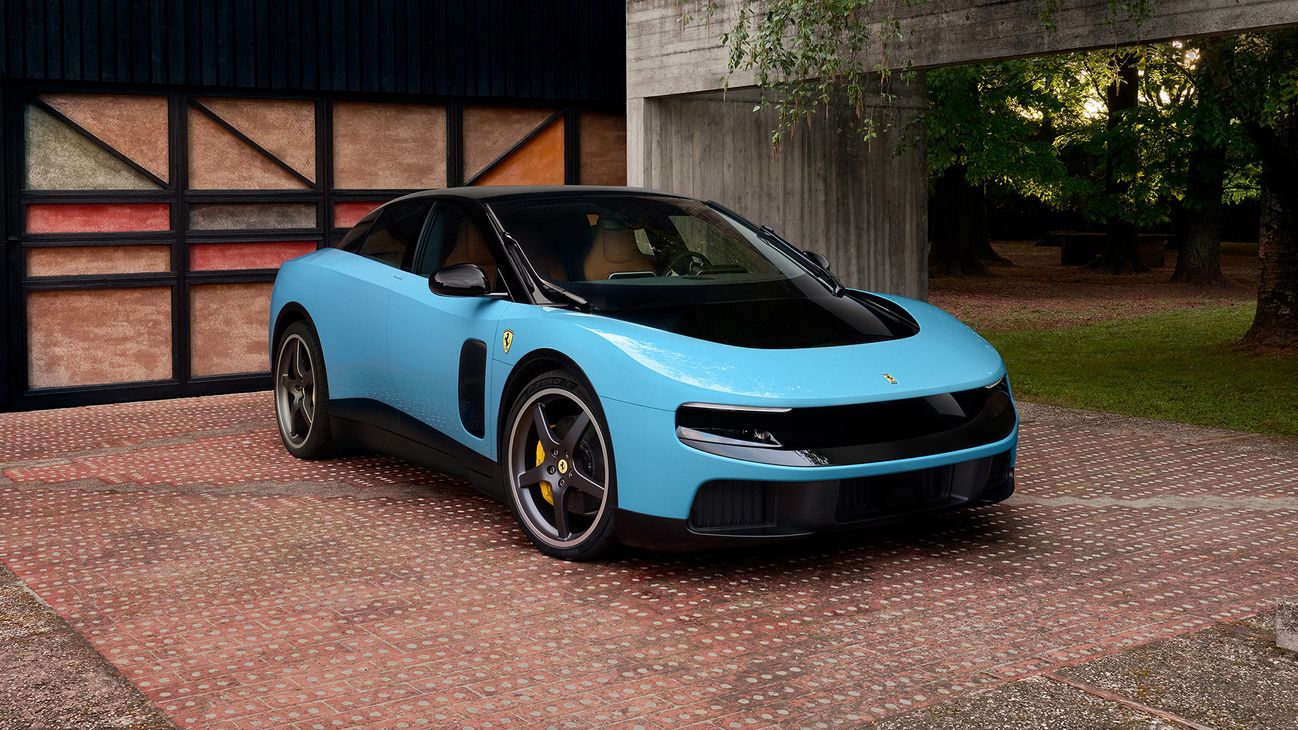
So here it is in blue.
I don't think I have the red picture here.
And red actually, it doesn't look too bad in red.
So one thing I'd like to explain to you guys here,
I think I have a picture for that.
Oh yeah, a picture here.
You have to see the vehicle kind of two different bodies.
You have like the base shape of the vehicle here,
which look like, you know, one straight line
from the bumper here, all the way to the top,
which what does that remind you of?
Straight line from bumper to top.
The Cybertruck.
Yeah.
But then you have the sort of wrap this thing around it here.
And so the top of the hood here,
which doesn't actually touches the hood is floating
because it's a head stock.
It's basically, it's a hair stock that goes through here.
Changes the look of the front end of the old profile
in the front end of the vehicle.
And then in the back, it's sorts of,
do I have a features of the back here?
I don't think I do.
Yeah, it's about on my part.
It looks like the back, like the tail lights and everything.
We're kind of getting swallowed inside the mouth
of the wrapping around the vehicle.
So yeah, it's apparently a very tough sell
to it for a lot of people, the reaction.
I mean, we posted a bunch of videos on YouTube.
We have the article on the next track.
You can read like how many comments on this thing.
179 comments, but like thousands and thousands
of comments on our social media.
I get, you know, on Instagram,
you get AI summary of the comments on your post.
And, you know, there was like thousands and thousands
of comments on our posts on the luce.
And the summary, the AI summary were brutal.
People are very much disliking the look of this vehicle.
So this is clear, but you know what?
The main thing about any Ferrari is like, it's not for you.
It's just, it's for so,
because I guess the price is obviously
I should talk about the price a little bit.
It's like, it's fun.
That's the one thing I don't like.
Yeah, I get why.
550,000 euros, 640,000 USD for the vehicle.
So it's not in any way shape or form,
one of the cheapest Ferraris at all.
Not of the more expensive.
It's not like the exclusive like million dollar vehicle,
but it's also, you know, the pro Sangui,
I think starts in the mid 200, I think.
Obviously it's a Ferrari.
So once you get the options going and everything,
it goes up super quick.
So I would assume that it's going to be a similar thing
for this one too.
So probably closer to like a 700, 800,000 dollar car,
which sounds nuts because it is nuts.
Now, one thing that I'm gonna,
because the design, it's whatever subjective you like it,
you don't like it, I don't really care.
One of the things that I want to push back on is like,
a lot of people were saying it's, you know, it's ugly.
It's super expensive.
And it's not even as good as a Tesla because of the specs.
And I have to push back here
because this is not a Model S plan.
It's, I get that the specs are similar, you know,
1000 hours power.
First of all, 800 load system already.
It's a little bit slower at 2.5 seconds, 0 to 100,
but it's not about drag racing this vehicle.
It's about four motors, one at each wheel, torque victory,
rear wheel steering, independent, active,
electronic suspension at each wheel.
So, you know, it's closer to like the Porsche,
Taycan, GT, turbo, you know,
which is also like a 200 plus thousand vehicle.
So you compare, not still comparable in pricing,
but you know, when you put the Ferrari logo on it,
it's always more expensive.
So this thing is going to be crazy to drive.
Now, speaking of the driving,
my biggest grip with the launch is that,
and we're going to talk about the interior too,
because I think the interior is worth talking about,
but my biggest problem with the launch itself is like,
the launch event was a lot around the fact
that this is a Ferrari, it's not,
one of the line that was often repeated is like,
this is not another electric car, it's another Ferrari.
You know, a bunch of variation of that line, it's like,
and what is Ferrari about?
It's about the emotions of driving,
how you feel when you drive the vehicle.
It's like, okay, and I look at the technology,
the electric platform behind it,
I'm like, I'm sure this thing can be a blast to drive,
because Ferrari, what they are known for,
is the tuning of the vehicle,
just like the raw connection that the driver
can have with the vehicle due to the tuning.
And when it comes to an electric vehicle,
if you have independent traction at each wheel
with four motors, if you have rear wheel steering,
if you have torque pictoring,
if you have active suspension at each wheel,
you can do some wild things.
This thing can be like a rail gun on the track.
Like the last thing I can think of,
you know, I haven't drive the Porsche GT,
but I've driven like the Audi GT,
which is also, you know, very similar to the Porsche,
that reminds me of that,
like it feels insane on the track.
And the Draco actually was, you know,
similar power, similar capability.
Yeah, Draco was, I didn't drive that one,
but I was riding it and it was crazy.
I was riding it with like the Lamborghini test driver,
and he was also crazy impressed by it.
So I think you can drive some crazy thing with it.
But then we didn't get to drive it.
So we just got to see it.
So it's, if you're a whole...
You didn't get to sit in a drive?
No, not even.
The only thing that we sort of got to see is,
apparently MKBHD got to drive it,
but couldn't release it in his video yet.
So I guess he's gonna have a new video about it soon.
They showed us like a 90 seconds video
of Charles Leclerc in Lewis Hamilton,
who are, you know, F1 drivers and Ferrari ambassadors,
driving it and riding in it.
And they were, you know, crazy impressed by it
and it looks super fun.
But at the same time, they are Ferrari ambassadors.
So it's like a little bit pious.
But yeah, it just, it feels weird to have the launch all be
about, whoop, am I like that?
What's going on?
I'm back.
Sorry.
Yeah, there you are.
Yeah, might be my hotel internet connection.
Sorry about that.
Sorry if I'm sniffing a lot, I'm just still recovering
from a little bit of a cold.
Yeah, where was I about that?
Yeah, it just feels weird that the whole launch,
I'm just, I'm just like, what the hell is going on?
Was about, you know, the emotions of driving a Ferrari
and a Ferrari's ability to replicate that
into an electric vehicles.
You know, there's a lot of interesting things
they did about that to keep that connection,
like obviously the sound that we talked about last year
where they put an accelerometer inside the electric motor,
inside the rotor, so that you can take the data
from the rotation and the vibration of the motor
and amplify that through the speaker of the car
to give feedback to the driver.
So it's not actual fake engine sound.
It's real sounds coming as real as like an electric guitar
through an amplifier is, let's say.
I think that's a very interesting solution.
We got to hear it a little bit.
Cool sound, like a very electric vehicle sound.
It's not, you know, it's not an engine sounds,
very much a motor sound, you know, a little bit tuned
that still sounded too aggressive.
And sometimes like an electric motor winding
can be a little bit, you know, on the higher side.
It's not as fun, but you know, they made it work.
The other thing that they did is that you have the paddles,
the shifting paddles on each side of the steering wheel.
And those are on the left side is the regen.
You can add regen.
And on the right side, you can add torque.
So you can play with your torque.
So it's not actual gear shifting,
but it gives you the feeling of it on driving.
I don't know how well this is executed
because again, we haven't driven it.
So I think that's just the thing that they dropped
with the launch, because I'm sure like they was talked
about us driving it later on this year and everything,
which, you know, I'm hoping that they invite me to that
because that would be crazy fun.
But I think they should have matched the launch
because other than that,
people are gonna just talk about the design
because that's the main new information
that you get this way.
But now let's move on from the outside of design
to the inside, because that I think is where love from,
Johnny Hyde and the team really shine.
I really enjoyed the design.
The seats are very much understated.
They look, you know, quite simple,
but I think they look very elegant, beautiful,
and they felt comfortable to sit in.
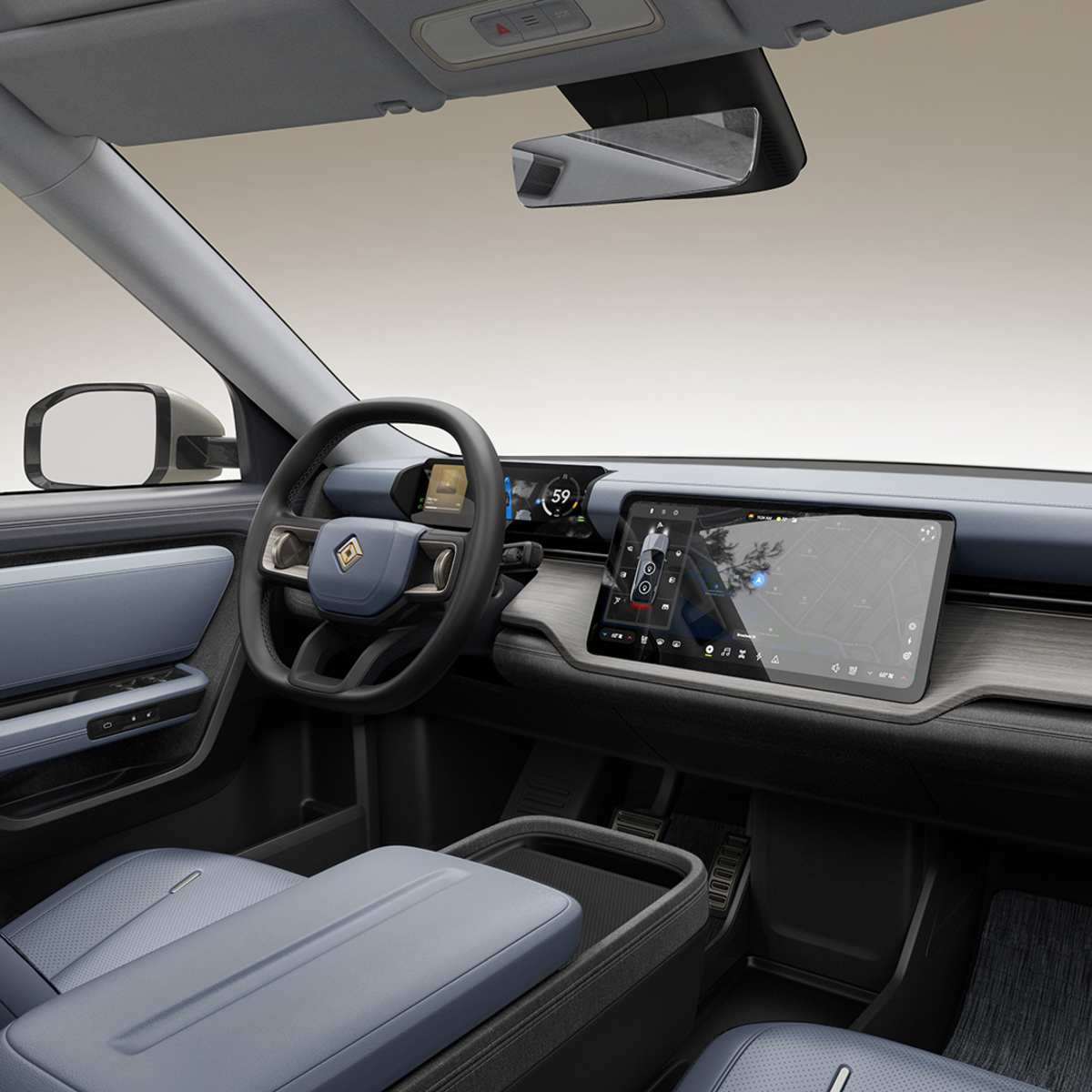
The steering wheel is honestly the coolest
steering wheel I've ever seen inside a vehicle.
A tin steering wheel, which minimal buttons on it,
but very cool buttons, including like the,
you have the mode buttons and, you know,
a few of the suspension, a few of the things,
just very simple and you see the beautiful paddle there.
And every single button inside the vehicle
is super satisfying to use.
These fans here, the way they click when you close them,
they look like a little vent from like an airplane motor,
super satisfying.
Same thing for those little switches.
The launch control is like an airplane,
like when you flip it, pull in the top, it's so cool.
And all of those things, you can see that,
you know, a team of designers spend a lot of times
on every single one of these little details,
cause they look cool.
The, there's still touch screen,
but there's just two of them.
There's this little one in the back here,
which I'm not even sure is a touch screen to be honest,
which you know what I think of it.
I think it only shows you like the driving performance
of the vehicle, which I guess it's something you wanna see
when you're on the back seat of a Ferrari,
which is not the best place to be in a Ferrari, by the way.
And, but on the front here, so this, this panel moves,
you can, you know, you use, there's a big end on the front,
which also you have on each side,
and you can see can swivels,
you can put toward the passengers or the driver,
and you have all the information about the vehicle,
all the settings and everything on the touch screen in there,
plus actual analogs button at the bottom for, you know,
the audio and the air controls.
Very, I really enjoyed the interior to be honest.
Other than the back seat, I have to,
my only gripe is that the back seat here is,
you know, there's a, it's a suicide door.
So it's suicide doors that put a lot of emphasis
on the back seat, you know, you open it up, you know,
it looks like, okay, the back seat is important in this car,
but then I sat in it and like, I'm six feet tall
and I had a ton of leg room, okay, a ton of leg room,
but it's not deep enough here.
So my feet just, my, they go way up
and I'm not supported for like a third of my legs,
even though I'm not, you know, that tall.
And then if I put my head on the headrest,
my head touches the roof.
So I would have given up, you know, two inches of leg room
because there's plenty of inches.
Like I had another six foot person sit in the front
and, you know, get a comfortable driving position
and it was like, you know, six inches between me and the,
in the seat.
So I would have given like two inches of leg room
for an inch of height here.
So if you're over six feet tall,
you won't be comfortable with the back seat.
What if the back seat can be moved forward though?
I didn't see any functions for that.
Maybe unless I missed it.
So just to step back a little bit,
obviously Johnny Ivan, Mark Newsom are former Apple designers.
They, Apple had a car program.
Do you think this was the Apple car at one point?
That's what a lot of people are saying,
like the way that they look at it.
But I don't know how, I don't think,
you know, the Apple car program must have been pretty far along.
They must have had a lot of designs.
I don't think they could have reused that.
I don't think, I don't think Johnny Ivan goes away,
goes to love from and then goes with his design.
Maybe, maybe he's like, do you think that's possibility?
Well, I'm sure it's not a hundred percent the same thing.
It's not zero percent the same thing,
but there's probably some amount of Apple car in this thing.
Yeah. A lot of people are saying that.
A lot of people just look like you can remove the Ferrari logo
on this and put the Apple logo and that would be it.
And I see it. I see what they're saying.
I see it's like super modern, super simple,
like the lines of the vehicle are super simple.
And I see what people are saying when things are not Ferrari-like.
So if they're not Ferrari-like, you can easily apply it to another brand.
But yeah. Yeah.
I mean, the stocks fell, the Ferrari stock fell 8 percent.
Yeah.
It's obviously, I think the overall reaction is negative
and people don't want to see an Apple car in the Ferrari lineup.
I did something interesting on the day of the lunch.
I got to see the car on Saturday.
The lunch was actually on Monday,
but there was like a media lunch also on Sunday and I got to attend that.
And there was a few hundred people there
and they did the whole show before the actual show on Monday.
And I would have assumed that,
so a lot of journalists got to see the car before that
and film the video on Saturday like I did.
But talking to people before the event,
I figured that it looks like about half of the people there had not seen the car.
So what I did when they actually released,
unveiled the vehicle, was instead of looking at the vehicle,
which I already seen, I looked around.
I was, me and Tim Stephen did the same thing.
We were both sitting together like,
we were like just looking around like, what people are thinking?
And like, I can tell you that there was a lot of a, oh, face fall.
But like, they could not believe it.
Yeah, you should get a video of that.
Like that should be a people's first reaction.
Seth, this level of security there was,
I've never seen anything like that.
They had me sign an embargo.
You know, normally that's standard.
People have you sign an embargo,
so you don't break the news before it comes out.
That's the deal you make with these automakers.
And like, they invite you to see the vehicle ahead of time,
but you agree to release your thoughts on it
and the pictures at the same time, that's fair.
The embargo was a little bit tougher than usual.
Like if you released information at a time,
like a half a million dollar fine or something.
It's like, okay, whatever.
I'm not going to break the embargo.
Like my word should be at the end of whatever, that's fine.
But then, even though we have an embargo,
they didn't want anyone to have any footage of this
on their home device.
So I arrived from the airport, go to the hotel.
At the hotel, the Ferrari staff put stickers on my phone.
Then we go to a car.
They bring me in a car to the venue.
At the gate at the venue, security pops into the car.
Look at my phone.
Okay, you have a sticker, you can go.
Drop me off at the venue.
Before going to the venue, they check again.
Then at the venue, I get escorted from the entrance of the venue
to the car.
Before I see the car, they check again.
They had, you know, people that had like ribbon glasses.
They made sure that they were not metal glasses.
It was nuts.
And then all the filming, they filmed with their own cameras,
everything.
And then they only sent me the footage three hours before the embargo.
So thank God my girlfriend was here with me
and she's a video editor.
And she was able to get the video out in time.
Because for all the people that were doing mainly,
and for me, an article, it was easier.
I just had to put the pictures of the article in there.
But yeah, it was very, very intense when it comes to that.
So no, I didn't have my, I had my phone with me
when the unveiling happened,
but I couldn't film anyone's reaction.
But yeah, the reaction were overwhelmingly bad.
The stock went down 8%.
But then it recovered in the last two days.
It basically recovered because the CO came out
and said that they are actually clucking up orders for this.
And now we have to put it in perspective a little bit
because there's this kind of unwritten rule
within the Ferrari community where there's a,
it's almost kind of a point system that they have
with the order books where if you want to be able
to buy some of the very, very exclusive Ferrari,
which often, you know, appreciate quite a bit
after their launch, it's great as a Ferrari collector,
but it's also not a bad investment.
So they make it a very exclusive thing.
And to get up on that list, it's good to buy, you know,
other Ferraris that are fully specced out and everything,
and to buy all of the Ferraris that come out.
This is a different game.
Like this is a game for a world class that you and I
are not even close to.
Like people that drug million-dollar cars several times a year.
And so probably a few of them bought the luce for that.
But Benedito Linna said that actually some new customers
are coming in too for it.
And that was, I think, the real goal of Ferrari here
is to get actually new customers, which is good news for Ferrari.
I'm very happy for them for that.
But I'm actually more excited for these old-school
Ferri people that are buying the car for maybe just to get
up the list on the next hypercar that they come out.
Why? Because I wouldn't be surprised that these people,
which I wouldn't be surprised if they're not very pro-easy,
they buy the car and you're like,
all right, I'm going to drive it just because I just dropped $700,000 on it.
And they drive it and they're like,
this thing is actually pretty nice.
It drives very well.
It's fun to drive.
The electric, I don't have to go to the gas station
or have my gas guy come over and fill it up, I guess.
So yeah, and then maybe it opens them up to like,
ah, you know what, it's electric is cool.
And my main thing is like, I think it's very cool to have a brand
that's obviously, as Dean says here, is like the 12-cylinder.
It's like it's known for its 12-cylinder engine and it's going electric.
It's, that's what's exciting about it here.
And obviously, I think most people expected the first Ferrari
to be kind of like a supercar, a hypercar, like the Roadster,
like the Navara or something like that.
And it's not that.
They went with a four-seat, a five-seater actually,
four-door hatchback.
So it's like, it's not really what people expected, which is fine.
But I think that we're not too far off from that.
Like the main thing, and they were open about it,
is like we're not doing a sports car right now for, because of the weight.
We couldn't get the weight down enough to make sense.
But we're not, you know, a few more years of battery improvement
and they're using, you know, very advanced and MC cells in there,
but there's already things coming out right now that I think would
shave off quite a bit of weight of that battery.
They're using a 122-kilometer battery back on this.
I could, I could see in the next few years an 80-something kilowatt hour pack
that makes sense, the Ferrari for the weight, for a super, a hypercar, supercar.
And with a Ferrari logo on it, all electric, super fun to drive.
So this is more like a test for them.
See how does the sound works, for the feeling of the emotion of driving,
how does the the solution for the gear shifting,
which is the torque shifting now, how that work,
really get a hold of the electric powertrain and apply it to their unique emotional driving experience.
Hopefully it went well enough that they keep going towards that direction.
I've never seen such a crazy backlash to be honest with you.
All right, two more pieces of news, and then we jump into the comments section.
I know there's not that many comments today because we went, we started a little bit early,
but you still have a little bit of time to put your question, your comments about
today's episode, any of the topics that we discussed, or any other topics in the EV world.
First off, the whole high from Waymo is officially starting its ride this week.
So it's in San Francisco, Los Angeles, and Phoenix.
If you order a Waymo, you actually get a free ride in the Hawaii.
So it's the new purpose-built autonomous vehicle from Zekar in partnership with Zekar.
And this is a nice vehicle. It's, you know, what I thought the subricade would be.
Another two-seater vehicle. Plenty of that groom.
You can sit in the front or in this back seat here.
It's, you know, you can move the seats quite a bit.
Yeah, the controls are all in a straight line on the side here.
Very simple, very straightforward, very user-friendly.
It's also all with Bri. So it's inclusive to visually impaired riders.
It is also communication from the vehicle to outsiders.
So, you know, everything is built to accommodate everyone and to support autonomous operation,
including even they thought about making it easier to clean.
You know, the eye-pace is not, maybe not the easiest vehicle to clean out there.
So, the Ohio is pretty cool.
And it's also equipped with a six-generation Waymo driver,
which probably is the bigger deal here because it brings the cost down quite a bit on the vehicle itself.
So, I don't think they are sharing in any way the cost of the Hawaii itself,
but the six-generation driver is believed to be under $20,000.
So, whatever the vehicle costs, you just have $20,000 to it,
and that's what Waymo pays to deploy this vehicle,
which is, you know, pretty reasonable for starting to get close to competitive with Tesla,
which Tesla has an advantage on that.
They achieved that with cutting the sensors count by 42 percent,
29 cameras to 13, 5 LiDAR sensors to 4, fewer radar units,
and the latest computing power, of course.
Oh, yeah, we have, we even saw it charging here.
A reader sent it to us, and thank you, Alexander, sent an image of it.
You can actually see the vehicle charging here.
It has a little frunk that's actually a charge port, and you can plug it in from here.
It's also a bit more efficient to, I don't know,
I don't think they release too much details there other than, like,
has, you know, more efficient overall for the power train.
It's electric, obviously.
Yeah, it doesn't look bad. It's like a minivan.
I wonder if they could also do package deliveries with that thing.
Yeah, kind of shape for commercial purposes, too, right?
All right, quick update before we go into the comment section about the Chevy Equinox
and Blazor 2027. We, you know, we're already at that time.
We get to see the first details of the 2027 lineup across all the automakers.
Not the biggest update here, but what we're learning from a few sources
across the interwebs is that biggest update is the Naxx.
You finally get the full Naxx lineup on the Equinox and Blazor.
So, you know, no need for the connector at the Supercharger.
And a big audio update. I didn't know this.
Apparently, people were complaining about the audio on the Equinox and the Blazor.
It seemed fine to me.
Yeah. Or maybe the premium, maybe the premium version was not
good enough. And then, so now you have an optional 8-speaker premium Bose system
for the higher trim, the SS Blazor. And what's the higher trim on the Equinox?
Yeah, that's not an Equinox SS. I think it's like an LT or something.
LT, yeah. RS, yeah, RS is nice.
Yeah. Yeah.
And also, there's new options for the Supercruise, the latest Active Safety Package 3,
and Supercruise packaging with heads-up display, and hand-sparking assists,
and Supercruise package for $3,355. The pricing is similar. I think $36,500
for the base Equinox goes up to $49. Quite a range on this.
And the Blazor, no pricing yet on the Blazor? No, not sure. Okay.
All right. Well, that's it for the news this week, and jump into the comment section.
Lutex says, I'll be very worried if Seth ever says anything other than, I'm good.
Yeah, me too. There's been some crazy weeks. Let's just say that.
Yeah, if he says, I'm okay, like panic.
Yeah. Head for the hills. Brett, I'm in Montreal and been here this past week.
It's amazing. So many electric cars too. I was surprised how many electric bikes
and motorcycles were in Montreal. Well, if he was there this week, Jesse,
it was maybe was for the F1. So there's always a lot of electric cars in Montreal,
but in F1 week, there's a lot of gasoline cars too.
I have to echo your sentiment with seeing the Luce for the first time. It's not a
bad looking car, but it lost its Ferrari heritage look. Yeah. Yeah. It definitely doesn't feel like
a Ferrari. The Ferrari looks like a small car stuffed into a large Otterbox car case.
That is an interesting take on it. I also get that.
Yeah. It's a wrapping all around it.
Yeah. I wonder if they could put like a different wrap on it or different.
I don't think the structure of the car itself is like that. It's more like the way to think
about the design of it. It doesn't look any less like a Ferrari than an
Urus looks like a Lamborghini. Urus is that SUV, but I would say the Urus does look like
a Lamborghini a little bit. Yeah. Yeah. I would disagree with that.
I personally like the design of the Luce, and though I understand why others may not,
it's unfair to jump to conclusions just yet. I have no doubt it will be amazing to drive,
but we'll see. Yeah. I'm in the same boat. I like it. Yeah. Just kind of Ferrari.
On the drive back after they showed me the car, I literally told the Urus, the Ferrari
PR guy, I was like, probably like the first week or two. Don't look at the comments too much.
Work maybe a month for things to settle before really pulling the real feedback in.
And I was right that the reaction was, hmm. Most people hating on the Luce
weren't realistically in the market to buy one anyway. Yeah. That's 0.01% of the population.
That's a thing. Like any Ferrari, it's not for you anyway.
The Luce looks better than a Cybertruck. Also, Ferrari has made one good-looking car in the
last 10 years. What do you think that car is? The Amalfi is the Roma also a good-looking car.
Like this is a lot of great-looking Ferraris. All right. Dean says,
unfortunately, this Apple design was lost in translation. Clearly, they are missing the
vital exotic status and excitement-driven elements that 10 millionaires to pay half a million dollars.
All right. Go to Zagreb, which is the capital of Croatia, while you are in Europe and try
Verne Robotaxi to compare it with Tesla. Is that on your trip? I mean, if I'm going to go to Zagreb,
like get me inside a rematch. I would test it for sure if I can compare it to like
but I don't think I even could compare it to the latest FSD there. So, yeah, it wouldn't be a great
comparison. If this was released as a new Apple EV with a 300 horsepower base, 400 horsepower
all-wheel drive models, getting 300 miles of range, starting at under 40K, it would have been a big hit.
All right. Yeah, probably right. Yeah. The Ferrari uses superpowered EV drivetrain in the body of their
new 12-cylindry using a half-sized battery pack for lower weight. It would have been a big hit.
You know, it's not that. It's a sedan with a hatchback. It's just not a supercar type of deal.
All right. What do you all think of the Volvo EX60? I think it's a great car.
Lots of range, great acceleration, Volvo looks. What do you think?
Yeah. I think we talked about it two weeks ago on the podcast, something like that. You can check
it out for a more in-depth talk, but we were both, you know, not many complaining about that car. I
think Volvo hit it out of the park with it. All right. I have never known how to pronounce Ohai.
Yeah. No. Is that right? I don't know.
Yeah. I said Ohai. Normally, it's probably not a good idea to listen to my pronunciation
of English word to know, but I call it Ohai. I think I've been to Ohai once in my life.
I don't remember if all people were saying it there, but I think it was that.
I could easily see solid state batteries used in a Ferrari virus going to afford it,
and the lower weight would be a perfect fit for a performance supercar. Yep. Makes sense.
That's where I see things going in the near future for Ferrari's electric vehicles yet.
Question. Slate has announced pre-orders start June 24th. How are you feeling about them?
They announced that, but the pricing is not confirmed yet. So I think the pricing is coming
out soon. That's the main thing like that. The pricing is going to be a maker or break for them.
So mid-20s, they said. If they can get there. Good. Sorry. Question. What do you think about
the Anthropic and Tesla data center lease? Could Anthropic pull out of the deal early?
I think that listening to what Elon Musk says these days and taking it as space value is probably
a bad idea. I've said what I said about the SpaceX IPO. I think it might be the thing that
pops the entire bubble of the stock market that we see these days. I don't know if you've been
following this said, but in the filing for the SpaceX, I think we talked about the SpaceX filing
a bit last week, but the deal was like 1.25 billion a month and then going up in May and June
because Colossus II now is also in play because Grock doesn't need anything because no one is using
it. So the idea is like, oh, okay, now it's not a bad recycling of those crazy data centers
which has terrible financials for a $2 trillion company. So it helps a lot with their financials
if they have like a $20 billion a year of revenue coming from this. But then Elon came out yesterday
or the day before on Twitter. And it's like, actually, this is just a 180-day lease that we
have with entropic that can end at any time within a 90-day notice or something like that.
Jesus, that's not the same thing that you guys presented in the S1 filing just days ago.
I've seen several of those Zikrs cruising around Silicon Valley, most are Jaguars though. I haven't
seen Ioniq 5 yet. Yeah, you know, I saw the Zikr at the LA Auto show like three years ago.
They had a pre-pre-pre addition. Yeah, they've been working on that for a while. The Ioniq 5 is
not ready just yet. I think that's coming soon though. All right, do we want to post more to
Mondona Lab? Yeah, I think we discussed it already a few weeks ago. My hopes now are
on the floor when it comes to that. All right, Rich SPK, the comedian says there should be an
electric track so you can get a tracks with NAX. Sounds like a Dr. Seesquot. The tracks is like
a little bit smaller in the blazer. Yeah, smaller SUV. What foreign brand EVs are currently built
in the USA? There's quite a few built in the South like Hyundai's, Kia's, Mercedes, Georgia, Mercedes
are in South Carolina, Volvos are in South Carolina, I believe.
Nissan in Mississippi. Yeah, Mississippi and Tennessee, I think. Yeah, they're all over there.
Have you all heard anything about when Volvo EX-60 will start arriving in the US?
You haven't heard anything that's not already out there? No.
Hype for Formula Sun this summer? Yes. So just for everybody out there,
we're going to be in Minneapolis, a little bit north of Minneapolis for Formula Sun this summer.
That's going to be July 20th, I think the 25th. It's also very close to the same time as the
Oshkosh fire. So if you're doing one, you can do the other fun times. Donut Lab is some BS.
That sounds about right. Yes. All right, that's it for the electric podcast this week. I hope you
enjoyed it as much as we did. I'm going to be back in Quebec next week. So it's going to
should be back at normal timing. And I hope you guys have a great weekend. And then we're going to
see you next week. Bye-bye.
About this episode
Robotaxi numbers take center stage as the hosts walk back an earlier Tesla fleet-growth claim, citing that “the fleet is actually shrinking and not growing,” and zoom in on the dashboard’s “active unsupervised” seven-day trend that spiked and then “crashed.” They also compare Tesla’s autonomy safety narrative to Reuters reporting about internal skepticism. The show then pivots to Ferrari Luce controversy—$550,000 euros, harsh backlash, and a points-style allocation system—before shifting to Waymo Ojai and Rivian R2 efficiency/EPA updates.
In the Electrek Podcast, we discuss the most popular news in the world of sustainable transport and energy. In this week’s episode, we discuss Tesla's alarming Robotaxi numbers, Ferrari's controversial Luce, Waymo Ojai, and more.
Today’s episode is sponsored by GM Energy. If you want to experience more resilience and control over your home energy, the GM Energy Home System adds stationary battery power for always-ready backup energy for your home, and the GM Energy PowerBank takes in energy from the grid and stores it for when you need it most. Learn more at gmenergy.gm.com
Special: This week, the podcast will start at 3 p.m. ET because Fred is still in Italy after the launch of the Luce.
As a reminder, we’ll have an accompanying post, like this one, on the site with an embedded link to the live stream. Head to the YouTube channel to get your questions and comments in.
After the show ends at around 5 p.m. ET, the video will be archived on YouTube and the audio on all your favorite podcast apps:
We now have a Patreon if you want to help us avoid more ads and invest more in our content. We have some awesome gifts for our Patreons and more coming.
Here are a few of the articles that we will discuss during the podcast: