Le Mans is a very long-distance race where cars have to keep going for hours. Teams test ahead of time so the car works well not just in daylight, but also over long runs.
Aragon is a race track in Spain where teams test their cars. Because it has long straight sections, it’s a good place to check how fast and how stable the car is at speed.
Term
P2s
P2s are a type of race car class used in endurance racing. They’re built to race for a long time and stay reliable, not just sprint fast for a few laps.
GT3s are a standardized class of race cars. They start from real production cars, but they’re modified for track racing and are used by many teams.
Term
nighttime
Nighttime testing matters in endurance racing because track conditions change—cooler air affects engine and tire behavior, and visibility is different. Teams use these sessions to validate lighting, driver comfort, and the car’s balance when temperatures shift.
Track days are organized events where drivers (often non-professional) can drive their own cars on a circuit for practice. In this context, the host compares professional testing to track days to explain the idea of renting time on a circuit for development and practice.
In a longer race, small problems and timing matter more. That gives drivers and teams more chances to use strategy and recover, even if they weren’t the fastest at the start.
They’re talking about a super-short race where there isn’t much time to make up ground with strategy. In that case, the quickest car usually matters more.
“Grid” is the lineup for the race. Being “way up the grid” means you’re near the front, which helps you get a better result even if your car isn’t the fastest.
Tire management means driving in a way that keeps the tires working well for the whole race. In long races, tires wear out, so you can’t just drive flat-out the entire time without losing grip.
Long races are different from short ones because the tires and grip change over time. That means a car doesn’t have to be the fastest for every moment to win—it can win by staying consistent and not destroying its tires.
Clay Millican is a drag racer. The hosts mention him because drag races are so short that tire grip and tire strategy don’t play the same role as they do in longer races.
A drag race is a short straight-line race where the goal is to get to the finish as fast as possible. Because it’s so short, getting off the line well can matter more than managing tires over time.
Reaction time is how fast the driver reacts when the race starts. In drag racing, the race is so short that reacting a little faster can make the difference before tire wear even becomes a big issue.
A whole shot win means you get out of the gate first and stay in front all the way to the finish. In drag racing, that can let a car win even if it isn’t the faster one on paper.
The throttle is what controls how much power the engine sends to the wheels. In a turn, using the throttle changes how much grip the tires have and how the car behaves.
Off camber means the track surface is tilted so the tires don’t sit straight up. That can make the car lose grip more easily and feel less predictable in the turn.
“Fastest lap” means the quickest one lap a driver does in the race. It shows the car and driver can be very quick, but winning usually depends on doing well repeatedly and making smart choices during the whole race.
Racecraft is how a driver actually races—when to pass, how to defend, and how to deal with other cars. It’s not just about going fast in clean air; it’s about staying quick while navigating traffic.
Managing traffic means dealing with slower cars (or lapped traffic) in a way that preserves your lap times and race position. It’s a core part of race performance because getting stuck behind traffic can erase your advantage even if you’re fast when the road is clear.
Fuel saving means driving in a way that uses less fuel than normal. In racing, that can let you pit less often—or pit at the right time—so you can gain positions even if you’re not pushing flat-out all the time.
A pit stop is when the car enters the pit lane for service—commonly refueling, tire changes, and sometimes adjustments. Race strategy often revolves around timing pit stops so you can come out in front, even if your car is slower for parts of a stint.
Stiffer springs make the suspension less “wobbly.” The car may feel more steady, but that doesn’t guarantee the tires are actually sticking better. Handling can improve in feel while lap speed still doesn’t.
“Aero” means how the car’s shape interacts with air. Some cars generate downforce that pushes the tires harder onto the road. The host says stiffer springs can help when that downforce is a big part of the grip, but not always.
Term
platform close to the road
This phrase is about the part of the car underneath that’s close to the ground. Designers can shape airflow under the car to help push it down onto the tires. If that effect is strong, suspension stiffness can help the car stay stable.
The Ford Mustang is a sporty car made by Ford, usually as a coupe or convertible. People bring it to track days because it’s built to drive fast and handle well. In the podcast context, it’s being used as an example of a car that can be fun on track even when advanced aero isn’t the main focus.
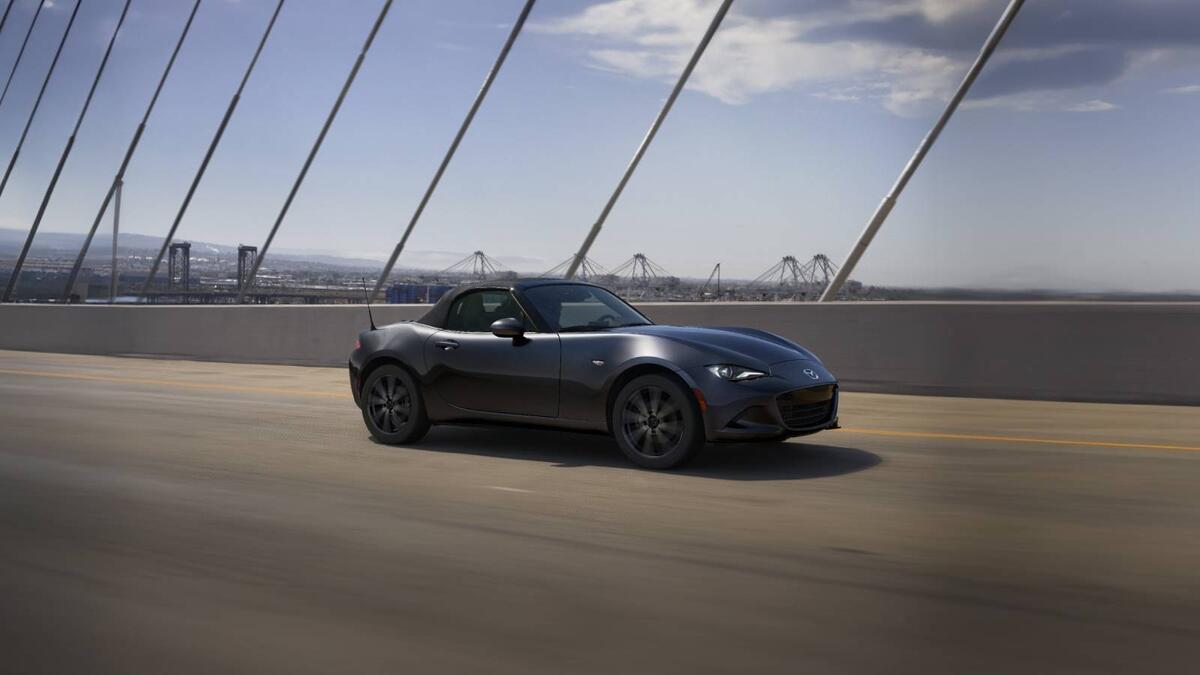
The Mazda MX-5 (Miata) is a small two-seat sports car made for fun driving. It’s known for being light and easy to handle on twisty roads and track days. In the podcast, it’s mentioned as an example of a car that can still work well even if advanced aero isn’t the main requirement.
“Softer” suspension lets the car move a bit more instead of staying perfectly rigid. That can help the tires stay in their best grip zone, especially on non-racing tires. The downside is the car may feel less quick to respond.
A “non racing tire” is a tire meant more for normal driving than track use. It usually has less grip and can lose traction sooner if you push it too hard. On track, you may need smoother driving and setup choices to get the best traction.
Grip is how well the tires can “hold on” to the road. If grip is low, the car will slide more and you usually have to slow down or lift off the throttle to stay in control.
When the car “leans,” it means the body tilts as you corner. Suspension setup can change how much it leans, and that affects how the tires stay planted.
Phoenix is where they’re talking about running very fast oval corners. The key idea is that at those speeds, the car has to stay stable and not tip too much.
Jimmy Kites is a racing driver mentioned as an example. The host is saying some drivers actually prefer the car to move a bit so they can feel what the tires are doing.
The right rear is one specific tire at the back of the car. The host is talking about how changing suspension stiffness can change how that tire grips and how the driver can feel it.
Inside tires are the tires on the inside of the turn. If the car leans a lot, those tires may lose load; if they stay planted, they can help the car grip through the corner.
“Go-kart” is a comparison meaning the car feels super quick to respond when you turn. The host is saying that if you make a race car too stiff, it can feel responsive but still lose grip.
A wing on a race car is there to push the car down onto the track. That helps the tires stick, but the suspension still has to keep the tires loaded correctly in the turn.
Term
arrow downforce
Downforce is the “suction” effect from a race car’s shape and wings that presses the tires harder onto the track. More downforce usually means better grip, especially when the surface isn’t very sticky.
They’re arguing against the idea that racing success is just about having money. The point is that talent and effort still matter a lot, even if money helps open doors.
Lance Stroll is a Formula One race driver. People often talk about his family’s wealth, and the host uses him to show that money isn’t the only factor in results.
Lawrence Stroll is Lance Stroll’s father. The host mentions him because his wealth and team ownership are part of why people think money plays a big role in racing careers.
The “ride engineer” works on how the car feels and behaves over bumps and curbs. The goal is to keep the tires gripping instead of bouncing or losing contact.
“Roll” is how much the car leans to the outside in a corner. The roll engineer helps tune the suspension so the car stays stable and predictable when you turn.
Hybrid systems mean the car uses both a gas engine and an electric system. In racing, that adds extra control and complexity because the electric part changes how power and braking work.
Electronic braking means the brakes are managed with electronic controls. That lets the car fine-tune braking for grip and stability instead of just applying the brakes the same way every time.
They’re saying the race engineer’s role has become more like a manager. They gather advice from different specialists and decide what changes to make to the car.
Weight transfer is when the car’s weight shifts around as you turn, brake, or accelerate. If the weight shifts too much, the tires lose grip. Keeping it more stable helps the car turn and stay fast.
Chassis balance means how well the car’s front and rear are working together when you turn. If the balance is good, the car turns more predictably and you can drive faster with less drama.
LIVE
Statistics are like bikinis, they show a lot, but not everything.
When I hear somebody say, oh, well, the only reason they're there is because they got money.
What they're really saying is the only reason I'm not there is because I didn't have money.
Number one, you need a fast car to win.
Number five, all it takes to make it is money.
Number seven, racing is fun.
I'm sorry, even just saying it out loud.
Not really. There are some times when it's really pretty bad.
Okay, let me just double check this works one more time.
Yay, yeah, it works.
Okay, welcome to It's Not the Car.
This is a show about racing and the people we are under pressure.
My name is Sam Smith.
I'm a recovering motorsport journalist and a club racer,
and I have another one of those shows where all three of us are here,
and I'm happy about that. That's cool.
Hi, Jeff. Hi, Ross.
Hola.
Hola?
Hola.
Have you been to Spain?
I have been to Spain. I just got back yesterday.
This is like the person who comes back from England with an accent.
That's the only word I know.
Everybody said that to me. I just said hi.
Is that like your full Spanish vocabulary right there?
That's a gracias, but I don't think I say it right.
And then Barcelona is supposed to say it like that.
It's very important.
So you were over there testing for Le Mans. How did it go?
Yeah, it went good.
We tested for two days at Aragon, which is not part of Lord of the Rings,
as it turns out.
Some people are like, well, that sounds like it's from Lord of the Rings.
I don't know.
It's halfway between Madrid and Barcelona.
Anyway, we tested there.
Had a good test.
It has a super long straightaway.
So a lot of Le Mans teams were testing there.
This one was only open to Le Mans Enter team.
So there was like 12, 13 of us, P2s mostly and GT3s.
Cars ready, do a little bit of a rebuild on it after the test
and ship her off to Le Mans in a couple of weeks and go do that.
So good test.
You said you guys got like 20 some hours of testing and a bunch of nighttime.
It sounds great.
No, it's a good test.
It's like a company that does test days, kind of like you think of track days.
There's a couple of companies in the U.S. that do the same,
but they arrange it with the track.
They arrange the catering.
They arrange lighting and marshaling and ambulances and everything.
A lot of people test there because the straightaway that they have
is slightly longer than the longest straight at Le Mans
between like between the Chicanes or whatever, you know,
so we can get to that full, full top speed and run the same arrow levels.
Ross, were you in Spain?
I know you're in Spain.
I was not in Spain.
I was on the island.
That sound like a tropical tropical.
Grass skirts and my ties and except it's not the kind of island.
It's Canadian, which means grass skirts and moose.
I'm now picturing a moose wearing a grass skirt.
But anyways, the Vancouver Island Motorsports Circuit
hanging out there doing a lot of programs there.
And, you know, the goal this year was to cut back on travel.
I haven't been home for a weekend in four weeks,
and I won't be for another six weeks, I don't think,
but they're shorter trips and I'm loving it.
I'm absolutely loving it.
That's good.
I mean, because for what, like 40 years, 500 years, however old you are,
you're basically timeless.
97.
Come on.
96.
For 96 years, you were traveling like every other week
for 300 days a week, something like that, right?
Every other week.
That sounds like a, that's a slow.
Don't think too much about it.
That's a slow year.
Yeah.
Did I tell you that I used to keep a spreadsheet
every night that I stayed in a hotel room?
Really?
Did you rate them?
No, I didn't know.
It would be pretty simple there.
Zero.
Not good.
Crap, crap.
Better than crap.
Smelled like crap.
Yeah.
But yeah, I can't remember if this was the record or not,
but 243 nights in a hotel room, which Jeff, I mean,
you know, that's pretty normal for us, right?
Dying is to keep track.
And it was always, do you know that we spent more nights
not at our house this year than we did at our house?
I love, I love how everybody like copes with travel
and with how everything changes, right?
Like the little tricks you do to keep yourself sane.
Like I had one friend who, he had a spreadsheet
where he rated Holiday Inn Expresses based on the quality
of the breakfast, which makes no sense
because they all had the same breakfast.
But you know, some of them turn out like, oh, man,
the raisin bran in this one was stale.
The raisin bran in the one down the street was even more stale.
But this one had the pancake machine,
and not all of them have the pancake machine.
I never did any of that.
I mostly just sat on an airplane and looked out a window
and went, why am I here?
What should I be doing?
I don't know.
That reminds me of, of rating things.
Then we should probably actually do a show.
But otherwise somebody's going to rate this show as zero.
Zero.
Would be an upgrade.
Hey.
When we had Jimmy Kite on, we talked about a lot of things,
but I had forgotten.
There was a time when he was the young whippersnappers
straight out of USAC, Silver Crown cars and everything.
And he was traveling with Team Scandia, IRL team.
You know, it's like, where are you going, Jimmy?
Tonight. What are you doing?
Well, research.
He was researching.
He said he was going to write a book on the racers guide
to strip joints.
I was, you said research and I was biting my tongue,
like, don't say strip clubs.
Don't say strip clubs.
There might be an app coming out.
I don't know.
Man, Jimmy, that was a good show.
Speaking of good shows, before we go any further,
we want to take a minute to thank BF Goodrich Tires.
And if this sounds like me thanking a sponsor,
it's because I am thanking a sponsor.
We like BFG.
BFG likes us and they've made a huge push in the last year or so
to really get back into the performance
and ultra high performance tire market.
Basically means they're building more tires for grassroots
motorsport and for performance enthusiasts
than they ever have before.
They make good stuff.
We like what they make.
If you have a minute, check it out.
This isn't just a thing.
What is it?
Well, I'm not just the president of the hair club.
I'm also a client.
We actually like BFG tires.
We use BFG tires.
I own some BFG tires that I paid for with my own money.
On top of that, they asked me to write a performance driving guide
and you can download it for free off their website,
which I do not have the URL for off the top of my head,
but I am sure that we will put it in the notes, in the show notes.
I like the writing part of it.
I enjoyed that part of it, but what was really cool
was the way they did all the layout and everything
and it's a pretty cool looking little performance driving guide.
For free?
Yeah, for free.
Right.
I actually have a couple of copies of this on my desk
and it's spiral bound.
It's like half an inch thick and what is it?
It's 115 pages deep and it goes into everything from
cornering techniques to how you think about the mental game
to how the mental game thinks about you
and also, I don't know, there's this raw sky on the cover
and I don't listen to anything he says,
but I've been told he's very good at what he does.
So as you may or may not know,
we change formats on this show every week.
This episode, this is a new format.
This is one we've never done before.
We call this one the fastest listicle in sports
and the focus in this show is myth busting.
Now, we occasionally do myth busting shows,
episodes where we pull apart the truths and half truths in racing
because motorsport is, when you get down to it,
nothing if not a bunch of lies and half truths,
but it's also a lot of misconceptions,
things that people think are true that really aren't.
And for this one, we're going to tackle what we think
are the 10 most misunderstood ideas in racing
and because we've got an hour show,
60 minutes, that means six minutes of myth.
So I have, very much in front of me,
I stole off the fridge in our kitchen, my wife's tea timer.
It's this little red thing made by a company called Zassenhaus.
And when you click it over, it goes tick, tick.
It's Zassenhaus's.
And then you pull it back and it goes like that.
So all of this makes sense to me.
Does this make sense to you guys?
Let's go.
Okay, so the first one, why is it still ticking?
Stop ticking, you little monkey.
It's got a magnet on the back,
which means I don't want to put it on anything on my desk
because it'll wipe things.
That's how computers work, right?
Put it down your forehead.
Okay.
It's on my, shh.
My forehead is not.
If it sticks to his forehead, we got a problem.
Save it as a problem.
We got a lot of problems anyway, Jeff,
and they're all with me.
Okay.
So our myths, I'm going to rattle them off right now
just so we know where we're going on all this
and we'll hit them one by one.
Number one, you need a fast car to win.
Number two, you should be on the throttle by the apex.
Number three, the best driver is the fastest.
Number four, stiffer springs make my car handle better.
Number five, all it takes to make it is money.
Number six, look far ahead and where you want to go.
Number seven, racing is fun.
I'm sorry.
That's even just saying it out loud.
Number eight, smooth as fast.
Number nine, more money and more people make you go faster.
And number 10, champions never lose their focus.
So with that, let's get into it.
The first myth came from Jeff and Jeff said that in racing,
it's a myth that you need a fast car to win.
Brown, unpack that.
What do you got?
Well, the reason it's a myth is because I have won some races
without the fastest car.
Some says the guy with the resume.
I may have actually, I'd have to go back and edit it up,
but I'm not so sure that I haven't won more than half of my races
without the fastest car.
Now, it never hurts.
I always like to have the fastest car.
It makes it easier for sure.
It opens up many more options,
but oftentimes when you don't have the fastest car,
you do some different things from a strategic standpoint.
And I think people would be surprised how often
the not fastest car wins races.
What do you think, Russ?
Can I use the phrase that I always use?
It depends.
I'm thinking about times that I've won
or been around teams that have won
and not the fastest car.
I think the longer the race, the less that matters.
Does it not agree?
Like if you have a one lap race,
kind of want the fastest car
because there isn't a whole lot of strategy there, right?
But I'm also going to say that there are many times
where a driver has made the difference.
You know, Fernando Alonso has done things
not in the fastest cars, but he's been able to,
if he didn't win, he put way up the grid
because of how he managed the issues the car had.
Yep, like tire management, you can take a car
and you're right, long races, Clay Millican might not agree
because his races last three and a half seconds.
You know, you're not going to out tire management
the guy probably in a drag race,
but long races give you more opportunities
to take a car that isn't the fastest and win.
Still, I mean, even in a three and a half second race,
there are races where, a drag race is where I think
the driver just reaction time, whatever,
that little bit better and they managed to win.
Well, actually, you bring up a great point.
So maybe Clay would be the exact example
because a whole shot win by definition
is that the slower car from start line to finish line won.
So in drag racing, it happens quite often.
The slowest car wins.
Yeah.
I've decided that my role in this is to sit here
and ask the obvious questions, which like,
if anybody thinks that I ask the obvious questions anyway,
shut up.
But why do you guys think that people end up
with that misconception?
Where does that come from?
I'm going to throw out something because I think
this might even apply later on as well,
but it's the easy excuse.
I didn't have the fastest car.
My car was slower.
I think that some fans, maybe the more casual fan,
thinks that racing is all about who can go the fastest
and he's got the champagne and the big trophy and all of that.
So he must have had the fastest car.
And again, I bet there's a statistic somewhere where
it wouldn't surprise me of 90% of wins
where the team just executed better than everybody else
and the team being the race team, the strategist,
the engineering, the driver, the whole package.
So often a car that is whatever, it's fifth best
but it operates and it executes 100% perfectly
is going to beat the fastest car that executes at 99%.
100% degree.
How often do you meet somebody at the top levels of the sport
who does believe this to be true, right?
Who believes that if they don't have the fastest car that day,
they don't have a shot.
The guy who qualified on pole thinks that's true
and everybody else thinks that's not true.
Well, and Jeff, I'm going to argue with you here.
The driver didn't.
The driver said, oh, the car was a piece of crap.
I put it on the pole.
There you go.
No, so as you were asking that question, Sam,
I'm kind of like, if anybody in motorsport is at the top,
they know this.
They know that's a myth.
That makes sense.
I'm sitting here, the timer's really close to zero,
but it hasn't dinged.
Wait, it works for tea every day
because I hear my wife making tea and it just doesn't do it.
There we go.
I can set my, this is what I used to time pit stops.
Does that work?
I like that.
There was a period of like a year where I used that exact
Apple ring as my wake up call in the morning.
And it ended when I threw my phone across the room
and hit the wall and picked it up and the screen was broken
and decided that I was both very stupid
and also that I hated that ringtone.
Should I pick a different one?
No, let's use it.
No, no use it.
Is that one?
Yeah.
Screw the German timer.
Go.
And then the last one, Jeff,
you have to throw your phone across the room.
Preferably at something that'll break it.
Whoa.
Okay.
That's what we're doing right there.
Okay.
Classic alarm set.
You tell me when to start.
I'll be the timer.
Okay.
Second myth.
This one comes from Ross.
This is a little more granular.
Jeff, hit the timer when I finish the suns.
You should be on the throttle by the apex.
Go.
Ross, why'd you say that?
What do you got?
I want to just go, you are wrong.
Because I heard that and my chest just went tight.
It's like, I gotta get out of bed.
Yeah.
I have heard so-called driving experts who said,
oh, you must always be on the throttle at the apex of a corner.
And I don't know, just about anything that starts off with or uses the word always in
it, short of it being something that's part of the laws of physics, I'm going to go with
it.
It depends, right?
There are corners that you should be on the throttle before the apex.
There are some corners where you should be on the throttle at the apex.
There are some corners you need to be after the apex before you get back to power.
So much of it depends on which way the car is pointing at that moment in time as you're
clipping past the apex and what happens afterwards?
Does that corner lead onto a straightaway?
Does it lead into another corner?
Is it going uphill?
Is it going downhill?
Is there banking or is it off camber?
There are just a few times over the past few years, I've seen, read, heard people saying
that and it just like, shake your head, dude.
And part of this gets to the core of, I hate it when people say, this is true.
And it's, I don't know, somebody made this up because they thought it sounded cool or
something.
So one of the things that we end up talking about a lot on this show is the notion of
adaptability, right?
The notion of there being no hard and fast answers.
And I love those two concepts because they apply to just about anything people do, whether
it's for a living or for fun or even just to kind of exercise their brains.
But what just occurred to me, Roz, what do you do when you're coaching somebody who believes
that there are hard and fast answers, who believes, for example, they're like, man,
every corner you do this and that and the other, how do you get them out of that stuck place?
Help them understand or experience when that is not true.
Throw your phone at them?
Well, no, it usually hits a wall and you break the screen.
But, you know, my job is to help a driver learn that.
And I can tell them that.
I can say, no, that's not true.
But until somebody really experiences it, that thing that's been pounded in their head could
stick with them for a long time.
So, you know, it may be a, hey, let's just try an experiment here.
Let's try something.
Let's try you staying off the throttle and see what the car does.
Does it continue to rotate slightly more slip angle in the rear tires than in the front?
The car changes direction, points in the right direction.
And now when you go to power, boom, you can go all the way to full power as opposed to this.
Oh, I dip into the throttle at the apex because there's a point there and it says I should start getting
the throttle, but then I have to pause and or lift to stay on the track before coming out of the corner.
I would think, Roz, from an engineering standpoint, you know,
maybe the car is too understeery to get on the throttle at the apex or maybe the back's coming out
and you need to be coming off the throttle a little bit or whatever.
And I would say in the same car, corner on different laps based on conditions, tire life,
where you get on the throttle would change.
And I get somebody going, well, I didn't mean it literally.
I meant that should be sort of a target that you should be there.
But it's just so dependent on the conditions and from lap to lap, that's going to change.
So, yes, you have to adapt.
There is always an exception to the myth slash rule.
We have 25 seconds. 25 seconds.
Well, let's just go to the next one.
Let's just go to the next one.
Yeah.
We'll have six minutes and 25 seconds.
Well, let's just sit here quietly and not say anything.
But we don't get to hear that thing.
Yeah.
I want to hear the clack.
This is like counting down the fuel, short time, drop the car, rev the engine, 21 go.
I need a ringtone that's just Jeff saying things like that, followed by that noise.
And then I won't throw the phone because it's Jeff.
I don't know.
I would hurt Jeff.
So our next myth comes from Jeff.
The best driver is the fastest.
Why did you say that, Brown?
What do you got?
So we have, there's all sorts of statistics now that rate drivers.
You know, we have the timing and scoring statistics.
You can look at fastest lap, fastest theoretical lap, fastest 10 lap average, fastest 10% of all the laps you ran average.
And you can look at all of these things.
And there's a company called B pillar that puts out a report after every major professional race that ranks all the drivers with standard deviation in their lap time.
And a Z score, which is this fancy statistical analysis, and it does all of that.
And I've always thought that, you know, like, I look at those statistics to try to figure out who is the fastest driver.
Most of the time, the guys who are on the top of those lists didn't win the race.
The guy who won it's like eighth, ninth, 10th, 15th.
And you're like, well, so there's the fastest, the best statistical driver didn't win the race.
And it always reminds me of the comment that statistics, I must think this five times a weekend.
Statistics are like bikinis.
They show a lot, but not everything.
And Jeff, correct me if I'm wrong, but isn't it like 87.413% of all statistics are made up?
414.
On the spot.
414.
Yeah.
Okay.
Yeah.
I think that's what it is.
Yeah, I knew it was wrong.
No, you can see it.
You can.
Right, Ross?
Isn't the question the fastest driver is the best driver?
That was the myth.
Yeah.
How do you define best?
Jeff, because have you not had fast drivers who you could not wait for them to go away and never have to work with them ever again?
Yes.
Is that the best driver?
Well, they were the fastest.
Yeah.
And I don't want it to be sounding like, well, being fast isn't important.
It is very important.
You can't be slow and be the best driver for sure.
Yeah.
You cannot.
And fastest lap, even fastest average over the entire race may be good.
But what made them fast over many laps is also how they manage traffic, racecraft.
Exactly.
And now you have things like fuel saving.
So you put a driver out who we're trying to jump them in the pits.
So what we need to do is save enough fuel so our pit stops two seconds shorter than the guy ahead of us.
And that's how we're going to pass them.
So you say your driver saved us fuel.
Well, he saved a great amount of fuel, run slower.
So his statistics, look, well, man, he sucked in that stint, but he came out ahead of the other car.
Well, how did he do that?
Well, it was the pit stop.
The pit guys saved his butt because he was slow in that stint.
And look, they passed him in the pits.
No, that was all driver.
The driver ran slower on purpose, saved enough fuel, had two seconds shorter of a fuel stop and passed the guy using that technique
rather than running a fast lap.
That's the great driver.
You look at IndyCar racing right now.
Alex Polo is the class of the field.
And Scott Dixon was, hate to say was because he's still amazing, right?
No.
One of the greatest of all time.
And the two things that the two of them seem to have an advantage over everybody else is, yes, they are fast.
They can be on pole.
They can, they can turn the fastest lap and race, but they can also do it using the tires less and using less fuel.
That's what separates them.
Before I get off this, can we flip this around just really quickly though?
There's a myth that the driver that finishes last is the slowest driver.
Oh, yeah, no.
Well, that kind of goes back to the fastest car.
Well, there are some really, really, really good drivers who are, I'm not going to say last, but they're back in the pack.
And it may be that they're just, their car is not as capable that day.
Yep.
Yeah, I think Formula One points that out.
You're not going to win with some of those cars.
I don't care if you're Max for stopping or not.
You're just not going to win.
I want to cap this by pulling this down to one thing.
What makes up the best drivers, right?
We've already talked about adaptability.
We know pace is in there, so you can't be slow.
What's the three or four of the things that just fill out that, that chart?
Broad qualities.
That make the best drivers fast.
This is a prerequisite, but it's not everything.
So it's one.
Racecraft, knowing when to pass, how to set up a pass, make a pass.
Especially in endurance racing, multi-class endurance racing, that would come bubble way to the top, I think.
And then I would say an understanding of the race situation, like saving fuel, pushing now, not pushing, taking a risk now, not taking a risk now.
A particular maneuver that has some level of risk done at the wrong time is the dumbest thing ever.
That exact maneuver, the exact technique, exact everything done at the right time is the most brilliant move ever.
So understanding when to deploy that and how the risk management.
And I'll throw out the ability to work with the team, giving good feedback on the car.
There are some drivers throughout history who you knew they were fast, but they always seem to be in not great cars.
Sometimes that's just because they could not communicate what was going on to the engineer.
And then there are times where there are many drivers who, who are super, super fast, who destroyed their careers by being less than good people out of the car.
This is where I'm also supposed to make that I'm right here, Joe Cross, but I can't do it.
I just can't.
I just feel bad.
So, okay.
All right.
So Jeff, you got the timer ready?
We got another one.
I'm ready.
Okay.
Next one comes from Ross.
He specifically laid this out for Jeff to go off on.
The myth is stiffer springs make my car handle better.
Hit the timer.
Jeff, go.
They, that's a myth.
They oftentimes do, but not always.
I think the way, the reason that myth kind of got started is because it will often, I won't say always, but it will often make the car feel better because it doesn't roll around.
It doesn't move.
I think drivers don't like movements that they don't expect or understand or it's harder to feel.
So if you put stiffer springs in the car moves less, you will think you will feel that it actually makes more grip.
But you might find that it's not really going around the corner any faster.
So it's the, what do you want?
A car that's super responsive versus a car that's got more grip, right?
And like certainly stiffer helps a car that's got like aero stuff going on, right?
Air going out of the car, like that platform close to the road controlling that.
But for a track day driver in there, BMW or Porsche or Mustang or Miata or whatever it is where aero really isn't a factor.
Explain why softer can provide more grip, but it might be less responsive.
Why that happens is because you're using the tire harder, especially if you're on like a non racing tire, you need to be a little more gentle on that tire because it doesn't have the inherent grip built into the compound and the construction.
So you can't lean on it.
You can't abuse that tire with which a stiffer spring does because there's just not enough grip in the actual tire to support that level of load.
The car might feel better, but it's going to hurt the tire and slide the tire quicker.
Now, I'm not saying you would go faster if you didn't make it stiffer because the feel, it all gets to how the driver responds to what the car is doing.
And if the car leaning way over, but making tons of grip makes you uncomfortable and you lift off the throttle because it's leaning over and you're not sure what it's going to do.
You're going to go slower than if you make less grip, but can stay on the throttle because it inspires confidence.
So the stiffer car probably inspires some more confidence, but it doesn't necessarily make grip.
And I'll give you an example. Indy cars on ovals, short ovals.
Man, you do not want a car that rolls over when you turn into a corner at Phoenix at 180 miles an hour.
You want that thing to be nailed to the ground and feel very comfortable and very stable.
But I've had drivers tell me, Jimmy Kites, one of the guys we had on the show, he would always want that movement.
He would say, I can't feel the right rear and I would go softer on the right rear and it would move.
And now he goes, now I can feel the right rear. I can feel what it's doing.
I know the grips there, but that I would say is more rare than a person that doesn't like that movement.
But the guys who can take that movement, they'll get themselves a little bit more grip.
And Jeff, correct me if I'm wrong here, but the way I picture it is, if I come into a corner, I'm turning right.
The car leans, it rolls, and a lot of drivers feel like, oh, well, that's not good.
The car is not handling well. But when you do that, if the car is softer, the inside tires tend to stay on the road more.
So they're helping. If the car is super stiff, like a go-kart, think about it as, you know, yeah, it's super responsive when I turn the steering wheel.
But it's almost like I'm lifting the inside tires off the ground.
And now I've just got two tires that are gripping the road. Obviously gone to extremes there.
But that's the way I picture it. And to me, it's always that balance between, I want a car that's responsive, but I want grip.
And there's no always answer.
There's no always answer. I mean, taking it to those extremes, Ross, think about, and I know it's got a big giant wing on the top of it,
but think about a world-wide sprint car and look at the amount of movement and how far that thing leans over on the right rear.
And it's on a very normally un-grippy surface, mud, dirt.
You know, okay, I know they have treaded tires and they work on that a lot, but that is not a high grip surface.
And they are making incredible amounts of mechanical grip on top of the big giant arrow downforce that they have.
So yeah, I'd say it's a myth. It's one of those that we're not saying they're myths because they're never true, but they're not always true.
6543 short time, rev the engine, go.
That's impressive. Given that Ross can't see the timer, I'm just sitting here like, I don't know, a babe in the woods just like,
oh, the clock's ticking around. Cool. You guys are good. I'm impressed.
So the next one, the next one came from Ross. A lot of people are probably going to need your responses on this,
but the myth is all it takes to make it in racing is money, which like, man, there are caveats there.
Jeff hit the timer, pull the string on the back of Bentley, see what happens. I love it.
I would love to sit down and go through the starting grid at the Indy 500.
I've kind of done this informally in the past or the Formula One grid and go, okay, which drivers came from massive amounts of money?
The example in Formula One, it's always lately, it's Lance Stroll. His dad, Lawrence Stroll, is a billionaire, owns a team,
and people go, the only reason he's there is because of all that money.
I'm not going to say that the money along the way did not help, but I'm also going to say that, I'm not saying it happens that often,
but there are times when he has been quicker than Fernando Alonso, one of the greatest Formula One drivers out there.
My hero.
What it really takes more than anything else is the work ethic, the commitment, everything else that needs to happen.
You take a guy like Lance Stroll and you go, the son of a billionaire, he never really needed to get off the couch his entire life.
He could sit there and play video games all day long, but he's worked his butt off to be there.
You go down the grid and Landon Norris came from a wealthy family who paid a lot of money to get him there, but he's also worked really hard.
Oscar Piastri didn't come from a ton of money.
Now, I'm not saying that these drivers came from families that were homeless.
You need some amount of money, but it's surprising when you follow the details of somebody's career and you realize that they ran out of money at this point
and they found a way to make it anyways.
They found a way to find somebody else's money to help support things or prove themselves.
And I mean, we're sitting here looking at the father of a professional race driver.
Sorry, Jeff, maybe this is the wrong thing to say here, but you weren't a millionaire.
Castle Brown was not that enormous.
It only had three pools.
Colin made it as a driver who's raced a NASCAR in sports cars.
He's driven Indy cars like he's driven everything.
And I think I can say he has been paid pretty well as a professional race driver throughout his career.
And it didn't happen because he came from a super wealthy family.
No.
And Colin is not the only driver that's like that.
This is going to piss somebody off.
I know for sure.
But when I hear somebody say, oh, well, the only reason they're there is because they got money.
What they're really saying is the only reason I'm not there is because I didn't have money.
Well, sorry, but that's an easy excuse.
The number of times people have said to me, oh, I've always wanted to race cars.
No, you didn't.
You just, you haven't wanted bad enough.
That's the difference.
Yep, I agree.
It doesn't hurt having the money does.
Well, actually, Jeff, I know a lot of drivers and I've worked with some of them who came from super wealthy families who had a lot of money.
And because of that, they didn't work hard enough.
Well, yeah.
So it can hurt.
Yeah, it can hurt.
Yeah, for sure.
Given a choice, I'd take the money.
But, you know, again, it depends on how much money because given the choice, I would rather work with a driver who is willing to work and put in all the effort and do everything it takes.
And find a way to prove themselves and find a way to find somebody to support their racing.
I would rather have somebody that does that than somebody that just had the money and sort of paid the way through it.
Yep.
The corollary to all this is that money can make it easier to put in the work, right?
If you are deeply dedicated and you don't have a day job and you're living off the trust fund and you have six castles in every country,
and you have a bunch of free time, you can donate to this, meaning like it's just there to be tapped.
It can make it easier to put in the work.
That's obviously a much more rare case.
But it does lead me to the question of how often do you guys meet somebody at the top levels of the sport who comes from money and puts in the work?
I know they're out there.
I know Ross, you've definitely worked with a couple of them.
One went to the podium at Le Mans.
But how rare are those people?
Well, at the extreme is Lance Stroll.
No limit to the budget worked hard enough to get to Formula One.
Aw.
I'm going to say look at the top drivers in IndyCar, in IMSA, in World Endurance Championship in Formula One.
And there's a good number of them that came from very little money relative.
Again, we're not talking about the real world of little money.
But it's just to me, it's an easy excuse.
Okay.
So on that note, I'm going to switch this around.
I have a jump ahead one because I like this one.
This one comes from Jeff.
The myth is racing is fun.
Three simple words.
Where does this come from?
Racing is fun.
It's also work.
It's also not fun.
Can I interrupt?
Just start this because every single time I'm around Colin, whether it's a text message or I'm at the track with him or whatever.
The last thing I say to him is have fun.
And Jeff, I think you do the same thing.
Is that where this came from?
The thing we end the show with?
That's where it came from?
I would say that to Colin before every race.
I have a thing that I say and the last sentences have fun.
Again, it goes down to the always thing.
Because it's a myth doesn't mean that it's never fun.
It is mostly fun.
But there are times if somebody said, well, racing is always fun.
Not really.
There are some times when it's really pretty bad.
And that varies from time to time.
And I think any pro driver who does it for a living would say, heck, I've had amateur drivers who had got grumpy, who were paying a lot of money.
And I go, this is terrible.
I hate this.
And I was like, well, wow, you're spending an awful lot of money to have no fun and stuff.
And it hits them and they have to start thinking about, you're right, I am spending a lot of money.
Well, pro guys have the same.
There's a lot that goes on that they don't really want to do.
Most of them want to get in the car and race and then they get out of the car.
And the stuff in between the time they get out and the time they get back in, whether that's a week, a month or two hours between practices is not the fun part.
It's not what they really, really want to do.
But they realize that as a pro, it's a necessary component to enable them to do the really, really fun part.
So racing is not always fun.
If you got right down to it, it's more often not fun than it is fun.
But the fun, the level of the fun is so cool that you're willing to put up with extended periods of not fun.
It's probably 10% at most is what you would call fun.
The rest of it is a lot of hard work so that you can have that fun.
And you're right, Jeff, the fun level is pull off the charts, right?
That's why we put up with all the crap.
And you can take the winningness teams and drivers in history and they lose more often than they win.
And for those people, the losing is not fun.
And there are people that go to the track this coming weekend.
There'll be tens of thousands of drivers at the track and they're there just to have fun.
But every now and then, the car breaks, somebody chops them off, they have whatever, something goes wrong.
And that's not fun.
But the rest of it is so much fun.
I'm reminded, it's funny, I'm just laughing just because there's a guy that I've known, a friend I've known,
I guess at this point going on almost 10 years, run a couple of Enduros with him.
He's won the run-offs a couple of times.
I met him in vintage racing, but he spends a bunch of time in club racing too.
His name is Troy Urmish.
He spends a lot of time with Dotson's on the West Coast.
But he's a big transporter that he, like a lot of teams, moves around a lot of stuff around in.
And on the back, on the gate of the transporter in big letters is this thing that Troy used to say all the time.
And it's very simple.
It's only fun when you're winning.
It's like when you break it down and you think about the percentage of time you spend winning versus percentage of time you spend doing anything else.
I don't know if I'd go that far personally, but yeah, I mean, it makes total sense.
Jeff, how many times in your career have you heard somebody in the sport say, I hate this sport?
Do you mean this last week?
How many times have I heard it today?
Yeah.
Oh, yeah.
No.
No.
Quite often.
And then every now and then that same person will go, oh, this is the most fun thing I could ever do.
Right.
I've said it.
I've said it.
It's belted into a race car in the middle of a corner.
Like, I hate this.
I don't want to do this anymore.
And then like 10 seconds later, you go, no, this is great.
This is really good.
Yeah.
Exactly.
It's not always fun, but now on balance, it beats like a regular job.
Like a real job.
Like a real job.
Yeah.
No.
Complaining.
I'm not ready to trade it in for one that's probably less fun even.
Yeah.
I would say that this podcast is more fun than a real job.
Well, I guess the pay is not as good though.
We should fix that.
There's a switch around here somewhere.
I can just flip it.
I know the changes.
Yeah.
That's interesting too.
And it is, it is a reminder that, because you can often feel while you're doing this,
that you're one of the only people who's not having a good time doing it,
because you made a mistake.
Oh, cool.
We get to end on something I say.
Boom.
Hang on one second.
Let me, speaking of a comment, he's coming to, I got to unlock the door real quick.
So give me 60 seconds.
I'll unlock the door.
We'll be right back.
I'll start the timer.
It will be wrong.
I'll be right back.
Tick, tick, tick, tick.
You've been in the Lotus yet lately since you got back?
It's been the weekend and the all British field meet was this past weekend.
And of course, Friday, we've not had rain in a month and a half.
It pissed rain on Friday when we had to drive into Vancouver, the top up.
And then we got to a place where we got the afternoon rush hour traffic, 45, 50 minutes,
just crawling in traffic.
Does yours, mine used to just leak perpetually on my knee.
Is yours leak or no?
No.
So that was one of the things was I said to Rob when we're leaving, I'm like, let me
know if you ever feel anything.
And one time she goes, oh, I got a little drop on my leg.
But that was the only time like in almost two hours of driving in the rain, one tiny
little drop in the passenger side.
I'm glad you said driving in the rain because for a second Jeff's face lagging
in context, he was like, what are they talking about?
Driving the Lotus in the pouring rain.
Racing is fun.
Yeah.
Remember that.
Racing is fun.
So we're now at number seven.
This one comes from Ross, myth number seven.
In the car, when you're driving, you should always look far ahead and where you want
to go.
And that talked to me about this Bentley.
What do you got?
I'm curious.
Yeah.
So that is something that I have said for so many years and told so many drivers
and told myself that so many times.
And I'm going to say it's only been in the last few years where I went, okay, it's
not wrong.
I'll admit that right now, but it's very, very, very incomplete.
I think what it does is it tells drivers, all you need to do is look far ahead and
sort of statically look far ahead.
The best drivers there, they glance far ahead, then they come back and look a little
closer at the reference point and then they glance ahead and then their eyes are moving
and are moving more than we're aware of.
And some of that, we didn't really know what the best drivers were doing until a lot of
research has been done in the past whatever, 10 years using eye tracking devices and things.
The very, very best drivers, sure they look far ahead, but it's what they do mentally.
They see things in their head before they can physically see it.
Their eyes don't just stay out there at one static point off in the distance.
They'll, I don't know, look 10 car lengths ahead or 50 car lengths ahead or seven seconds
or two seconds, whatever.
That sounds so static and that's why, again, it's not wrong, it's just so incomplete.
That's why I lumped it into this myth thing is because if your eyes are looking far ahead
and looking where you want to go, you're not doing it right.
Did you, so Ross, a while back, I never completed it with you, but I know you were super big
into these eye tracking glasses that you could see.
Did you learn that from putting those on like super top level pros and seeing where they
were looking and find out that they're doing it differently than maybe what we thought was
the right thing?
Sure.
Some of that, some of it was, there is some of that research out there and it's funny.
So I had sort of come up with this idea that this process that the best drivers use with
their vision, they mentally see places, they approach a corner and in their mind's eye,
they see the X of the corner, even though physically they can't see it yet.
Then they glance as far as they physically can see ahead.
Then their eyes sort of scam back to the next important reference in front of them and then
they glance ahead again and then it comes back and then it goes ahead and it comes back
and their eyes are moving back and forth like this and when them sort of peripherally you're
noticing as you're going by an apex, it's like, oh, peripherally I noticed that I'm a little
wide at the apex.
That means I can't get on the throttle right at the apex like I thought I could and what
I was told to do.
So that whole process and I was talking to Dr. David Ferguson who's at the Spartan lab
at Michigan University of Michigan where he does a lot of testing of drivers and he did
a bunch of stuff with eye tracking device on simulators and one of the things that he
noticed and we went back and forth on this is one of the things that he noticed is the
best drivers, they approach a corner looking at the exit and then working their way back
to the beginning of the corner.
The less than best drivers look at what's next and then
next sequentially going through the corner and if there's one thing that the best drivers
do visually than the less than best is that it's sort of looking ahead and then working
their way back and then looking ahead and then working their way back.
So their eyes are moving and you go, again, people have said, oh, look far ahead and scan.
Well, scan what?
This is defining what scanning means.
It's glance as far as your physical can see, scan back to the next reference point, glance
ahead and then keep your eyes moving.
And I have seen drivers who they look far ahead, but it's static.
It's like that's where they look almost like they're staring at one fixed point off in
the distance.
Off in the distance.
Yeah.
Yeah, that makes sense.
I've always had the problem in my very, very amateur driving thing.
I want to make sure as an engineer, you want to check off things and make sure.
So I know I need that my left front tire needs to hit that curb, like just hit that curb.
So I'm watching and I go, yep, okay, good.
Got that.
And then I'll look to what's the next thing.
I'm one of those, what's the next thing?
By the time I've absolutely made sure and watched my tire hit that curb, I'm way behind
and the next thing is already there and then I get in trouble.
Many drivers do that.
And I think you're exaggerating a little bit because I've seen you driving.
You're pretty damn quick for a guy that doesn't drive on the track much.
But there is a lot of it is, look there, glance there.
Give yourself a target and then sort of work your way to get there.
But rather than the checking, how am I doing?
It's like peripherally you're going, yeah, I'm aware of it, but I don't need to stare
at it.
And there's a certain, some of this comes with the trust in oneself.
Right.
It's the, I've set a target.
I'm just going to drive there.
And the target was the.
The target was right there.
Claxon.
Man, you nailed it.
That was like great timing.
Yeah.
Wow.
Once in my life.
Next one comes from Ross and I'm switching the order up again slightly.
Oh, no, wait, no, wait, I'm going to do that.
The next one comes from Jeff.
More money and more people make you go faster.
And you have parentheses here and it says, well, it's another Colin Brown story.
And I love Colin Brown stories.
So lay it on me.
Why did you put this one in here?
More money and people make you go faster.
Well, again, it doesn't hurt.
It's kind of like the, like the drivers who have more money, but it can get to the point
where you've lost touch with what's really important.
And the example is if people follow IMSA sports car racing, they'll know that the 31 car is
the wheeling Cadillac that has done exceptionally well against big, big, big, big teams.
I mean, it's a single car team, the 31 and they've won championships and one done quite
well with decidedly smaller operations and smaller number of people.
When you compare it to a BMW or a Acura team who have, I don't know, maybe exaggerating,
but not by much like double the people.
And so I think sometimes you get overwhelmed with, you have all of these people and all
of these inputs and it's almost impossible to organize that correctly and get down to
what's really important right now.
And I think a smaller team that's a little more scrappy, maybe doesn't have the budget
has to use their resources better and comes up with a better solution that's more practical.
They don't have all the esoteric things that they can look at because they didn't even
consider looking at them because they don't have five people who they're paying to look
at that.
And so I think sometimes more money with all of that.
Again, it's given the choice, I would take the money and I would try to deploy it the
right way, but sometimes I think you can get buried in all of those details and lose the
extreme focus on what's important immediately.
So Jeff, have you seen this or yeah, either been part of it or seen other teams where
you have so many, I'm just thinking about the engineering staff and you have so many
different engineers that one engineer is like, I want to go in this direction.
My simulation says this and then over here there's the damper guys going, well, my damper
curve says we need to go in this direction and then you get more engineers, more strategy
or whatever.
So you get people actually rather than working together, they're pulling apart.
Exactly.
And that's a new job of the modern race engineer.
We used to think race engineer was the guy who decided what springs to put on and when
to make a pit stop and back in the day, even downloaded the data and looked at his data,
he did all of that.
And now it's become so specialized that the race engineer, he has a simulation guy, he
has a vehicle dynamics guy, he has, I mean, some of these GTP teams that have split the
vehicle dynamics up into a roll engineer, a ride engineer, a aero engineer, yeah, yeah.
So it's not good over the curbs, the ride engineer, figure that out.
It's not handling good in the middle of a high speed corner, the roll engineers needs
to figure that out.
It's unstable in a high speed corner, the aero guy needs to figure that out.
And then there's more with the hybrid systems and the electronic braking and all of these
kind of things.
It's become highly, highly specialized and you may have, and this is not an exaggeration,
you may have 10 or 15 systems engineers working on the systems of one car and they're all
giving their advice to what to change to fix what the driver is complaining about.
And it's now become the race engineer's job.
They are more of an engineering manager nowadays is they have to take all of those inputs from
each one of those engineers giving their advice and distill it, maybe ask a quick question
or two to their engineering team and come up with what we're going to change on the car
to solve that.
So I'm not sure I've been around a big enough team to notice this myself lately.
Can you get a situation where you have in systems engineers, they're going, this is my
job, I pick up a paycheck every two weeks versus a team of three or four engineers who
I'm a racer.
This is what I love to do.
I don't care if I get paid or not.
And I think I know which one I would rather work around.
Yeah.
And I think a smaller team has to be that way because there's probably one engineer has
to be the roll guy, the ride guy and the arrow guy and probably does the simulation.
And he knows.
So when he's going to make a suggestion, he is basically pulled all four of those engineers
and got the answer because he's the same guy.
Yeah.
That.
Wow.
I've purposely been not looking at the clock while all this goes down, just waiting to
see where you end up.
That was impressive as hell.
That's the six minute thing.
I promise I will not spread around the paddock that Ross Bentley and Jeff Brown are six
minute men, but it rolls off the tongue so well.
So we have two more of these left.
We're going to hit them fairly quickly in six minutes each.
The next one, Ross, actually the last two are from Ross.
Man, talk about productive.
I know.
It sounds like there's more.
I think you're cheating.
Anyways, who do you think I am?
Jeff Brown.
The next one says smooth is fast.
And there's a lot of background on this and a lot of context for it.
So Bentley, give me in a single sentence, maybe two, why it's good to be smooth in a
race car or in a car at the limit of the tire and then tell me why it's also a myth.
Well, I was just going to go, this is actually going to be a short one because smooth is
fast until it's not.
Period.
Right.
So smooth is fast because going back to that conversation or the discussion you were going
through, Jeff, with the stiff versus softer suspension and stuff, I mean, the less weight
transfer you cause as a driver, the more overall grip you've got because you're keeping the
platform, the chassis balance better.
So yeah, smooth is fast.
But one way to be smooth is to drive around a track at one mile an hour.
You would be super, super smooth.
So at the most basic level, driving a race car is how smooth can you be with still getting
the car to change direction and go fast?
And I'm going to say I see a lot of drivers and this is why I sort of put this out here
is, and again, this is not an, it's, it's proving the, there is never an always in these things.
I've seen drivers who are super, super smooth to the point where they're slow.
No, slow could be as a relative term.
They could be half a second slower than they could be or two seconds slower, but they're
not as fast as they could be because they're so careful about being smooth.
And at some point you need to ask the car, do something.
And I've looked at it as sort of the, the progression where somebody comes into the
sport, they first start driving on track and their focus should be on being smooth.
You need to be able to get all the control movements, everything that you do.
So they blend together, they're smooth, all of that stuff, everything super smooth.
Then as a driver, when you get that handled, and that could be some drivers, it's a few
months into their career, some drivers, it's five years into their career.
But there's a certain point there where it's like, okay, now you need to grab it by the
scruff of the neck and say, come on, let's go.
And then you need to start to really ask more of the tires.
And you do that for some period of time.
And then your goal is now dampen all those abrupt movements.
So you become smoother, but asking everything from the tires.
And when you watch, when you watch Alex Palau driving IndyCar, he's smooth.
And you see it in his hand movement.
What we don't, what we're unfortunately not able to see are the pedals.
What they're doing with the throttle and brake pedal, that would be really cool.
But you see what they're doing with their hands.
And Palau is smoother with his inputs than other drivers.
You look at Paddle Award, what's he called, his nickname is Ninja Hands,
because his hands are super fast.
But one of the things that I've noticed is that Ninja Hands has become smoother over the past
three years. You look at his IndyCar from three years ago and compare it to today,
he's gotten smoother with what he's doing.
And that's again, just the steering.
So maybe this is unfair by saying smooth as fast as a myth.
No, it's not.
It's just, again, it's incomplete.
There's more to it than just being smooth.
Because if all you want to do is be smooth,
drive around the track at one mile an hour.
Yeah, again, it's not, it's one of those not always things.
And there are some, I'm sure, drivers who can turn that on and off.
They can be like, now it's a time to be not smooth and to be
ented. Figure the limits of this car, maybe by going over them with the pedals and the steering,
and then going, okay, now I'll smooth out a little bit because I know I was too abrupt.
But I've learned something about the car and now I can smooth out and go quicker.
Yes, and I've been asked sometimes I'll go and do one of these fun endurance races
and you hop in a car that you've never driven before and you get up to speed quickly and people
go, how do you get up to speed quickly?
Well, part of it is I kind of overdrive the car.
Which is not smooth.
Which is not smooth.
I mean, it's not stupidly unsmooth, but it's not smooth.
And then over with more laps, you keep smoother and with it.
And again, the guys at the top of their game,
pillows and stoppings and stuff like that, they get there.
They go from the tiny bit of smooth then to I'm just going to get really aggressive with the car
and then smooth all that out.
They do that in three laps.
Whereas some drivers, it might take 30 laps.
Some drivers, it might take 30 years, right?
But that's the process.
There we go.
Beat that one out a lot.
It took longer than I thought.
Sorry.
No, that was good.
You'll be docked points in the end, Tally.
Don't worry.
Your soul was found wanting.
We are now at our last or tenth, our final myth.
This also comes from Mr. Ross Bentley.
And it is, I know, right?
It's very simple.
It is five words.
Champions never lose their focus.
Bentley, what do you got?
They lose their focus just as much as any other driver on a track.
The difference is they regain it faster than everybody else does.
Oh, hell, I like that.
When most drivers first drive on a track, they drive through turn one.
They make a mistake.
They spend the rest of the lap or the rest of the session thinking
about that mistake they made in turn one.
The best drivers, they make a little mistake in turn one.
They file it away quickly and microseconds later,
they're focused on what's ahead.
And they just regain it faster.
And many of them have cues and triggers, and it's what I coach drivers on.
I know from my own experience, I lose my focus as much as I did
when I first started racing.
I regain it way quicker than I used to.
I've talked to top level pros and they'll go,
yeah, you lose your focus.
Regain it really quick.
It reminds me of NFL players.
Their need for focus has a pause in between each play.
But coaches will always tell the guy throws an interception
or he drops a pass.
And the coach will immediately say next play, next play.
They try to get them to, you don't worry about that.
You get back focused immediately.
And I think drivers have a unique ability, like you said, Ross, to do that.
They screw up a corner instead of like, man, I screw up a corner.
I did this, I did that.
Now they're in four corners later and they've messed all those up too.
You got to get back to it right away.
And the difference is that they're not playing one of these one ball sports
where they get timeouts every 10 seconds or whatever.
And the point is, is that next play, like that's a trigger, that's a cue.
And mine is car dancing.
I just say the word, the phrase car dancing to me.
And it's like, all that matters is me connected to the car right now.
And I am one with the car.
Yep.
Okay. So that ties into the question I was going to ask next, which is A,
how do you get focused back in a car?
What's the trigger?
You just answered that.
But the second half of the question is, how do you teach somebody to do it?
Same.
How do you coach somebody to just get them and make them have a trigger?
Yep.
Yeah.
I tell people it's your pre-planned thought, your PPT.
It's rather than, oh, I lost focus.
I lost focus.
Oh, I got to bring in my focus.
I got to start thinking, oh, I'll think about,
I'll think I'll be being smoother with my hands.
I'll think about looking farther ahead.
No, plan it now.
Think about what is that cue and mentally practice?
You could be driving down the highway, somebody can cut you off,
and you just go, eyes up, look ahead.
And you could be, somebody bumps into you in the airport,
and you want to knock them over, and you go, eyes up, look ahead.
So you practice.
Throw your phone at them.
You throw your phone.
Yeah.
You practice regaining your focus by using this trigger phrase.
And that's how you regain your focus.
And, okay.
Because you know what's going to happen, right?
You know you're going, I think I'm correct in saying,
that you'd be stupid to think, okay, I'm going to go do this race,
and I'm never going to lose my focus, and that's my goal.
Because you probably can't do that.
And I think the mistake is, and the part of the myth is,
that people think, I need to get better at maintaining my focus.
The moment that you accept the fact that you are going to lose focus,
and just work at regaining it faster,
makes it a whole lot easier too.
Jeff, have you ever had to talk somebody back into it from the box?
I mean, I'm assuming pros or pros.
Oh, yeah, lots.
What's it look like?
I think it's different with each driver.
Some drivers, they do it.
They have Ross's keywords,
or they have their own personal way to get back focused.
And you never hear it, basically, in the box.
Sometimes you'll get drivers on the radio who are just,
something happens, and they just go ballistic.
And they're, this guy cut me off, and he shouldn't have done that.
And now I'll never make that up.
And you know he cannot be focusing on what's important.
So all I can do is just either distract them, like, okay, got it.
We're working on it here.
With IMSA, you can call in something that you've seen.
You almost never get any satisfaction from that,
but at least you can try.
And you can say, okay, we got to get back to that fuel number.
That fuel number is really important,
especially now because we lost a few seconds.
That's okay, we can make it up.
But if you can get me this fuel number for the next 20 laps,
we'll make it up in the pits.
And then you've given them something to now focus on immediately,
rather than what tipped them all upside down.
And Jeff, I've heard you and other engineers talking to the driver,
so go, okay, great, how are the tires?
Like, can we make it to the end of this stop or whatever?
Like, you're right, distract them.
Yeah, or give them a task.
There we go, done.
All right.
And on that klaxon, I think that's our show.
Guys, do you have any other, anything to close us on?
Fun, but we just said, it's not always fun.
Yeah.
So I have fun as much as you can.
That's what I'd like to say.
And when it's not fun, think about the fun times
because it'll get there eventually.
All right, on that note, that's our show.
Tune in next time.
What's our topic in the next time?
Our topic next time.
Oh, right.
It's that time Ross and Jeff were hanging out
in this charming little New England resort town.
It was summer.
And even though they should have been off raising,
because it was the middle of the season,
they were at the beach.
And this massive, massive shark
starts eating swimmers and boaters
off the coast of this island.
Jeff was the police chief.
He wanted to close the beaches to protect the public,
but the Bay are a town.
He was real pissed about it,
except the shark kept eating more people.
And so Jeff teamed up with us.
He found this marine biologist,
but he also found this kind of hardened,
like gnarly ocean shark hunter.
And well, that was Ross, because of course it was.
And after a while, they learned to keep their eyes
not just up, but also down,
because sharks are in the water.
They're not in the sky.
And this one was pretty big.
And even though they didn't have enough money
for a bigger team or a bigger boat to come after it,
they eventually started working together
and it all worked out and the shark was dead and it was fun.
And beyond, well, beyond being a monster chase,
their efforts were celebrated as a masterful character study
and a critique of local politics.
And this whole treatise on how greed and denial
can lead to catastrophic failures in public safety.
I've lost the plot here.
Does this movie ring a bell with you guys?
It does ring a bell to me,
but I've decided that it's sad how basic and blockbuster obvious
you have to be, because next we're going to say,
and this movie has Jeff and Ross in it.
It was in a galaxy far, far away.
I did that once and you were like, no.
No, I don't know that.
Well, if you said there was a car numbered 95 red
with a lightning bolt on its side.
Okay, I could get a car.
I think that's G.I. Joe, Indiana Jones.
Was it the lightning bolt in the car?
I don't remember.
Okay, I do know Jaws.
I have seen that movie.
Great. Oh, see, this is good.
You guys have it.
Ross, wait, did you know?
Yes, I got that.
I'm trying to think if I've actually watched that movie.
Like I've seen enough parts of it
that I feel like I've seen it,
but I can't recall ever watched it.
That was in a previous century, wasn't it?
It's like, oh, God, yeah.
It was in the 70s, 80s.
I don't know. It's a very long ago.
And it's like the Godfather.
I've never seen the whole thing,
but I've seen enough bits and pieces.
Like we're going to need a bigger boat
and the lady with the legs who, you know,
she gets eaten and then there's that other person
who gets eaten anyway, but.
So it's basically Jaws again?
Oh, no.
You come to me this giant fish
on the day of my daughter's wedding
and everything just goes to hell from there.
I'm going to kill this.
We're now out of time.
That's the show, which means it's time to read us out.
It's Not The Car is written, produced, and built by us.
I'm the show's producer and creator
and not a lot of giant fish.
If you like this episode,
you'd like to help us keep going.
Well, good news, you can.
Check out patreon.com forward slash not the car
and click become a member.
We also have a merch store and show site at it's not.com.
In a nutshell, patreon, partnerships, and merch sales
are what make It's Not The Car possible.
We do the show on our own dime
because we like it and because we want to see something
out of the world.
We don't make a profit.
Fun fact, I was at an event this weekend
and somebody was signing books oddly enough
next to somebody you used to drive race cars with, Ross.
But I was signing books next to this person
and somebody came up to me and asked,
hey, so at the end of the podcast,
you always say you don't make a profit.
If you ever make a profit, are you going to say so?
And I'm like, well, yeah, I mean, I would.
And that's the end of that story.
It's pretty great.
I used to tell stories for a living kid.
You tell them very good at it.
If you're enjoying this show,
please leave a review and share it
with anyone you think might enjoy it.
Your recommendations make a huge difference
and they really do help us keep It's Not The Car on the air.
When I do this, I feel like the micromachines guy
from the 90s, if you know that reference,
you're old as me and that's pretty old,
but not as old as Ross and Jeff who are young at heart.
As always, thank you for listening.
That's the end of the show.
Have fun.
Always have fun.
That's a myth.
Doesn't exist.
About this episode
Ross and Jeff frame racing as a world of “lies and half truths,” then run through a list of misunderstood ideas. They challenge the “fastest car wins” and “best driver is the fastest” myths, arguing that strategy, execution, traffic management, and risk timing matter—especially as races get longer. They also debunk driving-technique rules like “always be on the throttle at the apex,” and explain why “smooth is fast” is only partly true. The episode closes with a Jaws-themed wrap-up and credits.
It’s another mythbusting episode! Ten classic racing myths, ten rapid-fire shoot-downs, no prisoners whatsoever.
Your answers, as always, come from INTC’s resident paddock veterans: Jeff Braun is a champion IMSA engineer with time in IndyCar and NASCAR. Ross Bentley is a former IndyCar driver and sports-car champion turned world-renowned performance coach and author.
This show changes format every episode, because squirrel. This format is a new one—we call it “THE FASTEST LISTICLE IN SPORTS.”
***
FREE 115-page BFGoodrich High-Performance Driving Guide written by Ross Bentley:
It’s Not the Car is a podcast about people and speed. We tell racing stories and leave out the boring parts.
Ross Bentley is a former IndyCar driver, a bestselling author, and a world-renowned performance coach. Jeff Braun is a champion race engineer. Sam Smith is an award-winning writer and a former executive editor of Road & Track magazine.
We don’t love racing for the nuts and bolts—we love it for what it asks of the meatbag at the wheel.