This is a specific type of Toyota/Lexus engine: a V6 with two turbochargers. The hosts are saying that this engine has a recall issue where debris left inside the engine during building can cause sudden, catastrophic failures.
This phrase means Toyota planned to use a turbocharged V6 engine along with a hybrid system. The hosts are questioning whether that plan worked out, given the engine problems now being reported.
A reliability crisis means people start losing confidence that a brand’s cars will keep working properly. In this episode, the hosts connect that idea to the big recall and engine failures they’re describing.
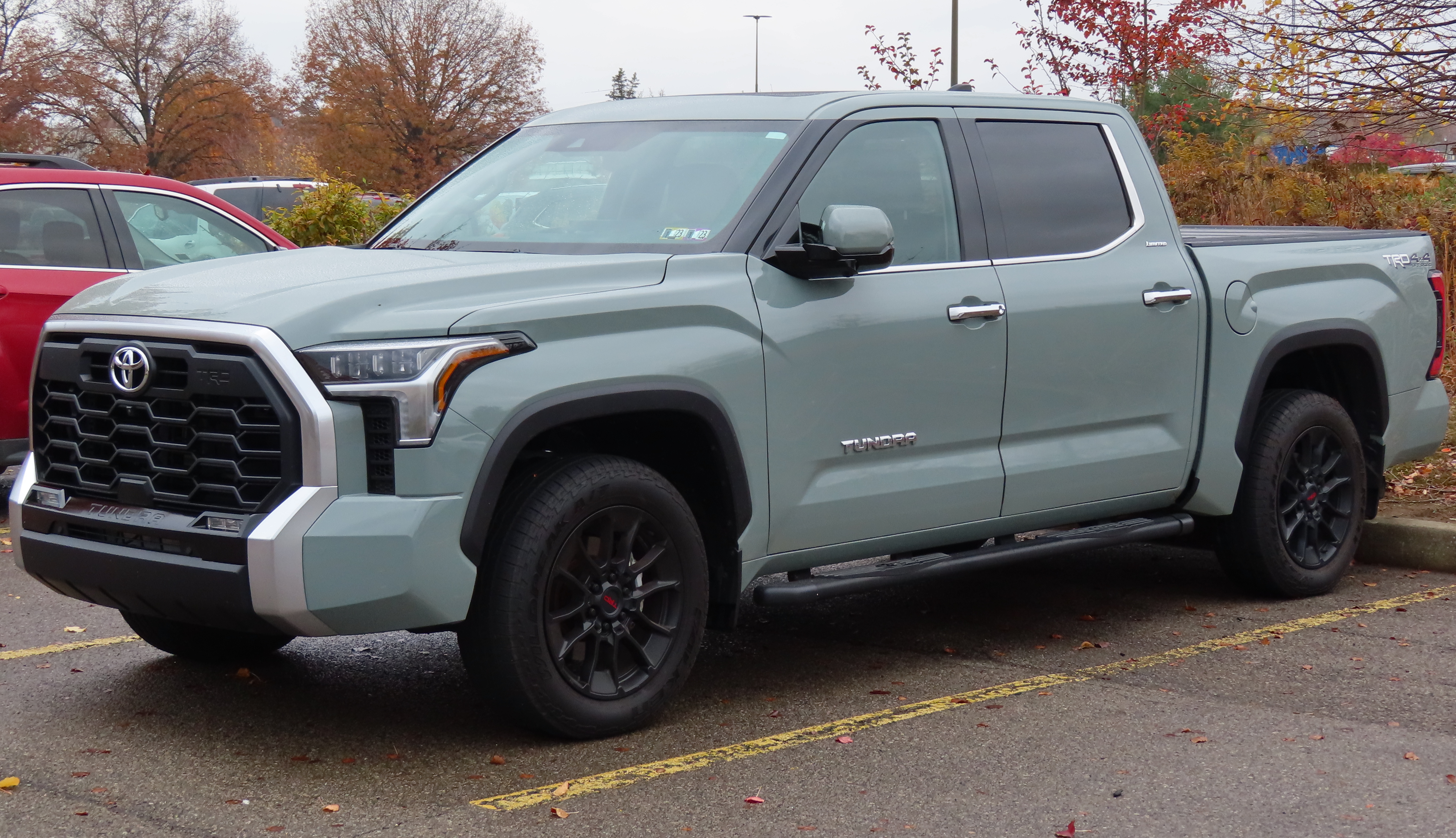
The Toyota Tundra is Toyota’s big pickup truck. In this segment, the host talks about how it’s set up for real truck jobs like towing, and how its engine/exhaust choices affect the driving experience.
A catback exhaust is an exhaust upgrade that replaces the parts from the catalytic converter to the back of the truck. It’s mainly done to change the sound (and sometimes how freely the exhaust flows).
TRD is Toyota’s in-house performance brand. A TRD performance package is a set of factory upgrades meant to make the truck feel and sound more “performance” oriented.
A V6 is an engine with six cylinders arranged in a V shape. The host is saying the Tundra is moving to a V6, and that changes things like complexity and how it sounds compared with older V8 setups.
This phrase means Toyota changed the Tundra’s main engine type to a V6. The host’s point is that it can still tow and work like a truck, but it’s not the same as the older V8 approach.
A V8 is a type of engine with eight cylinders. In trucks, it’s often chosen for strong pulling power, so when a brand moves away from V8s, people notice.
A boxed frame is the truck’s main metal structure under the body. Making it “fully boxed” usually makes it stronger and helps it handle heavy work better.
A composite bed is a truck bed made from materials other than steel. The benefit is it doesn’t rust the way a steel bed can.
Term
trim lineup
A trim lineup is the menu of different versions of the same truck. Some trims are more basic, and others add features—like off-road gear—so more types of buyers can choose what they want.
Term
trim lock
“Trim lock” sounds like how the manufacturer bundles options into specific versions of the truck. Instead of mixing and matching everything, certain off-road features come with certain trims.
This is a special kind of rear cab window that can slide down. It helps with airflow and makes the cabin feel more flexible for everyday use.
Term
head V8s
They’re talking about the V8 engine in the truck—specifically the cylinder-head part of the engine. The host’s point is that those older V8s were known for lasting a very long time.
A generational changeover is when a car gets redesigned into a new generation. New generations often bring lots of changes at once, and that can sometimes lead to early problems while everything settles in.
“Hybrid era” means the truck is moving to a hybrid powertrain. Instead of only using gas, it uses electricity too, which can add new technology and complexity.
“Electrification era” means the industry is shifting toward electric-powered technology. That can include hybrids and other electric-assisted systems that use batteries and electronics.
Disc brakes stop the car by squeezing pads against a spinning rotor. They usually stay more consistent when you brake a lot because they handle heat better.
Platform sharing means different cars are built on the same basic “parts and layout.” That can save money, but if one new system doesn’t work well, it can affect several models at once.
An eight-speed transmission is an automatic gearbox with eight gears. It can make the car shift more smoothly and efficiently, but if something’s wrong with the design, it can cause problems across many vehicles.
A class action lawsuit is when lots of affected owners join together in one legal case. In car stories, it usually means many vehicles may have the same problem.
Naturally aspirated means the engine doesn’t use a turbo or supercharger to force air in. The point here is that people expected a proven V8 to be dependable, but these trucks had unexpected problems.
This means tiny bits that shouldn’t be inside the engine ended up there during manufacturing. Toyota concluded that those bits caused the engine problems, which is why they recalled so many trucks.
These are videos where mechanics or reviewers take an engine apart to look for the problem. The hosts are saying you can see the contamination inside when the engine is taken apart.
A spun bearing is an engine part that starts slipping and rotating where it shouldn’t. When that happens, the engine can get badly damaged because the metal surfaces start grinding without proper lubrication.
“Recall fixes” are the corrective repairs performed after a safety or defect recall is issued. The speaker is using the number of completed fixes to show how widespread the issue has been.
This means the truck’s body is unbolted from its main frame to get enough access for a big repair. It’s a sign the job is more involved than a normal engine service.
Cylinder pressure is how hard the gas pushes inside the engine cylinder when it’s burning fuel. Higher pressure means more force on engine parts, so leftover debris can be more dangerous.
“Sporadically” means it doesn’t fail in the same way every time. The speaker is saying only some engines get the right kind of debris stuck in the right place, so failures show up irregularly.
Tight tolerances mean the engine parts have to be made with very precise spacing. If they’re even a little off, it can cause trouble and shorten engine life.
They mean the engine is working under more extreme pressure than older designs. That can make tiny imperfections matter more and lead to failures sooner.
They’re asking whether the failure is caused by how the engine is manufactured. That could mean the factory process leaves debris behind or doesn’t hit the required precision.
They’re saying that when engines are built with very precise parts, tiny metal leftovers can become a bigger problem. The engine’s design and operating conditions can make that debris cause damage.
A radiator is the part that helps cool the engine by letting heat escape into the air. More than one radiator usually means more than one system needs cooling.
A heat exchanger is like a radiator’s “partner” that moves heat from hot fluid to cooler fluid. It helps keep different parts of the car from getting too hot.
A transmission cooler helps keep the transmission fluid from getting too hot. Cooler fluid usually means the transmission lasts longer and shifts more consistently.
Alabama is referenced as the location of the plant where Toyota builds the engine discussed in the segment. The point is that the contamination-control process was implemented at that specific manufacturing site.
“Five point seven liter” is the engine size—how much space the cylinders have. The host is saying a bigger, simpler engine setup used to be less problematic than a more complex turbocharged design.
“Two turbos” means the engine has two turbochargers that help push more air into the engine. More turbo hardware usually means more parts that can wear out or fail, so it can be harder to keep trouble-free.
The Toyota Prius hybrid is Toyota’s famous hybrid car. The host brings it up to compare how the Prius hybrid approach differs from the Tundra hybrid, especially in terms of complexity and potential problems.
A “snowball effect” means a small problem can grow bigger over time. Even if people aren’t immediately stopping purchases, the situation can still get worse and spread.
The cam housing is the part that holds the camshaft in place. If the spacing inside it is changed, the engine can run differently and parts may wear less (or more).
It means pressure inside the engine is building up more than it should. When that happens repeatedly, it can cause parts to wear out faster or fail sooner.
It’s a V6 engine that’s 3.4 liters, and it uses two turbochargers to make more power. Turbos can make the engine run hotter and harder, so the design details matter a lot.
“Pinpoint exactly what they should change” describes the engineering challenge of identifying the root cause when failures happen in multiple ways and at different times. Automotive recalls and fixes often require separating manufacturing/quality issues from design limitations and then validating the fix across real-world use. The host frames Toyota’s difficulty as finding the single actionable lever.
This is a specific part inside an engine that helps hold the crankshaft in place. If that bearing wears out or fails, the engine can start running poorly or even get damaged. The host is saying Toyota may have changed this area to solve the problem.
A “silver bullet” is an idea that one simple change will solve a bigger problem. Here, the host is wondering if one specific fix is enough to stop the failures.
“OEM level” means the supplier is making parts for the car company itself, not just aftermarket parts. Those parts have to meet the same strict standards the factory requires.
Tier one suppliers are the companies that directly make big parts or systems for the car maker. If something needs fixing, the car maker usually has to coordinate with them first.
A recall is when a car company has to fix a problem on certain vehicles. In this episode, they’re talking about why some versions are included and others aren’t.
The Toyota Sequoia is a large SUV. In this episode, they’re saying Sequoias are left out because this group is talking about hybrid versions, which can be different from the non-hybrid cars being discussed.
A hybrid uses two kinds of power: a gas engine and an electric motor. Here, the hosts mention hybrids to explain why some Toyota models are treated differently in the warranty/fix conversation.
A dealer is the local shop that sells and services the car brand. In this story, the dealer is important because it’s the one involved in getting warranty repairs approved.
“Engine exploded” means the engine failed in a very serious way, not just a small problem. The hosts bring it up to show how bad the reported failures are and why people feel the warranty process isn’t working.
This is a mild-hybrid setup that uses a 48-volt battery and a motor-generator to help the engine. It can also recover energy when you slow down, which helps fuel economy.
Tooling is the specialized equipment a factory uses to build an engine. If they’re bringing in V6 tooling, it means they’re setting up the plant to make V6 engines instead of V8s.
Term
mothballing
Mothballing means shutting something down and putting it away temporarily. Here it implies the factory stopped using the V8 production setup.
A hybrid truck uses a gas engine plus an electric system. In this episode, they’re talking about the Tundra hybrid specifically and whether it’s dependable.
A bearing upgrade refers to a change to a component that supports rotating parts inside an engine or drivetrain. In this context, the host implies Toyota made a fix (an updated bearing) to address a known failure mode, and they’re questioning whether the same issues will show up later.
The “used market” is the secondary market where people buy vehicles that are already owned, often years after their original sale. In this segment, it’s important because recalls and fixes can be unevenly applied, so the risk profile of a given model year depends on whether the prior owner had the remedy done.
A proven track record means people have owned the cars for long enough to see whether the problem is truly fixed. The host is saying Toyota hasn’t shown that yet, so they don’t feel comfortable recommending it.
Replacing the engine is a major repair where the whole gas engine gets swapped out. The host is saying the problem is serious enough that it’s not a simple fix.
An engine dyno is a machine that runs an engine on a test stand while measuring how it performs. It can simulate certain conditions, but it’s not the same as driving because real roads add extra stresses like hills and changing loads.
Operating temperatures are how hot the engine and related parts get while driving. If parts repeatedly get very hot (and then cool down), that can cause problems over time.
Term
turbo ECO V6
This is Ford’s turbocharged V6 engine used in some trucks. Turbo engines can make strong power, but they also run hotter and have more moving parts, which can matter for long-term reliability.
The Ford F-150 is a large pickup truck that many people buy. The podcast talks about recalls, meaning some trucks may have safety or reliability problems that Ford has to fix. The key is that not every F-150 is affected the same way, so you should check the exact year and your vehicle’s details.
Company
Stalantus
“Stalantus” is the podcast mis-saying “Stellantis,” a big car company that makes brands like Ram and Jeep. They’ve put turbo engines into trucks and SUVs, and the host is talking about reliability as those vehicles get older.
A turbo inline-six is a straight-six engine with a turbocharger. The turbo helps it make more power, but it can also change temperatures and stress levels inside the engine.
A wiring harness is the car’s main bundle of wires that connects all the electronics. If it’s poorly routed or gets stressed by heat and movement, it can cause electrical problems.
The Dodge Ram is a large pickup truck. The podcast mentions the wiring harness, which is the set of wires that connects different parts of the truck. If there’s a problem with it, the truck can act up in ways that are hard to pinpoint, so it matters for reliability.
Term
volume battle
It means car companies are trying to sell the most vehicles possible. When that’s the goal, they may change what they build and how they price it to move more units.
The Chevrolet Silverado is a large pickup truck. The podcast mentions it in the context of sales competition, meaning it’s one of the main trucks GM sells to challenge other popular pickups. It’s discussed because its lineup helps determine how well GM is doing in that segment.
GMC Sierra is one of the big full-size pickup trucks sold in the U.S. The hosts mention it because it’s part of GM’s lineup that competes hard with Ford’s trucks.
The Ford F-Series is Ford’s main line of pickup trucks. It’s a big deal in the U.S. because it sells in huge numbers and often competes directly with other popular trucks.
“Hemi” is a nickname for an engine design where the inside of the combustion chamber is shaped like a half-sphere. It’s often used to signal a more powerful, performance-oriented V8.
“Five liter” means the engine is about 5.0 liters in size. Bigger displacement often helps an engine make strong pulling power, and it’s a common way people talk about engine options.
“5.3 liter” is the engine’s size, about 5.3 liters. It’s part of how people compare truck engines—some sizes are known for strong everyday pulling power.
“Small block” is a GM nickname for a particular type of V8 engine design. Saying “next generation” means GM plans to update that engine family with newer tech.
Concept
regulation perspective
This is about how government rules on emissions and fuel economy can push car companies to change what they build. The host is saying Toyota looked like it was doing the right thing for those rules, and others were expected to copy it.
In an automatic transmission, the torque converter uses fluid to transfer power. “Lockup” is when it switches to a more direct connection, and if that doesn’t work right, the truck can feel rough or behave oddly.
“HD trucks” means heavy-duty trucks—bigger, stronger pickups meant for towing and hauling. Since they’re used for tougher work, drivetrain problems can show up more clearly.
LIVE
Hello, everyone, and welcome to The Drive Cast.
I'm Kyle Choromka, Editor-in-Chief of The Drive.
And I'm Joel Federer, The Drive's Director of Content and Product.
And I'm Caleb Jacobs, Senior Editor at The Drive.
We got a trio today, and The Drive Cast is our weekly podcast giving you an inside look
at the biggest stories, controversies, and people shaping the automotive industry.
Before we get into it, yes, I'm back after a busy few weeks, and shout out to Joel for
running the show while I've been away.
If you haven't listened to his interview with Stalantis' head of American brands and
Ram CEO Tim Kuniscus on last week's episode yet, you missed a really fun time.
Great conversation, a lot of news being broken, just prime Drive Cast stuff.
So go check that out.
But today, we are talking about Toyota, the world's largest automaker, who for decades
has been known for building more reliable cars than anyone else.
But lately, some big cracks are starting to form in that foundation.
Indeed they have, Kyle.
Toyota historically has been reliable to a fault.
You might even say boring, though it's done a lot to try and shed that image.
But I think a lot of people would be fine with going back to boring instead of where
we are today.
If our tips inboxes any indication, engine failures, transmission issues, warranty drama,
and class action lawsuits tied to some of its most popular models, we got a problem.
By the way, our email is tips at thedrive.com.
Keep them coming, boys and girls.
Yeah, it's almost hard to believe that we're sitting here talking about this.
Toyota of all manufacturers.
But given the amount of digital ink we've spilled on this topic over the last two years,
it's time.
Unreal, yet so very real.
Last month, Toyota added another 44,000 vehicles to its ongoing recall of Tundra pickups and
Lexus SUVs with the company's troubled 3.4-liter twin-turbo V6.
Bringing the total to nearly 270,000 trucks over the last two years.
And this isn't some precautionary move.
Metal debris left in the engine during assembly is causing sudden and catastrophic failures.
A previous attempt to stop it didn't work, and so far Toyota has had to replace tens
of thousands of engines for free.
When the new Tundra launched in 2022, it dropped the old bulletproof V8 and was supposed to
move Toyota into a new hybrid turbo V6 era.
Now, as other pickup manufacturers are recommitting to V8s, people are starting to wonder, did
Toyota make a huge mistake here, and is its dependable reputation gone for good, or can
Toyota find its way back?
So today, it's Toyota's reliability crisis.
How it ended up here, what's really happening beyond the headlines, and what might be next.
By the way, if you like what we're doing here, do us a favor and hit us with a five-star
review on Spotify or Apple Podcasts.
It really does help get the drive cast in front of more people.
OK, let's go.
All right, I'm back.
Did you guys miss me?
I always miss you.
Highlight of my week was talking to you.
Maybe you guys shouldn't say that.
My wife doesn't listen to this, so this is fine.
Likewise, likewise.
No one who actually loves us listens to this stuff, but anyway.
I thought your mom listens to this and called you about worried about life.
Yeah, yeah, thank you for the whole biblical plagues reference.
I got a very concerned text from my mom wondering if everything was OK.
I am OK.
No plagues here.
I love that your mom listens.
Yeah, she does, she does.
She's very supportive.
But before we actually get into it, I just want to note that it has been just about one
year, Joel, since you joined the drive.
Pretty amazing what we're up to these days compared to where we were a year ago.
Happy anniversary, man.
Thank you.
I mean, you know, the irony here is that we actually have Caleb on the podcast today.
And it was last week or something.
I don't remember that he's the one who reminded me because it's on his birthday.
It's my anniversary of being at the drive.
And so he was like, you know, my birthday is coming up.
And it was kind of like a like I was like, yeah, because it's on my calendar.
I'm like, yeah, man, it is like I'm really excited for your birthday.
I didn't know what to say.
He's like, which means you've been here a year because your birth, my birthday is
the day you started.
I was like, oh, wow.
Like, so Caleb remembered before me.
I've just been a little busy.
Yeah, I'll always remember that.
And thankfully it's on the same day every year.
So don't have to worry about it.
We get to celebrate together.
Yeah, we've been busy.
We sure have been busy.
It's hard to believe that June 1st was or June 2nd, whenever it was
that you started was literally a year ago.
But here we are.
Here we are.
And here is Toyota.
All right.
Now, Joel, that I see that you actually just had a Tundra and then Alexis GX,
both of those that have the engine we're talking about here,
that troublesome twin turbo V6.
You did.
It's true, which it's just coincidence.
I swear, like I did not plan that.
That's not how this was going to happen.
They just came into the fleet, the Toyota Tundra.
It was that new TRD pro wave maker blue.
And I wanted to do a story about colors and blue.
And it was a great, great backdrop for that photo.
So it is ironic that we're about to talk about these cars.
And I just spent a week in each of these with these engines.
And so, yeah, that's it's fresh in my memory, you might say.
And neither of them blew up, correct?
I think I would have heard something about that.
You would have heard something about them.
Neither of them blew up.
The Tundra I did tow boats with and it is still not blow up.
So no, they did not blow up.
But the Tundra had a TRD performance package and had the the catback exhaust.
My wife had some thoughts.
Mainly, this is annoying.
And when does this truck leave?
That's a great point to dive into this because the Toyota moving to a V6,
it can still do the truck things.
It's not short on capability.
However, it is still a lot more complex than a V8.
It sounds different, especially with that exhaust.
And the irony of all of this is that Toyota made this decision to move
to a V6 powertrain in the Tundra.
Meanwhile, GM, Ram, Ford, they still all offer V8s.
Ram just got back into the V8 game with the with the Hemi coming back
and the Badger protest and all of that.
It's like two years ago, three years ago, four years ago,
when Toyota made the decision to launch the Tundra like this and say,
we're done with V8s, like, did that age very well?
One could argue, no.
OK, so, Joel, how did we get here?
How do we get here with a V6 Tundra that is, by all respects, far less
reliable than the Tundra it replaced?
So for those that aren't like, you know, Toyota Fnatics or Tundra Fnatics
or truck Fnatics, just a quick high level, we're on the third generation
Tundra, which, by the way, is kind of insane to think we're like 30 ish years
into this and we're on the third generation Tundra.
The second generation Tundra, the one that had the venerable 5.7 liter V8,
which is what this turbo six replaced, that had a 14 year lifespan,
which is it was old enough to get bar mitzvah.
This is crazy.
So the new Tundra moved the bar a huge way for this generation.
We got a fully boxed frame and we got a stouter transmission.
We got a turbo six instead of a V8, but it's a bigger truck.
It's a more competitive truck, but it kept a lot of the things
that made the Tundra what it is compared to the other trucks.
So like it had, it has a low bedside compared to the other trucks.
So you can reach into your bed, it has composite bed now,
which the composite bed can't rust.
There are other downsides to that though, of course, it has a bigger cab
so it competes with the other trucks at that level.
And it expanded the trim lineup and trim lock with off road models
and all these other things.
And so it is more competitive in many regards.
And most importantly, it still has the rear glass of the cab
that slides down fully, which is such a clutch feature.
I can't even, it's a cool feature that, you know, you get in a forerunner or whatever,
but it's the only truck on sale that has that.
I wish the Rivian had that. I really do.
So anyway, that's like that's how we got here, right?
Three generations of Tundra's first two head V8s, bulletproof reliability.
They'd rust out before they stopped working forever.
And that's just not the case of the current Tundra.
Yeah, it is true that Toyota out of a lot of companies has historically
done very long model runs before moving to a next generation.
That is one of the reasons why they had developed this reputation for
liabilities because they didn't take a lot of chances.
They figured out how to make a vehicle, made it for 89 10, 14 years
and then very carefully developed the next one to build on that reputation.
Part of what we're seeing here, because it's not just Tundra that's having an issue,
part of what we're seeing here is that Toyota just had a convergence
of model year or generational changeovers in the last four or five years.
And just they made a lot of changes this time to move into the hybrid era,
the V6 era, the electrification era.
And it's kind of growing pains in some respect,
but that doesn't make anybody feel better when you are talking about
literally hundreds of thousands of engines possibly failing randomly and catastrophically.
Yeah, and we're talking about a company that just moved from a five speed
automatic in the forerunner to what they have now also ditching drum brakes
on the Tacoma to go to disc brakes.
Like all of this is happening at the same time.
So while other automakers were making those changes years ago,
suddenly it's like, OK, we got to figure out how to make all of this work together
across different models, platform sharing.
Yeah, it is a big moment that they had to do so much all at once.
And maybe some of that's to blame here, hard to say for sure.
And in fact, on that note, one of the class action lawsuits they're facing
right now is related to one of their new eight speed transmissions
that was supposed to level up and modernize a number of cars
that's used in, I don't know how many, but several several really popular models.
And it's not it's not going great.
Not so good, not so good.
All right, now we have that background.
We have these turbo sixes, things aren't going so good.
What exactly is happening?
What's the problem here?
Yeah, so like we kind of touched on in the intro,
I've been talking about this for about two years at this point,
which is crazy to think we started to see pictures of Tundras
parked on the side of the interstate, sudden, you know, loss of power.
Then we see others that that won't start, others that are are knocking
and have these issues from the get go.
There were lots of confusion, right?
People were really skeptical because you go from a naturally aspirated
V8 that has been in production for a long time.
And yeah, sure, you know, it only got 14 miles per gallon or whatever,
but people were okay with that because the truck worked every time they got in.
There was a scramble to find out exactly what was causing these failures
and Toyota determined that it was left over manufacturing debris
that had made its way into the engine.
So right off the bat, they recalled more than 100,000 Tundras, also Lexus SUV.
So LX at first, and then later on, they add GX.
The plan was to get those cleaned up, right?
They say, all right, we got to make sure that that manufacturing
debris does not make its way into the engine anymore.
We've got to keep an eye on this.
And they'd been very insistent all along.
This is not a design defect, right?
They said this is an issue with what was left over
and it finds its way into main bearing number one.
Okay. So that has been the issue from the beginning.
You've seen that also in independent tear down videos, right?
Where mechanics will look inside.
They see like, yep, there it is.
There's the spun bearing there for a while before the recall was officially issued.
There were dealers taking care of these problems under warranty.
But what that entailed was essentially disassembling the entire engine, right?
Only replacing the affected components.
That's kind of hard to stomach, right?
Whenever you buy a new pickup and the engine immediately has to be torn down
so that way a few parts can be replaced, that's when Toyota came in and said,
you know what, what we're actually going to do is replace the entire engine.
And so that was the case with the first recall.
That was the remedy.
And then also to the follow up recall later on.
Now, just recently here in the past couple of weeks, Toyota has said, you know,
we're going to add another 44,000 trucks to this recall.
So we're well over a quarter of a million vehicles at this point.
So it has been able to complete about 77,000 recall fixes is what they have said.
But there's a lot of concern that the engines that have gone in,
these replacement engines could suffer from the same problems.
Man, it's a mess. It's a mess.
Yeah. Yeah.
And there have been pictures floating around of Toyota dealership service areas
that are just full of tundras with the body separated from the frame
so they can replace the entire engine.
Like it is, it's happening quite, quite often.
And Caleb, you were explaining to me before we started recording
that this whole debris left in the engine thing, it's actually not uncommon.
Like it is a normal, somewhat normal side effect of how these engines
are built and manufactured.
But what's really different about Toyota's situation here versus this being
something that just kind of happens and usually it's not that big of an issue.
Yeah, sure.
So the technical term for this manufacturing debris is called swarf.
So there is an issue with this swarf being left over inside the engine.
And older, older engines, you know, from from generations past,
they were able to to handle this debris that was left over
because they don't run such tight tolerances.
The cylinder pressures, all those things aren't quite as high.
That's what we're seeing right now in Toyota.
Just lay all of this out in an NHTSA recall document.
So they went on to explain that they have made several attempts to fix this issue.
They have taken a look at the internal pressures and tried to make changes to that.
The big issue is that once debris of a certain size and shape adheres
to that main bearing number one, that is what causes it to spin.
So it's not so much even the amount of debris.
And that's why we're seeing it kind of sporadically.
It's not every single one failing in the same way.
But once debris of a certain size and shape adheres to that bearing,
that is what causes it to fail over time with such high pressures.
So that's what Toyota has been trying to solve.
They've said, how in the world could we possibly, you know, reduce this?
And all this is, again, laid out in the NHTSA recall documents.
They get into a lot of technical terminology.
So I'll try to spare you from that.
That's essentially the issue is that these new engines run at such high
pressures with such tight tolerances that this swarf that wouldn't have been
an issue in years past is now a major issue.
Again, people say, is it a design problem?
Is it a manufacturing problem?
So it would be very insistent that it's the latter.
Not really sure where everybody else lands.
I think it is a bit of both.
I mean, the fact that they've tried to fix it and tried to build these engines
and make whatever adjustments to the assembly process so that this doesn't
happen and it's still happening, like that is that is noteworthy.
And it is also interesting because when Toyota made the decision to move
to a turbo V6 instead of a naturally aspirated V8, especially in a pickup truck,
a lot of people's concerns were, well, this is a much more like stressed
powertrain, the V6, the turbo, it's going to have to work harder.
It's going to wear out faster.
It's going to need more maintenance to deliver the same performance.
I don't think anyone was thinking about tolerances and metal debris
getting trapped in places that it wouldn't have in the past engine.
But it's still it's the same cause here that they move
to a different kind of engine for this application.
And here we are with, you know, over was it 100,000 failures at this point?
Probably like actually documented or at least 100,000 engines replaced.
I don't think people understand because again, Toyota is all about reliability,
right? So they tried ironically to overbuild this engine.
And this is going to surprise people, but that Toyota V6 is pretty complex.
The number of heating and cooling systems and heat exchangers and radiators
that is throughout that powertrain boggles them on.
At one point, someone told me they had like 10 or nine radiators,
which I don't think that's true.
I think, but I do think it has like three main cooling systems,
five heat exchangers slash radiators up front.
There's a primary engine radiator.
There's heat exchangers, a transmission cooler.
There's a hybrid inverter radiator.
Like that thing you can even just see through the front end.
How many radiators and lines are going around through the grill on the open grill models?
I mean, they focus so much on making sure it doesn't overheat and explode.
They missed like engine shavings, right?
Like, so that's OK.
Let's let's talk about that for just a second.
So Toyota has gone like they've taken pains to make sure they are doing
everything to reduce this this manufacturing debris.
So they implemented these these cleaner manufacturing procedures at the plant
in Alabama, where they build this engine.
They've been like, OK, we're going to be extra careful.
Now that we know this is the issue, we're going to make sure nothing gets in there.
And it didn't work.
That's that's the thing is, you know, it really is that issue of there is
so much such high pressures like this is stuff that was never an issue before.
Because whenever you've got a lazy old five point seven liter,
it just goes and goes, right?
But whenever you have got, you know, two turbos that are feeding air in there,
you've got this whole mess of parts, just like you were talking about, right?
I remember at the Tundra hybrid launch, it was several years ago,
I wrote a story that was all about how is the Tundra hybrid different
than a Prius hybrid?
In that story, you can see the cab in the bed taken off of the frame.
You can see all of the, you know, the components that lie underneath there.
I think it's the people who were concerned that, hey, guys, this might
this might be a little bit too much going on.
I fear that they were correct.
Yeah, vindication feels good, although not in this case.
Like no one's happy about this.
I mean, we would all rather Toyota be making quality products
that aren't having these failure issues and they're not going to go back to V8s.
But this has got to be something they can do here, because it does still
very, it does still surprise me that they haven't been able to figure this
out at the factory and yet they're still selling these trucks.
The Tundra is still a very popular model.
It's not like people have stopped buying Toyotas because of this, but there
is a snowball effect that they really need to pay attention to here.
So like, Caleb, where do you think they go from here?
Man, that is a great question.
And I think if Toyota had the answer to that, we'd be seeing it put in play right
now. And the the latest testing, the latest examinations that they've performed
on these engines was just in May of 2026.
So they took some engines that had the recall, while I say the recall fix,
the changes that they had made on the manufacturing line to hopefully prevent this.
And they saw essentially the exact same wear patterns as those first,
that first batch of engines.
OK, so well, oh, well, we didn't quite get that.
There, guys, we'll try again.
That and that's that's the thing is that they have they have been making
tweaks and actively doing things.
So they they made a clearance change on the cam housing to hopefully reduce these
pressures and in the terminology that you see in the recall documentation is
that they say it's a pressure stack up.
It's these things that compound that that cause these problems.
They just simply have not figured out for sure what's like how to fix that.
So right now, the engines that are being produced, these three point four liter
twin turbo V sixes, they have a slightly changed main bearing number one that
they hope to be more resistant to these problems.
OK, so that is a separate alteration, a separate change from that cam housing
clearance change that adjustment.
And so far, they have not seen any of the same issues.
But again, these things just take time, you know,
that's what we didn't see the first recall come up until two years after these
trucks had gone on sale.
Some of those soyotas had fewer than 10,000 miles on them.
Whenever they failed others, I've seen go for 200,000, right?
That's the really difficult thing is that they're failing in in different
ways at different points in time.
You know, some truck owners use theirs like trucks.
They're they're towing boats.
They're doing those things.
Others are just running around town.
It's hard to pin down.
And so while I, you know, I'm no manufacturing expert, I can't pretend
to know exactly how I would handle the situation.
I definitely don't envy Toyota in trying to pinpoint exactly what they should change.
Now, it seems like if they have made these changes to the main bearing
number one and the engines that are being manufactured right now, maybe
that's all it takes, right?
Maybe maybe that is the silver bullet all along.
They had kind of had their focus misdirected just trying to get those
things cleaned up, but in reality, it's even the most minor debris can cause that.
I don't know where they go next because I think they are too far.
They're too far to where they cannot revert back to V8 one.
I think that would seem kind of like admitting defeat in a way, but also
they're not making those anymore.
You know, that was kind of what we heard from Tim Kuniscus at Ram.
Whenever they had to fire, they hit me production back up.
They're like, you know, it's a supplier thing.
You've got to get in contact with all these other OEM level, you know,
tier one suppliers that build parts that, that ship them, you know, across,
you know, like national borders.
It's incredibly complicated.
It's not just as simple as saying, all right, guys, we're, we're switching
our back.
There's a lot that goes into it.
So I think that they ultimately are just going to have to figure out for sure.
What is the fix?
What will prevent this from happening again?
And throughout all of this, guys, we haven't even talked about how the
Tundra hybrids are not included in these recalls.
The Tundra hybrids are not included in the recalls because technically
it's not a safety issue for those trucks because they still have electric
power that can pull them off of the road.
They still use the same engines.
People, that's, that's quite a loophole to find.
It's exactly, exactly.
And so there's been talks from the very first recall.
They say, when are the hybrids going to be included?
When are we going to be, you know, brought into this hybrid owners are like,
guys, and, and so sure, you know, as long as it's within the powertrain warranty,
they'll be taken care of.
But what happens once you get past that 60,000 mile marker, that five year
marker, and you see the same failure.
This engine is used in the Tundra.
It's used in the Sequoia.
Sequoia has not been included in this at all because they're all hybrids.
Guys, there's a lot to this.
Again, if our tips inbox is any indication, it's not like saying,
well, the Tundra, the hybrid owners will be covered by the warranty.
That's no sure thing because the dealer is the intermediary for the warranty work.
And we've gotten so many emails from people saying, my Tundra's engine exploded.
I went to the dealer.
They said it was my fault.
Can you please help me get in touch with Toyota corporate?
Because this is not fair.
And, you know, we have done a number of those stories, but like the idea
that for the hybrid people, it's just kind of like go through the process
and you'll end up with a fix eventually.
That is not a satisfying answer.
Just a couple of points on things we just ran through that are more broad strokes
for people. Joel's got points.
Watch out, everybody.
I got points.
I got some thoughts and you're going to listen to them.
One, everyone loses here.
Like Toyota is losing here because they're losing customers and or their reputation.
Right.
And money and time and it's a headache and all these things.
Right.
Customers are losing because they're buying them and everything we just talked about,
whether they're blowing up, they don't know if it's going to blow up.
It's going to hurt their resale.
Or it's just taking a viable option out of their consideration and it's not like
there's, you know, does it's not like a compact sedan or even more importantly,
a compact crossover, right?
There's not like dozens and dozens of these things to choose from.
There's four main full size trucks on sale in America.
That's it.
Five, if you want to start splitting hairs with GMC and Chevy, but like whatever,
like it's not like there's a bevy of options.
First off, when they are all distinctly uniquely different in terms of power
train and more importantly, feature sets and designs and usability and functions
for your use case.
So there's that the losers are everybody.
Toyota is losing on this.
Consumers are losing on this.
It's a bad deal.
Also, to Kayla's point about just restarting production and Kyle, like where
do we go from here?
It's not even like this is, this is even worse than the RAM situation.
Right.
So like, yes, RAM had to like retool and re spin up production of the
Hemi and talk to suppliers and all those things that Hemi, and I can't believe
I'm going to say this, that Hemi was a more and is a more modern engine than
that 57 was.
It is because it was in some gen three option and like it has MDS for displacement.
It also, it also has the, the e-torque mild hybrid 48 bolt system on it.
So that is a more modern engine to begin with.
It automatically, and I can't believe I'm saying this either gets better fuel economy.
It's more efficient than the Toyota V8 was.
It may not be more reliable, but that's not the point.
And so they can't just bring the 57 back for like so many reasons.
And not only that, they don't have a V8 to replace it.
Like it's not like they don't have a V8 developed.
They can replace that with.
So that's definitely not an option.
This is, it's just a bad deal.
Yeah.
Yeah.
And keep in mind, it was about what five years ago that they stopped building
the V8s in that plant in Alabama.
Actually, we were the first ones to break the news that they were dropping V8s
from the lineup because we had a source inside the plant who told us they were
bringing in the V6 tooling and mothballing the V8 ones.
The Hemi turnaround when Ram killed it and brought it back, that was in the
span of what two and a half years or so.
So we're talking double the time.
It's just, it is physically, literally impossible for Toyota to go back to
the building V8s and put one in the tundra.
So Caleb, what do you tell someone?
You got a friend who's looking at a tundra thinking, hmm, you know, I like
the way it looks.
I don't know about this engine stuff.
Is it a big risk?
Can I trust Toyota?
What do you say to them?
Man, so I tested a tundra hybrid here and back when there was still snow on
the ground.
So at the beginning of this year, I had a friend text me, that's, Hey, man,
what do you think about the new tundras?
I said, Well, funny enough, dude, I got one in my driveway right now.
I said, I think that they are really, really good when they work.
And that is, that's the problem.
So I haven't experienced a failure firsthand, but you just continue to run
that risk.
You don't know if a 2026 is going to have those same failures down the road.
Now we don't necessarily have any reason to believe that after this bearing
upgrade, that we're going to see more of the same.
But, you know, if you're looking on the used market, this latest recall goes
all the way to 2024 model year, you know?
So if you are shopping and you don't have a budget of $70,000, odds are you're
going to be looking for a truck that's a few years old.
And I can't recommend one.
And that ended up being the headline of my last review for that tundra hybrid.
Even with it being a 2026 model, I said, this is the truck that I wish I could
recommend, right?
Because it does so many things well, especially, you know, whenever you
pair it with a hybrid system, 583 pound feet of torque.
I mean, that thing gets up and goes.
You've got a good interior.
You know, the cab is definitely spacious as competitive in terms of
infotainment and all that stuff.
By all means, it should be a good truck for folks to go to the lot and buy and be
taken care of, you know, by their Toyota dealers and all those things.
But I got to tell them to look elsewhere until there is a proven track record
that these fixes are working.
And right now we just don't have that.
This isn't a situation where this is something that, you know, if you're
handy, if you know how to wrench, like, yeah, go ahead and buy one.
Like the only fix is replacing the engine.
So like if you can source one and you find a deal and I used one, great.
But otherwise, this is not a DIY situation.
They had 14 years, 14 years.
And this is what we were getting.
It drives me absolutely bonkers and insane.
I just, I can't understand.
Well, so I guess like maybe my rebuttal to that.
And I'm not trying to stand up for Toyota either, but it's like, sure, you
can simulate real world use on an engine dyno and have it run at crazy RPM for
however long, but none of that is the same as real world use.
Again, I'm not, I'm not trying to say, oh, cut them, cut them some slack.
That, that isn't it.
But, you know, the repeated cycles, you know, like sometimes you get up to, you
know, operating temperatures.
Sometimes you don't.
Others, you know, you're running up a grade with a big trailer behind you.
You know, everything's maxed out.
I, I just don't know how you can quite simulate the actual real world loads
along with all the different variables that there are.
I don't know.
Maybe I'm being too sympathetic.
Well, but hang on a second.
You could say it for anyone, but Ford did it with their turbo ECO V6.
And let's be clear, like Ford's the number one recalled automaker in like for
all time now, but, but, but like it's not specific to just F-150 and those
engines and they're not having known massive issues with that specific engine.
Right.
And Stalantus came out with their turbo inline six, not V6, but regardless in
a truck and an SUV were approaching the two year, year mark.
And while I've heard the wiring harness that runs through a wagon or
grand wagon here in Ram is a nightmare.
As far as the wiring harness, the engines themselves, we've reported on so far.
They've been reliable and damn, they're smooth.
They are, dude.
They're good.
Right.
So to your point, Caleb, you're right.
It is hard to simulate things, but let's be clear.
These automakers spend billions of dollars and years, maybe 14, developing
things, engineering things, testing things.
And when you're developing a full size truck, we all saw the spy shots.
We all know they towed with this thing.
They put easily over 200,000 miles on prototypes.
I just, this is, this is a colossal headache.
This is not a good situation.
Yeah, there's no way around that.
If you were for GM or Ram, right, and you're watching this unfold to the
world's largest automaker, that again, there's only like four or five full
size pickup trucks sold in America today.
And this car company built this reputation upon reliability and you're
watching them go through this.
What goes through your mind if you're one of these other automakers?
They're selling trucks.
Sure.
Well, I say this with the best intentions.
All of those guys sell more trucks.
And I think that they, I think maybe there's a little bit of arrogance
that goes through, right?
At least if we're looking at the marketing, you know, they love to talk
about how many trucks they sell.
They love to talk about how they're the top dog, that there's no real competition
for them, but I do think that there's some sweetness for them, right?
As they see, as they see Toyota go through this.
Now, yeah, I've always heard the joke that Toyota was its own worst enemy
because it builds cars that are so reliable that they never have to be replaced.
You know, now maybe we see different side of that, but I do.
I think that Ford is so caught up in the volume battle against GM, especially as
Sierra and Silverado combined to really nip at the heels of Ford with the F
series and everything else.
I don't know, man.
I think that they're all ultimately glad that they've gone the direction
that they have, even, you know, with Ram having to kind of pivot and bring back
the Hemi, but, you know, the five liter never went anywhere for Ford.
The 5.3 liter, the 6.2 liter, they didn't go anywhere for GM.
And they're working on that next generation small block.
Yeah, I think they're glad that they just continued on business as usual.
And not even for the reasons that maybe we, you know, expected because
there for a while it looked like from a regulation perspective that Toyota had
the right idea that we would see other manufacturers follow suit.
And then we did see it with Ram.
Now that there's not so much of a concern, there are a lot of variables that
I'm not sure anybody could have truly predicted.
Now, maybe some had, you know, a good idea of it.
And ultimately, it's a case of just sticking to your guns.
But yeah, I, I'm sure, I'm sure they're not too upset over it.
And I can guarantee you they are certainly glad not to be going through this
headache working with dealers, because that, that's a big thing.
I don't want anyone to think that we're, and this is a Toyota episode,
and they have a very big problem in their hands, but I don't want anyone to
think we're, we're turning a blind eye to anything.
So to everything Caleb just said, I do want to say one thing, GM has its
own headache on its hands and we've reported on this extensively.
There's six twos that are blowing up and then they've got the whole
torque converter lockup issue in their HD trucks.
So like, you know, these are very complicated powertrains even in V8 land
these days, and everyone's got their issues, but no one in the truck land has
the extent of the issue on their hands at the exact moment that we have with the
tundra. And that's, that's, I think, just want to, that's the point we're trying
to make here. There are other issues and we're not ignoring those either.
And, and one more piece of context that I think brings us all together, you know,
as we said in the beginning, Toyota is the world's largest automaker by volume.
And so they make a ton of vehicles.
And so you pair that volume with their previous reputation for
reliability. When you have a spate of issues, it does kind of take on an
outsized importance and the headlines are blasted out about it.
And the image itself can actually outpace reality and where it's at with
recalls. The tundra thing is a big problem.
That is a huge recall, the fact that it's full engine replacements happening to
tens of thousands of trucks, like that's bad, but Toyota's overall recall rate
compared to the number of vehicles sold is actually not that bad.
It's lower than Ford, for example.
And so Joel, to your point, yes, Toyota is not in a good spot here.
There are a number of signs beyond this v6 issue that their reliability has
taken a nosedive, but it is not like any Toyota is a risky bet.
Like they still make a lot of very reliable cars.
Yeah, we haven't really seen any issues yet, I should say, with some of the other
new models they launched. The Tacoma is having some transmission problems.
The 4Runner seems to be okay for now.
We'll definitely get a much better sense of how much Toyota has learned from
this and what it's applied going forward in the next few years.
But yeah, it is not the situation where Toyota is unique in this or even in a
much worse place overall than everybody else.
It's just we're not used to seeing Toyota in this kind of state and it is
concerning, but we'll see what happens.
Yeah, we see it Ford recall.
That's Monday.
You see another one is Tuesday.
You see Toyota having to replace 100,000 engines and they can't figure out why.
Red alert.
It's a crisis.
Right.
Yeah.
And talking about it from the media perspective, I mean, that's why it's
just like, oh, wow, like we we've never had something like this from Toyota.
Not to say that it wouldn't be a big deal if it was one of the other, you
know, full-size truck manufacturers that certainly would be.
But that is what makes this the perfect storm, right?
Is Toyota's reliability, reputation, you know, how their trucks are overbuilt.
You know, I got a buddy, Manny's a Toyota diehard.
And anytime he talks about his Tundra, he's got one with the 5.7.
And he tells me how it's not really a half ton truck.
He says, this is really a three quarter ton truck.
You've got guys that are so serious about that.
Whenever you see Toyota making a pivot to go more modern, they say, that's
where they messed up.
That's the problem.
It's because Toyota is what it is.
It is what it is in the minds of regular consumers.
It's what it is in the minds of enthusiasts and diehards that it would
never buy something else.
And yeah, you're right.
People like to be vindicated.
There is no winners here.
There are there are no winners in this situation.
And we certainly don't want to see them continue to to have these problems.
You know, like it's not like, oh, thank goodness, you know, that isn't it.
There are good folks that work there that have made many, many good trucks
for years and years and years.
This is just a continued issue that I'm sure they can't wait to put behind them.
I'm sure they can't.
That's it for this week's episode of the drive cast.
Thanks to Toyota for keeping things not boring.
Joel for one last blast of energy before he hits the lake this weekend.
Caleb for his expertise, our editor, Tyler Mark, and thank you for listening.
We'll be back next Wednesday with a special episode that you will not want to miss.
Be sure to check out the drive.com for full coverage on this topic.
And there's a lot of it.
Subscribe to one of our fine newsletters.
They are free, by the way.
Follow us on Instagram, Facebook and TikTok and subscribe to us on YouTube.
Where, by the way, we did a video on this very topic two years ago
and still racking up views close to a million now, I think.
We'll see you next week.
Bye, everybody.
About this episode
Toyota’s reputation for reliability takes center stage as The Drivecast connects a wave of engine and transmission problems to recalls, class actions, and a shift from the older V8 era to turbo V6 and hybrid powertrains. Hosts dig into the alleged root cause—manufacturing debris (“swarf”) contaminating engines and spinning bearings—while debating whether fixes are truly working. They also weigh buyer trust, warranty coverage, and resale risk, arguing the “image” of the problem can outpace reality.
Toyota, the world’s largest automaker, who for decades has been known for building more reliable cars than anyone else. But lately, some big cracks are starting to form in that foundation.
Last month, Toyota added another 44,000 vehicles to its ongoing recall of Tundra pickups and Lexus SUVs with the company’s troubled 3.4-liter twin turbo V6, bringing the total to nearly 270,000 trucks over the last two years. And this isn’t some precautionary move—metal debris left in the engine during assembly is causing sudden and catastrophic failure, a previous attempt to stop it didn’t work, and so far Toyota has had to replace tens of thousands of engines for free.
So today, it’s Toyota’s reliability crisis—how it ended up here, what’s really happening beyond the headlines, and what might be next.
Stories mentioned in today's episode:
Toyota Turbo V6 Recall Campaign Grows to Include More Than 250,000 Trucks
We Finally Know Why the Toyota Tundra V6 Keeps Self-Destructing
‘Total BS’: Engine Teardown Specialist Says Toyota’s Explanation for V6 Failures Doesn’t Make Sense
Toyota Will Replace Over 100,000 V6 Engines in Recalled Tundras, Lexus SUVs
Toyota Recalls Another 127,000 Tundras and Lexus SUVs Over Self-Destructing Turbo V6s
Is Toyota’s New Twin-Turbo V6 Really Less Reliable Than Its Old V8s?
Toyota Dealers Brace to Replace 100,000 Tundra V6s
00:00 Intro
06:07 How did we get here?
09:40 What's happening?
18:26 Where do we go from here?
25:51 What do you tell potential buyers?
30:06 The competition
Learn more about your ad choices. Visit megaphone.fm/adchoices