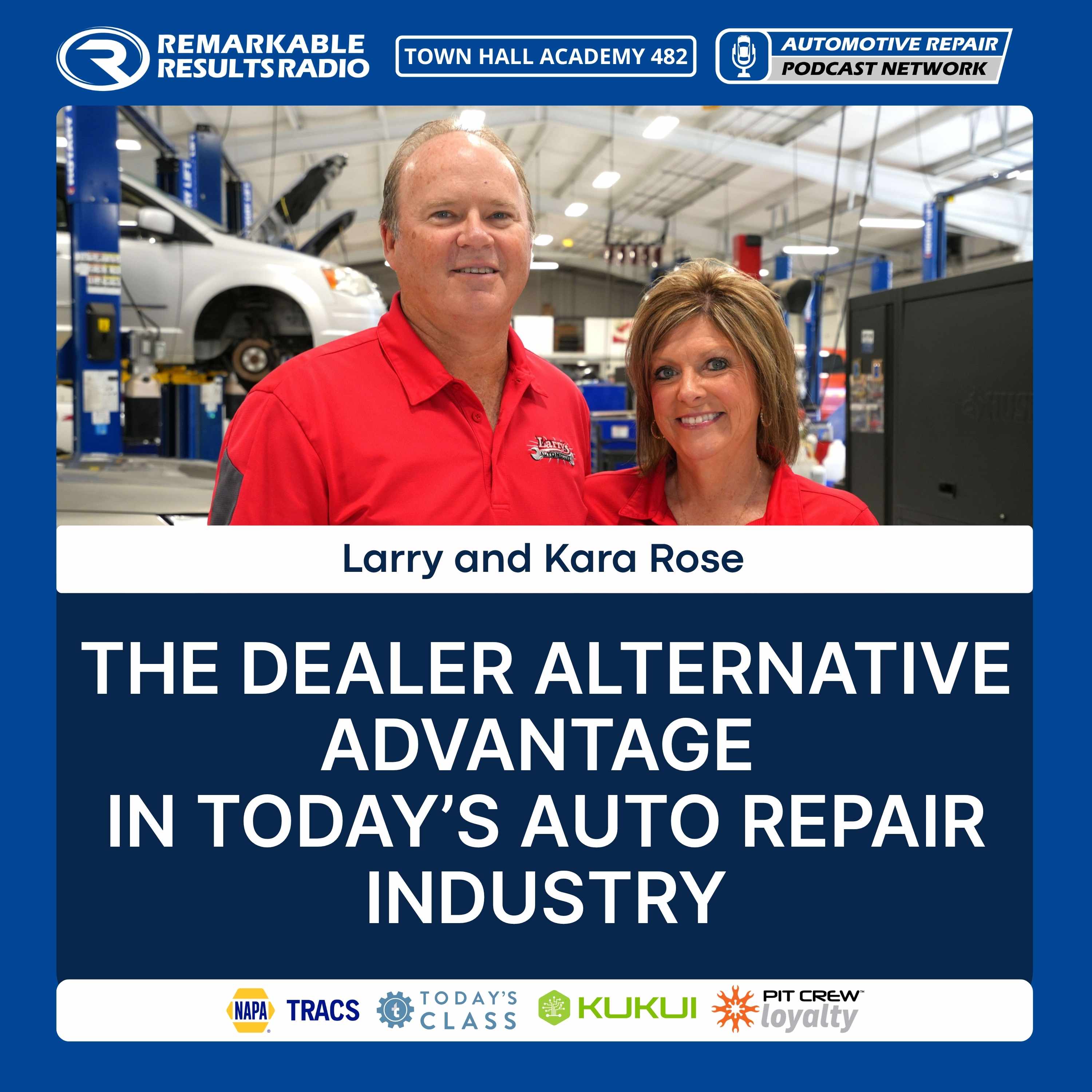
The Dealer Alternative Advantage in Today’s Auto Repair Industry [THA 482]
About this episode
Larry’s Automotive in Newburgh, Indiana earns Napa’s 2025 Auto Care Center of the Year, and the Rose team breaks down what’s behind the win: a spotless, pride-driven shop culture, strong service-advisor training, and a “dealer alternative” mindset that emphasizes doing the work better and treating customers right. The conversation also covers their family succession plan, how they shifted from hobbyist to professional entrepreneur, and using coaching, apprenticeships, and tool rebates to build capability. Loaner cars, TV advertising, and ongoing education round it out.
In this episode, host Carm Capriotto sits down with Larry and Kara Rose of Larry’s Automotive in Newburgh, Indiana, to celebrate their recognition as the NAPA 2025 Auto Care Center of the Year. Their story is more than an award; it’s a roadmap for building a sustainable, family-driven business through discipline, culture, and long-term vision.
What You’ll Learn
- How Larry turned a driveway side hustle into a scalable business
- Why Kara’s systems and structure were key to growth
- A clear, intentional plan for family succession
- How strong culture outweighs individual talent
- The impact of daily training and continuous learning
- Why service advisors are critical to customer trust
- Growth strategies like “dealer alternative” positioning and coaching
Building a lasting shop requires more than technical skill; it takes structure, culture, and a long-term vision for people and growth. Larry and Kara Rose, Larry’s Automotive, Newburgh, IN Thanks to our Partner, NAPA TRACS NAPA TRACS will move your shop into the SMS fast lane with onsite training and six days a week of support and local representation. Find NAPA TRACS on the Web at http://napatracs.com/ Thanks to our Partner, Today's Class Optimize training with Today's Class: In just 5 minutes daily, boost knowledge retention and improve team performance. Find Today's Class on the web at https://www.todaysclass.com/ Thanks to our Partner, KUKUI Stop juggling multiple marketing tools. KUKUI’s integrated platform delivers 4x better website conversions, automated follow-up, and real-time ROI tracking. Get industry-leading customer support with KUKUI at https://www.kukui.com/ Thanks to our Partner, Pit Crew Loyalty You’re probably tired of chasing new customers who never return. We understand. Pit Crew Loyalty ends the one-and-done cycle, turning first visits into lasting, reliable revenue at https://www.pitcrewloyalty.com/ Connect with the Podcast:
- Visit the Website:https://remarkableresults.biz/
- Subscribe on YouTube:https://www.youtube.com/carmcapriotto
- Follow on Facebook:https://www.facebook.com/RemarkableResultsRadioPodcast/
- Follow on LinkedIn:https://www.linkedin.com/in/carmcapriotto/
- Follow on Instagram:https://www.instagram.com/remarkableresultsradiopodcast/
- Join Our Virtual Toastmasters Club:https://remarkableresults.biz/toastmasters
- Join Our Private Facebook Community:https://www.facebook.com/groups/1734687266778976
- Join our Insider List:https://remarkableresults.biz/insider
- All books mentioned on our podcasts:https://remarkableresults.biz/books
- Our Classroom page for personal or team learning:https://remarkableresults.biz/classroom
- Buy Me a Coffee:https://www.buymeacoffee.com/carm
- Special episode collections:https://remarkableresults.biz/collections
The Automotive Repair Podcast Network: https://automotiverepairpodcastnetwork.com/
- Remarkable Results Radio Podcastwith Carm Capriotto: Advancing the Aftermarket by Facilitating Wisdom Through Story Telling and Open Discussion.https://remarkableresults.biz/
- Diagnosing the Aftermarket A to Zwith Matt Fanslow: From Diagnostics to Metallica and Mental Health, Matt Fanslow is Lifting the Hood on Life.https://mattfanslow.captivate.fm/
- Business by the Numberswith Hunt Demarest: Understand the Numbers of Your Business with CPA Hunt Demarest.https://huntdemarest.captivate.fm/
Larry's Automotive
"I have Kerry and Lara Rose from Larry's Automotive. There you're going to meet them here in a minute. We're going to talk about a whole bunch of really cool things going on at their shop, Larry's Automotive in Newburgh, Indiana."
They’re talking with people from a local repair shop called Larry’s Automotive. The episode is about how independent shops compete with dealerships, so the shop’s approach matters.
The hosts are interviewing Kerry and Lara Rose from Larry's Automotive, a repair shop in Newburgh, Indiana. In a dealer-alternative discussion, the shop’s real-world practices and customer experience are the focus.

Chevrolet Trax
"...so it's your choice. But it's proved to you that Trax is the single best shop management system in the..."
The Chevrolet Trax is a small SUV made for regular driving, like commuting and errands. It’s meant to be practical and easy to handle, with more space than a typical sedan. People talk about it when they want a simple, everyday vehicle option.
The Chevrolet Trax is a compact crossover SUV designed for everyday driving, offering a practical size and efficient powertrain options. It’s often discussed because it fits the “easy to live with” category—something that can be a sensible choice for people who want SUV space without a large vehicle. In a podcast, it may come up when talking about choosing a vehicle that’s straightforward to own and manage day to day.
five minutes daily
"In just five minutes daily, you boost knowledge, retention, and improve team performance."
They’re talking about a short daily training routine—only a few minutes each day. The goal is to help people remember what they learn and apply it at work.
The hosts describe a micro-learning approach—just five minutes per day—to build knowledge and retention for an automotive shop team. This is a common training strategy aimed at steady improvement rather than long, infrequent sessions.
today's class.com
"Start seeing results today. Join your peers at today's class.com."
Today's Class is a website that offers training for people who work in auto repair shops. The idea is that short daily learning helps the team get better over time.
Today's Class (today'sclass.com) is presented as a training platform for automotive shop teams. In this segment, it’s used to promote short daily training intended to improve knowledge retention and team performance.
NAPA
"You guys were named the Napa 2025 Auto Care Center of the Year. Huge, huge honor and award and milestone for you guys."
NAPA is a big auto-parts and service organization. If a shop wins a NAPA “Center of the Year” award, it usually means they’re doing a great job compared with other participating shops.
NAPA is a major automotive parts and service brand/network in the U.S. When a shop is named a NAPA Auto Care Center of the Year, it typically reflects performance, customer satisfaction, and operational standards within NAPA’s program.
Auto Care Center of the Year
"You guys were named the Napa 2025 Auto Care Center of the Year. Huge, huge honor and award and milestone for you guys."
This is an award that recognizes top auto repair shops. It’s meant to signal that the shop is reliable and does good work consistently.
“Auto Care Center of the Year” is an award category used by NAPA to recognize top-performing repair facilities. It’s a useful benchmark for listeners because it implies consistent quality and strong customer outcomes rather than a one-off job.
shop of the year
"And he went through the whole thing of why it's important to be shop of the year and how they have different shops throughout the United States and the Midwest region."
Being named “shop of the year” generally means the shop met specific criteria such as quality of repairs, customer service, and process consistency. In the context of repair-industry awards, it’s often tied to measurable performance rather than just reputation.
SkillsUSA
"You guys are involved in SkillsUSA. And because the silver tsunami exists in our industry, where so many people say, I'd like to retire."
SkillsUSA is a program that helps students learn practical job skills. For auto shops, it can be a way to find and train future technicians.
SkillsUSA is a career and technical education organization that helps students build hands-on skills for trades, including automotive. In the context of auto repair, involvement can support workforce development and apprenticeship pipelines.
silver tsunami
"And because the silver tsunami exists in our industry, where so many people say, I'd like to retire. I'd like to sell. I'd like to do some kind of succession."
“Silver tsunami” means a lot of experienced people are retiring around the same time. That can leave shops short on trained workers, so they need a plan to replace them.
“Silver tsunami” is a common industry phrase for the wave of experienced workers retiring, creating a shortage of skilled labor. In auto repair, it highlights why succession planning and training new technicians are urgent.
succession
"I'd like to sell. I'd like to do some kind of succession. And a lot of them just don't know how, who, when, where."
Succession planning in auto repair means preparing for ownership or leadership transitions so the shop can keep operating smoothly. The transcript frames it as something many people want to do, but don’t know how to execute.
floor scrubbers
"Well, I can start with the floors. So I've got a couple of floor scrubbers that I have the guys use daily. And we also have a apprentice that helps keep them clean."
Floor scrubbers are machines that clean the shop floor faster than doing it by hand. A clean shop can make customers feel more confident in the place.
Floor scrubbers are cleaning machines used to maintain shop floors efficiently and consistently. In a service environment, keeping floors clean can support safety, professionalism, and customer perception.
shop floor cleanliness
"it not only helps show the customer how, you know, we take care of the car, but it's also easy to see, easy to find stuff when you drop. So it just makes life better."
They’re talking about keeping the shop floor clean and organized. It helps customers feel confident, and it also makes it easier for the techs to find what they need.
The segment emphasizes “shop floor” cleanliness and organization as part of customer trust and operational efficiency. A clean workspace helps technicians spot problems sooner and reduces the chance of missing items during inspections or repairs.
operating room
"I always think of us as in the medical field, me getting rolled into an operating room and looking around. It's clean. I mean, you don't see a whole lot."
They compare the shop to a hospital operating room to make a point about cleanliness. The idea is that a tidy workspace helps people work better and find problems faster.
The speaker uses an “operating room” analogy to describe how a clean, controlled environment improves outcomes. In service businesses, the point is that cleanliness and organization reduce mistakes and make it easier to find issues quickly.
breaks
"He used to work here in high school and college, you know, doing breaks and oil changes, the basic things in back."
They’re talking about brakes—things that help the car slow down and stop safely. Brake service is a common job in repair shops and usually starts with learning how to inspect and service them.
“Breaks” here is almost certainly referring to brake service, which can include inspections, pad/rotor replacement, and related safety checks. Brake work is a common entry-level task in many independent shops because it’s frequent and requires careful inspection.
oil changes
"He used to work here in high school and college, you know, doing breaks and oil changes, the basic things in back."
An oil change replaces the old engine oil with fresh oil. It helps keep the engine running smoothly and is one of the most common services a repair shop does.
Oil changes are routine maintenance that replace used engine oil and the oil filter to maintain lubrication and protect engine components. For shops, oil changes are often a high-volume service that helps build process discipline and customer trust.
front counter
"So we felt it was real important for him to learn the front counter. So now he's up there. Then eventually he'll continue to work with our general manager"
The front counter is where customers interact with the shop. It’s where you explain what the car needs and coordinate the repair, so it’s important for learning how the business runs.
The front counter is the customer-facing area where service advisors handle intake, explain work orders, and manage communication about repairs. Learning the front counter helps future managers understand customer expectations, scheduling, and authorization processes.
shop foreman
"And our long-term goal for him is to actually learn how to be a shop foreman. The good thing is we have both of those positions filled with really strong people that are going to be around for a few years."
A shop foreman is the person who coordinates technicians and oversees day-to-day shop operations, including workflow, quality, and communication between the shop and management. In many independent repair shops, the foreman role is a key step toward running the business.
step up
"But there was a point in time, Larry, where you said it's time to step up. [620.2s] And I don't know what that means to you, but it means certain things to certain people."
They’re talking about deciding to take auto work seriously instead of treating it like a hobby. That usually means running it like a real business with customers and a plan to grow.
The hosts are describing a career pivot from casual or part-time work into a more serious, business-focused operation. In auto repair, that “step up” often means formalizing processes, managing customers, and scaling beyond a hobby mindset.
hobbyist
"But there's also another time where you stopped saying, I'm not going to be a hobbyist anymore. [631.8s] I'm going to be a true professional business person."
They’re saying he stopped doing car work just for fun and started doing it like a real job. A professional shop has more structure for fixing cars and dealing with customers.
“Hobbyist” here contrasts with operating as a professional shop. The distinction matters in auto repair because professional work typically involves consistent diagnostics, proper documentation, and customer-facing service standards.
transmissions
"[646.1s] And around 08 when the economy went bad, I started working at home a lot and building [652.4s] transmissions and fixing cars there."
He’s talking about transmission work, which is the part of the car that helps send power from the engine to the wheels. Fixing transmissions is detailed and usually takes a lot of time and know-how.
Larry says he was “building transmissions and fixing cars” from home, which points to transmission repair as a specialized service. Transmission work is labor-intensive and requires correct diagnosis, teardown/inspection, and reassembly to avoid repeat failures.
economy went bad
"[646.1s] And around 08 when the economy went bad, I started working at home a lot and building [652.4s] transmissions and fixing cars there."
They mention the economy got worse around 2008, and that influenced how he worked. When money is tight, people may delay repairs, but technicians sometimes adapt by changing how they run their work.
The segment ties the shift to working from home to the 2008-era economic downturn. In auto repair, slower consumer spending can change demand patterns, while experienced technicians may pivot to independent or at-home work to keep income steady.
working at home
"[646.1s] And around 08 when the economy went bad, I started working at home a lot and building [652.4s] transmissions and fixing cars there. [663.7s] And it just got so busy where there are cars in my driveway all the time..."
He describes doing repairs from home at first. The idea is that you can start small, get busy, and then eventually move into a bigger setup as the business grows.
Larry describes transitioning to working from home and using a personal shop to handle repairs. This is a common “dealer alternative” theme: independent technicians may start small, then grow into a dedicated facility as demand increases.
dealer full-time
"So I quit the dealer full-time. I worked in the full-time in my shop for six years."
They’re saying they used to work for a car dealership as a full-time employee. Then they left and focused on their own repair shop instead.
The speaker contrasts working “dealer full-time” with running their own shop. This matters because dealer service departments often have different workflows, staffing models, and customer expectations than independent repair businesses.
independent shop
"I worked in the full-time in my shop for six years. I got so busy and I realized I had a great business, ... So you get this thing, you walk into this beautiful operation,"
They’re talking about running their own repair shop. That means they control how work is scheduled and how the team is built, instead of working under a dealership.
The speaker repeatedly emphasizes their own shop operations, including hiring techs and building the facility. Independent shops typically manage their own scheduling, staffing, and customer communication, which can affect turnaround time and service quality.
COVID
"In 2020, we expanded, made a build a shop around the corner twice the size. It was a little bit slower during COVID, so I was my own contractor."
They’re referencing the COVID period, when business slowed and things were less predictable. They say they had to step in and do more of the work themselves.
The speaker mentions COVID slowing things down, which is relevant to shop operations because supply chains, staffing, and customer demand changed during that period. It also explains why they personally acted as a contractor during the slowdown.
preference for hiring techs who fit the shop culture
"not every tech is cut out for our shop. You know, I want people, we've got an ethic, we've got a morale here. ... If you're not happy, I don't want you working here."
They’re saying they don’t just hire based on skill—they also hire people who match the shop’s attitude and teamwork. They believe happy employees lead to better work and better customer service.
The speaker ties hiring decisions to morale and work happiness, stating not every technician is a fit for their shop. While not a mechanical term, it’s a meaningful operational concept because team stability can influence consistency of repairs and customer experience.
shop management system
"Hey, let's face it. [851.9s] Your shop management system is the single most important tool in your shop. [855.7s] Period."
A shop management system is how a repair shop organizes work. It helps keep jobs scheduled, paperwork correct, and customers updated so the shop runs smoothly. The point here is that good organization matters as much as having good technicians.
A shop management system is the set of processes and software tools a repair shop uses to run jobs—things like estimating, scheduling, work orders, tracking approvals, and billing. In a dealer-alternative shop, it’s often what keeps quality consistent and reduces “tribal knowledge” mistakes. The hosts are emphasizing it as the most important operational tool for the shop.
SMS
"NapaTrax has made selecting the right shop management system easy by offering the industry's best, most comprehensive SMS."
Here, SMS means “shop management system.” It’s the software a repair shop uses to organize and manage its work.
In this context, SMS stands for shop management system. The hosts use it to describe the software suite that supports how a repair shop runs and manages work.
workflow optimization
"a representative consults with you to help optimize your shop's workflow, efficiency and profitability."
Workflow optimization is about organizing how the shop does work so it runs more smoothly. The goal is to reduce delays and help the team get through jobs efficiently.
Workflow optimization means arranging processes so work moves through the shop faster and with fewer bottlenecks. In auto repair, this can improve efficiency by coordinating technicians, service advisors, and scheduling so jobs don’t stall.
profitability
"a representative consults with you to help optimize your shop's workflow, efficiency and profitability."
Profitability is how much money the shop makes after paying for everything. The idea here is that better organization and training can help the shop do more work without wasting time.
Profitability refers to how much money a shop earns after expenses. The segment ties it to improving workflow efficiency, implying that better organization and training can reduce wasted time and increase throughput.
learning management system
"Yes, a learning management system tailored to each role in your company. Simply put, Trax was designed and built for shop owners just like you."
A learning management system is a tool that helps companies deliver training to employees. It can track progress so everyone gets the right training for their job.
A learning management system (LMS) is software that delivers and tracks training for employees. This segment describes an LMS tailored to different roles in an auto repair company, helping ensure training is consistent and measurable.
one and done
"It's frustrating, it's exhausting, and it's not your fault. The industry average is 54 percent, one and done. We understand how discouraging that can be."
It means a lot of people come in once, then never come back. If that happens, the shop has to keep spending money to find new customers instead of relying on repeat visits.
“One and done” describes a customer acquisition problem where a large share of first-time customers don’t return after their initial visit. In auto repair, that usually means the shop is constantly paying for new leads instead of building repeat business.
pitcrew loyalty
"Well, pit crew loyalty changes the story. Our clients cut that rate by up to 38 percent, raising lifetime value by more than 50 percent."
“Pit crew loyalty” is presented as a customer-loyalty program designed to increase repeat visits for auto repair shops. The pitch ties it to reduced churn (fewer “one and done” customers) and higher lifetime value.
lifetime value
"Our clients cut that rate by up to 38 percent, raising lifetime value by more than 50 percent. Loyalty members visit nearly three times more often, creating predictable revenue without extra ad spend."
Lifetime value is basically how much money a customer is expected to bring in over time. If customers return more often, the shop makes more from each person.
Lifetime value (often abbreviated as LTV) is the total profit a shop expects to earn from a customer over the entire time they keep coming back. The segment argues that improving loyalty increases LTV because customers visit more frequently.
predictable revenue
"Loyalty members visit nearly three times more often, creating predictable revenue without extra ad spend. Pit crew loyalty, where customers stay and shops thrive on the web at pitcrewloyalty.com."
Predictable revenue means the shop can count on a steadier stream of income. Repeat customers help smooth out the slow periods so you’re not starting from scratch every month.
Predictable revenue means the shop can forecast income more reliably because repeat customers create a steadier flow of work. In the context of auto repair, loyalty programs aim to reduce the ups and downs caused by constantly buying new ads.
handbook
"So she knew, you know, all of the employee side of it. You know, we needed a handbook. I knew nothing about the business side of it."
They’re talking about a written set of rules for how the business runs. It helps everyone know what to do and can keep the shop organized and compliant.
A “handbook” here refers to internal policies and procedures for running a business—often covering employee expectations, HR processes, and compliance. In auto repair, having clear policies can reduce misunderstandings and help the shop operate consistently.
payroll
"But she knew the other part of payroll and, you know, needing a handbook and all the legalities of owning a business."
Payroll is how a business pays its workers. It also includes the paperwork and taxes that come with paying employees.
Payroll is the process of paying employees and handling related taxes and deductions. For an auto repair business, payroll is a core part of managing staffing costs and staying compliant with employment regulations.
making invoices
"I knew fixing cars, making invoices, making people happy. But she knew the other part of payroll and, you know, needing a handbook and all the legalities of owning a business."
An invoice is the bill you give the customer. It lists what work was done and what it cost.
“Making invoices” refers to generating customer billing documents that itemize labor and parts used for repairs. In auto repair, accurate invoicing is important for transparency, proper payment processing, and reducing disputes.
legalities of owning a business
"But she knew the other part of payroll and, you know, needing a handbook and all the legalities of owning a business."
They mean the rules and paperwork you have to follow to run a business legally. Getting this right can prevent problems later.
This phrase points to the legal and regulatory requirements of operating a business, such as contracts, employment rules, and other compliance obligations. For shop owners, understanding these “legalities” helps avoid costly mistakes and reduces risk.
specialist technician
"[1133.5s] is how do we get people out of being, and I don't mean to be a hobbyist, [1137.9s] but really, truly a specialist technician in the Bay is loving to do that [1142.1s] and not paying attention to HR and banking and all that stuff."
A specialist technician is a mechanic who focuses on certain kinds of problems or systems. Because they work on the same types of repairs often, they usually get better and faster at diagnosing them.
A specialist technician is someone who focuses on a narrower set of repairs or systems rather than being a generalist for everything. In a modern shop, specialization can improve diagnostic speed and quality because the technician builds deeper experience in specific vehicle issues.
Point of sale software
"[1142.1s] and not paying attention to HR and banking and all that stuff. [1147.0s] Point of sale software. [1149.4s] Right now, you'd probably just have you and a couple other people."
Point of sale software is the computer system a shop uses to create estimates, record what work was approved, and ring up the final bill. It helps the shop keep everything organized so customers get accurate invoices.
Point of sale (POS) software is the system a repair shop uses to write up work orders, capture customer approvals, and process payments. In auto repair, it often ties estimates, parts/labor tracking, and invoicing together so the shop can run more efficiently than with manual processes.
jump through some hoops
"[1153.0s] If you didn't have, again, Kara coming in saying, [1157.2s] you know, there, I got this corporate America background, [1159.7s] and I know what we're doing over here. [1161.4s] We've got to jump through some hoops to get there."
“Jump through some hoops” means there are extra steps and paperwork you have to do before you can grow. For a repair shop, it can be things like payroll, benefits, and other rules you must follow.
“Jump through some hoops” refers to the extra requirements and administrative steps involved in scaling a business or hiring employees. In the auto repair context, these can include compliance, payroll setup, benefits administration, and other operational hurdles that dealers and larger shops handle routinely.
cost to own an employee
"[1169.5s] Well, to be honest with you, when we first decided that we were going to build a place [1173.6s] and have employees, we went to talk to our accountant. [1176.8s] And he told me what it cost to own an employee or pay an employee. [1182.5s] You know, all the added things, you know, all their benefits, their taxes,"
This means the real cost of having someone on staff is more than just what you pay them by the hour. You also have extra costs like taxes and benefits, and those affect how much work you can afford to take.
“Cost to own an employee” goes beyond hourly wages and includes payroll taxes, benefits, and other employer expenses. For auto repair shops, understanding total labor cost is key to pricing jobs correctly and avoiding cash-flow problems as you scale.
AI
"Most parents don't talk to the kids about what it could be, the kind of money that can be made there. And where the younger generation can take it on further, our son's coming up with new ideas, bringing it in AI."
AI is computer technology that can help with tasks that normally take people time—like organizing information or helping spot patterns. In a shop, it could help with things like estimates or figuring out what’s wrong faster.
AI (artificial intelligence) in an auto repair shop can mean using software to help with diagnostics, estimating, customer communication, or workflow automation. The key idea is that the next generation may bring new tools that improve efficiency and decision-making.
learning curve
"It's that huge learning curve that we have that doesn't mean that what you did was wrong. It's just that you didn't attack it correctly and let's just regroup."
A learning curve is just the time it takes to get better at something. They’re saying that if you didn’t handle a situation the right way, it doesn’t mean you failed—it means you’re still learning the best approach.
A “learning curve” describes the period where someone is still building the skills and processes needed to do a job effectively. The hosts frame it as normal growth for owners/entrepreneurs in auto repair—mistakes aren’t necessarily wrong, they’re part of learning how to approach problems correctly.
corporate America
"I want to talk about the corporate America thing that Kerry, you brought and Larry, this happened because of where Kara was."
They’re using “corporate America” to mean the typical business world and how it works. They’re asking whether people in auto repair have the same kind of support or background.
“Corporate America” is used as a broad reference point for traditional business culture and structures. The hosts contrast that with the backgrounds and support systems that may or may not exist for people in the auto repair industry.
RSOT
"The point is that I always try to make on our shows is there's companies like RSOT. There's all kinds of coaching companies that can come in and help."
RSOT is brought up as an example of a coaching or support company. The episode doesn’t explain what it is, so listeners may want to look up what RSOT stands for.
RSOT is mentioned as an example of a company in the coaching/learning space that can support owners and operators. However, the transcript doesn’t provide enough detail to identify what RSOT stands for or its specific role in auto repair.
mentor
"So I realized that I needed a mentor. I needed an accountability partner. Did that ever come into play for you guys?"
A mentor is an experienced person who guides less-experienced operators by sharing knowledge, best practices, and decision-making frameworks. In the auto repair context, mentorship can help bridge gaps between hands-on mechanical work and the operational/business side of running a shop.
accountability partner
"I needed an accountability partner. Did that ever come into play for you guys? I don't think the ego side of it came into play at all with Larry."
An accountability partner is a person who checks in with you to make sure you’re actually doing what you said you’d do. For running a repair shop, that can help you stay consistent and not drop the ball.
An accountability partner is someone who helps keep an owner or operator focused on goals and follow-through. In auto repair businesses, this can matter because consistent process, communication, and follow-up are what turn good intentions into repeatable results.
Repair Shops
"So when we got connected with Repair Shops, it really was a way for him to learn more about the business and understand the part we were missing. So I don't think there's been a problem with him personally, with that whole relationship."
They’re talking about a group/network for repair shop owners. The idea is that it helps you learn the business side (like running the shop) and connect with people who can help.
“Repair Shops” is referenced as an organization/network that helps shop owners learn the business side of running a repair operation. In this context, it’s positioned as a connection hub that provides coaching, relationships, and resources beyond just technical car work.
team tool rebate
"And one of them that I have been really paying attention to is the team tool rebate and the extra you earn as a gold shop. What did you do with your team tool rebate this year?"
A “team tool rebate” is money back that a shop earns through a program, and it’s used to buy tools. The idea is to help technicians have the equipment they need.
A “team tool rebate” is a rebate program that rewards shops for purchases or participation, with the money effectively earmarked for tools. In this episode, the shop uses the rebate to buy tools for technicians and apprentices.
engine table
"I bought one item for the shop for everybody used to, you know, it's an engine table, transmission table that drops everything out the bottom that makes it job easier."
An engine table is a sturdy work platform for an engine. It helps mechanics move and position the engine more easily while working.
An engine table is a shop tool used to support an engine during removal, disassembly, or installation. The description here suggests it’s designed to make the job easier by allowing components to be handled more safely and efficiently.
transmission table
"I bought one item for the shop for everybody used to, you know, it's an engine table, transmission table that drops everything out the bottom that makes it job easier."
A transmission table is a shop stand used to hold a transmission while it’s being worked on. It can make removal and reinstallation simpler and safer.
A transmission table is a specialized lift/work stand for supporting a transmission during removal or service. The “drops everything out the bottom” phrasing indicates a design that helps lower or remove the transmission safely and efficiently.
continuing education mode
"if we're in a continuing education mode in our shop, our culture is the being a perpetual student."
This means the shop keeps investing in learning even after someone starts working there. They’re saying training isn’t just for knowledge—it can also be tied to rewards like tool money.
“Continuing education mode” describes a shop culture where technicians keep learning after they’re hired, typically through ongoing training. The hosts connect this to operational incentives—using training participation to influence how the shop allocates the team tool rebate.
apprentice program
"Apprentice program, you told me in our discovery call that your son-in-law went through it. The apprentice program, as you probably know, is a two-year program."
An apprentice program is a structured training pathway that develops technicians over a set period, often combining hands-on work with testing and coursework. Here, the hosts describe it as a two-year program and discuss how completing it (and passing tests) leads to further registration for additional assessments.
ASC tests
"he just completed his apprentice program. So he actually did it in one year and he's already passed a few of his ASC tests."
“ASC tests” refers to certification or assessment exams used to verify technician competency within a training/certification framework. In the segment, the speaker says the apprentice has already passed several ASC tests and is registered for more, implying progress toward qualification.
technician was not for him
"And we did have one that was not successful in the program. But it really allowed him the opportunity to figure out that being a technician was not for him in the whole scheme of life."
Sometimes training shows you that a job isn’t the right fit. Even if someone doesn’t succeed as a technician, the program can still help them figure that out early.
The hosts describe a scenario where an apprentice wasn’t successful and ultimately realized the technician role wasn’t a good fit. This highlights a practical aspect of training programs: they can help people discover whether a career path matches their interests and strengths before they commit long-term.
tough conversations
"Those are tough conversations, Larry, aren't they? ... there's nothing worse than seeing somebody struggle in life no matter what it is, you know, whether it's everyday life or in their job."
They’re talking about having to be honest with someone who’s struggling or not suited for the job. In a repair shop, that honesty can help the person move on to something they’ll be better at.
The hosts are discussing the difficult coaching conversations shop owners have to have with apprentices or employees who aren’t a good fit. In auto repair, this often means setting expectations about the realities of the work—pace, diagnostics, and customer-facing stress.
loaner vehicles
"Okay, you got loaner vehicles, are they doing you well? Absolutely."
A loaner vehicle is a temporary car you can use while your car is in the shop. It helps you keep moving instead of waiting without transportation.
Loaner vehicles are substitute cars provided to customers while their vehicle is being repaired. In the context of a dealer vs independent shop discussion, having loaners can reduce customer downtime and improve satisfaction during service.
loaner cars
"People love the loaner cars and because we're open at 730, it allows the people to come and drop their cars off, get a loaner car and still get to work by eight."
A loaner car is a temporary car you can use while your own car is in the shop. It helps you keep your schedule instead of being stuck without transportation.
Loaner cars are vehicles a repair shop provides to customers while their car is being serviced. The goal is to reduce downtime so customers can keep working or commuting, and it often improves customer satisfaction and retention.
lock box
"Or they can, we've got the lock box that they can drop off their cars. We lock their keys up, they can pick up after hours."
A lock box is a secure box where the shop stores your car keys when you drop the car off after hours. It lets you leave the keys safely without needing to wait for someone to be there.
A lock box is a secure container used to store a customer’s keys when the shop is closed. It enables after-hours drop-off while maintaining key security and controlling access to the vehicle.
rental car program
"You know, we have worked at a dealer that had rental car program and there was a lot of people needing to rent cars. There wasn't enough cars to go around."
A rental car program is when a dealership or shop helps customers get a temporary car while theirs is being fixed. If there aren’t enough rental cars, people may have to wait or go without.
A rental car program is an arrangement where a dealership or shop coordinates rental vehicles for customers during repairs. The key operational challenge is supply—if there aren’t enough cars available, customers can’t get transportation when they need it.
dealer alternative
"Another thing that I noticed on your website, and in fact, you've discussed it quite a lot here, the dealer alternative. You mentioned all of that great training that you had and the exposure that you had to the dealer world... calling yourself the dealer alternative?"
“Dealer alternative” means an independent shop that tries to be a better choice than the dealership for repairs. Here, they’re emphasizing that they can offer the same kind of convenience—like loaner cars—without the dealership experience.
“Dealer alternative” refers to an independent repair shop positioning itself as a better option than going to a dealership for service. In this context, it’s tied to operational advantages (like loaners and after-hours convenience) and the owner’s experience working in dealership environments.
warranty to be valid
"But the reason I say that is because the dealers and the manufacturers are trying to push it to the customers when they buy a car that they are required to bring their car back to the dealer for their warranty to be valid."
A warranty is the promise that the car maker will pay for certain repairs. Some dealers try to make it sound like you must use them for everything, but you can often get warranty coverage if the work is done properly by a qualified shop.
The speaker is describing how some warranties are conditioned on using the dealer for repairs or maintenance. In practice, many warranties can still be honored if work is performed correctly elsewhere, but the customer may be told otherwise to steer business to the dealership.
recalls
"A lot of people just like with recalls, we hear, was that a recall? Everybody really doesn't know what a recall means and what it is, just like they think that they have to take it to the dealer for their warranty to be good."
A recall is when the car maker says there’s a problem in certain cars and offers a fix. People often think only the dealer can do it, but the important part is getting the official repair done correctly.
A recall is a manufacturer-initiated safety or compliance repair campaign for vehicles with a specific defect. The segment highlights that many owners misunderstand what a recall is and may assume they must go to a dealer even when other qualified repair facilities can perform the required work.
alternative to the dealer
"So I say we're an alternative to the dealer because you don't really have to take a dealer. We can do anything that the dealer can."
The hosts are talking about using an independent shop instead of the dealership for car service. The claim is that you can still get the same kind of work done, just with a better experience.
This is a discussion about independent repair shops positioning themselves as a substitute for dealership service. The key idea is that customers can use non-dealer service for maintenance and repairs while still getting comparable or better customer experience.
training for our specialists
"Let's talk about your counter. I am just convinced the importance of training for our specialists, technicians in the bays, but that I almost rate the counter trusting,"
The segment emphasizes technician training as a differentiator for repair quality. In automotive service, training affects diagnostic accuracy, proper repair procedures, and the ability to follow manufacturer specifications.
service advisor
"you know, why don't we have a service advisor award? ... The service advisor is the face of your company. When the person comes into that front door, that person needs to greet them."
A service advisor is the customer-facing role at an auto repair shop who interviews the customer, writes up the work order, and coordinates with technicians. Because they’re the “face” of the company, their communication and product knowledge strongly influence customer trust and repair outcomes.
front desk training
"They've got a lot to learn and a lot to know as a service advisor. We do a lot of training with them too. It's kind of a little different. It looks a little different than it does necessarily with the technicians."
Training for front-desk staff (service advisors) is different from technician training because the focus is on communication, customer expectations, and accurate job write-ups. Well-trained advisors can reduce misunderstandings, improve estimate accuracy, and make the repair process feel smoother for customers.
BDG group
"Our local NAPA distributor, he does a fantastic job along with our BDG group of bringing in training opportunities for the front desk people."
BDG group is mentioned as another organization that helps bring training opportunities to the shop. It’s basically a network that supports learning for the people working with customers.
The BDG group is referenced as part of the shop’s training ecosystem, likely a dealer/repair-shop organization or buying/training network that brings educational opportunities to member shops. The segment doesn’t define it, but it’s presented as a source of training for front-desk staff.
Evansville Choice Award platinum winner
"I noticed the 2024 Evansville Choice Award platinum winner... We actually won it again for 2025... It's the customers... in whatever category. So ours was the auto repair."
They’re mentioning a local award the shop won. It’s based on votes from people in their area who pick their favorite auto repair business.
This segment references a local “Evansville Choice Award” and specifically a “platinum” level. It’s presented as a community-voted recognition for auto repair businesses in the Evansville area.
advertising is expensive
"...I think a lot of shops are missing it is they don't advertise. I know advertising is expensive, especially TV advertising."
The hosts are discussing how marketing—especially broad channels like TV—can be costly for repair businesses. This matters because visibility and lead generation directly affect how many customers a shop can book, which in turn impacts staffing and capacity.
dealer mentality
"The dealer's mentality is you bought a car here, you have to bring it back to us. That's how they think they get their business."
Some dealerships assume that if you bought a car there, you’ll also bring it back for repairs. That’s especially true for warranty work, so they try to keep you coming back to them.
The “dealer mentality” describes how many dealerships expect customers to return to them for service—especially warranty work. It’s a business model that relies on the customer coming back to the same dealer rather than using independent repair shops.
TV advertising for auto repair
"That is a big help that grown our business is TV advertising. You know, it's the alternative back to your question earlier."
They’re talking about running TV ads to bring in customers for a repair shop. It costs a lot, but they believe it still helps people find them.
The hosts discuss using TV advertising as a growth strategy for an auto repair business that doesn’t sell cars. They also mention the tradeoff: TV can be very expensive, but it can still drive awareness and leads.
warranty work
"because the dealer really isn't busy except for warranty work because the customer has to take their car back to the dealer for warranty work."
Warranty work means repairs the car maker agrees to pay for (as long as the problem is covered). Dealerships often handle these repairs, so independent shops may not get as many warranty jobs.
Warranty work is maintenance or repairs covered by the manufacturer’s warranty terms. In many cases, dealerships are the primary place customers go for warranty claims, which can make independents less busy unless they differentiate.
YouTube
"The way you have to advertising... is a lot of people don't watch TV anymore. They got YouTube, TV, you know, this and that."
They mention YouTube to point out that many people watch videos online instead of regular TV. That changes where businesses should advertise.
YouTube is referenced as a reason people don’t watch traditional TV as much anymore. For auto shops, that implies ad strategies may need to shift toward where audiences actually spend time.
advertising around sporting events
"So we have to do it around sporting events, NASCAR, football, baseball, the news. People usually watch those things."
They’re saying TV ads work better when they run during popular shows and sports. The goal is to show the ad when lots of people are watching.
The segment explains targeting TV ads during high-viewership programming like NASCAR, football, baseball, and the news. The underlying marketing idea is that you reach more potential customers by placing ads where viewers are already paying attention.
NASCAR
"So we have to do it around sporting events, NASCAR, football, baseball, the news. People usually watch those things."
They bring up NASCAR because it’s a popular TV audience. The point is that ads can reach more people during events like that.
NASCAR is mentioned as an example of a high-audience TV event where ads can be placed. In marketing terms, it’s a way to target viewers who are more likely to watch TV at that time.
no risk, no reward
"Larry, final word, sir. Well, you know what they say, no risk, no reward, right? Well, my wife, it took me a while to get her on board to take the risk and it's paid off."
It basically means you usually have to take a chance to get good results. Starting or growing a shop often involves some uncertainty, but it can lead to real payoff.
“No risk, no reward” is a common business mindset: meaningful growth usually requires taking on uncertainty, such as investing in a new shop, hiring, or expanding services. In this episode, it’s used to frame why ownership changes and expansion can pay off.
opening up a shop
"So for a shop, if I was to tell a guy that's thinking about opening up a shop, if he's got the skills to work on cars, he's got 90% of what he needs. And there's, like you said, repair shops tomorrow. Give them a call."
They talk about what it takes to start your own auto repair shop. The main idea is that if you have the skills and you’re willing to take the risk, you can make it work.
The hosts shift into advice for entrepreneurs considering starting an auto repair shop. This segment focuses on what skills and planning matter most before taking the leap.
general manager
"I was front and back and then I was up front and then I've hired a general manager now."
In an auto repair shop, a general manager (GM) typically oversees day-to-day operations like staffing, scheduling, customer flow, and profitability. The discussion here highlights how shop owners often shift from hands-on work to leadership as the business grows.
understaffed
"I guess I say as we are growing, you're always understaffed and looking for someone. So, I would cover for vacations for service advisors and stuff like that."
Understaffed means there aren’t enough employees to keep up with the work. When that happens, people often have to cover for each other—like helping with customer calls or service desk tasks.
Being understaffed means the shop doesn’t have enough people to handle the workload, which can slow down service and increase stress across roles. The segment connects understaffing to covering vacations and stepping into customer-facing duties like service advising.
pay attention to the business
"But you still have to pay attention to the business. I don't care. You can't keep your head under the hood and not pay attention."
They’re basically saying you can’t focus only on fixing cars—you also have to manage the shop like a business. That includes things like keeping things organized and making sure the shop runs smoothly.
The segment emphasizes that running an auto repair shop requires attention to business operations, not just working on cars. This concept ties into shop profitability, scheduling, communication, and process control—areas that can be as important as the mechanical work.
Premier Automotive Repair Business podcast
"Thanks for being on board to listen and learn from the Premier Automotive Repair Business podcast, Remarkable Results Radio."
They’re saying this episode is part of a podcast series focused on how to run an auto repair business. The emphasis is on business strategy and operations.
The hosts mention the “Premier Automotive Repair Business” podcast as the platform for this episode’s business-focused discussion. It frames the conversation around running an automotive repair operation effectively, not just fixing cars.
Request an Explanation
Heard something you'd like explained? We'll add it to this episode.
Sign in to request explanations for terms you heard.
Want to learn more?
Browse our glossary for plain-English explanations of automotive terms, jargon, and concepts.
Help improve this episode
See something that's not quite right? Our annotations are AI-generated and can sometimes miss the mark. Click the flag icon on any annotation to suggest a correction.