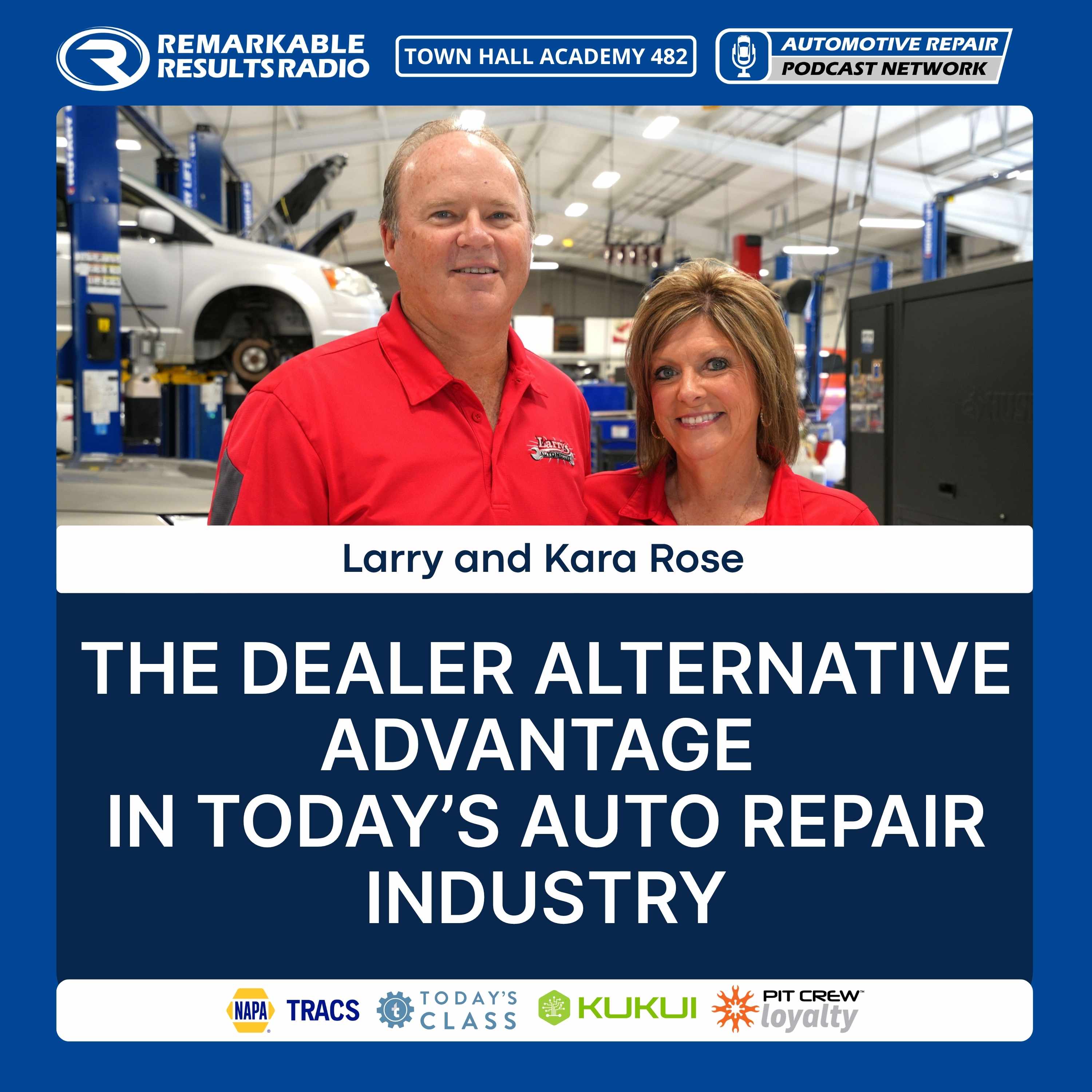
They’re talking with people from a local repair shop called Larry’s Automotive. The episode is about how independent shops compete with dealerships, so the shop’s approach matters.
The Chevrolet Trax is a small SUV made for regular driving, like commuting and errands. It’s meant to be practical and easy to handle, with more space than a typical sedan. People talk about it when they want a simple, everyday vehicle option.
Concept
five minutes daily
They’re talking about a short daily training routine—only a few minutes each day. The goal is to help people remember what they learn and apply it at work.
Today's Class is a website that offers training for people who work in auto repair shops. The idea is that short daily learning helps the team get better over time.
NAPA is a big auto-parts and service organization. If a shop wins a NAPA “Center of the Year” award, it usually means they’re doing a great job compared with other participating shops.
Being named “shop of the year” generally means the shop met specific criteria such as quality of repairs, customer service, and process consistency. In the context of repair-industry awards, it’s often tied to measurable performance rather than just reputation.
“Silver tsunami” means a lot of experienced people are retiring around the same time. That can leave shops short on trained workers, so they need a plan to replace them.
Succession planning in auto repair means preparing for ownership or leadership transitions so the shop can keep operating smoothly. The transcript frames it as something many people want to do, but don’t know how to execute.
They’re talking about keeping the shop floor clean and organized. It helps customers feel confident, and it also makes it easier for the techs to find what they need.
They compare the shop to a hospital operating room to make a point about cleanliness. The idea is that a tidy workspace helps people work better and find problems faster.
They’re talking about brakes—things that help the car slow down and stop safely. Brake service is a common job in repair shops and usually starts with learning how to inspect and service them.
An oil change replaces the old engine oil with fresh oil. It helps keep the engine running smoothly and is one of the most common services a repair shop does.
The front counter is where customers interact with the shop. It’s where you explain what the car needs and coordinate the repair, so it’s important for learning how the business runs.
A shop foreman is the person who coordinates technicians and oversees day-to-day shop operations, including workflow, quality, and communication between the shop and management. In many independent repair shops, the foreman role is a key step toward running the business.
Concept
step up
They’re talking about deciding to take auto work seriously instead of treating it like a hobby. That usually means running it like a real business with customers and a plan to grow.
They’re saying he stopped doing car work just for fun and started doing it like a real job. A professional shop has more structure for fixing cars and dealing with customers.
He’s talking about transmission work, which is the part of the car that helps send power from the engine to the wheels. Fixing transmissions is detailed and usually takes a lot of time and know-how.
Concept
economy went bad
They mention the economy got worse around 2008, and that influenced how he worked. When money is tight, people may delay repairs, but technicians sometimes adapt by changing how they run their work.
He describes doing repairs from home at first. The idea is that you can start small, get busy, and then eventually move into a bigger setup as the business grows.
They’re talking about running their own repair shop. That means they control how work is scheduled and how the team is built, instead of working under a dealership.
They’re referencing the COVID period, when business slowed and things were less predictable. They say they had to step in and do more of the work themselves.
They’re saying they don’t just hire based on skill—they also hire people who match the shop’s attitude and teamwork. They believe happy employees lead to better work and better customer service.
A shop management system is how a repair shop organizes work. It helps keep jobs scheduled, paperwork correct, and customers updated so the shop runs smoothly. The point here is that good organization matters as much as having good technicians.
Workflow optimization is about organizing how the shop does work so it runs more smoothly. The goal is to reduce delays and help the team get through jobs efficiently.
Profitability is how much money the shop makes after paying for everything. The idea here is that better organization and training can help the shop do more work without wasting time.
A learning management system is a tool that helps companies deliver training to employees. It can track progress so everyone gets the right training for their job.
It means a lot of people come in once, then never come back. If that happens, the shop has to keep spending money to find new customers instead of relying on repeat visits.
“Pit crew loyalty” is presented as a customer-loyalty program designed to increase repeat visits for auto repair shops. The pitch ties it to reduced churn (fewer “one and done” customers) and higher lifetime value.
Lifetime value is basically how much money a customer is expected to bring in over time. If customers return more often, the shop makes more from each person.
Predictable revenue means the shop can count on a steadier stream of income. Repeat customers help smooth out the slow periods so you’re not starting from scratch every month.
Topic
handbook
They’re talking about a written set of rules for how the business runs. It helps everyone know what to do and can keep the shop organized and compliant.
A specialist technician is a mechanic who focuses on certain kinds of problems or systems. Because they work on the same types of repairs often, they usually get better and faster at diagnosing them.
Point of sale software is the computer system a shop uses to create estimates, record what work was approved, and ring up the final bill. It helps the shop keep everything organized so customers get accurate invoices.
Concept
jump through some hoops
“Jump through some hoops” means there are extra steps and paperwork you have to do before you can grow. For a repair shop, it can be things like payroll, benefits, and other rules you must follow.
This means the real cost of having someone on staff is more than just what you pay them by the hour. You also have extra costs like taxes and benefits, and those affect how much work you can afford to take.
Concept
AI
AI is computer technology that can help with tasks that normally take people time—like organizing information or helping spot patterns. In a shop, it could help with things like estimates or figuring out what’s wrong faster.
A learning curve is just the time it takes to get better at something. They’re saying that if you didn’t handle a situation the right way, it doesn’t mean you failed—it means you’re still learning the best approach.
Concept
corporate America
They’re using “corporate America” to mean the typical business world and how it works. They’re asking whether people in auto repair have the same kind of support or background.
Company
RSOT
RSOT is brought up as an example of a coaching or support company. The episode doesn’t explain what it is, so listeners may want to look up what RSOT stands for.
A mentor is an experienced person who guides less-experienced operators by sharing knowledge, best practices, and decision-making frameworks. In the auto repair context, mentorship can help bridge gaps between hands-on mechanical work and the operational/business side of running a shop.
An accountability partner is a person who checks in with you to make sure you’re actually doing what you said you’d do. For running a repair shop, that can help you stay consistent and not drop the ball.
They’re talking about a group/network for repair shop owners. The idea is that it helps you learn the business side (like running the shop) and connect with people who can help.
A “team tool rebate” is money back that a shop earns through a program, and it’s used to buy tools. The idea is to help technicians have the equipment they need.
This means the shop keeps investing in learning even after someone starts working there. They’re saying training isn’t just for knowledge—it can also be tied to rewards like tool money.
An apprentice program is a structured training pathway that develops technicians over a set period, often combining hands-on work with testing and coursework. Here, the hosts describe it as a two-year program and discuss how completing it (and passing tests) leads to further registration for additional assessments.
Term
ASC tests
“ASC tests” refers to certification or assessment exams used to verify technician competency within a training/certification framework. In the segment, the speaker says the apprentice has already passed several ASC tests and is registered for more, implying progress toward qualification.
Concept
technician was not for him
Sometimes training shows you that a job isn’t the right fit. Even if someone doesn’t succeed as a technician, the program can still help them figure that out early.
They’re talking about having to be honest with someone who’s struggling or not suited for the job. In a repair shop, that honesty can help the person move on to something they’ll be better at.
A loaner car is a temporary car you can use while your own car is in the shop. It helps you keep your schedule instead of being stuck without transportation.
A lock box is a secure box where the shop stores your car keys when you drop the car off after hours. It lets you leave the keys safely without needing to wait for someone to be there.
A rental car program is when a dealership or shop helps customers get a temporary car while theirs is being fixed. If there aren’t enough rental cars, people may have to wait or go without.
“Dealer alternative” means an independent shop that tries to be a better choice than the dealership for repairs. Here, they’re emphasizing that they can offer the same kind of convenience—like loaner cars—without the dealership experience.
A warranty is the promise that the car maker will pay for certain repairs. Some dealers try to make it sound like you must use them for everything, but you can often get warranty coverage if the work is done properly by a qualified shop.
A recall is when the car maker says there’s a problem in certain cars and offers a fix. People often think only the dealer can do it, but the important part is getting the official repair done correctly.
The hosts are talking about using an independent shop instead of the dealership for car service. The claim is that you can still get the same kind of work done, just with a better experience.
Concept
training for our specialists
The segment emphasizes technician training as a differentiator for repair quality. In automotive service, training affects diagnostic accuracy, proper repair procedures, and the ability to follow manufacturer specifications.
A service advisor is the customer-facing role at an auto repair shop who interviews the customer, writes up the work order, and coordinates with technicians. Because they’re the “face” of the company, their communication and product knowledge strongly influence customer trust and repair outcomes.
Training for front-desk staff (service advisors) is different from technician training because the focus is on communication, customer expectations, and accurate job write-ups. Well-trained advisors can reduce misunderstandings, improve estimate accuracy, and make the repair process feel smoother for customers.
Company
BDG group
BDG group is mentioned as another organization that helps bring training opportunities to the shop. It’s basically a network that supports learning for the people working with customers.
The hosts are discussing how marketing—especially broad channels like TV—can be costly for repair businesses. This matters because visibility and lead generation directly affect how many customers a shop can book, which in turn impacts staffing and capacity.
Some dealerships assume that if you bought a car there, you’ll also bring it back for repairs. That’s especially true for warranty work, so they try to keep you coming back to them.
Warranty work means repairs the car maker agrees to pay for (as long as the problem is covered). Dealerships often handle these repairs, so independent shops may not get as many warranty jobs.
It basically means you usually have to take a chance to get good results. Starting or growing a shop often involves some uncertainty, but it can lead to real payoff.
They talk about what it takes to start your own auto repair shop. The main idea is that if you have the skills and you’re willing to take the risk, you can make it work.
In an auto repair shop, a general manager (GM) typically oversees day-to-day operations like staffing, scheduling, customer flow, and profitability. The discussion here highlights how shop owners often shift from hands-on work to leadership as the business grows.
Understaffed means there aren’t enough employees to keep up with the work. When that happens, people often have to cover for each other—like helping with customer calls or service desk tasks.
They’re basically saying you can’t focus only on fixing cars—you also have to manage the shop like a business. That includes things like keeping things organized and making sure the shop runs smoothly.
Topic
Premier Automotive Repair Business podcast
They’re saying this episode is part of a podcast series focused on how to run an auto repair business. The emphasis is on business strategy and operations.
I have Kerry and Lara Rose from Larry's Automotive.
There you're going to meet them here in a minute.
We're going to talk about a whole bunch of
really cool things going on at their shop,
Larry's Automotive in Newburgh, Indiana.
But thank you so much for letting us be part of you.
You know, our purpose is always to advance
the Automotive Repair Professional Repair Automotive Service Industry
with this great content and your participation as a listener
and people that constantly give me ideas to bring on and talk about.
Also, we have worked so hard in the last year
on our Automotive Repair Podcast Network app.
Oh boy, it's for your smartphone.
You can read show notes, link with our sponsor partners,
get all the shows in our network,
all seven we produce each and every week
from all our great, great talent that we produce shows for you.
So don't forget Automotive Repair Podcast Network.com forward slash app.
And thank you so much to our great sponsors NapaTrax,
today's class, Kukui and Pit Crew Loyalty.
Hey, did you know that NapaTrax has on-site training plus six-day week support?
Well, it all starts when a local representative meets with you
to learn about your business and how you run it.
After all, it's your shop, so it's your choice.
But it's proved to you that Trax is the single best shop
management system in the business.
Find NapaTrax on the web at NapaTrax.com.
Ready to optimize with today's class?
Boy, listen to an episode we did with David Boy's great program,
roll out a training plan for your automotive shop.
In just five minutes daily, you boost knowledge, retention,
and improve team performance.
Start seeing results today.
Join your peers at today's class.com.
Hey, welcome back everyone.
Larry Rose, how are you Larry?
Good, how are you?
I'm great.
I love that logo.
It is just bad.
Thank you.
Who made that?
Did Cara make that?
Well, I came up with the idea and Cara helped make that.
Yes.
I love it.
Cara, putting it in the background like you have it
is just a great thing.
Glad you're so here.
There's a lot to talk about here.
You guys were named the Napa 2025 Auto Care Center of the Year.
Huge, huge honor and award and milestone for you guys.
So when you got the phone call from maybe it was what Jason Rainey,
how'd you feel?
What did you think?
So we got the call from David Cosby, our local store owner.
And he said he needed to set up a meeting with us.
And I kind of thought maybe that was going to be what it was.
And then my wife had to rain me in and say,
well, there's several awards.
We could have just gotten a local award.
The anticipation was great.
And then when you found out Cara?
So we had all of our employees to come together for a dinner that evening.
And Cosby and his team was here.
And Jason was on the video talking to us and everything.
And he went through the whole thing of why it's important to be shop of the year
and how they have different shops throughout the United States
and the Midwest region.
We'd won the Midwest region and how great that was.
And explaining all the benefits and everything and congratulating us.
And he went one step further and said, well, not only did you win that,
but you also won shop of the year.
And all of our employees got so excited and started yelling.
And it was great to see the enthusiasm of everybody on the team.
What a cool idea to bring your team together for dinner.
Realize that you not only won the Midwest, but the national.
I'm getting goosebumps just listening to how you did that.
You guys are involved in SkillsUSA.
And because the silver tsunami exists in our industry,
where so many people say, I'd like to retire.
I'd like to sell.
I'd like to do some kind of succession.
And a lot of them just don't know how, who, when, where.
There's a lot of doubt going on in our industry about this.
But you guys have come up with a plan.
We don't want to hear all of it, but we'd love to hear a high level of how you're doing it.
And I want to find out how you keep your floor so white and shiny.
Well, I can start with the floors.
So I've got a couple of floor scrubbers that I have the guys use daily.
And we also have a apprentice that helps keep them clean.
So what my theory is, when you bring a customer back to see their car,
see what they're, you know, we're doing to it and they see the floor.
It's like, if you're taking care of your shop, you're taking care of your floor.
You're going to take care of their cars as well.
You know, so that's why I want my people to dress nice,
wear good clean uniforms and a nice white floor.
And it not only helps show the customer how, you know, we take care of the car,
but it's also easy to see, easy to find stuff when you drop.
So it just makes life better.
Please go to Larry's Automotive Repair in Newburgh, Indiana,
look at some of the gallery pictures and put your sunglasses on when you look at the shop floor.
I mean, and you're right, the pride, you know, I always think of us as in the medical field,
me getting rolled into an operating room and looking around.
It's clean. I mean, you don't see a whole lot.
You're usually laying down, but there's hardly a speck out of place
because they realize the importance of that.
Right. Ordered uniforms. I wanted white uniforms, just like doctors.
But the uniform companies told us they wouldn't be able to get them clean.
So we stuck with red.
We'll have to charge you more.
Yes, they'd have to replace them more often for sure.
So I think one of the key things and why you're on,
not only is to pay homage to the Auto Care Center of the year,
which is such an incredible honor.
And I've interviewed everyone, say for the last eight or nine years,
this whole family succession thing, you've got family inside, you've got a great team.
You guys aren't afraid to be perpetual students and to bring the kind of education that you know
your family is going to need to have, but the rest of your team.
How much has continuing education played a role in your succession?
Well, first of all, you kind of touched on our succession plan.
And our plan is to have our children take over our business in the near future,
not immediately, but in the near future.
And our son came back about six months ago to the area and has joined us.
He used to work here in high school and college,
you know, doing breaks and oil changes, the basic things in back.
So we felt it was real important for him to learn the front counter.
So now he's up there.
Then eventually he'll continue to work with our general manager
and really learn how to run the business.
Then eventually our goal is that he would take over one day.
In the back of the house, we're lucky to have our future son-in-law back there.
And he joined us a year ago.
And our long-term goal for him is to actually learn how to be a shop foreman.
The good thing is we have both of those positions filled with really strong people
that are going to be around for a few years.
And so we have many years for our family to learn from the people
that are really running our business for us right now.
Does that team know of your plans?
Yes, they do.
And let me add a little bit to what Kara said.
Our son wanted to step right in and not go to college and work for me.
And I was all for it.
And she says, well, you can tell him you could do that someday,
but you're going to go to college.
You're going to get a degree and learn your own way.
And if you want to come back someday, you can.
So he went out and got a college degree in electromechanical engineering
and an MBA in business.
So he's touched all the points.
So he's ready to step into it.
I hate to say, but she was right when she had him do that.
He's way more mature now, leaving and working for other people along the way and coming back.
Well, high five to you both for sending your son to school like that.
Now, you said two very important words, engineering and an MBA.
That whole car is an engineering marvel and it will continue to be.
Yes.
And with that base of knowledge, at least having gone through some formal training
and discipline and then having the business background,
I can't imagine how big Larry's is going to get someday.
Yeah.
And our daughter has learned how to do payroll and she helps with advertising and all the marketing.
She's been doing that for a couple of years, along with her full-time career also.
So we're kind of, you know, getting them all involved early on.
You think you're lucky that you could be where you are?
We're blessed.
Okay.
I love that word.
Yeah.
Excellent word.
We've both worked, but Larry has worked many hours to get us to where we're at.
It did not happen overnight and he's worked many long hours out in his garage behind the house
and then growing the business and, you know, I worked at, yeah, building the business and it's
just given us the opportunity to make it what it is today.
You know, it's such a great point and so many in our industry, Kara and Larry, are struggling
that they're struggling.
You guys, great story.
Larry worked out in the garage in the back of the house, right?
But there was a point in time, Larry, where you said it's time to step up.
And I don't know what that means to you, but it means certain things to certain people.
Then you open a business.
But there's also another time where you stopped saying, I'm not going to be a hobbyist anymore.
I'm going to be a true professional business person.
Take us back to that moment because there's not enough people realizing that jump that's so necessary.
It wasn't just a more of a hobbyist.
I was working at a dealership as a technician.
And around 08 when the economy went bad, I started working at home a lot and building
transmissions and fixing cars there.
It was basically two full-time jobs.
I was getting off at 5, 5.30 at the dealer and I was working out in my shop till midnight,
one o'clock in the morning.
And it just got so busy where there are cars in my driveway all the time, which my wife said that
was absolutely not going to happen.
So to keep those cars out of the driveway, they had to be in the garage.
So I had to get them in and out fast.
So I just got so busy that I couldn't take on two jobs anymore.
So I quit the dealer full-time.
I worked in the full-time in my shop for six years.
I got so busy and I realized I had a great business,
but it was only worth as much as my house was worth.
So I convinced my wife that we had to build a shop elsewhere
to get the clients away from our house.
So if we ever want to move or sell our house or do whatever, we had a business.
So grew from there.
In 2020, we expanded, made a build a shop around the corner twice the size.
It was a little bit slower during COVID, so I was my own contractor.
So again, I was working day and night, a lot of my own building in my new shop.
So when she said I built my business, I literally built my business.
So you get this thing, you walk into this beautiful operation,
you need to hire people, but when did you stop and say I need to learn
to be a professional entrepreneur?
I don't think I really stopped to do that.
I was just on the go all the time and I, you know, working at the dealership,
I knew a lot of people.
So I would just add techs as the business grew and, you know,
not every tech is cut out for our shop.
You know, I want people, we've got an ethic, we've got a morale here.
I tell everyone in meetings, I want you to come to work happy and I want you to go home happy.
If you're not happy, I don't want you working here.
We doubt them people that come to work in a bad mood every day,
because all that does is bring down the rest of your shop.
So culture seems to be a great culture, very clean operation, right attitude.
Did it evolve from you asking your people what kind of place do we want to create here?
Was it just the way you and Kara, you're just fun, exciting, elixing type people?
Well, again, I've worked at dealerships and I see what to do and what not to do.
I've worked with some bad eggs that will turn the whole shop upside down.
You know, you get one grouchy guy and he starts pointing out everything
and then everybody thinks it's a bad place to work.
Larry, I've got to stop you from there.
There's too many people right now in our industry that let that go and they live in that.
I guess the message is how do we convince people stop?
That's a very hard thing to do.
I've let some very good technicians walk because of their attitude.
It's very tough and you put up with it for so long and then when they leave,
you just feel like the weight just come off of your shoulders.
You know, at first you're like, how am I going to replace that person?
He was really good, but I think back to when I was at the dealer,
they lost me and they're still in business.
So, you know, I thought I was the greatest thing since sliced bread
and they lost me and they didn't go out of business.
So the same thing is going to happen to me.
Hey, let's face it.
Your shop management system is the single most important tool in your shop.
Period.
NapaTrax has made selecting the right shop management system easy
by offering the industry's best, most comprehensive SMS.
Now it all starts when a local representative meets with you
to learn about your business and how you need to run it.
After all, it's your shop, so it's your choice.
And having local representation is a huge plus.
Customizing tracks to your business, whether you're a one-person shop
or a large multi-bay or multi-location company,
a representative consults with you to help optimize your shop's workflow,
efficiency and profitability.
Trax always has the flexibility to do business how you need to do it,
which means it can also grow as your business grows.
And unlike the other guys, we'll be there for you after installation
with the best training and support in the business.
Yes, a learning management system tailored to each role in your company.
Simply put, Trax was designed and built for shop owners just like you.
Visit us on the web at NapaTrax, that's N-A-P-A-T-R-A-C-S dot com.
Strengthen your shop's entire team with today's class.
Everyone from technicians to service advisors can access impactful training
on their phones in just five minutes a day.
Opt for solo sessions or ignite friendly competition,
challenging team members to climb the leaderboard for the highest score.
Our effective daily training ensures measurable progress,
helping you develop your team.
Train smarter, not harder, with today's class
and transform your shop and your people.
Start seeing results today at today's class dot com.
You know, most shop owners feel trapped spending on ads while half their first time customers
never come back.
It's frustrating, it's exhausting, and it's not your fault.
The industry average is 54 percent, one and done.
We understand how discouraging that can be.
Well, pit crew loyalty changes the story.
Our clients cut that rate by up to 38 percent,
raising lifetime value by more than 50 percent.
Loyalty members visit nearly three times more often,
creating predictable revenue without extra ad spend.
Pit crew loyalty, where customers stay and shops thrive on the web at pitcrewloyalty.com.
Kara, as you were watching all this happen and very much a part of it,
were you excited to see where the business was headed?
Oh, it's definitely been exciting, but I'd have to honestly say
I'm more of a cautious person than Larry.
And so I'm always the one of, are you sure we can do this?
Are we going to be okay?
But he's always come through.
So, but it's been definitely exciting.
And it's been, I mean, it's not just him.
It's everybody that works for us.
You can use that word, Kara.
You said I came through, but you can say he was right.
He was right.
Tell her, Kara.
Tell her she can say it.
All right, Kara.
Yeah, he was right.
Kara podcast, you can be as honest as you want.
What a great team.
It's like Larry's the visionary risk taker.
Kara, you're saying, I think that's through Larry.
Wait a few minutes.
And Larry, was that healthy for you to slow you down a moment
before you jumped?
Probably so, because Kara had her own career and she would come from
the corporate world.
So she knew, you know, all of the employee side of it.
You know, we needed a handbook.
I knew nothing about the business side of it.
I knew fixing cars, making invoices, making people happy.
But she knew the other part of payroll and, you know,
needing a handbook and all the legalities of owning a business.
So that was a great help.
Where would you be without Kara right now?
Probably still in my garage.
I'd probably still be at the dealer, actually.
To be honest with you, I'd still be working at a dealer.
And that's a great admission in part of what I love to talk about on the show
is how do we get people out of being, and I don't mean to be a hobbyist,
but really, truly a specialist technician in the Bay is loving to do that
and not paying attention to HR and banking and all that stuff.
Point of sale software.
Right now, you'd probably just have you and a couple other people.
If you didn't have, again, Kara coming in saying,
you know, there, I got this corporate America background,
and I know what we're doing over here.
We've got to jump through some hoops to get there.
And did you say anoint her?
God bless her, holy oil and go.
Well, to be honest with you, when we first decided that we were going to build a place
and have employees, we went to talk to our accountant.
And he told me what it cost to own an employee or pay an employee.
You know, all the added things, you know, all their benefits, their taxes,
you know, everything that comes along with it, not just their hourly pay.
I walked out of there and thought, I don't know if we can do this.
And Kara was the same way.
But our accountant has talked her into things that I couldn't too.
So he's been a big help also.
Those are humbling yet breakthrough moments to think back to.
And to say that if we didn't turn that switch, step forward one step,
swallow hard, realizing the risk we were taking,
you guys wouldn't be where you are today.
That's exactly right.
It's a big risk.
And I think, Kara, for that, quite often that if she didn't have a good job,
I might not have taken the risk back then.
We were able to survive on her pay.
So if I failed, we were still going to be OK.
So that was a big help.
It made it a lot easier.
Do the kids know the risk you guys swallowed back then, the risk you took?
I think they're starting to see that now that they're in the business.
They didn't understand it back then.
They had no idea.
But every time we see a video or like one of your podcasts or Dem's podcast,
we'll send it to them and they watch it and they're like, wow, they're starting to understand.
The key is it's almost like shaking the leaves or the branches of the tree every once in a while.
You need a windstorm in order to make things grow.
Good for you.
Great to have heard about your succession plan.
And I know there's an awful lot of shop owners out there that do have family,
but they're ignoring some really tough, big decisions that you have to sit down and talk about.
That's the best thing to do is talk.
Most parents don't talk to the kids about what it could be,
the kind of money that can be made there.
And where the younger generation can take it on further,
our son's coming up with new ideas, bringing it in AI.
And some of the things that we wouldn't think of.
So it's nice to have younger generations to come and see.
And that's the best thing to do is have the shop owners, their parents talk to the kids.
So the kids understand the business more.
And understand the commitment.
We sat down with our kids and we said, is this something you want?
And are you committed?
We've put in the time and the effort up to now and we'll still be here with you,
but you have to put in the time and effort too.
It's not just something where you get the key to the building and off you go.
Like Larry said, our son, he went to vision training a couple of weeks ago.
And he came back with a lot of great ideas.
He put together a PowerPoint.
He had a meeting at 6.30 in the morning with the whole team.
And we're in the process of looking at doing some different rollouts
and changing a few things that he learned about just within his few days at vision.
What's really great about the whole process is we're still going to be here,
why he starts implementing ideas and trying to help make our business better.
So if it's good, we can support him and do it the right way.
And if it's not good, we're still here.
So we can say, hey, let's look at this another way.
We've already tried that and it didn't work or whatever.
Or you let him do it even though you may see some risk in it
and let him on his own bases come to you and says, mom, dad,
I think I should have yanked and maybe I yanked.
And you say, son, we've been through all of these.
It's that huge learning curve that we have that doesn't mean that what you did was wrong.
It's just that you didn't attack it correctly and let's just regroup.
I love that learning part of being an owner and entrepreneur leader.
I want to talk about the corporate America thing that Kerry, you brought and Larry,
this happened because of where Kara was.
But what if there isn't a spouse, a friend, a partner,
a significant other that doesn't have this kind of background?
The point is that I always try to make on our shows is there's companies like RSOT.
There's all kinds of coaching companies that can come in and help.
And so many times, well, I know what I'm doing.
I know what I'm doing and we do shows about all this time.
And owners come up and say, I had to get my ego and put it on the shelf.
So I realized that I needed a mentor.
I needed an accountability partner.
Did that ever come into play for you guys?
I don't think the ego side of it came into play at all with Larry.
He recognized from the very beginning that he didn't understand the business side of
everything as much as he did working on cars.
So when we got connected with Repair Shops, it really was a way for him to learn more
about the business and understand the part we were missing.
So I don't think there's been a problem with him personally, with that whole relationship.
But I do think that we have benefited tenfold from Repair Shops.
All of the connections, not just with our own coach, Ron, but all the connections that we have
through Repair Shop, you said, well, I think your question was going to kind of lead to
what do these people do if they don't know what to do?
And I think using a coach has been a great thing for us.
I also think that using the things that Napa has as a gold shop, they have a lot of different
people that you can get in contact with and learn from.
So I think shops really need to look down that avenue too and utilize what they offer you.
A lot of it's free, and it just really helps you do a lot of different things
that you might not know as a technician.
That's a great point, Kara.
And it's to both of you, as a Napa gold shop, there's a lot of additional benefits that
the program has.
And one of them that I have been really paying attention to is the team tool rebate and the
extra you earn as a gold shop.
What did you do with your team tool rebate this year?
We split it between our technicians.
We have a couple of apprentices that could use some tools.
And I mean, who can't use tools, whether you're young and just starting out,
or you've been doing it forever.
So we passed around the catalog and had everyone pick out tools.
And it equaled about $1,000 per technician that they all got in tools.
I bought one item for the shop for everybody used to, you know, it's an engine table,
transmission table that drops everything out the bottom that makes it job easier.
And then the rest all got split up between the technicians.
That is a really good program.
Everybody loved it.
I got to do an episode from shops like yours that have come up with the ideas to incorporate
what team tool rebate means at the end of the year.
And you just gave me this wild idea.
But, and again, we've done an episode at vision, by the way, with Pete McNeill and how he used
his and Jason was in the room and so was Matt Crumpton.
It's a great episode is coming out soon and great ideas.
But one of the thoughts that I had is if we're in a continuing education mode in our shop,
our culture is the being a perpetual student.
And we're mounting up, be it leader led, be it online, so many hours of training,
those hours of training can apply toward how we split the team tool rebate up.
They train, they get tools.
Yep, that's a good idea.
So that's my part of my job in this industry is to toss these great ideas up.
Apprentice program, you told me in our discovery call that your son-in-law went through it.
The apprentice program, as you probably know, is a two-year program.
And as I said, he joined us a year ago and he just completed his apprentice program.
So he actually did it in one year and he's already passed a few of his ASC tests.
And he's registered to take a few more.
So he really has put 100% into the program, not only him, but we also,
we have one other employee that was a graduate from the program.
And then we have another one that is in the program right now.
And we did have one that was not successful in the program.
But it really allowed him the opportunity to figure out that being a technician
was not for him in the whole scheme of life.
And it gave Larry the chance to sit down with him and talk through that and realize that
this wasn't the career for him.
So he was able to exit our shop and exit the career and go on and find something else to do.
Those are tough conversations, Larry, aren't they?
Very tough.
It's the first one I've had at my shop, but when I was working as a dealer,
they had an apprentice that I had to tell him he was not cut out for this work
and he needed to find something else to do.
And I think they know that already.
You can tell by what the effort that they put into their job,
it's, they don't know what to do.
Their parents tell them they have to find something to do
and they've gotten their license and they like cars and they like tinkering with them.
So they think that they can work on cars.
In reality, it's not for everyone.
And you just got to be blunt and tell them
there's nothing worse than seeing somebody struggle in life no matter what it is,
you know, whether it's everyday life or in their job.
So, you know, I have to tell them, I have to be the bad guy sometimes.
Some people look back and will probably walk in the door in five or six years
and say, Larry, thank you for letting me go.
And I had, it was the best thing that happened to my life and my career
because sometimes people are way too close to their problem
that you can see different and better than them.
Yep, you're exactly right.
Okay, you got loaner vehicles, are they doing you well?
Absolutely.
People love the loaner cars and because we're open at 730,
it allows the people to come and drop their cars off,
get a loaner car and still get to work by eight.
Or they can, we've got the lock box that they can drop off their cars.
We lock their keys up, they can pick up after hours.
They drop their loaner car off after hours.
It was a great move.
You know, I've gotten a lot of these ideas from me working the dealers.
You know, we have worked at a dealer that had rental car program
and there was a lot of people needing to rent cars.
There wasn't enough cars to go around.
When I first built, opened up my shop, I said,
we're going to have loaner cars.
When I got in charge for them,
all we require is them to put the gas back in it that they've used
and yeah, everyone loves them.
What a great move.
Another thing that I noticed on your website,
and in fact, you've discussed it quite a lot here,
the dealer alternative.
You mentioned all of that great training that you had
and the exposure that you had to the dealer world,
that was that impact on you calling yourself the dealer alternative?
Or do you just know you're so much better?
In a lot of ways, I think we're better than a dealer.
But the reason I say that is because the dealers and the manufacturers
are trying to push it to the customers when they buy a car
that they are required to bring their car back to the dealer
for their warranty to be valid.
They think if they go somewhere else for an oil change,
that avoids a warranty.
A lot of people just like with recalls, we hear, was that a recall?
Everybody really doesn't know what a recall means and what it is,
just like they think that they have to take it to the dealer
for their warranty to be good.
So I say we're an alternative to the dealer
because you don't really have to take a dealer.
We can do anything that the dealer can.
And in most cases, better with a better experience.
Cara, are you all bought into that?
Most definitely.
I saw a lot of things at the dealership while Larry worked there over the years.
And when he started his business, he was like,
they did a lot of things wrong and didn't treat people the right way.
And he goes, I want to treat people the right way.
And so it's definitely has been the right thing and kind of the right mentality
for our team here to talk about that.
Let's talk about your counter.
I am just convinced the importance of training for our specialists,
technicians in the bays, but that I almost rate the counter trusting,
developing relationships, personalities at our counter,
just slightly higher because it is one of the toughest jobs in our industry.
How are you guys bringing that kind of training?
You're exactly right, Carm.
So when we got this NAPA award, when we found out we could apply for it
or put people towards winning that award, there's a shop of the year
and there's a technician of the year.
And I reached out to Jason Rainey and I says,
you know, why don't we have a service advisor award?
The service advisor is the face of your company.
When the person comes into that front door, that person needs to greet them.
They need to have a smile.
They need to make them feel welcome.
And that is a big part of our company.
We need to have a service advisor award.
And, you know, he said, well, nobody's ever brought that to the table.
Never thought about that, but you're exactly right.
And that's going on to what you just said.
You know, they have to know what they're talking about, what they're doing.
They've got a lot to learn and a lot to know as a service advisor.
We do a lot of training with them too.
It's kind of a little different.
It looks a little different than it does necessarily with the technicians.
Our local NAPA distributor, he does a fantastic job along with our BDG group
of bringing in training opportunities for the front desk people.
But then we've also started the today's class
and we've been doing that for about a year now.
And every single person in our building from our GM,
all the way down to our oil changers, including our front desk,
they all get a question and they answer their questions a day and they learn from that.
And it's really helped that front desk to be able to understand
mechanical side of their job, but then also just the customer service side
and giving the best experience we can to every customer.
Well, you just mentioned today's class, David Boyce.
He's a great friend, a great partner and sponsor of the show.
And they just do a marvelous, marvelous job.
What a unique and very precious idea.
Let's talk about some community stuff.
I noticed the 2024 Evansville Choice Award platinum winner.
I don't think you can get bigger than platinum.
How cool is that?
Tell me about that.
We actually won it again for 2025.
Yeah, so two years in a row.
It's pretty exciting.
It's the customers.
It's all the people in the tri-state area that vote for their favorite
company in whatever category.
So ours was the auto repair.
So that was pretty exciting to win that locally.
Okay, Larry, I got to tell you something about your floors.
One more time.
So yesterday, I met Lowe's and my wife and I are shopping for this particular light thing.
And as we're walking around one of the corners, all of a sudden this machine comes out.
And it's a floor scrubber, Larry, with no one sitting on it, Larry.
It is computerized, like those inventory robots that I've seen at BJ's,
where they're just walking around.
I don't know how that stuff works.
I'd love to know.
But Larry, they have automated floor scrubbers today.
That is nice.
And I've seen that also, but what I don't think it would work in a shop.
Now, it might after hours, but during hours, if you drop a part and this thing's coming through
and it sweeps up a bolt while you're working, it could run into a problem there.
Can you imagine at night?
You know, at nine o'clock at night, this thing turns.
It's kind of like those vacuum cleaners at home.
Yeah, yeah, you're exactly right.
Do me a favor.
Don't buy one, but just price one and let me know how much they cost.
I bet they're pricey.
You know, I would like to touch something back about the service advisors.
Also, I don't mean to beat up on dealers, but I've, going into business, I've learned a lot
about dealers where I think a lot of shops are missing it is they don't advertise.
I know advertising is expensive, especially TV advertising.
But when's the last time you've seen a dealer advertise their shop?
You see all the car sales, the car advertisements, but they never advertise that they work on cars.
The dealer's mentality is you bought a car here, you have to bring it back to us.
That's how they think they get their business.
So we, since we don't sell cars, we have to advertise.
That is a big help that grown our business is TV advertising.
You know, it's the alternative back to your question earlier.
It's the alternative to the dealer because the dealer really isn't busy except for warranty work
because the customer has to take their car back to the dealer for warranty work.
So it's great to have a friendly face.
You walk into a shop, mom and pop shop, and you get a friendly attitude.
They help out.
It just, we try to be one step ahead or 10 steps ahead, I should say, than the alternative.
On your website, there's a couple of videos.
Are those your commercials that you run?
Yes. Yep. Those are our TV commercials.
Those are your TV and you do TV and you feel it is a really big impact for you.
I can tell you it's very expensive.
And when we were approached about doing TV advertising, I said absolutely not, but it helps a lot.
It's a big help.
The way you have to advertising, which Kara does a great job at this,
is a lot of people don't watch TV anymore.
They got YouTube, TV, you know, this and that.
So we have to do it around sporting events, NASCAR, football, baseball, the news.
People usually watch those things.
So that's where we put in our ads.
Makes all kinds of sense.
Well, look, this was refreshing.
Thank you for your perspectives on a whole lot of things about the shop,
your succession program, and of course, congrats to the Napa 2025 Auto Care Center of the Year.
Final word, any great advice to shop owners out there that are looking to just jump to the next
level? Kara, will do you first then Larry?
I would just say if your heart's in it, go for it.
Because if you don't take the risk, and I'm the one that should be saying that,
but if you don't take the risk, you never will know.
And it definitely has paid off for us and our family and all of our employees in the community.
So we're able to give back to our employees and to the community both.
So it's been well worth it.
You've got to go to the website.
Larry's Automotive Repair in Newbury, Indiana.
Just look at the shop and the pictures and how you market yourself.
Really, really well.
Good job.
Larry, final word, sir.
Well, you know what they say, no risk, no reward, right?
Well, my wife, it took me a while to get her on board to take the risk and it's paid off.
So for a shop, if I was to tell a guy that's thinking about opening up a shop,
if he's got the skills to work on cars, he's got 90% of what he needs.
And there's, like you said, repair shops tomorrow.
Give them a call.
If you're thinking about it, give them a call and find the help that they can give you.
And between them and Napa, there's a lot of great help out that can guide you the rest of the way.
I find it so interesting that you said he's got 90% of what it takes,
but sooner or later, he needs to flip that to a 50-50 entrepreneurial and then the technology piece.
Exactly.
At some point, when you start filling up your shop, you're going to need to either
move up front or hire somebody to move up front.
And for the longest time, I was doing both.
I was front and back and then I was up front and then I've hired a general manager now.
So, you know, I can do pretty much anything.
Okay, I got to keep going.
I thought this was going to be the end.
Which job did you like the most, back in the shop or on the counter?
Back in the shop.
I still like being back in the shop.
I like seeing people I know, greeting them, talking to them,
so I don't have a problem of being up there before when we were understaffed.
I guess I say as we are growing, you're always understaffed and looking for someone.
So, I would cover for vacations for service advisors and stuff like that.
And I like being up there a day or two, helping customers, talking to customers and stuff,
but my heart is in the back in the shop.
Yeah, find what you do so well and do it.
And I know some shop owners that say, hey, I've got a great GM and I've got everybody else.
And I'm back in the shop because that's my most natural tendency.
That's what I love to do.
But you still have to pay attention to the business.
I don't care.
You can't keep your head under the hood and not pay attention.
And if you can't pay attention, hire RSOT.
They will pay attention for you.
Yeah, repair shop up tomorrow.
Hey, thank you so much.
Great to hear your story.
And we need to have you back once there's some big succession things going on.
I would love to talk about it, okay?
Sure.
Maybe we'll bring our son in next time.
That'd be great.
Thanks, guys.
Larry and Cara Rose, owner, Larry's Automotive in Newburgh, Indiana.
Thanks for being here, man.
Thank you.
Thanks, Karm.
Thanks for being on board to listen and learn from the Premier Automotive Repair Business
podcast, Remarkable Results Radio.
Get your episodic education on the ARPN listening app at automotiverepairpodcastnetwork.com.
Also, enjoy the podcast on our Karm Capriato YouTube channel.
Karm is all for advancing the professional automotive service industry.
Until next time.
About this episode
Larry’s Automotive in Newburgh, Indiana earns Napa’s 2025 Auto Care Center of the Year, and the Rose team breaks down what’s behind the win: a spotless, pride-driven shop culture, strong service-advisor training, and a “dealer alternative” mindset that emphasizes doing the work better and treating customers right. The conversation also covers their family succession plan, how they shifted from hobbyist to professional entrepreneur, and using coaching, apprenticeships, and tool rebates to build capability. Loaner cars, TV advertising, and ongoing education round it out.
Thanks to our Partners, NAPA TRACS, Today's Class, KUKUI, and Pit Crew LoyaltyWatch Full Video Episode
In this episode, host Carm Capriotto sits down with Larry and Kara Rose of Larry’s Automotive in Newburgh, Indiana, to celebrate their recognition as the NAPA 2025 Auto Care Center of the Year. Their story is more than an award; it’s a roadmap for building a sustainable, family-driven business through discipline, culture, and long-term vision.
What You’ll Learn
How Larry turned a driveway side hustle into a scalable business
Why Kara’s systems and structure were key to growth
A clear, intentional plan for family succession
How strong culture outweighs individual talent
The impact of daily training and continuous learning
Why service advisors are critical to customer trust
Growth strategies like “dealer alternative” positioning and coaching
Building a lasting shop requires more than technical skill; it takes structure, culture, and a long-term vision for people and growth.
Larry and Kara Rose, Larry’s Automotive, Newburgh, IN
Thanks to our Partner, NAPA TRACS
NAPA TRACS will move your shop into the SMS fast lane with onsite training and six days a week of support and local representation. Find NAPA TRACS on the Web at http://napatracs.com/Thanks to our Partner, Today's Class
Optimize training with Today's Class: In just 5 minutes daily, boost knowledge retention and improve team performance. Find Today's Class on the web at https://www.todaysclass.com/Thanks to our Partner, KUKUI
Stop juggling multiple marketing tools. KUKUI’s integrated platform delivers 4x better website conversions, automated follow-up, and real-time ROI tracking. Get industry-leading customer support with KUKUI at https://www.kukui.com/Thanks to our Partner, Pit Crew Loyalty
You’re probably tired of chasing new customers who never return. We understand. Pit Crew Loyalty ends the one-and-done cycle, turning first visits into lasting, reliable revenue at https://www.pitcrewloyalty.com/Connect with the Podcast: