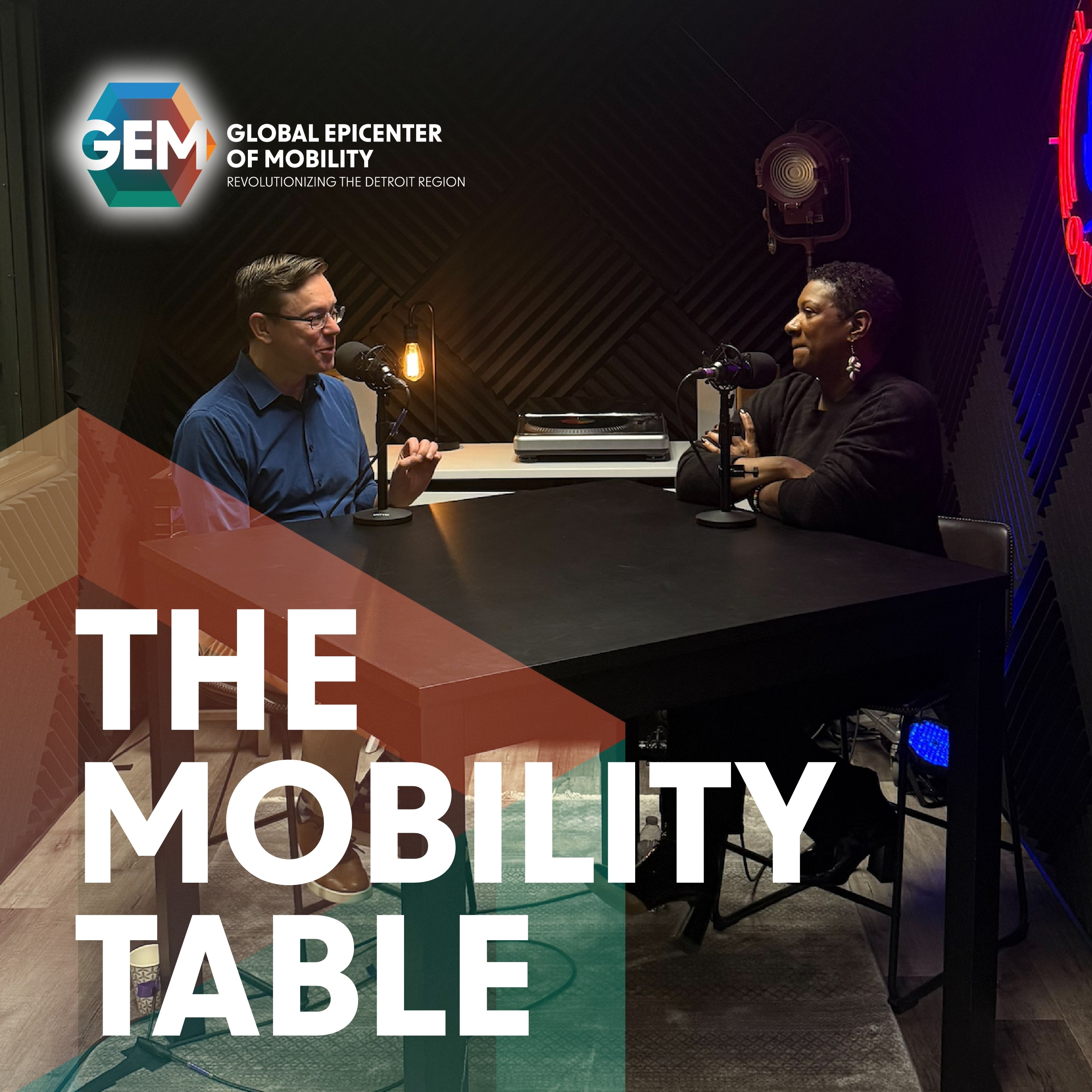
The Importance of Having Allies in Electrification with Brandon Bordenkircher, Campaign Manager for EVNoire supporting Electrifying Michigan
About this episode
Brandon Bordenkircher of Electrifying Michigan joins Bernard Swicky and Janine Gantt on The Mobility Table to argue that EV adoption needs “allies” who educate, demystify, and amplify messages across the mobility ecosystem. The discussion tackles why mainstream buyers struggle with uncertainty like charging and range anxiety, and how exposure (ride-and-drives, transit with electric buses) plus clear, non-jargony communication can build comfort. Electrifying Michigan is presented as a brand-agnostic, multimodal statewide convenor supporting partners without duplicating their work—connecting EVs, charging, workforce, and even electric boats and drones.
Brandon Bordenkircher joined Jeannine and Bernard at The Mobility Table to discuss the Detroit region’s multimodal capabilities. The conversation explored the role of allies, including trusted connectors, organizations, and individuals who advocate for electrification, as well as the importance of consumers in supporting its growth.
Brandon’s work at EVNoire is focused on an organization called Electrifying Michigan. Prior to his position at EVNoire he has inhabited roles across advocacy, public policy, and operations including Deputy Program Director for Midwest Government Affairs at Airbnb and a Lobbyist at Daimler. He also co-founded 12 Tone Matrix, pioneering AI-driven text analysis.
EVNoire
"[Episode: The Importance of Having Allies in Electrification with Brandon Bordenkircher, Campaign Manager for EVNoire supporting Electrifying Michigan]"
EVNoire is an organization working to help more people get involved with electric vehicles. In this conversation, it’s connected to efforts to electrify Michigan.
EVNoire is referenced as the organization Brandon Bordenkircher represents, focused on supporting EV adoption and equity-oriented outreach. In this segment, it’s tied to advocacy for electrification in Michigan.
electrification
"And when it comes to electrification, you know, it's a new issue for all of mobility, but particularly automotive, right? ... But, you know, sometimes new technologies can make people nervous, frankly, because"
Electrification is the move from gas cars to electric cars. It’s not just the car itself—it also involves charging and helping people feel comfortable using EVs.
In automotive, electrification means shifting from gasoline or diesel power to electric propulsion (typically battery-electric vehicles, and sometimes plug-in hybrids). It also includes the supporting ecosystem—charging access, grid readiness, and how people adopt and use EVs day to day.
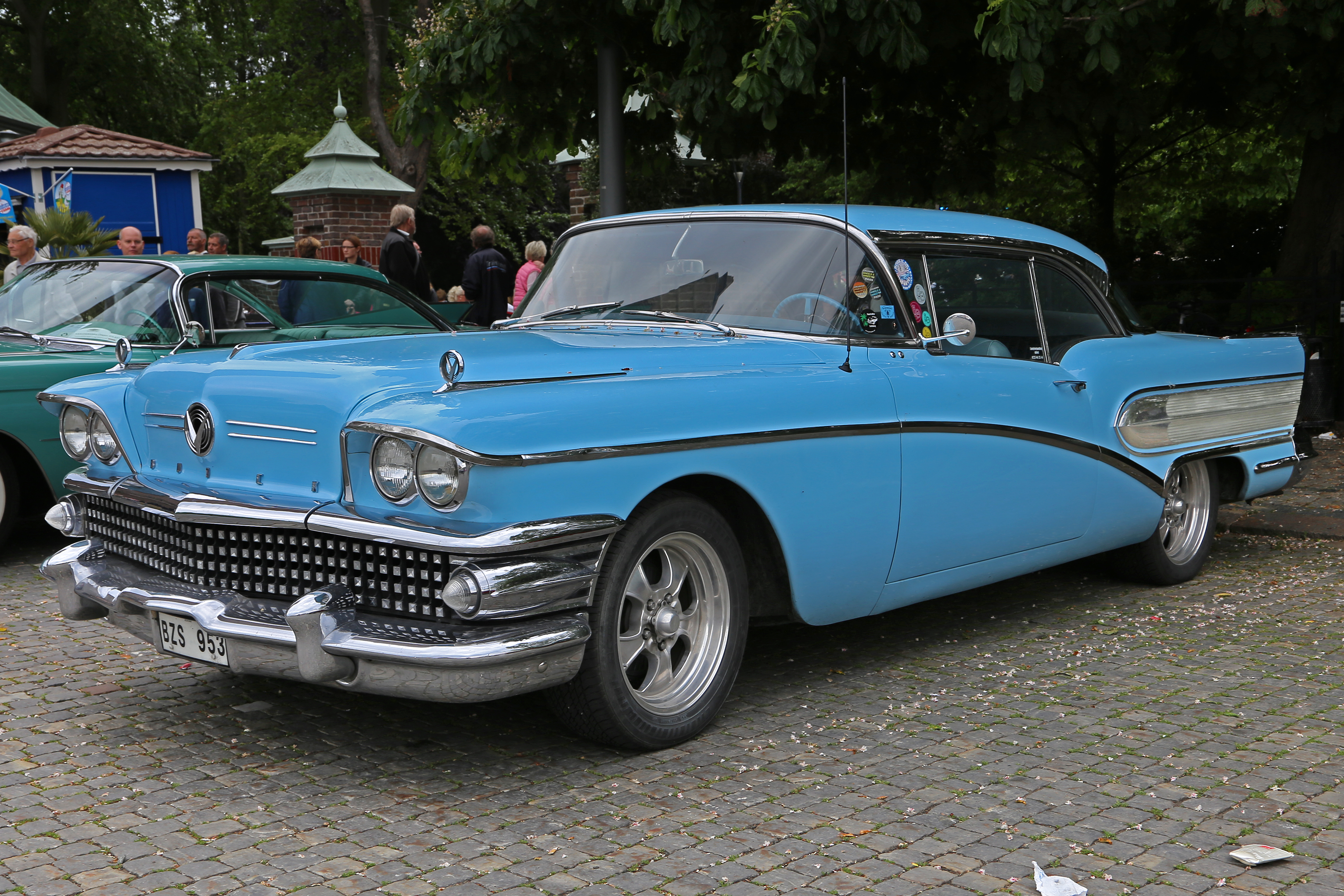
Buick Century
"... of worked the same way for decades now, almost a century. But they don't anymore, right?"
The Buick Century is a car model that Buick made for a long time. It was designed to be a comfortable, everyday sedan for regular driving. People mention it when talking about how car designs and buying habits changed over the years.
The Buick Century is a mid-size sedan that was produced by Buick for many decades, known for being a mainstream, family-oriented car. It often comes up in conversations about how long certain vehicle formulas stayed consistent before major changes in the market. In a podcast, it’s a good reference point for discussing what “used to work” for a long time and what shifted later.
consumer understanding
"We need that consumer understanding. Yeah, we sure do. And especially like the whole idea of EVs and autonomous vehicles..."
Consumer understanding means making sure regular drivers really get how the new tech works. For EVs, that includes things like charging and what to expect compared to gas cars.
Consumer understanding refers to how well everyday drivers grasp new technology—what it does, how it works, and what tradeoffs to expect. For EV adoption, this often includes charging basics, range expectations, and how the ownership experience differs from gas cars.
autonomous vehicles
"And especially like the whole idea of EVs and autonomous vehicles and electric vehicles, I mean, even just hearing you talk, I'm like, I want to make sure that we are always at our mobility table..."
Autonomous vehicles are cars that can drive with varying levels of automation, from driver-assist features to full self-driving (depending on the system). In adoption conversations, they raise questions about safety, trust, regulations, and how the technology fits into everyday driving.
range anxiety
"There's, as you think about electrification, it's range anxiety, right? It's, I don't know where I'm going to charge my car. I don't know how to do that, you know?"
Range anxiety means worrying your EV battery won’t last long enough for your trip. People fear they’ll get stuck because they’re not sure where they can charge.
Range anxiety is the fear that an electric vehicle (EV) won’t have enough battery charge to reach a destination. It’s usually driven by uncertainty about real-world range, charging availability, and charging speed.
electric vehicles (EVs)
"a couple of years ago, and I realized that there is truly a lack of education about electric vehicles. Like people really don't understand what it is."
Electric vehicles (EVs) run on electricity stored in a battery. The big idea here is that many people don’t know how EVs work yet, so they need clear information to feel comfortable.
EVs are vehicles powered primarily by electricity stored in a battery, rather than by gasoline. The transcript frames EV adoption as a learning curve—people need education on how EVs work and how to use them day to day.
mass adoption
"one of the challenges with this kind of mass adoption is because it feels like it's something that's niche for a small group of people. You know, it's not for me, but I really think that there's an opportunity for us to continue to create awareness so that people can see themselves driving in an EV, right?"
Mass adoption means more and more people start buying and using EVs, not just a small group. The point is that people need help understanding EVs so they feel confident switching.
Mass adoption refers to EVs moving from early adopters to mainstream buyers. The transcript highlights that education and awareness are key to reducing uncertainty and helping more people see themselves driving an EV.
mass market
"[224.1s] but now, OK, we've satisfied that part of the market. [226.8s] We need to go to mass market, you know, we need the family down the street."
Mass market just means the regular, everyday customers—not the enthusiasts who are excited about new tech. For EVs, it means making charging and using the car feel easy and predictable for most people.
“Mass market” means moving beyond early adopters and targeting everyday buyers who make up the majority of sales. In EVs, that usually requires simpler ownership experiences—charging access, clear instructions, and fewer friction points—so a typical family can use the car reliably.
early adopters
"[240.2s] I can't get to school because the car's not charged. [242.7s] You know, you're not going to get the same amount of tolerance, [246.6s] of inconvenience, as you will with the early adopters"
Early adopters are people who try new technology first, even if it’s not perfect yet. They’re usually more patient and willing to figure things out, while most people want things to work with minimal hassle.
“Early adopters” are the first group of consumers willing to try new technology despite rough edges. The speaker contrasts them with mainstream buyers by noting early adopters tolerate inconvenience more and are more likely to learn the system (like reading the manual) to make EVs work for them.
workforce development
"[275.0s] So I mean, I know we encounter this quite a bit in some of the work [278.3s] we do with our partners through workforce development and the [281.7s] Southeast Michigan groups that work on workforce."
Workforce development means training people so they can get good jobs in a growing field. For EVs, it’s about making sure there are skilled workers to support charging and vehicle maintenance.
“Workforce development” is the effort to train and prepare people for jobs needed by a growing industry. In the EV context, that can include skills for charging installation, electrical work, vehicle service, and other roles that keep electrified transportation running.
GM
"“I'll tell you GM, I know we're naming a brand, whatever. It's Detroit. GM is a big player in the market.”"
GM is General Motors, one of the biggest car companies in the U.S. They’re investing in electric vehicles and trying to help people learn how EVs work.
GM (General Motors) is a major automaker and a key player in the EV market, especially through brands like GMC and Chevrolet. Mentioning GM in this context highlights that large manufacturers are actively building EV experiences and educating customers.
key fob
"“...my mother who recently got a car and had a key fob and she was like, I don't know what to do with this. Like, where's the key? I'm like, oh, just push the button.”"
A key fob is the little remote you carry to control the car. Instead of putting a key in the ignition, many cars let you start by pressing a button.
A key fob is a small remote that lets you lock/unlock the car and often start it without inserting a traditional key. Many modern vehicles use it with a push-button start, which can confuse first-time drivers.
push the button
"“Like, where's the key? I'm like, oh, just push the button. Right.”"
“Push the button” means you start the car by pressing a button instead of turning a key. The car recognizes your key fob and then lets you start.
“Push the button” refers to push-button start, where the vehicle starts electronically when the key fob is detected. For EVs and modern cars, this is part of the “new normal” experience compared with turning a key.

Hummer Ev Hummer
"...t and that's exactly how I felt getting into this EV Hummer because it was the EV Hummer that I test drove. A..."
The Hummer EV SUV is a large SUV that runs on electricity instead of gasoline. It’s meant to feel powerful and capable, and it’s the electric version of the Hummer name. The podcast mention likely focuses on what it’s like to drive and how it matches (or doesn’t match) expectations.
The Hummer EV SUV is an all-electric SUV built by GMC’s Hummer brand, designed to deliver strong performance with electric power. It’s significant because it brings the Hummer name into the EV era, and it’s often discussed in test-drive contexts for how the driving feel and features differ from older, gas-powered Hummers. In the podcast, it’s likely brought up to connect expectations from the brand’s past with what an EV actually feels like behind the wheel.
charging experience
"“...identifying ways for people to have an experience with the vehicle, to be able to get inside of it, to be able to see how you charge it and all those things.”"
Charging is the main difference between an EV and a gas car. New owners often need help learning how to plug in, what to expect, and how charging fits into their daily routine.
The “charging experience” includes how drivers learn to plug in, choose charging speeds, and understand what the car is doing while charging. It’s a major adoption hurdle because EV ownership depends on charging routines rather than just fueling habits.
EV ecosystem
"“...because when we talk about the ecosystem, you know,”"
The “EV ecosystem” is everything around owning an electric car, not just the car itself. It includes charging places, how you pay for charging, and support that helps people feel comfortable using the system.
An “EV ecosystem” refers to the full network of people and infrastructure involved in EV adoption—vehicles, charging stations, utilities, and the services that support charging. When hosts mention the ecosystem, they’re usually pointing to how charging access and education affect real-world EV comfort and adoption.
ecosystem needs a purpose to exist
"the ecosystem needs a purpose to exist. And there is no purpose if the consumer is not buying the product."
This is basically saying the EV “system” only works if people actually want to buy and use EVs. Without buyers, the rest of the infrastructure and plans don’t really take hold.
The “ecosystem needs a purpose” idea is about how EV infrastructure, manufacturing, and consumer demand must align for the transition to work. In practice, if consumers aren’t buying EVs, the supply chain and charging ecosystem can’t sustain itself.
someone's garage or apartment
"But there needs to be a somewhere. And that is someone's garage or apartment, you name it."
They’re pointing out that where you live affects whether you can charge an EV. A garage or driveway makes charging easier than charging in many apartment situations.
Referencing “someone’s garage or apartment” highlights that EV charging and adoption depend on where people park and live. For many listeners, this points to the real-world challenge of charging access for apartment dwellers versus homeowners.
combustible engines
"...one of the things that we talked about was really kind of environmental pollution that comes from, you know, combustible engines."
Combustible engines are the traditional gas/diesel engines that burn fuel. The episode is saying they create pollution, which is one reason people are moving toward EVs.
“Combustible engines” means internal combustion engines that burn fuel (like gasoline or diesel) to create power. The discussion connects these engines to environmental pollution, contrasting them with EVs as a cleaner alternative for reducing emissions.
charging ability at their home
"...they're excited about getting into EVs. They can, you know, they have the charging ability at their home and that kind of stuff are then going to sell their car."
This means whether someone can plug in their EV at home. If they can, it’s easier to live with the car day to day, which makes people more likely to buy an EV.
“Charging ability at their home” refers to whether a driver can reliably charge an EV where they park overnight—typically via a home charger or access to a suitable outlet. Home charging is a major adoption factor because it reduces range anxiety and makes daily use convenient.
EV
"...helping to educate folks about adapting advanced mobility technologies, EV specifically, right. But like, who's doing that work?"
EV means electric vehicle. It’s a car that runs on electricity stored in a battery, and people often need help learning how charging and ownership work.
EV stands for electric vehicle, meaning a vehicle powered primarily by electricity from a battery (or sometimes another electric source). The key adoption hurdle is often understanding charging, costs, and day-to-day usability.
emerging ecosystem
"And as you and I talked about, when you have an emerging ecosystem like we have in Detroit, there are lots of people in the sandbox..."
An emerging ecosystem means a whole community that’s growing around a new technology. For EVs, that includes companies building parts, and people helping others learn how to use electric vehicles.
An emerging ecosystem is a network of companies, researchers, suppliers, and educators that are still forming around a new technology. For EVs, that ecosystem includes everything from developing technology to teaching people how to use it.
Detroit
"...when you have an emerging ecosystem like we have in Detroit, there are lots of people in the sandbox, like lots of folks that are doing different kinds of things..."
Detroit is mentioned as a place where a lot of EV-related work is happening. The idea is that big auto regions can help new technology spread faster.
Detroit is used here as shorthand for the regional EV and automotive innovation ecosystem. The point is that major auto hubs can accelerate electrification by bringing together suppliers, developers, and educators.
Electrifying Michigan
"[572.0s] And so, you know, let's talk about electrifying Michigan. [613.4s] and hear what they're doing in the region to help educate consumers"
Electrifying Michigan is a group in Michigan focused on helping people learn about electric cars. They aim to make it easier for consumers to understand how EVs work and what to consider before buying.
Electrifying Michigan is referenced as a regional ally working to educate consumers about EV adoption and ownership. The episode frames it as helping people understand how electrification affects real-world usage decisions.
battery
"[591.5s] And I was like, oh, my God, like there's nothing there. [594.5s] Like there literally was just there was just like, you know, a battery there."
The battery is what stores the electricity that makes the car move. In many EVs, it takes up space where a gas engine would normally be, so the hood area can look simpler.
In EVs, the battery is the main energy storage system that powers the electric motor(s). The “nothing else there” reaction in the transcript highlights that EVs often have fewer visible mechanical components in the engine bay because the battery and power electronics are packaged differently.
consumer adoption of EVs
"So, you know, we were having this conversation, as you know, about, you know, consumer adoption of EVs. And, you know, I became aware of electrifying Michigan as a new entity here in the state"
This is about what makes regular people actually want to buy and use an EV. Things like where you can charge, how much it costs upfront, and whether it feels convenient matter a lot.
“Consumer adoption of EVs” refers to how and why everyday drivers decide to switch from gasoline cars to electric vehicles. It’s influenced by things like charging access, upfront price, incentives, and trust in reliability and convenience.
brand agnostic, multimodal, statewide campaign
"So I serve as the program manager for the electrifying Michigan partnership. It's a brand agnostic, multimodal, statewide campaign and partnership dedicated to advancing multimodal transportation across the state, land, air, lakes."
“Brand agnostic” means they’re not pushing one specific car company. “Multimodal” means they’re thinking about more than just personal cars—how people move around in general.
“Brand agnostic” means the campaign isn’t tied to one automaker; it promotes EV adoption broadly. “Multimodal” highlights that electrification and mobility improvements aren’t only about cars—there can be buses, bikes, and other transportation modes too.
mobility ecosystem
"...to bring together the full mobility ecosystem, OEMs, utilities, government agencies, community-based organizations and more."
A mobility ecosystem is the whole “system” behind transportation, not just the vehicles. It includes utilities, companies, and government working together so electric transportation can actually function.
A mobility ecosystem is the network of organizations and technologies involved in transportation—like automakers, utilities, government, and community groups. The key idea is that electrification isn’t just a vehicle change; it requires coordinated systems across energy, policy, and workforce.
OEMs
"...to bring together the full mobility ecosystem, OEMs, utilities, government agencies, community-based organizations and more."
OEMs are the companies that make the vehicles or big parts of them. When they invest in EVs, it affects how many electric cars show up and how fast they improve.
OEMs are Original Equipment Manufacturers—the companies that build vehicles or major equipment. In electrification, OEMs matter because they decide which EV platforms to produce and how quickly to scale battery-electric models.
utilities
"...OEMs, utilities, government agencies, community-based organizations and more."
Utilities are the companies that provide electricity. Since EVs need charging, utilities have to make sure the power grid can handle the extra demand.
Utilities are the electric power providers that operate and expand the grid. For EV electrification, utilities are central because charging demand and new infrastructure require planning, upgrades, and coordination with regulators and communities.
shore power infrastructure
"So we have EVs, battery production, electric boats, shore power infrastructure and unmanned aerial systems, all accelerating at the same time."
Shore power infrastructure is when a dock provides electricity to a ship so it doesn’t have to run its own engine while parked. It helps cut pollution and uses cleaner power if the grid is cleaner.
Shore power infrastructure is electrical power supplied to ships while they’re docked, allowing them to shut down onboard engines and run electrically. It’s part of broader electrification because it reduces emissions and shifts energy demand to the grid.
unmanned aerial systems
"So we have EVs, battery production, electric boats, shore power infrastructure and unmanned aerial systems, all accelerating at the same time."
Unmanned aerial systems are drones or other aircraft that fly without a pilot inside. They often rely on batteries and advanced power systems, so electrification affects them too.
Unmanned aerial systems (UAS) are aircraft that operate without a human pilot onboard, typically controlled remotely or autonomously. Including UAS in electrification conversations highlights how battery and power technologies can apply beyond cars.
workforce synergies
"So these sectors share a deep technological and workforce synergies. Electrifying Michigan in our partnership was created to help connect these pieces."
Workforce synergies means workers can use similar skills in different electrification-related jobs. If training and hiring are coordinated, it’s easier to staff all the new projects.
Workforce synergies means skills and jobs can transfer across related industries as electrification expands (for example, manufacturing, battery assembly, and power systems). Coordinating training and hiring helps reduce bottlenecks when multiple sectors grow at once.
multi-modality
"“So I think that's a term that people may not necessarily understand. So when you say that, what do you mean?” “Yeah, multi-modality. That means we're not just talking about cars.”"
Multi-modality means thinking about transportation in more than one form. Instead of only focusing on cars, it also includes buses, trains, bikes, and e-scooters, and even things like delivery drones or self-driving vehicles. The goal is to plan for all these different ways people and goods move.
“Multi-modality” means electrification and mobility planning that covers more than just passenger cars. It includes transit modes like trains and buses, micromobility like bikes and e-scooters, and even logistics and emerging tech like drones and autonomous vehicles. The key idea is coordinating many different transportation and energy systems together.
e-scooters
"“We're talking about buses. We're talking about e-scooters. We're talking about bikes.”"
E-scooters are small electric vehicles you can ride for short trips. They matter in electrification because they can replace some very short car rides. Whether they help depends on things like safe riding rules and where people can charge them.
E-scooters are battery-powered micromobility devices that fit into the broader multi-modality ecosystem. They’re often discussed in electrification because they can reduce short-trip emissions and congestion when replacing car trips. Their impact depends heavily on charging access, safety rules, and local infrastructure.
electric boats
"“We're talking about autonomous vehicles, electric boats. We're talking about the energy utilized to power these things.”"
Electric boats are boats that run on electricity instead of traditional fuel. They’re included in electrification because they can reduce pollution where boats operate, like harbors. The big question is whether batteries can provide enough range and whether charging is available.
Electric boats are marine vessels powered by electric motors and batteries (or other electrical power sources). They’re part of the broader electrification conversation because electrifying marine propulsion can cut local emissions in ports and waterways. The practical challenge is energy storage and charging/charging infrastructure at marinas.
energy utilized to power these things
"“We're talking about electric boats. We're talking about the energy utilized to power these things.”"
This is about where the electricity comes from and how it’s used. Electrifying transportation means you need power for all those vehicles and devices, not just the vehicles themselves. The environmental impact depends on how that electricity is produced.
This phrase points to the idea that electrification isn’t just about swapping vehicles—it’s also about the energy supply chain. It includes how electricity is generated, transmitted, and used to power different mobility modes. Listeners should connect this to grid capacity, charging demand, and overall emissions depending on the electricity mix.
misconceptions
"or drones or electric boats, a lot of misconceptions with all those. And I think partnering with all our different partners, those are some of the best communicators in the state."
A misconception is a wrong belief. The hosts are saying a lot of people’s fears about electric tech come from misunderstandings, and better communication can help fix that.
The segment emphasizes that many public concerns about electrification come from misconceptions rather than facts. This is important because messaging and education can directly affect adoption rates and policy support.
allies
"That goes back to what you were saying, Bernard, about allies, right? Yeah. Allies helping, what you just said for me was the idea of amplifying the voice, right?"
Allies are people or groups that support the cause and help spread the message. Here, they’re talking about working with trusted communicators so more people feel informed and supported.
In this context, “allies” are partners and advocates who help communicate electrification benefits and address concerns. The hosts connect allies to outreach strategy—using credible messengers to build trust and momentum.
amplifying the voice
"Yeah. Allies helping, what you just said for me was the idea of amplifying the voice, right? Like multiple, sometimes it takes messages to come from multiple directions for people to finally get it and hear it."
It means getting the same message out through several people, not just one. When different trusted voices say it, people are more likely to pay attention and believe it.
“Amplifying the voice” here means spreading a message through multiple trusted sources so it lands with different audiences. The hosts argue that repetition from varied directions increases the chance people actually hear and accept the information.
shoreline infrastructure
"...so many different universities working on new technologies pertaining to shoreline infrastructure and charging electric boats, Torquito,"
Shoreline infrastructure is the equipment and electrical setup on land at docks. For electric boats, it’s what makes it possible to charge safely while the boat is tied up.
Shoreline infrastructure refers to the on-land systems that support marine electrification—especially power delivery at docks and marinas. For electric boats, this can include electrical upgrades, charging stations, and safety systems for wet-environment use.
Torquito
"...charging electric boats, Torquito,"
Torquito sounds like a name of a company or project mentioned in the electric boat space. The segment doesn’t explain what they make or how they’re involved.
Torquito appears to be referenced as part of the electric-boat/charging ecosystem, likely a company or project name connected to marine electrification. Without more context in the segment, it’s unclear what they specifically do.
e-boats
"[1075.5s] like that's a company here in Michigan [1077.8s] who is installing electric motors for e-boats. [1082.0s] It's making sure that everyone is connected,"
An e-boat is a boat that runs on electricity. Instead of using fuel engines, it uses electric motors, which can help cut pollution.
E-boats are electric boats powered by electric motors rather than traditional combustion engines. Electrification campaigns sometimes include marine electrification because it shares similar goals—reducing emissions and building charging/infrastructure and workforce capability.
public awareness and demand generation
"[1117.0s] I think number one, [1121.2s] I think there are three ways [1122.5s] that we compliment our partners specifically in that way. [1125.4s] Number one, public awareness and demand generation."
This is basically how organizations get people excited about EVs and other electrification efforts. They try to make more people want the technology so it actually gets used, not just talked about.
Public awareness and demand generation are outreach strategies meant to increase interest in a technology and convert that interest into real-world adoption. In EV policy and market-building, this often includes events, messaging, and partnerships that help people feel comfortable with the idea of electrification.
ride and drives
"[1125.4s] Number one, public awareness and demand generation. [1131.3s] So, ride and drives with consumers, [1134.0s] we just did one in Denver with our partners at Uber"
A ride-and-drive is when people get to sit in and drive a vehicle themselves. It helps them understand what it’s like to own and use an EV before they decide anything.
A ride-and-drive is a hands-on event where people can experience a vehicle (often EVs) firsthand, usually with staff available to answer questions. For electrification campaigns, these events help reduce uncertainty by letting potential buyers feel how the car drives and learn about charging and ownership in a low-pressure setting.
Uber
"[1131.3s] So, ride and drives with consumers, [1134.0s] we just did one in Denver with our partners at Uber [1140.7s] and that went great."
Uber is a ridesharing company. When Uber partners on EV events, it can help show EVs in real life—like how they work for people who rely on rides every day.
Uber is mentioned here as a partner in an EV ride-and-drive event. In electrification efforts, ride-hailing and mobility platforms can be important because they can influence fleet adoption and provide a real-world context for how EVs fit into daily transportation.
ride sharing drivers
"But these were ride sharing drivers who had never tried an electric vehicle or a hybrid vehicle before. So, getting them into the vehicle, understanding, this is how you can save money."
The hosts are discussing EV adoption among ride-sharing drivers, a group that often cares about operating costs and day-to-day usability. This matters because frequent driving can make fuel/charging economics and real-world experience especially influential.
hybrid vehicle
"But these were ride sharing drivers who had never tried an electric vehicle or a hybrid vehicle before. So, getting them into the vehicle, understanding, this is how you can save money."
A hybrid is a car that uses gas and electricity together. It’s a stepping stone for people who haven’t tried a fully electric car yet.
A hybrid vehicle uses both an internal-combustion engine and an electric motor/battery. Mentioning hybrids alongside EVs highlights that some drivers may already understand the concept of electrification, even if they haven’t tried a full EV.
demystifying
"But it's really about demystifying and just getting people to open up and try something new. It can be scary trying new things, but I have yet to meet a person who tries an EV who is no big deal."
“Demystifying” just means making something feel less scary or confusing. They’re trying to help people understand EVs by letting them try one instead of relying on rumors or fear.
In this context, “demystifying” means removing fear and misconceptions about electric vehicles by letting people experience them firsthand. The goal is to turn abstract concerns into real-world understanding through a ride or hands-on exposure.
exposure
"And it does seem to be the critical thing is the exposure, right? Because so much of the criticism is from people that have never been in a vehicle like that. Yes, exactly."
“Exposure” here refers to getting people physically into an EV (or hybrid) so they can form opinions based on experience rather than criticism from outsiders. The hosts connect exposure to reducing skepticism and improving acceptance.
EVs being sold at a higher clip
"So the more people see them, [1229.0s] the more they have a neighbor who gets an EV... [1216.5s] a lot more exposure now because EVs are being sold at a higher clip than they have before."
It means more electric cars are being bought than before. When people see them more often, they’re more likely to think, “Maybe I’d consider one too.”
The phrase “being sold at a higher clip” refers to EV adoption accelerating—more units are moving into everyday use. That matters because seeing EVs in real life reduces uncertainty and makes the idea of owning one feel more normal.
electric buses
"There's also electric buses. [1246.4s] Like all you need to do is take transit and you're utilizing an electric bus. [1251.6s] That's when people realize it's a lot quieter, it's a lot smoother."
Electric buses are buses that run on electricity. Because they’re quieter and feel smoother, people notice them differently than regular buses.
Electric buses are transit vehicles powered by electric motors and batteries instead of diesel or gasoline. The hosts highlight typical rider-perceived benefits like reduced noise and smoother operation, which can make EVs feel more “real” to the public.
autonomous underwater vehicle
"Let's say like an autonomous underwater vehicle [1285.7s] that one of the universities here is working on. [1291.0s] We wanna share those things."
An autonomous underwater vehicle is like a robot submarine. It can do its job underwater on its own, and the point here is that sharing these kinds of projects helps people learn about new technology.
An autonomous underwater vehicle (AUV) is a robotic craft that can operate underwater with its own onboard systems, often without real-time human control. In the context of the episode, it’s an example of a “partner win” or pilot project that can be shared to build visibility for electrification-adjacent innovation.
multiple angles
"Yeah, I agree, I mean that goes back to people need to hear the message from lots of different angles and different people until they receive it."
It means you don’t just tell people once—you explain the same idea in different ways. Using different trusted voices helps more people understand and feel included.
“Multiple angles” describes reaching audiences through different messengers and perspectives until the message lands. The hosts argue that EV adoption messaging often needs to be tailored and repeated across trusted voices.
trusted connectors
"One of the things that we're working on at the Global Epicenter Mobility is arming trusted connectors with information. So people who are trusted within particular communities to have information about opportunities that are available around EVs or other types of mobility opportunities"
It means using people in your community who are already trusted. Instead of sending EV info from strangers, you share it through the folks people listen to.
“Trusted connectors” are community members or organizations people already rely on. In EV outreach, they help translate information into messages that feel relevant and credible to specific audiences.
Global Epicenter Mobility
"One of the things that we're working on at the Global Epicenter Mobility is arming trusted connectors with information."
They mention Global Epicenter Mobility as the group behind this outreach effort. Here, it’s helping share EV-related information through people and organizations communities already trust.
Global Epicenter Mobility is referenced as the organization working on EV outreach. In this context, it’s involved in distributing information through trusted community connectors.
technical jargon
"it's also not about technical jargon that prevents people from understanding and seeing the opportunity and knowing that, yes, this is for you as well."
Technical jargon is complicated wording that experts use. If you avoid it, more people can understand what’s being offered and feel included.
“Technical jargon” refers to specialized language that can make EV topics feel confusing or intimidating. The hosts emphasize avoiding it so people can understand the opportunity and see themselves as the target audience.
demystify it
"So how do we demystify it and eliminate some of the jargon that make it difficult for people to see themselves as a part of it?"
“Demystify” just means explain it in a way that’s easy to understand. Instead of confusing details, the focus is on helping people feel comfortable—especially about things like charging.
In electrification conversations, “demystifying” means translating technical and policy jargon into practical, everyday language. The goal is to reduce uncertainty so people feel confident about charging, costs, and what owning an EV will actually feel like.
eliminate some of the jargon
"So how do we demystify it and eliminate some of the jargon that make it difficult for people to see themselves as a part of it?"
Jargon is “tech talk” that can sound confusing. If you remove it, people can focus on the questions that matter to them, like whether charging will be easy.
“Jargon” refers to specialized terms that can make electrification topics feel inaccessible. Removing it helps listeners connect the dots between EV technology and real-world ownership questions like charging reliability.
get a charge
"they don't wanna feel nervous about, am I gonna be able to get a charge? I've heard this, so it's a lot more of that"
“Get a charge” means plugging in your EV and actually being able to charge it. People worry about whether charging will work when they need it.
“Get a charge” is shorthand for successfully charging an EV—either at home, at work, or via public charging. Listener anxiety often centers on whether charging will be available, convenient, and reliable enough for daily use.
peer-to-peer (P2P) charging
"So one of our advisory board members, [1527.3s] plug P2P is actually a startup just like that. [1536.0s] So they realize that there's a lack of home chargers [1542.0s] so they started a company that is kind of like Airbnb [1546.1s] but for chargers, for electric vehicle chargers."
Peer-to-peer charging means people can share their chargers with other EV drivers. Instead of only relying on big public charging companies, you can sometimes book access through an app.
Peer-to-peer (P2P) charging is a model where EV charging access is shared between individuals or hosts rather than coming only from traditional utility or retail charging networks. It can expand charging availability by turning underused private chargers into bookable public-like charging.
plug P2P
"So one of our advisory board members, [1527.3s] plug P2P is actually a startup just like that. [1536.0s] So they realize that there's a lack of home chargers"
“Plug P2P” sounds like a company that helps EV drivers find places to charge by sharing access between people. The host compares it to Airbnb to explain the idea of sharing resources through an app.
“Plug P2P” is referenced as a startup addressing EV charging availability. The context suggests it operates a peer-to-peer model for sharing charging access, similar to how people share accommodations on Airbnb.
home chargers
"So they realize that there's a lack of home chargers [1542.0s] so they started a company that is kind of like Airbnb [1546.1s] but for chargers, for electric vehicle chargers."
“Home chargers” are EV charging stations you can use at your house. If you can charge at home, it’s usually easier to own an EV because you don’t have to find a public charger every time.
The phrase “home chargers” refers to charging equipment installed at or near where people park their cars, typically at home. Access to home charging is a major factor in whether EV ownership feels convenient, because it reduces reliance on public stations.
Airbnb-like model for chargers
"So they realize that there's a lack of home chargers [1542.0s] so they started a company that is kind of like Airbnb [1546.1s] but for chargers, for electric vehicle chargers. [1549.9s] So you sign onto the app, you find a charger nearest to you"
They’re comparing the service to Airbnb because it works like booking a time and place. EV drivers can use an app to find a charger and schedule when they’ll plug in.
The “Airbnb-like” comparison describes a booking-based system for EV charging, where drivers use an app to locate and schedule charging time at a specific location. This approach can help address gaps in public charging coverage, especially for drivers without convenient home charging.
public EV charging
"So you sign onto the app, you find a charger nearest to you, [1553.3s] say you're from out of town or something like that, [1555.9s] you can plug in for two, three, four hours, [1559.2s] however long you just schedule it."
This is about charging stations you can use when you’re out and about. Having chargers nearby and being able to schedule them makes it easier to drive an EV on trips.
The segment discusses finding a charger “nearest to you” and scheduling charging time, which is essentially public (or publicly accessible) charging. Public charging availability and usability are key to EV adoption because they reduce “range anxiety” and make trips feasible without relying solely on home charging.
supply chain expertise
"Supply chain expertise, we have manufacturing, a manufacturing backbone that will power our electrified future."
A supply chain is basically how parts and materials get made and delivered. Electrifying cars changes what parts you need, so companies need special experience to keep everything flowing smoothly.
“Supply chain expertise” refers to the know-how required to source materials, components, and logistics efficiently for a new technology. For electrification, supply chains must handle batteries, power electronics, and specialized manufacturing inputs that differ from traditional auto parts.
electrified future
"a manufacturing backbone that will power our electrified future. Right, but it's all here though, but it has to work differently now, right?"
“Electrified future” means more vehicles will run on electricity instead of gasoline. That usually requires not just cars, but also charging and the factories that make batteries.
“Electrified future” is shorthand for shifting transportation from internal-combustion vehicles to electric drivetrains. In practice, it involves EVs, charging infrastructure, and the industrial capacity to produce batteries and related components.
train on rails
"it's kind of like a giant machine and it's been doing one thing. And it's like a train on rails. You don't just change direction easily."
The speaker is saying big industries can’t just switch directions overnight. Factories and supply chains are set up to do one thing, so changing to EVs takes planning and time.
The “train on rails” analogy describes how industrial systems are hard to redirect quickly because existing infrastructure and processes are optimized for a specific path. Electrification requires coordinated, phased changes across manufacturing and supply chains to avoid costly disruption.
transformation
"So it's also, you need a certain amount of transformation"
“Transformation” means the whole system has to change, not just a single part. It’s about retooling factories and building new skills so the region can compete as EVs grow.
“Transformation” here refers to the broad shift required for electrification—upgrading manufacturing, retooling suppliers, and building new capabilities. The context highlights that this is competitive and must be done relative to what other states and countries are doing.
energy resilient
"...we stay energy resilient, you know, shift towards EVs, electric boats, drones, connected mobility just creates a lot of opportunities..."
Energy resilient means the power system can keep working even when something goes wrong. With more EVs, the grid has to be ready for extra electricity demand.
“Energy resilient” refers to the ability of an energy system to keep functioning reliably during disruptions. In electrification, it often means planning for grid capacity, backup power, and infrastructure that can handle higher electricity demand.
shift towards EVs
"...shift towards EVs, electric boats, drones, connected mobility just creates a lot of opportunities for grid modernization..."
The shift towards EVs means more cars are powered by electricity instead of gas. That affects how and where electricity is generated and delivered, especially for charging.
The “shift towards EVs” is the broader transition from gasoline vehicles to electric drivetrains. This changes how transportation energy is produced and delivered, putting new demands on charging infrastructure and the electric grid.
connected mobility
"...electric boats, drones, connected mobility just creates a lot of opportunities for grid modernization..."
Connected mobility means vehicles and transportation systems can “talk” to networks and each other. That can help EV charging and traffic work more efficiently.
Connected mobility refers to vehicles and transportation systems that communicate data—often via cellular, Wi‑Fi, or vehicle-to-infrastructure links. In electrification, connectivity can enable smarter charging, traffic optimization, and better coordination between vehicles and the grid.
grid modernization
"...connected mobility just creates a lot of opportunities for grid modernization, demand management, ..."
Grid modernization means updating the power network so it can handle more electricity use. EV charging adds new demand, so the grid often needs upgrades to stay reliable.
Grid modernization is upgrading the electric grid so it can handle new loads and technologies. With EV adoption, utilities may add capacity, improve controls, and expand distribution infrastructure to support charging demand.
demand management
"...grid modernization, demand management, so many opportunities, but we need, you know, the consumers to buy the vehicles."
Demand management is about using electricity more wisely so the grid isn’t overloaded. For EVs, it can mean charging at times when power demand is lower.
Demand management is coordinating electricity use to avoid overwhelming the grid during peak times. For EVs, it can include charging strategies like shifting charging to off-peak hours or using smart charging to match grid conditions.
massive adoption
"It really is, if we can get massive adoption, it truly can change how we all live our lives."
It means EVs become so popular that it’s no longer just a few people driving them. Once many people switch, it’s easier to build charging and make EVs practical for everyone.
“Massive adoption” refers to EVs becoming common enough that charging infrastructure, electricity planning, and consumer expectations all start to scale. When enough people and organizations switch, the benefits compound beyond individual vehicles.
fleets in local government
"but we have a lot of fleets in local government, whether it's the county, municipality, or the state, we should electrify all of these..."
A “fleet” is a group of vehicles used by an organization. If cities and states switch their fleets to electric, it can make EVs more common and help build charging where people live.
“Fleets in local government” means groups of vehicles owned and operated by counties, cities, municipalities, or states. Electrifying fleets can reduce emissions and operating costs while creating early demand for EVs and charging in a region.
electrify all of these vehicles
"We have a lot of fleets in local government... we should electrify all of these... be electrifying all these vehicles."
They’re talking about switching more than just private cars—like city and school vehicles—to electric. Fleets can be easier to convert because they usually drive similar routes and can plan charging.
“Electrifying everything” here means moving not just personal cars, but also fleets—like government and school vehicles—to electric power. Fleet electrification is often a faster path because organizations can plan routes, charging, and maintenance around predictable usage.
Request an Explanation
Heard something you'd like explained? We'll add it to this episode.
Sign in to request explanations for terms you heard.
Want to learn more?
Browse our glossary for plain-English explanations of automotive terms, jargon, and concepts.
Help improve this episode
See something that's not quite right? Our annotations are AI-generated and can sometimes miss the mark. Click the flag icon on any annotation to suggest a correction.