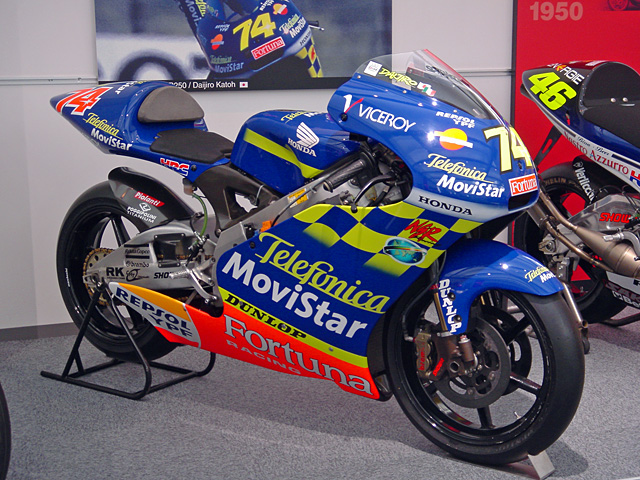
The Legendary Honda RC51 Beat Ducati at its own V-Twin Superbike Game
Cycle World Podcast
The Legendary Honda RC51 Beat Ducati at its own V-Twin Superbike GameCycle World Podcast · May 27, 2026
Annotations will appear as you listen
0:00
75:48
Car
Honda's RC51
The Honda RC51 is a race-focused motorcycle with a V-twin engine. Honda built it to win in Superbike racing, where the rules and engine sizes were a big part of the competition.
A V-twin superbike is a race bike with two cylinders arranged in a V shape. The way that engine makes power matters a lot for how the bike feels and competes in Superbike races.
Chicanes are a set of quick turns that force you to slow down. They’re a good test of how steady and controllable the bike is when you’re braking and changing direction.
“1000cc” means the engine is about one liter in size. In this era’s Superbike racing, that larger displacement class was often associated with V-twin motorcycles.
“750cc” is how big the engine is, measured by displacement. “4s” means four-cylinder engines, and the hosts are comparing different engine types racing under Superbike rules.
Car
CBR929RR
The Honda CBR929RR is a sport motorcycle that the hosts describe as having a softer, more street-friendly ride. They use it to contrast how the RC51’s suspension and steering feel more race-focused.
Suspension compliance is how soft or flexible the suspension feels when the bike hits bumps or loads up in a turn. Softer suspension can feel more comfortable, while stiffer suspension can feel more precise for racing.
Shuhei Nakamoto is a Honda engineer/leader mentioned as the person who made a big call about how to change the bike. In this story, his idea was to let the chassis flex more to help the rider control the bike.
Car
NSR 250
The Honda NSR 250 is a racing bike used in Grand Prix competition. Here it’s the bike Max Biagi was riding, and the discussion is about changing the chassis so it handles better at speed.
Max Biagi is the race rider in this story. The hosts are saying the bike changes were made to help him ride faster and win, and they describe how the chassis stiffness affected his results.
A “weave” is when a bike starts to wobble left and right quickly at speed. In this story, the chassis was made too flexible, and that wobble showed up so strongly it limited top speed.
A “flexible chassis” means the bike’s frame is designed to flex more when you ride. The idea is that it can help the tires grip, but if it flexes too much, the bike can start wobbling and become hard to control.
John Kosinski is the rider credited here with helping Honda win a major world championship. The hosts connect his success to the bike handling improvements they were describing.
Car
RC30
The Honda RC30 is a Honda race bike that won the Superbike World Championship twice. The big reason it worked is that it accelerated well, and superbike races have lots of turns, not just straight lines.
Cosworth is a motorsports engineering company that helps design and develop race engines. Here, it’s mentioned because Bordi’s work there influenced Ducati’s later engine direction.
“Four-valve” means each cylinder has four valves total—usually two for letting air in and two for pushing exhaust out. More valve area and better breathing can help the bike accelerate, especially when you’re coming out of turns.
“Two-valve” means each cylinder has just two valves total—one to bring air in and one to let exhaust out. The hosts are saying Ducati had a faction that wanted to stick with that simpler setup instead of moving to four valves.
Valve timing is about exactly when the engine’s valves open and close. If the timing is set for the wrong engine speed range, the bike may feel strong only at the top end but weak in the middle, which makes acceleration out of corners worse.
Mid-range is the middle part of the rev range—where you’re usually accelerating out of corners. If a bike has no mid-range, it feels flat unless you rev it very high.
Valve lift is how much the valves open. More lift can let more air in (and help exhaust out), but it has to be paired with the right timing so the engine accelerates where you actually ride it.
Here, “intake” means how well the engine can pull air in through the intake valves. The point is that valve timing that works at the top end may not pull enough air at lower revs, so acceleration suffers.
Term
piston's rising on compression
As the piston moves up, it squeezes the fuel/air mixture inside the cylinder. How that squeezing and airflow behave can change how much power the engine makes.
Valves don’t just open—they speed up and slow down fast. If they accelerate harder, the engine can breathe better at high revs, but it can also beat up the valve parts faster.
The valve train is the mechanism that moves the engine’s intake/exhaust valves. If the engine is tuned aggressively, these parts take more force and can wear out sooner.
Car
Honda RC45
The Honda RC45 is a Honda racing motorcycle designed to beat Ducati. The hosts say it had a lot of power, but it didn’t handle rough terrain as well as riders wanted, so Honda kept trying fixes.
Carl Fogarty is a famous motorcycle racer. In this story, he shows up at Ducati and gets an engine to ride, and his results help prove Ducati’s approach can win.
When an engine spins faster, the piston has to speed up and slow down more aggressively. The segment says those forces grow very fast with RPM, which is why high-rev engines need careful engineering to avoid breaking parts.
“100 by 63.5” is the engine’s basic size measurements: the cylinder diameter (bore) and how far the piston travels (stroke). This geometry affects how the engine behaves, especially at high RPM.
“Over-square” means the engine’s cylinder is wider than the piston’s travel distance. That often helps the engine rev higher, which is great for racing.
In a V-twin, the cylinders are set in a V shape. A 90-degree angle can help the engine feel smoother because the internal forces can cancel each other out better.
“Primary shaking force” is the main engine vibration caused by pistons moving. Engineers try to design the engine so those vibrations cancel out as much as possible.
Car
Ducati 851
Ducati 851 is one of the earlier bigger-displacement versions in Ducati’s V-twin racing line. The hosts say that as Ducati kept increasing engine size, it started running into strength/durability limits.
Car
Ducati 926
Ducati 926 is another bigger-displacement version mentioned in the Ducati V-twin story. The segment uses it to show that pushing displacement higher can stress parts until they start cracking.
Car
Ducati 888
Ducati 888 is one of the later, larger-displacement steps in Ducati’s racing V-twin evolution. The point here is that bigger engines eventually hit durability limits.
Car
Ducati 955
Ducati 955 is the biggest displacement mentioned in the Ducati progression. The hosts say that at this point, the engine’s internal parts—especially the cylinder liner—were getting too stressed and could crack.
The cylinder liner is the inner surface the piston seals against. If it’s too thin, the heat and pressure can cause it to crack, which can ruin the engine’s ability to seal properly.
Inside the engine, the piston has rings. One of them (the oil ring) helps keep oil from getting into the combustion area. If the cylinder wall isn’t perfectly shaped, that ring can’t do its job well.
The bore is the inside wall of the cylinder. If it gets warped or out of shape, the piston rings don’t seal as well, and the engine can start using oil or running with more friction.
Car
Ducati Testa Strata engine
This is a particular Ducati racing engine head design. The “Testa Strata” approach was meant to help the engine breathe and run efficiently at high RPM. Here, it’s part of Ducati’s attempt to fix friction losses when the engine spins fast.
This is a special way of controlling the engine’s valves. Instead of using springs to close the valves, the system uses cams to open and close them mechanically. The idea is more precise control and less loss.
Even when an engine makes power, some of that power is wasted as “drag” inside the engine. Friction horsepower is a way of measuring how much power gets lost to that internal drag.
The camshaft controls the valves. The cam profile is the cam’s shape, which decides when and how far the valves move. Tweaking it can change power, but it can also change how much the engine “fights itself.”
A cassette gearbox is a race-focused transmission design that’s built in modules. That makes gear changes and gearbox work faster and more controlled, which helps the rider hit the right engine speed at the right moment.
The shift drum is the internal part that helps move the transmission into the next gear. It’s basically the “gear selector” mechanism inside the gearbox.
Gear ratios are how the gearbox multiplies the engine’s speed. Different ratios can make the bike accelerate harder or reach higher speed depending on the track.
A vertically split crankcase means the engine’s lower and upper halves are separated along a vertical plane. That layout can complicate gearbox service because the transmission may be integrated with the engine cases, so swapping gearbox internals can require major engine disassembly.
Term
Euro five syndrome
The speaker is describing an emissions rule–driven engine change. To meet stricter pollution limits, engineers often adjust valve timing in ways that can reduce overlap and change how the engine feels.
Overlap is when the intake and exhaust valves are open around the same moment. It helps the engine “clean out” exhaust, but changing it can be part of emissions tuning.
Term
back pumping charge
“Back pumping charge” refers to intake charge being pushed back or not effectively retained in the cylinder during certain valve timing conditions. The speaker argues that shorter valve timing reduces that effect, which changes the engine’s torque characteristics.
Term
10 millimeters
Even a small engine position change can alter how the bike balances. That can change how it steers and how well it grips when you accelerate.
“Hook up better” means the bike grips the ground better so it can put power down without slipping. It’s usually about traction and suspension/chassis setup.
“V four” means a motorcycle engine with four cylinders arranged in a V shape. The host is saying Honda gave up that engine layout and switched to a different one (a V-twin) to chase better results.
This refers to the old 500cc two-stroke era of Grand Prix motorcycle racing. The host is saying that earlier racing ideas from that time shaped how some bikes were built.
A rubber timing belt is a belt with teeth that keeps the engine’s valve timing in sync. The host is saying Ducati had trouble with belt durability when they tried to make the engine’s timing changes more aggressive for racing.
Peak forces are the biggest “pushes” or stresses the parts see. The host is saying Ducati’s aggressive valve timing caused those stresses to spike, which is why the belt system wore out quickly.
A silent chain is a quieter timing chain used to control valve timing. The host is saying Ducati switched from belts to a chain because the belt system couldn’t handle the stresses of their racing valve timing.
Car
Ducati engine
They’re talking about a new Ducati engine that showed up around 2001. The point isn’t just “more power”—the host suggests the bike’s stability and how it behaves under braking/turn-in mattered just as much.
Wobble and weave are terms for when a motorcycle starts to feel unstable—moving around instead of tracking straight. The host is saying that instability can cost you distance and time in a race, even if the engine is strong.
Roll rate is how fast the bike leans over when you start turning. If it’s “fast,” the bike gets into the corner attitude quickly; if it’s too slow or too abrupt, it can feel awkward.
Term
quarter speed special
This sounds like a nickname for an engine that mainly feels strong at high revs. They’re saying the Ducati they’re talking about isn’t that kind of “high-rev-only” setup—it’s more spread out.
An aluminum twin spar frame is a motorcycle frame made from two main metal beams. It’s designed to be strong and stiff so the bike handles predictably when you’re turning hard.
A trellis frame is a motorcycle frame built like a metal lattice. It’s designed to be strong but not completely rigid, so the bike can feel more controlled when you’re turning and hitting rough pavement. The hosts are using it to explain how Ducati tried to solve handling.
Person
Preziosi
Preziosi is a Ducati engineer. The hosts are saying he made a big design decision to make the bike much stiffer, using carbon fiber. That choice shaped how the motorcycle handled.
Carbon fiber is a very strong, lightweight material made from woven fibers. Race teams use it because it can make parts stiff without adding much weight. Here it’s mentioned as part of a design meant to make the bike feel more rigid.
The “black pyramid” is a special structural piece on the bike. The hosts say it sits on the engine area (the cylinder heads) and helps keep the front steering mount in the right position. That matters because it affects how stable and predictable the bike feels when you turn.
The steering head is the front part of the frame where the handlebars/forks pivot. If it moves or flexes too much, the bike can feel vague or unstable. The hosts are saying Ducati used a structure to keep that front mounting point fixed.
Person
Tamborini
Tamborini is a person the hosts bring up as part of the background to the design story. They’re basically saying he wasn’t doing engineering in the strict sense—more like he watched bikes and took inspiration. That contrast helps explain why Honda’s later solution was more technical.
Laguna is a well-known race track in California. It’s the kind of place where you can really feel how a motorcycle handles. The hosts mention it because that’s where they observed the bikes behaving a certain way.
Person
Al Luddington
Al Luddington is the person the host quotes about a Laguna event, describing what he saw with Honda’s bikes. In this segment, his firsthand account is used to support the idea that the Hondas were unstable (“skating” and poorly connected to pavement) before they made a setup change. It’s a narrative anchor for the technical story.
Lateral stiffness means how much the bike’s frame resists bending sideways when you’re turning. Too soft can make it feel wobbly; too stiff can make it feel twitchy or uncomfortable over uneven pavement. The hosts say Honda could adjust this to improve handling.
RPM tells you how fast the engine is spinning. Spinning higher can help make power, but it also brings more stress and heat. The hosts are saying the V-twin can accelerate strongly without needing to run at very high RPM.
Throttle is the rider’s control of how much power the engine gets. The speaker is saying riders needed to open it smoothly so the bike didn’t jump into power too aggressively.
Engine mounts are the parts that hold the engine to the bike’s frame. If the mounting bolts or locations change, the engine can feel different and the bike’s behavior can change.
Term
cylinder-based gasket
A gasket is a sealing part that prevents leaks. The speaker is saying the cylinder-area gasket was the part that took the hit when the engine design was stressed or moved.
The cylinder block is the main engine casting that has the cylinder bores inside it. The host is saying Honda combined the cylinder block with the crankcase casting to reduce gasket-related issues.
A head gasket is a seal between the cylinder head and the engine block. If it fails, you can get leaks or overheating. The host is saying Honda’s design reduced the chance of head-gasket trouble.
A base gasket is a thin sealing part inside an engine that helps keep oil and combustion gases from leaking where engine parts bolt together. The host is saying Honda’s casting approach reduced the need for that gasketed joint, which lowered the chance of leaks.
“Pivotless construction” describes a chassis approach where the swingarm’s movement is controlled without a traditional swingarm pivot location. In the RC51 explanation, the swingarm is linked to a lug on the back of the gearbox, and the frame geometry allows the swingarm pivot to pass through holes—aimed at adding chassis flexibility and improving how the bike responds under load.
Chassis flexibility means the bike’s frame is designed to flex a little. That flex can help the bike soak up road bumps while you’re cornering, instead of relying only on the shocks.
Lateral flexibility is how much the bike can move sideways. When you’re leaning in a turn, that sideways movement is important so bumps don’t upset the bike.
Car
Ducati MotoGP bike
This is talking about Ducati’s top-level MotoGP race bikes. They’re comparing how the front frame area and engine mounting are built so the bike can deal with bumps while turning.
Triple clamps are the parts that hold the front fork tubes in place. They’re part of the steering setup, and in this discussion they’re described as being shaped to help the bike flex in a useful way.
Torque here means a twisting force. The speaker is saying the bike’s setup is meant to avoid twisting in a way that would make the tire lose grip or feel unpredictable.
A motorcycle’s powerband is the range of engine RPM where it makes strong, usable power. The host is connecting powerband shaping (how the engine delivers torque through the rev range) to traction: smoother delivery helps the tire maintain nearly constant force instead of surging.
Gripping means the tire is able to stick to the road. Better grip usually comes from keeping the tire planted and not letting the suspension unload it over bumps.
Airtime is when the tires momentarily leave the road. If that happens, the bike can’t steer as effectively because it’s basically coasting through the turn instead of gripping the pavement.
Compression damping is how the suspension resists being squished when you hit bumps or load the front/rear. If it’s set up for very smooth test tracks, rough roads can make the bike feel twitchy or uncomfortable and can affect grip. That’s why the same bike can feel great on a track but worse on the street.
Term
pump back
“Pump back” is a shorthand for how the engine can end up moving air around in a less efficient way at certain engine speeds. Instead of making strong torque in the middle of the rev range, the engine’s breathing gets worse there. That’s why they say it lowers the midrange.
Traction is how much grip the tires have. If the engine tries to push too hard for that grip—especially when you accelerate out of a corner—the tire can spin or slide. That’s what the hosts mean by breaking traction.
Fuel injectors are the parts that spray gas into the engine. They help the bike deliver the right amount of fuel at the right time, which matters a lot for smooth acceleration.
“Shower head” is a way of placing injectors so they spray fuel in a more spread-out pattern near the intake. That can help the engine get fuel more smoothly at certain speeds.
Off-idle is the moment right after you start to open the throttle from a stop or idle. That’s when the bike is most likely to hesitate if the fuel delivery isn’t matched well.
Term
vernier
Here, “vernier” means a small, precise fueling step used right after you crack the throttle. It helps the bike transition smoothly instead of hesitating.
The butterfly is the throttle valve that controls how much air gets into the engine. Since air changes with throttle position, the fuel system has to coordinate with it for smooth response.
Flat slides are a type of carburetor throttle design. The way they meter fuel can feel smooth or abrupt depending on how well they’re tuned.
Term
CO
CO refers to adjusting the fuel-air mixture. If it’s not set right, the engine can run too rich or too lean and feel rough when you roll on the throttle.
Fuel pressure is how hard the fuel system pushes gas toward the injectors. If it’s too low or too high for the setup, the engine can feel rough or hesitate.
LIVE
It's the Cycle World podcast. I'm Mark Hoyer, the editor-in-chief, and I'm with Kevin Cameron,
our technical editor. Today we're going to talk about Honda's RC51, the V-Twin Superbike.
Introduced circa 2000, hitting the track. I happened to be at Monza when it launched at,
well, it launched for me. That's where I got to see it firsthand with Colin Edwards,
and he said in the pits, well, I asked him, what's the difference between the RC51 and the RC45,
which he'd been successful on the RC45, done a fine job, and he said that the RC51 wasn't
trying to kill him in every corner. It actually turns. That's what he said.
So it was a very interesting race at Monza, and of course, it was a pretty epic season, and
that was the first race that Troy Baylis came along for Ducati and World Superbike,
and Mike didn't even put on a show there. He was incredible on the brakes at Monza going into
Chicanes, and he was so good, they stole him from Vance and Heinz and put him on the factory
Ducati team. Because Fogart had just been injured. Yeah, his humorist was... He was learning that he
wasn't coming back. You get a nerve injury, and your brain sends the signal, do this,
and only a faint reply is heard. Well, Davide Tarratzi said, I said, well, what about Carl?
Well, because Troy was there, and he said, we pray to God to heal the bone.
Anyway, RC51, the V-Twin Superbike. It was an interesting time for Superbike racing because
we had 750 CC4s and 1000 CC, roughly V-Twins. Suzuki was experimenting with the T1000R,
and Honda, of course, decided to mess with the rules and come out with the RC51. It was an
interesting time philosophically for Honda on a street bike basis because the RC51 was a different
motorcycle philosophically because it was a race bike. It was different than the 929,
the CBR929RR, and that was Tadal Baba's bigger circle bike. That's what he said. They would
develop the motorcycle to have a bigger circle, to be an easy steering, excellent street bike,
but it wasn't really a race bike. The softness of the 929, the compliance of the suspension,
was really different from the RC51. The RC51 was hard. Everything was for a Honda. It was not nearly
as hard as a Ducati. Ducati's of that era were just, boy, I think rock hard, everything. Rock hard
suspension, rock hard seat, pretty committed riding position. RC51, still a Honda, but
anyway, much different than the 929. Of course, we were there and Kevin's talked to these folks
quite a bit during development, and boy did he give us some notes. So let's do this, Kevin.
Okay. Well, I think one thing I want to say up front is that there are two narratives here,
and one of them is the product called RC51 by insiders, and those who have them today treasure
them, and as if they were an artifact of a better time. They are special. They are
wonderful gems that were not repeated. When Honda was done with racing the things, they
basically cut it off, and I think they were produced for a while, but it wasn't under development
any longer. So the street product did not get the benefit of all of the suspension and chassis
development and engine development that the World Superbike did. When Colin rode the
street bike prototype, he said that it was pretty undistinguished. It was 12 to 15 clicks slower
than the competition, and it was this, it was that, and it was also clear that test tracks in Japan
were glass smooth because the bike was so hard, and this was, in a way, a Honda tradition with
race bikes because RC30 and RC45 after it had the reputation of no front feel, poor performance on
rough surfaces because they were so hard. And meanwhile, there's another story thread that's
going on because in 97, a little known person at that time, Shuhei Nakamoto, was trying to decide
what should be done about Max Biagi's NSR 250 two-stroke V-twin, and he decided, let's try
flexible. Let's make the chassis flexible, and it was so flexible that Max could not
reach top speed on it without having it start that three cycle per second weave that threatens to
send you to the moon. And so before Max could really get to grips with that,
Earth Kanamoto caused the chassis to be made stiffer outside of Japan, and Max went on to
win the title. But the concept of a more flexible chassis is important in this narrative because
also at the very end of the RC45 period, this motorcycle, which was notable for poor performance
on rough surfaces, began to show some grip, and it improved rapidly toward the end such that
John Kosinski was finally able to win Honda a Superbike World Championship.
Well, these concepts, these ideas of a more flexible chassis were
circulating within Honda but not widely. Rob Muzzy said, speaking of events at
Koski, he said the race department and the production department did not necessarily talk
to one another. And in design, for example, the cylinder head for the production model,
we designed with different goals from the goals of the race department. And this is the nature
of organizations. The brain doesn't necessarily know where all the fingertips and toes are or
what they're up to. So this is part of the story. Well, then how did RC30 win two
Superbike World Championships in 88 and 89? It won them because it could accelerate,
and there are a lot more turns than there are straightaways.
It just happens that Massimo Bordi, when he went to Cosworth to
complete some of the work that would result in the 851 and the 750 before it,
a four-valve, a new thing for Honda, for Ducati, and a departure so great that
there were two factions within Ducati, namely Bordi faction and the two-valve forever faction
led by the old man. Tambourine. Well, the older old man. Yeah. Yeah. So.
What happened is that Ducati started out with the four-valve engine that had wildly excessive
valve timings that came to it from Formula One, which is what Bordi saw when he was at Cosworth.
And the Ducati's had no mid-range at the time that the RC30 was winning those championships,
and so it could not accelerate. And I remember Keely saying that he must ride in the corner
speed style because in terms of acceleration, it was more like a 125. So it was like an 850.
And so what began at this point is a slow march towards shorter valve timings, a little bit more
valve lift. These are steps toward the modern ideal of the four-valve, which has
not very much open time because two inlet valves expose flow area so much faster than one larger
valve, 41% more of the same total area, that they don't need that long timing. And long timing
is what kills acceleration because while it fills the cylinder very well at peak revolutions
or at peak torque revolutions, at lower revolutions, there isn't enough intake
velocity to keep flowing into the cylinder as the piston's rising on compression. So what happens is
you filled the cylinder and now it pumps it back out. So that was where Ducati was coming from.
They began to shorten their timing and when they did so, valve accelerations went up and so did the
stress on valve train parts. So that is the story here. They're waiting for a new design to come.
It's coming. Wait for it. And meanwhile, here's Honda with RC45, which had a lot of power,
which did not go well on rough surfaces. And they tried things. They moved the engine forward.
They fattened up the cam profiles without increasing the timing. They did a number of things to improve
it. But it was a losing battle because meanwhile, RC30 was not replaced by the 45.
Gary Mathers called it the terrible 45 because so many riders had legendary difficulties in
riding it. So the 45 was delayed until 1994. It took them three years to win World Super Championship.
And they put a lot of effort into that engine. And I think they were impressed with that. Meanwhile,
here is Carl Fogarty winning races. Now I see in my notes that Fogarty showed up at Ducati as a
disheveled, bummish looking person asking for an engine. And they decided to loan him an engine.
And he did really well with it, such that they said, come here boy, I'm going to make you a star.
And Fogarty proceeded to make Ducati's motorcycle in transition look like a star. One
championship for them. But this is further persuading Honda. We've got to do a twin
because our 45 is now turning close to 16,000. And piston acceleration is proportional to n
squared where n is RPM. And Ducati's n is only 12 or 118 at this point.
So they designed this thing 100 by 63.5. It's quite over square, but not radically so.
It's four valves. It has 90 degree v angle, which makes it possible to balance primary
shaking force 100%. And as was commented upon by Ducati engineers, when Honda makes a v-twin,
they copy what we've done and then they improve on it by doing the things we wish we'd done.
One of the problems is that as Ducati kept increasing their displacement, 851, 888,
926, 955. It just went on and on. And finally, the cylinder liner is so thin that it's
cracking all the time. The cases have been bored out until there's nothing to hold the studs in
place. And this thin cylinder is not sealing very well. You can see this is a concern because
they started out with one piece oil ring and it ended up with three pieces. And that's a classic for
scraping oil off of a distorted bore. So they needed a new engine. They're making all these
adjustments to it. So there are these streams of development. There's Honda. We're going to start
over and clean sheet of paper. Ducati are trying to bring out a completely updated new engine.
They're making do with what they have. And what they have is good handling. And not too much later,
Colin Edwards is going to say, I see the thing is he's up ahead of me wobbling.
And with every wallow, he gains five feet. He's pulling away from me and I can't do anything about
it because the harder I ride, the more chatter I get. So Ducati are preparing the Testa Strata
engine, the narrowhead. They've hired Angiolino Marchetti, who has just retired from 30 years at
Ferrari to design the head. They are developing the engine to run above 12,000, but it won't reach
12,000. They find that it's steeply rising friction above 12,000. They trace it to the head.
And this is important for Ducatisti because it is a fundamental belief that the
desmodromic system essentially contains no friction and that the savings in friction is
passed to the rear tire. Meanwhile, Ducati engineers are telling me we come up with a
new cam profile. It gives us four extra horsepower, but we find five more friction
horsepower in the cylinder head. So the program is a net loss. So they're having to struggle through
this mysterious cylinder head friction and Honda arrives on the scene with Colin Edwards Jr.
And he blasts them in 2000 and makes it look pretty good. Strong performance in the first year of
use in racing. Now the new Ducati appears and it has bigger valves. It's got all the stuff that
they've been sort of on the edge of their seat, but much of their R&D strength has been going
into things like crankcase cracking. I remember being at Laguna a couple of times and just seeing
them feeding engines into those bikes. They must have brought, you know, 30 or 40 of them.
Also, the Honda has a cassette gearbox so that if there's a certain turn on the racetrack where
they need to change the RPM in a certain gear by two or 300 revs, no problem. We have
that right here. Just slip this in. The cassette gearbox, you just pull it right out and you can
change your ratios and it's a boon. There's a plate on one side that has both gear shafts
and the shift drum and it just pulls out and plugs back in.
Yeah, it makes it very, very rapid and easy versus.
In order to have the benefit of the other ratios that they've made, they have to build up engines
with those ratios because it's a vertically split crankcase. And Boardy wishes that he hadn't done
vertically split, but that was what they began with. And so therefore they can't change the
gearbox without taking the engine out of the frame, taking it all apart, separating the cases. Ah,
the gearbox. Oh, it's five o'clock. We missed practice. No, don't want. So they have to bring
engines with the right gears in them. You know, first guess, second guess, maybe third guess.
Already ready to go. So they're having this problem. These durability problems
with an engine that is rapidly evolving. It's valve timing is getting shorter. What it's turning
into is what I like to call the Euro five syndrome, which is the emissions people want short valve
timings because that means the overlap that top dead center has to practically disappear.
And short valve timings give you broad torque because there isn't the opportunity for back
pumping charge that you've already pulled into the cylinder. So they're moving in this direction.
They incorporate these changes into Tesla strata. So in 2001,
Ducati blows them away.
Bayless. And the Honda guys are doing this head scratching and they've jacked the back end up
and they've done all these different things to try to get it to hook up better. They've moved
the engine forward 10 millimeters. You know how thick a 10 millimeter bolt is? It's not very much.
And it's not really working. It's like so many times if you've had any experience in racing
as a mechanic, the rider comes in and you say eagerly, how'd it go? Oh, about the same, I guess.
So makes you wonder, I should have been a shoe salesman. That's what I should have done. Makes
them real money and sleep at home. But all these forces are in play during these three years of
collision between Honda and Ducati. Honda has given up the V four, which is their favorite all time
everything in favor of a V twin because they could see they weren't getting anywhere with
RCs 30 and 45. But at the same time, those motorcycles were built to the obsolete idea
coming from MotoGP, coming from 500 two-stroke Grand Prix really, that the more rigid the chassis
can be made, the more easily handled are the terrible slips and grips that you get as the
accelerating out of a turn. And you're trying to use as much throttle as the rear tire will take
it. Oops, oops, oops. Each one of those eggs could grow into the monstrous chicken of a high
side and twinkling of an eye. So this modern power band is what Ducati are growing toward
throughout this whole period from 88 to the turn of the century. Honda, meanwhile, producing lots
of street bikes are nearly there. They have the short valve timings that work best in four valve
engines. They're already appreciate that fact. And they don't have a durability problems with
their valve train because there's no rubber tooth belt. See, the problem that Ducati had is that as
they keep making the valve timing shorter, the valve acceleration has to increase and therefore
the peak forces on the levers opening and closing and on the drive have to increase. And finally,
they would get to a point where they were changing belts every day. And after that, they got to a
point where they threw the belts away and went to a silent chain. But here's this fascinating
collision. Ducati's new engine comes home, comes into battle and it manages to defeat Honda in 2001.
But in fact, the Ducati engine may not have been the deciding factor because if you can't connect
with any distinction. And Colin's remark about losing five feet with every wobble or every weave
is very much to the point. Well, you could see the difference at Monza when they were racing,
when Bayless was racing with Edwards that first race that Bayless was on the bike.
It was so plain through the Chicanes because the Ducati's would pause. So you go in and if it's
left to right combo, they go in left, stand the bike up to roll to the right. And the Ducati's
would pause and you would watch the bike just, I mean, it's just a heartbeat, but it would go to
and the bike would do this. And then as soon as it settled in, they went a Kiriana Gawa on
the Kawasaki 750. It was shocking how fast his roll rate was. He could just roll no pause.
I said it to Colin Edwards. Now Colin's RC 51 at the same track, race, had less of a
pause than the Ducati. He could roll more smoothly, but not like Yanagawa. And I made that observation
to Edwards and he said, as Edwards would, I don't even care what anyone says.
A Kiriana Gawa has the best handling bike on the track. And it was, it was, he could,
he could really steer it and put it anywhere. I think he was down on powers, but evident.
But you could watch, you could just watch the Ducati's dig in on the exit. You know, they,
they move a little bit at the top. They roll it in and then they just kind of like, I don't know,
pump a little bit going out. And as you said, you know, five feet every time it happened.
Well, one of the comments that was made by a suspension specialist in all of this was that
Ducati, because they had such a featureless power band at this point, this is not the
quarter speed special with all the power up high. This has now been broadened out very considerably.
So the comment was made that they could tolerate a very loose setup, a very flexible chassis.
And at Honda, a gathering conviction that something needed to be done about the chassis,
not always Honda's big strong suit. You think of Honda, I think of Honda and I think of engines,
primarily. But now they're getting busy on this chassis thing. They buy, this is what Colin told
me, they bought a Ducati. They measured its stiffness in various directions and they found
that in the direction of interest, namely lateral flexibility, that the Honda was twice as stiff as
the Ducati. Well, and of course, they've had all these rider comments about wallowing and
five feet at every wallow and what have you. All this is taken into consideration.
So what happens is they start to play with it. They're making little changes here and there.
And finally, they decide that they want to make a modification kit that would
allow the flexibility to be introduced step by step, not suddenly committing
something that might be a disaster. Honda creates a disaster. That's not the headline they want.
Who would? Well, during the era of aluminum twin spar frames, when that stuff was coming in,
all we saw was bigger and bigger pieces and fatter, more reinforced steering heads and big
welds and big plates. It just, everything got really burly and that was what we believed was
the truth. And then here comes Ducati with the trellis frame, possibly not knowing what they had.
Yes, we know that they didn't know what they had because when Preziosi decided to build something
stiffer, he went all the way in the opposite direction with carbon fiber and built the
black pyramid, which rested on the cylinder heads and held the steering head out where it belongs.
And this was not a modification to Tamborini's creation. Tamborini was not an engineer.
Tamborini liked motorbikes and he observed them. So, Honda decided they're going to try this and
Al Luddington told me the story of being at Laguna and he said,
the Hondas went out. Well, there's one Honda because they only entered Cullen in 2002.
And Friday practice in the morning, he said it was skating. It was
poorly connected to the pavement. It showed instability and that evening they started
on something. The next morning he said that motorcycle was hooked up.
So, Honda, having passed through this,
there was a gray period in the early to mid-90s when people knew that the motorcycles were too
stiff but they didn't know what to do about it. People were doing crazy things like,
let's saw this crossmember out. Let's make a gash in this swing arm right about here.
This is not science. It's desperation. You have to combine the two.
Desperation forces you to accept things that you would not dream of otherwise.
And Honda did that. They created this system by which the lateral stiffness could be adjusted
and they deployed it and Cullen left all bales behind.
And I think this is a wonderful story because there are so many subplots.
It's like a novel or a mystery story of the better sort. Not the butler did it.
Well, it was a sensible choice to go to a v-twin because you got the displacement
and you could build the acceleration without the RPM. The thing that was important though was that
they didn't do without much RPM because they're pushing past 12,000. They did.
And so this was the unfairness. I later decided that it should have been
1,000 cc twins and 835 four cylinders. But there actually isn't a way to predict
which manufacturer is going to really push the RPM, which manufacturer is going to push the hookup
because there's so many ways to improve a motorcycle. And this story is so fascinating
because so much was going on that made a contribution. Ducati overcame their
wrongful beginning with those tremendous long Cosworth valve timings that turned it into a
corner speed bike because it didn't have the mid-range to accelerate. They knew they'd
accomplished something good when Fogarty said, stop, that's enough mid-range. It's too much.
Too much mid-range? Okay. And riders were saying you have to, on this bike, you have to take up
all the slack in the throttle so that when you start to feed power, there won't be any sort of
overdoing it. But even so, these bicycles were capable of some real when they
when they began to throttle up. So that had to be. But the thing was the formula
couldn't have predicted all of this. Oh, we see Ducati's doing this with valve timing.
Honda is trying to catch up in chassis characteristics. Oh, it's just accidents of the time.
Honda was fortunate that they had the experience of both the NSR 250 that Nakamoto was working on
and the last minute modifications to RC 45 that caused it to become a winning bike in 97.
So I love studying this. I learned so much from it. Well, they were leaving the bolts,
the RC 45, they were leaving the bolts out of one of the engine mounts, were they not?
Well, they certainly did with the 51. 51, got it. The engine bolt that goes
attaches to bosses on the front of the rear cylinder. Now, having the cylinders cast in
one piece with the upper crankcase went back a long way with Honda, went back to 1962.
Because when they built their first, their 254 cylinders,
the two crankshafts are doing this. And they're essentially trying to break the lid off of a
can of cat food by wiggling it back and forth. And what suffered was the cylinder-based gasket
because the cylinder and the engine are doing this and they're sliding against each other
and rolling the gasket up into little balls, like trying to get rubber cement off your fingers.
So, Hurricane, when was that, 87? They cast the upper
crankcase and the cylinder block in one, just as they had done in the 60s.
Because that meant they would never have base gasket or head gasket trouble.
So, these, Honda had certain advantages when they jumped in
with no experience of big V twins because they had an excellent engine department.
And Ducati had tremendous experience in that race series because they had one design
of engine and one design of chassis the whole time. So, they got to know those things well.
It's marvelous to have your brand new engine win the championship as it did for Honda in 2000
and as it did for Ducati in 2001. That's real competition on all kinds of levels.
Wonderful. I want to go back and live it again.
Now that I have some vague understanding of all the currents that were flowing.
So, that's my story. And of course, the street bike that is now a revered icon
and justly so, is nothing like what was raced.
Because it doesn't have all these people saying, well, we have to do something. What is it going to be?
And, well, we're not going to do this. Well, how do you know we're not going to? Well, because
I think I say so, but I'm not sure. And that's the time when change can take place. When
all the stuff you've tried fails. And you have to make a big change. Honda made a big change
by adding flexibility to their chassis. The chassis was a completely, it was a novelty as well. This
was, they called it the pivotless construction because there was a big lug on the back of the
gearbox of the RC51 V-Twin. The swing arm was linked to that lug. That was the primary strength
in the thing. But the frame also came down and it had holes through which the swing arm pivoted
past. And if I have a big set of drawings, I think it's something you can get at the visitor center
at Motogutzi of the V8. The Gutzi V8 had a great big old lug on the back of the gearbox
to which the swing arm attached. So that's not a new idea, but Honda adopted it. And
they ended up with the chassis that in the tradition of the racing they were familiar with,
namely Grand Prix, they were the right choices to make. And they were able to get off of dead center
and actually make the change of increasing chassis flexibility because it was desperation time.
Ducati's come back and knocked us flat. What are we going to do about it?
And in the process they learned, they really started the business of chassis flexibility
being intentionally used to provide suspension when the motorcycle is leaned over at 63 degrees.
And bumps are acting down here. They're not acting with the motorcycle upward, straight upright.
So they had to have lateral flexibility to function as a suspension when the motorcycle
was leaned over. The lack of this is why RC 30 and RC 45 had their reputations for being
impossible to ride on rough surfaces.
Well, I looked at the RC 51 frame, the bare frame, and then some body off images.
And what was fascinating is that the front engine mount, so you have the spar coming down
and then you have this triangular piece that's welded onto the bottom of the spar.
And it's, I don't know, 15 millimeters thick, maybe more. It's a big fat piece coming down
to bolt to the engine. And if you look at what's happening in MotoGP now, somebody got a picture
of the steering head and a cover that's normally over the steering head area of the front of a
Ducati MotoGP bike. And the cover was off and they got a photo, Peter Baum, who's at all the races
and got this photograph. The steering head is up here and the opening is huge. The distance
from the back of the opening to the steering head is massive and there's just acreage,
there's just space. And then the engine, the engine mount plates are these sheet metal things
that are thin. They have some contour and they're, you know, they're bent. Somebody puts it in their
brake and bends them up and, but there were these blades, the upper triple clamps on a lot of these
bikes now are blades, little thin blades. And all that is to give what Kevin's talking about,
that lateral suspension. You know, it's easy to control the bumps when the suspension has four
inches of stroke available to it, but you lean the bike over, it still moves a little bit over a bump.
But that, you know, the lever here between your steering and the wheel on the ground is a long,
long distance and you got to have some give there. Certainly you get a little bit out of the tire
and then all the way through to your handlebar grips. And they're designing this stuff to be,
you know, sort of parallelogram-ish so that you don't get torque. You don't want to get torque.
You just want it to move in a linear sideways. Well, the swing arm is the obvious case because it
has these beams which are vertically very tall and they connect to a rigid box in the front. So
it's like a rigid box with two triangular beams sticking out. But the thickness of each beam
has been getting smaller and smaller over the past several years. I first looked at when I first
got to where I could gauge this, 32 millimeters. Then I saw 25 and Mark is talking about less.
So we're getting to a region where you might expect to throw the chain off.
But this is the cutting edge right now. If you can hook your motorcycle up,
then all the wonderful ingenuity that you've displayed in smoothing the powerband
means that you can give the tire an environment in which to work, in which the force
that it is called upon to deliver is nearly constant. Not constantly spiking from
bump responses and so forth. You're trying to give the tire a comfortable life.
And it responds by gripping because it isn't getting airtime.
Airtime means that whatever forces are acting on the motorcycle, mostly its own inertia,
are going to tend to make it go straight rather than turn. Because all the troubles happen in the
turns. Accelerating like mad down the straightaway on a bike that doesn't hook up. See the Ducati
riders are talking, Peco first among them, about spinning all the way up into fourth or fifth gear
down the straightaway. Because once the tire starts to spin, it's hard to get it to hook up again.
Now they've put enough spring on the motorcycle so that when they lean over into a turn,
that the suspension compresses. And there's a lot of force there. The tires are very stiff.
The whole thing is designed as though it were fiendishly designed to be
impossible to hook up. Because the whole thing is so close to being rigid that the slightest
deviation from flatness in the road becomes a problem.
And several times in my notes, I see that it says that bikes originally come from Japan
quite often. Stiff in spring and damping because Japanese test tracks tend to be
glassy smooth. Yeah, this was a deal with Kawasaki for a long time.
Circa 2000 around this era. Every Kawasaki street bike had really stiff compression damming
from the 90s through this period of time. And we were all convinced of exactly what you said,
that Kawasaki's test track must be exceptionally smooth. Because once we got them over here on
the street, you felt everything on compression damping on those bikes.
So it's a
people never tire of saying that the motorcycle is such an integrated thing. Every part affects
the ability to perform of every other part. You can't just say, oh, we've got grippier tires,
put them on, we'll now win all the races. Because there was old Dick O'Brien back in
69 saying, well, about the time we get the chassis working about half decent,
said, good year comes along with a new tire, more grip. And I'm omitting all of his salty
speech here in the interest of a finished public product. But you can well imagine it.
He said, here comes good year with this new tire, and all of our work is for nothing,
and we have to repeat it. So this is the kind of thing that happens. In 2003, Ducati joined
MotoGP and they brought a ton of horsepower. Honda had built a bike that was
sold to the public as using nothing above superbike technology. It was going to be easy to ride. It was
going to be a new day for Grand Prix racing. And here comes Ducati with all this power.
So what do you do? How can you do very quickly? You close the intake valves later.
What does that do to your power band? It lowers the midrange because that's where pump back is
now taking place. So you have a harder hit as you reach the torque peak. And that harder hit is
going to break traction in certain places on the racetrack. That's just what happened.
Honda put dumped in a bunch of power and it killed their handling and their hookup. And they had to
take them a while to get it back functioning properly. And to get a, permit the phrase,
to get a grip on these problems. But that's how it is. Every part affects the function of every
other part. So you can't just say, we've increased this by so much.
Well, very injection. How many bar are you pumping? How many injectors do you have?
Where are the fuel injectors? What mythologies or visions are you having when you're making all
these decisions? Yeah. You know, I think some of the race bikes were like five bar at the time.
Yes, they were. They were around five bar. I think there were some who had a two level injection.
There was a low pressure to broaden the range of the injectors. And then Ducati had the period
where they had three injectors, a shower head above the intake bell mouth, a vernier,
which was to handle off idle and the first part of acceleration. And then the main fuel injector,
both of those are under the butterfly for most of the running. And then the shower head would
take over at a certain RPM or a certain condition. But then the next year, after the three injector
deal, they went to a single injector in the shower head position because I think Morelle said, well,
this is what we're developing now because Formula One is dumping a lot of money into this. And I
that we don't want to produce a backward system for motorcycles. And at the same time,
breaking new ground in Formula One. So they said, the single injector was a little hard
when it first came on. The initial hit was, but after that, it was very smooth. So
what can you do? Roughly tuned flat slides kind of reminds me of that. I used to roll in if you
didn't have your CO set up just right, you know, you were looking for a 4% CO. And then you'd have
enough fuel that your roll on would be clean, there'd be no coughing. But yeah, 72, five bars
about 72 psi of fuel pressure, which is a lot for I think most of us normal citizens who are
looking at, oh, you know, 30 to 50 these days seems to be the rule. But it's all of those components
happening at once. It's every little subtle change. It's the angle of the injector. It's
had single hole injectors to begin with. And the transition took place
during that time. And they finally went to 12 hole later on with RC 51. Now,
why was RC 30 replaced by RC 45? This is a fairly clear case. When that motorcycle arrived in
World Superbike, its power threshold was 7,500 RPM. A year later, they were facing
increasing power from the V twins and they changed the cam timings, etc.
Power threshold now moved up to 8,500. And when the motorcycle was no longer competitive,
1990 and later, and the RC 45 wasn't ready yet, they continued to soup it up such that the power
threshold moved to 10,500. So this is a mature design. No, this is an attempt to make an obsolete
motorcycle to extend its competitiveness. And this is what happens in reality. You've designed
something. It's a step forward. You have some success with it. The other guys come with their
new ideas. Soon your success is no longer interesting because the other guy's success
is taken over. This is a big hole into which to throw money.
Well, just think of the plane bearings. RC 51, you just had an engine that was fully modern and
Ducati was still playing around with rollers, right? Rolling bearings on the crank and
plane bearing rods. Yeah. And Bordy was saying that he had a bunch of things that he had planned.
And then he took a job at a tractor company. He left Ducati and took a job at a tractor company.
Now, maybe that was just he wanted to calm down. I don't know. It'd be interesting to know more about him.
People write books about Churchill. They don't write books about Bordy. What's wrong with this picture?
Yeah, seriously. Can you use another book on Ducati, can we?
Well, I've got a pile of them here. They all have beautiful pictures because, of course,
that is what people see when they look at a Ducati. But it is well to bear in mind
that they are an imaginative engineering group and they're doing fascinating stuff always.
This is below the paint. The paint is lovely. The shapes are lovely. This has always been
a characteristic of Italian motorcycles. But this type of intense competition doesn't always come
about. Doing 15 in a row. 500 GP championships. 1993. Count from five.
And where was the competition? People were saying he should slow down and make a race of it.
Would that be a race or would that be a scripted outcome?
You know, trade to lead and stuff. It's exciting for the spectators.
They told Schobert when he was racing the RS750 Honda, they told him to roll out
because they didn't want to get restricted. They got restricted anyway.
Yeah, kind of. Well, they got restricted probably later. Didn't they get a few more wins that way?
He was rolling out on this. That is good advice, sure.
Ride on the needle.
Yeah, I mean, RC51 came out to battle with the Ducati and it had Honda qualities to it. It had
its plane bearings. It had RPM and it had a twin-sided swing arm.
And Ducati hung on to that single-sided swing arm until the triple nine and they got the double
sided swing arm and then the styling was definitely controversial and rapidly dismissed.
Yes, definitely won.
For Ducati, a very short period. Ducati's styling cadence was always,
call it steady. They would make the bike and they would make it a long time
and they would make some detailed changes and then they were evolving the engine as Kevin was
pointing out and then here's the narrow head that's coming out and that's
for telling the next generation is of street engine.
It's fascinating and they were doing, you know, for Ducati, it's a technical company.
It's a strange combination of a being in a technical, it's different now, but then it was
a technical company with a very traditional styling base. We've got to have the single-sided
swing arm and, you know, when the 1098 came out, that was confirmed by talking to the designer
who was there who finished that bike to get rid of the 999 version, the turbo launch version.
And he said, I had dinner with him in Germany and I asked him about that and I said, you know,
to me it always seemed like the 1098 was a, it was just conservative enough
and it was an apology and he said, oh, it absolutely was, you know, we were really, we wanted to kind
of make up with the Ducati fan base and that's why the single-sided swing arm came back for a while,
but of course that's gone now, you know, your V-twins, they're there, they're,
it's still a big part of Ducati's personality and soul, but it seems purely,
it seems so much more purely technical now, you know, when you're dealing with the V-4s,
they're fantastic. I mean, they're just absolutely fantastic motorcycles and they're
in a way kind of ruthlessly technological now, different than the V-twin era where it was a
more swoosh, you know, I don't know what else to say. Well, the V-twin era started out with some
heavy baggage, the vertically split crankcase imposed limitations, the placement of the
studs imposed limitations because they could not make the larger bore engine,
the Testa strata went to 104 by 58.8 and suddenly they had these gigantic valves,
the cylinders were happy because they could fill through those wonderfully large valves
in the shorter time that they were open, they started out with long timings that killed the
engine's mid-range, this was sacred, this must not be changed, but it was changed because
desperation forces change, we humans like to be comfortable, we don't want to be upset by new ideas,
but there are times when we absolutely need some new ideas to break out of problems
that can no longer be solved in the old way and this was very much what Ducati was doing until
Testa strata, whereas Honda were able to look at the problem as not a heritage, but a design exercise.
Well, they were forced in a way to do it, you know, they had expressed their 750v4
probably about as much as they could. At that time, yeah.
But to push the V4 RC45 to make the kind of power that these other engines were making,
over 180 horsepower, it would have to travel the same path that the RC30 had done with its
power threshold rising by a thousand revs with regularity, so the motorcycle was becoming harder
and harder to ride well. And meanwhile, Ducati had, by being in a period of shortening cam timing,
its power band was described as being so featureless that they could use a very loose chassis and setup
because nothing, nothing sudden was going to get it shivering. And this is, I think it's very hard
when you're in the middle of working these problems out to mentally stand back and say,
wait a minute, here's where we're trying to hammer nails with our forehead. Let's stop doing it.
It hurts. It hurts the whole program.
It's very easy for organizations to become stuck on their tradition. And of course,
the styling thing, we perfectly well understand this, just like at Harley. The people who want
these motorcycles look at some designs and they say, that's not a Ducati, Harley.
And they are the definition of what is correct. They won't buy it if it doesn't please them.
And that's accepted. And it's easy to get into that same frame of mind with respect to
the design. Or we've got to have a single-sided swing arm. We've got to have this, that and the
other thing. No, we have to consider what we're trying to accomplish. We'll do it with that.
Honda built the NS3, which had two cylinders up and one cylinder forward, two stroke. And then for
84, what were they going to do? The original plan was, well, we'll soup it up more.
Do you think you could win these races? Was the question that was asked in
some famous boardroom with polished wood table. And after deliberate thought, the answer came. No,
we don't think we can win that way. Because we'd be refining this motorcycle to the ragged edge,
which is what had happened with RC 30. We don't want that. You want to start with a design that
has enough room for improvement built into it that it can last for more than 15 minutes in that
business. And so that was the decision. No, we're going to build it. The rules allow for a cylinder,
we're going to build a four. And that's what Ducati did when they got into MotoGP in 2003.
They considered building a twin with gigantic, bigger than a 454 Chevy piston.
And they said, we don't know how to burn a cylinder that big. They later learned it when
they made the twin so big, 1200s. But at the time they didn't have that information. So they said,
we're going to have to go with a V4 because it won't sound all that different.
We're going to have the crank pins 70 degrees apart for reasons that are covered elsewhere.
And that's how it went.
Lots of people were disappointed that they built a V4. Now people are being disappointed
that they're putting valve springs in some models. They're not doing it for fun
or to annoy you. So change. Well, it's such a, yeah. Motorcycling is such a combination of
art and science and their motion. And as you said, you know, the residents in the customer's
mind, if the customer doesn't believe what it is or the story doesn't help them
move into a new era, then they're not going to move into the new era. Ducati did a great
job because what did Ducati do? Ducati showed up and said, well, we need a four cylinder race
motor GP. And of course, we're going to make street bikes four cylinders and
they have. This is a very important point because Domenic Collie talked about this.
He said, for years, our bikes did not accelerate or have the high top speeds of some of the
Japanese products. And people would say, oh, well, but Ducati have European flair
while you're looking at the license plate on some rice burner. So Domenic Collie said,
we're going to compete directly with the Japanese
supersport models. We're going to go to the top. Yeah, 1098. They geared it to around a good quarter
mile. And they were just saying, we're going head to head. We're not going to rely on
some spirited interpretation of what Italian this is or European flair. You know, that's fine,
have it, use it. But that's what's great now, you know, is I think Ducati has successfully
converted itself to a performance. We are technology and we are performance
GP. We are a trickness. It's just all of that is what Ducati is. So when you look at the bike,
you're not sad that a Panigale B4R is not a twin. You're excited for what it represents and that
you get a sliver of that MotoGP-ness and you get that taste. That's what I think. Honda,
for so long with the V4 750s, like a VFR, you know, pretty soft street bike, great all-around
motorcycle, VFR 750, you know, it evolved away from the Superbike, the RC30 was the homologation
special, but you got a piece of that and during that era, 95, I mean, the first new motorcycle
I ever bought was a 95 Honda VFR 750 and it was because of gear driven cams, the sound of the
crank. It had a single-sided swing arm like the RC30, but it was affordable and I could,
you know, I mean, I had to scrape to get that bike bought. I didn't buy a 900 SS because it was
more expensive than I, you know, I'd considered it, but I couldn't, I didn't know about Desmo
valves and rubber belts and it was all, I couldn't solve that problem at the time and so I bought
the Honda, but it was a sliver of oval pistons, it was a sliver of gear driven cams that gave you a
taste of that Honda technology. There's a relatedness, yes, that lovely sound of those gears,
which of course you have to work very hard to suppress if you're going for certain levels of
quiet. Well, when they're set up, they were, then they were, there's a,
they were, you know, and it's just, it's great. But Honda, you know, Honda is so, I don't know,
they're agnostic about, it's always, they've always been relatively agnostic about their
accomplishments and the tools that they're using to get there. I mean,
they said, we're going to go race dirt track. They experimented with, you know, that, that CX
turns sideways, CX and then they said, now let's just do this. And they just,
they built the bike, they kicked ass and like, okay, great, bye. You know, just, yeah, we did that,
we'll move on. RC 51, you know, we're a V4 company and we're, we're invested and we're doing RC
30s and RC 45s. And then bang, here's this twin and they work at the twin and they,
and then they move on. They could see that World Superbike was like steeple chase.
All these participants are rushing towards this huge hedge. You have to jump over it.
It no longer appeared that the RC 30 or RC 45 was going to go over the hedge,
it was going to lodge among the branches. They had to have a machine that could sail over the hedge.
In other words, a fresh design with plenty of room for improvement.
They cast heads for, for some of these engines with extra material around the ports
so that experimentation could go forward on airflow, on the nature of power bands.
That information is somewhere in a notebook. Gary Mathers, who was ahead of racing for American
Honda for so many years, said that one of the problems with Japanese engineering is that every
year one third of the engineers will be shifted from your department to outboard motors, lawn care,
who knows what. And they will take their notes with them as part of their resume.
So Ducati have an advantage in this, in that they have people who are learning about racing.
They're not going to go to outboard motors. They're going to be right there with that information,
valuable information, valuable understandings. It's just different ways of doing business.
Yeah. I think what you mentioned earlier about what Muzzy said at Kawasaki about
production, not talking to racing. I think Ducati's had a,
you know, they're dealing with a lot smaller volumes. They're not, you know,
they're not trying to build 150s to sell in India and, you know, as a hero Honda at the time.
You know, they're just, that communication I think is probably easier at Ducati just by this
sheer difference in size between it and the Japanese company on the performance side. But that,
that communication, it's just fascinating how, how you can have that chasm between racing and
production. One of the changes that was made that Muzzy spoke of was that the production
bikes began to, were soon being given smaller intake ports. And what that does, of course,
is it fattens up the mid-range because now instead of when you're 3000 revs below peak torque,
the air velocity was sort of languid. So as the pistons started to rise on compression,
the air said, oh, okay, I'm out of here. Make the ports a little smaller and there's enough
velocity to keep on filling the cylinder. The English Formula One people were always doing
stuff like sleeving it back one sixteenth of an inch to correct a zone of weakness in the torque curve.
So anyway, I love this stuff.
My middle son tells me that the, our show here is, has a reputation among his friends of being
nerdy. Well, bring it on. Bring it on. Because who is going, who is going to abandon a tradition that
has a powerful grip on management and say, we have to go this way because this is what will
happen if we don't, we won't have a product that can do this. We need to plan that product without
regard to, but it's going to look funny.
Well, that's it folks. Thanks for listening. That's RC 51 and more than the nerds. The
and more. Yes. And the nerd's perspective. I just wanted to bring those threads together
so that there's a story. Yeah. It was a fascinating time. It was,
I was so fortunate to go to Monza at that particular moment in time. Watch RC 51,
watch Bayless coming in, first race, first race on Michelin's, driving through the trees to Monza.
I mean, you know, you don't, you don't realize history is being made some days,
but it was. And looking back, what a, what a time. Well, thanks for listening folks.
Check us out on Patreon. Share this with your friends. We appreciate you being here.
Get us in the comments and we'll catch you next time.
About this episode
Honda’s RC51 arrived around 2000 as a major handling-and-strategy shift in the V-twin superbike era, with Monza serving as a vivid firsthand reference point. The hosts connect RC51’s lateral stiffness, pivotless chassis ideas, and quick gearbox ratio changes to why it could stay composed where Ducati’s bikes paused or wobbled through chicanes. They also trace the deeper rivalry: RC30’s acceleration advantage, Ducati’s valve-timing and durability limits, and how both brands chased traction, torque delivery, and rule-driven engineering.
At its core, Honda tries things. Honda superbikes were established as V-4s in the early 1980s, but when Honda Motor Co. saw Ducati winning with a V-twin in World Superbike, it build a new V-twin engine for the 2000 season. And won. Technical Editor Kevin Cameron and Editor-in-Chief Mark Hoyer talk about the origins of the RC51, also known as the VTR1000 SP1/SP2, and its World Superbike championships in 2000 and 2002.