Autocross is a driving course where you go fast through a layout of cones. If it’s on dirt instead of pavement, the tires grip differently and the car can slide more. They’re saying they got to drive it hard in that kind of course.
These angles are basically how “tall” a bump or hill can be before your front or rear bumper hits the ground. Better angles mean you can go over rough stuff without scraping. They’re saying the setup made it easier to avoid scraping.
Scraping is when the bottom of the car or the bumper rubs the ground. It usually happens on steep bumps or rough terrain. The speaker says they didn’t scrape, which means the car had enough clearance for that course.
Traction control helps prevent the tires from spinning when the road is slippery. If you’re on something like sand, it may try to stop you from sliding. The speaker says that with the right driving mode, the car will still let you drift.
Drifting is when the car’s back end slides sideways while you keep steering to stay in control. It’s much easier on slippery surfaces like sand or dirt. The speaker says they could do that by using the car’s settings.
Terrain mode is a setting that changes how the car behaves on slippery or uneven ground. It helps the car avoid wheel spin and keeps things more controlled when traction is low.
Term
drive too, actually
They’re talking about a particular drive mode/setting (tied to an XRT) they used during the off-road section. The point is that, in their experience, it wasn’t as hard as expected.
They’re saying the car’s battery got scraped or hit the ground on a rough spot. That matters because the battery is the most expensive and sensitive part of an EV.
They’re talking about how the car’s battery is protected with extra shielding. The idea is that the factory design already covers the kinds of impacts you might get in normal use or rough driving.
They’re using the Jeep Wrangler as the benchmark for serious off-roading. The point is that this other car isn’t built to do the same kind of extreme trails.
They’re comparing the Subaru WRX to an off-road-focused vehicle. The WRX is great for everyday roads and bad weather, but it’s not the right tool for places like Moab.
They’re talking about their Hyundai Ioniq 5, which is an electric car. Even though it’s electric, you still need regular maintenance like rotating the tires.
They’re talking about how a car brand can get a bad reputation at first, then earn trust later. In this case, Hyundai’s improvements and long warranties helped people change their minds.
A powertrain warranty is coverage for the big moving parts that power the car. If it’s long (like 10 years), it can make people more willing to buy because repairs may be covered.
They’re saying that what people think about a brand isn’t always what you get when you actually drive the cars. Sometimes a brand’s reputation takes time to catch up to the real experience.
Toyota is mentioned as one of the “go-to” brands people compare others to. In this conversation, it’s mainly about how Hyundai stacks up against Toyota in buyers’ minds.
Honda is part of the comparison set—another well-known brand people use as a reference point. The point here is how Hyundai is viewed relative to Honda, not a specific Honda model.
Nissan is brought up as another brand people compare against. Here it’s used to explain where Hyundai is seen in the market, not to discuss a particular Nissan car.
Grip is how well a tire can generate traction between the road surface and the rubber. More grip generally means better acceleration, braking, and cornering, while less grip makes the car easier to slide. The hosts use grip to explain why a certain setup would make drifting easier.
EV means electric vehicle. Instead of burning gas, it uses electricity stored in a battery to move the car. That can make the car feel quick and smooth when you accelerate.
The Porsche Taycan is Porsche’s electric car. It’s designed for sporty driving, not just commuting. The host likes it especially on winding roads because it feels fun and composed.
Bring a Trailer (BaT) is an online auction site focused on enthusiast vehicles, where cars are sold to a motivated audience. Prices there can reflect collector demand and condition, so “what it’ll show up on Bring a Trailer for” is a way of estimating future resale value. The segment uses it as a benchmark for how much the Taycan might be worth later.
Miles are how much the car has been driven. Higher mileage usually means more wear, which can affect resale price. The host is pointing out the mileage as part of estimating value.
They’re talking about a Cadillac Escalade IQ, which is the electric Escalade. They’re basically reviewing how it feels and works during a long trip, including how helpful the tech is.
They’re basically asking: “Which car is best for a long drive?” That includes how efficient it is, how charging works along the way, and whether it’s comfortable to live with.
The speaker mentions using two different charging networks, which matters because EV charging can vary by network reliability, pricing, app/payment flow, and charger availability. Switching networks can change how smooth (or frustrating) the trip is.
“Ionna” appears to be a specific EV charging brand/network the speaker used for their first charging experience. Charging brands can differ in charger hardware, reliability, and how the user interface/app works.
Company
Apex Carolina
They mention “Apex Carolina” as a specific charging stop they checked out. It sounds like it’s a notable location on their trip, not just a generic charger.
EV chargers put power into the battery, and the number in kW tells you how fast it can charge. Even if a charger is rated high, your car may charge slower depending on battery temperature and how full the battery already is.
Concept
Real-world charging vs rated speed
Charging speed isn’t always the same in real life as it is on paper. Cold weather, wind, and how full your battery is can all make charging slower or faster.
GM Energy is GM’s network of EV charging stations. The speaker is basically saying how well that particular GM charging spot worked compared to others.
Flying J is a chain of truck stops. The speaker is pointing out that EV chargers are showing up at places like this, which can make charging easier while traveling.
It’s not just about how fast a charger can be—it's also about whether it works when you show up. The speaker is saying the charging networks have been getting better at reliability.
Where chargers are placed matters. Having more than one working charger nearby makes it less likely you’ll have to wait or go somewhere else.
Term
EA
EA is Electrify America, a company that runs public fast-charging stations for electric cars. They’re talking about what kinds of charging plugs those stations have.
CCS is the plug/charging system many electric cars use at fast-charging stations. If you see CCS on a charger, it usually means your EV can charge quickly there.
An adapter is a piece that lets your car plug into a charger that uses a different plug type. Some people need different adapters depending on whether they’re using fast DC charging or regular AC charging.
Term
AC
AC is the common kind of electricity used by many chargers, including at home. Your car usually has to convert it before it can charge the battery, so it’s often slower than fast charging.
Term
DC
DC is the kind of charging that’s designed for fast charging. Because it’s set up differently than AC, it can charge your battery much quicker.
The Subaru BRZ is a small sporty car from Subaru. It’s the kind of car people buy for driving fun, but here they’re also talking about using it for practical stuff like carrying dog cages.
The Alternative Fuels Data Center is a website that helps you find places to charge alternative-fuel vehicles. Here, they’re using it to locate EV charging stations on a route.
Term
Nax ports
They’re talking about the type of charging plug at the station. If your car uses a different plug, you might need an adapter or you may not be able to charge at that location.
Electrify America is a company that runs fast EV charging stations. If you’re planning a trip, knowing where they are and what plug they use helps you avoid getting stuck.
An axle is the part that connects the wheels to the car and helps them move. They’re describing picking up an axle for an older car, likely for a repair or restoration.
They’re talking about working on an old car by finding older parts. That’s common in restoration—getting the right piece so the car can be repaired or brought back.
They’re discussing the Ford Maverick hybrid truck. The big point is that the newer setup can tow around 4,000 pounds and still gets good fuel economy, so it’s more practical for towing small loads.
A hybrid uses a gas engine plus an electric motor. The electric system helps the car save fuel, especially when you’re slowing down or driving in traffic.
All-wheel drive (AWD) sends power to more than just the front or rear axle, improving traction when conditions are slippery. The speaker specifically ties AWD to winter drivability, implying better grip when climbing a driveway in snow.
They’re talking about the new Jeep Cherokee they drove for a week. Their main complaints are that it doesn’t feel distinct enough as a Jeep and that some new features (like electric door release) seem unnecessary.
Regenerative braking is when the car slows down and also “recharges” the battery a bit. The host is saying the dashboard doesn’t make it obvious when that’s happening.
Jeep has a recognizable front grille with seven vertical slots. The host is saying that without that design cue, the car wouldn’t look like a Jeep anymore.
They’re talking about a door that unlocks using electronics instead of a traditional purely mechanical handle/latch. They think it’s unnecessary because regular mechanical doors have worked for a long time.
A powered tailgate is a trunk/liftgate that opens and closes by itself with a button. It’s handy when you’re carrying stuff and don’t want to wrestle the hatch.
This is a smaller engine (1.6 liters) that uses a turbo to squeeze more power out of the same fuel. It usually helps the car feel quicker without needing a huge engine.
The Jeep Grand Wagoneer is mentioned briefly as another Jeep model. The hosts are using it to discuss what people think they’re buying when they buy a Jeep.
Low range is like having a “slow and strong” gear for off-roading. It helps the vehicle move slowly with more pulling power when climbing or going over rough ground.
The Jeep Compass is another Jeep SUV they’re referencing. They’re saying that when Trailhawk-style versions exist, a lot of buyers actually go for those off-road trims.
The Jeep Recon is an electric Jeep model. The podcast is grouping it with other electric vehicles while talking about what’s coming. Even though it’s electric, it still has wheel bearings like any other car, and they can wear out over time.
Concept
longitudinal format vs transverse format
Longitudinal vs transverse is just how the engine sits in the car. It affects how the drivetrain is packaged and can change how the car drives and what components fit where.
Multi-link front suspension is a more complex front suspension design. It helps the tires stay better positioned for smoother driving and more predictable handling.
Hurricane 4 is the name of a particular new four-cylinder engine. They’re saying it’s already in the Grand Cherokee and might show up in the Cherokee as well.
The Jeep Grand Cherokee is another Jeep SUV. They’re saying it already has the newer engine they’re talking about, and the Cherokee might get something similar too.
This is describing a “big redesign” to make room for a new engine. If you have to change everything in front of the firewall, it usually means the new engine doesn’t fit the old layout.
A “hemi” engine has a special shape inside the cylinder head where the fuel burns. That shape can help the engine breathe and burn fuel more efficiently, which can make it feel stronger.
An EV lineup is just the set of electric vehicles a company sells (or plans to sell). The discussion is basically about how many EVs are “in the mix” depending on what you count.
EVs (electric vehicles) are cars powered primarily by electricity stored in a battery, rather than gasoline. The host compares EV sales volume and discusses how a smaller brand like Subaru may have different incentives and resources for launching EVs.
The Subaru Outback is a popular Subaru model that’s meant for everyday driving but also handles rougher roads better than a typical car. The host is saying the new one looks different, so people might not immediately realize it’s an Outback.
It means the car usually powers the rear wheels more than the front. When the road is slippery or you need different traction, it can change that balance.
This is practical driving technique for EVs with regenerative braking: if regen is weak, you need to lift off the accelerator earlier to slow down smoothly before a stop. It highlights how regen strength changes real-world pedal/anticipation habits.
A “power cycle” is basically rebooting the car’s systems. They’re saying a certain function or setting doesn’t stay active or doesn’t work the same way after the car restarts.
In some EVs, you can drive mostly with just the accelerator. When you lift your foot, the car slows down using the battery’s charging system, so you don’t have to press the brake as much.
The Toyota bZ4X is an EV. The point here is that Toyota’s early version of the driving feel was designed to be more like a gas car, rather than letting drivers use a strong “one-pedal” style.
Term
strong region
“Strong region” appears to be a mis-transcription of “strong regen,” meaning high regenerative braking strength. Strong regen increases deceleration when you lift off the accelerator, which can feel more aggressive and can reduce brake use.
The Nissan Leaf is an EV. The hosts are saying Nissan claimed one-pedal driving wasn’t allowed in Japan, but they question why the US can’t enable it if it’s just a software setting.
EVs often control driving features through software. The hosts are saying that if the car can do it, the difference between countries might be policy/software choices rather than hardware.
Battery percentage is how full the battery is, shown as a number like 20% or 80%. Some EVs hide that and show “miles remaining” instead, because they think it’s easier to understand.
A percentage meter is just a gauge that shows how much is left as a number from 0% to 100%. Here, it’s being used to make the “how far you can drive” information easier to understand.
A fuel gauge traditionally shows fuel level in simple fractions (like “three quarters,” “one quarter,” or “empty”). The hosts discuss a shift toward percentage-based displays, which can make remaining fuel feel more precise and easier to interpret.
The Lexus GX 550 Over Trail is basically an off-road Land Cruiser, but sold by Lexus. It’s meant to feel more comfortable and upscale inside, while still being capable for rough roads.
The Toyota Land Cruiser is a tough, off-road SUV that’s been around for a long time. Depending on where you live, Toyota sells very similar versions under different names, including Lexus in the U.S.
The Land Cruiser Prado is a name Toyota uses in some countries for a Land Cruiser variant. It’s part of the same overall family, just marketed differently depending on the market.
The Lexus GX 550 Overtrail is the off-road version of the GX 550. It’s meant to handle dirt and rough trails better than the regular model, thanks to things like tougher tires and protection underneath.
All-terrain tires are built to handle more than just clean pavement. They generally grip better on dirt, gravel, and rough surfaces than regular all-season tires.
Skid plates are protective panels mounted under the vehicle to shield vulnerable components from impacts. On off-road trims, they help reduce the risk of damage when driving over rocks, logs, or uneven terrain.
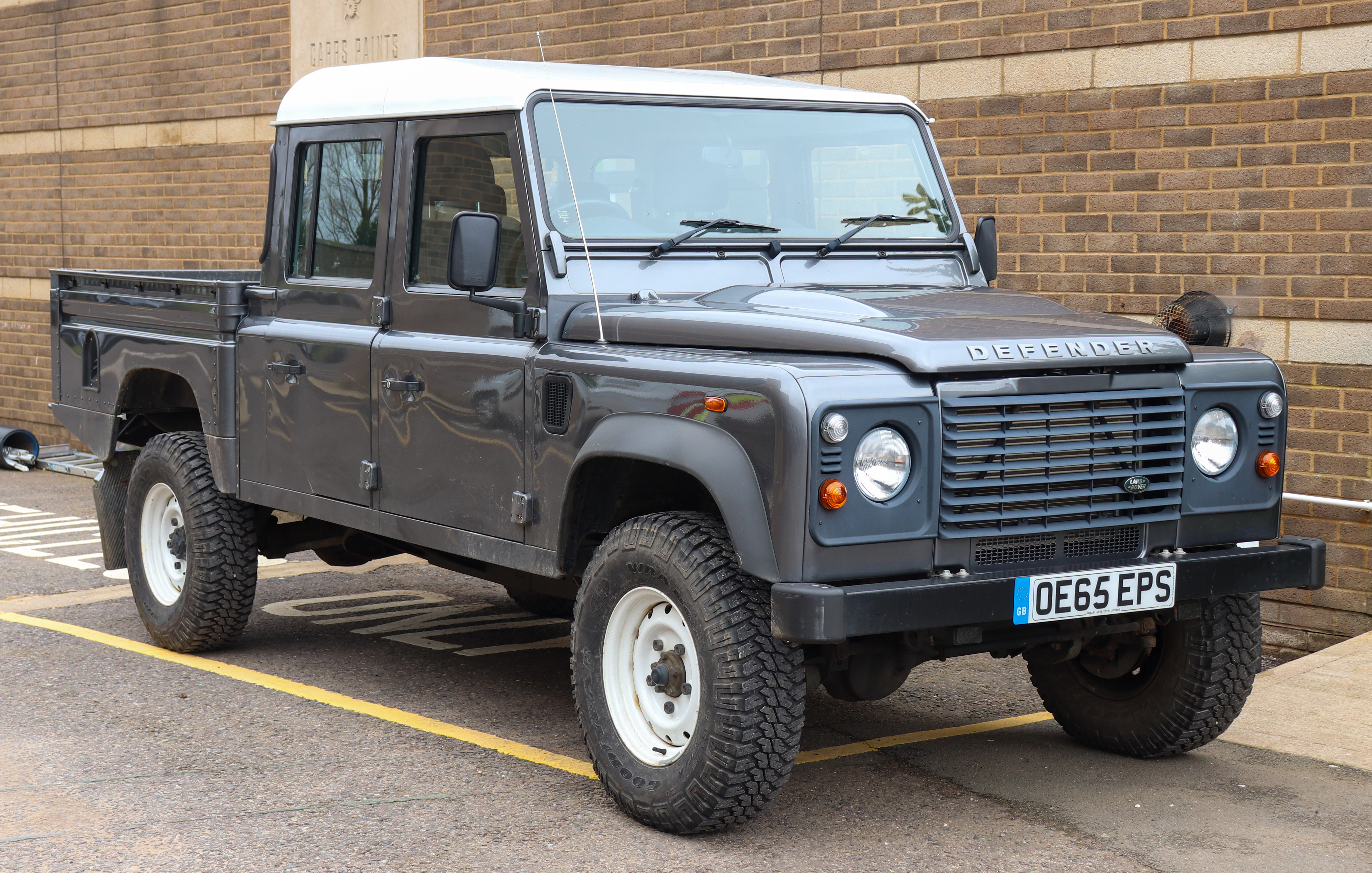
The Land Rover Defender is a tough SUV designed for off-road driving. The podcast mentions it while talking about different generations of the vehicle. Off-road use can be harder on parts like wheel bearings, so it’s a relevant example.
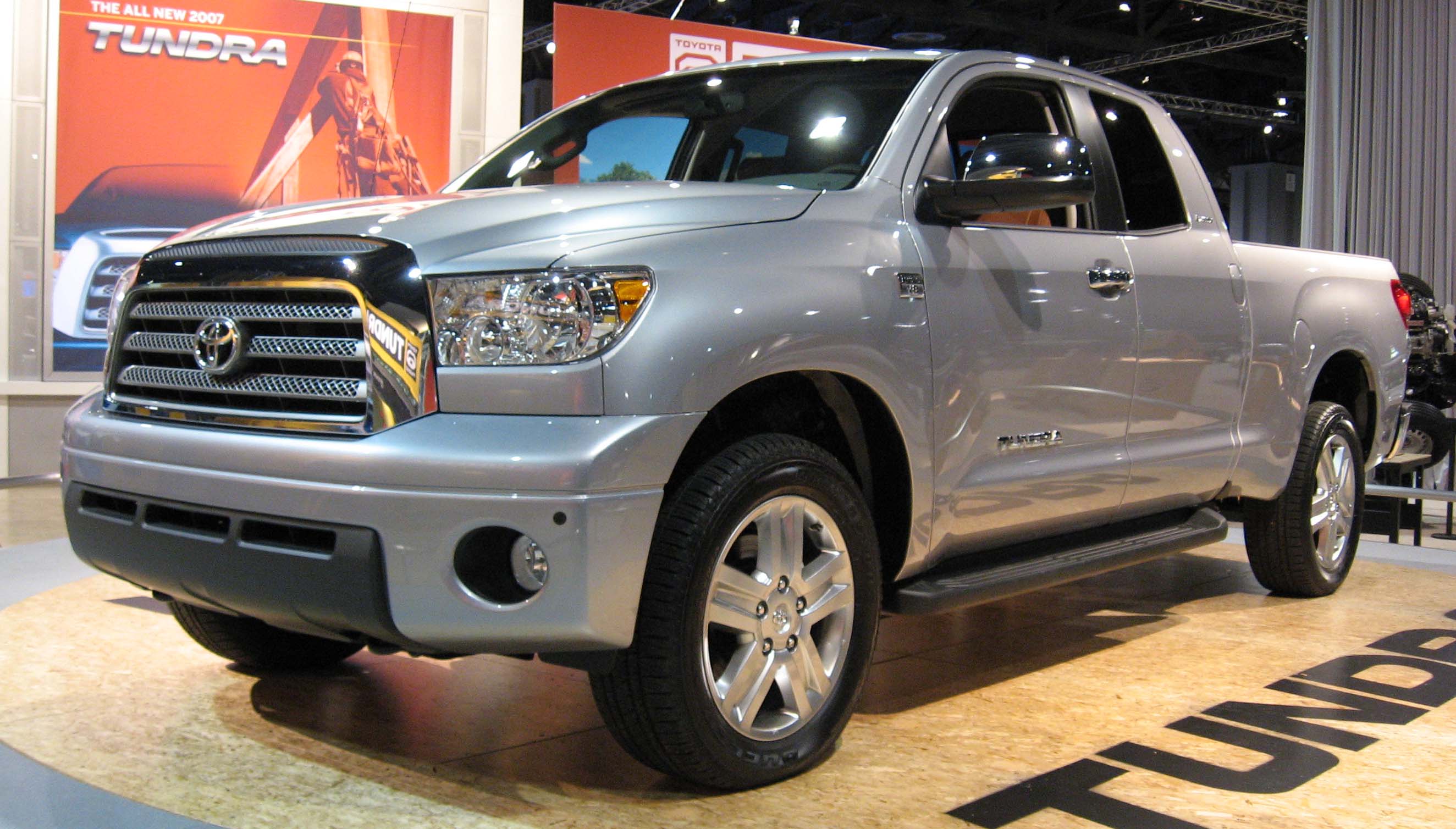
The hosts are pointing out that the engine in the Lexus GX is related to an engine used in the Toyota Tundra. That helps you understand what kind of powertrain feel to expect.
The Lexus LX is brought up because it shares the same engine family as the GX. That helps you predict how the GX’s powertrain will feel.
LIVE
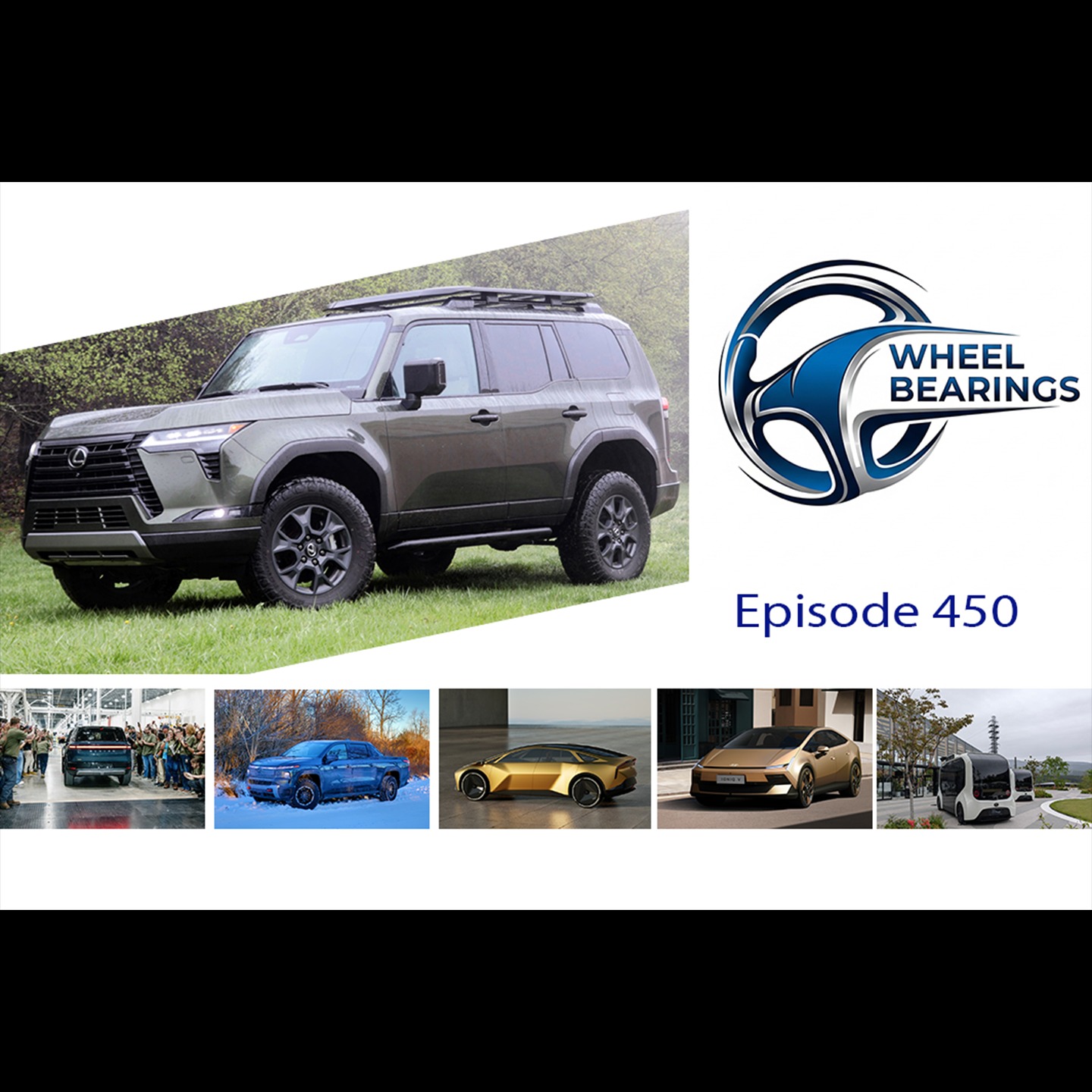
[SPEAKER_00]: this is episode 450 of wheel bearings.
[SPEAKER_00]: I am Sam a bull salmon from telemetry.
[SPEAKER_01]: I am Roberto Baldo from SAE International and the SAE automotive engineering podcast.
[SPEAKER_01]: I don't know how I forgot that was a thing, but that's where we are right now on Sunday morning.
[SPEAKER_02]: And I am not Nicole Wakeland, as you may have noticed, all and I'm representing New England here.
[SPEAKER_02]: I'm John Volker from Upstate New York.
[SPEAKER_00]: And yeah, I think even if people were to sing on audio, I think they would have figured out just from your voice that you're not quite Nicole.
[SPEAKER_01]: We were gonna send him a wig, but it didn't make it in time because he lived so far away.
[SPEAKER_00]: Yeah Nicole is hanging out in New Orleans with Akira for a couple of days at the Jazz Fest.
[SPEAKER_00]: I saw this morning she posted a picture of some Benier's just covered in powdered sugar.
[SPEAKER_00]: And she also posted a picture of an Akira MDX because you're on a roller maker trip.
[SPEAKER_01]: I was looking around for my trumpet, but it's in my band space right now.
[SPEAKER_01]: I'd play with some jazz.
[SPEAKER_01]: Bad, bad, horrible jazz.
[SPEAKER_01]: Not the jazzo's horrible.
[SPEAKER_02]: My, or my jazzo's horrible.
[SPEAKER_02]: Okay.
[SPEAKER_02]: Well, is the only child in my school to have been asked to leave fifth and sixth grade choir for not only not being able to sing, but doing it loudly and happily.
[SPEAKER_02]: you all are the music side.
[SPEAKER_01]: They just bring you up to like, hey, it's, I'd come here.
[SPEAKER_01]: You know what, we love, we love the excitement.
[SPEAKER_01]: We love the, the, the, the, the, the, the enthusiasm.
[SPEAKER_01]: enthusiasm.
[SPEAKER_02]: Um, I'm older, this was a, you're disturbing the rest of the choir.
[SPEAKER_02]: How would you like some more study hall time?
[SPEAKER_01]: Um, yeah.
[SPEAKER_01]: That's how I was asked to leave the rocket club in high school.
[SPEAKER_01]: It was the 80s.
[SPEAKER_01]: They're like, hey, dude, it's just leaf.
[SPEAKER_01]: No one was nice to children until about the mid 90s.
[SPEAKER_01]: That's very good.
[SPEAKER_00]: And then arguably we may have been a little too nice to them, but that's a story for another.
[SPEAKER_01]: uh... all right let's let's get started with us uh... robby would even drive in so i went to the hunting metaplan i had not been very missed the first couple trips out there because complex blah blah blah uh... and so they know it's great when around saw the metaplan it's uh... it's like a a very a larger version of the plant i saw in Singapore uh... which is really interesting because you know it's it's different from your typical
[SPEAKER_01]: cool, they're hiring for a second shit right now.
[SPEAKER_01]: Awesome.
[SPEAKER_01]: They're gonna make a lot of cars are cool.
[SPEAKER_01]: Really the most exciting thing was that they gave me a Hyundai Ionic 5XRT and they made an auto cross like a dirt track and they just let us go at it.
[SPEAKER_01]: So that's what I did.
[SPEAKER_01]: So that's what I drove.
[SPEAKER_01]: I drove a Hyundai Ionic 5XRT.
[SPEAKER_01]: What's fun is that the, well, it's fun.
[SPEAKER_01]: The road was really rotted.
[SPEAKER_01]: Like the track was super rotted by time I got there.
[SPEAKER_01]: And when you're driving any sort of vehicle, especially something that feels lower than it is, you're always kind of winceing, like waiting for the bumper to sort of dive into something.
[SPEAKER_01]: Nope, because they shaved up the bumper, they did approach the departure, those angles have been increased, it's been raised.
[SPEAKER_01]: I didn't have any issues like scraping or anything.
[SPEAKER_01]: the traction control, you put it in sand and you put in sport, you can drift it to the cows come home.
[SPEAKER_01]: So that's my, if you, someone on blue sky was like, oh, I drove it.
[SPEAKER_01]: I just bought an XRT.
[SPEAKER_01]: If that person is listening, that's how you drift your vehicle.
[SPEAKER_01]: find a nice dirt road, hopefully you know what else is around and you just you turn off your tracks you will see just traffic traction control we use the sand because it was in the corners it was pretty deep sand and so you kind of had to you know you don't want to overcook it but [SPEAKER_01]: You could, and yeah, no, I had a great time is, you know, inside it's a, it's a, it's a Hyundai, it's a, Ionic 5, which I have in my driveway, so it has that little terrain mode, which allows you to put in dirt sand, snow, mud, lava, I don't think the last one's true.
[SPEAKER_01]: But, uh, yeah, I really, I, I, I, I, I, I, I, I, I, I, I, I, I, I, I, I, I, I, I, I, I, I, I, I, I, I, I, I, I, I, I, I, I, I, I, I, I, I, I, I, I, I, I, I, I, I, I, I, I, I, I, I, I, I, I, I, I, I, I, I, I, I, I, I, I, [SPEAKER_01]: I like the XRT when they had the dry program, but the drive was actually pretty tame.
[SPEAKER_01]: Like, here's a dirt road and go up here.
[SPEAKER_01]: And I go, okay, we just drove up dirt road and I believe Palm Springs.
[SPEAKER_01]: This was a lot more fun.
[SPEAKER_01]: This was like, hey, just go nuts and we did.
[SPEAKER_01]: And my best lap, there's too much dust and the sensors didn't pick up my takeoff.
[SPEAKER_01]: The person who got like 51, he was there on the track first, so it wasn't as reddit, but also I think he's a better driver than me.
[SPEAKER_01]: So I think there's that.
[SPEAKER_01]: So he had a better track, and he can do it better.
[SPEAKER_01]: He's better than I am.
[SPEAKER_01]: Had a lot of fun going to the battery pack on anything drama.
[SPEAKER_02]: No, it was on that XRT drive too, actually.
[SPEAKER_02]: And for whatever reason, you're right, it wasn't that challenging, of course.
[SPEAKER_02]: We managed to ground the pack on the one sort of hard rock.
[SPEAKER_02]: That one.
[SPEAKER_02]: Yeah, that one spot.
[SPEAKER_02]: Yeah.
[SPEAKER_02]: Yeah, didn't do anything and there was a long discussion there afterwards about, well, is your pack strong enough and they sort of gently said, yes, we we guard our packs and we armor them against whatever people might do with them.
[SPEAKER_02]: And that's the standard pack.
[SPEAKER_02]: We didn't add any extra armor on the edge of it.
[SPEAKER_01]: Yeah.
[SPEAKER_01]: So yeah, so it's, you can scratch up the bottom apparently according to Hyundai, you know, they have to build these things with the idea that at some point someone's gonna find a really spiky rock and high center of their vehicle on it.
[SPEAKER_01]: So, or drive it in Michigan, you know?
[SPEAKER_01]: Or drive it in Michigan.
[SPEAKER_01]: One or one of those two, I was in, was I into Troy, oh, like a week ago.
[SPEAKER_01]: And I was in an Uber, as I did drive around, but the whole time I'm like, man, you guys.
[SPEAKER_01]: So yeah, no, it was a very, you know, it was just a track run, but it's a reminder that I like that XRT.
[SPEAKER_01]: It's a bit more, I mean, again, it's not a Wrangler.
[SPEAKER_01]: That's not what it's built for, don't think it's a Wrangler.
[SPEAKER_01]: If you're like, well, I can't grow up, you know, Moab or whatever.
[SPEAKER_01]: I'm making it, that's not what this car is.
[SPEAKER_01]: That's, you can do the same thing.
[SPEAKER_00]: It's meant for going, you know, taking the road out to where John lives or, you know, [SPEAKER_01]: It's like a heavier, uh, slightly less fun version of a WRX.
[SPEAKER_01]: There you go.
[SPEAKER_01]: Yeah, like a WRX is great for me.
[SPEAKER_01]: Me, no, whenever I get a WRX, I'm super excited because it choose up all roads.
[SPEAKER_01]: It doesn't care, but also it, I can't go to Moab in a WRX even though it's built to go off road.
[SPEAKER_00]: Yeah, well, you know, and even, you know, like the Subaru Saltera and the Toyota BZ, just in their standard form, those cars have more ground clearance than the XRT does, you know, the XRT is like seven inches of ground clearance, which is not a whole lot.
[SPEAKER_02]: You know, I didn't think an increment of an inch higher than the standard.
[SPEAKER_00]: Yeah, yeah, the standard one six inches and this is, as a seven.
[SPEAKER_01]: Yeah, it's definitely not for insane off-roady, but it is for you found something cool to do.
[SPEAKER_00]: Hello, you know, it's better, it's got more ground clearance than the Ford Machi rally, which is, you know, like 5.9 inches, which, you know, for something that is supposed to emulate a rally car,
[SPEAKER_00]: Not a lot of, not, not, not much graph closer.
[SPEAKER_01]: You can't call it a rally if it doesn't.
[SPEAKER_00]: It's a rally because he's got those cool white wheels on it.
[SPEAKER_02]: Oh, all right then.
[SPEAKER_02]: That said, I live in a place where we have a fair percentage of electric cars.
[SPEAKER_02]: I have not seen a single-mocky rally or a single-ion at 5xRT on the road.
[SPEAKER_02]: Have you guys?
[SPEAKER_01]: Let's see them here pretty often, and I went to the dealership to get the wheels rotated on our ionic five, and so I was just kind of talking to the sales person who sold us our car.
[SPEAKER_01]: He's actually a nice person.
[SPEAKER_01]: Then again, whenever we walk in my life, like, you know, he writes about cars and that pretty much gets rid of all the sort of BS that happens.
[SPEAKER_01]: But he was saying like, he's like, yeah, we get, he's like, they don't send us very many [SPEAKER_01]: So I've seen a couple around here, but I live in the Bay Area.
[SPEAKER_01]: I can't swing a stick without hitting an EV.
[SPEAKER_01]: I mean, I see a lot of, of, of, of, what do you call it?
[SPEAKER_01]: The VINFASTS.
[SPEAKER_01]: I see a lot of VINFASTS drive around here.
[SPEAKER_00]: I mean, the only place in America where you'll see VINFASTS.
[SPEAKER_01]: Yeah, they're just like, if there's an EV, someone here's going to buy it and drive it around.
[SPEAKER_01]: I see oceans, I see it.
[SPEAKER_02]: Although it earned much to my shock, I presented at an EV conference last month and then fast had the second largest display on the floor along with Kia.
[SPEAKER_02]: It didn't seem to be terribly populated, but I was surprised to see it still out there.
[SPEAKER_01]: I think the other potential to be like the, you know, Hyundai and the 80s with the Alantra are not, I'm sorry, the Excel, where it comes out, they first get here and it's like, it's not great.
[SPEAKER_01]: Like, the Excel wasn't a great car.
[SPEAKER_00]: It would make a couple generations.
[SPEAKER_01]: Yeah, it goes for a couple generations.
[SPEAKER_01]: I think if they stick with it and they have the money to do so, and they iterate and every car is better than the one before, they're just a potential for them to do.
[SPEAKER_01]: say my well and you know but it's all you know first impressions are really tough to get over I think the Hyundai really was able to to succeed because the the you go was so incredibly bad and it was around same time like everyone's like yeah it's it's not great but it's not the you go [SPEAKER_00]: So you get the, I mean, even for, you know, for a Hyundai, you know, it took a good, you know, 20 plus years for people to really start taking them seriously and the main thing that kept and going through that time is after the first couple of years when their quality and rate of the quality was so awful and, you know, frankly it was was not great.
[SPEAKER_00]: You know, they started introducing, you know, insane, like 10-year, you know, powertrain warranties and, you know, five, six-year bumper to bumper warranties.
[SPEAKER_00]: And that was, you know, and the cars were, you know, among the most affordable on the market.
[SPEAKER_00]: And so, you know, people, you know, figured, okay, well, it's cheap.
[SPEAKER_00]: And, you know, I can get a really good warranty on it.
[SPEAKER_00]: I'll take a flyer on it.
[SPEAKER_00]: And, but, you know, even with that, you know, it wasn't until, like the late 2000s or early 2010s that, you know, people really started to take them more seriously.
[SPEAKER_01]: I still had people who, you know, even five years ago who were very much like, well, I mean, I know you liked these Mondays, but I'm not gonna buy one, because, you know, blah, blah, blah quality issues.
[SPEAKER_01]: So, yeah, it's always been for a long time.
[SPEAKER_02]: That just created my throat.
[SPEAKER_02]: Lad, I'm always surprised that the difference between perception and reality because we drive so many new cars.
[SPEAKER_02]: We have sort of an up to date 2026 picture of what a brand is like, what the cars are actually like.
[SPEAKER_02]: A brand here at least, Hyundai has sort of emerged as the budget alternative to Toyota and Honda probably somewhere above Nissan.
[SPEAKER_03]: In fact, I'm still getting the, what aren't they Korean?
[SPEAKER_02]: I didn't hear that word there, John.
[SPEAKER_00]: I think you dropped out a little.
[SPEAKER_00]: I wasn't sure what the rules were.
[SPEAKER_00]: I didn't ask them to jokingly.
[SPEAKER_00]: I actually had a reader or listener right in last week because Nicole used a couple of words.
[SPEAKER_00]: She didn't drop any F-bombs, but she, she got a little [SPEAKER_02]: being a dream or a fragile flower, I won't go there.
[SPEAKER_00]: Okay.
[SPEAKER_00]: Anything else on the ionic five XRT?
[SPEAKER_01]: Now, yeah, the ground clearance is seven inches.
[SPEAKER_01]: There you go.
[SPEAKER_01]: That's how I looked at a real quick case and anyone interested.
[SPEAKER_01]: Yeah, here you go.
[SPEAKER_01]: XRT, it's a lot more expensive than the other ionic five's.
[SPEAKER_01]: But if you live on a dirt road and you wanna drift, there you go.
[SPEAKER_01]: There you go.
[SPEAKER_00]: You might actually be able to do it, do the drifting easier with an SEL, just because it's not on quote-unquote altering tires.
[SPEAKER_00]: Yeah.
[SPEAKER_00]: So you're gonna have less, little less grip.
[SPEAKER_00]: All right, John, tell us what you've been driving.
[SPEAKER_02]: I actually have had a test car every week for the past six weeks, which has been kind of great so I'll bang through them quick.
[SPEAKER_02]: I had a Porsche Taycon, possibly my favorite, [SPEAKER_02]: EV, just because up here, you know, New York is a high-tech state, but they take pretty good care of the roads, especially in my county.
[SPEAKER_02]: And so we have a lot of curvy roads with hills.
[SPEAKER_02]: They're a twisty.
[SPEAKER_02]: They don't have a lot of traffic on them.
[SPEAKER_02]: And so having a tie-con is always a pleasure.
[SPEAKER_02]: This was the cheap one.
[SPEAKER_02]: This was only 138 grand.
[SPEAKER_02]: Yeah.
[SPEAKER_02]: Well, you know, I'm thinking five years in what's it going to show up on bring a trailer for or maybe maybe the cheap.
[SPEAKER_00]: About 38.
[SPEAKER_02]: I'm going to bring a trailer, but so just drop the one.
[SPEAKER_00]: That's about the price.
[SPEAKER_00]: It'll be.
[SPEAKER_00]: Is it all right.
[SPEAKER_00]: You use tie compresses or it's not, it's not what you would expect of a use Porsche.
[SPEAKER_01]: You can get one right now for 50,000.
[SPEAKER_01]: And 24, 15, 16,000 miles.
[SPEAKER_01]: Eric, 15, yep, no, 16.
[SPEAKER_01]: That doesn't tell me.
[SPEAKER_01]: Oh, yeah, yeah, yeah, yeah.
[SPEAKER_02]: Well, and the reason I ask is because there's this weird thing that's come up with some of the data from recurring on EVs, where it turns out, each of the battery may be as important as the number of miles.
[SPEAKER_02]: Every use car salesman says, oh, you know, it's got 70,000 miles on it to Navy, therefore, [SPEAKER_02]: you know, it, I'll price it cheaper.
[SPEAKER_02]: If it's a newer modelier, that may actually be a decent deal, but I digress.
[SPEAKER_02]: The Tycott was lovely and I realized I've finally got an over my irritation with Gorsha not offering one pebble driving just because it's, [SPEAKER_02]: It's such a nice throwback in a way to how you used to drive cars.
[SPEAKER_02]: The screen is only this big and you don't get distracted by anything digital.
[SPEAKER_02]: You just drive the car and [SPEAKER_02]: You know, I know that the roads and curves up here pretty well, and, you know, it took about half an hour to realize I could go into any curve, 15 miles an hour faster in that car and just hold it through than any other vehicle I had tested recently.
[SPEAKER_02]: Until the next largest UV in front of me breaks in terror for a curve.
[SPEAKER_02]: So, the tie-com was lovely, and always is, I will always take the tie-com to drive.
[SPEAKER_02]: In six days, I put 1800 miles on an escalade IQ in four states and a province.
[SPEAKER_02]: And that was an interesting road trip.
[SPEAKER_02]: Loved super crews.
[SPEAKER_02]: The newest version of super crews is really good.
[SPEAKER_02]: I hadn't, I didn't see it do anything that worried me over those six days.
[SPEAKER_02]: parking, the escalated IQ, IQL, I should say, um, not some fun, despite good cameras.
[SPEAKER_02]: And in fact, in a small town that was laid out before the arrival of Horses' carriages, it was miserable.
[SPEAKER_02]: Bruh, my drive wave line, but that's a great road trip car, 1.9 miles per kilowatt hour over those 1600 miles, but it does wait for 1.5 tons, yeah.
[SPEAKER_02]: Charge that two different charging networks, you guys tell me if you want to know this stuff.
[SPEAKER_02]: Yeah, no, we want to all, all that kind of stuff.
[SPEAKER_02]: All right, I had my first ever Ionna charging experience.
[SPEAKER_02]: I covered them.
[SPEAKER_02]: I'd go now to see their sort of marquee site, uh, Apex Carolina.
[SPEAKER_02]: Why not, I think?
[SPEAKER_02]: Yeah, some more in the Carolinas.
[SPEAKER_02]: Yeah, and um, you know, that one's lovely and very stylish and 60's retro a little bit.
[SPEAKER_02]: this I didn't even know there was one it's on the border of Vermont and New Hampshire.
[SPEAKER_02]: It was 34 degrees, it was raining because it's New England in the winter and I showed up it had a canopy.
[SPEAKER_02]: it had trash bins.
[SPEAKER_02]: I charge at 360-8 kilowatts because I could take it down to 14 or 12 percent.
[SPEAKER_02]: It had squeegees and at the motel next door, they said, oh, are you charging out there?
[SPEAKER_02]: Do you want some coffee?
[SPEAKER_02]: So over at all, you know, it didn't look all that promising.
[SPEAKER_02]: It was a, you know, canopy off the side of a budget motel with a restaurant that was no penny at next to it, but the whole thing worked flawlessly, power delivery was great.
[SPEAKER_02]: There were two other EVs that showed up why was there.
[SPEAKER_02]: So I wasn't the only one, but first impression in real world use very impressed.
[SPEAKER_02]: And then, in Western New York State, I went to a flying J slash GM energy site.
[SPEAKER_02]: GM is putting money into some sea star chains.
[SPEAKER_02]: This one charged at 344, so almost as good.
[SPEAKER_02]: My one grumble there was it was probably a few hundred feet from the convenience store and the winds off like Erie just blow steadily to the east at 25 miles an hour and it was cold, but, you know, have tied for four problems.
[SPEAKER_02]: So those all work great.
[SPEAKER_02]: The elect five America station I went to was less fast, but it did work.
[SPEAKER_01]: Yeah, I'm seeing the last two years, they've really sort of made sure that they're systems actually work.
[SPEAKER_01]: It is weird though when they do stick and put, you know, the recent one they put near my house, which is less than a mile from another electrifier manifestation, they put 10 charging stations in, which I'm like, see, that's how you do it, you can't put two in, stop that.
[SPEAKER_01]: It's like, I'm not going to decommission the first one.
[SPEAKER_01]: First one's not on a Walmart, is it?
[SPEAKER_01]: No, no, it's at a like a, it's at a vans or lucky.
[SPEAKER_01]: It's at another, they're both at supermarkets.
[SPEAKER_01]: One of them is closer to the, to the freeway than the other.
[SPEAKER_01]: But they're both, the smaller one actually is used a lot.
[SPEAKER_01]: The new bigger one.
[SPEAKER_01]: There's always at least, there's always a spot there.
[SPEAKER_01]: Oh, you know, they're both being used and then, yeah, so it's, you know, when they both work when I, you know, have to, you know, if I, if I'm going shopping and I'm like, oh, I still have like the free charging, which I rarely ever do because I'm lazy and it's easy just to plug my car in at home.
[SPEAKER_01]: But when I do, you know, plug it in, walk right, you know, it's walk into the store buy something come back out cars charge everything's.
[SPEAKER_01]: on the new EA have half an exports and half CCS.
[SPEAKER_01]: It does not.
[SPEAKER_01]: I was hoping this was going to be an export location because, you know, they had talked about it, but as far as I know, did they even have an export location yet?
[SPEAKER_00]: I mean, I don't always have an half.
[SPEAKER_00]: I think E.A.
[SPEAKER_00]: has started to retrofit some stations.
[SPEAKER_00]: I think there's a handful that they've done, but not land of any.
[SPEAKER_01]: A land of Florida and water Ford Connecticut.
[SPEAKER_01]: It looks like that's their next pilot stations, which seems.
[SPEAKER_01]: Yeah, it's been a minute, but, you know, more must, you know, that's fine.
[SPEAKER_01]: Everyone has adapters, which I never got, which I found out like, [SPEAKER_01]: Never got an email or maybe I did, but I never got an email to get my free adapter from Hyundai, so I don't make boo.
[SPEAKER_01]: Well, two adapters.
[SPEAKER_00]: Yeah, well, yeah, for Hyundai, you need you need one for AC and one for DC.
[SPEAKER_02]: Right, right, and trying to explain this To the public at large.
[SPEAKER_02]: They get the adapter the idea that you need different adapters for different use cases is a challenge.
[UNKNOWN]: Yeah [SPEAKER_02]: But what else did I have?
[SPEAKER_02]: So the escalated IQ was great.
[SPEAKER_02]: I'll be at massively incredibly, horribly energy inefficient.
[SPEAKER_02]: But not a bad way to travel a long distance in crappy weather on interstates.
[SPEAKER_00]: Well, we will be, we will have an escalated IQ as part of our fleet for Operation Frodo in June when we're transporting rescue dogs.
[SPEAKER_00]: Yeah.
[SPEAKER_00]: And so I'm going to be driving that one from Detroit to Omaha.
[SPEAKER_00]: And so actually there's there's no there's no ionostations in Michigan yet.
[SPEAKER_00]: There's several in Ohio and there's actually one in Gary Indiana.
[SPEAKER_00]: So I may may make a stop there for to try that to check that one out on the way.
[SPEAKER_02]: definitely right from that.
[SPEAKER_00]: But the big size will be handy for putting multiple dog treats in there.
[SPEAKER_02]: Although I didn't, well, maybe it's not a Cadillac thing.
[SPEAKER_02]: I didn't see the old Subaru style I had.
[SPEAKER_02]: Look, our load bay is wide enough where you can put two standard medium sized dog cages side by side.
[SPEAKER_02]: But unlike Subaru's, it doesn't come standard with a golden retriever.
[SPEAKER_01]: Yeah, just in like, you know, we got our BRZ.
[SPEAKER_01]: They were just a dog in there.
[SPEAKER_01]: Even the BRZ.
[SPEAKER_01]: I mean, the dog was vaping, but he's in there.
[UNKNOWN]: Ha ha.
[SPEAKER_00]: Well, according to the alternative fuels data center site, there are currently four electrify america stations with, uh, with Nax ports, uh, one in Connecticut, uh, one, uh, in, uh, let's see in Maryland, uh, another one, uh, in your Pittsburgh, and then one in Florida.
[SPEAKER_01]: Oh, Pittsburgh.
[SPEAKER_01]: All right.
[SPEAKER_01]: Well, next time I have to go out to the office, so I'll see if I can cruise over to the South East Pittsburgh.
[SPEAKER_01]: to be honest I don't think I've been a pitch I've been to the Pittsburgh area like four times for work I've never actually been in Pittsburgh I've never I'd never have time I'm just there to work do a bunch of things and that the office isn't actually in Pittsburgh.
[SPEAKER_01]: It's in more and Yeah, maybe it's near I don't know anything about Pittsburgh to be honest [SPEAKER_02]: All right, John, what else you got?
[SPEAKER_02]: What else?
[SPEAKER_02]: And then I did 2700 miles in a Maverick hybrid all-wheel drive.
[SPEAKER_02]: And this was a deliberate long-term test.
[SPEAKER_02]: I had to pick up a 50-year-old axle from way, way, way south of the Mason Dixon line for a 70-year-old car as one does.
[SPEAKER_02]: And practically new for you.
[SPEAKER_02]: we'll get to that part of it at the end, um, but, uh, and the trick got interrupted by the northeast, very largest, no storm.
[SPEAKER_02]: But, um, I had the truck and I wanted to test it out as a long term vehicle.
[SPEAKER_02]: Um, I was a fan of the Maverick one at launch.
[SPEAKER_02]: I am still a fan of the Maverick because in the update, they paired the hybrid, not just with all wheel drive, but with 4,000 pounds of towing capacity.
[SPEAKER_02]: No, it won't tow your 28 foot boat, but it will tow anything on a small trailer.
[SPEAKER_02]: I didn't naturally have to tow the axle fit nicely in the bed diagonally, but anyway, I did vaffle trip in truly crappy weather and got almost 30 miles a gallon.
[SPEAKER_02]: The bulk of it on the interstate, [SPEAKER_02]: which was a little lower than I'd hoped, but again, it was fairly heavy duty cycle and it was cold and snowy and side winds and all the rest, but I still love the fabric, the door handle still irritate me, but otherwise in my in my world home run, especially with the hybrid that has all real drive, because I cannot own a car that does not have all real drive if I want to get up my driveway in the winter.
[SPEAKER_02]: So that was that.
[SPEAKER_02]: Then, the latest two, I had a week with the new Jeep Cherokee, which I was very interested in.
[SPEAKER_02]: Yeah, I think I was driven up.
[SPEAKER_00]: I have to post again when they did the launch program, I was on vacation in Mexico and so it couldn't go.
[SPEAKER_01]: I'm supposed to get the Cherokee hybrid and May, and I could like two weeks.
[SPEAKER_01]: Why should you know someone about that?
[SPEAKER_02]: Mike, you know, there are all hybrids at this moment.
[SPEAKER_02]: You cannot get a non-hybrid power train does not use the H word anywhere.
[SPEAKER_02]: It might be in the owner's manual, if there is still a known owner's manual.
[SPEAKER_02]: But other than that, nothing on it says hybrin.
[SPEAKER_02]: And even the gauges aren't incredibly clear that you're sort of re-gening.
[SPEAKER_02]: And so, you know, it's a perfectly good large compact or small mid-size to row crossover.
[SPEAKER_02]: My main problem was I just don't understand what makes this a Jeep.
[SPEAKER_02]: It could be, take away the seven-slot grill, it could be anything.
[SPEAKER_02]: Put a different grill on the front, it's square, and there were certain things that didn't [SPEAKER_02]: Yeah, maybe if you're in a grand wagon year, but for a 40-ish thousand crossover, do you need a little button that electrically releases the door and then on the outside sunken handle where you put your thing in and push the rubber mat and the door releases.
[SPEAKER_02]: That just didn't feel very GP.
[SPEAKER_01]: It also feels like just a waste of money to be honest.
[SPEAKER_01]: Like mechanical doors have been working for over a hundred years.
[SPEAKER_01]: Why are we doing this with electric doors?
[SPEAKER_01]: Let's please stop.
[SPEAKER_01]: I know, there's lots on that.
[SPEAKER_01]: Exactly.
[SPEAKER_01]: And then there's a whole region where they're like, yeah, don't do that.
[SPEAKER_02]: Yeah, yeah.
[SPEAKER_02]: And there were a few odd cost cutting.
[SPEAKER_02]: You know, it didn't feel cheap.
[SPEAKER_02]: The interior was good enough.
[SPEAKER_02]: I had the old black, which I'm never a fan of, but it was fine.
[SPEAKER_02]: As far as I could ascertain, I should have looked it up on the interwebs, um, it has, you know, it has a powered tailgate.
[SPEAKER_02]: I couldn't find the button to what the tailgate backed out.
[SPEAKER_02]: You could do it from the fog, but usually on the length of vehicles.
[SPEAKER_00]: It's inside the pillar.
[SPEAKER_00]: Usually on the left-hand side of the cartel.
[SPEAKER_00]: I looked space.
[SPEAKER_00]: I was wondering.
[SPEAKER_02]: Unless it was hidden or it was, what like something else?
[SPEAKER_02]: Now, I'm perfectly willing to admit to be an idiot here.
[SPEAKER_02]: Um, it was also raining that do sense a theme for spring in the north of East, but um, so I wasn't crawling around, but it just, you know, that was a little, little bit of a puzzle.
[SPEAKER_02]: There was one other thing which I'm now forgetting, but you know, [SPEAKER_02]: It should sell, well, it looks somewhat cheapish if you take the grandwagonier as their most recent styling statement because it's very upright.
[SPEAKER_02]: It has fewer rounded curves, it's a little bit more knife-edge in some of its aspects.
[SPEAKER_02]: Nice and upright, so people will say yes, SUV.
[SPEAKER_02]: uh... and the engine is a 1.6 liter turbo with this two motor hybrid system which worked fine um... and unless i hammered it the engine coming on was fairly sedate um... but got to the economy to get out of it second we got fuel economy to get
[SPEAKER_02]: 34.
[SPEAKER_02]: So, you know, not quite rev 4 hybrid levels, but it has legit all-wheel drive as opposed to the the Toyota practice of the small e-mode around the rear axle.
[SPEAKER_02]: So, um, [SPEAKER_02]: I don't know.
[SPEAKER_02]: I just, I think, I think they'll sell a ton.
[SPEAKER_02]: And quality seemed good.
[SPEAKER_02]: They come from Mexico.
[SPEAKER_02]: So, of course, it's terrifying for now.
[SPEAKER_02]: I just, I'm curious whether people will perceive it as a Jeep or whether they're buying a brand name for what is essentially a very [SPEAKER_01]: I mean, sorry to have a few Cherokees or Grand Wagoners or whatever actually do you go off road.
[SPEAKER_00]: And they have acknowledged that there is going to be a trailhawk version of this.
[SPEAKER_00]: So it will be lifted up.
[SPEAKER_00]: It will have some sort of low range mechanism like they had on the last generation Cherokee and so on.
[SPEAKER_00]: It will have some more capable, more serious off-road credentials than this one.
[SPEAKER_00]: You know, this is, this is the one for most people, but I think once they once they launch the trailhawk, you know, with the previous generation Cherokee and with the compass and others, they sell a surprising proportion of, you know, trailhawk type models on those.
[SPEAKER_00]: And so, no doubt that that will sell that probably sell quite well for this Cherokee lineup as well.
[SPEAKER_02]: Well, something did cross my mind, that vehicle is built on a stellar large platform, which I hadn't realized.
[SPEAKER_02]: which is also what's under the new charger and the wagon ErS, and I guess the Jeep recon, which are electric.
[SPEAKER_02]: The charger is obviously getting its gasoline engine now in a longitudinal format where this is a transverse format.
[SPEAKER_02]: So is there, let's seriously consider, is there a [SPEAKER_00]: I don't think so because, you know, with the style of large platform, there's, you know, there's a couple of different variants of it, you know, so there's versions that were the front end, you know, ahead of the, the bulkhead, the front bulkhead is longer, like what you find on the, the Wagonier S and on the, you know, the, you know, the, you know, it's [SPEAKER_00]: the charger.
[SPEAKER_00]: And, you know, those use a multi-link front suspension.
[SPEAKER_00]: The version that's used in the Cherokee is a little bit shorter has a front suspension as designed for transverse engine mount.
[SPEAKER_00]: So, I don't think I don't think we'll...
[SPEAKER_00]: And same as last words, we probably won't get a Hellcab or Hemi version of this Cherokee, but what we probably will, what they probably will be, is one with the new 2-liter 4-cylinder hurricane 4 that they just launched in the Grand Cherokee.
[SPEAKER_00]: So that, you know, in the Grand Cherokee, that one's like 320, 320-1 horsepower.
[SPEAKER_00]: So, we'll probably get that in a version of the Cherokee, maybe in the Trailhawk, maybe in some other trim levels as well.
[SPEAKER_00]: Yeah, so that's probably about the limits of what we'll see in that particular vehicle.
[SPEAKER_02]: I'm also going to remember when certain British car makers would fit a new engine by redesigning absolutely everything forward of the firewall.
[SPEAKER_02]: Again, I digress, but I can think of one brand CEO who would like that.
[SPEAKER_00]: Yeah, I'm sure Tim Kineskis would love to stuff.
[SPEAKER_00]: Yeah.
[SPEAKER_01]: I'm sure Tim Kineskis would love to stuff.
[SPEAKER_01]: Just whatever you put in there.
[SPEAKER_01]: Just call it a himmy.
[SPEAKER_01]: It doesn't have to be a himmy.
[SPEAKER_01]: It doesn't matter.
[SPEAKER_00]: Just take me.
[SPEAKER_00]: All of their engines have hemispherical combustion chambers.
[SPEAKER_01]: Ha.
[SPEAKER_01]: Hemmy.
[SPEAKER_01]: They're all himmy.
[SPEAKER_01]: Yeah.
[SPEAKER_01]: Everything's a himmy.
[SPEAKER_01]: Bicycles, hammy, they're all hammy's.
[SPEAKER_02]: Okay, anything else on the Cherokee?
[SPEAKER_02]: Yeah, the last one I just picked up a couple days ago, a Subaru Trail Seeker.
[SPEAKER_02]: It's in one of four Subaru electric vehicles now, all of which are Toyota's with stars on the nose, which is four times as many EVs as four itself now.
[SPEAKER_00]: I'm sorry.
[SPEAKER_00]: That's 4 times as many times as 4 times now.
[SPEAKER_02]: If you don't include the E-transit, which I think actually, I think the E-transit production has ended.
[SPEAKER_02]: You know, I got caught out on that.
[SPEAKER_02]: I got a note from Ford, but it may have been at the end of last year, so I'm not sure.
[SPEAKER_01]: I did a whole video about the E-transit, and then like two weeks later, they're like, yeah, we're not doing that anymore, I'm like, ah.
[SPEAKER_02]: I know they said they weren't going to have a new generation of it built here, but anyway.
[SPEAKER_02]: So yes, and actually, four times as many EVs as Volkswagen sells today in the U.S.
[SPEAKER_02]: But anyway, the trail secret to me, I'm sort of fond of because the only one that actually looks like a Subaru now.
[SPEAKER_02]: Does it feel like a Subaru inside?
[SPEAKER_02]: Not particularly.
[SPEAKER_02]: It feels like a Toyota, does that matter to Subaru buyers?
[SPEAKER_02]: I'm not convinced it will.
[SPEAKER_02]: I've always said if any brand should have had EVs early on of Subaru, but there's so tiny globally.
[SPEAKER_02]: I looked it up.
[SPEAKER_02]: They don't even make a million cars a year globally.
[SPEAKER_02]: of which fully two thirds now are sold in North America, which is bizarre for Japanese company, but they do one thing really well as their marketing says longevity, safety, adventure, and hopefully these vehicles will [SPEAKER_02]: You know, uh, take them, take that, continue to take them down that path.
[SPEAKER_02]: What I found amusing at the, uh, drive for the car was they just put up a side shot of the thing.
[SPEAKER_02]: And the super version has roof rails.
[SPEAKER_02]: And they ask people, no brand.
[SPEAKER_02]: What kind of car is this?
[SPEAKER_02]: Everybody said super.
[SPEAKER_02]: It's that, right?
[SPEAKER_00]: Like probably all the time.
[SPEAKER_02]: It was an outback.
[SPEAKER_02]: Yeah, exactly.
[SPEAKER_02]: And the the outback doesn't look like the outback anymore.
[SPEAKER_02]: So, um, [SPEAKER_02]: I'll be curious to see if anyone buys one by mistake.
[SPEAKER_02]: Anyway, so I'm driving that so far, so good.
[SPEAKER_02]: I'm taking it on a 240 mile road trip today.
[SPEAKER_03]: Cool.
[SPEAKER_03]: That's for us.
[SPEAKER_03]: Some.
[SPEAKER_03]: What are you doing?
[SPEAKER_03]: All right.
[SPEAKER_00]: Yeah, I mean, I haven't driven the trail seeker yet, but I've driven the same vehicle as a Toyota, which is the Beasy Woodland.
[SPEAKER_00]: Right.
[SPEAKER_00]: And yeah, I was really impressed with it.
[SPEAKER_00]: It's the most powerful, you know, the trail seeker in the Beasy Woodland are the most powerful variants of that apart from the Lexus RZ, you know, so the 375 horsepower.
[SPEAKER_00]: You know, they're quite fun to drive.
[SPEAKER_00]: And one of the interesting things when I was talking to the chief engineer from Toyota about that, you know, he said, you know, they've set it up to be, you know, because the two motors are each capable of 220 horsepower, but because of the the voltage and current they get from the battery, [SPEAKER_00]: They're kind of capped at about 375, but what they've done is by default it biases towards rear power, rear torque bias.
[SPEAKER_00]: So the rear motor is putting out the full 220 and then the front motor is putting out 150-ish horsepower.
[SPEAKER_00]: But it can shift between 70-30 in either direction, depending on the traction, what you need, what's available.
[SPEAKER_00]: and it was quite fun to drive that vehicle and it's got it's got a surprising amount of room inside you know good good car to space and it's a you know it's roughly the same size as the old outback and like you said it certainly looks more like an outback than the new outback does is actually the same size except being for inches taller [SPEAKER_00]: Yeah, it's on that same platform, same wheelbase, et cetera, but but the proportions of it now the boxy proportions make it somehow looks much larger it looks weird they out back is great until you look at it.
[SPEAKER_01]: It's fine, you know what no one's bought a super because it looks good.
[SPEAKER_01]: That's true make no one no one except maybe the old SVX.
[SPEAKER_01]: Yeah, but no one, yeah, no one, no one, but nobody bought those.
[SPEAKER_01]: So yeah, so yeah, I mean, I had like a team, but it's was her.
[SPEAKER_01]: So yeah, on a 2004 bug guy, which was like a weird looking car.
[SPEAKER_01]: I love that car.
[SPEAKER_01]: Oh, yeah.
[SPEAKER_02]: Yeah.
[SPEAKER_02]: On the one thing I will say about the trail seeker slash [SPEAKER_02]: The Regen is the weakest in any two motor car I've ever driven.
[SPEAKER_02]: It just doesn't have.
[SPEAKER_02]: So you learn to drive for it, but you lift off and let a Regen much earlier before the stoplight.
[SPEAKER_02]: one thing.
[SPEAKER_02]: The other thing is, um, nothing latches through power cycles.
[SPEAKER_02]: So I have to tell it to give me a strong region with the left paddle.
[SPEAKER_02]: Every single time I turn the car on and off, and worse, I like kill-hole because I live in a place with hills.
[SPEAKER_02]: That doesn't even latch if you change gears.
[SPEAKER_02]: If you reverse and then go back into drive, it turns out that's weird.
[SPEAKER_02]: Which is just bizarre.
[SPEAKER_02]: Yeah, that's right.
[SPEAKER_02]: Perhaps over time.
[SPEAKER_00]: If we all complain enough, maybe they'll change their philosophy, at least on the region.
[SPEAKER_02]: Dude, it worked with, it worked with Hyundai.
[SPEAKER_01]: Yeah, the new one on its life.
[SPEAKER_01]: Yeah, like you tell like you know some automakers listen on days one of them I'm sure there's others Yeah, well, you know Toyota's philosophy when they launched the BZ4X Yeah, and that also obviously got applied to the the Subaru variants [SPEAKER_00]: They wanted the experience for their customers to be as much like driving one of their hybrids or gas vehicles, and had, you know, staying away from strong region, you know, certainly no one pedal mode, even, you know, that you could select, you know, it's not even selectable.
[SPEAKER_00]: And, you know, I don't think, I think we're, [SPEAKER_00]: I don't think that people really liked that very much, and they haven't changed their philosophy on the region yet, maybe if we keep whining about it, they will eventually, but certainly they've said that in Japan, supposedly regulations in Japan don't allow for one pedal drive, and Nissan has said the same thing when they launched the new leaf.
[SPEAKER_00]: They said no Japan [SPEAKER_00]: However, yeah, but this is the US market and it's all software-controlled.
[SPEAKER_00]: So you could do one pedal in the US and not allow in Japan.
[SPEAKER_00]: It's not like a whole lot of cars are going back and forth between those two markets.
[SPEAKER_00]: There's a concept called Addidiveness.
[SPEAKER_02]: Yeah, I will say I drove a BZ earlier this year and it is improved in a lot of subtle ways over the original BZ 4X, which I really felt was borderline and contemptuous for anyone who had EV experience.
[SPEAKER_01]: It was it was an angry teenager has been forced to clean their room and they're like fine, I'll do it, but I'm not going to do a good job.
[SPEAKER_01]: Fine, you want an EV here.
[SPEAKER_02]: Here's what, um, and the one example actually that made me a really happy was in the initial car, it would not give you battery percentage.
[SPEAKER_02]: It only gave you miles remaining.
[SPEAKER_02]: And I asked about that.
[SPEAKER_02]: And they said, oh, battery percentage will be too confusing.
[SPEAKER_02]: People only want to know how many miles are remaining.
[SPEAKER_02]: Well, if the calculator didn't oscillate quite as much all over the map, maybe.
[SPEAKER_02]: But you know, you can actually use one or the other or both.
[SPEAKER_02]: And excuse me, you know, just a percentage meter.
[SPEAKER_00]: Yeah, exactly.
[SPEAKER_00]: I was just going to say, you know, people have been used to for a century looking at a fuel gauge and saying, okay, it's three quarters full.
[SPEAKER_00]: It's one quarter full.
[SPEAKER_00]: It's empty.
[SPEAKER_01]: Yeah.
[SPEAKER_02]: Yeah.
[SPEAKER_02]: We've been using percentage.
[SPEAKER_02]: They now have a percentage.
[SPEAKER_02]: It seems smaller type than is the miles remaining.
[SPEAKER_03]: But progress.
[SPEAKER_00]: All right, OK, well, let's carry on then.
[SPEAKER_00]: So I also had a product the last week from the Toyota Motor Company.
[SPEAKER_00]: I had the Lexus GX 550 Over Trail, which is the fancier, most off-roady version of a Land Cruiser, the current generation Land Cruiser.
[SPEAKER_00]: Or at least the Land Cruiser 250, [SPEAKER_00]: Within Toyota, there's actually a whole bunch.
[SPEAKER_00]: There's always been a bunch of different Land Cruiser variants.
[SPEAKER_00]: And so depending on where you are in the world, this particular vehicle is either called Land Cruiser or Lexus GX-550 here in North America.
[SPEAKER_00]: Some places it's a Land Cruiser Prado or Land Cruiser 250.
[SPEAKER_00]: Then there's also the LX, which is, that's the high-end 300 series Land Cruiser.
[SPEAKER_00]: But in that mid-range Land Cruiser territory, the GX is basically the same as the Land Cruiser, but with a nicer interior, it doesn't have so much weight of hard plastics, it feels more premium.
[SPEAKER_00]: And given what a Land Cruiser costs, if you go for one of the higher end off road Land Cruisers, [SPEAKER_00]: the price difference between a land cruiser at the high-end versus a GX550.
[SPEAKER_00]: Actually not that much and you know when I when I first drove a land cruiser you know I the price on that one was like $74,000 which is about where a GX550 starts and you know I I said at the time you know it's like well if you're gonna spend this kind of money on it you might as well just get the GX [SPEAKER_00]: be a little more comfy just like a nice car.
[SPEAKER_00]: Yeah, be more comfy.
[SPEAKER_00]: You know, have, you know, night nicer feeling materials, you know, not no hard plastics.
[SPEAKER_00]: So it was definitely a nicer place to spend time.
[SPEAKER_00]: The over trail is the most off-road oriented version of it.
[SPEAKER_00]: So you get the bigger all-thrain tires on 18 inch wheels.
[SPEAKER_00]: It's got, you know, skid plates underneath, things like that.
[SPEAKER_00]: And the one that I had was also equipped with a roof rack, which when you're driving at highway speeds, you absolutely know you have a roof rack up there.
[SPEAKER_00]: Even if the sun roof is closed and you can't see it, you hear it.
[SPEAKER_00]: You hear the noise of the air flowing over this roof rack.
[SPEAKER_00]: But if you are going to use a GX550 over trail, you know, to go camping, go off into the woods, carry your kayaks, your bikes, [SPEAKER_00]: put a rooftop tent on it, whatever it might be.
[SPEAKER_00]: You'll want to use that.
[SPEAKER_00]: The reality is that most people that are going to buy a GX 550, even if they get the over trail, probably never going to do that.
[SPEAKER_00]: They're going to be like land rover defender or customers.
[SPEAKER_00]: The first two generations of owners of the vehicle will probably never ever go on anything worse than a gravel road.
[SPEAKER_01]: Then Roman will buy it over at TFL and that's all he'll do.
[SPEAKER_00]: Yeah, but by the time it's on to the third or fourth owner, it's got a time TFL by the last night.
[SPEAKER_02]: Yeah.
[SPEAKER_02]: But meanwhile, those muddy soccer fields are really, really four-wheel drive necessary.
[SPEAKER_00]: Yeah, you need, absolutely.
[SPEAKER_00]: Yeah.
[SPEAKER_00]: And at least, this one's got off-road, all-trained tires on it so that when you do take it off-road, it's gonna have a lot better grip than the all-season tires that are on standard GS550s.
[SPEAKER_00]: So the other big difference between when Brandon does a long job on those new neighbors.
[SPEAKER_00]: exactly.
[SPEAKER_00]: So the the other big difference between the GX and the Land Cruiser is the power train.
[SPEAKER_00]: All the current generation Land Cruisers have the 2.4 liter turbo either with or without a hybrid system.
[SPEAKER_00]: The the GX has the same 3.4 liter twin turbo V6 that you will find.
[SPEAKER_00]: in the Tundra and Sequoia and in the LX and probably some other products as well from the Toyota in Lexus Group, a 10-speed automatic transmission, 349 horsepower, [SPEAKER_00]: in the six-sysh, five-hounds of torque, 479 foot on foot-pounds of torque.
[SPEAKER_00]: So it's got plenty of performance, that's not an issue.
[SPEAKER_00]: And it's actually pretty similar in terms of output to the hybrid in the Land Cruiser, but feels a lot nicer.
[SPEAKER_00]: The engine feels better than the four-cylinder and the Land Cruiser.
[SPEAKER_00]: I've complained before about Toyota's four-cylinder engines, [SPEAKER_00]: Don't sound great.
[SPEAKER_00]: The V6 definitely much nicer to drive, although, well, actually, to be fair, the the hybrids, the Toyota, the body on frame hybrids, not great fuel efficiency, either.
[SPEAKER_00]: This one's like a trimmerly.
[SPEAKER_00]: Yeah.
[SPEAKER_00]: Well, Toyota on the body on frame vehicles like the Tundra and Sequoia and the Tacoma and the four runner, they're using the hybrid to enhance performance more than enhanced fuel efficiency because they don't really get you any better fuel efficiency.
[SPEAKER_00]: The GX with the V6 is rated at 17 miles per gallon combined, 15 city, 21 highway.
[SPEAKER_00]: I averaged about 15 all around, including a bunch of highway driving.
[SPEAKER_00]: I didn't get a chance to take it to an off road park or anything, but during the weekend when I had it, we had a whole bunch of rain and so I took it out blasting around some [SPEAKER_00]: some unpaved back roads that we're getting pretty rotted and had some big hefty puddles in there And it felt fine on there, so I mean, that's that's probably the most the most GX-550s are ever going to experience anyway So it you know, it handled those fine You know, watching and some you know on a muddy back road You know, no issues there with with traction or anything like that
[SPEAKER_00]: had the, this one, you know, had the optional heads up display, the Mark Lovingson Premium audio, and a bunch of other things weren't, see, the, where's the, looking for the roof rack.
[SPEAKER_00]: Oh, here we go.
[SPEAKER_00]: The off-road roof rack 1500 bucks for that.
[SPEAKER_00]: So that's, you know, again, if you are actually going to take this thing to go camping in the woods and use it, get that.
[SPEAKER_00]: If not, skip that because that probably contributed to the lower fuel economy as well as the significant amount of wind noise around the thing.
[SPEAKER_00]: So if you're not going to use it, save your money, but if you are going to use it, then you know, then it's definitely worthwhile.
[SPEAKER_00]: So, base price on the GX550 over trail is 79,345, which is a set compared to the Land Cruiser.
[SPEAKER_00]: It was only a $1,000 more, and I think it's worth it for this vehicle to go with the GX instead.
[SPEAKER_00]: All in, the one that I had, [SPEAKER_00]: You want, you guys want to take guesses on what the destination charge was on this.
[SPEAKER_00]: Oh, uh, 2495.
[SPEAKER_00]: How much?
[SPEAKER_00]: 2495.
[SPEAKER_00]: I'm going to say eight.
[SPEAKER_00]: Robin.
[SPEAKER_00]: um... you're both high uh... it was fourteen fifty uh... these days that sounds almost reasonable for a year right now i don't uh... so and and the all the one i had was finished was painted the uh... the nori green pearl which uh... was a really nice color with really good and looked even better once i had a whole bunch of mud on the sides of it from trying to run those back roads
[SPEAKER_01]: So if I have any sort of off-road vehicle, I only try to, I decided I'm only going to try to get photos of it and just look in absolutely filthy.
[SPEAKER_04]: Yeah.
[SPEAKER_01]: Because I mean, that's the, come on.
[SPEAKER_01]: That's the whole thing of the car.
[SPEAKER_01]: So it should be.
[SPEAKER_01]: I know.
[SPEAKER_02]: I need her for having bugs smears on the windshield.
[SPEAKER_02]: I'm like, excuse me.
[SPEAKER_02]: I was testing.
[SPEAKER_02]: Yeah.
[SPEAKER_01]: You can go to the, you know what, they can go to the, they can go to the AutoMakers website.
[SPEAKER_01]: bug smears on it.
[SPEAKER_00]: Yeah.
[SPEAKER_00]: If you want pictures of a clean car, go to the website.
[SPEAKER_00]: All right, let's let's carry on.
[SPEAKER_00]: So last week was the the Milan design show, which is, you know, the place where automakers, you know, usually like to unveil new cars, right?
[SPEAKER_03]: Okay, I said yes.
[SPEAKER_01]: I think there's a there's a Chrome issue with you know Chrome because I promise we updated every 13 minutes And right now it's like hey, you should be updated and I'm like oh gosh [SPEAKER_00]: Well, on day brought a number of American journalists, including our aforementioned friends from TFL and Sophie on Bay over to Milan, to show off new concept that they were announcing there.
[SPEAKER_00]: Actually, no, it's not a concept, it is a production model that they're launching, that is going to be on sale soon in Europe.
[SPEAKER_00]: It's going to be assembled in Turkey, and it's the new Hyundai Ionic III.
[SPEAKER_00]: What do you guys think about this car?
[SPEAKER_01]: Hatch!
[SPEAKER_01]: I don't know.
[SPEAKER_00]: It's a hatch.
[SPEAKER_00]: I don't know, but the hot part.
[SPEAKER_01]: It's firing not hot now.
[SPEAKER_01]: Yeah.
[SPEAKER_01]: But I, you know, I like a small little hatch.
[SPEAKER_01]: I mean, I like it, you know, it would, you know, it's probably going to do well.
[SPEAKER_01]: It's probably not, you know, it's not going to be sold here, because we can't have small cars because, you know, F-150 effect.
[SPEAKER_01]: But.
[SPEAKER_01]: Yeah, no, I think it, you know, it's a cool little car.
[SPEAKER_01]: I like a, I like the back end.
[SPEAKER_01]: I like that it's, it's very sort of cut off.
[SPEAKER_01]: It's got that little weird, you know, that little wing for, you know, all the, not speeding it's going to do.
[SPEAKER_00]: Well, this is the online version, which is like 150 horsepower or I think, yeah, I was like that in Europe is like all the horsepower.
[SPEAKER_01]: But no, I think it's cool.
[SPEAKER_02]: What's so me is this is probably.
[SPEAKER_02]: Hyundai's attempt to get out and do it out with.
[SPEAKER_02]: less expensive Chinese EVs, which are now if I remember something like 15% of the European market to the great distress of Volkswagen, which will have less expensive EVs coming into course.
[SPEAKER_02]: But I will be curious to see if Hyundai can do the same trick with a compact SUV, which is really [SPEAKER_02]: When I was in England six weeks ago, all anyone could talk about was, and I, of course, forgotten the brand because I had, Jay Koo, J-A-E-C-W.
[SPEAKER_02]: I had never even heard of a Jay Koo, and it seemed to be the one that everyone was pointing to as 20% cheaper than whatever, [SPEAKER_02]: all the others were, we'll see how the quality stands up whether they can do servicing all the rest, but I'll be curious to see if Hyundai can compete with those folks.
[SPEAKER_00]: Still, this is a cool, yeah, Jake, Jake.
[SPEAKER_00]: Jake who's a new brand from Cherry, which has been at Cherry's been around for a while.
[SPEAKER_00]: And yeah, I've seen that little Jake who car that they're talking about, which looks pretty interesting.
[SPEAKER_00]: You know, this thing, the ionic three, you know, it's based on the 400 volt version of the, um, EGMP architecture.
[SPEAKER_00]: Uh, so, you know, similar to what we had here in the, uh, the Kona EV, um, what we're getting in the ionic three smaller than those.
[SPEAKER_00]: Um, you know, it's, it's going to be like the same size as the, uh, Kia EV 2.
[SPEAKER_00]: That's launching, uh, in Europe shortly.
[SPEAKER_00]: I, you know, I, I like the look of this thing.
[SPEAKER_00]: You know, it's got a little bit of, you know, the lost or vibe to it.
[SPEAKER_00]: And it looks, looks like it would be a fun, you know, fun car to drive around.
[SPEAKER_02]: Yeah, that's the same platform as the key EV four, which was there today, and that they were going to bring in.
[SPEAKER_02]: Yeah, I'm actually drove in Korea.
[SPEAKER_02]: Boy, last spring, I think now.
[SPEAKER_02]: and then they're not bringing it in because made in Korea whereas they're EV-3, the little tiny square box compact SUV will actually be made in North America.
[SPEAKER_02]: But that too is the same platform the 400 version of EV-400, Volverging and BGNP.
[SPEAKER_00]: I'm not sure the the Kona and those are on that platform they it's not it's technically not the platform But they are using the 400 volt the same foreign volt components the battery motors power electronics because it's it's EV first But it's still like a modular type platform.
[SPEAKER_01]: So it's a little different from the EGMP.
[SPEAKER_00]: Yeah [SPEAKER_00]: The other big thing that's new on the ION X3 is an all new infotainment system.
[SPEAKER_00]: So this is the first on-day to feature their new Android Automotive based infotainment.
[SPEAKER_00]: Which means, you know, it's running all Android.
[SPEAKER_00]: You'll be able to download apps to it and everything.
[SPEAKER_00]: It's, they've got [SPEAKER_00]: 12.9 inch or 14.6 inch center displays, and then there's also a small instrument cluster display on top of the dash.
[SPEAKER_00]: So that's the thing that's, you know, we'll be getting that in other vehicles here soon.
[SPEAKER_00]: Yes, it does have support for CarPlay and Android Auto.
[SPEAKER_00]: I tried to hook up your phone.
[SPEAKER_01]: When I was at the metaphor, I tried to get them to tell me when.
[SPEAKER_01]: But they're like, I'm like, so when's this coming to the United States?
[SPEAKER_01]: And they just kind of looked at each other.
[SPEAKER_01]: Like, do we say anything about that yet?
[SPEAKER_01]: The playoffs, they're infotainment system.
[SPEAKER_01]: They're, they're SUV stuff, but I was trying.
[SPEAKER_01]: I really tried to get like a, like, oh, next generation.
[SPEAKER_01]: Ionic five or something.
[SPEAKER_01]: Something.
[SPEAKER_01]: Nothing.
[SPEAKER_00]: Yeah, I mean we could we could see it later this year and the new Tucson When that arrives that's that's coming later this year So it could show up there But certainly I would guess by sometime next year at the latest we'll start to see it in cars here [SPEAKER_00]: All right, so just last night I got back.
[SPEAKER_00]: Well, actually, let's continue with the Melancho first.
[SPEAKER_00]: The Hyundai also, let's see, where's it?
[SPEAKER_00]: The Kia Kia showed off a concept in Melan called the Metatarrismo.
[SPEAKER_00]: which some people are referring to is kind of a next generation stinger that's electric it doesn't it doesn't seem to have any of the design language of what we've seen in other recent years like the the EV nine or the the the new tell you ride it's it's quite different what [SPEAKER_01]: It doesn't have any door handles, so how are you going to get Nomsky?
[SPEAKER_01]: It's a concept, I mean, we get excited about these concepts.
[SPEAKER_01]: Kia doesn't, and Hyundai do a pretty good job of sort of bringing a car to market this sort of looks like the concepts, relatively quickly.
[SPEAKER_01]: So what we see here, it's not going to be as cool.
[SPEAKER_01]: I guess the word would be, or as, but they're probably going to have something close to this coming to market in a couple of years.
[SPEAKER_01]: Yeah, the Mediterranean was a weird name.
[SPEAKER_01]: I don't like word meta in anything, but it's like, it's, you know, and it's sort of sadanish.
[SPEAKER_01]: Yeah, you could put your friends in the back.
[SPEAKER_01]: Isn't it from for dogs?
[SPEAKER_01]: That's all really matters to be honest.
[SPEAKER_02]: And hey, that's Sunday, so it's time for a new design language from Kia.
[SPEAKER_01]: Yeah, it is like, they just go crazy.
[SPEAKER_01]: I appreciate that Kia and I know they're just like, woo!
[SPEAKER_01]: You all know, they're like, you all know with every new car.
[SPEAKER_01]: It doesn't quite work out.
[SPEAKER_01]: I honestly think, you know, it was really the design of that vehicle, this sort of, you know, made it not the concept.
[SPEAKER_02]: It was amazing working, but then they ran into things like aerodynamics.
[SPEAKER_01]: Yeah, so yeah, it'll be it'll be fun to see how much of this is like that when it comes out.
[SPEAKER_02]: I'm just curious at this stinger apparel, because there were a lot of high hopes for the stinger or a rear drive compact for Norse today, and actually was that hatchback, I think?
[SPEAKER_02]: Yes, it was.
[SPEAKER_01]: Yeah, everyone loved the stinger, no one bought the stinger, right?
[SPEAKER_02]: Well, in part, [SPEAKER_02]: it needed a couple more years of suspension developing to be a really, you know, sort of the less expensive vehicle to match it up with stuff that's more expensive.
[SPEAKER_02]: And I'm not convinced the dealers knew what to do whether or not how to sell it.
[SPEAKER_02]: Is there a niche in the US for something like that?
[SPEAKER_01]: for a sedan or like it seems to think so I mean there's a niche for like you if you have to select the BRZ GR86 like that sort of there is a niche it's it's young enthusiasts who still want to transmissions so that's that's you know it's a small you know it's a small but those people will continue to buy that car again and you know I see they're all over the place here in the bay area I have a BRZ you know I'm [SPEAKER_01]: Yeah, that's true.
[SPEAKER_01]: But I don't know if the fordor is something that people are, I don't know, pulling people away from like a like a three series for this or like what do you would you is that or is that market so I type up with those folks that you never know.
[SPEAKER_00]: Yeah, that that that that may be what they're what they're targeting is, you know, something like the three series.
[SPEAKER_00]: You know, of course you get, you know, Genesis, you know, still in there too with the G70 for now.
[SPEAKER_01]: I see a lot of like Genesis G7s that like young guys have bought and like totally tricked out.
[SPEAKER_01]: They've lowered it.
[SPEAKER_01]: They've done all the things.
[SPEAKER_01]: They really like the design of that vehicle.
[SPEAKER_01]: So it's got it.
[SPEAKER_01]: But again, it's a such a small it's such a small market.
[SPEAKER_01]: Like the enthusiast market is you know, it gets smaller every year.
[SPEAKER_01]: I think to be honest, [SPEAKER_02]: It was the G70, the new Q35, no.
[SPEAKER_02]: Yes, it's like a Q, it's a, it's a, yeah.
[SPEAKER_01]: G35 was it, what was one of the call it before the Q, G35?
[SPEAKER_01]: Yeah, G35, yeah, I remember, G35 was, that was huge.
[SPEAKER_01]: But yeah, the genesis isn't that big.
[SPEAKER_01]: It's just you just hit this weird little spot and in the hearts of these enthusiasts and all it takes is like three people to buy it and one of them to end up in a magazine or on a site and then everyone's like, oh my god, that's a great call that's by that and let's trick it out and let's do all these things to it.
[SPEAKER_01]: But you never, you know, [SPEAKER_01]: It's, it's, it's a really a crapshoot for the enthusiast market because you're never quite sure.
[SPEAKER_01]: Like, is this going to, are people going to buy this?
[SPEAKER_01]: Or can we, can we de-throwing the three series that BRZ, the, the, the meata, can we, can we take those on?
[SPEAKER_01]: Because none of those cars, but send also a lot.
[SPEAKER_02]: When I think the challenge is that, in a lot of cases, they're more popular with second owners than they are with first owners.
[SPEAKER_02]: I wonder if G70s are relatively cheap.
[SPEAKER_02]: I don't look.
[SPEAKER_02]: but compared to other things that you might tune.
[SPEAKER_00]: Probably, you know, and I think, you know, the people who are, I think the people who are more likely to be the enthusiast, you know, like you say Robby, you know, probably a little bit younger may not have the income to afford one of these cars new, but, you know, then, you know, when after a couple of years, you know, pick one up, pick a used one up with, you know, not too many miles at a reasonable price.
[SPEAKER_00]: Let's see, here's the 2019 G70 for.
[SPEAKER_00]: Yeah, that's like, I mean, that's it.
[SPEAKER_00]: But that's with 99,000 miles.
[SPEAKER_00]: Here's a 22 with, with only 6,000 miles on it for 32 grand.
[SPEAKER_01]: All right.
[SPEAKER_01]: Well, you know what I'm seeing a lot of.
[SPEAKER_01]: Cameries.
[SPEAKER_01]: Yeah, like lowered and, and, and, and, you know, Camries have become sort of like the mass like enthusiasts vehicle.
[SPEAKER_01]: People are blasting down the road in a tour.
[SPEAKER_01]: You know, like it's something else.
[SPEAKER_01]: And yeah, a lot of like, you know, they're like, well, I need, you know, I don't have a lot of money.
[SPEAKER_01]: The money I do have, I want something that's going to last forever.
[SPEAKER_01]: Tour to Camry.
[SPEAKER_01]: And then I'm going to piece mail like, you know, maybe I'll lower it, maybe I'll put some wheels on it, maybe I'll put an exhaust system on it.
[SPEAKER_01]: I'm going to tint all the windows so no one can see what I'm doing inside the car.
[SPEAKER_01]: Maybe I feel it with vape, who knows?
[SPEAKER_02]: Tutor Carser are so interesting because for us, aside from a bazillion superiors, both tuned and lifted, it's almost all old VW group products.
[SPEAKER_02]: Jedas, golfs two generations back, three generations for a generation back.
[SPEAKER_02]: You know, I can't imagine what a tuned camera even looks like.
[SPEAKER_01]: It looks like a camera, but lower, lower.
[SPEAKER_00]: Yeah, and with the wheels, it's a very strange camera.
[SPEAKER_01]: Yeah, the camera's horrible.
[SPEAKER_01]: And I think I've said this before.
[SPEAKER_01]: Nothing breaks my heart more than a WRX or STI that's been lowered, because that's definitely what that car should not be doing.
[SPEAKER_01]: Buy a VRZ.
[SPEAKER_01]: Just buy, I have a BRG, buy when I see them all the time, they're all lower cambers all out of whack.
[SPEAKER_01]: That's fine.
[SPEAKER_01]: Don't do that to an SDR or WRX.
[SPEAKER_01]: Come on.
[SPEAKER_01]: Stop, they're rally cars.
[SPEAKER_01]: Yeah.
[SPEAKER_01]: They're supposed to be sitting higher, not low.
[SPEAKER_01]: You're hurting them.
[SPEAKER_01]: Well, you're hurting me.
[SPEAKER_00]: Like, for a while when I was young, I guess one thing that nobody should be doing is hurting Robbie.
[SPEAKER_00]: Yeah, don't hurt me.
[SPEAKER_01]: Don't hurt Robbie.
[SPEAKER_01]: Many trucks for a long time, like in the 80s, I was like, why are you doing that?
[SPEAKER_01]: It's a truck.
[SPEAKER_01]: But now I'm like, you know what's fine?
[SPEAKER_01]: You got a mini truck you want to lower the hell out of it you want scraping it absolutely everything go crazy more mini trucks I'm waiting for a maverick logo with a real engine Yeah It's only matter time before somebody does it put a trade engine in there hey [SPEAKER_01]: The thing you have of mini truck or riding your friends of mini truck in 80s and 90s, it's a horrible experience.
[SPEAKER_00]: I had an 84s 15, GMCS 15 that drove all through college.
[SPEAKER_00]: Did you slam it?
[SPEAKER_00]: No, I did not.
[SPEAKER_01]: Okay, see, that's what I'm talking about.
[SPEAKER_01]: If you've been in the vehicle that's been slammed, it's absolutely horrible experience.
[SPEAKER_00]: Oh, no.
[SPEAKER_00]: But even stock, it was a pretty horrible experience.
[SPEAKER_02]: It was an S15 design by Chevy or was that still an Asuzu or something?
[SPEAKER_00]: No, it was a GM design.
[SPEAKER_00]: So, you know, it was a boxy, you know, style of gym, trick map pickups, etc.
[SPEAKER_02]: Oh, Chevy Monterey.
[SPEAKER_00]: Yeah.
[SPEAKER_00]: Yes.
[SPEAKER_00]: It was the first generation after the love.
[SPEAKER_00]: But the one I had, you know, like the first couple of model years, they still used the Suzu 1.9-liter engine.
[SPEAKER_00]: So, I had one with the Suzu 1.9-liter four-speed manual and literally nothing else.
[SPEAKER_00]: You know, manual track windows, you know, manual mirrors the whole gamut.
[SPEAKER_01]: I had a girlfriend at a B-22 Mazda B-2200 and I absolutely nothing.
[SPEAKER_01]: It was just car.
[SPEAKER_00]: Yeah.
[SPEAKER_01]: It was just trucked.
[SPEAKER_00]: What is this truck that they put in after market radio in there because you know that at that and that age, you know, they were selling these stripper models with no radios or anything.
[SPEAKER_00]: And you know, it's kind of like what what's late is going to try and sell.
[SPEAKER_00]: Yeah.
[SPEAKER_00]: Yeah.
[SPEAKER_00]: So no AC market.
[SPEAKER_00]: That was the big thing.
[SPEAKER_01]: No AC in the back of the day.
[SPEAKER_00]: Yep.
[SPEAKER_01]: But and we were glad to have those vehicles.
[SPEAKER_00]: But I did find a used 23, G70, 2.0 turbo, all wheel drive with 20 or the mileage going on.
[SPEAKER_00]: It was like 25, 26,000 miles, or 50,000 miles for 26,000, [SPEAKER_00]: It's out there, they're out there.
[SPEAKER_01]: They're out there.
[SPEAKER_01]: They're out there.
[SPEAKER_01]: They're out there, kids.
[SPEAKER_01]: Remember, children are our future.
[SPEAKER_00]: So if the Kia doesn't do it for you, Hyundai showed off the Ionic V in China this week at the Beijing Motor Show, which is, and it just as they've recently talked about for North America, [SPEAKER_00]: with making their dramatically expanding their lineup and adding new models.
[SPEAKER_00]: They're recommitting to the Chinese market, and this Ionic V is a four-door that's got kind of a late 70s wedge shape to it, almost kind of a [SPEAKER_00]: a load of the spree kind of vibe to it, but in a four door sedan, it's electric, as it would be with the ionic badge.
[SPEAKER_00]: And let's see, it's part of Hyundai's recommitment to the Chinese market.
[SPEAKER_00]: They're launching 20 new models in China over the next five years.
[SPEAKER_00]: starting with this new ionic V and expanding an electrified lineup, including an additional SUV for the first half in the first half of 2007.
[SPEAKER_00]: They're targeting 500,000 sales in China eventually.
[SPEAKER_00]: Oh, well, I don't know.
[SPEAKER_00]: What do you think of the ionic V?
[SPEAKER_02]: I loved it.
[SPEAKER_02]: I looked at it and I mean, I'm from the generation where the lotus spree was sort of the car of choice, if you weren't a Porsche fan.
[SPEAKER_02]: And so, you know, that white, the spree wedge shape, but I looked at the ionic five and I heard V. And I immediately saw current gen Prius, which has the most raked wingscreen of any vehicle Toyota sounds, if I
[SPEAKER_00]: Yeah, yeah, no, you're right looking at it now.
[SPEAKER_00]: It does have a bit of the preas vibe to it as well the current Jen Prius and I should say I love the lines the current Jen Prius has a previous generation about just the nobody's buying up.
[SPEAKER_01]: Really?
[SPEAKER_01]: Oh, that's sad.
[SPEAKER_00]: Yeah, the Prius is not doing well.
[SPEAKER_01]: Well, it's everything else is high It's not America.
[SPEAKER_02]: Yeah, but they always knew that.
[SPEAKER_02]: I mean, they said we're gonna bring in 20,000 the first year and 30,000 year after Why do you need to buy it Prius if you can get a Corolla hybrid that's built in the US no less [SPEAKER_02]: at produces within 10% of the gas mileage, and you don't get all of the legacy preestate because I have a relation who still says Toyota Pious, and that was a 21 year old snout product after so many days.
[SPEAKER_00]: Yeah, it's sadly we will probably never see the Ionic V on American shores.
[SPEAKER_01]: I guess I gotta go to China and drive some cars.
[SPEAKER_01]: Yeah, I'm just like a lot in the way.
[SPEAKER_00]: Need to.
[SPEAKER_00]: Need to arrange a wheel bearing's road trip to China.
[SPEAKER_01]: Yep, like you can just drive over the strip, you know.
[SPEAKER_01]: Through Alaska into Russia, I'm sure they'll be fine with it.
[SPEAKER_01]: They're like, where the wheel bearings folks, come on!
[SPEAKER_01]: but bring you a puppy.
[SPEAKER_00]: All right.
[SPEAKER_00]: So last night I got back from several days in Japan and, you know, making Robbie jealous.
[SPEAKER_00]: And Toyota brought a small group of us over to visit Wolven City.
[SPEAKER_00]: which is this mobility, we're hybrid mobility test course that they have built in the shadow of Mount Fuji.
[SPEAKER_00]: It's built on the site of the former Higashi Fuji assembly plant, which started off in the 1960s building the Sports 800, the Toyota Sports 800, which is this tiny little two-seat 800cc sports car.
[SPEAKER_00]: Um, and over the years they built everything from Corolla's and by the end of its model, the end of its production run in 2020, it was building the Toyota Century, and, um, so they closed that plant in 2020 and consolidated that production elsewhere.
[SPEAKER_00]: and they announced this woven city thing.
[SPEAKER_00]: So woven is this group woven by Toyota is this group woven Toyota that's kind of responsible for all of the advanced technology development.
[SPEAKER_00]: So you know, it includes their assisted automated driving stuff, connected stuff, [SPEAKER_00]: They're all their software development is being done within woven So that's their new arena software platform and and the reen software tools So that's the stuff that we're first seeing in production in the new RAV4 with its new infotainment in the new ADAS that came from a marine and so [SPEAKER_00]: Well, the city is this mix of proving ground, company town, inventor, garage, inventor lab.
[SPEAKER_00]: So the inventor garage, they have all the stuff from the old plant.
[SPEAKER_00]: They tore down everything else except for the building that was the stamping plant.
[SPEAKER_00]: And that is now the Adventure Garage, which is a lot like what we have here in Detroit with new lab, where you bring in various startups and partners, and you've got collaborative workspaces and labs for many small scale manufacturing and testing and development and co-working spaces.
[SPEAKER_00]: And so all of the woven city stuff, the first phase, opened in October last year.
[SPEAKER_00]: They had 20 teams within the garage, the inventor garage working on various things, and they announced four more this week, including Jobi, the helpful maker of EV tall aircraft, and company that does commercial karaoke systems.
[SPEAKER_00]: And so they're doing something with AI and karaoke and generating automatic playlists for your karaoke.
[SPEAKER_01]: Is that a thing we need?
[SPEAKER_01]: Was that where we needed AI and karaoke?
[SPEAKER_01]: It's a pretty easy sale.
[SPEAKER_01]: Hey, you want to sing a song badly in front of all your friends while you're drunk.
[SPEAKER_01]: Do we need AI to be inserted into that?
[SPEAKER_02]: It's going to be in the dashboard of your next Chinese vehicle.
[SPEAKER_01]: There you go.
[SPEAKER_01]: But I don't think I need AI.
[SPEAKER_00]: It probably already is.
[SPEAKER_00]: Yeah.
[SPEAKER_00]: And then there's the the what they call the inventors field which is the testing area and then the residential area so this is what's really different from a lot of these other kind of places is there's people working there but also people living there.
[SPEAKER_00]: And the ultimate goal is to have about 2,000 people there.
[SPEAKER_00]: So far, there's about 100 people in 55 households, including, you know, toilet employees and spouses and children, but they're gonna be opening it up to people from outside of Toyota as well.
[SPEAKER_00]: What's, they're testing out a variety of stuff like their e-pallet, mobility shuttles, and their personal mobility vehicles, their swake, leaning, three wheel scooters, that those are actually pretty cool looking.
[SPEAKER_00]: But one of the things that they announced [SPEAKER_00]: So they built their own foundation model and they've got a vision language model that's running on that.
[SPEAKER_00]: So unlike a large language model is focused on text, this is focused on processing visual data and doing stuff with it.
[SPEAKER_00]: And so when you walk around woven city, one thing you notice fairly quickly is there's cameras everywhere.
[SPEAKER_00]: And some of this, you know, I mean, they're using it for a variety of different things.
[SPEAKER_00]: Part of it is they want to do collaborative perception.
[SPEAKER_00]: So as vehicles are driving around this town, you know, obviously the sensors on the vehicles are limited to line of sight, just like human drivers are.
[SPEAKER_00]: But the cameras, you know, can pick up if there's somebody walking out from behind a building or behind a parked car, they can, you know, it'll detect that and send messages to the cars in the area to provide alerts, you know, and let you know, hey, you know, there's a hazard here, that's, that's all good, but they're also doing some other stuff like, you know, there's not just people living in here, but there's going to be some, there's some businesses in there.
[SPEAKER_00]: one of them is a UCC coffee shop.
[SPEAKER_00]: UCC is a Japanese coffee company that has a chain of coffee shops, but they were also the ones that invented canned coffee back in the 1960s.
[SPEAKER_00]: Um, and so in this coffee shop, when you go in, there's cameras in the ceiling that are using this vision language model to look at what people are doing, what kind of drinks they're buying and then how they're responding to these strengths, you know, kind of a market research thing, which is all kind of creepy, very creepy.
[SPEAKER_02]: and it's for your own good, you know, it will go so much better for you and your lovely family.
[SPEAKER_02]: We know where they live by the way.
[SPEAKER_03]: Yes, right over there.
[SPEAKER_00]: They all live right here, and the thing that I wrote in the article that I put together is I'm willing up to a point to give Toyota some credit that a lot of this, they're trying to do it to make mobility safer.
[SPEAKER_00]: fair enough, you know, the collaborative perception stuff on the roads to enhance the situational awareness, whether it's an automated vehicle or a human driven vehicle, there's actually some really good aspects to that.
[SPEAKER_00]: But in a world where palantir and meta and ice and the Chinese government exist flock of flock, I don't want this, you know, obviously the people that are participating in this living in woven, woven city, you know, they know what they're getting into.
[SPEAKER_00]: They've agreed to this, you know, how much if any of this ever expands beyond this testing facility remains to be seen, but it just seems kind of potentially problematic.
[SPEAKER_01]: Yeah.
[SPEAKER_01]: Yeah, we don't.
[SPEAKER_01]: Yeah, I just don't.
[SPEAKER_01]: I think there's a big pushback, especially from from the younger, the younger folks, people, which is everyone younger than me.
[SPEAKER_01]: You know, some of them are moving away from smartphones, or moving away from anything that's sort of cracking them and some more tangible items, you know, listen to CDs, you know, even to sets, like I've been to two punk shows where they sold me cassettes.
[SPEAKER_01]: And so, yeah, I think there's, there's just like, I don't want to be, you know, scanned and watched and, and, and, collected.
[SPEAKER_02]: I mean, the knowledge or not, GPS location in their phones.
[SPEAKER_01]: Yeah.
[SPEAKER_01]: paint their turn off locate, but then you know, at the same time some of these kids are like sharing their locations with each other, which is like also problematic.
[SPEAKER_01]: So I think it's it's a weird.
[SPEAKER_01]: Yeah, we're we're in this weird sort of like at one point, you're like, well, and whenever someone says, well, you know, you don't want your car to come to to track you, you know, your phone tracks you.
[SPEAKER_01]: I'm like, yeah, but you can also turn off a lot of these things in your phone.
[SPEAKER_01]: It's a lot more difficult in a car.
[SPEAKER_01]: And it's a lot more difficult when you're on the public.
[SPEAKER_01]: where they're just cameras everywhere.
[SPEAKER_01]: And so that's sort of like, well, your phone track she was, it's almost a straw man argument at this point.
[SPEAKER_01]: We're like, yeah, but I can leave my phone at home.
[SPEAKER_01]: When I go outside, I'm still getting tracked even without my phone.
[SPEAKER_01]: And that's not what I signed up for as a human.
[UNKNOWN]: Yeah.
[SPEAKER_00]: Um, yeah, I mean, there were actually some some good things that they had there like one of things, you know, they for the people living and working in a woven city, they have a fleet of shared vehicles, they have a fleet of Toyota BZs.
[SPEAKER_00]: Um, and they have a parking garage, so all the vehicles are parked in there.
[SPEAKER_00]: and they have bidirectional charging system in there.
[SPEAKER_00]: And they've set up a virtual power plant.
[SPEAKER_00]: And the team at a Rene has developed an energy management system that, so they've got solar panels on the garage.
[SPEAKER_00]: The system is tied into the local utility.
[SPEAKER_00]: And they can take charge from the EV batteries when needed, [SPEAKER_00]: You can even feed that back into the grid, they're testing that, and then for the people they're living there, when they need a vehicle, instead of having it parked next to the building they're living in, they just use the app, and then they have something called a Moby Guide, which is a little autonomous vehicle.
[SPEAKER_00]: What it does is it communicates with the vehicles in the garage, [SPEAKER_00]: and connects wirelessly with that vehicle and then does virtual wireless towing to the location where the person summoned it and then the mobie guide goes back to the vehicle and the mobie guides are equipped with radar and light-r and cameras to provide more robust assistance in what you get from just the cameras that are on the vehicles.
[SPEAKER_00]: And they're also used for other stuff like used for, you know, they can tow little trailers, you know, some of the utility crews, grounds, keepers and so on, use or to use for deliveries around the complex.
[SPEAKER_00]: So that was pretty cool and having the virtual power plant system was, I think, you know, it was really a good thing to be working on.
[SPEAKER_00]: And then what was the other thing?
[SPEAKER_00]: Oh, we had the the Swake scooters were pretty slick.
[SPEAKER_00]: And they're also, I'll try to remember now what.
[SPEAKER_00]: There was a bunch of interesting things, but also some very dubious things, like I said.
[SPEAKER_00]: so we'll see how that all plays out they say they want to get to to 2000 residents in woven city over the next couple of years and it's going to be interesting to watch how much of that stuff ever gets anywhere you know what see if they ever actually have any jobie aircraft flying out of there taking people somewhere.
[SPEAKER_01]: Yeah, that'd be interesting.
[SPEAKER_01]: I'm really interested in their their their grid management because I know you're in Japan, you know, after Fukushima sort of this deep Bindi Commission, you know, they were they there was a lot they put a lot into nuclear power that was like this is the magic thing is going to keep us where Japan will, you know, [SPEAKER_01]: Well, we won't need outside influence for our power.
[SPEAKER_01]: And then Fukushima happened and then that was a whole, you know, like, Whoops.
[SPEAKER_01]: So it'll be interesting.
[SPEAKER_01]: And I think that's some of the reticents in Japan for EVs is like, well, we don't, you know, our grids already been strained because, you know, this, this, you know, this nuclear power plant is now offline.
[SPEAKER_01]: So, [SPEAKER_01]: It'll be interesting how, you know, I think people don't think that EVs can also balance the grid.
[SPEAKER_01]: EVs can feed back into the grid, you know, you combine them with renewable solar, when geothermal or whatever.
[SPEAKER_01]: And when those things aren't like producing power, now you have a giant, you know, array of batteries everywhere that can also feed back into the grid in order to balance everything.
[SPEAKER_02]: And the advantage is that Japan has a known small number of electric utilities as opposed to the 3,800 in this country that all have distinct unique systems to try and interoperate with.
[SPEAKER_02]: And that was like always believed that vehicle to home in the US makes a huge amount of sense.
[SPEAKER_02]: providing grid management services and backup power or, you know, shuffling power, arbitraging power through the grid in the US seems to be much more problematic just given the disparate array of electric utilities.
[SPEAKER_02]: In some places, it'll work, but in a lot of places, it's going to be completely irrelevant for quite a while.
[SPEAKER_01]: Well, in North California, PG&E, which has been said they have this pilot program, but you can't get them to talk about it, you know, off the, you know, on background and stuff, people are like PG&E's a pain in the ass to work with.
[SPEAKER_01]: They sort of really don't want to do this.
[SPEAKER_02]: And so it is like, [SPEAKER_02]: But there, above and beyond that, remember, the DOE has canceled hundreds of millions of dollars from utilities to R&D labs in the last 18 months, having anything to do with electrification, electric vehicles or in any way of hurting climate change.
[SPEAKER_02]: Yeah, well, I don't really cancel those.
[SPEAKER_02]: So there's an additional incentive above and beyond PG&E specific problems for none of those folks to talk about any of that at this particular moment.
[SPEAKER_01]: I get a DOE email like every day and every one of them is just like, oh, [SPEAKER_00]: Well, I think, you know, we want part of the reason why there's limited adoption of EVs in Japan as well.
[SPEAKER_00]: Especially, you know, in a lot of cities, you know, there's limited places to park.
[SPEAKER_00]: Most people don't necessarily have off street parking to plug in an EV, which makes it more challenging to own one there.
[SPEAKER_00]: a scenario like this where people are using a shared fleet, and so you've got this constraint, the fleet, the vehicles are all parked in one place.
[SPEAKER_00]: It makes it easier to also do something like a virtual power plant like this.
[SPEAKER_00]: So some interest, it addresses some of the problems [SPEAKER_01]: Yeah, exactly.
[SPEAKER_01]: Yeah.
[SPEAKER_01]: And he's not Shakura, which man, that was fine.
[SPEAKER_01]: Yeah.
[SPEAKER_01]: I love the knees.
[SPEAKER_00]: I think you're right.
[SPEAKER_00]: All right.
[SPEAKER_00]: So one other thing that they demoed for us there was something called integrated Onsen, which is onsen is Japanese word for safety or security.
[SPEAKER_00]: And what they're doing with this is utilizing the in vehicle sensors, the driver [SPEAKER_00]: like the infrared cameras, massive sensors in the steering wheel, and you know, as we get more and more vehicles that are talking to you, I'm very sorry.
[SPEAKER_00]: There's times when you just don't, you know, when you don't want the vehicle talking to you, you know, when you need to focus on the driving task, [SPEAKER_00]: And so what they've developed is a way to model the drivers, the drivers behavior and their set of baseline for the way a particular driver operates the vehicle.
[SPEAKER_00]: And then looking for changes in that, that would indicate that hey, between that and what the outside sensors are seeing.
[SPEAKER_00]: Okay, now we need to leave the driver alone, and so if the navigation system was giving you guidance, but you need to merge onto a highway and you need to focus for that, what it's doing is it's generating a score of essentially the driver's workload, and once it gets above a certain threshold, the system just pauses and backs off and leaves you alone to focus on the driving task.
[SPEAKER_00]: which is an interesting idea, how well they can actually make it work, we'll see.
[SPEAKER_00]: But who knows?
[SPEAKER_00]: They were showing us that one with a simulator, driving simulator, and had the driver going through a number of scenarios, and you see the score going up and down in different scenarios.
[SPEAKER_00]: And as it goes up, you know, the car stops talking and, you know, switches, switches modes to, uh, to let the driver focus.
[SPEAKER_01]: There was a beep in my, uh, Kona Electric.
[SPEAKER_01]: We had that car for three years.
[SPEAKER_01]: Never figured out what it was before.
[SPEAKER_01]: I was like, I ran them alert.
[SPEAKER_01]: Never, I got to always try to look around like, what is this for?
[SPEAKER_01]: What is, is there a car in my blind spot?
[SPEAKER_01]: What's happening?
[SPEAKER_01]: Never figured it out.
[SPEAKER_02]: I, you don't live in our cold enough climate, but when that happens here, half the time, it's an ice alert potential sensor, uh, temperatures coming down, and it's like, a lot to get below like thirty or ninety thousand years need.
[SPEAKER_01]: Yeah.
[SPEAKER_01]: We don't know.
[SPEAKER_01]: And it wasn't that just brand.
[SPEAKER_01]: I don't know what it was for.
[SPEAKER_02]: Yeah, given that the this to rural trail seeker.
[SPEAKER_02]: A parent, I have to dive into the settings, but the settings for a lot of the safety systems seem to be on or off.
[SPEAKER_02]: They don't seem to be graded.
[SPEAKER_02]: Um, I was driving around a constant radius fairly shallow turn at 28 miles an hour.
[SPEAKER_02]: And I turned to look at an old car in the driveway of one of my neighbors.
[SPEAKER_02]: And as you walked at me, that I had taken my eyes off the road.
[SPEAKER_03]: There are limits folks.
[SPEAKER_03]: Yeah, that's for my opinion.
[SPEAKER_00]: So let's let's carry on.
[SPEAKER_00]: So Rivian this week officially started production of the R2.
[SPEAKER_00]: And about the same time, GM, who's reported to GM, has paused development of their next generation large electric trucks and SUVs.
[SPEAKER_02]: Um, I think I put this in an article in January.
[SPEAKER_02]: There's, I've played tag in the notes, but, um, electric pickup trucks have largely failed so far.
[SPEAKER_02]: And, um, it is notable to me that Rivian is not making an R2T or at least not yet.
[SPEAKER_02]: I'll pick up version.
[SPEAKER_02]: They're just doing the SUV.
[SPEAKER_02]: which makes sense because they said as much as five years ago, look, they launched the R1T and showed the R1S, but they built the R1T first, in part because then it was the only battery electric pickup truck on the market.
[SPEAKER_02]: Ford hadn't come out yet, GM hadn't come out yet, it's not for us.
[SPEAKER_02]: But they now sell twice as many SUVs as pickup trucks in the R1 line might be more now.
[SPEAKER_02]: And it's about 75% SUVs.
[SPEAKER_02]: Is it?
[SPEAKER_02]: Okay.
[SPEAKER_02]: Yeah, last time I checked it was two for one, so yeah, you know, everybody knows and uses an accepts SUVs, there are a lot of people who will drive an SUV who won't try to pick up truck.
[SPEAKER_02]: I will be curious to see if there is a new range of trucks.
[SPEAKER_02]: They have a battery plant in construction now for what they call LMR cells, lithium manganese-rich cells, which are supposed to be almost as cost-efficient as lithium-ion [SPEAKER_02]: to those of the high energy cells that we use today.
[SPEAKER_02]: So that would give GM 3 different cell chemistries for different applications, different cost levels.
[SPEAKER_02]: And that LMR plant was always going to be how they got the cost of their trucks down.
[SPEAKER_02]: I should look at, well, I guess really the only [SPEAKER_02]: big SUV on that platform is the Cadillac, isn't it?
[SPEAKER_02]: And all the rest of the rocks?
[SPEAKER_02]: Okay.
[SPEAKER_00]: So that's not the Hummer, the Hummer SUV.
[SPEAKER_02]: OK, yeah, I'm fair.
[SPEAKER_02]: Now, homer numbers haven't looked particularly meaningful of late, even against things like the escalated IQ.
[SPEAKER_02]: But I'll go back and check.
[SPEAKER_02]: It's, I think the question will be, obviously, they're wildly underutilized in the plant that makes all those trucks.
[SPEAKER_02]: I think the question will be, are they going to soldier on, gritting their teeth, and producing out low numbers [SPEAKER_02]: or will they, in fact, wind them up and go where I tend to think the higher volumes are in EVs, which is affordable, smaller vehicles, compact crossovers and the like.
[SPEAKER_02]: But I was a little surprised to see it.
[SPEAKER_02]: Maybe they'll put the new cells into the existing trucks.
[SPEAKER_02]: the last thought I have there as I think they missed a bet by doing the unibody format, essentially an avalanche redux, um, as opposed to what Ford did, which was a conventional body with all of the attachment points where you're standard updates could bolt right onto your electric truck.
[SPEAKER_02]: Can't do that with the GM's, but the fleet sales people will [SPEAKER_00]: Yeah, I, I, I, I, my suspect that, you know, what we may see is, you know, for our GM also picking up on the e-rev approach, following Stalantis and Ford and, and maybe maybe, maybe scout if they ever actually get to production, we'll, we'll see on that one, but you know what I'm going to say, Sam, you know what I'm going to say.
[SPEAKER_03]: go ahead and say, will anyone ever plug in their e-rips?
[SPEAKER_00]: I think when the e-rips, I think when the e-rips, the answer is yes, why?
[SPEAKER_00]: Because, because within e-rips, the [SPEAKER_00]: the battery is so large, you know, that you are getting significant electric range.
[SPEAKER_00]: And I think, you know, it will, I think it will make a lot more sense to plug those in than even a standard plug and hybrid.
[SPEAKER_02]: For fleet buyers, I hear that argument, because they actually look at numbers and they grow until they rational decisions.
[SPEAKER_02]: truck buyers in America are the one the most conservative traditional buyers of any vehicle segment.
[SPEAKER_02]: And what I hear is this.
[SPEAKER_02]: Oh, yeah, drives much smoother than like my last truck.
[SPEAKER_02]: Scott 350 miles on gasoline.
[SPEAKER_02]: And I think there's like 120 miles or something on electricity.
[SPEAKER_02]: But, you know, I got a gas station once a week, just like always.
[SPEAKER_02]: And yeah, I never bothered with that plug stuff.
[SPEAKER_02]: It's a hassle.
[SPEAKER_01]: that the end of the day that the large the full-size truck market is room from truck that's what they want they want a big loud gas power truck [SPEAKER_01]: the F-150 lightning is a good truck for like it's it's the perfect truck for 80% of F-150 owners in my mind but they people don't want that they want to like you said conservative weirdly Eevee's have been politicized for reasons that are beyond me at this point I mean well I mean lobbyists but beyond that yeah so it yeah they they broom broom truck that's what they want they don't want well I mean I didn't even explain you know ram you know
[SPEAKER_00]: Yeah, the himmy is a worse engine than the hurricane the six cylinder hurricane and the truck and yeah slower uses more gas the only thing it does is make better noise That's it for room-room truck.
[SPEAKER_01]: I'm telling you that's a lot that's the entire large full-sized truck market all but you know I see a lot of silver autos.
[SPEAKER_01]: I see a lot of rivions.
[SPEAKER_01]: I don't see as many like everyone fits the light needs but I see them in fleets [SPEAKER_01]: I see them, you know, caltrans, searing california uses the F15, I'm sorry, not the F15, the Silverado EV and that makes sense because they're like, oh, we can control, you know, how much energy these things are using because the, you know, electricity, the electricity pricing isn't nearly as volatile as gas.
[SPEAKER_01]: as and which recently has been you know very clearly shown um and so and most of these people are driving maybe a hundred miles a day if they're you know maybe most of them they're just going somewhere they're parking the truck and now the truck has a giant battery in the back to they can power you know random tools from so again for fleets absolutely I get it rational decisions [SPEAKER_02]: retail buyers, as I keep saying, auto dealers have set many generations of children to expensive universities based on irrational behavior by retail vehicle buyers.
[SPEAKER_02]: And I would like to believe them that you are right.
[SPEAKER_02]: But when large automakers who sell plug-in hybrids start to release the data on the plugging in behavior of their user bases, which thus far they have not done either because they haven't collected it, looking at used alatus.
[SPEAKER_02]: Although, because what?
[SPEAKER_02]: They have the data.
[SPEAKER_02]: I have no doubt they have the data.
[SPEAKER_02]: Um, they probably don't on the first generation of Pacifica's in four by ease.
[SPEAKER_02]: The older you can access them because they didn't think it was important.
[SPEAKER_02]: Yeah, they got the science credits regardless of whether anyone ever plugged in in.
[SPEAKER_02]: Just, and the fact, of course, that they canceled all of them three weeks after the current administration eliminated all penalties for knitting anything at all.
[SPEAKER_02]: And it says it all to me, Toyota has the data and they refuse to release it because as they said we're worried it might be misinterpreted.
[SPEAKER_02]: Case closed.
[SPEAKER_02]: Now, 100 miles on EV, some people will plug in in.
[SPEAKER_02]: Will they do a majority or even half of their miles?
[SPEAKER_02]: I'm grid energy.
[SPEAKER_02]: Count me as skeptical until the data should come.
[SPEAKER_00]: What if what if what if fuel prices stay, you know, four or five, six dollars a gallon?
[SPEAKER_01]: I mean, these are people who are spending over a thousand dollars a month on a truck payment in addition to paying whatever they're paying for the big wheels of the, this is, this is a lifestyle.
[SPEAKER_01]: This is the id, this is their, this is everything their personality, paying more money for gas.
[SPEAKER_01]: That's a, that's a badge of honor.
[SPEAKER_02]: And the data seems to show that people react more to the velocity of the change in gas prices than they do the absolute level.
[SPEAKER_02]: If we look back to 2008 in 2009, there was this wonderful period, because they prices spike in saying line.
[SPEAKER_02]: I forget which month it was.
[SPEAKER_02]: There was this period where for four months, the sales mix in the US in 2008 or nine, [SPEAKER_00]: That was 2008 because right after the meltdown, all the demand went in the tank, gas actually in 2009 fuel prices actually fell because of lack of demand.
[SPEAKER_02]: Yeah, but [SPEAKER_02]: But for those four months, we met the 2015 emissions standards and then even before everything fell off a cliff for several months.
[SPEAKER_02]: If I remember, it kind of normalized and people started buying what they were was going to buy anyway because they got used to gas prices.
[SPEAKER_02]: Were it for dollars a gallon now?
[SPEAKER_02]: If it went to eight and stayed there, maybe, but I think four dollars will be normalized.
[SPEAKER_00]: Okay.
[SPEAKER_00]: Right off.
[SPEAKER_00]: Let's see.
[SPEAKER_00]: Let's let's talk a little bit about Stalantis before we wrap up.
[SPEAKER_00]: So, yeah, you put in something here about Stalantis focusing on four core brands globally.
[SPEAKER_00]: And Stalantis also made an announcement this week introducing Mopah.
[SPEAKER_00]: which is, you know, new products from their Mopar Parts Division, focusing on animals, you know, dogs and other critters that you might be carrying in your vehicle.
[SPEAKER_00]: So, you know, they're basically trying to go down the Subaru path and appeal to pet owners.
[SPEAKER_00]: But on the four brands, what do you think about that, focusing on Jeep, RAM, Pujo, and what was the fourth time?
[SPEAKER_00]: Yeah, yeah.
[SPEAKER_03]: Yeah.
[SPEAKER_02]: So to my right is a very large shelf of books about the auto industry.
[SPEAKER_02]: Number books.
[SPEAKER_02]: But, um, [SPEAKER_02]: When I read that, there's a piece in that article which I think orders broke, um, that's the link we have, it that says essentially, we're not going to kill off any brands, we're going to make them smaller and regionalize them for the places they apply, which is to say [SPEAKER_02]: um, launcher for it'll be fine.
[SPEAKER_02]: And they're various other brands.
[SPEAKER_02]: I'll be sad to see Citron go if it does or Citron can find two whichever six countries in the EU and the UK it matters in.
[SPEAKER_02]: But they said essentially those cars will be derivatives of vehicles from our four core brands.
[SPEAKER_02]: We seem to be in a renaissance of bad engineering.
[SPEAKER_02]: Certainly, the four Subaru EVs are bad engineers and Toyota is in really the classic way.
[SPEAKER_02]: Different badges, different grille, different model names, same vehicle.
[SPEAKER_02]: And I worry that that is what's going to happen with Stellantis.
[SPEAKER_02]: I get the thinking behind this, but the more I think about Stellantis and the more I look at their executive struggles and their products and their lineups, the more it brings to mind really ugly facet of 50 years ago.
[SPEAKER_02]: Possibly the most [SPEAKER_02]: grim pressing book.
[SPEAKER_02]: I have on the whole auto industry.
[SPEAKER_02]: I have a lot of books is called British Leyland, Chronicle of a car crash 1968 to 1978 by a guy named Chris Caldons.
[SPEAKER_02]: He makes the point that when British Leyland was mashed together out of almost all of the volume makers in England, sent forward an absent Chrysler.
[SPEAKER_02]: and GM, but everything else that was native British matched together, they had 40% market share, but they had 48 separate plants in the country, making stuff.
[SPEAKER_02]: They had 190,000 workers, and they had a capacity of a million units [SPEAKER_02]: Does this sound like a any modern day parallel?
[SPEAKER_00]: Because I like, yeah, like Carlos de Varro's mashing together, 14 brands to create still antists or pretty much the Chinese auto industry.
[SPEAKER_02]: Yeah, well, the Chinese auto industry has subsidies at every level, but I'm not sure make it really comparable here.
[SPEAKER_02]: But in the [SPEAKER_02]: No, local capitalist world, um, I look at Stellantis, and I just keep seeing British Leiland.
[SPEAKER_02]: They have the same problems in England.
[SPEAKER_02]: It was regional.
[SPEAKER_02]: You know, we've got unemployed coal miners up here, so you need to build a car plant to teach a bunch of people who've never done anything except mine coal to build high precision engines.
[SPEAKER_02]: Um, in this case, France wants its factories preserved.
[SPEAKER_02]: Italy wants its factories preserved.
[SPEAKER_02]: The US wants its factories preserved.
[SPEAKER_02]: Same thing, I said regions and England's replaced with countries, um, way, way, way too many brands.
[SPEAKER_02]: How many brands this Toyota have now?
[SPEAKER_00]: Um, three.
[SPEAKER_00]: Well, I guess if count, uh, century, uh, it'll be four, uh, with, with, with century kind of block.
[SPEAKER_00]: It was a separate brand.
[SPEAKER_00]: Um, uh, yeah, they've got the Hatsu, um, and, uh, they got 20 in the Lexus.
[SPEAKER_00]: Yeah, not the total Lexus.
[SPEAKER_00]: They got GR for sports cars, um, and then, they're, they're adding century as a, the breaking that out of the separate brand, then the Hatsu, [SPEAKER_03]: Okay.
[SPEAKER_02]: Well, I would argue that he knows probably or possibly century and certainly G. R. are small and or regionally specific, which is rare.
[SPEAKER_02]: In fact, still and it says it wants to go.
[SPEAKER_02]: I just still and it has a lot of capacity.
[SPEAKER_02]: Under the previous CEO, they made some head scratching product decisions like killing the Cherokee two and a half years before the replacement arrived and so forth and like a lot of other car makers, they got caught in the fact that the EV adoption rate has proceeded to massively different rates in different markets.
[SPEAKER_02]: China at 50% EU at 2025% US at about 10%.
[SPEAKER_02]: building products to map across all that is hard.
[SPEAKER_02]: But I want to see how Stalantis is going to clean up the US.
[SPEAKER_02]: You know, I'll leave the rest of it through someone else.
[SPEAKER_02]: You know, Chrysler makes a mini van.
[SPEAKER_02]: Dodge makes the charger and two dorms.
[SPEAKER_02]: They've already killed the [SPEAKER_02]: the dragon right, which is 15 years old now.
[SPEAKER_02]: Yeah, which I guess is going to continue for a while.
[SPEAKER_00]: It's it's it's selling better than it ever has.
[SPEAKER_00]: And which was the case for the challenger before they killed it.
[SPEAKER_00]: Yeah.
[SPEAKER_00]: But yeah, I mean, it's going to be interesting to see what they have to say next month when they have their investor day.
[SPEAKER_00]: And they're going to lay out their strategic plan.
[SPEAKER_00]: Yeah, I mean, Stellantis is kind of a strange one, especially in North America.
[SPEAKER_00]: Because, you know, they've got the four North American brands.
[SPEAKER_00]: And even though, you know, Chrysler and Dodge obviously have very limited lineups.
[SPEAKER_00]: The thing is, none of those brands are have standalone dealer networks.
[SPEAKER_00]: all their dealers sell all four brands.
[SPEAKER_00]: So in some ways it makes things easier to have those individual, you know, one or two or three models for a brand, and not do the bad engineering to the, you know, to the same degree, you know, how they handle this in Europe [SPEAKER_02]: Yeah, because Pujo and Citron and Fiat and Opel slash box all are all competing mass market brands, different personalities and different markets, but having For effectively Toyota competitors or well Volkswagen, of course, Volkswagen has say I'm sure is well, but yeah, I just
[SPEAKER_02]: the French combined and put citron was always sort of the weird offshoot of Pujo.
[SPEAKER_02]: Okay.
[SPEAKER_02]: Got that.
[SPEAKER_02]: And then there's DS, which was a weird offshoot of citron.
[SPEAKER_02]: Right.
[SPEAKER_02]: Right.
[SPEAKER_02]: And and then they got Opel in basically can everybody in Rosalind.
[SPEAKER_02]: So now Opels are badge engineered something else.
[SPEAKER_02]: And then you add fiatian and top of that, what a long, long shot.
[SPEAKER_02]: I mean, crawled out for Romano and Mazurati, they're all addressed.
[SPEAKER_02]: What do you do with it?
[SPEAKER_02]: Aside from selling to the Chinese, which I think could be a non-zero possibility, but I don't know.
[SPEAKER_00]: Wouldn't be surprised to see at least some of those brands get sold off.
[SPEAKER_03]: All right.
[SPEAKER_03]: Anything else?
[SPEAKER_03]: Nope.
[SPEAKER_00]: All right, well, let's call it a day then.
[SPEAKER_00]: Thanks everybody for listening, John.
[SPEAKER_00]: Thank you so much for joining us.
[SPEAKER_00]: We will definitely have to have you back again soon.
[SPEAKER_00]: Thank you for having me.
[SPEAKER_02]: And that's especially on the EV tip.
[SPEAKER_02]: For always, I can't tell apart, but EVs I'm there.
[SPEAKER_00]: All right, awesome.
[SPEAKER_00]: All right, take care everybody, and we will talk to you next time.
[SPEAKER_01]: Bye.
About this episode
A wide-ranging Wheel Bearings chat that starts with Hyundai Ioniq 5 XRT dirt-track fun—terrain modes, drifting on sand, and a discussion of how the battery pack is armored after they managed to ground it once. The hosts then compare EV charging experiences, adapters, and real-world efficiency across multiple brands and networks. Test drives expand to a Porsche Taycan, Escalade IQ, Jeep Cherokee hybrid, Subaru Solterra/Trail Seeker regen quirks, and Toyota’s GX 550 Overtrail. The “too many brands” debate turns to Stellantis strategy and badge engineering fears, plus Toyota’s Woven City surveillance/AI vision language model and grid-management experiments.
This week Nicole is off in New Orleans with Acura so our buddy John Voelcker is sitting in. He's been driving a bunch of stuff including the Ford Maverick hybrid, Porsche Taycan, Cadillac Escalade IQ, Jeep Cherokee and Subaru Trailseeker. Robbie drove the Hyundai Ioniq 5 XRT and Sam had the Lexus GX550 Overtrail.
At Milan Design Week, Hyundai unveiled its new Ioniq 3 compact and Kia showed off the Vision Meta Turismo. Hyundai also showed off the new Ioniq V in Beijing. GM has paused development of a next set of electric full-size trucks and Rivian has launched production of the R2. Stellantis now has pet accessories under the Mopaw brand looks likely to focus on just four main brands going forward.