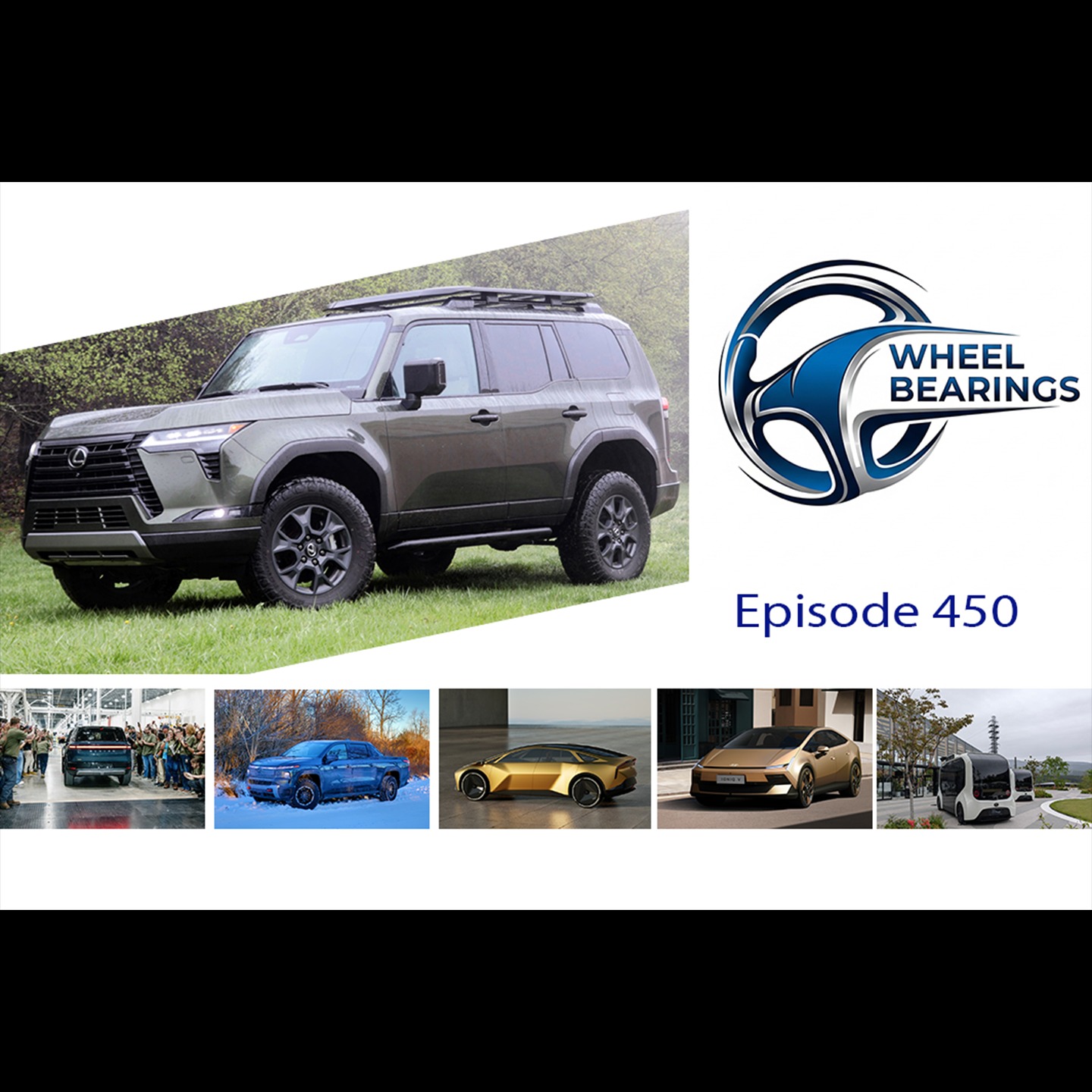
About this episode
A wide-ranging Wheel Bearings chat that starts with Hyundai Ioniq 5 XRT dirt-track fun—terrain modes, drifting on sand, and a discussion of how the battery pack is armored after they managed to ground it once. The hosts then compare EV charging experiences, adapters, and real-world efficiency across multiple brands and networks. Test drives expand to a Porsche Taycan, Escalade IQ, Jeep Cherokee hybrid, Subaru Solterra/Trail Seeker regen quirks, and Toyota’s GX 550 Overtrail. The “too many brands” debate turns to Stellantis strategy and badge engineering fears, plus Toyota’s Woven City surveillance/AI vision language model and grid-management experiments.
This week Nicole is off in New Orleans with Acura so our buddy John Voelcker is sitting in. He's been driving a bunch of stuff including the Ford Maverick hybrid, Porsche Taycan, Cadillac Escalade IQ, Jeep Cherokee and Subaru Trailseeker. Robbie drove the Hyundai Ioniq 5 XRT and Sam had the Lexus GX550 Overtrail.
At Milan Design Week, Hyundai unveiled its new Ioniq 3 compact and Kia showed off the Vision Meta Turismo. Hyundai also showed off the new Ioniq V in Beijing. GM has paused development of a next set of electric full-size trucks and Rivian has launched production of the R2. Stellantis now has pet accessories under the Mopaw brand looks likely to focus on just four main brands going forward.
Links
New Hyundai Ioniq 3 breaks cover with stunning sci-fi looks | Auto Express
First Production Rivian R2 Drives Off The Line Just Days After A Tornado Hit The Factory - Jalopnik
Advertising Inquiries: https://redcircle.com/brands
Privacy & Opt-Out: https://redcircle.com/privacy
auto cross like a dirt track
"Really the most exciting thing was that they gave me a Hyundai Ionic 5XRT and they made an auto cross like a dirt track and they just let us go at it. So that's what I did."
Autocross is a driving course where you go fast through a layout of cones. If it’s on dirt instead of pavement, the tires grip differently and the car can slide more. They’re saying they got to drive it hard in that kind of course.
Autocross is a timed driving event on a closed course marked with cones, emphasizing handling and driver skill rather than top speed. When adapted to a dirt track, traction and surface consistency change dramatically, making tire slip and vehicle stability more noticeable. The speaker’s point is that the Ioniq 5 XRT was used in a playful, controlled way to demonstrate its dynamics.
approach and departure angles
"Nope, because they shaved up the bumper, they did approach the departure, those angles have been increased, it's been raised. I didn't have any issues like scraping or anything."
These angles are basically how “tall” a bump or hill can be before your front or rear bumper hits the ground. Better angles mean you can go over rough stuff without scraping. They’re saying the setup made it easier to avoid scraping.
Approach and departure angles describe how steep a surface the vehicle can climb (approach) or descend from (departure) without the bumper or underbody hitting. Increasing these angles usually means more “off-road clearance” and less risk of scraping on obstacles. The speaker says the car’s bumper/geometry was adjusted for the course so they didn’t scrape.
scraping
"I didn't have any issues like scraping or anything. the traction control, you put it in sand and you put in sport, you can drift it to the cows come home."
Scraping is when the bottom of the car or the bumper rubs the ground. It usually happens on steep bumps or rough terrain. The speaker says they didn’t scrape, which means the car had enough clearance for that course.
Scraping refers to the car’s bumper or underbody contacting the ground, which can happen when the vehicle is too low for the obstacle or when the approach/departure angles are limited. It’s especially common on rough tracks, steep ramps, or uneven dirt. The speaker uses scraping as a key indicator that the course setup and vehicle clearance were sufficient.
traction control
"the traction control, you put it in sand and you put in sport, you can drift it to the cows come home. So that's my, if you, someone on blue sky was like, oh, I drove it."
Traction control helps prevent the tires from spinning when the road is slippery. If you’re on something like sand, it may try to stop you from sliding. The speaker says that with the right driving mode, the car will still let you drift.
Traction control is a driver-assistance system that reduces wheelspin by cutting engine power and/or braking individual wheels. On slippery surfaces like sand, it can limit how much the car can slide, so putting the car in a more aggressive mode (like “sport”) can change how intrusive it feels. The speaker claims they could drift it extensively with the right settings.
drift
"the traction control, you put it in sand and you put in sport, you can drift it to the cows come home. So that's my, if you, someone on blue sky was like, oh, I drove it."
Drifting is when the car’s back end slides sideways while you keep steering to stay in control. It’s much easier on slippery surfaces like sand or dirt. The speaker says they could do that by using the car’s settings.
Drifting is driving with intentional oversteer so the car’s rear slips outward while the driver maintains control through steering and throttle. It’s typically easier on low-grip surfaces like sand or dirt, and modern stability/traction systems can be configured to allow more slip. The speaker describes using traction-control and drive modes to enable repeated drifting.
terrain mode
"so it has that little terrain mode, which allows you to put in dirt sand, snow, mud, lava"
Terrain mode is a setting that changes how the car behaves on slippery or uneven ground. It helps the car avoid wheel spin and keeps things more controlled when traction is low.
Terrain mode is a drive setting that adjusts how the vehicle responds to throttle and traction conditions. It typically coordinates traction control and stability systems so the car can move more effectively on low-grip surfaces like dirt, sand, or snow.
drive too, actually
"No, it was on that XRT drive too, actually. And for whatever reason, you're right, it wasn't that challenging"
They’re talking about a particular drive mode/setting (tied to an XRT) they used during the off-road section. The point is that, in their experience, it wasn’t as hard as expected.
The speaker references an “XRT drive” and then discusses how the route wasn’t very challenging. This appears to be a specific drive mode or trim-related setting used during the dirt/sand portion of the event.
ground the pack
"We managed to ground the pack on the one sort of hard rock. That one spot."
They’re saying the car’s battery got scraped or hit the ground on a rough spot. That matters because the battery is the most expensive and sensitive part of an EV.
“Grounding the pack” means the vehicle’s battery pack contacted the ground during a hard obstacle or uneven surface. For EVs, this is a key concern because the battery is expensive and needs protection from impacts.
armor them against whatever people might do with them
"there was a long discussion there afterwards about, well, is your pack strong enough and they sort of gently said, yes, we we guard our packs and we armor them against whatever people might do with them"
They’re talking about how the car’s battery is protected with extra shielding. The idea is that the factory design already covers the kinds of impacts you might get in normal use or rough driving.
This is about battery protection engineering—designing the EV’s battery pack with shielding/armor to reduce damage from impacts, debris, or off-road contact. The discussion implies the manufacturer’s standard protection is intended to handle real-world abuse without adding extra armor.
standard pack
"And that's the standard pack. We didn't add any extra armor on the edge of it."
They mean the normal, factory battery setup—no extra protection added. The takeaway is that the stock battery protection is what they rely on.
“Standard pack” refers to the factory battery configuration without additional aftermarket or extra protective armor. In this context, it’s used to reassure listeners that the baseline battery protection is already designed for impacts.
Jeep Wrangler
"It's a bit more, I mean, again, it's not a Wrangler. That's not what it's built for, don't think it's a Wrangler."
They’re using the Jeep Wrangler as the benchmark for serious off-roading. The point is that this other car isn’t built to do the same kind of extreme trails.
The hosts say the discussed vehicle is “not a Wrangler,” using the Jeep Wrangler as shorthand for a true off-road-focused platform. The implication is that the other car may have some rugged styling or mild capability, but not the same off-road hardware or intent.
Subaru WRX
"Yeah, like a WRX is great for me. Me, no, whenever I get a WRX, I'm super excited because it choose up all roads. It doesn't care, but also it, I can't go to Moab in a WRX even though it's built to go off road."
They’re comparing the Subaru WRX to an off-road-focused vehicle. The WRX is great for everyday roads and bad weather, but it’s not the right tool for places like Moab.
The Subaru WRX is discussed as a car that “chooses up all roads,” meaning it’s capable and confident across varied conditions. The hosts contrast it with off-road trips like Moab, implying the WRX is better suited to mixed driving than extreme off-roading.
ground clearance
"...those cars have more ground clearance than the XRT does, you know, the XRT is like seven inches of ground clearance, which is not a whole lot."
Ground clearance is how high the car sits off the ground. If you have more clearance, you’re less likely to hit the bottom when the road gets rough.
Ground clearance is the distance between the lowest part of the vehicle and the road surface. It directly affects how likely you are to scrape the underbody when driving over rocks, ruts, or steep driveways.
Hyundai Ioniq 5
"...I went to the dealership to get the wheels rotated on our ionic five, and so I was just kind of talking to the sales person who sold us our car."
They’re talking about their Hyundai Ioniq 5, which is an electric car. Even though it’s electric, you still need regular maintenance like rotating the tires.
The speaker references getting the wheels rotated on their Hyundai Ioniq 5. The Ioniq 5 is Hyundai’s popular electric crossover, and routine service like tire rotations is still important even on EVs.
Brand reputation recovery after early quality issues
"...the Excel wasn't a great car... it took a good, you know, 20 plus years for people to really start taking them seriously... after the first couple of years when their quality... was so awful..."
They’re talking about how a car brand can get a bad reputation at first, then earn trust later. In this case, Hyundai’s improvements and long warranties helped people change their minds.
A major theme here is how Hyundai’s early reputation suffered due to poor quality, then improved over time. The hosts argue that warranties and gradual iteration helped people eventually take the brand seriously, even if the first cars weren’t well received.
Bumper-to-bumper warranty
"...10-year, you know, powertrain warranties and, you know, five, six-year bumper to bumper warranties."
A bumper-to-bumper warranty is broad coverage for lots of parts on the car. The hosts are saying Hyundai offered long coverage to reassure buyers.
The transcript also mentions “bumper to bumper warranties,” which generally cover most vehicle systems and components for a set time or mileage. In the context of this episode, the point is that aggressive warranty coverage helped Hyundai keep sales strong while quality improved.
Powertrain warranty
"...they started introducing, you know, insane, like 10-year, you know, powertrain warranties and, you know, five, six-year bumper to bumper warranties."
A powertrain warranty is coverage for the big moving parts that power the car. If it’s long (like 10 years), it can make people more willing to buy because repairs may be covered.
The hosts discuss Hyundai’s “10-year powertrain warranties,” which cover major components that make the car move (like the engine and transmission on gas cars, and analogous EV drive components). Longer warranties can reduce buyer risk and help a brand recover reputation after early quality concerns.
difference between perception and reality
"[694.6s] [SPEAKER_02]: Lad, I'm always surprised that the difference between perception and reality because we drive so many new cars. [701.6s] [SPEAKER_02]: We have sort of an up to date 2026 picture of what a brand is like, what the cars are actually like. [708.9s] [SPEAKER_02]: A brand here at least, Hyundai has sort of emerged as the budget alternative to Toyota and Honda probably somewhere above Nissan."
They’re saying that what people think about a brand isn’t always what you get when you actually drive the cars. Sometimes a brand’s reputation takes time to catch up to the real experience.
The hosts are calling out how brand reputation (perception) can lag behind what people actually experience driving the cars (reality). This matters in buying decisions because early quality issues or stereotypes can persist even after improvements.
Nissan
"[708.9s] [SPEAKER_02]: A brand here at least, Hyundai has sort of emerged as the budget alternative to Toyota and Honda probably somewhere above Nissan. [725.6s] [SPEAKER_03]: In fact, I'm still getting the, what aren't they Korean?"
Nissan is brought up as another brand people compare against. Here it’s used to explain where Hyundai is seen in the market, not to discuss a particular Nissan car.
Nissan is mentioned as a lower reference point in the hosts’ ranking of brand positioning, with Hyundai placed “above Nissan” in perceived value. This is about market perception rather than a specific Nissan vehicle.
Honda
"[708.9s] [SPEAKER_02]: A brand here at least, Hyundai has sort of emerged as the budget alternative to Toyota and Honda probably somewhere above Nissan. [725.6s] [SPEAKER_03]: In fact, I'm still getting the, what aren't they Korean?"
Honda is part of the comparison set—another well-known brand people use as a reference point. The point here is how Hyundai is viewed relative to Honda, not a specific Honda model.
Honda is included in the “budget alternative” comparison, grouped with Toyota as a mainstream standard. The hosts are discussing brand perception and how buyers evaluate quality and value.
Toyota
"[708.9s] [SPEAKER_02]: A brand here at least, Hyundai has sort of emerged as the budget alternative to Toyota and Honda probably somewhere above Nissan. [725.6s] [SPEAKER_03]: In fact, I'm still getting the, what aren't they Korean?"
Toyota is mentioned as one of the “go-to” brands people compare others to. In this conversation, it’s mainly about how Hyundai stacks up against Toyota in buyers’ minds.
Toyota is referenced as a benchmark brand for mainstream buyers, with Hyundai positioned as a budget alternative to it. The comparison is about perceived value and reliability reputation rather than technical details.
grip
"Yeah. So you're gonna have less, little less grip."
Grip is how well a tire can generate traction between the road surface and the rubber. More grip generally means better acceleration, braking, and cornering, while less grip makes the car easier to slide. The hosts use grip to explain why a certain setup would make drifting easier.
EV
"I had a Porsche Taycon, possibly my favorite, EV, just because up here, you know, New York is a high-tech state..."
EV means electric vehicle. Instead of burning gas, it uses electricity stored in a battery to move the car. That can make the car feel quick and smooth when you accelerate.
EV stands for electric vehicle—cars powered primarily by electric motors and a battery pack instead of a traditional gasoline engine. EVs can feel different for driving because instant torque changes how they accelerate and how traction is managed on slippery or curvy roads. In this segment, the Taycan is described specifically as an EV.
Porsche Taycon
"I had a Porsche Taycon, possibly my favorite, EV, just because up here, you know, New York is a high-tech state... And so having a tie-con is always a pleasure."
The Porsche Taycan is Porsche’s electric car. It’s designed for sporty driving, not just commuting. The host likes it especially on winding roads because it feels fun and composed.
The Porsche Taycan is Porsche’s all-electric performance sedan. In the segment, the host mentions it as a favorite test car and talks about how it fits well with curvy, hilly roads. The discussion also frames it as a high-tech EV that still feels engaging on twisty routes.
Bring a Trailer
"Well, you know, I'm thinking five years in what's it going to show up on bring a trailer for or maybe maybe the cheap."
Bring a Trailer (BaT) is an online auction site focused on enthusiast vehicles, where cars are sold to a motivated audience. Prices there can reflect collector demand and condition, so “what it’ll show up on Bring a Trailer for” is a way of estimating future resale value. The segment uses it as a benchmark for how much the Taycan might be worth later.
miles
"You can get one right now for 50,000. And 24, 15, 16,000 miles."
Miles are how much the car has been driven. Higher mileage usually means more wear, which can affect resale price. The host is pointing out the mileage as part of estimating value.
Mileage is a key factor in used-car valuation and expected wear. The segment mentions a specific mileage range for the test car, implying it affects how much it might sell for later. In enthusiast markets, mileage often matters alongside condition and service history.
Cadillac Escalade
"In six days, I put 1800 miles on an escalade IQ in four states and a province... parking, the escalated IQ, IQL, I should say, um, not some fun, despite good cameras."
They’re talking about a Cadillac Escalade IQ, which is the electric Escalade. They’re basically reviewing how it feels and works during a long trip, including how helpful the tech is.
The speaker is driving a Cadillac Escalade IQ, an EV version of the Escalade nameplate. They discuss how it behaves on a road trip and comment on features like cameras and overall usability.
road trip car
"Bruh, my drive wave line, but that's a great road trip car, 1.9 miles per kilowatt hour over those 1600 miles, but it does wait for 1.5 tons, yeah."
They’re basically asking: “Which car is best for a long drive?” That includes how efficient it is, how charging works along the way, and whether it’s comfortable to live with.
The speaker is evaluating which EV/vehicle works best for long-distance travel, focusing on efficiency, charging logistics, and real-world comfort. “Road trip car” is a concept that blends range planning with how the car behaves at speed and during stops.
charging networks
"Charge that two different charging networks, you guys tell me if you want to know this stuff."
The speaker mentions using two different charging networks, which matters because EV charging can vary by network reliability, pricing, app/payment flow, and charger availability. Switching networks can change how smooth (or frustrating) the trip is.
Ionna charging experience
"All right, I had my first ever Ionna charging experience."
“Ionna” appears to be a specific EV charging brand/network the speaker used for their first charging experience. Charging brands can differ in charger hardware, reliability, and how the user interface/app works.
Apex Carolina
"I'd go now to see their sort of marquee site, uh, Apex Carolina... some more in the Carolinas."
They mention “Apex Carolina” as a specific charging stop they checked out. It sounds like it’s a notable location on their trip, not just a generic charger.
“Apex Carolina” is mentioned as a charging location/route stop connected to the charging experience. The speaker frames it as stylish and retro, implying it’s a notable charging site rather than just a random charger.
EV charging (kW)
"I charge at 360-8 kilowatts because I could take it down to 14 or 12 percent. It had squeegees and at the motel next door, they said, oh, are you charging out there?"
EV chargers put power into the battery, and the number in kW tells you how fast it can charge. Even if a charger is rated high, your car may charge slower depending on battery temperature and how full the battery already is.
The speaker is talking about EV charging power in kilowatts (kW). Higher kW generally means faster charging, but real-world speed also depends on the charger type, the car’s battery/thermal limits, and the battery’s state of charge.
Real-world charging vs rated speed
"first impression in real world use very impressed. And then, in Western New York State, I went to a flying J slash GM energy site... My one grumble there was it was probably a few hundred feet from the convenience store and the winds off like Erie just blow steadily to the east at 25 miles an hour and it was cold."
Charging speed isn’t always the same in real life as it is on paper. Cold weather, wind, and how full your battery is can all make charging slower or faster.
The segment contrasts charging performance in real-world conditions (weather, wind, distance from amenities, and battery state) with what you might expect from charger ratings. This matters because EV charging speed can vary significantly based on temperature and how the car manages battery charging.
Flying J
"in Western New York State, I went to a flying J slash GM energy site. GM is putting money into some sea star chains."
Flying J is a chain of truck stops. The speaker is pointing out that EV chargers are showing up at places like this, which can make charging easier while traveling.
Flying J is a truck stop chain that often hosts EV charging alongside fuel and convenience services. In this segment, the speaker references a Flying J location with GM Energy charging, highlighting how charger placement at travel stops can improve convenience for road trips.
GM Energy
"in Western New York State, I went to a flying J slash GM energy site. GM is putting money into some sea star chains. This one charged at 344, so almost as good."
GM Energy is GM’s network of EV charging stations. The speaker is basically saying how well that particular GM charging spot worked compared to others.
GM Energy is General Motors’ EV charging network brand. The host is visiting a GM Energy site and comparing charging performance to other stations, which helps listeners understand how different networks and locations can affect real-world charging.
Charging station reliability/uptime
"The elect five America station I went to was less fast, but it did work. Yeah, I'm seeing the last two years, they've really sort of made sure that they're systems actually work."
It’s not just about how fast a charger can be—it's also about whether it works when you show up. The speaker is saying the charging networks have been getting better at reliability.
The speaker comments that networks have improved over time to ensure their systems actually work. For EV owners, charger uptime and consistency are as important as peak power because a broken or occupied charger can derail a trip.
Charger placement and redundancy (multiple stations)
"It is weird though when they do stick and put, you know, the recent one they put near my house... they put 10 charging stations in, which I'm like, see, that's how you do it, you can't put two in, stop that. It's like, I'm not going to decommission the first one... But they're both, the smaller one actually is used a lot."
Where chargers are placed matters. Having more than one working charger nearby makes it less likely you’ll have to wait or go somewhere else.
The host discusses how adding multiple charging stations near each other (and not decommissioning the first) affects availability and convenience. This is a practical concept for EV drivers: redundancy reduces the chance of being stuck waiting for a single charger to free up.
CCS
"on the new EA have half an exports and half CCS."
CCS is the plug/charging system many electric cars use at fast-charging stations. If you see CCS on a charger, it usually means your EV can charge quickly there.
CCS (Combined Charging System) is a common fast-charging standard for many EVs. It uses a specific connector and supports higher power than basic charging, so it’s what you look for at most public fast chargers.
EA
"on the new EA have half an exports and half CCS."
EA is Electrify America, a company that runs public fast-charging stations for electric cars. They’re talking about what kinds of charging plugs those stations have.
EA here refers to Electrify America, a major U.S. EV fast-charging network. The hosts are discussing how EA stations are set up with different charging standards (like CCS vs others).
adapters
"Everyone has adapters, which I never got... for Hyundai, you need you need one for AC and one for DC."
An adapter is a piece that lets your car plug into a charger that uses a different plug type. Some people need different adapters depending on whether they’re using fast DC charging or regular AC charging.
Adapters let an EV owner use a charger with a different connector standard than the one their car natively supports. The discussion highlights that you may need separate adapters for AC vs DC charging, depending on the car and charger types.
DC
"for Hyundai, you need you need one for AC and one for DC."
DC is the kind of charging that’s designed for fast charging. Because it’s set up differently than AC, it can charge your battery much quicker.
DC (direct current) fast charging sends power to the vehicle in a form that requires less conversion, enabling much higher charging speeds. The hosts are contrasting DC charging with AC and explaining why adapters can differ.
AC
"for Hyundai, you need you need one for AC and one for DC."
AC is the common kind of electricity used by many chargers, including at home. Your car usually has to convert it before it can charge the battery, so it’s often slower than fast charging.
AC (alternating current) is the type of electricity used by many slower chargers and home charging equipment. EVs typically convert AC to DC inside the vehicle, which is why AC charging is often slower than DC fast charging.
Subaru BRZ
"[1392.9s] [SPEAKER_02]: But unlike Subaru's, it doesn't come standard with a golden retriever. [1396.2s] [SPEAKER_01]: Yeah, just in like, you know, we got our BRZ. [1398.5s] [SPEAKER_01]: They were just a dog in there. [1401.6s] [SPEAKER_01]: Even the BRZ."
The Subaru BRZ is a small sporty car from Subaru. It’s the kind of car people buy for driving fun, but here they’re also talking about using it for practical stuff like carrying dog cages.
The Subaru BRZ is a compact sports coupe built in partnership with Toyota, known for its balanced handling and lightweight feel. In the segment, it’s mentioned as the car they have available for dog-cage storage, which highlights how usable the trunk/load area can be for everyday tasks.
Alternative Fuels Data Center
"[1407.3s] [UNKNOWN]: Ha ha. [1407.3s] [SPEAKER_00]: Well, according to the alternative fuels data center site, there are currently four electrify america stations with, uh, with Nax ports, uh, one in Connecticut, uh, one, uh, in, uh, let's see in Maryland, uh, another one, uh, in your Pittsburgh, and then one in Florida. [1428.3s] [SPEAKER_01]: Oh, Pittsburgh."
The Alternative Fuels Data Center is a website that helps you find places to charge alternative-fuel vehicles. Here, they’re using it to locate EV charging stations on a route.
The Alternative Fuels Data Center (AFDC) is a U.S. Department of Energy resource that tracks locations and details for alternative fuel stations, including EV charging. In the segment, the host uses it to find Electrify America stations and their connector types (NACS ports).
Nax ports
"[1407.3s] [UNKNOWN]: Ha ha. [1407.3s] [SPEAKER_00]: Well, according to the alternative fuels data center site, there are currently four electrify america stations with, uh, with Nax ports, uh, one in Connecticut, uh, one, uh, in, uh, let's see in Maryland, uh, another one, uh, in your Pittsburgh, and then one in Florida. [1428.3s] [SPEAKER_01]: Oh, Pittsburgh."
They’re talking about the type of charging plug at the station. If your car uses a different plug, you might need an adapter or you may not be able to charge at that location.
“Nax ports” appears to refer to NACS charging ports (the Tesla-style connector) being available at certain stations. Connector compatibility is crucial for EV road trips because not every charger uses the same plug type.
Electrify America
"[1407.3s] [UNKNOWN]: Ha ha. [1407.3s] [SPEAKER_00]: Well, according to the alternative fuels data center site, there are currently four electrify america stations with, uh, with Nax ports, uh, one in Connecticut, uh, one, uh, in, uh, let's see in Maryland, uh, another one, uh, in your Pittsburgh, and then one in Florida. [1428.3s] [SPEAKER_01]: Oh, Pittsburgh."
Electrify America is a company that runs fast EV charging stations. If you’re planning a trip, knowing where they are and what plug they use helps you avoid getting stuck.
Electrify America is an EV fast-charging network in the U.S., known for installing high-power chargers along highways and in metro areas. The segment mentions Electrify America stations and connector availability (NACS ports), which matters for whether a given EV can charge without an adapter.
long-term test
"[1463.0s] [SPEAKER_02]: And then I did 2700 miles in a Maverick hybrid all-wheel drive. [1468.7s] [SPEAKER_02]: And this was a deliberate long-term test. [1471.5s] [SPEAKER_02]: I had to pick up a 50-year-old axle from way, way, way south of the Mason Dixon line for a 70-year-old car as one does."
A long-term test means they keep using the car for a while instead of just driving it once. That gives a better idea of what it’s like day after day.
A long-term test is when a vehicle is used over an extended period to evaluate how it behaves in real life, not just during a short drive. It helps reveal issues like comfort, fuel/energy use consistency, and how well the car handles repeated trips and tasks.
classic car restoration / parts sourcing
"[1471.5s] [SPEAKER_02]: I had to pick up a 50-year-old axle from way, way, way south of the Mason Dixon line for a 70-year-old car as one does. [1484.4s] [SPEAKER_02]: And practically new for you. [1489.6s] [SPEAKER_02]: we'll get to that part of it at the end, um, but, uh, and the trick got interrupted by the northeast, very largest, no storm."
They’re talking about working on an old car by finding older parts. That’s common in restoration—getting the right piece so the car can be repaired or brought back.
The segment describes sourcing a “50-year-old axle” for a “70-year-old car,” which is typical of restoration work. This often involves tracking down correct-era parts, dealing with fitment challenges, and planning logistics for transporting heavy components.
axle
"[1468.7s] [SPEAKER_02]: And this was a deliberate long-term test. [1471.5s] [SPEAKER_02]: I had to pick up a 50-year-old axle from way, way, way south of the Mason Dixon line for a 70-year-old car as one does. [1484.4s] [SPEAKER_02]: And practically new for you."
An axle is the part that connects the wheels to the car and helps them move. They’re describing picking up an axle for an older car, likely for a repair or restoration.
An axle is a key drivetrain/suspension component that connects wheels to the vehicle and helps transmit torque. In the segment, they’re picking up an axle for an older car project, which is a clue they’re dealing with restoration or maintenance on a classic vehicle.
Maverick
"Um, I was a fan of the Maverick one at launch. I am still a fan of the Maverick because in the update, they paired the hybrid, not just with all wheel drive, but with 4,000 pounds of towing capacity."
They’re discussing the Ford Maverick hybrid truck. The big point is that the newer setup can tow around 4,000 pounds and still gets good fuel economy, so it’s more practical for towing small loads.
The speaker is talking about the Ford Maverick, specifically the hybrid version. They mention an update that pairs the hybrid with all-wheel drive and increases towing capability to about 4,000 pounds, which changes how useful the truck is for hauling on small trailers.
hybrid
"You cannot get a non-hybrid power train does not use the H word anywhere. It might be in the owner's manual, if there is still a known owner's manual. But other than that, nothing on it says hybrin."
A hybrid uses a gas engine plus an electric motor. The electric system helps the car save fuel, especially when you’re slowing down or driving in traffic.
A hybrid powertrain uses both an internal combustion engine and an electric motor/battery system. In practice, hybrids often improve fuel economy in stop-and-go driving and can also change how the vehicle manages power delivery and regenerative braking.
all wheel drive
"I am still a fan of the Maverick because in the update, they paired the hybrid, not just with all wheel drive, but with 4,000 pounds of towing capacity... because I cannot own a car that does not have all real drive if I want to get up my driveway in the winter."
All-wheel drive (AWD) sends power to more than just the front or rear axle, improving traction when conditions are slippery. The speaker specifically ties AWD to winter drivability, implying better grip when climbing a driveway in snow.
towing capacity
"...paired the hybrid, not just with all wheel drive, but with 4,000 pounds of towing capacity. No, it won't tow your 28 foot boat, but it will tow anything on a small trailer."
Towing capacity is how much weight the vehicle is allowed to pull. If you exceed it, the truck can overheat or struggle to stop safely.
Towing capacity is the maximum weight a vehicle is rated to pull safely, usually measured in pounds. It depends on the vehicle’s powertrain, cooling, brakes, and chassis design, and it’s especially important when towing with smaller trucks.
Jeep Cherokee
"Then, the latest two, I had a week with the new Jeep Cherokee, which I was very interested in... My main problem was I just don't understand what makes this a Jeep... It could be, take away the seven-slot grill, it could be anything."
They’re talking about the new Jeep Cherokee they drove for a week. Their main complaints are that it doesn’t feel distinct enough as a Jeep and that some new features (like electric door release) seem unnecessary.
The speaker discusses a week with the new Jeep Cherokee, focusing on how it feels and what makes it “a Jeep.” They criticize the styling cues (like the seven-slot grille) and also question certain convenience features, including an electrically actuated door release.
re-gening
"And even the gauges aren't incredibly clear that you're sort of re-gening. And so, you know, it's a perfectly good large compact or small mid-size to row crossover."
Regenerative braking is when the car slows down and also “recharges” the battery a bit. The host is saying the dashboard doesn’t make it obvious when that’s happening.
“Re-gening” refers to regenerative braking, where the vehicle uses the electric motor as a generator to slow down and recover energy. The speaker notes the gauges aren’t very clear about when regeneration is happening, which can affect how drivers understand the hybrid’s behavior.
seven-slot grill
"My main problem was I just don't understand what makes this a Jeep. It could be, take away the seven-slot grill, it could be anything."
Jeep has a recognizable front grille with seven vertical slots. The host is saying that without that design cue, the car wouldn’t look like a Jeep anymore.
Jeep’s seven-slot grille is a signature design element that’s been used across many Jeep models for decades. The speaker argues that removing it would make the front end look generic, which is why they see it as important brand identity.
electric doors
"...do you need a little button that electrically releases the door and then on the outside sunken handle where you put your thing in and push the rubber mat and the door releases... Why are we doing this with electric doors?"
They’re talking about a door that unlocks using electronics instead of a traditional purely mechanical handle/latch. They think it’s unnecessary because regular mechanical doors have worked for a long time.
The speaker is referring to an electrically actuated door release/handle feature, where the door unlocks via a button and a sensor/actuator rather than a purely mechanical latch feel. This is part of a broader trend toward electronic convenience features, which can add complexity and cost.
powered tailgate
"As far as I could ascertain, I should have looked it up on the interwebs, um, it has, you know, it has a powered tailgate. I couldn't find the button to what the tailgate backed out."
A powered tailgate is a trunk/liftgate that opens and closes by itself with a button. It’s handy when you’re carrying stuff and don’t want to wrestle the hatch.
A powered tailgate is a liftgate that can open and close using an electric motor, often with a button or key fob. It’s meant to make loading easier, especially when your hands are full.
1.6 liter turbo
"and the engine is a 1.6 liter turbo with this two motor hybrid system which worked fine um..."
This is a smaller engine (1.6 liters) that uses a turbo to squeeze more power out of the same fuel. It usually helps the car feel quicker without needing a huge engine.
A 1.6-liter turbo is a small-displacement engine boosted by a turbocharger to make more power than you’d expect from its size. Turbo engines often feel more responsive at low-to-mid speeds, but they can be sensitive to maintenance and heat management.
e-mode
"...as opposed to the the Toyota practice of the small e-mode around the rear axle."
E-mode is a setting that lets the hybrid run more on electricity. Here, they’re saying it tends to use the rear wheels for that electric driving.
E-mode is a hybrid operating mode that emphasizes electric driving. In this context, it’s described as being focused on the rear axle, meaning the car may use the electric motor(s) to move the vehicle with different wheel involvement than a full AWD system.
Jeep Grand Wagoners
"...sorry to have a few Cherokees or Grand Wagoners or whatever actually do you go off road."
The Jeep Grand Wagoneer is mentioned briefly as another Jeep model. The hosts are using it to discuss what people think they’re buying when they buy a Jeep.
The Jeep Grand Wagoneer is name-dropped as part of a comparison list of Jeep models. It’s used to frame the question of whether buyers are choosing Jeep brands for off-road use or for branding/identity.
low range mechanism
"It will have some sort of low range mechanism like they had on the last generation Cherokee and so on. It will have some more capable, more serious off-road credentials than this one."
Low range is like having a “slow and strong” gear for off-roading. It helps the vehicle move slowly with more pulling power when climbing or going over rough ground.
A low-range mechanism provides much lower gearing than normal driving, letting the vehicle crawl at very slow speeds with better control. It’s commonly paired with 4x4 systems for steep climbs, descents, and loose surfaces where you need torque at low speed.
Jeep Compass
"...with the previous generation Cherokee and with the compass and others, they sell a surprising proportion of, you know, trailhawk type models on those."
The Jeep Compass is another Jeep SUV they’re referencing. They’re saying that when Trailhawk-style versions exist, a lot of buyers actually go for those off-road trims.
The Jeep Compass is mentioned as another model that previously offered Trailhawk-type variants. The hosts use it to argue that a meaningful portion of buyers choose the more off-road-oriented trim.
Jeep Recon
"...w charger and the wagon ErS, and I guess the Jeep recon, which are electric. [SPEAKER_02]: The charger is..."
The Jeep Recon is an electric Jeep model. The podcast is grouping it with other electric vehicles while talking about what’s coming. Even though it’s electric, it still has wheel bearings like any other car, and they can wear out over time.
The Jeep Recon is referenced as an electric vehicle in the same breath as other electric models. The podcast also mentions the Charger and “wagon” context, indicating a broader EV lineup discussion. Wheel-bearing relevance remains because electric vehicles still rely on conventional wheel hubs, bearings, and suspension components that can wear with road conditions and mileage.
longitudinal format vs transverse format
"The charger is obviously getting its gasoline engine now in a longitudinal format where this is a transverse format. So is there, let's seriously consider, is there a [SPEAKER_00]: ... versions that were the front end..."
Longitudinal vs transverse is just how the engine sits in the car. It affects how the drivetrain is packaged and can change how the car drives and what components fit where.
Longitudinal and transverse describe how the engine is oriented in the engine bay. Longitudinal mounting typically suits rear-wheel-drive layouts and larger packaging flexibility, while transverse mounting is common in many front-wheel-drive-based designs and can constrain certain components.
multi-link front suspension
"And, you know, those use a multi-link front suspension. The version that's used in the Cherokee is a little bit shorter has a front suspension as designed for transverse engine mount."
Multi-link front suspension is a more complex front suspension design. It helps the tires stay better positioned for smoother driving and more predictable handling.
A multi-link front suspension uses several control arms to manage wheel movement and maintain alignment under braking, cornering, and bumps. It’s often chosen for better ride/handling balance compared with simpler suspension designs.
Jeep Grand Cherokee
"...what they probably will be, is one with the new 2-liter 4-cylinder hurricane 4 that they just launched in the Grand Cherokee. So, in the Grand Cherokee, that one's like 320, 320-1 horsepower."
The Jeep Grand Cherokee is another Jeep SUV. They’re saying it already has the newer engine they’re talking about, and the Cherokee might get something similar too.
The Jeep Grand Cherokee is referenced as the model that already launched with the new engine mentioned in the segment. The hosts suggest the Cherokee could eventually get the same powertrain options, potentially including the Trailhawk.
Hurricane 4
"...is one with the new 2-liter 4-cylinder hurricane 4 that they just launched in the Grand Cherokee. So, that, you know, in the Grand Cherokee, that one's like 320, 320-1 horsepower."
Hurricane 4 is the name of a particular new four-cylinder engine. They’re saying it’s already in the Grand Cherokee and might show up in the Cherokee as well.
“Hurricane 4” refers to a specific engine family being discussed as a new 2.0-liter four-cylinder. The hosts connect it to the Grand Cherokee and speculate it could appear in the Cherokee lineup, including Trailhawk.
redesigning everything forward of the firewall
"I'm also going to remember when certain British car makers would fit a new engine by redesigning absolutely everything forward of the firewall. Again, I digress, but I can think of one brand CEO who would like that."
This is describing a “big redesign” to make room for a new engine. If you have to change everything in front of the firewall, it usually means the new engine doesn’t fit the old layout.
This describes an extreme approach to engine packaging: instead of just swapping parts, the manufacturer reworks the front structure and layout to fit a new powerplant. It’s a useful concept for understanding why some engine changes require major engineering and cost.
hemispherical combustion chambers
"All of their engines have hemispherical combustion chambers. Hemmy. They're all himmy."
A “hemi” engine has a special shape inside the cylinder head where the fuel burns. That shape can help the engine breathe and burn fuel more efficiently, which can make it feel stronger.
Hemispherical combustion chambers (often called “hemi” chambers) are shaped to promote better airflow and more efficient burning of the fuel-air mixture. That design can help power output and performance, which is why “hemi” is a popular performance nickname.
Subaru Trail Seeker
"Okay, anything else on the Cherokee? Yeah, the last one I just picked up a couple days ago, a Subaru Trail Seeker."
They’re talking about a specific Subaru model called the Trail Seeker. The point is that it’s connected to Subaru’s newer electric-vehicle lineup.
The speaker is referring to a Subaru “Trail Seeker” as a specific model they recently picked up. In context, it’s being discussed alongside Subaru’s EV lineup, implying it’s part of the brand’s electrified vehicles.
EV lineup
"It's in one of four Subaru electric vehicles now, all of which are Toyota's with stars on the nose... If you don't include the E-transit..."
An EV lineup is just the set of electric vehicles a company sells (or plans to sell). The discussion is basically about how many EVs are “in the mix” depending on what you count.
An EV lineup refers to how a brand structures its battery-electric vehicles across different models and product generations. The transcript also highlights how EV counts can change based on whether you include specific programs or vehicles that have ended production.
Ford Etransit
"If you don't include the E-transit, which I think actually, I think the E-transit production has ended... I did a whole video about the E-transit..."
The E-Transit is Ford’s electric van. The speaker is saying they think production stopped, and they learned that after making a video.
“E-Transit” is the electric version of Ford’s Transit van, and it’s mentioned as a vehicle whose production may have ended. The speaker notes they got a note from Ford and that their earlier video became outdated quickly, which underscores how EV production plans can change.
EVs
"So yes, and actually, four times as many EVs as Volkswagen sells today in the U.S. But anyway, the trail secret to me..."
EVs (electric vehicles) are cars powered primarily by electricity stored in a battery, rather than gasoline. The host compares EV sales volume and discusses how a smaller brand like Subaru may have different incentives and resources for launching EVs.
Volkswagen
"So yes, and actually, four times as many EVs as Volkswagen sells today in the U.S."
Volkswagen is a big car company. In this segment, they’re mentioned as a reference point for how many EVs are being sold in the U.S.
Volkswagen (VW) is a major automaker used here as a benchmark for EV sales in the U.S. The host’s point is that another brand’s EV sales are being compared against VW’s current EV volume.
Subaru Outback
"It was an outback. Yeah, exactly. And the the outback doesn't look like the outback anymore."
The Subaru Outback is a popular Subaru model that’s meant for everyday driving but also handles rougher roads better than a typical car. The host is saying the new one looks different, so people might not immediately realize it’s an Outback.
The Subaru Outback is a crossover/wagon built around Subaru’s all-wheel-drive focus and family-friendly practicality. In this segment, the host notes that the newest Outback styling doesn’t look like the older Outback, which can affect how people recognize it at a glance.
Lexus Rz
"It's the most powerful, you know, the trail seeker in the Beasy Woodland are the most powerful variants of that apart from the Lexus RZ, you know, so the 375 horsepower."
They bring up the Lexus RZ as another electric Lexus to compare against. It’s basically their reference point for how strong the EVs feel.
The Lexus RZ is Lexus’s electric crossover, and the hosts reference it while comparing “most powerful” variants in the same general segment. They use it as a benchmark for EV power and performance feel.
rear torque bias
"but what they've done is by default it biases towards rear power, rear torque bias. So the rear motor is putting out the full 220 and then the front motor is putting out 150-ish horsepower."
It means the car usually powers the rear wheels more than the front. When the road is slippery or you need different traction, it can change that balance.
“Rear torque bias” means the drivetrain is programmed to send more torque to the rear wheels by default. In an EV with two motors, the car can then dynamically adjust front/rear torque split as traction changes.
two motors
"he said, you know, they've set it up to be, you know, because the two motors are each capable of 220 horsepower, but because of the the voltage and current they get from the battery, they're kind of capped at about 375, but what they've done is by default it biases towards rear power, rear torque bias."
This is about an EV that has an electric motor on more than one axle. Because of that, the car can send more power to the wheels that have grip.
A “two-motor” EV uses separate electric motors for the front and rear axles (or two drive units) to control how much torque each end gets. That enables features like torque biasing and shifting power distribution based on traction needs.
shift between 70-30 in either direction
"But it can shift between 70-30 in either direction, depending on the traction, what you need, what's available."
They’re saying the car can change how power is split between the front and rear wheels. It can favor whichever end has better grip.
The hosts describe a variable torque split that can move between a 70/30 front/rear distribution and the opposite direction. This is a key advantage of dual-motor EVs because it lets the car react to traction and driver demand in real time.
lift off and let a Regen much earlier before the stoplight
"It just doesn't have. So you learn to drive for it, but you lift off and let a Regen much earlier before the stoplight, one thing."
This is practical driving technique for EVs with regenerative braking: if regen is weak, you need to lift off the accelerator earlier to slow down smoothly before a stop. It highlights how regen strength changes real-world pedal/anticipation habits.
power cycles
"one thing. The other thing is, um, nothing latches through power cycles."
A “power cycle” is basically rebooting the car’s systems. They’re saying a certain function or setting doesn’t stay active or doesn’t work the same way after the car restarts.
“Power cycles” refers to turning the system off and back on (or restarting the vehicle’s power state). The host’s comment suggests a behavior where something “doesn’t latch through” after a restart, which can indicate a software/feature persistence issue.
one pedal mode
"They wanted the experience for their customers to be as much like driving one of their hybrids or gas vehicles, and had, you know, staying away from strong region, you know, certainly no one pedal mode, even, you know, that you could select, you know, it's not even selectable."
In some EVs, you can drive mostly with just the accelerator. When you lift your foot, the car slows down using the battery’s charging system, so you don’t have to press the brake as much.
One-pedal mode is an EV driving setting where lifting off the accelerator slows the car and can bring it to a near-stop, using regenerative braking. The idea is to reduce how often you need to use the brake pedal in normal driving.
Toyota bZ4X
"Yeah, well, you know Toyota's philosophy when they launched the BZ4X Yeah, and that also obviously got applied to the the Subaru variants"
The Toyota bZ4X is an EV. The point here is that Toyota’s early version of the driving feel was designed to be more like a gas car, rather than letting drivers use a strong “one-pedal” style.
The Toyota bZ4X is Toyota’s battery-electric crossover, and the discussion highlights Toyota’s early software/drive-feel philosophy. The hosts say Toyota aimed to make the EV experience resemble hybrids or gas cars, including avoiding selectable one-pedal/strong-regeneration behavior.
strong region
"They wanted the experience for their customers to be as much like driving one of their hybrids or gas vehicles, and had, you know, staying away from strong region, you know, certainly no one pedal mode, even, you know, that you could select, you know, it's not even selectable."
“Strong region” appears to be a mis-transcription of “strong regen,” meaning high regenerative braking strength. Strong regen increases deceleration when you lift off the accelerator, which can feel more aggressive and can reduce brake use.
Nissan Leaf
"...certainly they've said that in Japan, supposedly regulations in Japan don't allow for one pedal drive, and Nissan has said the same thing when they launched the new leaf."
The Nissan Leaf is an EV. The hosts are saying Nissan claimed one-pedal driving wasn’t allowed in Japan, but they question why the US can’t enable it if it’s just a software setting.
The Nissan Leaf is cited as another EV where the company stated regulations in Japan prevent one-pedal drive. The hosts then contrast that with the US market, where the same functionality could be enabled because it’s software-controlled.
software-controlled EV driving modes
"However, yeah, but this is the US market and it's all software-controlled. So you could do one pedal in the US and not allow in Japan."
EVs often control driving features through software. The hosts are saying that if the car can do it, the difference between countries might be policy/software choices rather than hardware.
The hosts argue that because EV behavior like one-pedal/regen strength is software-controlled, it could be enabled in different markets if regulations allow. This highlights how automakers may ship different feature sets by region even when the underlying hardware is capable.
battery percentage
"...in the initial car, it would not give you battery percentage. It only gave you miles remaining."
Battery percentage is how full the battery is, shown as a number like 20% or 80%. Some EVs hide that and show “miles remaining” instead, because they think it’s easier to understand.
Battery percentage is a driver-facing estimate of the EV’s state of charge shown as a percent. The hosts discuss how some EVs choose to display miles remaining instead, arguing that percent can be “too confusing” or less intuitive for everyday use.
percentage meter
"And excuse me, you know, just a percentage meter. [2599.4s] [SPEAKER_00]: Yeah, exactly... It seems smaller type than is the miles remaining."
A percentage meter is just a gauge that shows how much is left as a number from 0% to 100%. Here, it’s being used to make the “how far you can drive” information easier to understand.
A “percentage meter” is a gauge that expresses a remaining amount as a percentage rather than rough segments. In this context, it’s about how the instrument cluster can show “miles remaining” alongside a percentage-style readout.
fuel gauge
"...people have been used to for a century looking at a fuel gauge and saying, okay, it's three quarters full. [2606.3s] [SPEAKER_00]: It's one quarter full."
A fuel gauge traditionally shows fuel level in simple fractions (like “three quarters,” “one quarter,” or “empty”). The hosts discuss a shift toward percentage-based displays, which can make remaining fuel feel more precise and easier to interpret.
Lexus GX 550 Over Trail
"So I also had a product the last week from the Toyota Motor Company. [2631.5s] [SPEAKER_00]: I had the Lexus GX 550 Over Trail, which is the fancier, most off-roady version of a Land Cruiser..."
The Lexus GX 550 Over Trail is basically an off-road Land Cruiser, but sold by Lexus. It’s meant to feel more comfortable and upscale inside, while still being capable for rough roads.
The Lexus GX 550 Over Trail is Lexus’s off-road–oriented version of the Toyota Land Cruiser platform. In North America, Lexus sells it as a more premium alternative, emphasizing comfort and interior materials while still targeting serious trail use.
Toyota Land Cruiser
"...which is the fancier, most off-roady version of a Land Cruiser, the current generation Land Cruiser. [2645.1s] [SPEAKER_00]: Or at least the Land Cruiser 250..."
The Toyota Land Cruiser is a tough, off-road SUV that’s been around for a long time. Depending on where you live, Toyota sells very similar versions under different names, including Lexus in the U.S.
Toyota’s Land Cruiser is a long-running, body-on-frame style SUV known for durability and off-road capability. The transcript highlights how the same underlying “Land Cruiser territory” can be marketed under different names depending on the region—Land Cruiser, Land Cruiser Prado/250, or Lexus GX in North America.
Land Cruiser 250
"Some places it's a Land Cruiser Prado or Land Cruiser 250. [2672.0s] [SPEAKER_00]: Then there's also the LX..."
Land Cruiser 250 is a name used in some markets for a Land Cruiser version. The key point here is that Toyota uses different model names depending on the country.
Land Cruiser 250 is another regional naming for a mid-range Land Cruiser variant. In the segment, it’s used to explain how Toyota’s Land Cruiser lineup gets different labels worldwide, even when the vehicles are closely related.
Land Cruiser Prado
"Some places it's a Land Cruiser Prado or Land Cruiser 250. [2672.0s] [SPEAKER_00]: Then there's also the LX..."
The Land Cruiser Prado is a name Toyota uses in some countries for a Land Cruiser variant. It’s part of the same overall family, just marketed differently depending on the market.
Land Cruiser Prado is a regional name used for a mid-range Land Cruiser variant in some markets. The transcript notes that what’s called the Prado or Land Cruiser 250 in certain places corresponds to the broader Land Cruiser family, while North America gets the Lexus GX branding.
GX 550 Overtrail
"The over trail is the most off-road oriented version of it. So you get the bigger all-thrain tires on 18 inch wheels. It's got, you know, skid plates underneath, things like that."
The Lexus GX 550 Overtrail is the off-road version of the GX 550. It’s meant to handle dirt and rough trails better than the regular model, thanks to things like tougher tires and protection underneath.
The Lexus GX 550 Overtrail is the more off-road-focused trim of the GX 550. It’s typically set up with larger all-terrain tires, skid plates, and other underbody/off-road hardware to make it more capable on rough roads than the standard GX 550.
all-terrain tires
"So you get the bigger all-thrain tires on 18 inch wheels... And at least, this one's got off-road, all-trained tires on it so that when you do take it off-road, it's gonna have a lot better grip than the all-season tires that are on standard GS550s."
All-terrain tires are built to handle more than just clean pavement. They generally grip better on dirt, gravel, and rough surfaces than regular all-season tires.
All-terrain tires are designed to work on both pavement and unpaved surfaces. Compared with typical all-season tires, they usually have more aggressive tread and sidewall support for better grip when roads get loose, muddy, or rocky.
skid plates
"It's got, you know, skid plates underneath, things like that. And the one that I had was also equipped with a roof rack, which when you're driving at highway speeds, you absolutely know you have a roof rack up there."
Skid plates are protective panels mounted under the vehicle to shield vulnerable components from impacts. On off-road trims, they help reduce the risk of damage when driving over rocks, logs, or uneven terrain.
roof rack
"And the one that I had was also equipped with a roof rack, which when you're driving at highway speeds, you absolutely know you have a roof rack up there. Even if the sun roof is closed and you can't see it, you hear it."
A roof rack is the bars on top of the car for carrying extra stuff. When you drive fast, the air moving over it can make wind noise.
A roof rack is an attachment system on top of the vehicle used to carry gear like bikes, kayaks, or a rooftop tent. At highway speeds, it can create noticeable wind noise and aerodynamic drag, which is why the speaker mentions hearing the airflow.
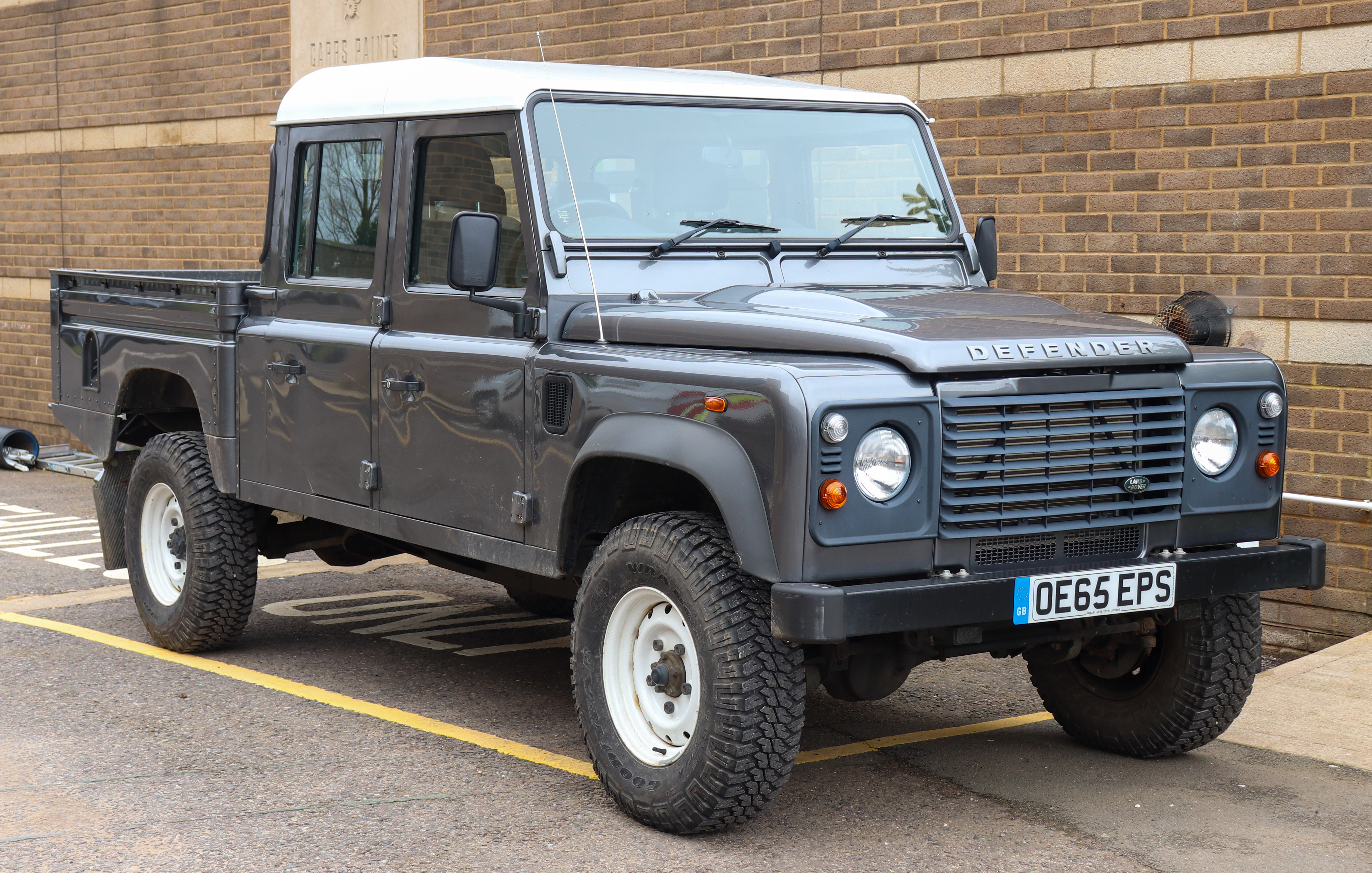
Land Rover Defender
"...o do that. [SPEAKER_00]: They're going to be like land rover defender or customers. [SPEAKER_00]: The first two generat..."
The Land Rover Defender is a tough SUV designed for off-road driving. The podcast mentions it while talking about different generations of the vehicle. Off-road use can be harder on parts like wheel bearings, so it’s a relevant example.
The Land Rover Defender is a rugged, off-road-capable SUV with a long-running reputation for durability and capability. It’s brought up in the context of “customers” and generational talk, which suggests the episode is comparing how different generations are built and used. Wheel bearings can be especially relevant on vehicles that see rough roads and frequent off-road conditions.
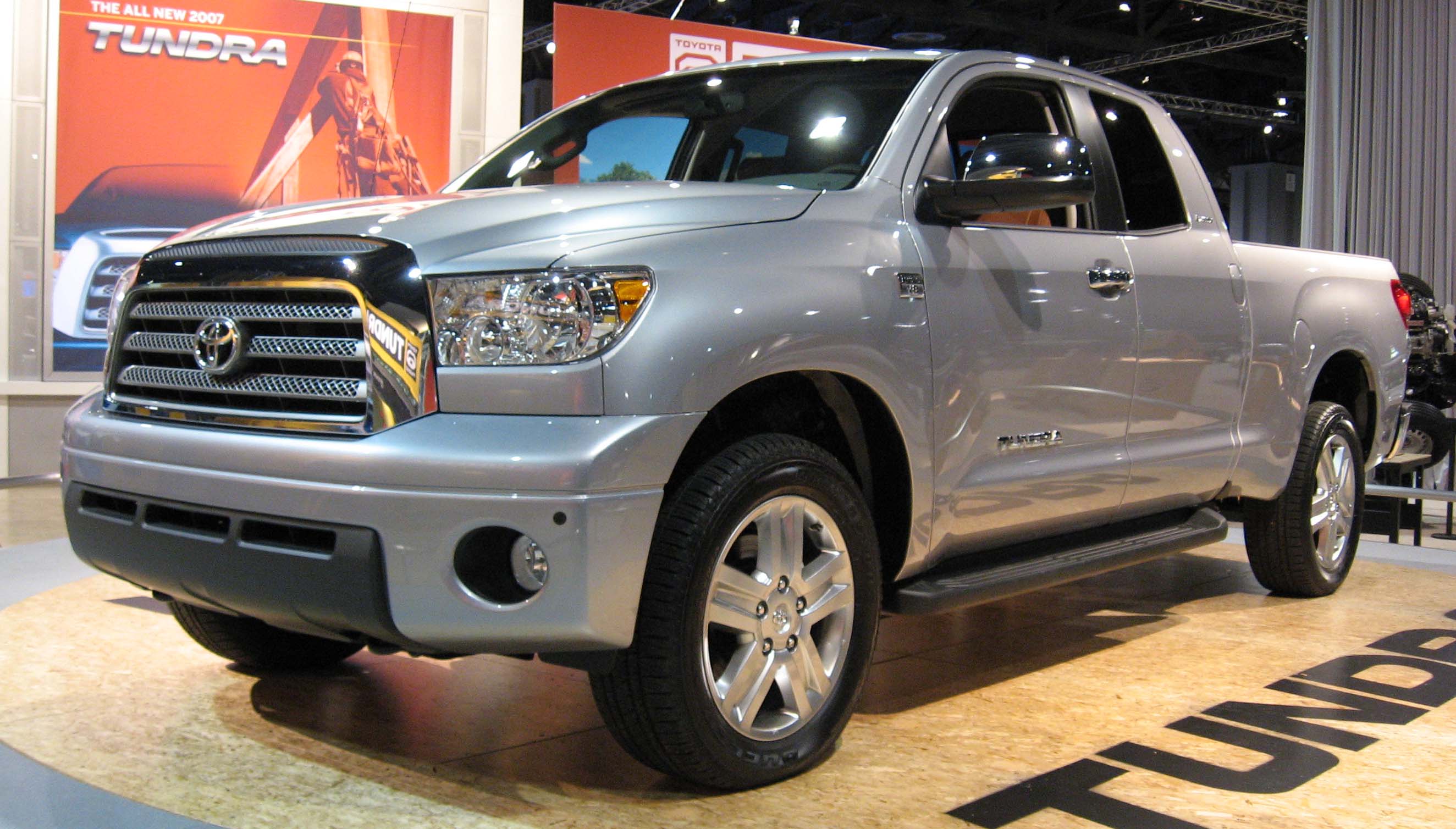
Lexus LX
"The GX has the same 3.4 liter twin turbo V6 that you will find... in the Tundra and Sequoia and in the LX..."
The Lexus LX is brought up because it shares the same engine family as the GX. That helps you predict how the GX’s powertrain will feel.
The Lexus LX is mentioned as another Lexus model that uses the same 3.4-liter twin-turbo V6 as the GX. This is relevant because it suggests similar engine behavior and likely similar drivetrain calibration philosophy across the Lexus full-size lineup.
Toyota Tundra
"The GX has the same 3.4 liter twin turbo V6 that you will find. in the Tundra and Sequoia and in the LX..."
The hosts are pointing out that the engine in the Lexus GX is related to an engine used in the Toyota Tundra. That helps you understand what kind of powertrain feel to expect.
The speaker says the Lexus GX uses the same 3.4-liter twin-turbo V6 found in the Toyota Tundra. That’s important because it ties the GX’s performance and character to Toyota’s larger truck platform engine family.
Toyota Sequoia
"The GX has the same 3.4 liter twin turbo V6 that you will find. in the Tundra and Sequoia and in the LX..."
The hosts mention the Toyota Sequoia because it uses the same type of engine as the Lexus GX. That’s useful for understanding how the GX might drive.
The transcript links the GX’s engine to the Toyota Sequoia, implying shared powertrain architecture. This matters to enthusiasts because it can affect parts availability, tuning potential, and how the engine behaves under load.
3.4 liter twin turbo V6
"The GX has the same 3.4 liter twin turbo V6 that you will find. in the Tundra and Sequoia and in the LX..."
This is a V6 engine with two turbochargers. Turbos help the engine make more power by forcing extra air in, which can make it feel stronger when you accelerate.
A 3.4-liter twin-turbo V6 uses two turbochargers to increase airflow and boost power. Twin-turbo setups can improve responsiveness and help deliver stronger torque across a wider range compared with a single-turbo or naturally aspirated design.
10-speed automatic transmission
"...a 10-speed automatic transmission, 349 horsepower, [SPEAKER_00]: in the six-sysh, five-hounds of torque, 479 foot on foot-pounds of torque."
A 10-speed automatic is a car’s automatic gearbox with lots of gear ratios. More gears can help the car shift in a way that keeps the engine working efficiently.
A 10-speed automatic transmission has more gear ratios than older multi-gear automatics. More gears can help keep the engine in its most efficient or powerful operating range more often, improving both drivability and fuel economy.
four-cylinder
"The engine feels better than the four-cylinder and the Land Cruiser. I've complained before about Toyota's four-cylinder engines, Don't sound great."
A four-cylinder engine is a smaller engine with fewer cylinders. The hosts are saying it doesn’t feel as good (and doesn’t sound as good) as the V6 they’re comparing it to.
A four-cylinder engine is a smaller-displacement engine with fewer cylinders than a V6 or V8. In this segment, the hosts criticize Toyota’s four-cylinder sound/feel and contrast it with the smoother, nicer-driving V6.
V6
"The V6 definitely much nicer to drive..."
A V6 is an engine with six cylinders. They’re saying it drives better and feels smoother than the smaller four-cylinder setup.
A V6 is an engine with six cylinders arranged in a “V” shape, typically offering smoother power delivery than a four-cylinder. Here, the hosts say the V6 is “much nicer to drive,” especially compared with the four-cylinder feel.
four runner
"Toyota on the body on frame vehicles like the Tundra and Sequoia and the Tacoma and the four runner..."
The Toyota 4Runner is a rugged SUV. They mention it to say Toyota’s hybrid doesn’t always translate into big gas savings, even if it helps how it drives.
The Toyota 4Runner is referenced as another body-on-frame Toyota where the hybrid system is described as improving performance feel more than fuel economy. It’s used to reinforce the broader point about Toyota’s hybrid tuning on truck-based SUVs.
Toyota Tacoma
"Toyota on the body on frame vehicles like the Tundra and Sequoia and the Tacoma and the four runner..."
The Toyota Tacoma is a pickup truck. They’re saying Toyota’s hybrid setup in these truck platforms is more about driving feel than saving lots of fuel.
The Toyota Tacoma is mentioned as part of Toyota’s truck-based, body-on-frame hybrid lineup. The hosts argue that the hybrid system is tuned more for performance than for major mpg improvements.
optional heads up display
"had the, this one, you know, had the optional heads up display, the Mark Lovingson Premium audio, and a bunch of other things..."
A heads-up display shows important info on the windshield. That way you can keep your eyes on the road instead of checking the dashboard.
A heads-up display (HUD) projects key driving information onto the windshield so you can see it without looking down at the instrument cluster. Here it’s mentioned as an optional feature on the GX, part of the overall equipment package.
Mark Lovingson Premium audio
"had the, this one, you know, had the optional heads up display, the Mark Lovingson Premium audio, and a bunch of other things..."
Mark Levinson is a premium audio brand used in some Lexus models. They’re listing it as one of the higher-end options on the vehicle.
This appears to refer to Mark Levinson Premium audio, a high-end Lexus sound system brand. The hosts mention it as part of the GX’s option list, implying a more premium cabin experience.
wind noise
"If not, skip that because that probably contributed to the lower fuel economy as well as the significant amount of wind noise around the thing."
Wind noise is the extra sound you hear from air hitting the car’s shape or accessories. They’re saying a roof rack can create more of it, especially at highway speeds.
Wind noise is aerodynamic noise caused by airflow disruption around parts like roof racks, crossbars, or poorly sealed accessories. In this segment, the hosts connect the roof rack to both lower fuel economy and increased wind noise.
destination charge
"All in, the one that I had, You want, you guys want to take guesses on what the destination charge was on this. Oh, uh, 2495."
The destination charge is what the dealer adds to pay to get the car shipped to your area. It’s part of the final price, so it matters when you’re budgeting.
The destination charge is a one-time fee added to a vehicle’s price to cover shipping the car to the dealer. The hosts discuss guessing the amount on the GX 550, highlighting how it affects the final “out-the-door” cost.
Milan design show
"So last week was the the Milan design show, which is, you know, the place where automakers, you know, usually like to unveil new cars, right?"
They’re talking about an auto/design event in Milan where car companies usually show off new stuff. It’s basically a big stage for announcing upcoming cars.
The Milan design show is referenced as an event where automakers typically unveil new vehicles. In auto media, these events are often used to generate buzz around upcoming models, including concept cars and near-production previews.
production model
"Actually, no, it's not a concept, it is a production model that they're launching, that is going to be on sale soon in Europe. It's going to be assembled in Turkey, and it's the new Hyundai Ionic III."
They’re saying this isn’t just a show car—it’s a real car that will be made and sold. The discussion is about when it’ll be available in Europe.
A “production model” means the vehicle is intended to be built and sold to customers, not just shown as a one-off concept. The hosts contrast it with a concept car by saying it will be on sale soon in Europe.
hatch
"What do you guys think about this car? Hatch! I don't know. It's a hatch."
They’re describing the car as a hatchback. That means the back opens upward and it’s usually more practical for carrying stuff than a traditional trunk.
A “hatch” refers to a hatchback body style, where the rear door lifts upward and the cargo area is accessed through the same opening. Hatchbacks are popular because they combine passenger space with practical storage.
Ford F150
"[SPEAKER_01]: I mean, I like it, you know, it would, you know, it's probably going to do well. [SPEAKER_01]: It's probably not, you know, it's not going to be sold here, because we can't have small cars because, you know, F-150 effect. [SPEAKER_01]: But."
The Ford F-150 is a very common large pickup truck. The podcast is talking about whether it will be sold in a particular market. When a truck is popular, it also means more people will report maintenance needs like wheel-bearing wear.
The Ford F-150 is a widely sold full-size pickup, and the podcast is discussing its market reach and sales expectations. That kind of conversation often matters for service topics because high-volume models tend to show up frequently in repair shops and owner reports. Wheel-bearing issues, when they exist, are easier to spot and quantify on popular platforms due to sheer numbers.
F-150 effect
"It's probably not, you know, it's not going to be sold here, because we can't have small cars because, you know, F-150 effect."
The “F-150 effect” means that when one type of vehicle (like big trucks) becomes really popular, the whole market shifts. So smaller cars may struggle to sell because the industry and rules tend to favor bigger, higher-demand vehicles.
The “F-150 effect” is the idea that when a popular vehicle segment (often trucks) becomes dominant, automakers and regulators push the market toward larger, more profitable vehicles. That can make it harder for smaller cars to be sold in certain regions due to demand, pricing, and policy realities.
Hyundai Ioniq 3
"...this thing, the ionic three, you know, it's based on the 400 volt version of the, um, EGMP architecture. Uh, so, you know, similar to what we had here in the, uh, the Kona EV..."
400 volt version of the EGMP architecture
"...the ionic three, you know, it's based on the 400 volt version of the, um, EGMP architecture."
“400 volt” is about the electrical system inside the EV. It can influence how the car charges and what kind of hardware it uses, and it’s often chosen to keep costs down.
EGMP is Hyundai/Kia’s electric vehicle platform, and the “400-volt” version refers to the car’s high-voltage electrical system. Voltage level affects charging behavior and component design; 400V systems are common and can be cost-effective, though some performance and charging characteristics differ from 800V setups.
Hyundai Kona
"...similar to what we had here in the, uh, the Kona EV, um, what we're getting in the ionic three smaller than those..."
They compare the Ioniq 3 to the Hyundai Kona EV. The point is that the new car is expected to be built on a similar kind of EV setup, so it may feel familiar in how it’s engineered.
The Hyundai Kona EV is used as a reference point for the Ioniq 3’s platform/architecture approach, specifically the idea of using a 400-volt EGMP variant. That suggests Hyundai is reusing lessons and engineering from an existing EV model.
Kia EV2
"...it's going to be like the same size as the, uh, Kia EV 2. That's launching, uh, in Europe shortly."
They mention the Kia EV2 as another upcoming small electric car. It’s brought up to show what size category Hyundai’s Ioniq 3 is aiming for.
The Kia EV2 is referenced as a near-term European launch, used as a size/segment comparison point for the Hyundai Ioniq 3. The implication is that both will target the same compact EV buyer, competing on packaging and price.
platform
"Yeah, that's the same platform as the key EV four... But that too is the same platform the 400 version of EV-400."
A “platform” is the car’s basic building plan—where major parts go and how the body is structured. When two cars share a platform, they can feel more similar and may use shared EV components.
The hosts repeatedly reference “the same platform,” meaning the underlying vehicle architecture. In EVs, platform sharing often affects where the battery sits, how the motors are packaged, and how power electronics are integrated, which can influence driving feel and manufacturing efficiency.
Kia EV3
"[SPEAKER_02]: Boy, last spring, I think now. [SPEAKER_02]: and then they're not bringing it in because made in Korea whereas they're EV-3, the little tiny square box compact SUV will actually be made in North America. [SPEAKER_02]: But that too is the same platform the 400 version of EV-400, Volverging and BGNP."
The Kia EV3 is a compact SUV that runs on electricity. The podcast mentions it will be made in Korea and that it will be sold there. Electric cars still have wheel bearings, so they can wear out just like on any vehicle.
The Kia EV3 is discussed as a compact SUV EV, with the podcast noting where it’s made and that it will be brought in. That kind of detail matters for service and parts availability because production location can influence supply chains and early ownership experiences. In a wheel-bearing episode, an EV like the EV3 is still subject to normal bearing wear from driving, alignment, and road conditions.
Chevrolet Volt
"...cally not the platform But they are using the 400 volt the same foreign volt components the battery moto..."
The Chevrolet Volt is a plug-in hybrid, so it can run on electricity and also has a gasoline engine. The episode is talking about the Volt’s battery system and how it’s designed. Even with a hybrid powertrain, wheel bearings are still mechanical parts that can wear out over time.
The Chevrolet Volt is a plug-in hybrid that uses a battery system alongside a gasoline engine. The podcast mentions “400 volt” and references shared components, which points to how the electrical system is built and serviced. Wheel-bearing discussions can still apply because even electric drive vehicles have conventional wheel-speed and suspension components that wear with mileage.
Android Automotive
"So this is the first on-day to feature their new Android Automotive based infotainment... Which means, you know, it's running all Android."
Android Automotive is the car’s built-in software platform from Google/Android. It lets the car run apps and features without you needing to rely only on your phone.
Android Automotive is the in-car operating system the speaker says the vehicle’s new infotainment is based on. It enables a more app-like experience directly in the car and supports downloading apps, rather than relying solely on phone mirroring.
12.9 inch or 14.6 inch center displays
"It's, they've got 12.9 inch or 14.6 inch center displays, and then there's also a small instrument cluster display on top of the dash."
They’re talking about big screens in the middle of the dashboard. Bigger screens usually make it easier to see maps and app information while driving.
The speaker describes large center infotainment screens, with sizes cited as 12.9 inches or 14.6 inches. Screen size matters because it affects usability for maps, media, and app interfaces, especially with an Android Automotive-based system.
CarPlay
"Yes, it does have support for CarPlay and Android Auto. I tried to hook up your phone."
CarPlay is Apple’s system for using your iPhone through the car’s screen. If you have an iPhone, it can make navigation, music, and calls easier to access while driving.
CarPlay support is mentioned as being available in the vehicle’s infotainment system. CarPlay lets you mirror and control compatible iPhone apps through the car’s display and controls.
Hyundai Tucson
"Yeah, I mean we could we could see it later this year and the new Tucson When that arrives that's that's coming later this year So it could show up there"
The Hyundai Tucson is a popular compact SUV. The discussion is about a newer version arriving soon, which usually means updated features and design.
The Hyundai Tucson is Hyundai’s compact SUV and a major volume model. When the hosts mention a “new Tucson” arriving later this year, they’re talking about the next generation/refresh that typically brings updated styling, tech, and powertrain options.
Concept car
"Kia Kia showed off a concept in Melan called the Metatarrismo... Kia doesn't, and Hyundai do a pretty good job of sort of bringing a car to market this sort of looks like the concepts, relatively quickly."
A concept car is basically a “preview” of what a brand might build later. It can look futuristic, but the real customer car usually changes things to be practical.
A concept car is a show vehicle built to preview future styling, packaging, and sometimes powertrain ideas. Production versions often keep only parts of the concept’s look—especially when it comes to usability and regulations.
Kia Stinger
"which some people are referring to is kind of a next generation stinger that's electric"
The Kia Stinger was Kia’s sportier, more performance-minded car. They’re saying this new concept might be like a future EV version of that idea.
The Kia Stinger is Kia’s former performance-oriented fastback, known for sporty handling and a more driver-focused vibe than typical mainstream sedans. The hosts compare the Metatarrismo concept to a “next generation Stinger,” implying a potential sporty EV direction.
door handles
"It doesn't have any door handles, so how are you going to get Nomsky? It's a concept, I mean, we get excited about these concepts."
They’re pointing out that the car has no normal door handles you grab. On some EVs, the handle is hidden and you open the door using a sensor or a hidden handle mechanism.
The hosts note the concept “doesn’t have any door handles,” which typically implies flush, hidden mechanisms such as electronic touch handles or pop-out handles. This is a common EV design trick to improve aerodynamics and create a cleaner exterior look.
Toyota Gr86
"... niche for like you if you have to select the BRZ GR86 like that sort of there is a niche it's it's youn..."
The Toyota GR 86 is a small sports car meant for fun driving. The podcast mentions it as part of a smaller “niche” group of cars. Even sports cars can need wheel-bearing service if they’re driven hard or accumulate mileage.
The Toyota GR 86 is a sports coupe built for driving feel, and the episode groups it with the BRZ/GR86 niche conversation. It’s mentioned because it represents a specific kind of enthusiast-focused car rather than a mainstream utility vehicle. Wheel bearings can still be relevant on sports cars due to performance driving and the stresses placed on the suspension and steering components.
BMW 3 Series
"...But I don't know if the fordor is something that people are, I don't know, pulling people away from like a like a three series for this or like what do you would you is that or is that market so I type up with those folks..."
The BMW 3 Series is a very popular mainstream sport sedan. The hosts are wondering if a cheaper car could realistically steal buyers from it.
The BMW 3 Series is a long-running compact executive sedan that’s often used as the benchmark for mainstream “sport sedan” buyers. The hosts are questioning whether a smaller/cheaper alternative (like the hatchback/stinger-style idea) could pull buyers away from the 3 Series.
enthusiast market
"But again, it's a such a small it's such a small market. Like the enthusiast market is you know, it gets smaller every year."
The “enthusiast market” means people who really care about how a car drives and how it can be modified. The hosts are saying that group is getting smaller, so niche sporty cars may struggle to sell in big numbers.
The “enthusiast market” refers to buyers who prioritize driving feel, performance, and customization over mainstream practicality. The hosts argue this segment is shrinking over time, which can make it harder for niche sporty models to achieve high sales volumes.
2019 G70
"Let's see, here's the 2019 G70 for. Yeah, that's like, I mean, that's it. But that's with 99,000 miles."
They’re talking about a specific used Genesis G70 from 2019. The point is that mileage matters a lot: a car with more miles can be much cheaper than one with only a few thousand miles.
A 2019 Genesis G70 is being used as a concrete example of the enthusiast market’s pricing reality—showing a high-mileage car and then a much lower-mileage example at a higher price. This illustrates how used-car mileage and condition strongly affect what enthusiasts can afford to buy and modify.
Camries
"Well, you know what I'm seeing a lot of. Cameries. Yeah, like lowered and, and, and, and, you know, Camries have become sort of like the mass like enthusiasts vehicle."
The Toyota Camry is being described as a “mass” enthusiast platform—meaning lots of owners modify it for style and personal taste. The hosts mention common mod directions like lowering, wheels, exhaust, and window tint, reflecting how mainstream cars can still become enthusiast projects.
lowered
"Yeah, like lowered and, and, and, and, you know, Camries have become sort of like the mass like enthusiasts vehicle... maybe I'll lower it, maybe I'll put some wheels on it..."
“Lowered” means the car sits closer to the ground. People do it to make the car look better, but it can make bumps feel harsher and can reduce ground clearance.
“Lowered” refers to reducing a car’s ride height, usually by changing suspension components. Enthusiasts do it for aesthetics and sometimes handling feel, but it can also affect ride comfort and clearance.
tint all the windows
"...maybe I'll put an exhaust system on it. I'm going to tint all the windows so no one can see what I'm doing inside the car."
Window tint is a film applied to the glass to make it darker. People do it for privacy and to reduce sun glare, but the darkness level has to follow local rules.
“Tint all the windows” refers to applying darker film to glass for privacy, heat reduction, and glare control. It’s a common cosmetic mod, but it can also run into legal limits depending on local regulations.
exhaust system
"...maybe I'll lower it, maybe I'll put some wheels on it, maybe I'll put an exhaust system on it."
An exhaust system is the parts that route gases out of the engine. People upgrade it mainly for a different sound, and sometimes for a small performance improvement.
An “exhaust system” upgrade typically changes the muffler/cat-back components to alter sound and sometimes airflow. Enthusiasts often do this to get a different tone and, depending on the setup, modest performance gains.
wheels
"...maybe I'll lower it, maybe I'll put some wheels on it, maybe I'll put an exhaust system on it."
When they say “wheels,” they mean changing the rim style. It’s usually done for looks, but it can also change how the car drives depending on the tires and fitment.
“Wheels” in this context means swapping to different rims, often for style and sometimes for performance. Wheel changes can alter ride quality, steering feel, and fitment—especially if the new wheels use different tire sizes or offsets.
VW group
"Tutor Carser are so interesting because for us, aside from a bazillion superiors, both tuned and lifted, it's almost all old VW group products."
“VW group” means Volkswagen’s big family of car brands that share similar designs. The point here is that most of the cars they’re talking about are older cars from that same corporate family.
“VW group” refers to Volkswagen Group’s family of brands and platforms (Volkswagen, Audi, etc.) that share engineering and parts. The hosts are saying the cars they see are mostly older Volkswagen Group products, often modified.
Volkswagen Golf
"...t all old VW group products. [SPEAKER_02]: Jedas, golfs two generations back, three generations for a gen..."
The Volkswagen Golf is a compact car that has been made for many years. The podcast is talking about older versions and how many generations back they are. Different generations can use different parts, so wheel-bearing wear and replacement can vary.
The Volkswagen Golf is a compact car that has gone through many generations, and the podcast references “two generations back” and “three generations for a gen.” That kind of generational comparison matters because mechanical designs and component layouts can change over time. Wheel-bearing discussion often depends on which generation you’re dealing with, since bearing designs and service access can differ.
STI
"Nothing breaks my heart more than a WRX or STI that's been lowered, because that's definitely what that car should not be doing. ... Stop, they're rally cars."
The Subaru WRX STI is the more hardcore, track/rally-focused version of the WRX, typically with stronger drivetrain components and more aggressive tuning. Here, the host criticizes lowering it, saying it should sit higher like a rally car.
cambers
"Just buy, I have a BRG, buy when I see them all the time, they're all lower cambers all out of whack. That's fine."
“Camber” is the inward/outward tilt angle of a wheel relative to vertical. When cars are lowered, camber often changes and can end up “out of whack,” which can cause uneven tire wear and affect handling.
rally cars sitting higher
"Stop, they're rally cars. Yeah. They're supposed to be sitting higher, not low."
Rally cars are typically set up with higher ride height and suspension travel to handle rough surfaces, potholes, and uneven roads. The host’s argument is that lowering a rally-based Subaru (WRX/STI) goes against that design intent.
slam it
"[4061.5s] [SPEAKER_00]: Did you slam it? [4062.9s] [SPEAKER_00]: No, I did not. [4063.6s] [SPEAKER_01]: Okay, see, that's what I'm talking about. [4064.8s] [SPEAKER_01]: If you've been in the vehicle that's been slammed, it's absolutely horrible experience."
“Slam it” means lowering a vehicle aggressively, usually to the point where the suspension travel is very limited. The host argues that when a mini-truck is slammed, the ride becomes harsh and uncomfortable—even if it’s not modified beyond lowering.
four-speed manual
"[4102.8s] [SPEAKER_00]: So, I had one with the Suzu 1.9-liter four-speed manual and literally nothing else. [4109.4s] [SPEAKER_00]: You know, manual track windows, you know, manual mirrors the whole gamut."
A four-speed manual is a simple stick shift with four forward gears. With a small engine, it can require more shifting and can feel less smooth than newer transmissions.
A four-speed manual transmission means the gearbox has four forward gears plus reverse. On older mini-trucks, a four-speed manual often goes with a small engine, so it can feel busy on the highway and less refined than later multi-gear setups.
B-Series B2200
"[SPEAKER_00]: You know, manual track windows, you know, manual mirrors the whole gamut. [SPEAKER_01]: I had a girlfriend at a B-22 Mazda B-2200 and I absolutely nothing. [SPEAKER_01]: It was just car."
The B-Series is a basic pickup/utility truck. The podcast is describing it as having simple manual controls like manual mirrors and windows. Even simple trucks still have wheel bearings that can wear out with driving.
The “B-Series” in the podcast context appears to refer to a small pickup/utility truck with manual features like manual track windows and manual mirrors. It’s being used as an example of a very basic, straightforward vehicle setup. In a wheel-bearing discussion, simpler mechanical designs can still experience the same fundamental bearing wear from road use, but maintenance access and replacement approaches may differ by model.
stripper models
"[4121.2s] [SPEAKER_00]: What is this truck that they put in after market radio in there because you know that at that and that age, you know, they were selling these stripper models with no radios or anything. [4133.6s] [SPEAKER_00]: And you know, it's kind of like what what's late is going to try and sell. [4137.0s] [SPEAKER_00]: Yeah."
A “stripper model” is the cheapest version of a vehicle with fewer options. In this case, it sounds like it might not even have basic things like a radio or power accessories.
“Stripper models” refers to base-trim vehicles built with minimal features—often no radio, fewer power accessories, and fewer comfort options. The speaker uses this to explain why these mini-trucks felt very plain even when they were stock.
after market radio
"[4122.4s] [SPEAKER_01]: What is this truck that they put in after market radio in there because you know that at that and that age, you know, they were selling these stripper models with no radios or anything. [4133.6s] [SPEAKER_00]: And you know, it's kind of like what what's late is going to try and sell."
An aftermarket radio is a stereo you install yourself (or have installed) instead of the factory one. Here, they’re saying older base trucks often didn’t include a radio, so people added them later.
An aftermarket radio is a replacement head unit installed by the owner rather than coming from the factory. The speaker mentions it because these mini-trucks were sold as “stripper” versions with no radio, so owners commonly added one later.
Beijing Motor Show
"...Hyundai showed off the Ionic V in China this week at the Beijing Motor Show, which is, and it just as they've recently talked about for North America..."
The Beijing Motor Show is a big car event in China. Automakers use it to announce new cars and future plans. Here, it’s mentioned to explain where Hyundai’s electric sedan was revealed.
The Beijing Motor Show is a major auto event in China where manufacturers reveal new models and concepts. When a car is “shown off” there, it often signals the company’s near-term plans for that market. In this segment, it’s used to frame Hyundai’s China-focused electrification push.
Wedge shape design
"...this Ionic V is a four-door that's got kind of a late 70s wedge shape to it, almost kind of a a load of the spree kind of vibe..."
A “wedge” design is when a car’s shape looks like it’s narrowing toward the front, like a slice. It often makes the car look more aerodynamic and sporty. In this segment, they’re using it to describe the electric sedan’s styling.
A “wedge” design refers to a car body shape that tapers toward the front and often sits lower, creating an aerodynamic, aggressive silhouette. The hosts use this term to connect the Hyundai IONIQ V’s styling to older sports-car proportions and to explain why it looks distinctive. It’s a design concept, not a performance spec.
Prius
"[4311.5s] [SPEAKER_00]: Yeah, the Prius is not doing well. [4313.6s] [SPEAKER_01]: Well, it's everything else is high It's not America."
The Prius is Toyota’s famous hybrid car. It uses both a gas engine and an electric motor to get better mileage. The discussion is basically about whether people should buy a Prius or a Corolla Hybrid instead.
The Toyota Prius is the brand’s best-known hybrid, using an electric motor alongside a gasoline engine to improve fuel economy. In this segment, the hosts discuss why buyers might choose a Toyota Corolla Hybrid instead of the Prius, especially when fuel economy is similar.
Toyota Corolla
"[4318.2s] [SPEAKER_02]: ...Why do you need to buy it Prius if you can get a Corolla hybrid that's built in the US no less ... at produces within 10% of the gas mileage..."
The Corolla Hybrid is a hybrid version of the Toyota Corolla. It’s meant to be a regular, everyday car that still gets good gas mileage. They’re saying it can be a better choice than a Prius for some people.
The Toyota Corolla Hybrid is a hybrid version of the Corolla that’s positioned as a more mainstream alternative to the Prius. The hosts claim it delivers fuel economy close to the Prius while avoiding some “legacy” downsides, making it an easier sell for many buyers.
Toyota Sports 800
"[4403.4s] [SPEAKER_00]: It's built on the site of the former Higashi Fuji assembly plant, which started off in the 1960s building the Sports 800, the Toyota Sports 800..."
The Toyota Sports 800 is an old-school Toyota sports car from the 1960s. They bring it up because the factory site has a long automotive history before becoming Toyota’s modern test town.
The Toyota Sports 800 is a small, classic two-seat sports car from the 1960s. The hosts mention it to explain the history of the Higashi Fuji assembly plant site that later became part of Woven City.
Toyota Century
"[4422.1s] [SPEAKER_00]: ...by the end of its model... it was building the Toyota Century, and, um, so they closed that plant in 2020..."
The Toyota Century is Toyota’s flagship luxury sedan, known for a traditional, high-end approach. The hosts mention that the former Higashi Fuji plant eventually built the Century before closing in 2020, tying the site’s production history to Woven City’s development.
Woven City
"[4437.9s] [SPEAKER_00]: and they announced this woven city thing. [4441.1s] [SPEAKER_00]: So woven is this group woven by Toyota..."
Woven City is Toyota’s big experiment space. It’s like a real town and test area where Toyota can try new mobility ideas in a practical setting.
Woven City is Toyota’s planned “company town” and proving ground built to develop and test advanced mobility technologies. The hosts connect it to Toyota’s software and advanced technology work, describing it as part test track, part living lab, and part engineering hub.
RAV4
"[4460.0s] [SPEAKER_00]: ...first seeing in production in the new RAV4 with its new infotainment in the new ADAS..."
The Toyota RAV4 is a popular SUV. In this segment, they’re saying Toyota is putting its newest software and safety/driver-assist features into a new RAV4 first.
The Toyota RAV4 is Toyota’s compact SUV, and the hosts mention a “new RAV4” as the first production place where Woven’s software and technology are showing up. They specifically tie it to updated infotainment and ADAS (driver-assistance) features.
infotainment
"[4460.0s] [SPEAKER_00]: ...first seeing in production in the new RAV4 with its new infotainment in the new ADAS..."
Infotainment is the touchscreen and related system for things like music, maps, and phone features. They’re saying Toyota’s new software work is showing up in the RAV4’s screen and controls too.
Infotainment is the vehicle’s integrated system for navigation, audio, smartphone connectivity, and other user-facing functions. The hosts mention “new infotainment” in the RAV4, implying Woven’s software development is being rolled into the user interface as well as driving tech.
ADAS
"[4449.9s] [SPEAKER_00]: ...assisted automated driving stuff, connected stuff... [4460.0s] [SPEAKER_00]: ...first seeing in production in the new RAV4 with its new infotainment in the new ADAS..."
ADAS means driver-assist tech that helps you avoid crashes or reduces workload while driving. Examples include systems that help keep you in your lane or slow down automatically if something is in the way.
ADAS stands for Advanced Driver-Assistance Systems—features like adaptive cruise control, lane centering, automatic emergency braking, and other sensing/automation aids. The hosts say Woven’s software and development work is showing up in production vehicles, including a new RAV4’s ADAS.
e-pallet
"[4618.5s] [SPEAKER_00]: What's, they're testing out a variety of stuff like their e-pallet, mobility shuttles, and their personal mobility vehicles, their swake, leaning, three wheel scooters, that those are actually pretty cool looking. [4637.2s] [SPEAKER_00]: But one of the things that they announced [SPEAKER_00]: So they built their own foundation model and they've got a vision language model that's running on that. [4655.7s] [SPEAKER_00]: So unlike a large language model is focused on text, this is focused on processing visual data and doing stuff with it."
An e-pallet is basically a small electric platform for moving stuff around. It’s the kind of vehicle you’d use for deliveries, and it helps test how future “delivery robots” might operate.
An e-pallet is a small electric logistics/mobility unit used to move goods around a campus or city environment. In smart-city testing, these kinds of vehicles help evaluate how autonomous or semi-autonomous delivery and routing systems work in everyday conditions.
line of sight
"[4678.7s] [SPEAKER_00]: Part of it is they want to do collaborative perception. [4680.7s] [SPEAKER_00]: So as vehicles are driving around this town, you know, obviously the sensors on the vehicles are limited to line of sight, just like human drivers are."
Line of sight is basically “can the sensor see it from where it is?” If something is blocked—by a building, another car, or a corner—the sensor may not detect it.
“Line of sight” means a sensor can only detect objects that are directly in its view path, not around corners or behind obstacles. For vehicles, this is a key limitation that collaborative perception and additional sensors (like cameras on infrastructure) can help address.
collaborative perception
"...the collaborative perception stuff on the roads to enhance the situational awareness, whether it's an automated vehicle or a human driven vehicle, there's actually some really good aspects to that."
Instead of each car only relying on what its own sensors can see, cars can “team up” by sharing information. That helps everyone spot hazards sooner and more reliably.
Collaborative perception is when vehicles (and sometimes infrastructure) share sensor data so each vehicle has a more complete picture of what’s happening around it. That can improve situational awareness for both human-driven and automated vehicles, especially when one car’s sensors can’t see something clearly.
situational awareness
"...to enhance the situational awareness, whether it's an automated vehicle or a human driven vehicle..."
Situational awareness is how well a driver (or car) understands what’s going on around them. Better awareness means you can react to hazards sooner and more accurately.
Situational awareness is the ability to understand what’s happening around you in real time—traffic, hazards, and other road users. In vehicle safety systems, it’s improved by combining sensors and (in some approaches) sharing information between vehicles.
meta
"...palantir and meta and ice and the Chinese government exist..."
Meta is a big tech company. Here it’s mentioned as an example of how data collection can feel intrusive, especially when combined with location tracking.
Meta is mentioned alongside other entities to highlight concerns about surveillance and data collection. The point isn’t automotive hardware specifically, but how data ecosystems can influence connected-vehicle and smart-city deployments.
Palantir
"...But in a world where palantir and meta and ice and the Chinese government exist..."
Palantir is a tech company known for working with data. The hosts bring it up to question how much real-world tracking or data use could expand.
Palantir is referenced as one of the organizations involved in large-scale data and analytics. In this segment, it’s used to raise concerns about how data-driven systems could be used beyond the intended safety purpose.
GPS location
"I mean, the knowledge or not, GPS location in their phones. ..."
GPS location means your phone (or car) can figure out where you are using satellites. The hosts are saying it’s easier to manage/turn off on a phone than it is in a car.
GPS location refers to using satellite signals to determine where a device is. The hosts discuss how phones can track location (and how that can be turned off), contrasting it with how difficult it can be to control tracking in a car or while on public roads.
bidirectional charging system
"...and they have a parking garage, so all the vehicles are parked in there. and they have bidirectional charging system in there."
Bidirectional charging means the car can act like a small power source. Instead of only charging from the grid, it can also send electricity back when needed.
A bidirectional charging system lets an EV not only draw power from the grid, but also send power back to it. That enables services like load balancing and emergency backup, and it’s a key enabler for “vehicle-to-grid” style energy management.
virtual power plant
"And they've set up a virtual power plant. And the team at a Rene has developed an energy management system that, so they've got solar panels on the garage."
A virtual power plant is like a “smart controller” that combines lots of small energy sources together. Instead of one big power station, it uses things like solar and EV batteries to help the grid.
A virtual power plant (VPP) coordinates many distributed energy resources—like solar, batteries, and EVs—to behave like one large power plant. In this case, the system aggregates energy from EV batteries and solar to support the local grid and manage demand.
Moby Guide
"...they just use the app, and then they have something called a Moby Guide, which is a little autonomous vehicle. What it does is it communicates with the vehicles in the garage..."
A “Moby Guide” is basically an autonomous helper robot-car. You summon it with an app, and it handles moving the vehicle to you using sensors and wireless communication.
The “Moby Guide” is described as a small autonomous vehicle that communicates with other vehicles in the garage and assists with moving them to where a person summons them. The key point is that it’s an automated logistics/parking assistant using onboard sensing (radar, light/cameras) and wireless coordination.
feed that back into the grid
"...You can even feed that back into the grid, they're testing that, and then for the people they're living there, when they need a vehicle..."
They’re describing the idea of sending electricity from the car back to the power network. That way, the EV batteries can help when the grid needs extra power.
“Feeding back into the grid” refers to exporting electricity from EV batteries to the utility network. This is typically part of vehicle-to-grid (V2G) or grid-support programs, where the EVs can help stabilize supply and demand.
virtual wireless towing
"...and connects wirelessly with that vehicle and then does virtual wireless towing to the location where the person summoned it and then the mobie guide goes back to the vehicle..."
They’re describing a system where a helper vehicle can move another car to you without a traditional tow truck. It’s done through wireless coordination and automation.
“Virtual wireless towing” is the idea that the autonomous “Moby Guide” coordinates with a vehicle to move it without a physical tow setup. Practically, it implies wireless control/coordination plus the ability to guide or reposition the vehicle safely within the controlled environment.
radar and light-r and cameras
"...the mobie guide goes back to the vehicle and the mobie guides are equipped with radar and light-r and cameras to provide more robust assistance in what you get from just the cameras..."
The hosts say the autonomous “Moby Guide” uses radar, “light-r” (likely LiDAR, a laser-based distance sensor), and cameras. Together, these sensors improve obstacle detection and navigation compared with cameras alone, especially in challenging lighting or weather.
Swake scooters
"Oh, we had the the Swake scooters were pretty slick. And they're also, I'll try to remember now what."
They also mention some scooters that sounded interesting. The details in the transcript aren’t clear enough to know exactly which brand/model they mean.
The segment mentions “Swake scooters” as another showcased mobility product. This appears to be a named scooter offering in the same smart-city/vehicle ecosystem, but the transcript doesn’t provide enough detail to identify the exact model or manufacturer confidently.
Fukushima
"...after Fukushima sort of this deep Bindi Commission, you know, they were they there was a lot they put a lot into nuclear power... And then Fukushima happened and then that was a whole, you know, like, Whoops."
They bring up Fukushima because it changed how Japan thinks about power sources. The idea is that nuclear energy plans didn’t go as expected after the disaster.
The hosts reference Fukushima to discuss Japan’s energy policy shift after the nuclear disaster. The point is that assumptions about nuclear power being a “magic” solution were challenged by real-world events, affecting how grid planning and power generation are viewed.
vehicle-to-grid (V2G)
"EVs can feed back into the grid, you know, combine them with renewable solar, when geothermal or whatever. And when those things aren't like producing power..."
Vehicle-to-grid (V2G) is the idea that EVs can communicate with the grid and either draw power to charge or send power back to help stabilize it. This turns EV batteries into distributed energy storage that can respond to grid needs. The transcript frames it as a way to combine EVs with renewables to handle times when generation drops.
grid balancing
"And when those things aren't like producing power, now you have a giant, you know, array of batteries everywhere that can also feed back into the grid in order to balance everything."
Grid balancing is the continuous process of matching electricity supply to demand so the system stays stable. When renewables like solar aren’t producing, the grid needs other sources or stored energy to fill the gap. EV batteries can potentially help by feeding power back into the grid during those times.
vehicle-to-home (V2H)
"And that was like always believed that vehicle to home in the US makes a huge amount of sense. Providing grid management services and backup power or, you know, shuffling power, arbitraging power through the grid in the US seems to be much more problematic..."
Some EVs can send power back out of the battery and into your house. That means they can act like backup power during an outage and help manage electricity use. It’s basically “your car powers your home.”
Vehicle-to-home (V2H) is when an EV can send electricity back to a home’s electrical system. That can provide backup power during outages and help manage household energy usage. It’s part of the broader idea of using EV batteries as grid-connected energy storage.
time-of-use / arbitraging power through the grid
"Providing grid management services and backup power or, you know, shuffling power, arbitraging power through the grid in the US seems to be much more problematic..."
Arbitraging power is basically “buy low, use/sell high.” With EVs, you might charge when electricity is cheaper and then use or send that stored energy back later when it’s worth more. The goal is to save money and help the grid.
Power arbitrage (often discussed alongside time-of-use pricing) is the practice of buying electricity when it’s cheaper and selling or using it when it’s more valuable. In an EV context, that can mean charging the battery during low-cost periods and discharging later to earn revenue or reduce costs. The transcript ties this to grid services, but notes it can be harder where utilities and systems differ.
PG&E
"Well, in North California, PG&E, which has been said they have this pilot program, but you can't get them to talk about it... people are like PG&E's a pain in the ass to work with."
PG&E is Pacific Gas and Electric Company, a major utility in Northern California. The transcript mentions it in the context of a pilot program for EV/grid-related initiatives and suggests there are communication or cooperation challenges. For listeners, this is an example of how utility participation can affect real-world EV-to-grid progress.
DOE
"But there, above and beyond that, remember, the DOE has canceled hundreds of millions of dollars from utilities to R&D labs in the last 18 months, having anything to do with electrification, electric vehicles or in any way of hurting climate change."
DOE refers to the U.S. Department of Energy, which funds and supports research and development related to energy technologies. The transcript claims the DOE canceled large amounts of funding for utilities and R&D labs tied to electrification and climate-related work. That’s relevant because incentives and grants can strongly influence whether EV/grid projects get built.
off-street parking constraint
"Especially, you know, in a lot of cities, you know, there's limited places to park. Most people don't necessarily have off street parking to plug in an EV, which makes it more challenging to own one there."
Off-street parking matters for EV adoption because it determines whether drivers can reliably charge at home. Without dedicated parking, charging often depends on public chargers, workplace charging, or shared fleet setups. The transcript highlights how limited parking in many cities can slow adoption even when EVs are otherwise attractive.
shared fleet charging
"a scenario like this where people are using a shared fleet, and so you've got this constraint, the fleet, the vehicles are all parked in one place. It makes it easier to also do something like a virtual power plant like this."
Shared fleet charging means many EVs are used by an organization and managed together. Because they’re controlled as a group, it’s easier to coordinate when they charge. That can make advanced grid features more feasible.
Shared fleet charging refers to EVs that are centrally managed—often by a company or service—so charging can be coordinated across multiple vehicles. This makes it easier to implement grid-interactive strategies like a virtual power plant because the fleet can be controlled as a group. The transcript suggests this setup reduces some of the practical barriers to coordinated charging.
integrated Onsen
"So one other thing that they demoed for us there was something called integrated Onsen, which is onsen is Japanese word for safety or security. And what they're doing with this is utilizing the in vehicle sensors..."
This is a safety/comfort feature that tries to read when you’re busy or distracted. When it thinks you need to concentrate, it can quiet down the car’s alerts and instructions so you can focus on driving.
The hosts describe an “integrated Onsen” system that uses in-vehicle sensors to understand the driver and manage how much the car communicates. The idea is to detect when the driver needs focus and then reduce or pause alerts and guidance to avoid distraction.
infrared cameras
"...the driver [SPEAKER_00]: like the infrared cameras, massive sensors in the steering wheel..."
Infrared cameras help the car see the driver’s eyes and face, even at night. That lets the car tell if you’re paying attention or getting tired.
Infrared cameras can track the driver’s face and eyes even in low light by using infrared illumination. They’re often used for driver monitoring—detecting attention, drowsiness, or whether the driver is looking where they should.
in vehicle sensors
"And what they're doing with this is utilizing the in vehicle sensors, the driver like the infrared cameras, massive sensors in the steering wheel..."
Modern cars use lots of sensors—cameras and other detectors—to “watch” what’s going on. By combining them, the car can judge situations more accurately.
The segment references using multiple sensors inside the car to monitor both the driver and the driving environment. This kind of sensor fusion is common in modern driver-assistance systems, where inputs are combined to make better decisions than any single sensor alone.
driver workload score
"...what it's doing is it's generating a score of essentially the driver's workload, and once it gets above a certain threshold, the system just pauses and backs off and leaves you alone to focus..."
The car estimates how “busy” or demanding the driving situation is. If it thinks you need to concentrate, it can stop or pause prompts so you can focus.
The hosts describe a system that generates a “score” representing the driver’s workload based on sensor inputs and driving context. When the score exceeds a threshold, the car reduces communication (like navigation prompts) to minimize distraction during high-demand moments.
Kona Electric
"There was a beep in my, uh, Kona Electric. We had that car for three years. Never figured out what it was before."
They’re talking about a Hyundai Kona Electric and a beep they couldn’t figure out. It’s a reminder that car warning sounds can be hard to interpret unless you know what system is causing them.
The speaker mentions a Hyundai Kona Electric and a recurring beep they never identified. This highlights a common real-world issue with driver-assistance alerts: some warnings can be confusing if the owner doesn’t know what trigger condition corresponds to the sound.
blind spot
"I was like, I ran them alert. Never, I got to always try to look around like, what is this for? What is, is there a car in my blind spot?"
The speaker connects the beep to the idea of a car in the blind spot, which is typically detected by sensors (often radar or cameras) monitoring adjacent lanes. Blind-spot alerts are meant to warn you before a lane change when another vehicle is detected near your mirrors.
ice alert
"...when that happens here, half the time, it's an ice alert potential sensor, uh, temperatures coming down..."
An ice alert is a warning that the road may be icy. It usually comes on when the temperature drops enough that ice can form, even if the road looks dry.
The transcript references an “ice alert” that appears when temperatures drop, implying the car estimates road icing risk. Many vehicles use outside temperature sensors (and sometimes additional data) to trigger warnings when conditions are likely to create black ice.
safety system settings on or off
"A parent, I have to dive into the settings, but the settings for a lot of the safety systems seem to be on or off. They don't seem to be graded."
The speaker says many safety systems seem to be only “on or off” and not “graded,” meaning they don’t offer fine-tuned sensitivity levels. That can affect how often alerts trigger and whether they feel helpful or annoying to the driver.
Rivian R2
"...an this week officially started production of the R2. [SPEAKER_00]: And about the same time, GM, who's..."
GM
"And about the same time, GM... has paused development of their next generation large electric trucks and SUVs."
GM (General Motors) is mentioned in the context of pausing development of its next generation of large electric trucks and SUVs. That’s relevant because it suggests GM is adjusting its EV strategy based on product economics and market demand.
Rivian R2
"So Rivian this week officially started production of the R2."
The Rivian R2 is Rivian’s newer electric vehicle. When a company “starts production,” it usually means the car is moving toward real customer deliveries instead of just prototypes.
Rivian R2 is the next-generation compact electric vehicle from Rivian, positioned as a more affordable step compared with the company’s earlier R1 models. The discussion here is about Rivian starting production, which matters because it signals the brand is moving from concept and early production into broader availability.
electric pickup trucks have largely failed so far
"...electric pickup trucks have largely failed so far."
This is a market concept: despite high interest and strong marketing, electric pickup trucks have struggled to gain broad adoption. Reasons often include pricing, charging convenience, and consumer expectations for towing/range, which can make EV pickups harder to sell than EV SUVs in the near term.
Rivian R2T
"it is notable to me that Rivian is not making an R2T or at least not yet."
R2T sounds like the idea of a Rivian R2 pickup truck. The host’s point is that Rivian hasn’t announced or started that pickup version yet—only the SUV.
R2T refers to a hypothetical or rumored Rivian R2 pickup variant. The host says Rivian is not making an R2T (at least not yet), implying Rivian is prioritizing the SUV first and delaying a pickup version.
Rivian R1S
"...they launched the R1T and showed the R1S, but they built the R1T first..."
The Rivian R1S is Rivian’s electric SUV. They’re using it to explain how Rivian’s product lineup and priorities have shifted over time.
Rivian R1S is Rivian’s electric SUV in the R1 lineup. The host notes Rivian showed the R1S alongside the R1T, and later argues Rivian’s current focus on SUVs makes sense given market demand.
Rivian R1T
"...they launched the R1T and showed the R1S, but they built the R1T first, in part because then it was the only battery electric pickup truck on the market."
The Rivian R1T is Rivian’s electric pickup. The point being made is that Rivian started with the truck first because, early on, there weren’t many electric pickups available.
Rivian R1T is Rivian’s electric pickup truck. In the segment, the host explains Rivian launched the R1T first because it was the only battery-electric pickup on the market at the time, which helped justify focusing on the truck variant early.
LMR cells (lithium manganese-rich cells)
"They have a battery plant in construction now for what they call LMR cells, lithium manganese-rich cells, which are supposed to be almost as cost-efficient as lithium-ion..."
LMR cells are a type of battery chemistry. The idea is to make batteries cheaper by using a different mix of materials, while still keeping the battery good enough for the car.
LMR cells are lithium-manganese-rich battery cells, a chemistry aimed at reducing cost while still delivering strong performance. The segment suggests GM is building a plant to produce these cells so it can use different battery chemistries for different vehicle needs and price points.
battery cell chemistries
"So that would give GM 3 different cell chemistries for different applications, different cost levels."
Battery chemistries are different “recipes” for making the battery. Using more than one recipe helps companies choose the best balance of cost and performance for each model.
“Cell chemistries” refers to the specific materials and electrochemical makeup used in battery cells. Using multiple chemistries lets automakers match battery cost and performance to different vehicle types and target price points.
unibody format
"...they missed a bet by doing the unibody format, essentially an avalanche redux..."
A unibody is when the car’s body and frame are basically one piece. The hosts are saying that design choice can make it tougher to adapt the vehicle later for new electric versions.
Unibody construction means the body and frame are integrated into one structure, which can reduce weight and improve packaging. The hosts argue that choosing an unibody approach (compared with a more traditional body-on-frame design) can make it harder to reuse existing mounting points for future electric-truck platforms and attachments.
Chevrolet Avalanche
"...essentially an avalanche redux, um, as opposed to what Ford did..."
The Avalanche is a Chevrolet pickup with a distinctive body style. They’re using it as a reference to explain what kind of design GM chose and why that might complicate future electric versions.
The Chevrolet Avalanche is a GM pickup-based vehicle known for its unique body style and versatility. Here, it’s used as a comparison point (“avalanche redux”) to describe a design direction the hosts think GM took, and how that may affect the ease of adapting to electric trucks.
plug in their e-rips
"go ahead and say, will anyone ever plug in their e-rips? ...And yeah, I never bothered with that plug stuff. It's a hassle."
They’re debating whether people will actually plug in a plug-in truck. The idea is: if the battery lets you drive far on electricity, charging at home or at a station makes more sense.
This segment centers on charging behavior for plug-in vehicles. The hosts argue that when a vehicle has a large battery and meaningful electric range, plugging in becomes more worthwhile than relying on gasoline or a basic hybrid strategy.
electric range
"...within e-rips, the battery is so large, you know, that you are getting significant electric range."
Electric range is how far the car can go using only battery power. If that number is big enough, it makes charging feel more worth it.
Electric range is the distance a plug-in vehicle can travel using only its battery before it needs charging (or, depending on the vehicle, before the engine assists). The hosts connect electric range to charging convenience and whether owners will bother plugging in.
plug stuff
"And yeah, I never bothered with that plug stuff. It's a hassle."
They’re basically talking about the inconvenience of charging—plugging in, dealing with chargers, and planning around it. That’s why some people avoid it.
“Plug stuff” is the hosts’ casual way of referring to the real-world hassle of charging a plug-in vehicle. They contrast the convenience of using gasoline with the extra steps of finding a charger and plugging in.
Dodge Ram
"...t want well I mean I didn't even explain you know ram you know [SPEAKER_00]: Yeah, the himmy is a worse..."
The Dodge Ram is a large pickup truck. The podcast is comparing it to something else and mentioning it in that context. Trucks often work harder than cars, so parts like wheel bearings can wear out sooner depending on how they’re used.
The Dodge Ram (Ram pickup) is a full-size truck, and the podcast references it in a comparison-style remark. That suggests the conversation is about how different trucks behave or what issues owners notice. Wheel bearings are a common wear item on trucks due to load, road conditions, and mileage, so Ram trucks can come up in real-world maintenance discussions.
Ford F-150 Lightning
"...the F-150 lightning is a good truck for like it's it's the perfect truck for 80% of F-150 owners in my mind..."
The Ford F-150 Lightning is Ford’s electric pickup truck. Instead of burning gas, it uses a big battery, and it can even power tools when you’re parked.
The Ford F-150 Lightning is an all-electric version of the popular F-150 pickup. It’s designed to be a practical daily truck, with a large battery pack and the ability to power tools via onboard outlets.
Chevrolet Silverado EV
"...caltrans, searing california uses the F15, I'm sorry, not the F15, the Silverado EV and that makes sense because they're like, oh, we can control, you know, how much energy these things are using..."
The Chevrolet Silverado EV is GM’s electric version of the Silverado pickup. Fleets like it because electricity pricing can be more predictable than gas, so budgeting is simpler.
The Chevrolet Silverado EV is GM’s electric pickup. The discussion highlights fleet use, where predictable electricity costs and route planning can make EV operating expenses easier to manage than gasoline.
plugging-in behavior data
"...start to release the data on the plugging in behavior of their user bases... Count me as skeptical until the data should come."
They’re talking about whether people actually plug their plug-in cars in at home or work. Without real data, you can’t tell if the car is saving energy in practice or just on paper.
This segment centers on real-world charging behavior—how often owners of plug-in vehicles actually plug them in. The hosts argue that without transparent data, it’s hard to judge whether EV/PHEV benefits are achieved in everyday use.
Chrysler Pacifica
"...they probably don't on the first generation of Pacifica's in four by ease."
The Chrysler Pacifica is referenced in the context of early plug-in hybrid generations and how charging behavior may have been tracked (or not tracked) by the manufacturer. The speaker suggests that early PHEV programs may have relied on incentives rather than actual charging habits.
science credits
"...Yeah, they got the science credits regardless of whether anyone ever plugged in in."
“Science credits” appears to refer to regulatory credits tied to emissions/efficiency rules (often used to meet compliance targets). The speaker’s point is that credits can be earned regardless of whether owners actually charge the vehicles in real life.
grid energy
"...I'm grid energy. Count me as skeptical until the data should come."
“Grid energy” means the electricity coming from the power company. The speaker is basically saying EVs depend on where that electricity comes from, so the benefits aren’t guaranteed without looking at the details.
“Grid energy” refers to the electricity used to charge EVs, which depends on how the power grid generates electricity (mix of renewables, gas, coal, etc.). The speaker is skeptical that EV benefits automatically translate to lower real-world impact without considering the source of the electricity.
truck payment
"...these are people who are spending over a thousand dollars a month on a truck payment in addition to paying whatever they're paying for the big wheels of the..."
They’re talking about the monthly financing cost for the truck. The idea is that for some buyers, the truck is more about identity and lifestyle than saving money.
The speaker references the monthly cost of financing a truck (“truck payment”) as part of the overall ownership cost. The point is that many buyers are spending heavily on payments and then still pay for fuel, framing it as a lifestyle choice rather than pure economics.
gas prices
"And the data seems to show that people react more to the velocity of the change in gas prices than they do the absolute level... If it went to eight and stayed there, maybe, but I think four dollars will be normalized."
The discussion centers on how consumers respond to fuel costs. They’re distinguishing between the absolute price of gas (e.g., “four dollars”) and the rate of change in gas prices, which can influence buying decisions and short-term sales behavior. This is a common way economists model demand sensitivity to fuel costs.
emissions standards
"Yeah, but for those four months, we met the 2015 emissions standards and then even before everything fell off a cliff for several months."
Emissions standards are laws about how “clean” cars have to be. If a car has to meet a certain year’s rules, the manufacturer may need to change how the engine and exhaust systems work. That can influence what cars are sold and how they’re engineered.
Emissions standards are government rules that limit how much pollution a vehicle can produce. When the hosts mention meeting “2015 emissions standards,” they’re referring to regulatory targets automakers had to design vehicles to comply with. These rules can affect engine calibration, aftertreatment systems, and even which models are offered.
Stalantis
"Let's let's talk a little bit about Stalantis before we wrap up... you put in something here about Stalantis focusing on four core brands globally... they said essentially those cars will be derivatives of vehicles from our four core brands."
Stellantis is a big car company that owns multiple car brands. The hosts are saying Stellantis wants to concentrate on a few main brands worldwide, while keeping other brands but making them more focused on certain regions. That can change what cars you see in your country.
Stellantis (transcribed here as “Stalantis”) is the multinational automaker formed from the merger of Fiat Chrysler Automobiles and PSA Group. The hosts discuss Stellantis’ strategy to focus on a set of “core brands” globally and keep other brands alive by making them smaller and more regional. This kind of brand architecture affects product planning and which nameplates show up in different markets.
Mopar
"And Stalantis also made an announcement this week introducing Mopah... new products from their Mopar Parts Division, focusing on animals, you know, dogs and other critters that you might be carrying in your vehicle."
Mopar is the parts and accessories brand tied to Stellantis. When you hear about Mopar, it usually means replacement parts or add-ons sold through the company’s channels. It’s meant to be compatible with their vehicles.
Mopar is Stellantis’ brand for parts, accessories, and service. The hosts mention an announcement introducing “Mopah” (likely Mopar) and tie it to products from the Mopar Parts Division. Mopar offerings typically include replacement parts, performance parts, and dealer-supported accessories.
Pujo
"...focusing on Jeep, RAM, Pujo, and what was the fourth time?"
“Pujo” sounds like it’s referring to Peugeot, a European car brand. The hosts are talking about which main brands Stellantis will emphasize. That affects how the company plans cars for different parts of the world.
“Pujo” appears to be a transcription of Peugeot (often pronounced similarly in some accents). The hosts are listing Stellantis’ core brands, and Peugeot is one of the major European brands in the Stellantis portfolio. The point is that Stellantis wants to keep certain brands central while making others more regional.
Citron
"I'll be sad to see Citron go if it does or Citron can find two whichever six countries in the EU and the UK it matters in."
“Citron” likely means Citroën, a French car brand. The hosts are basically saying they hope Citroën doesn’t disappear. If a company reorganizes brands, some nameplates may show up less in certain countries.
“Citron” is almost certainly a transcription error for Citroën, the French automaker brand. The hosts say they’d be sad to see Citroën go, implying concern about brand consolidation. Stellantis’ strategy of keeping brands but making them smaller/regional can lead to reduced global presence for some European marques.
Subaru EVs
"[6279.6s] [SPEAKER_02]: Certainly, the four Subaru EVs are bad engineers and Toyota is in really the classic way."
They’re referring to Subaru’s electric cars and saying they think the engineering isn’t great. The point is about how the whole EV lineup feels, not one specific model.
The hosts are talking about multiple Subaru electric vehicles (“Subaru EVs”) and criticizing their engineering. They’re using “bad engineers” as a shorthand for perceived product/engineering shortcomings across the EV lineup.
badge engineering
"[6285.7s] [SPEAKER_02]: Different badges, different grille, different model names, same vehicle."
“Badge engineering” is when multiple models share the same underlying vehicle platform and engineering, but are sold under different brand names with different styling cues like grilles. The speaker argues that this approach can lead to a lack of distinctiveness and potentially hide engineering problems behind superficial changes.
Stellantis
"[6295.5s] [SPEAKER_02]: I worry that that is what's going to happen with Stellantis... [6435.0s] [SPEAKER_02]: How many brands this Toyota have now?"
The hosts are talking about Stellantis and saying they worry the company may repeat past mistakes. Their concern is that too many brands and complicated management can lead to worse products.
Stellantis is the automaker being criticized for “executive struggles” and for having a lineup strategy that could mirror past consolidation mistakes. The speaker compares Stellantis’ situation to historical industry consolidation problems in the UK.
British Leyland
"[6320.4s] [SPEAKER_02]: ...a book... called British Leyland, Chronicle of a car crash 1968 to 1978... [6404.9s] [SPEAKER_02]: They have the same problems in England."
British Leyland is a historical UK car company the host is using as a cautionary example. They’re saying that when too many brands get mashed together, the result can be messy and lead to worse cars.
British Leyland is referenced as a historical example of how merging many automakers and brands can create operational and product problems. The speaker uses it as an analogy for what they fear could happen with modern consolidation.
automotive consolidation (mashing together brands)
"[6330.8s] [SPEAKER_02]: ...when British Leyland was mashed together out of almost all of the volume makers in England... [6435.0s] [SPEAKER_02]: How many brands this Toyota have now?"
They’re talking about what happens when lots of different car brands get combined under one big company. The worry is that it can create confusion and lead to worse results instead of better cars.
The segment discusses consolidation—merging many “volume makers” and brands into one larger group—and how that can create inefficiencies, too many overlapping brands, and management complexity. The hosts connect this to historical UK industry issues and suggest a modern parallel with Stellantis and the broader industry.
subsidies at every level
"[6385.0s] [SPEAKER_02]: Yeah, well, the Chinese auto industry has subsidies at every level, but I'm not sure make it really comparable here."
The speaker says the Chinese auto industry has subsidies “at every level,” implying government support influences production and competition. This is presented as a reason the Chinese industry may not be directly comparable to the UK/European consolidation story.
Hatsu
"Um, uh, yeah, they've got the Hatsu, um, and, uh, they got 20 in the Lexus. Yeah, not the total Lexus."
This “Hatsu” mention is unclear in the transcript. It sounds like another brand or sub-brand being grouped with Lexus/GR/Century, but the exact name isn’t certain.
“Hatsu” appears to be a transcription error or shorthand for a Toyota-related sub-brand/line discussed alongside Lexus, GR, and Century. Because the transcript doesn’t clearly identify the intended name, it’s hard to map confidently to a specific automotive brand.
GR
"They got GR for sports cars, um, and then, they're, they're adding century as a, the breaking that out of the separate brand, then the Hatsu, [SPEAKER_03]: Okay."
GR is Toyota’s performance brand—think sportier, more enthusiast-oriented versions. It’s like a “racing-inspired” label Toyota uses for certain cars.
GR refers to Toyota’s Gazoo Racing performance sub-brand, used for sportier models and motorsport-inspired engineering. The discussion frames GR as a sports-car-focused brand within a broader brand portfolio.
EV adoption rate
"...they got caught in the fact that the EV adoption rate has proceeded to massively different rates in different markets. China at 50% EU at 2025% US at about 10%."
EV adoption rate just means how fast people in a place are switching to electric cars. If one country buys EVs much faster than another, car companies have a harder time planning what to build.
“EV adoption rate” refers to how quickly electric vehicles are being bought in different regions. The segment argues that EV demand is uneven across markets, making it difficult for automakers to plan products and investments that fit everyone at once.
Dodge Charger
"Chrysler makes a mini van. Dodge makes the charger and two dorms."
The Dodge Charger is a well-known Dodge performance car. In this discussion, it’s brought up to show that Dodge doesn’t have a huge variety of models right now.
The Dodge Charger is a performance-oriented American sedan/coupe lineage known for muscle-car heritage. The hosts mention it as part of Dodge’s limited lineup, highlighting how brand identity is tied to a small number of models.
Dodge Challenger
"And which was the case for the challenger before they killed it. Yeah."
The Dodge Challenger is a classic muscle car. The hosts are saying that when a similar situation happened before, the Challenger ended up selling better than expected.
The Dodge Challenger is a muscle-car model line that has been periodically refreshed and reintroduced over the years. The segment compares its sales success to the fate of another model (“killed it”), implying that discontinuations can be controversial if demand remains strong.
shared dealer networks
"...even though, you know, Chrysler and Dodge obviously have very limited lineups. The thing is, none of those brands are have standalone dealer networks. all their dealers sell all four brands."
A shared dealer network means one dealership can sell several different brands. The hosts are pointing out that some Stellantis brands don’t have their own separate dealer setup—they’re all sold through the same dealers.
A shared dealer network means multiple brands are sold through the same dealership locations, rather than each brand having its own standalone dealers. The segment argues that this is a key structural difference for Chrysler and Dodge within Stellantis in North America.
Fiat
"Yeah, because Pujo and Citron and Fiat and Opel slash box all are all competing mass market brands, different personalities and different markets, but having For effectively Toyota competitors or well Volkswagen, of course, Volkswagen has say I'm sure is well, but yeah, I just"
Fiat is an Italian car brand. They’re bringing it up as an example of how big European companies compete with lots of different brands and model choices.
Fiat is mentioned as one of the mass-market brands in the European competitive landscape. The conversation is using these brands to illustrate how different automakers manage engineering and model lineups across multiple brands.
Opel
"Yeah, because Pujo and Citron and Fiat and Opel slash box all are all competing mass market brands... So now Opels are badge engineered something else."
Opel is a German car brand. They’re saying some Opel models are essentially the same cars as other brands—just sold with different badges and styling.
Opel is discussed in the context of “badge engineering,” meaning the same underlying vehicle is sold under different brand names with mostly cosmetic changes. The hosts are contrasting how European groups handle brand differentiation versus how some competitors keep fewer models per brand.
DS
"And then there's DS, which was a weird offshoot of citron. Right."
DS is a brand that’s closely tied to Citroën’s family. The hosts are saying DS was created as a separate, more premium identity even though it shares roots with Citroën.
DS is referenced as a “weird offshoot” of Citroën, which points to how PSA/Stellantis-era brand hierarchies have created premium sub-brands. DS models typically use shared engineering but are marketed with a more upscale identity.
badge engineered
"So now Opels are badge engineered something else. And then you add fiatian and top of that, what a long, long shot."
Badge engineering means taking a car that already exists and selling it under another brand. The car may look a bit different, but it’s usually the same basic design underneath.
Badge engineering is when a manufacturer sells a largely unchanged vehicle under a different brand name. It’s often used to reduce development costs by reusing the same platform, while marketing teams adjust branding and minor trim differences.
Romano
"I mean, crawled out for Romano and Mazurati, they're all addressed. What do you do with it?"
They probably mean Alfa Romeo, an Italian brand known for sporty cars. The conversation is about how big groups manage multiple brands and what might happen to them.
“Romano” is likely a mis-transcription of “Alfa Romeo.” The context is a list of brands under a larger corporate umbrella, and the hosts discuss potential future ownership changes.
Mazurati
"I mean, crawled out for Romano and Mazurati, they're all addressed. What do you do with it?"
They likely mean Maserati, an Italian luxury sports-car brand. They’re talking about what happens to brands like that when companies reorganize or decide to sell parts of their business.
“Mazurati” appears to be a mis-transcription of Maserati. The hosts are listing brands and then asking what to do with them, implying corporate strategy decisions like selling or restructuring.
Request an Explanation
Heard something you'd like explained? We'll add it to this episode.
Sign in to request explanations for terms you heard.
Want to learn more?
Browse our glossary for plain-English explanations of automotive terms, jargon, and concepts.
Help improve this episode
See something that's not quite right? Our annotations are AI-generated and can sometimes miss the mark. Click the flag icon on any annotation to suggest a correction.