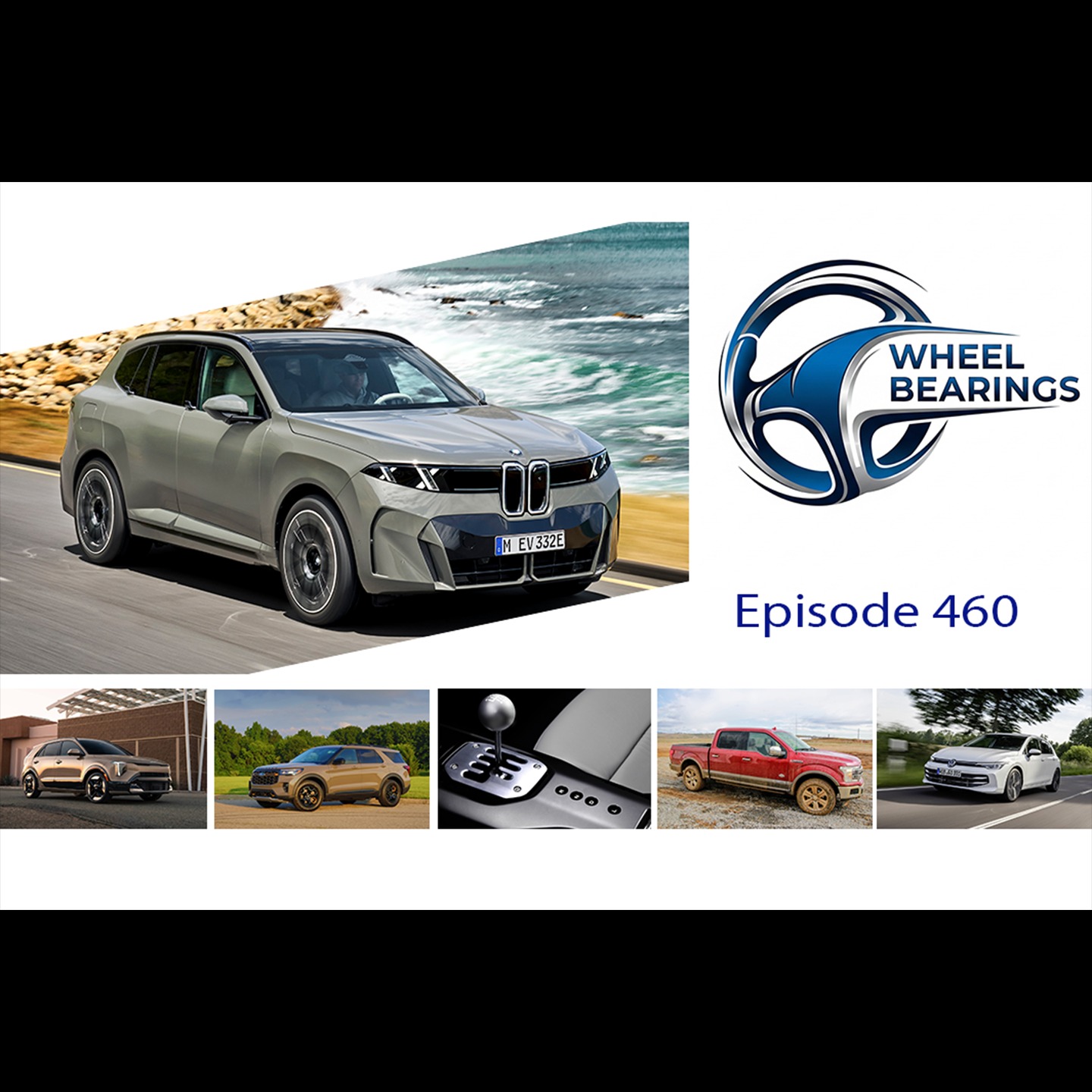
About this episode
The hosts kick off with holiday weekend stories, then pivot to Nicole’s brief drive of a 2026 Ford F-350 Super Duty King Ranch FX4 off-road diesel—an ultra-expensive, heavy-duty truck with a 6.7L high-output Power Stroke making 500 hp and 1,200 lb-ft. Nicole focuses on how quiet and refined the diesel feels, how luxurious the King Ranch interior is, and how hard it is to evaluate a towing-focused machine without actually towing. The conversation also touches on the sheer size of dually Super Duties and the mismatch between comfort and work capability.
Sam and Robbie both had the Ford Explorer Tremor this week and Nicole rounded out the Ford fest with the F-350 King Ranch PowerStroke duallie.
Diesel cars are fading away in Europe and BMW has launched the next-generation X5 including an all electric iX5. California is bringing back some EV incentives for first-time buyers and the Kia Niro is going hybrid only for 2027. Thieves have been stealing truckloads of batteries from a Tesla factory and Ferrari is bringing back a simulated manual transmission.
Sam also has a conversation with Christopher Maiwald, CEO and Founder of charger manufacturer Lectron.
Links
Diesel's demise nears as Volkswagen axes diesel Golf after 50 years | Autocar
Why Ford's 3.0L Power Stroke Diesel Died An Ignoble Death - Jalopnik
New California Incentive Gives Some First-Time EV Buyers $3,500 Instant Discount - Jalopnik
Our Readers Came Up With These Honest Auto Company Slogans - Jalopnik
Someone Keeps Stealing Entire Truckloads Of Tesla Batteries
Polestar Is Offering Up to $25,000 Off Its 3 and 4 EVs
Toyota Announces $3.6B Expansion, 2,000 New Jobs at its San Antonio Plant
Advertising Inquiries: https://redcircle.com/brands
Privacy & Opt-Out: https://redcircle.com/privacy

Ford F
"...n for a good chunk of last week. I drove the 2026 Ford F three fifty Super Duty King Ranch FX4 off-road. T..."
The Ford F-100 is a pickup truck model from Ford’s older truck lineup. The podcast mentions it because the speaker has been driving or thinking about different trucks. Older pickups can help show how parts like wheel bearings wear with time.
The Ford F-100 is a classic nameplate from Ford’s pickup lineup, typically associated with earlier generations of full-size trucks. In this podcast context, it’s referenced as part of the speaker’s driving history. That makes it relevant to discussions about wear items like wheel bearings, since older trucks can highlight how maintenance needs change over time.

2026 Ford F-350 Super Duty King Ranch FX4 off-road
"I drove very briefly because I was out of town for a good chunk of last week. I drove the 2026 Ford F three fifty Super Duty King Ranch FX4 off-road."
This is a Ford Super Duty truck—one of the biggest, strongest pickup models—meant for towing and tougher driving. The King Ranch trim is the nicer version, and FX4 off-road is the package that adds off-road-focused hardware.
The 2026 Ford F-350 Super Duty King Ranch FX4 off-road is a heavy-duty pickup built for towing and rough-road use. It’s notable here because Nicole specifically calls out the FX4 off-road package and the King Ranch trim, which are aimed at buyers who want maximum capability and comfort in a diesel tow rig.
FX4 off-road package
"I drove the 2026 Ford F three fifty Super Duty King Ranch FX4 off-road."
FX4 is Ford’s off-road option package. It adds features meant to help the truck handle rough roads better than a standard setup.
The FX4 off-road package is Ford’s factory bundle of off-road upgrades for the Super Duty line. It typically focuses on improving traction and durability for dirt roads, trails, and rough conditions.

XC 60
"My fleet company had said to me, You're getting an XC 60 this week."
The Volvo XC 60 is a smaller luxury SUV. Nicole is pointing out that she expected that kind of vehicle, but instead got a much bigger truck.
The Volvo XC 60 is a compact luxury SUV that Nicole mentions as part of her fleet assignment. She contrasts it with the much larger Ford Super Duty truck to highlight how different the driving experience is between a crossover and a heavy-duty pickup.
6.7 liter high output Power Stroke V8 turbo diesel
"it has a 6.7 liter high output power stroke v8 turbo diesel which is 500 horsepower and 1200 pound feet of torque"
This is Ford’s big diesel engine for heavy-duty trucks. It’s turbocharged and built to pull hard—especially when you’re towing heavy loads.
The 6.7-liter high-output Power Stroke V8 turbo diesel is Ford’s heavy-duty diesel engine used in Super Duty trucks. “Turbo diesel” means it’s a compression-ignition engine that uses a turbocharger to make strong low-end pulling power, which is why it’s emphasized for towing.
torque
"it has a 6.7 liter high output power stroke v8 turbo diesel which is 500 horsepower and 1200 pound feet of torque"
Torque is the engine’s pulling strength. For towing, higher torque usually means the truck can haul heavy stuff more easily.
Torque is the twisting force the engine produces, and it strongly affects how well a vehicle can pull heavy loads. In towing discussions, torque is often more important than horsepower because it helps the truck move and accelerate under load.
heavy duty towing
"so this is for heavy duty towing like really really really really heavy duty towing"
Heavy duty towing means hauling very heavy trailers regularly. It’s the kind of work that needs a truck built to pull hard without overheating or struggling.
Heavy duty towing refers to using a truck for sustained, high-load hauling—typically requiring a diesel engine and drivetrain designed to handle large trailers. It’s a use case where engine torque and cooling capacity matter more than everyday driving comfort.
diesel engine
"I love the diesel engine in this and I had to I double check before the show started because I thought, wait a minute, which engine should I have? ⁓ it has it, you know, there was an there was a diesel engine thing in trucks where it's like loud and obnoxious."
A diesel engine is the type of engine that runs on diesel fuel and uses compression to ignite the fuel. People often expect diesels to be loud, but this one sounds calm while driving.
A diesel engine is an internal-combustion engine that uses compression ignition (fuel ignites from heat/pressure created by compressing air). In trucks, diesels are often associated with strong torque for towing, but the host is emphasizing that this one is unusually quiet.
dually
"It's it's so big. It's so powerful. Now it was nice to drive, it was surprisingly, and it was dually like you've got it's crazy. ⁓ This wasn't this was a dually."
“Dually” refers to a dual-rear-wheel setup (two wheels on each side of the rear axle) used on heavy-duty trucks. It improves load-carrying and stability for towing, but it also makes the truck wider and harder to park or maneuver.
high towing tow rating
"⁓ the high payload, that it has the high towing tow rating, that it has the high output turbo diesel, that the King Ranch makes it really very fancy inside."
A towing rating is the maximum weight the vehicle is certified to tow under specified conditions. When the host says it has a high towing tow rating, they’re pointing to the truck’s capability for trailers and heavy loads.
high payload
"⁓ the high payload, that it has the high towing tow rating, that it has the high output turbo diesel, that the King Ranch makes it really very fancy inside."
Payload is the maximum weight you can carry in the truck’s bed and/or with passengers, within the vehicle’s certified limits. The host’s “high payload” point is about how much work material the truck can haul safely.
Apple CarPlay
"⁓ you got charging porch, you got Apple CarPlay, you've got all these, you've got all the bells and whistles and that really beautiful interior."
Apple CarPlay is a smartphone integration system that mirrors compatible iPhone apps onto the vehicle’s infotainment screen. It’s commonly used for navigation, music, calls, and messages while keeping the driver focused on the road.

Ford Edge
"...e parking lots I pulled into and I'm right at the edge edge. Like and I can see I am smack in that parki..."
The Ford Edge is a midsize SUV meant for everyday driving. The podcast mentions it while describing a parking situation and how close the vehicle was to the lines. That’s the kind of moment where you might notice how the tires and suspension behave.
The Ford Edge is a midsize crossover SUV designed for daily driving with a comfortable ride and practical space. In the podcast, it’s mentioned during a parking maneuver where the speaker talks about being close to the edge of a parking space. That kind of real-world driving detail is often where people notice steering feel, tire behavior, or undercarriage noises.
dual wheel rear axle
"They have you ever been sent an F four fifty dually? Or you're lucky. 'Cause if you think this is big, having the dual wheel rear dual wheel rear axle ⁓ really makes it challenging to go anywhere."
A dual wheel rear axle is the rear axle configuration that carries two wheels per side, creating the dually stance. This setup spreads weight better for heavy towing/hauling, but it also increases the truck’s width and makes tight spaces more difficult.
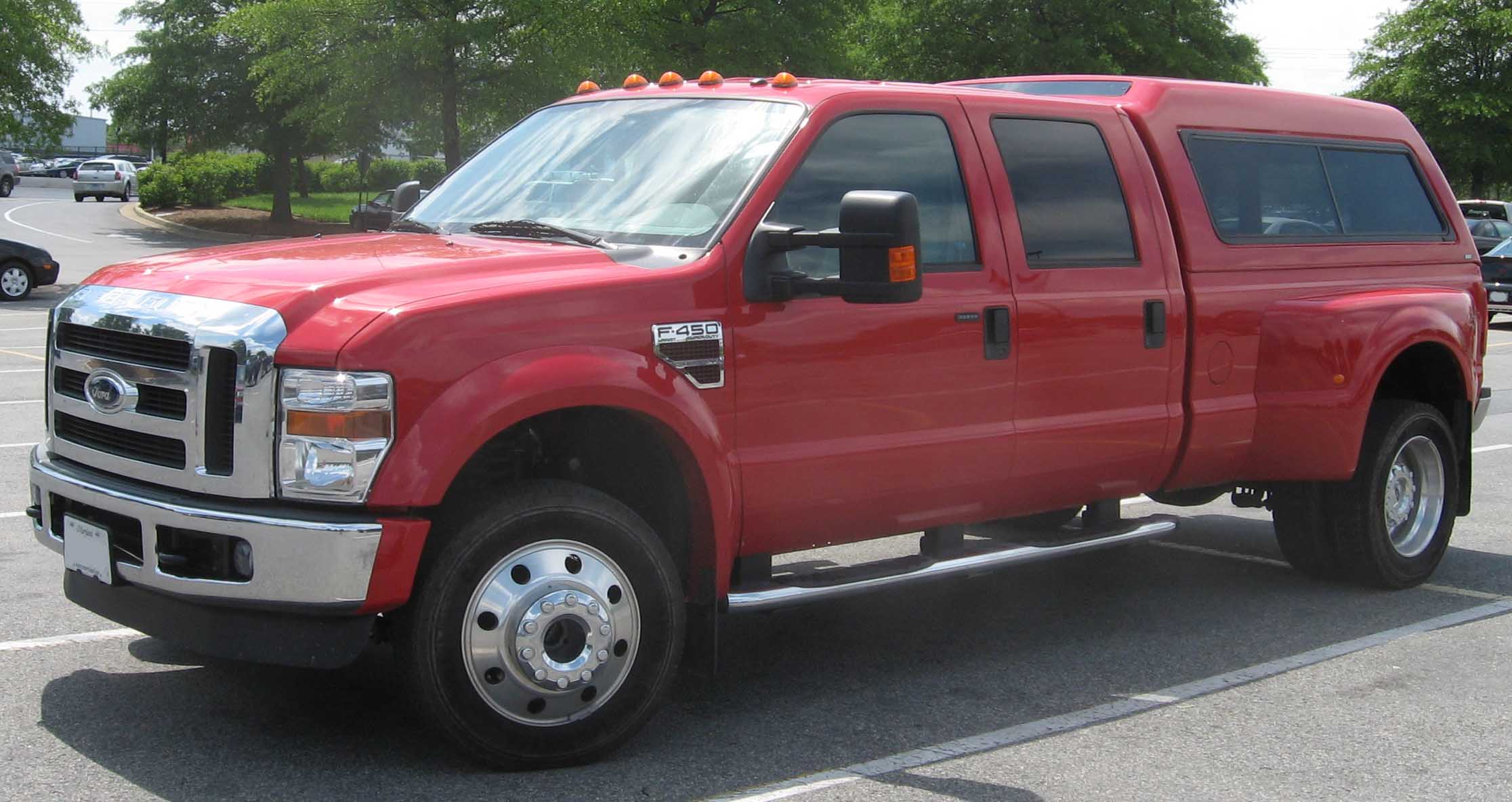
F four fifty dually
"They have you ever been sent an F four fifty dually? Or you're lucky. 'Cause if you think this is big, having the dual wheel rear dual wheel rear axle ⁓ really makes it challenging to go anywhere."
This refers to a Ford F-450 dually, which is a heavier-duty Super Duty variant than an F-350. The dually rear-wheel setup is the main reason it’s described as especially challenging to maneuver.

Ford Explorer
"Which is a car. Well it's not a car. It's an SUV. Okay, so the Ford Explorer, it's it's a cop car, is what it is."
The Ford Explorer is a midsize SUV. Here they’re talking about it as a police vehicle, which is a common real-world use case for this model.
The Ford Explorer is a midsize SUV, and in this segment it’s described as “a cop car,” meaning it’s used by police fleets. That context matters because fleet vehicles are often evaluated for durability, packaging, and drivability under continuous stop-and-go use.
Tremor package
"But then they said, Hey, you know what we should do? We should put a tremor package on there. I d so now the car makes zero sense in my opinion."
A Tremor package is an add-on that makes a vehicle more capable off-road. It usually includes things like extra protection underneath and tires meant for rougher surfaces, but the hosts think it’s not the best fit for this SUV’s real-world job.
The Tremor package is an off-road appearance-and-function package that typically adds hardware like skid plates, all-terrain tires, and increased ride height. The hosts argue it can make sense on a smaller truck, but feels mismatched when applied to a heavy SUV meant for daily use.
EcoBoost twin turbo three liter V six
"It's got it's what is it? So th they outfit it with a Eco Boost twin turbo three liter V six has four hundred horsepower, four hundred and fifty pound feet of torque."
EcoBoost is Ford’s way of using turbochargers to make an engine feel stronger. “Twin turbo” means there are two turbo units helping the engine make more power, and “three liter V6” tells you it’s a V-shaped six-cylinder engine with a 3.0-liter displacement.
EcoBoost is Ford’s turbocharged engine family, and “twin turbo” means two turbochargers help force more air into the engine for higher output. A “three liter V6” describes the engine’s size and cylinder layout (six cylinders in a V shape), which is the basis for the power and torque figures discussed.
skid plates
"It it's you know, it's got it's got some underbody protection. You know, it's got a couple of skid plates and all terrain tires."
Skid plates are protective shields under the car. They help prevent damage if you hit the ground while driving on rough trails.
Skid plates are protective metal or composite panels mounted under a vehicle to shield vulnerable components from impacts when driving over rocks, ruts, or uneven terrain. Here, they’re mentioned as part of the Explorer’s off-road-oriented setup.
all terrain tires
"You know, it's got a couple of skid plates and all terrain tires."
All-terrain tires are tires meant for more than just smooth roads. They’re built to handle dirt and rougher surfaces better than regular street tires.
All-terrain tires are designed to work across mixed surfaces—pavement, dirt, gravel, and light trails—using a tread pattern that balances grip and durability. The hosts connect them to the vehicle’s off-road package and the idea of “underbody protection.”

Ford Maverick
"I'm like, okay. An F one fifty tremor, sure. ⁓ the the Maverick tremor, why not?"
The Ford Maverick is a smaller pickup, and the Tremor version is meant to be more off-road capable. The hosts compare it to the Explorer to say the off-road package fits the truck’s purpose better.
The Ford Maverick is a smaller pickup truck, and the “Tremor” version is aimed at off-road styling and capability. The hosts use it as a comparison point to argue that a Tremor package makes more sense on a smaller truck than on a heavy SUV.
ground clearance
"If if anything, you know, the Explorer is actually gonna be a lot more useful off road than a Maverick. You know, it's got more ground clearance."
Ground clearance is how much space there is between the bottom of the vehicle and the ground. More clearance helps you avoid hitting the ground when roads get bumpy or uneven.
Ground clearance is the distance between the lowest part of the vehicle and the road. More ground clearance helps reduce the chance of scraping the underbody and improves how well a vehicle can handle uneven off-road terrain.
captain's chairs
"It has the captain's chairs in the back, which is like cool. I guess that's fancy. That's nice."
Captain’s chairs are separate seats with space between them, not a single long bench. The hosts bring them up because the Explorer’s back row feels more like a minivan setup.
Captain’s chairs are individual, separated seats (instead of a single bench) typically used in the second row of some SUVs and minivans. The hosts mention them to describe how the Explorer’s rear seating feels “like a minivan,” which affects how practical it is for a family.
wireless charger
"this is not a cheap vehicle. But it's the first vehicle I've gotten into in a while that isn't like an entry level sort of like price range that doesn't have a wireless charger."
A wireless charger lets you charge your phone without plugging in a cable. The hosts are surprised the Explorer doesn’t include it, even though the vehicle isn’t cheap.
A wireless charger is a phone-charging system that transfers power without plugging in a cable, usually via inductive charging. The hosts are surprised this vehicle lacks wireless charging despite being a higher-priced model.
USB port
"there's two little shelf there's like a shelf and then there's like a little hole where you can where the where the USB Port is, but you know, both of them have like rubber are rubberized."
A USB port is the connection you plug a cable into to charge a phone or other device. They’re talking about the location of the USB port and how they tried to charge their phone.
A USB port is a standardized connection used to power and/or transfer data to devices like phones. In this segment, the hosts discuss where the USB port is located and how it relates to charging.
wireless charging
"One of the number one things people want from the cars now is wireless charging. People don't want cables, apparently. They just want to stick their phone down, have it charge, and just go and do whatever they have to do."
Wireless charging means you can charge your phone without plugging it in. You just set your phone on a charging pad in the car and it charges automatically.
Wireless charging lets you charge a phone without plugging in a cable, usually using an inductive charging pad inside the car. Drivers typically place the phone on a designated spot and the car transfers power through electromagnetic fields.
Android auto
"Which I understand. You know, ⁓ it does have CarPlay and Apple Auto and it's or I'm sorry, ⁓ Android auto, not Apple Auto."
Android Auto is a way to connect your Android phone to the car’s screen. It brings things like maps and music to the dashboard so you can use them more safely.
Android Auto is a smartphone integration system that mirrors compatible apps and navigation to the car’s infotainment screen. It’s designed to make phone functions easier to use while driving, typically via USB or sometimes wireless connectivity depending on the car.
twin turbo V six
"It's not sipping gases I can tell you that with that twin turbo V six. It's just gulping it down."
A twin-turbo V6 is a V-shaped 6-cylinder engine with two turbochargers. Turbos help the engine make more power, but they can also lead to higher fuel use when you drive it hard.
A twin-turbo V6 uses two turbochargers to force more air into a V6 engine, improving power and responsiveness. In this context, the host is contrasting fuel economy expectations with how the engine actually feels and drinks fuel.
rubber floor mats
"They did have like rubber rubber you yeah, I love rubber floor mats. I don't know why we put carpet in any car that's not a luxury car."
Rubber floor mats are tough mats that protect your car’s carpet from dirt and spills. They’re usually easier to hose off than carpet.
Rubber floor mats are protective mats designed to be easy to clean and resistant to mud, snow, and spills. The hosts prefer them over carpet in non-luxury vehicles because they’re better suited to messy everyday use and off-road-ish conditions.
suspension
"Typically, you know, for an off road vehicle you want the suspension to be a little more compliant, you know, so that when you go over bumps and rocks and stuff, the wheels can actually move up and down."
Suspension is what helps the car absorb bumps. If it’s tuned for off-road, the wheels can move more over rough ground so the ride stays controlled.
Suspension is the system of springs, shocks, and linkages that controls how the wheels move over bumps and how the car rides. The host is specifically talking about suspension compliance—how easily the wheels can move up and down so the tires maintain contact over rocks and uneven ground.

Hyundai Palisade
"…if you know, if someone in the family insisted that… you had to have some sort of SUV like vehicle. This… it'd be okay… but it wouldn't be my first choice. You know, I would take, you know, a Palisade or a Telluride over this."
The Hyundai Palisade is a family SUV with three rows of seats. The hosts are using it as an example of a more sensible choice for hauling kids than the Explorer Tremor.
The Hyundai Palisade is a three-row midsize SUV known for family-focused comfort and space. In this segment, it’s mentioned as a better first choice than the Ford Explorer Tremor if someone insists on an SUV instead of a minivan.
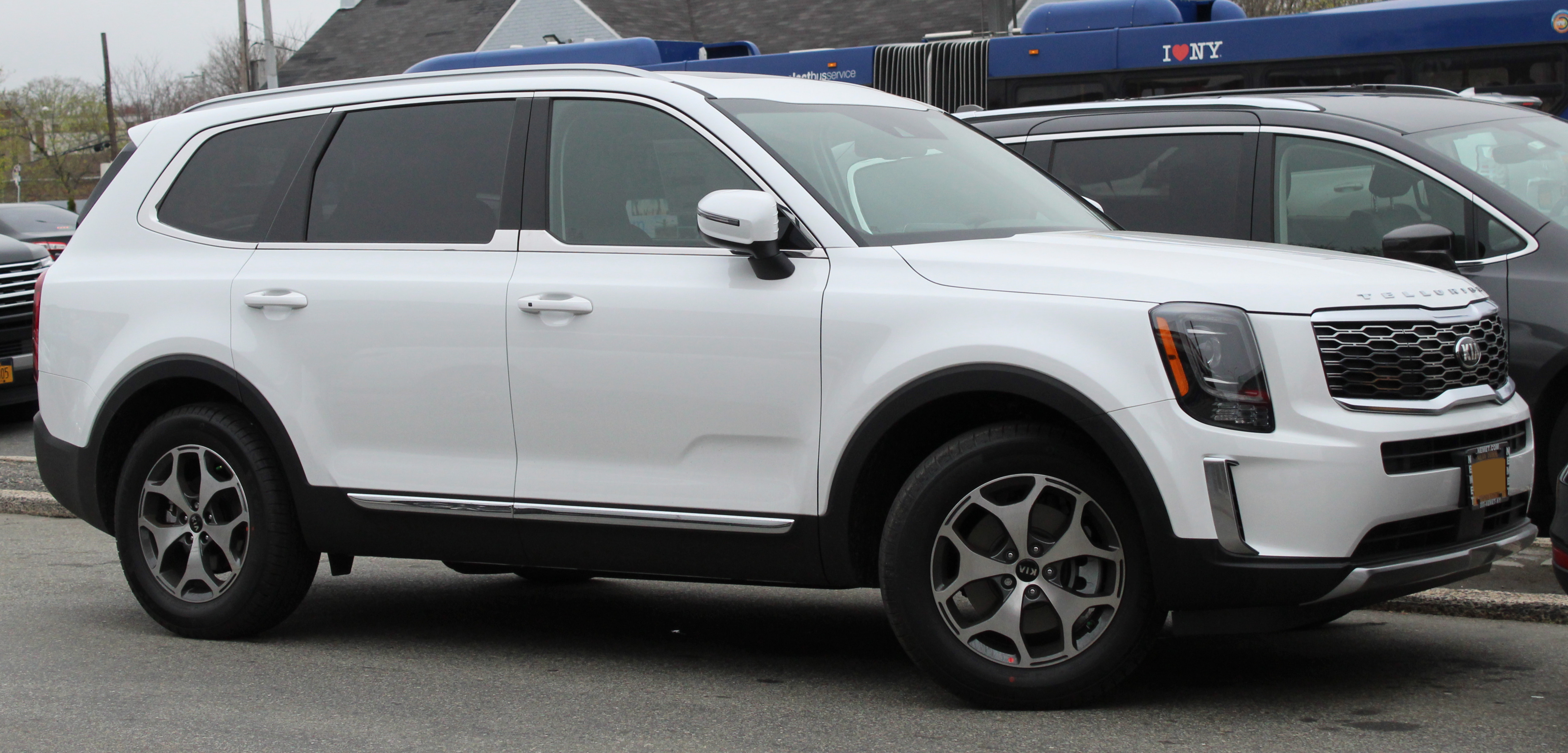
Kia Telluride
"…it wouldn't be my first choice. You know, I would take, you know, a Palisade or a Telluride over this."
The Kia Telluride is a family SUV with three rows. The hosts mention it as a better pick than the Explorer Tremor for people hauling kids around.
The Kia Telluride is a three-row midsize SUV that’s popular with families for its roomy interior and easy daily usability. Here it’s compared directly against the Ford Explorer Tremor as a more appropriate choice if you need an SUV instead of a minivan.
Blue Cruise
"I did I did go out and do some highway driving with with the Blue Cruise to try out… it's got the latest version of Blue Cruise on there… Blue crew is always used to give up and just say, put your hands back on the wheel…"
Blue Cruise is Ford’s system that can help drive on some highways. It can reduce how much you have to steer, but it still makes sure you’re paying attention and ready to take over.
Blue Cruise is Ford’s hands-free driver-assistance system for certain highways, using sensors and mapping to guide the car while the driver monitors the system. The segment focuses on how the latest Blue Cruise version behaves better than earlier iterations, but still requires driver attention checks.
capacitor sensors
"…then it still has that problem that all Ford vehicles of the last half dozen years have had because Ford still will not put ⁓ capacitor sensors in their steering wheels. So they don't really know if your hands are on the wheel."
Capacitor sensors in a steering wheel detect driver hand presence by measuring changes in electrical capacitance when skin is near the wheel. The hosts criticize Ford for not using these sensors, which leads to more frequent “hands on wheel” prompts and reminders to move or jiggle the wheel.
Roberto Baldwin
"Roberto Baldwin (27:13) you're right, it does have the badge. Never mind…"
Roberto Baldwin is another person on the podcast. Here he mostly chimes in with quick corrections and jokes rather than deep technical details.
Roberto Baldwin is a podcast participant who reacts to the hosts’ points and contributes commentary, including correcting details about the Tremor badge and joining the destination-charge guessing game. His lines are mostly conversational rather than technical.
power folding
"…And and the third row seats are power folding, so there's couple of buttons in the back that you know, you can put the seats down, put back up."
Power folding means the seats move automatically with buttons. In this case, the third-row can fold down to make extra room without you wrestling with it by hand.
Power folding refers to seats that fold and unfold using electric motors and buttons, rather than requiring manual effort. Here it’s used for the Explorer’s third-row seats, letting the driver quickly create more cargo space.
Sam Abuelsamid
"Sam Abuelsamid (27:24) And and the third row seats are power folding…"
Sam Abuelsamid is one of the people talking on the podcast. In this part, he shares hands-on impressions about the vehicle features and driving tech.
Sam Abuelsamid is a journalist/analyst who co-hosts or contributes to the discussion and provides the technical and practical commentary in this segment. His remarks cover third-row seat operation, fuel economy impressions, and the Blue Cruise behavior.
Nicole Wakelin
"Nicole Wakelin (28:13) we're gonna go twenty seven hundred. I'm gonna do what the other one was…"
Nicole Wakelin is another person on the podcast. In this part, she’s mainly involved in the playful guessing game, not the car-tech explanation.
Nicole Wakelin is a podcast participant who participates in the destination-charge guessing and banter. In this segment, her contribution is not primarily technical.
diesel penetration
"Sam Abuelsamid (29:10) All right. Let's let's move on. ⁓ so Nicole, you had a diesel engine in that F three fifty. But ⁓ diesels are ⁓ they're they're starting to shrink. ⁓ you know, they're they're losing their losing their appeal in the market. especially in Europe where you know, not so long ago, you know, prior to twenty fifteen, you know, diesels were were counted for half the market in Europe. Sam Abuelsamid (29:37) and in some countries in Europe it was, you know, significantly over that. I think in Italy at one point they were up to about eighty percent diesel penetration."
Diesel penetration just means “how common diesel cars are” in a country or region. The hosts are saying diesel used to be a huge part of the European market, but it’s shrinking.
Diesel penetration is the share of vehicles in a market that are diesel-powered. The hosts use it to describe how diesel was once extremely common in Europe (including very high percentages in some countries) before declining.
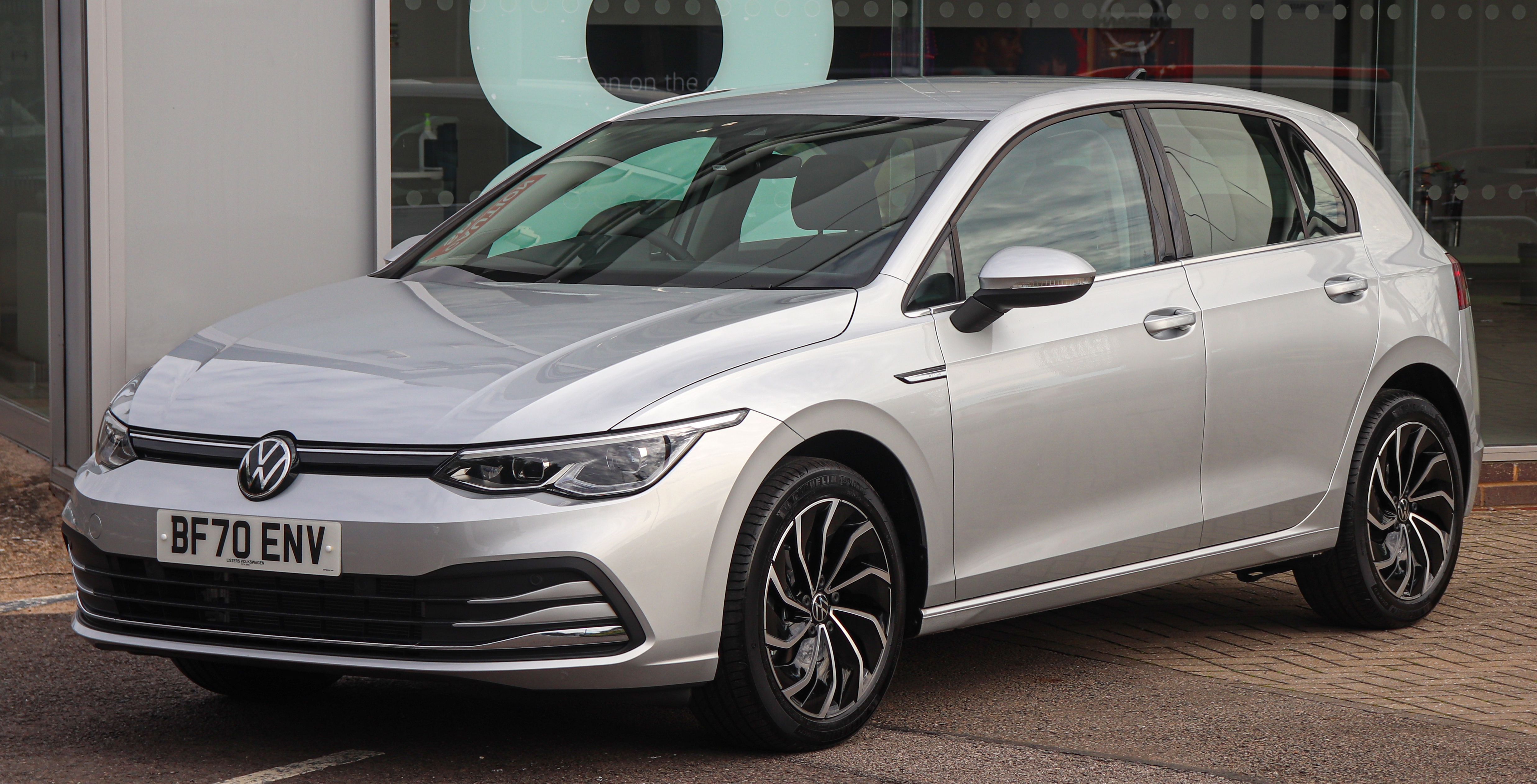
Volkswagen Golf
"Sam Abuelsamid (29:37) and in some countries in Europe it was, you know, significantly over that. I think in Italy at one point they were up to about eighty percent diesel penetration. which is kinda kinda nuts. ⁓ but ⁓ now, you know, one of the first mainstream cars with a diesel engine was the Volkswagen Golf back in the mid nineteen seventies. And ⁓ they're winding down golf diesels. ⁓ they've already pulled it out of the market in the UK."
The Volkswagen Golf is a very common small car. In the past, it was one of the early popular choices for diesel engines, but the hosts say Europe is moving away from diesel and the Golf diesel is being removed.
The Volkswagen Golf is a long-running compact hatchback that became one of the first mainstream cars to offer a diesel engine in the mid-1970s. In this segment, the hosts use it as an example of how “diesel cars” are being phased out in Europe, including the UK.
dieselgate
"And of course, you know, that's that's why, you know, de one of the reasons diesels are going away is because of dieselgate, you know, 'cause VW kind of cheated a little on emissions testing."
Dieselgate was a major scandal involving Volkswagen diesel cars. The claim is that the cars didn’t meet emissions rules in real life the way they did on tests, and it led to big penalties.
Dieselgate refers to Volkswagen’s emissions-cheating scandal, where software was used to defeat or manipulate emissions testing results. The hosts connect it to why diesel cars are losing appeal and why Volkswagen faced fines and buybacks.
particulate filter
"but by the time by the time we owned our Jetta diesel that we bought in twenty ten, ⁓ it no longer did that because it had a particulate filter on there. And that, you know, at least the particulate filter was functional."
A particulate filter is an emissions device that catches the smoky soot from a diesel engine. It helps keep the exhaust cleaner by trapping soot and then burning it off later.
A particulate filter (often called a diesel particulate filter, DPF) traps soot particles produced by a diesel engine. It periodically cleans itself by burning off the trapped soot, which is why the host says their Jetta’s particulate filter was functional and reduced the “smoke screen” effect.
Nox filter
"And that, you know, at least the particulate filter was functional. ⁓ the the Nox filter, not so much, but the particulate filter was functional."
A NOx filter is meant to reduce a harmful exhaust gas called NOx from diesel engines. The host is saying their car’s soot filter worked better than the system meant to control NOx.
A NOx filter refers to emissions-control systems aimed at reducing nitrogen oxides (NOx) from diesel exhaust. In this segment, the host contrasts it with the particulate filter, saying the NOx filter “wasn’t so much” functional, which ties into why diesel emissions regulation became a major issue.

Volkswagen Jetta diesel
"but by the time by the time we owned our Jetta diesel that we bought in twenty ten, ⁓ it no longer did that because it had a particulate filter on there. And that, you know, at least the particulate filter was functional. ⁓ the the Nox filter, not so much, but the particulate filter was functional."
The Volkswagen Jetta diesel is a diesel-powered Jetta. The hosts talk about the emissions equipment on their diesel Jetta—some parts helped with soot, but other emissions controls weren’t as effective.
The Volkswagen Jetta diesel is a compact sedan variant that used emissions-control hardware to reduce soot and nitrogen-oxide pollution. Here it’s specifically tied to how diesel aftertreatment systems (like particulate filters) can work, while other parts (like NOx control) may not perform as well.
International Council for Clean Transportation
"Sam Abuelsamid (31:20) I was they they paid a few tens of billions of dollars in fines and had to buy back hundreds of thousands of cars and Yeah. ⁓ I I was looking up some I was looking up some data last week when I saw this and according to I C C T, which was the organization that uncovered the whole dieselgate thing, the International Council for Clean Transportation."
The International Council for Clean Transportation is a group that studies clean transportation and emissions. The hosts mention it as the organization that helped expose what happened with dieselgate.
The International Council for Clean Transportation (ICCT) is an independent organization that investigated and helped uncover the dieselgate emissions issue. In the segment, it’s cited as the group that “uncovered the whole dieselgate thing.”

Ford F-150
"opportunity, you know, with a th F three fifty dually diesel and you missed it. ⁓ did did either of you ever drive the ⁓ F one fifty diesel that they sold back starting in ⁓ twenty eighteen? Nicole Wakelin (33:19) I don't I mean, I don't think so."
The Ford F-150 is a very common big pickup truck. Here they’re talking about Ford adding a diesel engine option to it in 2018, and how that fits into the broader decline of diesel cars.
The Ford F-150 is a best-selling full-size pickup, and this segment focuses on its diesel options. The hosts specifically discuss Ford launching a 3.0-liter diesel V6 in the F-150 starting in 2018, which is a key example of automakers trying to keep diesel alive in light-duty trucks.
three liter diesel V six
"for Ford you know, Ford launched you know, a three liter diesel V six in the in the F one fifty in twenty eighteen. And ⁓ you know, it like back back it in like the late two thousands, all you know, Stallant or well Dod Ram, yeah, still Dodge actually at the time."
This means a diesel engine with six cylinders, shaped like a “V,” and about 3.0 liters of total engine size. The hosts say Ford put this engine into the F-150 starting in 2018.
A “3.0-liter diesel V6” describes a diesel engine with six cylinders arranged in a V configuration and a displacement of about 3.0 liters. In this segment, it’s the diesel powerplant Ford launched in the F-150 in 2018.

Nissan Titan
"... the five liter Cummins diesel that went into the Nissan Titan for a while. That was originally designed for the..."
The Nissan Titan Crew Cab is a pickup truck with a larger cabin for more passengers. The podcast mentions it because, for a while, it was offered with a Cummins diesel engine. Different engines can change how the truck is maintained and used.
The Nissan Titan Crew Cab is a full-size pickup variant that prioritizes passenger space with a crew-style cabin. In the podcast, it’s mentioned in relation to a five-liter Cummins diesel that was used in the Titan for a period. That’s relevant because engine and drivetrain choices can influence maintenance schedules and how components are stressed.
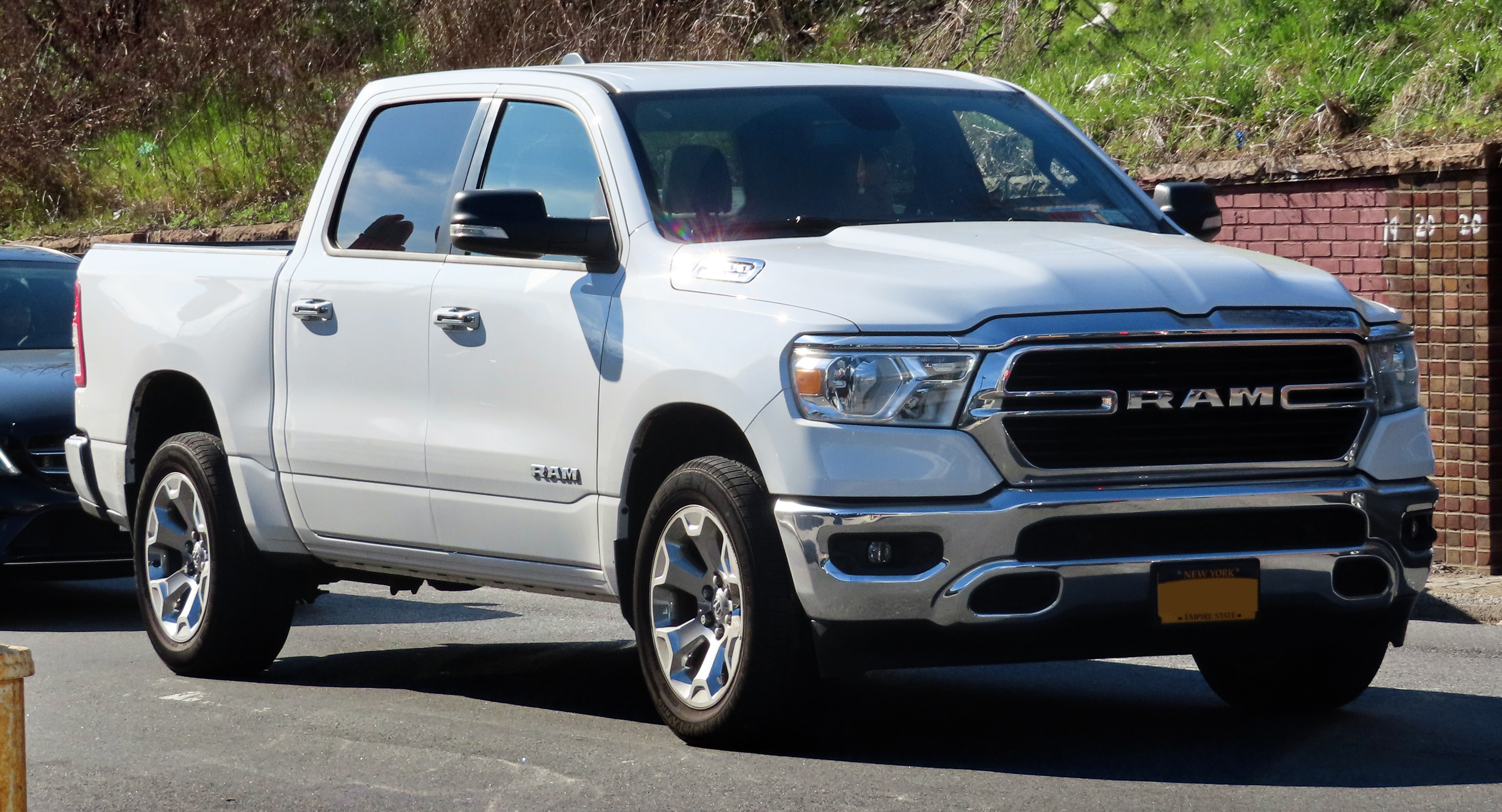
Ram 1500
"That was originally designed for the Dodge Ram. That was supposed to go into the Ram fifteen hundred. And then then they canceled that program. Dodge canceled it when they were going through their bankruptcy."
The Ram 1500 is a pickup truck model. The hosts talk about diesel engine plans that were supposed to go into it, but those plans changed and some programs were canceled.
The Ram 1500 is a light-duty pickup from Stellantis’ Ram brand, and the segment discusses diesel plans for it. The hosts mention a proposed engine (including a Cummins diesel) that was originally intended for the Ram 1500 before being canceled.
Cummins diesel
"Well actually at one point they were going to put ⁓ you know, the five liter Cummins diesel that went into the Nissan Titan for a while."
Cummins is a company that makes diesel engines. The hosts mention Cummins diesel because other truck makers were considering using that engine in their pickups.
Cummins diesel refers to diesel engines made by Cummins, a major engine supplier. The segment uses it as an example of how different automakers considered or used Cummins powerplants in their trucks as part of their diesel plans.
EcoDiesel V6
"Dodge, you know, was gonna do their the three liter ⁓ ecodiesel that they you know, and they eventu they eventually did that. Well actually at one point they were going to put ⁓ you know, the five liter Cummins diesel that went into the Nissan Titan for a while."
EcoDiesel V6 is a diesel engine option used in some Ram pickups. The hosts are saying it became part of their diesel strategy, but it didn’t go smoothly financially or legally.
EcoDiesel V6 refers to a diesel V6 engine family used in some Ram trucks. In the segment, it’s mentioned as the diesel engine Dodge/Ram eventually pursued after earlier plans, and the hosts say it later cost money and led to fines.

Nissan Titan
"Well actually at one point they were going to put ⁓ you know, the five liter Cummins diesel that went into the Nissan Titan for a while."
The Nissan Titan is a big pickup truck. The hosts mention it because a diesel engine (from Cummins) was used in it temporarily while companies were experimenting with diesel options.
The Nissan Titan is a full-size pickup, and the hosts mention it in the context of diesel engine sourcing. They say a Cummins diesel was used in the Titan “for a while,” as part of the broader story of automakers trying different diesel strategies.

Dodge Ram
"...for a while. That was originally designed for the Dodge Ram. That was supposed to go into the Ram fifteen hun..."
The Dodge Ram is a large pickup truck made for towing and carrying loads. The podcast mentions it because a certain design was originally intended for the Ram 1500. That means the idea started with that truck before being used elsewhere.
The Dodge Ram is a full-size pickup truck line known for towing and hauling capability. The podcast references an earlier plan for a component or system that was originally designed for the Ram 1500. That kind of historical design detail can come up when people talk about how parts evolved across models.

Range Rover
"And ⁓ Ford was working on a four point four liter diesel V eight, which 2687.7s got cancelled from the F one fifty program, but they did event they did ultimately end up building that. But they used it in ⁓ in Europe in Range Rovers and Land Rover models."
Range Rover is a luxury SUV. The hosts say a diesel V8 that was canceled for the F-150 program still got used in Europe in Range Rover models.
Range Rover is Land Rover’s luxury SUV line, and the hosts mention it as a place where a diesel V8 concept engine ended up being used. This highlights how some diesel development plans shifted toward premium SUVs rather than light-duty trucks.

BMW X5
"BMW had an event in Spartanburg last week at their factory down there where they where they build the X five to unveil the next generation X five. ... they unveiled the all new X five."
The BMW X5 is a popular luxury SUV from BMW. In this episode they’re talking about the newer version—what it looks like outside, and what kind of tech and power options it will have.
The BMW X5 is BMW’s midsize luxury SUV, and this segment is about its next-generation redesign. They discuss how the new X5 grows slightly, changes its front “kidney” grille styling, and shares interior/tech ideas with the BMW iX3.
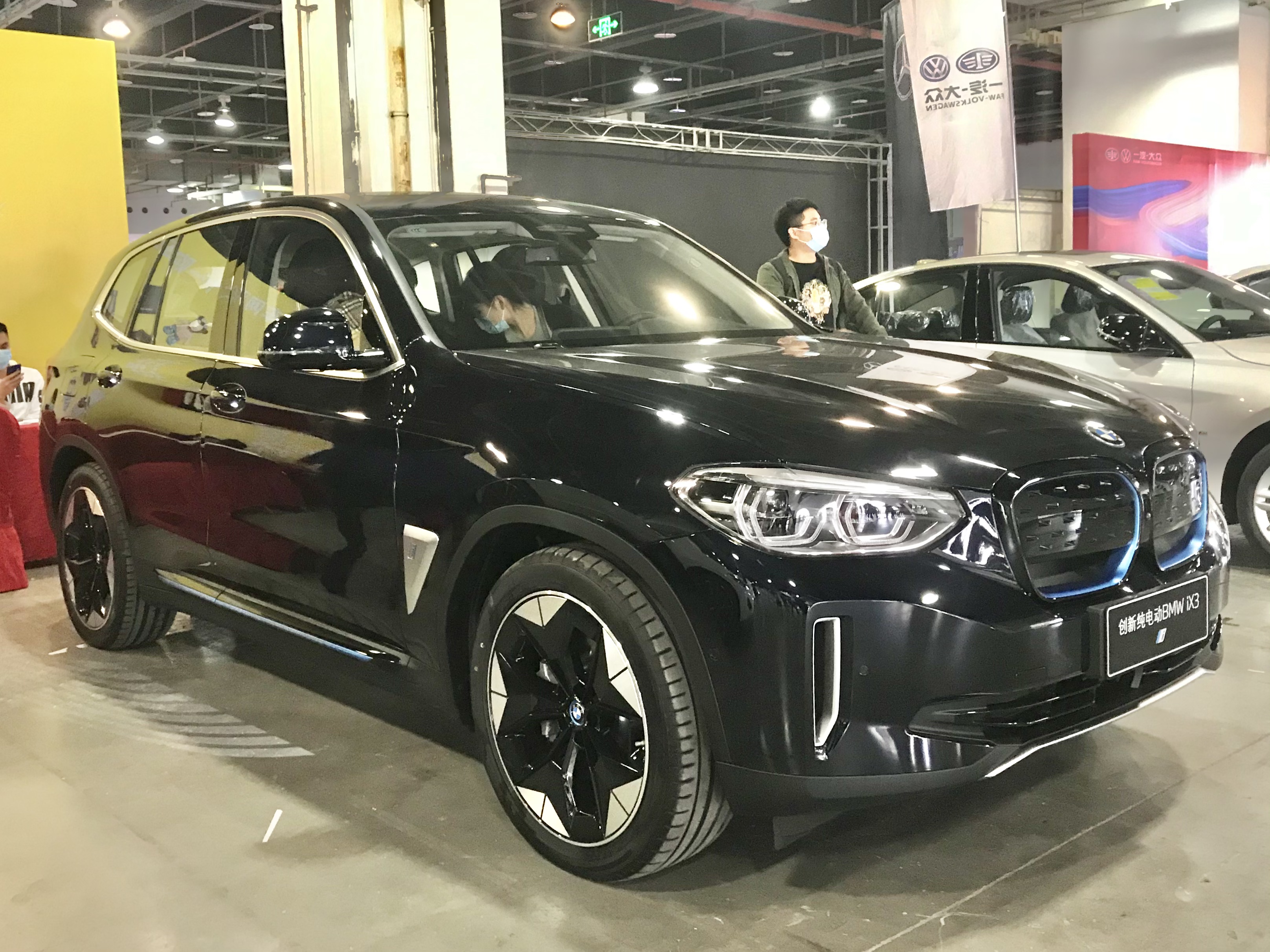
BMW iX3
"they made the grill, the the kidneys... just like they did with the new IX three. ... the interior is a lot like the the new IX three. ... it's got that same parallelogram shaped center display ... software controlled vents."
The BMW iX3 is BMW’s electric SUV. They compare the new X5 to it because the iX3 uses similar interior screens and some of the same tech features.
The BMW iX3 is BMW’s electric SUV, and the hosts use it as a reference point for the new X5’s design and tech. They mention shared hardware and interior elements like the software-controlled vents and the same kind of large, modern display layout.
kidney grills
"they made the grill, the the kidneys, the grill kidney grills a lot smaller, just like they did with the new IX three."
BMW’s “kidney grills” are the brand’s recognizable front grille shape. In this episode they’re saying BMW made that grille smaller on the new X5.
“Kidney grills” is BMW’s signature grille shape, named for its distinctive kidney-like openings. The hosts say the new BMW X5’s kidney grille is smaller, and they connect the styling change to what BMW did on the newer iX3.

Neuer Class
"...of this new X five? I mean it just looks like the Neuer class. You know. There you go. Big big Noya class. Ow, ..."
“Neue Klasse” is a name BMW uses for its next big plan for new cars. The podcast mentions it because the speaker thinks a new vehicle looks like it belongs to that new generation. When a company changes its platform, it can change how the car is built and maintained.
“Neue Klasse” refers to BMW’s new vehicle platform strategy, discussed in the context of what the next-generation cars will look and be built around. In the podcast, it’s mentioned as a comparison to a new X5 design, with the speaker focusing on the name and the idea of a new class of vehicles. Platform changes are significant because they can affect vehicle architecture, including how components are packaged and serviced.
software controlled vents
"it's also got a lot other things from the IX three like the the software controlled vents."
These are air vents in the dashboard that can be controlled electronically. Instead of adjusting them only with physical knobs, the car’s system manages how the air flows.
Software-controlled vents are HVAC air vents whose airflow direction and/or settings are managed by electronic controls rather than purely mechanical linkages. The hosts mention this as a carryover from the BMW iX3 interior experience into the new BMW X5.
plug-in hybrid
"there then there's a forty eight volt mild hybrid. There's a plug in hybrid version of that."
A plug-in hybrid is part gas car and part electric car. You can charge it by plugging it in, and it can often drive some distance on electricity before the gas engine takes over.
A plug-in hybrid (PHEV) combines an internal-combustion engine with a battery that can be charged from an external power source. The hosts say the new BMW X5 will have a plug-in hybrid version alongside its other powertrains.
mild hybrid
"they're launching with four different powertrains. ... an updated version of the three liter turbo six cylinder ... and there then there's a forty eight volt mild hybrid."
A mild hybrid is a car that has a small electric assist system. It helps the engine (for example during acceleration or stop-and-go), but it’s not meant to replace the engine like a full electric car.
A mild hybrid uses a small electric system to assist the engine, but it doesn’t typically drive the car purely on electricity for long distances. In this segment, the new BMW X5 lineup includes a 48-volt mild-hybrid version as one of its powertrain options.
battery electric
"There's a full battery electric IX five. ... uses a lot of the Noya class hardware from the the IX three. ... it's now five hundred and seventy horsepower. it's got a cell to pack battery."
A battery electric vehicle is the fully electric kind of car. It uses a big battery to power the motor, and you charge it like a phone—by plugging it in.
A battery electric vehicle (BEV) runs on electricity stored in a large battery pack, with no gasoline engine driving the wheels. The segment says the BMW iX5 will be a full battery electric model using hardware from the iX3, and they quote an output figure and battery-pack mention.
hydrogen fuel cell
"they're also gonna be doing a hydrogen fuel cell version of this, which you know, maybe three people will buy. ... in Germany there actually are more ... hydrogen fueling stations."
A hydrogen fuel cell car makes electricity using hydrogen. Instead of plugging in, you’d refuel hydrogen—but it only works well where there are hydrogen stations.
A hydrogen fuel cell vehicle generates electricity onboard by combining hydrogen with oxygen, then uses that electricity to power the drivetrain. The hosts discuss a hydrogen fuel cell version of the BMW X5/iX5 concept and debate how practical it is given fueling-station availability.
light signatures
"…everyone light signatures are sort of a big deal for a lot of these automakers at this point 'cause you gotta figure out something, especially when you're making an SUV that all look the exact same from the profile."
“Light signatures” are the recognizable look of a car’s lights—especially the daytime running lights. Car makers use them so you can tell what model it is even from a distance.
“Light signatures” are the distinctive shapes and patterns of a car’s exterior lighting (like headlights and DRLs) that help identify the brand and model at a glance. Automakers use them heavily because many SUVs look similar in silhouette from the side.
EV
"…there was that moment where everybody was trying so hard to have everything. We're gonna have EVs, but then we're gonna have a plug-in hybrid, we're gonna have a hybrid…"
“EV” means electric vehicle—cars powered primarily by an electric motor and a battery, rather than a gasoline engine. In the discussion, EVs are contrasted with hybrids and plug-in hybrids in terms of what automakers are prioritizing.
powertrain lineup simplification
"…they're all realizing like we we don't need four different powertrains for every single vehicle we have. How about we pick what works best?…"
They talk about car companies simplifying their lineup—offering fewer different types of powertrains. The idea is that the market isn’t rewarding “one of everything” strategies.
The hosts discuss automakers moving away from offering multiple powertrain options (EV, plug-in hybrid, hybrid, and gas) for every model. They argue the market is pushing companies to pick fewer, more successful configurations.
Bev
"…If you can look at the Bev versus P Hev like sales numbers, like EVs are like killing it…"
“Bev” means battery electric vehicle—an EV that runs on a battery. The hosts are comparing how well these sell versus plug-in hybrids.
“Bev” is shorthand for battery electric vehicle (BEV). The hosts use it when comparing BEV sales to plug-in hybrid (PHEV) sales.
P Hev
"…If you can look at the Bev versus P Hev like sales numbers, like EVs are like killing it and then people are like, No, but P P hevs, you know, plug in hybrids are the future…"
“P Hev” means plug-in hybrid. It’s the kind of hybrid you can charge from a plug, and the hosts are saying it sells less than full electric cars.
“P Hev” is shorthand for plug-in hybrid vehicle (PHEV). The hosts compare plug-in hybrid sales to EV sales to argue that plug-in hybrids aren’t meeting expectations.

Ford Bronco
"Maverick Hybrid and Bronco set records. So if you scroll down in that sales release to where they actually have the sales numbers, you know, said fur remember it said first half growth in that headline."
The Ford Bronco is Ford’s rugged, off-road SUV. The hosts bring it up because it’s selling very well right now.
The Ford Bronco is Ford’s off-road-focused SUV line, known for rugged styling and trail capability. Here, it’s mentioned as setting sales records alongside the Maverick Hybrid.
Ford Maverick Hybrid
"yeah, they the headline on Ford's sales June sales release says Ford Large SUVs and F series lead first half growth. Maverick Hybrid and Bronco set records."
The Ford Maverick Hybrid is a small pickup truck that uses a hybrid system to help it use less fuel. The hosts mention it because it’s selling well compared to other trucks.
The Ford Maverick Hybrid is a compact pickup from Ford that uses a hybrid powertrain to improve fuel economy versus a traditional gasoline truck. In this segment, it’s cited as one of the models driving Ford’s sales growth.

Ford F series
"well actually for the for the second quarter we're down ten point three percent. So where's the growth? And large trucks, you know, F series ⁓ was down eleven percent."
The Ford F-Series is Ford’s long-running lineup of full-size pickup trucks (including the F-150 and related models). In the segment, it’s used as a benchmark for how Ford’s “large trucks” are performing year-to-date.

Ford Expedition
"It's down thirteen percent overall since the beginning of the year. ⁓ and the explor or the expedition down twenty seven percent."
The Ford Expedition is a large SUV meant for families, with room for multiple passengers. In this discussion, it’s mentioned because its sales are falling.
The Ford Expedition is Ford’s full-size three-row SUV, positioned for families and towing. The hosts cite it as being down sharply in sales, contrasting with the models that are “setting records.”
depreciates
"Yeah, it depreciates. It's not yeah."
Depreciation means your car is worth less as time goes on. The point here is that you shouldn’t treat a car like an investment that will hold its value.
Depreciation is the loss of a vehicle’s value over time. The hosts argue that cars typically depreciate (unlike a house or certain collectibles), so buyers should think about total cost over the years they’ll still be paying the loan.
interest rates
"ideally, you know, if you can save up enough money to buy it in cash, you know, which you know, that's that's the best way. Especially because interest rates are so high now."
Interest rate is the extra cost you pay for borrowing money. When rates are high, your car loan costs more overall, not just per month.
Interest rate is the percentage cost of borrowing money on a loan, which directly affects monthly payments and total paid over the life of the financing. The hosts emphasize that higher interest rates make both new and used car loans more expensive.
loan rates
"you know, average loan rates are, you know, well over ten percent, like eleven or twelve twelve, thirteen percent. You know, and a lot of people are paying a lot more than that."
Loan rates are the interest rate you pay when you borrow money. A higher rate means you pay more overall for the car.
Loan rates are the interest percentage charged on borrowed money. In car shopping, higher loan rates can dramatically increase the total cost of financing the vehicle.
Sparks, Nevada
"the Tesla Panasonic battery factory in Sparks, Nevada. ⁓ ... Inside E Vs that says the thie the thefts reportedly occurred at the ⁓ Giga Factory in Sparks, Nevada."
Sparks, Nevada is a city in Nevada where Tesla has major battery manufacturing. The thefts in this story are said to be connected to facilities there.
Sparks, Nevada is the location of Tesla’s battery-related manufacturing operations discussed here. The segment specifically ties thefts to the Tesla/Panasonic battery factory and the Giga Factory in that area.
Tesla
"Tesla batteries actually. apparently there's been a ring of thieves ⁓ that have been stealing trailer loads of Tesla batteries from the Tesla Panasonic battery factory in Sparks, Nevada."
Tesla is a company that makes electric cars and battery energy products. Here, they’re talking about thieves stealing Tesla battery packs.
Tesla is an EV manufacturer known for battery-electric vehicles and energy products. In this segment, the discussion centers on Tesla’s battery packs and energy storage products being targeted in thefts.
battery packs
"They have stolen nearly a dozen trailers full of battery packs, in ⁓ in recent months."
Battery packs are the large rechargeable battery units that store electricity. Here, the thieves are stealing those battery units.
Battery packs are the assembled modules and cells that store electrical energy in an EV or energy storage system. In this segment, thieves steal full trailers of these packs.
social engineering
"rather than break into the facility and load up a truck themselves, the thieves targeted the logistics side of the business and simply drove off with the batteries after social engineering their way into Tesla's secu somewhat secure shipping area."
Social engineering means tricking people to get access, instead of forcing entry. In this story, it helped thieves reach a secure shipping area.
Social engineering is manipulating people to gain access or information rather than breaking in physically. Here, thieves reportedly used it to get into Tesla’s shipping area and take batteries.
power walls
"the first the first thefts occurred in December, ⁓ when they drove off with two two trailers full of Tesla power walls, valued at four hundred and seventy five thousand dollars."
Powerwall is Tesla’s home battery system. It stores electricity so your home can use it later, and the story says thieves stole those units.
“Powerwall” is Tesla’s home energy storage product that stores electricity for later use. The segment says thieves drove off with trailers full of Tesla Powerwall units.
firmware updates
"it can go out to ⁓ to Tesla's servers and get firmware updates and stuff. So if they n if they know it's been stolen, you know, just like just like an iPhone or or a lot of other phones now, ⁓ you know, it they can"
Firmware is the built-in software that controls a device. Firmware updates are changes sent to it over the internet, and the story says that can be used to shut stolen units down.
Firmware is the software embedded in a device’s control electronics, and firmware updates are new versions pushed to that device. The segment explains that stolen battery systems can be identified and disabled via connectivity and updates.
Wi Fi
"these are all you know, remote controlled, Wi Fi controlled, ⁓ and you know, they can when you hook when you hook up, you know, they you connect it to your Wi Fi and then you know, it can go out to ⁓ to Tesla's servers and get firmware updates and stuff."
Wi-Fi is wireless internet. The story says these battery systems can connect over Wi-Fi to get updates from Tesla.
Wi-Fi is a wireless network technology that lets devices connect to the internet without cables. The segment uses it to explain how battery systems can reach Tesla’s servers for updates.
serial number
"the you know, they'll check the serial number and say, this was one of the stolen battery packs and they'll just shut it down."
A serial number is like a unique ID for a specific device. The story says they can look up that ID to see if it’s been reported stolen.
A serial number is a unique identifier assigned to a specific product unit. The segment says systems can check the serial number to confirm it’s stolen and then shut it down.
Hemi
"Forget the alimony payment. You need a Hemi."
“Hemi” is slang for a performance V8 engine design with a special shape inside the engine. People use it to mean “big power.”
“Hemi” refers to a hemispherical combustion-chamber engine design associated with Chrysler’s performance V8s. It’s often used as shorthand for a powerful, performance-oriented V8.
Jaguar
"And Jaguar, we do hope you enjoy your lunar."
Jaguar is a luxury car brand. In this part, it’s mentioned for a joke slogan.
Jaguar is a luxury car brand. The host uses it in a humorous slogan about “lunar,” not as a technical or product discussion.
Mazda
"Mazda when you when you want to show you know cars better than your neighbor, but you can't afford a Porsche."
Mazda is a Japanese car brand. Here it’s just part of a funny slogan.
Mazda is a Japanese automaker. The segment mentions Mazda in a humorous line about showing cars better than your neighbor.
infotainment
"⁓ and then for the Nissan Ultima, infotainment comes pre programmed with GPS located bail bondsman near you."
Infotainment is the car’s built-in entertainment and information system. It’s usually the screen that handles music, navigation, and other features.
Infotainment is the in-car system that combines entertainment and information features—typically a touchscreen, audio controls, navigation, and connectivity. In this segment, it’s referenced as being “pre programmed” with GPS-related content.
Nissan Ultima
"⁓ and then for the Nissan Ultima, infotainment comes pre programmed with GPS located bail bondsman near you."
Nissan makes cars, and they’re talking about the Altima model. They’re joking about the car’s built-in screen/navigation being set up with something specific.
Nissan is a Japanese automaker, and the host appears to be referring to the Nissan Altima (the transcript says “Ultima”). The point being made is about infotainment being “pre programmed,” which is a tech/UX feature rather than a mechanical one.
Mitsubishi
"I like the the poor little Mitsubishi, which is also the last one on this list. Mitsubishi, we're still here and we're just as surprised as you are. This is painful."
Mitsubishi is a car brand from Japan. The hosts are making a joke about Mitsubishi still being around while other things are changing.
Mitsubishi is a Japanese automaker. Here, it’s mentioned as part of a list of automakers being discussed in the context of how they’re “still here,” implying a contrast with others that are struggling or exiting certain markets.
Stellantis
"the Stellantis one is pretty good. We've tried nothing and we're still out of ideas."
Stellantis is a big car company that owns multiple brands. They’re mentioning Stellantis as one of the companies in their list.
Stellantis is a major multinational automaker formed from the merger of Fiat Chrysler Automobiles and PSA Group. In this segment, the host references “the Stellantis one,” likely as part of a set of brand/company examples being discussed.
federal tax incentives
"⁓ all right, ⁓ California, ⁓ after the ⁓ the federal tax incentives were killed last year, California promised to bring back their own state incentives"
Federal tax incentives are government discounts for certain purchases, like EVs. The hosts are saying those EV discounts were removed, and California is trying to offer its own instead.
Federal tax incentives are government programs that reduce the cost of buying certain vehicles—commonly EVs—through tax credits or similar benefits. The segment says these were “killed,” then discusses California attempting to replace them with state incentives.
California
"⁓ all right, ⁓ California, ⁓ after the ⁓ the federal tax incentives were killed last year, California promised to bring back their own state incentives"
California is a U.S. state. The hosts are talking about California planning its own EV buyer incentives after federal ones ended.
California is a U.S. state that frequently sets its own vehicle and emissions policies, including EV purchase incentives. In this segment, California is described as planning a bill to bring back state EV incentives after federal ones were removed.
point of sale rebate
"⁓ and it would be let's see, that it's gonna be ⁓ point of sale rebate, like the federal incentives were."
A point of sale rebate is money off that happens right when you buy the car. Instead of getting the benefit later, the discount is applied at purchase.
A point of sale rebate is an incentive applied at the time you buy the vehicle, reducing the purchase price immediately rather than waiting for a later tax credit. The hosts compare it to how the federal incentives worked.
EV buyers
"⁓ and it would provide up to thirty five hundred dollars for first time E V buyers. So if you already own an E V, you're out of luck."
EV buyers are people buying an electric car. The hosts are saying the incentive is aimed at first-time EV owners, not people who already have one.
EV buyers refers to people purchasing an electric vehicle (EV), who may qualify for incentives depending on eligibility rules. The segment specifies “first time EV buyers” and notes that existing EV owners would not qualify.
price cap
"and there's also a price cap. So for the the new E Vs they have to have a sticker price less than fifty thousand dollars. … And the used ones can't be over twenty five thousand dollars."
A price cap is the maximum car price that still qualifies for the discount. In this case, the hosts mention limits for both new and used EVs.
A price cap is a limit on the vehicle’s purchase price for eligibility—if the car costs more than the cap, the incentive doesn’t apply. The segment says new EVs must have a sticker price under $50,000, and used EVs under $25,000.
Lucid
"If you're buying a a f luxury EV, you're doing fine. You don't you don't need a tax break for that. If you're if you're if you're buying a lucid or you know a Rivian R one, yeah, you don't need a tax break."
Lucid is an electric-car brand. The hosts are saying Lucid buyers likely don’t need incentives because those cars are priced at the high end.
Lucid is an EV brand known for luxury electric sedans and strong range/efficiency positioning. The hosts argue that buyers of a Lucid don’t really need tax breaks because the vehicles are already expensive enough.
Rivian R one
"If you're if you're buying a lucid or you know a Rivian R one, yeah, you don't need a tax break."
Rivian makes electric vehicles. They’re using Rivian as an example of a more expensive EV where incentives may not matter as much.
Rivian is an EV brand best known for electric adventure vehicles. The transcript says “Rivian R one,” which appears to refer to the Rivian R1 (the R1T/R1S lineup), mentioned here as an example of a high-priced EV that wouldn’t need incentives.
Polestar
"also, ⁓ you know, if you don't live in California and you want to get a deal on an EV, ⁓ Polestar's having a closeout sale. They've got the big yellow and black signs on the stores now. You know, everything must go."
Polestar is an electric car brand. The hosts are saying Polestar is doing a closeout sale, meaning they’re trying to sell through inventory with big discounts.
Polestar is an EV brand that sells performance-oriented electric cars. The hosts mention Polestar running a closeout sale with prominent store signage, implying aggressive discounting to move inventory.

Polestar three
"Sam Abuelsamid (59:24) Yeah. Tw tw twenty five thousand dollars off on the Polestar three and the Polestar Four."
The Polestar 3 is a premium electric SUV. Here, the hosts are talking about a big price discount on it, which can make it more competitive for shoppers.
The Polestar 3 is a Polestar electric SUV built on Volvo/Polestar’s platform strategy, positioned as a premium EV alternative to luxury German crossovers. In this segment, it’s discussed in the context of a large discount, which affects how buyers compare it to other EVs.

4 Polestar Four
"Sam Abuelsamid (59:24) Yeah. Tw tw twenty five thousand dollars off on the Polestar three and the Polestar Four."
The Polestar 4 is another Polestar electric car, more “coupe-like” in shape. The discussion here is about discounts and whether you can still buy one in the U.S.
The Polestar 4 is a Polestar electric fastback-style SUV/crossover that’s marketed as a more coupe-like EV compared with boxier rivals. The hosts mention it alongside the Polestar 3 while discussing current incentives and import/sales availability.
Request an Explanation
Heard something you'd like explained? We'll add it to this episode.
Sign in to request explanations for terms you heard.
Want to learn more?
Browse our glossary for plain-English explanations of automotive terms, jargon, and concepts.
Help improve this episode
See something that's not quite right? Our annotations are AI-generated and can sometimes miss the mark. Click the flag icon on any annotation to suggest a correction.