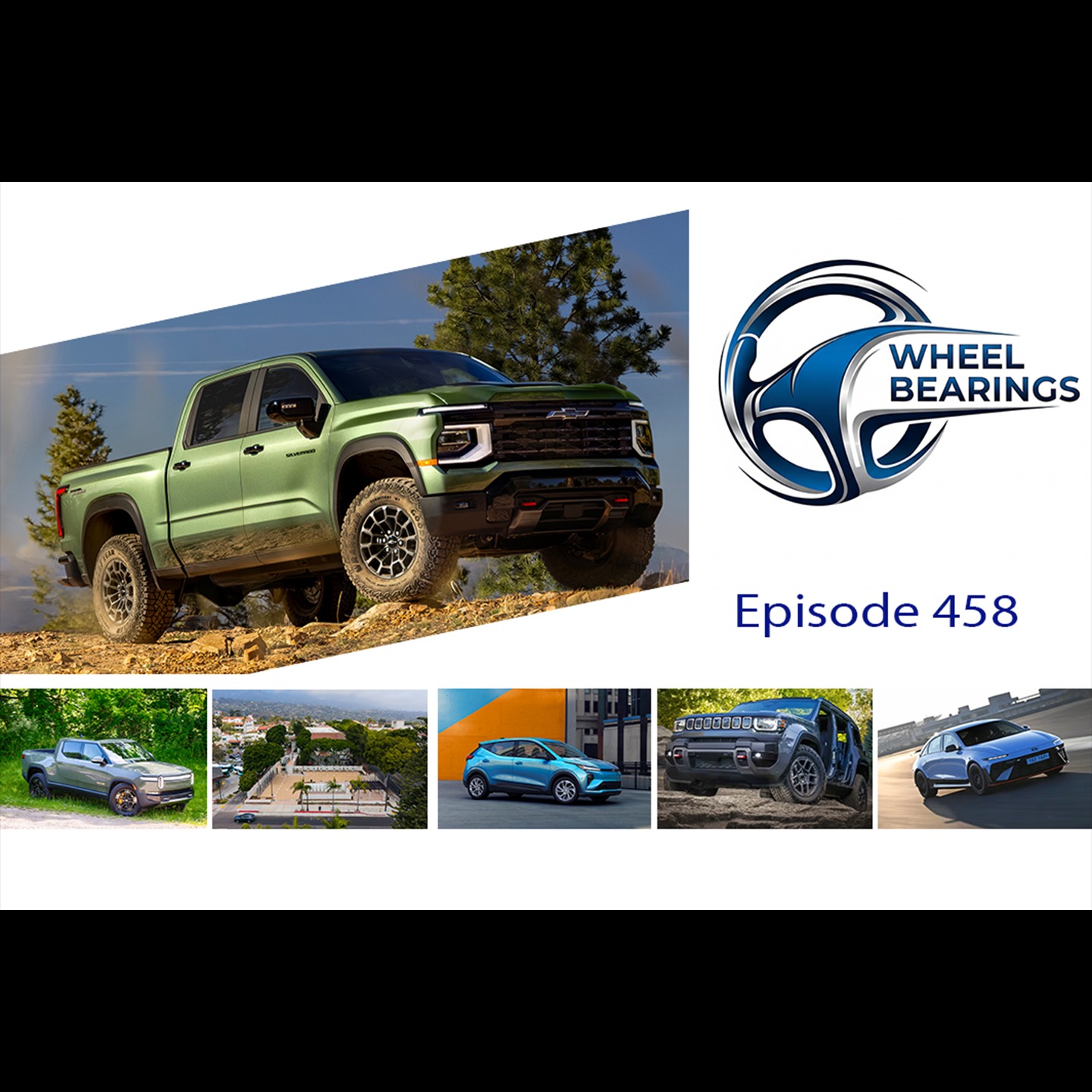
About this episode
Hosts kick off with Cars and Coffee oddities, then Nicole reviews her week with a 2026 Chevy Silverado EV Trailboss—talking trim details, interior “value,” and how destination charges and home charging affect the real cost. The conversation widens to tech frustrations (GM EVs lacking CarPlay/Android Auto), plus practical EV and PHEV ownership stories: charging standards, range-to-empty behavior, and even a Polestar key-fob failure workaround. The episode ends by questioning promised future software features and delayed “E Rev” launches.
This week Sam drove the Polestar 4 and Kia Sportage Hybrid. Robbie had the Sportage plug-in hybriid and Nicole had the Chevy Silverado EV Trail Boss.
The Porsche Taycan is looking its wagon variants in America and gaining fake shifting. Chevrolet is redesigning the Silverado for 2027 with bigger V8s. Electrify America has opened a new 20 bay charging station in Santa Barbara. The Jeep Recon's range is even worse than anticipated and the Chevy Bolt has no battery reserve. The Hyundai Ioniq 6 N has beat the Lexus LFA's Ring time. Carvana is now selling new vehicles and GM's battery boss isn't confident in solid state cells.
Links
Porsche is enhancing the driving experience of all Taycan models
Chevrolet Introduces the Next-Generation 2027 Silverado 1500, the Most Powerful and Advanced Silverado Everen/2026/jun/0516-chevrolet-next-generation-2027-silverado.html
Electrify America Opens New EV Fast Charging Station in Santa Barbara, California
The 2026 Jeep Recon’s EPA Rating Confirms It’s An Energy Guzzler
Hyundai’s Electric Sedan Just Beat The Lexus LFA Around The Nürburgring - Autoblog
Rivian faces a class action lawsuit over self-driving in its early vehicles - Engadget
The New Chevy Bolt Was Driven Until It Died. Here’s What Its Battery Buffer Looks Like
Carvana Quietly Bought Several Stellantis Dealerships And Now Sells New Cars Too - Jalopnik
Here's Where GM Will Install New Sodium-Ion Batteries | Podcast
Advertising Inquiries: https://redcircle.com/brands
Privacy & Opt-Out: https://redcircle.com/privacy
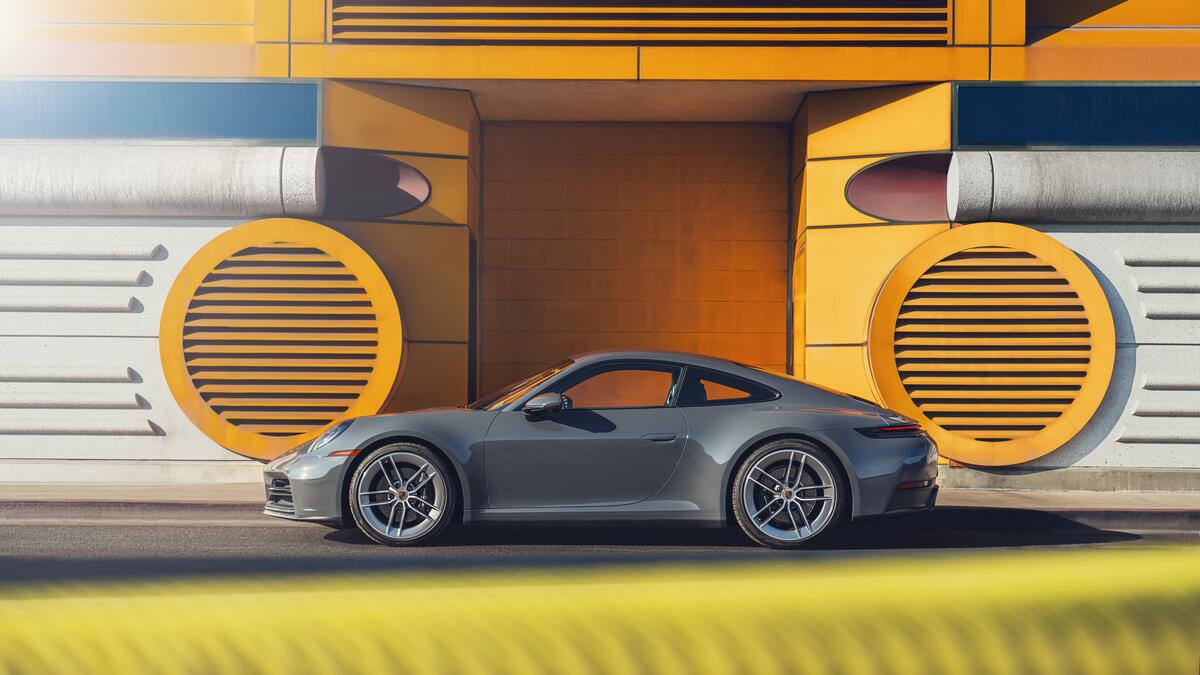
Porsche 911 GT3 RS
"…a Porsche nine eleven GT three R S pulled in and right behind it, a Mustang GTD. First one I've seen in the wild."
This is a Porsche 911 GT3 RS, which is the more extreme, track-oriented version of the 911. It’s built to go fast and handle sharply, with performance-focused parts.
The Porsche 911 GT3 RS is a track-focused version of the 911, built around maximizing grip and driver feedback rather than comfort. It’s known for its high-revving performance and aggressive aero/track hardware that make it feel very different from a normal 911.

Ford Mustang GTD
"...ven GT three R S pulled in and right behind it, a Mustang GTD. First one I've seen in the wild. Yeah. ⁓ and wha..."
The Ford Mustang GTD is a special, high-performance version of the Mustang. It’s meant for faster driving and more serious performance. If wheel bearings are being discussed, it’s because performance driving can reveal worn bearings through noise or vibration.
The Ford Mustang GTD is a high-performance, track-oriented variant of the Mustang line. It’s mentioned as something the speaker saw in the wild, which highlights its rarity and attention from enthusiasts. High-performance cars can make wheel-bearing problems more noticeable due to higher speeds, stronger braking, and more aggressive driving.
crate engine
"…it replaced the the original Opal engine in it with a Ford Eco Boost crate engine. So it had had some sort of Ford turbocharged four cylinder engine in there…"
A crate engine is an engine you buy as a complete package. It’s meant to be installed into a car project without having to build everything from scratch.
A crate engine is a complete engine sold as a packaged unit, usually including major components and sometimes accessories, intended for engine swaps. It’s popular for projects because it can be easier to source than building an engine from individual parts.
turbocharged four cylinder engine
"…it replaced the the original Opal engine in it with a Ford Eco Boost crate engine. So it had had some sort of Ford turbocharged four cylinder engine in there…"
This means the engine has a turbo that helps it make more power. It’s a smaller engine (four cylinders) but boosted to feel stronger.
A turbocharged four-cylinder engine uses a turbocharger to force more air into the cylinders, allowing more power from a smaller engine. In practice, it often improves acceleration and efficiency compared with a naturally aspirated engine of the same size.
Ford EcoBoost crate engine
"…it replaced the the original Opal engine in it with a Ford Eco Boost crate engine. So it had had some sort of Ford turbocharged four cylinder engine in there…"
They replaced the original engine with a Ford turbo engine sold as a complete package. That kind of engine is made to be swapped into other cars.
The speaker describes swapping in a Ford EcoBoost crate engine. A crate engine is a complete, factory-built engine sold as a package for swaps, and EcoBoost refers to Ford’s turbocharged gasoline technology.
brakes
"Did they update the brakes? …it’s got some newer brakes on there."
They’re talking about the car’s stopping system. If you add a bigger engine, you may need better brakes too so the car can slow down safely.
In this context, “brakes” refers to the stopping system components (pads/rotors or drums, calipers, and related hardware). The discussion is about whether the brakes were upgraded to match the car’s new, more powerful engine.

Chevrolet Silverado EV
"Well, this week I have the 2026 Chevy Silverado EV Trailboss, ⁓ which is the first time they've had a trail boss in the Silverado EV…"
This is a 2026 electric Chevrolet Silverado, in the Trailboss trim. Trailboss usually means it’s meant to handle rougher roads and off-road use better than the standard version.
The 2026 Chevrolet Silverado EV Trailboss is an electric pickup with an off-road-oriented trim. The “Trailboss” label typically signals more rugged setup and capability-focused tuning compared with other Silverado EV versions.

Honda Ridgeline
"...o saw this was like, that's a weird looking Honda ridgeline. Like everybody. Everybody. Or an avalanche. Ridg..."
The Honda Ridgeline is a medium-size pickup truck. It’s built to be useful like a truck, but it’s designed to drive more comfortably like a regular car. Wheel bearings can wear faster on trucks that see rough roads or frequent hauling.
The Honda Ridgeline is a midsize pickup truck that blends truck utility with a more car-like ride and comfort. It’s referenced as a “weird looking” alternative in the conversation, highlighting how it stands out visually. In a wheel-bearing context, pickups like the Ridgeline can be relevant because carrying loads and driving on rough roads can increase wheel-bearing wear.

Chevrolet Avalanche
"...Honda ridgeline. Like everybody. Everybody. Or an avalanche. Ridgeline. Apparently, here ridgeline was the li..."
The Chevrolet Avalanche is a pickup truck that was designed to be more comfortable and versatile than a basic work truck. It’s a vehicle people bring up when talking about truck styles and categories. Wheel bearings can become an issue on trucks because they often drive on rougher roads or carry heavier loads.
The Chevrolet Avalanche is a pickup truck that’s known for combining truck utility with SUV-like comfort and features. It’s mentioned alongside other vehicles in the conversation, likely as a point of comparison in appearance or category. Wheel-bearing discussions can include trucks like the Avalanche because their use patterns—loads, rough roads, and higher mileage—can accelerate wheel-end wear.
mid gate
"Yeah, they had the mid gate, which they carried over to the Silver Auto EV."
A mid gate is a section between the cab and the bed that can open up. It helps you carry longer items by giving you more space to load them.
A mid gate is a movable panel or barrier between the cab and the bed that can be lowered or opened. It effectively extends the usable cargo length by allowing longer items to pass through into the cab area.
two-inch lift
"They had the mid gate, which they carried over to the Silver Auto EV. ... It's a a two-inch lift ..."
A two-inch lift means the truck sits higher than stock. That extra height helps it clear bumps and rough ground more easily.
A “two-inch lift” means the suspension has been raised by about two inches. That increases ground clearance, which helps an EV truck deal with uneven roads and off-road obstacles.
all train tires
"You like 18-inch wheels, there's all train tires, there's red tow hooks, special badging."
They mean all-terrain tires. Those are made to handle both regular roads and rougher surfaces without being as specialized as true off-road tires.
“All train tires” appears to refer to all-terrain tires—tires designed to work across mixed surfaces like pavement, gravel, and light trails. They typically balance tread life with better traction off-road than highway-focused tires.
ground clearance
"It's a a two-inch lift ... there so it's so it's higher ground clearance than the base Silverado EV."
Ground clearance is the distance between the road surface and the lowest part of the vehicle. More ground clearance generally improves approach/departure angles and reduces the chance of scraping underbody parts.
tow hooks
"there's all train tires, there's red tow hooks, special badging."
Tow hooks are strong metal points on the car where you can attach a tow strap or recovery rope. They’re especially handy if you get stuck off-road.
Tow hooks are reinforced attachment points on the front or rear of a vehicle used to pull it with a rope or strap. Off-road or utility trims often highlight them because they’re useful for recovery when traction is limited.
extended range
"so there's an extended range and then there's a max range. The extended range starts at 70, the max range starts at 86.6."
Extended range means the EV is set up to go farther on a charge. They’re comparing it to an even higher “max range” number.
Extended range refers to an EV configuration or driving mode/packaging that prioritizes maximizing usable battery distance. In this discussion, it’s contrasted with a “max range” figure, implying different operating targets or conditions.
max range
"so there's an extended range and then there's a max range. The extended range starts at 70, the max range starts at 86.6."
Max range is the EV’s best-case “go the farthest” estimate. It usually assumes you drive in a very efficient way.
Max range is the EV’s highest advertised/targeted distance setting, usually achieved under specific efficiency assumptions. It often corresponds to a more conservative power/energy strategy than everyday driving.

Renault Wind
"... And it was highway driving and it was very, very windy, like terribly windy here. And it's the kind of ..."
The Renault Wind is a small Renault car. The podcast mentions it while talking about how windy conditions felt during highway driving. When people discuss wheel bearings, it’s often because noise at speed can come from the wheels or from other factors like airflow.
The Renault Wind is a small car from Renault that’s known for its compact size and open-air style. It’s brought up in the context of windy highway conditions, which suggests the conversation is about real-world driving comfort and aerodynamics. Wheel-bearing discussions can still include smaller cars because road noise and vibration can be confused with other issues, especially at speed.
road hugging weight
"it it does have a a respectable amount of road hugging weight."
They mean the truck feels stable and doesn’t get blown around as easily. The extra weight (including the battery) can help it feel more planted on the highway.
“Road hugging weight” is a descriptive way to say the vehicle feels stable and planted at speed. For EV trucks, the heavy battery mass can increase inertia, which can reduce how much the body feels pushed around by wind.
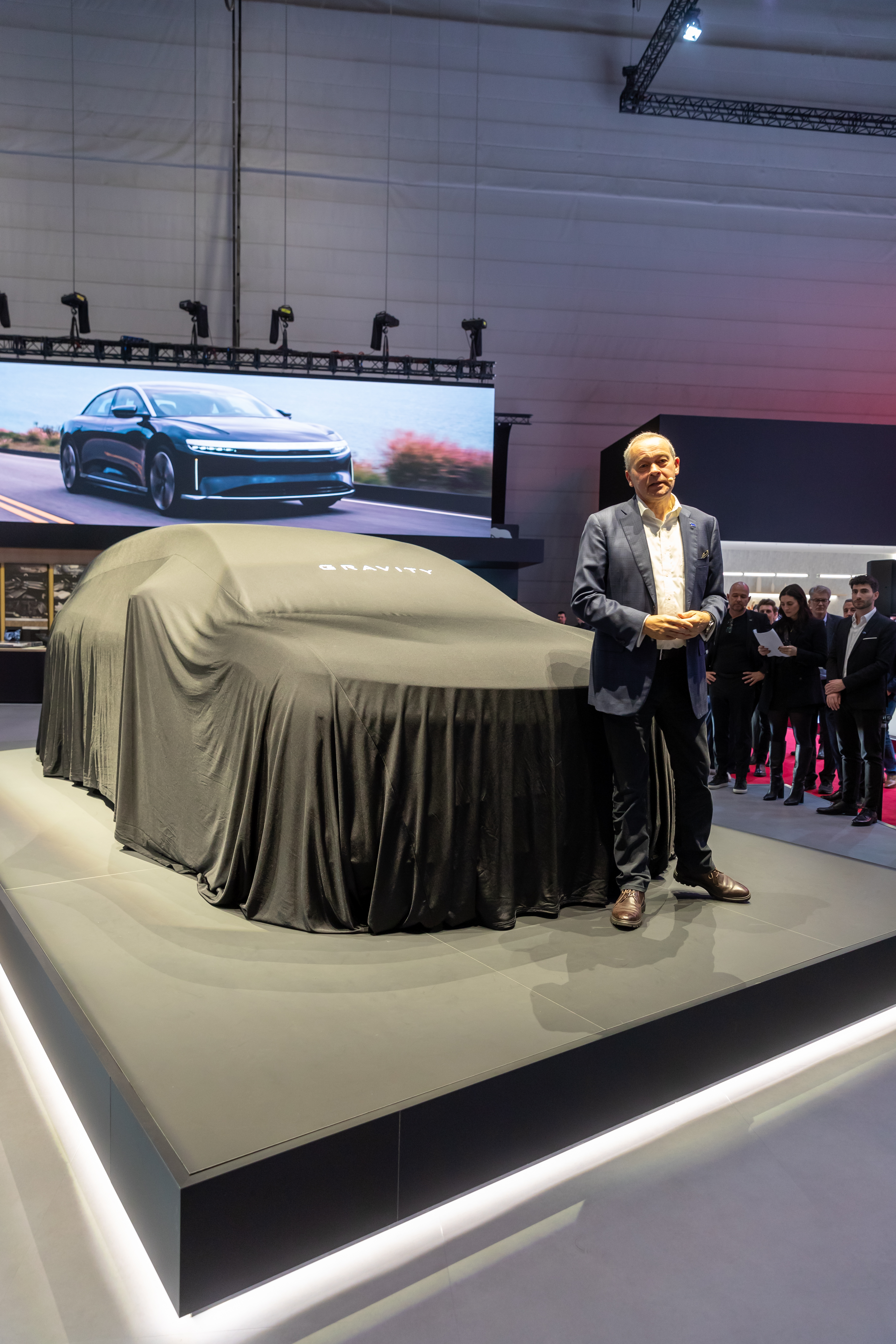
Lucid Gravity
"...nt. Roberto Baldwin (07:19) It's got a low center gravity. Nicole Wakelin (07:45) 'cause he gets crammed in..."
The Lucid Gravity is an electric SUV. It’s designed to be stable and comfortable, and the podcast mentions it has a low center of gravity. That matters because it affects how the car handles and how forces reach the wheels.
The Lucid Gravity is Lucid’s electric SUV, designed to provide a spacious, family-friendly body with an EV powertrain. It’s mentioned alongside comments about low center gravity, which is relevant because it can affect how the vehicle feels during cornering and how loads transfer to the wheels. In a wheel-bearing discussion, EV SUVs are also interesting because their weight and torque delivery can influence wear patterns at the wheel ends.

Ford Maverick
"Well, well, if you if you put down the mid gate, you practically could park a Ford Maverick in the back."
The Ford Maverick is a small pickup truck. They’re using it as a comparison to say the EV truck’s rear area is huge when you open up the mid gate.
The Ford Maverick is a compact pickup known for its small size and practical, efficient layout. Here it’s used as a size reference to describe how much space you could fit in the back of the discussed EV truck if you lower the mid gate.
EV
"I enjoyed driving this. ⁓ kind of forgot I was driving an EV, which is sort of nice."
EV means electric vehicle. It’s a car that runs on electricity from a battery instead of using gasoline.
EV stands for electric vehicle, meaning the car is powered primarily by an electric motor and a battery rather than a gasoline engine. In this episode, the host notes that the Silverado EV feels like a normal, well-mannered truck rather than something that “feels” electric.
Trail Boss
"Don't love is it's not cheap. So, you know, is seventy thousand dollars? That's a lot... it's the trail boss and it's the off road y one and and it like whoop seventy grand is a lot for a truck."
Trail Boss is a specific trim level on some Chevrolet Silverado trucks. It’s the “off-road” style/version, and the hosts are talking about what it costs when you build one.
Trail Boss is a trim name used by Chevrolet on certain Silverado models, typically aimed at off-road capability and styling. In this segment, it’s tied to pricing discussions (including destination charge) for the truck being configured online.
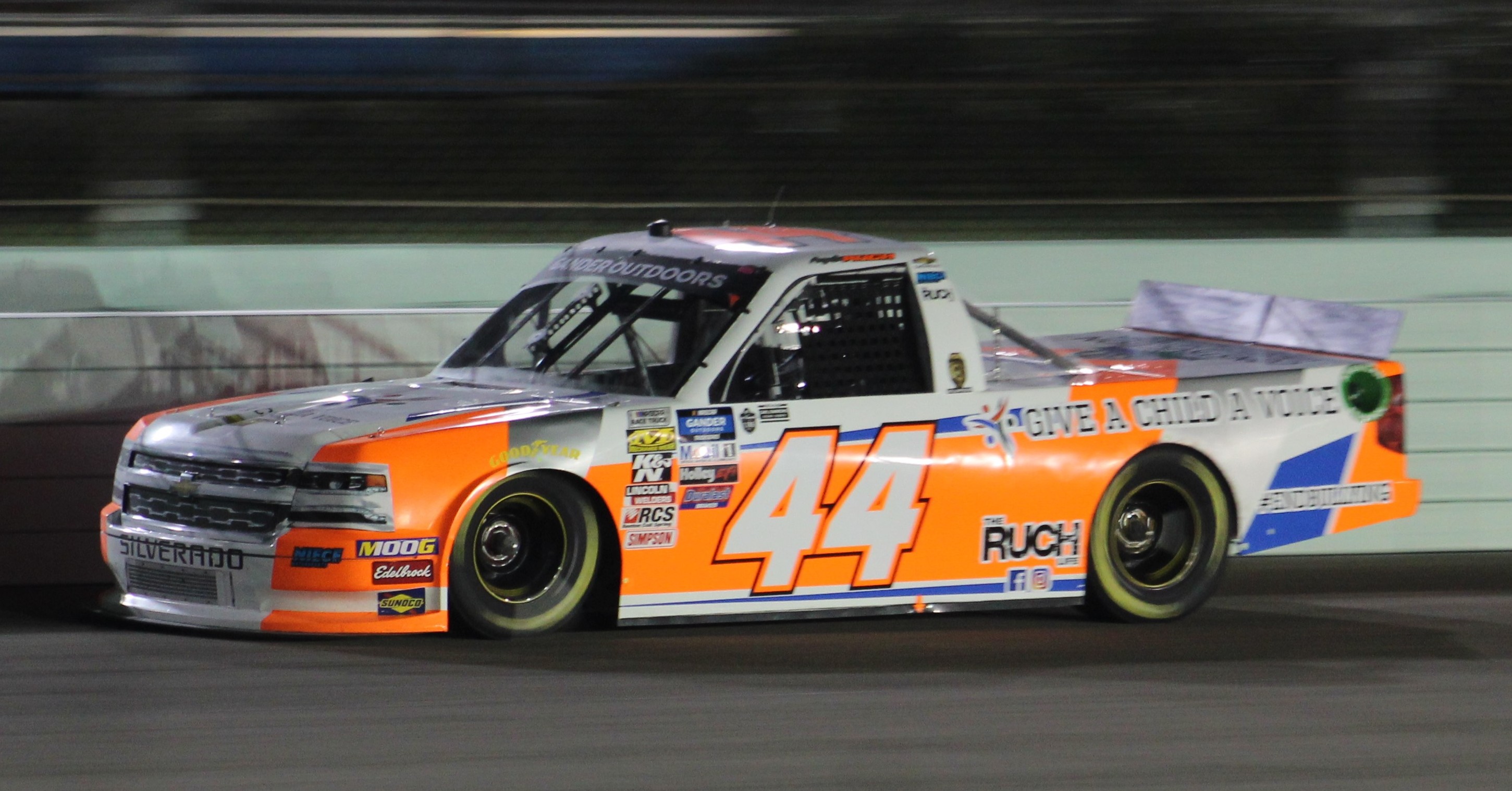
Chevy Silverado
"yeah, no, this isn't an Eevee slight. This is a Silverado. This is a Chevy Silverado comment. And I guess I should say if you felt that way about the gas one, guess what? You're gonna feel that way about the EV too."
The Chevrolet Silverado is a big pickup truck. The host is saying the inside doesn’t feel fancy enough for the high price—especially compared to what you’d expect when spending around seventy grand.
The Chevrolet Silverado is GM’s full-size pickup truck line, and this episode compares how the cabin feels versus the price. Nicole argues that the interior doesn’t quite deliver the “wow” you expect when you’re paying around seventy thousand dollars for a Silverado (including the EV version discussed).
charging
"I had troubles charging the F-150 where it makes like I want to say like ⁓ I don't quite know what's happening because we never figured out but my it would just stop charging in the middle... This doesn't. So it can still my little my little grizzly charger... still is perfectly happy to charge up... Chevy Silverado EV."
Charging is how you refill an electric car’s battery by plugging it in. The host is saying one truck had problems charging at home, but the Silverado EV charged normally.
Charging refers to replenishing an EV’s battery by plugging it into a charger. Nicole describes both a fault condition (charging stopping mid-session with a blinking light) and a positive outcome where her older home charger continues to work reliably with the Silverado EV.

Ford F150
"I had troubles charging the F-150 where it makes like I want to say like ⁓ I don't quite know what's happening because we never figured out but my it would just stop charging in the middle and when I plug it in at home it would just stop charging and I get like a little there's a little light that blinks when there's a fault in my charging thing and something goes wrong like every now and then the power fluctuates and I'm charging an EV and it'll do that."
The Ford F-150 is a full-size pickup, and here it’s mentioned as a comparison for EV charging behavior. Nicole describes a problem where charging would stop mid-session and a fault light would blink on her home charging setup.
destination charge
"so are we gonna guess on the destination charge? ... the destination charges on all the full size trucks had gone up again to twenty eight ninety five... it's saying twenty five ninety five right now online if you build the trail boss."
A destination charge is the extra cost for getting the car from the factory to the dealership. It’s part of the final price you see when you build or price a truck online.
Destination charge is a fee added to a vehicle’s price to cover shipping the car from the factory to the dealer. The hosts discuss how much it costs for full-size trucks and note that it can change over time, including for the Trail Boss configuration.
CarPlay
"So ⁓ one thing you didn't mention was the infotainment. you know, and of course this being a GM E V means it doesn't have any CarPlay or Android Auto. It was funny because I I I didn't think I would care and then I cared because I couldn't connect anything and it was a long drive and I wanted to and it just it was I did not like not having it. That bugs me, not having Apple CarPlay."
Apple CarPlay is a way to connect your iPhone to your car so you can use apps like music and maps on the car’s screen. In this segment, they’re frustrated because the car won’t connect, so they can’t use those features.
Apple CarPlay is a phone-integration system that lets you use an iPhone through the car’s infotainment screen and controls. It typically provides maps, calls, messages, and music in a familiar Apple-style interface. The hosts dislike not having it because they can’t easily connect their iPhone for media and navigation.
Android Auto
"So ⁓ one thing you didn't mention was the infotainment. you know, and of course this being a GM E V means it doesn't have any CarPlay or Android Auto."
Android Auto is a way to connect an Android phone to your car so you can use apps like music and maps on the car’s screen. They’re saying this car doesn’t support it either.
Android Auto is Google’s phone-integration system that mirrors compatible Android apps onto the car’s infotainment display. Like CarPlay, it’s designed to make phone functions easier and safer to use while driving. The segment mentions it as missing, implying the GM EV lacks mainstream phone mirroring options.
infotainment
"So ⁓ one thing you didn't mention was the infotainment. you know, and of course this being a GM E V means it doesn't have any CarPlay or Android Auto."
Infotainment is the car’s screen and electronics for things like music, maps, and connecting your phone. Here, they’re saying the system doesn’t let them use their phone the way they expect.
Infotainment is the car’s in-dash system for media and connectivity—things like the screen interface, audio controls, navigation, and phone integration. In this segment, it’s relevant because the host is discussing how the system lacks phone mirroring features.
roll their own
"They they they follow the Tesla pattern. Yeah, they do their they do they roll their own completely."
“Roll their own” here means the company made its own system instead of using the common phone-connection features most cars support. That can make it harder to connect your phone the way you’re used to.
“Roll their own” means the automaker builds its own proprietary software and interfaces instead of using widely adopted third-party systems. In this context, it suggests Rivian (and/or similar EV makers) uses a custom infotainment/phone experience rather than CarPlay/Android Auto. That can change how seamless phone connection and app use feels day to day.
louvers
"When you slide them, you know how normally you slide an air vent and it's you slide it, you can like slide it left, right, and then you can move little louvers up and down."
Louvers are the adjustable slats inside an air vent that control airflow direction. The host describes a vent mechanism where the louvers have a “click point,” making fine adjustments harder because the airflow direction jumps when you release the control.
plug-in hybrid
"It's a like a what is it? 1.6 liter turbocharged four-cylinder plug-in hybrid. It's got a six-speed automatic transmission."
A plug-in hybrid can be charged like an electric car. It can drive on electricity for a while, and when that runs out it switches to using gas like a normal hybrid.
A plug-in hybrid (PHEV) is a hybrid vehicle that can be charged from an external power source. That lets it run in EV-only mode for a limited range, then switch to the gas engine (and/or hybrid system) when the battery is depleted.
terrain modes
"It's all-wheel drive with terrain modes and whatnot."
Terrain modes are different driving settings for different road conditions. They help the car behave appropriately when the surface is slippery or rough.
Terrain modes are driving settings that adjust how the vehicle responds—often changing throttle mapping, traction control behavior, and sometimes shift strategy. They’re meant to tailor the car to conditions like snow, sand, or normal pavement.
all-wheel drive
"It's all-wheel drive with terrain modes and whatnot."
All-wheel drive means the car can send power to all four wheels. That usually helps it grip better on slippery roads or uneven surfaces.
All-wheel drive (AWD) sends power to all four wheels, improving traction compared with front- or rear-wheel drive. In this Sportage PHEV, the host also mentions terrain modes, which typically change throttle/traction behavior for different surfaces.
six-speed automatic transmission
"It's a like a what is it? 1.6 liter turbocharged four-cylinder plug-in hybrid. It's got a six-speed automatic transmission."
A six-speed automatic transmission is an automatic gearbox with six forward gear ratios. The number of gears can affect how the engine operates (for example, keeping it in a more efficient range) depending on driving conditions.
EV only
"so they're the it's EPA 33 miles, EV only."
EV-only means the car is driving using electricity from the battery. The gas engine isn’t powering the wheels during that mode.
EV-only mode means the vehicle is running on electric power from the battery rather than using the gas engine for propulsion. The host quotes an EPA figure for how many miles it can do in EV-only mode under test conditions.
MPGE
"they says that it gets what's it 83 MPGE? ... So really it's got 36 MPG."
MPGe is a way to compare how efficiently an electric car uses energy. It turns electricity use into a number that’s comparable to miles per gallon for gas cars.
MPGe (miles per gallon equivalent) is a fuel-economy metric used for electric vehicles and plug-in hybrids. It converts the energy used from electricity into an equivalent “gallon of gasoline” basis so EVs can be compared using similar units.
J1772
"charging it, it's got a you know, it's got J1772, easy peasy, charges at night."
J1772 is the most common North American charging connector standard for plug-in electric vehicles. When the host says it’s “J1772,” they mean the car can use typical public Level 2 chargers with that plug shape.
delivery charge
"Sam Abuelsamid (24:50) ...you guys wanna guess the ⁓ the the delivery charge? [1967.9s] Sam Abuelsamid (24:50) Ooh, I was gonna say that. I'll go ⁓ twelve ninety five. [1974.4s] It's fourteen forty-five."
A delivery charge is an extra fee for getting the car to the dealership. The hosts are basically saying it adds up, so the final price can feel bigger than you expect.
A delivery charge is a fee added to a car’s price to cover getting the vehicle from the factory to the dealer (and related logistics). In this discussion, the hosts compare delivery charge amounts to show how the “out-the-door” total can feel surprisingly high even when the base price sounds reasonable.

Honda Element
"...using that the design from, you know, that design element that we saw on the like the E V nine. ⁓ it's move..."
The Honda Element is a small SUV with a very distinctive, boxy shape. It’s known for being practical and roomy inside. Older versions can come up in wheel-bearing discussions because they may have higher mileage now.
The Honda Element is a compact SUV known for its boxy design and practical interior space. It’s mentioned in the context of design elements and comparisons to other vehicles, which shows how its styling is memorable. For wheel-bearing topics, older Elements can be relevant because many have accumulated significant mileage and may show typical wheel-end wear.
hitch mounted racks
"Sam Abuelsamid (26:32) ...The only difference between is one of them has one of those little hitch mounted racks that you know, fold down rack to to put like stuff [2145.5s] Sam Abuelsamid (27:00) Well, this one's I mean you could you could probably strap bikes on there..."
A hitch-mounted rack is a carrier that plugs into the hitch on the back of the car. It’s often used to carry bikes or other gear, and in this story it’s the only real difference between two similar SUVs.
A hitch-mounted rack attaches to a vehicle’s receiver hitch (the standardized opening at the rear) and is commonly used for carrying bikes or gear. Here, the host uses it as a practical way to differentiate two otherwise identical Honda CR-Vs.
AWD
"Sam Abuelsamid (28:29) ...I had the Sportage hybrid SX Prestige all wheel drive."
AWD means the car can send power to all four wheels. That can help with grip on wet or snowy roads.
AWD (all-wheel drive) means power can be sent to more than just the front or rear wheels, improving traction on slippery or uneven surfaces. The host mentions AWD as part of the Kia Sportage hybrid SX Prestige setup, framing it as a capability feature.

Toyota Corolla
"...u could take a corrol off again, you could take a corolla off road. No one's stopping you. Sam Abuelsamid (..."
The Toyota Corolla is a small car meant for everyday driving. People often choose it because it’s reliable and easy to use. It’s also common on the road, so it’s frequently discussed when talking about wear items like wheel bearings.
The Toyota Corolla is a compact, everyday passenger car known for being practical and widely used as a commuter vehicle. It comes up in conversation when people talk about how easy it is to live with and how versatile it can feel in different driving situations. In a wheel-bearing discussion, it’s also a common platform because many Corollas rack up high mileage over the years.

Sportage hybrid
"Sam Abuelsamid (29:08) Yeah. yes. so I I had ⁓ I had the the Sportage hybrid. so same basic powertrain, that's in the plug in hybrid, but a little bit less electrical power. and ⁓ it's got the one point six liter turbo, four cylinder, six speed automatic, ⁓ all wheel drive."
This is a Kia Sportage hybrid. It uses both a gas engine and an electric motor to help save fuel, and it also has a turbo gas engine plus an automatic that can send power to all four wheels.
The Kia Sportage hybrid uses a hybrid powertrain that combines an internal-combustion engine with an electric motor. In this discussion, it’s described as sharing the same basic setup as a plug-in hybrid, but with less electrical power, plus a 1.6-liter turbo four-cylinder and an automatic transmission driving all four wheels.
EPA rated
"Sam Abuelsamid (29:08) ...it's got the one point six liter turbo, four cylinder, six speed automatic, ⁓ all wheel drive. And it is rated it's EPA rated at"
EPA-rated numbers are the official fuel-economy estimates for a car. Your real mileage can be better or worse depending on how you drive and conditions.
EPA-rated fuel economy is the official estimate published by the U.S. Environmental Protection Agency based on standardized testing. Real-world mileage can differ because of driving style, weather, traffic, and how often you use electric power in hybrids.
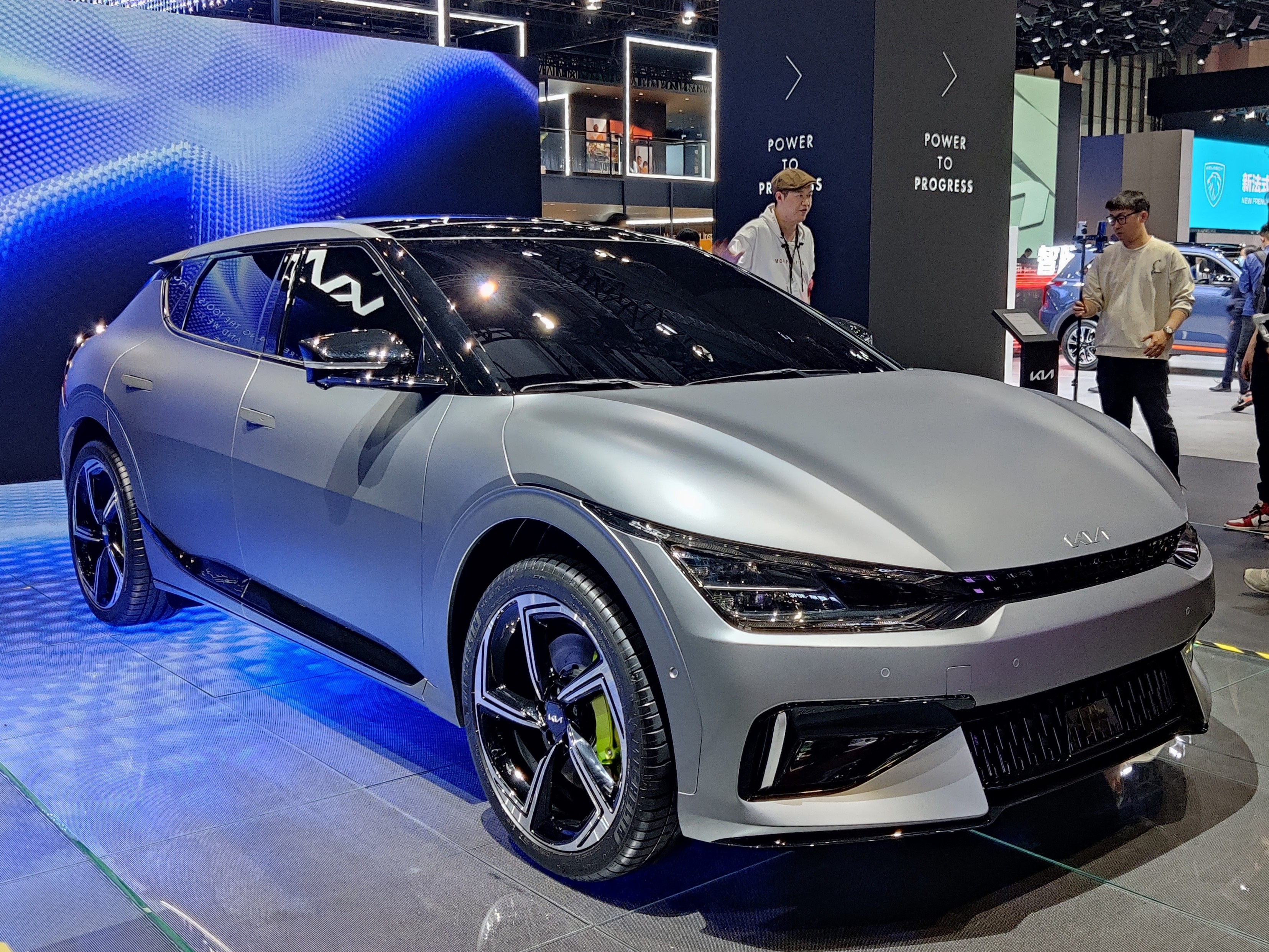
EV6
"Sam Abuelsamid (30:00) Yes. Yeah, it's got that little panel. [2487.7s] our our E V six has the same thing. And so we just leave it on climate mode..."
The Kia EV6 is an electric Kia. Here it’s mentioned because it has a similar dashboard control setup, and the hosts say they prefer using the steering-wheel controls instead.
The Kia EV6 is an all-electric crossover, and in this segment it’s referenced because it has a similar infotainment/control setup to the speaker’s Sportage. The point is the EV6 shares the same “panel” behavior that the hosts find annoying, not that it’s being compared on performance.
blind spot view monitor
"Sam Abuelsamid (31:43) ...the SX Prestige, you know, gets you stuff like LED fog lights, power folding mirrors, roof rails. ⁓ it's got the it's got a heads up display, it's got the blind spot view monitor, so when you put on the turn signal it shows the view from the camera on one side or the other in the instrument cluster."
This feature helps you see cars in your blind spots. When you turn on the turn signal, it can show camera images so you can check before changing lanes.
A blind spot view monitor uses cameras to show what’s next to or behind the car when you activate the turn signal. Instead of relying only on mirrors or warning lights, it can display a live camera view in the instrument cluster to help you judge lane changes.
heads up display
"Sam Abuelsamid (31:43) ...the SX Prestige, you know, gets you stuff like LED fog lights, power folding mirrors, roof rails. ⁓ it's got the it's got a heads up display, it's got the blind spot view monitor..."
A heads-up display shows important info on the windshield. That way you can keep your eyes on the road instead of looking down.
A heads up display (HUD) projects key driving information onto the windshield so you can see it without looking down at the instrument cluster. It’s commonly used for navigation prompts, speed, and driver-assistance alerts.

Honda Civic
"...like I mean we that that's what we had on our old Civic. And on the Civic it only had the camera on the p..."
The Honda Civic is a small car designed for regular commuting. People talk about it because it’s practical and usually has modern convenience features. When wheel bearings come up, it’s often because this model is common and can accumulate mileage over time.
The Honda Civic is a compact car that’s popular for efficient daily driving and long-term ownership. It’s mentioned in the context of features like a camera system, which matters because wheel-bearing issues can affect steering feel and stability. Civics are also common, so they often show up in real-world discussions about suspension and wheel-end wear.
remote smart parking assist
"Sam Abuelsamid (32:48) ...It's also got the the remote smart parking assist, which I've always thought was kind of a strange little feature to have. Yeah. On the key fob you can press the button and you know, if you're if your car is in a very tight parking space..."
This is a parking helper where you can press a button on your key fob and the car will steer itself into or out of a tight parking spot. It’s meant to help you avoid hitting things when space is tight.
Remote smart parking assist is an automated parking feature that can maneuver the car while the driver stands outside, typically using buttons on the key fob. The goal is to reduce the risk of bumping nearby objects when parking in tight spaces.
Polestar Four
"I I also had ⁓ a Polestar Four. and ⁓ again, I s I still really like driving the Polestar Four. ... the key fob was not working. ... you get an NFC card. ... because the key fob was dead, I had to use the NFC tap the NFC card on the B pillar to unlock the doors. ... the tailgate will not open from the outside."
The Polestar Four is an electric car that can unlock and start using a key fob. Here they explain what happens if the key fob battery dies: you can still unlock the doors using an NFC card, but opening the back (tailgate) becomes a hassle and may require starting the car first.
Polestar Four is a Polestar electric vehicle that uses keyless entry and a digital/near-field identification approach instead of a traditional always-on key. In this segment, the hosts describe a real-world failure mode: when the key fob battery is dead, the car can still unlock doors via an NFC card, but the tailgate won’t open normally and requires a more involved in-car sequence.
key fob
"one of them, ⁓ the the key fob. ... the key fob was not working. ... because the key fob was dead, I had to use the NFC tap the NFC card on the B pillar to unlock the doors."
A key fob is the small wireless device you keep in your pocket to unlock the car. If its battery dies, the car may not recognize it, so you might need a backup method to unlock or start the car.
A key fob is the wireless remote you carry to lock/unlock and often start a modern car without inserting a physical key. This segment highlights a specific consequence: if the key fob battery is dead, the car may still unlock some functions via an NFC card, but other actions (like opening the tailgate) may be blocked.
NFC card
"you get an NFC card. ⁓ and so because the key fob was dead, I had to use the NFC tap the NFC card on the B pillar to unlock the doors."
An NFC card is a small card that can communicate with the car when you tap it close to a reader. In this story, tapping the NFC card helps unlock the doors when the key fob isn’t working.
NFC (near-field communication) is a short-range wireless technology that lets two devices exchange data when they’re very close together. Here, the Polestar Four provides an NFC card as a backup: you tap it on the B-pillar area to unlock doors when the key fob isn’t working.
B pillar
"because the key fob was dead, I had to use the NFC tap the NFC card on the B pillar to unlock the doors."
The B-pillar is the metal post between the front and back doors. They’re saying the car’s NFC “tap here” spot is on that post.
The B-pillar is the vertical structural support between the front and rear doors on a car’s body. In this segment, it’s specifically where the NFC reader is located, so tapping the NFC card on the B-pillar triggers door unlocking when the key fob is dead.
tailgate
"So if you want to put something in the back, if the fob is dead, the tailgate will not open from the outside. You press the button, nothing happens."
The tailgate is the rear door you open to get into the trunk/cargo area. Here, they’re saying that if the key fob is dead, the tailgate won’t open normally from the outside.
A tailgate is the rear door on many hatchback-style vehicles and some SUVs/pickup-like designs, used to access the cargo area. The segment describes a key-fob-dead scenario where the tailgate won’t open from the outside even after unlocking the doors, requiring an in-cabin process.
wireless phone charger
"Because the key fob was dead, that means that I had to put the ⁓ the NFC card down on where the wireless phone charger is for it to recognize that in order for the car to start."
A wireless phone charger is a pad where you set your phone to charge without a cable. In this segment, they’re using that area as part of the workaround when the key fob isn’t working.
A wireless phone charger is a charging pad that transfers power to a compatible phone without plugging in a cable, typically using inductive charging. The hosts mention using that same area as the place to put the NFC card (or otherwise interact with the car) so the car can recognize the backup identification for starting.
software controlled vents
"it still has the the stupid software controlled vents, which I have ranted and raved about too many times and I posted another little video about it last week."
“Software controlled vents” refers to HVAC (heating/ventilation/air conditioning) airflow vents whose operation is managed electronically by the car’s software rather than by purely mechanical controls. The hosts complain that this design is annoying, implying the user experience depends on the infotainment/software flow.

Porsche Taycan
"all right. For twenty twenty seven Porsche is doing some some more updates to the Tycon. and ⁓ first of all, they have discontinued the cross tourismo and sport tourismo variants from the US market."
The Porsche Taycan is Porsche’s electric car. Here, they’re talking about Porsche making updates for the 2027 model year and changing which versions you can buy in the US.
The Porsche Taycan is Porsche’s electric performance sedan, known for its fast acceleration and multi-speed-style driving feel. In this segment, the hosts discuss Porsche updating the Taycan for the 2027 model year and changing which trims are sold in the US.
fake shifting
"but for twenty twenty seven we do get fake shifting and more enhanced noises."
“Fake shifting” is when an electric car pretends to shift gears. It uses timing and sometimes sound so it feels more like a regular car, even though it’s not really doing real gear changes.
“Fake shifting” refers to an artificial gear-change experience in an automatic or electric car—typically using sound, timing, and simulated shift behavior to mimic a traditional multi-gear transmission. It’s meant to make the car feel more engaging even though the drivetrain isn’t actually changing gears the way a conventional gearbox does.

Hyundai Ioniq 5 N
"went and ⁓ and benchmarked a hun Hyundai Ionic five N and said, ⁓ we gotta do that And so now they offer that on the on the Tycon."
The Hyundai Ioniq 5 N is Hyundai’s high-performance electric vehicle. They’re using it as a reference because it has a fun, sporty “shift-like” feel that they want to bring to another car.
The Hyundai Ioniq 5 N is a performance-focused electric SUV from Hyundai’s N division, built to feel more like a sporty, driver-oriented car than a typical EV. The hosts benchmark it for its driving features—specifically the simulated shifting behavior and the “torque dip” during transitions.
torque dip
"So, you know, it's got the whole shifting with the the little torque dip when it does the shifts, you know, simulated eight speed automatic."
A “torque dip” is a short moment where the car’s pull feels weaker. In cars that simulate shifting, it can be part of the effect—like a brief pause—before the acceleration comes back.
A “torque dip” is a brief reduction in delivered torque during a drivetrain transition—often used to mimic the feel of a real gear change. In EVs with simulated shifting, engineers may shape the torque curve so the car “drops” momentarily, then surges again to create a more familiar performance sensation.
simulated eight speed automatic
"it's got the whole shifting with the the little torque dip when it does the shifts, you know, simulated eight speed automatic. ⁓ you know, and you can shift it with the paddles and everything."
This means the car pretends it has an 8-speed automatic. The EV doesn’t actually shift like a normal transmission, but it changes how power is delivered so it feels like different gears.
A “simulated eight speed automatic” is when an EV uses software to imitate an 8-speed automatic transmission. Instead of real gear ratios, it changes throttle/torque mapping and shift timing so the driver experiences distinct “gears” and shift events.
Laguna Seca
"my joker origin story is that I was invited to the ⁓ the five in drive program at Laguna Seca and it went into my spam folder and I didn't know and I didn't go to the event"
Laguna Seca is a famous race track in California. Car companies often hold events there so people can drive cars on a real track.
Laguna Seca is a well-known road racing circuit in California, famous for its technical layout and elevation changes. It’s also a common venue for automaker events and test programs where journalists or customers drive cars on track.
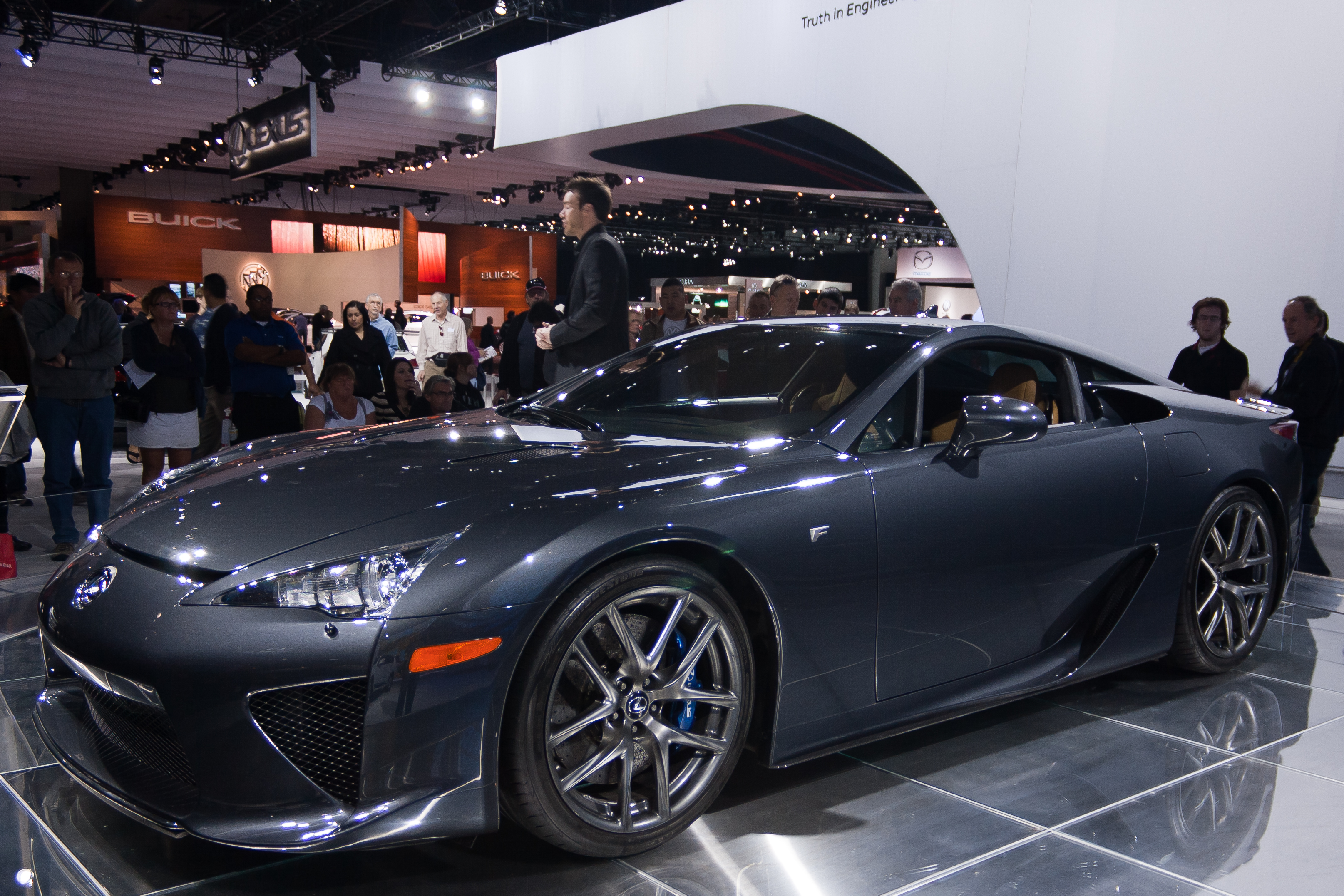
Lexus LFA
"and it recorded a faster lap time than the vaunted Lexus L F A. [3494.2s] Sam Abuelsamid (44:51) Yeah, the the L F A, you know, back when it still you know, when it was still new and fresh, ⁓ it they it went ⁓ what, seven minutes thirty eight seconds around the the Nordschlifer."
The Lexus LFA is a rare, high-performance Lexus supercar. Here it’s mentioned because it’s known for a famous lap time on the Nürburgring’s Nordschleife.
The Lexus LFA is a high-revving, naturally aspirated supercar from Lexus, famous for its performance and its limited production run. In this segment, it’s used as a benchmark because the speaker cites its Nürburgring Nordschleife lap time from when it was “new and fresh.”
Nordschlifer
"it they it went ⁓ what, seven minutes thirty eight seconds around the the Nordschlifer. And ⁓ the ⁓ the five N did ⁓ seven thirty five and change."
The Nordschleife is the famous, very twisty Nürburgring track in Germany. People use lap times there to compare how fast and capable different cars really are.
The Nordschleife (often misspelled as “Nordschlifer” in transcripts) is the long, older Nürburgring circuit layout in Germany, known for elevation changes and a huge variety of corners. Lap times there are widely used as a real-world performance benchmark for both sports cars and EVs.
auto journalists
"one thing I wanna I wanna every once in a while I have auto journalists that'll be like, you know, all EVs drive the same, they all feel the same, which is wrong."
Auto journalists are people who review cars for magazines, websites, or TV. The host is saying their generalizations about EVs aren’t accurate.
“Auto journalists” refers to professional reviewers and writers who test cars and publish opinions or performance impressions. The speaker argues that even among journalists, the claim that “all EVs drive the same” is wrong based on their own experience.

Jeep Wrangler
"...was a little excited. I mean I really just want a Wrangler that's an E V. What is it the what'd they call it..."
The Jeep Wrangler is a type of SUV built for off-road driving. It’s designed to go on rough roads and trails better than many regular cars. The podcast mentions an electric version, and wheel bearings are important on Wranglers because they often get used on tougher surfaces.
The Jeep Wrangler is a rugged, off-road-focused SUV known for its ability to handle rough terrain and its removable/versatile body design. It’s discussed here in the context of an electric version, which is significant because wheel-end loads and driving characteristics can change with different powertrains. In a wheel-bearing podcast, Wranglers are especially relevant because off-road use can accelerate wear in wheel bearings and related components.

Jeep Recon
"All right. ⁓ well anyway, the the recon, ⁓ which may finally actually possibly be launching sometime soon, ⁓ officially has an official EPA rating now. Up until now, Jeep has been saying, yeah, it's gonna get about two hundred and thirty miles of range."
The Jeep Recon is Jeep’s upcoming electric SUV. They’re talking about how far it can drive on a charge (EPA range) and whether that number makes sense for the battery size and the cost.
The Jeep Recon is an upcoming Jeep EV positioned as a more EV-friendly alternative to the Wrangler formula. In this segment, the hosts focus on its EPA-estimated range and how that range stacks up against the size of its battery pack and the price.
EPA rating
"All right. ⁓ well anyway, the the recon, ⁓ which may finally actually possibly be launching sometime soon, ⁓ officially has an official EPA rating now. Up until now, Jeep has been saying, yeah, it's gonna get about two hundred and thirty miles of range."
EPA rating is the government’s standardized estimate of how many miles an electric car can go on a full charge. It’s used so you can compare range between different EVs more fairly.
An EPA rating is the U.S. Environmental Protection Agency’s standardized estimate for how far an EV can drive on a full charge. Because it’s measured using consistent test procedures, it’s commonly used to compare range between different EVs.
kilowatt hour battery pack
"For a hundred kilowatt hour battery pack. That's the thing. If it was like, okay, it's 200 and you know 22 miles of range, but it only has like a 60 kilowatt hour battery pack…"
A kilowatt-hour (kWh) is how much energy is stored in the car’s battery. Bigger numbers usually mean the car can go farther, so people compare kWh to the stated range.
A kilowatt-hour (kWh) battery pack is the amount of electrical energy stored in the EV’s battery. More kWh usually means more potential range, so enthusiasts often compare kWh to the EPA range to judge efficiency and packaging tradeoffs.
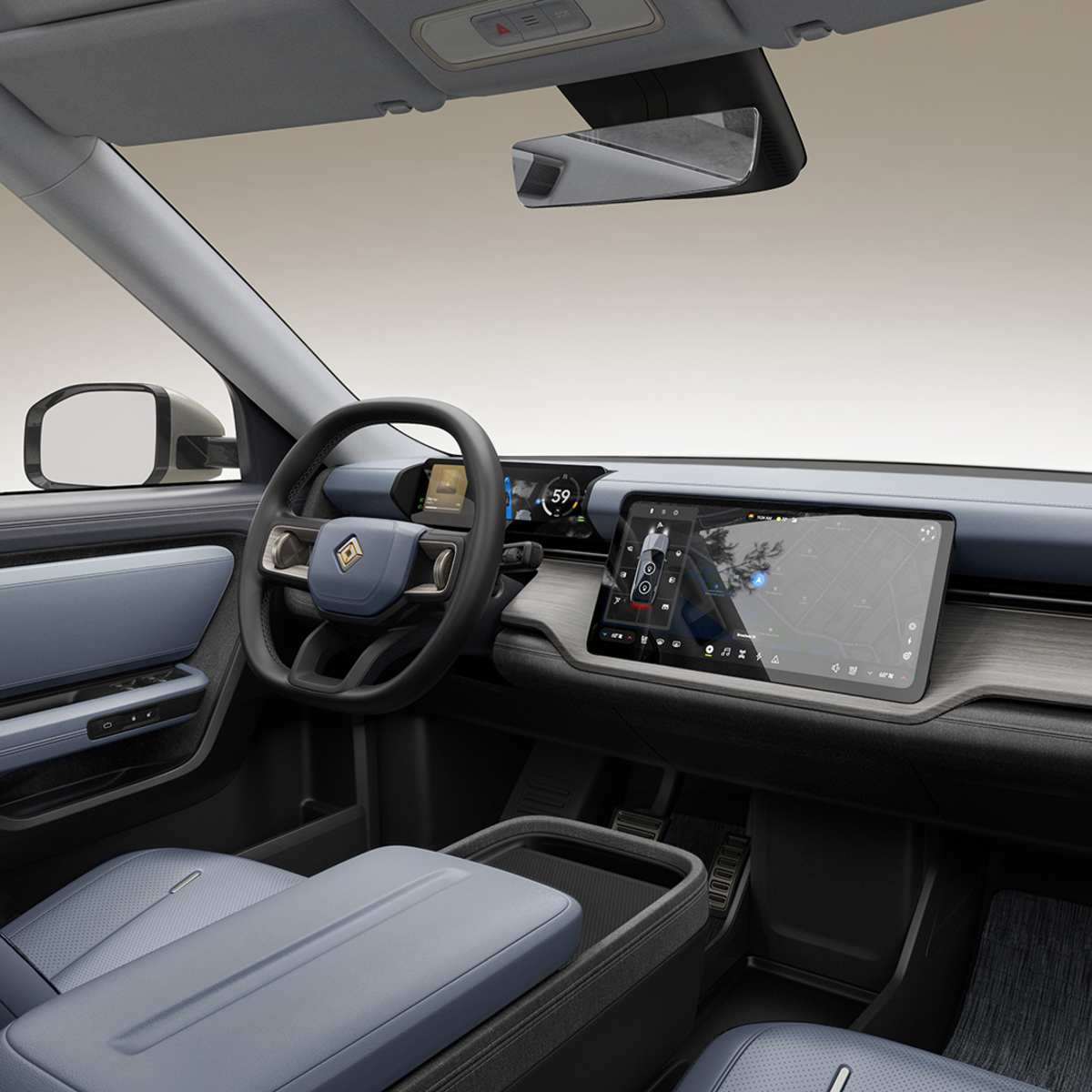
Rivian R2
"and and just for for reference, yeah, the the Rivian R two has now started shipping to customers. They've they started d customer deliveries…"
The Rivian R2 is an electric SUV/EV that’s starting deliveries. They’re comparing how far it can go on a charge to the Jeep Recon, and they mention that tire/wheel choices can change the range.
The Rivian R2 is an EV that’s being positioned as a practical alternative with strong EPA range figures. Here, the hosts compare its range to the Jeep Recon while also noting differences like wheel size and features (including infotainment/phone integration).
twenty one inch wheels
"that one, ⁓ with the the version with the twenty one inch wheels, ⁓ gets three hundred and thirty miles of range."
Wheel size (like 21-inch wheels) affects EV range because it changes tire sidewall height and rolling resistance. In general, larger wheels often reduce range slightly, while smaller wheels can improve efficiency.
all terrain tires
"Or if you go with the twenty inch all terrain tires, you get three hundred and seven miles of range."
All-terrain tires are made for both regular roads and rougher surfaces. They can cost you a little range because they’re not as optimized for efficiency as road tires.
All-terrain tires are designed to handle a mix of pavement and light off-road use. They typically trade some efficiency for traction and durability, which can reduce EV range compared with more road-focused tires.
Skyview
"I think they call it Skyview or something like that. Yeah, the retractable fabric roof. Yeah, that's it. Yeah."
Skyview is the name Jeep is using for the Recon’s open/close roof feature. It’s basically the car’s branded version of a retractable soft top.
Skyview appears to be the branding/name for the Jeep Recon’s retractable fabric roof feature. Named roof systems are usually marketed as a signature design element and can also affect how the cabin feels and how the vehicle is used day-to-day.
retractable fabric roof
"I think they call it Skyview or something like that. Yeah, the retractable fabric roof. Yeah, that's it. Yeah."
A retractable fabric roof is a soft top that can open up like a convertible. It’s mainly about enjoying the open-air feel while still having a roof when you want it.
A retractable fabric roof is a soft-top that can open/close to change the cabin from enclosed to open-air. On EVs, this is often discussed as part of the vehicle’s “lifestyle” appeal and usability rather than as a performance feature.

Dodge Charger
"... that this thing's gonna sell even worse than the Charger Daytona. Roberto Baldwin (50:34) I saw a charger ..."
The Dodge Charger is a car that’s built to be fast and fun to drive. It’s often discussed in terms of different versions and how well they sell. If wheel bearings are being talked about, it’s because worn bearings can create noise and vibration that you’ll notice more in a performance car.
The Dodge Charger is a performance-oriented sedan/coupe-style muscle car that’s known for strong power and a long model history. It’s referenced in the context of sales comparisons, which can come up when discussing how certain trims or special editions land in the market. Wheel-bearing topics can intersect with Chargers because performance driving and higher speeds can make early wheel-end noise more noticeable.
NAX connectors
"Electrify America opened up a new charging station this week. in Santa Barbara. It's got twenty three hundred and fifty kilowatt stalls and and it and it still doesn't have NAX connectors on it."
NAX connectors are the plug type used by some newer fast-charging setups. If a charger doesn’t have that plug, your car might not be able to use it directly (or you may need a different connector/adapter).
NAX connectors refer to a newer EV charging connector standard used by some networks and automakers. The point here is compatibility: if a station doesn’t have NAX connectors, certain vehicles may not be able to use that hardware without an adapter or may have to use a different connector.
Electrify America
"Electrify America opened up a new charging station this week. in Santa Barbara. It's got twenty three hundred and fifty kilowatt stalls…"
Electrify America is a major U.S. EV fast-charging network operator. In this segment, it’s mentioned as opening a new high-power charging site, which is relevant because charging availability and connector support affect real-world EV usability.
Santa Barbara
"Electrify America opened up a new charging station this week. in Santa Barbara. It's got twenty three hundred and fifty kilowatt stalls…"
Santa Barbara is where the new fast charger was opened. Where chargers are located matters a lot for whether EVs are convenient to own.
Santa Barbara is the location of the newly opened fast-charging station discussed in this segment. Charging network coverage by city/region is a practical factor for EV owners planning trips and daily charging.
adapter
"So then when you pull up, you're like, Well, do I want to use my adapter or not? And fortunately, like every car comes with an adapter, so it's not the end of the world. ⁓ but yeah."
An adapter helps you charge when your car’s plug doesn’t match the charger’s plug. It’s a compatibility tool so you can still use the station.
In EV charging, an adapter is used to make one charging connector type work with another. The point is compatibility: if your vehicle’s plug doesn’t match the station’s connector, an adapter bridges the difference.
battery buffer
"But they they did include a a one point nine megawatt ⁓ battery ⁓ energy storage system. so there's a big giant battery. So it's not just sucking all you know, if you got twenty cars they're charging, it's not just sucking it all down off the grid simultaneously. It's got a battery to buffer it."
A battery buffer is like a backup battery for a charging station. It helps the station share power more smoothly instead of relying on the power grid all at once.
A battery buffer is an energy-storage system that smooths out power demand. Instead of the charging station pulling everything directly from the grid at once, the buffer supplies or absorbs power to keep charging steadier.

Chevy Bolt
"let's go back to Chevy. ⁓ so the the Chevy Bolt, the the new Chevy Bolt is out now. They're delivering them to customers. ⁓ and the guys from Out of Spec did you know, they they always get everything and do a whole bunch of different kinds of tests on there."
The Chevrolet Bolt is an electric car. Here they’re talking about the newer Bolt model and how people are testing it after it starts getting delivered.
The Chevrolet Bolt is an all-electric compact car known for practical daily driving and fast, widely available charging. In this segment, the hosts discuss the “new Chevy Bolt” being delivered and tested by Out of Spec.
state of charge
"With the bolt, they found that when it got to one percent state of charge, boom, it was done. It rolled to a stop."
State of charge is basically how full the EV battery is. When it gets very low, the car may stop or limit power to keep the battery safe, so you can’t count on much extra driving.
State of charge (SoC) is how full a battery is, usually shown as a percentage. In EV testing, reaching very low SoC can mean the car limits power or shuts down to protect the battery, which is why “buffer” range matters.

Tesla Model S
"I drove a ⁓ Model S and it was at zero and we were I was doing a test with Tesla."
The Tesla Model S is an electric sedan. In this story, they’re testing what happens when the battery gauge hits zero, and they’re showing that the car may still keep going for a bit before stopping.
The Tesla Model S is an EV sedan known for long-range capability and software-driven energy management. Here, the hosts describe a test where the car was at 0% state of charge and still continued for additional miles, illustrating how EV “empty” can still include some reserve behavior.
Chevrolet Silverado 1500
"also Chevrolet ⁓ this past week ⁓ announced the the twenty twenty seven Silverado fifteen hundred. So this is the combustion version of their full size truck."
The Chevrolet Silverado 1500 is a big pickup truck. In this episode they’re talking about the 2027 version getting new engine options and a refreshed interior, including a large center screen.
The Chevrolet Silverado 1500 is GM’s full-size pickup, and this segment focuses on its combustion (gas) version for the 2027 model year. The hosts highlight that the 2027 Silverado 1500 gets new V8 engines and updated interior tech, which is a major change for a truck that’s historically relied on familiar displacement sizes.

Chevrolet Corvette Grand Sports
"a few couple months ago when they introduced the twenty twenty seven Corvette Grand Sports, they announced new engines, new sixth generation small blocks for that. for the the Corvette."
The Chevrolet Corvette Grand Sports is a higher-performance Corvette. The hosts bring it up because it recently got new V8 engines, and they’re saying the Silverado is getting similar engine changes.
The Chevrolet Corvette Grand Sports is a performance-focused Corvette variant, and the hosts use it as a reference point for GM’s recent engine updates. They mention that the Corvette Grand Sports introduced new V8 engines, which then parallels what’s coming to the 2027 Silverado 1500.
passenger screen
"If you are so inclined, you can also get a passenger screen. decided I'm I'm sorta anti passenger screen."
A passenger screen is an extra display for the front passenger, like a second tablet-style screen in the dash. Some people use it, but others say it rarely gets used.
A passenger screen is an infotainment display mounted for the front passenger, separate from the driver’s main screen. The hosts discuss why some automakers add them (often for tech-forward markets) and why some drivers find them unused in practice.
VR goggles
"have ridden around in a car with a VR helmet on there. ⁓ back a few years ago at CES Audi was doing demos with ⁓ an autonomous concept car that they had ⁓ up on the the roof of the parking garage at the ARI. And they they had us wear ⁓ VR goggles while we were riding around in this thing."
VR goggles are a headset you wear that shows a computer-made world in front of your eyes. If the picture doesn’t line up with how the car is actually moving, it can make people feel sick.
VR goggles are a head-mounted display that shows a virtual scene to the wearer. In cars, they can be used to simulate driving views or experiences, but they can also cause motion sickness if the visuals don’t match the vehicle’s movement.
autonomous concept car
"at CES Audi was doing demos with ⁓ an autonomous concept car that they had ⁓ up on the the roof of the parking garage at the ARI. And they they had us wear ⁓ VR goggles while we were riding around in this thing."
An autonomous concept car is a show-car prototype meant to demonstrate self-driving. It’s not necessarily something you can buy, but it’s used to test and show how the tech would work.
An autonomous concept car is a prototype vehicle designed to demonstrate self-driving technology rather than being a production model. In this segment, the hosts mention Audi using such a concept car for VR demos, which implies the car could move while the VR experience was synchronized to its motion.
motion sickness
"was tied to the motion of the vehicle. So as the vehicle went straight, yeah, it looked like you were going straight at whatever you were seeing as the car turned, you you know, you would see it turn. ... So they tied it to the motion to try to minimize the effects of motion sickness because, you know, if you had one kind of motion coming from the car and something different that your eyes were seeing, you know, you're probably gonna have a lot of people throwing up in your concept car."
Motion sickness is when you feel nauseous because your body and your eyes disagree about what’s happening. In VR, it can happen if the headset view lags behind or doesn’t match the car’s real movement.
Motion sickness is the nausea that can happen when your eyes and inner ear send conflicting signals about movement. The hosts describe how tying the VR view to the vehicle’s motion helps reduce motion sickness by keeping what you see aligned with what you feel.
latency
"was the the problem with early VR was latency. So if you moved like there was a slight delay and the boom, people are just"
Latency is the delay between a real-world action and what the system displays. In VR demos, high latency means the visuals update too late, which increases the mismatch between what your eyes see and how the vehicle actually moves—making motion sickness more likely.

Byd Shark 6
"...ou look at the photos, you will notice there's no shark fin on the roof of any of these trucks. Because w..."
The BYD Shark 6 is a vehicle that looks like a pickup. The podcast mentions a design detail about the roof. Wheel bearings can still wear over time on vehicles like this, especially if they’re driven on rough roads.
The BYD Shark 6 is a pickup-style vehicle mentioned with design details, specifically the absence of a shark-fin antenna on the roof. That kind of detail can matter in discussions about vehicle packaging and electronics placement. In a wheel-bearing context, any truck-like vehicle is relevant because its weight and road use can influence wheel-end wear.

Ford Edge
"... trucks. Because what they've done is at the back edge of the cab, there's like a almost like a little t..."
The Ford Edge is a mid-size SUV meant for normal daily driving. It’s designed for comfort and practicality. Vehicles like this are often discussed with wheel bearings because they’re common and rack up mileage on regular roads.
The Ford Edge is a midsize crossover SUV built for everyday family use, with a focus on comfort and practicality. It’s referenced in the context of a description near the back edge of the cab, suggesting discussion of body/packaging details. In a wheel-bearing podcast, crossovers like the Edge are common because they’re widely driven and often see mixed road conditions.
pro power on board
"…if they have any plans for any sort of hybrid ⁓ or any sort of power export solution 'cause, you know, Ford has, you know, pro power on board with all their hybrids and yeah and even with their non hybrid trucks you can get a two kilowatt pro power on board…"
It’s a feature on some trucks that turns the truck into a portable power source. Instead of only driving, it can also plug in and run things using electricity it makes.
“Pro power on board” is a truck feature that lets the vehicle act like a power generator, typically by using the hybrid system or engine to supply electricity to external devices. In the segment, they compare Ford’s setup to what can be optioned on non-hybrid trucks, emphasizing how useful a few kilowatts of output can be for camping or jobsite needs.
solid state batteries
"…one of the things I asked Kurt about was ⁓ solid state batteries. you know, 'cause GM, you know, is previously announced, you know, they're working with a bunch of different companies on solid state batteries…"
Solid state batteries are a newer type of battery that uses a solid material inside instead of a liquid. People have been talking about them for years, but they’re still not widely available in large numbers.
Solid state batteries are a next-generation battery design that replaces the liquid or gel electrolyte found in many current lithium-ion packs with a solid electrolyte. The segment frames them as a long-promised technology that’s still not at mass-volume production, and they compare the timeline to “hydrogen fuel cells” as an analogy for how long development can take.
dendrite issue
"…there's the there's the dendrite issue, which is because it's the solid state, it's not lit so it what happens is as it's the ions are going back and forth, it creates little spikes and those spikes cause search circuits, which means it kills the life cyc the lifetime of the battery…"
A dendrite issue is when microscopic “spikes” form inside a battery. Those spikes can cause the battery to short out sooner, so it doesn’t last as long.
The “dendrite issue” is a major failure mode in some solid-state battery designs where tiny needle-like structures can grow through the battery’s solid electrolyte. Those growths can create internal short circuits, which reduces battery life and prevents the cells from achieving high charge-cycle durability.
charge cycles
"…instead of having like thousands and pho thousands upon thousands of charge cycles, it has a couple hundred and then pfft instead."
A charge cycle is basically how many times you can charge and use the battery before it wears out. More cycles means the battery lasts longer.
A “charge cycle” is one full use of the battery from a high state of charge down and back up again (or an equivalent amount of energy throughput). The segment uses it to illustrate how dendrite-related shorting can drastically reduce how many cycles a solid-state battery can survive.
Dyson
"Yeah, called Sacty three. And they you know, they got acquired by Dyson when Dyson was still planning to build an electric SUV. And yeah, they yeah, they they worked on it for another three or four years and finally Dyson gave up and said, Yeah, y you know you can"
Dyson is a company most people know for vacuum cleaners. Here, they’re mentioned because they also tried to get into electric vehicles and battery tech, then backed away.
Dyson is a consumer-technology brand best known for vacuum cleaners, but it previously pursued electric-vehicle plans. In this discussion, Dyson is mentioned as acquiring a solid-state battery company and later giving up on the EV effort.
hands free assisted driving
"back when they first launched the R one T and R one S, you know, they said, Yeah, these cars are eventually gonna get, you know, self driving, hands off hands free self you know, hands free assisted driving capabilities is w actually what they what they talked about."
“Hands-free assisted driving” means a car can help steer and drive while you don’t have to keep your hands on the wheel all the time. In this segment, they’re saying Rivian promised this, but it didn’t end up working as advertised.
“Hands-free assisted driving” refers to driver-assistance systems that allow the driver to remove their hands from the wheel under certain conditions. The hosts compare Rivian’s early promises to systems like Super Cruise, but note that the promised capability didn’t materialize for first-generation vehicles.

Rivian R1T
"and then ⁓ Rivian, you know, speaking of ⁓ somewhat scamish behavior, back when they first launched the R one T and R one S, you know, they said, Yeah, these cars are eventually gonna get, you know, self driving, hands off hands free self you know, hands free assisted driving capabilities is w actually what they what they talked about."
The Rivian R1T is an electric truck. The discussion here is about Rivian’s early claims for hands-free driving features and how those promises didn’t fully happen, which is part of why there’s a lawsuit.
The Rivian R1T is an electric pickup that was marketed with plans for advanced driver-assistance features. In this segment, the hosts discuss how early promises about hands-free capability didn’t arrive as expected, leading to legal action for first-generation owners.

Rivian R1S
"back when they first launched the R one T and R one S, you know, they said, Yeah, these cars are eventually gonna get, you know, self driving, hands off hands free self you know, hands free assisted driving capabilities is w actually what they what they talked about."
The Rivian R1S is an electric SUV. Here, they’re talking about Rivian’s early promises for hands-free driving features and how those features weren’t delivered as expected, which is part of the lawsuit.
The Rivian R1S is an electric SUV that was also part of early marketing around future hands-free assisted driving. The hosts say the promised capability didn’t happen for first-generation vehicles, and that limitation is tied to a class action lawsuit.
supercruise
"So like a supercruise style system. You know, I don't think they ever actually said that it would be fully autonomous, you know, the way has said."
Super Cruise is a technology that helps a car drive more on its own, including letting you take your hands off the wheel on certain roads. The hosts use it as an example of the kind of capability Rivian was being compared to.
Super Cruise is a brand-name driver-assistance system (from General Motors) known for enabling hands-free driving on compatible roads. In the transcript, it’s used as a reference point for what Rivian’s system was compared against.
class action lawsuit
"and so there's a class action lawsuit. So if if if you've got one of those first generation R ones, ⁓ yeah, you you might be coming into some money at some point. 'Cause ⁓ a judge yeah j a judge a judge has said that lawsuit can go forward."
A class action lawsuit is when many people with the same problem join together in one lawsuit. Here, it’s about early Rivian owners and the promised hands-free driving features.
A class action lawsuit is a legal case where one or a few plaintiffs sue on behalf of a larger group with similar claims. In this segment, it’s tied to owners of early Rivian vehicles who were promised hands-free capability that didn’t arrive.
level three
"Murphy, I mean if you're selling first of all, if you're buying a car because someone tells you it's gonna be hand it's gonna be level three, which is eyes off, hands off autonomous driving."
Level three is a type of driver-assist where the car can do a lot of the driving by itself. But you still have to be ready to take control if the car asks you to.
“Level three” refers to SAE automated-driving capability where the car can handle most driving tasks in certain conditions, but the driver must be ready to take over when prompted. It’s not fully hands-off autonomy; the system expects driver supervision.
autonomous driving
"Murphy, I mean if you're selling first of all, if you're buying a car because someone tells you it's gonna be hand it's gonna be level three, which is eyes off, hands off autonomous driving."
Autonomous driving means the car tries to drive itself. Even when it’s doing a lot, many systems still need the driver to watch and be ready to help.
Autonomous driving describes vehicle systems that can steer, accelerate, and brake without continuous human input. In practice, most “autonomous” features are limited to specific conditions and require driver supervision depending on the automation level.
Carvana
"all right. And then finally, ⁓ Carvana. ⁓ have either of you two either either bought or sold cars through Carvana? ... you can go on Carvana, put in your VIN number, get an offer for that car, and if you accept the offer they'll roll up with a flatbed and hand you a check and take away your car."
Carvana is a company that sells cars in a more online-first way. You can get offers and buy through their website, and they can deliver the car to you.
Carvana is an e-commerce-focused used-car retailer that also operates physical “car vending machine” lots. In this segment, it’s described as using a platform to buy/sell cars online, then delivering vehicles via flatbed.
VIN number
"you can go on Carvana, put in your VIN number, get an offer for that car, and if you accept the offer they'll roll up with a flatbed and hand you a check and take away your car."
A VIN number is like a car’s unique ID. It helps websites like Carvana figure out exactly which vehicle you have.
A VIN (Vehicle Identification Number) is a unique 17-character code that identifies a specific vehicle. Carvana uses the VIN to generate an offer and to match the exact car being bought or sold.
Stellantis
"so they they have bought a bunch of Stellantis dealers in the past year. And they're they're applying their same model, their same sales model, ⁓ with ⁓ new Stellantis vehicles. So Jeeps, Rams, Chryslers, and Dodges, ⁓"
Stellantis is a major automaker group that owns multiple brands, including Jeep, Ram, Chrysler, and Dodge. The segment explains Carvana buying Stellantis dealers and selling new Stellantis vehicles through Carvana’s online sales flow.
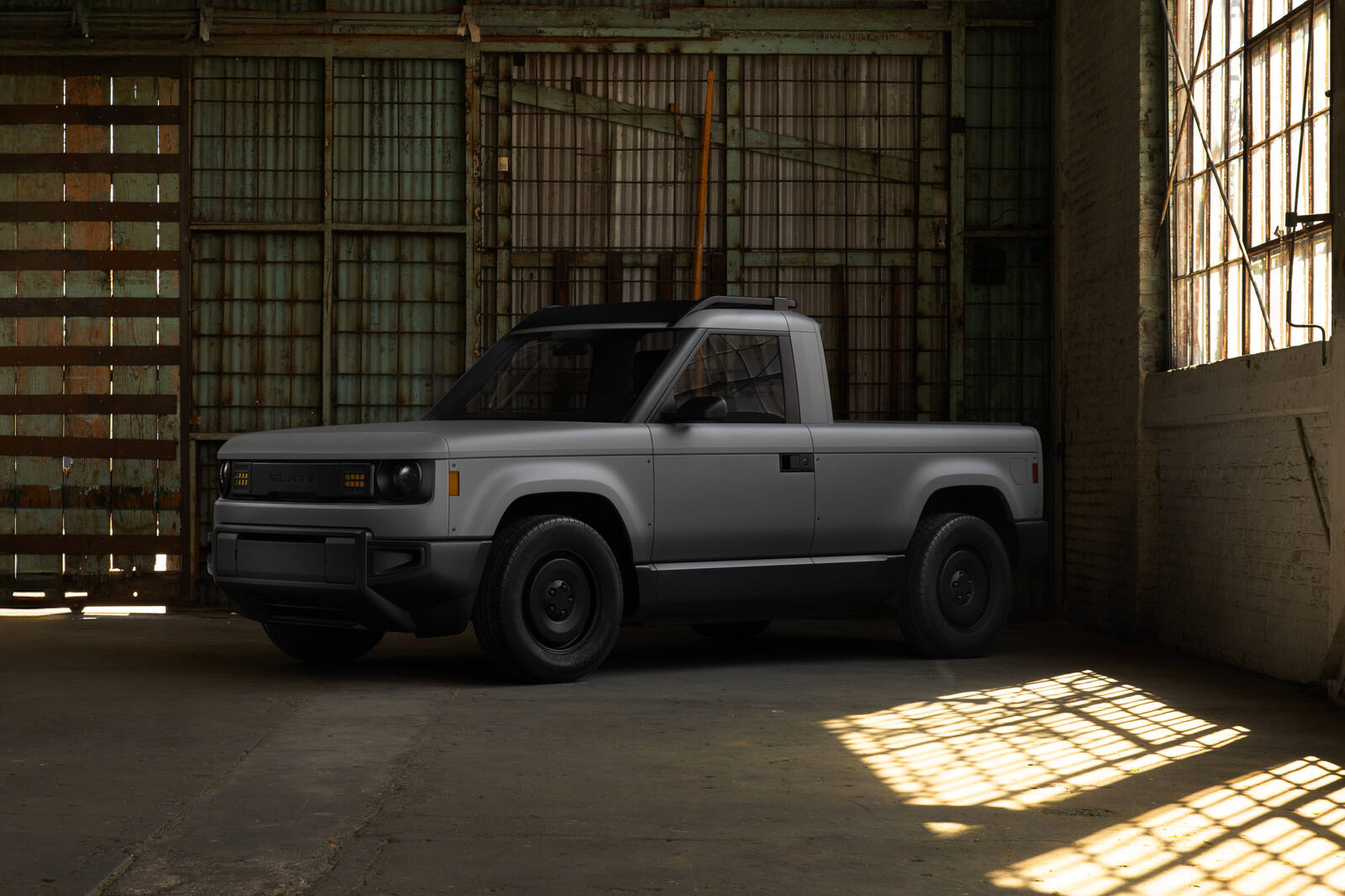
Truck Slate Auto
"...ey were Carvana's granted the option to invest in slate auto. So they might start looking into like, you know,..."
“Truck” here is a general term, not a specific model. Trucks are often used for heavier work and rougher roads, which can make wheel bearings wear out sooner. The podcast is likely connecting that to maintenance and repair costs.
In the podcast, “Truck” appears as a general reference rather than a specific model, likely tied to business or investment discussion. Because wheel bearings are a wear item, the topic can apply broadly to trucks due to their typical use—heavier loads, rougher roads, and higher mileage. The mention is relevant as a reminder that wheel-end maintenance matters across many truck types.
BYD Shark
"The BYD Shark seems to be a solution to having a truck that is electric but can still travel five hundred miles on the combined electric motor and gas engine. This'll allow you to tow without the long stops to charge."
The BYD Shark is an electric pickup idea from BYD that’s meant to drive long distances. The point being made is that it can tow and still go about 500 miles without waiting at charging stations for long periods.
The BYD Shark is a BYD electric pickup concept positioned around long-distance capability using both an electric motor and a gas engine. In this segment, it’s cited as a way to tow while still reaching roughly 500 miles before needing to charge.

Ford F-150 Lightning
"...n Stellantis. Ford has promised a next generation lightning that's going to be an E Rev. ⁓ Scout is ⁓ plannin..."
The Ford F-150 Lightning is an electric pickup truck. The podcast talks about what Ford plans next for an electric version of the Lightning. Wheel bearings can be important on trucks like this because they’re heavy and can put more load on the wheels.
The Ford F-150 Lightning is an electric version of the F-150 pickup, known for bringing EV technology to a mainstream truck platform. It’s referenced in the context of promises for a next-generation “E Rev” Lightning, which matters because future EV trucks may change how wheel-end components are stressed. Wheel-bearing discussions often include trucks like this because their weight and torque can affect wear patterns.

Terra Scout Terra
"...n E Rev version of the the Scout Traveler and the Scout Terra. so you know they should be arriving. And and Ste..."
“Terra” here refers to a vehicle model that’s expected to have an electric version. The podcast is talking about plans for that electrified model. Even with a new powertrain, wheel bearings are still a normal part of keeping the vehicle running safely.
“Terra” is mentioned as part of an electric “E Rev” plan for a Scout Terra, tying it to the broader electrification of that vehicle line. This is significant because EV versions can alter vehicle weight distribution and torque delivery, which can influence wheel-end wear. In a wheel-bearing podcast, the key relevance is that any new electrified SUV/truck platform still relies on robust wheel bearings.
E Rev
"Ford has promised a next generation lightning that's going to be an E Rev. ⁓ Scout is ⁓ planning an E Rev. You know they're going to launch with an E Rev version of the the Scout Traveler and the Scout Terra."
“E Rev” is a name for a hybrid-style setup that uses electricity for part of your driving. When you need more range or power—like towing—it switches to gas to keep going.
“E Rev” is being used as a label for an electrified powertrain strategy where the vehicle can drive electrically for a limited distance, then uses a combustion engine to extend range—especially when towing or under load. In the segment, it’s contrasted with a pure battery-electric launch timeline, implying it’s not a full EV.

Jeep Grand Wagoneer
"...ng yep, we're still going to be launching the the Grand Wagoneer E Rev and the Ram fifteen hundred E Rev, you know..."
The Jeep Grand Wagoneer is a big, more luxurious SUV. The podcast mentions an electric version coming, which changes how the SUV is powered. Wheel bearings matter on large vehicles because they carry more weight and can see more stress on the road.
The Jeep Grand Wagoneer is a large, upscale SUV positioned for comfort and premium features. It’s mentioned here in connection with an electric “E Rev” launch, which is relevant because EV drivetrains can change how torque and weight affect wheel-end components. Large SUVs also tend to experience wheel-bearing wear sooner when driven on rough roads or with heavy use.
Grand Wagoneer E Rev
"Stellantis, you know, as of what, a month ago saying yep, we're still going to be launching the the Grand Wagoneer E Rev and the Ram fifteen hundred E Rev, you know, this year."
The Grand Wagoneer E Rev is a future electrified version of the Grand Wagoneer. The idea is that you can drive on electricity for a while, but when you need more power or range—like towing—you’ll still have a gas engine to help.
The Grand Wagoneer E Rev is a plug-in hybrid–style “E Rev” concept tied to Stellantis’ push toward electrification. In this context, “E Rev” is being discussed as an electrified powertrain strategy that’s still expected to rely on a combustion engine when you need more range or towing capability.
Ram fifteen hundred E Rev
"Stellantis, you know, as of what, a month ago saying yep, we're still going to be launching the the Grand Wagoneer E Rev and the Ram fifteen hundred E Rev, you know, this year."
The Ram 1500 E Rev is a future Ram 1500 pickup with an electrified powertrain. The point is to use electricity for normal driving, but still have gas power available when you need it, like towing.
The Ram 1500 E Rev is an electrified version of the Ram 1500 pickup being discussed as part of Stellantis’ planned lineup. The “E Rev” framing here suggests a hybrid-like approach: electric driving for everyday use, with a gas engine stepping in when you tow or need extra range.
PHEVs
"I talked it up in a in a in an artic in a video I made about like what P Hav you know, how P HEVs hurt work."
PHEVs are plug-in hybrid cars. You can drive on electricity for a while, but they also have a gas engine for longer trips or when you need extra power.
PHEVs means plug-in hybrid electric vehicles. They combine a battery and electric motor for driving on electricity with a gasoline engine for longer trips or heavy use like towing.

Dodge Ram
"...ch ready to launch the ⁓ the E Rev version of the RAM two years ago, almost two years ago. ⁓ you know, ..."
The Dodge Ram is a large pickup truck meant for work like hauling and towing. The podcast mentions an electric version, which changes how the truck powers itself. Wheel bearings can be a concern on trucks because they often carry heavy loads and drive on rough roads.
The Dodge Ram is a full-size pickup truck line known for towing and hauling capability. It’s referenced here in the context of an electric “E Rev” version, which is significant because EV trucks can change how torque is applied and how components experience loads. Wheel-bearing discussions often include trucks because heavy use and rough roads can accelerate wheel-end wear.
V eight
"Carlos Tavares and brought back Tim Caniscus and you know, Tim decreed, ⁓ we have to put V eight's in everything. So, you know, that has kind of shuffled the schedules around, you know, 'cause they don't want to launch too many things simultaneously."
A “V8” is an engine with eight cylinders arranged in a V shape. The segment is basically saying that if a company insists on using V8 engines in many models, it can delay or complicate the rollout of electrified versions.
A “V eight” refers to a V8 engine, meaning eight cylinders arranged in a V shape. In this discussion, the speaker claims leadership wants V8s “in everything,” which would affect scheduling because developing and integrating multiple powertrains takes time.
Carlos Tavares
"then they fired ⁓ Carlos Tavares and brought back Tim Caniscus and you know, Tim decreed, ⁓ we have to put V eight's in everything."
Carlos Tavares is a senior executive associated with Stellantis. In this segment, he’s mentioned in connection with leadership changes that the speaker says affected the timing of electrified “E Rev” launches.
Tim Caniscus
"and then they fired ⁓ Carlos Tavares and brought back Tim Caniscus and you know, Tim decreed, ⁓ we have to put V eight's in everything."
Tim Caniscus is a leader at Stellantis mentioned in the discussion. The hosts say his direction to keep V8 engines in many vehicles affected how quickly the company could launch electrified versions.
Tim Caniscus (as spoken) is referenced as a Stellantis leader who, according to the speaker, pushed for V8 engines across the lineup. The segment ties that decision to shifting schedules for E Rev electrified models.
Request an Explanation
Heard something you'd like explained? We'll add it to this episode.
Sign in to request explanations for terms you heard.
Want to learn more?
Browse our glossary for plain-English explanations of automotive terms, jargon, and concepts.
Help improve this episode
See something that's not quite right? Our annotations are AI-generated and can sometimes miss the mark. Click the flag icon on any annotation to suggest a correction.