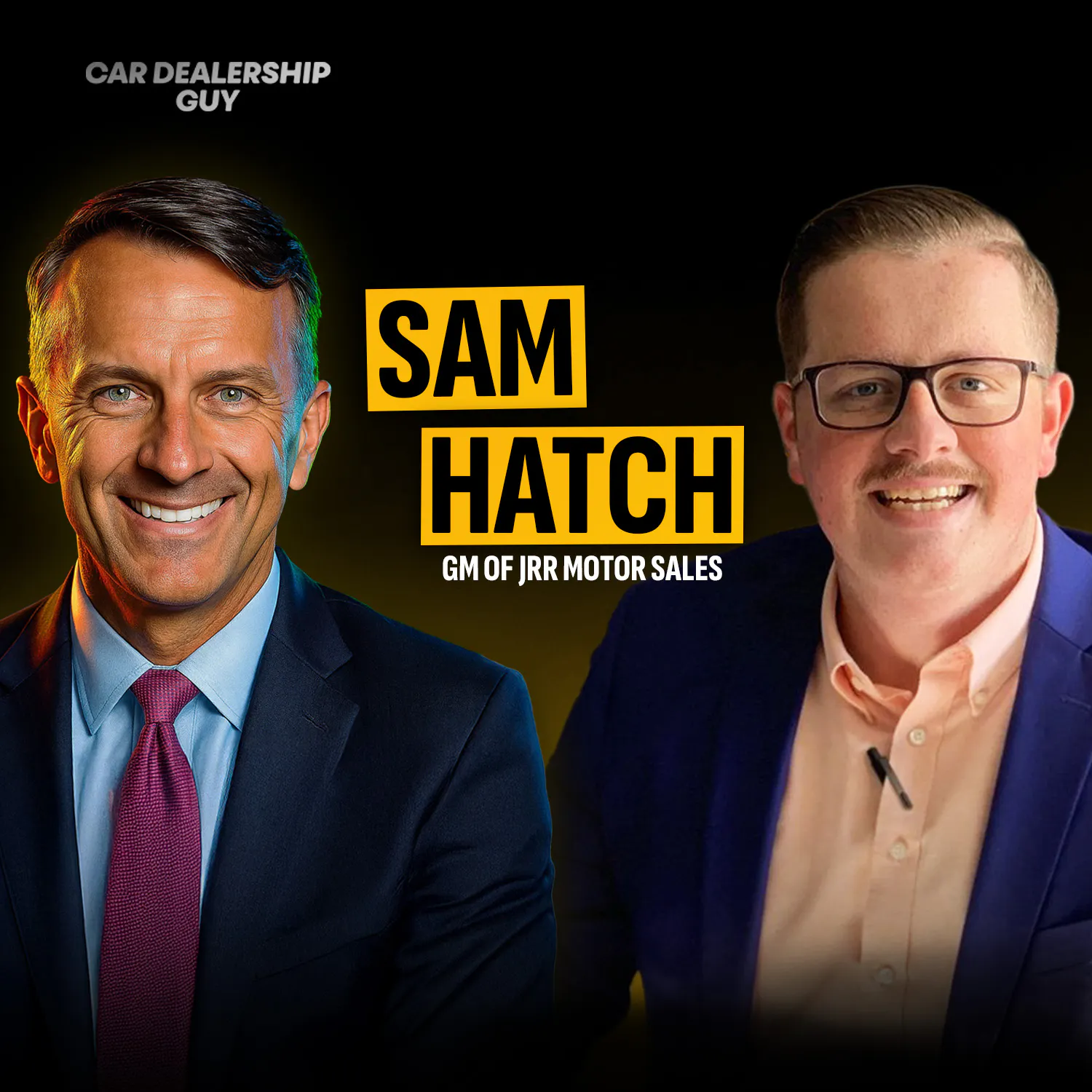
“We’re Buying Deeper!” How AI-Powered Sourcing Is Solving Used Car Acquisition (+ Scaling Secrets) | Sam Hatch, General Manager at JRR Motor Sales
About this episode
Sam Hatch traces his path from traveling car sales to running a used-car operation built on relationships, process, and aggressive sourcing. He explains how his store leans on 30 years of wholesale connections, auctions, boots on the ground, and Facebook, then shows how AI and simple automation help streamline pricing and inventory workflows. The conversation also digs into why he moved his top salesperson into a buying-center role and how disciplined acquisition drives profit.
Vauto
"Why hasn't Vauto made it to where it automatically puts my cost to market? I throw it on a spreadsheet and I can say how many cars can I buy at a list of 95%"
Vauto is a dealer software tool. It helps dealers find and price used cars, and the speaker is saying it doesn’t fully automate their pricing math the way they want.
Vauto is a software platform used by many dealers for used-car sourcing and inventory management. In this segment, the host is questioning why it can’t automatically calculate a dealer’s “cost to market” pricing workflow.
cost to market
"Why hasn't Vauto made it to where it automatically puts my cost to market? I throw it on a spreadsheet and I can say how many cars can I buy at a list of 95% deducted by my threshold of where I need to profit, right?"
“Cost to market” means figuring out whether the price you pay for a used car still makes sense compared to what similar cars sell for. If there’s not enough room for profit, you don’t buy it.
“Cost to market” is a pricing concept where a dealer compares what a car costs them (acquisition cost) against the going market price. The goal is to set a buy price that still leaves room for profit after reconditioning, transport, and other acquisition expenses.
recon
"So my pack, my profitability, recon, transit, whatever. Why can I create a spreadsheet that automatically plugs all those in and I can see every single car?"
“Recon” is dealer shorthand for reconditioning—work done to bring a used car up to retail-ready condition. It can include mechanical repairs, detailing, and cosmetic fixes, and it affects the true cost of acquiring the vehicle.
transit
"So my pack, my profitability, recon, transit, whatever. Why can I create a spreadsheet that automatically plugs all those in and I can see every single car?"
“Transit” here means the shipping/transport cost to get the car from where you bought it to where you keep it or sell it.
In dealer operations, “transit” refers to the cost and logistics of moving vehicles from where they’re sourced to where they’re stored or sold. It’s part of the total acquisition cost that must be accounted for when calculating profitability.
JRR Motor Sales
"Today I'm joined by Sam Hatch, general manager at JRR Motor Sales. As used car acquisition becomes increasingly difficult for both franchise and independent dealers, Sam explains how a boots on the ground strategy paired with AI automation is solving his inventory problem."
JRR Motor Sales is the used-car dealership where Sam Hatch works. They’re talking about how their buying process and logistics help them get enough cars to sell.
JRR Motor Sales is a used-car dealership referenced as the employer of Sam Hatch. The segment uses the company’s sourcing and logistics setup to explain how AI automation and on-the-ground buying can scale inventory.
boots on the ground strategy
"As used car acquisition becomes increasingly difficult for both franchise and independent dealers, Sam explains how a boots on the ground strategy paired with AI automation is solving his inventory problem."
This means having real people doing the work of finding and checking cars. The idea is that software helps, but humans still do key sourcing tasks.
A “boots on the ground strategy” means using people who actively source and inspect vehicles in the real world, rather than relying only on software. In the segment, it’s paired with AI automation to solve inventory acquisition at scale.
AI automation
"Sam explains how a boots on the ground strategy paired with AI automation is solving his inventory problem. Sam breaks down the radical decision to move his best salesperson into a buying role and why most dealers are looking at their data all wrong."
AI automation means using computer intelligence to do some of the dealer’s work automatically. In this episode, it’s used to help find and price enough used cars.
AI automation refers to using artificial intelligence to automate parts of the sourcing and pricing workflow. Here it’s described as helping dealers scale inventory acquisition by reducing manual spreadsheet work and improving decision speed.
credit pull
"[188.9s] I came from a store where if an up came in, it was a 100% credit pull. [193.0s] Like you got your deal split, couldn't take another up if you couldn't [195.2s] pull their credit, right?"
A credit pull is when someone checks your credit history to see if you qualify for a car loan. The speaker is saying their old store wouldn’t proceed unless they could check and verify credit.
A credit pull is when a lender (or dealership financing process) checks a customer’s credit report to decide whether they qualify for financing and at what terms. The speaker’s point is that their prior store required a 100% credit pull before moving forward with a deal.
deal split
"[193.0s] Like you got your deal split, couldn't take another up if you couldn't [195.2s] pull their credit, right?"
“Deal split” is a way dealerships break up how a car deal is handled and paid out. In this story, it matters because they couldn’t move forward with another customer if they couldn’t get the credit check done.
“Deal split” is dealership jargon for dividing a deal into parts—often separating who gets paid for which portion (for example, sales vs. finance/commission) or splitting the transaction structure. Here, it’s tied to whether the dealership can proceed with additional customers based on credit approval.
mailers
"[201.9s] What was one of the biggest things in the auto industry for mailers? [206.9s] It was called the money Carlo, which is like horrible. [209.9s] The triple sevens."
“Mailers” are ads sent through the mail to get people to come in and shop for a car. The speaker is talking about what those ads were like and what customers thought they’d get.
In auto retail, “mailers” are direct-mail marketing pieces sent to targeted households to generate leads for test drives, trade-ins, or special offers. The speaker is discussing how mailers were used in the industry and what people expected to receive.
money Carlo
"[206.9s] It was called the money Carlo, which is like horrible. [209.9s] The triple sevens. [210.7s] Everybody thought they want something coming in there."
“Money Carlo” is the name of a car-ad promotion the speaker is talking about. They imply it was kind of a gimmick that people still reacted to.
“Money Carlo” is referenced as the name of a direct-mail promotion in the auto industry. The speaker’s tone suggests it was a gimmicky campaign that people responded to, even if it wasn’t effective or was poorly executed.
triple sevens
"[206.9s] It was called the money Carlo, which is like horrible. [209.9s] The triple sevens. [210.7s] Everybody thought they want something coming in there."
“Triple sevens” sounds like a catchy name for a promotion used in car ads. The speaker is saying people thought they were getting something valuable when they saw it.
“Triple sevens” appears to be a marketing/offer phrase the speaker associates with auto direct-mail campaigns. In this context it likely refers to a specific promotion people believed they were being offered when they received the mailer.
exit acquisitioning
"A lot of these dealerships were working towards exit acquisitioning and a way for them to get the best numbers that they could possibly produce was they were doing these super sales religiously, which I found fascinating."
This phrase sounds like a business plan where a dealership is thinking ahead about how it will eventually “cash out.” So they try to buy and sell cars in a way that sets them up for a better outcome later.
“Exit acquisitioning” sounds like a dealership strategy focused on acquiring inventory or deals with an eye toward an eventual exit (selling the business, exiting a market, or monetizing the operation). The key idea is that sourcing and sales tactics are optimized for future payoff rather than just short-term transactions.
traveling salesperson
"What lessons did you learn about selling cars as a traveling salesperson that help you today? Like what are the tips to being a great salesperson that you learned on the road?"
This is a salesperson who travels to different places instead of staying in one dealership. They help find and sell cars by working with people in multiple areas.
A “traveling salesperson” is a sales role where the person covers multiple locations rather than working at one dealership. In used-car sourcing, this often means building relationships, finding inventory leads, and negotiating deals across different markets.
integrity (sales ethics)
"I will tell you the thing that I had to hold above all next to God was like integrity. And I never looked at it like I was selling somebody a vehicle. I always looked at it like car creating a relationship."
Here, “integrity” means doing the right thing when selling a car—being honest and treating the customer fairly. It’s about making sure the customer has a good experience, not just closing the sale.
In the context of car sales, “integrity” is presented as an ethical approach to negotiations and customer treatment—prioritizing honesty and a fair experience over squeezing the deal. The host contrasts it with a more cynical “everyone else will do it” mindset.
pre-purchase inspection (PPI)
"[479.9s] You saw a ton of sales quick and it was fueled by special promotions. [485.2s] So there's a level of excitement. [487.3s] Your traditional salesperson working a dealership six, seven days a week"
A pre-purchase inspection is when someone checks the car (usually before you buy) to look for problems. This helps you avoid surprises.
The segment discusses how salespeople use tactics and messaging to close deals, but it doesn’t clearly mention an inspection process. A PPI is typically a separate step where a buyer pays for an independent inspection before buying.
dealer add-ons
"[504.1s] tactics that other people were using. [505.7s] Hey, come refinance in six months to a year. [508.3s] You know, fed them this, you know, I don't know, whatever type of line [511.7s] got them by to get a close."
Sometimes dealerships make extra money by adding extras to the deal—like add-on products or services—so the customer pays more than just for the car.
The host is describing sales tactics used to increase profit by pushing additional products or services beyond the core car sale. In dealership terms, these are often bundled into the deal to raise the total transaction price.
refinance
"[504.1s] tactics that other people were using. [505.7s] Hey, come refinance in six months to a year. [508.3s] You know, fed them this, you know, I don't know, whatever type of line"
Refinancing is when you swap your current car loan for a new one, often to change the payment or interest rate.
Refinancing means replacing an existing auto loan with a new loan, usually with different terms. In dealership conversations, it can be used as a sales strategy to steer customers toward a future loan change.
podium
"This episode is brought to you by podium. ... Podium's voice AI books appointments routes calls correctly and escalates when it should based on your dealership's playbooks."
Podium is a company that makes software for car dealers. They use AI to handle phone calls and help schedule appointments so dealers can respond faster and convert more leads.
Podium is a software vendor that provides AI-driven tools for dealerships, especially around customer communication. In this segment, it’s described as using voice AI to book appointments, route calls, and follow dealership-specific playbooks.
AI agents
"...thousands of their customizable AI agents are actively running sales and service workflows every day."
AI agents are “do-the-work” computer programs. Instead of just chatting, they can take actions like handling parts of sales or service processes.
AI agents are software systems that can carry out tasks or workflows automatically, rather than just generating text responses. Here, the host claims customizable AI agents are actively running sales and service workflows every day.
voice AI
"Podium's voice AI books appointments routes calls correctly and escalates when it should based on your dealership's playbooks."
Voice AI is AI that can understand what someone says out loud and respond automatically. For dealers, it can help answer calls, schedule appointments, and send calls to the right person.
Voice AI refers to AI that understands spoken language and can respond via phone calls or voice interfaces. In this segment, it’s used to book appointments, route calls, and escalate issues according to dealership playbooks.
unit sales
"What was your record day in unit sales and your record week number of sales sold? I want to say a 10 day sale at 67 cars."
Unit sales just means how many cars a dealer sold. It’s a common way dealers measure how well they’re doing over a day or week.
Unit sales is the number of vehicles sold, typically tracked daily, weekly, or monthly by dealerships. The host uses it to talk about a “record day” and “record week” in sales volume.
subprime
"[740.7s] various but subprime. [742.0s] We were at a kid. [742.4s] We were at a Hyundai store that was buying deeper than, you know, the"
“Subprime” means the customer’s credit isn’t great. That usually makes car loans harder to get and more expensive, so dealers have to adjust how they buy and sell cars.
“Subprime” refers to borrowers with weaker credit histories, which typically leads to higher interest rates and stricter lending terms. In used-car acquisition, it often shows up as a customer financing profile that dealers must plan inventory and pricing around.
Hyundai
"[742.4s] We were at a Hyundai store that was buying deeper than, you know, the [745.2s] Mariana's trench. [746.1s] Every time I go to these stores, they're their auto group, family owned"
Hyundai is a car brand. The speaker is saying they worked at a Hyundai dealership, which is relevant to how they learned the used-car business.
Hyundai is a major automaker with franchise dealerships that sell new vehicles and often trade into used inventory. In the transcript, the speaker references working at a Hyundai store as part of their used-car sourcing experience.
franchise
"[781.2s] It is the car business. [782.6s] You know, having had all that experience, seeing all these franchise [785.94s] "
A franchise dealership is a car store that sells one brand’s cars under a formal agreement. The speaker is talking about dealership structure and how those stores operate.
A franchise dealership is a retail business that sells a specific automaker’s vehicles under an agreement with the manufacturer. The transcript’s “franchise” reference points to how dealership networks are organized and how store operations can differ by ownership and structure.
general manager
"So and he basically gave me the ball. He said, Hey, I'll do all of your, you know, what I would call a Comptrolling or controller aspect stuff and buying cars and you sell them and keep up with the sales. And I was a glorified general manager at 23."
A general manager is the person running the dealership. They make sure the different departments work together to hit sales goals and keep the business operating.
In a dealership, a general manager is the top on-site executive responsible for overall operations—staffing, budgeting, and hitting sales targets. They coordinate departments like sales, finance, and inventory so the store runs smoothly day to day.
sales manager
"...if I could take a sales manager job at a store, then I got to become general sales manager, that's the type of director, then a general manager..."
A sales manager runs the dealership’s sales team. Their job is to help the team sell cars and meet targets.
A sales manager oversees the dealership’s sales team and day-to-day selling process. They typically manage leads, pricing discussions, and sales performance so the store stays on track.
controller
"He said, Hey, I'll do all of your, you know, what I would call a Comptrolling or controller aspect stuff and buying cars and you sell them and keep up with the sales."
In dealership operations, a controller is a finance-focused role that handles accounting and financial controls. The controller often oversees things like inventory-related accounting, reporting, and ensuring the numbers stay accurate.
buying cars
"He said, Hey, I'll do all of your, you know, what I would call a Comptrolling or controller aspect stuff and buying cars and you sell them and keep up with the sales."
“Buying cars” means finding and purchasing used vehicles to sell at the dealership. If you buy the right cars at the right price, it’s easier to sell them and make money.
“Buying cars” here refers to sourcing inventory for the dealership—acquiring used vehicles to resell. It’s a core dealership function because the quality and pricing of inventory strongly affect sales margins and how quickly cars move.
60 month leases
"...just absent doing 60 month leases, just destroying people's lives, you know, just like doing doing things that were much different than I was a cater to..."
A 60-month lease is basically a 5-year rental contract for a car. When lots of cars are leased and then returned after that time, it changes what used cars dealers can find and buy.
A “60 month lease” is a car lease agreement with a 5-year term. In used-car sourcing discussions, it often comes up because lease returns and lease-end inventory can affect what’s available to buy and how prices move.
Dan Cummins
"...I was willing to go to Dan Cummins at a thousand cars or 800 cars a month store go there and try to..."
The speaker mentions Dan Cummins as someone they’d work with for buying cars in very large quantities. It’s a specific person or operation, not a general car term.
Dan Cummins is referenced as a person the speaker would go to for high-volume used-car sourcing (e.g., “a thousand cars” or “800 cars a month”). In this context, it’s about a specific dealer/operator or sourcing channel rather than a general industry concept.
independent used car operation
"...you're a gentle manager of the independent used car operation and it's interesting because before you open this retail point..."
This means a used-car business that operates on its own (not as part of a big brand dealership group). They still have to find and buy cars, but the structure is more independent.
An independent used car operation is a dealership business that isn’t part of a large franchise group, typically operating with its own sourcing and sales processes. The GM contrasts this with the wholesale background of the person they work for.
wholesaler
"...before you open this retail point, the the individual you work for is basically a wholesaler. So he's moving hundreds of cars a month and decides hey, we want to open up a retail location."
A wholesaler is like a bulk buyer. They buy cars in large numbers and then sell them to dealerships instead of selling to regular customers.
A wholesaler is a business that buys vehicles in bulk and sells them to other dealers or buyers, rather than selling directly to the public. Here, the GM explains that the person they work for is essentially a wholesaler before opening a retail location.
used car acquisition
"One of the toughest jobs in automotive motive new used whatever is used car acquisition. Where are you getting used cars today?"
Used car acquisition just means how a dealership finds and buys the used cars it will later sell. The hard part is getting enough cars consistently without overpaying.
Used car acquisition is the process of finding, sourcing, and purchasing inventory for a dealership—before any retail sales happen. In this segment, the GM is describing how difficult it is to consistently locate good used cars and buy them at the right volume and price.
wholesale fleet
"Our wholesale fleet is ran off of relationships that have been established over the span of 30 years and we don't have a single buyer for our fleet of wholesale cars that I mentioned online."
A wholesale fleet means the group of used cars a wholesaler has available to sell to other dealers. They’re talking about where those cars come from and how they manage the supply.
A wholesale fleet is the dealership or wholesaler’s inventory pool of vehicles intended for wholesale sale (often to other dealers). In the segment, the GM says their wholesale fleet is sourced through long-standing relationships and not through a single online buyer.
auto auction
"...with who America's auto auction, Mannheim... [1098.0s] But primarily auction auction rooftops dealership..."
An auto auction is like a big marketplace where used cars are sold. Dealers use it to buy cars in larger quantities and often for lower prices than retail.
An auto auction is a marketplace where vehicles are sold to dealers and other buyers, often in bulk. For used-car acquisition, auctions are a major way to find inventory quickly and at wholesale-style pricing.
Mannheim
"...with who America's auto auction, Mannheim, a desk, anybody [1065.9s] who sells cars, any any auction house..."
They’re talking about Mannheim as a place where used cars are bought and sold. It’s part of the auction network dealers use to find inventory.
The speaker mentions “Mannheim” as a key source in their used-car pipeline. In this context, it refers to an auto-auction ecosystem/marketplace that dealers and buyers use to source inventory.
trades
"We're getting I don't know how many trades and people that it doesn't work [1074.5s] in the auto. So they send it to us."
A “trade” is when someone turns in their current car as part of buying a different one. Dealers then resell those trade-in cars later.
“Trades” refers to vehicles dealers receive when customers trade in their current car for another purchase. In used-car sourcing, trade-ins are a common supply channel for additional inventory.
wholesale copy
"We're not looking to make thousands. [1079.8s] You know, our average wholesale copy is a couple hundred bucks."
“Wholesale copy” here means the typical wholesale price they pay for a vehicle (their average per-unit cost). It’s used to describe their sourcing strategy and margin expectations rather than retail pricing.
private party acquisition
"...a lot of dealerships [1103.0s] that we obviously get trades from and then private party acquisition."
This means buying used cars directly from regular people, not from dealerships or auction lanes. It can help you find cars that aren’t showing up in the usual places.
Private party acquisition means buying vehicles directly from individual owners rather than through dealer trade-ins or auctions. It can expand inventory options, especially when certain used cars are scarce at auction.
viato
"I'm very largely invested in viato what they use internally to dictate not only my market day supply, but how they come up with the data that creates what I should be putting in a car and what I should be asking for it"
Viato is a software system the dealership uses to help decide what cars to buy and how to price them. It uses data to guide their decisions instead of relying only on gut feel.
Viato is the internal software tool the dealership uses to guide used-car sourcing and pricing. The host says it helps determine what inventory to buy and what to ask for each car by using market data.
market day supply
"...viato what they use internally to dictate not only my market day supply, but how they come up with the data that creates what I should be putting in a car"
“Market day supply” is a way to measure how many days it would take to sell the cars that are currently available in the market. It helps the dealer decide whether prices should be higher or lower.
“Market day supply” is a market-inventory metric that estimates how many days it would take to sell the current supply of a given vehicle. In pricing and sourcing, lower supply can support higher asking prices, while higher supply can pressure prices down.
list
"...my average cost to my car is 84 percent of the market and my average list is 95 percent."
Here, “list” means the price the dealer posts for the car. It’s the starting asking price before any bargaining.
In this context, “list” refers to the dealer’s listed asking price for a vehicle (often before negotiation). The host contrasts it with average cost to show how their pricing strategy tracks the market.
Facebook Marketplace
"...you're big on stock wave, big on Facebook marketplace."
Facebook Marketplace is where people post cars for sale. The dealership uses it as a place to find inventory.
Facebook Marketplace is a consumer-to-consumer listing platform the dealership uses for sourcing used cars. The host groups it with AI-driven search/sourcing as part of their acquisition workflow.
SEO
"...using SEO search engine optimizes how you can optimize a search engine."
SEO means making your listings easier to find on Google or other search engines. If you do it well, more people searching for cars will see your inventory.
SEO (search engine optimization) is the practice of improving how easily a website or listing appears in search results. The host mentions “SEO search engine optimizes,” implying they use SEO-style optimization to improve discoverability of inventory and leads.
spreadsheet
"I throw it on a spreadsheet and I could say how many cars can I buy at list of 95 percent deducted by my threshold of where I need to profit?"
A spreadsheet is a table where you can plug in numbers and rules. The host is using it to estimate which car deals will still make enough money after other costs.
In dealership sourcing, a spreadsheet is used to model deal economics—inputs like acquisition cost, expected reconditioning, and logistics—then calculate which vehicles meet profitability rules. Here, it’s central to automating how many cars can be bought under constraints.
profit threshold
"list of 95 percent deducted by my threshold of where I need to profit? So my pack, my profitability, recon, transit, whatever, why can I create a spreadsheet that automatically plugs all those in"
A “profit threshold” is the lowest amount of profit you’re willing to accept. If a car can’t meet that minimum, it doesn’t make the cut.
A “profit threshold” is the minimum margin (or expected profit) a buyer requires before a vehicle qualifies as a deal. The host describes using a threshold to filter which cars can be purchased while still meeting profitability targets.
Carvana
"Well, you know, who's not doing that is Carvana. Carvana is using agentic."
Carvana is a big used-car company that sells cars online. Here, they’re being used as an example of a company using AI to automate parts of the buying process.
Carvana is an online used-car retailer that buys and sells vehicles at scale. In this segment, the host mentions Carvana as an example of a company using AI-driven automation for sourcing and operations.
agentic
"Well, you know, who's not doing that is Carvana. Carvana is using agentic."
“Agentic” AI means the software can do tasks for you, not just talk. It can follow steps to complete a goal, like running sourcing searches and saving the results.
“Agentic” refers to AI systems that can take actions toward a goal, not just answer questions. In used-car sourcing, an agentic system can operate tools, apply filters, and record results as part of a workflow.
OpenAI
"Is it is a cloud? Is it open AI or a chat GPT? What are you creating?"
OpenAI is a company that makes AI tools like ChatGPT. The question here is what AI platform the creator is using for their assistant.
OpenAI is the organization behind the ChatGPT family of AI models. The host is asking whether the tool being built uses OpenAI/ChatGPT or another cloud-based AI platform.
ChatGPT
"Is it is a cloud? Is it open AI or a chat GPT? What are you creating?"
ChatGPT is an AI chatbot. Here, they’re asking whether the assistant being built is based on ChatGPT.
ChatGPT is a conversational AI model that can generate responses and help automate parts of a workflow. In this segment, it’s referenced as a possible underlying AI for an assistant that performs or records sourcing actions.
sensitive data
"So he just it's really specific about sensitive data. So that's what's that's what's kind of funny."
Sensitive data is information that shouldn’t be shared or exposed. The speaker is saying the system is careful about what kind of private information it allows you to use.
Sensitive data refers to information that should be protected because it could cause harm if exposed—such as account details, pricing inputs, or proprietary dealer information. The speaker notes that the system is “specific about sensitive data,” implying access and handling controls.
repeat script
"So right now I have it running on a on a repeat script to where I pro I just a little bit of code and made a script to where it literally it's just too easy."
A repeat script is basically an automation that repeats a task. Here it’s being used to make the process of gathering and organizing vehicle data easier.
A repeat script is an automated set of instructions that runs the same workflow repeatedly. In sourcing workflows, scripts are often used to pull data, apply rules, and reduce manual steps when evaluating inventory.
MMR
"...I say, hey, how many cars can I actually buy based off of what I think it'll bring at 100% of MMR based off at CR versus what Viato told me to pay."
MMR is a pricing guide for used cars. It helps dealers estimate what a car is worth by looking at recent sales, so they can decide if a deal is good.
MMR (Manheim Market Report) is a widely used pricing index in the used-car industry. Dealers use it as a benchmark for what a vehicle should be worth based on recent market sales, then compare their target purchase price against it.
CR
"...100% of MMR based off at CR versus what Viato told me to pay."
CR here sounds like a number the dealer plugs into their deal math. It helps them estimate how much money they can spend and still make the numbers work.
In this context, CR is being used as a multiplier/assumption in the dealer’s pricing model—specifically tied to how they expect the vehicle to perform relative to their benchmark. It’s part of the math that turns market pricing into an actionable buying budget.
AI-powered sourcing
"...we've talked a lot on the podcast about how the future of being a GM is learning how to manage and work with AI. You're doing that."
AI-powered sourcing means using computer tools to help a dealer find and evaluate used cars faster. Instead of doing everything by hand, the system helps with pricing and decision-making.
AI-powered sourcing uses automated data collection and analysis to find and evaluate used vehicles more efficiently than manual searching. For dealers, it can help estimate value, compare offers, and scale inventory acquisition while keeping decisions consistent.
StockWave
"“...insights to data that currently exists in Viato, stock wave and elsewhere?”"
StockWave is software that helps car dealers manage inventory and listings. The host is saying their tool can use data from platforms like this.
StockWave is another dealer-focused software platform used for inventory and listing workflows. The host groups it with other data sources that their tool can tap into for better decision-making.
web scraping
"Well, on our Facebook right now, because there are certain scraping restrictions, refreshing restrictions, API restrictions, all these different things, it's really hard to integrate what you're asking."
Web scraping means using software to automatically copy information from a website. Dealers use it to collect lots of car listing data quickly, but websites may block or limit it.
Web scraping is the automated process of pulling data from websites (like listings) by reading the site’s pages or underlying data feeds. In used-car sourcing, it’s often used to gather inventory details faster than manual searching, but it can run into platform rules.
API restrictions
"Well, on our Facebook right now, because there are certain scraping restrictions, refreshing restrictions, API restrictions, all these different things, it's really hard to integrate what you're asking."
An API is a set of rules that lets one app talk to another app or website. API restrictions are limits on how much or how fast you’re allowed to pull data.
An API (Application Programming Interface) is a structured way for software to request data from another system. API restrictions limit how often or how much data a tool can pull, which affects how efficiently a dealer can automate used-car sourcing from platforms.
refreshing restrictions
"Well, on our Facebook right now, because there are certain scraping restrictions, refreshing restrictions, API restrictions, all these different things, it's really hard to integrate what you're asking."
Refreshing restrictions are rules that limit how often you can update or re-check information on a website. That can make it harder to keep up with new car listings.
Refreshing restrictions are limits on how frequently a system can update or re-query data from a platform. For sourcing, this can slow down how quickly inventory changes are detected and how often searches can be rerun.
chat (AI) for data-finding
"But what I was able to figure out was using chat to help me find the data a little bit easier."
They’re using an AI chat tool to help them figure out what to search for and how to search better. The goal is to find car listing information faster and with fewer dead ends.
Here, “chat” refers to using an AI chat tool to help interpret what data to look for and how to search for it. In sourcing workflows, this can mean generating better search terms and strategies to find listings more efficiently.
appraisal tool
"The information gets put into there... compiles on to in our V auto for our appraisal tool. I go in there, I check which ones are even within the ballpark or something I can bid it for."
An appraisal tool estimates what a car is worth. The host uses it to decide which cars are close enough to their target price to make an offer.
An appraisal tool is software used to estimate a vehicle’s value so the buyer can decide whether a deal is within a target range. Here, the host uses their appraisal workflow to check which cars are “within the ballpark” before bidding.
inventory tracking
"once we write a check... gets put under our spreadsheet and then I track its existence in my inventory track when it gets sold track how much you get how much I made off of it."
Inventory tracking means keeping records of each car from “we bought it” to “we sold it.” They’re also tracking how much money they made on each one.
Inventory tracking is the process of recording each vehicle’s status from acquisition through sale. The host describes tracking when a car enters inventory, when it sells, and the profit outcome.
DMS
"So what DMS retail we use. We use dealer track across the board."
DMS means “dealer management system.” It’s the computer system a car dealership uses to organize inventory and manage sales paperwork. They’re saying they use different systems depending on whether they’re doing retail or wholesale.
DMS stands for dealer management system. It’s the software dealers use to run day-to-day operations like inventory, pricing, and customer/deal workflows. In this segment, the host contrasts different DMS setups for retail vs wholesale inventory tracking.
dealer track
"We use dealer track across the board. We use Cox across the board for every everything we have."
Dealertrack (spelled “dealer track” in the transcript) is a dealership software tool. They’re saying they use it for their whole operation. It helps them manage the business side of buying and selling cars.
“Dealertrack” is referenced as a tool used “across the board,” likely for dealership operations tied to inventory and deal processing. In the used-car world, Dealertrack is commonly associated with digital retailing and workflow software. Here, it’s part of the host’s stack of systems used to keep inventory and sourcing organized.
Cox
"We use Cox across the board for every everything we have."
Cox is a company they rely on for dealership software/tools. The point is that it helps them manage or source inventory efficiently. They’re saying they use it for basically all of their operations.
Cox is referenced here as a software/vendor used across the dealership’s operations. In dealer workflows, Cox products are commonly used for inventory and sourcing/market data, which helps keep listings and stock information current. The host says they use Cox “across the board” for everything they have.
Fraser
"But for our our host operation, we use Fraser just because of the accessibility and how easy the simplicity of it. It is night and day."
Fraser is another company/tool they use for sourcing and running part of their dealership operation. They’re saying it’s much easier to use and works better for their day-to-day needs. The “night and day” comment means the workflow is smoother.
Fraser is mentioned as the sourcing/operations platform the host uses for their “host operation.” The host implies it’s easier to access and simpler to use than the alternative, and that the difference is “night and day.” This is about choosing dealer tools that improve speed and workflow for inventory management.
Zurich
"This episode is brought to you by Zurich. Zurich helps dealers operate with clarity, confidence, uncertainty..."
Zurich is the company sponsoring the episode. They’re talking about insurance and dealer support services that help car dealers manage risk and run their finance/insurance side of the business. It’s an ad for dealer-focused coverage and tools.
Zurich is the sponsor and is positioned as providing insurance and risk-management solutions for dealers. The ad mentions “F&I processes,” training, and “risk management solutions,” which are common dealer-focused insurance and finance-and-insurance services. This is relevant because it ties into how dealers protect long-term value while scaling operations.
F and I processes
"...protecting long term value from proven F and I processes and insights driven training..."
“F&I” means finance and insurance. It’s the part of the dealership where they arrange financing and sell add-ons like warranties or insurance. The sponsor is saying they help dealers run that side more effectively.
“F&I” refers to finance and insurance—the dealership department/process that sells products like vehicle warranties, insurance, and financing packages alongside the car. The sponsor claims their tools support “F&I processes and insights,” meaning better workflows and decision-making in that profit-and-risk area. This is a specialized dealership term rather than general “finance.”
wholesale business
"I think is what you said and you said you'd have those cars on your lot if whole if the wholesale business wasn't so good."
Wholesale means selling cars to other car dealers instead of regular buyers. It’s usually a different pricing and profit game than selling retail to the public.
In used-car dealing, the wholesale business is selling vehicles to other dealers (or dealer networks) rather than to end customers. Dealers often make more predictable margins when they can source cars in bulk and move them through wholesale channels.
retail
"...to get a better return selling them to car dealers than you are to consumers retail."
Retail means selling the car to regular customers (not other dealers). The price and profit can be different than selling the same car wholesale.
Retail is selling a vehicle directly to end customers, typically at a higher price than wholesale. The episode contrasts retail returns versus selling to other dealers, which can change the dealer’s overall profit strategy.
market relevancy
"Yeah, we we have dealers that have a way better market relevancy than my little store in the middle of nowhere."
Market relevancy means your cars fit what local buyers want. If your inventory matches demand, you can sell faster and usually make better money.
Market relevancy here refers to how well a dealer’s inventory and pricing match what local buyers are actually searching for and willing to pay. Higher market relevancy can improve demand and reduce time-on-lot, which matters when sourcing and reselling cars.
clean title
"Nothing Kentucky people look at my cars and the how price how cheap I price them and they're like, is it a clean title?"
A clean title means the car’s paperwork doesn’t show serious problems like being totaled or rebuilt. Buyers ask about it because it affects price and whether the car can be financed or resold easily.
A clean title means the vehicle’s ownership paperwork has no major legal or damage history flags (like salvage or rebuilt branding). For used-car buyers and dealers, title status strongly affects value, financing eligibility, and how easily the car can be resold.
sourcing these cars
"[1744.4s] I had a guy that was producing 25 plus cars a month from me [1747.1s] off on the floor where I make a boatload of money. [1749.6s] I took him off the floor because I knew how good he would be [1752.4s] at sourcing these cars and he's passionate about it."
Here, “sourcing” means tracking down used cars the dealership wants to buy. It’s about finding the right vehicles, not just any cars that show up.
“Sourcing” in this context means actively locating specific used vehicles (often from auctions, wholesalers, or other dealers) that match the dealership’s needs. It’s not just buying whatever is available—it’s finding the right inventory quickly and consistently.
transparency
"[1774.7s] I'm hitting up everybody faster than anybody in my neck of [1777.3s] the woods you're not going to get it's going to be hard to [1779.9s] have somebody get there before me have better transparency"
“Transparency” here refers to having clear, timely visibility into the sourcing pipeline—like knowing what inventory is available, where it is, and what the pricing/condition looks like. In used-car buying, better transparency reduces surprises and helps dealers move faster.
multi-purposed (salesperson → buyer)
"it's an interesting strategy to take your top sales person and turn them into a buyer... re allocating that guy to your buy center"
They’re describing a staffing strategy where a strong salesperson is moved into buying too. The goal is to get more value from that person for the whole business.
The segment describes reallocating a top car salesperson into a buying role, effectively turning one person into a dual-purpose function. This is an operational strategy to increase how much value one team member creates across both retail sales and wholesale sourcing.
wholesaling
"your buy center is your cell center too because you're wholesaling those yeah yeah so it's exactly there you go"
Wholesaling is when a dealer buys cars and then sells them to other dealers or resellers instead of selling directly to the public. It’s a different sales channel than retail.
Wholesaling in used-car acquisition means buying vehicles (often in bulk or from other dealers) and then selling them onward rather than retailing them directly to end customers. In dealership operations, this is commonly tied to sourcing workflows and a “buy center” function.
BDC
"yeah yeah he was selling cars off of Facebook already selling he didn't take a single up not a single leader for my BDC came into my dealership selling 20 cars a month okay just posting cars on Facebook"
BDC is a dealership’s lead-generation team. They help bring in potential buyers and follow up so sales can happen.
BDC stands for Business Development Center, a dealership team focused on generating and managing leads. In this segment, the host contrasts a BDC’s typical role with a salesperson who was already selling cars through Facebook and other online channels.
paid for organic
"so we started with that basic paid for advertisement that I wanted to train change it to paid for organic which is where I paid to make people naturally see me more"
They’re talking about changing how they get attention online—less just paying for ads, more getting cars seen naturally through how the platform shares content.
The speaker is describing a shift in strategy from straightforward paid promotion to “organic” visibility—content that reaches people through non-ad distribution (like shares and algorithmic recommendations). In practice, dealerships often blend both approaches to increase reach and reduce reliance on pure ad spend.
Facebook campaigning stuff
"and that's what we started investing in with the whole Facebook campaigning stuff and marketing and it's been a great success"
This is about running targeted ads on Facebook to get more people to see the cars and contact the dealership.
“Campaigning” refers to running targeted ad campaigns on Facebook to reach specific audiences and drive vehicle inquiries. The host contrasts this with simply posting and emphasizes that the dealership invested in these campaigns for lead generation.
wholesale operators
"...there's probably something you know a wholesale operators use car dealers like yourself know something about velocity that maybe franchise dealers don't know..."
A wholesale operator is someone who buys cars in larger quantities and sells them to other dealers. They usually have different buying channels than a typical retail dealership.
A wholesale operator is a business that buys vehicles in bulk or through dealer-to-dealer channels and then sells them to other dealers or buyers. In used-car sourcing, they often have faster access to inventory and pricing than retail franchise stores.
velocity
"...wholesale operators use car dealers like yourself know something about velocity that maybe franchise dealers don't know or appreciate..."
Here, “velocity” means how fast a dealership can turn cars over—buy them, sell them, and get paid. Faster turnover can help the business make money sooner.
In dealership operations, “velocity” usually means how quickly inventory moves—how fast cars are bought, reconditioned, and sold. Higher velocity can improve cash flow and reduce the time money is tied up in unsold inventory.
OEMs
"...you've got a speed that you're able to execute with a little faster than the OEMs do you agree or disagree..."
OEM means the original car maker—the company that builds the vehicles. The point here is that dealerships can sometimes move faster than the manufacturer’s typical pace.
OEM stands for Original Equipment Manufacturer, the company that builds the vehicle brand’s cars. The speaker contrasts dealership execution speed with what OEMs typically allow or plan for, implying different operational constraints.
independent dealer
"...at some point hatch you probably said hey I'm better and I want to be an independent use more than I want to be a franchise..."
An independent dealer is a dealership that isn’t tied to a specific brand franchise agreement. The idea is that they may have more freedom in how they buy and sell cars.
An independent dealer is a dealership not operating under a manufacturer’s franchise agreement. The speaker frames independence as enabling different sourcing and profit approaches compared with franchise stores.
profit strategy
"...first thing is your profit strategy you know when you hear about guys like the Dan Cummins group that has a two hundred dollar profit strategy..."
A profit strategy is how a dealership decides how it will make money on each sale. Some stores aim for bigger profit per car, while others sell more cars with smaller margins.
A profit strategy is the dealership’s approach to making money per deal—how much margin it targets and what tradeoffs it accepts (like selling more cars with thinner margins). The speaker uses examples of different profit targets to illustrate how strategy affects willingness to keep selling.
buying center
"so I'll tell you one of the things I learned walking away from today bold move taking your best sales person turning him into that by center but talk about a great gift that'll generate use cars that you can sell but then also positions that same person if they want to go back and sell those cars as well"
A “buying center” is the dealership’s used-car sourcing team. It’s the group that finds cars to buy, helps negotiate them, and brings inventory into the store so the dealership can resell it.
In a dealership context, a “buying center” is the team and process dedicated to sourcing used vehicles (finding inventory, negotiating, and acquiring cars to resell). The host is emphasizing staffing and leadership—turning a top salesperson into the person who runs that sourcing function to scale acquisition.
online market
"hatch easier acquisitioning right so we don't we haven't touched the online market at all and people would hate me if I did but that's where I'm going next is I want to"
The “online market” means finding used cars through websites and online listings instead of only through local, face-to-face connections. The host is saying they want to start using those online sources next.
“Online market” here refers to sourcing used vehicles through digital channels rather than relying only on local, in-person relationships. The host says they haven’t tapped it yet, and that’s the next direction for their acquisition strategy.
brick and mortar
"I took a store that is basically brick and mortar hey they have a great process boots on the ground like I said a sturdy imagine if you just took a small adaptation and added to that so that's my goal"
“Brick and mortar” just means a physical, in-person business location. The host is saying they’re starting from a traditional dealership setup and then adding online-style improvements.
“Brick and mortar” is the traditional physical dealership setup—having a store location where customers and inventory operations are handled in person. The host contrasts that with adding digital/online sourcing improvements to scale acquisition.
OEM name badge
"...we franchise dealers think we have a huge advantage because we've got the OEM name badge..."
“OEM” means the original car maker. The “OEM name badge” is the official brand signage a dealership uses for that automaker.
“OEM” stands for Original Equipment Manufacturer—the company that built the vehicles in the first place. An “OEM name badge” refers to the dealership’s official branding tied to that manufacturer, which can influence customer trust and marketing reach.
Request an Explanation
Heard something you'd like explained? We'll add it to this episode.
Sign in to request explanations for terms you heard.
Want to learn more?
Browse our glossary for plain-English explanations of automotive terms, jargon, and concepts.
Help improve this episode
See something that's not quite right? Our annotations are AI-generated and can sometimes miss the mark. Click the flag icon on any annotation to suggest a correction.