They’re starting the discussion about what makes a motorcycle look beautiful. The conversation is basically about taste and how people decide what looks good.
The segment describes how intense, bright lighting at an exhibit can make a motorcycle’s design details “pop,” altering the viewer’s impression of its aesthetics. This is an example of how environmental factors can affect visual perception of form, lines, and surface details.
The hosts emphasize that “beauty” in motorcycles is subjective—what one person finds attractive can depend on personal experience and context. That’s why the same bike can look different under different lighting or settings, and why there’s no single universal definition of beauty.
The McLaren 650S is a very fast, high-end sports car made for performance driving. It uses a powerful engine and is designed to handle well at speed. It often gets mentioned because it’s a modern example of a “supercar” built for both excitement and control.
Car
Triumph Speed Twin
The Triumph Speed Twin is a classic British motorcycle. The hosts are praising how it looks—especially the way the engine and parts are exposed in a clean, uncluttered way. They’re also saying that the same design vibe carried into later 650cc models.
“Pre-unit” and “unit twins” refer to how Triumph twin-cylinder engines were constructed and packaged. Pre-unit designs separate the engine and gearbox into different casings, while unit twins combine them into a single assembly. That packaging affects how the motorcycle looks and how the engine/primary area is shaped.
Carburetors are what older bikes used to mix fuel with air before it goes into the engine. On many classic motorcycles, you can see them clearly, and that visibility is part of what people find visually appealing. The carburetors also connect into the air intake system.
An air filter box (airbox) is the housing that contains the air filter and routes intake air to the carburetors or fuel injection system. The hosts highlight that the airbox is visible and visually “light,” which reinforces the classic, uncluttered look. Functionally, the airbox also helps smooth airflow and protect the intake from dirt.
A drum brake uses brake shoes inside a rotating drum to slow the wheel. The hosts call it “the traditional drum brake of the past” and mention a transition around 1970, implying the shift toward more modern braking hardware. Visually, drum brakes also contribute to the older, simpler look of classic motorcycles.
Wire spokes are the thin metal spokes used on traditional motorcycle wheels, typically laced to a rim. The segment treats them as part of the classic “British” visual language—contrasting with later wheel designs that look more modern or bulky. Spoked wheels also visually emphasize the bike’s lightness and mechanical character.
They’re talking about how motorcycle designers changed where the engine sits relative to the wheels. Moving the engine changes both how the bike rides and how it looks. The hosts also say racing ideas often end up influencing regular bikes.
Topic
hinge of fate bikes
The hosts use “hinge of fate bikes” to mean motorcycles that were big turning points—where a lot changed in how bikes were designed or built. It’s basically a way of saying “this model mattered a lot.”
A “bagger” is a motorcycle style associated with touring bikes that typically have large saddlebags and a more cruiser-like riding posture. The hosts use it as a weight reference point, comparing how heavy some earlier sportbikes were to what baggers weigh. They also discuss why some people complain about baggers, framing it as a debate about what counts as a “race bike.”
Fork tubes are part of the front suspension system. They help the front wheel move up and down smoothly over bumps. The hosts are pointing out that a bike can be very heavy even if the front suspension components look relatively small.
Power valves are parts on some two-stroke engines that help the engine make strong power across different speeds. They adjust timing so the bike doesn’t feel weak at certain RPMs. The hosts are saying the TZ750 doesn’t use them, so it’s more of a straightforward “all power” setup.
They bring up a Jay Leno quote as a way to talk about motorcycle design. The idea is that some bikes are visually “open” and you can see through them, which they think looks elegant.
Car
Triumph Bonneville
The Triumph Bonneville is a famous British motorcycle. Around 2001, Triumph brought back a retro style, but kept it modern enough to ride and enjoy today. The hosts are talking about how that new retro look still feels connected to the older bikes.
Car
Triumph Speed Twin 1200
The Triumph Speed Twin 1200 is a newer motorcycle from Triumph that’s styled like classic British bikes. The speakers are pointing out how its design lets you see through the bike and how some parts visually resemble older carburetor setups.
Fuel injection is how a motorcycle feeds fuel to the engine using electronics. It’s different from a carburetor, but the bike can still be styled to look like the older carb era.
Company
Amel monoblock carburetor
The speaker is talking about a classic carburetor style (“Amel monoblock”) that people associate with older performance bikes. Even though this motorcycle uses fuel injection, it’s designed to look like it has that old-school carb hardware.
“Going retro” means making a new motorcycle look and feel like an older classic. Triumph was trying to bring back that classic vibe, but still make it a modern bike you can ride.
“Kick in the pipes” is a phrase riders use to describe when the bike suddenly sounds and feels more alive. It’s basically about that satisfying moment when the engine really starts to pull.
Car
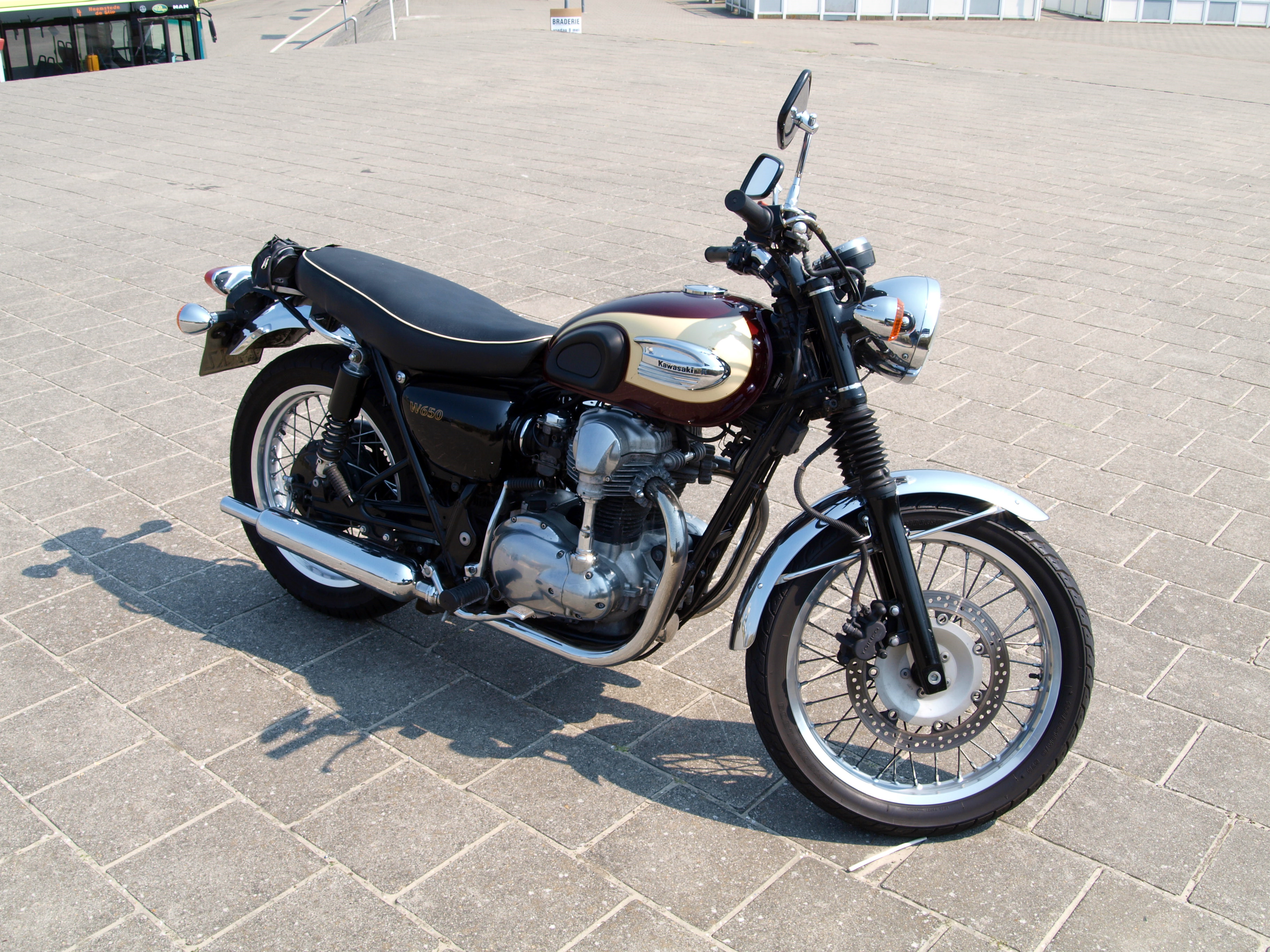
Kawasaki W650
The Kawasaki W650 is a retro Kawasaki motorcycle. The point here is that it feels and sounds old-school—more like classic Triumphs—rather than like a modern bike.
“17s” means the motorcycle has 17-inch wheels. Wheel size can affect how the bike rides and what tires you can run.
Car
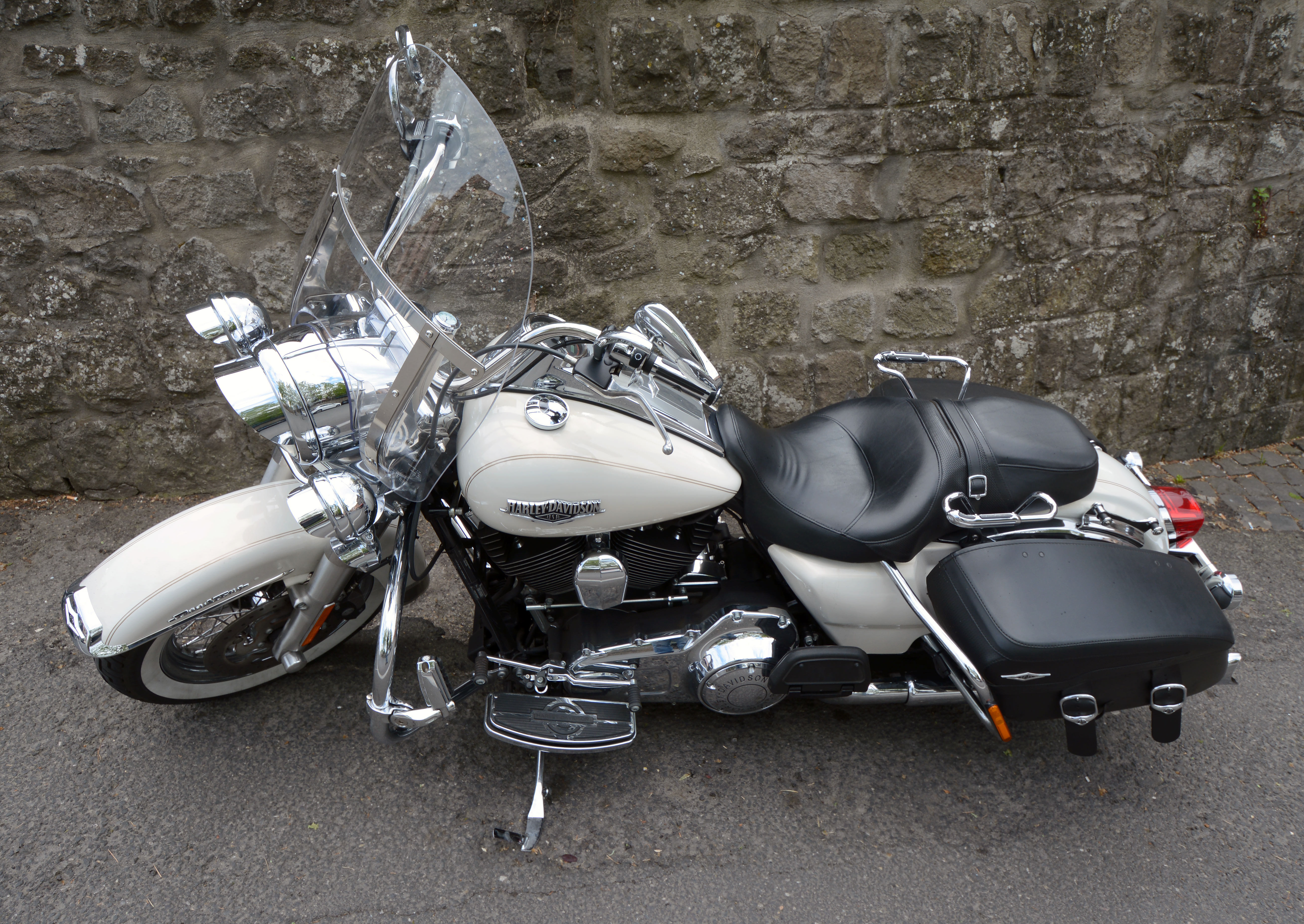
Harley Davidson Road King
The Harley-Davidson Road King is a touring cruiser. They’re saying the 2009 version got a newer chassis, which made it handle better than older Road Kings.
Straight-cut gears are a type of gear tooth shape. They often make more noise, and in this case Harley changed it because customers thought it was too loud.
Helical gears have angled teeth that tend to run quieter than straight-cut gears. Here, Harley changed the fifth gear to reduce noise people didn’t like.
“Blacked out” means parts that used to be shiny chrome are finished in black. It’s a style trend that changes the bike’s look without changing the core design.
“Jukebox look” is a way of saying the bike looks flashy and shiny, like the decor you’d see on an old jukebox. They’re contrasting that classic chrome style with darker modern styling.
In motorcycle and car marketing, “heritage” refers to using classic styling cues, brand history, and traditional design language to appeal to buyers. The speaker contrasts heritage-focused customers with those who still want modern or different finishes, showing how identity and design choices can be part of the product strategy.
Chrome is the shiny metal coating you often see on classic bikes and cars. In this discussion, it’s part of what makes the bike look rich and memorable.
A twin-loop frame is the motorcycle’s main metal structure. The shape helps the bike feel more stable and can make the engine and suspension work together better.
Hydraulic suspension uses fluid-controlled damping to manage how the wheels move over bumps. Compared with simpler setups, it can smooth ride quality and improve traction by controlling how quickly the suspension compresses and rebounds.
“Weight forward” means the bike feels like it has more of its mass toward the front. That can change how it steers and how stable it feels when you slow down or turn.
Car
1920-ish Indian scout
The Indian Scout is a classic Indian motorcycle. The speaker’s point is that it was designed to be easier for more kinds of riders to enjoy, not just the most athletic or experienced people.
The camshaft controls when the valves open and close. Putting it higher in the engine can make the valve linkage shorter and more direct, which can improve packaging and how the engine looks and works.
Overhead-cam engines put the camshaft closer to the valves, so the valve actuation can be simpler. The hosts are saying some older designs improved the pushrod setup first, as a stepping stone toward that overhead-cam arrangement.
Car
74 Commando Roadster
The “74 Commando Roadster” is a specific BSA Commando variant referenced as “England’s parallel twins last stand.” The hosts are using it to frame the end of an era for parallel-twin motorcycle design in England, tying the discussion back to engine architecture and character.
Car
Harley Sportster
The Harley-Davidson Sportster is a popular Harley motorcycle with a V-twin engine. Because of how the engine turns, it can make the bike feel like it’s “alive” and moving even when you’re stopped.
Counterweights are weights on the crankshaft that help cancel out the engine’s shaking. Changing them changes what kind of vibration you feel—more up-and-down or more side-to-side.
Car
Royal Enfield 500 bullet
The Royal Enfield Bullet 500 is a classic single-cylinder motorcycle. Single-cylinder engines often shake more than multi-cylinder bikes, and the host is saying this one was especially noticeable.
Featherbed is a well-known Norton motorcycle frame design. Here, it’s mentioned to set up how the bike was mounted—solid mounting tends to make vibrations feel more direct.
Car
Norton Commando
The Norton Commando is a classic British motorcycle. In this segment, the host explains that its engine balance works well with rubber mounting, which helps control vibration, and they also describe it as beautifully designed.
Balance factor is a way of describing how well the engine’s moving parts cancel out shaking. If it’s tuned for rubber mounts, the vibration feels different (usually smoother) than if the mounts don’t match.
Rubber mounts are rubber pieces that hold the engine in a way that absorbs shaking. They help keep engine vibration from traveling straight into the frame and rider.
The primary cover is the housing that protects the chain/gears that move power from the engine to the gearbox. A nice-looking primary cover also usually means the bike’s mechanicals are well cared for.
Term
triple chain
A triple chain primary drive uses multiple chain runs to transmit engine power to the gearbox. More chain runs can help distribute load and reduce wear when properly lubricated and maintained.
Intake ports are the engine’s air pathways. If they’re shaped well, the engine breathes better and runs smoother and stronger.
Car
Harley touring bike
Harley’s Touring bikes are the long-distance models. They’re designed to be comfortable and smooth, and the speaker is describing how the engine feels at different speeds.
Car
Harley-Davidson XR750
The Harley-Davidson XR750 is a famous racing Harley built for dirt-track style riding. The speaker is saying that engineers changed things like compression and materials to stop the engine from knocking and to make it run reliably.
Compression ratio is how tightly the engine squeezes the fuel-air mixture before it ignites. Squeezing more can make more power, but too much can cause knocking.
Daytona is a famous racing venue. The speaker is using it to explain where the bike’s engine settings were tested and refined.
Term
iron vs aluminum (cylinder/head material)
The speaker contrasts iron and aluminum materials in the context of engine heat management. Iron tends to retain heat longer, which can increase detonation risk, while aluminum generally sheds heat more quickly—so material choice affects combustion stability.
“Silicone” here likely means a sealant used to help parts fit tightly together. In an engine, good sealing helps prevent leaks and keeps things working reliably.
Your engine has valves that open and close to let air and fuel in and exhaust out. The valve train is the mechanism that controls that timing. Over time, wear or changes in clearances can make it behave differently.
A sprocket is the toothed wheel that the chain rides on. Drilling holes is one way to make it lighter, but you can’t remove too much material where the chain teeth do the work.
Wire wheels are the classic kind of motorcycle wheels with thin metal spokes. They look great and give a traditional style, even if they’re not always the most modern choice.
Car
XR 750
The Honda XR 750 is a famous racing motorcycle from the dirt-track world. The hosts are talking about how its design is “beautiful” because it’s built around what the race needs, not extra stuff.
A flat tracker is a bike set up for flat-track racing. It’s usually simpler and more “bare” than a road-race bike because the track and speeds demand different things.
Fairings are the shaped panels on a motorcycle that help it cut through the air. On faster road-race tracks, they can make the bike more stable and efficient.
Braking power is how well the bike can slow down quickly and controllably. In racing, you need strong brakes because you’re often entering corners fast.
Trail braking means you start braking before the corner and keep braking a little after you turn in. The goal is to slow down while still keeping the bike stable and pointed where you want.
A snap wheelie is when you quickly give the throttle and the front wheel pops up. It happens because the rear wheel suddenly gets a lot of pulling force.
Lean angle is how much you tilt the bike into a turn. Keeping a steady lean can help the bike behave more predictably when you accelerate out of the corner.
Center of mass is the “balance point” of the bike. If that balance point is lower, the bike tends to feel more stable and less likely to tip up when you accelerate hard.
A four-stroke engine is a type of engine cycle that works in four steps. It’s a common design in motorcycles and cars, and it helps determine how the engine makes power.
“Bread loaf tanks” is just a descriptive nickname for a motorcycle fuel tank shape. It helps explain the bike’s unusual layout and how everything is packed tightly around the rider.
The gearbox is what lets a motorcycle use different gear ratios. That’s how it can pull strongly at low speeds and still go fast when needed.
Term
tack cable
“Tack cable” appears to refer to a tachometer cable, which mechanically drives the gauge that shows engine RPM. The hosts describe it running from the gauge area down to the engine/gearbox area, highlighting the mechanical nature of the instrumentation.
Kinesthesia is the sense of body movement and spatial awareness—how you “feel” motion through your muscles and inner ear. The hosts argue that many riders love motorcycles because the experience is physical and immediate, not just about speed or specs.
A flywheel is a heavy rotating part that helps the engine run smoothly. The idea here is that where the heavy rotating mass sits affects how the bike feels when you accelerate and turn.
They’re talking about a Suzuki motorcycle and how the outer parts can hide what’s really going on. When you look “under the fairing,” you can appreciate the engineering details more.
They’re making an analogy: sometimes people change the outside look to seem faster or more advanced, but it doesn’t actually work as well as hoped. Real improvement usually needs changes to the underlying design, not just the shape.
The segment discusses how headlights affect other drivers’ behavior at intersections. The host argues that having headlights on makes you appear larger and more noticeable, influencing how people judge your closing speed and whether they pull out.
Saddle tanks are fuel tanks that sit on the sides of the bike rather than as one big tank on top. They help create a particular classic motorcycle look.
Overhead valves are a way of arranging the engine’s valves so they sit higher in the engine. That can make the engine taller, which changes the bike’s overall shape.
“Frameless” doesn’t mean there’s no structure—it means the bike doesn’t use a big, obvious frame. Instead, parts like the engine and frame-like components help hold the bike together.
A twin-beam chassis is a frame design that uses two main side beams to hold the bike together. Using aluminum can keep it light, and the shape can also look really elegant.
Car
Vincent Comet
The Vincent Comet is a famous old-school motorcycle. The host is saying that when you change the engine from a single to a twin (and how it’s packaged), the whole look of the bike changes a lot.
“1000 cc” is how big the engine is, based on the total volume of the cylinders. Bigger displacement often helps an engine make more power, and it also affects how the bike has to be shaped.
The timing case is the cover that protects the parts that control when the engine opens and closes. In this discussion, it’s also part of what makes the motorcycle look distinctive.
This means a Triumph engine with about 500cc of displacement. The host is explaining that engines like this were used for wartime power and later found their way into bikes.
An air shroud is like a cover/duct that guides cooling air over the engine. The host is saying you can spot these engines because they have mounting points for that cooling setup.
The “stroke” is how far the piston moves up and down inside the engine. A 100mm stroke is a specific design choice that can affect how the engine makes power and how it feels.
Car
GSXR 750
That’s the Suzuki GSX-R 750, a popular sport motorcycle. The speaker is comparing its cooling design details to older engines.
Concept
air-cooled vs air-oil cooled vs liquid cooling (weight tradeoff)
Different motorcycles cool themselves in different ways. The host is saying that liquid cooling adds weight because you have to carry coolant and a radiator, while air/oil cooling can be lighter.
Car
Ducati 916
The Ducati 916 is a landmark sport motorcycle known for its iconic design and racing heritage. The host says they haven’t discussed it yet, setting up that it will be part of the “beautiful motorcycle” argument.
A crankshaft vibration is basically the engine shaking in a way you don’t want. Engineers try to reduce it so the bike runs smoother and parts last longer.
LIVE
Hey, welcome to the Psycho World Podcast. I'm Mark Hoyer, the Editor-in-Chief. I'm with
Kevin Cameron, our technical editor. Today we're going to talk about beauty, aesthetics.
What is beauty? Beautiful motorcycles. So we're going to have a list and it might be
somewhat partial. It could be influenced by our life experience or other environmental
factors.
Oh, could it?
What have we seen? If you haven't seen it, you can't know it's beautiful.
Well, an example of how a small change can make something that was before unappealing
into a fascination. I saw this at Ducati's exhibit at one of the European shows, probably Milan.
Extremely bright light on one of those motorcycles that bears the name of a famous
long ago rider. And the intense light made every detail apparent. It wasn't just,
yeah, that colorful thing there with a lot of parts and stuff. It brought my eye to every point.
So maybe something's more beautiful in daylight. The other day I was at the tax man and everyone
in the room was smiling and I said, why is everyone smiling? And one of them looked at me and said,
because it's a good day. Hey, all right. So there's a big subjectivity here.
Yes. In the tax department, it's a good day. Yeah. Must not be done with their taxes yet.
Yeah. Well, are you going to offer us a motorcycle or shall I?
Well, I think you should do because you're the one with the list.
I do have a list. I just wrote
monitoring sentences about beauty, which is a mystery to me.
Yeah. It is a mystery. It's what it's, you know, beauty is an ideal. That's what one of my
philosophy professors said. It's beauty is an ideal. Okay. Sounds good.
Well, you know, when you see it, isn't that what the judge said?
I do have a list and it kind of coincides with the first bike that you put, which you said 1960s
Triumph 650s. Yeah. I would go back to the core document, the original and I would say the 1940-ish,
3940 Triumph Speed Twin. Massively elegant. It certainly extended its beauty into the 650 as
the bikes evolved, but it is a fabulous looking machine. It has that live airiness that you're
talking about that they did expand on it in the 60s through the pre-unit and then to the unit twins.
There was a little more air around it. It was not as hunkered down because
it had suspension and it was a little taller, the rear suspension, but.
Well, when young people today look at those motorcycles, they say,
oh, that's really different. What is? You can see right through it.
Because the carburetors are just sticking out there with their carburetors. That's a carburetor.
And there may be an air filter box. You can see it, but the carburetors,
they are connecting to the air filter box and it's all light and airy. Spoked wheels,
that is wire spokes, wire wheels, and the traditional drum brake of the past, which
sort of was a transition that sort of hinged on 1970. But that look
was the updated British single because they always had these, except for the
slopers that they made in the 20s and 30s, but they had this standing up straight cylinder,
straightforward as can be. And as time passed, the engine moved toward the front wheel. And
what works in racing soon becomes a style in production, as we've seen this time and again.
Many of the bikes on Mark's list are hinge of fate bikes. They were big changes that occurred.
That changed everything, like the 86 Suzuki GSXR. In the past, there had been bikes that
weighed as much as a bagger is required to in the bagger's championship.
Over 600 pounds, and they were calling them sport bikes. Now, why do people croak and complain
about baggers? That's not a race bike. And yet, except a CBX, which is just weighs a ton.
And it's little 125 size fork tubes on it. Well, that's me sneering in retrospect, isn't it?
It's time to shut that guy up. Well, you're a two-stroke guy, you know? Like,
big fat inline six four-stroke street bikes. I mean, what the heck, you know?
It's time to cut wood. We got TZ750s. No power valves, just all power, no valves.
All power, no valves. That's good. I like it. Well, on the twins, what you say is true about
being able to see through the bike. It's a famous Jay Leno quote, never trust a motorcycle,
you can't see through. He's good for the Ryquip, that Jay Leno. And he's a great
collector of beautiful things. Everything, yeah. Yeah, taking that speed twin to the 1960s
triumphs, I mean, in Bonneville, the Tigers, they just, the shape of the tank, they rode
handy. They rode lively. They look wonderful. They're narrow-waisted. They're easy to engage with.
They make that sound. They vibrate a certain way. It does communicate to people who have
experienced it. And it certainly is an elegant form, which they've extended to the new bike.
So as soon as you were saying, like, I could see through, we can see through these bikes,
the speed twin, the new speed twin 1200, for example, I took a picture of it out here in
the parking lot, and it is got a hole in it. And it's got a, it's got fuel injection, but it has
very Amel monoblock carburetor looking fixtures. And it's right there. And you can see through it.
And I'm, you know, we'll have that image up already. Well, this is why I think the sunlight
was coming through. That's why I walked out and it was late in the day. And there's this flash of
sun coming through the middle of the bike, the heart of the motorcycle right behind the engine.
Pow! And it, it, uh, they've done a beautiful job with those forms that are,
that are so evocative that it, you know, it, there's this,
you know, when the first Bonneville came out in 2001, when they first went retro at Triumph,
they were trying to be a modern motorcycle manufacturer. They were going to compete
it with 600 CC four cylinders. They were going to make 1200 CC land ripping Hayabusa like,
you know, they were just going for it on in all categories. That was their plan.
And then they decided they could finally go retro. And in 2001, I went and rode the Bonneville.
And what struck me at that time was there was an uneasy truce between that Bonneville
and what had come before. It was there. It looked very,
it was very close, but they put the kick in the pipes. Yeah, they put the kick in the pipes.
It was a very good example, but it actually rode less like a Triumph than you wanted it to.
It was too modern in a sense. The Kawasaki W650 actually rode more like a vintage Triumph and
it sounded more like a vintage Triumph with the way the pipes work. And it was a very interesting
time around that. Now with this, with the Speed Twin, we've seen the newer version of that Bonneville
form for so long. They've updated it and kept the essence of the bike, but in a new form with
17s and like neat tires. It's a, and it's working for them. I mean, it's really,
it's really working for them, but it isn't. That's what can happen as you listen to your market.
Yeah. The market is saying, why does it say Triumph on there if it looks like a Kawasaki? Come
on, fellas. And they did. They came on. Yeah. So that was good. Yeah, the persistent form though,
you know, when I think of Harley's knucklehead and I think of the, the residency in the motor
cyclists spirit, that form has been there for so long, it feels like its own truth.
You know, it's just there and you just, and you can expect it and it will be there.
Yeah. That's, I mean, that's why I put the 09 Harley Davidson Road King on there because it was
the new chassis that they're still using. That's a great chassis. That's the foundation of the
bag or race bike. So new chassis, much better handling than the previous versions. And the
Road King was such an essential form that they nailed at that time, especially it was a better
motorcycle, but the proportion, the resolution of it going out back to the bags, they really,
they really hit it. And particularly that era, that 09 era, the colors and finishes they were doing
were just impeccably classic and wonderful. The depth of the Burgundy paint on Peter Egan's 09,
they might have been a 10. I know it was an 09 because it had the straight cut fifth gear
that they changed later. It was too noisy for customers that they changed to a helical fifth
the next year in 2010. But it was just exquisite. And, you know, we've, we've transitioned in style
to blacked out things like Harley's stuff is blacked out. So even when you do the Road King,
which was a very traditional, like what you would call the jukebox look, right? A lot of chrome
and some reds, like it's, it's seriously a column of style for Harley. It's like, do the jukebox bike,
whether that's a heritage, there is that segment of customers still would like to have that. But
we went blacked out and it's still a really nice form. But there's something to be said for
the deep, the deepness of those finishes, the deepness of the chrome and the deepness of that
Burgundy that you just, you get lost in a reverie. I don't know what else to say.
I went to Bonneville with Indian, they wanted to set a record. And
some executives rode into our little encampment where people were cooking dinner, a popular prospect
at the time. And one of the bikes that those fellows rode had this
creamy green color that was my uncle's 1948 Buick. Now there is a language without words,
which can be very powerful because I remember going to the swimming hole with my uncle who had
driven up from New York the night before and had no sleep. And we're jumping on his bed,
take us to the swimming hole in that 48 Buick with that color. So if you know
that those colors can be there in the minds of people of a certain age, you can sell them something.
Strong feelings associated with that color because it lit up right away on my instrument panel.
And I'm not sure I like that. I like that. I don't want parts of my brain belonging to
controllers outside of my knowledge, but there it is. I notice that a lot of the bikes on your list
here are really moments of big change. The Max Norton, for example, the change to the twin loop
frame and all hydraulic suspension with weight forward. The 1940 speed twin was they designed,
Edward Turner designed the engine to fit in the existing single cylinder frame.
So what they were changing was a new engine sound, a new degree of performance,
and a new reason to buy. So that was a big one. 1920-ish Indian scout.
In the beginning, the big Indians and the big Harleys were for athletic young men.
No bones about it. They were for athletic young men and people asked the reasonable question,
what if we made a more available motorcycle, one that more kinds of people could ride?
That is what Scout was designed to be. It was done intentionally because somebody was thinking.
So here it is on your list. Yeah, it was such an elegant form.
100 pounds lighter than the competition, just marvelous.
And then the Vincent twins, no frame, no steel tubing, thinking again, thinking new.
Parilla Grand Sport, well Giuseppe Salmajie went from company to company designing things.
When they didn't have someone on staff to do it, Salmajie at your service signed here.
And the Grand Sport had a high camshaft and you can see it way up there with little pushrod,
little pushrod, little stubby guys going out to the valves. One cylinder. It was a miniature Manx.
Oh, I was deadly, deadly, deadly obsessed with buying the Grand Sport for a long time. I was
shopping. I found the Grand Sport guy. I was talking to him. He had Grand Sports in his collection.
He's like, well, you could buy one of these. But they were not cheap. And they're also,
you know, it's a 1950s to 50. And I was like, well, I'm, you know, I'm kind of a gorgeous hunk
of man. Is that going to be the riding experience I'm looking at? Because the elegance of the engine.
And I think for me, what's, I think the Scout, the Manx, and the Vincent have in common with
the Perilla that the shape of the engine suggests and forms what's contained within it.
And so when you look at the forms of the engine, you're understanding this here is where the timing
gears are, even the 40 Triumph or the 60s Triumph that that elegant triangle with lots of screws
holding it. Yeah. And it just, that's such the British thing as like how many, how many screws
can we put in to join two, two machine services that are obviously not perfect.
But yeah, the Perilla with the high cam, I liked it because it was, it's, it is, it is a push rod,
but they were moving toward saying we should get rid of these push rods eventually, shouldn't we?
As other people already had, they were just moving the cam.
And Vincent did the same thing on their Comet single. They raised the cam up so the push rods
became shorter. So it was a step toward overhead cam, which typically uses half the valve spring
pressure of a push rod and rocker engine, because there's got to be some spring there
to heave the push rod back and forth and to rock the rockers. So that's a point. Commando,
74 Commando Roadster you've listed. Here was England's, the parallel twins last stand.
Everything they had done to those engines had made them vibrate worse. They made the bores bigger,
the pistons were heavier. They didn't necessarily adhere to the 6,
6,500 RPM of the original back in 1936. So some pretty formidable vibration and those who remember
those twins remember, and of course, for the same reason, the Harley Sportster,
the front wheel whipping back and forth rapidly at idle because the rotation of the engine,
the shaking force of the pistons and the counterweights on the crankshaft
just sang the same song as the flexibility of the fork tubes. So there's that front wheel
doing that thing. And that is an important feature that says, yes, you're among friends
because you know this. Yes, it's doing stuff. It's alive. And if you pull the brake,
if you pull the brake, it changes because the wheel can't dance with it. And they're changing
the vibration. That was the thing is that they were changing the vibration to a horizontal
by adding more counterweight. The more counterweight you add, the less it shakes up and down,
the more it shakes back and forth. And it was a little more pleasant. The most
vibratory motorcycle perhaps I've ever ridden neck and neck with the 1999 Royal Enfield 500
bullet that was put together rather roughly at the factory at that time. It was vibrated
so much it made me itchy. I rode a 650 Cafe racer Norton in a featherbed, so a solid mount.
Somebody thought maybe they had used a commando crank by accident because the balance factor of
the commando crank is tuned to work with the rubber mounts, which is one of the reasons I
picked the commando. I believe the engine is one of those
truly beautiful forms leaned forward the sweep of the pipes, the shape of the timing cover that
three lobed beauty on the right side and then the gorgeous glistening polished primary cover on the
left containing a triple chain that virtually never wears out if you take care of it.
Just as elegant as could be. And the other thing about the commando is it was really the apex
for the British twin. It brought the most, the 850, the shape of the tank,
the rubber mounting, the way that it ran and made torque. We've talked about the combustion chamber
of this engine and the shape of the intake ports and the filling. It is a great running engine.
When they're right, they are just a spectacular fun. It's got, you know, I think mine on the Dino,
48 pounds, pound-feet of torque at 5,000. But with the rubber mount, you know, it's the same
experience you get on a Harley touring bike with rubber mount or the Dynas that were rubber mount
before they changed it. There's the motion at idle, but someone throws a switch. Now,
Harley's done a very good job of broadening that smooth area like the new touring bikes.
You get all of that, you lug it down and you get the chug-a-chug-a-chug and you feel the bike, but
the edges are off of it. And then you get up to 2,500 or 3,000 and the switch goes off and it is
glass smooth, but you've got the soundtrack. You know what you're riding. That's why I
picked the Commando because it has that, it has an aesthetic beyond just parking it at late light
and admiring the horizon line on the gas tank or on the shiny aluminum covers.
It's beauty extends to the level of functionality that it brought to that parallel twin form
and that it just runs great and it steers nice. It's not as sweet as a feather bed,
but it is a good handling motorcycle and you can really have a, you can have a good time.
XR750, dirt tracker. This is the closest to two wheels, an engine and a place to sit
that you can come. And when I first looked at one, I thought those wheels could not be rolled
any closer to the engine without interfering with the suspension motion or something.
And of course the engine is, like all Harley engines, substantial in weight,
but for 1972 it was an outstanding leap forward. They built 200 iron XRs for 1970
and it was a lot of iron and at Daytona they kept lowering the compression more and more
until they got under six to stop it from detonating because iron keeps heat in. That's why they make
stoves out of it so the logs won't cool off and stop burning and they just got one thing wrong.
Silicone and head material. Scratch out where it says cast iron and right aluminum.
Of course it was more complicated than that and the limited circulation book on the development of the
XR talks about so many little changes that had to be made along the way,
such as the valve train becoming twice as stiff over the life of the vehicle.
But where's beauty? I like wire wheels. I like front sprockets with holes drilled in them,
not because I particularly want it lighter, although I do, but you could make it lighter by
making it thinner, except at the sprocket teeth, but there's a kind of
important elegance about that. I would like to have sprockets on the wall here. I may yet.
Going back to the dirt tracker, you said elegance. The thing that's most elegant about an XR 750
is it is so essential, what you were saying. It's hard to reduce the motorcycle any more
than a flat tracker. For road racing, we have to put some fairings on it because we're just
going to be going that fast. We need all kinds of braking power. Certain things, yeah.
Right, because you have asphalt and you have grip, and throwing a front brake,
hard corner entry, hard trail braking on a mile, I doubt it.
Maybe? I mean, we could try it. I don't know, but that's what's so beautiful.
That when you lay the thing in there that the tack goes up, because you're getting onto the
side of the tire at a lower radius, so the engine has to speed up, or you've slowed down and we
can't have that. I knew I was getting somewhere on a road race course. The first time I started
really going fast, when I was noting RPM change, RPM going up, going through corners where you
weren't braking super hard, I was like, oh, I see. I understand. Then snap wheelies that you could
get where you would be pulling it up on the tire and you were getting an extra drive,
essentially from changing the rear gearing as you're accelerating. It kind of hoists the wheel
on the tire. It's a real interesting feeling. There have been riders, road race riders who've
talked about continuing to hold the motorcycle at angle of lean, because it doesn't wheelie
as easily. The center of masses has been lowered.
Now, that's why I said talked about. It's not proved, but people are thinking about this.
Well, where is beauty in all this?
I have hung a picture of the Suzuki RK67 50cc twin, 17 horsepower at 17,000 something RPM,
and it is basically the bike that sent the four stroke Honda's four stroke home from that class.
They pulled their entries. They stopped running in that class because, well, Honda was preparing
automotive manufacturing. That's a big deal. They had a purpose in going racing, which was
to make Honda a household word. They had done that. They could say, well, we could have gone
ahead and built our three cylinder or our planned four cylinder 50 and carried on, but that's where
we stepped off in that class. Well, this motorcycle, everything is crowded together.
The rider is squeezed down onto the tank, which is long and strange looking. They called the
bread loaf tanks, but this is at least three loaves end to end. The engine is quite a massive thing.
The gearbox is bigger than the power section, but there are the things that are so familiar,
the tack cable coming out of the tack and disappearing down to some little gearbox on
the engine, the temperature gauge going to the radiator, the carburetors you could see,
still early type, but I think I'm pleased to stand and look at this thing because it's so
single-minded. It has two inch wheels, two inch tires, I'd say, little tiny skinny things,
as were the men who rode them. 14 speed gearbox, all old tech.
After 1967, they discovered that the FIM in limiting gearbox speeds to six
had not sentenced them to non-competitive performance. They had required them to discover
something new. Here's this motorcycle, which for most people would be, yeah, what's the point
of it, though? I have to agree. Most people ride a motorcycle because they like that
kinesthesia. They like to ride just as people who first learned to ride horses in Central Asia
must have liked to ride, and that's something that can never be forgotten, but this is a certain
kind of very focused design, and there I stand there every few mornings and just look at it.
Well, it's what you said about it in your notes. Total weight, 128 pounds as close to nothing as
possible, which is exactly why I like the XR750, knowing the engine is heavy, but also that weight,
especially the crank weight, circular flywheel in the middle of the bike. A lot of people really
credit the bike's ability to hook up and turn by having its masses where they are functioning in
the way they are. It's a very essential motorcycle, the way that you say the Suzuki is, even though
probably had a fairing, you're looking at it with the body off and marveling at what might be
a little bit of hidden beauty behind the fairing. They tried to streamline steam locomotives at the
end of their period of usefulness, and it didn't work. It just made them look like
all the art books have the Gestetner calculator case. The Gestetner calculator was one of those
things you go chica chica chica with the buttons and pull a handle, and it adds that number to the
ones you're adding. They thought they could sell more units if they had it styled by a famous
designer, so they took it to one and they made a cover for it. They didn't change the machinery,
they just put a cover on it with a different shape, and we're like that, we humans.
Change the shape, change the color. Oh, it's all new, I want one. That's okay.
You know, I've done an experiment over the years with the cars and trucks I drive,
and it's the use of headlights. So on my commute, there are two intersections where
people tend to pull out when they shouldn't. They can't perceive your presence in closing speed,
or they somehow ignore your size. But what I found statistically having lived there for a long
time is that if I have my headlights on, they hesitate more because I look bigger. I'm more
present by my burning eyeballs on my truck or my car. And think of all the animals who make
their hair stand on end to make them look bigger. I'm certain it's true, Kevin, I'm certain.
We're wired for it. Yeah. So why when you have a mountain lion and you're, you know, nearby,
you don't lean down, you don't turn and run away, you put your hands up really high, and if you got
rocks, you start smacking them together to make loud noises. You gotta be impressive to get the
lion to be disinterested in you. Yes. Shall I run a picture of a mountain lion? No.
No mountain lion. The Indian scout was a terrible story because they created this thing that was
conceptually correct. And then Indian played horrible financial games. They bought stock,
they played the market with cash on hand, and they tried to sell people outboard motors and
shock absorbers in their motorcycle stores. Hey, we're diversifying. This is the big trend now,
back in the 30s. And so then they said, Hey, which is some frames here left over from our
singles program. Let's, let's cram the scout motor into those spindly low frames. So the scout has
all these different manifestations. But what is memorable is that it was made to be a motorcycle
for a larger population of riders. And that by making it lighter, as well as smaller in
displacement, they didn't throw away performance when they did so. So it was fun to ride. And
if you look at those things long enough and appreciate their history,
they begin to look right. Now the bulbous tank that you will find on both Harley-Davidson's
and Triumph's, the 1940 speed twin, that bulbous tank traces back to Howard Davies and George
Brough, both of whom adopted saddle tanks at about the same time, what 1924, I think. And
what had happened was flathead engines had sprouted overhead valves. So the engine became taller.
That put an end to the long low look, which fanciers of it couldn't bear to see end.
Oh, flat tanks are, I mean, I had, I had flat tanks waiting circ, you know,
orbiting my list, flat tank Norton's. Yeah. Oh gosh, yes. Absolutely gorgeous. But also
could be made those tanks were made on a sheet metal break and soldered together. Silver solder.
So leakage was a possibility. But there's the Vincent. Now I want to invoke an empty concept
of rightness. Oh, you're begging the question. You bet I am. But the Vincent with no frame,
no steel tubing visible anywhere except in the swing arm, was a step away from the traditional
motorcycle. And it was the most powerful and fastest motorcycle of its time. And it has an
influence that resounds to this day. Because not only because steel tube frames have taken
a smaller part in the present day, but because the idea of the frameless construction, the new
super ledger Ducati has a carbon frame that is perched on the cylinder cylinder heads at the rear
and at the top of the crankcase at the front. And it is as close to nothing as you can make.
But that material has so much strength that it takes less of it to do the job that's necessary.
And I think there's there's beauty in that too. Sometimes it comes and goes a previous 250 GP bike
had a sensuously curved curved twin beam aluminum chassis. And I thought that was just a lovely
thing. And then they made the RS 1000. And it just had big old chunks of aluminum out there
doing the job, but not looking like Brancusi's bird in space, or like the strange forms taken
by icicles as water runs down and drips off the end. I think those organic forms are fascinating
because they excite your curiosity. What is in there that's making this happen?
Well, you pulled the Vincent back out and the twin because you'd mentioned the comet earlier,
because the comet is what they built. And then they were like, Well, you know, what if we put
another one of these cylinders on here and on something and doubled it to 1000.
And I think the comet is a pretty nice looking motorcycle, but having the two cylinders at
the angles that they run with the two pipes with the sweep going into the single silencer at the rear
and the shape of the timing case and that extension of the engine to a twin.
For me, it changes the aesthetic massively. In addition to adding the performance you talked
about being the being the big 1000 cc ripper that it was because it's
a lot easier to get 50 horsepower out of a 1000 twin than it is a 500 single.
You can get there, but it's pretty stressed. It's hard work.
During the during World War Two, a generator unit powered by a 500 triumph engine was created.
And some of those engines were put into bikes for street use after the war and can be recognized
by the fact that on the sides of the fins, there are little bosses that can be drilled and threaded
to hold the air shroud around the cylinders that was necessary to cool the generator engine in an
airplane. And I saw one of those bikes once at an outdoor show at that museum in Boston,
I can't think of the name. But fine pitch finning, die cast, very elegant, very nice,
all the same. Antique as all get out because why did it have a 100 millimeter stroke?
However, went a long way. GSXR 750, air oil cooled, fine pitch finning, still alive in 1986.
Part of the lightness factor was not having liquid systems,
sure. Eight pounds per gallon of water, big aluminum radiator, yeah, seven pounds per gallon for oil.
Well, we haven't spoken about the Ducati 916. We haven't. And one of the things that's
of special interest about this motorcycle to me is that Massimo Tamarini was not a
degreed engineer. He was a person who understood things in his own terms rather than in those
given to him by the textbook. I don't mean to denigrate the textbook. There aren't too many people
that correct the vibration periods of a crankshaft by feel. Although I believe that
Phil Irving described a means of doing so, that you would make a hole in the crankcase
with a plug that would line up with screwed in weights in holes in the crankshaft and you would
unscrew the weights, pull them out through the hole and put in a different set
and ride it until you got one you liked. The point here is that there's more than one way to do these
things. One way is to hire engineers from the most prestigious schools and have them design
motorcycles. What do they know about motorcycles? They know about a crankshaft vibration. They can
calculate material loads and so forth. But the 916 shows us that design of a form
has to do with the designer's sense of aesthetics, which isn't taught.
This looks beautiful. This is ugly. Put it in the trash. There have been a lot of efforts to do that
in art, in the visual arts. There have been periods when some viewpoint was prominent.
And of course, there are many people who had to rebel against it. They started their own movement.
Soon they were in charge. But the Ducati 916 was designed by someone who
created a shape that he liked to look of. And it happens that most of us like it, too.
And it's a simple shape. Inside we know there's this big space hogging 90 degree V-twin. How are
you going to put that between wheels this way, this way? And they struggle with that problem for
years until they solved it by making a V4, which had a much shorter stroke. The engine was more
compact and that gave them more options as where they could put it and how it would be oriented.
But Tamborini made this design. And I remember talking to a degreed engineer and I said,
to what qualities does Ducati attribute the handling of the Trellis chassis?
He said, it was designed by a genius.
I like it. Hard to argue. That's a nothing statement. That's essentialism at its worst.
That's your old Crower Roller Rockers ad. Crower Roller is the 50s Roller Rockers.
Still are Crower Roller Rockers. Roller Tappet Cams and what? Roller Tappet Cams and something.
Give results that are positively unreal. I love it. I say that so much.
Positively unreal because what does it even mean? Let's go to marketing school.
I am saying because the 916, we're very easily signaled by shapes and we're just susceptible.
That's why we put the cover on the calculator and we go, oh, that's nice. It doesn't change
anything about it except it's got to cover motorcycles that became supersonic and we're
kind of in that still in that supersonic phase. At least we're using aero and MotoGP and we have
wings that are actually interacting with the air in a way that's functional and meaningful.
What was nice about the 916, there were a lot of things that we could say are sort of dumb.
Like why would we put the mufflers both under the saddle and very high and at the rear of
the motorcycle. Eric Buhl was right, stuff it underneath the bike. Let's not move the
mass up there and yet we loved it. We loved the organic shapes. We loved the contours of that bike.
They were simple contours. They weren't folded and corrugated and
simple contours, complex curves, compound curves and suggestive of animal nature. It's
why an E-type looks good. A Jaguar E-type. It has a hot air on four wheels.
Yeah. I go back, for me, one of the essential moments for beauty in my whole career
and sort of epiphanies of understanding. I went to a metal shaping class with Ron Covell
who had done the America's most beautiful roadster. He did a lot of work with Arlen Ness.
Arlen Ness did this 57 Chevy custom that he built that had fins on it.
Ron was an incredible hand-forming metal shaper, hammers and dollies, and I took his class
and he would say, I'm going to show you how to build a chopper tank. He gets out a piece of
welding wire. I use this welding wire to get a form and he holds it up and he starts to roll
his thumb on it and he starts to put a curve into it. He says, I'm going to form this until
it's a shape that I find pleasing. I was like, oh, infinity. Wow. You're talking about the infant.
That's the infinite. It's something that I find pleasing. When you get those contours,
and it's absolutely true that somewhere between this straight line and this scribble of wadded
wire, you have a form that has a taper and a shape that pleases you. That's to me the 916 is that
it had those contours, it had those narrow headlamps. There's talk about
Tamborini using the NR750 as an inspiration because the NR had the pipes up in the tail
section and it had the squat, sort of cat eye, a little bit of a cat eye headlamp treatment.
And certainly we find inspiration in many places. I read other stories. When I'm sitting
around and I'm trying to write a story, I read other stories and I look for something that
causes a vibration. It makes a feeling happen. I try to take that feeling and say, what can I
mine out of my experience that might be like that? Yeah. Well, there's a point that I want to make
here and that is that around 2002, the European design adopted this supersonic look with scoops,
with sharp edges, zigzags, matte stealth coatings, all stuff borrowed from aircraft.
At one point, Eric Bewell decided that he would bring to the general world the little known
Harley Caltech wind tunnel fairing, which was an important element in their resounding Daytona
win in 1968 and 69. People called it the whale. They didn't like it because it reminded them of
fat,
convex, blubbery shapes. Bulbous. Bulbous, yes. Absolutely bulbous. Whereas they liked the
of that sort of F-104-ish business. Never mind that the F-104 is a 50-sizine.
And we can't criticize this because we know that motorcycles don't go fast enough
to benefit from the insights of supersonic flight. But the rounded shape doesn't please people right
now. So let's get these things sold, put a cover on it that people like, and move it, ship it,
as it says in the famous book about computer development. Well, it was an interesting time
like Honda Hurricane 87. That was a simple one. Well, the form of the fairing was very,
very simple, but they covered everything. And so the fairing, there wasn't even a gap where you
looked at the frame. And that was one of the most interesting things about that bike, is
all of the design, really, the aesthetic was outside. It was the cover. And then if you took
the fairing off, it was like, as a person who says, oh, Vincent's are beautiful, or Norton
Manx's are beautiful because of the form of the engine. This was just all like all the stuff.
It had metal pipes and steel brackets. And they just had like looking under a car.
Yeah, the bottom of a car, absolutely. Is there anything less aesthetic than a car that's rolled?
How wrong does it look? So I had a discussion once with the people that were doing the
Oh, what was that new V-twin that Polaris did? Victory. And they said, do you have any
opinions about how engines should look? And I said, as it happens, I do.
And so they listened politely. And then they said, well, we don't think you'll be very pleased
with what we're making. But my idea was that I like the
the shrink wrapped look that the cast cases and case covers should, in some degree,
reveal what is inside them, just as the human skin reveals that we are
built on a bony structure. We have ribs. We have we have shoulder blades. We have organs.
And I want to have an idea that there are mechanical parts here. This is a machine.
It is not designed by the Eggman. The Eggman is my absolute unfavorite when it comes to engine
design because he decreed that simple motorcycles like BSA's copy of the DKW two stroke, the Bantam,
should be built on an egg shaped crankcase. And sticking out of this egg would be a thin
cylinder. Oh, yeah, that makes that makes sense. Yeah, every time I go to the fridge for an egg,
I think about putting a thin cylinder on it. And it would have a shift shaft coming out.
It would have a sprocket and so forth. And this has this this egg motor has been there for years
and years. And I just strongly dislike it. Because I feel that the engine is a machine and that it
is okay to reveal that it contains gears, shafts and linkages. Yep. So here's a story about victory
and Indian. So Gary Gray was around at the beginning of victory. And Gary worked,
you know, he was part of the team that sort of had to discover how to
test fuel tanks for tip over bursting and, you know, instituting a motorcycle program
from nothing. Now they were a good manufacturer, they're making thousands and thousands of engines
for side by sides and quads and all that stuff. But they had to go through that. And when they
came out, you know, they bought Indian and they started working on Indian and producing Indians.
You know, they they had an aesthetic to begin with because they were evoking the
soupy vendors of the chief, which was very, very nearly close on this list. I like the
essential elements of the 101 a little bit better with the less vendor. But Gary said,
I was interviewing Gary around the Indian chief time. I said, well, Gary, you know,
what lessons have you learned from victory that you're applying to Indian? And his first answer
was kind of glib and he said, well, everything, you know, like everything we frame design and
chassis and handling and mass, you know, masses and all this stuff. And I was like, what about
the engine? And he's like, yeah, you know, one thing we learned was that we don't let the engineers
style the engine. And the first victory is they had a they had a funny weight to them,
at least from my my opinion is they, they were there, they generated a top heavy tension
on the non primary side, where the the shape of the cylinders didn't didn't carry a broadening
taper to the top. And it to me, it brought attention that was like unresolved. It's to me,
it's the difference between the soft tail that they do now, they do a soft tail low rider s,
which used to be a dyna, but they switched everything as a soft tail, which from an
engineering perspective, is a good design. It's stiffer performs better. And it made sense from
a manufacturing standpoint, because why are we making two cruiser platforms for a market that
is not going like gangbusters, it's shrinking a little bit. So it makes a lot of sense. But I
don't think that the low rider s soft tail that they make now resolves in the same way that the
low rider s dyna with the twin shocks resolves. And that's where when I look at something, I get
a tension that says it's there. Nope, I'm not, it's not finishing right for some reason. And
that's what the victory motor was. And when you look at, you know, you look at that Indian evoking
the flathead in modern times and fitting it into the bike, it's, it's a very good size. It has,
it has pleasing angles. And I'm, I've always, I've always been a little bit like, well, you know,
it's not actually a flathead. I know you had to do that. But at the same time, it's like, well,
it's like, it's a cover that looks like flathead. It should, I wanted it to be more like a motor,
but I also understand when you were bringing out a line of flathead wallpaper next.
Well, I, you know, honestly, I went to a press, a press launch for the Yamaha, the big V twin Yamaha,
the star, and it was a pushrod and it was a really tall engine and it, you know, had a very long
stroke. I forget what it is, but I was in that meeting, you know, and they were talking about
that motorcycle and he said, Oh, well, we used, you know, we use pushrods, you know, the motor's
tall and we wanted to make it a little bit shorter. And I said, well, you know, I'm curious
when the flathead version will be coming out because that would be shorter still. And he was
an engineer and he had a good chuck. He was like, I appreciate, I appreciate you, but no, we're not
making a flathead. I have always wanted someone to make a modern flathead, you know, just to put,
just to start from scratch and how, how, how good could you make it? Gordon Blair made,
did some research into that at one point. Oh, did he? Mostly about combustion speed.
Now, of course, the flathead has a lot of unnecessary surface area in the combustion chamber that is
exposed to hot gas. And that's a critical factor. And it, it ends up affecting all sorts of things,
like can we make the cylinder round when the engine is running? But he, he was able to get
quite good light up times, short, you know, in the thirties. And
was able to ameliorate some of the worst features of flathead designed by using modern techniques.
But the only modern flathead that I know of, I think Honda built a flathead that needed to
fit under the seat of some four wheeler needed to fit in a little space. So they said, well,
take the valves and put them next to the cylinder. And just like
Cosworth made the rod ratio 1.8 when they needed to make the engine a little smaller to get air
through the venturi tunnels on the other side of the crankcase. So compromise, compromise.
One of the things about the AJS7R that has always struck me as beautiful is the cover for the
cam chain. Oh, exactly. Exactly. And that, thank you for bringing the AJS out because I'm looking
at it on the list. I'm like, we didn't talk about that. We got to go next. And here's Kevin. Oh,
it's like a marriage. Yeah, you know, we know which way we're going to step. But yeah, the
7R G50, that case where you, if you know anything about the insides of an overhead cam engine
with a chain driven cam, you know exactly what you're looking at. And it's a beautiful, elegant
cast thing. It is really the droop of the seat, the shape of the AJS tank. It's a little bit like
the Perilla. It has a little bit of a saddle shape to it. The sides coming down with gorgeous
contours, the Perilla the same, the G50, the AJS7R, and then the little fairing. And it just,
also with the drum brake having the circular discs with like fins basically, like a giant fin
to try and take some of that heat off the drum, I'm sure. It's really got a thing.
It appears to me that it was in 1922 that AJS discovered intake offset as a means of speeding
up combustion. And there it was for all to see because people walked around paddocks and looked
at things. It was one of the wonderful things about the English. They called them the,
there were two English motorcycle magazines that came out on a weekly basis and they called them
the comics. And they employed artists to draw the features of new, of innovations on both production
and racing motorcycles. And there is a trove of those things in England that are not being used
or anything. And it's just, I love those drawings, many of which are in those old magazines.
But anyone could have looked at that and said, look at this. This intake port goes in on a tangent.
Why would they do that? One reason would be to make the
charge swirl around in the in the combustion chamber as the piston came up and the action began.
But for a long time only the English did intake offset. But this is the thing about these motors
that are like the Manx. You can say, oh, it has intake downdraft. Let me measure that. Oh, well,
it says 12 degrees. Why are they doing it? Well, maybe they want to minimize the short circuiting of
fresh charge to the exhaust valve during valve overlap when they're both open a little bit
with the piston nearing top center. It was there were no secrets.
And yet nobody copied it for a long time. And AJS tried all kinds of creative stuff in the 1920s.
They tried overhead cam. It didn't give them any more power. So they went back to overhead valve.
Then somebody said, you know, I think the weight of the pushrod and rocker is
floating the valves at high RPM and leaving the valve open longer and making more power. So
why don't we try harder with the overhead cam? And the power went right up.
But they were learning by doing. They were changing stuff all the time.
And the late Robert Iannucci pursued for years a seven hour that it was in South Africa,
which had a gear cam drive. He never found out why it was built or who built it.
But he was after that bike for years. And one day he phoned me and he said, I've got it.
He was, he was always a seven hour fan and a G 50 fan. And when I was, I had my Perilla phase,
which I never acted on the Perilla, but I wanted desperately to have a Perilla 250 grand sport.
And then I was in a G 50 phase where I'm like, I want a G 50 street bike, you know,
want to take him like you would with a max, you know, turn it into something you could ride on
the road and, and experience more than just at a racetrack. And I had a hard obsession with that.
And, you know, Rob was kind of a guy and he could, he could find one or he's like, well,
I know someone who has one for sale and kind of flirted with that. And then I got the opportunity
to ride one collector in Texas, Sir Paris, and he let me ride a G 50. And what I discovered
was I didn't, I didn't actually need it. And it was a, it was a great financial relief because
they were not cheap. And I was trying to find ways of doing it, like, what can I sell? And
how could I make this a reality? And I rode that bike and I thought, well, you know,
this is not spectacularly different than riding a Vela set on the street, a 500 single Vela set.
And I was like, I think I can live without it. I think I can make it because it made all the
beat, beat, beat sounds. And I'm actually, I've always been kind of a cooking model guy anyway,
you know, I've always been, I don't need, I don't need the super aggressive cam and the,
and the rack like riding position, like I understand the emotion behind, you know,
the emotion behind clip ons and the emotion, you know, being a cafe racer or getting on a
Panigale V4R. I understand all of that. And I, but also I just like to ride around. I'm very
cooking model. I'm very, I own an MSS. I don't own a Thruxton. Yeah. You know, I just, I'm sort of
like thinking about that guy riding to his job in Birmingham, you know, to build something in a
factory, going to the docks, you know, riding to the docks. In his barber jacket. Yep. I've just
always kind of been, been that guy. Well, so I think what we've, what we've played with a little
bit here is the idea that motorcycles that command our visual interests are often departures from
convention. They're innovative. But at the same time, the Ducati 250s that I saw when I was a
downtrodden college student, which had those sensuous gas tanks, it's just a gas tank,
you could have taken that gas tank off and put a, just a regular clunky looking gas tank on it.
It would have fed gas just fine. But they chose to make this, this lovely organic shape,
which was mysterious because I didn't know why it seemed to be asking me something.
But I wanted it. I never had one. And it was steel anyway. Who would have a steel gas tank, right?
But, but this is, this is, I'm fascinated by beauty because I feel it. I can't get to it. I can't
work out what it might be. So good. The mystery persists. Well, that's, yeah, the mystery persists.
That's a good, that's a good finish off. Well, the mystery persists. Well, it was, it was fun for
me. I sure enjoyed that. We'll try to populate this with all the photos. The producer will be excited
when they hurl forth the gigabytes of images. One of the things that struck me, I was looking at
that photography of an Egyptian sculpture, one of the inevitable kings or head scribes. And of,
it was a straightforward portrait of a person. And being is how it's warm there. He wasn't entirely
clothed. And there was the curve of, of his abdomen that was perfectly natural.
And this was, this was executed in hard black diorite stone. Now, the artist making this thing
had to have a clear picture of what the shape had to be while removing bits of the surface with
whatever tools they used. And that shape had to be very well in mind. And what immediately sprang
to mind was the mathematically described contour of gear teeth, which are also made of very hard
material. And I think that, that giving precise shape to very hard materials is just fascinating.
I like gears. I keep them around here to look at for that reason. Yeah. Well, thanks for listening,
folks. That was beauty. We've, we've done it in a little over an hour.
We appreciate listening. Of course, check us out on Patreon.
Hit us up in the comments. We enjoy our time with you, and we will catch you next time round.
About this episode
Mark Hoyer and Kevin Cameron dig into what makes a motorcycle beautiful, arguing that aesthetics often come from engineering choices, proportions, and the way a bike reveals its mechanical parts. They move through a long list of examples, from Triumph Speed Twins and Norton Commandos to the Ducati 916, Harley XR750, and Suzuki RK67, mixing design history with personal memories, riding impressions, and strong opinions about what looks right and why.
What is a beautiful motorcycle? You know it when you see it? Kevin and Mark talk about beauty of motorcycles both inside and out. We have a lot of the hits--Vincent Black Shadow, Harley-Davidson XR-750, Norton Manx, and more--but they sneak in some unusual stuff, too, all the way to the 1967 Suzuki RK67 50cc roadracer with 17-speed transmission!