A brake pad is a part that helps your car stop by pushing against a spinning disc to slow it down. It's important to know what it looks like and how it works.
The power steering pump is a part that helps push the fluid that makes turning the wheel easier. If it breaks, steering gets harder and it might need to be fixed or replaced.
Cars need special liquids to keep parts working well and not get too hot. These liquids need to be checked and changed to keep the car running smoothly.
The Chevrolet Nova is a small car made by Chevrolet. The 1974 Nova SS is a sportier version that was designed to be faster and look more exciting than the regular model. It was popular with people who wanted a fun car to drive in the 1970s.
Labor rates are the amount of money a mechanic charges for each hour they work on your car. In big cities, this can be quite expensive, making repairs cost more.
Points were old parts in cars that helped make the spark for the engine. Newer cars don't use them anymore.
LIVE
Welcome back to another edition of My Car Guru and your flabbergasted host, Leonard
B. Lawson here.
I'm flabbergasted at the response I got to my offer to the local community to have a
training session at my dealership.
I put it on Facebook and I'm going to teach young drivers or like people with learners
permits, whoever needs it basically, high school age folks to come in to Gateway and
I'm going to teach them three different basic things, driver safety and trying to avoid things
like road rage and you know the common ailments that are on the highways in America.
The second thing I'm going to teach is on car basics like how to check certain things,
how to put air in your tires, how to change a flat, which I guess nobody's going to do
now that we have cell phones, but I'm going to show them how anyway, certain emergency
things.
I was looking on Amazon for basic emergency kits that you can keep in your vehicle and
I found one.
I was going to buy like 50 of them and they're like anywhere from $22 to $49 a piece.
I know it's kind of expensive, but I think our young people are worth it and that's
something that I would be perfectly happy to donate to this cause.
The third thing I'm going to teach is under the car.
I want these young people to have basic knowledge of the underside of the car and the way things
work like front wheel drive and rear wheel drive and all wheel drive.
What the heck is a transfer case and what does it do?
So I'm going to put a, you know, well we don't sell passenger cars anymore except the Mustang.
I'm going to put a small SUV up there, probably front wheel drive, put an all wheel drive up
on a lift and put a truck up on a lift.
And I'm going to have my techs and service advisors and stuff going to be showing them,
you know, just kind of get mature of the underside of the car.
I think when you are a young person and you have responsibility for a vehicle, you need
to know what a brake pad is versus a brake shoe.
The difference between drum and disc brakes, I want them to know that.
I think if with their, their young fertile minds, if they learn it one time when they're
young, they'll remember it for the rest of their life.
I remember when that guru guy showed us what a brake pad was.
You know, I think that'll stick.
So I'm overwhelmed with the response.
I put that on Facebook.
My phone was literally blowing up last night while watching Miss Scarlett on PBS.
Gone through all six seasons of that.
We were on the last episode of season six and my phone is just going nuts and I keep
looking.
I said, honey, look at this.
And it was all in response to that Facebook post.
So what does that tell me?
What does that tell you?
You think parents are concerned that their kids just aren't getting enough information
about something as important as defensive driving, you know, how to handle certain situations
out there on the road.
And also the fundamentals of car ownership, like blowing up your tire, at least making
sure that the air pressure in your tires is adequate, how to put air in your tires.
That's not rocket science.
You know, they should really know more than just how to put gas in the car because that's
just one of many fluids.
And I'm going to show them what a cooling system is, where it is, about all the fluids.
I'm going to explain what power steering is.
What does the word power come from?
Power breaks.
What makes it power?
You know, I mean, do you know what that what makes it power versus not power?
Most people don't know that it involves fluid that has to be checked occasionally, can actually
get contaminated, can leak out.
I mean, you got your vehicle in the shop and the mechanic comes up and says, hey, you need
a new power steering pump.
You know what most people say?
How much is that?
You know, they don't know what it does.
Do they need to know what it does?
I think they do.
And I think maybe they need to go back there and and say, show me why I need a new power
steering pump.
What is it doing?
Is it leaking?
Is there something broken inside of it?
Are you going to replace it with an aftermarket pump or a factory pump?
What's the difference in price?
I'd like to know, wouldn't you?
Most people don't.
They say, well, how much is it?
And you know, it may be coming from AutoZone, O'Reilly's on a late model car.
I don't want their water pumps, their power steering pumps, their air compressors.
No thank you.
I want OEM, original equipment manufactured.
I want a Honda air compressor, Honda fuel pump, Honda water pump.
Honda oil pump.
Why do you think there's so many pumps on a car?
It's because they use fluid.
Heck, your car's driven by fluid.
Do you know that if you have an automatic, a vehicle with an automatic transmission,
there's something on it called a torque converter.
And it's filled with fluid.
And one side of it is connected to the engine.
And the other side is connected to the gears and the transmission.
And the only thing that's driving that car is the rotation, the spinning of fluid
inside that torque converter.
There is no direct connection.
I'm sorry, there is no direct mechanical, metallic connection.
It's fluid.
That's why a car takes off smoothly.
It's because of the way that torque converter is converting energy from the engine
to the transmission.
But there are little vanes that are spinning inside that torque converter.
It's a big, old, round, thick thing.
Looks like a doughnut, OK?
A metal doughnut.
And inside, you can't see the inside of it.
Well, you could if you cut it apart.
But inside, there's vanes on one side, vanes on the other side.
When one side starts spinning from the engine, it spins that fluid inside that torque
converter and spins the transmission.
Fluid is important to your vehicle.
And because it is ignored by most people, that's why they have things like
power steering pumps, fuel pumps, water pumps, torque converters.
You know, the transmission is full of fluid, engines full of oil, hopefully,
not completely full, but up to the full mark.
And these kids need to understand why those things are important.
As I say many times, you are preserving the value of your vehicle if you maintain it properly.
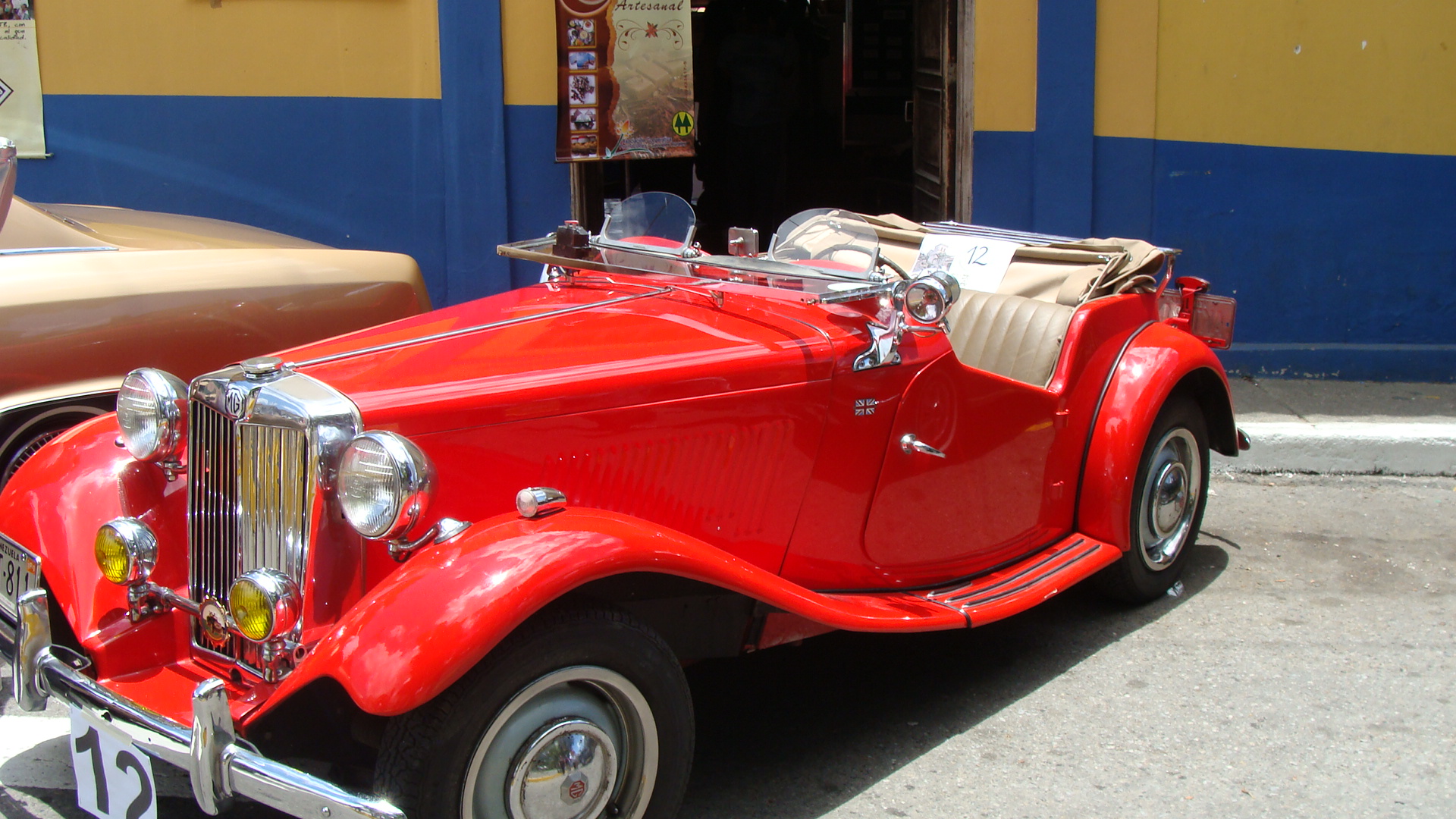
I'm looking at a 1950 MGTD right now.
Lady in Johnson City is wanting to sell that vehicle.
And it's in really good condition.
It was bought new, get this, in 1957.
Sorry, it was used.
But it was bought for her father, by her grandfather in 1957.
And the car looks, it's been restored.
But just think about, when you look at this car, there's no way that car is 69 years old.
That thing's as old as the car guru.
And it looks that good.
And she showed me the original paperwork.
Folks, that doesn't just happen.
You know, that's love.
That's respect.
That's appreciation for a machine.
And also the memories that were created with the use of that machine.
She remembers riding around in parades and seeing the car just, you know,
the respect and love that her father had for that thing and taking it to car shows and so forth.
It's hard to get rid of something like that.
But, you know, if a family is not interested in it, then it's better off in somebody else's hands.
But my point is the reason that vehicle looks so good and runs hopefully so well,
once I do a little evaluation on it, is because it's been properly maintained.
And we all know what a difference that can make to the vehicle of value.
I'll be back in just one minute.
How many car accidents have you been in?
I'm just sitting here thinking back.
The first one I wasn't driving, my brother was, we were headed to basketball practice in high school.
And we went around a curve and a vehicle was over, halfway over in our lane.
And we had nowhere to go.
I mean, there was a hillside just right there covered with rocks.
My brother moved over as far as he could, but we still got clipped.
And thank goodness the driver looked up at the last second and realized what he was doing,
but we got hit in the left rear.
The second accident I had was driving past Tuscalem College,
and I'm just in this brand new Chevy Colorado, and I'm just going down the road.
And here comes this student coming out of Tuscalem, the entrance there.
Didn't even stop.
Didn't even hesitate to look left or right.
Just shot right across, nailed me right in the side of that brand new Chevy Colorado.
Now, both of those accidents could have been worse.
And, you know, the sad thing about it is both of those accidents were unavoidable.
Not my fault.
Not my brother's fault either.
Oh, I forgot about another accident.
Yeah, I was driving home from a concert late at night.
I dropped off my 16-year-old girlfriend, who is now my wife.
And I made it within a mile of the house, and I think I dozed off.
Weird place to doze off, going around a curve.
And I spun out, and I just tore the heck out of that 1974 Chevy Nova SS.
It was brand new, too.
But, you know, I tore that car out of pieces.
You could look.
The left front wheel was, you couldn't even see it.
It was bent up underneath the car.
You know how much the estimate was to fix it?
$987, 1974.
And a modern car could have been totaled, because all the airbags and stuff going off and all the sensors destroyed.
Times have changed, and that was totally my fault.
And so those kind of accidents are going to happen to kids.
So there's certain lessons, right, that they can be taught, that I can teach them, I can use words,
I can show film examples of people losing control of a car around a curve like my daughter did in a 1987 VW Jetta.
Ten days after she got her driver's license, she's one mile.
Well, as a crow flies, she's 500 yards from my house.
And she totals that Jetta, because she goes off the road, then overcorrects.
So there's a technique that can be taught to tell people what to do if you go off on the berm.
You don't jerk the steering wheel to get back on the road.
You slow down.
You gradually slow down, and then get off of the berm, get back onto the road.
Once you've slowed down, you don't jerk the steering wheel.
That's what she did.
She reacted.
She jerked the steering wheel, spun around 360, took out a bunch of a whole fence row and several nice trees.
The worst accidents, of course, involve high speed, drugs and alcohol, and distractions.
And we don't know this for a fact.
I lost my son in a car accident.
He hit the back of an 18-wheeled truck that had not pulled completely off the road.
And the witnesses that were behind him said that his brake lights never came on.
Now, I know that if he had seen that truck, that it was still sticking in the back of the 18-wheeler,
was still sticking six feet out on the road, he wouldn't have hit it.
So, I don't know whether he was looking down at his phone or what.
I mean, it just absolutely makes no sense to us.
But if that's what it was and it's a possibility, then we need to make sure that the kids get the point about cell phones.
I mean, if you're going 60 miles an hour and you look down at your cell phone for three seconds,
which would be a short period of time to look at a text.
One, two, three.
How far have you traveled?
A hundred yards, 300 feet.
I asked one of our young employees that question and she said,
50 feet?
I said, no, 300 feet.
So, there's a lot of things that can distract you in a vehicle.
We all know that, adjusting the radio, you know, searching for the news podcast that you want to listen to
and also, you know, you're messing around on the infotainment screen and all of a sudden,
oh man, I need to look at the road.
You can also get distracted just by your mind wandering.
I mean, that's happened to me a bunch in my life.
I just, I tried to think about, how did I get here?
You know, I've driven around multiple curves and I guess my subconscious mind took over the driving
because I was somewhere else and then getting sleepy,
getting tired, driving down the road.
So many things to be aware of.
So that's one of the things I'm going to do.
I'm going to have a state trooper here too and I want them to hear from him.
That won't take long.
What is he thinking when he pulls you over?
What is he looking for?
You know, what kind of attitude do you need to have?
We see a lot of bad examples of people acting up, won't roll down their window.
You know, I wasn't doing anything.
This is entrapment.
You know, they start resisting.
That's a bad move.
You don't resist a policeman.
If they tell you to get out of the car, you get out of the car quickly.
I mean, I just can't believe some of these behaviors that I see on YouTube and Facebook and people just...
I guess they think that it's funny at first or that they're privileged.
They're not privileged.
That state trooper or that local policeman or sheriff, deputy, they don't know them from Adam.
You know, they're very careful.
They approach your car.
They don't know if there's going to be somebody in there that's nice and friendly or ready to pull a gun on them.
So how are they prepared?
They are prepared for the worst case scenario.
If you see a policeman walking up to a vehicle he's pulled over, he's very cautious.
He hangs back.
He doesn't get totally episodum.
He waits to see what he can see.
And he gets their license and registration and proof of insurance.
That's what they're looking for.
And by the time the policeman gets up there, you should already have that out.
Young drivers should know those are three things that have to be in the car.
Whose responsibility is it to make sure they're in the car?
Well, I mean, if you're 18 years old, you should have enough sense to have those things in your car.
And also to look at your license plate and make sure that your tags aren't expired.
And then finally, look at your driver's license and make sure it's not expired.
Well, I didn't know it was expired.
And what does proof of insurance mean?
My parents do that.
Yeah, that may be the problem.
The parents are doing too much.
I'm going to try to cure some of that for folks.
So if you've got kids getting ready to get their driver's license, maybe have their learners permit.
Our new licensed drivers and or are still in high school.
Then you can call the dealership and get on the list 423-639-5151.
Or you can call me on my cell phone, send me a text message.
Say, yeah, I have two kids that I would love to come to your seminar.
We have not nailed down the date, but it will be in later on in March.
We're trying to pick a night that doesn't interfere with church on Wednesday for those who go.
And so it'll probably be a Tuesday or a Thursday, or maybe a Tuesday and a Thursday, depending on how many people come.
But it's going to be fun and we're going to feed them.
So that's one meal, a teenager eating meal that you won't have to take care of.
So I'm saving your household budget money.
And if you have more than one kid, I've had several parents say, well, I've got three kids and they're all coming.
And like I say, I mean, it's going to be fun just to see the faces that show up here.
And I think one of the things I'm fascinated about is that, you know, we've got all these parents responding.
I just wonder if the kids are going to be that enthused about it.
But if you're still in control of your kids, then and you can get them here.
I can assure you it will be interesting and they will thank you.
I'll be back in just one minute.
You know, I can hear some of the kids now.
I don't care about cars.
Well, then you give me your keys.
No, I don't want to give you a key.
Well, then you're going to learn about your car.
This will be good for you.
But then I don't know if that's a good thing to say either because the parent always said, you know, eat your broccoli.
Why?
Because it's good for you.
So I don't know.
Maybe some of them have to be like Andy Griffith and grab Opie by the ear and just drag him to Gateway Ford and learn things that they need to learn about their vehicle.
And I've had several parents say, well, can I stick around?
Maybe I could learn something.
And we've done women's clinics before.
I mentioned that yesterday.
There's a lot of men that need to know more about their vehicles.
Men act like they know a lot about their vehicles, though.
Most of them don't, though, especially modern vehicles.
I mean, it's tough.
I go back there and I try to learn.
I'll spend an hour or so a week in my shop going from mechanic to mechanic and just kind of looking in.
And see what they're doing and harassing them a little bit.
Not about how hard they're working, but to please explain to me what the heck that is, you know, when they have something torn apart, because I just like to know.
I like to be able to share this information.
It's one of the things that has convinced me that extended service contracts or extended warranties are are important to own because they can be severe budget busters when they break cars.
Labor rates in excess in major cities of $200, $250 an hour.
I mean, you just have a diagnosis.
It's $250.
Yeah, but they just plugged it in.
Yeah, it doesn't matter.
It's $250, please, plus tax and shop supplies.
What shop supplies?
It's just something we charge everybody.
Yeah, Toyota dealers are the worst.
I mean, their customers tend to maintain their vehicles a little bit better and they get gouged.
I mean, they even probably sell flushes for their headliner.
Well, probably not that, but they sell flushes for everything else.
You try to sell a flush to a Hyundai owner and they'll tell you to pound sand and they should because a lot of that is just a waste of money.
I would flush my cooling system and I probably do it no later than 50,000 miles.
You remember when General Motors came out with that 100,000 mile coolant?
You should have seen what that coolant looked like after 50,000 miles.
It was no longer a beautiful shade of orange.
It was brown.
It looked like pond water after a rain.
That can't be good for a cooling system, especially for a water pump.
Sometimes you have to ignore the maintenance schedule that's in your owner's manual because sometimes they're just trying to sell you the vehicle up front.
I remember when they changed the tune-up frequency on vehicles.
When I first got into the business, you were supposed to get a tune-up at 22,500 miles.
Now they say, well, a tune-up isn't what it used to be.
It used to be basically spark plugs, spark plug wires, new points, and a condenser.
Then the filters and all that stuff.
Of course, when I was first doing this, all of that was probably $49.
Now a tune-up is spark plugs.
That's about it.
You may have a problem with a coil or multiple coils because that's what fires the spark plug now.
Those are pricey.
A tune-up could balloon to $800 to $1,000.
That'll get somebody's attention in the service drive.
That'll get some yelling and screaming, gnashing of teeth.
Now if a customer comes in and we have them come in with 20,000 miles on their car,
and they say, yeah, I need a tune-up, what's the job of the service advisor?
It's to advise.
Mr. Johnson, would you mind telling me why you believe your vehicle needs a tune-up?
Well, I just thought it was maybe due for new spark plugs and points.
It doesn't have points on it anymore, and your spark plugs should be good for 100,000 miles.
So no tune-up needed.
What else can we do for you?
So anyway, after saying all of that, the whole point of this youth seminar is to make them safer drivers,
make them aware of the dangers that are out there, and then just help them understand their car a little bit better
so that when they go in to get service, they maybe won't be so susceptible to getting ripped off.
And if any parents want to stick around, as long as you hide yourselves, I guess that'll be okay.
So if you're interested, 423-552-2020, that's my cell phone.
Send me a text, and we will get back with you on the exact date, time, and the curriculum.
I'm going to give away some really cool things to the youngsters.
I think it'll be fun, and they'll love it, and they'll thank you, and I'll see you next time.
About this episode
Leonard B. Lawson shares his passionate plan to teach young drivers essential skills beyond just driving—covering defensive driving, basic car maintenance, and understanding vehicle mechanics. He emphasizes the importance of educating teens on topics like tire care, brake systems, and fluid functions to foster responsibility and safety. Leonard also reflects on personal accident experiences and the dangers of distractions, especially cell phone use while driving. The episode highlights the value of hands-on learning and community involvement, including bringing in a state trooper to reinforce safe driving habits.