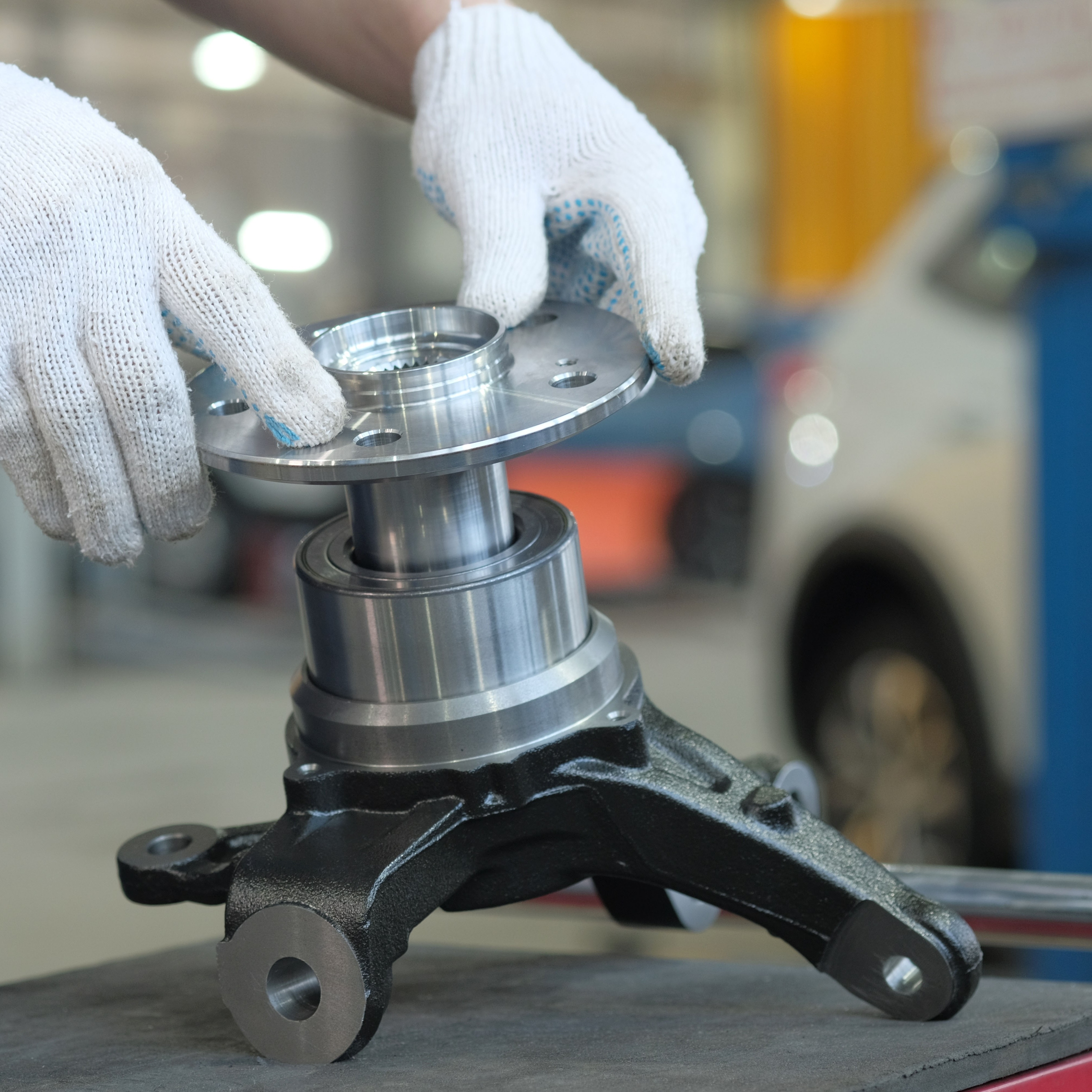
Exploring essential car maintenance, this episode dives into wheel bearing issues, tire pressure checks, and the differences between summer and winter tires. Expert technician Nick Stoffel shares insights on diagnosing wheel bearing problems, the importance of timely repairs, and how to handle tire pressure warnings as temperatures drop. Listeners also learn about the benefits of seasonal tire changes and the significance of regular tire rotations. With practical advice and real-life examples, this episode equips car owners with the knowledge to keep their vehicles safe and efficient.
Denny had to make another trip to Lloyd's for a wheel bearing issue in his vehicle. What are the signs you need to get a wheel bearing fixed and what could happen if that maintenance is delayed. Common causes behind humming sounds. Tire pressure problems. Is it time to switch summer tires for winter tires or invest in an all season tire? Tire rotation frequency. How to check your vehicle if it is recalled. Ask our car care expert Nick Stoffel of Lloyds Automotive. Visit lloydsautomotive.net 651-228-1316.
"I was thinking, I think I got a wheel bearing problem. Judging from our show, which I do listen once in a while, you know, as we're talking, maybe learning a little bit here and there, I thought this is kind of a humming sound."
A wheel bearing helps the wheels turn smoothly. If it's damaged, it can make a humming noise and make it harder to drive the car.
A wheel bearing is a set of steel balls or rollers that allow the wheel to spin smoothly on the axle. If a wheel bearing is worn out, it can cause noise and affect the vehicle's handling.
"...shifting and moving and rubbing into a brake rotor or a caliper. And those situations can also be very dangerous."
The brake rotor is a metal disc that helps stop your car when you press the brake pedal. If it gets worn out, your brakes might not work as well, which can be dangerous.
A brake rotor is a component of a disc brake system that provides a surface for the brake pads to clamp down on, creating friction to slow down or stop the vehicle. Worn or damaged rotors can lead to reduced braking performance and safety issues.
"...rubbing into a brake rotor or a caliper. And those situations can also be very dangerous."
The caliper is the part of the brake system that holds the brake pads and squeezes them against the brake rotor to stop the car. If it's not working properly, your brakes won't work well.
A caliper is a part of the disc brake system that houses the brake pads and applies pressure to the brake rotor when the brakes are engaged. It plays a crucial role in stopping the vehicle by creating friction against the rotor.
"...you get the drive axle out of the way, sometimes you have to remove some of the steering suspension..."
The drive axle is a part that helps turn the wheels by carrying power from the engine. It's important for making the car move forward or backward.
The drive axle is a shaft that transmits power from the vehicle's transmission to the wheels, allowing them to turn. It plays a crucial role in the vehicle's drivetrain.
"...but that whole bearing assembly will slide off of the chassis of the vehicle, you'll install the new one and then just reverse order..."
A bearing assembly helps the wheels spin smoothly. It's like a set of small balls inside a ring that lets parts move easily without rubbing against each other.
A bearing assembly is a component that allows for smooth rotation between parts, often found in wheel hubs. It supports the weight of the vehicle and enables the wheels to turn freely.
"You take the bearings in new grease and you know, either you have a pump or you do it by hand..."
Bearings help parts of a car move smoothly without rubbing against each other. They are important for things like wheels to turn easily.
Bearings are mechanical components that allow for smooth rotation or movement between parts, reducing friction. They are commonly used in various automotive applications, including wheel hubs, to support rotating shafts.
A cotter key is a small metal pin that keeps nuts and bolts from coming loose. It helps hold parts together safely.
A cotter key is a fastener used to secure a nut or bolt in place, preventing it from loosening. It is typically a split pin that is inserted through a hole and bent to hold it securely.
"...is he had to straighten out whatever the term is. I think they called it a dust shield or some kind of protector. Tell me about what that is."
A dust shield is a part of the car that keeps dirt and dust from getting into important areas, like the brakes. It helps the brakes work better and last longer.
A dust shield is a protective component that prevents dirt, dust, and debris from entering sensitive areas of a vehicle, such as the brake system. It helps maintain the performance and longevity of the brakes by keeping contaminants away.
"...when they designed these vehicles to kind of protect the brakes and some of those rotating components, they put a tin shield on the inboard side..."
A tin shield is a metal cover that protects important parts of a car, like the brakes, from dirt and damage. It helps keep those parts working properly.
A tin shield is a protective cover placed on certain components of a vehicle, such as brakes, to prevent damage from debris and environmental factors. It helps to maintain the integrity and functionality of the parts it shields.
"2015 Nissan Altima at highway speeds, a loud hum is created."
The Nissan Altima is a car that many people use for everyday driving. The 2015 version is known for being comfortable and good on gas.
The Nissan Altima is a mid-size sedan known for its comfort and fuel efficiency. The 2015 model features a range of engine options and is popular among families and commuters.
"I have older all-season tires on the car that show uneven wear."
All-season tires are types of tires that can be used in different weather, like rain or light snow. They are good for everyday driving but might not be the best for extreme weather.
All-season tires are designed to provide a balance of performance in various weather conditions, including dry, wet, and light snow. However, they may not perform as well as dedicated winter tires in severe conditions.
"They mentioned uneven wear. Maybe if there's some cupping or abnormal wear, they can rotate them in a manner where they're spinning in the other direction."
Uneven wear means that some parts of the tire are more worn out than others. This can happen for various reasons, like not having the tires aligned properly or if the air pressure is off.
Uneven wear refers to tires wearing down at different rates across their surface, which can lead to handling issues and reduced performance. This can be caused by misalignment, improper inflation, or suspension problems.
"Maybe if there's some cupping or abnormal wear, they can rotate them in a manner where they're spinning in the other direction."
Cupping is when parts of the tire tread wear down unevenly, creating a bumpy surface. This can happen if the car's suspension isn't working right or if the tires aren't inflated properly.
Cupping is a specific type of uneven tire wear characterized by high and low spots on the tire tread, often caused by suspension issues or improper tire inflation. It can lead to a noisy ride and decreased traction.
"Maybe if there's some cupping or abnormal wear, they can rotate them in a manner where they're spinning in the other direction. See if they know it goes away."
Tire rotation means changing the position of the tires on your car, like moving the front tires to the back. This helps them wear evenly and last longer.
Tire rotation is the practice of moving tires from one position on the vehicle to another to promote even wear. This is important for extending the life of the tires and maintaining optimal performance.
"If the tires are aged, sometimes that rubber does start to dry out a bit and create that uneven wear and it might be due for a set of tires."
Tire aging is when tires get old and the rubber starts to break down, even if they look okay. This can make them unsafe to use, so it's important to check their age.
Tire aging refers to the degradation of tire materials over time, even if the tread appears to be intact. Factors like exposure to sunlight, temperature changes, and ozone can cause the rubber to dry out and crack, leading to safety concerns.
"...and it might be due for a set of tires. So even though they might not be worn out, due to the age of the tires."
Tire replacement means getting new tires for your car when the old ones are worn out or too old to be safe. It's important for keeping your car safe and running well.
Tire replacement is the process of removing old tires and installing new ones. This is necessary when tires are worn out, damaged, or aged beyond safe use, ensuring the vehicle maintains optimal performance and safety.
"...2008 Toyota Prius, the tire pressure light came on. Let me see, it's kind of jumped all over..."
The Toyota Prius is a car that uses both gasoline and electricity to run, making it very efficient on fuel. The 2008 version is known for being environmentally friendly and has some advanced features for its time.
The Toyota Prius is a hybrid electric vehicle known for its fuel efficiency and eco-friendly design. The 2008 model is part of the second generation of the Prius, which features improved aerodynamics and technology compared to its predecessor.
"...They are all at 35 psi, but it's been two days now and the light is still on..."
PSI means pounds per square inch, which is how we measure the air pressure in tires. Keeping the right PSI helps your tires work better and keeps you safe while driving.
PSI stands for pounds per square inch, a unit of measurement used to quantify tire pressure. Proper tire pressure is essential for optimal vehicle performance, safety, and fuel efficiency.
The Volvo XC70 is a type of SUV that looks like a station wagon but is built to handle rougher roads. It's known for being safe and comfortable for families.
The Volvo XC70 is a mid-size crossover SUV known for its rugged design and versatility, combining elements of a station wagon with off-road capability. It features a spacious interior and is often praised for its safety features and comfortable ride.
"Does not appear to have any punctures, has good tread. Could it be the seal on the rim?"
Tread is the pattern on the tire that helps it grip the road. If the tread is worn down, the tire won't perform well, especially in rain or snow.
Tread refers to the rubber on the surface of a tire that makes contact with the road. Good tread is essential for traction and safety, especially in wet conditions.
"...when the tire is low on pressure, when we're driving it, that sidewall is taking much more load..."
Tire pressure is how much air is inside your car's tires. It's important to keep it at the right level so your car drives safely and the tires last longer.
Tire pressure refers to the amount of air in a tire, measured in pounds per square inch (PSI). Maintaining the correct tire pressure is crucial for vehicle safety, fuel efficiency, and tire longevity.
"...when the tire is low on pressure, when we're driving it, that sidewall is taking much more load..."
The sidewall is the side part of the tire that helps hold it together. It protects the inside of the tire and keeps it strong.
The tire sidewall is the part of the tire that connects the tread to the wheel. It provides structural integrity and protects the inner components of the tire from damage.
"Bought a BMW X5 SUV this summer here, she says. It came with high performance summer tires on it."
The BMW X5 is a fancy SUV that combines luxury and performance. It's known for being comfortable and having lots of tech features.
The BMW X5 is a luxury midsize SUV known for its performance, comfort, and advanced technology features. It offers a range of powerful engines and a spacious interior, making it a popular choice among luxury SUV buyers.
"It came with high performance summer tires on it."
High performance summer tires are special tires that help your car handle better in warm weather. They are great for driving fast and making sharp turns.
High performance summer tires are designed for superior handling and grip in warm, dry, and wet conditions. They typically have a softer rubber compound and a tread pattern optimized for performance driving, making them ideal for sports cars and performance vehicles.
"...I need to do the oil change only every 10,000 miles and the tire rotation every 5,000 miles..."
An oil change is when you replace the old oil in your car with new oil. This helps keep the engine running smoothly and can help it last longer.
An oil change is the process of replacing the old engine oil in a vehicle with new oil to ensure proper lubrication and functioning of the engine. It's a critical maintenance task that helps prolong engine life.
"...They use it for variable valve timing, a lot of things, and there's a lot of small passages that need good clean oil."
Variable valve timing is a system in engines that changes when the valves open and close. This helps the engine run better and use fuel more efficiently.
Variable valve timing (VVT) is a technology used in internal combustion engines to optimize performance and efficiency by adjusting the timing of the valve openings and closings. This allows for better power delivery and fuel economy across different engine speeds.
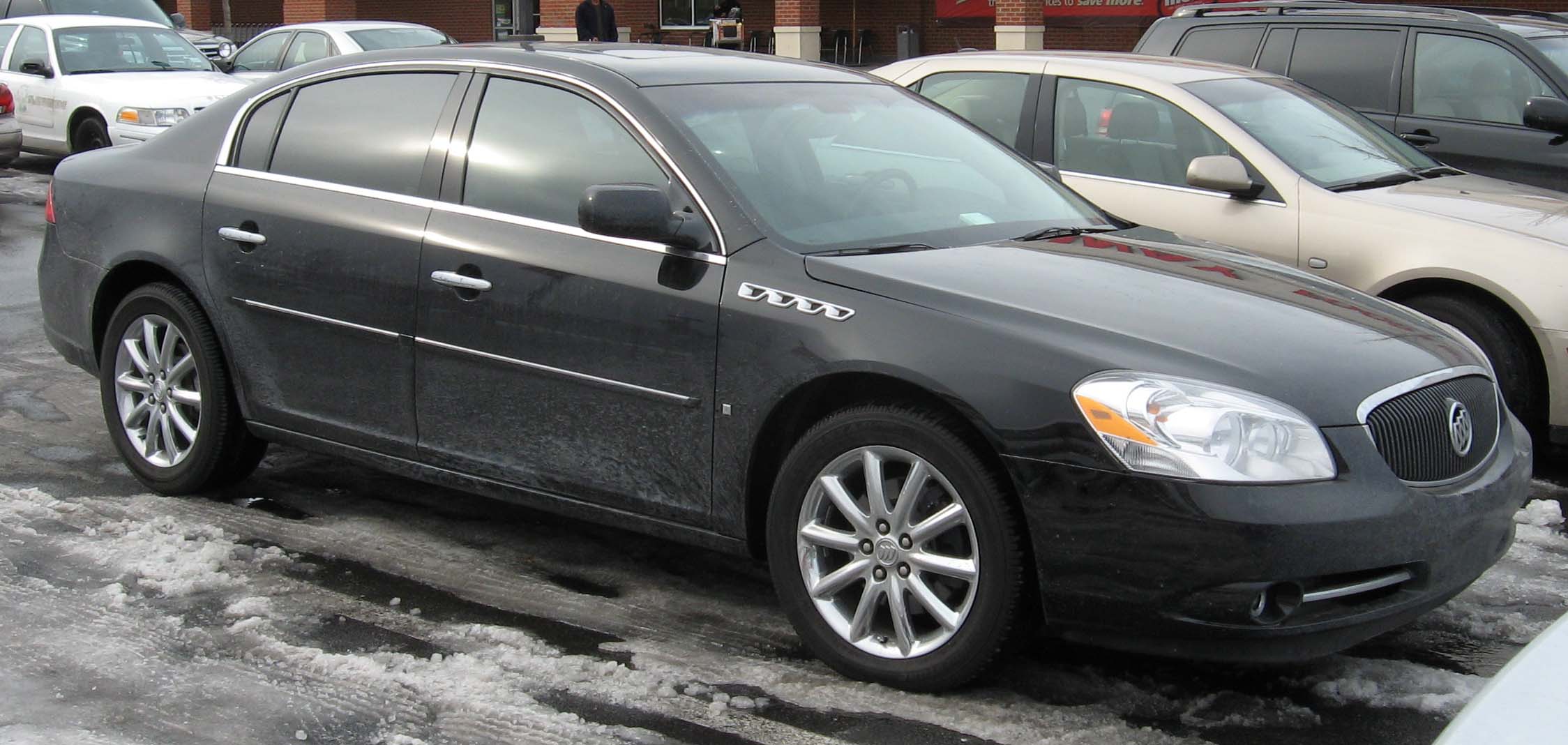
"My son, Texter says, has a 2008 Buick Lucerne, when he turned on the heat for the first time this year, an engine light showed up on the dash..."
The Buick Lucerne is a large car made by Buick, a brand of General Motors. It was made from 2005 to 2011 and is known for being roomy and comfortable.
The Buick Lucerne is a full-size sedan that was produced by General Motors from 2005 to 2011. It is known for its spacious interior and comfortable ride, making it a popular choice among families and for those seeking a comfortable daily driver.
"...an engine light showed up on the dash and indicated that the thermostat was at fault."
A thermostat is a part of the car that helps control the engine's temperature. It opens and closes to let coolant flow, keeping the engine from getting too hot or too cold.
The thermostat is a critical component in a vehicle's cooling system that regulates the engine's temperature. It opens and closes to allow coolant to flow to the radiator, ensuring the engine does not overheat or run too cold.
"...ad a picture of Dan Burns changing the oil on his Corvette? Yes."
The Chevrolet Corvette is a fast and stylish sports car that many people love to drive. It's famous for being powerful and fun, and lots of car enthusiasts enjoy taking care of them, like changing the oil to keep them running well.
The Chevrolet Corvette is a high-performance sports car known for its distinctive design and powerful engine options. It has been a symbol of American automotive engineering since its introduction in 1953, often celebrated for its speed, handling, and affordability compared to other sports cars. Discussions about the Corvette often revolve around its iconic status and the passion of its owners, as seen in activities like DIY maintenance.
Select text to request an explanation
Ring Central will completely transform the way you work.
It gives you built-in AI across all your business conversations.
Your phone system has an AI receptionist
that answers calls 24-7.
Your video meetings have AI that takes notes instantly.
Even your contact center has AI,
so you can help customers faster.
It all comes together in one reliable platform
for effortless AI communications.
See for yourself at ringcentral.com.
Ring Central, voice of your business.
Guys, it's no use putting it off.
The best time for an underwear refresh is now.
Tommy John Underwear is designed for a perfect fit
that stays put all day.
They're zero-chave thanks to four times more stretch
than competing brands,
and their innovative horizontal quick-draw fly
is a game changer.
With over 30 million pairs sold,
there are thousands of men out there
more comfortable than you.
Don't settle for less.
Go to TommyJohn.com today
for 25% off your first order with Code Comfort.
That's TommyJohn.com, Code Comfort.
Tommy John, Comfort Perfected.
Hold up, we got one play.
Everything we work for comes down to this.
Quick question, speaking of workouts,
how would you rate your athletic program?
Bro, we're in the middle of the state championship.
Oh, so like a B plus then.
Dude, get out of our huddle.
Well, at homes.com, we leave it all on the field
to get you detailed information on local schools.
Off the field!
Off the field, copy.
All right, go sports.
How'd he even get in here?
Homes.com, we've done your homework.
Thanks to the help we get
from ASC certified technician, Nick Stoffel
from Lloyd's Automotive.
Yeah, we'll help you keep it running
like you did to my vehicle this past week.
Nick, good morning.
Good morning, Denny.
I was mentioning on the air earlier this morning
that I had the unexpected pleasure
of visiting Lloyd's Automotive this past week
or was this past, was it Monday?
Monday, Tuesday, Tuesday, maybe it is.
It doesn't make any difference.
I was thinking, I think I got a wheel bearing problem.
Judging from our show, which I do listen once in a while,
you know, as we're talking,
maybe learning a little bit here and there,
I thought this is kind of a humming sound.
Not a real vibration, but just kind of.
And I did the trick, you know,
we talked about going down the road,
turning right or left, seeing if it disappears,
depending which way you turn it, whatever.
And I was a little nervous, quite honestly,
about driving it to Lloyd's under those conditions.
I want to ask you about that.
Anyway, it turned out to be, again, a wheel bearing.
And could I, you know, was there reason
to be kind of nervous about it?
What can happen if a wheel bearing really goes bad?
Well, I think you were right on in the fact
that you heard something, so that's your first warning.
Hey, it's making a little noise.
Let's go to the bottom of it.
I think people run into trouble
when they ignore that noise.
And they'll say, oh, it was making noise
for a while, a couple of months, whatever.
But it seems to have gone away.
It must have gotten better.
Well, it's just the reverse there, the opposite.
It's got worse where things are loosened up
and the noise has kind of gone away.
But now there's a lot more free play,
a lot more movement than wheel bearing.
So obviously the extreme and extremely rare situation
where like the wheel bearing come apart
and the wheel would kind of dangle there,
very unlikely to happen.
But we do see them worn enough or loose enough
where they'll actually canter enough
to even cause excessive wear into the brakes.
You know, you'll have things shifting and moving
and rubbing into a brake rotor or a caliper.
And those situations can also be very dangerous.
So if you hear any kind of rotational,
humming noise when you're driving your vehicle,
not necessarily wheel bearing, it could be a tire,
it could be something else, rotating,
but it's enough of a warning, it's your heads up,
I need to get this in and get it looked at
because people that ignore that
are the ones that run into more trouble.
And in those situations,
wheel bearing is expensive as you know,
but when you add more repair to it,
it just becomes that much more expensive.
So it's best to avoid that
and get it fixed right the first time.
Yeah, like any other issue.
Before I ask my next question or two,
I wanna invite our listeners to join in.
If you have any kind of a car care question,
call us or text us.
We always like to say earlier sooner than later
because Nick takes his leave about 7.45.
Our time goes by so quickly.
Whatever your question is,
pertaining to your car, your truck, your van,
you need to bring it in for service,
but you wanna know maybe ahead of the game
what could be wrong, call us, text us.
6514619226.
Your technician, Mike,
who's a great technician by the way, as you know,
I didn't have a chance to talk to him
nor did I see him doing the work,
but what we're talking about a wheel bearing in this,
in this case, it was the right front.
You put it on the hoist and what can the,
and I've seen videos,
can the tire actually wobble as you're moving it by hand?
Well, what you're doing is you're,
you know, you'd grab the top and the bottom
and then side to side to kind of chip the load.
And if there's free play, that's pretty extreme.
Most often what we'd need to do
is spin the wheel once in the air,
put the vehicle in the drive
and get the vehicle up to speed
and then you might need a set of scope
or something to try to identify which wheel is coming from
because I can tell you,
wheel bearing sometimes can get us,
even though it's done in our whole lives,
chasing our tail a bit,
and it takes sometimes two people that get under there
and try to pinpoint the location of that noise.
But yeah, you know, in most cases these days,
it's an assembly, so you pull the wheel off,
you pull the brakes off,
you know, you get the drive axle out of the way,
sometimes you have to remove
some of the steering suspension,
but that whole bearing assembly
will slide off of the chassis of the vehicle,
you'll install the new one and then just reverse order,
you know, you put the axle back in,
some of the steering suspension if necessary,
the brakes back on and the wheel back on.
Keep in mind, we live in Minnesota,
so sometimes some of those nuts and bolts can be rusty,
we might need a little heat,
give a little extra,
a little extra tap with the hammer to get things
to come apart, but once they're apart,
we make sure we clean them thoroughly
so they go back together the way they were designed
and get you back on the road.
I know I'm dating myself,
but I remember a phrase called,
of repacking wheel bearings,
when did that go away?
It's been a while,
most often if we see that's on a trailer or something,
you know, because it's one of those things that,
you know, it's good that they invented
the sealed bearing assembly
because everyone forgot to repack the wheel bearings
and then become loose,
the grease would become dirty
and then that dirt and grime would get in there
and damage the bearings so you end up replacing them,
but essentially what you would do is,
similar to taking the brakes and wheels off,
but now instead of the whole assembly coming apart
in the center of that hub,
the wheel bearings, the inner and outer will come out,
once they were removed,
you need to clean all that excess of grease
and grime from inside that hub.
You take the bearings in new grease
and you know, either you have a pump or you do it by hand
and you repack and try to introduce that grease
to get the old grease to come out,
the new grease to go in,
you know, once you've done that,
you reassemble it and get the properly pork
or install the nut and the cotter key
so you don't have it excessively loose
or excessively tight bearing,
so there's a little more of a mechanics hand
involved with that process, but doable.
So if you have an old enough vehicle or a trailer,
you watch a couple of videos
and you can see how that process and procedure goes
and you can probably handle that on a weekend yourself.
All right, 6514619226,
whatever your car care question may be.
You know, another thing that Mike did
and I found out later
and you have to tell me with this
because I think I had this issue before
is he had to straighten out whatever the term is.
I think they called it a dust shield
or some kind of protector.
Tell me about what that is.
That's another thing that as the seasons change
and we get a little more ice and snow on the roads,
well, people will come in and you know,
you know, they drove through a snow drift
or something of sorts
and they'll have this scraping,
screeching noise coming from the,
you know, the wheel of their vehicle.
And what we have found is when they designed these vehicles
to kind of protect the brakes
and some of those rotating components,
they put a tin shield on the inboard side
to keep anything from coming up in the road
to getting caught up in there.
Well, that tin with age and with our climate and salt
and you know, those things that we've talked about
might get a little bit corroded
or it might rust a bit, might swallow up a bit
and you catch that wrong chunk of ice or snow
and it can kind of tweak that shield
and that can make contact with the brake rotor
ever so slightly, kind of like a record player
and as it rotates, it kind of scrapes a little bit,
you hear that noise.
So not a big repair, you get it up in the air
and you can usually reposition or tweak it
as we like to call them to give them a little bit
of that air gap to keep from them rubbing
and that, you know, not much of a repair at all,
to be honest, you just kind of get it back on the road
and people are happy.
All right, like me.
And it's probably my imagination, Nick,
but I swear that my car moves faster.
It's almost like there's less drag.
It's like getting my car washed and it works better.
Well, you know, there's some truth to that.
People come in and they have a noise, you know,
and we spend a lot of time trying to figure it out
and get it fixed up.
And oftentimes, once you've repaired
whatever is known broken or bad or worn,
you tell them it is fixed and it is good
and that puts their mind at ease, you know,
and you get back in the road and you might say,
oh, do I still hear that?
I'm hearing things.
The guys at the shop, hold me, it was fine.
They inspected it, they repaired it,
they did whatever head didn't need be done.
I trust them, so the noise is gone
and by the next day, they've forgotten about it.
Yeah, yeah, nice job.
Thanks to Mike, great job.
All right, we need to take a break.
Let's invite our listeners again to join in.
Any kind of a car car question, again,
we urge you to do it sooner rather than later.
We're getting a couple of texts here I want to field.
But don't wait, we'd love to help you out.
651-461-9226, stay with us.
November 1st today, brand new month on this Saturday
and do not forget to set your clocks back.
We fall back overnight tonight.
We lose daylight saving time
when we're back to standard time early tomorrow morning.
So set those clocks back one hour.
Here on Newstalk A3O, this is WCCO.
Good morning, welcome back to CCO's Car Care Show.
We're here thanks to Nick Stoffel
from Lloyd's Automotive every Saturday
in the seven o'clock hour,
right after the seven o'clock news break.
Nick, for those listeners,
we have brand new listeners all the time.
We appreciate that.
If those listeners need some help from Lloyd's,
how do we find you guys?
Yes, sir.
Before I give you that information,
I want to, speaking of our listeners,
it's my in-laws anniversary today.
And I think it's their 51st.
So congrats to them.
And they listen to me every week,
which is kind of nice.
I have at least two listeners.
I know that behind me.
My family's usually asleep.
So it's nice to have them listening in.
Congratulations.
I should say.
As far as Lloyd's goes,
you can reach us at 651-228-1316.
If you're on Grand Avenue in St. Paul,
we're at 982 Grand.
I mean, if the weather's nice,
stop and say hi.
And if you need any other information,
you can look at our website
and get that at LloydsAutomotive.net.
Very good, Nick.
We'll get that information out to our listeners
before you take your leave,
which is about 7.45 this morning.
Call us, text us any kind of a Car Care question.
Maybe you're concerned about your vehicle.
You might want to know what could be ailing,
and Nick will give you a little diagnosis over the air.
Just call us, text us.
651-4619-226.
Listeners have done just that.
Nick, here's one.
2015 Nissan Altima at highway speeds,
a loud hum is created.
It feels like the engine is running at too high of RPM,
but 1,500 RPMs are showing.
I have older all-season tires on the car
that show uneven wear.
The car runs fine otherwise,
except for that loud hum at highway speeds.
What could be the problem?
I'm sure it could be any of these that he's listening.
The engine, tires, muffler, or what?
Absolutely.
I think that the key is that they said highway speed.
So maybe something as their speed increases,
their frequency and the volume of that,
the tires are moving faster.
So that's a good test.
Take it in.
One thing they can do is try rotating those tires.
They mentioned uneven wear.
Maybe if there's some cupping or abnormal wear,
they can rotate them in a manner
where they're spinning in the other direction.
See if they know it goes away.
If the tires are aged, sometimes that rubber does
start to dry out a bit and create that uneven wear
and it might be due for a set of tires.
So even though they might not be worn out,
due to the age of the tires,
if you have a low mile or you don't drive much,
it might be due for a set of tires
before winter falls on us.
See another tire question that just came in too.
2008 Toyota Prius, the tire pressure light came on.
Let me see, it's kind of jumped all over.
Checked all the tires and needed to fill two of them.
They are all at 35 psi, but it's been two days now
and the light is still on.
What else could it be?
Well, some vehicles will have a reset procedure.
Sometimes there's a button.
Sometimes you go to that trustee owner's manual
and you'll find a procedure.
You go online, you can find a procedure.
Typically, if the light is unsolid,
it's not seeing the right pressure.
It needs to be reset.
If the light is flashing, it's telling you
that it doesn't see one of those sensors.
So this time of the year, we get a lot,
a lot, a lot of low tires.
As the temperatures cool, those pressures
will adjust just a couple psi.
Not significant, but just enough to trigger that light.
So you have to stop in when you have service,
have them top off the air.
And like I said, some vehicles require a procedure
of driving for a period of time.
Sometimes there's a sequence of some of the controls
on the dash, but each vehicle has a little difference.
If the light is on, do a little research.
If you can't figure it on your own,
go to your shop, your dealership.
I'm sure they can get you fixed up pretty quick.
Very good.
Again, our phone number is also our text number,
6514619226.
Here's a 2016 Volvo XC70 90,000 miles on it.
One tire, not a tire question today.
One tire continues to lose pressure.
I have a feeling we're gonna get a lot of these this season.
Drops from 36 psi to 20 every two weeks.
Does not appear to have any punctures, has good tread.
Could it be the seal on the rim?
It actually could be the seal, could be the valve stem.
You may not see a puncture,
but there's still maybe one there.
And one thing I wanna tell folks is,
we let the tire get low, we get it topped off.
But if you keep topping it off and topping it off
and that tire gets low,
when the tire is low on pressure,
when we're driving it,
that sidewall is taking much more load
and it can actually wear and damage that sidewall.
So you may not realize it.
You don't see it visually on the outside,
but when we remove that tire from the wheel,
there'll be a whole handful of rubber particles
that have collected in the bottom of the wheel there.
And that's the sidewall of the tire.
So you can't ignore that.
You can't say, oh, I'll get to it later.
I'll just keep filling it up.
Because at some point in time,
you damage that tire beyond repair.
Now you need a tire.
Depending on the type of vehicle,
you might need more than one.
So if your tire is losing air,
top it up, pay attention to it.
If it goes forever without adding it again,
you're good to go.
But if you're like, oh, I just topped this tire off
and now here it is two weeks later,
it's down from 35 to 20,
that's pretty significant
and that will cause wear on that tire.
So get that in, have somebody look at it,
repair the leak and get you back on the road
before you need to buy a tire.
Well, now you got me thinking.
I have that reading read out on my dash,
which I look at all the time.
And I think cold temperatures,
the pressure is generally,
at least in my cars, about 32, 33,
does that sound about right?
Yeah, you know, inside that,
you open the driver's door and there's a placard there
that'll tell you the pressure at cold.
So, and you don't have to overthink this, folks,
I don't want people panicking
because it's that time of the year,
everybody's tires will adjust,
you top them up a little bit to be just fine.
I'm talking about the scenario where you know
actively, like I keep adding air every two weeks.
If you do that too many times,
that is gonna damage the tire
and it will have to be replaced.
So it's just don't ignore it, don't get to it later,
stop what you're doing next time you need air,
take it in, have that thing fixed for you.
But you can, if your car's parked outside
subject to this cold, extreme weather
at this time of year, can you add,
what would you suggest, maybe depending where it is?
Let's say it's at 32 pounds
and it goes down to 31 or 30.
If you put it up to like 34 overnight.
That's cool.
What we do is when people come in at this time of year,
we always add just a couple, two, three PSI,
just enough to satisfy that sensor.
Keep in mind when you start your vehicle in the morning,
the tires are at the lowest pressure they're gonna be.
That's why when you look at the placard,
it's gonna say certain PSI cold air or cold temp.
Well, you start driving your vehicle,
once those tires start to heat up,
the air is moving around,
the oxygen gets a little more excited,
it's bouncing around inside that tire,
the tires will inflate a little bit.
Just a couple PSI, not significant.
So you do have a bit of a window there, two, three PSI.
Now I don't want you going out there and say, no,
it says 32, I'm gonna put 45 in it.
That's too much, don't do that.
But if it's 32, you go to 35, you're fine.
Therefore, on that cold morning,
when it dips down to 33, 34,
it loses that one or two PSI,
you start driving, they warm back up,
you're not dealing with this tire light.
And you know, usually we'll see this,
like I said, almost every car it seems like
has an issue with their tires this time of the year.
But don't be alarmed, don't be worried,
top them up, two, three PSI like you mentioned,
and you'll be just fine.
Very good.
Hang on, Nick, we're gonna take a break for weather,
see what the weatherman is promising here
for the next few days of this brand new month.
Do not forget to set your clocks back one hour
overnight tonight, we lose daylight saving time,
back to standard time early tomorrow morning.
As I said, weather's coming up,
stay with us, Newstalk A3O, WCCO.
And welcome back to CCO's Car Care Show,
Denny Long here along with AOC Certified Technician,
Nick Stoffel, from Lloyd's Automotive,
answering those car care questions
till just about 7.45 this morning.
Among other things, we have more tire questions
coming in, Nick, let's see if we can help
this listener out.
Bought a BMW X5 SUV this summer here, she says.
It came with high performance summer tires on it.
I'm assuming, Texter says I need different tires
for winter, should I just ditch the OEM summer tires
for all season tires or buy winter specific tires
and switch back and forth with the OEM summer tires?
So a couple of choices there.
So as you know, we get this question from time to time
and I usually say that a good all season tire
fits most vehicles on the road.
This vehicle in particular, depending on the trim
and the wheels, if it's got the big go fast V8 engine
in there, it might call for handling purposes
for those summer tires.
Those situations might be a case where I tell somebody
to go find a winter tire wheel package.
Another nice thing too is that they can oftentimes
recommend the change in the wheel size
to help with that profile of the tire
to make it a little bit taller.
Some of the issues we have on these higher
performance tires is the tread design,
but also that very low profile tire
doesn't give the sidewall much flex.
So sometimes on those snowy and icy conditions,
a very stiff tire doesn't get the best traction.
So this case I'd probably have in contact
that their shop or the dealership,
wherever they take that vehicle for service,
have a conversation, do a little research.
You got a little bit of time left here.
You got another, hopefully we don't have that white stuff
for another few weeks or what have.
But I would look at that seriously.
This might be one of those situations
where you do want to get a second set
of winter tires and wheels for that vehicle.
Yeah, good idea.
Listener sent this text in,
the heater control knob on my older Toyota Sienna
won't turn all the way to cold.
I think I turned it into fast
and something may have slipped out of place.
What kind of an auto repair shop fixes this?
A regular mechanic or a body shop,
do you think, Texter wants to know?
I think a mechanical shop,
the place where we have all your regular
mechanical service would do that job for you.
But I'm curious to what might have happened.
I wonder if everything's kind of set inside of that control.
Maybe the knob itself slipped.
So maybe you really are getting the full temperature extremes.
One thing I would ask if you turn the knob to the left,
you can see the arrow point.
I'm assuming it's not making all the way to the cold side.
But if you go all the way to the hot,
does it go past the hot setting?
Like the knob is indexing correctly.
So that might be as simple as something as that.
If there's something inside that controller
that's stripped or damaged,
that might be a little more work there.
So I would have something to get a peek at
and give you an assessment and an estimate.
Nick, here's the rotation question.
Texter wants to know, after 9,000 miles,
do you think tires should be rotated
even if all four tires tread depth measure the same?
People always ask, often do you rotate your tires?
So as I've said before, I bought a new truck last year
and every time I changed the oil, I rotate the tires.
The tire design's kind of very aggressive
so they're easily to get everyone aware.
So not just the tread depth,
but if it gets any kind of cupping or uneven wear,
that can also affect the tire life.
And tires are very expensive,
so we want to get as many miles as possible.
So based on your driving style,
based on the vehicle, the tires, that's gonna change.
I would think 9,000 miles is quite a few miles.
I'd probably want to at least, you know,
get them on the other side of the vehicle.
So they're going the opposite way down the road,
which will kind of help prolong their life,
make them wear on the other edge of the tire.
But it's kind of case by case and it's a visual inspection
and you got to trust the pros
to give you the best advice.
Yeah, for sure.
Listener, Synthestex 2021 Toyota Sienna Hybrid
and they're telling me, I imagine at a shop or dealer,
I need to do the oil change only every 10,000 miles
and the tire rotation every 5,000 miles.
I was just curious, Texas, as I'm so used to changing
my oil at least every 5,000 miles,
I realized that Synthetic just wanted your opinion
on both tire rotation and the oil change.
Here's when we get a lot.
That is when we get a lot and I would reverse it.
I would do the oil every 5,000,
maybe the tires, every other oil change,
case by case, but as you know, Denny,
we feel very strongly about changing the oil
at 5,000 miles on a synthetic oil.
Not many vehicles use conventional oil anymore,
but they do have a conventional oil.
You can go 3,000 miles on that.
But the synthetic oil, we could talk in length
for days about why, but it kind of comes down
to the repairs that we're seeing.
There's a lot more mechanical, timing type wear.
They use oil for a lot more than just lubricating.
They use it for variable valve timing,
a lot of things, and there's a lot of small passages
that need good clean oil.
We don't need any carbon or any kind of sludge
building up in those areas.
So change your oil, good quality oil,
good quality filter every 5,000 miles
and it'll keep your engine running happy.
I'm looking at a texnik that it's about a Lexus RX500H,
no particular question about that in particular,
but the question I think is a good one.
If I brought it in for service, would you, with Lloyd's,
check for any recall notices on the vehicle?
Did your guys do that?
Actually, I do believe, I don't remember the website,
but I think any of us can.
So if you get online, do a search online,
any recalls on my vehicle,
there's gonna be a website that's gonna pop up,
you can put that vehicle identification number in,
query that, and it'll pop up and tell you,
you can also call the dealership
and give them that same number,
and they should be able to tell you.
So that information's available for anyone to find.
It's required by law, it's shared.
Now, every time you take your vehicle into a shop,
are they gonna look for that?
And that's not necessarily,
it's something related to the repair
that they're doing a little research
and it might come up in that, investigated,
but is it necessarily something
they're gonna look at every time?
Yeah, right, yeah, you're right.
It's available online.
That's you, salute.
My son, Texter says, has a 2008 Buick Lucerne,
when he turned on the heat for the first time
this year, an engine light showed up on the dash
and indicated that the thermostat was at fault.
He's good heat come out of the driver's side
of the passenger side, it's blown cold air.
Also hot air blowing into the back seat.
Is this a blend door issue?
I think there may be onto something there.
Usually if we have inconsistent temperature
driving to the passenger side
and we have like a dual zone type heating and cooling system,
one of those mode or temperature doors is jammed up,
it can be broken, the motor might actuator
might not be operating properly,
something can be out of sequence.
So this time of the year, especially if it's blowing
cold air, you're not gonna want that
when the temperatures get a bit colder.
So I would have that brought in,
figure out what it is.
Hopefully it's not the most difficult
actuator to access.
There's many of them in those heated control boxes.
Some of them are readily available
just at the base of the dashboard.
Unfortunately some of them, however,
like on the back of the dash,
which means you need to do some disassembly
to get to them.
So get that looked at, figure out which actuator
door it might be, get that fixed up
before the temperatures get too cold.
Yeah, I think we have time maybe for one more, Nick,
and this kind of jumps around, so bear with me.
2018 Subaru, we are getting intermittent messages
for the TPMS to check the owner's manual.
We brought it into a service place
and the message was not on at the time.
They could not see anything wrong
with the monitoring system, so they didn't fix anything.
Should we just have them replace the sensors anyway?
I probably wouldn't do that.
They can be a little costly.
In most cases, you remove the tire from the wheel,
you have to separate the tire from the wheel
once it's off the vehicle.
You replace the sensor, you have to program the sensor.
But if this light was on, now it's off,
it might just be that the tire pressure
needed a little adjusting like we touched on earlier.
So this time of the year, people say,
started my vehicle this morning,
the tire light was on my way here, it went off.
That's because as we were driving,
the tires heated up a little bit,
we got that extra one or two PSI in there,
satisfied the system, the light went off.
The solution is you just add another pound or two
of pressure just to get them up
just a little bit above that threshold.
So in the morning when it's cold,
the tires don't dip below that spot.
So it's a normal thing, doesn't cause for any alarm,
don't be worried, just take it in when you get service,
they'll adjust the pressure to be just fine.
Okay, I think we have time maybe for one more.
Any particular text question that comes in,
I'll save Nick for next week,
we'll open up the show with those
so we don't leave someone out here.
Nick, a text that says when rotating tires,
should they also be balanced each time?
That's another fair question.
I don't think it's necessary every time,
but if you're noticing, it doesn't ride the same
as a little bit of a shimmy or,
something's a little bit off.
Typically a tire out of balance slightly,
you're gonna have a slight field to it.
If something's significant, it's very clear.
But if you're noticing something a little bit off,
you might mention say, I'm due for rotation,
I also feel like the vehicle is not as smooth as it was.
That might be a good time to do that.
Rebalance them.
A lot of wheels use those sticky weights,
so they're pretty stout, so we don't lose any,
so I don't have to worry about that.
But I don't think it's necessary every time,
but every so often, probably not the worst idea.
One more quick one, and this is not a question.
Well, it is a question.
Remember that texture that had a picture
of Dan Burns changing the oil on his Corvette?
Yes.
He wants to know, did Nick receive the picture?
We did, and then we were looking,
and he goes, how old do you think that is?
And he was in this week too, so I'm sorry,
I missed you, but Dan was in,
so I got to spend some time with him.
Oh, me.
It's so funny, as I've done this my whole life,
as you get to the point where you get to own the place,
and also everyone else is gone,
like they were there as you were working your way through,
so anytime you want to stop by Dan or Danny,
I would love to have you.
Oh, it's standing.
All right, that's great.
All right, Nick, thanks so much again
for those folks that need help.
As you say goodbye, how do we find Lloyds?
Yes, sir, so if you have a question,
we will always answer it, don't worry.
You can reach us at 651-228-1316,
and if you're looking for us in St. Paul,
we're at 982 Grand Avenue,
which is the corner of Grand and Chatsworth,
and finally, if you need any information,
you can find on our website,
which is LloydsAutomotive.net.
Thanks for the help, Nick.
We will talk one week from today.
Sounds like a deal.
Thanks, Danny.
Nick Staffel from Lloyds Automotive.
Ring Central will completely transform the way you work.
It gives you built-in AI
across all your business conversations.
Your phone system has an AI receptionist
that answers calls 24-7.
Your video meetings have AI that takes notes instantly.
Even your contact center has AI
so you can help customers faster.
It all comes together in one reliable platform
for effortless AI communications.
See for yourself at ringcentral.com.
Ring Central, voice of your business.
Guys, it's no use putting it off.
The best time for an underwear refresh is now.
Tommy John Underwear is designed
for a perfect fit that stays put all day.
They're zero-chave thanks to four times more stretch
than competing brands,
and their innovative horizontal quick-draw fly
is a game changer.
With over 30 million pairs sold,
there are thousands of men out there
more comfortable than you.
Don't settle for less.
Go to TommyJohn.com today
for 25% off your first order with Code Comfort.
That's TommyJohn.com Code Comfort.
Tommy John, Comfort Perfected.
Homes.com has collaboration tools
to help home shoppers search, share,
and discuss home shopping with family, friends,
and their agent directly through the site.
Though it was fun to get that email
from your husband about that three-bedroom in the hills
to which he replied via text
that you would never live in the hills
and you'd like to find a three-bedroom
closer to the beach,
to which he replied,
why are you so uncompromising?
A fun way to spend an afternoon
but we think it's just a tad bit easier our way.
Homes.com, we've done your homework.
This episode is brought to you by Progressive Insurance.
What if comparing car insurance rates
was as easy as putting on your favorite podcast?
With Progressive, it is.
Just visit the Progressive website
to quote with all the coverages you want.
You'll see Progressive's direct rate,
then their tool will provide options
from other companies so you can compare.
All you need to do is choose
the rate and coverage you like.
Quote today at Progressive.com
to join the over 28 million drivers
who trust Progressive.
Progressive Casualty Insurance Company and Affiliates.
Comparison rates not available in all states or situations.
Prices vary based on how you buy.
Hey, Fidelity.
What's it cost to invest with the Fidelity app?
Start with as little as $1
with no account fees or trade commissions
on U.S. stocks and ETFs.
Hmm, that's music to my ears.
I can only talk.
Investing involves risk, including risk of loss.
Zero account fees apply to retail brokerage accounts only.
Cell order assessment being not included.
A limited number of ETFs are subject
to a transaction-based service fee of $100.
See full list at Fidelity.com slash commissions.
Fidelity brokerage services LLC, member NYSE SIPC.
Request an explanation for:
6 cars
6 cars featured
Request an Explanation
Heard something you'd like explained? We'll add it to this episode.
Sign in to request explanations for terms you heard.
Want to learn more?
Browse our glossary for plain-English explanations of automotive terms, jargon, and concepts.
See something that's not quite right? Our annotations are AI-generated and can sometimes miss the mark.
Click the flag icon on any annotation to suggest a correction.