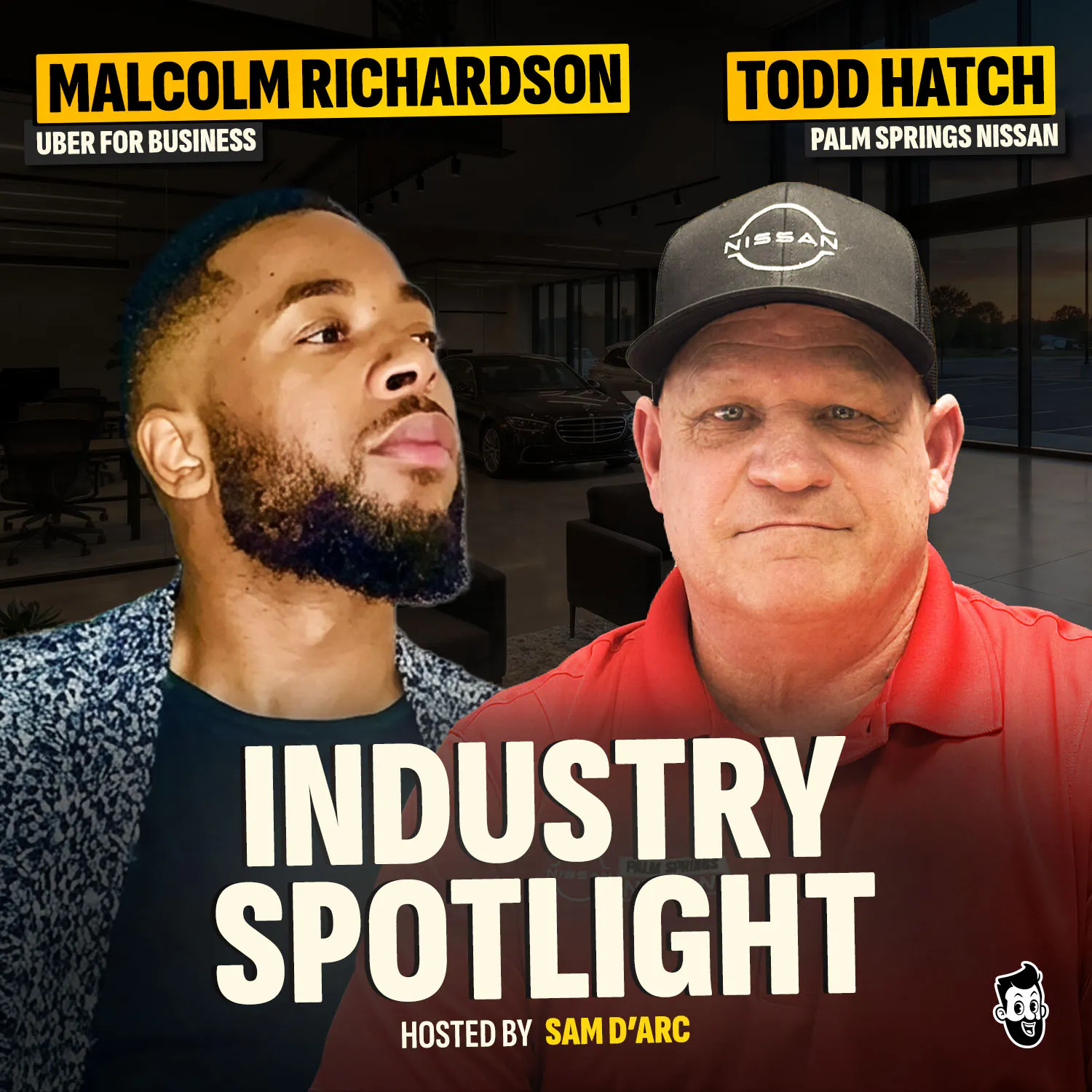
“You're Losing Millions!” The $12,000/mo Transportation Leak Almost Every Dealer Ignores | Industry Spotlight
About this episode
A dealership service team reworked its transportation program after realizing shuttles and loaners were draining cash without improving satisfaction. By shifting to Uber-based rides, integrating requests into the RO workflow, and adding guardrails, the store cut costs, simplified reimbursement, and even freed up parking space. The discussion also shows how the same setup can support parts delivery and employee transportation, while keeping tighter control over usage.
transportation P&L leak
"Hey everybody, welcome to the Cardiola Ship Guy industry spotlight. I'm your host Sam Dark and coming up today, every dealership in this industry has a transportation P&L leak they've stopped looking at."
P&L is a dealership’s profit-and-loss statement. A “leak” means a part of the business is costing more money than it should, without anyone fixing it.
“P&L” stands for profit and loss, and a “leak” means money is being lost in a specific cost area faster than the dealership can control it. In this context, the episode argues that customer transportation (shuttles/loaners) is quietly draining cash and hurting customer experience.
CSI
"...shuttles that sit idle for 40 minutes then run late and tank CSI coordinators chasing keys instead of selling service."
CSI is Customer Satisfaction Index, a metric dealerships track based on customer surveys after service. The episode argues that poor transportation (late shuttles, unavailable loaners) directly harms CSI scores.
loaner fleets
"Loaner fleets that depreciate the second the key lands in a customer's hand shuttles that sit idle for 40 minutes then run late and tank CSI coordinators chasing keys instead of selling service."
A loaner fleet is the group of backup cars a dealership gives customers while their car is being repaired. If those cars aren’t available or the service is slow, customers get frustrated.
A “loaner fleet” is the set of rental/loaner vehicles a dealer provides to customers while their car is in service. These vehicles create ongoing costs (drivers, maintenance, insurance, depreciation) and can also affect customer satisfaction if they’re unreliable or inconvenient.
depreciate
"Loaner fleets that depreciate the second the key lands in a customer's hand shuttles that sit idle for 40 minutes then run late and tank CSI coordinators chasing keys instead of selling service."
Depreciation is the loss of a vehicle’s value over time, and it accelerates when a car is used as a loaner. The episode’s point is that loaner cars lose value immediately once they’re put into service, adding a hidden cost to the program.
Uber for Business
"Todd Hatch runs service at Palm Springs, Nissan Malcolm Richardson leads dealer accounts at Uber for Business. ...Props to Uber for Business for supporting today's content."
Uber for Business is a way for companies to arrange rides for customers or employees. The hosts are using it as an alternative to running a dealership shuttle fleet.
“Uber for Business” is a corporate ride-hailing program that can provide transportation without maintaining a dealer-owned shuttle/loaner fleet. The episode frames it as a practical alternative to reduce idle time, staffing complexity, and customer transportation complaints.
all in monthly spend
"So we had three shuttles three different drivers. I would say and if I'm looking at you know the maintenance on the the the vans themselves tires gasoline. We were probably spending about $12,000 a month..."
“All-in” means the total cost of everything combined. They’re adding up all the expenses to see what the transportation program really costs each month.
“All-in” means the total cost including multiple categories, not just one line item. Here it bundles shuttle/van maintenance, tires, and fuel into a single monthly transportation cost figure.
fender bender
"...and then the inevitable fender bender whether it was a small one or a big one you had to deal with the customers insurance it just really became a problem for us so we cut that fleet down to 12."
A fender bender is a small crash. Even small accidents can cause delays and paperwork, which costs money for a dealership’s loaner cars.
A “fender bender” is a minor collision, but even small crashes can create big operational costs for a dealer’s loaner/shuttle program. The episode highlights insurance handling and downtime as part of why maintaining a large fleet becomes expensive.
warranty repairs through our manufacturer
"Okay use them only for warranty repairs through our manufacturer that pays us back for him so I'm not that's funded by the OEM..."
Warranty repairs are fixes the manufacturer agrees to pay for. The dealer gets reimbursed, so transportation costs are less risky than when the dealer has to cover everything.
Warranty repairs are work covered by the vehicle manufacturer, and dealers typically get reimbursed under warranty terms. The episode contrasts using loaners for manufacturer-paid warranty work versus using them more broadly, which can turn into unreimbursed expense.
OEM
"...so I'm not that's funded by the OEM yeah and so if I'm a writer what my writers would do..."
OEM means the car maker itself. If the OEM is paying for the repair, the dealership is more likely to get reimbursed for related costs.
OEM means Original Equipment Manufacturer—the company that built the vehicle (and typically the warranty program). In the episode, OEM funding/reimbursement is what makes limited loaner use financially manageable.
shuttle utilization
"And then you know you go back to the shuttle what did your shuttle utilization look like when you look at actual ride count per hour was it effective when you have the shuttle"
Utilization is how much the shuttle is actually being used versus sitting idle. If the shuttle can’t match where people need to go, it wastes time and money.
Utilization measures how effectively the shuttle resources are used—often tracked as ride count per hour. The episode says their shuttle system couldn’t match routes to demand, so the program didn’t deliver value even when it was running frequently.
appointment link
"And then being able to set them up where whatever your appointment is you get a 1230 appointment you send in the link they're done at 115 they go get them they bring them in."
An appointment link is a website/app link that helps schedule your service visit. In this conversation, it also helps coordinate when and how you get picked up.
An appointment link is a digital scheduling link used to coordinate service visits and related logistics. Here, it’s tied to how customers receive pickup instructions and timing for transportation during service.
service shuttle
"So you mentioned yet options you started at the service shuttle first you probably looked at different options before you made the full pivot."
A service shuttle is a car/van the dealership uses to pick you up and drop you off while your car is in for service. It helps you keep your day going instead of sitting at the dealership.
A service shuttle is a dealership-provided ride that transports customers while their vehicle is being serviced. It’s often used to keep customers from having to wait at the dealership or arrange their own transportation.
service writers
"Was there anything that was a challenge from an adoption standpoint where your service writers or the customer or someone wasn't completely comfortable with the process."
Service writers are the people at the dealership who take your car’s service order and talk to you about what needs to be done. They help manage the process while your car is being worked on.
Service writers are the dealership staff who interface between customers and the service department. They typically write up service requests, communicate recommended work, and coordinate the customer’s experience during repairs.
adoption standpoint
"Was there anything that was a challenge from an adoption standpoint where your service writers or the customer or someone wasn't completely comfortable with the process."
This means whether people were willing and able to start using the new system. They’re asking if the change was hard for employees or customers to get used to.
“Adoption standpoint” refers to how easily staff and customers accept and start using a new process or service. In this segment, the hosts discuss whether people were comfortable with the workflow change from shuttle service to Uber.
service drive
"And then from it from your side what is the dealer typically get wrong about Uber as a solution in the service drive."
The service drive is the part of a car dealership where you pull in for service—like dropping off your car or getting it back. The episode is talking about how transportation solutions fit into that flow.
A dealership “service drive” is the area where customers enter to drop off or pick up vehicles for service. In the segment, it’s where the operational workflow for rides/shuttles and vehicle movement happens.
DMS
"let's talk integration when you say rides tie back to our own numbers inside the DMS so you have an integrated integration within the DMS."
DMS is the dealership’s main computer system for managing things like service appointments and repair paperwork. The episode is saying the ride solution can connect to that system.
DMS stands for Dealer Management System, the software dealerships use to run service and sales operations. Here, the discussion is about integrating ride requests so they “tie back” to dealership records.
service advisor
"What does that actually look like for the advisor at the right up desk walk us through that process what what what what does the advisor do to actually place that call."
A service advisor is the person at the dealership who helps you with service—like explaining what needs to be done and coordinating the work. They’re saying the ride tool should be easy for that person to use.
A service advisor is the dealership employee who interfaces with customers about vehicle service, schedules work, and manages the service process. The segment emphasizes that the advisor shouldn’t have extra steps or “another tap open.”
repair order number
"the service advisor can request a ride directly from that screen while managing the art that they're managing RO from right and so that ride ties directly to that repair order number."
A repair order is the paperwork for the work being done on your car. The repair order number is like an ID that ties the ride and billing to that specific service visit.
A repair order (RO) is the dealership’s official work authorization/document for a vehicle’s service. The “repair order number” is used to link the ride request to the specific service job so costs and records can be tracked.
warranty reimbursement
"at the end of the month as you mentioned a warranty reimbursement from the OEM your controller can wreck can reconcile that download the report and upload it right into their OEM system."
Warranty reimbursement is when the car maker pays the dealership back for warranty-covered repairs. They’re saying the ride data can be uploaded so the dealership can get reimbursed correctly.
Warranty reimbursement is money the dealership gets back from the automaker (OEM) for eligible warranty repairs. The segment describes reconciling ride-related downloads/reports into the OEM’s system for reimbursement.
TSD integration
"every riot maps to a customer and RO and then every dollar is accounted for the TSD integration is a great example would give service managers kind of a unified view of loners and right share so they can choose the right option."
TSD integration is a computer connection between systems so ride/transportation info can be tracked alongside service work. The goal is better visibility and accounting for the dealership.
TSD integration refers to a specific software integration mentioned as an example of connecting ride/transportation data into dealership systems. The point is that it helps service managers see and account for transportation options tied to service work.
loaners
"every riot maps to a customer and RO and then every dollar is accounted for the TSD integration is a great example would give service managers kind of a unified view of loners and right share so they can choose the right option."
Loaners are replacement cars the dealership gives you when your car is in the shop. They’re talking about comparing options like loaners versus other transportation in real time.
Loaners are substitute vehicles dealerships provide to customers while their car is being repaired. The speaker mentions using ride/vehicle options to give managers a unified view so they can choose the right option for each customer.
radius of miles
"But we try and keep it in a in a radius of miles now if it's a if it's a special circumstance will accommodate people"
They’re describing a distance limit—like “we’ll arrange rides within this area.” If someone’s outside the usual area, they may make exceptions.
A “radius of miles” is a geographic limit for where the dealership will arrange transport. The speaker says they try to keep rides within a set area, but can accommodate special circumstances outside that range.
designated spot in front of the dealership
"So they already know this customer this guy's coming he's driving this car boom we have a designated spot in front of the dealership where they walk out to it"
This describes a standardized pickup location used to streamline the ride process. By having customers walk out to a known spot, the dealership reduces confusion and makes the Uber workflow more repeatable for staff and customers.
monthly transportation spend
"So speaking of the comp let's do that monthly transportation spend before so loaners and service personnel personnel all that stuff what's the delta between what you were spending before and today with Uber"
They’re talking about the dealership’s monthly cost for moving people around—like rides for customers. The point is to compare what they used to spend versus what they spend now using Uber.
This refers to the dealership’s recurring costs for getting customers and/or staff where they need to be—often via rides, shuttles, loaners, or other transport arrangements. In the segment, the host compares the dealership’s prior transportation costs to what they spend after switching to Uber.
service vans
"Okay so you still got the 12 and then do you have service vans do you have delivery vans completely. Nope and I'm delivering parts so not that I'm boasting about it but I was able to cut"
Service vans are vehicles the dealership uses to move stuff around—like parts or equipment. Here, they’re saying they don’t have extra vans for that, because they’ve changed how they get parts.
Service vans are dealership vehicles used to transport parts, tools, or sometimes staff between locations. In this segment, the speaker says they don’t run service vans for customer transport, but they do deliver parts and use Uber to pick up parts instead of relying on multiple drivers and trucks.
CP labor
"So has that shown up as a benefit and labor in hours per hour or CP labor. I think that's part of it I mean we've changed some processes since I've been here"
“CP labor” is shorthand for customer-pay labor—labor charges billed to the customer for service work. The speaker connects Uber to freeing up advisor time and improving labor efficiency, implying it can affect how many billable hours the shop can generate.
low mileage cars
"...now we're turning these cars this 12 like every six months it's working much better for my use car department even yeah because now they know I'm they're getting these low mileage cars and I'm not buried in a bunch of them."
Low mileage just means the car has been driven less than average. The speaker is saying it helps the used-car department sell cars faster.
“Low mileage” refers to vehicles that have been driven relatively little, which can make them easier to sell and less risky to stock. In the transcript, the dealer turns cars more frequently because they’re not stuck with a large inventory of higher-mileage units.
courtesy rise pick up and drop off
"Uber for with Uber for business it's Uber Uber's enterprise arm and we work with dealers auto groups and OEMs and they use us for courtesy rise pick up and drop off parts delivery as well as corporate business travel... Most dealers still have a driver or two running parts around town"
It’s basically “we’ll get your car or you to the dealership and then bring you back” as part of service. The platform helps coordinate that so the dealer doesn’t need as many drivers.
This refers to a dealership service where a customer is picked up and dropped off, typically using a third-party platform. In the transcript, it’s positioned as an entry point for dealers to use the platform beyond just parts delivery.
parts delivery
"Most dealers still have a driver or two running parts around town... what are your sharpest dealers doing on parts delivery... dealers can call an order and dispatch through that same platform so that putting somebody off the floor and send it somebody to get it"
Instead of waiting for parts to arrive, the dealer arranges for parts to be delivered quickly so repairs can keep moving. The discussion is about using a platform to send parts to the right place fast.
Parts delivery is the process of getting automotive parts from a warehouse or supplier to the dealership or directly to a technician. The transcript describes dispatching through the same platform used for other services, including coordinating between locations.
vehicle pick up and drop off
"...second as he mentioned to as well is a vehicle pick up and drop off as well as kind of like the white glove version so if a customer doesn't want to come in right they may be too busy the dealership can drop off the customer vehicle and then the the porter can uber back to the dealership"
It means the dealership arranges to get your car to the shop and bring it back. The goal is to make it easier for customers and reduce how many people the dealership needs to run around.
Vehicle pick up and drop off is a logistics service where the dealership arranges transportation for the customer’s car and/or the customer. The transcript also describes a “white glove” version where a porter can handle the car while the driver returns separately, reducing the need for extra chase vehicles or drivers.
white glove version
"...vehicle pick up and drop off as well as kind of like the white glove version so if a customer doesn't want to come in right they may be too busy"
“White glove” means a higher level of service—more help and less hassle for the customer. In this case, it’s about making pickup/drop-off smoother.
“White glove” is a service-level phrase meaning extra attention and convenience beyond the basic offering. Here, it describes a more hands-off experience for customers, with coordinated pickup/drop-off and reduced need for additional dealership staff.
test drive
"...the dealership sales teams... when you get when you get prospects you know to the dealership you know to buy a car you know or to even think about or the test drive it"
A test drive is when a customer takes a car out to drive it before deciding to buy. They’re saying the service can help with that step too.
A test drive is the customer’s opportunity to drive a vehicle before purchase. The transcript mentions sales teams using the platform to help get prospects to the dealership and support the buying process.

Chevrolet Suburban
"...s does this product work there is it an urban and suburban play I'm in Kalamazoo Michigan it's tough to find..."
The Chevrolet Suburban is a large SUV made to carry a lot of people and gear. It’s designed for everyday driving and road trips, so it works well when you need more space than a smaller car. It may be mentioned when people talk about vehicles that fit both city and suburban life.
The Chevrolet Suburban is a full-size SUV built for large families and heavy-duty everyday use, with seating and cargo space designed to handle long trips and lots of passengers. It often comes up in discussions because it’s a common choice for people who need practicality and room, especially in areas where driving distances are longer. In a podcast, it may be mentioned as part of a conversation about “urban and suburban” lifestyles and what vehicles fit those needs.
rideshare pool
"Yeah so rule dealers Malcolm thinking about rule dealers thinner rideshare pool longer pickup times does this product work"
It means how many drivers are available nearby to take trips. If there aren’t many, customers wait longer.
A rideshare pool is the set of available drivers/couriers that can accept trips in a given area. The transcript connects a smaller pool to longer pickup times and reduced service robustness.
urban and suburban play
"Yeah so rule dealers Malcolm thinking about rule dealers thinner rideshare pool longer pickup times does this product work there is it an urban and suburban play I'm in Kalamazoo Michigan"
They’re asking whether this service works best in cities or in suburbs too. The answer is that it can vary depending on how many drivers are available in each area.
This phrase refers to whether the service strategy works better in city areas versus surrounding suburbs. The transcript discusses coverage differences and how availability can vary by location.
hotspot for drivers
"...we take that to our maps team and we say like hey how can we get more and more supply more drivers more couriers out to this way right and try to even sometime we can even make things a hotspot"
It’s like telling drivers where the most ride requests are coming in. The goal is to reduce wait times by sending drivers to the busiest areas.
A “hotspot” is an area where demand is higher, so more drivers/couriers are directed there to meet that demand. The transcript describes using maps and supply/demand targeting to improve service coverage around specific dealerships.
branded loners
"Todd that says hey my branded loners they're rolling billboards I'm not really I'm not ready to give up that brand exposure what's your counter to that"
They’re talking about loaner cars with the dealership’s name on them, like a rolling billboard. The debate is whether that marketing is worth keeping compared to posting online.
“Branded loners” refers to loaner vehicles that carry the dealership’s branding, acting like moving advertisements. The transcript contrasts keeping that branding versus using social media for brand exposure.
rolling billboards
"Todd that says hey my branded loners they're rolling billboards I'm not really I'm not ready to give up that brand exposure"
It’s a way of saying the car’s branding gets seen while it’s out in public. The speaker is comparing that to online marketing.
“Rolling billboards” is a marketing metaphor for branded vehicles that advertise while they’re being driven around. In the transcript, it’s used to argue that branded loaners create visibility.
on demand service
"A couple things are happening at once first customer expectations for on demand service that are all time high like people are using their phone to book everything on their book flights groceries doctor visits right."
It means people want to book and get help right away using their phone. Instead of waiting around in a dealership lobby, they expect a faster, app-based process.
“On demand service” means booking and receiving services instantly (or near instantly) through a phone/app rather than waiting for a set schedule. In this context, it’s about customers expecting to arrange things like transportation and service appointments quickly.
Uber vs traditional loaner fleet economics
"...when you weigh in that traditional loaner fleet... against a per ride model like Uber... so think about expense cut where does that money go to directly to the bottom line."
They’re talking about whether it’s cheaper to run your own loaner cars or to use rides from a service like Uber. The big idea is that cutting the old expense can improve the dealership’s bottom line.
This segment compares the cost structure of a dealership’s traditional loaner fleet versus using Uber-style rides for customer transportation. It focuses on expense categories, how savings flow to the service department’s results, and why the shift can be financially compelling.
margin pressure
"...dealerships under real margin pressure and the fixed ops are really carrying the store right now..."
It means the dealership is making less profit per sale because costs or competition are squeezing the numbers. That’s why they’re trying to cut expenses.
“Margin pressure” means profit margins are being squeezed—often due to higher costs, competitive pricing, or weaker demand. Here it sets up why dealerships are looking for cost-saving changes to transportation programs.
fixed ops
"...dealerships under real margin pressure and the fixed ops are really carrying the store right now so when you weigh in that traditional loaner fleet."
Dealerships have two big money areas: selling cars, and running the service/parts side. “Fixed ops” refers to that service/parts side that keeps the lights on.
“Fixed ops” is shorthand for a dealership’s fixed operations—mainly service, parts, and collision/repair—distinct from selling new/used vehicles. The segment argues fixed ops are carrying the dealership financially under margin pressure.
per ride model
"As he mentioned insurance appreciation salaries of the person that's managing it against a per ride model like Uber."
Instead of paying to keep a bunch of cars ready all the time, you pay for each individual ride when it’s needed. That can be cheaper and easier to manage.
A “per ride model” charges based on each trip rather than maintaining a fleet of vehicles. The episode compares this to loaner fleet costs (insurance, staffing, vehicle management) to show why the math can favor rideshare.
service department bottom line
"...think about expense cut where does that money go to directly to the bottom line... Your best KP your best KPI is the bottom line it's the net for the service department..."
“Bottom line” just means the final money result—what’s left after expenses. They’re saying owners care most about improving that number for the service side.
The “bottom line” is the net profit/result after all costs for a department. The episode frames the service department’s performance as the key metric owners watch, especially when fixed expenses like loaner vehicles are reduced.
guard rails and controls
"...the biggest mistake a dealer can make in the first year... is not making sure some guard rails and controls are in place... you can always have a couple bad actors at every location..."
They mean setting rules so the program doesn’t get abused or run over budget. The goal is to keep spending controlled while still helping customers.
“Guard rails” and “controls” are rules and limits put in place to prevent misuse and keep a program within budget. In this context, they’re about limiting ride amounts/distance/frequency and ensuring the right people approve or configure the system.
Uber Black
"...you can always have a couple bad actors at every location right... People may be ordering Uber Blacks right for the best friends or whatever that might be..."
Uber Black is the more expensive, premium version of Uber. The point here is that without rules, people might pick the pricier option.
“Uber Black” is a premium Uber service tier typically associated with higher-end vehicles and higher per-ride pricing. The episode mentions it as an example of how some users might choose more expensive options without controls.
dashboard
"...we like to have what our service advisors and managers are making sure we set it before any service advisor gets even touches the dashboard or orders are right."
A dashboard is the screen/software panel where employees manage the program. They’re saying to set the rules first so staff don’t accidentally allow overspending.
Here, “dashboard” refers to the system interface where staff manage transportation program settings and place ride orders. The speaker stresses configuring guard rails before staff can use it.
mileage limits
"...we set it before any service advisor gets even touches the dashboard or orders are right... we set up all the guard rails... the mileage limits and all the controls..."
It’s a rule that limits how far a ride can be. That helps keep the dealership from paying for overly long trips.
“Mileage limits” are caps on how far rides can go under the dealership’s transportation program. The episode describes setting these limits in the system as part of the guard rails to control costs.
vouchers
"Everything you can put vouchers in where the dealer is going to only pay 25 of the voucher if it's a $30 ride the customers pays that so there's a lot of options that Uber's built in."
A voucher is like a spending credit for rides. The dealership can set it up so they only cover a portion, and the customer pays the rest.
In this context, “vouchers” are pre-set payment credits the dealership provides for rides, with a defined reimbursement percentage. The episode mentions the dealer paying only part of the voucher amount to control spend.
mile radius
"I use a mile radius because I'm in a small valley you could do it on a dollar a month we could set we only want to spend this much per month right and when you hit that you get a warning so."
It’s a rule that limits rides to a certain distance area around the dealership. That keeps costs predictable and matches local travel needs.
A “mile radius” is a geographic limit defining how far from the dealership the ride is allowed to go. The speaker uses it as an example of tailoring the program to local geography (a small valley).
vehicle privileges
"That's a great perk and actually that's a great thing you know we'll hear sometimes about employees that don't even qualify for vehicle privileges can't drive a vehicle for whatever reason."
“Vehicle privileges” means employees get permission to use a company vehicle. It’s usually a perk with rules about who qualifies and under what conditions.
“Vehicle privileges” refers to dealer-provided access to company vehicles—often for employees to drive for personal or work-related use. In dealership operations, it can be structured as a perk with eligibility rules (like needing a valid driver’s license).
Request an Explanation
Heard something you'd like explained? We'll add it to this episode.
Sign in to request explanations for terms you heard.
Want to learn more?
Browse our glossary for plain-English explanations of automotive terms, jargon, and concepts.
Help improve this episode
See something that's not quite right? Our annotations are AI-generated and can sometimes miss the mark. Click the flag icon on any annotation to suggest a correction.