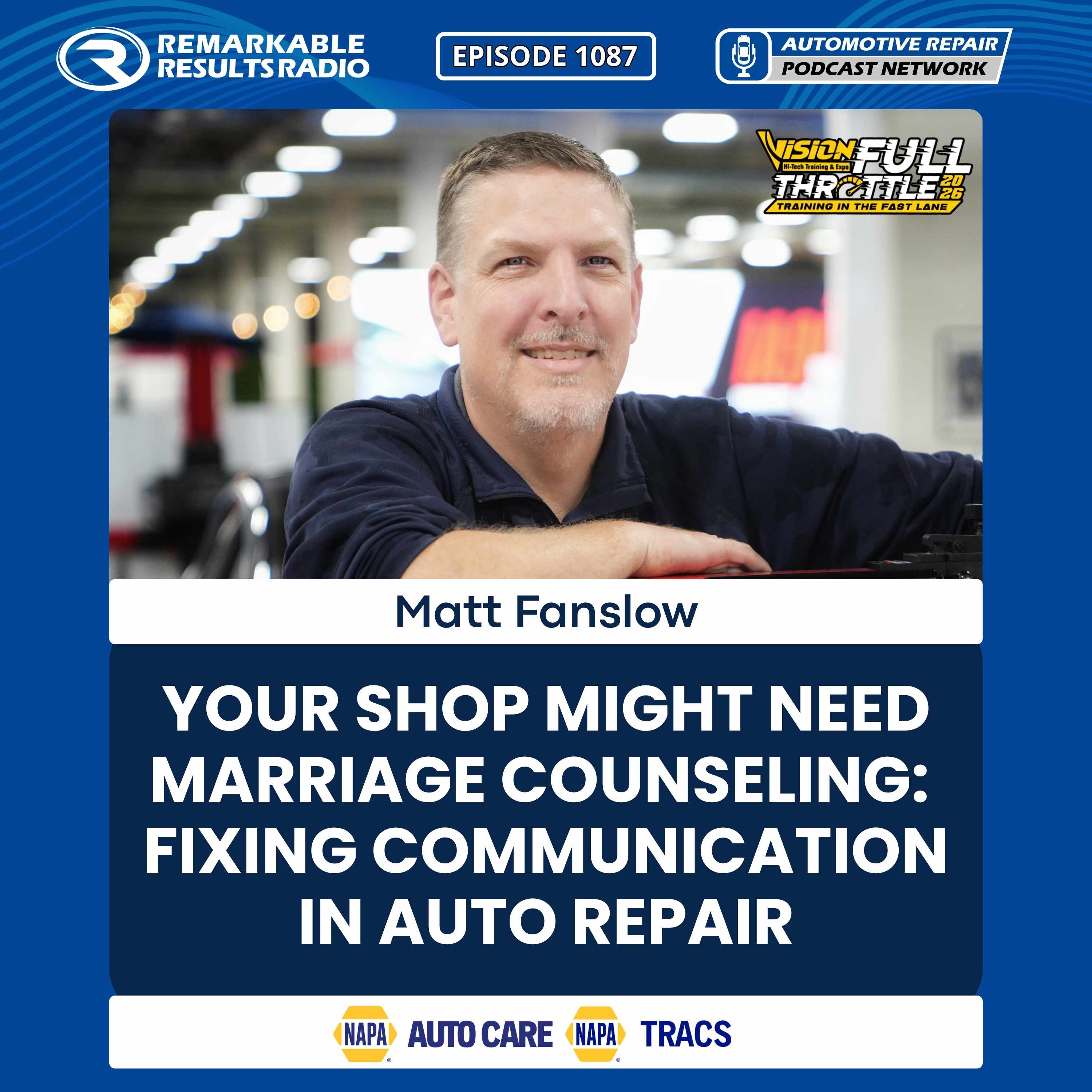
Riverside MN’s Matt Fonzlo joins Karm Capriotto to connect relationship communication skills to everyday auto shop performance. The discussion centers on “marriage counseling” for shops: power dynamics at the counter, the need for validation, and how tone and delivery can trigger defensiveness. They break down the “four horsemen” (criticism, contempt, defensiveness, stonewalling) and how these show up between advisors, techs, and owners. The episode also highlights Vision 2026 tech-talk formats for training new presenters, plus Napa sponsorships for shop training systems.
Recorded live at VISION 2026, host Carm Capriotto and Matt Fanslow explore how lessons from marriage counseling can improve communication in auto repair shops.
The core discussion centers on Matt’s article for NAPA Auto Care's Insight Magazine, “Your Shop Might Need Marriage Counseling,” and the industry’s gap in soft skills. His central argument is simple: most automotive professionals were never taught effective communication or soft skills. In the past, shop culture often relied on public criticism or shame to correct mistakes. Today, that approach backfires, especially for younger technicians, who are more likely to disengage or “quietly quit” in that kind of environment.
Matt proposes a different approach: applying communication techniques commonly used in therapy to everyday shop interactions.
Drawing from the Gottman Institute, Matt outlines common communication pitfalls: criticism, contempt, defensiveness, and stonewalling, and how they show up daily in shop environments.
Key solutions include:
Validating feelings, especially with anxious customers
Coaching without shame, addressing mistakes privately with support
Seeking outside perspective, using coaches or therapists to uncover blind spots
Finally, both Carm and Matt challenge the stigma around seeking outside help. They encourage shop leaders to work with coaches, counselors, or therapists to uncover blind spots and improve their leadership approach. Far from being a weakness, asking for help is framed as a sign of strength and self-awareness.
The goal isn’t to turn shops into therapy sessions; it’s to make small, intentional changes in how people communicate every day. The payoff? Fewer emotional blowups, stronger team culture, and customers who feel safe, heard, and respected.
"[64.9s] Yeah, we don't quite get the same lake effect, you guys.
[67.5s] Yeah, yeah.
[68.3s] Anyway, enough with the weather."
Lake effect is when cold air passes over a big lake and picks up moisture. Then it dumps that moisture as snow, so one town can get a lot more snow than another nearby.
“Lake effect” is a weather pattern where cold air moves over a warmer lake, picking up moisture and then dropping it as snow downwind. It can create very different snowfall amounts over short distances, which is why some areas get hammered while others nearby see much less snow.
"Scott Shotten and I are presenting a all-day hands-on PicoScope class at Johnson County Community College"
PicoScope is a diagnostic tool that lets mechanics look at electrical signals in a car. Instead of guessing, it helps them see what’s happening with sensors and wiring so they can find the problem faster.
PicoScope is a brand of automotive diagnostic oscilloscopes used to view electrical signals in real time. In auto repair training, it’s often used to diagnose issues like sensor faults, ignition problems, and communication problems by “seeing” what the signals are doing.
"I'm doing kind of an introduction to key cutting and programming."
This is the process of making a car key and then teaching the car to recognize it. Many newer cars won’t start unless the key is programmed to that specific vehicle.
Key cutting and programming refers to creating a physical key blank and then programming the car’s immobilizer/transponder and remote functions to match the vehicle. Modern cars often require both steps, and the programming portion is usually the more technical and vehicle-specific part.
"But he is a proponent of a tool called the MT Pro, which is an eight channel lab scope."
The MT Pro is a diagnostic tool. The way they describe it, it helps a technician look at what’s happening in the car’s systems so they can find the problem faster.
The MT Pro is described as a tool used in diagnostics. In this context, it’s being positioned as a lab scope platform for analyzing vehicle signals during troubleshooting.
"about this tool or whatever my how I approach a vehicle diagnostics or something like that. But the class times are three hours, four hours, eight hours."
Vehicle diagnostics is how a mechanic figures out what’s actually causing a car problem. Instead of replacing parts randomly, they test and measure to find the real cause.
Vehicle diagnostics is the process of using tests and measurements to identify the root cause of a problem. The segment suggests the speaker wants to teach an approach to diagnostics using the lab scope tool, emphasizing structured troubleshooting rather than guesswork.
"So, you know, a couple of years ago, we have somebody talking about HP tuners, not how to tune the car, but how to use it as a diagnostic tool. I learned so much in that class about a tool that I already had."
HP Tuners is software that lets you connect to a car’s computer. Mechanics can use it to look at what the car is doing and find problems, not just to change performance settings.
“HP Tuners” is a popular aftermarket engine tuning and diagnostics software/ecosystem used to read data and, in many cases, reflash the vehicle’s ECU. In this context, the host is emphasizing using it more as a diagnostic tool than for performance tuning.
"So, you know, a couple of years ago, we have somebody talking about HP tuners, not how to tune the car, but how to use it as a diagnostic tool. I learned so much in that class about a tool that I already had."
A diagnostic tool helps a mechanic “talk” to the car’s computer. It can show error codes and real-time sensor readings so you can figure out what’s wrong.
A diagnostic tool is used to communicate with the vehicle’s control modules to read trouble codes, live sensor data, and readiness/monitor status. The key idea here is using tuning/scan capabilities to troubleshoot issues rather than immediately changing calibration.
"And Napa Tracks will move your shop into the SMS fast lane with on-site training,
[372.0s] six days a week support and local representation."
Napa Tracks is a program from Napa that helps repair shops get training and support. The goal is to help shops run better and communicate more effectively with customers.
Napa Tracks is a training and support program associated with Napa (the automotive parts retailer/distributor). It’s designed to help auto shops improve skills and processes through on-site training and ongoing support.
"[609.6s] Zero soft skills, because if you had an ounce of soft skills, [614.0s] you'd at least think before you spoke."
Soft skills are how you talk to people and handle situations. In a shop, it’s things like listening, being clear, and staying calm so customers feel understood.
In auto repair, “soft skills” are the people-and-communication abilities that help technicians and service advisors work effectively with customers and coworkers. When they’re missing, misunderstandings at the front counter can escalate and slow down repairs or damage trust.
"And you see this happen at the front counter where the customer is saying, My car is doing this."
The “front counter” is basically where you talk to the shop staff before work starts. How that conversation goes can affect whether you feel understood and whether the repair process feels fair.
The “front counter” is where the customer interacts with the shop—typically the service advisor or customer service rep. In auto repair, this is where communication style and expectations can make or break trust, especially when diagnosing concerns or discussing repairs.
"I think women in particular, even if it's not true that the shop, whoever the service advisor, the customer service rep, the mechanic, the owner, whoever's talking to them, already there's the stigma of I'm a woman. I don't know anything about cars."
This is the idea that some people assume women don’t know about cars. That assumption can change how seriously someone is taken at the shop and can make communication harder for everyone.
This describes a social stigma that can affect how customers are treated and how they communicate at the shop. In practice, it can lead to misunderstandings, less effective explanations, or customers feeling dismissed—even when they’re accurately describing symptoms.
"I think women in particular, even if it's not true that the shop, whoever the service advisor, the customer service rep, the mechanic, the owner, whoever's talking to them,"
A service advisor is the person at the shop who talks with you about your car. They help translate what the shop needs to do and keep things organized between you and the mechanic.
A service advisor (sometimes called a service writer) is the shop employee who communicates with the customer, writes up the work order, and coordinates the repair with the technicians. They’re central to setting expectations, explaining findings, and managing the repair timeline.
"There's already fear. Now there's a power dynamic that even the person sitting at the counter doesn't know exists."
A “power dynamic” means one side feels more in control than the other. In car repairs, the shop usually knows more about what’s going on, so the customer can feel less confident or less able to question things.
A “power dynamic” refers to an imbalance in control or authority—here, between the customer and the shop staff. Auto repair conversations can feel unequal because the shop has technical knowledge, access to tools, and control over diagnosis and recommendations.
"they can back that up quick and apologize, validate their feelings of fear, validate their feelings that they felt I was condescending, even though I wasn't."
This is about acknowledging that the customer feels scared or upset, instead of arguing about whether they’re right to feel that way. It can calm things down so the shop can move forward.
Validating a customer’s feelings means acknowledging their fear or frustration as real, even if the shop’s intent wasn’t to be rude. In auto repair, this can de-escalate conflict and improve cooperation during diagnosis and repair.
"[1329.6s] The automotive world is changing fast.
[1331.4s] And customers are expecting speed, accuracy, and confidence in every repair.
[1336.2s] To keep your shop competitive, your technicians need training that's smarter,
[1340.3s] faster, and future focused."
Customers want three things: repairs done fast, done right, and explained in a way that makes them feel sure. If a shop can’t deliver those, people lose trust quickly.
This phrase captures the modern service-shop performance triangle: customers want repairs done quickly, diagnosed correctly, and communicated with confidence. It ties directly to shop competitiveness because delays or uncertainty can erode trust even if the final fix is correct.
"Therefore, down on your knees and the three feet of water feeling like you're,
[1316.3s] So the fact is, is I could come in with a little bit different.
[1320.4s] It could be tone, it could be structure, all the things.
[1324.0s] And next thing you know, they're standing on their feet in three feet of water.
[1329.6s] The automotive world is changing fast.
[1331.4s] And customers are expecting speed, accuracy, and confidence in every repair.
[1336.2s] To keep your shop competitive, your technicians need training that's smarter,
[1340.3s] faster, and future focused.
[1342.3s] That's why Napa AutoCare is excited to introduce three new auto tech initiatives.
[1346.9s] Fast track assessments, the accelerator training program, and tech assist.
[1351.6s] It all starts with fast track assessments."
Napa AutoCare is connected to the NAPA parts/service ecosystem. Here, they’re talking about programs meant to help repair shops train their techs and run repairs more smoothly.
Napa AutoCare is a service/training brand associated with the NAPA network, focused on helping independent shops improve technician capability and shop processes. In the episode, it’s presented as rolling out new training initiatives to help shops respond to changing customer expectations.
"[1342.3s] That's why Napa AutoCare is excited to introduce three new auto tech initiatives.
[1346.9s] Fast track assessments, the accelerator training program, and tech assist.
[1351.6s] It all starts with fast track assessments."
This is a quick way to figure out what a tech is good at and what they need to work on. The goal is to get people improving faster instead of waiting around.
“Fast track assessments” refers to a quick, structured evaluation process to identify a technician’s current skill level and training needs. The idea is to reduce time-to-improvement so shops can keep up with faster-moving vehicle technology and customer expectations.
"[1342.3s] That's why Napa AutoCare is excited to introduce three new auto tech initiatives.
[1346.9s] Fast track assessments, the accelerator training program, and tech assist.
[1351.6s] It all starts with fast track assessments."
This sounds like an intensive training path meant to help technicians improve quickly. Instead of slow, general training, it’s meant to push learning forward faster.
An “accelerator training program” is a training track designed to speed up skill development, typically by focusing on the most relevant competencies first. In the context of the episode, it’s positioned as part of a shop competitiveness strategy—helping technicians learn faster and stay current.
"Through AR capable smart safety glasses, your technicians can instantly pull up torque specs, wire colors, component locations, and even connect with a live expert"
Torque specs are the exact “tightness” numbers for bolts. Using the right value helps keep parts secure without over-tightening or under-tightening.
Torque specs are the manufacturer-specified tightening values for fasteners. Using the correct torque helps prevent stripped threads, broken bolts, and improper component clamping.
"Hey, let's face it. Your shop management system is the single most important tool in your shop, period."
A shop management system is the software a repair shop uses to keep everything organized—jobs, paperwork, and billing. If it’s set up well, the shop runs smoother and communicates better.
A shop management system (SMS) is the software used to run day-to-day repair operations—like scheduling, work orders, estimates, and billing. The segment frames it as the “single most important tool” because it ties communication and workflow together across the shop.
"...to help optimize your shop's workflow, efficiency, and profitability."
Profitability is the shop’s ability to earn money after expenses. The speaker ties it to optimizing workflow and efficiency, implying that better communication and process control can reduce costly delays and rework.
"...to help optimize your shop's workflow, efficiency, and profitability."
Efficiency means the shop can do the work without wasting time. Better organization and communication usually make the whole process faster.
Efficiency in a repair shop means getting work done with less wasted time—fewer delays, smoother handoffs, and faster turnaround. In this segment, it’s linked to using the right system to improve how the shop operates.
"...a representative consults with you to help optimize your shop's workflow, efficiency, and profitability."
Optimizing workflow means improving the shop’s process so cars move through the shop smoothly. It helps prevent confusion between the people working on the car and the people talking to the customer.
To optimize a shop’s workflow means redesigning or configuring processes so tasks happen in the right order, with fewer bottlenecks and clearer handoffs. In auto repair, this often reduces miscommunication between advisors, technicians, and customers.
"Yes, a learning management system tailored to each role in your company. Simply put, tracks was designed and built for shop owners just like you."
A learning management system is a platform that helps companies train employees. It can assign training based on job role so people learn what they need for their specific work.
A learning management system (LMS) is software that delivers training content and tracks progress. This segment emphasizes an LMS “tailored to each role,” meaning different staff roles get different training paths.
"But we have condescension and we have stonewalling. There's criticism, contempt, defensiveness, and stonewalling."
Stonewalling means someone basically stops talking or refuses to engage when there’s a problem. In a car shop, it can look like ignoring questions or not responding, which usually makes the situation worse.
Stonewalling is a communication pattern where one person shuts down, refuses to engage, or withdraws during conflict. In the context of auto repair, it can show up as going silent with a customer, avoiding questions, or not responding to concerns—making problems harder to resolve.
"Marriage counseling for a business, think about it. Really? It translates."
They’re comparing shop communication to relationship counseling. The message is that better communication inside the team can improve how the business treats customers.
The speaker uses “marriage counseling” as a metaphor for improving communication and teamwork inside an auto repair business. The idea is that the same conflict-avoidance and communication skills that help couples can help a shop’s team interact with each other and customers.
"...this person may be driving numbers and KPIs and processes and systems and finance, but not necessarily will they always help you with the people's side of you..."
KPIs are numbers a business uses to see if it’s doing well. They’re useful for tracking performance, but they don’t tell you whether people are communicating well or feeling heard.
KPIs (key performance indicators) are measurable targets a business tracks to judge how well it’s operating—things like throughput, turnaround time, or sales metrics. In auto repair, KPIs help owners manage the shop, but they don’t automatically address communication, trust, and employee/customer relationships.
"One of my employees left lug nuts loose and that wheel could have came flying off. Could you even imagine and stuff like that?"
Lug nuts are the bolts that hold your wheel onto the car. If they aren’t tightened properly, the wheel could loosen and become dangerous.
Lug nuts are the fasteners that clamp a wheel to the vehicle’s hub. If they’re left loose, the wheel can shift or come off, which is a serious safety risk.
"Our customers kind of are our customers because they feel safe. They come to the shop feeling safe."
The speaker means the customer feels comfortable talking to the shop. When that happens, people are more likely to explain problems clearly instead of getting defensive.
“Feeling safe” describes a customer experience where the shop’s tone and process reduce fear of blame or conflict. The speaker connects this to better information flow—customers share concerns without becoming defensive.
"You wouldn't notice it in these great big moments. You would notice it over time in these little interactions."
The speaker emphasizes that customer trust is built (or damaged) through repeated small interactions, not just dramatic moments. In service businesses, consistent communication habits—listening, acknowledging concerns, and explaining—shape long-term customer experience.
Select text to request an explanation
This is the Automotive Repair Podcast Network.
Everybody, Karm Capriotto with Vision 2026.
God, man, I don't know.
This could be our eighth year here.
We're just so, so, so happy to be here.
Matt Fonzlo is with me from Riverside up in the great state of Minnesota.
Was it cold up there this year?
We had some pretty good weeks of cold.
Sub-zero, sub- like negative 20.
It's one of the coldest.
I think it's one of the coldest states in the whole U.S., isn't it?
I think, yeah, I think it's recognized as the coldest state in the United States.
Go further north, I think like Maine's further north,
but it's surrounded by the ocean, which is a big heat capacitor,
so it just doesn't get as cold.
Yeah.
There was a bunch of years that I working for corporate America
that I had to go to Minneapolis.
Even though there wasn't a whole lot of snow compared to...
I've been leaving Buffalo with, you know, 30 degree weather.
And I'm going to your place with all kinds of snow,
and then there's no snow there, but I was never colder in my whole life.
Yeah, we don't quite get the same lake effect, you guys.
Yeah, yeah.
Anyway, enough with the weather.
It's becoming spring.
We're here in Kansas City.
I'm impressed with what I see.
I know you're teaching a couple of classes here, aren't you?
What are you doing?
I mean, that's using the word teaching very loosely.
Okay, all right.
Yeah.
You're showing your knowledge?
I mean, it's not a lot to share,
but yeah.
You're inspiring.
I'm definitely sharing.
You're dragging people over the line?
What is it?
What is it screaming?
I mean, by now, everyone should know.
I have no idea what I'm doing.
But I am, yeah.
Scott Shotten and I are presenting a all-day hands-on
PicoScope class at Johnson County Community College
all day Friday and then Saturday morning with Andrew Sexton.
I'm doing kind of an introduction to key cutting and programming.
And then Saturday afternoon is the,
I guess I would like to say popular.
It seems to have a lot of popularity tech talks.
You invented this.
I mean, I stole it, but yeah.
We talked about this in an episode I think we did at ASDA.
And I have to tell you, you're onto something so big here
for people wanting to come up and say,
I think I can be a trainer and give me a shot.
And that's what it is.
Yeah, and also, I think this year in particular,
one of the presenters, I'm probably going to mess up his last name.
So I apologize, but Mike Biancare.
I think that's how you pronounce it.
I think he's recognized by quite a few is being very smart, which he is.
But he is a proponent of a tool called the MT Pro,
which is an eight channel lab scope.
He would like, I think, to start delving into a little bit more of presenting.
However, it's daunting if, you know,
visions putting out the emails or the the the word that they are now looking
for presenters submit classes now for review.
He's looking at that going, I would like to share my knowledge
about this tool or whatever my how I approach a vehicle diagnostics
or something like that.
But the class times are three hours, four hours, eight hours.
That's daunting.
Like, I know, I think I know this tool pretty well,
but do I have three hours of material?
I don't how many slides would I need or what am I going to talk about?
That's really daunting.
What's the stopgap?
How can I take somebody that maybe has a passion for it
and maybe he ends up being brilliant at it, which I think he will be.
But how do we get him into the fold a little bit?
How do we give him a path to go?
I don't know about three hours and I don't want to be the sole solely
responsible for this entire class.
Can I share it with somebody or somebody's?
And now I have to come up with 45 minutes or an hour or an hour
and a half or 15 minutes, whatever it may be.
How do I do that?
There's there's no means to do that.
And then that's tech talks.
Now I'm going to get however many people I need, be it two or six
or whatever for the three or four hours that were in there.
And they bring up something.
It may be a case study on a car.
Hey, I ran into this really cool thing and this is how I found it.
Or this is a tool I really like to use.
I don't think it gets used the right way.
Or I read, you know, I read a lot of stuff online, social media,
professional forums that people go about this, I think the wrong way.
Here's, you know, my take on that or whatever it may be.
So, you know, a couple of years ago, we have somebody talking about HP
tuners, not how to tune the car, but how to use it as a diagnostic tool.
I learned so much in that class about a tool that I already had.
Yeah, I find it's a good way to bring in new people into the fold.
And if you're in the lobby here at Vision 2026, you'll hear some
of the older presenters, educators, whatever.
I and I don't mean that like taking digs at them.
Nobody gets to choose when they're born, but they're on the way out.
They're looking retirement.
They're thinking retirement and they're looking down the line.
Where's the new people?
Exactly.
And we talked about that and asked it and I'd like to come back and talk about that.
But before we go, Matt has a podcast on the Automotive Repair Podcast Network
diagnosing the aftermarket A to Z, tons of fans, great content.
I want to talk about that when we come back.
But thank you so much to Napa Tracks for sponsoring us here at Vision.
Talking to some people about their SMS systems and one of the things
that they have recognized so highly with Napa is their perpetual daily training
and infield people to help them hold their hands and get some of these features
set with their system and also some other really great sponsors here on the show.
Hey, stay ahead of the curve with Napa AutoCare's newest auto tech initiatives,
fast track assessments, accelerator immersive training and tech assist smart support.
The future of technician training is here.
Connect with your local Napa representative for more information.
Hey, let's face it, your shop management system is the most critical tool in your shop.
And Napa Tracks will move your shop into the SMS fast lane with on-site training,
six days a week support and local representation.
Find Napa Tracks on the web at NAPATRACS.com.
Hey, welcome back, Matt.
Let's go back just for a moment about tech talks.
Anyone over the years that you've been doing this reach up into being a full time
or maybe a part time trainer that you know of?
Yeah, I mean, yeah, I think some of them starting out,
it was hard to find just people with limited experience presenting.
But I'd say over the years, we've seen them grow into it or on their path to doing it.
And maybe it's not actually teaching full blown classes, but other means, other mediums.
OK. Zebbeard comes to mind.
I think we will see classes from Zebbeard, both diagnostic and even management
slash ownership type one way or another.
He's so cool to listen to the thing I like about he's got that accent.
You know, I'm telling you, it's like a freaking trump card.
I think I mentioned it in an episode that we did last year with Zeb.
I always tell him when I talk in English accent, a Southern accent,
I'm drawn into people that don't talk like a normal Yankee like me.
Right. Well, it's kind of that Southern Arkansas accent.
And then the attitude behind it.
And he is really no BS.
Like if he if he thinks it, he says it.
If anything, say what you will about Zeb, and most of it is going to be very good.
The one thing he's like most people that are very likeable.
He's just genuine.
What what you see is what you get. That's right.
Yeah, he's a no nonsense. Very non sense.
So anyway, I invited Matt into the studio because
I found out that he wrote this incredible article on your shop might need marriage counseling.
After I read the title, I says, I got to read this thing.
Two thousand words to come up to your particular point.
And there will be a point hopefully down the road here that
Matt's willing to share that entire article.
We don't have time right here to justify it.
The theme of this podcast for the last 11 years has been
listen to learn just one thing and please implement what you may have learned.
And the same concept being here at Vision, people are going to take a lot of notes.
They're going to hear a lot of things.
They're going to get a lot of things virtual.
They're going to record some stuff.
And if you let all this great networking and learning go to waste, shame on you.
And the only way this industry is going to continue to improve the professionalism
it so well deserves is we got to be doing stuff.
We got to do things.
You are so passionate about lifting this industry.
Your shop may need marriage counseling.
Where the hell were you when you come up with that?
Well, I was higher than a kite.
No, I don't.
If knowing you, that's the wrong word.
You're just high on life, I think.
Yeah, high on something.
I don't know.
I guess I just correlate a lot of stuff that watching stuff either in the shop,
reading about it on social media, hearing about it and hanging out with people,
it wouldn't have to necessarily be at trade shows or expos or anything like that.
But what I find that makes sense to me is that one,
none of us were born with these communication tools.
We're not.
And then depending on how most of us were raised,
the vast majority of us were never taught how to properly communicate,
right?
At least not constructively.
And it's probably gotten worse over time as parents are both working and social media and
screens are what's raising kids.
So they're even less able to develop tools for communication.
Zero soft skills, because if you had an ounce of soft skills,
you'd at least think before you spoke.
Think before you spoke.
And then, so trying to qualify all this.
The one thing I see at the front counter is you have a power dynamic.
And you see that in relationships.
And marriage is easy when to pick on where there's a power dynamic where maybe more traditionally
you have the man is the one that works, the breadwinner, the provider, and then the female
mother, talking like heteronormal, if you will, that they're raising the kids.
They're the caregivers.
That would be stereotypical.
It's not so much the case anymore.
But there's a power dynamic where he is the breadwinner.
Therefore, he controls the finances and therefore is almost like the boss of the relationship.
That's 20 years ago.
Right.
But we still have a dynamic and we can roll that however you want.
It might be now the woman's a breadwinner.
It may have nothing to do with the breadwinning.
It might have to do with other power dynamics.
And those shift, those may shift where, and I'm not saying that's wildly unhealthy, but
we have a power dynamic.
And therefore, that changes how you communicate and now you're leveraging that power depending
on how you want to do that.
Because of that, we'd never really learned to validate.
And that's a word that gets, I don't know if we say it enough.
And when we do, I don't know that we say it with intention.
But you can validate somebody's feelings without agreeing with them.
And I think that's the issue is we very rarely talk to people about how we feel or how something
made us feel.
And for men, talking about feelings is that might as well be a third language.
It's probably easier for all of us to go learn Latin than to talk about our feelings.
So we never learned to do that.
And then most of us, especially in this profession, we're fixers, right?
We analyze, we fix, there's a cause and effect.
So you come to me and say, hey, Matt, the other day when you said something,
it really kind of made me feel bad about myself or it hurt my feelings or made me feel really sad.
My knee-jerk reaction is to go, well, that's not what I meant.
And how you got there, I don't know how you got there, but this is what I meant.
And I'm breaking apart the conversation that led to your feeling rather than saying like,
because I care about you and we're friends and all that saying,
I'm really sorry about that.
I wouldn't want to hurt your feelings.
Can you tell me more about that?
How did that happen?
What did I say?
Was it sometimes it's not even what you say, it's how you say it, which I am very guilty of.
It's not even what I say a lot of times.
It's how I say it is what really hurts or causes certain feelings.
Yeah, your tone, man, that could just either the monotone or the no cell or whatever it is.
Or the sarcastic or the way your eyes look or the rolled up mouth, the rolled eyes.
That's usually makes people feel pretty bad about themselves.
There's a nice way to say this.
And then there's the other way.
And I go with the other if only for personal entertainment.
But we don't learn to do that.
And we're never taught that and it feels wildly uncomfortable.
And it's weird for us to, as a man, it is very hard to go to somebody and say,
Hey, you know what, when you said that, that made me feel a certain way.
And then that person to go, I'm really sorry that made you feel that way.
Can you tell me more about that?
And then maybe next day or an hour later or two hours later, like,
Hey, could we revisit that a little bit?
Because when I said this, it had nothing to do with that.
And we can do that later when everyone's more at a calm state, if you will.
But we're not taught any of this.
This is not taught in schools.
It's certainly not taught at home.
And you see this happen at the front counter where the customer is saying,
My car is doing this.
And I think women in particular, even if it's not true that the shop,
whoever the service advisor, the customer service rep,
the mechanic, the owner, whoever's talking to them,
already there's the stigma of I'm a woman.
I don't know anything about cars.
Don't kid yourself.
Most men don't know anything about cars either.
But that's already a feeling.
There's already fear.
Now there's a power dynamic that even the person sitting at the counter doesn't know exists.
And I'm asking you to do this.
Now the response of however that is, even if it's a question for clarification,
doesn't come off that way.
It comes off condescending.
And now they're on the defense.
The customer is being very defensive because they've perceived or interpreted your
clarifying question as being condescending to them.
Right.
Because they're already scared.
They don't know anything about cars.
You're going to take advantage of them.
And if everyone in the conversation, but namely the customer service rep or the service
advisor is aware of these things, they can back that up quick and apologize,
validate their feelings of fear, validate their feelings that they felt I was condescending,
even though I wasn't.
But we don't have that kind of training at our counter.
I've never seen it.
I have never seen it or heard about it.
The only time I've heard about it is what conversations we've had on this podcast
and on mine with Margaret Light.
Listen, there's so many service advisor training courses, coaches are offering it.
There's so many independence that are starting up to get ourselves, if you will,
up to speed as an industry in this higher level of sophistication, self-awareness,
confidence, all that stuff.
And I think this is an apropos time for you to have this and bring this up because
it has everything to do with relationships and communications and how it could be applied
to our counters.
I love that part.
It's at the counter.
It's in the shop.
It's in the business.
The dynamic between the front and the back and the front of house and the back of house
and the office, if we don't work on that, the business is failing unless we work on it.
How about that?
I can't speak for you specifically.
You're not so terribly much older than I am, but the way you were raised,
the communication was probably minimal.
There was expectations of you and when you failed those expectations,
you might be of the generation where the leather strap or the switch was used.
You heard?
No, I'm guessing generation-wise.
The belt buckle jingle scared the crap out of it.
My parents, that's how they were raised.
The belt was used often.
And for infractions, we'd probably never consider it.
I deserved it, actually.
But that's how they perceived it, right?
But we learned so much about communications by observing.
I mean, they didn't sit down and teach us.
We observed.
There was a level of integrity and honesty and ethics that just threw us assimilation.
And I'm not saying that we're not doing it today, but there's that dynamic,
I think, of you saying of social media that says,
not don't worry about that.
Well, I think what happens is it gets worse.
Like, not that the corporal punishment was so good.
It has its own set of repercussions.
Then my parents, raising kids, make a conscious decision of we're not going to corporal punish,
or at least not to that level.
But then they unwittingly use shame.
And that, my generation, I think carries a lot of shame.
Well, okay, that makes it where we have pretty thick skin when the owner,
the manager comes over and berates us because we interpret that as like,
I screwed up, I deserve that, I had that coming, right?
And that's generally accepted as good.
That's a positive thing.
The next generation, they don't have that either, right?
So they're labeled snowflakes.
Don't get me wrong, there are cases where I buy into that a little bit, or a lot of it.
There's also cases where they were never given the tools to deal with that,
and shame wasn't such a great way to learn how to deal with it anyways.
Like, just feeling really bad about yourself isn't so great either.
So now we have to have ways to communicate with them
and get what we need without them silently quitting,
silently killing their relationship with the shop.
Silently quitting, we can't have that.
And that's what's happening because they're not equipped with that.
You can't go over and just say, light them up about some mistake they made.
Even if it's a legitimate mistake and it was a bad mistake,
and it could have had severe, severe repercussions to the shop.
Going over there and just lighting them up doesn't work.
They shut down, they probably just go home sick.
They need a mental day, something we've never heard of.
You have almost destroyed them.
So now there's a different way to go about it.
And it's been around for a long time, like it's been around for decades.
And most of us don't learn it until we're sitting on a couch next to our significant others
trying to learn how to better communicate, because that's why our relationships are
falling apart is we never learned how to ask for our desires, our needs.
Needs and desires get kind of used, unfortunately, interchangeably.
Needs are Maslow's hierarchy, right?
And then maybe a few others.
And then there's, I greatly desire this.
And then your partner can say, I can do that, or I don't want to do that.
And that's how it starts.
And then you learn from the Gottmans.
They're the scientific contribution to relationships,
mainly intimate relationships, where they have come up with
overtime of observing couples and getting to the point where they can predict with an insane
accuracy who's going to be divorced in the next two years, five years, 10 years.
It's amazing.
It is amazing.
And it's because of that, you would think we would slowly migrate to learning more about these
facts, if you will, or theories and skills, learning these skills.
Is marriage counseling big today?
I have no idea, honestly.
It's got to be bigger than when I grew up or when I first got married.
Yeah, I think it's more acceptable than ever before.
And I think some people are doing it, they're already in counseling earlier on in life
for their own things.
Like we have a very anxious generation than generation before this generation.
And I know that's speaking somewhat vaguely, but people in there, I don't know,
40 and younger are more anxious than the generation before that.
So they've already been in counseling to learn to deal with social anxieties or just
life anxieties, stuff like that.
So I think people going to counseling is far more acceptable than ever before.
I think before you went to counseling because you were broken,
you're messed up, you need to go to counseling.
Where now it's, I'm going to counseling because I either need someone to help point out my blind
spots or I need this toolkit.
Social anxiety outside pressure is telling me I'm not worthy or I'll never be like them.
So I get depressed.
Is that what this is all about?
That I think a lot of people feel like they're in a lake or a river swimming
with or against the current.
They don't even know they're floundering, feel like they're drowning.
It's everything they can do to keep their head above water.
And they almost need somebody to pull them aside and say like, well,
one, you're not alone.
Two, you're probably doing better than you think you are.
Like you think you're drowning, but you're not drowning.
It's the water's three feet deep and you're choosing to be on your knees.
And somebody needs to tell them that.
And somehow the significant other family, very close friends aren't any help, it seems.
And sometimes they contribute to it negatively, like parents being critical.
And sometimes it's unwittingly critical.
Sometimes I'm asking you these things or I'm telling you these things because I love you
and I want to see you succeed.
But the way I'm structuring it makes you actually feel worse about yourself.
Therefore, down on your knees and the three feet of water feeling like you're,
it's everything you can do to keep your head above.
So the fact is, is I could come in with a little bit different.
It could be tone, it could be structure, all the things.
And next thing you know, they're standing on their feet in three feet of water.
The automotive world is changing fast.
And customers are expecting speed, accuracy, and confidence in every repair.
To keep your shop competitive, your technicians need training that's smarter,
faster, and future focused.
That's why Napa AutoCare is excited to introduce three new auto tech initiatives.
Fast track assessments, the accelerator training program, and tech assist.
It all starts with fast track assessments.
This tool pinpoints a technician's exact skill level.
Whether they're a student, job applicant, or a new hire,
so you know their strengths and where they need improvement
without putting a customer's vehicle at risk.
Then comes accelerator training program.
Using immersive technologies like virtual reality, augmented reality,
and AI driven simulations.
It compresses years of technician development into just months.
Trainees practice real world jobs, alignments, brakes, diagnostics,
in a safe, virtual first environment with instant feedback.
Instead of tying up your senior techs, they can focus on customers
while new hires become billable, competent team members in record time.
And once they're on the job, tech assist keeps that support going.
Through AR capable smart safety glasses, your technicians can instantly pull up torque specs,
wire colors, component locations, and even connect with a live expert
who sees exactly what they see, providing guidance step by step.
System integration with information platforms and DVI, streamline workflow,
and boost efficiency.
This assess, accelerate, assist approach helps your shops deliver better quality repairs,
faster training, and long term success.
The full solution launches March 2026, but beta registration is now open.
Want your shop to lead the future of automotive training?
Connect with your local Napa representative today.
Hey, let's face it.
Your shop management system is the single most important tool in your shop, period.
Napa Tracks has made selecting the right shop management system easy
by offering the industry's best, most comprehensive SMS.
Now it all starts when a local representative meets with you to learn about your business
and how you need to run it.
After all, it's your shop, so it's your choice.
And having local representation is a huge plus.
Customizing tracks to your business, whether you're a one person shop
or a large multi-bay or multi-location company, a representative consults with you
to help optimize your shop's workflow, efficiency, and profitability.
Tracks always has the flexibility to do business how you need to do it,
which means it can also grow as your business grows.
And unlike the other guys, we'll be there for you after installation
with the best training and support in the business.
Yes, a learning management system tailored to each role in your company.
Simply put, tracks was designed and built for shop owners just like you.
Visit us on the web at Napa Tracks.
That's N-A-P-A-T-R-A-C-S dot com.
The beauty of what I'm hearing is not only on a personal basis,
but Matt rarely does an episode, thinks, writes,
if it can't relate to the shop and life in the shop.
You, in your article, you talked about how this applies to the four horsemen
of the apocalypse. I never heard of that until I read it in your article.
School me.
Running with the biblical nature of it.
But the four horsemen of the apocalypse of a marriage,
the failure of a relationship, involves, let's see if I can rattle them off.
I have them written.
But we have condescension and we have stonewalling.
There's criticism, contempt, defensiveness, and stonewalling.
How people display them and how often they display them is a really good indicator of
how the relationship is going to fail and when, because of that.
And those are the pillars, maybe not the pillars.
The constructs.
Yeah, those are really the constructs of most relationships.
Let's pick on stonewalling.
That's usually the male territory and a lot of shame.
So I would say that is my number one default.
So if my wife comes to me, maybe not so much anymore, but you're even not even terribly
long ago, but years ago, if she had something to say that wasn't necessarily critical,
I would interpret it that way.
And she could come to me with a feeling like, hey, you know, when you forgot to pick up whatever
when after I asked you that made me feel whatever said, just would speak vaguely.
I wouldn't hear that.
I wouldn't validate the feeling right away.
It's like, geez, I made a mistake.
I'm sorry, I freaking forgot.
You know, it's 530.
I want to be home.
I got to cook dinner.
I got to do all these things.
So yeah, I saw my watch.
I saw my phone.
It's 530.
I got to get home.
I got to start dinner.
I totally spaced doing it.
It's just super defensive.
She might say like, hey, hey, hey, I'm not getting on your case about it.
I'm just telling you, this is how it made me feel.
And then I would just boom, throw up the walls and she might as well not exist.
You felt bad that you couldn't reach your personal goals.
She recognized the point that you were late and all of a sudden there's a clash.
Even though you were both, you know, you were doing the right thing and she was just trying to
help you through the fact that we got stuff to do.
Right.
And actuality, the interpretation should be me of her is she is better trying to help me love her
the way she needs me to love her.
And not jumping on your back.
Right.
And even though I messed up in something I did hurt her feelings,
rather than me trying to feel those feelings of it sucks to hurt people who loves feelings.
It just sucks.
I got to do more of that for Ann because she's always trying to correct me.
Right?
Yeah.
I never can do anything right.
Sometimes it feels that way.
That's why she's saying Ann.
But there is the reality of sometimes, and that example probably doesn't qualify,
but there's times where you may say something and it hurts their feelings.
And you can say like, I'm sorry, I would never want to hurt your feelings, but tell me more.
But then you have to come back to it at some point.
We have to revisit this because you're interpreting in that way.
Sucks for me because I had zero intentions.
This is what I meant by that.
That has to be talked about in the moment is absolutely not the time to do that.
Right?
And when somebody comes to you with their feelings is exactly not the time to start talking about
yours.
If you have feelings, fine, write it down, come back to it.
Don't talk about it at that point.
But with those four horsemen, with the condescension and the criticism and the stonewalling,
the defensiveness, you can watch this in the shop all day, every day.
Right.
And it happens at the front counter.
It happens in the office.
It happens in the back.
So it's just like take your shop for an example and you see this stuff going on.
Oh, we're also well adjusted.
This just doesn't qualify.
Of course.
I'm sorry.
You're perfect.
Let's pick another shop.
Shop B.
ASC has tech A, tech B, we have shop A, shop B.
Okay, let's go to shop B.
Shop B.
It's always shop B.
The imaginary Riverside.
How do we, or you, in recognizing this, you realize it's going on and you see some of this
percolating, have you gotten involved?
Yeah.
Yeah.
And I don't want to make it sound like it's so strategic because it wasn't.
It's more just trying to be very subtle with it.
And a lot of it was just through my own, like getting better about it at home translates to
getting better at work.
Ah, I like that.
Honestly, that's it.
If it's working at home, you know you could bring it to, at home, bring it to work.
Correct.
And maybe at work, it isn't so much defensiveness, but it could be stonewalling.
It could be criticism.
Like criticism is really hard.
You feel like you're in a somewhat no-nonsense environment.
So therefore, I'm trying to be no-nonsense, but it is actually quite critical.
And it's not even criticism by itself is bad.
It's criticism with condescension.
That's the damaging stuff.
At some point, we're going to have to be critical.
We're going to have to call people out on their stuff.
That's double bad.
That's double bad.
Right.
But if you're doing it from a place of superiority, now you've got a problem.
You're creating a problem.
And people don't generally respond well to that.
Marriage counseling for a business, think about it.
Really?
It translates.
Can you imagine getting together with the entire team and have a Margaret Light sit in front?
It said, listen, I've hung out for two days.
I felt I saw, let's talk about how we can sit by the campfire and sing kumbaya.
Now, I know that sounds a little tongue-in-cheekish,
but how much better can the company be in its communication skills and serving the customer,
the level of professionalism by getting rid of criticism,
contention, defensiveness, and stonewalling?
If you can fix it at work, maybe you could take it home.
Instead of saying, I did it at home.
I could bring it to work.
It doesn't matter where you start fixing it.
Yeah.
And maybe not to this degree, but I'm going to compare it a little bit.
And I don't want it to be like apples to apples.
It's not.
It can't be.
But one mantra is, good therapists have good therapists.
Right?
That's one.
And two, oftentimes we're in conversations about certain entities, certain professions,
like law enforcement.
They should all have regular counseling.
You cannot deny that that job, oftentimes, you see the worst of people.
You see people at their worst, and it starts to affect you.
They need a way to go and have those blind spots checked,
toolkits given to be able to re-center.
That should happen, right?
But why doesn't that translate to the shop?
Why wouldn't we ever consider on retainer a therapist of some sort, a counselor of some sort?
And maybe it isn't every week.
I don't know, maybe it starts out every week, but everybody has access.
All right.
Stop.
It's not a sign of weakness to want to have this done.
And in fact, just watch police shows on TV.
Pick one, because there's a million of them out there.
How often, after two or three episodes in a row,
somebody needs to go to speak to someone because they shot somebody.
Something happened.
The older generation is, no, no, no.
I don't need this stuff.
And the younger generation seems to be more pliable, and they want to talk to someone.
I think it's a brilliant idea of being able to talk out your feelings,
especially if you don't know how to verbalize them with anyone.
Yeah.
Verbalize them, communicate them.
You know, I get to abuse the I feel statements, but it's true.
And you don't have to say those verbatim, but it's really coming in with a feeling,
not saying, hey, you did this.
Or maybe you say, this happened.
Let's talk about it.
You were mean when you said that.
That doesn't work.
Right.
No, I wasn't.
What are you talking about?
You hurt my feelings.
I can't argue that.
Right.
And I shouldn't.
I shouldn't want to.
The other thing is, like you said, you brought up weakness.
That's interesting.
We should know this by now.
I think generations ago, toughing it out, that was viewed with respect.
Like that person, they went through hell.
I mean, oh, whatever it is.
And they came out the other side whole.
How do you know?
You never heard them complain.
Yeah.
How do you know they came out whole?
Right.
They're so freaking destroyed inside, but they put up a really good facade.
Asking for help is not a lot of times.
Most of the time is not a sign of weakness.
That's a sign of strength because now I've had to check my ego.
I can do this all by myself, but I can't.
How could I?
How could I possibly be my best counselor?
I'm the worst.
I'm the easiest person to lie to, and I'm really good at lying to myself.
Asking for help is often a massive sign of strength.
It doesn't matter what everyone else thinks.
They don't.
They can't know, but you have to know.
Sometimes asking for help is a massive sign of strength.
It doesn't matter if it's this for communication.
It could be for a substance use disorder.
Finally admitting, I can't control this anymore.
I never could.
Nobody could.
I have to ask for help.
And that is a massive, huge sign of strength.
Like I've had to accept my lack of ability in this, my lack of skill, my lack of knowledge.
I can't do this alone.
The level of professionalism in our industry that we have to all work toward
can't get done without the ego being dropped and for people recognizing,
listen, I started my business.
I never, I never went to, I never read a business book.
I've never gone to a conference, but it's time that I learned how to be a better businessman.
There's all kinds of ways to learn that the podcast network perfect plays forward.
I know coaches that have coaches.
And in fact, what I think you're doing, and we're saying in this podcast episode,
to owners, if you have a coach, that's great, but you may, this person may be driving
numbers and KPIs and processes and systems and finance, but not necessarily will they
always help you with the people's side of you or the emotional bank account that could be
weak and lacking as you're trying to build, you know, the business over here.
How hard is it to find a therapist?
You pick up the phone, you talk to people.
Hey, do you have a therapist?
Are you kidding me?
What are you kidding?
How do we, let's talk about, how would we start as a shop owner, as a lead specialist in the
Bayes? How do we start?
My knee jerk is we all start writing letters to Margaret Light to start some network,
like better help for auto repair shops that they can find therapists.
But it's like looking for anything, right?
You're going to start out probably on Google, Google reviews, referrals, stuff like that.
And then you're going to try to find somebody that you vibe with, I guess, for lack of a better
word or maybe vibe isn't a good word because you can, you could be with a therapist that you get
along with and you feel like a friend, but they never push you and they need to push you.
They need to forge a relationship with you of some degree that you care about.
And then they got to start pushing you. They have to start giving you some tool kits and
demand of you that you use them and put them into practice. Because otherwise, you're just
spending an hour, however many times a month or whatnot, shooting the breeze with a friend
that pats you on the back and you feel better, but you're not getting out.
But that's a disinterested party that has nothing at stake in family and or in business
that allows you to at least get something off of your chest that's not valuable.
It's valuable to a degree, but it's not going to help you. It'll make you feel better in the
moment and it's not going to make you better. It's a momentary good feel. I released. It's
like going to confession. But you never figured out what led to it or what's your contribution
to it. It's like going to confession. Bless me, father. I've used the Lord's name in
vain 10 times. You go back in two weeks and you say, I've used the Lord's name in vain 10 times.
You just keep doing it. Yeah. Say 10 hill mayors. At some point,
when does he pull you aside and say, Hey, you know what? Come to my office.
Tell me about your day. This was a strange analogy. Not really. I mean, it's kind of
what it is. You call up a friend and it's like, man, today sucked at work. One of my employees
left lug nuts loose and that wheel could have came flying off. Could you even imagine and stuff
like that? And then they're just coaching you through it a little bit and you feel better
in the moment. Okay. I probably won't fire them now, but you don't go back and do the process
of what led to the loose lug nuts from a process type standpoint. And then also,
do you ever address the part where you went and screamed at the top of your lungs to this
technician or technical specialist? It'd be mechanical specialist technically, right?
You never address how you screamed at the top of your lungs to this mechanical specialist
in front of everybody about how they could have killed somebody and
ruined the reputation of the shop and nobody leaves lug nuts loose and how dare you, all these
things, like of all the things to forget, that's what you're going to forget. You're going to
maybe look at the process of we got to stop taking this person off cars to go do something
else, give people rides, go pick up parts, whatever it may be, but you never address the part where
you made a fool of them in front of everyone or you made an example of them or whatever took
out your fears on them, made them feel extremely small and horrible and shameful and all the things,
you never addressed that. And also, how could you have handled that better? Do you really think
they left them loose on purpose? You can take them back to your office and explain to them the
gravity of that mistake without doing it in front of everybody, without making them feel shameful,
especially if it's somebody that just rarely makes mistakes, like you can't remember the last
time they had a comeback or something was done wrong, you could come to them with support, like,
you know, I'm glad that didn't go out the door, good catch or it's good thing, so and so caught that
and then don't worry about it. Like, I'm glad you feel bad about it because you care, but
I don't feel bad about it because I know you wouldn't try that on purpose and
you're a good tech, you're a good mechanic, you're a good mechanical specialist, you do a good work
here. I'm not worried this is ever going to happen again, just take it easy, right? And I'm not
saying like kid glove things, I'm just saying you can come in with a, from a angle of support
in front of everybody and then pull them off to the side and private and just the gravity of that,
like, you know, this could have been bad. And I know, I know, okay, well, I don't, I don't need you
to feel bad then. Exactly right. Now ask them, like, what part of the process do you think led
to that? And it could be, now we're going to go down the rabbit hole of Common Cause, Special Cause,
but how did it break down? I mean, there's, what do you think happened? And honestly,
boss, I just spaced it, I can't tell you why. Matt, can we do this stuff in the real world?
Yeah, absolutely. So please use this episode to look deep inside and do some of the things that
Matt's suggesting. His 2000 word article, hopefully Matt, we can make that available in some, some
way to get it downloaded and online because we're not doing it justice because you just,
you hammered a lot of great stuff in that article, the who, the what, Ben's where and how's in it.
And as you're talking about criticism, contempt, defensiveness and stonewalling,
and there isn't anyone listening to this episode that can't relate, that they continue to do this
stuff or over and over again, or maybe when you were a younger person and now you've kind of matured
and you've, you've grown and you've seen different parts of life, which is allowing you to make
yourself a better, more compassionate person. And if you're the leader of the operation,
you do it for the sake of all your peoples, you do it for the sake of the client, you do it for
the sake of you, you'll never hire really good people who find out that there's a
unrest inside the business because we can't seem to come to terms with this, the loosey,
goosey stuff that we need marriage counseling for, business counseling, maybe that's the right
words, maybe you need business counseling and no, it's not coaching. It's all to do with emotions
and how people feel and how we make them feel. And we'd like to talk a lot of crap about culture.
Oh, our, our shop culture. Oh, you got to improve your culture. Well, there it is.
There's a really big freeway to a better culture. Exactly right. Exactly right. Maybe that's part
of the title of this episode, improving your culture with marriage counseling.
That's a good start. But you know what? I'm almost to the point where, and we talk a lot
about culture on the podcast, we did tons of episodes and I'm wondering if it's just,
well, yeah, it's, I don't want to, I don't want to listen. I don't want to hear it.
And part of my concern is, and maybe we should have led with this, is you could take this,
I mean, I love sarcasm probably more than I should. You know what? I really do.
You're the king of it. I wish. No, you are. I don't know if that's good.
We're voting it. I'm worried that listeners, if they don't make it to this point,
go to a little bit of an extreme and it's not a little bit. It's a lot of bit of an extreme that
somehow the shop will have to get a sharing stick or a sharing wrench that we hand around in a,
you know, sharing circle. No, that's not what we're talking about. We're talking about these
little interactions and some of them big, but a lot of them are just little interactions.
And it's just changing your delivery a little bit. It's changing your responses a little bit.
You could do this as a leader, manager, owner, whatever, shop foreman, you could do little
things. Nobody would probably even know, except they just know they feel better about work and
being at work and they feel better about coming to you with more and more things. All of a sudden,
you're kind of thinking to yourself like the open door policy, nobody ever used to come into the
open door unless they were just steaming mad and, hey, you haven't reviewed me in two years. I haven't
had a raise. They come in after they've carpet baked for how long and they're just explode into
your office. Now you realize those explosions are almost non-existent and they're coming in
more often. That's what you would recognize as a leader. And the other things you just notice
at the front counter, there's not that shops have it happen a lot, but minimal if any meltdowns
from customers or just really tense. Like maybe we don't see the dramatic reality TV meltdowns
at the front counter ever, but there's definitely tense moments. There's definitely times where
now that customer isn't our customer anymore. They just kind of silently left. Well, that doesn't
happen so much anymore. Our customers kind of are our customers because they feel safe.
They come to the shop feeling safe. They're talking to whoever is behind the counter,
male or female. Typically, we associate females behind the counter as being a little bit better
or a lot bit better, a lot better at it than men. But now it doesn't matter because they've taken
tools from marriage counseling and applied it at the front counter. And now it doesn't matter who
it is coming in with their vehicle and their problems and their fears. Maybe they brought
their cardio and it's a comeback. Like, hey, ever since you, but now because you have these tools,
the shop interprets it differently. And that customer feels safe telling you about it that
they're not going to get the defensive owner going like, well, that has nothing to do with that.
We didn't do that. How could you possibly think us doing a break job on your car would cause
your radio to stop working? It just doesn't happen. You wouldn't notice it in these great big
moments. You would notice it over time in these little interactions. And that's real-world stuff,
too. But it is real-world. It is real-world. Ever since you did this, now this. I know.
And don't say that if you're listening that it's never happened to you, you've never heard.
Oh, you're not paying attention. Yeah, you're not. Man, thank you so much for your perspectives
on everything, your wisdom and all that you do for our industry. And of course, the podcast here
on the Automotive Repair Podcast Network. Diagnosing the aftermarket A to Z, we just diagnosed you
today. And the doctor here, here's the prescription. Go find, go get a counselor. Hey, thanks so much
for this. We got to figure out how to get that 2000-page article out there for people to listen to.
Maybe just maybe we can put a link to it in the show notes of this episode because it's
brilliant. Appreciate you doing that. Thanks for coming on, man. Thanks for having me.
Thanks for being on board to listen and learn from the Premier Automotive Repair Business
Podcast, Remarkable Results Radio. Get your episodic education on the ARPN
listening app at AutomotiveRepairPodcastNetwork.com. Also, enjoy the podcast on our Carm Capriato
YouTube channel. Carm is all for advancing the professional automotive service industry. Until
next time.
Request an explanation for:
Request an Explanation
Heard something you'd like explained? We'll add it to this episode.
Sign in to request explanations for terms you heard.
Want to learn more?
Browse our glossary for plain-English explanations of automotive terms, jargon, and concepts.
See something that's not quite right? Our annotations are AI-generated and can sometimes miss the mark.
Click the flag icon on any annotation to suggest a correction.