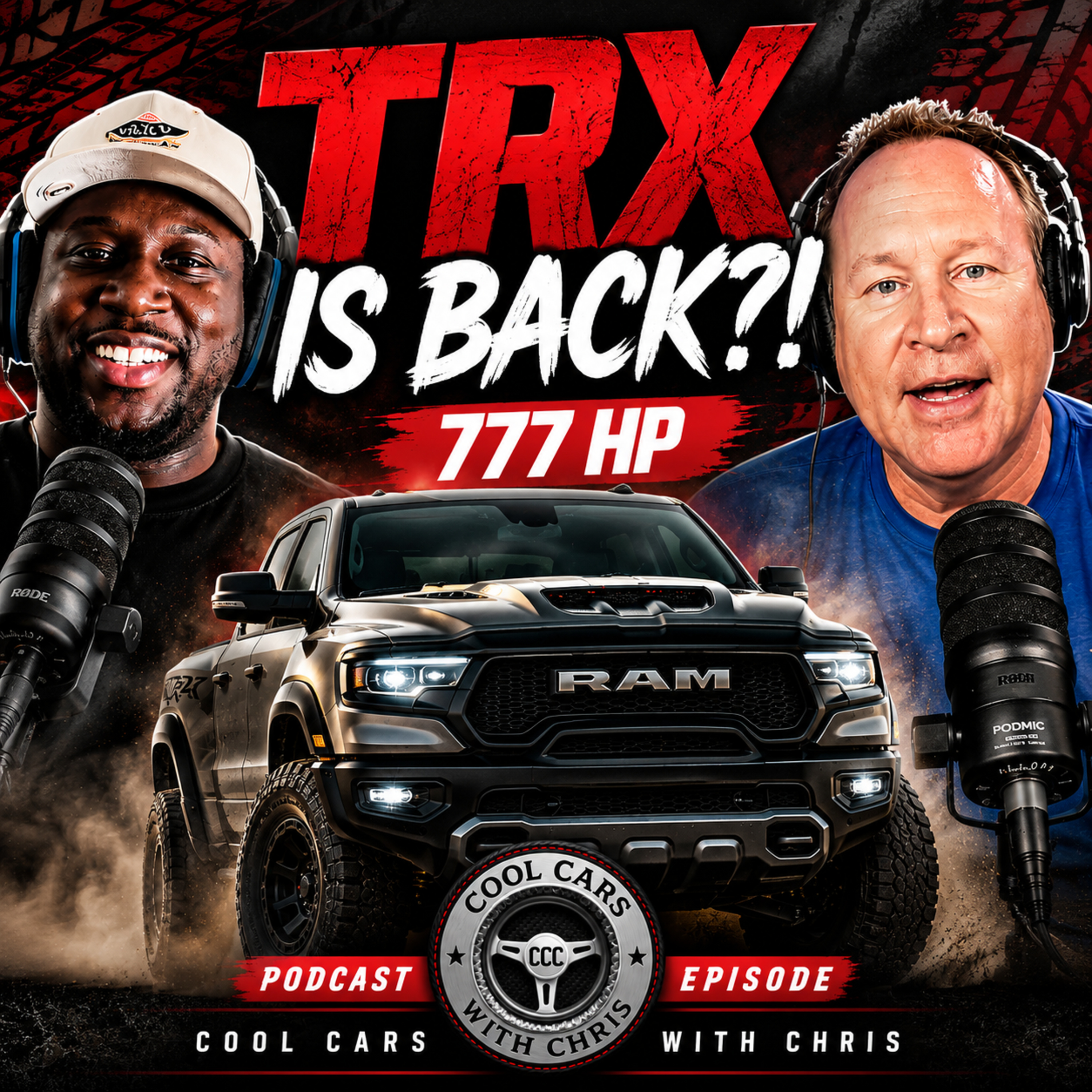
043 | RAM TRX Is Back With 777 HP — Are Street Trucks Making a Comeback?
About this episode
Ram TRX’s return takes center stage, with the hosts tying the comeback to emissions fears and a broader shift in powertrains—while also looking back at the “street truck” era. They connect modern 777-hp talk to Ram SRT 10 and Viper V10 roots, and debate why these trucks appeal as both performance toys and practical work tools. Along the way, they compare street-focused trims, talk fuel and ownership habits, and share a few real-world car culture stories.
In this episode of Cool Cars with Chris, Chris and Courage discuss the reported return of the RAM TRX with 777 horsepower and whether high-performance street trucks are making a major comeback. They revisit legendary models like the RAM SRT-10, the original supercharged Ford F-150 Lightning, and the Toyota Tacoma X-Runner, while also exploring SRT, Scat Pack trucks, and the future of American V8 performance. The conversation covers the ultra-limited Cadillac CT5-V Blackwing, rising gas prices, expensive truck fill-ups, fuel-pump maintenance, towing costs, Uber driving, electric vehicles, and the Ford Mustang Mach-E. Later, the guys dive into Cars and Coffee culture, Corvette-owner stereotypes, why enthusiasts should drive their sports cars, and the growing value of clean, unmodified Nissan 350Zs.
They also compare the 350Z and 370Z, discuss high-mileage 370Z ownership, analog sports cars, BMW and Mercedes-Benz luxury appeal, and whether the Alfa Romeo Giulia delivers a more exciting enthusiast experience.
In this episode
- The reported 777-horsepower RAM TRX return
- RAM SRT-10 and Viper-powered trucks
- The original Ford F-150 Lightning
- Are street trucks making a comeback?
- Toyota Tacoma X-Runner and performance-truck concepts
- Cadillac CT5-V Blackwing pricing and exclusivity
- The disappearance of American V8 sedans
- Gas prices and expensive truck fill-ups
- The half-tank fuel-pump debate
- Towing costs and track-day expenses
- Uber driving, EVs and the Mustang Mach-E
- Cars and Coffee culture
- Why enthusiasts should drive their cars
- Are clean Nissan 350Zs becoming collectible?
- Nissan 350Z versus 370Z
- High-mileage 370Z ownership
- Performance cars versus luxury badges
- Alfa Romeo Giulia versus BMW and Mercedes-Benz
Follow for More
Love cars, horsepower, road trips and real automotive conversations? Follow Cool Cars with Chris and Courage for new podcast episodes, YouTube videos, car reviews, event coverage and behind-the-scenes content.
🌐 Cool Cars with Chris Website:
https://coolcarswithchris.com
▶️ Cool Cars with Chris on YouTube:
https://www.youtube.com/@CoolCarswithChris619
📸 Cool Cars with Chris on Instagram:
https://www.instagram.com/cool_cars_with_chris619/
▶️ Courage — The DriveN Dad on YouTube:
https://www.youtube.com/@TheDriveNDad22
📸 Courage — The DriveN Dad on Instagram:
https://www.instagram.com/thedrivendad22/
00:00 Welcome Back: Weather, San Diego and a Wild Dallas Trip
03:54 Dodge RAM or RAM? The Brand and Its Truck Innovations
06:49 What Is RAM Planning Next?
09:03 The RAM TRX Returns With 777 Horsepower
09:53 RAM SRT-10, the Original Ford Lightning and Viper Power
12:44 SRT, Scat Pack and the Return of the Street Truck
13:48 Toyota Tacoma X-Runner and Lowered Performance Trucks
17:58 Cadillac CT5-V Blackwing and American V8 Performance
23:44 Gas Prices, Fuel Pumps and the Half-Tank Rule
28:33 Trucking Costs, Uber Drivers and the Mustang Mach-E
32:10 Car Dealerships and Buying the Right Vehicle for the Job
36:54 Blackwings, Corvettes and Cars and Coffee Culture
39:24 Why Car People Love Sharing Their Stories
42:08 Track Days, Towing Costs and Driving the Cars You Own
48:24 Are Clean Nissan 350Zs Becoming Collectible?
50:40 Nissan 350Z vs. 370Z
53:29 Older Z Cars, Reliability and Analog Driving
55:07 Living With a High-Mileage 370Z and Its Quirks
1:00:04 Performance Cars vs. Luxury Badges
1:02:43 Alfa Romeo Giulia vs. BMW and Mercedes-Benz
1:04:37 Driven Dad 22 Update and Closing
#RAMTRX #RAMTRX777HP #PerformanceTrucks #StreetTrucks #RAMSRT10 #FordLightning #CadillacBlackwing #CT5VBlackwing #Nissan350Z #Nissan370Z #CarPodcast #AutomotivePodcast #CarCulture #CoolCarsWithChris #TheDriveNDad

Dodge Ram
"...t I think they're the same, but I guess they call Ram, like Ram trucks, but it's right. That actually i..."
Ram is the name used for a line of pickup trucks. In the episode, it’s mentioned because some Ram models were connected to the same kind of V10 performance idea people associate with the Viper.
“Ram” refers to Ram Trucks, which produces pickup trucks, and the podcast mentions it in the context of the Ram name being used for trucks. The episode also ties it back to the idea of the Ram SRT 10 and the V10 connection. That’s why Ram comes up alongside the Viper discussion.
rear suspension
"Like for example, they were the first ones, as far as you know, might be the only one [286.2s] still that do the rear suspension that's got spring suspension in the rear versus leaf springs. [292.5s] Right. They were doing that."
Rear suspension is what connects the back wheels to the truck and helps it absorb bumps. Different suspension designs can make the truck ride smoother or feel harsher.
Rear suspension is the set of components that controls how the back of a truck moves over bumps and how it keeps the tires planted. The host specifically contrasts two designs—spring suspension versus leaf springs—because they can feel different in ride comfort and handling.
coil spring suspension
"they were the first ones, as far as you know, might be the only one [286.2s] still that do the rear suspension that's got spring suspension in the rear versus leaf springs. [292.5s] Right. They were doing that."
Spring suspension means the truck uses springs (often coil springs) to help soak up bumps. The idea is that it can make the ride feel more comfortable than older leaf-spring setups.
Spring suspension refers to using coil springs (or similar spring elements) in the rear suspension rather than leaf springs. Coil-spring setups are often associated with a smoother ride because they can better control wheel movement and damping characteristics.
leaf springs
"still that do the rear suspension that's got spring suspension in the rear versus leaf springs. [292.5s] Right. They were doing that. And also that, which supposedly gives you a really nice like car ride [299.3s] on a truck is what I've heard."
Leaf springs are an older-style suspension made from stacked metal strips. They’re tough for hauling, but some people feel they don’t ride as smoothly as coil-spring setups.
Leaf springs are a traditional truck suspension design that uses stacked metal strips to support the axle. They’re durable and can handle heavy loads, but they can feel less refined than coil-spring setups in terms of ride comfort.
mini toolbox
"And the other really cool thing that I liked as they did was this cool little mini [308.9s] toolbox in the, in the actual like side fender. Did you see these ones? [316.4s] I feel like I started to see nose on newer other trucks other than Ram, but I have seen that before."
A mini toolbox is a built-in storage box, in this case mounted in the side fender. It’s handy for tools, but it can take away some space you’d normally have in the truck bed.
A mini toolbox in the side fender is an integrated storage compartment built into the truck’s bodywork. It’s designed to keep small tools and gear accessible, but the host notes it can require reducing the usable bed space to package the structure.
truck bed
"in order to make that little toolbox or whatever it is on the side of the [328.6s] fenders work is they have to make the actual bed itself smaller. They kind of make the bed, [334.9s] its space in the middle, a little smaller than a normal truck bed would have."
The truck bed is the open area in the back where you put cargo. The host is saying that if the truck adds storage in the fender, it may reduce how much space you have in the bed.
The truck bed is the cargo area behind the cab where you haul items. The host explains that adding an integrated fender toolbox can force packaging changes that reduce bed space compared with a “normal” bed layout.
aftermarket toolbox
"but you do give up, you sacrifice actual space in the actual bed. That same thing, if you bought [362.4s] like an aftermarket toolbox and staff slapped it on the end of your truck. [366.1s] Yeah, I'm trying, I'm trying to think like, Oh, is it like one of those like 200 piece snap-on"
An aftermarket toolbox is a tool storage box you add after buying the truck. The host is comparing it to the factory idea and pointing out the tradeoff in space.
An aftermarket toolbox is a storage box installed by a third party (not originally built into the truck). The host compares the factory-style fender storage concept to what happens when you add an aftermarket toolbox to the end of the truck.
Hemi engines
"the Hemi engines were coming out. And I think at the time those Hemi engines came out. There wasn't any other real like, like trucks of its size that had kind of like power output,"
A “Hemi” engine is a type of engine design where the combustion chamber is shaped like a half-sphere. That shape helps the engine burn fuel more effectively, which can translate to strong power.
“Hemi” refers to Chrysler’s hemispherical combustion-chamber engine design, which helps airflow and combustion efficiency. The host uses it to explain why early-2000s Dodge Ram trucks had standout power compared with other trucks of similar size.
emissions
"Well, so people did think that the TRX was going to die because of all of what was going on with, you know, emissions and them even changing the charger challenger."
Emissions are the harmful gases and particles a vehicle puts into the air. If the rules get stricter, manufacturers often have to redesign engines to meet them.
Emissions are regulated pollutants that vehicles produce, and stricter rules can force automakers to change engines or tuning. Here, the host connects emissions pressure to uncertainty about whether the TRX could continue.

Dodge Challenger
"...now, emissions and them even changing the charger challenger. And but the charger was what they're calling it ..."
The Dodge Challenger is a sports car built for strong acceleration and a loud, performance-focused feel. It’s been around for a long time, so people talk about how it changes as emissions rules get stricter.
The Dodge Challenger is a classic American muscle car known for its powerful V8 options and long-running popularity. It often comes up in discussions about how performance cars adapt to emissions rules and changing regulations. That’s why it’s mentioned alongside talk of “changing” and “charger challenger” in the episode.

Dodge Charger
"Well, so people did think that the TRX was going to die because of all of what was going on with, you know, emissions and them even changing the charger challenger."
The Charger and Challenger are Dodge’s famous muscle cars. The host is saying changes happening to those cars could also influence what happens with Ram’s performance trucks.
The host is referring to Dodge’s Charger and Challenger muscle-car line, which are being discussed as part of the brand’s broader engine and platform changes. In this segment, that context is used to explain why people thought the TRX might be affected.
Hurricane V6
"but the charger was what they're calling it now, going to the hurricane, you know, v six and, you know, which is what the, what is the hurricane v six for those who don't know it actually think of the"
The “Hurricane V6” is a named engine that uses six cylinders. The host is talking about it as part of a newer direction for the brand’s engines.
The “Hurricane V6” is a specific engine family name used by Stellantis for a V6 powerplant. The host contrasts it with a straight-six discussion, highlighting how the new engine lineup is part of the brand’s shift in powertrains.
straight six
"which is what the, what is the hurricane v six for those who don't know it actually think of the v six? What is it? Straight six. So yeah. So it's a, it's, they went basically full on"
A straight-six is an engine with six cylinders lined up in one row. It’s a classic engine layout that some brands are known for.
A straight-six is an engine layout where all six cylinders are arranged in a single line. The host brings it up while discussing the “Hurricane V6,” and then compares it to how BMW and Mercedes have used straight-six engines historically.
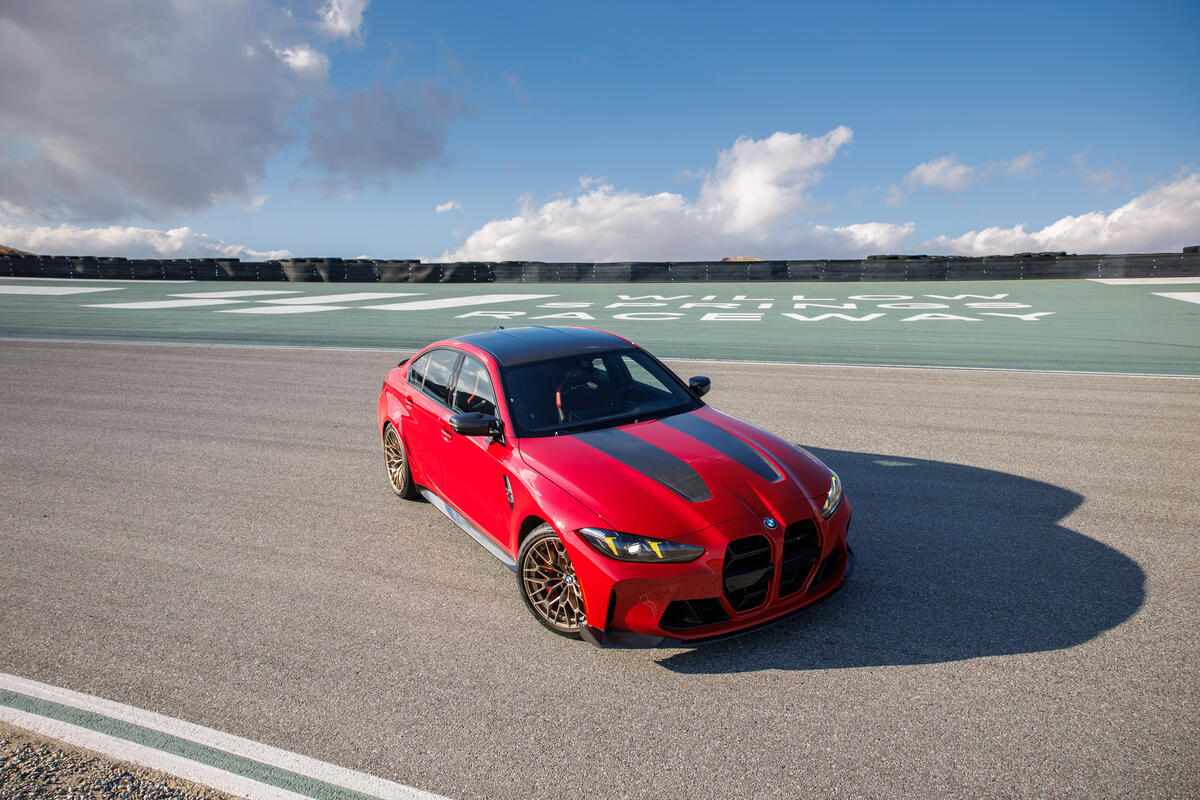
E 90 generation M threes
"I think some of the crazier except for those gins where they just decided to do whatever would like the M three, the, the one that everybody loves, the E 90 generation M threes."
The E90 M3 is a BMW M3 from the E90 3 Series generation. The host is using it as an example of BMW’s performance history with straight-six engines.
The “E90 generation M3” refers to the BMW M3 built on the E90 3 Series platform. It’s mentioned as an example of a BMW-era straight-six performance car that enthusiasts love.

BMW E90
"I think some of the crazier except for those gins where they just decided to do whatever would like the M three, the, the one that everybody loves, the E 90 generation M threes. Was it the V eight? They had that a V eight version. Was that M four?"
The BMW 3 Series is a luxury car that’s meant to drive nicely and feel sporty. The podcast also mentions the M3, which is a more powerful, performance-focused version of the 3 Series.
The BMW 3 Series is a compact luxury sedan that’s known for balancing everyday usability with sporty driving. In the podcast, it’s referenced in connection with the E90-generation M3, which is a high-performance version of the 3 Series line. That makes it a natural topic when discussing iconic BMW performance models.

TRX
"…people thought that the TRX and, you know, these performance trucks with the V eights and performance were going to be dead, but they actually have announced that they're bringing back to TRX now with, you know, 777 horsepower motor."
TRX is the name used for Ram’s super-fast, high-power pickup. The host is saying Ram is bringing it back with around 777 horsepower, which is why they’re calling it a comeback for street trucks.
The TRX refers to the Ram TRX, a performance pickup built around a high-output V8 and a “supertruck” approach to power and traction. Here, the host says Ram is bringing the TRX back with 777 horsepower, framing it as a comeback for street-focused performance trucks.
777 horsepower
"…they actually have announced that they're bringing back to TRX now with, you know, 777 horsepower motor."
“777 horsepower” is a specific power rating that indicates how much work the engine can do over time. In performance-truck talk, horsepower is used as a headline number to compare how aggressively a vehicle can accelerate and how strong it feels under load.

Ram SRT 10
"…they're starting to build now are kind of a recalling back to the old Ram SRT 10. So the one with the, that took the Vipers V 10."
The Ram SRT 10 is a special, fast version of a Ram pickup. It’s famous because it used a big V10 engine, and it’s often brought up when people talk about modern trucks trying to be “supercar fast.”
The Ram SRT 10 is a high-performance Ram pickup that’s best known for using a V10 engine originally associated with the Dodge Viper. It’s a key reference point in the “street truck” era because it proved a pickup could be built for serious straight-line power, not just towing.

Dodge Viper
"...ld Ram SRT 10. So the one with the, that took the Vipers V 10. Yeah. Now, now was that the, was that engin..."
The Dodge Viper is a very high-performance sports car. It’s known for using a V10 engine, which is a big part of what makes it stand out.
The Dodge Viper is an extreme American sports car known for its big V10 engine and raw, performance-first character. The podcast references the Viper’s V10 when comparing it to other vehicles, which shows how distinctive its engine choice is. It’s discussed because it’s a memorable, enthusiast-focused car rather than a mainstream daily driver.
Ram Srt 10
"...build now are kind of a recalling back to the old Ram SRT 10. So the one with the, that took the Vipers V 10. ..."
Ram is the name for a line of pickup trucks. In the episode, it’s mentioned because some Ram models were built for extreme performance using a V10.
Ram is the truck brand name used for Ram Trucks, and the podcast connects it back to the Ram SRT 10 idea. That reference is tied to the same V10 performance theme mentioned with the Viper. It comes up because Ram has had special high-performance truck variants that stand out.
V10
"…the old Ram SRT 10. So the one with the, that took the Vipers V 10."
A V10 is an engine with 10 cylinders arranged in a V shape. More cylinders usually means smoother power delivery and a lot of potential for high horsepower—especially in performance vehicles.
A V10 is an engine with ten cylinders arranged in a “V” shape, typically giving it a distinctive sound and strong high-RPM power. In performance trucks and supercars, the V10 layout is often chosen to deliver big displacement without going to a V12.
automatic
"…cause I know it doesn't, didn't have a stick. I think it was a thread to an automatic. They did make, they did make manual versions…"
An automatic transmission changes gears by itself. In this discussion, the host is comparing automatic versions to manual versions and implying the manual ones are harder to find.
An automatic transmission shifts gears without the driver operating a clutch pedal. The host contrasts automatics with manual versions of the Ram SRT 10, suggesting that automatic-equipped trucks were more common, while manuals were the rarer enthusiast pick.
manual transmission
"…I think it was a thread to an automatic. They did make, they did make manual versions for the truck version for the truck. Yep. No way. There, there were… manual SRT 10, you know, Ram pickups…"
A manual is when you shift gears yourself using a clutch and a stick. The host is saying some of these trucks were made with a manual, but they were less common than automatic versions.
A manual transmission is a gearbox where the driver selects gears using a clutch pedal and a shift lever. In the context of the Ram SRT 10, the host is pointing out that manual versions existed but were rarer than automatics, which affects enthusiast interest and auction desirability.

lightning
"I wanted a lightning so bad, not talking the electric one today, kids. I'm talking about the one from like different era, like early 2000s and it had the 5.4 liter super charged V eight"
They mean the Ford Lightning, which is a faster, more performance-oriented pickup truck. Back in the early 2000s, it used a supercharged V8 so it felt more like a street performance vehicle than a basic work truck.
The speaker is referring to the Ford Lightning, a performance-focused version of the F-150 pickup. In the early 2000s, it’s known for using a supercharged 5.4-liter V8 to make a street-friendly “hot truck” feel.
5.4 liter super charged V eight
"I'm talking about the one from like different era, like early 2000s and it had the 5.4 liter super charged V eight with a, I don't think he had any extra cab, a single cab, but it might have had the flared"
This describes a V8 engine that uses a supercharger to cram more air into the engine. More air usually means more power, so it feels much quicker than a normal V8.
A supercharged V8 is an engine where a forced-induction system (the supercharger) pushes extra air into the cylinders. That lets the 5.4-liter V8 make more power than the same engine without boost.
flared fenders
"with a, I don't think he had any extra cab, a single cab, but it might have had the flared fenders and it was kind of lower with like street tires. It was more like a street truck"
Flared fenders are fender panels that stick out more to make room for wider tires. They also make the truck look more aggressive.
Flared fenders are widened body panels that cover more tire width. They’re commonly used to fit wider wheels/tires and give a more aggressive, “stance” look.
street tires
"fenders and it was kind of lower with like street tires. It was more like a street truck than an off road truck. The Brian O'Connor special. That's what it was."
Street tires are made for regular driving on roads. They’re usually better for everyday grip and ride than tires built for off-roading.
Street tires are designed primarily for pavement grip, comfort, and predictable handling on dry and wet roads. They typically aren’t as aggressive or durable as off-road tires meant for mud and rocks.
Brian O'Connor special
"than an off road truck. The Brian O'Connor special. That's what it was. That's what I saw that again. I was like, when I first saw that movie dude, I was like, there's no way using"
This is a reference to a character from The Fast and the Furious. They’re basically saying the truck setup looks like the kind of street-racing style you’d see in the movies.
“Brian O’Connor special” is a pop-culture reference to the character Brian O’Conner from The Fast and the Furious. The speaker uses it to describe a street-focused, movie-inspired “hot truck” vibe rather than a true off-road setup.

F-150 Raptor
"...ess, whatever business it is. And they get like a Raptor or a TRX or or some big giants F 350. It's like j..."
The Ford F-150 is a large pickup truck. The episode talks about it because there are different versions, including more powerful or more rugged ones.
The Ford F-150 is a full-size pickup truck that’s widely sold and used for everything from daily driving to work tasks. The podcast mentions it in the context of big, high-performance variants like the Raptor or TRX and also references larger models like the F-350. That’s why it’s brought up—because it’s the base platform for many different “types” of trucks.

Ford F350
"And they get like a Raptor or a TRX or or some big giants F 350. It's like jacked up on like 40 inch tires. And then they got their company logo all over it and they just tax right off or whatever."
The F-350 is a heavy-duty Ford pickup. It’s the kind of truck people choose when they need serious hauling power, and the host is saying contractors often buy trucks like this for their business.
The Ford F-350 is a heavy-duty pickup built for towing and payload work. Here it’s grouped with the Raptor and TRX as another “big truck” contractors use while showing off branding and stance.
tax right off
"And then they got their company logo all over it and they just tax right off or whatever. So, but, but Ram is going to do something."
They mean that a business can sometimes deduct certain costs from taxes. The host is saying some contractors try to treat a truck purchase as a business expense.
“Tax right off” is shorthand for deducting business expenses from taxable income. In this context, the speaker is describing how some contractors treat expensive trucks as business write-offs.
Scat Pack
"they're using that now to kind of do some scat pack versions of, you know, of their trucks, kind of the same way that they had with the, the tiers of, of, um, of challengers and chargers,"
Scat Pack is a Dodge name for a faster, sportier version of a vehicle. It usually means more power and more performance-focused setup than the standard trim.
Scat Pack is a Dodge performance trim level name that typically indicates a more powerful engine and sportier tuning than the base model. The host compares it to how Dodge used tiered names on the Challenger/Charger lineup, implying similar “street performance” positioning for trucks.
Hellcat
"And then you had the, you know, the, the hell cats, they're kind of doing the same now with these, with these trucks, which, you know, is kind of a callback to, like you said, like the four lightning,"
Hellcat is Dodge’s name for their super high-performance versions. The idea is that it’s part of a lineup of increasingly powerful trims, and the host says trucks are getting similar tiering.
“Hellcat” is Dodge’s high-performance model/trim name associated with very large horsepower V8 engines and track-capable tuning. The host is using it as an example of how Dodge’s performance tiers (RT/SRT/Scat Pack/Hellcat) are now being echoed in truck versions.
street version
"And that, I think that genre of, you know, street truck has kind of been lost from that time. You know, it was, you remember when Toyota had their Tacoma,"
A “street version” is a truck setup meant mainly for driving on regular roads. It usually has a lower stance and fewer off-road-focused parts than a typical lifted truck.
A “street version” refers to a factory trim or package tuned for on-road driving—typically lower ride height, less off-road hardware, and styling/performance aimed at everyday use. In the segment, the host contrasts these with more traditional lifted, off-road-oriented truck setups.
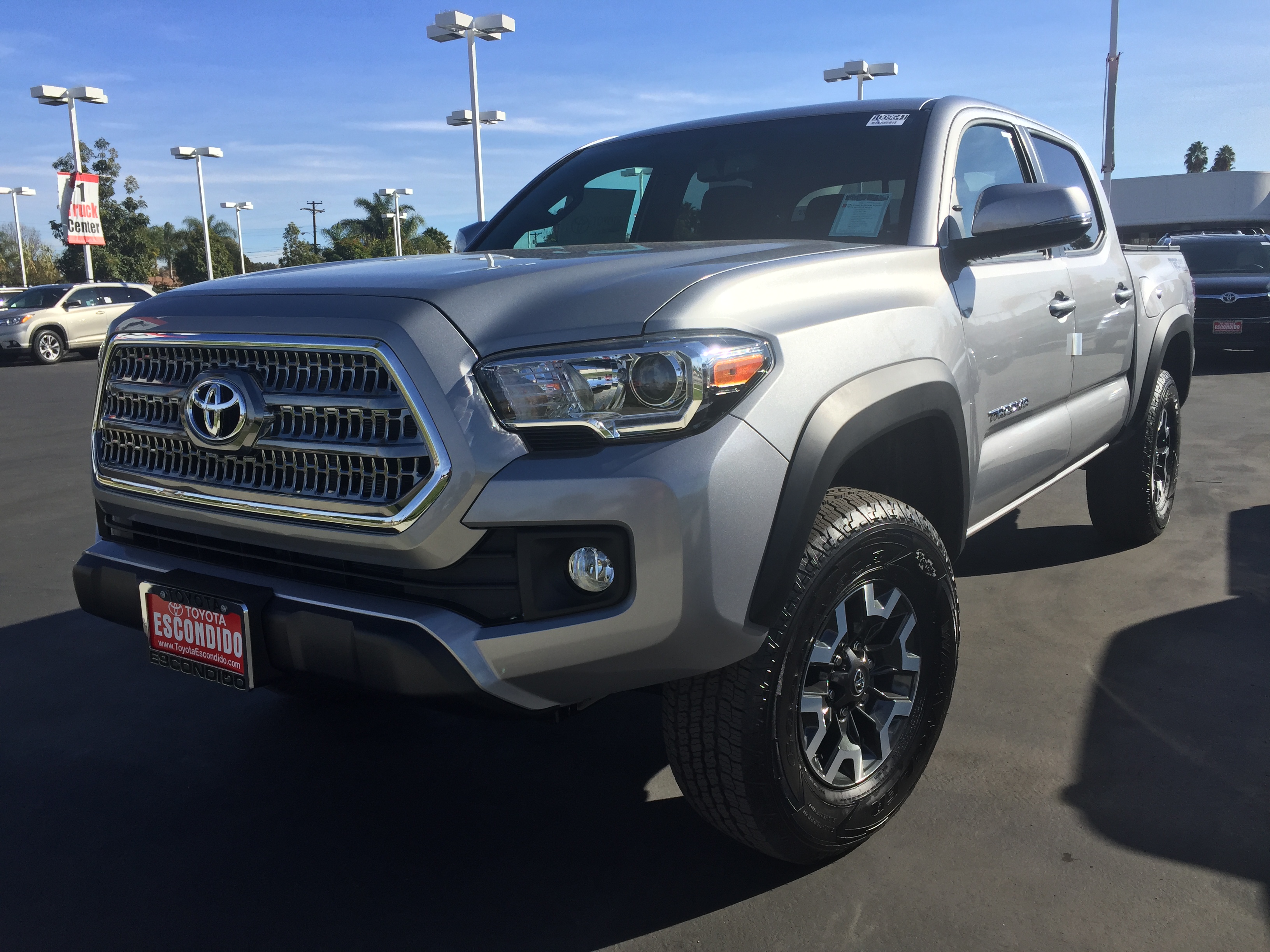
Toyota Tacoma
"You know, it was, you remember when Toyota had their Tacoma, they had their Tacoma, they had a street version called the X X stream or X something or other. I do remember."
The Toyota Tacoma is a midsize pickup known for being a popular platform for both off-road builds and street-focused variants. Here, the host mentions Toyota offering a “street version” of the Tacoma with a special name, as an example of the street-truck idea coming and going over time.

Honda Stream
"... Tacoma, they had a street version called the X X stream or X something or other. I do remember. I don't k..."
The Honda Stream is a family-oriented vehicle meant to carry people comfortably. The podcast mentions it while talking about different versions of vehicles that were sold for everyday driving.
The Honda Stream is a people-focused vehicle (a family-oriented model) that the podcast mentions in the same breath as the Tacoma’s “street version” idea. The reference suggests the conversation is about different trims and how manufacturers market practical vehicles for everyday use. It comes up as part of that broader “what was available” discussion.
pre runners
"But most of the Tacomas you see are like kind of lifted with like beefier tires and four wheel drive and pre runners and things like that. But they did have one that was like, it's just the opposite of that."
Pre-runners are trucks set up for off-road desert driving. They usually have a tougher suspension and bigger tires, but they’re not necessarily built for the same kind of full-time off-road use as a typical 4x4.
“Pre-runners” are off-road-oriented trucks (often based on a 4x4 platform) configured without a full-time four-wheel-drive system for desert-style driving. They’re typically associated with lifted suspension, skid protection, and aggressive tires, aiming for off-road durability rather than street comfort.
lower stance
"It was basically like, it's just the opposite of that. It was called the X or something extreme or something. X was like an every logo, like, yeah, like everything. Well, I think it might have been an energy drink called X something or two. X was like all popular rage, but X in front of everything. And they did this X truck and it was like this regular like lowered with bigger tires, kind of like the SRT."
A “lower stance” means the truck sits lower to the ground. The host is saying that helps it look and drive more like a street truck, but it can limit how extreme you can go for off-road clearance.
A “lower stance” means the vehicle sits closer to the ground, usually from lowering springs/coilovers or a factory street package. The host frames it as the key difference between an off-road-capable setup and a street-focused version that can’t go “too extreme” for off-road clearance.
super chargers
"[902.2s] souping them up with like super chargers or turbo charger or doing any nuts to it? [906.0s] Just kind of like they are what they are."
A supercharger is a device that forces more air into the engine. More air usually means more power, because the engine can burn more fuel.
A supercharger is an engine-mounted forced-induction device that compresses incoming air so the engine can burn more fuel and make more power. It’s different from a turbocharger in how it’s driven, but both aim to increase horsepower by increasing air density.
turbocharger
"[902.2s] souping them up with like super chargers or turbo charger or doing any nuts to it? [906.0s] Just kind of like they are what they are."
A turbocharger uses the car’s exhaust to spin a fan that pushes extra air into the engine. More air helps the engine make more power.
A turbocharger is a forced-induction system that uses exhaust gases to spin a turbine, which compresses the intake air. That denser air helps the engine produce more power without increasing engine size.

Nissan Gtr
"...like, Oh, I can do all like the, like the Mexican GTR, like, you know, people get those specifically be..."
The Nissan GT-R is a fast sports car. People often buy it because it’s known for strong performance and a serious driving feel.
The Nissan GT-R is a high-performance sports car known for strong acceleration and a reputation for being capable in real-world driving. The podcast references it as something people seek out specifically, including a mention of “Mexican GTR,” which points to how the car can be a targeted purchase. It’s discussed because it’s one of the most recognizable performance models in the Z/GT tradition.
fly under the radar
"[929.1s] It doesn't have that stand out, you know, that's the definition of, you know, where a contractor [933.9s] can go and just, yeah, make that their work truck and then go and do all of that stuff and, you [939.6s] know, have it not having fly under the radar completely. That's what it is. That's what it's [943.0s] all about."
“Fly under the radar” here means keeping your truck from looking or sounding too extreme. The idea is to avoid attention—especially from police.
In car culture, “fly under the radar” means keeping your vehicle’s modifications subtle enough that it draws less attention from law enforcement or others. The host connects it to avoiding flashy visuals and loud exhaust that can increase the chance of being noticed or pulled over.
SEMA
"[974.7s] actually fairly recently, I think it was, I don't know if it was SEMA or if it was something else [979.5s] that they had done this for, but they did actually kind of try to build like sort of a Tacoma X [985.2s] runner concept that they called it, which was like brand new."
SEMA is a big car show in the U.S. where companies show off custom and performance ideas—often the kind of stuff that turns into real products later.
SEMA (Specialty Equipment Market Association) is a major U.S. trade show where automakers and aftermarket companies showcase concept vehicles, performance parts, and customization trends. It’s especially known for “street truck” and off-road build ideas.
platform
"done where it's easy to just take a regular car you already have in your platform. Like, [1019.1s] so you already had the Tacoma already. All you have to do is like, maybe do a suspension kit on [1022.3s] it, like, and, you know, whatever, put like a different wheels or reverse suspension kit on"
A “platform” is the main shared design underneath a vehicle. If a company reuses that base, it can make different versions of cars without engineering everything from zero.
An automotive “platform” is a shared set of engineering underpinnings—like chassis architecture and major components—that multiple models can use. The host argues that reusing a platform is cheaper and faster, which is why manufacturers create many versions of the same base vehicle.
suspension kit
"so you already had the Tacoma already. All you have to do is like, maybe do a suspension kit on [1022.3s] it, like, and, you know, whatever, put like a different wheels or reverse suspension kit on [1027.3s] this. Cause it's like, you know, what you normally do with trucks, you lift them."
A suspension kit is a set of parts that changes how the car rides and handles. It can be used to lift a truck or make it feel more aggressive without replacing the entire vehicle.
A suspension kit is an aftermarket package that changes how the truck’s suspension works—often including components like springs, shocks/struts, and sometimes control arms. In this context, it’s used to explain how lifting or “sporting up” a truck can be done by swapping suspension parts rather than redesigning the whole vehicle.
lift
"Cause it's like, you know, what you normally do with trucks, you lift them. Well, yeah, yeah, [1031.9s] I'm saying like, yeah, whatever you got to do, I'm sure you can swap out the suspension. And [1034.9s] I'm sure it's, I'm sure it's a very, I'm sure it's probably a matter of a few thousand dollars"
A “lift” means raising a truck higher off the ground. People do it by changing suspension parts so the truck sits taller.
In truck customization, a “lift” means raising the vehicle’s ride height by changing suspension components. The host is describing the common truck mod path: lift the truck, then adjust wheels/tires and related suspension parts to match the new stance.
Blackwing
"Well, the, so the, the CT five, just a regular CT five, black wing is already over a hundred. That's what I'm saying."
“Blackwing” is Cadillac’s performance trim name used on certain models. It typically indicates a more track-oriented setup and higher-output engine calibration compared with the base version.

Chevrolet Corvette
"...ll that stuff. Is it basically, I didn't know the Corvette is rear engine or mid engine or whatever it is. T..."
The Chevrolet Corvette is a sports car designed for fast driving. The engine placement affects how the car handles, so people often talk about whether it’s in the middle or toward the back.
The Chevrolet Corvette is a performance sports car known for its strong engine options and its long history as a flagship American road car. The podcast brings up the car’s layout—whether it’s rear-engine or mid-engine—because the Corvette’s engine placement is a key part of how it drives. That’s why it’s a frequent subject in driving and car-nerd conversations.
ethanol
"So this thing runs on ethanol, right? And it runs on batteries, I think together."
Ethanol is a type of fuel made from alcohol. Some cars can be tuned to run on ethanol blends, which can help them make more power.
Ethanol is an alcohol-based fuel that can be blended with gasoline (often as E85, for example). Some performance cars are designed to run on ethanol blends because it can support higher power when the engine is calibrated for it.
batteries
"So this thing runs on ethanol, right? And it runs on batteries, I think together."
Here, “batteries” means the car’s electric battery pack. It’s what lets the car use electricity in addition to its fuel engine.
In this context, “batteries” refers to the high-voltage battery pack used to provide electric power alongside the engine. The host is describing a hybrid-style setup where the car can use both fuel and electricity.
all in one
"You could put diesel in it. If you want it to, it's called the all in one."
“All in one” is the host’s way of saying the car combines different kinds of power. In this case, it’s using fuel and electricity together.
“All in one” here is being used as a shorthand for a combined power approach—fuel (ethanol) plus electric power—rather than a single traditional power source. The host is implying the system is designed to do multiple energy modes together.
Corvette Stingray
"I'm pretty sure there's probably some similarities between like the base Corvette Stingray motor and the CT five V because it is still like a, it's still a regular V eight."
The Corvette Stingray is a Chevrolet sports car. The host is basically saying its V8 engine is the kind of baseline they’re comparing to other GM cars like the Cadillac CT5 V.
The Chevrolet Corvette Stingray is a performance-focused sports car known for its V8 power and track-capable character. In this segment, the host compares the Corvette’s base V8 to the Cadillac CT5 V, using engine type as the common thread.
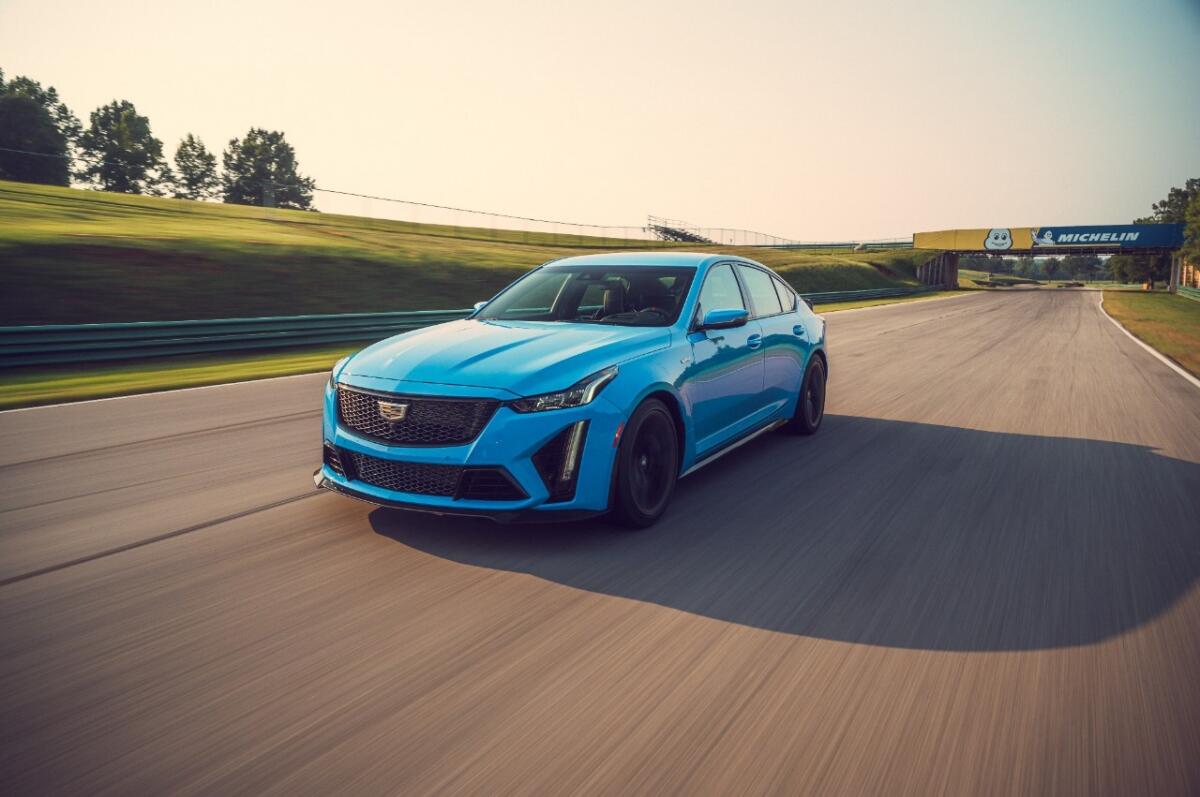
Cadillac CT5
"But, but yeah, the, the, the Cadillac it, I think that it does share the, the, not the 06 is V eight, but I'm pretty sure there's probably some similarities between like the base Corvette Stingray motor and the CT five V because it is still like a, it's still a regular V eight."
The Cadillac CT5 is a Cadillac sedan. Here, the point is that some CT5 versions use a V8 engine, and the host is comparing that to other GM V8s.
The Cadillac CT5 is a midsize luxury sedan from Cadillac, and in this discussion it’s being compared based on its engine layout. The host says it’s still a regular V8 (not a flat-plane setup), which matters because V8 architecture affects how the engine sounds and how it delivers power.
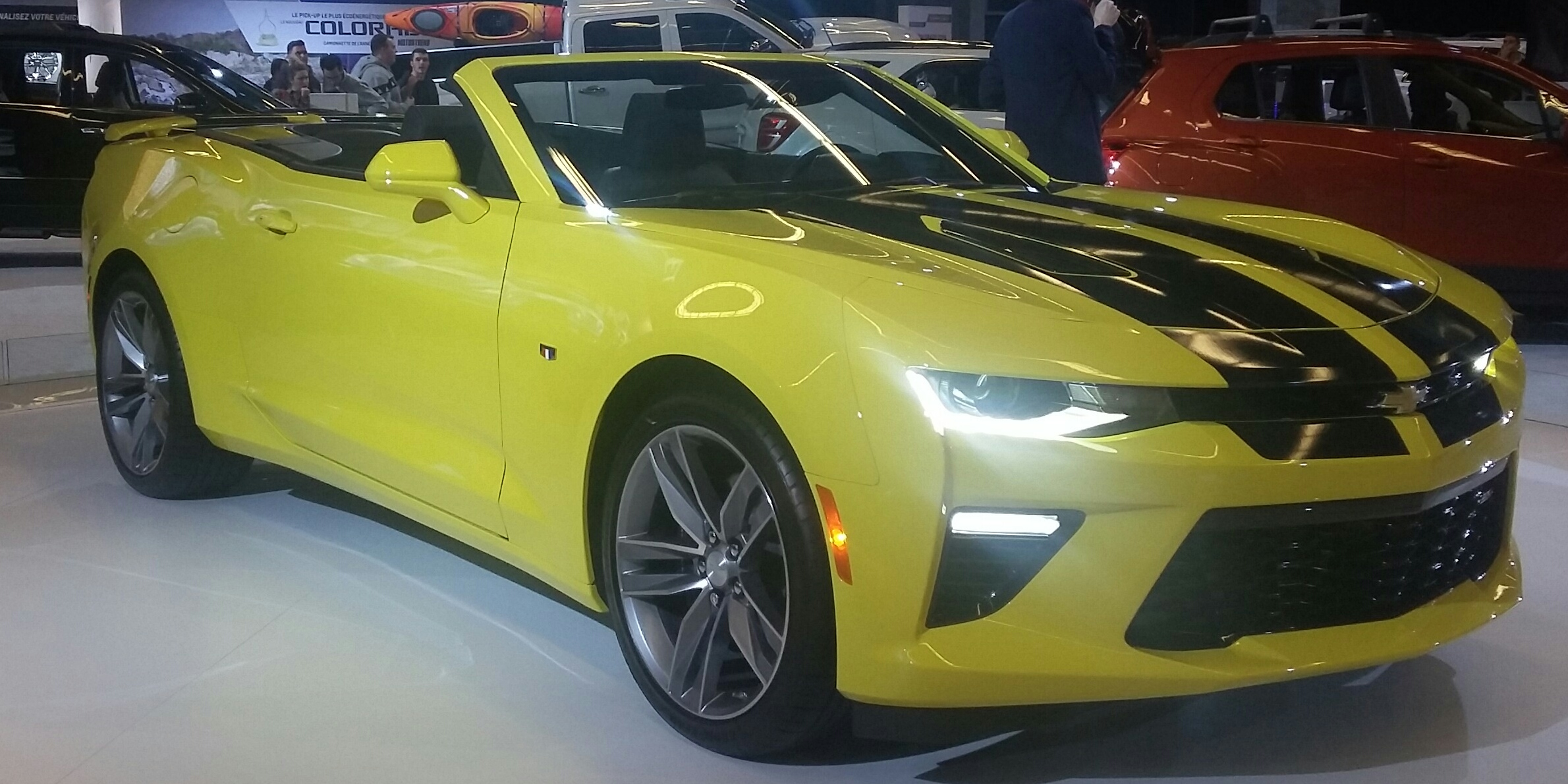
Chevrolet Camaro
"...r? It takes a V eight, not anymore. It was just a Camaro and you know, right? Did they have a, did they ha..."
The Chevrolet Camaro is a sports car that’s often associated with powerful engines. Depending on the year, it may come with different engine options, including V8s.
The Chevrolet Camaro is a long-running American muscle and pony car known for V8 performance in many model years. The episode references it in the context of engine choices and how the lineup has changed over time. That makes it relevant when discussing what “Camaro” means to enthusiasts and how it’s evolved.

Chevrolet Impala
"even, yeah, even in, you know, that era where they still had like the Impala and the Malibu and you know, those cars, like those didn't have V eights either."
The Chevrolet Impala is a popular Chevy sedan model. The host is using it as an example of a time when regular Impalas weren’t typically V8-powered.
The Chevrolet Impala is a long-running full-size sedan nameplate. Here it’s mentioned as part of an era when the host says those mainstream Chevy models didn’t have V8 engines, unlike the higher-performance GM brands.

Chevrolet Malibu
"even, yeah, even in, you know, that era where they still had like the Impala and the Malibu and you know, those cars, like those didn't have V eights either."
The Chevrolet Malibu is a common Chevy sedan. The host is mentioning it to make the point that many regular Malibus weren’t V8 cars.
The Chevrolet Malibu is a midsize sedan nameplate. In this segment it’s used as another example of mainstream Chevy models that, according to the host, didn’t come with V8 engines in that era.

Chevrolet Caprice
"...t's been a while since we've had, we had like the Caprice, like the, or the Chevy SS, if you remember those..."
The Chevrolet Caprice is a large, comfortable car. The episode mentions it because people remember it from earlier years, and it’s being compared to another older Chevy sedan.
The Chevrolet Caprice is a full-size car that has been used as a comfortable, practical vehicle in the past. The podcast mentions it alongside the Chevy SS, indicating a comparison of older GM-era sedans people remember. It comes up because it’s a nostalgia and “what we used to have” type of reference.

Chevy SS
"You know, it's, it's been a while since we've had, we had like the Caprice, like the, or the Chevy SS, if you remember those, they were like the, basically they were just like the whole and like Australian cars brought over and rebashed it."
The Chevrolet SS is a Chevy sedan that was built to feel more like a performance car. In this conversation, it’s mentioned as an example of a Chevy that had a V8.
The “Chevy SS” refers to the Chevrolet SS, a performance-oriented sedan that was sold in the U.S. in the 2010s. The host brings it up as an example of a Chevy that could be V8-powered, contrasting it with other GM sedans that didn’t use V8s.
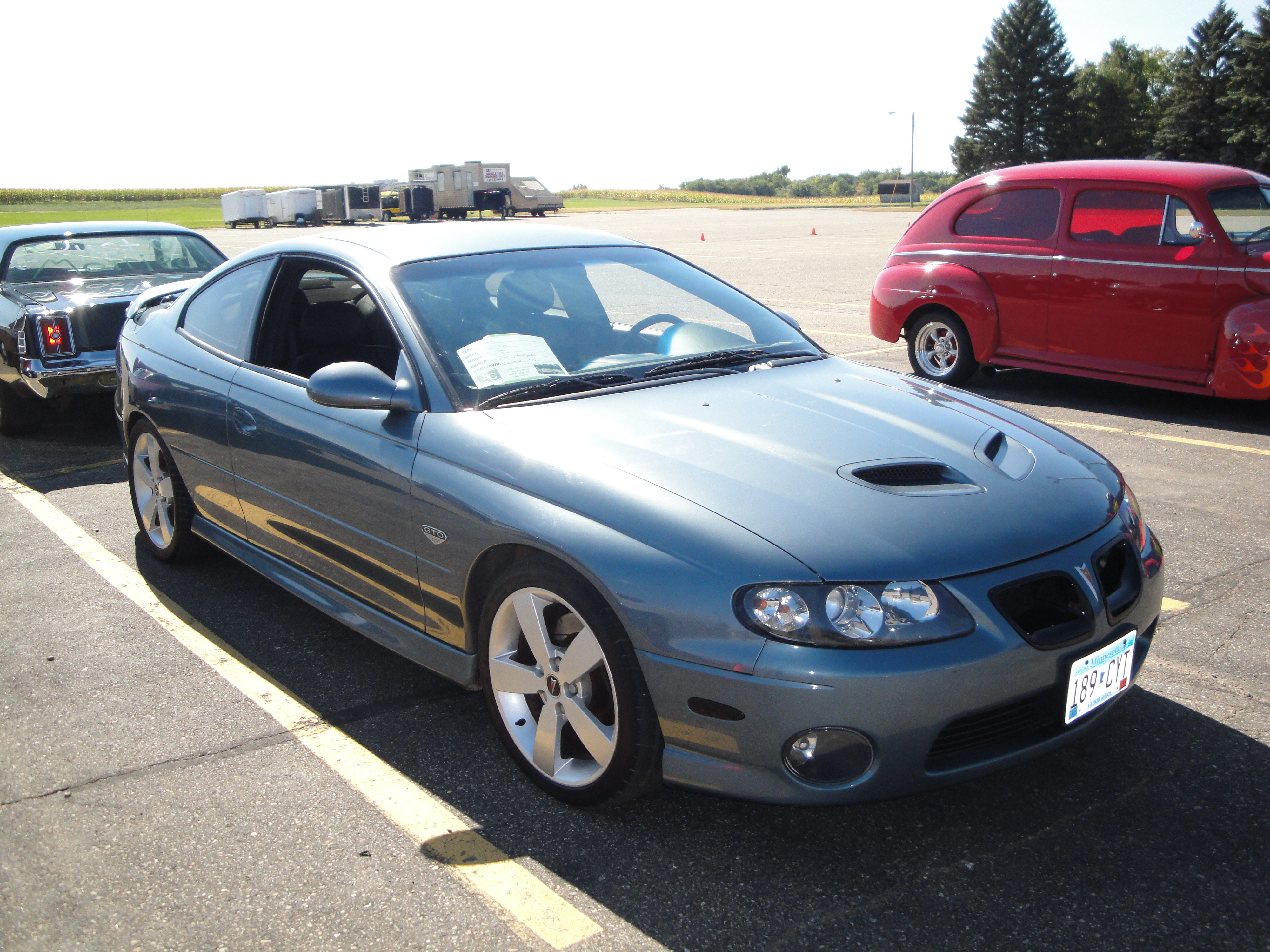
Pontiac Gto
"I remember, yeah, they had a Pontiac had one too. It was a Pontiac GTO, the, the, they had the GTO."
The Pontiac GTO is a famous muscle-car model. In this conversation it’s brought up as part of the Pontiac lineup that the host associates with V8 power.
The Pontiac GTO is a classic muscle-car nameplate associated with V8 performance. The host mentions it alongside the Pontiac G8 as a sedan/powertrain example, saying they likely shared the same motor.

Pontiac G8
"They also had the, the G eight. If you remember that the Pontiac G eight, it was, it was just a sedan and, and had to say, I think they had the same motor, but that was actually one of my dream cars back in the day."
The Pontiac G8 is a Pontiac sedan that was meant to feel more like a performance car. The host is saying it likely shared the same engine as the GTO.
The Pontiac G8 is a performance-oriented sedan that was sold in the U.S. in the late 2000s. The host describes it as a sedan and suggests it used the same motor as the Pontiac GTO, which is relevant to why it was considered a “dream car.”

Scion Tc
"like a dream car for mine was like a Scion TC. So a dream car for years, like when that ran [1414.1s] and like I got me to work without breaking down."
A Scion tC is a small sporty car made by Scion (Toyota). Here it’s brought up as a dream car because it was dependable enough to get the speaker to work without problems.
The Scion tC is a compact, sporty coupe from Scion (Toyota’s youth brand) that became popular for being practical while still feeling fun to drive. In this segment, it’s mentioned as a “dream car,” specifically tied to reliability and getting the speaker to work without breakdowns.
fuel pump
"he says that you need to keep your car at least half a tank always. And the reason why is for [1489.0s] the fuel pump, cause it cools off the gas there, cools the fuel pump."
The fuel pump is what sends gas from the gas tank to the engine. The idea here is that if your tank is too low, the pump can run hotter and may not get as much liquid fuel, which can be harder on it.
The fuel pump is the component that moves gasoline from the tank to the engine. In this segment, the host repeats a common tip: keeping the tank from getting too low helps the fuel pump stay cooled and reduces the risk of the pump drawing in air.
fuel filters
"I think there's filters and fuel filters and all that kind of stuff, but, but, um, they were suggesting that, you know, never run your tank that low."
Fuel filters help keep dirty particles out of the gas system. If you keep driving with the tank nearly empty, more debris can get pulled into the system and clog things up.
Fuel filters are parts that trap dirt and debris before the fuel reaches the engine and fuel system. If you regularly run the tank very low, you can stir up sediment at the bottom, which can increase how much gunk the filters have to catch.
topping off
"I guess I'm not, I guess I'm done. I'm heading out of here,"
Topping off means adding extra gas after the pump already stops. It can be messy and may cause problems with the car’s emissions system.
Topping off is the practice of filling past the normal shutoff point after the pump clicks off. It can increase the chance of fuel spillage and can contribute to evaporative emissions issues because the system is designed around a specific fuel level range.
fuel card
"but I remember a while ago at work, you know, we, we had these fuel, fuel cards for our work trucks. [1660.8s] They have big tanks on there and stuff and, and diesel's a little bit more than gas."
Fuel cards are like special credit/debit cards companies give to drivers to pay for gas or diesel. They help the company control and track fuel purchases.
Fuel cards are payment cards used to buy fuel for work vehicles, often tied to a company account. They can make it easier to track fuel spending and restrict purchases to certain stations or fuel types.
diesel
"They have big tanks on there and stuff and, and diesel's a little bit more than gas. I remember [1664.9s] a long time ago, I took a picture of the actual pump after it was done pumping the, the, the"
Diesel is a type of fuel that’s commonly used in trucks. The speaker is saying diesel usually costs more than regular gas, so filling up can be more expensive.
Diesel is a fuel used in many trucks and commercial vehicles because diesel engines are typically efficient under heavy loads. In the transcript, it’s contrasted with gasoline to explain why filling up can cost more.

Tesla Semi
"... $50 to fill up his truck. What are we talking? A semi truck, of course. Yeah. But it was, it wasn't, he..."
The Tesla Semi is a large electric truck used to move freight. Instead of buying gas or diesel, it runs on electricity, so people talk about charging costs and how that changes the driving business.
The Tesla Semi is an electric semi-truck designed for long-haul freight. The podcast references the cost of charging to illustrate how operating an electric truck can differ from fueling a diesel truck. It’s discussed because electric trucking is a major shift in how commercial vehicles run.
semi-truck
"What are we talking? A semi truck, of course. Yeah. But it was, it wasn't, he said it wasn't [1698.9s] even empty. It was like, it was like a quarter tank in the truck."
A semi truck is the big truck that pulls a trailer for hauling goods. Because it’s so large, even a “small” amount of fuel left can still be a lot of gallons.
A semi truck is a tractor unit that pulls a trailer, commonly used for long-haul freight. It typically has very large fuel tanks, which is why the transcript’s “quarter tank” still translates to a huge number of gallons.
American truck simulator
"And I used to, I was going to say, I used to play this, [1715.2s] this game way back called a American truck simulator. Oh, is it like Sims or whatever?"
American Truck Simulator is a video game where you drive trucks. The speaker says it tries to copy real truck driving details like gears and stopping to refuel.
American Truck Simulator is a driving simulation game focused on operating commercial trucks. The transcript describes it as trying to be realistic about truck driving tasks like shifting and refueling.
CDL
"and, and, you know, even like getting down to [1734.1s] like different gearings of trucks, like with all of like the gears that you run through and, [1738.0s] and, you know, you got to fill up gas and everything. So you have your CDL there or what? [1742.1s] You got your CDL doing this?"
CDL means Commercial Driver’s License. It’s the special license you need to drive big commercial vehicles like trucks and buses.
CDL stands for Commercial Driver’s License, which is required to drive many large vehicles like semi trucks. The transcript connects CDL to the idea of being a truck driver in the simulator.
CB radio
"They even like had like, you know, [1746.5s] ability to like kind of quote unquote, like CB radio, like folks that are like nearby, [1751.0s] like within your vicinity, when you play online, like it was, it was cool."
CB radio is a basic walkie-talkie style radio that people use to talk to other drivers. The speaker is saying the game included a similar “talk to nearby people” feature.
CB radio (Citizens Band radio) is a short-range two-way radio system used by drivers to communicate. In the transcript, it’s referenced as a feature in the game that mimics real-world trucker communication.
fuel prices
"“...but now with fuel prices being so high, especially you can do like an Uber driver.”"
“Fuel prices” just means how expensive gas or diesel is. If fuel gets more expensive, it costs more to drive for work, like deliveries or rideshare.
“Fuel prices” refers to the cost of gasoline or diesel per unit (like per gallon). In trucking and rideshare, higher fuel prices directly increase operating costs, which can change whether drivers still make money.
EV
"“...definitely if you're driving like an EV or something of that sort, like for Uber, you're probably winning right now.”"
EV means electric vehicle. The idea is that if you drive an electric car for rideshare, your energy costs may be lower than paying for gas every day.
EV stands for electric vehicle. The host argues that if you’re driving an EV for Uber, you’re “probably winning” because electricity can be cheaper and more predictable than gasoline.

Ford Mustang
"... the Ford dealer, maybe not, maybe you go look at Mustangs and selling you a Mustang Maki instead. Okay. I g..."
The Ford Mustang is a sports car that many people recognize. It comes in different versions, so dealers may try to steer you toward a particular Mustang model or trim.
The Ford Mustang is a highly popular American sports car that’s been a mainstay for decades, with many different trims and performance levels. In the podcast, it’s mentioned in the context of shopping at a Ford dealer and possibly choosing a specific Mustang model. That’s why it comes up as a common “go look at one” car for buyers.

Nissan Altima
"like, you know, going in, I did, again, I always forget that I even had this car, but I had a 20, what, 2014 or 15 Nissan Altima for a while, like just literally the Uber spec, white, you know, cloth interior Nissan Altima, because I got it because I was going to Uber while I was in college still."
The Nissan Altima is a common, everyday car. Here, the point is that the host used one for Uber because it was practical and fit the needs of the job.
The Nissan Altima is a mainstream midsize sedan known for being practical and affordable to run, which is why it’s often used as a daily driver. In this segment, the host mentions an Altima specifically in an Uber context, highlighting how it was chosen for cost and usability rather than performance.
Uber spec
"like just literally the Uber spec, white, you know, cloth interior Nissan Altima, because I got it because I was going to Uber while I was in college still."
“Uber spec” just means the car was picked for ride-share work. It’s usually a practical version with durable, easy-to-clean features for lots of passengers.
“Uber spec” is a shorthand for a ride-share-focused setup: a car chosen for low hassle, easy maintenance, and comfortable, durable interior materials for frequent passenger use. It usually implies a practical trim (often cloth seats) rather than a luxury or performance-oriented configuration.
buying a vehicle for a particular purpose
"when you buy a vehicle for say a particular purpose, like buying a shovel or something, you know, it's a tool, you know, or a hammer or whatever."
The host is saying you should buy a car based on what you need it to do. Like a tool, it’s about matching the job, not chasing the fanciest option.
This is the idea of “purpose-built” buying: choosing a vehicle based on the job it needs to do, not just personal preference. The host compares it to buying a tool like a hammer or shovel—if it fits the task, the details matter less.

Datsun 240Z
"...iterally world traveled with his car that did the 240Z guy. Right. Right. So, or, or they're working on ..."
The Datsun 240Z is an older sports car that became popular with car enthusiasts. The episode mentions it because it’s the kind of classic car people love enough to keep and show off.
The Datsun 240Z is a classic sports car from Nissan’s early Z-car era, known for its timeless styling and enthusiast following. The podcast references a “240Z guy” who traveled with the car, which highlights how the model can become a personal passion project. It’s discussed because it represents the roots of the Z-car identity.
gas hog
"[2545.1s] but it didn't really affect will of springs. I mean, people went out there, people were out there [2549.3s] racing. Yeah. And they towed stuff out there, which is, which has got to be a big gas hog, [2553.8s] you know, dude, dude, if we had a tow of my car out there with my truck, I would have spent so"
A “gas hog” is a vehicle that uses a lot of gas. Towing usually makes it drink even more fuel because the engine has to work harder.
“Gas hog” is a slang term for a vehicle that burns a lot of fuel, especially under heavy load. In this segment, it’s used to describe towing-heavy driving, where fuel consumption climbs quickly.
tow capacity
"[2563.5s] twice the way back or whatever. And filling that truck up, it'd been like a thousand dollars in gas. [2570.6s] You know, what's your tow and capacity on your truck? I believe, I think it's 10,000, [2576.3s] nine down to 10,000, I think somewhere around there. If I paid you to try to tow my, my,"
“Tow capacity” is the maximum weight your truck is meant to pull. If you exceed it, the truck can overheat or handle poorly, and stopping gets harder.
“Tow and capacity” refers to a truck’s maximum towing capability—how much weight it’s designed to pull safely. It’s usually limited by factors like engine power, transmission cooling, brakes, and suspension.
mileage
"[2595.6s] Toad out there. Well, I think, okay, like I said earlier, that the gas, the fellow truck up would [2600.4s] probably be at today's prices from, from, to say from a quarter tank, not from MD, from a quarter [2605.0s] tank, it'd probably be over 200, $200. And then I'd probably have to do that multiple times [2612.2s] because if you do tow, you lose mileage. So the mileage on the highway is say 20 miles a gallon"
In this context, “mileage” means how many miles you can drive on a gallon of gas. When you tow something, the truck has to work harder, so you usually get fewer miles per gallon.
“Mileage” here means fuel economy (miles per gallon), and the speaker contrasts empty cruising versus towing. Towing increases aerodynamic drag and rolling resistance, which typically reduces highway MPG.
Buttonwillow
"[2629.1s] maybe on the highway, maybe something like that. And I never tried it, but you know, so, you know, [2636.6s] going out to button willow, like even that's all the way up in Bakersfield. Like that's, yeah. [2641.7s] I never really towed anything big with my other truck I did. This one, I didn't do much towing"
Buttonwillow is a race track in California. People go there for track days, and the speaker is using it as an example of a trip that would be expensive to tow to.
Buttonwillow is a motorsports road course in California where drivers often attend track days and events. The speaker mentions it to illustrate how far they’d have to travel and how towing would affect fuel costs.
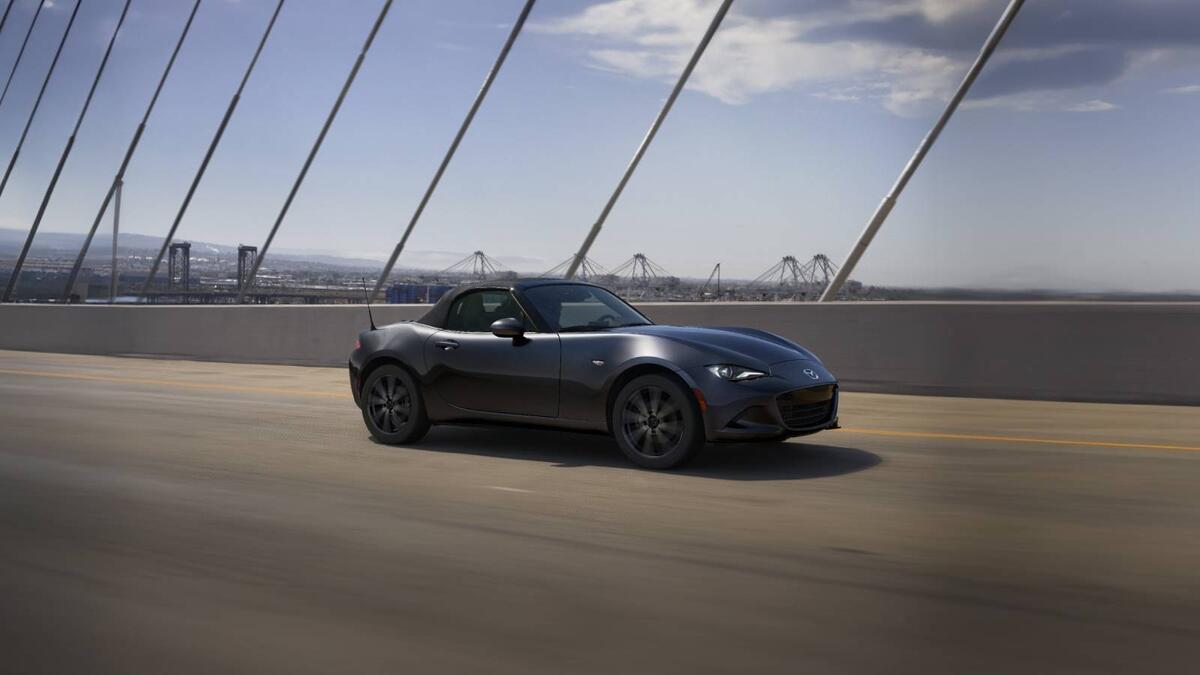
Mazda MX-5 / Miata
"... a two door sports car, like I have like the Z or Miata or something like that. You, it can't be your onl..."
The Mazda Miata is a small two-seat sports car designed to be easy and fun to drive. It’s often considered a good choice if you want something sporty without being a huge car.
The Mazda MX-5, commonly called the Miata, is a lightweight two-seat roadster focused on fun handling and an engaging driving feel. The episode groups it with other small two-door sports cars, suggesting it’s a realistic option for someone who wants a car that’s not too big or complicated. That’s why it’s mentioned in a “what could be your only car?” type of conversation.
miles
"I'm trying to calculate the miles, even with that kind of like usage on the car, [2778.0s] I'm still maybe doing 6,000 a year on the car, you know, which really isn't much."
“Miles” is basically how far the car has been driven, like what you see on the odometer. More miles can mean more wear, but good maintenance can still make a high-mile car a good buy.
In car talk, “miles” usually refers to odometer mileage—how many miles the car has been driven. Higher mileage often affects resale value and can correlate with wear, depending on maintenance history.
analog
"I don't want to say the downfall, but it was more of the negative connotation that it was more [2847.3s] analog and like it, it didn't have a lot of tech compared to like the newer cars that were coming out back, you know, when it was out,"
Here, “analog” means the car feels more old-school and less dependent on lots of electronics. The idea is that some people now prefer that simpler, more connected driving experience.
In this context, “analog” means the car is more mechanically and dynamically straightforward—less reliant on modern electronic driver aids and infotainment. The speaker contrasts it with newer cars that feel more “techie,” arguing that some buyers now prefer the simpler, more engaging feel.
tech
"it was more of the negative connotation that it was more analog and like it, it didn't have a lot of tech compared to like the newer cars that were coming [2852.4s] out back, you know, when it was out,"
“Tech” here means the newer electronic features in cars, like screens and driver-assist systems. The speaker’s point is that some people prefer fewer electronics and more direct driving feel.
“Tech” in car discussions usually means modern electronic features—infotainment, driver-assistance systems, and other software-driven components. The speaker is saying the older car had less of that, and that buyers are increasingly valuing the more straightforward experience.

Nissan 350Z
"Well, do you remember, did I send you that thing where I saw a post saying the 350 Zs were going [2909.0s] to start going up in value? And so that's what I mean, I was looking at 350s..."
The Nissan 350Z is a popular sports car that many people like because it feels straightforward and fun to drive. Chris is saying the good, original ones are getting more expensive because fewer are staying unmodified.
The Nissan 350Z is a late-2000s-era sports coupe known for its analog, driver-focused feel and strong real-world performance. In this segment, Chris is talking about how the 350Z’s value is rising because clean, unmodified examples are becoming harder to find.
convertible
"if you want one that hasn't been touched, chances are getting a convertible one. [2967.6s] Those ones usually aren't touched."
A convertible is a car with a roof that can open up. Chris is saying the convertible versions of the 350Z are often the ones people leave alone and don’t modify as much.
A convertible is a body style with a retractable roof, typically trading some structural rigidity and added weight for open-air driving. Chris notes that convertibles are often the least modified examples, implying they’re more likely to remain “untouched” than other variants.
mid-range torque
"But, but I mean, I guess I'm saying is it like it's, [3017.7s] the 350 felt fun, felt, felt quick. It felt a lot of mid-range torque and power in the mid-range,"
Mid-range torque is the engine’s pulling power in the middle of its revs. Chris is saying the car feels quicker because it has strong shove when you’re not just revving it to the top.
Mid-range torque is the twisting force an engine makes at the middle of its RPM range, where it’s most useful for everyday acceleration. Chris is using it to explain why the 370Z feels “dangerously fast” compared with the 350Z—because it pulls strongly without needing to rev extremely high.

M 35
"Cause even, you know, again, still sort of being in the infinity Nissan camp, the, the M 35 that I had the year before that it had different, it actually had different infotainment."
They’re talking about an Infiniti M35, which is a luxury sedan. They’re saying the car’s tech and screen setup changed between certain model years.
The speaker mentions an Infiniti M35, an Infiniti luxury sedan. They’re using it as a personal reference point for how the infotainment and tech features changed between model years (07 vs 08).
infotainment
"the, the M 35 that I had the year before that it had different, it actually had different infotainment. It had like a different design."
Infotainment is the car’s main screen and electronics for music, navigation, and phone features. They’re saying that part of the car changed between those years.
Infotainment is the car’s combined information and entertainment system—typically the touchscreen, navigation, media controls, and phone/voice integration. The speaker is comparing how infotainment differed between model years on the Infiniti M35.
Bluetooth
"you probably have to go back to having one of those, those like receiver things where you like to like, have Bluetooth over your radio."
Bluetooth is the wireless connection that lets your phone talk to the car. They’re saying you might need extra equipment if the original radio doesn’t support Bluetooth.
Bluetooth is a wireless connection used to pair a phone with the car so you can stream audio or use hands-free calling. The speaker is describing the workaround of using a Bluetooth-capable setup when the factory radio/head unit doesn’t support it.
receiver things
"you probably have to go back to having one of those, those like receiver things where you like to like, have Bluetooth over your radio."
They mean an aftermarket gadget that receives your phone’s audio wirelessly. It’s a way to add Bluetooth to an older car stereo.
“Receiver things” here refers to aftermarket wireless audio receivers that let you add phone connectivity (like Bluetooth) to an older factory radio. It’s a common retrofit approach when the original head unit lacks modern connectivity.
head unit
"just like switch out the, the like literally the one I got for Jacob's Mustang, the one, um, the head unit itself, you can order on Amazon, you can order on the website."
The head unit is basically the car’s main stereo/controls. They’re saying you can swap it out to get newer features.
The head unit is the main electronics module for the car’s audio and infotainment controls (radio, media, and screen interface). The speaker says you can replace the head unit itself to add modern features like Bluetooth.

twin turbo 300 ZX
"I tell everybody, you know, if I would have had a, if I would have had a twin turbo 300 ZX, I don't think I would have had a 300 ZX for very long ... there's just so much they could go wrong with those."
They’re talking about the Nissan 300ZX with twin turbochargers. The idea is that it’s more complicated than simpler versions, so it can cause more trouble if it wasn’t maintained properly.
The host is specifically talking about a twin-turbo Nissan 300ZX. They argue that the twin-turbo version can be more complex and therefore more prone to problems, so it’s something you’d want to buy only if it’s in great condition and you’ll maintain it carefully.
deferred maintenance
"if, if you got one that just was not very well taken care of and, and just had a lot of like deferred maintenance, it's, it, you"
Deferred maintenance is when you keep putting off car repairs and routine upkeep. Over time, small problems can turn into bigger ones, which is why an older car can become unreliable if it wasn’t cared for.
Deferred maintenance means postponing scheduled repairs and service until later. The host is using it to explain why an older Z (especially a twin-turbo 300ZX) can become unreliable: neglected issues compound over time.
alignment
"It should not be this hard. It should not be this rattle trap back here, you know, and that's kind of what I had to look at it and alignment and that kind of stuff."
Alignment is making sure your wheels are pointed the right way. If it’s off, the car can feel “off,” wear tires faster, and sometimes make steering feel weird.
Wheel alignment is the adjustment of how the tires sit relative to the road—angles like camber, caster, and toe. If alignment is off, the car can feel unstable, pull, or cause abnormal tire wear, and it can also make suspension issues feel worse.
check engine lights
"so I drive it and see like the battery issue or the suspension issue, but no check engine lights. The other car, it was probably check engine lights."
The check engine light comes on when the car’s computer finds a problem. The host is saying his car isn’t lighting it up (except for one battery-related issue), which usually suggests fewer active engine problems.
A “check engine” light is the dashboard warning that the engine control system has detected a fault and stored a diagnostic trouble code. The host is using it as a quick indicator of whether the car is throwing measurable problems versus only having feel-based issues like noise or harshness.
battery issue
"so I drive it and see like the battery issue or the suspension issue, but no check engine lights. The other car, it was probably check engine lights."
A battery issue can mean the battery itself is weak, the charging system isn’t maintaining voltage, or the car’s electrical system is detecting an abnormal power condition. On modern cars, that can trigger warnings and sometimes affect starting, electronics, or sensor behavior even if the engine is fine.
drivetrain lash
"I was going to say that the, uh, the car, I knew this when I drove a thing, how it has that drivetrain lash when you shift hard, has like a clunky shift to it."
Drivetrain lash is a little “slop” in the parts that send power from the engine to the wheels. When you shift hard, that slack can cause a clunky feel before everything tightens up.
Drivetrain lash is the small amount of free play or slack in the powertrain—between components like the transmission, driveshaft, and differential. When it’s noticeable, you can feel a clunk or delay when shifting hard because the drivetrain takes up that slack before torque fully transfers.
Request an Explanation
Heard something you'd like explained? We'll add it to this episode.
Sign in to request explanations for terms you heard.
Want to learn more?
Browse our glossary for plain-English explanations of automotive terms, jargon, and concepts.
Help improve this episode
See something that's not quite right? Our annotations are AI-generated and can sometimes miss the mark. Click the flag icon on any annotation to suggest a correction.