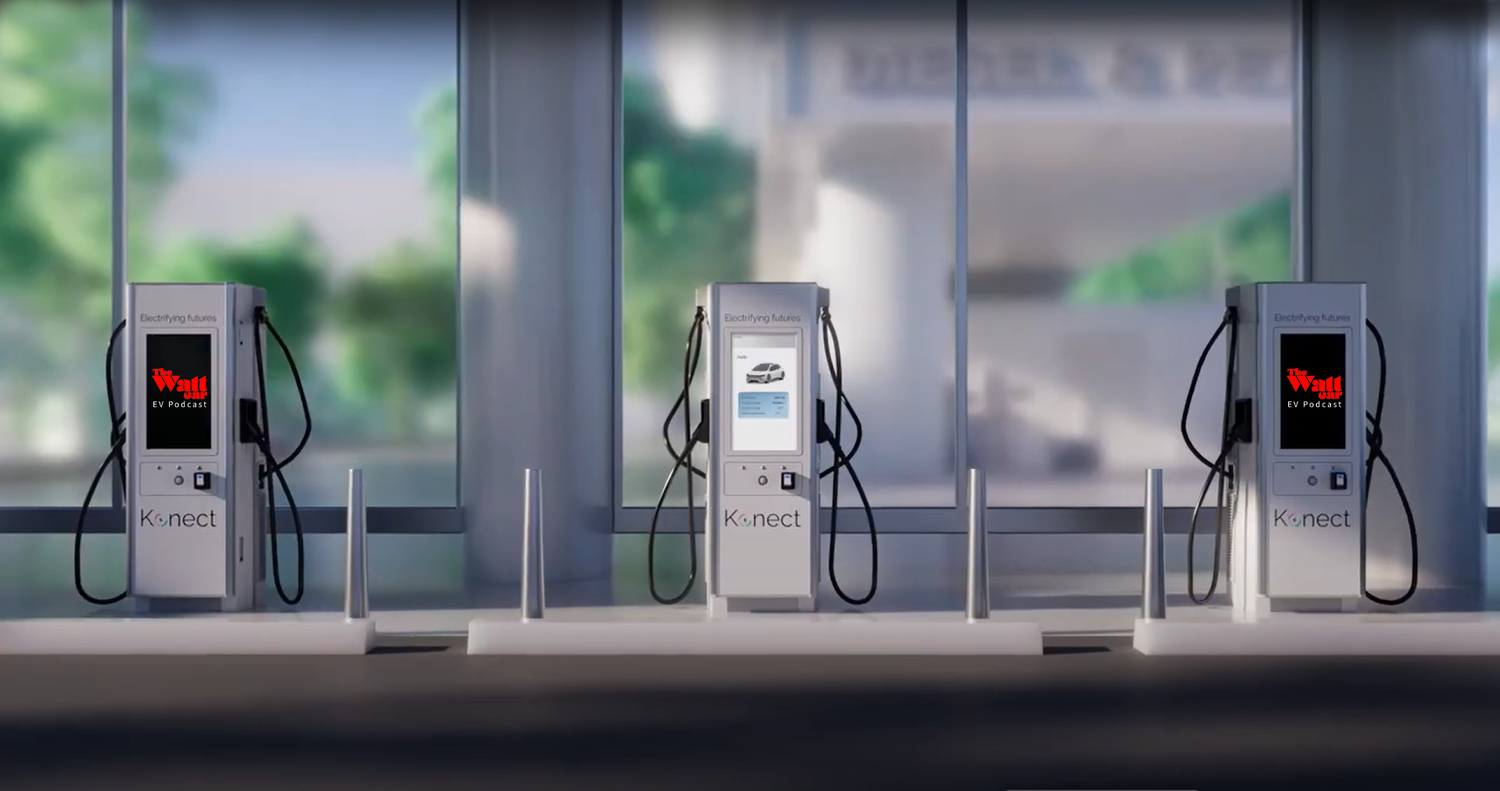
00:48
This is the WhatCarEV podcast for Thursday, September 18th, 2025, Episode 240, Connecting the Dats.
01:04
So we have had a few repeat guests in our history.
01:09
And it's always a fun time.
01:11
It's always a fun time to have guests on this podcast.
01:15
So this is something, you know, I think I've teased it over the last couple of weeks.
01:20
It's been on the works for a while, and sometimes it's tough to coordinate schedules, but we
01:27
So if you remember Episode 181, I believe, we had Merrick Glass of Connect join us, and
01:37
So Merrick, welcome back.
01:42
And as you said, it's been a long time coming, but I'm thrilled to be back with you guys.
01:45
It's good to chat again.
01:47
And you have some news about your new role within the company.
01:51
And so if you'd like to share some of that.
01:54
And I also, wait a minute, am I getting too excited?
01:57
We've got to introduce ourselves first.
01:59
I don't know who you are, Ed.
02:04
I'm a very enthusiastic podcaster of four plus years, as you might have gathered
02:08
from my spontaneous introduction.
02:13
Been doing various things in the automotive world for over two decades.
02:17
I'll just leave it at that.
02:19
And yeah, driving headfirst in the big, brave world of EVs.
02:24
And I'm Phil Royal.
02:26
I've got, as I said last week, I've got a microphone and a headset, so I'm a professional.
02:33
So this, to set the stage for us before we jump too far into this, Ed, there was
02:38
a story that led to where we are today.
02:43
Would you like me to?
02:46
Because I've got the memory of a sieve.
02:48
Well, so this is, gosh, I think a couple of months ago, I got an email from basically
02:59
Merrick and one of his assistants saying, oh, we just, you know, connect and go bark
03:06
You volunteer, the parent company conducted the survey of EV owners, kind of their wants
03:13
and kind of a wish list.
03:15
And when I first read it, I was like, honestly, this isn't too exciting because these, not
03:22
not kind of to paraphrase the declaration of independence.
03:25
We hold these truths to be self-evident.
03:28
You know, drivers want convenience.
03:30
They want amenities.
03:32
They want, you know, charging close to them, reliable charging.
03:36
I'm like, of course, you know, everyone wants that.
03:40
So I didn't really think much of it and I'm like, well, you know, yeah, I would like
03:43
to have them on at some point in the future.
03:46
But I didn't feel a great sense of urgency at the time.
03:49
But then I visited a friend who had her car in the shop and I guess at the time,
03:55
the rental company, the only car they had available was the Nissan Leaf.
03:59
Of course, we know, you know, EV nerds would know this is not the new 2026
04:04
miles, the older style.
04:06
So the DC fast charging on that was a Chatham-O plug, which is becoming
04:11
more and more rare.
04:13
So that narrows the field even from CCS, NACS, Chatham-O is like, so to try
04:20
to find an operational Chatham-O charger, we spent over an hour
04:25
looking for a charger that worked.
04:27
And I was like, this is miserable.
04:30
This is not convenient or close or convenient.
04:34
No. And, you know, I've said this more than once.
04:37
I'm spoiled as a Tesla owner because regardless of what you think of
04:41
Elan or Tesla as a brand, they're the supercharger network is really top
04:46
notch in terms of availability, reliability, ease of use.
04:51
So it was really an eyeopening moment for me.
04:54
And I was like, you know what, if other EV drivers,
04:57
if this is what they have to go through to charge, I understand the
05:00
frustration and I understand the hesitation I'm part of consumers,
05:05
like, you know, I don't want to deal with this.
05:08
So that was really the light bulb moment for me.
05:10
And I reached immediately after that, reached out to Mary said,
05:14
let's let's talk about this because this is really a big deal.
05:19
So enter Merrick finally after now we'll get to your
05:24
brief introduction.
05:29
I know we went through it before, but let's let's set the stage as well for you.
05:33
Yeah, sure. No. And again, thanks.
05:35
Thanks for having me back, Congress.
05:36
So I'm Merrick Glass and I am now the president of Kinect.
05:40
I know the the last time that I was on here chatting with you guys,
05:43
I was our global head of strategy and marketing.
05:46
But back in back in April of this year, I actually took on the president role.
05:50
So now I'm leading the business globally. Wow, congratulations.
05:53
Thank you. Thank you.
05:54
You know, it's a very, very exciting and and just as a reminder, right?
05:58
So I mean, connect.
05:59
I know you mentioned it, right?
06:01
But connect is part of Gilbarco Vita Root,
06:03
which is part of our parent company, Volunteer.
06:05
Volunteer is a mobility technology conglomerate, essentially,
06:09
that trades publicly on the New York Stock Exchange.
06:11
And then Gilbarco Vita Root is actually a business
06:14
that's been providing traditional fueling solutions for the last
06:19
And so essentially all of our all of our biggest customers
06:22
would be those fuel retailers that everybody's familiar with.
06:25
The Sheets, the Wawa's, the BP's, the XR's, all of those guys.
06:29
And essentially, we ended up launching Kinect
06:31
because all of those customers were becoming increasingly
06:34
and increasingly interested in EV as they started to see the pickup.
06:38
And so we felt that it was our duty as one of the providers
06:41
and one of their partners to make sure that we had a fantastic
06:43
EV offering to bring them as well.
06:45
And so connect is now the e-mobility focused provider
06:48
within that within Gilbarco Vita Root that helps bring electrification
06:52
to more and more convenient stores across North America and the world.
06:56
I just want to interject real quickly again, like I did in the beginning.
07:02
What kind of initially sparked my desire to reach out to to connect into Merrick?
07:09
And you thought, how do you even put this together?
07:13
Is I noticed I recognize the Gilbarco Vita Root name from gas pumps
07:19
and like, oh, they're doing an EV initiative.
07:22
This is really interesting.
07:23
I want to dive into that.
07:25
And at first, you were like, what?
07:26
Yeah. And then you you you lost me at the beginning.
07:30
But then you fueled up your car and you're like, oh, yeah, yeah.
07:33
It makes gas pumps.
07:35
Turns out you're right.
07:36
So anyway, well, so let's get to the kind of the heart of the issue today.
07:42
You guys did a survey of EV drivers
07:45
and sort of their wants, needs, pain points, wishes, so forth.
07:52
I'm going to go over kind of the top line.
07:55
I kind of pulled it out said.
07:57
So these are some of the top points of the of the find the findings of the survey.
08:01
Said 32 percent of EV drivers
08:03
say said they would favor sites close to their location.
08:08
Close to major routes.
08:10
Drivers don't want to make big detours.
08:14
Twenty one percent would avoid sites with 10 to 20 minute detour.
08:20
And 37 percent said they would not go to one more than 20 minutes off their route.
08:27
Twenty a percent of drivers say they would be more like to visit
08:30
Charger with the Loyalty Rewards Program.
08:34
Seventeen and this is something Philip and I have discussed before.
08:38
Seventeen percent of drivers wanted to pay for charging in store.
08:43
So that was kind of interesting.
08:45
I wonder if that's got more to do with just apt fatigue than anything.
08:49
Well, I think we'll get into that.
08:51
That's another thing to 93 percent of drivers would pay more
08:57
for the convenience of being, you know, closer on the route.
09:01
And let's see where we also uptime.
09:07
It says, I guess, governments are starting to mandate uptime.
09:10
Ninety nine percent in the UK, which is pretty ambitious.
09:14
Ninety 98 percent in Australia and 97 percent for Nevi funded fast chargers.
09:21
Wifi was a big want.
09:23
Yeah, refreshments, food, restrooms.
09:30
And yeah, it's and finally,
09:33
99 percent of drivers said they were willing to make a five minute detour
09:37
to get the amenities they're looking for.
09:39
So anyway, I'm going to hand it over to you to kind of unpack this a little
09:43
and kind of what was the kind of the genesis of this
09:47
and what how this is influenced connects business strategy in terms of
09:53
you know, the B2Bs or kind of the consumer facing proposition.
09:59
Yeah, sure. So happy to have to unpack it, right?
10:01
And there's there's a lot in there, right?
10:03
And I mean, it's I think that the interesting piece that I would say, right,
10:07
it's like, as you read through the first time,
10:10
and I think you rightly said, right, you read through these things and you think,
10:14
hey, I mean, like it doesn't sound like rocket science, right?
10:18
Like drivers want something obvious, they want amenities, they want all these things.
10:22
But the interesting piece, and I know we chatted about this a little bit last time
10:25
is to date, many of the CPOs have not actually been able to give consumers that.
10:30
Like you're still running into chargers
10:32
that are in the back of a parking lot that are unlit, not covered.
10:36
People are standing there in the rain trying to get the charger fired up.
10:39
Reliability remains a key issue, right?
10:41
And I think this was a really interesting way for us to just solidify
10:45
some of that and really get some data behind it.
10:48
And again, part of it is, look, I think for all of us within the space, right?
10:51
We want to see that adoption continue.
10:53
We want to see more and more sites come online and pick this up.
10:57
And so interesting for us is we're speaking to our core customer base.
11:01
It's a really good way of showing them, hey, the sites that you guys have,
11:03
the knowledge that you guys have, the experience that you've already been able
11:06
to bring to drivers is truly differentiating within this space.
11:11
And so, again, I can unpack a couple of those pieces, right?
11:14
Because I think some of them are very important to hit on.
11:17
But I think a lot of it just comes back to,
11:20
even though those things sound obvious,
11:24
I think given where the EV space was a few years ago,
11:27
with most of the new drivers being like very dedicated early adopters,
11:34
a lot of those pieces were nice to have, right?
11:36
In the sense that you still had drivers that were willing to go to the back
11:39
of that dark parking lot and sit in the rain or stand in the rain
11:42
as they're trying to get the charger going or walk the 500 feet
11:46
to the nearest bathroom or whatever it was, right?
11:48
But as we've continued to see EVs adopt,
11:53
and look, just last year, I think there was one and a half million
11:56
plug-in vehicles that were sold in the US and everything that we've seen
12:00
in terms of kind of new studies and new releases coming out in terms of adoption.
12:05
Despite all the turbulence and noise around the market in the first half of this year,
12:11
that adoption is continuing to pick up, right?
12:13
And so with that, I think comes a couple of things.
12:15
I think one is, look, it's new drivers, right?
12:19
And there's new drivers that are coming online
12:21
that probably have less patience than those early adopters, right?
12:24
And so I think all of these pieces that we're talking about here,
12:27
in terms of reliability, amenities, convenience, all of those things,
12:32
we're really starting to see really shift towards being table stakes, right?
12:37
Whereas before, they were kind of really things that were fantastic.
12:41
Yeah, exactly, right?
12:42
And I mean, again, I think it's a really exciting time to be in the space given,
12:47
look, that presents significant challenges to some ChargePoint operators,
12:51
but it also presents significant opportunities, right?
12:54
And I think kind of being able to take this data and then really craft both our strategy, right?
12:59
But also for our core customers who are typically the side hosts who are going to be doing this,
13:03
for them to be able to have this kind of data and look through that
13:05
and really have an understanding for what good looks like,
13:09
I think it's hopefully going to drive just the industry to be better for EV drivers, right?
13:14
And make sure that all those things continue to come through.
13:18
But I mean, look, I think you said it, right?
13:22
And I think it is one of those things that is a limiter for
13:25
people who are looking to adopt EVs today, right?
13:28
Is they want that same level of convenience,
13:32
and they want that exact same feeling as they have when they fill up an ICE car, right?
13:36
And in that, it's all those things that you mentioned, right?
13:41
And again, that one was, I mean, some of those stats were pretty interesting, right?
13:44
Where you see 93% of drivers are willing to pay extra to avoid a 20-minute detour, right?
13:51
And I mean, even on top of that, right, it's you see like one in five
13:56
are going to avoid sites that are 10 to 20-minute detour, right?
13:59
And so that location piece starts to become very, very important.
14:03
And what I think you're seeing, right, is like as you get that wider adoption,
14:07
one drivers expect convenience, but they're also willing to pay for it, right?
14:11
And so I think in that sense, like for charge point operators,
14:13
it's a very interesting time to be thinking about how they're deploying their sites
14:19
and deploying those strategies.
14:22
I think the other pieces that I did find interesting, I mean, back to the amenity side
14:26
of things is just how strongly that came through, right?
14:30
I mean, you mentioned that Wi-Fi was the highest ranked, right?
14:33
I found that fascinating in the sense that Wi-Fi was ranked as higher than restrooms,
14:39
as something that people want at their charging sites, right?
14:43
And so I think it is those pieces as you're starting to see more and more people come on,
14:47
they're looking for ways to make that dwell time, essentially, I mean,
14:51
whether it's productive or comfortable or whatever, right?
14:54
But they're really looking for ways to not just sit in their car on their phone
14:58
while their car charges, right?
15:00
And so I think starting to take some of that in and hopefully as we continue to see sites
15:06
deploy with that kind of message is going to be critical, right?
15:11
And look, I mean, you asked in terms of, hey, how has that impacted our strategy?
15:17
Look, I know we tried it last time, right?
15:19
And obviously, given our heritage, we've got these great relationships with these fuel retailers.
15:25
And the great thing for fuel retailers is they're in a very strong natural position
15:32
to take advantage of the shift towards EV, right?
15:35
You think about convenience and you think about the locations.
15:39
I mean, a lot of our customers have spent the last 100 years fine-tuning their networks
15:43
to make sure that they're in those bi-traffic locations, that they're by the highways,
15:47
that they're in places where people are going to want to stop.
15:50
And on top of that, I mean, we chatted last time again, right?
15:53
In terms of this whole outdoor fueling experience is something that they've taken years and years
16:00
So they know that people want well-loved locations.
16:03
They know that people want to be able to stand underneath the canopy.
16:06
They understand that things like clean bathrooms and Wi-Fi are important, right?
16:10
And then on top of that, they've got all of the, I mean, essentially kind of the
16:13
food offerings, the coffee, all those pieces that people want to be able to take advantage of.
16:19
And so for us, I think the biggest pieces that we've taken away from it are, hey,
16:24
now more than ever, we truly believe that is an interesting time for fuel retailers
16:28
to be taking a look at EV and thinking, how can they really get in the mix here
16:31
and start taking advantage?
16:32
Because they truly do have a really strong position here as the market continues to evolve.
16:37
Well, one, and I think we touched on this last time too, is I think, and of course,
16:45
This is kind of a dynamic thing with EVs right now.
16:50
But the longer-dwell time compared to ICE currently now, I'll get into how that's
16:58
But traditionally for ICE vehicles, it's I'd say like three to five minutes
17:04
to top off the tank, right?
17:06
Whereas even with the best commercially available fast charging, at least in North America,
17:13
you're looking at probably 20, 30, 45 minutes.
17:19
So, and maybe your research bears this out, is that's a real prime opportunity
17:26
for these side owners that offer more compelling amenities like food, like a lounge
17:32
Wi-Fi to really kind of capitalize on that.
17:36
Because that's something that, you know, traditional fuel retailers, people are in
17:41
and out, okay, thank you, by, you know, they don't, they can't, the time isn't sticky enough
17:49
for them to really make something of it.
17:51
And of course, there are a lot of constraints on this.
17:55
I mean, I've been to some gas stations where I'm amazed that they even fit it on the lot.
18:00
So, obviously, for a traditional fuel, for traditional gas station, it's all about throughput.
18:10
You know, traffic, the frequency and density of traffic going through there,
18:17
that's flipped a little bit with EVs and that the opportunity, and correct me if I'm wrong,
18:22
but it seems to me would be more with the dwell time and the stickiness
18:26
of engaging the customer as much as possible.
18:30
With the time they're spending there, rather than just throughput.
18:33
And I wonder if you could kind of speak to how, I guess, how your partners are kind of
18:42
managing that transition and if it's even possible to do both at the same time.
18:46
And if there are any kind of case studies or examples, you can think of
18:52
where that's been done successfully.
18:57
I know that's really a loaded question.
19:00
No, but it's the right question to ask.
19:04
And look, I think there's a couple of things to touch on there.
19:09
The interesting piece that I would say is if you look back historically,
19:13
at least within the fuel retail space, essentially there's been a tremendous
19:20
amount of the land lease model that's been deployed, where effectively they'll run to
19:25
parking space and XYZ, CPO is going to come in, they'll put the chargers on, it's their network,
19:32
and effectively then the site host is offering EV charging to their customers,
19:38
but they're kind of out of the loop for their business.
19:42
And so what we've seen, and I mean, we've seen it a lot over in Europe,
19:46
and the shift is continuing to happen more aggressively in the US now,
19:49
is for all of those reasons that you just mentioned, the site host are starting to get
19:54
much more involved in terms of the fuel retailer starting to say,
19:57
hey, we actually want to make sure that we're owning this.
19:59
And I think that's driven by a couple of key pieces.
20:02
I think the one is just consumer experience and control over that consumer experience.
20:09
Look, I think we all know, even as I said, the EVs are adopting fast,
20:15
but we remain a minority in terms of the driving population within the US.
20:20
That said, we are a very loud minority, right?
20:26
There's a very big social element to being an EV driver, right?
20:29
You look on things like PlugShare and you see those as big forums where people
20:33
are having big discussions.
20:35
And what you see is that the reliability and the consumer experience that you offer at your site
20:43
gets talked about, right?
20:44
And truly what that means is that those forums can really make or break the reputation of those
20:48
sites. And again, I think many of the drivers, as we spoke about, are very nervous about going
20:56
to an unreliable charger. They're very nervous about having exactly what you said to happen,
21:00
where it says, hey, you pull up to a charger and it doesn't work, right?
21:03
And now you're on a battery and you're stressed about your car dying, right?
21:08
And so people take those reviews very, very seriously.
21:11
And some of the challenges that we've seen with our core customers being the fuel retailers
21:16
is if you go down that land lease model, you don't control that experience, right?
21:21
And so if the charger is down, it's not actually yours to service.
21:24
It's not yours to fix.
21:25
But you still have to deal with the angry customers coming in and saying,
21:28
how come this doesn't work? Blah, blah, blah.
21:30
And they're like, we can't do anything about it, you know?
21:33
That's exactly right. That's exactly right.
21:36
And that's the interesting thing is if you look on those forums,
21:39
it's actually, it's very rarely the CPO getting blasted, right?
21:44
It's the flag that sits on top of the site, right?
21:46
And so it's that C store owner that's getting off the cat grass.
21:48
Yeah, the CPO, yeah.
21:50
Yeah, exactly. When they don't really have control over it, right?
21:52
So they're really pushing to try to integrate some of that in now
21:56
to make sure that they're controlling that consumer experience
21:58
and offering a positive experience at their sites.
22:01
The other piece that you mentioned there, right,
22:02
which is interesting that we're starting to see a lot of,
22:05
and it's actually a core piece of what we believe Connect brings to the market is
22:10
there's starting to be a much heavier tie-in to existing fuel retail loyalty programs,
22:17
right? I think that they've seen on the traditional side of the business
22:20
that those loyalty programs are exceptionally effective, right?
22:23
In terms of being able to get repeat customers
22:26
and to be able to make that consumer experience better.
22:30
And so what they're trying to do is effectively tie that loyalty
22:32
from the EV driver into those in-store purchases.
22:36
And exactly to separate, really take advantage of the fact
22:38
that, hey, there is additional dwell time here.
22:40
And so if you can then push that loyalty program to tie into,
22:45
just as an example, hey, charge 10 times, get a free coffee, right?
22:48
Like something like that.
22:50
You start to really drive that consistent experience for the customer as well.
22:53
And again, something that they're familiar with.
22:56
The challenge that our customers have had to land these models,
23:00
you can't, right? Because the two systems don't actually integrate in with each other.
23:04
But effectively through some of the technology that we bring to market,
23:08
we're actually able to integrate those systems so that EV
23:12
just becomes another portion of the convenience store business, right?
23:16
And that's starting to really strongly differentiate there.
23:20
And then the last thing that I'll say, which is interesting, Ed,
23:23
is you mentioned essentially, it's, hey, there are some of these sites that are,
23:28
let's call them challenging, right? Like they're small.
23:31
But the benefit for the convenience store, as a customer said is,
23:37
they've been making those space trade-offs forever, right?
23:41
I mean, they've had to think through, hey, how many dispensers do I want
23:44
versus how much C store space do I want?
23:46
What does that throughput look like?
23:48
And how do I need to change my offering to mix that?
23:51
And so certainly what I'd say is we're starting to see a trend towards
23:55
effectively kind of much more amenity focused sites.
23:59
Rather than just fueling.
24:01
Exactly, right? And specifically in Europe, we've got an increasing number of just
24:08
charging only sites, right? So essentially, I mean, right by me, there was an older BP
24:15
site that got taken down, that's now being put up as a BP pulse kind of full just EV hub,
24:20
right? Where they're then really gearing that amenity set that they've got there
24:23
towards that EV driver. So we're seeing these transitions happen in real time.
24:29
But I think you're right. I mean, it's going to be that transitionary phase, right?
24:33
And I think it'll take a while for everybody to get it, right?
24:36
But I mean, certainly, I would say there's a number of our customers that are doing it
24:40
exceptionally well. And again, comes back to just then it's a much better experience for
24:46
the driver. They're driving that in store, that in store engagement as well,
24:50
which is great for the customer and great for them, right?
24:53
Mm hmm. Yeah, I am a few months ago, I had an experience. I was on a road trip to Southern
25:00
California. And I don't know if you've heard of them. It's right now, I think they only have
25:04
like, I think one or two active sites, but this this kind of regional network called Rove.
25:12
True. Yeah. And so I actually stopped by, I guess, their first or their flagship store.
25:18
And it was, it was really nice. I mean, lots of chargers. Now, granted, it was a pretty big lot
25:24
size. So, you know, they have the luxury of kind of spreading out a little bit.
25:28
But like a really high end convenience store. It was affiliate with the Gelsons, which
25:35
I don't know if you're familiar with that. It's kind of more of a premium supermarket
25:39
kind of brand in Southern California. But, you know, very well staffed.
25:44
They were very polite. They were, you know, oh, sir, can you know, is there anything we can
25:48
do for you? Or, you know, they were even having a barbecue cookout on the patio. And I'm like,
25:53
oh, wow, that's really nice. So, yeah, it's definitely not a traditional fueling experience
26:00
like you get at a gas station where, you know, right, pull in, fill up and, you know, you
26:05
got to got to get the key to the bathroom with like the PVC pipe hanging off of it.
26:11
Yeah. You know, anyway. No, and I mean, the interesting piece is that I have to imagine
26:17
after that experience, if you're ever back in that area, you go back to that site again.
26:22
Right. And I think if I'm in the area and, you know, I don't know, I mean, I kind of went
26:28
out of my way the first time just because I was curious about it. I don't know if I'd
26:32
necessarily go out of my way to visit it again. But if I was going by and I was in the area,
26:37
I'd definitely visit it again. So would you say there's a 21% chance that, oh wait, no, what was
26:44
the number? That you would take a five minute detour to? For clean restrooms and Wi-Fi?
26:51
No, but it's, you know, if that's what the future looks like, I mean, that's,
26:54
I mean, it's pretty promising. Now, obviously in Southern California, at least by US standards,
27:00
they have a pretty high density of EV ownership. So, you know, I think they, assuming they kind of
27:08
calculated the throughput and, you know, the revenue from that. But, you know, there are other,
27:14
I mean, Phil just got back from a trip from Nebraska, he said it was. Yeah. And he saw
27:21
like what, one or two EVs during your whole trip or something? Yeah, I saw almost no EVs,
27:26
saw a lot of those Amazon Rivian vans. But yeah, it's always shocking when I leave this state
27:34
and leave my little bubble of Southern California as to what the rest of America does in the middle.
27:42
Like, it's very different. I'm very aware that what I see in my neighborhood is not
27:48
representative of the majority of the country. Yeah. And like I said, we discussed this
27:53
before, but you know how regional this is, you know, imagine if you go to like Wyoming or,
27:59
you know, Montana, if you try to pitch this, they'll probably be like,
28:04
you know, we hardly see any of you, you know, why should I spend, you know, six figures to,
28:09
you know, put all this in when no one's going to use it? But, you know, I mean, I don't know,
28:15
I mean, in your experience, what's been the tipping point where like former skeptics
28:20
start to be interested in, they're like, oh, maybe there's an opportunity in this.
28:25
Yeah, it's that's an interesting question.
28:29
I mean, the piece that I would say is I haven't necessarily seen a specific tipping point, right?
28:36
And I think part of that comes down to, look, I think we're doing a better and better job
28:40
as an industry of being able to answer some of those questions, right? I mean, look, I think
28:47
some of it is taking the excuses away from drivers as well, right? I mean, we talked a lot about
28:54
reliability. One of the downsides of some of the EV forums that I spoke about is, if you're an ice
29:00
driver and you're looking at that and you're thinking about trying to get an EV, and all you're
29:04
seeing is commentary around, hey, this charger doesn't work, this charger doesn't work,
29:08
I have to go 10 minutes out of my way here, you're going to look at that and you're going
29:11
to think, like, why would I do this, right? Yeah. And so I think, look, as we,
29:18
as we, and I mean, I say we, I mean, as us as connect, I mean, one of the biggest pieces that
29:22
we try to push is, hey, we can really help drive that high reliability, right? And I think
29:27
as that starts to come through, drivers start to have less excuses, you start to see the
29:31
adoption there. And then really, as soon as that adoption starts to kick through is when
29:36
you start to see the site hosts pivot around, right? And look, there's obviously a little
29:40
bit of a chicken and egg there, right? Because the site hosts are saying, oh, I want to see more
29:44
drivers and the drivers are saying, I want to see more chargers before I make the leap.
29:48
But look, I think, still, right, that's where, that's where some of the funding
29:52
aspects can come into play, right? And so, I mean, like, obviously,
29:56
Nevi has been all over the press and Nevi essentially kind of kicking back off here
30:01
and getting moving again. I do believe that that'll continue to go a long way to helping
30:06
get that initial infrastructure in place and start to solve that chicken and egg problem.
30:11
But even in addition to Nevi, right? And one of the things that I find interesting is a lot of
30:16
the focus gets placed on that federal funding. But if you look at state level grants, utility
30:22
programs, like essentially, there's a whole bunch of these other funding pools that exist for site
30:26
hosts to be able to go out. And in some cases, actually get even more funding than they would
30:32
through Nevi and admittedly with probably less red tape to sort through, right? And so,
30:38
that's where I would say, I mean, we've been able to convince some of those customers who've
30:44
looked at this and said, oh, I'm never going to see a return on this. I don't think this makes
30:48
sense. But really just taking a detailed look at what they're doing and saying, hey, look, you've
30:51
got of your, whatever, X number of sites, 25 that are available within your area, that takes
30:59
that upfront cost significantly down with the utilization rates that are in whatever
31:04
state you're in. This becomes a really viable opportunity. But I spoke a lot about kind of connect
31:10
specifically last time, but I come back to the three pieces that we see, right, in terms of,
31:15
hey, what does tip the scales for our customers to want to take a leap into electrification?
31:21
And it's, look, it's got to be easy, right? So our customers don't want to be out trying to
31:26
source 18 different pieces to pull together what is an EV ecosystem. It's got to be seamless.
31:32
And that comes back to, hey, they want to integrate with loyalty. They want to integrate
31:35
with the media platforms that they've already got running. But the most important one is it's
31:39
got to be profitable. But they've got to be able to make money out of this as the business, right?
31:44
And so I think by being able to get in there and help them figure out what that upfront cost
31:48
looks like and help them take that down and really drive that ROI up. I mean, at the end
31:53
of the day, that's, that's really what gets our customers excited and moving forward.
31:57
I guess that's one area. I mean, as much as possible in kind of a summary fashion,
32:03
that's one area I'm not super familiar with is like the revenue model of
32:09
traditional gas stations and convenience stores in terms of financing upgrades.
32:15
How does that typically work?
32:19
Yeah, in the traditional fueling side of the world?
32:22
Yeah, or specifically how it does today with if they want to install chargers.
32:29
Yeah, sure. So, look, I mean, essentially, for us, right, there's a number of different
32:34
options that we bring to customers when they're thinking about installing chargers, right? So
32:39
depending on kind of where they are, how big they are, what level of financial capacity they
32:44
have, we've got a whole bunch of different programs that we could put in place. So for
32:49
us, I mean, as a first brush, right, kind of regardless of what path they're going down,
32:54
we help out with that funding analysis, right? And that's where I say, I mean, obviously,
32:59
Nevi gets a lot of the headlines because of the times of the federal government. But
33:03
I think a lot of our customers are amazed at just how much money actually does want
33:07
to go to work in the space, right? And just how many of these programs are out there
33:11
and available. So that's one path. But then in addition to that, I mean, we partner
33:17
with a whole bunch of essentially kind of other players within our ecosystem to bring,
33:22
whether it's financing options to our customers so that they can essentially get that financing
33:26
package up front, take down that upfront cost and then take that on as more of an operating model.
33:31
Or we do partner with essentially kind of some complete third party use cases where if
33:37
one of our customers says, hey, I really want to take on EV, not willing to take any
33:41
bit of a financial leap on it, we can't introduce them essentially to a third party
33:45
operator who will come on, go down that that leasing path and then effectively allow that
33:51
to still offer EV charging to their customers. So it's a very wide gamut. And to be honest,
33:57
it works in a pretty similar way on the traditional side of things, just
34:00
probably without that third party piece. So you mentioned earlier on about plug share,
34:07
which I'm well aware of and how influential that's become in kind of getting the word out
34:13
about charging stations, reliability, pricing, that sort of thing. I wanted to touch on this
34:21
and I know this might be kind of a sensitive subject, especially from the B2B context. But
34:29
pricing can really be all over the place with charging, either state to state or
34:36
I mean, I made the mistake once of charging, not even a DC fast charger,
34:42
but level two, where it was 78 cents a kilowatt hour, which is insane. But I didn't read the
34:51
fine print before I plugged in. I'm like, oh, look, charger and oh, nobody's parked here.
34:56
I wonder why? I wonder why. Found out. And then just the other day, I went to a government
35:04
building near my house here and it was actually a charge point. But then I looked online,
35:10
I said, what's the rate for this? It was nearly $5 for 15 minutes, which if you break that down
35:18
on a kilowatt hour level, that's insane. And it's like, I think, I guess, you mentioned the survey
35:27
findings that drivers are willing to pay more for convenience for charging. But at what point,
35:34
I guess, and I know my guess is you probably take kind of a laissez-faire approach to a lot of your
35:42
customers like, hey, you do what works for you. We're not going to tell you how to run your
35:46
business. But I'm wondering if you do though, generally have some guidelines in terms of
35:52
pricing, in terms of best practices like, look, yes, you can set the price with whatever you
35:58
want. But it gets to a certain level where customers will actually avoid your charger
36:05
because of the high prices. And how that's communicated, managed, like I said, recommendations.
36:12
Yeah. So to be totally honest with you, it's more of the first for us in the sense that we let
36:19
our customers go out and run their business. We certainly have a whole ton of pricing expertise
36:26
and pricing analysis that we can help customers with. And essentially, if they pull us in to do
36:31
that, we're more than happy to provide that. But more than anything, what we find is,
36:37
well, a couple of things. I think one, we really push to make sure that our customers
36:42
do understand pricing in their local markets. I think that's one of the big pieces. Obviously,
36:47
prices fluctuate dramatically across the markets. And so we need to have a good
36:50
understanding for what is competitive and what good looks like. I think, again, that in some ways,
36:57
the interesting piece for us is our customers have been working in a dynamic, competitive
37:04
pricing environment for 100 years. When you think about how often fuel prices are changing,
37:10
you think about how often they need to take that through. And so they're actually normally
37:14
very good at making those essentially price versus quantity decisions. And so typically,
37:21
what we find is they've got their own very heavily staffed pricing teams that go out and look at this
37:27
stuff very aggressively. And so typically, I think what we find is they're normally pretty close
37:33
to the mark. Based on their experience with gasoline and diesel, so in terms of
37:44
I guess competitive pricing, just both the guy across the street or down the street.
37:48
And so they're also applying that logic to charging as well.
37:52
Correct. Correct. I mean, as we said, they look in a lot of ways. The
38:00
convenience for owners, they're looking for what we talked about before. They're looking
38:03
for that consumer connection where they can then drive that consumer in store, be able to
38:08
kind of have that in store relationship and then that loyalty and all those pieces with the
38:13
customers. And so they're not really going to benefit by putting a price out there that is
38:19
so egregious that customers are not going to come anymore. And self-defeating, yeah.
38:24
Yeah, exactly. Right. So typically what we see is they are normally very good at
38:29
yeah, taking into account, hey, what is the competitive pricing around my area and then
38:33
making sure that they push that through. One of the other things that's interesting,
38:39
right? And I mean, we see this a lot in Norway where obviously the EV adoption is very, very high.
38:45
But we actually also allow for our customers to essentially integrate with the price pull signs
38:52
that they've got on site. And so now what you're starting to see is in a lot of these locations
38:56
in Norway, it's not only the fueling prices that are up on those price pulls,
39:00
but the per kilowatt price as well. Right. And so in that, I think it's great for consumers
39:05
in that you're not going to pull in and get surprised. But it's also, I think, just good for
39:10
those, essentially those customers who are willing to go out and be aggressive and stand
39:14
behind the pricing to draw in the right level of engagement from drivers. But I think that's the
39:21
piece that I think is very key, right? I mean, you need to have visibility into that pricing
39:27
for consumers. Right. I think to your point, the worst thing that happens is you charge up
39:31
and all of a sudden you realize 10 minutes after that you've charged up at a rate that you never
39:36
would have agreed to had you known what it was. Right. And so I think we really try to take advantage
39:41
of A, those times as pulls, but B, the connect chargers, the screen is 32 inches. And so we make
39:49
sure that that pricing is provided on that screen so that consumers know what it is they're
39:52
getting into. So I kind of want to get into that a little more in terms of like, I'm more
39:59
on the data side. So retailers that are within the connect network, how can they kind of
40:11
broadcast or make that data available to drivers where if they have connected navigation system
40:17
in their car that you do a charging point search and that get the kilowatt hour pricing.
40:25
How, I mean, I imagine you've kind of worked that into your model, but I'm just wondering if
40:30
you could talk a little bit about that. Yeah, sure. So I mean, essentially, that's exactly right.
40:35
So through the software that we provide, effectively we offer integrations into what
40:40
would be kind of all of the big charger finders, right? You think of things like ZAPMAP,
40:49
like we would have integrations into that. So that one, you can post your pricing and
40:53
you can make sure that that's visible. But two, even just getting those sites onto ZAPMAP so that
40:56
they're available for consumers, you can then go and see and figure out where they want to stop.
41:02
The auto one is an interesting one, right? Because what I would say is auto manufacturers are
41:07
starting to be more cooperative there. But for a large part, they do hold those systems pretty
41:14
tight, right? And so we are trying to work with some of the auto OEMs to make sure that
41:18
those integrations are available and that we can actually get that to get that pricing pushed
41:22
out to them. But I've seen, I mean, so my day job, I cover infotainment and telematics.
41:31
And what I'm seeing is a fairly large scale adoption among a lot of the OEMs of Google Maps.
41:38
It's kind of their navigation platform. So I imagine if you have an integration with that,
41:44
that'll address a big part of the market. And then the other ones,
41:50
there's some various different providers like Tom Tom, for instance, or whatnot.
41:57
If you make that data available to them, that would kind of get it out, I'd say to the most drivers.
42:04
Yeah. And so, I mean, Google Maps is one that we tie into, right? And so I think to your
42:08
point, I mean, we are, look, we're aggressively trying to get integrations with as many of
42:14
those as we can, right? I think that the piece for us comes back to pay for our customers
42:18
and for drivers, right? The morbidity that they can have into what sites are available,
42:24
what's the utilization at, like at those sites, okay, if they've got six chargers,
42:27
are three of them being used right now. What's the pricing at that site? I think all of those
42:31
things are beneficial for both our customers and for the consumers. And so we're pushing to get
42:37
as many of those as we can. But yeah, I mean, today, exactly. I mean, Google Maps, ZAP map,
42:42
I mean, effectively all like the major ones we've got ready to go.
42:47
Great. So this just actually was announced a couple of days ago. And I don't know if you
42:54
heard about this or what your thoughts are on this, but I guess Tesla has just launched a
42:59
white label supercharger program. So I'm just kind of interested is if you see them as competition
43:08
or a potential partner with Connect and how you kind of view that.
43:16
Yeah, sure. So I mean, look, Tesla has always been a competitor to us in one way or another, right?
43:27
Look, it's a bit of a different model that they typically offer, right? Where essentially
43:31
they will control all of the backend, all of the software, all of those pieces
43:35
versus we tend to allow our customers to do that. But look, at the end of the day,
43:42
I mean, I remain steadfast in what I said before, which is, hey, for this industry to
43:47
continue to evolve, which is, I mean, hey, it's good for Tesla. It's good for us. It's good
43:51
for drivers, right? But we need that driver adoption to come, right? And so really when I
43:56
look at it, it's, hey, if that leads to more sites deploying chargers, and that leads
44:02
to more EV adoption, that's fantastic, right? I think for all of us in this industry,
44:08
it's, hey, like what we really want is for the industry to keep growing, right? And to grow
44:11
at a pace that allows driver adoption to take up. And so in that sense, it's great news.
44:19
Yeah. But I think from your standpoint though, you have kind of a built-in advantage with
44:26
your traditional customer base of fuel retailers and convenience stores,
44:31
and that you can have the system integration into their onsite system so they'd have
44:38
greater control over it, greater visibility in terms of the utilization and revenue.
44:45
And I don't know what Tesla offers on that level. And maybe they can't even compete. Maybe,
44:54
you know, I know they said they're going to handle the maintenance and so forth, but
44:58
you know, for your traditional customer, they're like, no, we want the visibility,
45:02
we want the control over the experience. So, you know, I guess for the customers you're going after,
45:08
you kind of have an inherent advantage for that. So.
45:12
Yeah. I mean, well, look, we like to think so, Ed.
45:18
Well, awesome. I really appreciate your time. I know you're a busy guy, but
45:23
yeah, I'm kind of with you. The more the better, you know, competition improves the breed.
45:29
You know, I think the better, I honestly feel charging is for better, for worse, the number one
45:38
kind of obstacle preventing greater EV adoption is the, you know, frustrating customer
45:44
experience. And some people just saying, I don't even want to deal with this.
45:47
So, I think the more we can improve that, the more EV adoption we'll see.
45:52
So. Totally agreed. Totally agreed. No, and hey, thanks. Thanks again for having me on, guys.
45:57
Happy to be back and hopefully back again in the future.
46:01
So, how do people find out more about Connect? Yes.
46:04
We'll just wrap up with social media plugs and website plugs.
46:10
Yeah, sure. So, essentially, if you just go to, I think it's gobarcovederoot.com
46:15
slash connect, you can find everything there. We've also got Thursday,
46:20
gobarcovederoot linked in page where we're consistently posting updates on Connect.
46:25
And that's where you can find most of the pieces on us.
46:30
Now, does that have, from a consumer standpoint, does that also have a site finder or how is that
46:35
handled? So, that does not today, Ed. Again, typically it's because we...
46:40
We'll have you on for the third time.
46:45
Yeah, but it's essentially today our customer has got to control where they
46:48
want their sites to be visible. But, hey, as we said, I think in this industry,
46:54
life is going to be about partnerships for a long time and making sure that we
46:57
give drivers that visibility, right? So, it's one for us to pick up and have that conversation
47:01
with them. All right. Thanks again. Great. Thanks a lot, guys.