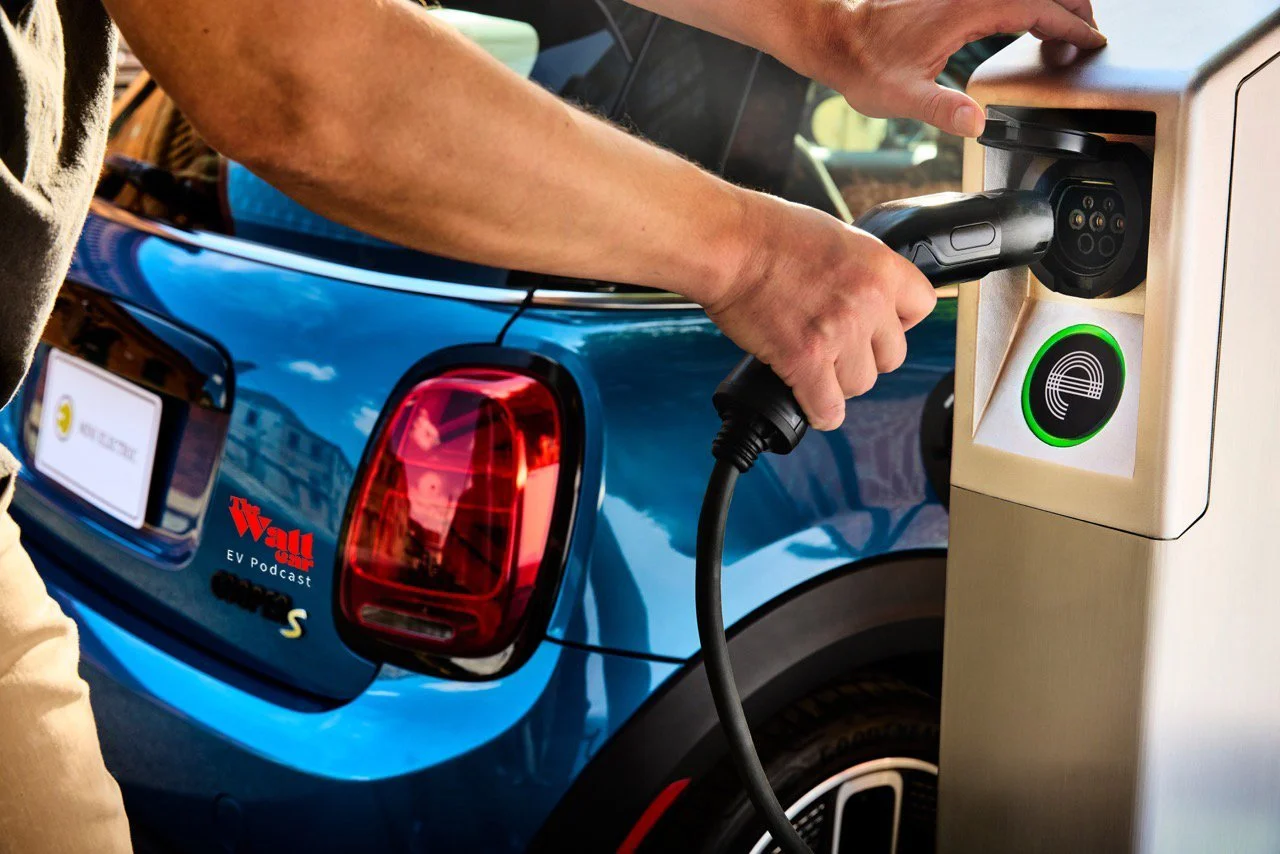
Nathan King and Tia Gordon from It's Electric return to discuss their progress three years after their initial concept of curbside EV charging. Now operating in six US cities with a seventh coming soon, they share insights on how demand has surged and how their bring-your-own-cord model helps prevent cable theft. The conversation covers the challenges of scaling curbside charging across diverse cities, the shift from pitching the idea to cities seeking their expertise, and cultural differences between East and West Coast adoption. They highlight real-world usage data and the evolving landscape of urban EV infrastructure.
This week, itselectric co-founders Tiya Gordon and Nathan King join us on the podcast for an update on their innovative bring-your-own-cable curbside charging company. Over the years, Nathan and Tiya have brought itselectric from concept to reality, with curbside chargers in six cities, with a seventh on the way. And that’s only the beginning.
"We're thrilled to have back on for the third time. Nathan King and Tia Gordon from It's Electric, and this is actually a company I saw going way back."
It's Electric is a company that works on ways to help electric cars charge easily, especially by putting chargers on the street.
It's Electric is a company focused on electric vehicle charging solutions, including curbside charging infrastructure. They have been involved in developing and promoting innovative EV charging concepts.
"something I kind of had some interest in when it was still kind of conceptual, which is curbside charging, which early on didn't get a lot of attention."
Curbside charging means you can plug in your electric car right on the street, like at a lamp post, so you don’t need a special parking spot at home to charge it.
Curbside charging refers to electric vehicle charging stations installed along public streets, allowing EV owners to charge their cars conveniently without needing private garages or dedicated parking spots. This concept is important for urban areas where off-street parking is limited.
"one of the things that I think caught your attention with this was you had an obsession with bring your own cord. Yes, because this is something that Europe has been doing for a while,"
Bringing your own cord means you carry your own charging cable for your electric car, so you can plug it in wherever there’s an outlet, instead of needing special cables at the charging spots.
The 'bring your own cord' concept means that EV drivers carry their own charging cable to plug into public or street-side outlets, rather than relying on fixed cables at charging stations. This approach is common in Europe and allows more flexibility in charging infrastructure.
"just the post they call them ballards in the UK, I think."
Bollards are small posts on sidewalks or streets that can hold electric car charging outlets, so you can plug in your car right on the street.
Bollards are short vertical posts often used in urban environments to control traffic or protect pedestrians. In the UK, some EV charging outlets are integrated into bollards, making them accessible for curbside charging.
""...seeing a greater abundance of EV infrastructure. We're so start moving it here on the east coast that it's very nascent, it's very new.""
EV infrastructure means the places and equipment where electric cars can be charged. Without enough chargers, electric cars can't be used easily for long trips or daily driving.
EV infrastructure refers to the network of electric vehicle charging stations and related facilities that support the use of electric cars. This infrastructure is critical for enabling widespread adoption of EVs by providing convenient places to recharge.
""...there's a lot of often nimbyism when people see chargers go into the ground. And they assume that they, non EV drivers often assume that this infrastructure is paid for with their tax dollars.""
NIMBYism is when people don't want new things built near where they live, even if those things are good for others. Here, some people don't want EV chargers installed nearby.
NIMBYism stands for "Not In My Back Yard" and describes opposition by residents to developments or projects near their homes, even if they may be beneficial overall. In this context, it refers to resistance against installing EV chargers in neighborhoods.
"...d be for everybody. Of course, we argue that the charger is for everyone and we can convert her to EV. But..."
The Dodge Charger is a big car made for driving fast and comfortably. It is well-known for having strong engines and sporty looks.
The Dodge Charger is a full-size sedan known for its powerful engine options and muscle car heritage. It has been a popular choice for those seeking a blend of performance and practicality, and discussions about converting it to electric highlight its cultural significance and potential future in EV form.
"...really quickly and just sort of describe our business model, which is a little bit unique in the level two EV charging world. So we are primarily an owner operator..."
Level two EV chargers help electric cars charge faster than a regular plug by using more power. They are common at homes or public places where you park for a while.
Level two EV charging refers to electric vehicle chargers that provide a moderate charging speed using a 240-volt power source, typically found in homes or public locations. These chargers are faster than level one chargers but slower than DC fast chargers, making them suitable for daily use and curbside installations.
"So we are primarily an owner operator, right? So we install the charger, and then we own and maintain that charger. Most level two chargers are, you know, you're buying them from an OEM..."
This means the company puts in the chargers and takes care of them, instead of just selling the chargers and leaving others to fix or manage them.
An owner operator model in EV charging means the company installs, owns, and maintains the charging stations themselves, rather than just selling the hardware. This allows them to control pricing, upkeep, and customer experience directly.
"Most level two chargers are, you know, you're buying them from an OEM, and you're going to be responsible for setting the pricing and maintaining it if something goes wrong with it."
OEM means the company that actually makes the charger or part, before anyone else sells it or uses it.
OEM stands for Original Equipment Manufacturer, referring to the company that originally makes the hardware or components, such as EV chargers, which are then sold to other companies or customers.
"...being a Tesla owner and predominantly using the supercharger network when I'm out and about. And thankfully, I have home charging in my garage..."
Tesla has special fast chargers called Superchargers that let you fill up your car's battery much faster than normal chargers, making it easier to travel long distances.
The Supercharger network is Tesla's proprietary fast charging infrastructure designed to quickly recharge Tesla electric vehicles on long trips or daily use.
"...and thankfully, I have home charging in my garage. So I'm probably not exactly a target customer, but uptime is so critical to brand image customer perception..."
You can charge your electric car at home by plugging it into a special charger or sometimes just a regular outlet, so you don't always have to go to public chargers.
Home charging refers to the ability to charge an electric vehicle at a private residence, typically using a dedicated charging station or a standard electrical outlet.
"...now on that point in terms of diagnostics, how from a technical standpoint, how would you get notified if there's an issue with one of your chargers?"
Diagnostics means checking the chargers to find out if something is wrong or broken so it can be fixed quickly.
Diagnostics in the context of EV charging refers to the process of monitoring and identifying issues or faults in charging stations to ensure proper operation.
"...Yeah, we do. You know, so we have our charging management system, which all of our chargers are connected to the internet, you know..."
It's a computer system that watches over all the chargers to make sure they are working right and tells the people in charge if there's a problem.
A charging management system is a software platform that monitors, controls, and manages electric vehicle chargers remotely, often providing real-time status and diagnostics.
"...reporting back to the host, the cloud based platform, right? And Tia knows like, I have the dashboard open on my computer..."
It's a system on the internet that lets people check and control the chargers from their computers or phones wherever they are.
A cloud based platform is an online service hosted on remote servers that allows real-time monitoring and management of devices like EV chargers from anywhere with internet access.
"...I've replaced social media with just looking at my charger status updates. And so as soon as we notice anything happening..."
These are messages that tell you if a charger is working, broken, or offline so you know if you can use it.
Charger status updates provide real-time information about the operational condition of EV chargers, including availability, faults, or offline status.
"So there is Neve and then the subcomponent was CFI. So Neve Broadbrush is for corridor charging, fast charging on highways and rest stops."
CFI is a government program that helps build fast chargers for electric cars along highways so people can charge their cars on long trips.
CFI refers to the Charging and Fueling Infrastructure program, a subcomponent of NEVI funding focused on expanding fast charging stations along corridors and highways to support electric vehicle travel.
"So Neve Broadbrush is for corridor charging, fast charging on highways and rest stops. But then there was something that was community charging below that,"
Corridor charging means putting fast chargers along highways so electric cars can recharge during long trips.
Corridor charging refers to fast charging stations placed strategically along highways and major travel routes to enable long-distance electric vehicle travel.
""I'm very optimistic about like some of the work that we see coming out of like Rivian, like the R2 is very exciting.""
The Rivian R2 is a new electric truck and SUV that will cost less than Rivian's first vehicles. It's made to be useful and easy to own for more people.
The Rivian R2 is an upcoming electric pickup truck and SUV from Rivian, designed to be more affordable and accessible than their initial models. It aims to expand Rivian's market reach with smaller, versatile electric vehicles.
""And like even Ford has their skunkworks in California and they're like, oh, okay, let's do a, let's do an affordable pickup truck.""
Ford is a big car company from America. They have a special team working secretly on new ideas like cheaper electric trucks.
Ford is a major American automotive manufacturer with a long history. Their 'skunkworks' refers to a secretive or experimental division working on innovative projects like affordable electric pickup trucks.
""And then also, you know, like Toyota secretly, you know, saying, oh, you know, hybrids are the future, but here's eight new EVs that we're putting out this year.""
Toyota is a big car company from Japan. They made hybrid cars popular and are now making many new electric cars.
Toyota is a major Japanese automaker known for pioneering hybrid technology and now expanding its electric vehicle lineup with multiple new EV models.
"it's such an ugly word, but I'm just going to say ignorance about EVs that some people may kind of say, hmm, you know, I mean, gas is now five bucks a gallon. You know, maybe I should take a second look at EVs."
Gas costing five dollars a gallon means it is expensive to fill up a gas car, so some people might think about switching to electric cars.
Gas price at five dollars a gallon refers to the cost of gasoline fuel, which influences consumer decisions between traditional gasoline cars and electric vehicles.
"I've been drawing analogies to the LED lighting transition. This is kind of in the weeds, but just like bear with me. Like when I started my career as an architect 20 years ago, like the idea that we were all going to switch our incandescent lights to LEDs was like, people were like, that'll never happen. People love their incandescent lights. It's got a warm glow. And then like here we are... I just replaced all the incandescent bulbs with LEDs in my garage like two weeks ago."
LED lights are a type of light that uses less electricity and lasts a lot longer than old-style light bulbs. Many people now use LED lights because they save money and don't need to be changed as often.
LED lighting refers to light-emitting diode technology used for illumination. It is more energy-efficient, lasts significantly longer, and has become the preferred lighting technology over incandescent bulbs.
"Really what we where we like to be and we have a technical term here. It's electric. We call it a juicy corner. A juicy corner is a non metered residential part of side street that intersects with a commercial thoroughfare."
A juicy corner is a good spot to put electric car chargers where a quiet neighborhood street meets a busy shopping street. People can charge their cars while shopping or overnight at home.
A 'juicy corner' is a term used to describe an ideal location for electric vehicle chargers, typically a non-metered residential side street that intersects with a busy commercial thoroughfare. This location allows for both opportunity charging during the day and overnight charging for residents.
"they can do opportunity charging, right? So they can plug in and charge for a few hours, whether they shop or eat."
Opportunity charging means charging your electric car for a little while when you stop somewhere, like a store or restaurant, so your battery gets some extra power without needing a full charge.
Opportunity charging refers to plugging in an electric vehicle for a short period during activities like shopping or eating, to add some charge without waiting for a full recharge. It complements overnight charging and helps extend driving range during the day.
"It's all just like APIs that need to be connected on the back. But at the moment no. At the moment no but if you were to be approached by like a parking service provider it says hey let's talk."
APIs are like digital bridges that let different apps and systems talk to each other, so you can use one app to pay for parking and charging at the same time.
APIs (Application Programming Interfaces) are software tools that allow different apps and systems to communicate and work together. In EV charging, APIs enable integration of payment and access systems across networks.
"We're looking to put chargers where people are already parking for long periods and that's overnight and that's convenient and that's residential. We're looking to emulate that same overnight charging Edward that you're doing in your home for that park on the street."
Overnight charging means plugging in your electric car to charge while you sleep, so it’s ready to go in the morning.
Overnight charging refers to charging electric vehicles during the night when they are parked for long periods, typically at home or residential areas. This is convenient for drivers and helps balance electrical grid demand.
"I fit my favorite quote that the CEC said about us is that it's electric puts chargers where they're hard where it's hard but where they're most needed"
CEC is a government group in California that helps plan and support energy projects like electric car chargers.
CEC stands for California Energy Commission, a state agency responsible for energy policy and planning, including initiatives to expand electric vehicle charging infrastructure.
"...They do not want an attached cable solution. They want something that is attractive and low key..."
An attached cable solution means the charging cable is always connected to the charger, so you don't have to carry your own cable when charging your electric car.
An attached cable solution in EV charging means the charging cable is permanently connected to the charger unit. This contrasts with untethered chargers where users bring their own cables, affecting convenience and aesthetics.
"Canada is really ahead of the curve in terms of like per capita EV adoption rates. Especially certain metro areas."
This means how many people in a place own electric cars compared to the total number of people living there.
Per capita EV adoption rates measure the number of electric vehicles owned per person in a given area, indicating how widespread EV usage is relative to the population.
"Especially certain metro areas yeah. Now that they have just started the process for BYD and I think that's going to be very interesting to watch up there."
BYD is a company from China that makes electric cars and batteries.
BYD is a Chinese automotive brand known for producing electric vehicles and batteries. It has been expanding its presence in international markets, including Canada.
"if our chargers are close to you sign up to get a cable if our chargers are not close enough there with us we're working and getting more chargers in the ground... if you're close enough we'll get you a free cable and you can use our chargers."
A charging cable is the cord you use to plug your electric car into a charger to fill up its battery.
A charging cable is the physical cable that connects an electric vehicle to a charging station, allowing electrical energy to flow into the vehicle's battery.
Select text to request an explanation
This is the What Car Evie podcast for Thursday, March 12th, 2026, episode 261.
It's electric three years later.
I think this is a first.
A first.
First time we've had three time guests.
Three Pete.
Three Pete.
There you go.
Which is quite exciting because we were just discussing before we get into all of this
since how long it's been since we've had these guests on and it's been just over a year.
And a lot has happened in the last year, both I'm sure with the company and also, I don't
know, America.
So there's been a variety of things.
I'm very curious as to what's going on.
I'm Phil Royal.
I am one of the podcast hosts here who tells people to go to youtube.com slash at the What
Car.
And also youtube.com.
No.
TheWhatCar.com slash store and I'm awful at this and buy a paraphernalia that helps
support the podcast.
And I would say the blog, but we've just run away and abandoned that at this point.
Ed Sanchez, we are coming up, if not upon five years, almost exactly podcasting.
Imagine that.
Wow.
Hard to believe.
Yeah.
I much prefer saying the five year number rather than the number of years that we've actually
been doing automotive content.
Yes, which is a ways, quite a while.
Anyway, so without further ado, so if you've been following the What Car for a while, you
will recognize our guests today.
If you have not, we'll make this introduction.
We're thrilled to have back on for the third time.
Nathan King and Tia Gordon from It's Electric, and this is actually a company I saw going
way back.
I think, I don't know if I'd say since their inception, but I'd say close to it and something
I kind of had some interest in when it was still kind of conceptual, which is curbside
charging, which early on didn't get a lot of attention.
I didn't feel or didn't get the amount I thought it deserved, but it is it definitely
is now and they've got some big news to share with us today.
And I'm sure this is going to be a very interesting discussion.
So Nathan Tia, welcome.
Hello.
So we'll see how that works, we've got some, we'll see how the audio works on this.
But Ed, just real quick, backing up, one of the things that I think caught your attention
with this was you had an obsession with bring your own cord.
Yes, because this is something that Europe has been doing for a while, where they would
just basically have effectively an outlet either on a lamppost or just the post they
call them ballards in the UK, I think.
And so so people just bring their own cord, plug in and some cities, you know, London
parts of the UK and parts of Europe, this is very common arrangement.
And one of the advantages to it is one thing we've seen, unfortunately, in some parts of
the US is cable theft and vandalism.
So this kind of takes that out of the equation, because there's no cord to cut or vandalize.
So I thought it's a pretty genius idea.
So this is curbside, we have to bring your own cable.
And that just got Ed's nerd mind going about how this could work.
So Nathan, Tia, like, what's what's been going on?
Yeah, since what was August?
So there'll be some links in the show notes, as I always say, to the last two episodes,
which was one was in May 23, that was first time, and then August 2024, which was the
last time. So I don't, you know, if I were better at this job, I would have listened
to the last episode. I don't remember exactly where we left off a year and a half ago.
Yeah, I have that. Remember that interview pretty well.
I actually recorded it. I was in Boston when we recorded it.
I'm pretty sure we hadn't yet announced our Boston RFP win, but at the time we sort of
knew about it. And I think that that was kind of the big news for us. That was our first
big contract. We had also won a big federal grant back then that we knew about, that we
were starting to figure out how to deploy. And some of the fruits of that grant are have
kind of been developing more recently. But just really high level, I love this kind of
like, you talk to us when we were still in the concept design phase, like when we didn't
have anything, we were just still kind of a concept in a deck. Then you talk to us when
we had a product ready to go, but we hadn't really put any chargers in the ground. And
you know, we were just sort of like, you know, being coy, you know, we'll have some big news
coming up. Now we're happy to say we have chargers live in six US cities. These are proper curbside
chargers in six US cities. I can rattle them off. A seventh one coming soon, which we will be excited
to announce. And you know, for us, this is a lot of great progress that we've made.
You know, we've now, we are confident in saying that we've proven that curbside charging is a
thing that it's possible. And that a lot of our drivers are really starting to enjoy it and use
it. Yeah, we like to say, you know, that it's electric is going to be curbside charging for
a country that does not yet know what curbside charging is. And so we, you know, some cities we
come into and people are ready to go literally. It's a massive amount of signups. Dozens in the
first week that we went live in DC, we have 100, over 100 users in San Francisco, we have
insane utilizations. In San Francisco, we're hitting 70% does of last month.
It's really just been an amazing process to go from here's a solution to could this work to
cities saying this is what we need to actually getting emails from drivers. We have some of them
on our website because they warm our hearts because they say this is exactly what we needed.
This is a simple solution. This is easy. This is close to where I live. So kind of get that full
circle of having an idea and going through the labor of getting it out into the world and then
actually having users that love it is very surreal. It's happens so fast, you know, because you have
to make the product. The product has to be certified when the contracts you have to do so much labor
to get these charges into the ground. But it's our goal that no one knows about that. And they just
magically pop up. And that's what we keep pushing to do. Just like flowers in the spring.
What when when you go back like to the early days and early days. Yeah, well, yeah, and
really early. Yeah, the really, really early days when you when you didn't have a product,
you had an idea, you had something you were pursuing and you could see probably you could
undoubtedly foresee several problems that you're going to have to tackle. Now that you've got
actual like product customers, people using these, like, were you about right with your
guess on what would be problematic, what would be easy? Or was there just like,
wow, we completely missed like, I was anticipating this would be a problem. And the big problem was
actually this over here, not this other thing. I'll start by saying that the weird thing is is
that you know, we're technically a startup. And a lot of startups go through pivots, like the product
changes, the business model changes. As I was building, you know, our most recent deck for
some presentations, I always allow myself like 30 seconds of nostalgia. And I'll go back and look
at like our very, very first deck just to kind of look at that contrast. And literally nothing
changed. Like, like, we're doing exactly what we said we were going to do with business models
exactly as we said, the benefits are exactly what we said they were going to be. And then
what's changed in the last, you know, legally four years since we were a concept is demand.
It's just shot up even with federal headwinds, even with OEM stumbles, the demand is just
massive in the United States right now. Yeah, I'll follow on to that, which is to say,
I'm fond of saying that what we do isn't really hard, it's just complicated, you know, like
figuring out, you know, how to get rockets into space is hard. But what we do is very,
very like pedestrian, right? Like we're digging a hole and we're sticking something in it.
And we're doing that over and over again. And so there isn't really anything like that's
fundamentally difficult about what we do. It's just a complicated problem. And the thing that I'd
like to remind people is like to solve a complicated problem, you just have to have the right formula.
And once you know what the formula is, the complicated problem becomes less complex.
Now, I don't want to say that it's, I just go from city to city, and it's the same formula,
like the thing that we are solving now is like, well, the differences, the subtle differences
between Boston and Los Angeles, like there's the utility is different, the permitting process is
different, the way people react to you, you know, having a parking space with an EV charger in it
is different. There's lots of, there's lots of little shifts and things that you have to kind
of adjust for. But, you know, the problem that we're solving isn't really that difficult if
once you have the right way of going about doing it.
One thing I'm kind of curious about is I'm sure in the early days because it was so conceptual
rather than like, you know, in the ground like installed, like actual real world use is,
I imagine there are some people that got it immediately and they were like, yes, this is
exactly what we needed. This is awesome. Where there are others that were a little more skeptical
and like, well, I don't know, you know, you don't have any pre-existing customers,
you know, we're not sure about this. Now you can say, oh, we got customers here and here,
we work with these cities. So in terms of like references and referrals that you can, you know,
point to for new accounts or new municipalities, you say, hey, feel free to talk to them. They
can tell you the whole process and what their experience was. I wonder if you could speak a
little toward that. I'll kick this one off, which was three years ago, we were approaching cities
and trying to figure out how they were thinking about curbside charging.
Now it's a little bit the other way around. Cities come and start talking to us about how
we think curbside charging should be done. Of course, we have our thoughts, right?
So absolutely, it's a totally different conversation to be talking to a city when you
already can point to, well, you know, you could look at these chargers that we already have in
Boston, like it's a very, very different conversation. And then we can sort of cite these
real world examples of, you know, oh, you know, in this case, you know, you know, we noted that
we saw a lot of people charging overnight. And we're, and it's not just something that we're
speculating about. We're like, well, actually, we can show you that 65% of the charging is happening
from 9pm to 9am, you know, and so we can start to point to things that help those cities think
about how they craft their policies around curbside. Awesome. So one thing I wanted to get is early on,
I mean, for people that don't know your headquartered in New York City,
initially one of your first, I guess, big deployments was in Boston,
but I was looking through your press releases more recently, and you've had a lot of activity on
the West Coast. So I'm wondering if you could speak to that and kind of what that experience has
been like and how, either culturally or logistically, how it's been different than dealing with east
coast cities? One word is no. We can start there. But it's electric is a nationwide solution. We
were never designed just to live on one coast. We're designed to be anywhere where there's
just an overwhelming density of street park cars. And that's LA, that's SF, that's Boston, that's
DC. It's everywhere. So, you know, to Nathan's point, there's some cultural differences in
terms of people just get it on the West Coast a little bit faster because they're used to just
seeing a greater abundance of EV infrastructure. We're so start moving it here on the east coast
that it's very nascent, it's very new. And the fun part is that, you know, we try and take that
culture into consideration. So a great example we can tell is there's a lot of often nimbyism
when people see chargers go into the ground. And they assume that they, non EV drivers often
assume that this infrastructure is paid for with their tax dollars. And since they don't drive an
EV, there can be a little bit of attention around that. So we had that in one of our cities on the
east coast where there is some local pushback of a particular citizen on the block that said,
you know, I'm not for this because I don't drive an EV and I don't want my tax dollars going towards
a specific cohort of people in the city that is not me. It should be for everybody. Of course,
we argue that the charger is for everyone and we can convert her to EV. But in the meantime,
you know, you can go about these sort of small protests in a lot of different ways.
And we thought the best way to do it would be with a little bit of fun. So we made these really,
for lack of a better term, cute stickers of bright orange cats wearing collars that had
dollar signs on it. And then there was a big bubble around the cat that said this EV charger
cost taxpayers your dollars. And we put that on our Boston chargers. And another Boston property
owner who had a charger in their neighborhood liked our sticker so much that he was a designer and
he made a sticker of his own that said the same exact thing, but it had this great graphic of his
house behind it. And so what we're finding is that we always imagined this, that we would be
neighborhood charging solutions, that even though we're this national brand, that we're going to
be this big company, that we truly become this little neighborhood solution, that people really
feel ownership to it, that they really want the chargers to be just like the same way that you
have your local neighborhood restaurant. People take care of these chargers without even us asking
because we take care of snow removal. One of our property owners, you know, shoveled the charger
out during the blizzard, like, because everyone uses it. This is an amenity in the neighborhood
that makes their quality of life better. And so we really love this whole, we kind of take a page
from Sesame Street and we say these are the chargers in your neighborhood. And that we really
want everyone to feel like this is their neighborhood charger, like that's your bodega,
that's your coffee shop, these are your chargers. And that's really been also one of the best parts
of the last year is really seeing the culture pop up around the chargers. I was just going to say,
I think that was kind of one of the genius aspects of your whole concept was kind of empowering
private property owners. And I mean, I don't know if you could have, you know, foreseen kind of the
political wins going the way they did. But it's almost like you already have a predefined narrative.
And, you know, I know that that term is thrown around, you know, very loosely, and it's kind of,
some people see as kind of stilted, but it's a true story where people to say, well, you know,
I don't want tax dollars spent on this, you could approach them and say, how would you like to make
money off this? And they're like, Oh, tell me more, you know, so I think that to me, that's one of the
most unique aspects of your business model. And I'm sure it sounds like you've been able to change
a lot of minds with that, as opposed to, you know, these massive, you know, large scale
infrastructure products that required, you know, digging up the road and, you know,
putting in huge transformers and, you know, all that sort of thing. I'm wondering if you have
any stories you could share on that. Oh yeah, the best compliment we get is that when we have a
ribbon cutting, we really try and make it fun. We invite obviously everyone in the city, on the
city side, on the gov side, on the DOT side to come cut the ribbon with us on the utility side,
if they were involved in any part of the process. And it's a big affair. And the best compliment
that we get over and over and over again is people show up for the ribbon cutting and they say,
where's the charger? Because it's so subtle, and it just sort of blends in that people don't even
see it. And that's what we want, because there's so much nimbyism in cities. People do not want
big, garish pieces of street furniture in their residential neighborhoods. So
we love when that happens. I don't know if you have any other
clogged stories, Tom? I'm going to pull it out into kind of a wider lens really quickly and just
sort of describe our business model, which is a little bit unique in the level two EV charging
world. So we are primarily an owner operator, right? So we install the charger, and then we own
and maintain that charger. Most level two chargers are, you know, you're buying them from an OEM,
and you're going to be responsible for setting the pricing and maintaining it if something goes
wrong with it. And, you know, it's a very different model of what we're doing. And because we have
that owner operator model, like we're very, very conscious about to put it in kind of blunt terms,
like we want to maintain our brand. We want people to think that we've got something that
works nicely, it plays nicely in their town, and isn't going to be too disruptive,
and also stays on and working, right? Like I think, you know, for us, if the charger is down,
we stop making money. And so it's on us to make sure that that charger is, you know, as soon as
anything starts to happen with that charger, we have to jump into action and make sure that it
gets fixed. If people are encountering our chargers and they have a bad experience, like we may never
get another chance to have that driver come back and use it. And so it's really important for us
to sort of have these, these aren't just fun things we're doing because we can, you know,
these aren't just marketing stunts. Like it's really, really important for us to have a product
and a service that people really like and people really want to use because it's not like we've
made the sale and we're walking away from it. Like we've need to keep making the sale for another
10 or 15 years. So, you know, that I think positions us slightly differently in the industry and
makes us kind of a weird fit. But for curbside charging, it's the fit you need, right? Like
you have to kind of have these approaches because it's very different putting something on a public
city street than putting something in a parking garage. Yeah, I can't tell you just, I mean,
thankfully, and again, I'm not trying to make a statement with this, but being a Tesla owner
and predominantly using the supercharger network when I'm out and about. And thankfully,
I have home charging in my garage. So I'm probably not exactly a target customer, but
uptime is so critical to brand image customer perception. I can't tell you, not with my car,
but when I've gone out with other friends with, you know, other EVs come up and you look on a
charger, it says out of service or, you know, it has an error message or something. I mean,
it's just kind of such a crap shoot. And I could see why that would turn people off to EVs all
together. They'll just say, you know, nine times out of 10, when I go to a gas station, I know it's
going to work. I know the procedure. You know, it's easy to understand this. It's like, it's like
gamble if it's even going to work in the first place. And you know,
so yeah, now on that point in terms of diagnostics, how from a technical standpoint,
how would you get notified if there's an issue with one of your chargers? Do you get,
do you have a team that like say, oh, we got a little, got a red flag here, we need to
send someone out, take care of this? Yeah, we do. You know, so we have our
charging management system, which all of our chargers are connected to the internet, you know,
through a cell connection. And so they're continuously reporting back to the host,
the cloud based platform, right? And Tia knows like, I have the dashboard open on my computer,
or like I've replaced social media with just looking at my charger status updates. And so as
soon as we notice anything happening, like, you know, usually I know about it, but like,
there's other people on our team that are also monitoring this and emails get sent. So if a
charger goes offline, you know, we get an email. And, you know, like the last one I'm remembering
was where we were kind of freaking out was actually like, our neighborhood in San Francisco, the
power went out. We were trying to figure out what was going on, what was going on. And then our
second line of defense is also just the, the property that we're connected to and our drivers.
And so almost as soon as we noticed the chargers going offline in San Francisco, we started getting
emails from like our host property. Oh, yeah, the power just went out, you know, or drivers or
we'll say, Hey, I noticed that your chargers off, but also like the streetlight or the traffic signal
is off too. And so, you know, like, so we, we find out about it. That's a very extreme example.
There's a robust back end, there's 24 hour customer support, we have an operations manager who's
Magic. And as a small team, we're all monitoring these to make sure that there's a smooth customer
experience. There's always kinks, I wish there wasn't, right? So, you know, we work through those
and, you know, once drivers get their cables, they are just elated. And they're charging. And
the thing I want to point out, I know we wanted to talk about this maybe Edward was BYOC bring
your own cable. That's absolutely first of the kind in North America, you know, we have a certified
product for US for Canada. And everyone, that was a lot of consternation on behalf of the world
when we were starting, like we were, we were, we were taking, I would never even, we took a very,
very clear view on detachable cable winning in the US. And of course, there's always a pit in my
stomach that we're going to have a lot of bad actors, people that we're going to ask for the
cable and then lose it 17 times. And don't put any ideas people that yeah. But, you know, we've
distributed over 400 cables, we've had one person misplaced their cable, which I truly believe that
they misplaced there, or they left it somewhere at an Airbnb or whatnot, you know. And so yeah,
people, you, when it's your thing, you treat it a lot better when it's a public thing.
Yeah, you take more ownership of it. Yeah, you take, it is your freedom to be able to charge in
your neighborhood. We're not going to misplace it, you're not going to just drop it on the ground,
you're not going to run over it, because you need this to be able to charge your vehicle.
So I think that there's a stroke of brilliance in the psychology there that no one really thinks
about, you know, public infrastructure very kindly. And it's a nice little sort of, you know,
sigh out move on our end to give people this personal possession that allows hook into public
infrastructure, but that thing is still theirs. Yeah. So I wanted to just shift gears a little bit.
So the big, at least it seemed big to me, I don't know if this, but the whole Neve funds issue,
and you know, the Trump administration's their attempt at trying to claw that back.
But then there was a court order that said, no, you must release these funds.
Did that really affect you guys one way or the other very much? Because your business model is so
unique. I mean, maybe, I mean, I'm guessing either it was a non-issue or it was kind of secondary.
I'm wondering if you could speak to that. Sure, I can start. So I mean, the Biden era,
the Biden administration puts a lot of work and a lot of funding into scaling infrastructure across
the country. So there is Neve and then the subcomponent was CFI. So Neve Broadbrush
is for corridor charging, fast charging on highways and rest stops. But then there was
something that was community charging below that, which was 2.5 billion that was allocated for urban
and rural. And within that 2.5, you know, we had applied for and painstakingly submitted
very well, very considered, very well researched grant applications. And we were awarded a lot of
great projects for lack of a better term. So DC, some work in DC was, you know, a very big grant,
our ride and drive grant, which was to basically build what was known as a curbside charging toolkit,
which was basically like, here's everything we've learned, and we're going to publish this
white paper and then everyone else can understand how this can work in urban context. And we were
doing that by putting chargers in five different cities. And even though, you know, the word of
the term of art is uncertain, is what you have to use around this right now. You know,
there's still funding that is awarded to us that will sit in someone's crypto account until the
foreseeable future. But it'll be rewarded back to us. Sorry. You know, we built a pipeline that
always treated that federal funding as nice to have, and didn't rely on it. So that we were never
put in a position where if that federal funding got cut, there was immediate sort of like,
you know, access that dropped on its electric, because we couldn't risk that
tidy. We couldn't have that level of risk to our city and to our projects. So yeah.
I'll say like, I'm at the point right now to where I'm firmly convinced that these kinds of
headwinds versus tailwinds are cyclical. And, you know, right now we're at like peak headwinds,
right? Like just like everything in the current sort of culture and administration seems to be
pushing back on, you know, EVs and clean energy and things like that. But I think it's starting
to tip in the other direction. And, you know, and I'm not celebrating the fact that gas prices
are going up for people. Like, you know, it's like it's not good. Like people, it's already too
expensive to live in this country. And if you have to pay, you know, 20% more to fuel your vehicle,
like that sucks. It shouldn't be happening. But like it is a reminder that like a fossil fuel-based
fueling system is going to be super vulnerable to like these global shifts that just like they seem
to happen every, you know, four to six years. Like, you know, I'm 50. I've lived through a bunch of
these sort of mid-east conflicts. They seem to come around every kind of administration, you know,
like it just seems to happen. And, you know, it reminds people that like, wow, if I'm just kind
of relying on a more stable fuel source that doesn't have, you know, huge, huge price spikes in it,
you know, then this is a more predictable way to live. And so I anyways, I think like we might be
sort of, you know, coming off of a peak Talwin's period. And as some of these court decisions get
reversed, you know, we might start to see more positivity. I think that there were a lot of
missteps about the automakers. And I just actually was talking to a friend of mine yesterday and I
had like a 30-minute rant. I didn't know I had inside me. But like I'm very optimistic about like
some of the work that we see coming out of like Rivian, like the R2 is very exciting.
We're big fans of Slate Auto. I don't know if you've covered the Slate Auto, but like that,
I can't wait for those. I can't wait to have a crank on my, I just like, I'm just really looking
forward to that. And like even Ford has their skunkworks in California and they're like, oh,
okay, let's do a, let's do an affordable pickup truck. Okay, great. I think we might start to
be getting on the right track. And then also, you know, like Toyota secretly, you know, saying, oh,
you know, hybrids are the future, but here's eight new EVs that we're putting out this year. So
I try to just sort of like stay above it, you know, like right now we've got like the vibes
are bad for EVs. I get that. But I also think like, oh, you know, a year or two from now,
vibes might be pretty good for EVs. And you know, then we look smart. But you know,
anyways, that's kind of how I'm trying to think. No, it's kind of funny. Phil and I were actually
just talking about this the other day about, you know, what's happening in the Middle East right
now. And we were talking about historical oil prices. And historically, as of now, and as of
now I say, as we're recording this, they're not near an all time high. That was 2008 and 2022.
That were the all time, you know, price per barrel hit a high, but we're already at a one year high
right now. And who knows how high that's going to climb. And at some point, I feel,
you know, despite all the fun, you know, it's such an ugly word, but I'm just going to say
ignorance about EVs that some people may kind of say, hmm, you know, I mean, gas is now five
bucks a gallon. You know, maybe I should take a second look at EVs. So to your point, I think
there is sentiment and I think that can be influenced by, you know, fuel prices,
you know, a lot of other, a lot of other factors that aren't maybe directly political. And
thankfully, I almost see EVs becoming less politicized as they become more mainstream and
more familiar. And I think a part of that is charging visibility. And I think, you know,
you guys are a big part of that is the more they're more they're seen as like commonly available
and like not weird and exotic. But like, oh yeah, you know, I could totally on one of these,
you know, I think that's a big part of it. Yeah, I mean, this like for me, the fundamental is like
if you have access to convenient charging, it's like EVs are better. They're just like, I think
that that's what happened to me. Like once I started driving, I was like, I'm never driving a gas
car again. Like I don't like this is just the better way to do it. And I have to kind of struggle
to still to find EV chargers in New York City, like it's still kind of a big challenge here.
But I'm still like no matter what, I will never go back because I like, I like driving this machine.
And I like not having to go to gas stations, you know, I like just being able to come to work
and find a free charger when it's available and plugging it. And that's how I do it. But, you
know, I just I think that the better product wins out, you know, I've, I've been drawing analogies
to the LED lighting transition. This is kind of in the weeds, but just like bear with me. Like
when I started my career as an architect 20 years ago, like the idea that we were all going to switch
our incandescent lights to LEDs was like, people were like, that'll never happen. People love their
incandescent lights. It's got a warm glow. And then like here we are. And actually, like,
or would you even want to, right? Like I got to place it in three months. Like it's just not
like an LED light is has the same qualities as the old product. And it lasts, you know,
10 times longer. Like why would you spend $3 on a thing that's going to fail?
It's like one sixth the amount of energy. Yeah.
Yeah. And what's actually amazing is the lighting industry in the United States. You would think
that like, okay, people only need to buy one bulb. And then, you know, they never need to replace it.
So like, oh, we don't need as many bulbs. And so the lighting industry is going to collapse.
But it's actually like something four times as large in the US as it was like 10 years ago.
Like the fact that it's a better product has led to more economic development. Like, and so I seek
myself in this kind of like, we are helping develop what is fundamentally a superior product to
what's out there today. And that fundamental thing is going to over the long term kind of win out
over the old technology. It'll take time. It's not, it's not like it's everything is perfect today.
But like it's, it's there. It's already in a lot of regards better than the old way.
Setting aside towing things in pickup trucks, I understand that.
Yeah. But as we've discussed exhaustively.
As you guys talk about. Yeah.
It's funny you mentioned the LEDs. I just replaced all the incandescent bulbs with LEDs in my garage
like two weeks ago. And I've gone from like six sets of incandescent things. I put four
sets of LEDs in. I only keep two of them on because they're so much better. And it's,
exactly that. It's like this technology comes along and I've kind of fought it and it's like,
ah, but what I've got is already so easy. It's already there. You know, it already works.
And then I replace it. I'm like, wow, I needed like a third of what I had. It lights better.
It works better. It's cheaper. I should have done this years ago.
Yeah. Like, like what a fool am I that I've been battling this like in cold temperatures,
they don't turn on like all of these downsides that I just overlooked. And you know, here I am now
singing the praises of LEDs in my garage for people to hear. But back to the government funds and
everything. I've been saying like, as I see new companies come up or whatever, that I think,
I don't know, who even knows how many times I've said it, that I hope that the companies that are
coming in are not relying on those government funds. Because as soon as something happens,
like, that's when they'll just disappear. So I'm really happy that you guys built a plan that
can utilize that but doesn't rely on it.
It's not relying on it. Yeah.
Yeah. Because that's especially in these days, like you just like people can, yeah, they can
wind up and wake up on the wrong side of the bed. And the next thing you know, like everything that
you thought was guaranteed is out the window. So I, this is, I mean, maybe this is too abstract
or conceptual right now, but I'm wondering if you've looked at or have been approached by other
companies. So along with curbside parking, there's like, you know, if you work in conjunction with
like parking meters, I know a pretty, one of the bigger parking service providers at least
out here on the West Coast is Park Mobile. I know if you've heard of them, but a lot of times it's
just like an app base, like you park in a space, you either type in a code or you scan a QR code,
and it basically has got the meter running. Either, if either you've approached companies
like that or they've approached you that said, Hey, let's try and work together so we could
kind of kind of have a two for one thing. So like if people, you know, if it's a paid parking space,
they plug into charge. If you can kind of tie that in with parking payment or how you kind of
foresee that working if that's still kind of in the concept stage. Sure. The short answer is no.
And I think there's one big reason why, which I'll explain. And then like the
follow up clarification to that, which I'll give now is that's probably something that we'll look
at in the future. But like at the moment, when we think about curbside charging as being this
experience for overnight charging, so for like the curbside charging is at home charging for
people without garages, that's happening on streets where you don't have parking meters.
So we might have like a neighborhood permit or something. Yeah. Or but if you have a neighborhood
permit, then you're one of the EV drivers that parks in that neighborhood anyhow, right? Like so
that that's kind of one of the things that we're we're this is one of these like narrative things
that we've been working on over the last three years is like put the charger as close as possible
to where people are already parking their car, right? Don't put a charger somewhere and then
expect a bunch of people to go there, especially for level two. You want to co-locate parking and
charging. And so that usually means that we're not on a metered street because a metered street,
nobody is parking there for too long anyhow, right? You don't see overnight usually at most like two
or three hours. Yeah. And these are the the commercial the commercial boulevard things like
that. Really what we where we like to be and we have a technical term here. It's electric. We
call it a juicy corner. A juicy corner is a non metered residential part of side street
that intersects with a commercial thoroughfare. That's really the perfect place to put the
chargers because then we can have chargers that are just you know just one left hand turn
onto the side street for people who are going coming to that busy commercial district during
the day and they can do opportunity charging, right? So they can plug in and charge for a
few hours, whether they shop or eat. But then all of those people go back to their neighborhoods and
then you have your drivers who live in the neighborhood who park their car in that same
spot overnight and they plug in and charge. And that's really the juicy corners where we
see the highest utilization when we go back and we look at which chargers are doing very well.
That's you know our chargers in San Francisco are kind of like that. It's on a residential block
but on that corner there's like a restaurant on the other side of the street. You know like
that's the perfect place for us. And so that's where we what we look for. And then we don't
really want to be in competition with metered parking. You know like that's that's not really
where we think we're going to see good utilization anyhow. That being said like to make a larger
point we want there to be an easier customer experience for for drivers, right? Like it's
like I'm an EV driver. I have a folder on my phone that's just all EV charging apps.
And like we're gonna that's not how it's going to be in like six or seven years. Like it's
going to be you're just going to like have a way to charge that is not like pulling up an app.
That's going to be across all the different networks. But like that's complicated and that's
going to take time. But you know the same app that you pay for parking. Yeah pay for the curbside
charger like why not like it's all just like APIs that need to be connected on the back.
But at the moment no. At the moment no but if you were to be approached by like a parking
service provider it says hey let's talk. Yeah sure sure awesome. So on on that note kind of
you know what you what's your primary market. Have you looked at an expansion beyond curbside to
either destination or you know retail you know restaurant shopping or is your feeling like
that market saturated enough we have our niche that we're growing very successfully we're going
to stick with that for a while. I mean I can jump in yeah like I said we're looking to put
chargers where people are already parking for long periods and that's overnight and that's
convenient and that's residential. We're looking to emulate that same overnight charging Edward
that you're doing in your home for that park on the street. So that's our that's our sweet spot
that's where we focus and that's literally where we have a green field. We have very little competition
for curbside in the United States because I fit my favorite quote that the CEC said about us is that
it's electric puts chargers where they're hard where it's hard but where they're most needed
and that's absolutely true. It's really easy to put a bunch of chargers in a shopping mall
parking lot. It's really hard to put chargers on curbs and densely populated. It's not hard.
It's not hard. It's actually it is non-marked. It is just complicated. It's complex. So no
the only exception I will make to that answer is that we do get a lot of inbound from people that
just want a good looking charger in their parking lots. They do not want an attached cable solution.
They want something that is attractive and low key. So you know where the official charging
solution for Governor's Island here in New York which is a car-free island but we charge all
other fleet vehicles that moves their compost and their construction materials around. So
there's a way for us to be in different contexts in different typologies. Our charger can easily fit
into a parking lot. That's not a problem for us at all but we're really designed for that curbside
context and it's again we built our own industry. You know our founder backgrounds which we didn't
really talk about too much. I already mentioned I'm an architect which I'm fun to do but you know
Tia's comes from the world of design. So like the DNA of our company is really kind of oriented
around this. It's got to look good right. It's got to fit in and I don't know that necessarily the
EV charging industry has necessarily been oriented around this idea that the charger has to look
really nice. So like we kind of approach it like that again not as a nice to have like it's fundamental
to what we do. Your charger has to look nice or people are going to reject it. They're not going
to want it in their neighborhood. And so we do see interest like from the likes of you know the
trust for Governor's Island for using our chargers in an off curbside context just because it's
compact. It looks very nice. The power you know it's building power. When it's when the cable is
not attached to it it's very clean and it's almost invisible as Tia sort of mentioned before.
And so we do kind of see like longer term opportunities just because like you might have
a private property owner who's very concerned about the appearance and the look of their
property and they don't want to have like cables you know draped on a hook or being left on the
ground because it doesn't look right. So you know that's kind of inbound interest that we're sort of
from these other sort of like non-municipal sort of application. I'm thinking like upscale resorts
or hotels potentially yeah something like that. Or even cities we made an announcement in November
that wherever placing in Los Angeles the curbside blink chargers which are all our all our attached
cable solutions and this was getting to a point where they were having to replace cables where the
size sometimes was almost daily. Oh jeez. And so it's design matters on a wide variety of degrees.
So you know we're really excited about the detachable cable solution for all convexes.
Yeah I know you mentioned kind of in passing you mentioned Canada I think more from kind of a
regulatory kind of standard standpoint but and you may not be able to answer this at this moment but
any plans for international expansion or have you had any inquiries or any interest in going
beyond the U.S. Plan on January 17th 2025. I will tell you that it's under NDA but we do actually
have a charger operating in Canada right now. You know like the skepticism about detachable
cable was like well what if the you know what if it gets cold and we're like oh no you know we've
got chargers you know here in New York that have gone through you know a couple of you know 10 degree
or 8 degree days and they're like no no negative 40 is what we're thinking about. Yeah we're not
8 degrees like negative 40 and so the we've been subjecting that charger to some extreme Canadian
cold I don't know if it got down to negative 40 quite yet but like again detachable cable is kind
of nice because one of the problems in that really really frigidly cold weather is the cable gets
really stiff and difficult to work with and so now you're taking on a nice warm cable and it's
very you know client it's pliable but yeah no we're interested in Canada we have our
certifications hardware certifications for Canada in place. Canada is really ahead of
the curve in terms of like per capita EV adoption rates. Especially certain metro areas.
Especially certain metro areas yeah. Now that they have just started the process for BYD
and I think that's going to be very interesting to watch up there. Well guys I know we're coming
up to the top of the hour I really really love catching up with you guys and finding out what's
new I'm really happy for your success like I said I think this is something that's been needed for
a long time and you guys are making it happen and can't wait to have you on again in a year or so.
Yeah I'm vision casting you know like you know the amount of progress that we make each time we
come on the on the podcast so yeah we have to have one on the books next time and we're like oh
my god I can't believe we only did this and this. And for any EV drivers or aspiring EV drivers
we've got Chargers Live from Boston DC LA San Francisco Alameda Detroit so if you want
charging if our chargers are close to you sign up to get a cable if our chargers are not close
enough there with us we're working and getting more chargers in the ground so that's just my little
cta if you want to put that in the show notes as well. Yeah so that was that was going to be my
question is how do people find out more information website any social media. It's electrics.us
and that also show you our handles on instagram and on linkedin and yeah and we'd love to just
you know we love all of our drivers we're so excited every time we get new signups we send
really good swag with our cables fysna so. Hello it's electrics.us shoot us an email if you're
if you want to know where our chargers are and if you're close enough we'll get you a free
cable and you can use our chargers. Awesome. All right well thank you very much. Thank you guys. Thank you.
Request an explanation for:
2 cars
2 cars featured
Request an Explanation
Heard something you'd like explained? We'll add it to this episode.
Sign in to request explanations for terms you heard.
Want to learn more?
Browse our glossary for plain-English explanations of automotive terms, jargon, and concepts.
See something that's not quite right? Our annotations are AI-generated and can sometimes miss the mark.
Click the flag icon on any annotation to suggest a correction.