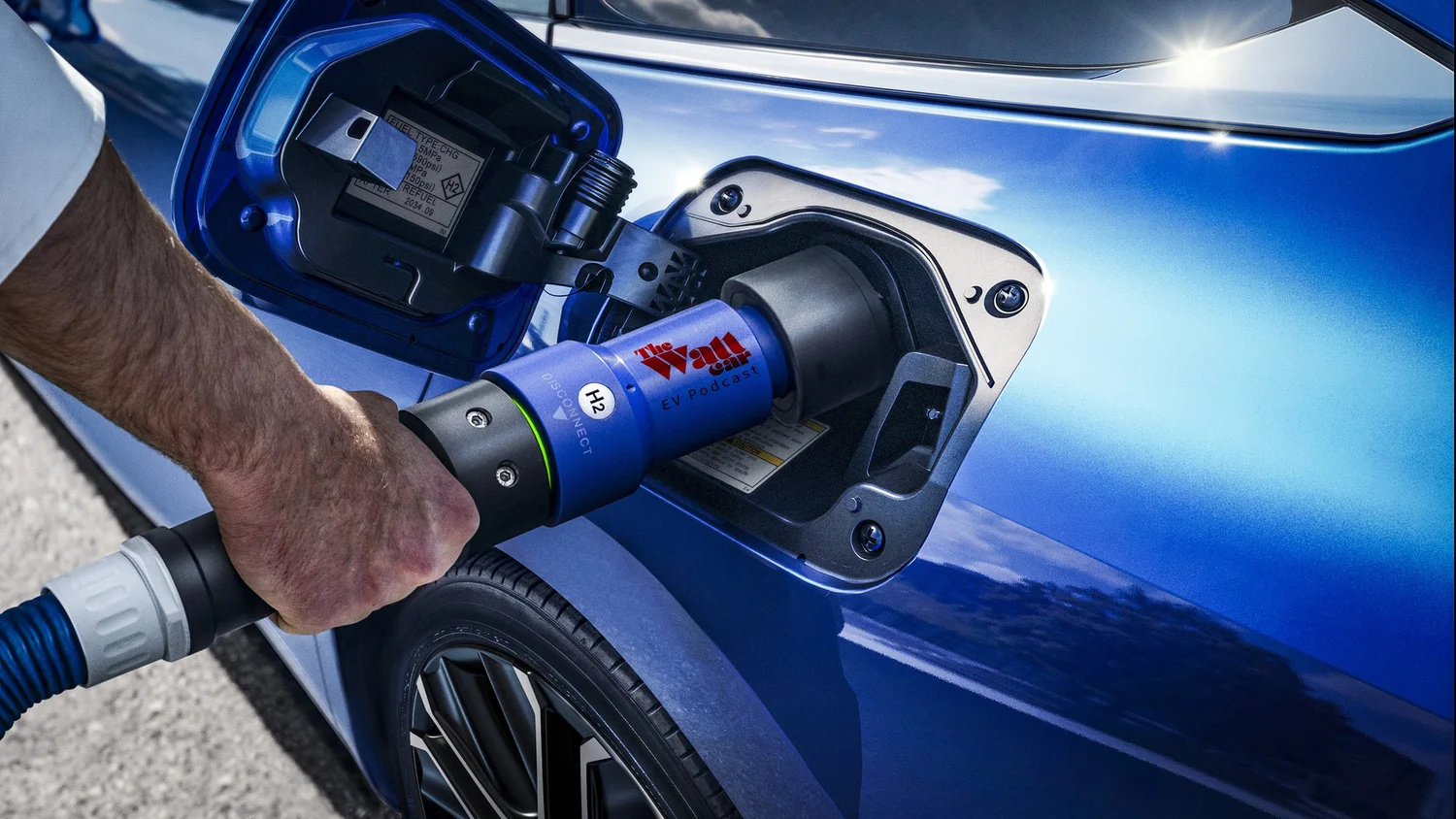
264: 10 Years of Fuel Cell Ownership
About this episode
Hydrogen fuel-cell ownership gets real with Andrew Fisher, who’s been driving a Toyota Mirai for 10+ years. The hosts compare early “free fuel and perks” incentives to today’s California reality: hydrogen prices that spiked dramatically, shrinking station availability, and occasional outages that leave drivers scrambling. Andrew shares practical fueling lessons (nozzle locking, occasional freezing), rat-damaged wiring issues, and the emotional toll of relying on a limited network. He’s still hopeful for niche use cases, but admits his future may be EV or hybrid.
This week, we speak to someone who has lived the fuel cell lifestyle for 10 years and is now at a crossroads. From gen 1 to today, Andrew Fisher has parked three Toyota Mirais in his driveway. Revealing the good, the bad, and the ugly, Andrew recounts his ownership experience and offers his advice as to whether YOU should consider owning a fuel cell vehicle.
Subscribe to the podcast on Apple Podcasts, Amazon Music, Audible, Spotify, PocketCasts, iHeartRadio, Podbean, and more! Or heck, use your favorite podcast application.
Perhaps you prefer to watch as well as listen. If so, we’ve got you covered.
SHOW NOTES
Follow Andrew Fisher on Instagram: https://www.instagram.com/afish197
This week’s hosts: Phil Royle and Edward A. Sanchez
Episode art courtesy Toyota
Music courtesy Twisterium at Pixabay
Website: https://www.thewattcar.com
Buy merch: https://www.thewattcar.com/store
YouTube: https://www.youtube.com/@thewattcar
plug-in hybrids
"Preferably, we kind of cover, you know, hybrids, plug-in hybrids, so forth."
A plug-in hybrid is like a hybrid, but you can charge it by plugging it in. That means you can often drive some distance on electricity alone before the gas engine kicks in.
Plug-in hybrids (PHEVs) are hybrids with a larger battery that can be charged from an external power source. This allows more electric-only driving than a standard hybrid, depending on battery size and charging habits.
effectively electric vehicles
"The Mirai cars are effectively electric vehicles. They just get powered in a different way."
They mean it drives like an electric car because it uses an electric motor. But instead of charging a battery from a plug, it makes electricity using hydrogen.
When the speaker says the Mirai is “effectively” an electric vehicle, they’re pointing to the driving feel: electric motors propel the car. The key difference is energy source—fuel cell hydrogen generation versus a plug-in battery.
dark interior
"[492.0s] and just a light interior, that first model year, those first 300 all had a dark interior [497.3s] which wasn't the best for Southern California, I guess, you know, especially in the summertime,"
Interior color affects cabin heat soak, especially in hot climates like Southern California. A darker interior can absorb more solar energy, making the car feel hotter when parked in the sun.
six months, no payments
"[610.7s] a year to find another job and Toyota was very cool about it, they even said, hey, six [615.0s] months, no payments, like they just covered it for six months, you know, I was like, yeah,"
They’re saying Toyota offered a break where they didn’t have to make car payments for six months. It’s basically temporary payment help during a tough time.
“No payments” is a form of financial relief that can come from the automaker or lender during hardship. For buyers, it’s a reminder to ask what assistance programs exist if income changes.
EV
"I actually did test drive an EV, I forget exactly to make a model of it, but they had an EV option."
EV stands for electric vehicle, meaning the car is powered by a battery and electric motor rather than a hydrogen fuel cell. The speaker is comparing the economics and practicality of an EV versus a hydrogen car during times when hydrogen stations were unreliable.
hydrogen outage
"I remember, I can't remember exactly what date this was, but there was basically a region-wide hydrogen outage, like basically no hydrogen fueling stations effectively in the state were like operational."
A hydrogen outage means the hydrogen pumps aren’t working or aren’t available. That can leave hydrogen car owners stranded or waiting a lot longer than usual.
A hydrogen outage here means a disruption where fueling availability drops dramatically, often due to station failures, supply issues, or operational shutdowns. For fuel-cell vehicle owners, this can force detours, long waits, or temporary switching to other vehicles.
gap insurance
"So I thought I've been carrying gap insurance all along. It wasn't gap insurance, it turns out it was like, it was that extended maintenance plan."
Gap insurance helps if your car gets totaled and the insurance payout doesn’t cover what you still owe on the loan. It can prevent you from being stuck paying the remaining loan balance.
Gap insurance covers the difference (“gap”) between what you owe on a financed car and what the car is worth if it’s totaled or stolen. It’s often bundled with auto loans/leases and can be confused with other coverage types.
rat damage
"So if you park it outside in winter and a rat's looking for a warm place to hide... I've lived through that once already with this car. Insurance covered it..."
Rats can get into a parked car looking for warmth and chew on things. That can break wires and lead to expensive repairs, even if the car otherwise runs fine.
Rodent damage is a real-world maintenance issue for parked vehicles, especially in winter when animals seek warmth. Common outcomes include chewed wiring, damaged insulation, and electrical faults that may require insurance claims and repairs.
wiring harness
"...they may realize, hey, this wiring harness is pretty tasty. So I've lived through that once already with this car."
A wiring harness is like the car’s wiring “bundle” that connects all the electronics. If animals chew it, the car can act weird or stop working because important electrical connections get damaged.
A wiring harness is the bundled set of wires and connectors that routes power and signals throughout the vehicle. Rodents chewing on it can cause electrical faults, immobilization, or safety system errors, often leading to expensive repairs.
hydrogen fuel
"So if you park it outside in winter and a rat's looking for a warm place to hide... So I mean, the main, is the main reason you're not driving it right now, just fuel costs, fuel availability..."
Hydrogen fuel is the “fuel” that a hydrogen car uses to make electricity. The car doesn’t burn it like gas—it's used inside the car to produce power, and you typically get water out.
Hydrogen fuel is what fuel-cell electric vehicles (FCEVs) use to generate electricity onboard. Instead of burning fuel like a gasoline car, hydrogen is converted to electricity in the fuel cell, with water as a byproduct.
fuel cells
"But, you know, kind of the reality, I guess mostly around just like the fuel situation... what is your view of fuel cells now having had this..."
A fuel cell EV makes electricity using hydrogen. Instead of charging a battery from a plug, it uses hydrogen to power the car.
Fuel cells generate electricity onboard by combining hydrogen with oxygen, producing water as a byproduct. In a fuel-cell EV, that electricity powers an electric motor, but the “fuel” is hydrogen rather than a battery charge.
nozzle
"...you take that nozzle, and you find the valve... you're supposed to squeeze the lever first, that actually locks the mechanism in place... the nozzle just goes flying off..."
In hydrogen fueling, the nozzle is the high-pressure connector that mates to the vehicle’s inlet and controls when fuel delivery starts. The transcript highlights a safety/locking step: the lever must be squeezed so the nozzle locks before hydrogen begins flowing.
high pressure hydrogen
"...as soon as that high pressure hydrogen, you know, starts being delivered, the nozzle just goes flying off."
High pressure hydrogen is hydrogen stored and dispensed at very high pressures, requiring specialized fueling hardware and strict connection procedures. The speaker’s experience shows why: once delivery starts, any imperfect connection can lead to a rapid disconnect.
secondary release in the trunk
"...the owner's manual said that there's a secondary release in the, in the trunk. So I had to go find that and, you know, pull that little thing and then that that worked."
If the normal button for the fuel cap doesn’t work, there’s usually a backup way to release it. Here, the backup release is located in the trunk.
A secondary fuel-cap release is an alternate mechanism used when the normal in-cabin release fails. In hydrogen vehicles, this can be critical for getting access to the fueling system without forcing the cap or risking damage.
pump decides pressure is complete / tank is full
"...it would continue till it decided, the pump decided, hey, the pressure is complete, the fuel tank is full, you know, then it would stop the delivery..."
The gas pump watches the pressure and decides when the tank is full. So you don’t always control the exact stop point yourself.
The fueling process is controlled by the station/pump, which monitors pressure and determines when the tank is full. This automation reduces user error, but early systems could behave differently than modern ones (including how/when they stop and vent).
H2
"I see where, you know, I show up and there's maybe like four pumps at a station. It's usually under a branded gas station. They have a separate area where they've designated for the H2."
H2 is just the symbol for hydrogen. At a fueling station, it marks the area where you refuel with hydrogen.
H2 is shorthand for hydrogen, commonly used to label hydrogen fueling areas at stations. It helps drivers quickly identify where hydrogen refueling equipment is located.
EV charger
"Or like you could go to an EV station, it'll, an EV charger will charge at one speed, but then if somebody plugs into the port on the other side, it starts splitting."
An EV charger is the station that gives electricity to your electric car. Some chargers are faster than others, so charging time can vary a lot.
An EV charger is the equipment that supplies electricity to an electric vehicle. Different chargers can deliver different power levels, which affects how fast the car can charge.
app that you could look at
"but they've always had an app that you could look at it and you can see, [2294.9s] okay, this one's up, this one's down, you could nowadays, you can even see, okay, how many,"
They’re using an app to check if the station is working before they drive there. That helps avoid wasting a trip.
They mention using a station-status app to check whether hydrogen pumps are operational. For hydrogen drivers, real-time station telemetry can be crucial because stations can be down unexpectedly.
how many kilograms do they have left
"you could nowadays, you can even see, okay, how many, [2299.6s] you know, kilograms do they have left that they can deliver before the station refuels,"
Some stations show how much hydrogen is left. That way you can guess if it’ll still be available when you get there.
Beyond “up/down” status, some hydrogen station systems show remaining inventory in kilograms. That lets drivers estimate whether the station will likely still have fuel by the time they arrive.
hydrogen pumps
"but one time at that orange station, you know, they, the way they did it is they had existing [2355.0s] gas pumps and they would slot hydrogen pumps right in between,"
These are the machines that actually dispense hydrogen into the car. If they’re not working, you can’t refuel.
Hydrogen pumps are the dispensing units at a hydrogen fueling station. Their availability and layout directly affect how many vehicles can be fueled at once and how quickly a station can recover from downtime.
seat heaters
"[2475.8s] those, those gen ones had seat heaters in the front and the back. For some reason, the current one only has front seat heating as an option. But for some reason, that's a [2488.0s] that's a feature of cars that people in my family really like is that, Oh, I can heat the seat."
Seat heaters are the controls that warm your seat. They’re especially nice in winter, and this person is saying the newer car doesn’t offer the same rear-seat heating.
Seat heaters are an HVAC feature that warms the seats using electrical heating elements. The speaker notes a change in availability between earlier and current vehicle generations, which affects comfort and usability in cold weather.
hydrogen stations
"...you got to stop and get fuel, if you're going to even make it all the way to work... it sounds like the fuel situation went from... there's a lot fewer hydrogen stations... you at least had some consistency knowing where they were..."
Hydrogen cars need hydrogen at special stations. If there aren’t many stations, or if they’re sometimes out of service, it can be hard to fuel up when you need to.
Fuel-cell EVs rely on hydrogen fueling infrastructure, so the availability of hydrogen stations directly affects real-world usability. Even if the cars are capable, limited station coverage and occasional outages can make commuting stressful.
reliable
"...if the stations become a little more ubiquitous, a little more reliable, and if the fuel price will consistently be reasonable..."
Reliable means the station actually works when you go there. For hydrogen cars, that consistency matters a lot for everyday commuting.
“Reliable” refers to consistent station operation and hydrogen supply, not just the existence of a station on a map. Reliability is crucial because a station outage can strand a hydrogen vehicle even if the car itself is functioning normally.
infrastructure
"...they were invested along with other hydrogen car manufacturers, they were invested in, you know, the, the infrastructure and the supply..."
Infrastructure is the system around the car—like making and delivering hydrogen and having stations that work. Without that network, even a good hydrogen car can be inconvenient.
In this context, “infrastructure” means the network of hydrogen production, distribution, and dispensing equipment that supports fuel-cell vehicles. Automakers can build cars, but without reliable infrastructure the vehicles can’t scale.
station shut down
"...it was like two blocks from work, I was like, this is perfect. That station shut down beginning of 2025, more or less permanently. So that was,"
When a hydrogen station closes, it can break your normal routine for refueling. Then you have to travel farther or hope another station has hydrogen.
A hydrogen station shutdown is a direct example of how infrastructure risk impacts hydrogen vehicle owners. When a nearby station closes, drivers may lose their practical fueling routine and have to rely on fewer remaining sites.
shopping for a hydrogen vehicle
"is just what advice would you give somebody to shopping for a hydrogen vehicle? And it seems like know where the pump is. What it all boils down to."
They’re saying buying a hydrogen car is about more than horsepower or range. You also have to think about where you can refuel and what it costs.
This frames hydrogen vehicle “shopping” as more than comparing car specs—it’s about total ownership constraints like station location, fuel pricing, and incentive terms. The episode’s advice emphasizes planning around real-world fueling access.
$5,000 checks for two cars
"they looked at my application said, we've already, we've already cut you to $5,000 checks for two cars, you don't get a third one."
They got a set amount of rebate money, but only for a limited number of cars. The lesson is to confirm how many vehicles the incentive covers before you commit.
This describes a specific rebate structure: a fixed dollar amount per eligible vehicle, with a maximum number of eligible vehicles. It’s a practical example of why buyers should read the fine print on incentives.
Request an Explanation
Heard something you'd like explained? We'll add it to this episode.
Sign in to request explanations for terms you heard.
Want to learn more?
Browse our glossary for plain-English explanations of automotive terms, jargon, and concepts.
Help improve this episode
See something that's not quite right? Our annotations are AI-generated and can sometimes miss the mark. Click the flag icon on any annotation to suggest a correction.