" 3 Car Myths Busted: Old Cars, Brake Life & Oil Changes EXPLAINED"
About this episode
The host tackles three common maintenance questions by pushing back on the idea that older cars are automatically expensive, explaining that brake dust can mimic rust on a white car, and laying out a very conservative oil-change routine. He leans on personal examples, parts pricing, and long-term ownership habits to argue that preventive care and sensible driving keep costs down and vehicles alive longer.
Saturday Q&A is loaded this week with three questions every driver needs to understand.
John asks: Do Older Vehicles cost more to maintain?
🚗We break down why that's a myth-and how proper maintenance actually makes older vehicles a smart financial move.
Sandra asks: How long should brakes last? The real answer depends on your driving habits-but one routine makes all the difference: twice-a-year brake inspections.
Frank asks: How often should I change my oil?
If you want your engine to last, the answer is simple: more often than you think.We explain why shorter intervals beat stretched ones every time.
It all comes back to one thing-
maintenance, maintenance, maintenance. Take care of your vehicle, and it will take care of you.
👉Got a question for next week? Drop it in the comments!
#CarMaintenance. #OilChange. #BrakeTips
Like,Follow,Share, Subscribe, comment, and ring the bell so you don't miss the next rescue project, maintenance tips, and real-world car ownership advice. Thank You Friends❤️
More Episodes and...project Details & Links are available at Car Connection Business Network .com (ccbusnet.com) you'll find everything on our home page if you'd like to follow the build & Repair work & Connect with our program partners, click their logo to meet them. Thank You for your support. Nile Motormouth Jenkins.
Motormouth Merch available in our online store at ccbusne.com grab some gear all proceeds go to Total Freedom Addiction Campuses Canada & USA where aNew Life Awaits those ready to say good bye to their addiction for good! Your support is HUGE❤️ Skippy & Motormouth.
Happy Healthy Motoring Friends, Peace Patience Kindness Always, We'll 👀 you in the next one!
Skippy & Motormouth.
E-Mail Anytime [email protected] or [email protected]
brakes
"Whether it's a 25 year old Jeep Wrangler getting a second chance at life or a Nissan Rogue getting its brakes back in order, or maybe even a mystery leak that's got everyone scratching their heads."
Brakes are what help your car slow down and stop safely. If someone says the brakes need attention, it usually means checking parts that wear out over time and making sure the system is working properly.
“Brakes” refers to the vehicle’s braking system that slows or stops the car by converting motion into heat. When someone says a car needs its brakes “back in order,” it usually means inspection and service of components like pads, rotors, calipers, and brake fluid.
mystery leak
"Whether it's a 25 year old Jeep Wrangler getting a second chance at life or a Nissan Rogue getting its brakes back in order, or maybe even a mystery leak that's got everyone scratching their heads."
A “mystery leak” means your car is leaking fluid, but it’s not clear where it’s coming from. A mechanic usually checks what fluid it is and follows the trail to find the exact part causing the leak.
A “mystery leak” is an unexplained fluid leak where the source isn’t obvious. Shops typically diagnose it by checking fluid levels, looking for wet spots, and identifying whether the leak is coolant, oil, transmission fluid, or something else.

Nissan Rogue
"Whether it's a 25 year old Jeep Wrangler getting a second chance at life or a Nissan Rogue getting its brakes back in order, or maybe even a mystery leak that's got everyone scratching their heads."
The Nissan Rogue is a common everyday SUV. In this episode, it’s mentioned as an example of a car that needs brake work to stay safe.
The Nissan Rogue is a mainstream compact crossover SUV. Here it’s used as an example of a daily-driven vehicle needing brake service, which is a common maintenance topic for owners.

Jeep Wrangler
"Whether it's a 25 year old Jeep Wrangler getting a second chance at life or a Nissan Rogue getting its brakes back in order, or maybe even a mystery leak that's got everyone scratching their heads."
A Jeep Wrangler is a rugged SUV that’s built for off-road driving. People often keep older Wranglers running for years, so it’s a common example when talking about maintenance and repairs.
The Jeep Wrangler is a popular off-road SUV known for its rugged, body-on-frame design and strong aftermarket support. In this segment, it’s referenced as an older vehicle that needs attention—typical of how Wranglers are often maintained and kept on the road.
automotive service technician
"It happens over four decades as an automotive service technician, shop owner, you get flashbacks. You really do."
An automotive service technician is a mechanic who diagnoses problems and fixes cars. The host is saying he has a lot of real-world experience from working in a shop.
An automotive service technician is a trained professional who inspects, diagnoses, and repairs vehicles. In the context of the episode, the host is emphasizing real shop experience and past cases that inform the advice.

Toyota Fj
"We have a bit of a mini series going now on the 2007 Toyota FJ cruiser updates, upgrades. [338.7s] What do you look for when you evaluate a particular vehicle..."
The Toyota FJ Cruiser is a specific Toyota SUV model. The hosts are using their 2007 one as an example of how to inspect a car and spot problems before they get worse.
The Toyota FJ Cruiser is a retro-styled SUV built on Toyota’s compact SUV platform. In this episode, the hosts use a 2007 FJ Cruiser as a real-world example for evaluating a vehicle’s condition and what to look for during a seasonal check.
evaluate a particular vehicle for spring evaluation
"[338.7s] What do you look for when you evaluate a particular vehicle, any particular vehicle for spring spring evaluation? What are we looking for?"
This is basically a seasonal checkup for your car. The idea is to look for warning signs early so small problems don’t become expensive ones.
A seasonal vehicle evaluation is a structured inspection done at a time of year when conditions change (like spring). The goal is to catch issues early—things that look “out of place” before they turn into bigger repairs.
kilometers
"Well, I use our very own 2007 FJ cruiser just just slightly behind 400,000 kilometers. [357.9s] What am I looking for?"
Kilometers are just a way to measure distance. When they say a car has hundreds of thousands of kilometers, they mean it’s been driven a lot.
Kilometers (km) are a unit of distance commonly used outside the U.S. When a vehicle has “400,000 kilometers,” it’s describing how far it’s been driven, which helps estimate wear and maintenance needs.
older vehicles cost too much to maintain
"John writes in question one older vehicles cost too much to maintain, don't they? We're going to unwrap that we're going to pull over park we're going to drill down sideways and see what we can come up with on that one."
This is the “myth” that older cars are inherently too expensive to maintain. The episode frames it as a breakdown of real maintenance costs and what actually drives expenses—like condition, wear items, and how the car was maintained.
breaks last
"Sandra writes question number two motor mouth how long should breaks last like coffee breaks lunch breaks breakfast breaks Dems the brakes. Yeah, we're going to cover that one off as well."
They’re talking about how long your brakes should last before you need new brake parts. How long they last depends on how you drive and how much you stop.
“How long should breaks last” is about brake service life—how long brake pads/rotors can go before needing replacement or resurfacing. Brake wear varies a lot based on driving style, vehicle weight, and whether you do lots of stop-and-go driving.
Volkswagen
"...but anyways, I'm working for this first time ever in my life I'm working for a dealership. [493.3] And I think I can say it on the air Volkswagen I had good experience there..."
Volkswagen is the car brand the speaker mentions from their dealership work experience. It’s included here because it’s a specific consumer-facing automotive identity tied to the host’s story.

Volkswagen I
"... dealership. And I think I can say it on the air Volkswagen I had good experience there they almost killed me w..."
The Volkswagen ID. Buzz is a van that runs on electricity instead of gasoline. It’s meant to carry people comfortably, like a family van. People talk about it because it’s an electric version of that kind of vehicle.
The Volkswagen ID. Buzz is an all-electric van built around the idea of a modern, family-friendly people mover with electric power. It’s often discussed because it represents a shift from traditional vans to battery-electric packaging and driving feel. In a dealership story, it may come up in relation to customer experience, test drives, or how the vehicle is handled and sold.
handbrake
"Otherwise, you know, somebody pulls a handbrake on the earth and I fall off. And they go next."
The handbrake is the brake you pull to keep the car from rolling when parked. It can also be used to explain how sudden braking can throw someone off.
A handbrake (parking brake) is a secondary braking system used to hold the car stationary. In the segment, it’s used as a dramatic example of how a sudden brake application can cause a person to lose balance.
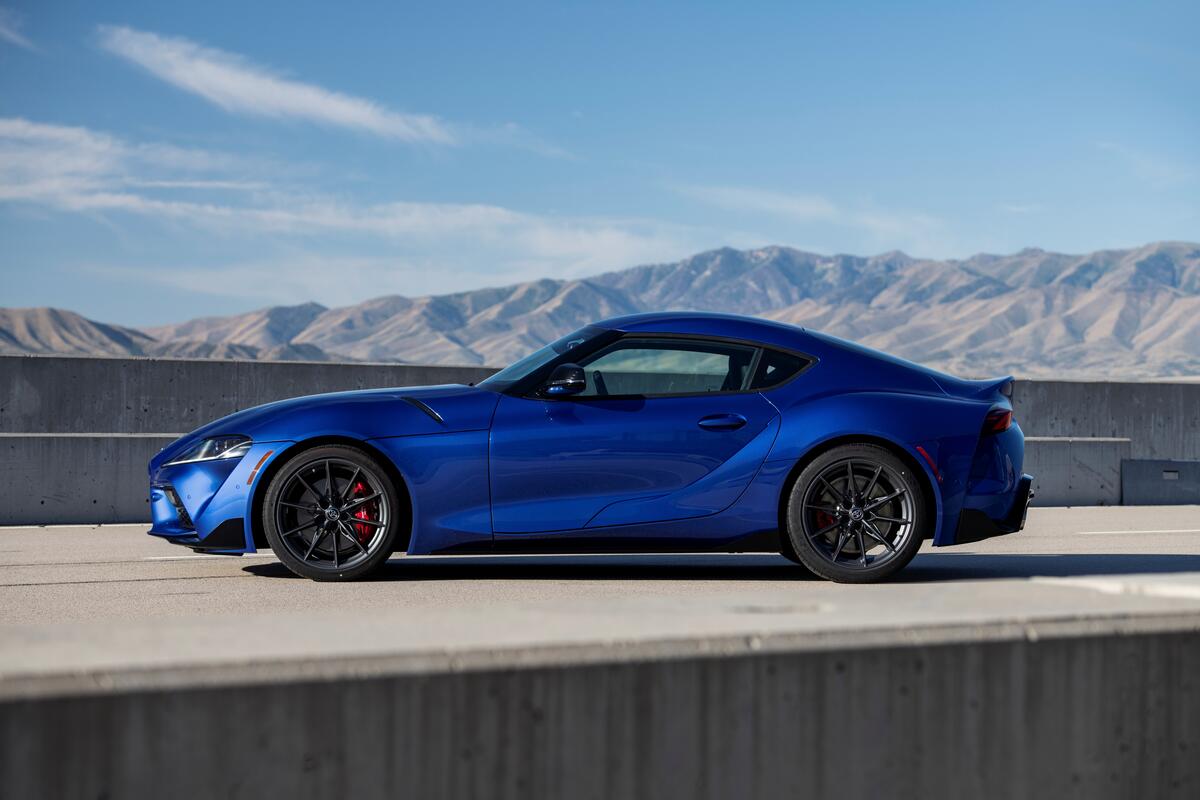
Toyota A90
"That's a long time ago in Bethlehem right now. And I'm going, I even said out loud, I had fresh coffee brewing. I had the TV on in the lounge at the dealership. All the guys had booked it. I'm there on my own. Nobody helps you to bring everything in. They just go, yeah, see you tomorrow. Thanks a lot. Thanks for coming out, buddy. So they take off, leave me in a mess, which is usual and I'm hunting for keys and every car's got to be in the compound. Of course, it's raining or snowing. So anyways, I'm sitting there. It's snowing like the blazes outside. I got a 90 minute drive. I'm sipping on my coffee and doodling on the notepad when I suddenly found myself screaming, you've got to be an idiot. And I looked around and going, I guess that's me. I was working for $6 and 35 cents an hour. There you go. But that wasn't the story I was going to tell. And I thought I'd share that with you kind of popped in there."
The Toyota Supra is a sports car made by Toyota. It’s built to feel quick and fun to drive, not like a regular family car. People talk about it a lot because it’s an important and well-known performance model.
The Toyota Supra is a performance sports coupe known for its strong engine options and driver-focused design. It’s often discussed because it has a long history and a reputation that keeps it relevant in car conversations decades after its debut. In a dealership or enthusiast context, it’s the kind of car people bring up when talking about iconic performance models.

Volkswagen Jetta
"So anyways, this guy comes in, he's got a white Jetta, white, all white. And he's mattered in a wet hornet. And he throws his keys at me. My car is rusting out."
A Jetta is a Volkswagen car model. Here, the host is saying the “rust” isn’t real rust in the metal sense—it’s coming from brake dust getting on the car.
The Volkswagen Jetta is a compact sedan. In this story, the host is explaining why the customer’s Jetta appears to be “rusting out” even though the bumper is plastic.
plastic bumper
"So I'm looking at the plastic bumper on the front and on the back. And so I go, Okay, these little tiny rust thingies on here."
A plastic bumper is the car’s outer front/rear cover made from plastic. The host is pointing out that plastic can’t rust like metal, so the spots are coming from something else.
A plastic bumper is the outer impact-protection cover on many modern cars, typically made from molded polymers rather than steel. The host uses this to debunk the myth that the bumper itself is “rusting out,” since plastic doesn’t rust the way metal does.
wax on, wax off
"And I'll just watch you. You do the same thing I did. You know, wax on, wax off and then use the clean cloth and just buff it. Just do a spot."
“Wax on, wax off” refers to applying wax/polish to a surface and then buffing it off to improve appearance and protect paint. The host uses it as a practical method to test whether the “rust” can be removed like surface contamination.
brake dust
"Because it's white and you live in a city and there's buses traveling up and down the road that have metal brake pads, it's brake dust landing on your car. And then overnight, there's a dude that lands on your car. Those little metal particles get moist."
Brake dust is the tiny powder that comes off your brakes when you stop. The host is saying that this dust can stick to your car and, when it gets wet, it can look like rust even if the car isn’t actually corroding.
Brake dust is the fine residue created when brake pads and rotors contact each other. The host explains that metal particles from brake pads can land on the car, get moisture on them, and form rust-like specks on paint and plastic surfaces.
metal brake pads
"Because it's white and you live in a city and there's buses traveling up and down the road that have metal brake pads, it's brake dust landing on your car."
Brake pads can be made from different materials. Here, the host is saying that pads with metal in them can create dust/particles that end up on your car and later look like rust.
Metal brake pads contain metallic compounds that can shed more visible dust and particles during braking. The host ties those metal particles to the “rust” spots forming after they get moist.
vehicle ownership
"I said it's called vehicle ownership. And that's where we all are folks. That's why I shared that story. So that's my segue. When you own and operate an automobile at what point does that what does the vehicle ownership get transferred to you at what."
When you own a car, you’re the one responsible for keeping it maintained. That means things like regular upkeep and repairs are on you, not the previous owner or a shop.
“Vehicle ownership” is the idea that once you own a car, you’re responsible for ongoing maintenance and upkeep. The hosts are using it to explain when upkeep stops being someone else’s job and becomes yours.
fuel injection system
"They said, well, what else are you going to do? I mean, if your fuel injection system's not working, you got to get that baby busted open and get going on that."
Fuel injection is the system that feeds gasoline into the engine. If it breaks, the car may not start or may run badly because the engine isn’t getting fuel correctly.
A fuel injection system is how a modern engine delivers fuel to the cylinders. If it’s not working, the engine may not start or may run poorly because the engine isn’t getting the right fuel amount at the right time.
co-pilot
"So listen up. If you're just getting your drive through goodie, whatever that may be, watch the guy in the other seat if you have a co-pilot."
A co-pilot is just the passenger in the car. In this story, they’re joking that the passenger might be distracted by snacks.
In car contexts, a co-pilot is the passenger who rides along and may help with navigation, spotting hazards, or managing tasks while driving. The transcript uses it as a setup for a car-related joke.
ran out of gas
"A man was driving down the road and he ran out of gas. And just at that moment, a bee flew into his window and the bee said, What seems to be the problem?"
It means the car’s fuel tank was empty. Without fuel, the engine can’t run, so the car will stop.
“Ran out of gas” means the fuel tank was empty, so the engine can’t keep running. It’s a common roadside scenario and often leads to additional issues if the car is repeatedly driven with very low fuel.
low mileage
"So thank you to Earl and Louise Grant, husband and wife team at City Auto Sales and Leasing for providing us with a safe haven to go and purchase a low mileage quality vehicle at fair prices."
“Low mileage” just means the car hasn’t been driven very much. That can mean less wear, but you still want to check service records and inspect the car.
“Low mileage” means the vehicle has been driven relatively few miles compared with similar cars. Lower mileage often suggests less wear on components, but it doesn’t replace checking maintenance history and condition.
City Auto Sales and Leasing
"So thank you to Earl and Louise Grant, husband and wife team at City Auto Sales and Leasing for providing us with a safe haven to go and purchase a low mileage quality vehicle at fair prices."
They’re talking about a local dealership called City Auto Sales and Leasing. The hosts say it’s a good place to find cleaner used cars and leasing/financing options.
This is the dealership/business the hosts mention as a place to buy vehicles. They describe it as a “family owned and operated” operation that provides access to quality used cars.
in-house leasing and financing
"They have the greater Toronto areas, premier, pre-owned auto store, in-house leasing and financing available. So if you don't see the particular vehicle you're looking for, just let them know."
They’re saying the dealership can arrange the lease and loan paperwork itself. That can be easier, but you should still look at the total price and the terms.
“In-house” means the dealership handles leasing and financing arrangements internally rather than sending you to a separate lender process. It can streamline paperwork, but you should still compare the effective cost and terms.
rust free underneath
"He doesn't have a lot of inventory but what he does have and what he has access to is all from out west and they're older vehicles but he said they're, and I've seen them. They're absolutely rust free underneath."
They mean the underside of the car isn’t corroded. Rust underneath can be expensive to fix, so it’s a big deal when buying a used vehicle.
“Rust free underneath” refers to the condition of the underbody (frame, floorpan areas, and suspension mounting points) having little to no corrosion. Rust can be a major cost and safety issue, so underbody condition is a key used-car inspection item.
rusty and crusty
"Because when I look at the same age of vehicle here in Ontario and go, what ocean was this on the bottom for and how long? It's rusty and crusty. They aren't from out there. Yeah, you're going to get yourself a super good deal."
“Rusty and crusty” describes heavy corrosion, often from road salt and moisture exposure. This is commonly worse in regions with aggressive winter salting, and it can indicate structural deterioration.
lower control arm
"He's going to do some custom exhaust on it and we need a bracket changing on the front housing. We need that plasma cut off so it's nice and clean and then weld the new bracket on for us for the lower control arm."
The lower control arm is part of the suspension that helps hold the wheel in the right position. If the bracket or mounting is bent or broken, the car can handle poorly and may be unsafe until it’s fixed.
The lower control arm is a suspension component that locates the wheel and helps control ride and handling. If its mounting bracket is damaged, it can affect stability and safety, which is why the speaker emphasizes replacing the bracket.
plasma cut
"He's going to do some custom exhaust on it and we need a bracket changing on the front housing. We need that plasma cut off so it's nice and clean and then weld the new bracket on for us for the lower control arm."
Plasma cutting is a metal-cutting method that uses a hot, focused gas stream. It’s used to cut out damaged metal so a new piece can be welded in accurately.
Plasma cutting uses an electrically heated, high-velocity jet of ionized gas to cut through metal cleanly. It’s commonly used in fabrication when removing or trimming damaged brackets before welding on new parts.
reman parts
"Older vehicles equal more access to remand parts. I can find pretty much a left handed nose inhaler out there for any automobile."
Reman parts are used parts that get taken apart, repaired, and rebuilt to work like new. They’re often cheaper than brand-new parts, but some people have had mixed experiences depending on the part.
Reman (remanufactured) parts are rebuilt components restored to a like-new standard, usually using a core from an older part. The speaker argues reman parts can reduce repair costs compared with new OEM parts, though they personally avoid reman clutches.
clutch assembly
"We had to put a clutch assembly in the 97. That's pretty old wouldn't you say? In the 97 Jeep TJ and it's out front. You can hop in it, turn the key, fire it up and drive it."
The clutch assembly is what lets the engine power get transferred to the transmission. When it wears out, the car can have trouble shifting or driving, and fixing it usually takes a lot of labor.
A clutch assembly is the set of components that connects and disconnects engine power to the transmission. Replacing it is a major job because it typically requires removing parts of the drivetrain to access the clutch.
wheel alignment
"But just not safe at the moment until that bracket is replaced. That has to be replaced and a wheel alignment has to be done but it's completely back together and everything works."
Wheel alignment means adjusting the angles of the wheels so they point the right way. After certain repairs, it helps the tires wear evenly and keeps the car from pulling to one side.
Wheel alignment is the adjustment of suspension angles so the tires track straight and wear evenly. After suspension or steering-related work, an alignment is often required to prevent uneven tire wear and pulling.
aftermarket
"Everything was bought aftermarket. I didn't buy one piece for that little TJ Wrangler from the dealer. Not one piece."
Aftermarket parts are replacement parts made by other companies, not the car’s original manufacturer. For older vehicles, they’re often easier to find and can cost less than dealer parts.
Aftermarket parts are made by companies other than the original vehicle manufacturer (OEM). They’re often cheaper and more available for older cars, but quality can vary by brand and application.
Wrangler Tj Wrangler
"...termarket. I didn't buy one piece for that little TJ Wrangler from the dealer. Not one piece. In fact I had to ..."
The Wrangler is a type of SUV made for off-road driving. Many owners add extra parts to improve how it handles trails and rough roads. The podcast mention suggests someone was buying aftermarket parts for their Wrangler.
The Wrangler is a rugged off-road SUV designed for trail use and everyday driving, with a strong aftermarket ecosystem. It’s frequently discussed because owners often customize them with parts like suspension, tires, and accessories to match their terrain and driving style. In the podcast context, it sounds like the conversation is about sourcing parts and building up a Wrangler rather than relying on dealer options.
OEM
"Reman parts are lower. Create lower repair cost versus the new OEM. So you've got something that's two to five years old."
OEM parts are the “factory” style parts made to match the car exactly. They can cost more than other options like aftermarket or reman parts.
OEM means Original Equipment Manufacturer—parts made by (or for) the vehicle maker. OEM parts are often more expensive than aftermarket or reman options, but they’re designed to match the vehicle’s original specifications.
clutch disk
"Just happens to be the name the manufacturer L UK and I knew the product line. It shows up two days later $212 all in brand new clutch disk pressure plate throw bearing pilot bearing and even the arbor to line the clutch up into the transmission."
The clutch disk is the part that helps your engine and transmission connect and disconnect. When it wears out, shifting can get harder or start slipping.
A clutch disk is the friction plate inside a manual-transmission clutch. When you press the clutch pedal, it separates and reconnects engine power to the transmission.
pressure plate
"It shows up two days later $212 all in brand new clutch disk pressure plate throw bearing pilot bearing and even the arbor to line the clutch up into the transmission."
The pressure plate squeezes the clutch disk so power can transfer smoothly. If it wears out, the clutch can slip or feel different.
The pressure plate is the clutch component that clamps the clutch disk against the flywheel. It’s part of the clutch assembly and wears over time like the disk.
throw bearing
"It shows up two days later $212 all in brand new clutch disk pressure plate throw bearing pilot bearing and even the arbor to line the clutch up into the transmission."
The throw bearing is what helps the clutch “let go” when you push the pedal. If it fails, the clutch can get noisy or hard to use.
A throw bearing (release bearing) is the bearing that moves when you press the clutch pedal. It helps disengage the clutch so you can shift gears.
pilot bearing
"It shows up two days later $212 all in brand new clutch disk pressure plate throw bearing pilot bearing and even the arbor to line the clutch up into the transmission."
The pilot bearing helps the transmission input shaft spin smoothly. If it’s worn, you can get vibration or clutch/shift problems.
The pilot bearing supports the transmission input shaft where it meets the engine. It helps the input shaft spin smoothly during clutch engagement.
arbor to line the clutch up
"It shows up two days later $212 all in brand new clutch disk pressure plate throw bearing pilot bearing and even the arbor to line the clutch up into the transmission."
This is a tool used to line up the clutch parts before you bolt everything together. It helps the clutch go in correctly the first time.
An arbor (alignment tool) is used to center the clutch disk so it lines up with the transmission input shaft. Proper alignment helps the clutch install smoothly and reduces premature wear.
shifter
"Sir clip and a plastic button to hold the shifter in position in the right clock position on the 2000 Nissan Rogue and they put it on emergency run."
The shifter is what you move to choose gears like Park, Drive, or Reverse. Small parts around it can affect how reliably it stays in position.
The shifter is the mechanism you move to select gears (or drive modes). The clip/button mentioned is used to hold it in the correct position so it can engage properly.

Nissan 2000 Nissan
"...er in position in the right clock position on the 2000 Nissan Rogue and they put it on emergency run. I called ..."
The Nissan 200 SX is an older Nissan sports car. It’s a smaller coupe that was made to be more fun to drive than a basic commuter car. The mention suggests it was involved in a problem that required quick help.
The Nissan 200 SX is a compact sports coupe known for being a performance-oriented model in Nissan’s lineup during its production era. It’s brought up in conversations about specific vehicles and parts because owners and mechanics often deal with age-related issues and troubleshooting. In the podcast context, it sounds like the discussion involves a particular situation where the car needed attention and was handled in an emergency or roadside context.
sealed unserviceable components
"The newer vehicles more sealed unservice serviceable components so you got to buy the entire component and if it's a dealer item get ready."
Some newer car parts are built like sealed units, so you can’t easily open them up and fix them. When they break, you usually replace the entire part.
“Sealed, unserviceable components” refers to assemblies designed so internal parts aren’t meant to be repaired or rebuilt. Instead, technicians replace the whole unit when it fails.
remove and replace
"Pucker because it's going to hurt it is really going to hurt its replacement not repair systems it's remove and replace remove and replace."
This means the shop takes the old part out and installs a new one instead of fixing the original part. Newer cars often make this the only practical option.
“Remove and replace” describes a repair approach where an entire component is swapped instead of being repaired internally. Newer vehicles often push this because parts are integrated or not serviceable.
flatbed or a tow truck
"You'll have to watch the video because it's a mini series to see how in depth I got into this so you can see what happens when you evaluate a vehicle properly and I don't want it leaving the shop and coming back on a flatbed or a tow truck or hearing that it interrupted a vacation to the local cottage that you have in the family."
A flatbed tow truck is what you call when a car can’t be driven normally. They’re emphasizing maintenance so you don’t end up needing a tow.
A flatbed tow truck is used when a vehicle can’t be driven safely or at all. The speaker’s point is to prevent breakdowns by evaluating and maintaining the car before it becomes a tow situation.
maintenance
"So John great question keep your older vehicle if it's solid and it's not all rusted out you got yourself a very good automobile. You'll save money to stay on top of the maintenance that's all and it doesn't matter what you own what name brand model or color you're going to throw parts at it at some point it's a piece of equipment."
Here, maintenance means regular checkups and replacing worn parts before they cause problems. Doing it on time helps prevent bigger, more expensive repairs later.
In this context, maintenance means scheduled upkeep and inspections to catch wear items before they fail. The speaker frames it as the key to avoiding expensive breakdowns and repeat visits to the shop.
normal wear and tear
"You'll save money to stay on top of the maintenance that's all and it doesn't matter what you own what name brand model or color you're going to throw parts at it at some point it's a piece of equipment. It's called normal wear and tear."
Normal wear and tear means parts wear out over time just from driving and using the car. It’s not usually a sign of something being broken right away.
“Normal wear and tear” refers to predictable deterioration from regular use, like brake pad wear or suspension bushings aging. The speaker uses it to justify that some repairs are expected over time.
screeching
"When I hear screeching and grunching and grinding and particles flying I'll come and see you."
Screeching is a common brake noise that often indicates brake pads are worn down to the point where wear indicators contact the rotor. It’s a warning sign that the brakes need attention soon.
grinding
"When I hear screeching and grunching and grinding and particles flying I'll come and see you."
Grinding brake noise usually suggests severe pad wear or damage—such as metal-on-metal contact between the pad backing and rotor. At that point, continuing to drive can accelerate rotor damage and reduce braking effectiveness.
particles flying
"When I hear screeching and grunching and grinding and particles flying I'll come and see you."
“Particles flying” implies brake dust or debris being thrown off, which can happen when pads are heavily worn or when components are failing. It’s presented as a sign to stop driving and get the brakes inspected immediately.
rotors
"...driving it until you're doing your own nasty machining job on everything that's in the brake system because that's going to cost you."
Rotors are the spinning metal discs your brake pads clamp onto. If they get damaged, braking can feel worse and may cost more to fix.
Rotors (also called brake discs) are the metal surfaces the pads clamp onto to slow the car. If pads are allowed to wear too far, rotors can get damaged and may require resurfacing or replacement.
winter tires
"Because now the FJ's in the shop the last thing I'm going to do to it is take the winter tires off bring the summies in but before those wheels go on I will do a brake service."
Winter tires are specialized tires designed for cold temperatures and snow/ice traction. The speaker mentions removing winter tires and swapping in summer tires as part of seasonal maintenance, which can be a good time to do brake work.
summer tires
"...take the winter tires off bring the summies in but before those wheels go on I will do a brake service."
Summer tires are designed for warmer temperatures and typically provide better dry/wet grip than winter tires in heat. The speaker references the seasonal swap to set up when brake service is performed.
calipers
"I will do a brake service. Calipers off pads out clean and lube the pins. That's a perfect time to do it."
Calipers are the parts that squeeze the brake pads against the spinning brake discs. They’re a key part of how your car actually slows down.
Brake calipers are the clamp-like parts that squeeze the brake pads against the rotors to slow the car. When doing brake work, technicians often remove calipers to access the pads and inspect the condition of the hardware.
lube the pins
"Calipers off pads out clean and lube the pins. That's a perfect time to do it."
Those pins help the brake caliper move freely. Lubing them with the right grease helps the brakes wear evenly and reduces squeaks or sticking.
“Lube the pins” refers to applying appropriate brake hardware lubricant to the sliding pins/guide hardware that allow the caliper to move smoothly. Proper lubrication helps prevent sticking, uneven pad wear, and brake noise.
warp
"If you don't heat them up and warp them out you're burning them off. Take it easy out there."
“Warp” means the brake rotors get damaged by heat and no longer sit perfectly flat. When that happens, braking can feel rough or pull/vibrate.
To “warp” brakes means the brake rotors become uneven or distorted from heat. That can cause vibration or uneven braking, and it’s often discussed alongside aggressive driving that overheats the braking system.
stop and go traffic
"It's extremely hard to stop and go stop and go. Do you really have to get to the next traffic light before me because I really don't care."
“Stop and go traffic” is when you’re constantly slowing down and speeding up. That repeated braking can wear out your brakes faster.
“Stop and go traffic” describes frequent acceleration and braking in dense traffic. This driving pattern increases brake heat cycles and wear because the brakes are used repeatedly at low speeds.
brake job
"I just did a break job on a truck little pickup truck I've owned since I was 22. And I did the rear brakes for the very first time."
A “brake job” means getting the brakes serviced—usually replacing the parts that wear down. The hosts use it as an example of how brake wear can happen at different rates.
A “brake job” is service work on the braking system, typically replacing wear items like brake pads and sometimes resurfacing or replacing rotors. The episode uses it to illustrate how often different parts wear out depending on driving habits.
fronts
"I did the rear brakes for the very first time. I did fronts which I've done. That was the third set."
“Fronts” means the brakes on the front of the car. When you brake, more of the stopping force usually goes to the front, so they can wear out sooner.
“Fronts” here means the front brakes, which are often serviced more frequently than rear brakes. During hard braking, the car’s weight shifts forward, increasing how much the front brakes do.

Honda Crv
"So it was a really nice. It was a nice little ride. 1998 Honda CRV. I loved it. First Honda I ever owned and it was great to me."
The speaker recalls owning a 1998 Honda CR-V as their first Honda and says they loved it. The mention supports the episode’s theme that older cars can be worthwhile when properly maintained.
change my oil
"How often should I change my oil? There is so much stinking controversy out there that you know what, I'm just going to cut through all the radar, all the smoke, all the opinions and go with what works."
This is the episode’s core maintenance topic: how often to change engine oil. The host argues for changing oil sooner than some online advice, emphasizing that oil degrades and contamination builds up over time and use.
short trips
"Engine oil breaks down, thermal breakdown. If you do short trips, the motor oil gets completely contaminated with moisture and acids from carbon and other particles that are in that waste motor oil."
Short trips can prevent the engine from fully warming up, which increases moisture buildup in the oil. That moisture can combine with combustion byproducts to form acids, accelerating oil degradation and increasing wear risk.
motor oil breaks down
"Engine oil breaks down, thermal breakdown. If you do short trips, the motor oil gets completely contaminated with moisture and acids from carbon and other particles that are in that waste motor oil."
Oil doesn’t last forever. Over time and heat, it gets less effective at protecting the engine.
“Motor oil breaks down” refers to oil losing its protective properties due to heat and chemical aging. As it degrades, it can’t lubricate as effectively and is more likely to contribute to wear inside the engine.
bearing surfaces
"It becomes poison to the bottom end of your engine. The important, very important components are down there and you do not want your motor oil to be acidic in eating bearing surfaces, connecting rod bearings, crankshaft bearings, camshaft bearings, and the like."
Bearing surfaces are the metal contact areas inside the engine where rotating parts ride on a thin film of oil. If oil becomes acidic or contaminated, it can increase friction and wear on these surfaces, leading to expensive internal damage.
crankshaft bearings
"...you do not want your motor oil to be acidic in eating bearing surfaces, connecting rod bearings, crankshaft bearings, camshaft bearings, and the like. That's all expensive."
The crankshaft bearings help the crankshaft spin smoothly. Bad oil can make them wear out sooner.
Crankshaft bearings support the crankshaft, allowing it to rotate while maintaining precise clearances. Clean, non-degraded oil is critical; acidic or contaminated oil can increase wear on these bearings.
connecting rod bearings
"...you do not want your motor oil to be acidic in eating bearing surfaces, connecting rod bearings, crankshaft bearings, camshaft bearings, and the like. That's all expensive."
Connecting rod bearings are the bearing shells that support the crankshaft at each connecting rod. They depend on oil pressure and oil cleanliness; contaminated or acidic oil can accelerate wear and potentially lead to major engine damage.
camshaft bearings
"...you do not want your motor oil to be acidic in eating bearing surfaces, connecting rod bearings, crankshaft bearings, camshaft bearings, and the like. That's all expensive."
Camshaft bearings help the camshaft move correctly. If oil isn’t changed often enough, these parts can wear out.
Camshaft bearings support the camshaft so it can open and close the engine’s valves at the right times. Like other engine bearings, they rely on oil lubrication; degraded oil increases friction and wear risk.
3500K
"I don't do the long trips like I used to... 3500K is enough for me and I want to protect my engine... Change your driving habits. Change your oil and filter at 3500 kilometers."
“3500K” here means changing your oil and filter about every 3,500 kilometers. The goal is to keep the engine oil clean so the engine is better protected.
The speaker is using “3500K” to mean 3,500 kilometers between oil/filter changes. The idea is to keep oil fresh so the engine stays protected, especially with lots of short trips.
short driving
"I don't do the long trips like I used to. I do a number of toodling... I try and limit that as well... Whether you're doing long driving or short driving, use that as a rule of thumb..."
Short trips can be tougher on your engine oil because the engine doesn’t fully warm up. The host suggests changing oil and filters more often when you mostly do short driving.
Short trips can be harder on an engine because the oil may not reach full operating temperature, which can increase sludge and contamination. The speaker contrasts their “toodle trips” with long trips and still recommends frequent oil/filter changes.
Wix
"I buy Wix oil filters, nothing less. I like the gold brand Wix. I've been using Wix since I was like 15."
Wix is an oil-filter brand the speaker trusts for filtration quality. They specifically mention buying Wix oil filters and believing the filters are well made.
full synthetic motor oil
"I don't need a full synthetic motor oil and pay through the wazoo for it. If it's one of the European cars we run to the car shows in the summer, that's different."
Full synthetic oil is a “premium” type of engine oil made to perform well in a wide range of conditions. The host thinks you don’t always need it, depending on the car.
Full synthetic motor oil is an oil formulated from chemically engineered base stocks, typically offering strong performance across temperature ranges. The speaker argues it isn’t necessary for their Japanese vehicles and that it can be overpriced.
conventional oil
"But for the Japanese stuff that we have around or the Jeep, just a very high end conventional oil and it's out of there at 3500K all the time."
Conventional oil is the more standard type of engine oil. The host is saying they use it (instead of pricier synthetic) for some vehicles and still change it often.
Conventional oil is a more traditional, petroleum-based lubricant compared with synthetic blends or full synthetic oils. The speaker claims they use conventional oil for their Japanese vehicles and a Jeep, changing it frequently.
parallel park
"Can you think you can park that in there, young man? Yeah, parallel park in downtown Dunville... I popped her right in there, turned my wheels the right direction, shut it off."
Parallel parking is when you park your car alongside the curb next to another car. The host is talking about practicing the maneuver during a driving test.
Parallel parking is a low-speed maneuver where you position a car alongside another vehicle and then straighten out within a narrow space. The speaker uses it as an example of practicing driving skills.
oil and filter
"Change your driving habits. Change your oil and filter at 3500 kilometers... use that as a rule of thumb quality filter quality, top quality motor oil."
When you change your oil, you should also replace the oil filter. The filter traps dirt in the oil, so replacing it helps keep the new oil cleaner.
Changing both the oil and the oil filter matters because the filter removes contaminants that build up in used oil. The speaker’s “my rule” is to do both at the same interval (3500 kilometers) to keep the engine protected.
Request an Explanation
Heard something you'd like explained? We'll add it to this episode.
Sign in to request explanations for terms you heard.
Want to learn more?
Browse our glossary for plain-English explanations of automotive terms, jargon, and concepts.
Help improve this episode
See something that's not quite right? Our annotations are AI-generated and can sometimes miss the mark. Click the flag icon on any annotation to suggest a correction.