
#71 - TRD Hammer or Raptor? Automotive Person Of The Year, Robo Rivian, 2027 Offroad CX-5 & MORE!
About this episode
Toyota’s rumored TRD Hammer desert-racer truck sparks debate on whether it’s finally dethroning the Raptor—16 years late, but maybe legit thanks to Toyota’s Baja pedigree. The hosts then go off on car media’s tech-obsessed “Person of the Year” pick (Nvidia’s Jensen Huang), and argue about AI agents and the future of dealership/direct-to-consumer sales. BMW M3 styling gets roasted, Lexus ES screen design is criticized, and a Hyundai Palisade stop-sale/recall tragedy is discussed. Later: Rivian’s robotaxi plans, vertical micro-dramas, and a Houston/AI/real-estate tangent before ending with Chuck Norris news.
We're building the biggest online car club in the world. Join the community! clutch.club
Clutch Culture Hoodies BACK IN STOCK: https://hypercleanstore.com/collections/gear-up/products/clutch-culture-hoodie
Hey you! Yeah you... Drop us a 5 Star rating AND review if you enjoy the show. Thanks in advance!
Sharing the show is the best way to help it grow!
Email your questions, topics, stories: [email protected]
If you're a parts manufacturer or supplier that want's to be apart of either the 2003 LX470 or 2014 Gen 1 SVT Raptor, get in touch with us via email at [email protected]
Follow the show on social @ClutchCulturePod on Instagram & TikTok
Watch the video version on YouTube @ClutchCulturePod
third pedal
"Clutch. Third pedal. Dot club. And that's where you can sign up for our community..."
Most cars have two pedals (brake and gas). In a manual car, there’s a third pedal—the clutch—that helps you change gears.
In a manual-transmission car, the “third pedal” is the clutch pedal. It’s used to disengage the engine from the gearbox so you can shift gears smoothly.
Gen 1
"...this isn't a Gen 1 Raptor club. It's not an Alex 470 club. It is a car club..."
“Gen 1” just means the first version or early generation of a vehicle. They’re saying the club isn’t only for people who like the earliest Raptor.
“Gen 1” means “first generation,” i.e., the earliest version of a model line. Here it’s used to specify the original-era Raptor, implying the club isn’t only for that specific generation.
Toyota
"I think most people that are in the off-roading or even just car world will say is Toyota is finally trying to dethrone the Raptor."
Toyota is a major car brand. In this conversation, they’re being talked about as a company trying to compete with Ford in off-road trucks.
Toyota is being positioned as the automaker trying to challenge Ford’s off-road dominance. In off-roading culture, Toyota and Ford are often compared because they’ve each built strong reputations for trucks and trail-ready packages.
Chevy
"I mean, to be exact, faster than what Chevy's done it. So I guess that's a win."
“Chevy” means Chevrolet. They’re being mentioned as a brand that hasn’t matched Ford’s off-road truck momentum.
“Chevy” is shorthand for Chevrolet, which is being referenced as not making the same kind of off-road push. The comparison is about how long Ford’s Raptor has been selling versus how quickly other brands responded.
TRD Hammer
"I saw I think a trademark or something of the name TRD Hammer or Toyota Hammer was filed that, oh, you know, finally they're coming, you know, for the Raptor."
TRD is Toyota’s performance/off-road brand. “Hammer” sounds like a new name Toyota might be planning for an off-road truck that would go after the Raptor crowd.
“TRD Hammer” is discussed as a rumored/trademarked name tied to Toyota’s TRD (Toyota Racing Development) branding. The listener takeaway is that Toyota may be preparing a new off-road model line or package positioned to compete with the Ford Raptor.
four-wheelers
"Or the Rough Riders just riding four-wheelers down New York City, you know what I'm saying?"
They mean ATVs—off-road vehicles with four wheels. It’s being used as a funny, exaggerated scenario.
“Four-wheelers” refers to ATV-style vehicles (all-terrain vehicles) that typically have four wheels and are used off-road. The speaker is using it as a comedic image of “Rough Riders” riding them through New York City.
clutch.club
"Shoot us a line through clutch.club and we'll get back to you. Clutch.club, we'll get right back to you."
clutch.club is the website they’re telling listeners to use to sign up or reach them. It’s basically their online hub for the show.
clutch.club is mentioned as the place to contact or sign up, and it’s tied to the show’s promotion. It appears to be a community/platform related to the podcast’s “clutch culture” theme.
off road
"What are these lame-os going to do off road, huh? To come in from guys with off-road vehicles. We'll get a question."
“Off-road” means driving on rough or unpaved roads—like dirt trails or rocky paths. Off-road trucks are set up to handle that better with tougher parts and suspension designed for bumps.
“Off-road” refers to driving on unpaved or rough surfaces like dirt trails, rocks, mud, and sand. Vehicles built for off-road use typically prioritize traction, suspension travel, and durability to keep tires in contact and protect key components.
Motor Trend
"[520.7s] I mean, I know if somebody from Motor Trend is watching this or is going to [522.1s] see this clip, if you don't watch full podcast, like, what are we doing here?"
Motor Trend is a well-known car magazine/website that covers new vehicles and gives awards. Here, it’s being used to set the context for why they’re talking about a tech CEO in a car-related award.
Motor Trend is a major automotive media outlet known for reviews, long-term tests, and awards. Mentioning it in the context of “Person of the Year” frames the segment as part of mainstream auto-industry recognition rather than a niche enthusiast award.
Porsche
"I was just talking to somebody, a big Porsche guy... Evidently, a lot of people didn't know Porsche is kind of hurting financially... Porsche makes an announcement that they're looking at building something higher than the GT three..."
Porsche is a car company from Germany that makes high-performance sports cars. Here, they’re talking about how Porsche’s money situation and announcements can influence what fans think and want next.
Porsche is a German automaker best known for performance cars like the 911 and track-focused models. In this segment, the discussion centers on Porsche’s financial health and how that affects fans’ perceptions and expectations.
docuSign
"Most high end customers, you know, have somebody that is kind of facilitating the paperwork and running the paperwork to their office or docuSign or power"
DocuSign is a website/app for signing documents electronically. It helps people finish paperwork faster without meeting in person.
DocuSign is an electronic signature platform used to sign contracts digitally. In car buying, it can speed up approvals and reduce the need for in-person paperwork handling.
push button start
"And just like push button start, you know, push button start started at the very elite level of cars. And now it's in every car."
Instead of putting a key into the ignition, you press a button to start the car. It used to be mostly on expensive cars, but now it shows up on many regular ones too.
Push-button start is a keyless ignition system where you press a button to start the engine instead of inserting a traditional key into the ignition. It became common first on higher-end vehicles and then spread to mainstream models as the technology got cheaper.
direct to consumer
"we need to go or the manufacturer needs to go direct to consumer, this that and the other... we just need to go to direct to consumer no more dealership."
Direct-to-consumer means the car company sells the car to you without using regular dealerships. People like it because it can mean simpler pricing, but the big question is whether service and repairs are still easy to get.
“Direct to consumer” (DTC) means the automaker sells cars straight to buyers instead of routing sales through traditional dealership networks. Supporters argue it can reduce markup and improve pricing transparency, while critics worry about service coverage and local support.
Tesla
"There's a Tesla body shop right by a gym that I attend... I have dealt with some nightmare situations with Tesla... they've sold millions of cars."
Tesla is a company that makes electric cars. The speaker is talking about what it’s like when a Tesla needs repairs and how those experiences can be good or bad depending on the situation.
Tesla is an American electric-vehicle (EV) maker known for high-volume production and a large on-road presence. In this segment, the host is discussing Tesla body-shop experiences, implying that repair/ownership outcomes can vary widely.
body shop
"There's a Tesla body shop right by a gym that I attend... I have seen the same car sitting there waiting to get repaired... Just take a picture."
A body shop is where cars go after they’re damaged, usually from crashes or impacts. They handle things like fixing the outside of the car and repainting it.
A body shop is a repair facility that fixes vehicle damage to the exterior—like dents, collision damage, and paint-related issues. The mention here is tied to waiting on repairs, which can reflect parts availability, repair complexity, and workflow.
Vin
"I know the Vin... I know, I know what it is... I'm going to need this for the show evidence."
VIN is the car’s unique ID number, kind of like a fingerprint. The speaker wants it to make sure they’re talking about the exact right car for evidence.
VIN stands for Vehicle Identification Number, a unique code assigned to each car. It’s commonly used to confirm the exact vehicle (trim, options, and service/parts compatibility) when documenting or verifying what car is involved.
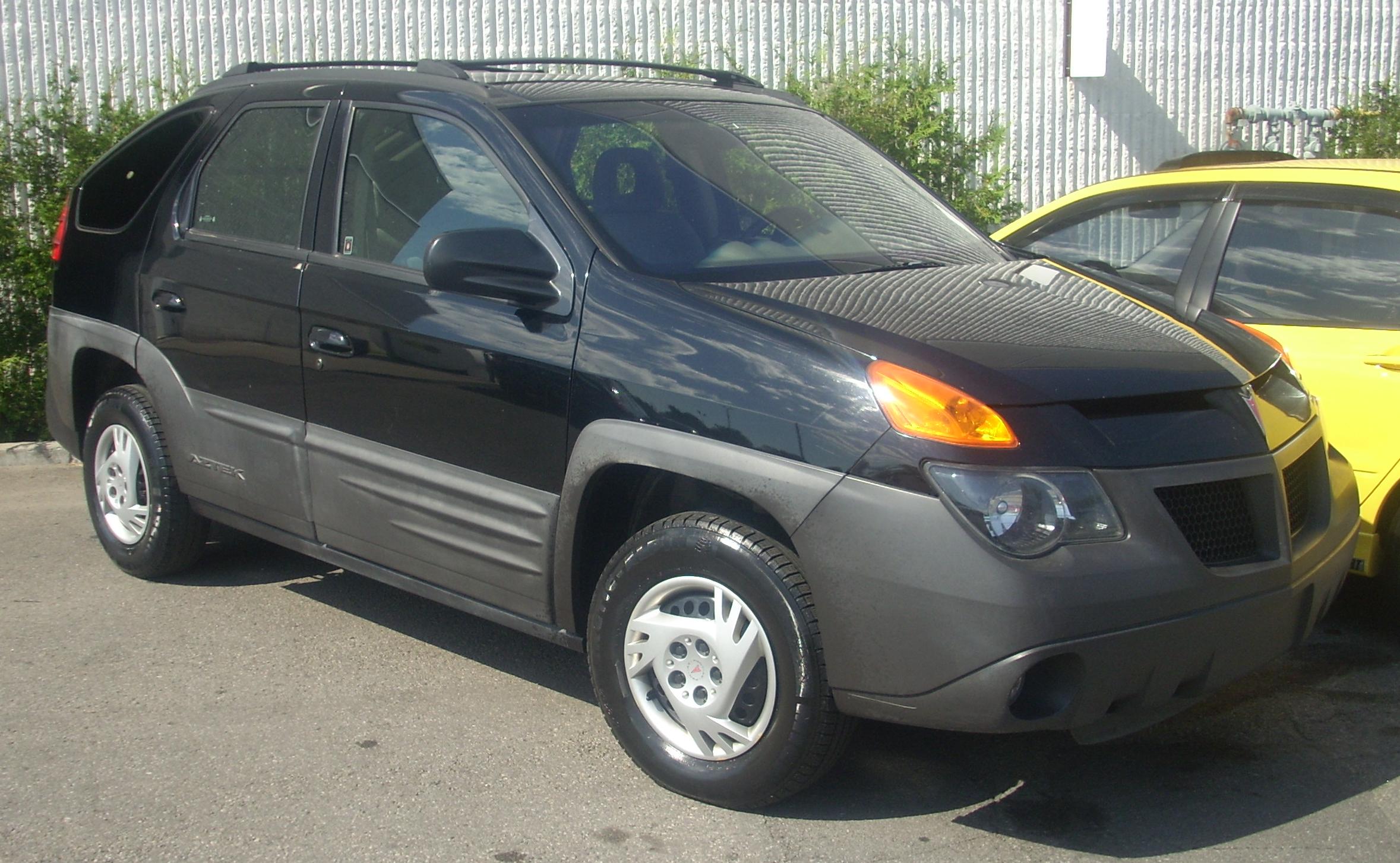
Pontiac Aztec
"you know, people bought the Pontiac Aztec."
They bring up the Pontiac Aztek because it was a very controversial-looking car. The point is that some people will hate a design, but others will still buy it if they like it.
The Pontiac Aztek is used as an example of a car that was widely criticized for its styling. It’s a reminder that even very polarizing designs can still be bought by people who like them, regardless of mainstream taste.
front grills
"They're really going down with the ship on these front grills, aren't they?"
They’re talking about the car’s front grille—the part up front that you can see first. They’re saying they don’t like how it looks.
“Front grills” refers to the grille area at the front of the car, which is both a styling element and historically tied to cooling airflow. The speaker criticizes the design, implying the grille styling is a negative change.
starting price
"I think I know it's not a $35,000 starting price, but you know, starting at 50 going all the way up with 812 trim packages, you can be at $98,000 for the top trim package, probably."
Starting price is the cheapest version of the car you can buy. The full price can jump a lot when you choose higher trims and add features.
“Starting price” refers to the lowest MSRP you can pay for a given model, usually with a base trim. The speaker contrasts a lower entry point with much higher prices once you add higher trims and options.

Lexus LX
"I like what I have in my LX and in my GX because I don't have the GX with the bigger screen that was redesigned."
The Lexus LX is a big luxury SUV. Here they’re talking about whether a bigger infotainment screen is actually useful or just something you pay for.
The Lexus LX is a full-size luxury SUV known for comfort and off-road capability. In this segment, it’s mentioned in the context of infotainment screen sizing and how the driver feels about having a larger display.

Lexus GX
"I like what I have in my LX and in my GX because I don't have the GX with the bigger screen that was redesigned."
The Lexus GX is a luxury SUV that’s built to handle rough roads. They’re saying they don’t need the newer, bigger screen because it doesn’t feel worth the extra cost.
The Lexus GX is a mid-size luxury SUV that’s popular for its rugged, body-on-frame roots and off-road friendliness. The speaker references a redesigned GX with a larger infotainment screen, tying it to the idea of “value” versus screen size.
average consumer
"You got to take that hat off and you got to look at the average consumer. And the average consumer wants a bigger iPad."
This just means the typical person buying a car, not the hardcore car enthusiasts. They usually care more about comfort and easy tech than performance details.
The “average consumer” is the mainstream buyer who prioritizes comfort, convenience, and easy-to-understand features over hardcore driving feel. In automotive marketing, this often drives design choices like big screens and simplified interfaces.
cockpit
"They don't speak to me from just a simple sitting in the cockpit and looking at this screen that's not integrated into anything."
The “cockpit” is the driver’s area inside the car—where you sit and where the controls and screens are. It’s about how comfortable and easy it feels to use everything.
In automotive talk, the “cockpit” refers to the driver-focused cabin area—seat, steering wheel, instrument cluster, and controls. When someone says something “doesn’t speak to me” from the cockpit, they’re usually reacting to ergonomics and how intuitive the layout feels.
Audi
"If you look at Audi, if you look at BMW, if you look at Mercedes, this is kind of the German brand selling point as they thought through the interior a little bit more than an American manufacturer or Japanese manufacturer."
Audi is a German car brand. The point here is that Audi is known for putting a lot of thought into how the inside of the car looks and feels.
Audi is one of the major German automakers known for interior design and user experience. In this segment, it’s used as an example of a brand that “thought through” the cabin layout more carefully than some competitors.
BMW
"If you look at Audi, if you look at BMW, if you look at Mercedes, this is kind of the German brand selling point as they thought through the interior a little bit more than an American manufacturer or Japanese manufacturer."
BMW is a German car brand. In this discussion, it’s mentioned as a company that tends to design the car’s interior more thoughtfully.
BMW is another German automaker often associated with driver-focused interior ergonomics and premium cabin design. Here it’s grouped with Audi and Mercedes as a brand that historically emphasized interior layout rather than simply adding tech screens.
Mercedes
"If you look at Audi, if you look at BMW, if you look at Mercedes, this is kind of the German brand selling point as they thought through the interior a little bit more than an American manufacturer or Japanese manufacturer."
Mercedes is a German luxury car brand. The speaker is using it as an example of a company that usually designs the inside of the car with more care.
Mercedes-Benz is a German luxury brand known for high-end interior design and comfort-focused ergonomics. In the segment, it’s cited as part of the “German brand” approach to interior design versus simply mounting a screen on top of the dash.
iPhone
"we got the guy who designed the iPhone... look at this interior. It's like, yeah, it does look like an iPhone."
The iPhone is used as a shorthand comparison for a minimalist, touch-screen, consumer-electronics design language. The speaker’s argument is that copying that look doesn’t automatically deliver the brand identity or design coherence people expect from a Ferrari.
traffic
"[2631.9s] Like if you really think about it, the traffic's insane, the behavior's insane. [2637.5s] Certain places don't even feel like you're in Houston when you are."
They’re talking about how crazy busy the roads are. When traffic is like that, driving feels stressful and you burn more fuel because you’re constantly stopping and going.
The hosts are describing Houston as having extremely heavy traffic. For car enthusiasts, traffic conditions matter because they influence driving stress, fuel economy, and how often you’re stuck in stop-and-go driving.
I-10
"This is I-10. This is the biggest highway in the country. And I'm going to be at a standstill at some point of the day."
I-10 is a big interstate highway in the U.S. It’s the kind of road you’d take for commuting or getting around a large metro area, and traffic can get slow.
I-10 is a major U.S. interstate highway that runs across multiple states, including through the Houston area. When someone says they’re on I-10, it usually signals heavy, long-distance commuting traffic rather than a short road trip.
Barnedominium
"[3445.2s] I just know I understand why things get built. [3447.7s] And I think the Barnedominium thing, [3450.4s] I think it could speak to a lot of car enthusiasts. [3453.4s] The problem is, I noticed some people have gotten burned pretty heavy on Barnedominiums"
A Barnedominium is basically a house built in a barn style. People like them because they look cool and can be customized, but you have to plan carefully.
A “barn-dominium” (often shortened to Barnedominium) is a home built using a barn-style structure—typically a large open interior with modern living space added. In the car-enthusiast context, it’s often discussed like a hobbyist “project” home where people build for lifestyle and aesthetics, similar to how some people build cars.

Land Rover introduced the 2026 Range Rover Sport SV Winter Dusk Bespoke
"Anyway, all right, let's get to a couple more quick car stories before we wrap up today's show [3555.3s] Land the Plain. One of your favorites, Land Rover introduced the 2026 Range Rover Sport SV Winter Dusk Bespoke. I haven't seen that. Did you see it? I haven't seen it."
Land Rover made a special version of the Range Rover Sport for 2026. It’s from their “SV” customization program, so it’s meant to look and feel more premium and unique than a regular one. “Bespoke” usually means it has special, tailored details.
This refers to a special 2026 Land Rover Range Rover Sport variant called “SV Winter Dusk Bespoke.” “SV” is Land Rover’s Special Vehicle Operations program, which typically focuses on bespoke styling and higher-end materials. The “Bespoke” naming signals customer-tailored or highly customized details rather than a standard trim.
Rivian
"or whatever, or it's Rivian, or, and we can end with this, really end on a light note."
Rivian is a company that makes electric trucks and SUVs. The point here is that people also argue and defend Rivian like they do with traditional car brands.
Rivian is an American EV maker best known for trucks and SUVs like the R1T and R1S. The speaker mentions it in the context of people defending brands, reflecting how enthusiast communities form around EV brands too.
Request an Explanation
Heard something you'd like explained? We'll add it to this episode.
Sign in to request explanations for terms you heard.
Want to learn more?
Browse our glossary for plain-English explanations of automotive terms, jargon, and concepts.
Help improve this episode
See something that's not quite right? Our annotations are AI-generated and can sometimes miss the mark. Click the flag icon on any annotation to suggest a correction.