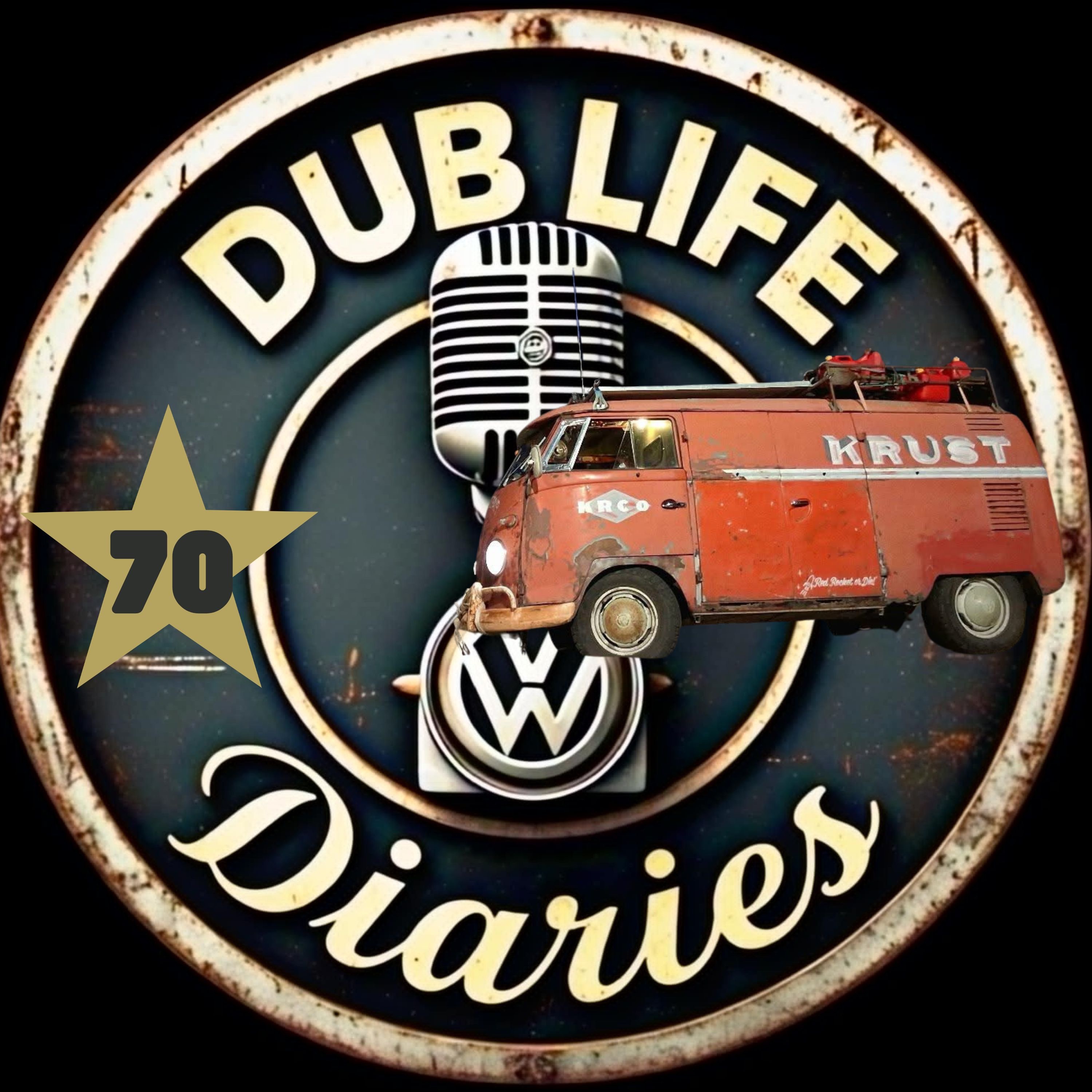
77,000+ Miles. 38 States. One Legendary VW Krust Bus Dave Broenen Ep70
About this episode
Dave Broenen’s “Crust Bus” takes center stage: a weathered 1960-panel VW that’s logged “77,000 miles inside of 23 months” across “38 states” and countless roadside lessons. Between the trip stories, the hosts dig into what makes long-haul bus life work—pre-trip checks, gauges as “early warning system,” and carrying spares for failures like “the condenser” or low oil pressure. The episode also highlights the VW community’s kindness, from help during breakdowns to the shared “Drive your bus.”
What happens when you take a 1960 Volkswagen panel bus, point it toward the horizon, and refuse to stop?
In Episode 70 of Dub Life Diaries, Joe sits down with Dave Broenen, better known as the pilot of the legendary KRUST BUS, to talk about an incredible journey that has taken him more than 78,000 miles across 38 states in just 23 months.
Dave shares how a lifelong love of Volkswagens, inspired by his family and his first rusty Beetle, eventually led him to purchase and transform a weathered split-window bus into one of the most recognizable adventure vehicles in the VW community. Along the way, he has crossed mountain passes, explored remote backroads, camped across America, and built friendships that prove the Volkswagen community is unlike any other.
In this episode, you'll hear:
✅ The story behind the KRUST BUS and the “Bus Pilot” nickname
✅ How Dave prepared a vintage VW for cross-country travel
✅ The engine combinations and upgrades that survived nearly 80,000 miles
✅ Breakdowns that became unforgettable adventures
✅ Incredible stories of kindness from VW enthusiasts across the country
✅ Essential advice for first-time vintage Volkswagen owners
✅ Why “Drive Your Bus” has become more than just a hashtag
From snow trips on Mount Shasta to award-winning cross-country adventures, Dave's story is a reminder that the best memories often happen when things don't go according to plan.
If you've ever dreamed of hitting the open road in an air-cooled Volkswagen, this episode is for you.
🎙️ Guest: Dave Broenen
🚌 Vehicle: The KRUST BUS (1960 VW Panel Bus)
📍 Journey: 78,000+ Miles | 38 States | 23 Months
🏁 Goal: 100,000 Miles by the end of the year
Listen now and discover why sometimes the breakdowns create the best stories.
#DubLifeDiaries #Volkswagen #VWBus #SplitWindowBus #AirCooledVW #RoadTrip #KrustBus #VintageVolkswagen #VWCommunity #DriveYourBus #Podcast #DaveBroenen #VolkswagenAdventure #BusLife #CrossCountryRoadTrip
Support this podcast at — https://redcircle.com/dublife-diaries-the-vw-lifestyle-podcast/donations

Volkswagen Bus
"...Life Diaries. Now, most people see an old, broken Volkswagen bus and they might think, dang, this is going to be a..."
A Volkswagen Bus is an older type of van made to carry people and gear. Some are old and can look rough, but they’re popular because they’re roomy and can be turned into a trip or camping vehicle. That’s why people talk about them even when they’re not in perfect condition yet.
The Volkswagen Bus is a classic air-cooled Volkswagen van known for its boxy shape and roomy interior, often used for road trips, camping, and everyday hauling. It comes up in car culture because many older examples are now restored or kept as lifestyle vehicles. In the podcast context, it’s mentioned as the kind of old, broken bus people may judge before realizing what it can become.
troubleshooting
"You got to do some troubleshooting along the way. [282.5s] You absolutely do."
In an automotive context, troubleshooting means diagnosing what’s wrong by checking symptoms, checking likely causes, and narrowing down the problem. The host frames it as something you learn over time when you’re willing to work on your own vehicle.

Volkswagen Beetle
"So he just living on a shoestring. [318.9s] He got another Volkswagen. [320.0s] He got a Beetle. [321.3s] So that brought, you know, air cooled Volkswagen's back, you know, into our family."
The Volkswagen Beetle is a classic small car that’s known for its simple, old-school design. Here, the host is talking about how it was an air-cooled Volkswagen and how it became the family’s go-to car.
The Volkswagen Beetle is an iconic air-cooled Volkswagen with a compact, rounded design and a long production history. In this story, it’s specifically described as bringing “air cooled Volkswagen’s” back into the family, which is a key part of why it mattered to them.
air cooled
"He got a Beetle. [321.3s] So that brought, you know, air cooled Volkswagen's back, you know, [325.4s] into our family."
“Air cooled” means the engine is cooled by air moving over it, not by coolant flowing through a radiator. Older Volkswagens like the Beetle used this design, which is part of why people talk about them differently than newer, water-cooled cars.
“Air cooled” refers to an engine cooling design that uses airflow over the engine instead of a liquid coolant system. That matters on older Volkswagens because air-cooled engines have different maintenance habits and failure modes than water-cooled setups.

Volkswagen Carmen Gia
"And, and of course I got a Beetle as my first car in 1867 Beetle. [337.3s] So yeah, they're just sort of, you know, the economical car. [341.9s] And they allow you to park pretty much anywhere because they're so compact [347.3s] and you can take them off road."
The Volkswagen Karmann Ghia is a classic VW that looks a lot more “sporty” and stylish than a Beetle. Here it’s just being used as an example of the different Beetle-based VWs the family had.
The Volkswagen Karmann Ghia is a classic Volkswagen model known for its stylish coupe body and close relationship to Beetle-era mechanicals. In the segment, it’s mentioned as what the older brother drove, contrasting with the more utilitarian Beetle.
rusty
"Looking at your, your storyline or your past, you said it was a rusty 67. Tell me what was it about this car that maybe got you hooked? ...but the car was so rusted."
“Rusty” means the car’s metal had been corroding. In places where they use salt on roads, that salt can speed up rust, especially on older cars and in hard-to-see spots.
“Rusty” here is about corrosion—metal slowly breaking down due to moisture and chemicals. In the context of a 1967 Volkswagen Beetle in Minnesota, road salt accelerates corrosion, especially in hidden seams and underbody areas, which is why the host found lots of fasteners and debris in small crevices while cleaning it up.
salt is used on the roads
"Now I grew up in St. Paul, Minnesota and in Minnesota, salt is used on the roads to get rid of the snow and the ice to melt it. Right."
Road salt is what cities spread in winter to melt snow and ice. It helps driving, but it can also cause cars to rust faster because it gets on the metal and keeps it wet.
Road salt is a winter de-icing chemical that lowers the freezing point of water so snow and ice melt. While it improves safety, it also increases corrosion risk for vehicles by accelerating rust on metal and getting into seams and underbody areas.
St. Paul, Minnesota
"Now I grew up in St. Paul, Minnesota and in Minnesota, salt is used on the roads to get rid of the snow and the ice to melt it."
St. Paul, Minnesota is a cold place where they use salt on the roads in winter. That salt can make older cars rust faster, especially underneath and in small gaps.
St. Paul, Minnesota is in the “salt belt,” where winter road maintenance uses salt to melt snow and ice. That salt can be especially harsh on older cars because it promotes corrosion on exposed and trapped metal surfaces.
fenders
"And but it was already so rusted that the fenders were held on with cabinet door hinges along the fenders. So where the body and the fender meet, there'd be a hinge there."
Fenders are the panels above the wheels. If they’re rusted, they can get loose, and the host describes a case where the fenders were held on with makeshift fasteners.
Fenders are the body panels over the wheel area, and they’re structural-adjacent in many cars because they help protect the wheel and manage water/splash. Here, the fenders are described as being held on with hinges and screws due to rust at the body-to-fender seam.
sheet metal screws
"And the guy just, you know, unceremoniously just screwed in sheet metal screws to keep the fenders from flapping in the wind or falling off. But the car, otherwise, you know, the Beetle ran well."
Sheet metal screws are small screws meant for thin metal. The host is saying someone used them as a quick fix to keep the fenders from coming loose.
Sheet metal screws are fasteners designed to bite into thin metal panels. In this story, they’re used as an improvised repair to keep rusted fenders from flapping or falling off, which is a red flag for long-term durability.
64 Chevy Van
"And then after that, I went to air cool cars about 64 Chevy Van. I used that to move out to California from Minnesota where I studied computer science and several years past before I got another Beetle."
A 1964 Chevy Van is an older Chevrolet van from the mid-60s. In this story, it’s the car the host used between Beetles.
A 1964 Chevrolet Van is an early-1960s full-size van platform from Chevrolet, often remembered for its utilitarian, boxy styling and straightforward mechanicals. Here it’s mentioned as the host’s “air cooled” detour before getting another Beetle.
adjusted my valves
"Like today I'd adjusted my valves. I set my dwell and timing filled my tires because I'm going to go on a"
Valve adjustment means setting the small gap in the engine’s valve system. If the gap is wrong, the engine can run rough or lose power, so it’s something owners check periodically.
“Valve adjustment” is setting the clearance (or lash) between the camshaft and the valve so the engine’s valve timing stays correct. On many air-cooled VW engines, this is a routine maintenance item that helps keep idle quality and compression healthy.
dwell
"I set my dwell and timing filled my tires because I'm going to go on a trip tomorrow and yet another trip."
Dwell is a setting related to how long the ignition system charges before it fires the spark. Getting it right helps the engine burn fuel consistently and run smoothly.
“Dwell” is the amount of time the ignition points (or triggering system) stay closed during each engine cycle. It directly affects ignition coil charging and can change how strong and consistent the spark is, especially on older VW ignition setups.
timing
"I set my dwell and timing filled my tires because I'm going to go on a trip tomorrow and yet another trip."
Timing is when the spark plug fires during the engine cycle. If it’s off, the engine may feel sluggish or run hotter, so setting it helps it run right.
“Ignition timing” is when the spark happens relative to the engine’s piston position. Correct timing improves combustion efficiency, throttle response, and can prevent overheating or pinging—important for long trips in a VW bus.
situational awareness
"And then when you're driving, your head is always on a swivel. You're have situational awareness. You're checking your mirrors for other vehicles that are passing on the"
Situational awareness is just paying close attention to what’s happening around you while you drive. It means watching mirrors and traffic so you can react early to changes.
In driving, “situational awareness” means continuously scanning for hazards and changes around you—traffic, road conditions, and other vehicles’ behavior. The host ties it to checking mirrors and anticipating how grades affect speed and momentum.
grade
"People tailing you when you have a grade coming up, you prepare for the grade. Do I need you a little bit of momentum for that?"
A grade is how steep the road is. Going uphill usually takes more effort, and downhill can change how you need to manage speed.
A “grade” is the road’s slope (how steep it is uphill or downhill). Grades change required engine power and vehicle speed, so the host discusses preparing for them—especially when other drivers are tailing you.
headwind
"What about headwinds? What about, and I have an altimeter. I've got a bunch of gauges in my boss in the cross bus."
A headwind is wind blowing against you. It can make the vehicle feel like it’s working harder, especially on hills or long stretches.
A “headwind” is wind blowing directly toward you, increasing aerodynamic drag and making it harder to maintain speed. The host connects it to why gauges/altitude help distinguish wind effects from climbing grades in a bus.
altimeter
"What about headwinds? What about, and I have an altimeter. I've got a bunch of gauges in my boss in the cross bus."
An altimeter tells you how high you are above sea level. It can help you understand whether you’re actually going uphill or downhill when the road doesn’t make it obvious.
An “altimeter” measures altitude, which can help when you’re crossing terrain where it’s hard to tell whether you’re climbing or descending. The host uses it in a VW bus context to distinguish headwinds/grades and avoid surprises on long routes.
Mount Shasta snow trip
"There's a, an annual event here called the Mount Shasta snow trip. Now I live in Shasta County, California. And every year there is this, this trip, probably the last 27 years..."
The “Mount Shasta snow trip” is a yearly winter off-road drive near Mount Shasta. The host says it’s not just any car—there are rules about what kind of Volkswagen bus you’re allowed to bring.
The “Mount Shasta snow trip” is an annual off-road adventure event held around February (often overlapping Super Bowl weekend) in the Mount Shasta area. The host explains it has strict eligibility rules for the vehicle, which drives the specific VW bus search.
water crossings
"a bunch of guys go off and go romping through the woods off, you know, drive through snow, dirt roads, some technical terrain, water crossings."
“Water crossings” means driving through water on the trail. It’s something you have to do carefully because water can reduce traction and can cause problems for older vehicles if they’re not set up for it.
“Water crossings” are driving segments where the vehicle must pass through shallow water, requiring careful throttle control and clearance awareness. For an older VW bus, this is a real durability and drivability consideration because water can affect cooling, electrics, and traction.
bay window buses
"It has to be 1967 or older, no bay window buses, no vanigans, no Beatles, no square backs and all that stuff."
“Bay window” is a later style of Volkswagen bus where the front side windows stick out in a rounded way. The host is saying the snow trip doesn’t accept that style—only the earlier split-window buses.
“Bay window” refers to a later Volkswagen Type 2 design where the front side windows are larger and bulge outward (the “bay” shape). The host contrasts it with the required “split window bus,” showing how VW generations are visually distinct and event-eligible.
bucket list thing
"So it was kind of a bucket list thing for me. So I'm looking for a bus that's suitable for this event."
A “bucket list thing” means something you really want to do at least once. In this story, the host wants to do that snow trip, so he’s looking for the right bus.
A “bucket list thing” is a personal goal you want to accomplish before you move on from that chapter of life. Here it frames the VW bus purchase as motivated by a specific event requirement rather than just general collecting.
transaxles
"So it was filled with transaxles and transmissions."
A transaxle is a combined gearbox-and-differential unit. It’s what helps send power from the engine to the wheels. In the context here, it means the yard bus was basically full of drivetrain parts.
A transaxle is a combined gearbox and differential assembly—common on many front- or rear-engine layouts. On air-cooled Volkswagen buses, it’s a key part of how power gets from the engine to the wheels. In this story, the bus was filled with transaxles, implying it was essentially a parts source.
reduction boxes
"So an engine had been put in front beam, you know, transaxle, reduction boxes. So it was a running, driving bus."
Reduction boxes are gear units that help the wheels turn with more torque. They make it easier for a heavy bus to move, especially at lower speeds. Here, they’re part of the drivetrain that made the bus roadable.
Reduction boxes are the final-drive gearboxes at the ends of the Volkswagen bus drivetrain that multiply torque and allow lower gearing. They’re part of the classic VW setup that helps heavy vehicles move effectively. Mentioning them here explains what was installed to make the bus running and driving.
single port 1600 engine
"It was a running, driving bus. And it actually that setup is what I use for the Shasta snow trip. I just got things dialed in as well as I could. It was a single port 1600 engine."
This describes a specific type of Volkswagen 1.6-liter engine. “Single port” means the intake setup is one-port-per-cylinder, which changes how the engine takes in air. It’s the engine he used for his trip.
A “single port” 1600 refers to a 1.6-liter Volkswagen air-cooled engine configuration where the intake manifold uses one intake port per cylinder head. It’s a specific carb/intake style that affects how the engine breathes and performs. In this episode, it’s the engine Dave says he dialed in for the Shasta snow trip.
shiplap style paneling
"That kind of looked like a wooden cabin inside that would paneling kind of like shiplap style paneling and a wood burning stove."
Shiplap style paneling is a type of wood wall covering made from boards that overlap. Dave is describing the interior look of the camper conversion inside the bus. It’s more about the build style than the car’s performance.
Shiplap style paneling refers to overlapping wooden boards used as interior wall cladding, often seen in rustic cabin-style builds. Dave mentions it to describe the custom camper interior he found in the bus before the seller stripped it out. While not mechanical, it’s a recognizable conversion aesthetic in VW camper culture.
pop top
"It had actually had a pop top on it, like I called a turret top. So it's a pretty much a square or small rectangle pop top that had been put on it."
A pop top is a camper roof that lifts up like a hinge to give you more space inside. It’s often used to create a bigger sleeping area. Here, he’s describing the bus’s camper-style roof setup.
A pop top is a hinged, removable roof section on a camper van/bus that lifts up to create extra headroom and sleeping space. Dave describes it as a “turret top,” meaning a compact raised roof shape. This is a common conversion feature for VW camper builds.
turret top
"It had actually had a pop top on it, like I called a turret top. So it's a pretty much a square or small rectangle pop top that had been put on it."
A “turret top” is a nickname for a pop-top roof that’s more square and compact. Dave is using it to explain what the raised roof looked like. The shape matters because it changes the camper layout and how it fits the bus.
“Turret top” is a descriptive term for a compact, boxy raised pop-top roof shape—more like a small turret than a tall, rounded dome. Dave uses it to clarify the geometry of the camper roof he found on the bus. It’s relevant because roof shape affects how the camper interior and weather sealing are handled.
single point, single port 1600
"You know, the engine first came with, as I mentioned, the single point, single port 1600. It was kind of a tired engine."
This is describing how the engine feeds air and fuel on a Volkswagen 1600. Different versions can run a little differently, so it affects how the bus drives.
“Single port” and “single point” describe the intake/fuel setup on a Volkswagen 1600 engine, referring to how many intake ports and how fuel is delivered. This matters because different 1600 variants can feel noticeably different in throttle response and overall drivability.
later transaxle
"He says, oh, I had a later transaxle on it. So it's geared higher."
A transaxle is the drivetrain unit that combines the gearbox and the rear differential. Using a later one can change the gearing, so the bus can cruise at different RPMs for the same speed.
A transaxle is the combined transmission and differential assembly used on many rear-engine Volkswagens. Swapping to a “later transaxle” can change final gearing, which is why the host says it’s “geared higher” and therefore allows higher cruising speeds.
Datsun 510
"but the old tack I had in there, used to have an old Datsun 510 back in the 80s."
The Datsun 510 is a classic car people still talk about. In this story, it’s relevant because the tachometer came from that older Datsun.
The Datsun 510 is a classic Japanese compact sedan known for its enthusiast following and common use as a donor car in older projects. Here it’s mentioned because the host reused an aftermarket-style tachometer from that earlier car.

Datsun 510
"... the old tack I had in there, used to have an old Datsun 510 back in the 80s. It was a little, you know, plast..."
The Datsun Bluebird Sedan is an older family-style car made by Datsun. It’s the kind of sedan people bought for everyday driving, and it’s remembered because it was common and dependable for its time. In the podcast, it’s mentioned as part of the host’s past car experience.
The Datsun Bluebird Sedan is an older mid-size sedan from Datsun/Nissan, known for being practical and widely used in its era. It’s brought up in the podcast as part of the host’s history with Datsun models, connecting to the broader theme of classic Japanese cars. The mention helps set the scene for why these cars are remembered and talked about.

Datsun 510
"...d tack I had in there, used to have an old Datsun 510 back in the 80s. It was a little, you know, plast..."
The Datsun 510 is an older small sedan made in Japan. People like it because it’s relatively light and straightforward, so it can be a fun car to drive and work on. The podcast brings it up as a car the host owned long ago.
The Datsun 510 is a compact, older Japanese sedan that became well known for being simple, lightweight, and fun to drive. It’s often discussed in enthusiast circles because it’s a popular platform for repairs, upgrades, and motorsport-style builds. The podcast mentions it as a personal car from the host’s past, highlighting its memorable ownership experience.
JC Whitney catalog
"I got thinking I probably got on the JC Whitney catalog. And accurately."
JC Whitney was a popular place to buy car parts by mail. The host is saying the tachometer likely came from that kind of aftermarket parts catalog.
JC Whitney was a long-running U.S. mail-order retailer known for selling automotive parts and accessories, especially for older cars. Mentioning the JC Whitney catalog suggests the tachometer was likely an aftermarket accessory rather than original equipment.
RPMs
"You know, 3,800, 3,850 RPMs, maybe 3,900. So it's not perfect, but still manageable, right?"
RPMs tell you how fast the engine is spinning. Higher RPMs usually mean the engine is working harder, like when you’re climbing a hill or accelerating.
RPMs means revolutions per minute, a measure of how fast the engine’s crankshaft is spinning. When someone says 3,800–3,900 RPMs, they’re describing engine speed under load, which affects noise, vibration, and how hard the engine is working.
main bearings
"Now the engine for the, that I had in the snow trip, [1229.6s] it actually, that 1600, [1233.4s] it got the main bearings out really beat because we were climbing a [1237.6s] 1700 foot grade one night on the snow trip."
Main bearings are small metal parts inside the engine that help the crankshaft spin smoothly. If they wear out or get damaged, the engine can start running poorly and can even suffer serious damage.
Main bearings are the bearings that support the engine’s crankshaft inside the engine block. If they get “beat” (worn or damaged), the crankshaft can lose proper lubrication and alignment, which can quickly lead to major engine damage—especially during sustained hard driving like steep climbs.
cylinders three and four
"I knew I'd lost at least one, maybe two cylinders. [1245.6s] And we're just chugging up this grade. ... [1280.5s] But cylinders three and four, they were blazing hot."
Cylinders are the engine’s individual chambers where fuel burns. If specific cylinders (like three and four) are much hotter than the others, it usually means something isn’t right in how they’re firing or being cooled.
An engine’s cylinders are individual combustion chambers, and cylinder numbering identifies which ones are misfiring or overheating. The speaker says cylinders three and four were “blazing hot,” implying uneven combustion or cooling/lubrication issues—often a sign of a failing ignition component or internal wear.
oil pressure was low
"So the bearings took a beating from one side. [1294.9s] So I had my oil pressure was low at internal bleeding. [1298.6s] So that was the end of that engine."
Engines rely on oil to keep moving parts from grinding each other up. If the oil pressure is too low, the engine may not be lubricated well enough, and parts like bearings can wear out fast.
Oil pressure is the force that circulates engine oil through bearings and other moving parts. When it’s low, the engine may not be getting enough lubrication, which can quickly damage bearings and lead to catastrophic failure.
1600 dual part
"I built another engine, which was a 1600 dual part with an angle 90 cam. [1307.9s] Single carb, so it was a 34 pick three. [1313.3s] And that's what I drove cross country with the same transaxle,"
“1600” means the engine is about 1.6 liters. “Dual port” means the intake air has two pathways into each cylinder head, which can help the engine breathe better.
“1600” refers to engine displacement—about 1.6 liters—while “dual port” describes a cylinder-head design used on many air-cooled Volkswagen engines. Dual-port heads have two intake ports per cylinder, which can improve airflow compared with single-port designs.
angle 90 cam
"I built another engine, which was a 1600 dual part with an angle 90 cam. [1307.9s] Single carb, so it was a 34 pick three. [1313.3s] And that's what I drove cross country with the same transaxle,"
The camshaft is what tells the engine when to open and close the valves. A different cam profile can change where the engine feels strong—like more power at higher RPM versus lower RPM.
A camshaft controls valve timing by opening and closing the engine’s valves. “Angle 90 cam” appears to be a specific camshaft grind/profile the builder used, which would change how the engine makes power across the RPM range.
Single carb
"[1307.9s] Single carb, so it was a 34 pick three. [1313.3s] And that's what I drove cross country with the same transaxle, [1317.7s] the same reduction boxes."
A carburetor is the device that mixes fuel with air for the engine. “Single carb” means one carb is doing that job for the whole engine.
A carburetor (carb) mixes fuel and air before it enters the engine. “Single carb” means one carburetor is feeding the engine, which is a common setup on some classic Volkswagen builds and can simplify tuning compared with multi-carb setups.
tack that was registering wrong
"[1317.7s] the same reduction boxes. [1320.1s] And again, I was driving that thing, you know, with that, [1323.3s] that tack that was registering wrong."
A tachometer tells you how fast the engine is spinning (RPM). If it’s reading wrong, you might think you’re at a safe RPM when you’re not.
A “tach” (tachometer) measures engine RPM. If it’s “registering wrong,” the gauge may be inaccurate, which can make it harder to shift or avoid over-revving.
glitter bomb
"So that engine was called glitter bomb. [1330.1s] There's a whole story of how it got that name. [1331.8s] I don't know if we're going to have time for it,"
“Glitter bomb” is the nickname for the engine. The story behind it is that someone suspected metal particles in the oil—basically a sign the engine was wearing internally.
“Glitter bomb” is a nickname for the engine build described in the episode. The name is tied to the idea that “glitter” (metal particles) was found in the oil, suggesting internal wear or bearing damage.
top end builds
"And so that kind of where it got the name, [1345.6s] but I did three or two additional top end builds on that engine. [1349.9s] So the original heads went bad."
The “top end” is the part of the engine with the cylinder heads and valves. A “top end build” means rebuilding those upper components to fix wear and get the engine running right again.
“Top end” refers to the upper portion of the engine—typically the cylinder heads, valves, and related components. A “top end build” usually means rebuilding or refreshing those parts to restore compression and performance without replacing the entire engine bottom end.
cylinder three
"[1349.9s] So the original heads went bad. [1352.7s] And then I had a cylinder three created with my timing shifted. [1357.7s] Do the electronic points, the magnet carrier shifted by nine"
A multi-cylinder engine has separate cylinders. “Cylinder three” means the third one, and the comment suggests that cylinder had to be repaired or rebuilt because it wasn’t working correctly.
“Cylinder three” identifies a specific cylinder in a multi-cylinder engine. When a builder says they “had a cylinder three created,” it implies work was done to that particular cylinder—often due to damage, wear, or a problem that affected only one cylinder.
dual carbs
"And that engine was an 1835 with dual carbs. [1378.6s] It was the first time I went to dual carbs."
Carburetors are devices that mix fuel and air for the engine. “Dual carbs” means there are two of them, which can make the engine breathe better and respond more sharply when you press the gas.
“Dual carbs” means the engine uses two carburetors instead of one. On an air-cooled VW-style build, that typically helps each carb feed a portion of the engine, improving throttle response and airflow compared with a single-carb setup.
broke a valve
"And I'm driving more about 4,000 RPM. [1402.8s] And I lost a sucked a valve or a broke a valve on cylinder two. [1410.1s] Coming back from Texas last January on New Year's Day."
The engine has valves that open and close to let air/fuel in and exhaust out. If a valve breaks, the engine can’t run correctly and the build may need major repairs or a new engine.
A “broke a valve” failure means the engine’s valve (part of the valvetrain that opens and closes to control airflow) fractured or failed. Valve failures are often tied to durability limits—things like sustained high RPM, insufficient spring/valvetrain control, or mismatched parts for the intended use.
cylinder two
"And I lost a sucked a valve or a broke a valve on cylinder two. [1410.1s] Coming back from Texas last January on New Year's Day."
Engines have multiple cylinders. “Cylinder two” just means the second one, and it tells you where the failure happened so you can figure out what might have caused it.
“Cylinder two” identifies which cylinder in a multi-cylinder engine experienced the valve failure. Knowing the specific cylinder helps diagnose whether the problem is random wear or related to a localized issue (like oiling, cooling, or a component mismatch on that bank/cylinder).
optimum power
"What's the most durable build? [1432.5s] What's the most going to give me, you know, optimum power and optimum [1437.0s] gearing."
“Optimum power” means the engine is tuned so it makes the best strength for how you actually drive it. It’s not just about peak numbers—it’s about getting the right power where you need it without breaking parts.
“Optimum power” refers to the engine setup that produces the best usable output for the intended driving. In practice, it’s a balancing act between airflow (carb/heads), RPM range, and durability—especially when the host is also chasing long-distance reliability.
exhaust valve
"The valve, the exhaust valve from cylinder four, [1451.9s] it actually hammered around inside the cylinder. [1455.8s] It busted through the cylinder and it blew off the top of the case"
An exhaust valve is a small engine part that opens to let spent exhaust gases out of a cylinder. If it breaks or gets stuck, it can cause major damage inside the engine very quickly.
An exhaust valve is the engine valve that opens to let burned gases leave the cylinder through the exhaust system. In this story, the exhaust valve from cylinder four fails catastrophically and damages the cylinder area, which is why the engine can’t keep running normally.
cylinder four
"The valve, the exhaust valve from cylinder four, [1451.9s] it actually hammered around inside the cylinder. [1491.6s] It just beat the hell inside cylinder four for God knows how long."
Engines have multiple cylinders, and each one is like its own combustion chamber. “Cylinder four” just means the specific one that failed in this case.
“Cylinder four” means the fourth combustion chamber in the engine’s firing order/layout. When a failure happens in one specific cylinder—like a valve letting go—it can create localized damage that still affects the whole engine’s ability to run.
Wolfgang International
"So I'm talking to the local shop here. [1507.1s] I have the good fortune of being three miles away from a shop, [1511.0s] really a world renowned shop called Wolfgang International, [1514.5s] run by Steve Phillips."
Wolfgang International is a car repair shop the host considers top-tier. In this story, it’s the place he can reach quickly after the engine failure.
Wolfgang International is described here as a nearby, highly regarded shop that the speaker trusts for major engine problems. The mention matters because it connects the breakdown event to a specific specialist resource for repairs.
Steve Phillips
"really a world renowned shop called Wolfgang International, [1514.5s] run by Steve Phillips. [1516.6s] We're really blessed and grateful to have him nearby because I can be"
Steve Phillips is the person running the shop the host mentions. The host is saying he’s lucky to have that expert nearby.
Steve Phillips is identified as the person running Wolfgang International, the shop the speaker relies on after the engine failure. This is relevant because it frames the repair as coming from a specific experienced specialist rather than a generic mechanic.
stroker
"So it's a 90.5 by bore by 78 crank. So it's a, it's a mild stroker, kind of a medium grade stroker."
A stroker is an engine modification that makes the engine’s “piston travel” longer. That usually increases engine size and can make the car pull harder, especially at lower and mid speeds.
A stroker is an engine build that increases displacement by using a crankshaft with a longer stroke (and matching bore/parts). That typically changes the engine’s torque character—often making it feel stronger in the midrange compared with a stock-style build.
bore
"So it's a 90.5 by bore by 78 crank. So it's a, it's a mild stroker, kind of a medium grade stroker."
Bore means how wide each cylinder is. Together with stroke, it helps determine how big the engine is and how it’s tuned to make power.
Bore is the cylinder diameter inside the engine. In combination with stroke (the crank’s travel), bore helps determine total displacement and how an engine’s airflow and combustion characteristics are set up for a given build.
crank
"So it's a 90.5 by bore by 78 crank. So it's a, it's a mild stroker, kind of a medium grade stroker."
The crankshaft is the main rotating part that turns the engine’s motion into movement. A “78 crank” usually means the crank has a certain stroke length, which changes engine size and how it pulls.
The crank (crankshaft) is the rotating shaft that converts piston up-and-down motion into rotational motion. When someone specifies a “78 crank,” they’re typically referring to the crank’s stroke length, which is a key factor in displacement and the engine’s torque feel.
Panchito hedge
"And with a Panchito hedge, you know, bigger valves, dual carbs, some Weber clones of their MPH PMX's."
“Panchito” refers to a specific cylinder head/valve setup associated with performance VW air-cooled builds, commonly known for improved flow. In this context, the host is describing how the head choice (with bigger valves) supports the engine’s breathing for more power.
Weber clones
"dual carbs, some Weber clones of their MPH PMX's. And I said, Steve, if you can have that engine done in time for me"
Weber clones are carburetors made to work like classic Weber carbs. They’re often used because they can be more affordable but still let you tune the engine for performance.
Weber clones are aftermarket carburetors designed to copy the layout and tuning approach of Weber carburetors. Enthusiasts often use them because they can be cheaper than original Webers while still supporting similar tuning and performance potential.
freeway flyer transaxle
"And then I got a freeway flyer transaxle. So for the people that want the technical details,"
A Freeway Flyer is a special VW gearbox setup meant for highway driving. It changes the gear ratios so the engine can spin less RPM at cruising speeds.
A “Freeway Flyer” transaxle is a VW gearbox variant geared for cruising, typically by changing gear ratios to lower engine RPM at highway speeds. That’s especially relevant for a bus, where long-distance comfort and keeping the engine in its efficient power band matters.
388 ring with an 82 fourth
"So for the people that want the technical details, it's a 388 ring with an 82 fourth. So it's a pretty tall fourth gear."
Those numbers describe the gear tooth counts that set the ratio for 4th gear and the final drive. Changing the ratio affects how fast you go at a given engine speed.
This is a gear-ratio description: the “ring” (ring gear) and the “fourth” gear tooth counts determine the final drive and the specific ratio for 4th gear. Higher or lower ratios change how fast the bus travels at a given RPM and can make highway cruising feel more relaxed.
five speed transaxle
"I call it a five speed transaxle with no fourth gear. So the third to fourth is a little bit tall."
A transaxle is the gearbox plus the rear differential in one unit. “Five speed” means it has five forward gears, which affects how the car accelerates and how it cruises.
A transaxle is the combined gearbox and differential assembly used in many Volkswagen layouts. Calling it a “five speed transaxle” means the transmission has five forward gears, and the differential is integrated so the drivetrain can be packaged efficiently.
IRS setup
"So I got a set from him that he had a customer go on to IRS setup. So they were going to delete their reduction boxes."
IRS means the rear wheels move independently instead of being tied together. That can improve ride and traction, and it often changes the rear-end hardware compared to older setups.
IRS stands for independent rear suspension, a rear suspension design where each wheel can move somewhat independently. In VW terms, switching to an IRS setup often changes how the rear drivetrain and reduction gearing are packaged and serviced.
compression
"The compression is not real high at 7.7 to one. So you can run regular fuel in it."
Compression is how tightly the engine squeezes the fuel-air mix before it ignites. Higher compression usually needs higher-octane fuel, while lower compression can run on cheaper gas.
Compression (often discussed as compression ratio) is how much the engine squeezes the air-fuel mixture before ignition. A lower compression ratio generally tolerates lower-octane fuel more easily, which is why the speaker links it to running pump gas.
7.7 to one
"The compression is not real high at 7.7 to one. So you can run regular fuel in it."
“7.7 to one” is the engine’s compression ratio. It’s a number that helps determine what kind of gasoline the engine can safely use.
“7.7 to one” is the compression ratio (7.7:1), a numeric measure of how much the engine compresses the mixture. This relatively modest ratio helps the engine avoid knock on lower-octane gasoline.
87 octane
"Just regular cheap 87 octane pump gas. And the thing is just as Steve calls it,"
Octane is how resistant the gasoline is to pinging/knocking in the engine. If an engine is set up for it, you can use lower-octane gas like 87.
Octane rating is a measure of a fuel’s resistance to knocking (uncontrolled combustion) in an engine. The speaker is saying the build’s compression ratio is low enough to run safely on 87 octane pump gas.
torque monster
"And the thing is just as Steve calls it, he calls it a torque monster. It's got a lot of torque."
A “torque monster” means the engine pulls strongly, especially at lower speeds. That usually makes the car feel quick to accelerate without needing high RPMs.
“Torque monster” is enthusiast slang for an engine that produces strong low- to mid-range torque, making it feel effortless and responsive. In this context, it’s tied to the build’s internal setup and how it drives the vehicle.
205 tires
"I can be now at 65 miles an hour with the transaxle setup, the reduction boxes, and then 205 tires. I got grabbers."
“205” is the tire width (about 205 millimeters). Wider tires usually grip better, which can make the car feel more planted.
“205” refers to tire width in millimeters (205 mm), which affects grip and how the car loads the drivetrain. Wider tires can improve traction, but they can also change gearing feel and rolling resistance.
15 inch rims
"I got grabbers. So I got 205s on 15 inch rims."
“15 inch rims” means the wheels are 15 inches across. Wheel size changes the tire’s shape and can affect ride and how the car cruises.
“15 inch rims” means the wheel diameter is 15 inches, which influences tire sidewall height and overall rolling diameter. That, in turn, affects cruising RPM and how the car’s gearing “feels” in practice.
long hauls
"What parts tend to fail the most on long hauls like this? Well, you know, now that I got my setup dialed in,"
A “long haul” is a long road trip where the car runs for hours and hours. Over time, small problems can show up and turn into breakdowns. The host is talking about what usually fails on trips like that.
“Long hauls” here means extended road trips where the vehicle is under sustained load and vibration for a long time. That kind of use increases the odds that small ignition or electrical issues become big problems far from home. The host frames his parts-failure discussion around what tends to fail during these extended trips.
mechanical points
"I've been running mechanical points and condenser for a long time now. I've had engine failures that are directly related to running electronic points,"
Mechanical points are the older-style ignition parts that physically open and close to make the spark happen. Since they’re metal contacts, they can wear out. The host prefers them for long trips and keeps spares on hand.
Mechanical points are the traditional ignition breaker contacts that open and close to trigger the ignition coil. Because they’re physical contacts, they wear over time and require periodic checking/adjustment. Here, the host argues they’re a “safe process” for long-haul reliability and says he carries spare parts.
condenser
"I've been running mechanical points and condenser for a long time now. So I always carry points. I always carry condenser."
The condenser is an electrical part in the older points ignition system that helps the spark happen cleanly. It works with the points to prevent problems like arcing and weak spark. The host keeps one with him in case it fails during travel.
A condenser (also called an ignition capacitor) is part of the points ignition system that helps control the electrical behavior of the coil when the points open. It reduces arcing and helps the ignition produce a strong, stable spark. The host says he carries a condenser as a spare because it can be a failure point on the road.
electronic points
"Now, I'm no longer running electronic points. I've been running mechanical points and condenser for a long time now."
This is a way to control when the spark happens in the ignition system using electronics instead of a physical contact set. The idea is that it should be more consistent. The host is saying that in his experience, electronic points have led to expensive problems.
“Electronic points” refers to an ignition system that replaces the traditional breaker points with electronic switching. The goal is more consistent spark timing and less wear than mechanical contacts, but it can introduce different failure modes. In this segment, the host links electronic points to costly engine failures on long trips.
gasket cinch
"I used to use something called gasket cinch to kind of mate the valve cover gasket to the valve cover. I now use aviation sealant. So if anybody's using gasket cinch, don't use that for that purpose."
Gasket cinch is a product people use to help a gasket stay put when they install it. The host says it can cause problems for valve covers because it may not seal reliably over time.
“Gasket cinch” is a gasket sealant/adhesive product used to help hold a gasket in place during assembly. In this context, the host warns that it can become slippery and allow leaks at the valve cover gasket.
aviation sealant
"I used to use something called gasket cinch to kind of mate the valve cover gasket to the valve cover. I now use aviation sealant."
Aviation sealant is a strong, leak-resistant sealant used in aircraft. The host uses it to help the valve cover gasket seal better than the product he used before.
Aviation sealant is a high-performance sealing compound commonly used in aircraft to resist vibration, temperature swings, and leaks. Here it’s used as a replacement for gasket cinch to better seal a valve cover gasket.
tachometer
"Similar point, tachometer. When you're having an ignition problem and usually I find it's when the condenser is failing, you start seeing the tach start to bounce."
A tachometer shows engine speed (RPM). If it starts bouncing or swinging wildly, it can be a sign the engine isn’t firing consistently, usually due to an ignition problem.
A tachometer measures engine RPM, and erratic needle movement can indicate ignition misfires or unstable spark. The host specifically links tach bounce to ignition problems, often when the condenser is failing.
fan belt
"fan belt, those are a lot of the biggies that you know, essential things to carry."
A fan belt is a belt that helps run important parts of the engine, like the alternator that charges the battery. If it fails, the car can quickly lose power to electrical systems.
A fan belt (more commonly called a serpentine belt) is the belt that drives multiple accessories like the alternator and cooling fan. If it breaks or slips, you can lose charging and other critical functions quickly.
gear oil
"I always carry a bunch of oil with me, gear oil as well. You lose those things."
Gear oil is the special lubricant for the transmission and gears. If you run low on it, the gears can wear out faster and the car may start making bad noises.
Gear oil is the lubricant used in a vehicle’s transmission and/or differential. It’s formulated to handle high loads and friction inside gearboxes, and low levels can lead to noisy operation or accelerated wear.
lug nuts
"lug nuts and things of that nature that either I've never lost lug nuts, but I've run into people that lose them all of the times."
Lug nuts are the bolts that hold your wheel onto the car. If you lose them, the wheel can become loose, so having extras can prevent a roadside problem.
Lug nuts are the fasteners that clamp a wheel to the vehicle’s hub. Losing them is dangerous because the wheel can loosen or detach, so carrying spares is a practical roadside strategy.
clutch cable
"And of course, cables, throttle cable, clutch cable, things of that nature."
A clutch cable connects your clutch pedal to the clutch mechanism. If it fails, it can be hard or impossible to shift properly.
A clutch cable is the mechanical linkage that operates the clutch on cable-actuated manual transmissions. If it breaks or goes out of adjustment, you can lose the ability to disengage the clutch smoothly.
throttle cable
"And of course, cables, throttle cable, clutch cable, things of that nature."
A throttle cable links your gas pedal to the engine’s throttle. If it fails, pressing the gas may not change engine speed the way it should.
A throttle cable is a mechanical cable that connects the accelerator pedal to the throttle body. If it frays, stretches, or breaks, the engine may not respond correctly to pedal input.
Jumper cables
"but. Jumper cable. Say it again. Jumper cables."
Jumper cables let you start a car with a dead battery by borrowing power from another car. They’re a basic emergency tool for roadside breakdowns.
Jumper cables are used to jump-start a car with a dead battery by connecting it to a running vehicle’s battery. They’re a common essential item for long trips because battery failure can happen suddenly.
jumper packs
"I carry two jumper packs. One that I charge up another one that you can actually charge [2065.7s] off a low battery."
A jumper pack is a small portable battery you can use to start a car if the battery is dead. The host carries extra ones so they’re not stuck if one fails.
Jumper packs are portable battery units used to start a car without needing another vehicle. In this context, the host carries two so they can recover from a low-battery situation while traveling far from help.
capacitors
"It has some, some capacitors in it. They're like fast release capacitors. So that's one you don't have to pre-charge it."
Capacitors are parts inside some electronics that can store electricity and release it quickly. Here, the point is that the pack can provide power fast without you having to wait to pre-charge it.
Capacitors are electronic components that store and release electrical energy quickly. The host mentions “fast release capacitors” to describe a jumper pack design that can deliver power without needing a long pre-charge.
external oil filter
"I could go on and I carry extra oil filter [2081.6s] because I have external oil filter. I also carry an extra oil line where if I want to basically"
An external oil filter is an oil filter that’s mounted outside the engine. The host carries a spare and a way to reroute oil so they can keep driving if that filter system has trouble.
An external oil filter is an oil filter mounted outside the engine’s usual filter location, typically as part of an aftermarket oil system. The host carries an extra filter and an alternate oil line so they can bypass the external setup if it fails.
bypass
"I also carry an extra oil line where if I want to basically bypass my external oil cooler and my extra oil filter, [2092.2s] if I have a catastrophic failure there,"
To bypass something means you route around it instead of sending fluid through it. In this case, he reroutes oil so the engine still gets lubrication even if the external cooler/filter setup fails.
To bypass means redirecting fluid flow around a component rather than through it. Here, the host uses an extra oil line to bypass the external oil cooler/filter and “shunt” oil back to the engine’s standard cooling path.
external oil cooler
"I also carry an extra oil line where if I want to basically bypass my external oil cooler and my extra oil filter, [2092.2s] if I have a catastrophic failure there, [2094.4s] I could just, you know, kind of shunt it back,"
An external oil cooler is an add-on heat exchanger that lowers engine oil temperature by moving heat into airflow. The host describes redundancy: if the external cooler or filter fails, they can reroute oil flow to keep the engine supplied.
shunt it back
"if I have a catastrophic failure there, [2094.4s] I could just, you know, kind of shunt it back, [2098.1s] my full flow system back to the engine."
“Shunt it back” means send the flow another way. Here it means redirecting oil back to the engine’s usual cooling system so you can keep going.
“Shunt it back” means rerouting flow through an alternate path. In this oil-system context, it refers to redirecting oil back into the engine’s normal cooling route if the external cooler/filter circuit has a failure.
full flow system
"I could just, you know, kind of shunt it back, [2098.1s] my full flow system back to the engine. And that way, at least I can just get by with the inbuilt"
A full-flow oil system means the engine oil goes through the oil system components (like cooling/filtering) as part of its normal path. The host is saying he can reroute that path if the external parts fail.
A full-flow oil system routes all (or essentially all) engine oil through the filter/cooling components before it returns to the engine. The host contrasts that with bypassing the external cooler/filter so the engine can still receive properly routed oil.
fan shroud
"And that way, at least I can just get by with the inbuilt [2104.4s] standard oil cooler that's in the fan shroud. So we could go on and on, but those are some of the biggies."
A fan shroud is like a cover/duct that helps the fan push air in the right direction. Here, it’s where the stock oil cooler gets its cooling airflow.
A fan shroud is a ducting piece around a cooling fan that helps direct airflow where it’s needed. The host mentions the “standard oil cooler…in the fan shroud,” meaning the bus’s factory cooling setup is integrated into the airflow path.

69 Bay window bus
"It was in this, I have a 69 Bay window bus called Old Red. [2144.9s] It was folly up top camper. [2147.8s] Right here. [2149.2s] Yeah, it's a great bus. [2150.7s] And I gave it a disc brake."
This is a classic Volkswagen bus from 1969 with the “bay window” style that fans recognize right away. The host also says he upgraded it with disc brakes, which generally helps the bus stop better than older brake designs.
A “Bay window” Volkswagen bus (here, a 1969) is the classic late-60s/early-70s Transporter/Type 2 look with the distinctive window shape in the front side panels. In this segment, Dave also mentions modifying it with a disc brake, which is a common enthusiast upgrade to improve stopping performance compared with earlier drum setups.
disc brake
"Yeah, it's a great bus. [2150.7s] And I gave it a disc brake. [2152.9s] So it's kind of like a 71, if you know what I mean, [2155.4s] because the 71's have that benefit."
Disc brakes are a brake system where pads squeeze a metal disc to slow the vehicle down. People upgrade to them because they usually work more consistently, especially when you’re driving hard or downhill for a long time.
A disc brake uses brake pads clamping onto a spinning rotor, which typically provides more consistent braking and better heat handling than older drum brakes. On classic Volkswagen buses, enthusiasts often add disc brakes to reduce fade and improve pedal feel, especially for long, demanding drives.
Interstate five
"You're approaching the California borders. [2179.4s] You're heading south on Interstate five [2181.6s] and you're climbing up into the Siskiyou mountain range, [2184.8s] which is a fairly treacherous."
Interstate 5 is a big highway that runs along the West Coast. Saying the route is on I-5 helps you picture where the drive is happening and what kind of road trip it was.
Interstate 5 (I-5) is a major north–south highway on the U.S. West Coast that runs through Oregon and into California. Mentioning I-5 anchors the route and helps listeners understand the real-world driving conditions during the long climb.
Siskiyou mountain range
"You're heading south on Interstate five [2181.6s] and you're climbing up into the Siskiyou mountain range, [2184.8s] which is a fairly treacherous. [2187.5s] It's not terribly tall mountain, but the grade is long."
The Siskiyou Mountains are a tough mountain area between Oregon and California. Long climbs there can be hard on a vehicle, which is why it’s a big deal in a road-trip account.
The Siskiyou Mountains form the rugged border region between Oregon and California, and they’re known for long, demanding climbs and changing conditions. In this story, the host describes it as treacherous and “punishing,” which matters because grades like this can stress brakes and drivetrains.

Volkswagen Vanagon
"...ge with a split bus or compared to a Baywind or a Vanagon is the split buses and if, you know, I'm not supe..."
The Volkswagen Vanagon is an older van that many people use for camping and road trips. It’s part of the Volkswagen van family, and people often compare it to earlier versions. The podcast mentions it while talking about which VW van style is being discussed.
The Volkswagen Vanagon is a later-generation Volkswagen camper van, known for its more modern design compared with earlier split-bus models. It’s often discussed because it became a popular choice for road trips and camping, and many owners keep them running for long-distance travel. In the podcast, it’s mentioned in the context of comparing different classic VW van styles, including split buses and other variants.
towing a 38 foot camper
"I lived in Colorado Springs for nine years, you know, towing a 38 foot camper through the mountains, you know,"
Pulling a 38-foot camper is like hauling a big load. It makes the drive harder—especially in wind and on mountain roads—so the vehicle has to work a lot more.
Towing a 38-foot camper is a heavy-duty use case that stresses the tow vehicle’s power, cooling, and braking. It also changes how the vehicle behaves in wind and on mountain roads, which is why the host mentions mountains and the divide.
cratered
"and so the first one is coming back from buses by the bridge a couple of years ago [3105.0s] and so under three cratered on me, the magnet, the magnet carrier for my electronic points."
“Cratered” suggests the piston got badly damaged, often from severe knocking. When this happens, the engine usually needs inspection and often major repairs.
“Cratered” here likely describes piston crown damage from detonation—where the metal surface gets pitted or eroded. It’s a serious failure mode because it indicates the engine experienced extreme combustion conditions.
detonating
"and so anyway, and I didn't know it, but so under three cratered on me because [3134.4s] my timing in advance and it was, it was a detonating and I didn't know that. [3138.3s] I didn't hear it."
Detonation is engine knock—burning happens too aggressively and not smoothly. It can damage the engine, so it’s important to fix the cause (like timing or fuel).
Detonation is uncontrolled “end-gas” combustion that produces a sharp pressure spike, often described as knocking. It’s commonly linked to excessive ignition advance, poor fuel quality, or overheating, and it can damage pistons and cylinder heads.
Needles, California
"So anyway, now I'm stranded by Needles, California, several miles outside of Needles, California. [3146.3s] And I put a Facebook post out just let people know, you know, here's the latest installment"
Needles, California is a town in the desert region of Southern California. The host mentions it as the location where his vehicle broke down.
Needles, California is a desert city in the Mojave region along major highway routes through Southern California. In this story, it’s where the speaker ended up stranded after an ignition/timing issue.
tow bar
"But I was talking to Ryan before I actually got the tow bar and I said, Hey man, I'll just buy the tow bar from you."
A tow bar is the bar/connector that links two vehicles when one is being towed. It helps keep the towed vehicle aligned and controlled while you drive.
A tow bar is a rigid connection between a towing vehicle and the towed vehicle. It’s used to transfer steering and braking loads (depending on setup) so the towed vehicle can be safely pulled behind the tow vehicle.
Menard, Texas
"I'm in Menard, Texas. I'm 98 miles away from the camping venue."
Menard, Texas is the town the speaker is in when the clutch problem hits. It helps you understand how far into the trip they were.
Menard, Texas is the specific town where the speaker is stranded while dealing with a failing clutch. It provides real-world context for how far from the destination the breakdown happened.
pressure plate
"I have, I think I have the parts I need to fix this. I had a pressure plate and I had a new throw up airing. I didn't have a, had the, the, the disc, I didn't have the pressure plate."
The pressure plate is the part of the clutch that squeezes the clutch disc so power can transfer. If it’s worn out, the clutch can slip and start failing quickly.
A pressure plate is part of the clutch assembly that clamps the clutch disc against the flywheel. When the pressure plate wears or fails, the clutch can’t clamp properly, causing slipping or rapid degradation of the friction surfaces.
friction disc
"I had the disc, the friction disc and not the pressure plate. So I had two of the three parts I might need."
The friction disc is the clutch’s “grippy” part that transfers power when it’s clamped. If it’s worn, the clutch can slip and stop working right.
The friction disc (clutch disc) is the replaceable part that actually provides the friction surface between the flywheel and the pressure plate. Wear or damage to the friction material is a common cause of clutch slipping and eventual failure.
unscheduled maintenance event
"And we have empathy for those that are, have a breakdown and unscheduled maintenance event [3966.9s] as I like to call it."
It means something breaks or needs attention when you didn’t plan for it. Instead of doing routine service, you have to deal with the problem right then—often by getting help or making a quick repair so you can keep going.
An unscheduled maintenance event is a mechanical problem that forces you to stop and deal with it unexpectedly, rather than following a planned service interval. In car culture, these moments often lead to roadside help, parts sharing, and quick fixes to get back on the road.
rubber wheel chucks
"It's like, oh, that's one of those rubber wheel chucks that harbor fright cells, like [3994.1s] the molded rubber one that has like the little handle on the back triangle."
A wheel chock is a small block you put in front of (or behind) a tire so the car can’t roll. The rubber kind grips better and is gentler on the tire or wheel.
Rubber wheel chucks (wheel chocks) are blocks you place against a tire to prevent a parked vehicle from rolling. Rubber versions are common because they’re grippy and less likely to damage wheels than hard materials.
valve adjustments
"Yeah, well, start with smaller trips and then, you know, get used to doing the maintenance things when you start driving long enough where you have to do valve adjustments and oil changes, you know, those are longer trips."
Valve adjustments are a routine tune-up where you set the small gap in the engine’s valve system. It helps the engine run correctly and avoid extra wear.
Valve adjustments are periodic tweaks to the clearance (or “lash”) between the camshaft and the valve train. On many older air-cooled Volkswagen engines, correct valve clearance helps maintain proper compression and prevents valve train noise or wear.
oil changes
"Yeah, well, start with smaller trips and then, you know, get used to doing the maintenance things when you start driving long enough where you have to do valve adjustments and oil changes, you know, those are longer trips."
An oil change is when you replace old engine oil with new oil. It keeps the engine lubricated so it doesn’t wear out as quickly on long drives.
Oil changes replace used engine oil with fresh oil to keep lubrication and heat control working properly. For long road trips, staying on schedule helps reduce wear and helps the engine survive sustained loads and heat.
Grants Pass, Oregon
"It's a short trip. It's just like a little excursion up to Grants Pass, Oregon and back."
Grants Pass is a town in Oregon that the host is using as a road-trip destination. The point is that the drive includes hills/grades, so you need to be ready for upkeep.
Grants Pass is a city in southern Oregon that the host uses as an example destination for a road trip. It’s relevant here because the route includes long grades, which increases the importance of maintenance readiness.
drum brakes
"And if you have just drum brakes all the way around, you got to do it all for wheels. Just get used to doing those things."
Drum brakes are brakes where the friction material presses inside a round drum. They often need regular adjustment, especially if you have drums on every wheel.
Drum brakes use brake shoes inside a drum that expand to create friction when you press the pedal. They typically require more periodic adjustment than disc brakes, so if a vehicle has drum brakes on all corners, you may need to adjust multiple wheels.
dipstick
"If you can't touch your dipstick when you're checking your oil, you know, [4416.9s] your engine's getting kind of hot."
A dipstick is a tool you pull out to check how much oil is in the engine. If it’s so hot you can’t touch it, that usually means the engine is running too hot.
A dipstick is the removable stick used to check an engine’s oil level. If the dipstick is too hot to touch, it’s a sign the engine is running very hot and may be overheating.
gauges
"I encourage people to get gauges. [4420.3s] Some people call them word gauges. [4421.9s] I call them data, early warning systems."
Here, gauges mean extra meters that show important engine info. They help you notice trouble early instead of finding out after damage is done.
In this context, gauges are aftermarket or additional instruments that display critical engine data. They’re used to spot problems early—like overheating, low oil pressure, or fueling issues—before they become catastrophic.
early warning systems
"Some people call them word gauges. [4421.9s] I call them data, early warning systems. [4424.5s] So if you have your gauges, then you can know how your vehicle is performing on"
Early warning systems are things that help you catch problems before they turn into a breakdown. In a car, it’s usually about watching key numbers like heat and oil pressure.
Early warning systems are monitoring setups that alert you to developing problems before they cause failure. In cars, that usually means watching temperatures and pressures so you can back off or fix the issue in time.
oil temperature
"And so if you have oil temperature, oil pressure, ideally attack, maybe a head [4440.7s] temp gauge, I have a wide band gauge on mine so I know what my air fuel mixture is."
Oil temperature tells you how hot the engine oil is getting. If it runs too hot for too long, the oil can’t protect the engine as well, so it’s a key warning sign.
Oil temperature is how hot the engine oil gets while the engine is running. Monitoring it helps you avoid overheating and protects engine wear because oil needs to stay in a safe temperature range to lubricate properly.
head temp gauge
"And so if you have oil temperature, oil pressure, ideally attack, maybe a head [4440.7s] temp gauge, I have a wide band gauge on mine so I know what my air fuel mixture is."
A head temp gauge measures how hot the cylinder head gets. If it climbs too high, it can be an early warning that something isn’t right.
A head temp gauge measures the temperature of the engine’s cylinder head. Monitoring it helps catch overheating or abnormal combustion conditions before they cause damage.
wide band gauge
"And so if you have oil temperature, oil pressure, ideally attack, maybe a head [4440.7s] temp gauge, I have a wide band gauge on mine so I know what my air fuel mixture is."
A wideband gauge helps you measure how much fuel is being burned compared to air. It’s useful for tuning so the engine isn’t running too lean or too rich.
A wideband gauge measures the air-fuel ratio in the exhaust with good accuracy. That lets you tune fueling so the engine runs correctly under different loads, improving drivability and helping prevent running too lean or too rich.
air fuel mixture
"I have a wide band gauge on mine so I know what my air fuel mixture is. [4446.0s] So I can get my jetting dialed in."
The air-fuel mixture is the balance between how much air and how much fuel the engine burns. Getting it right matters because too lean or too rich can cause poor performance and can increase the risk of engine damage.
jetting
"So I can get my jetting dialed in. [4448.1s] That's probably more than what most people need."
Jetting is tuning how much fuel a carburetor delivers. Changing the jet sizes helps the engine run right, especially when conditions like temperature or altitude change.
Jetting refers to adjusting the fuel metering in a carburetor (or carb-style system) by changing jet sizes. Correct jetting ensures the engine gets the right fuel across different conditions, especially when altitude or temperature changes.
38 foot bumper pole camper
"I panhandle the Texas is pretty far north as you can go before you are right out [4466.6s] of the state and I pull over to get gas with my 38 foot bumper pole camper. [4477.0s] And I look back at the driver or the passenger side back wheel to double axle"
This is a long camper trailer that’s pulled using a pole connected near the bumper. Because it’s so long, it’s a big towing load and can make the tow vehicle work harder.
A bumper-pole camper is a trailer/camper setup that’s supported by a pole attached near the vehicle’s bumper area. The long length (38 feet) implies a heavy towing load, which increases demands on the tow vehicle and can raise temperatures under strain.
double axle trailer
"And I pull over to get gas with my 38 foot bumper pole camper. [4477.0s] And I look back at the driver or the passenger side back wheel to double axle [4482.1s] trailer and the center of it's just glowing red hot."
A double-axle trailer has two sets of wheels. That usually makes towing steadier and helps carry heavier loads more safely.
A double-axle trailer has two wheel axles, which helps spread the load and improve stability when towing. It can reduce how hard the trailer pushes and bounces compared with a single-axle setup.
milestone
"So really, and there's sort of a milestone I want to get. You know, I didn't I didn't start out with this goal..."
They’re using “milestone” to mean a big target they want to reach, like a certain mileage number. It’s basically a progress marker for their trip.
In this context, “milestone” is being used to mark a specific driving goal—reaching a certain odometer level during the trip. It’s not a technical car term, but it’s a meaningful way enthusiasts track long-distance use and durability.
100000 mile threshold
"So that'd be kind of cool just to kind of hit that hundred mile, 100000 mile threshold, you know, a fairly short time span."
They’re talking about a mileage goal—getting to 100,000 miles. For car people, that number is often seen as a sign the vehicle has been used and held up over time.
A “100000 mile threshold” is an enthusiast-style durability benchmark: hitting 100,000 miles is often treated as proof the vehicle can handle long-term use. The host is using it as a goal for their road-trip bus timeline.
Request an Explanation
Heard something you'd like explained? We'll add it to this episode.
Sign in to request explanations for terms you heard.
Want to learn more?
Browse our glossary for plain-English explanations of automotive terms, jargon, and concepts.
Help improve this episode
See something that's not quite right? Our annotations are AI-generated and can sometimes miss the mark. Click the flag icon on any annotation to suggest a correction.