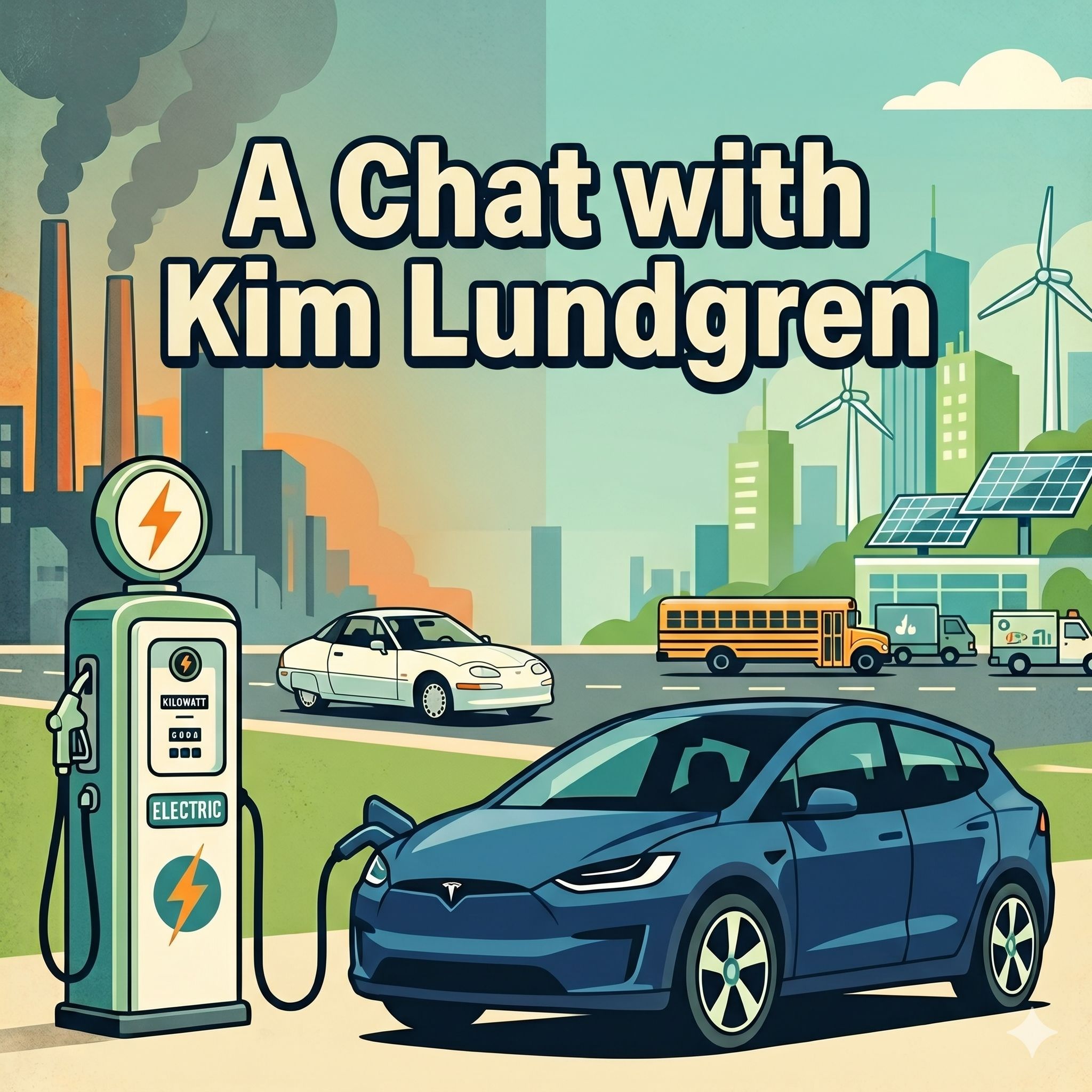
A Chat with Kim Lundgren
About this episode
Kim Lundgren talks about her 25-year career helping local governments tackle climate change, from emissions inventories and vulnerability assessments to practical steps like building upgrades, fleet planning, and route optimization. She also shares memorable stories from driving a GM EV1 as a daily car in Medford, including the public reaction it got and the early misconceptions people had about EV range. The conversation keeps circling back to local action, values, and how cities can lead by example.
In this episode, we chat with Kim Lundgren, the founder of Kim Lundgren Associates (KLA). Kim shares her journey from being an pioneer in municipal climate planning to driving an original GM EV1 as a city official in the early 2000s. We explore the role local governments play in decarbonizing our communities, the evolution of clean school bus programs, and why "right-sizing" municipal fleets is a low-hanging fruit for sustainability. Kim provides a grounded perspective on why we aren't just "saving the planet," but rather ensuring humanity can continue to thrive on it.
Support the Show https://www.supportkilowatt.com/
Other Podcasts:
News Links:
*Show Art Created By Gemini
Hosted by Simplecast, an AdsWizz company. See pcm.adswizz.com for information about our collection and use of personal data for advertising.

General Motors Ev1
"...e're going to start the conversation off with the EV1, because Kim actually had an EV1 as her daily dr..."
The General Motors EV1 is an early electric car made by GM. It’s often talked about because it was one of the earlier examples of a car designed to run on electricity. In the podcast, it’s mentioned because someone actually drove one every day, which helps explain what it was like to live with.
The General Motors EV1 is an early electric vehicle from GM that’s frequently referenced when discussing the history of modern EVs. It’s significant because it represents one of the first widely known, purpose-built EVs that helped shape public awareness of electric driving. It may be discussed in the podcast because Kim had one as a daily driver, making it a practical, real-world example of how the EV1 worked day to day.
purpose-built electric vehicle (not a conversion)
"...GM tested out the EV1, which was a car that was actually designed and built from the ground to be an electric vehicle, not just some kind of conversion."
A purpose-built EV is made for electricity from the start. A conversion is when someone takes an existing gas car and tries to change it to run on electricity. Designing it from scratch usually makes it work better as an EV.
A “purpose-built” EV is designed from the ground up for electric propulsion, rather than being converted from an existing gasoline platform. That typically allows better packaging for batteries, more efficient drivetrain layout, and EV-specific safety and cooling design. The segment contrasts this with conversions to highlight why early EVs like the EV1 were significant.
AC induction motor
"It had a lightweight frame, it was a two-seater, had an AC induction motor."
An AC induction motor is the electric motor that turns electricity into motion. It uses alternating current (AC) to spin the motor smoothly. The EV1 used this type of motor as part of its electric power system.
An AC induction motor is an electric motor that uses alternating current to create a rotating magnetic field. It’s a common EV motor type because it can be efficient and durable, and it works well with modern motor controllers. In the segment, it’s used to describe the EV1’s drivetrain.
EV1
"Most of these EV1s were leased in places like California and Arizona, and I believe all of them had to be leased. You could not purchase these cars to own. GM eventually decided this was not the path they wanted to go."
The EV1 was an early electric car made by General Motors. Instead of selling it like a normal car, GM mostly leased it, and later they stopped the program and took the cars back.
The EV1 refers to General Motors’ early electric vehicle program from the 1990s. In many markets (including California and Arizona), the cars were leased rather than sold to the public, and GM later ended the program, retrieved the vehicles, and destroyed many of them.
leased (could not purchase these cars to own)
"Most of these EV1s were leased in places like California and Arizona, and I believe all of them had to be leased. You could not purchase these cars to own."
A lease-only sales model means customers don’t build ownership rights like they would with a retail purchase. For the EV1, this limited long-term access to the vehicles and contributed to how the program ended—GM could retrieve cars rather than deal with a large used-car market.
pulled the plug on the program
"GM eventually decided this was not the path they wanted to go. They pulled the plug on the program, and then they took all the cars back, and then famously... crushed them."
This phrase means the company stopped the project. For the EV1, GM ended it, took the cars back, and destroyed many of them.
“Pulled the plug” describes a company abruptly ending a product program. In the EV1’s case, GM ended the program, retrieved vehicles, and then destroyed many of them—an outcome that became a major talking point in EV history.
crushed them
"They pulled the plug on the program, and then they took all the cars back, and then famously... to the frustration of many just crushed them."
Crushing means the cars were destroyed instead of being sold or kept. That’s a big deal because it meant the EV1s weren’t likely to show up later as used cars.
Crushing the vehicles is the physical end of a product program—removing cars from circulation and limiting future availability. The EV1 story is often discussed this way because it prevented many cars from entering the used market and preserved the controversy around the program’s end.
climate vulnerability assessments
"So we do everything here at KLA from greenhouse gas emissions inventories, climate vulnerability assessments. So essentially looking at where are the emissions coming from, and then how are the"
This is a study of how vulnerable a city or region is to climate impacts. It helps decide what problems to prioritize and where solutions will matter most.
Climate vulnerability assessments evaluate how exposed and sensitive a place is to climate-related risks (like heat, flooding, or drought) and how well it can adapt. For EV and renewable-energy policy, these assessments help target investments where they reduce risk most.
greenhouse gas emissions inventories
"So we do everything here at KLA from greenhouse gas emissions inventories, climate vulnerability assessments. So essentially looking at where are the emissions coming from, and then how are the"
A greenhouse gas emissions inventory is a structured accounting of where emissions come from (often by sector like transportation, buildings, and industry). It’s a foundational step for climate planning because it establishes a baseline before setting targets and strategies.
electric vehicles
"And recognizes that there's so many solutions, including electric vehicles, that are right there at our fingertips right now and can really be something that folks move forward with."
Electric vehicles run on electricity stored in a battery, not gasoline. Because they don’t have tailpipes like gas cars, they can help reduce the pollution people breathe in daily life.
Electric vehicles (EVs) are cars that use electric motors powered by batteries instead of burning gasoline or diesel. In climate and air-quality discussions, EVs are often highlighted because they can reduce tailpipe emissions where people live and travel.
Clean School Bus Program
"So it's called the Clean School Bus Program. And I think it was an EPA program. It was still active up until a couple of years ago..."
This was a government program (through the EPA) to make school buses cleaner. The goal was to reduce the exhaust kids are exposed to on long bus rides, improving air quality around schools and neighborhoods.
The Clean School Bus Program is an EPA program aimed at reducing pollution from school buses by helping communities replace or retrofit older buses. In this segment, it’s used as an example of how EV-related policy can start with cleaner transportation for kids, even if the buses aren’t necessarily converted to full EVs.
tailpipes
"And so the toxins that come out of the tailpipes of different vehicles, they breathe that in more. And so asthma and other respiratory issues are a huge challenge."
A tailpipe is where a vehicle’s exhaust comes out. The podcast explains that kids can be more affected because they breathe more quickly and are smaller, so the pollution can hit them harder.
Tailpipes are the exhaust outlets on vehicles where combustion byproducts are released into the air. The segment connects tailpipe emissions to health impacts—especially for children—because they breathe faster and are closer to the exhaust environment.
asthma and other respiratory issues
"And so the toxins that come out of the tailpipes of different vehicles, they breathe that in more. And so asthma and other respiratory issues are a huge challenge."
Asthma and other breathing problems can get worse when the air is polluted. The podcast is making the point that bus routes expose kids to exhaust for a long time, which can increase health risks.
Asthma and other respiratory issues are health problems that can be worsened by air pollution, including vehicle exhaust. The segment emphasizes why transportation emissions matter locally—because children on school buses spend significant time breathing the air affected by nearby traffic.
diesel particulate filters
"when we got the Clean School Bus Grant, the idea was, hey, diesel particulate filters can be put on these big diesel buses to make it so that what is coming out the tailpipe is much cleaner"
A diesel particulate filter is a device on a diesel exhaust system that catches the smoky soot before it leaves the tailpipe. It helps make diesel exhaust cleaner by trapping and then burning off that soot.
A diesel particulate filter (DPF) is an emissions-control device that traps soot (particulate matter) from a diesel engine’s exhaust. It periodically cleans itself by burning off the trapped soot, reducing visible smoke and harmful particles.
Clean School Bus Grant
"when we got the Clean School Bus Grant, the idea was, hey, diesel particulate filters can be put on these big diesel buses to make it so that what is coming out the tailpipe is much cleaner"
A Clean School Bus Grant is money provided to help school districts reduce pollution from their buses. Here, it helped pay for cleaner exhaust equipment on diesel buses.
The Clean School Bus Grant refers to a funding effort aimed at reducing pollution from school bus fleets. The segment discusses how the grant supported emissions upgrades for diesel buses and how eligibility rules affected who could receive funding.
retrofit
"if we're retrofitting school buses, we want to give money to folks who own the buses. But we made a case that more than 30% of school districts in the US do not own their school buses, they lease them from the private sector."
A retrofit means taking something that’s already in use and adding new parts or upgrades to it. Here, it’s about improving older buses’ emissions without buying brand-new buses.
A retrofit is adding new technology or equipment to an existing vehicle that didn’t originally have it. In this context, it means installing emissions upgrades (like DPFs) on already-existing diesel school buses rather than replacing the buses entirely.
EPA
"because, you know, and you can understand, you can appreciate how EPA wants to have more control over, okay, if we're retrofitting school buses, we want to give money to folks who own the buses."
EPA is the U.S. agency that works on environmental rules and pollution control. In this story, they’re involved because they’re funding cleaner school bus projects.
The EPA (U.S. Environmental Protection Agency) sets and enforces many of the rules that control vehicle emissions. In the transcript, the EPA is also funding programs that encourage cleaner school buses and emissions upgrades.
electric buses
"I think this is great. And I love that more and more school districts are going with the electric buses."
Electric buses are buses that run on electricity stored in batteries instead of diesel fuel. The speaker’s point is that school routes are usually predictable, so it’s easier to plan around the bus’s range.
Electric buses use electric drivetrains powered by onboard batteries (and sometimes charging infrastructure) instead of diesel engines. The transcript frames them as an easier transition for school districts because many routes are fixed and predictable, reducing operational uncertainty.
climate action plan
"So what had happened was Menford, when I started with the city, I was hired to basically write a climate action plan for them... And so when Menford had the first climate action plan in Massachusetts in 2001, we got a lot of press around that."
A climate action plan is a structured set of goals and policies a city uses to reduce greenhouse-gas emissions and address climate impacts. The guest ties Menford’s early plan (in 2001) to increased media attention and follow-on interest from other cities. It’s a “policy-to-project” concept: planning can unlock partnerships, funding, and pilot programs like EV deployments.
Massachusetts
"because Menford, Massachusetts... And so when Menford had the first climate action plan in Massachusetts in 2001... Well, back then, in the early 2000s, Massachusetts adopted the California Clean Air Standards."
Massachusetts is central to the story because the guest describes how the state’s early adoption of California’s clean air rules influenced automakers to place EVs in the region. The discussion is about how local and state policy can shape what vehicles show up and when. It’s a useful geographic policy context for EV adoption.
Clean Cities Coalition
"There's a program called the Clean Cities Coalition, that's part of the United States Department of Energy. And I had started attending meetings for that they were bringing funding in for alternative fuels."
The Clean Cities Coalition is a program within the U.S. Department of Energy focused on advancing alternative fuels and reducing petroleum use. In the segment, it’s described as bringing funding for alternative-fuel efforts, which connects directly to why EVs were supported and deployed in places like Massachusetts. It’s an example of how federal programs can accelerate local EV adoption.
alternative fuels
"There's a program called the Clean Cities Coalition... they were bringing funding in for alternative fuels. That's what Clean Cities has always focused on."
Alternative fuels are fuels for cars that aren’t regular gas or diesel. Electricity is one of the biggest examples. In this segment, the guest is saying funding for alternative fuels helped support EV projects.
Alternative fuels are transportation fuels other than conventional gasoline or diesel, including electricity, hydrogen, and biofuels. The guest mentions Clean Cities funding for alternative fuels, which is directly relevant to early EV programs. Understanding this term helps explain how EV initiatives were often bundled into broader “fuel switching” efforts.
Clean Air Standards
"Well, back then, in the early 2000s, Massachusetts adopted the California Clean Air Standards. And so all of the car companies were like, Oh, let's get some electric vehicles on the ground in Massachusetts."
Clean Air Standards are government rules meant to reduce pollution. When Massachusetts adopted California’s version, it encouraged car companies to bring more cleaner vehicles to the state. That’s part of why electric cars like the EV1 showed up.
“Clean Air Standards” refers to emissions rules that limit pollutants from vehicles and other sources. The guest says Massachusetts adopted California’s standards, which effectively pushed automakers to offer more low-emission vehicles—like EVs—within the state. This is a key policy mechanism behind early EV rollouts.
charging station
"So they came into City Hall, they literally installed put in a charging station for me right at City Hall actually ended up getting like the best spot. Because that's where the utilities work."
A charging station is the fixed equipment that delivers electricity to an EV’s battery. Where it’s installed matters because it affects convenience, access for utilities/maintenance, and how consistently drivers can charge. The host notes the station was placed at City Hall in a “best spot” tied to utility access.
minimize how much of the battery that we were using
"And that's when, you know, you learn pretty early like, Oh, I can adjust my driving. I'm going to take my foot off the gas a bit. I'll slow down... not hit the brakes so hard, just finding that way to minimize how much of the battery that we were using."
This is about range management—driving in a way that reduces energy consumption so you can go farther on a limited battery. Techniques mentioned include easing off the accelerator, slowing down more gently, and avoiding hard braking. Those behaviors reduce the energy the car must spend to accelerate and help limit losses.
fully electric car
"which is when I would explain to people that this is a fully electric car. Now, you know, you have to think back 2001, there were barely any hybrids on the road."
The phrase “fully electric” distinguishes a battery-electric vehicle (BEV) from hybrids, which use both a gasoline engine and an electric motor. Around 2001, hybrids were far less common, so many people didn’t immediately understand that an EV could be entirely powered by electricity. The host describes explaining this distinction to people and getting positive reactions.
EV
"...I can't possibly get an EV. And I still find that people have that thought today... because even if you drove a fossil fuel vehicle across the country, you'd have to stop to gas it."
EV stands for electric vehicle, and the episode is addressing a common misconception that EVs can’t handle long-distance travel. The hosts contrast the idea with the reality that any car—gas or electric—requires stops during a cross-country trip (gas stops vs charging stops).
fossil fuel vehicle
"...because even if you drove a fossil fuel vehicle across the country, you'd have to stop to gas it."
A fossil fuel vehicle is a car that runs on gasoline or diesel. The episode uses this term to make a practical comparison: long-distance travel requires stopping for fuel, which is analogous to stopping for charging in an EV.
American Recovery and Reinvestment Act
"...I got hired by a big engineering firm to build their municipal climate and energy practice, which at the time that was the Obama administration had put out the first round of ARA, ARPA, the American Recovery and Reinvestment Act..."
This was a big U.S. government program that injected money into the economy. The episode mentions it because some of that money was aimed at climate and energy-efficiency projects, which can help the systems EVs rely on.
The American Recovery and Reinvestment Act (often shortened to ARRA) was a major U.S. federal stimulus law. In the context of this episode, it’s referenced as a source of public funding that encouraged climate and energy-efficiency projects, which can indirectly support EV infrastructure and related work.
reduce their emissions
"...But you think you have a right to tell cities how they should reduce their emissions."
It means trying to put less pollution into the air. With EVs, the idea is that switching from gas cars to electric cars can help reduce harmful emissions.
“Reduce their emissions” means lowering the pollutants a city or region releases into the air, usually by cutting fossil-fuel burning and shifting to cleaner energy and transportation. In EV conversations, this often connects to electrifying vehicles and improving grid power.
saving the planet (metaphor)
"“when you were talking about saving the planet… saving the people… as long as you're consistent, you don't need to be perfect.”"
They’re talking about “saving the planet” as a way to describe climate goals. The point is that you don’t need to be perfect—just keep making progress in the right direction.
The phrase “saving the planet” is used here as a metaphor for climate action and sustainability priorities. The hosts discuss whether the goal should be perfection or consistent progress—an approach that maps to how EV adoption is often argued (steady improvement over flawless solutions).
terraforming
"“Mars is the next step… we’ll all be dead before Mars is ready to terraform… So, this is the current step.”"
Terraforming means trying to change a planet so people could live there. In this conversation, it’s used more like a big-picture idea about the future, not a practical EV topic.
Terraforming is the idea of changing a planet’s environment so it becomes habitable for humans (or other life). In EV discussions, it’s often used as a metaphor for long-term climate and sustainability goals—how we “reshape” our future rather than just chase short-term fixes.
colonizing Mars
"“We need to sure look at colonizing Mars someday… But for now, we know that this works.”"
Colonizing Mars means building a permanent human presence on Mars. The hosts are contrasting that far-future plan with what we can do right now on Earth.
Colonizing Mars refers to establishing permanent human settlements on Mars. It’s a speculative long-term goal that contrasts with near-term actions on Earth—like reducing emissions—which is a common framing in sustainability and EV advocacy.
HVAC systems
"“you have to take care of your buildings and your HVAC systems and things like that. So, any community or local government…”"
HVAC is the system that controls heating and cooling in a building. Keeping it maintained—or upgrading it—can reduce energy use. It’s an important part of making buildings more efficient.
HVAC stands for heating, ventilation, and air conditioning. In buildings, HVAC systems often represent a large energy load, so upgrading or maintaining them is a key part of making facilities more efficient—especially when transitioning away from fossil-fuel heating.
heat pot
"“like, oh, well, you didn't go all electric there, rip out that natural gas stuff and put it in a heat pot now.”"
They’re talking about replacing a gas heating setup with an electric heating option. The key idea is not to replace working equipment too early, because that wastes resources and money.
“Heat pot” appears to refer to a heating appliance/system being swapped in during an electrification effort. The point in the transcript is that ripping out existing natural gas equipment immediately and replacing it with a new electric heating setup can be wasteful if the current system isn’t at end of life.
natural gas
"“rip out that natural gas stuff and put it in a heat pot now.”"
Natural gas is a fuel used for things like heating buildings. The discussion is basically saying: don’t replace gas equipment immediately just to “go all electric” if the old system still has useful life.
Natural gas is a fossil fuel commonly used for building heating. The transcript uses it as an example of why electrification decisions should be timed to equipment end-of-life, rather than forcing immediate swaps that create waste.
end of life planning
"“So, we want folks to be looking as we're nearing end of life. So, we've got big decisions that are coming up. We're it's 15, 16 years old…”"
End-of-life planning means you plan for replacement before things break down completely. Instead of changing equipment too early (wasting money) or too late (risking failures), you schedule upgrades when they make sense.
“End of life” planning means preparing for major replacements when equipment or vehicles reach the point where repairs become unreliable or too expensive. The transcript ties this to EV and building decisions—planning ahead rather than making wasteful, premature changes.
decentralized vs centralized fleet management
"“So, some communities are, everything's super decentralized. Every department, if they have a car or vehicle of some sort, they take care of it. Other places where it's more centralized…”"
They’re comparing two ways cities can run their vehicle programs. In one model, each department handles its own vehicles; in the other, one central person manages the fleet. Central control can help make EV and replacement decisions more consistent.
The transcript describes two organizational approaches: decentralized operations (each department manages its own vehicles) versus centralized control (a fleet manager coordinates decisions). Centralization can make it easier to standardize EV adoption timing, replacement schedules, and operational changes across the whole city.
fleet manager
"“Other places where it's more centralized, like in New York City, you're going to have a lot more control by the fleet manager who can decide, okay, this is what we're changing out for this.”"
A fleet manager is like the “vehicle planner” for an organization. They decide which vehicles to use and when to replace them so the fleet runs efficiently. Centralized control usually makes those decisions easier to coordinate.
A fleet manager is the person responsible for overseeing a fleet of vehicles—deciding what to buy, when to replace vehicles, and how to operate them efficiently. The transcript contrasts decentralized departments with centralized control, where the fleet manager can standardize decisions across the city.
route optimization
"“Easy things they can do without even buying new vehicles, like, I mean, for buses, any type of transit, route optimization, same thing with your trash trucks, even your street sweepers.”"
Route optimization means planning the best path for vehicles to take. If routes are smarter, trucks and buses drive less and waste less energy. That can also reduce pollution.
Route optimization is planning delivery or service paths to reduce distance traveled and stop-and-go driving. For fleets like buses, trash trucks, and street sweepers, better routing can lower energy use and emissions because vehicles spend less time idling and driving inefficiently.
right sizing your fleet
"“So, really, right sizing your fleet to make sure that you're putting the right vehicle in the right application for what's needed. Those are some quick, easy little things.”"
It means choosing the right kind of vehicle for the work. If you use a vehicle that’s bigger than you need, you waste energy and money. Matching the vehicle to the job helps cut costs and pollution.
“Right sizing your fleet” means matching the vehicle type and size to the actual job it needs to do, instead of using a bigger truck or bus than necessary. In fleet operations, this can reduce energy use, emissions, and maintenance costs because vehicles aren’t overbuilt for the task.
EV webinar
"“Yeah. So, I watched, and I mentioned this to you earlier, but I watched the one of your webinars on EVs…”"
They’re referring to an online talk about electric vehicles. It’s being used as background for the discussion, not as a technical vehicle detail.
An EV webinar is an educational session focused on electric vehicles, often covering fleet electrification strategies, infrastructure, and operational considerations. The transcript references watching such a webinar as context for the conversation.
Blink
"they were able to partner with Blink, for instance, for charging infrastructure. The city kind of had to put in, you know, they had to dig... but then Blink operated the chargers."
Blink is a company that provides and runs EV charging stations. The city helps with the construction work, and Blink takes care of operating the chargers.
Blink is an EV charging company that operates charging hardware and services. In the segment, the city partners with Blink so the city handles the site work (digging trenches), while Blink runs the chargers.
emergency power for EV charging (covered parking)
"they are using, they have covered parking that is just for emergency power to power vehicles. That covered parking doesn't go back into the grid... That's there to charge vehicles... in an emergency to charge citizens vehicles so that they can get to safety"
This is backup power for EV chargers. If there’s a disaster and the grid goes down, the chargers can still work so people can charge enough to get to safety.
The speaker describes covered parking that is backed by emergency power specifically to charge vehicles during outages. Importantly, it’s not meant to feed power back into the grid; it’s a resilience measure so citizens can charge and evacuate or reach safety.
Hurricane Sandy
"I think a lot of what you're seeing there from New York is a result of Hurricane Sandy. And what often happens is when we do have a massive event happen... that's when we see all the vulnerabilities"
Hurricane Sandy was a big storm that caused major damage, especially in parts of New York. The point here is that it showed where systems weren’t ready, which pushed cities to plan better for future emergencies.
Hurricane Sandy is used as the example of a major event that exposed infrastructure vulnerabilities and drove resilience planning. The segment ties it to why local governments in New York adopted more preparedness-focused approaches for extreme weather and energy systems.
climate action series (webinar series)
"That was really the point of our climate action series there, the webinar series. So like, hey, this is happening other places,"
The speaker references a climate action webinar series designed to share lessons learned across locations. In context, it’s about transferring resilience and EV infrastructure strategies from one community to others.
zoning and building permits
"...our local government policies and zoning and building permits are not innovating at that speed. And so what ends up happening is, you know, a project will come forth in the cities like..."
Zoning and permits are the local rules that decide where something can be built and what requirements it must meet. EV chargers aren’t just “plug in and go”—cities may need to approve locations and construction details first.
Zoning and building permits are local government rules and approvals that determine where infrastructure can be installed and how it must be built. For EV charging, these processes can become bottlenecks because chargers often need electrical upgrades, curb/sidewalk placement decisions, and clear standards for safety and access.
electrification
"But everything with electrification, whether it's buildings, transportation, none of that was planned for. People who live in... want to have an EV charger..."
Electrification means switching more of everyday life—like cars and buildings—from gas or other fuels to electricity. That creates new work for cities because they have to build and manage the new systems.
Electrification is the broader shift from using fossil-fuel energy to using electricity across sectors like transportation and buildings. The segment frames electrification as a planning challenge for local governments because it requires new infrastructure, new rules, and new staffing capacity.
on-street EV charging (no driveway/garage)
"People who live in, you know, triple-deckers in Cambridge want to have an EV charger, but they don't have a driveway or a garage. What are we doing? How do we put this just on the street?"
On-street EV charging is for people who park on the street instead of in a driveway or garage. It usually means the city has to set up designated spots and make sure there’s power available.
On-street EV charging is charging access for drivers who don’t have private parking like a driveway or garage. This typically requires city-managed curbside or public charging programs, including rules for where chargers can be installed and how power is delivered.
Amsterdam EV charging model (everyone brings their own charger)
"I was actually just in Europe and everywhere. Oh my god. But Amsterdam is a great example. Everywhere you went, there's it looked like a parking meter, but it's not. It's an EV charging and everyone just brings their own charger."
The Amsterdam example is about how a city can make public charging easier to use. Instead of every charger being a totally custom project, the public setup is standardized so drivers can plug in with their own gear.
The Amsterdam example describes a charging setup where curbside infrastructure resembles parking meters, but the system is designed for EV charging access. The key idea is a standardized public interface that supports drivers using their own charging equipment, reducing the need for one-off city-by-city solutions.
greenhouse gas emissions perspective
"And because when you look at everything from a greenhouse gas emissions perspective, local government operations, like in the whole scale of a community, are typically less than 3% of total emissions."
This is about thinking in terms of total pollution (greenhouse gases) rather than one project. The point is that some efforts may not matter as much as you’d think compared with the biggest sources of emissions. It’s a way to decide what to focus on first.
“Greenhouse gas emissions perspective” refers to evaluating climate impact by total emissions, not just one category like building upgrades or transportation. The speaker uses this framing to argue that local government operations are typically a small share of community-wide emissions. That’s a strategic way to prioritize where limited resources can have the biggest effect.
local government operations
"And because when you look at everything from a greenhouse gas emissions perspective, local government operations, like in the whole scale of a community, are typically less than 3% of total emissions."
This means the pollution from city/county activities, like city vehicles and city buildings. The speaker’s point is that it’s important, but it’s often not the biggest source of emissions in the whole community. So cities should also help residents switch to cleaner choices.
“Local government operations” means the emissions tied to how a city or county runs—like municipal buildings, fleets, and services. The speaker argues these are usually a small portion of total community emissions, so local governments should balance their own upgrades with helping residents make changes. This is a policy concept that affects how EV charging and outreach are prioritized.
geothermal with solar
"...great that you updated that high school to be geothermal with solar and all these EV charging. That's great because you had to update that building anyways."
This means using two kinds of clean energy at once. Geothermal uses heat from underground, and solar uses sunlight. Together they can make a building cleaner, which supports the bigger goal of reducing emissions.
“Geothermal with solar” describes combining renewable energy sources: geothermal for steady heat/energy and solar for electricity generation. The speaker uses it as an example of building upgrades local governments may pursue. For EV listeners, this matters because cleaner electricity and heating reduce the overall emissions benefits of electrification.
decarbonize your home, to move to an electric vehicle
"A lot of what we talk about when we engage with the community and their community members is trying to understand what are the barriers for you to decarbonize your home, to move to an electric vehicle. Yes, we hear money a lot, the cost of it."
The segment frames EV adoption as part of a broader decarbonization effort, not just a vehicle purchase. It highlights that barriers include more than sticker price—like understanding options and vehicle types. This is a useful lens for listeners because EV decisions are often influenced by education and local support.
local governments
"is trying to get local governments to really own that role that they have to help their community members move to solutions that aren't just about the climate, but are going to be healthier for them, cleaner for them."
The segment discusses how local governments can influence EV adoption and mobility by shaping programs, incentives, and infrastructure planning. The idea is that policy can help residents transition to cleaner, healthier, and potentially lower-cost transportation options.
life cycle, looking at an electric vehicle
"you know, life cycle, looking at an electric vehicle, you can still save quite a bit of money when you're not having to bring in for oil changes and all the other things a lot. So there's real opportunities there for local governments"
“Life cycle” means the full cost of owning a vehicle over time, not just what you pay at the dealership. With electric cars, you usually skip things like oil changes, which can lower maintenance costs.
“Life cycle” cost looks beyond the purchase price and considers total ownership over time—energy use, maintenance, and major service needs. For EVs, the big savings often come from not needing frequent oil changes and having fewer routine service items compared with many gas cars.
oil changes
"life cycle, looking at an electric vehicle, you can still save quite a bit of money when you're not having to bring in for oil changes and all the other things a lot."
Oil changes are something gas cars need regularly to keep the engine lubricated. Electric cars don’t use engine oil the same way, so they usually don’t need oil changes.
Oil changes are a routine maintenance item for internal-combustion (gasoline/diesel) vehicles. EVs don’t have engine oil in the same way, so they typically avoid oil-change schedules, which can reduce recurring service visits and costs.
EVs for All America
"Next episode, we're going to talk to Max Patton, who's with EVs for All America, which is a bipartisan group to kind of take the stigmatism or the politics out of how your car is propelled"
They mention a group called “EVs for All America.” The point is to keep the conversation about electric cars focused on real-world benefits instead of political arguments.
“EVs for All America” is referenced as a bipartisan group focused on removing partisan friction around EV adoption. The underlying theme is that EV policy and messaging can be framed around practical benefits rather than politics.
Request an Explanation
Heard something you'd like explained? We'll add it to this episode.
Sign in to request explanations for terms you heard.
Want to learn more?
Browse our glossary for plain-English explanations of automotive terms, jargon, and concepts.
Help improve this episode
See something that's not quite right? Our annotations are AI-generated and can sometimes miss the mark. Click the flag icon on any annotation to suggest a correction.