
Exploring the future of car interiors, Olivier Juane from VIAD discusses the innovative Air Vision screen technology designed to reduce information overload for drivers. The conversation dives into the evolution of dashboard design, the integration of screens, and the potential for a calmer driving experience. Juane emphasizes the importance of creating elegant, user-friendly interfaces that prioritize safety and reduce distractions. The episode also touches on trends in interior comfort and sustainability, as well as the automotive industry's shift towards modular designs and upgrades.
"...You know, what was it, the Ford Expedition that had the screens that were like behind?"
The Ford Expedition is a large SUV that can carry many passengers and has a lot of space. It usually comes with modern technology like screens for navigation and entertainment.
The Ford Expedition is a full-size SUV known for its spacious interior and capability. It often features advanced technology, including multiple screens for entertainment and navigation.
"...I used to drive a Renault 5 and there was nothing in there, right? My natural was just fine..."
The Renault 5 is a small car made by Renault that was popular in the 1970s and 1980s. It was designed to be affordable and easy to drive around town.
The Renault 5 is a supermini car produced by the French manufacturer Renault from 1972 to 1985. It was known for its compact size and practicality, making it popular in urban environments.
"...there's also a massive problem in our industry today is affordability of vehicle, we've just got to a point where there's so much money..."
Affordability of vehicles means how easy it is for people to buy cars without spending too much money. It looks at how much cars cost and if people can pay for them.
The affordability of vehicles refers to the financial accessibility of cars for the average consumer. This includes factors like purchase price, financing options, and ongoing costs like insurance and maintenance.
"and I wanna say, Sean, is it Stellantis or Renault are doing refurbished parts that they're selling?"
Renault is a car company from France that makes many types of cars. They are known for their affordable and practical vehicles.
Renault is a French multinational automobile manufacturer known for producing a wide range of vehicles, from compact cars to commercial vehicles. The company has a strong presence in Europe and is part of various automotive alliances.
"and I wanna say, Sean, is it Stellantis or Renault are doing refurbished parts that they're selling?"
Stellantis is a big car company that makes many different brands of cars, like Jeep and Dodge. It was created when two companies joined together.
Stellantis is a multinational automotive manufacturing corporation formed from the merger of Fiat Chrysler Automobiles and PSA Group. It encompasses a variety of well-known automotive brands including Jeep, Dodge, and Peugeot.
"are doing refurbished parts that they're selling?"
Refurbished parts are old car parts that have been fixed up to work like new again. This can save money and help the environment by reusing parts instead of throwing them away.
Refurbished parts are used components that have been restored to a like-new condition, often through cleaning, repairing, or replacing worn elements. This practice can help reduce costs and waste in the automotive industry.
"But I like this idea of you bring your car to a factory, they run it down the line and you have an upgraded car at the end."
An upgraded car is a car that has been improved with better parts or features. This could mean nicer seats, better technology, or more powerful engines.
An upgraded car refers to a vehicle that has been enhanced with new features, technology, or components to improve performance, comfort, or aesthetics. This can include anything from new interior materials to advanced technology systems.
"Bridgestone Weather Peak Tires with a 70,000 mile limited warranty."
Bridgestone is a well-known company that makes tires for cars, trucks, and motorcycles. They create tires that help vehicles perform well in different weather conditions.
Bridgestone is a major global tire manufacturer known for producing high-quality tires for various vehicles, including passenger cars, trucks, and motorcycles. They offer a wide range of tire products designed for different driving conditions and performance needs.
"Bridgestone Weather Peak Tires with a 70,000 mile limited warranty."
Weather Peak Tires are a type of tire made by Bridgestone that work well in different weather conditions. They come with a warranty that covers them for up to 70,000 miles, meaning they should last a long time.
Weather Peak Tires are designed by Bridgestone to provide all-season performance, offering good traction and durability over a long lifespan, backed by a 70,000-mile limited warranty. They are suitable for various weather conditions, making them a versatile choice for drivers.
"They announced yesterday that they're winding down the Model S, they're winding down the Model X. They're scrapping them."
The Tesla Model X is an electric SUV that has unique doors that open upwards and is designed to be spacious and safe for families.
The Tesla Model X is an all-electric SUV known for its distinctive falcon-wing doors, spacious interior, and advanced safety features. It is designed for families and offers high performance.
"Well, the story on electric vehicles isn't very compelling right now, right?"
Electric vehicles are cars that run on electricity instead of gasoline. They use batteries to power an electric motor, which makes them different from regular cars that use fuel.
Electric vehicles (EVs) are cars that are powered entirely or partially by electricity, using electric motors instead of internal combustion engines. They are often seen as a more sustainable alternative to traditional gasoline-powered vehicles.
"...when we had Henry Paynon who owned his Model 3 and he had a problem with it and he had to go from Detroit to Cleveland to get it fixed."
The Tesla Model 3 is a popular electric car that is known for being more affordable than other Tesla models. It's designed for everyday use and has many high-tech features.
The Tesla Model 3 is an all-electric sedan produced by Tesla, known for its affordability and advanced technology features. It has become one of the best-selling electric vehicles worldwide.
"Toyota did well. It had record sales of 10.5 million, which puts it well established."
Toyota is a car company from Japan that makes many popular cars and trucks. They are known for making vehicles that last a long time and are good on gas.
Toyota is a Japanese automotive manufacturer known for producing reliable and efficient vehicles. It is one of the largest car manufacturers in the world.
"Well, this is Toyota Lexus. So just the cars, the passenger vehicles."
Lexus is a brand of luxury cars made by Toyota. They are known for being very comfortable and having lots of nice features.
Lexus is the luxury vehicle division of Toyota, offering premium cars known for their comfort, advanced technology, and reliability. It competes with other luxury brands like BMW and Mercedes-Benz.
"Toyota used to make boatloads of money in the US market. And then about five years ago, it started reporting losses and has continued to."
The US market is where cars are sold in the United States. It is important for car companies because many people buy cars there.
The US market refers to the automotive market in the United States, which is one of the largest in the world. It includes various consumer preferences and regulatory requirements that influence car sales and manufacturer strategies.
"Funny how, John? Funny how, because Nissan and Honda make more profit in the United States than they do anywhere else in the world."
Nissan is a car company from Japan that makes many different types of vehicles, including sedans and SUVs. They are popular for their reliable cars and innovative technology.
Nissan is a Japanese automotive manufacturer known for producing a wide range of vehicles, from compact cars to trucks and SUVs. They are recognized for models like the Altima, Sentra, and the iconic Z-series sports cars.
"Julia said they'll build cars in the Volvo plant in South Carolina. So that's minimal investment for them to come in here."
Volvo is a car company from Sweden that makes safe and reliable cars. They are well-known for their focus on safety features.
Volvo is a Swedish automotive manufacturer known for its focus on safety and quality. The brand has a strong reputation for producing reliable vehicles, including sedans, SUVs, and wagons.
The GMC Terrain is a small SUV that is good for families and has a lot of features to make driving comfortable.
The GMC Terrain is a compact SUV that offers a blend of style, comfort, and technology, making it a popular choice for families and individuals looking for a versatile vehicle.
"...we're gonna build the bright drop vehicles...."
BrightDrop is a company that makes electric vehicles for delivering packages, helping companies deliver items more efficiently.
BrightDrop is a subsidiary of General Motors focused on electric delivery vehicles and logistics solutions, aiming to improve last-mile delivery efficiency.
Car
Rivian Amazon Delivery Van
"...Rivians got the Amazon van, we got the bright drop,..."
The Rivian Amazon Delivery Van is an electric vehicle made for delivering packages, helping Amazon deliver items more quickly.
The Rivian Amazon Delivery Van is an electric delivery vehicle developed by Rivian in partnership with Amazon, designed to enhance the efficiency of package delivery services.
"Well, look, what electric vans have caught on towards electric transit, e-transit, hasn't sold much of anything."
The Ford E-Transit is a van that runs on electricity instead of gas, making it better for the environment. It's meant for businesses that need to deliver goods, but not many have bought it yet, which shows that switching to electric vehicles can be tough for some companies.
The Ford E-Transit is an all-electric version of Ford's popular Transit van, designed for commercial use and urban deliveries. While it aims to provide a sustainable alternative to traditional gas-powered vans, its sales have been slower than expected, indicating challenges in the transition to electric vehicles in the commercial sector. The discussion around it reflects the ongoing evolution of the automotive industry towards electrification.
"Rivian has sold, I think Amazon claims they've got 25,000 of its electric vans in operation right now."
Amazon is a big online shopping company that is also using electric vans for deliveries. They work with Rivian to get these vans.
Amazon is a multinational technology company known for its e-commerce platform, but it has also invested heavily in electric vehicles, particularly through partnerships with companies like Rivian to enhance its delivery capabilities.
"...and it much prefers it over the ice-powered vans"
ICE-powered vans are those that run on gasoline or diesel fuel. They have engines that burn fuel to make the vehicle move, which is the way most vehicles worked before electric ones became popular.
ICE-powered vans refer to vehicles that use internal combustion engines, which burn fuel to create power. This is the traditional method of powering vehicles before the rise of electric alternatives.
"...I'm just going to go out and buy some more Econoline vans..."
The Ford Econoline is a big van that many businesses use to transport goods or people. It's known for being strong and reliable, making it a common choice for companies.
The Ford Econoline is a series of full-size vans that have been popular for commercial use, particularly for fleet operations. Known for their durability and versatility, they have been used for various purposes, including cargo and passenger transport.
"...because people are going to trade them in or it's going to come off lease."
A lease is like renting a car for a few years. You pay to use it but don’t own it, and you usually have to return it when the lease ends.
Leasing a car means you pay to use it for a set period, typically 2-3 years, without owning it. At the end of the lease, you can return the car, buy it, or lease a new one. This is common for those who prefer driving new cars without the commitment of ownership.
"...that I thought was interesting. GM especially talked about all the subscription services that it's selling and taking in billions in revenue."
Instead of buying a car or feature, you pay a monthly fee to use it. This is similar to how you might subscribe to a streaming service for movies or music.
Subscription services in the automotive industry allow customers to pay a recurring fee for access to vehicles or features, rather than purchasing them outright. This model is becoming increasingly popular as manufacturers look for new revenue streams.
"...GM especially talked about all the subscription services that it's selling and taking in billions in revenue."
GM stands for General Motors, a big company that makes cars like Chevrolet and Cadillac. They are working on new ways to sell cars and services, like subscriptions.
General Motors (GM) is one of the largest automobile manufacturers in the world, known for brands like Chevrolet, GMC, Cadillac, and Buick. They are heavily involved in innovation and technology, including electric vehicles and subscription services.
"...They call it deferred revenue because you can't count it until it's actually paid. But they got billions on the books."
It's money a company has received but hasn't yet earned because they haven't delivered the product or service. Think of it like paying for a magazine subscription; the company gets your money, but they still have to send you the magazines over time.
Deferred revenue refers to money received by a company for goods or services that have yet to be delivered or performed. In the automotive context, this can relate to subscription fees that are paid upfront but recognized as revenue only when the service is provided.
"...how many more miles people are using BlueCruise for driving."
BlueCruise is a feature in Ford cars that lets you drive without using your hands on the wheel, but only on specific roads. It's like having a smart helper while you drive.
BlueCruise is Ford's advanced driver-assistance system that allows for hands-free driving on certain highways. It uses cameras and sensors to monitor the vehicle's surroundings and keep it centered in its lane.
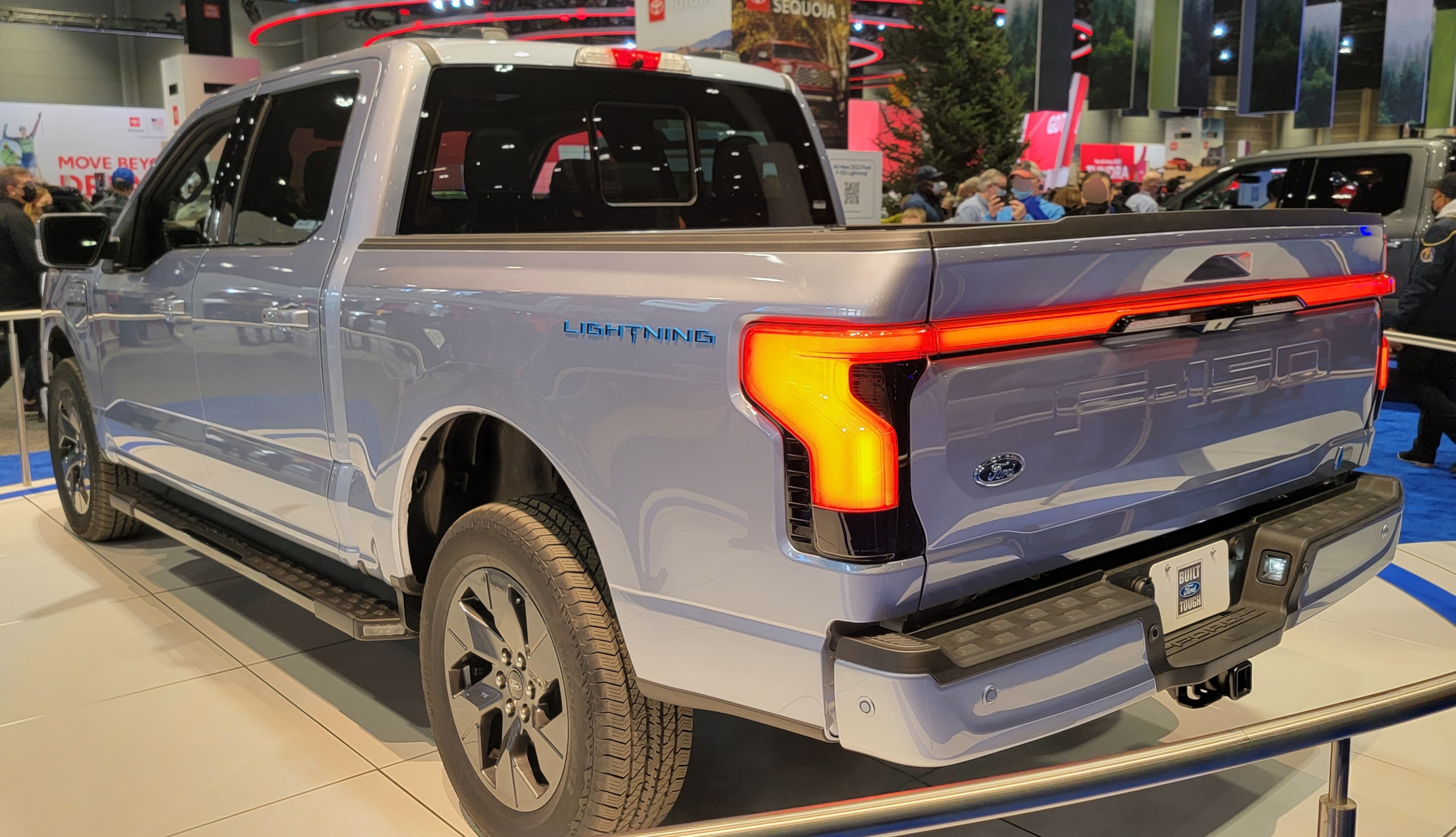
"and how more people are signing up for it. Suddenly it's in the F-150 and their hours of use have just exploded."
The Ford F-150 is a big truck that many people use for work and everyday driving. It's popular because it can carry heavy loads and is very reliable, which is why more people are starting to use it for different jobs.
The Ford F-150 is a full-size pickup truck that has been one of the best-selling vehicles in the United States for decades. Its significance lies in its versatility, strong performance, and ability to cater to both work and personal use, making it a popular choice among consumers. The mention of increased usage highlights its growing importance in various sectors, especially in commercial applications.
"...two Chinese cars in that you can drive, the Xiaomi Su7 Ultra, the Yang Wang, U9 Extreme."
The Xiaomi Su7 Ultra is a car made by Xiaomi, a company famous for making smartphones and electronics. This car is part of their new venture into making vehicles.
The Xiaomi Su7 Ultra is an electric vehicle produced by the Chinese technology company Xiaomi, known for its consumer electronics. This model represents Xiaomi's entry into the automotive market, showcasing their ambition to diversify their product offerings.
Car
Yang Wang U9 Extreme
"...the Xiaomi Su7 Ultra, the Yang Wang, U9 Extreme. And the reason I mention this is,..."
The Yang Wang U9 Extreme is a high-performance electric sports car made by a Chinese company called Yang Wang. It's one of the new electric cars that are becoming popular.
The Yang Wang U9 Extreme is an electric supercar from the Chinese automotive brand Yang Wang, which focuses on high-performance electric vehicles. This model is part of a growing trend of electric supercars emerging from China.
Select text to request an explanation
AutoLine After Hours is brought to you by
Bridgestone Tires, solutions for your journey.
Hey, welcome everybody to AutoLine After Hours.
And especially to you, Gary.
Well, thank you, John.
How are you?
I'm doing pretty good.
In this Michigan winter that we're finally having,
this is a real winter.
Let me tell you what.
You're gonna have a hot show.
We're gonna have a hot show.
Well, yeah, that's right.
So we should let everybody know,
our special guest today is Olivier Juane.
He's the director of Advanced Customer Interface for VIAD,
which really doesn't tell the audience anything.
He's really an expert in interior design
and we're going to be getting into that.
And we've also got Dave Zoya joining us as well.
So Dave, great to have you on the show.
Thanks for having me.
Yeah.
Pleasure to be here.
Excellent.
So Gary, you always have a bunch of questions all lined up.
I sort of go off the top of my head.
Why don't we start from a more structured standpoint with you?
Okay.
So Olivier, one of the things that we promise
that we would talk to you about,
and we'll start talking about this right from the get-goes,
and then we'll move on from there
to the other things that John will get on to get to.
You guys developed screen technology called Air Vision.
Correct, yes.
And this is, my understanding is to eliminate
much of the screen confusion
that exists when we're looking at cars.
And nowadays it seems, and Dave and I have driven
a ton of cars of late looking at interiors
and screens are everywhere.
And not to mention the lighting that is being used
as trim now.
I mean, it's just like you're in some sort of a carnival
when you sit down in a vehicle.
You guys are addressing that.
We're addressing that.
In fact, the concept is also to reduce the quantity
of information that is blasted at you all the time.
I always feel like as an HMI designers,
you have a canvas and this canvas is now multiple screens
and you feel like you have to put information everywhere.
As a consumer, as a driver,
sometimes you have way too much information coming at you.
So the thing we do with Air Vision is we work
through a reflection type system,
which means the picture framing that you get
of what we call postcarding effect
of having a screen inside a black surface
doesn't exist anymore.
You can have one screen, two screens, five screens
and not see a screen but see information.
And this information seems to be floating
in the space in front of you.
So it has a magical aspect to it.
And because of that, you can make information come
when you need it and only the information
that you need at that moment.
So it gives you a less distracted driving system,
but also a more precise system.
And the quality of the image is really interesting.
But I mean, is there a classic screen
or are you just using a surface that you're projecting on?
We're not projecting.
It's literally a reflection.
So you still have screens,
but the dimension of the screen is not as important
in the sense that if you have a nine inch screen,
but you can see a nine inch block, right?
Now if you have a nine inch screen in the system,
you don't see the edge of the screen,
so you see just the information.
That allows you to have maybe more classic screens
and have just as good of a quality.
Particularly when you start using a local dimming,
you can really, really get some beautiful imagery.
Because the decor, what's behind is always there.
So you have this beautiful piece of fabric, for example,
that is there and the image is floating in front of it
in the image of just your cluster, for example,
or your navigation.
You have to experience it.
Yeah, I've seen it.
I wouldn't even describe it as a screen,
because when you say screen,
we all think of the screens that we're used to.
I would call it more of a display area.
And so instead of these rectangular screens
attached to the instrument panel,
it's a display area that sort of floats
behind the instrument panel.
Correct.
I guess is the way I would describe it.
But you must love the idea as a designer, Olivier.
You must love the idea of getting rid of these screens.
It has become almost, I mean,
it has, I think it's been a rest to the number of screens
in the size of screens to a point where I feel like
the consumer of getting screen fatigue, you know?
I mean, we're up to doing like,
one of the ways it doesn't exist anymore,
that the 52 inch screen, 52 inch is bigger than my TV.
And do I need that to drive a car?
Clearly not, right?
So I feel like we're going to move toward
a much calmer interior.
And that's a solution that can be used for that.
But the other thing from a design standpoint is,
these screens just look like an afterthought
that have been added to the instrument panel, up to now.
And it's, to me, I knew the industry had to get through this.
It's just an in elegant design solution.
And so I love the fact that you guys are coming up
with a whole new, another idea on this.
Even the screens that have been embedded into the console
or the instrument panel look like screens
that have been embedded, maybe a little bit better
instead of just stuck on.
But you guys are shattering that whole paradigm
with this new approach.
Yes, that is a goal.
And bring something to the designers
that they can design things again.
Because it feels like, when you have a screen,
you have a screen, the best you can do
is cover it with a black lens
and maybe make it a little less square.
But it's still always the same language.
And it becomes difficult to get a differentiation
from interior to interior when you start looking at
particularly in the Chinese car,
which have screens everywhere,
they all end up looking the same to me.
This is not the design freedom of creating something
interesting to look at because of some of the screen.
This then requires that the IP itself
be designed differently than it is designed now.
Yes.
So tell us what the changes would be.
Well, I think some of the biggest changes
is mostly on the integration.
So that's one of the advantages we have at Forvia
is we have multiple business group.
So we have an electronic business group
plus four cyclical electronic which does screens.
And we have the interior system group
that does instrument panel.
And we have even software people in Toronto
that are doing some fantastic software based around the eye
so that it's not just programming,
it's programming for the human eyes
so that we can do better imagery.
And all those working together give us the capacity
to do some intelligent integration,
which I can't give you too much detail on that
that's at the moment,
because we're still working on it.
So would you deliver an entire IP
to the assembly line as a goal?
We do.
Currently we do.
We do currently deliver, I don't know.
Close to two million, I believe, a year IP instrument panel
for all kinds of customers.
And we do that all over the world.
How do you control, I mean, you're obviously looking
at eye gaze and things like that,
but is there also another way to control what's going on?
So today you can control it through in the MMI,
so a rotary like you control a lot of German cars.
You can't touch it because it's too far from you
and it's not really a touchscreen
because it's not really a screen.
But you can control it with a screen, a secondary screen.
You can control it by voice as well.
And the one I prefer that we are currently developing
is gaze and select,
where since we've had to implement cameras
to watch a driver make sure he's being safe.
It's a new European legislation.
So through that we can track the eyes
and by tracking the eyes we can see where he's looking
and we can then, through a button or voice,
select an icon to activate something.
So you could look at something on this display.
Right, which is not even there
because it's a reflection, right?
And then it would detect that and let's say,
it was a navigation map that it would blow the map up
so then the guy could see that.
Yes, so the gaze and select,
the degree of precision is what we're working on.
It works.
What we're trying to do is define
that they are to a much smaller space.
So currently what things we do is like,
we look at an icon, the icon gets bigger
because you're looking at it
and then you push a button to select it
and it opens a menu, for example.
Those kind of things are what we do right now.
The spacing we have between the icons
is currently a certain distance
and we're trying to shrink that distance
so that we can correctly identify things
that are close to each other.
But we've been in testing with consumer as well
to see the appetite of people
and how quickly they understand and use it.
It has to be very precise for it to be adopted
so that's what we're working on right now.
But you need the button so it isn't like an oh shit moment
when you look at something and you're like,
oh, but didn't we need to look at that?
A confirmation.
If you think of the system that people talk through
when they can't talk, it's looking at the eyes
and they're, you know, those things
that have been around for a while
and being able to do it by blinking would be a solution
but everybody blinks and some people blink more than others
so that being a physical confirmation,
I think is a good way of making stuff in a mobile vehicle.
So it's not for it that we are also doing
something else driving around, yeah.
Well, John, you mentioned screens
and how they had this effect on interior design.
You know, what was it, the Ford Expedition
that had the screens that were like behind?
Yeah, it was behind the, sort of along the windshield.
Right.
And then BMW's got that, they're doing a reflection
on the fret that's around the glass.
Are you seeing designers coming up
with things like you guys have built up?
I mean, like this is becoming a new phenomenon?
I feel that that's things we've been showing,
you know, having smaller screens that are closer to the windshield
so that they are more in the direction of the car movement.
And so your focal is not, that's changed so much
from a screen here to, you know,
I think that's definitely something that's coming more and more.
You know, we've been showing it for maybe five years,
I think the first time, yeah, four or five years.
And, you know, I feel like we tend,
I don't know, I'm gonna say that properly,
but we tend to come up with trends,
with informed that we show in our show car
and then we see them a few years later in the market,
pretty regularly, and not always made by us.
Unfortunately.
Somebody stole your idea.
I would say, I feel like the car industry
has a mind that is very everywhere at the same time.
I always feel like, you know, we think of something
and then Audi does it.
And it's like, oh yeah, we had the same idea.
It's not, we didn't need to show it to them.
They, you know, the round air vent with a number
giving you the temperature on the little screen.
We did that at the LA Auto Show
and it was in their car the next year, you know,
and I know they didn't see it.
You know, it was just, I think designers
are the same influences, right?
We look at the same thing
and you're trying to solve the same problems.
We try and solve the same problem.
We have the same influences.
So I believe that there's not, you know,
one person that invents everything.
I think it gets invented by PCs,
by multiple people at the same time.
And then sometimes they get put together
in really intelligent and nice ways.
But yeah, I don't feel like designers are all mighty for that.
It's just everybody's got pieces of it.
It's just, you know, reading a magazine,
watching a movie, internet, you know, all those things.
They all influence us.
So the heads up displays go away,
you think in the future with this kind of?
You know, the one thing that adds up great at
is giving you information that's floating in space.
The problem is the space that's in front of it
is a lot, it's not controlled, controllable, right?
So if it's really bright out, you can't see it.
If it's really dark, you won't turn it down
because it's too bright.
It is great because where it's projecting the information,
it's just difficult to control because of the environment.
So what we're doing with our vision is reversing the system
so that we control the environment
and you always have a good vision of it.
But in the end, it's giving information when you need it,
when you need it in a much more elegant way.
And that's what we're trying to do.
I like what you talked about, Olivier,
reducing the information overload for drivers
because it's definitely there, you know?
There's all kinds of distraction, not just with the phones.
Right.
How do you, where do you see that going?
Because I've seen all kinds of future thinking
from mainly automotive suppliers
as to where things could go,
they're using virtual reality to identify,
whether it's a person or a dog,
walking along the sidewalk, maybe going in front of them.
And all of it is really cool from a technology standpoint,
but all I can think of,
if all these things start popping up on my screen,
identifying what's out there,
it's going to be more information overload.
Yeah, that's, there's an add-as-aspect of it.
So the safety, you know, this I think is a good thing,
but how much of that information needs to be given
all the time is more,
I feel like we should be able to control
the quantity of information we give
in function of the importance of the information we're giving.
The fact that the car can see every pedestrian,
every bicycle, everything all the time,
it's great for the car to do that,
but only show it to me when I need to know
that this bicycle I might eat because I missed it.
You know, that the importance of information
should be hierarchically,
I don't even know if that's a real word,
put in front of you at the right moment.
You know, we were working with companies
that was working on getting cars driving by themselves.
And that was reversed because now you were a passenger
in a car and the screen was giving you
a lot of information to make you feel safer
that the car was actually seeing everything
that you were seeing and was aware of it.
And that was a completely opposite effect
where you wanted that over information
because the person spent all the time looking at the screen,
not even looking outside because of all the information
that was happening in front of them.
And that was a really interesting experience
and we did some tests on tracks
with the robots crossing the road and things.
That was pretty interesting.
So, Levy, to what extent do you think
that vehicle manufacturers look at the abundance of screens
as being something that is valuable, sets them apart,
makes it, you know, it's a bigger screen,
it's a more expensive vehicle, obviously.
And, you know, I mean, it's sort of like
when wood was used in the interiors for a long time
because that had luxury, right?
And...
I wish wood comes, I hope wood comes back
because I like the warm aspect of wood in the vehicle,
but especially modern wood.
But do you see what I'm saying?
That, you know, it would be very difficult for people
to suddenly, you know, pull back and say, you know,
oh, you know, we have a discrete design
in terms of our interface versus, you know,
you get into what was an escalate IQ
that has a pillar to a pillar screen, you know that?
Yeah, I feel that we are reaching the point
where the screens are going to go back down
in size and quantity.
We reach a mask, I feel like we've reached a maximum,
pillar to pillar, I mean, it's in the fourth,
it's in the Cadillac, it's in Lincoln,
it's in, you know, a lot of Chinese car now too,
it's in the Mercedes, I mean, the giant piece of glass,
it's not really fun to look at.
I mean, I feel like that as a designer,
I get it, I understand why it's there,
I even know why we got there, now we got there,
now I think it's time to back up from that a little bit
and bring interesting design back into the,
and I think you still need the information,
so we're still going to have information given to us,
although, I mean, I used to drive a Renault 5
and there was nothing in there, right?
My natural was just fine, but we also need to look at,
I feel like there's also a massive problem
in our industry today is affordability of vehicle,
we've just got to a point where there's so much money
in the cars that most people can't afford new cars anymore,
I mean, you know, I look at my children,
none of them can afford a new car
and they all have jobs and they all, you know,
it's gotten to a point where it's difficult to find something
that's even affordable at all.
So I feel like, you know, that excess of technology
costs money, I mean, screens are not cheap
and the more screen, the more money
and the more electronics behind it
and the more and the more and the more,
and I feel like the prices of vehicle proportionately
to what they provide has gotten out of hand completely
and I think that's something that needs to evolve
and that simplification will bring cheaper prices for sure.
Olivia, we've talked a lot about screens,
display information and all that,
but I'm sure you're thinking more about the entire interior.
What kind of other things do you think
that we're going to see, trends?
Seat comfort is really getting key
because we spend more and more time in our cars.
So how you get to comfortable interiors,
it's not necessarily by adding more feature, right?
It's good design, it's understanding the body posture
and now we move in the seat.
I feel that that's something that's going to grow
and the sustainability is another point.
I feel like that's something we don't talk a lot
about in the US, it's more European thing,
but it is, some of our customers have targets
for the amount of sustainability,
meaning recyclable material, recyclable material,
how to evolve an interior,
like we're working with a European OEM
on how we can reformish a car.
Basically a factory where you bring your car at one end,
you drop the keys and you go at the end
and you get your car back and it's been modernized
and it's been upgraded throughout the entire system.
And that's really interesting to me,
the idea of modularity, meaning how to disassemble
and reassemble a car.
A car seat typically after five years,
the bolster on the exterior of the car is beat up
because you go in and out,
everything, the driver's seat really wasn't passenger.
What if she can remove it and replace that
and only that, not the whole seat?
There are ideas of the upgradability
that I think are interesting for an interior.
Now this is very interesting what you're talking about
and I wanna say, Sean, is it Stellantis or Renault
are doing refurbished parts that they're selling?
Both of them.
But I like this idea of you bring your car to a factory,
they run it down the line and you have an upgraded car
at the end.
So is it like the interior of an airplane?
I mean, the airframes last a long time
but the interiors get upgraded.
They get upgraded and renewed regularly, yeah, absolutely.
That's the concept that we're toying with right now.
And not just us, Renault does it as well as Stellantis.
It's very European today but I think it's interesting
to see it grow because we have limited resources
on our planet, right?
And we can't just keep on bearing it
after we're done with it
because we only need it at some point
and nothing is infinite.
So I feel like the automotive industry
uses a lot of raw materials.
Maybe we should use them longer, better.
Well, this is an interesting idea
because this gets to the heart of affordability.
If you can have a car that's four or five years old
but has been upgraded again,
this is better than certified pre-owned.
It's taken that up another notch.
That's an intriguing business model.
It's clearly not the current business model
of making and selling all the time.
But I feel like as the markets are maturing,
there's got to be some evolution on how we do business.
And then I gotta believe that with autonomy,
you're able to completely rethink what you might be able
to do with the interior of a car.
Yeah, absolutely.
And the fact that we've been toying with seats that turns,
the idea of that one image that we've all seen
with the old families in this Studebaker, I think it was,
and it was a glass roof and they all around the table
like playing cards or something, that image,
it's still fascinated us as designer for interior
because there's a modularity to that idea
that if you move your chairs around,
you move the people around the interiors
and you do other things,
not just sit on the row waiting to get there, right?
The journey becomes an interesting part of the travel,
not just where you are and where you want to be,
but how you get there and what happened in between.
But you guys have to deal with a lot of safety regulations
in terms of that's probably what is keeping,
because it always occurs to me that seat designers
always have these wonderful looking seats
that we see at shows
and we never see them in production vehicles,
they all...
Absolutely, yes.
And I'm sure that that goes back to the thing of
like you need that thing bolted down.
Yep, the safety aspect of a seat is incredible.
The, you know, in a crash situation,
the amount of force that you impact on the seat
that has to go to the floor of the car
and those four little bolts, basically.
So there's a lot of engineering behind it.
However, there's capabilities
of doing things a little different
and it's not always explored
because it's easier to do something standard.
You know, tooling a seat frame is many millions of dollars.
So the OEs have figured that out a long time ago
and they use the same frame for multiple vehicle
and for multiple generation.
You know, I remember many years ago
wanting to add an armrest that was actually part of the seat
and to make that one hole to put the armrest fixing on,
that was a million dollar tool change.
So we never did it, you know.
So I feel like as generation changed,
that's when you can implement something new and different.
But like between one model year
and the following one, there's not a lot of changes.
Usually the frame can last for 10 years.
No question, you know.
Olivia, are your customers the automakers
bringing companies like Forvea in earlier in programs?
You know, I saw Ralph Jills,
the head of design for Stellantis a few months ago
and he was saying he wanted suppliers in the studio
at the sketch stage because, you know,
if you can design ideas in at the very beginning,
there's no extra cost.
Whereas if the design's done and they see, like you say,
you want to add a hole for an armrest, it's a million bucks.
So my question, are they bringing you in earlier
than they did before?
Yes, they are.
And you know, you're talking about Ralph,
he's definitely one of the spearhead of that idea
him and quite a few other that are wanting us to look at.
Because my job as a designer is not to create for them.
My job is to make sure that their design
gets into a production.
So a lot of time, I have more technical knowledge
of how it's done than they do.
And I can spot things that are not feasible much quicker.
But being a designer, I can talk with them in the design sense
and explain why and what we could do if we can do that.
That would bring the same result.
They can do that with engineers.
Engineers is not feasible and then walk away.
So what do I do with that information, right?
So we are getting involved as industrial designer,
not stylist, a lot earlier with the OEs than we used to.
Especially in the, there was a period long time ago
where we were very involved with the design team
very early on.
We were working with concept car at the time.
I've worked on several concept car with design studios
to get to something that was feasible quickly.
And then there was this period where everything
went to build to print and they didn't want to talk to us
at all anymore.
We'd get things thrown over the wall, look at them,
tell them it doesn't work, make some proposal,
and that slows the system down a lot.
If we can get to a feasible design
when we're sketching together,
that would be in production much, much quicker.
And I feel that that's one of the advantages
the Asian OEM, especially the Chinese OEM,
have had on the rest of the world
because they are involving us much, much earlier.
Very interesting.
Look, with that we're gonna have to wrap up
this part of the show.
But Olivia, very interesting having you come on
and talk all about where interior design's going.
I wanna thank you for being here.
I appreciate being here.
Thank you very much.
Good deal.
We're gonna be back in a minute.
We're gonna be talking about more of the news
that has gone on all week long
in this crazy automotive industry.
But first a shout out to our great sponsor, Bridgestone.
Making a life full of memories.
One road trip at a time.
That's what really matters.
Bridgestone Weather Peak Tires
with a 70,000 mile limited warranty.
All right, we're back.
We're gonna be talking news of what's gone on in the week.
And Gary, you always got a list of things to go through.
Well, I think that since it's the closest in time,
we should talk about the Tesla earnings.
Oh, wow.
That was fascinating, I thought.
I don't know if you've been following that too, Gary.
Yeah, a little bit, yeah.
So sales down, revenue down, operating profits down,
net profits down.
The stock goes up because Elon is essentially,
in my view, kind of walking away
from the retail automotive business
and you're gonna put all those chips
on AI, humanoid robots,
RoboTaxies and computer chips.
Yeah, it was very interesting that
during the earnings call yesterday and the questions
and the questions are always very interesting
because the analysts are asking questions
by and large and there was virtually no discussion
of automobiles, okay?
They announced yesterday that they're winding down
the Model S, they're winding down the Model X.
They're scrapping them.
I mean, let's say.
Buy them now because they're gonna be gone.
They're gonna be gone in the next quarter.
So they're gone in a couple of months.
Now, we all know that they're old in the tooth
and they should have probably gone away before now
in traditional auto industry that would be
just normally don't make them go away.
You refresh them, put some money into it.
But nobody talked about that.
Nobody has questions about that.
I mean, there were questions about the cyber cab,
but you know, what are the analysts interested in?
They're interested in where's the stock price going?
And it's pretty clear the stock price
is not being driven by automotive retail.
And I mentioned automotive retail because, you know,
clearly they're still going to make the cyber semi
or not mentioned, right?
And the cyber cab.
So that's why I'm saying retail automotive.
That seems to have fallen off Elon's.
Well, the story on electric vehicles
isn't very compelling right now, right?
I mean, so to sell Tesla stock basically based
on what's going on in the electric vehicle market
is a tough sell, I think.
Yeah, no, it totally is.
And when your sales are going down,
your revenue and your profits are going down.
I mean, if this was a quote unquote normal car company,
their stock would tank.
Well, maybe not because GM also reported drops in profits
and its stock did fairly well.
Well, GM's net income for 2025 went down 55% from 2024.
Much of that was attributed to the tariffs
that they had to eat.
Oh, and they're EV right off.
So I mean, yeah, if you, to your point, EV right off.
Right, yeah.
So yeah, no, the Tesla story is fascinating.
Musk says they're going to spend $20 billion
in capital expenditures this year alone.
I mean, just to put that in perspective,
that's like twice what General Motors would normally spend.
And Tesla's a much smaller company than GM.
So I mean, he's going to go crazy,
getting into, getting rid of the X and the S
and converting that manufacturing space
for humanoid robots.
He wants to build his own chips.
We all know that fab plants are humongously expensive
and so on and so forth.
Yeah, I was interested in, at CES,
there was a lot of talk about robotics
and a lot of auto companies or people in the auto ecosphere
are getting into robotics and in humanoid.
So you got all the chip guys, right,
are acquiring robotics companies
or launching divisions where they're very focused.
Even traditional suppliers like Schafer talked about it
recently about how they're going to sell sensors
and things into the robotics world.
So everybody's jumping into that field,
but it sounds to me like he's a little over optimistic
on the timeline, right?
Oh, what a surprise.
You want to think about a timeline, right?
So I think there's that,
because the more realistic chatter around CES
was it's a difficult proposition
and there's, particularly with humanoids
and getting them even into factory settings,
there's a whole cultural aspect to this
in terms of companies wanting to invest in that,
getting workers that you have the labor issues,
all that kind of stuff.
So I think he's way over optimistic
about using that capacity to start pumping out
humanoid robots.
Yeah, he is, but Elon's all about painting
this great vision of the future
that people buy into and that drives the stock price.
So when you ask, why didn't anybody talk about
the normal automotive operations?
No, he's talking about building
a million humanoids a year.
He's talking about 5 million to 10 million cybercaps a year
and building their own chips, designing their own chips
and where they're going with AI
and Tesla and SpaceX both are going to invest in XAI
and that's what the analysts are,
that's music to their ears.
So if you look at the, you know, the Optimus 3
which they all proclaimed was, you know,
the best thing ever and ever will be world without end
and it occurred to me, I wonder how these things
are gonna be serviced and repaired
because mechanical devices break, right?
And so I was unable to find any indication
that that's being addressed by Tesla.
And it reminds me of when we had Henry Paynon
who owned his Model 3 and he had a problem with it
and he had to go from Detroit to Cleveland to get it fixed.
Okay, so you've got your Optimus 3 that's in your house
that suddenly is freaking out, who's gonna fix it?
Well, look, you know, any assembly plant today
has all kinds of robots in there,
mainly welding and painting.
They've got to be serviced, they've got to be repaired.
Right, but they're not walking around your house
and this is what he's talking about these being used for.
I mean, you don't use a million robots.
I mean, he's got six plants,
ain't gonna be using a million robots in six factories.
Right, that's part of the problem is the adoption,
even in factory settings, there's a few units
or things like that.
There's not like a mass volume
that somebody usually commits to and getting it
into your house, I mean, you know,
people are talking about the whole safety aspect of that.
You know, are you gonna trust a robot
around your kids at this point?
So, you know, I think that's a question.
But to fixing them, I think they wanna train the robots
to fix the robots ultimately.
Somebody had a demonstration where they were swapping out
the robot's battery at the end of the day kind of thing.
So, you know, they can train them to be self-sufficient.
Service robot takes off its arms, sticks it out,
be poking robot.
No, you're right, it was a Hyundai
with Boston Dynamics robot showed a robot on the line.
It's stomach, so to speak, is a battery.
It goes over to a shelf, it pulls its battery
out of its stomach, snaps another one into place,
and goes back to work.
So, why not have that kind of approach
for servicing them or repairing them?
But, I'm skeptical.
Well, okay, so you mentioned Hyundai.
Hyundai's operating profit, which was reported,
fell 19.5% from 2024.
Well, I know both, Hyundai and Kia took tariff hits.
And that was because of tariffs.
Five billion dollars combined?
Yeah, it was three billion for Hyundai alone
in terms of the tariff impact that they had on that.
And that was talking about the 15% tariff,
not the 25% tariff that President Trump said on Monday
that he was going to be applying to South Korea
because the South Korean legislature
hasn't approved the deal fast enough.
Well, we'll see if that happens.
You know how Trump operates.
He's always trying to get the deals done
and with more threats, I don't think it's going to happen.
The 25% tariff, that is.
We'll see, I mean, it could,
but I don't think it's going to happen.
Toyota did well.
It had record sales of 10.5 million,
which puts it well established.
I think that was more.
I thought it was 11 million something.
If you include Daihatsu and Hino.
Oh yeah, if you include Daihatsu and Hino,
which Toyota usually does,
because they're part of the Toyota Group.
Well, this is Toyota Lexus.
So just the cars, the passenger vehicles.
And so, but I mean, I've read that they have been absorbing
the tariff costs and so they're saying like,
okay, consumer, we won't pass it on to you yet.
I gotta work on this.
And I've been talking about doing it.
Toyota used to make boatloads of money in the US market.
And then about five years ago,
it started reporting losses and has continued to.
And so, I gotta dig into that.
There's something funny going on there.
Funny how, John?
Funny how, because Nissan and Honda
make more profit in the United States
than they do anywhere else in the world.
Toyota sells more vehicles than they do
at a higher price point than they do and loses money.
What is going on?
It's more stuff in their cars.
Yeah, press more screens.
I don't wanna take my hand as to what I think
is really going on because I gotta dig
into the numbers first.
But there's some funny business going on there.
So, speaking of a funny business,
there was the Canada-China agreement,
wherein I wanna get this.
Canada will allow up to 49,000 Chinese bills,
electric vehicles per year into the Canadian market.
Tariffs on Chinese EVs will drop from 100%,
which they put on after Biden put the 100% tariffs
on Chinese EVs, down to 6.1%,
which is the standard most favored nation rate.
And the 50% of all Chinese EVs imported
under the 49,000 unit annual quota
must be priced at $35,000 or below by 2030.
What do you make of this, John?
Well, look, I've been talking about this
since last year.
Canada has only like four weeks ago.
Well, I know, but this goes back to a conversation
I had with the Consul General of Canada based in Detroit
and that they didn't wanna do it,
but if the Trump administration forced their hand,
they would play the China card.
I.e., if Trump is going to trash
the Canadian auto industry, which he's effectively doing,
GM and Stellantis have already pulled all kinds
of production out of Canada.
So the Canadians were like, look,
if the Trump administration is going to destroy
our auto industry, we're gonna turn to other alternatives.
Most notably being, we'll let the Chinese come
into our market.
And now the question is, is this really going to happen?
The USMCA Free Trade Agreement is up for renegotiation
this summer, that gives the Canadians
a hell of a bargaining chip.
And so let's see if they go through with this
or if it's just a bargaining chip.
I think it's a done deal.
I mean, because the Canadians wanna sell
their agricultural products.
That's part of the thing that they need to move
this stuff to China.
So I mean, this auto part is just one small aspect
of a larger deal.
Yeah, no, I hear what you're saying.
I'm not fully convinced it's going to happen yet.
I think it was a smart play though,
because I mean, if you look at how auto industries
get developed, companies come in, they develop a market,
and then they invest.
Kind of the Trump notion that the Chinese
are gonna come here, lay out a few billion dollars
to set up assembly and all that kind of stuff.
Before they have a market, I think is wrong.
And I think the Canadians are starting to seed
the potential for the Chinese to come in
and invest in Canada, I think.
And the US is gonna be squeezed in the middle
where China's in Mexico, they'll be in Canada.
And the US industry's losing out on that Canadian
and Mexican market.
Trump said he'd welcome Chinese automakers
to come into the US.
But you gotta let them in first, I think.
I mean, that's the way it's always worked, right?
Volkswagen was here, then they built a plant.
And the Japanese, they got some market,
and then they built plants.
And the Chinese aren't just gonna come in here
without a base.
Julia said they'll build cars in the Volvo plant
in South Carolina.
So that's minimal investment for them to come in here.
Yeah, even the fact that they own Volvo.
Right, so it's like they're building it in their plant.
That's right.
But they already have the investment.
You're right.
Usually you have to establish some kind of market
and then once you get enough volume,
then you can start building.
But they already got a plant, Geely does.
So okay, so Mary Barra called this move
by the Canadian government a slippery slope.
And I was reading today, and I highly recommend,
and I'm gonna destroy her last name,
but our friend Jackie Charniga.
Charniga.
Charniga of the Detroit Free Press
wrote an absolutely amazing story
that's in today's paper.
And I think USA Today also picks it up for those
who are not in the Detroit area
about the cami plant in Ingersoll, Ontario.
How Ingersoll, Ontario is basically,
the town exists because of that plant.
And that's where they were making equinoxes,
but then General Motors says,
oh, let's make them in Mexico.
So they took the equinoxes out of the plant
and the GMC trains out of the plant.
So then they were like,
we're gonna build the bright drop vehicles.
This is gonna revolutionize last mile delivery.
This is gonna be the best thing ever.
Rivians got the Amazon van, we got the bright drop, okay?
And how last fall they basically said, we're done.
And now the plant is just being shut.
And I'm thinking to myself,
so what is it that General Motors is doing for Canada
that this slippery slope is existing
because in Canadian government saying,
we're hoping the Chinese will come
and invest some money in our auto industry?
Yeah, I'm not sure exactly what Mary Barra means
by a slippery slope, but things are changing fast.
That's for sure.
And Canada is a market of less than 2 million vehicles a year.
It manufactures about one and a half million.
So the rest being imports aside,
although it exports most of what it produces,
mainly to the US.
But yeah, how much does General Motors really need Canada?
It doesn't wanna walk away from that investment,
but if the Trump administration is going to rig the market
so that it doesn't make any sense to be in Canada,
GM will pull the plug on Canada.
So why did that bright drop van fail?
Well, look, what electric vans have caught on
towards electric transit, e-transit,
hasn't sold much of anything.
Rivian has sold, I think Amazon claims they've got 25,000
of its electric vans in operation right now.
If not for the Amazon orders, where would the Rivian van be?
And so you asked me, why is bright drop?
Look, the numbers just don't compute.
But didn't we hear, okay, when bright drop was announced
that FedEx is gonna buy X-Many
and this company is gonna buy that many,
and this is the perfect use of an EV
because there are deterministic routes
and we know what the routes are
and they go back to the Depot at night
and they get recharged and this makes so much sense.
What happened to that?
That's a great question, Gary.
I mean, because you're right,
for a fleet owner that has a normal delivery route
is about 80 miles for most Amazon trucks.
Perfect, it's perfect to have them electric
and then they go back to their marshaling yard
and they charge up overnight
and the drivers come back in the next day
and everything's full range again.
So I talked to a driver, loves driving the thing
and it much prefers it over the ice-powered vans,
but why have not other fleets picked up on this?
I just gotta believe it's initial cost that fleets,
your cost of ownership, if you buy the EV
probably all works out and to your benefit,
but it's making that initial investment
where you can buy 10 vehicles that are ISIS
and save $100,000 or whatever.
Right, plus I think you're absolutely right on that.
It's also, you've got mechanics who are trained
on the old ice vehicles, you've got all the parts,
you got all the tools and now you've gotta get
all new everything for the electric vehicles.
So it's the purchase price, it's the charging infrastructure,
but it's also who's going to work on these things
and why don't we, I'm thinking as a fleet manager,
it's like, wow, that's a lot of change.
I'm just going to go out and buy some more
Econoline vans.
Yeah, it's changing the mindset.
It's the same thing innovation runs into everywhere, right?
It's just changing that culture on that mindset.
But John, that point about the fleet manager having
to think about the repair and the difficulty
in finding people who are able to do that,
doesn't that argue that consumer EV purchases
are going to run into that at some point in time
where there's a realization of like,
I need my car fixed, but I call the dealer
and he's only got one guy who works on EVs
and he's got 12 cars ahead of mind.
Versus if I have an ice vehicle,
you can go to a mechanic down the street and he can fix it.
Yeah, let's see what happens because,
up to now everybody's been buying EVs brand new.
And so they're under warranty, in the consumer's mind,
it's going to be taken care of if there's a problem.
But now we're seeing significant numbers
of EVs coming off lease.
And in fact, we reported in Auto Line Daily this week,
there was a study from the University of Michigan
that showed three year old EVs have the lowest cost
of ownership.
And in fact, car for car compared to an ice vehicle,
you can save over the life of the vehicle up to $13,000
because of that.
But the key is because it's used
and they've taken the main depreciation hit.
And that's true of any kind of vehicle.
Whoever buys it secondhand,
it was the first owner that took the depreciation hit.
But now we're going to see all kinds of EVs
coming into the used car lots at dealers
because people are going to trade them in
or it's going to come off lease.
The dealer is either going to send it to auction
or they're going to try to sell it on their lot.
And we're going to see a lot more used EVs being bought.
And then we're going to run into the issue
that you're talking about here, Gary.
Who's going to service them?
Who's going to repair them?
Can we talk?
All right.
So I got one more, another trade agreement.
This is between the EU and India.
And India will cut tariffs on imported European cars
from 110% down to 40% initially
and eventually to 10% once this is fully implemented.
It's supposed to be implemented by the end of the year.
End of the year, end of the decade.
I thought it was the end of the decade
when it dropped to 10%.
Well, my reading of it is that it will be like,
well, the ink will be dried.
The 40% this year, right?
And, but you're right, I hate it.
It will allow 250,000 EU made vehicles
to enter at the 10% tariff,
which is six times larger than any other previous
Indian trade deal, which was 37,000
with vehicles from the UK.
Look, it's significant.
I mean, you know, India's got a population
greater than China's.
It's not a big market.
I mean, compared to China,
I think India sells four million,
four and a half million vehicles a year.
It's actually the third largest market by country in the world.
That really surprised,
it's China, the United States and then India.
And now I'm talking by country.
Obviously Europe is much bigger than,
but by country, no, India is.
And it's the last great growth market
potentially left in the world.
India and Africa are the last places on earth
where there's huge populations.
You know, India's a billion four in population,
Africa's a billion, where car ownership is very, very low.
You know, you look at around the rest of the world,
it's saturated.
There's no growth, not even China.
So yeah, Renault jumped right on that deal
and said, we're going into India in a big way.
So I wonder, like, okay, the European car makers
are obviously affected by the tariffs
that have been established in the United States.
Will sales in India offset that?
Offset what?
Well, okay, I'm BMW,
suddenly it's more expensive for me to sell a vehicle
in the United States than it had been.
Now that there's this deal with India,
I'll sell to India and I will make up
from what I'm losing in the United States.
Yeah, I mean, but you gotta be realistic.
I mean, it's not like the Indian market
is all of a sudden gonna explode in volume,
but it will grow.
And so you may not, as a BMW per your example,
be able to offset tariff losses
in the United States this year by the end of the decade.
Yeah, maybe the Indian market is pretty significant for you.
So maybe it's Volkswagen brand, not BMW.
Yeah, maybe it's just make it simpler.
But you know, one of the interesting things
is that they're gonna have, you know,
the EU is, you know, the supply base
that they're buying from other countries.
Now India becomes a much more appealing place
for them to do their business for things like
wearing harnesses, forging, castings, et cetera,
that there's like zero tariff that they're gonna be having.
So it will, the ZFs and other suppliers of the world,
I think are gonna be rushing there faster than the OEMs are.
Well, right.
I mean, you know, maybe there's more geopolitical stability
sourcing out of India than there is in China.
But all those suppliers have got huge investments in China
that I'm sure they don't wanna walk away from.
But now the question is, yeah,
how much do you put into the Indian basket?
How much investment do you put in there?
But clearly having maybe not a free trade agreement,
but a trade agreement between Europe and India
where tariffs drop dramatically,
you will see trade grow just as dramatically.
That's why trade wars are complicated, right?
That's why you don't wanna start one.
Exactly.
So a couple of things I picked up on this week
that I thought was interesting.
GM especially talked about all the subscription services
that it's selling and taking in billions in revenue.
They call it deferred revenue
because you can't count it until it's actually paid.
But they got billions on the books.
Ford came out this week talking all about
how many more miles people are using BlueCruise for driving
and how it's expanded the availability across its lineup
and how more people are signing up for it.
Suddenly it's in the F-150
and their hours of use have just exploded.
Yeah.
So I thought that was something that we who watch the industry
need to keep tabs on.
We've been talking about the revenue and profits
that could come from these revenue services
or excuse me, subscription services.
Now it looks like it's starting to happen.
And I think Ford has talked about on its software services
that it does as part of Ford Pro fleet management.
Profit margins of like 70%.
I mean, way beyond anything that they can get
in the rest of the industry.
That fleet guy you were talking about before,
that's who's paying that down.
That's right.
That's exactly right.
But I don't know that Dave is going to be paying that.
No, but I mean, to your point, I think,
the more the software comes in
and there's AI driven kinds of software
that they're putting into,
that's coming into cabins and infotainment systems and stuff.
People are going to want some of these features, I think.
And I think they will be willing to pay
small subscription amounts for select things
that they can now do in their car.
So I think it is coming.
Yeah, but it's got to be really compelling.
I mean, I don't want to pay a monthly fee
to turn it on my seat here,
but I will pay to drive hands free.
Right, exactly.
And there's more of that type of stuff coming
that's being envisioned that I can see,
particularly younger people who've been used to
how they function with their phones and stuff
and you start to do it in your car
and you start to have this capability,
I think you may start to pay for some of this stuff.
But the thing I wonder about,
you mentioned the younger people
that have grown up with their phones.
I mean, their phones are central to their existence, right?
I mean, it's just not something that they happen to have.
This is something that they communicate with their friends
and just find out about the world and so on.
So to what extent are they going to say,
oh yeah, I want this replicated in a car
and I will spend more money for it?
Yeah, I think the trick and most people are talking this way
is not to replicate it.
It's to find something that's unique
about being in an automotive environment.
And I don't know what that is,
but some of the things that you're seeing,
that you saw around CES,
just in terms of infotainment and agentic AI type stuff
that they're doing, I think is getting us closer
to where you could parcel out some features
that you might not be interested in one,
but maybe you're interested in it.
And so they're starting to be the smorgasbord,
I think, of things that are possible.
Yeah, my advice to the industry is,
if you can do it on your phone,
don't even try to do it in the car.
Right, which is why the hands-free,
eye-free driving makes so much sense
because you can't do that with a phone, right?
I mean, in terms of buying anything,
whether it's gasoline or something from Chick-fil-A,
I mean, you can do it on your phone right now,
somehow.
Well, I saw one demo, for instance,
it was you're on a route in your navigation system
and you decide you want Mexican food in an hour
by, at a place that has a charging station
where I can recharge my car.
You start to get kind of these multiple inputs.
You know, if your navigation service can do things like that,
that might be something that you would say,
you know, I'd like that. Hey, Google.
Yeah.
Yeah, but I mean, this is more seamless and more,
you know, it can adjust your route,
it can, you know, tell you what's the impact
it's going to be on your battery
and all that type of stuff.
So I think it's getting far more sophisticated
on what they can do.
Yeah, as long as it's something,
if it's a situation where having it integrated
with the car is better,
then the automakers have a chance
at charging the subscription service.
Otherwise, forget about it.
Yeah, it has to be around the functioning of the automobile,
I think, or that you're in this automobile.
Right.
You just turned someone's phone off by saying, hey, Google.
They rushed me out.
Sean's saying that when Gary said, hey, Google.
Somebody in the audience had their phone turned on.
That's pretty good.
So it's how effective these things are.
We're getting to the end here,
but one thing that I thought I'd point out,
we also reported this in AutoLine Daily,
Gran Turismo, which is one of the most popular games
in the world, is now incorporating two Chinese cars
in that you can drive, the Xiaomi Su7 Ultra,
the Yang Wang, U9 Extreme.
And the reason I mention this is,
any automaker that can catch the next demographic wave
and ride it, can ride it for an entire generation,
but you got to crack the code on making that generation
really want your product.
And so with Chinese cars going into Gran Turismo,
now Gen Z and Gen A,
Gen A being those who are up to 15 or 16 years old,
are going to grow up as Chinese cars are just,
and Chinese brands are just part of the normal everyday
experience, at least in gaming,
at least with Gran Turismo.
And I think that is a cultural,
I don't know what I want to call it, a turning point.
But doesn't most of the world
live with Chinese cars right now?
Yeah, they are available in so many countries,
but so many people have never seen them yet.
I mean, are there Chinese cars in Brazil?
Yeah, are there a lot of Brazilians
who have never, ever seen a Chinese car?
Yeah, but they're in England, they're in France,
they're in Germany, they're in Europe, right?
I think they're in China.
I think the Chinese sort of have an inferiority complex
in terms of their cars aren't necessarily considered
on the same plane.
I think that was true until a few years ago.
Well, I mean, I think it's not,
I think they're competitive, I'm not saying they're not competitive,
but I think in their mind, being in a platform like that
where they're on a par with these other supercars,
really is a feather in their cap.
Good way to put it.
All right, we gotta end with something positive,
so I'll give you guys a quiz, okay?
Okay, yeah.
January 29th,
1886, a patent was applied for
that basically revolutionized
everything we've been talking about today.
1886?
1886.
So I would say that was probably,
you're gonna get it, Gottlieb Daimler's patent
for the automobile.
You were close, you were so close.
Okay, then it was odd, odd.
Carl Benz?
Carl Benz, that was Carl Benz, yeah.
Carl Benz, not Daimler.
Yes, so the Benz patent motor wagon,
the world's first practical automobile,
he applied for a German patent,
and it was, we're celebrating the anniversary today of that.
And I thought it was interesting,
that it was a three-wheeler, okay?
And the engine was, of course, in the back,
because you have the wheel in the front,
so you've got nothing to put it against,
and I just wonder, maybe that was the right design.
Maybe he is.
Your engine, three-wheel?
Yeah, maybe the three-wheel.
Nah, that's a three-wheel thing,
I can tell you, those things understeer like crazy.
Still waiting for that App Terror drive, John.
Yeah, that's right.
I had an interview with the co-CEO
just a couple of days ago,
that video's about to get posted.
Very interesting, we can talk about that next time, too.
But let's wrap it up.
Dave Zoya, thanks so much for coming on the show.
Good having you here, Gary, good having you.
I want to, before we sign off,
I also want to give a great shout out
to our Patreon and YouTube members,
because you guys really help us
keep shows like this going along.
But with that, we'll see you next week.
Enjoy your journey.
Request an explanation for:
10 cars
Scroll for more
10 cars featured
Request an Explanation
Heard something you'd like explained? We'll add it to this episode.
Sign in to request explanations for terms you heard.
Want to learn more?
Browse our glossary for plain-English explanations of automotive terms, jargon, and concepts.
See something that's not quite right? Our annotations are AI-generated and can sometimes miss the mark.
Click the flag icon on any annotation to suggest a correction.