
AD #4277 - Doug Field Leaves Ford; Pentagon Wants Detroit to Make Weapons; SpaceX Props Up Cybertruck Sales
About this episode
Ford’s Doug Field exits as the company reorganizes EV and ICE development into a new Product Creation and Industrialization unit that absorbs “skunk works,” with profits still reported separately for Model E and Ford Blue. The Pentagon is reportedly talking with major automakers like GM and Ford to speed up weapons production. SpaceX is propping up Cybertruck demand, while CTL fights a Pentagon blacklist tied to Chinese military concerns. Other updates cover Renault’s India expansion, new large PHEV battery tech, Stellantis hiring Hyundai’s US sales chief, and rising recall/warranty costs.
skunk Works
"...led the company's skunk Works, which was all about developing evs that could compete with the Chinese on price and technology... The skunk Works will now be run by Alan Clark..."
“Skunk Works” is a nickname for a team that builds new technology fast, often with fewer layers and more freedom. Here it’s tied to Ford’s EV development efforts.
“Skunk Works” refers to a specialized, high-velocity R&D organization focused on developing advanced technology quickly. In this context, Ford’s skunk works is described as working on EVs aimed at competing with China on price and technology.
Product Creation and Industrialization
"Ford is reorganizing its product development and manufacturing operations into one new organization called Product Creation and Industrialization, and it will absorb the skunk Works."
Ford is creating a new group that brings together designing vehicles and making them. The idea is to connect the engineering work more directly to factory production.
This is the name of Ford’s new organization that combines product development and manufacturing operations. The segment says it will absorb the skunk works, implying a tighter link between engineering and building vehicles at scale.
Ford Blue
"...Ford will continue to report its profits and losses for Model E and Ford Blue... Those are the companies EV and IC Operations, respectively..."
Ford Blue is Ford’s internal name for its traditional gas-engine business. The company still tracks its results separately from the electric-vehicle business.
Ford Blue is mentioned as the internal-combustion (IC) operations side of Ford’s financial reporting. The segment frames it as the counterpart to Model E, highlighting Ford’s ongoing split between EV and gas-engine strategies.
Model E
"Yet, even with the new business unit, Ford will continue to report its profits and losses for Model E and Ford Blue as part of the company's income statement."
Model E is Ford’s label for its electric-vehicle business inside the company. They still track results separately from the gas-engine side, called Ford Blue.
Model E is referenced as Ford’s EV business unit for financial reporting purposes. The segment contrasts it with Ford Blue, which is tied to internal-combustion operations, showing how Ford tracks performance by vehicle powertrain strategy.

Cybertruck
"...SpaceX accounted for nearly thirteen hundred of the roughly seventy one hundred cyber trucks registered... and without those sales, cybertruck registrations would a slump fifty one percent."
They’re talking about Tesla’s Cybertruck and how many are being registered. The key claim is that Musk-linked companies are buying them in large numbers, which keeps the registration numbers from falling.
The segment focuses on Tesla’s Cybertruck and how registrations are being supported by purchases from Elon Musk-related companies. It cites data suggesting these company buys materially affect quarterly registration totals and would otherwise drop significantly.
SMP Global Mobility
"According to data from SMP Global Mobility, SpaceX accounted for nearly thirteen hundred of the roughly seventy one hundred cyber trucks registered..."
They’re citing a specific company that tracks vehicle registrations and related mobility data. The numbers in the story depend on that dataset.
SMP Global Mobility is the data source used for Cybertruck registration and ownership estimates in the segment. Using a specific mobility/registration data provider matters because it underpins the sales-boosting claim.
SpaceX
"According to data from SMP Global Mobility, SpaceX accounted for nearly thirteen hundred of the roughly seventy one hundred cyber trucks registered..."
SpaceX is mentioned because it’s buying a lot of Cybertrucks. That buying shows up in registration data and helps keep Cybertruck sales from looking worse.
SpaceX is cited as accounting for a large share of Cybertruck registrations in the quarter discussed. The segment uses this to argue that Musk’s non-automotive companies are propping up Cybertruck sales.
CTL
"Despite a slowdown in EV sales in China, battery makers CTL posted big growth in the first quarter... CTL controls forty six percent of the evy battery market in China..."
CTL is a company that makes EV batteries. The segment says it’s growing fast in China, and it’s also dealing with U.S. government scrutiny that could affect its ability to expand in the U.S.
CTL is discussed as a battery maker with strong growth in China, including revenue and profit increases. The segment also notes CTL’s market share in EV batteries and energy storage systems, and that it’s trying to be removed from a Pentagon list tied to Chinese military connections.
Pentagon's list of companies with ties to the Chinese military
"...speaking of CTL, it's try to get itself removed from the Pentagon's list of companies with ties to the Chinese military, which could derail its goal of expanding in the US."
The Pentagon has a list of companies it considers connected to the Chinese military. If a company is on that list, it can make it harder for them to do business or expand in the U.S.
The segment says CTL is trying to get removed from a Pentagon list related to alleged ties to the Chinese military. Being on such lists can restrict business opportunities, complicate partnerships, and affect expansion plans in the U.S.
Renault
"Renault has high hopes for the Indian market. It now has fifteen thousand employees there and is giving them an elevated role within the group, which will include developing platforms, architectures, and technology for future models."
Renault is a car company. Here they’re talking about growing in India—building cars there and using the country to help design and develop future models.
Renault is a major automaker that’s expanding its strategy in India. In this segment, they’re building multiple models there and using India as a base for platforms, architectures, and technology development for future vehicles.
platforms and architectures
"...giving them an elevated role within the group, which will include developing platforms, architectures, and technology for future models. Renault has already entered used four of the seven vehicles..."
A platform is the shared “base” that multiple cars can be built on. An architecture is the overall design plan for how the car is laid out, so the company can make many models without starting from scratch each time.
“Platforms” and “architectures” refer to shared vehicle design foundations—like the underlying structure, mounting points, and engineering layout—that multiple models can use. Using fewer platforms helps reduce cost and speed up development across compact cars and SUVs.
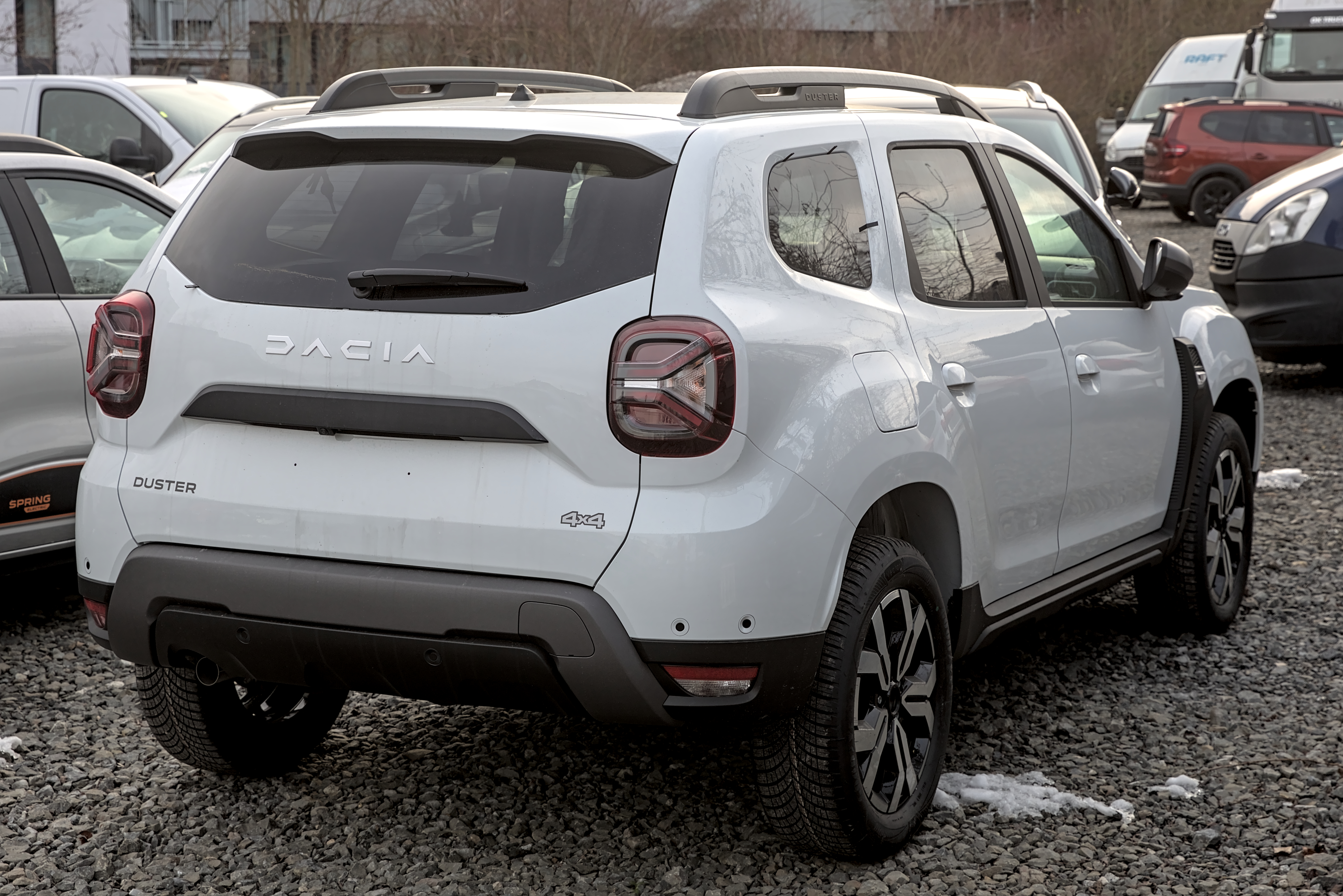
Dacia Duster
"... India by the end of the decade. Like the all new Duster, the seven models are based on two platforms and ..."
The Dacia Duster is a small SUV made by Dacia. It’s meant to be practical for everyday driving and family use. The podcast mentions an updated lineup, with several versions built using shared vehicle designs to keep things efficient.
The Dacia Duster is a compact SUV designed to offer practical features and space at a relatively accessible price point. It’s significant because the podcast context points to a new generation with multiple models built on two platforms, which typically helps manufacturers spread development costs and tailor versions for different markets. That kind of platform-and-model strategy is often discussed when talking about how a brand plans growth and product expansion.
IC hybrid in EV power trains
"...will span compact cars to larger SUVs with IC hybrid in EV power trains, but they won't be limited to India when you factor in vehicles, R and D and components."
They’re saying the lineup will include different kinds of “electric-ish” cars—some that use a gas engine plus batteries, and some that are more EV-focused. The point is variety in how the cars are powered.
This describes powertrains that combine internal-combustion (IC) engines with hybrid systems and also EV (electric) drivetrains. The segment’s takeaway is that Renault’s India lineup will span multiple electrification approaches, not just one type of vehicle.
large plug in hybrid batteries
"...is going after what could be an emerging part of the market, large plug in hybrid batteries. S Volt's newest pack is a whopping eighty kilowat hours..."
A plug-in hybrid battery is the battery in a car that you can charge from an outlet. “Large” means it’s bigger, so the car can run on electricity for longer before using gas.
Large plug-in hybrid (PHEV) batteries are high-capacity battery packs designed to let a plug-in hybrid drive significant distances on electricity before the engine takes over. This segment frames them as an “emerging” market category and discusses how battery tech and charging speed could affect demand.
EV only driving range
"It's said to provide a four hundred kilometers or nearly two hundred and fifty miles of EV only driving range and the ability to fully recharge in ten minutes."
EV-only range is how far the car can go using electricity alone. If that number is high, you can drive more of your day without burning gas.
“EV only driving range” is the distance a plug-in hybrid can travel using only its electric motor and battery. It’s a key metric because it determines how often drivers can avoid using the engine in daily driving.
fully recharge in ten minutes
"...and the ability to fully recharge in ten minutes. New battery and charging tech could make large battery pehs obsolete..."
This is talking about how fast you can charge the battery. If a car can recharge in about ten minutes, it’s easier to fit charging into a normal trip.
This refers to very fast charging capability—reaching a full battery state in about ten minutes. If true in real-world conditions, it can reduce “charging anxiety” and make larger battery packs more practical.
charging tech could make large battery packs obsolete
"New battery and charging tech could make large battery pehs obsolete, but as Folk believes, they could have a place in large and off road SUVs..."
They’re saying better charging could mean you don’t need the biggest battery all the time. If you can recharge quickly, a smaller battery might still work well.
The segment suggests that improvements in charging and battery technology could reduce the need for very large battery packs. The idea is that if you can recharge quickly, you may not need as much stored energy to achieve similar day-to-day usability.
Hyundai Motor America
"Orange had been with Hyundai Motor America since two thousand and eight and served as vice president of sales for the past sixteen months..."
Hyundai Motor America is Hyundai’s business in the United States. The segment is saying the person they hired had been working in Hyundai’s US sales leadership.
Hyundai Motor America is Hyundai’s US organization, and the segment says Michael Orange worked there for years. The point is that Stellantis hired an executive with a track record in US sales.
cost of recalls and warranty work
"...we're going to post a video this weekend that uncovered the massive increase in the cost of recalls and warranty work in the industry. The numbers are shocking."
A recall is when a car company has to fix a safety or defect issue. Warranty work is fixing problems that are covered by the company—both can get very costly.
Recalls and warranty work are expensive because they require fixing vehicles after problems are identified, often including parts, labor, and logistics. The segment says the industry’s costs are rising sharply, especially tied to EV investment write-offs.
Bridgestone Solutions
"Autoline Daily is brought to you by Bridgestone Solutions for your Journey CSP, the Composites Solution partner Intrepid Control Systems, over the air Engineering, boost your game and thanks to the following YouTube and Patreon members."
Bridgestone is a major tire company. This “Bridgestone Solutions” part is their services/business side, not a car model or a single part.
Bridgestone Solutions is a Bridgestone-branded services arm focused on tire and mobility-related solutions. In this ad context, it’s positioned as a partner for “Journey CSP,” which suggests a customer program or service offering rather than a specific vehicle component.
over the air Engineering
"Autoline Daily is brought to you by Bridgestone Solutions for your Journey CSP, the Composites Solution partner Intrepid Control Systems, over the air Engineering, boost your game and thanks to the following YouTube and Patreon members."
“Over the air” means the car can get software updates wirelessly. Instead of going to a shop, the update can be delivered remotely.
“Over the air” (OTA) engineering refers to updating or managing vehicle software remotely via cellular/Wi‑Fi rather than using a dealer visit or physical media. This enables faster fixes, feature updates, and validation of software changes across fleets.
Intrepid Control Systems
"Autoline Daily is brought to you by Bridgestone Solutions for your Journey CSP, the Composites Solution partner Intrepid Control Systems, over the air Engineering, boost your game and thanks to the following YouTube and Patreon members."
Intrepid Control Systems is a company that helps car makers test and manage vehicle software. They provide tech that supports diagnosing problems and validating vehicles before they’re released.
Intrepid Control Systems is an automotive software and testing company that provides tools for validating vehicle platforms. In the segment, they’re described as producing network hardware/software solutions for vehicle manufacturers and supporting fleet testing.
diagnostic trouble codes
"Intrepid's Neovi cloud platform helps manufacturers quickly identify diagnostic trouble codes and defects by pinpointing which vehicles have specific software versions."
A diagnostic trouble code is like a “check engine” message with a specific label. It tells the car’s computer what kind of problem it thinks it found.
Diagnostic trouble codes (DTCs) are standardized identifiers stored by a vehicle’s onboard computer when it detects a fault. The segment claims Intrepid’s platform can quickly identify DTCs and defects and tie them to specific software versions.
fleet testing
"Taking your fleet testing into the future of mobility. Intrepid control systems driven by your data"
Fleet testing means testing lots of cars, not just one. It helps find problems that might only show up when many vehicles are driven in the real world.
Fleet testing is validating vehicles across many units (and often many locations) to catch issues that only appear under certain conditions. The segment frames it as moving “into the future of mobility,” implying more data-driven, software-aware testing.
Request an Explanation
Heard something you'd like explained? We'll add it to this episode.
Sign in to request explanations for terms you heard.
Want to learn more?
Browse our glossary for plain-English explanations of automotive terms, jargon, and concepts.
Help improve this episode
See something that's not quite right? Our annotations are AI-generated and can sometimes miss the mark. Click the flag icon on any annotation to suggest a correction.