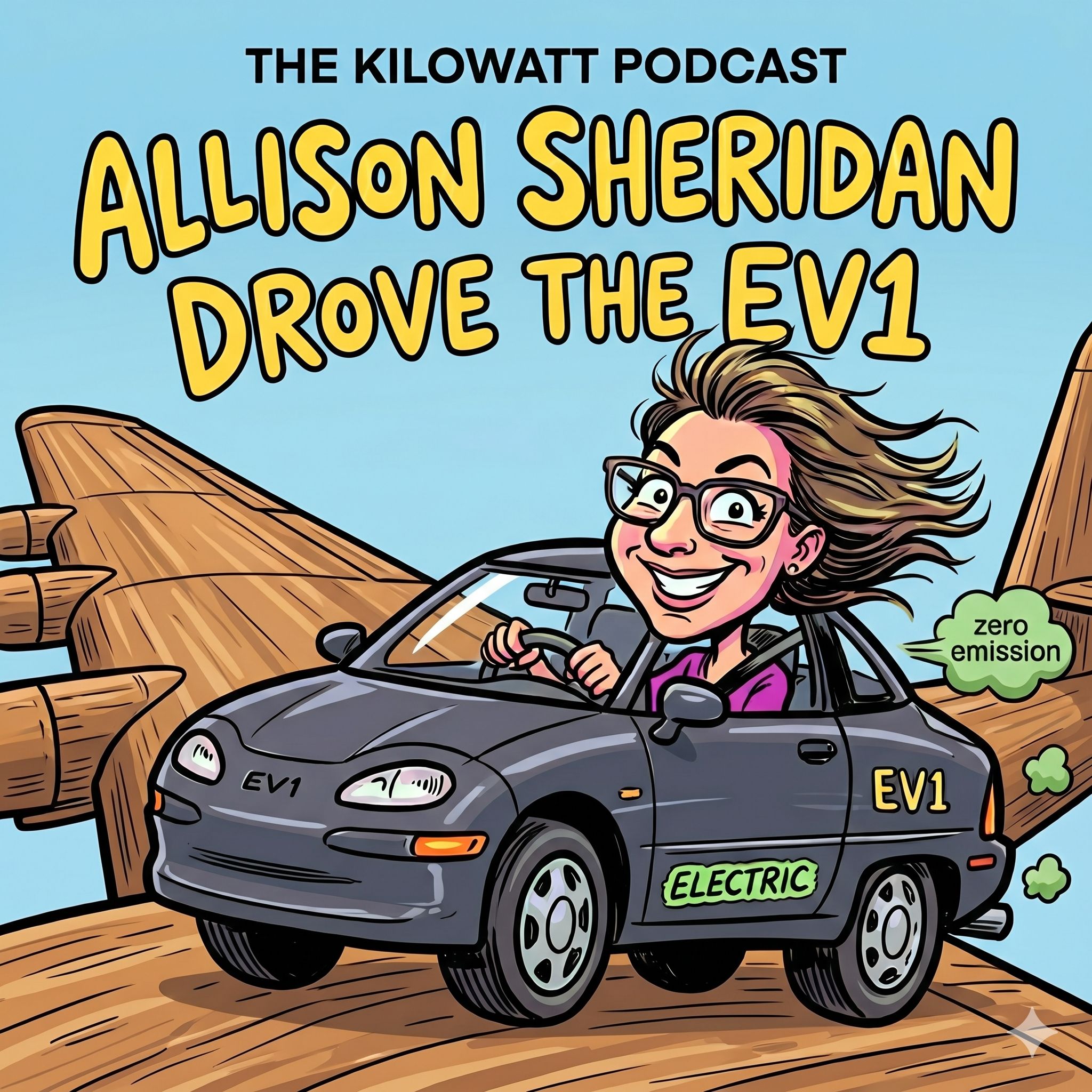
Allison Sheridan’s EV1 driving story kicks off with a quick connection to a prior conversation about Kim Lundgren’s time with an EV1. Allison then places the EV1 in context—GM built an EV1 prototype around 1995 to generate excitement—and describes testing a prototype on a private runway, including dialing regenerative braking up and down. The hosts also trade EV acceleration talk (0–60 times) and pivot into Howard Hughes and the Spruce Goose, tying back to Hughes Aircraft through the host’s 1979 work.
"...ow, because Kim and I talked about how she had an EV1 for a little bit or had the use of an EV1 for a l..."
The General Motors EV1 was an early electric car made by GM. It was designed to be driven like a normal car, but it used electricity instead of gasoline. The podcast mentions it because it’s a notable early example of an EV people could use.
The General Motors EV1 was an early electric vehicle program from GM, created to explore what battery-electric cars could be like for real-world driving. It’s often discussed in EV history because it represents one of the first widely known attempts by a major automaker to put EVs into customer hands. In the podcast context, it comes up as a personal story about someone having or using an EV1.
"So one of the, I have two distinct memories from it. And one of them was that this prototype had a dial where you could dial in or down the regenerative braking."
A prototype is an early version of a car that’s built to test new technology. It may not be the final design you’d see in production cars.
A prototype is an early, not-final version of a vehicle used to test ideas and systems before mass production. In this context, it suggests the EV1 program was still experimenting with features like adjustable regenerative braking.
"And one of them was that this prototype had a dial where you could dial in or down the regenerative braking. Oh, cool. I thought that was an interesting idea..."
In an EV, regenerative braking helps slow the car down while also recharging the battery. It’s like the car uses its motor to slow down, and that slowing creates electricity.
Regenerative braking is when an EV slows down by using its electric motor as a generator. Instead of wasting the car’s motion as heat, it converts some of that energy back into electricity to recharge the battery.
"Well, you know, Bodhi, I've always been thinking about where I could best contribute to your show... Steve and I both got to do this to drive the Tesla Roadster... This was the original Roadster."
The Tesla Roadster was one of Tesla’s first electric sports cars. People talk about it because it was surprisingly quick for an EV back when it came out.
The Tesla Roadster is Tesla’s early electric sports car, known for proving that an EV could deliver real performance. In this segment, the hosts specifically discuss the original Roadster (the first-generation car) and how it felt fast enough to surprise other drivers.
"...p, while you do that, but I definitely bought the Tesla Model 3 performance because I love fast acceleration. I..."
The Tesla Model Y is an electric SUV-style car. It’s meant for everyday use with extra space compared to a sedan, and it can come in versions that accelerate quickly. That’s why it may be mentioned when someone talks about buying a Tesla for performance.
The Tesla Model Y is an electric crossover/SUV built on the same general platform approach as the Model 3, but with a higher seating position and more cargo-friendly shape. It’s a common topic because it blends everyday practicality with electric power and can be ordered in performance-oriented trims. In this episode, it’s referenced in the context of choosing a fast-accelerating Tesla model.
"Mike and Vamp, while you do that, but I definitely bought the Tesla Model 3 performance because I love fast acceleration... I smoke them at the light."
The Tesla Model 3 is an electric sedan. The “performance” version is the quicker, more aggressive one, and the speaker likes how fast it can accelerate.
The Tesla Model 3 is Tesla’s mainstream EV, and the “performance” variant is tuned for stronger acceleration and sharper driving feel. Here, the speaker ties the Model 3 Performance to their enjoyment of quick launches from a stoplight.
"I love fast acceleration... I go from 0 to 35... So it looks like the first generation Roadster had a couple of 0 to 60s."
“0 to 60” means how fast a car can go from stopped to 60 mph. It’s a popular way to compare how quick different cars feel when you launch.
“0 to 60” is shorthand for how quickly a car accelerates from a standstill to 60 mph. It’s a common EV and performance-car metric because it captures launch strength and power delivery.
"I love going in front of... I love it when some jerk goes, you know, flying around me up to the stop light and then I smoke them at the light."
A stop light is the traffic light where cars have to stop. The speaker is describing how they like to accelerate quickly when the light turns green.
A “stop light” is a traffic signal where vehicles must stop, making it a real-world place to test launch acceleration. In this segment, it’s used to describe how the speaker enjoys quick starts against other drivers.
Select text to request an explanation
Hello, everyone, and welcome to Kilowatt, a podcast about electric vehicles, renewable
energy, autonomous driving, and much, much more. My name is Bodie, and I am your host. And on today's
episode, we have a little chat with Allison Sheridan. And this was not planned. This morning,
Allison sent me a text and she said, Hey, I was listening to your interview with Kim Lundgren.
And do you know, because Kim and I talked about how she had an EV1 for a little bit or had the
use of an EV1 for a little bit. And Allison, did I ever tell you about my experience with an EV1?
And the answer is no, but we know now because Allison shared it with us. So I was like, you know
what, this is going to be the episode today. One, because I got a lot of stuff to do today,
and I've already done a lot of stuff already today. So since this is done, this is what's
going to go out. But two, it's just always fun to catch up with Allison, like genuinely one of
my favorite people to talk to. It's a conversation. She does my homework for me. She makes
recording this podcast super easy. Her and Steve and a bunch of other people as well.
Oh, oh, oh, oh, I'm almost forgetting. We had another fun topic that I'll save for a surprise,
but we talked about the EV1 for a little bit, and then we kind of transitioned into
something that has nothing to do with this show whatsoever. But I happen to find fascinating.
So having said all that, let's go ahead and welcome Allison to the show.
Hey, Bodie. Nice to see you again.
Nice to see you. It's been a minute since we've actually chatted. I think it's been since Vegas
that we've sort of been face to face to chat. Yeah.
Oh, wow. Well, I had to horn in and say, can I come on and talk again? I get stuff to say.
Well, actually, that's not true. You said, hey, did I ever tell you about my EV1 experience?
And we've been friends for seven years and no, you have not.
That's surprising. I try to repeat all of my stories at least 12 times in the first seven years.
And I've heard many of them 11 times. But this is the first time I'm going to hear this one.
So how did you get an opportunity to drive or play with an EV1?
Well, the reason I brought this up was you interviewed and what was her name?
Kim Lundgren.
Kim Lundgren. And she was talking about her experience with the EV1.
That was a great interview, by the way. I love that.
So I started working for Hughes Aircraft Company in 1978 and I stayed with company for 35 years.
And during that time, they got bought and sold a whole bunch of times.
In 1985, they got purchased by General Motors and it was not a successful
collaborative thing. It didn't really come of anything.
They did some cool laser stuff for being able to follow cars at safe distances and that kind
of thing. But it all fell apart because I don't know, two giant bureaucracies don't do all together,
I guess. But around 1995 or so, GM built a prototype of the EV1 and they were trying to get
excitement going. Oh, and this was collaborative with the El Segundo Culver City area Hughes
Aircraft people. Actually, down into Torrance, we had some people working on it and I had gotten to
work on it a little bit. And they wanted to get excitement going with the executives about this
new fancy electric vehicle they were going to build. So they built this prototype and since
I was a girl engineer, my super respectful boss thought, you know, she can shuttle the
executives around to do the test drive. I'm an actual engineer, but okay, that's fine. So
there's something to know about Hughes. It was founded by Howard Hughes who was an American
aviator amongst other things and Hughes Aircraft Plant in Culver City only ever built one plane,
the Spruce Goose. So Hughes Aircraft is kind of a misnomer, but there's a whole other story
if you want to get into it later about what the Spruce Goose, but it doesn't have anything to
do with the subjects of Kilowatt. So anyway, it covers the Hughes Plant. Howard built the longest
privately owned airstrip in the world at the time. It was 1.8 miles long, 2.9 kilometers.
So that was, apparently for his personal planes, because it didn't have anything to do with the
Spruce Goose, the only plane he ever built. I thought it was because the Spruce Goose was so
heavy that that was the only way it would get off. I did know that they, I want, and this is all
coming from a movie. Don't steal that part of the story. Don't steal that part of the story,
because we're going to go off to the Spruce Goose later. But yeah, no, it never went on land.
So it didn't have anything to do with that. This was just his own personal private runway. He was,
he did three, I think, trans-continental flights that he was famous for. He almost died in a plane
crash, a lot of different things. But yeah, he was a big plane guy. So I think he was probably
doing it for his own plane. But anyway, this privately owned airstrip, which was no longer
being used as an airstrip, was where they were going to let the executives drive the EV1.
So my executive drove the car and the guy running the program said, well, do you want to drive it
too? What do you think Allison said? I would imagine he said, no, this isn't something that's
going to interest me in the future. No, no. Yeah, I wanted to do it. Yes, pick me, me.
So one of the, I have two distinct memories from it. And one of them was that this prototype had
a dial where you could dial in or down the regenerative braking. Oh, cool. I thought that was
an interesting idea because some people for some reason don't like regenerative braking, but maybe
they like to have some of it. They could have a dial on it. But I don't think most people would
probably understand what it was doing or why you would want more of it. But anyway, I dialed it
all the way up and then I punched the accelerator. And as soon as I got up to speed, I let off the
accelerator completely to come to a full stop. And I did it again and I did it again. I did a
little bit of feathering in and out to just see what it felt like, but mostly I was just punching
it, screeching to a stop, punching it, screeching it to a stop. And the program guy that was with
me just completely freaked out because he said all of these executives were like these old guys
that would just get in and kind of what did make noise, I guess, but putter up and down the runway
and they never stress tested the car at all. And he was really kind of surprised that I was as
aggressive with it as I was, but it was really, really fun. I do have a question about this
and it relates to today, but how did you have the foresight to agree to get in the car and do this
so that we could have the interview today? That is some amazing foresight.
Well, you know, Bodhi, I've always been thinking about where I could best contribute to your show
and you bring this kind of thoughtful information to you.
No, I appreciate that. And my 21 year old self appreciates that because I was just getting
smashed every night. So I wasn't, I had no foresight.
Oh, I did the same thing, by the way. I had an opportunity to, Steve and I both got to do this
to drive the Tesla Roadster. And it's a long story how that ended up happening, but I
scared the guy that I was driving in it with. There was a point where I needed to turn left
and there were cars coming, but I had felt what the car could do. And so I just hit it and went
right in front of these cars. And he freaked out. He thought I was going a little aggressive.
And I said, well, the car was fine. This was the original Roadster.
Yeah. Yeah. The first one.
Yeah. I mean, still the first one by today's standards, not the same pickup that your car has,
the Model 3 performance, but still quite a bit.
Really? Oh, interesting. Yeah.
No, I don't think, I think the original Roadster was still in, now I have a little cut up, but...
Mike and Vamp, while you do that, but I definitely bought the Tesla Model 3 performance because
I love fast acceleration. I don't speed oddly enough. I go from 0 to 35.
And I love going in front of... I love it when some jerk goes, you know, flying around me up to
the stop light and then I smoke them at the light. I enjoy that quite a bit.
So it looks like the first generation Roadster had a couple of 0 to 60s.
Man, I'm looking on the Wikipedia and I just lost it. Where did it go?
It finally happened. You heard it here. Bode's finally lost it.
As we've already discussed before we started recording, my brain's not working so good today.
Let's see.
You're supposed to be going doot-de-doo.
I, Alison, I told you I gave a presentation today.
And I, without thinking about it, I made that noise like doot-de-doo. Anyway.
You could have asked perplexity this question a lot faster.
10 out of 10 presentation today, by the way.
Really?
Well, that's what I was told. I made fun of the city manager. So that was a good way to start it.
Uh, 0 to 60, 3.7 or 3.9 seconds, depending on the...
Wow. Yeah, mine's... Yeah, you're right.
So it's still fast. I mean, there's no shame in the game. It's faster than my car.
Mine's 3.1. So, yeah, no wonder I love my car.
Yeah. No slouch.
Do you want to go completely off topic and talk about this, Bruce Hoos?
Because I have a fun story about that.
I mean, I've already tried to, so let's go ahead and jump into it.
So the Spruce Goose was a massive flying boat.
It was created by Howard Hughes. It was built by a Hughes aircraft during World War II,
and its purpose was going to be as a transatlantic flight transport vehicle.
And it's an important point that it was not made out of spruce.
It was made out of wood, but it was made almost entirely of birch.
But I think the word birch didn't work with, I don't know, you can...
All the names they came up with that started with another B sounded nasty,
so they went with Spruce Goose. So Howard built the prototype,
which by the way is the largest seaplane ever built in the history of time.
And to this day, it had the largest wingspan of any aircraft,
other than the twin fuselage straddle launch that came out in 2019.
That was one of those big glider sort of planes.
I think it was made to go around the world without stopping or something like that, I forget.
But the Spruce Goose is a wingspan. If you look up Spruce Goose
and 747, you'll see diagrams people love to draw of how big the Spruce Goose
wingspan is compared to 747. It's massive, way, way bigger than 747.
So back to the flight. Oh, so the prototype only flew once,
and that was on November 2nd, 1947. And Howard was at the controls as it flew for 26 seconds.
It got 70 feet off the water and it went about a mile at 135 miles per hour.
And that was down in Long Beach Harbor. And so it never was on the runway.
And it also was never flown again after that. That was the end.
And the program was canceled. But now, why am I telling you this story?
You could have all read out of Wikipedia. When 1979, I was working as a student engineer
for Hughes Aircraft. This is before the EV1 stuff happened in the 80s.
And Dave Grant was a hydraulics engineer in the same group. And he came out of his office one day
and he says, hey, everybody, they're selling the Spruce Goose to the Rather Corporation.
And today's the last day I can give you a tour. And I looked at him and I was like, Dave,
why would you give us a tour of the Spruce Goose? What did you have to do with it? And he goes,
oh, I didn't tell you, I was a co-pilot on that flight.
What?
Yeah. And I said, Dave, I didn't know you had your pilot's license. And he said,
I didn't. And that's why he let me be in the co-pilot seat because he wasn't clear to take off.
And Howard wasn't. And he didn't want anybody else to take the controls. And there's no way Dave
was going to because he didn't know how to fly. Isn't that crazy?
Oh, crazy. Also brave and kind of stupid.
Yeah, he did a lot of stupid things. But so anyway, I was like, okay, he wants to take us on a tour.
And Steve and I, in our entire lives, never, ever played hooky. We never skipped school,
even one time. I mean, I didn't skip college classes. I mean, I might have been late sleeping
in a little bit, but never skipped a class. We never skipped work. I called Steve, who was in
a different group in Hughes, and I said, Steve, we got to go do this. And so he's like, yes.
So we all raced down to Long Beach and he took us in to, at the time, the Spruce Goose was in
a, in a building that was designed for it. So if you looked at it from an aerial view,
it looked like a plane. It had, you know, a point apart and the wings sticking out.
And we walked into this room, there were probably 15 or 20 of us. And it was dead silence, Bodie.
Just shock at the massiveness of this thing. I mean, it was unbelievably big. It was,
it was just ridiculous how huge this thing was. And so we started climbing around on the plane.
Like, I remember a couple of guys got a ladder and climbed up and looked at the, at the rotors and
stuff. There were eight of them, I think four on each side at the engines. And they played around
with those. And then we went inside. And you know how you go to a museum and there's like ropes,
little red ropes and barriers and a docent telling you what's going on and you're not
allowed to touch anything. There was none of this. This was just us with Dave climbing around on the
plane. So I got in Howard Seat. And I know the funniest thing I noticed was that the horizon
indicator was painted on the window. There wasn't an electronic one or a little gravity level or
anything like that. And I asked him why. And he said, well, because Howard was the only one ever
going to sit there. So it was painted at his eye level. That's all you needed. You didn't need
anything else to show you that the horizon would be the horizon. You could tell the tilt from that.
So I guess it was foggy or something that might have been a problem. But anyway, we also walked
out into the wings. Actually, I don't think I did, but I know Steve did. And you could literally
play basketball inside these wings, the height of them. It was so freaking big. It was crazy.
I climbed up a ladder up into the tail and I was mad because I had to climb back down because I
realized I had a skirt on. So that was poor choices. But I didn't know that was going to happen.
But it was so cool. And all throughout this, Dave kept telling us stories. He kept saying,
oh, we upgraded this and then we upgraded that and we upgraded that. And I said,
why were you upgrading things? And he said this plane was kept flight ready until the day Howard
died. He always wanted it ready to fly it at a moment's notice. He was going to do it again.
Isn't that crazy? Wow. Why did they cancel the project?
That I don't know. Howard did a lot of weird things. There's a movie about him and the way
he ran things. And he was kind of loosed with the money. He eventually made the company into
a nonprofit. The Hughes Medical Foundation was what we did on behalf of. So we had no,
there was nothing like profit and loss and revenue kind of numbers. We just took money
from the government, did whatever we wanted. But a lot of cool stuff came out of the company,
like lasers or no, not lasers, the digital watch, that was one of them. Oh yeah. Yeah,
there were some amazing inventions considering that we were kind of a slush fund for whatever
I would want to do. We actually had a, he had people build a medical bed for him,
like Hughes Aircraft did. That was probably a $300,000 bed when we were done or a million
dollars, I don't know. Really? Yeah. Yeah, that's just kind of an undercover thing. But
the last thing I did want to say on the Spruce Goose thing is not one of us had a camera with us.
There's no photos of it, of us getting to see it and sit around in it. That is so unfortunate.
Yeah. That wouldn't happen today. No, it'd be hard to, as a matter of fact,
I might get somebody fired today just because like why was so and so standing on top of like
whatever or, you know, there's lots, lots of stuff. That is so interesting. I do
find that time period, you know, when like airlines were just forming and, you know,
I don't dress, I'm a slob when I go and fly, but people would dress up in their suit and tie. Oh
yeah. Oh, yeah, hats and... Yeah, my mom was a flight attendant for a while and it was, I don't know,
just a little plane that flew from Kenai to Anchorage. It wasn't little. I think it held like 50
some people. But like my mom dressed like the flight attendants in the, in the 60s, you know,
just like what you see in... Little piltop hat kind of thing. Yeah. Now you see me, that kind of thing.
And I got to fly in the cockpit with the pilots. I sat in the third seat. It was super cool.
But yeah, all of that in terms of that, that era is just really interesting to me.
Yeah. Maybe we should do a podcast on it.
There's a, in the mute, there's a book called Hughes that tells you a lot about the crazy
stuff that's going on. But in the movie, they focused on the courtroom stuff with TWA.
And I forget what he was doing. He was doing something underhanded and he was in trouble
for it, as I recall. Yeah. I mean, as we know, geniuses with a lot of money do some stuff.
Yeah. Yeah. Are you familiar with Jimmy Buffett's plane?
No. So he had, it's the Grumman HU16 Albatross, but it's an amphibious boat.
And when I worked as a firefighter in Carson City, the, I don't know if it's still station
two, but back then it was station two was at the airport. And right next to the airport,
right next to our station or right behind it, actually, they used to fix these Albatross
amphibious planes. And they were, they're like probably what, and I don't know what year Howard
Hughes decided to build the Spruce Goose. But these were built, you know, back in, I believe,
the 50s sometime. But these things are like Winnebago's, but they're flying Winnebago's.
And Jimmy Buffett's plane, I didn't go in his plane, but I've been in other people's planes
just touring that facility. But his plane used to be service there. And they are a throwback
to luxury. Like nobody modifies these things. Like it's all wood paneling and it's nice and
polished. And that's what this group did on top of keeping the plane fit, you know,
is they made sure that if there was something damaged, you know, they'd sand it down and
they'd relacker it and maybe fill it if they needed to do that kind of thing. You know,
they, these things were just like, like you would, these planes, this is terrible to say,
but these planes would be, you could imagine someone flying these planes, a pilot flying
these planes and being brought a cocktail. That's how swanky and nice and of the era they were.
So. Oh, geez. Well, it's funny to let me come on and tell a story that has
somewhat to do with electric vehicles, at least at the beginning. That was fun.
No, I think actually this is going to be the episode today, because I've been really busy
with actual work stuff. So this is, this is perfect. And the fact that we have gone just
short of 20 minutes is also perfect. So this will, this will be today's episode for sure.
Well, good. Always fun to come on. Should, should you plug my show or something?
Oh, you do all the time, right? You know, you should, we should do this
because you are going on a couple of vacations. So
what, what do you have planned? Because I know you've got lots of stuff planned.
Just because you're on vacation does not mean you stop doing your show.
Right. I'm going to be playing audio files from Bodie Grimm.
Bodie has mixed a couple of the interviews he's done recently, especially the Kim Lundgren one
and a couple of others that I'm going to use as I'm not going to call them filler, but you
know, they're going to be really fun. Yeah, it's hard to have a 21 year streak without missing a
show because you just can't, right? I can't break that because once I do, I'm just probably going
to go, yeah, I'm out and this is hard doing it for so long. So I'm going to keep it going, but
with the, with help of some wonderful friends like you, Bodie.
And I, I phrased my whole pitch that way for your show, just so that you would thank me.
I like it. Yeah, you did everything on the pitch except for introduce yourself,
but I get to do that at the beginning. Oh yeah. Yeah, I guess that's a good point.
That's okay. I'm learning so many things in my fifties. Where would people go? So it's pod feet
dot com. It's the no silicast chit chat across the pond, programming by stealth. Wow, you have
been paying attention. That's everything. Security bits is my favorite when you and Bart get together
and chat security. Yeah, I've always, I've wondered a lot of times whether I should spend
security bits off as its own show, but I'm afraid nobody would listen to the parts of the show
where I'm on by myself. So I don't do it. That's a valid, that's a valid concern. And it's not to
say that it's valid in that people won't. It's valid in that I have similar, similar thoughts sometimes.
Yeah, everybody loves Bart. Bart is a cyber security specialist and brings us
security news that we can do something about mostly. He tells you whether to light your hair
on fire about something or not. And basically the answer is if something can't be updated,
throw it away and pass all your systems all the time. Yeah, he has now started to say
responsibly recycle it. Yes. Yeah, no, it's great. And Adam makes this great. So if you're not
subscribed to Alison's podcast, I would highly suggest you do that. No, you should subscribe
to Bode's podcast, much better show. If you're not subscribed to this podcast, what are you doing?
Why are you even here? There are so many people who listen to this podcast on the web, according
to stats. Really? Yeah. And it's always very surprising to me, but God bless you. I love that
you do, but subscribe. All right, Alison, thank you so much for joining me today and doing my homework
for me. All right, this is great. All right, everybody, I hope you enjoyed that conversation
with Alison. I sure did. We probably talked for another 20, 25 minutes after that, and it is nice
to catch up. I genuinely don't think that I have talked to her since Vegas, since January. Of course,
we text all the time and mess each other all the time, but yeah, it's been a while since we've
actually been able to sit down and have a conversation, which is, I mean, again, always fun,
always fun. Second, only to that is listening to Alison's podcast, the No Silla Cast, Chitchat
Across the Bond, Programming by Stealth. Under No Silla Cast, we talked about it. We had security
bits, and it's a don't miss in this crazy world that we live in with everything going on with
data breaches and security bug vulnerabilities and all this stuff that's going on. It really does
make me feel better, because sometimes the headline that we get in our news aggregator may
skew towards you reading that article, but it might not actually be what the headline is, and Bart
and Alison take that scariness, and they put into something that's reasonable and often actionable.
Yes, I really encourage you to go and listen. That's part of the security bits,
is part of the No Silla Cast, and I believe it's every two weeks. Then she talks to Adam Angst,
if you know who he is, he created, along with his wife, Tanya, the tidbits newsletter,
and truly, OGs. They've been doing it for a really long time and just have so much,
like not only do they have a wealth of information, they know the history. So if you're a technology
nerd, please go and check out what Adam Angst is doing as well, which I don't think he owns tidbits
anymore, but it doesn't matter. He still does stuff for them. Go check out what Adam's doing.
I'll put links in the show notes. All right, everybody, that is it for me. If you want to
email me, it's bodi, B-O-D-I-E at 918digital.com. You can find me on X at 918digital. I'm on LinkedIn,
which is just Bodi, Grim, G-R-I-M-M. I think that's it. Still working through those emails,
but hopefully, maybe by the end of the week, I'll have a call caught up. I thought I was going to
be caught up, and now I'm not. So trying to get through them. All right, everybody, thank you so
much for listening, and I will talk to you soon.
If you liked the show, please take a moment to rate, review, and subscribe. It really does help
the show to grow. Thank you for listening.
Request an explanation for:
4 cars
4 cars featured
Request an Explanation
Heard something you'd like explained? We'll add it to this episode.
Sign in to request explanations for terms you heard.
Want to learn more?
Browse our glossary for plain-English explanations of automotive terms, jargon, and concepts.
See something that's not quite right? Our annotations are AI-generated and can sometimes miss the mark.
Click the flag icon on any annotation to suggest a correction.
Report incorrect info
Suggest better explanations
Flag missing cars
More from Kilowatt: A Podcast about Electric Vehicles