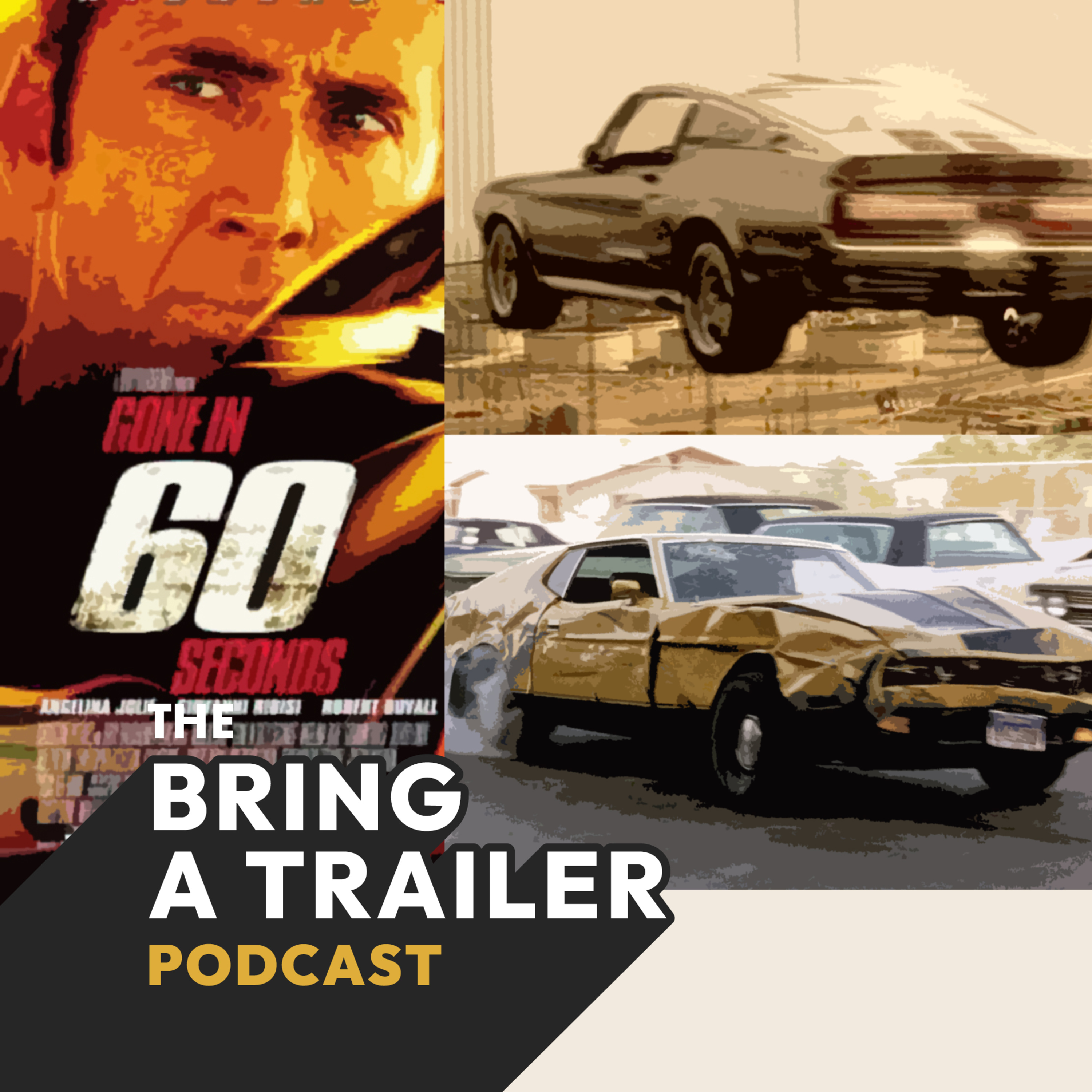
B(aT) the Movies: Gone in 60 Seconds (1974 and 2000)
About this episode
Tyler and Cam kick off with how they first got hooked on Gone in 60 Seconds—Tyler’s cheap DVD/VHS find with “this yellow Mustang on the front”—then work through the 1974 original versus the 2000 remake. They compare vibe, pacing, and chase filmmaking (lots of cuts, less long car coverage), argue about authenticity vs “pop and flash,” and dig into car choices, from Eleanor to an E39 and a Porsche 911 “996” owner’s manual. They also hit Rotten Tomatoes, heist logistics, and the Eleanor legal saga.
This week we have a full house for our next movie installment: Beck, Tyler, and Cam join Alex to talk about the joys and pains of 2000's Nic Cage vehicle Gone in 60 Seconds, and the 1974 cult film of the same name that loosely inspired it. The crew discuss how each of them came to the movie (or both, as the case may be); expose their divides of opinion early; wantonly throw around the term "masterpiece"; marvel at the huge budget divide between the old and new films, just one of the many massive differences; lament the painfully cringey car dialogue; discuss fair payment for a job done; differentiate between "nighttime" and "hot time"; and confess to some Eleanor-based confusion.
And then, on to the cars. What perspective has 26 years of hindsight given us on which cars got boosted and which didn't? How was no one worried about security in a circa-2000 Ferrari warehouse? Where does the modern move sit in the pantheon of films involving car chases in the LA River. Exactly how bad was CGI in 2000? Our rowdy group of cig-rippin' drug-thievin' miscreants closes by talking about Angelina's hair, other elements that don't hold up, and some of their favorite cars in both movies.
Got suggestions for our next guest from the BaT community or an idea for our next game episode? Let us know at [email protected]!
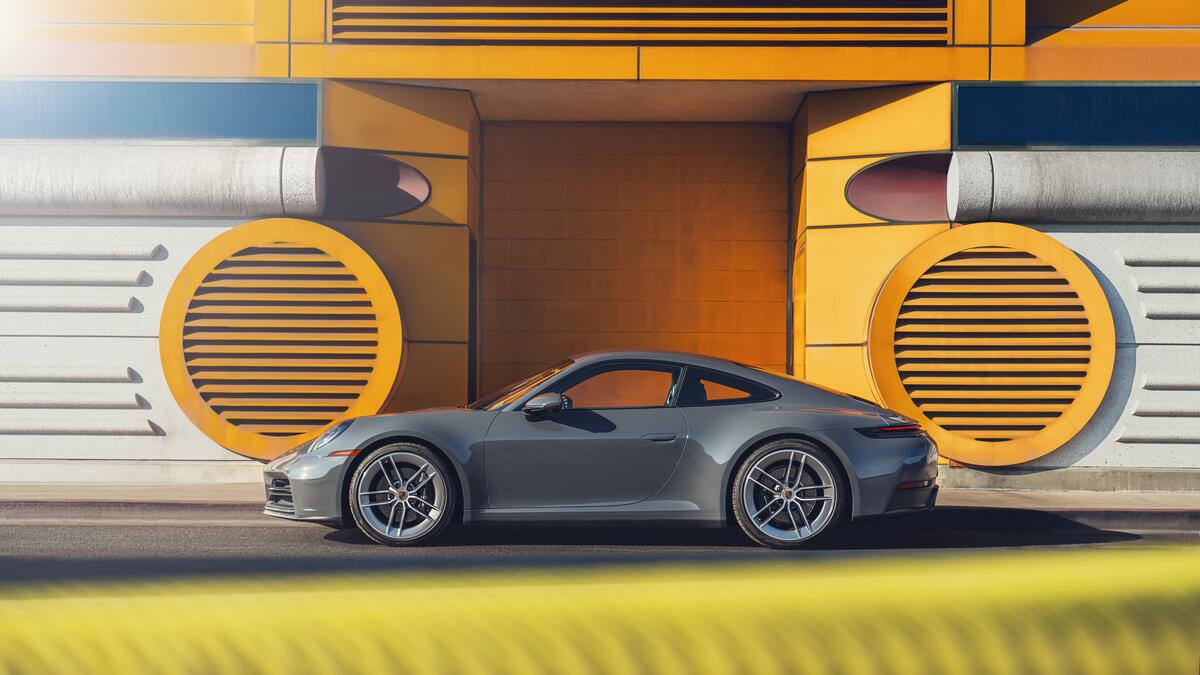
Porsche 911 (996)
"Yeah, 996. [1132.6s] What is it? [1133.4s] It's an owner's manual for 996. [1135.4s] Isn't it?"
The Porsche 911 (996) is a particular generation of the Porsche 911 made around the late ’90s/early 2000s. The hosts are saying the movie shows something like an owner’s manual that’s specifically for that 996 generation.
Porsche 911 (996) refers to the 911 generation produced in the late 1990s and early 2000s. The hosts connect the film’s imagery to an “owner’s manual for 996,” which is a specific nod to that generation of the 911.
Arctic Silver
"Yeah. Arctic Silver. That's kind of all you get is turbo."
Arctic Silver is the name of a specific silver paint color. It’s used to describe the exact look of the car’s finish.
Arctic Silver is a Porsche paint color name, used to describe a specific metallic silver finish on cars like the 911. Color names matter to enthusiasts because they help identify the exact spec of a particular car or movie prop.
turbo
"Arctic Silver. That's kind of all you get is turbo. There's pre everything."
“Turbo” means the engine has a turbocharger. It helps the engine make more power by pushing extra air into the cylinders.
“Turbo” refers to a turbocharger, which uses exhaust energy to spin a turbine and force more air into the engine. That typically allows a smaller engine to make more power than a naturally aspirated one, which is why “turbo” shows up in discussions of certain Porsche trims and eras.
IMS issues
"So by that point, we knew nothing about all the IMS issues or what the interiors were going to feel like 20 years later."
“IMS” is short for a part inside the engine. Some Porsche 911s had a problem with a bearing in that area, and if it fails it can cause serious (and costly) engine damage.
“IMS” stands for Intermediate Shaft, a component in some Porsche 911 engines. The “IMS issue” refers to failures of the IMS bearing, which can lead to expensive engine damage, so it became a major used-car concern for 996-era cars.
departure
"Yes. And it was such a departure. It makes a lot of sense that that was the car."
In this context, “departure” means the movie’s car choice or vibe is a noticeable break from what people expected. The hosts are framing the Porsche as a standout because it doesn’t match the usual expectations for the era’s car culture.
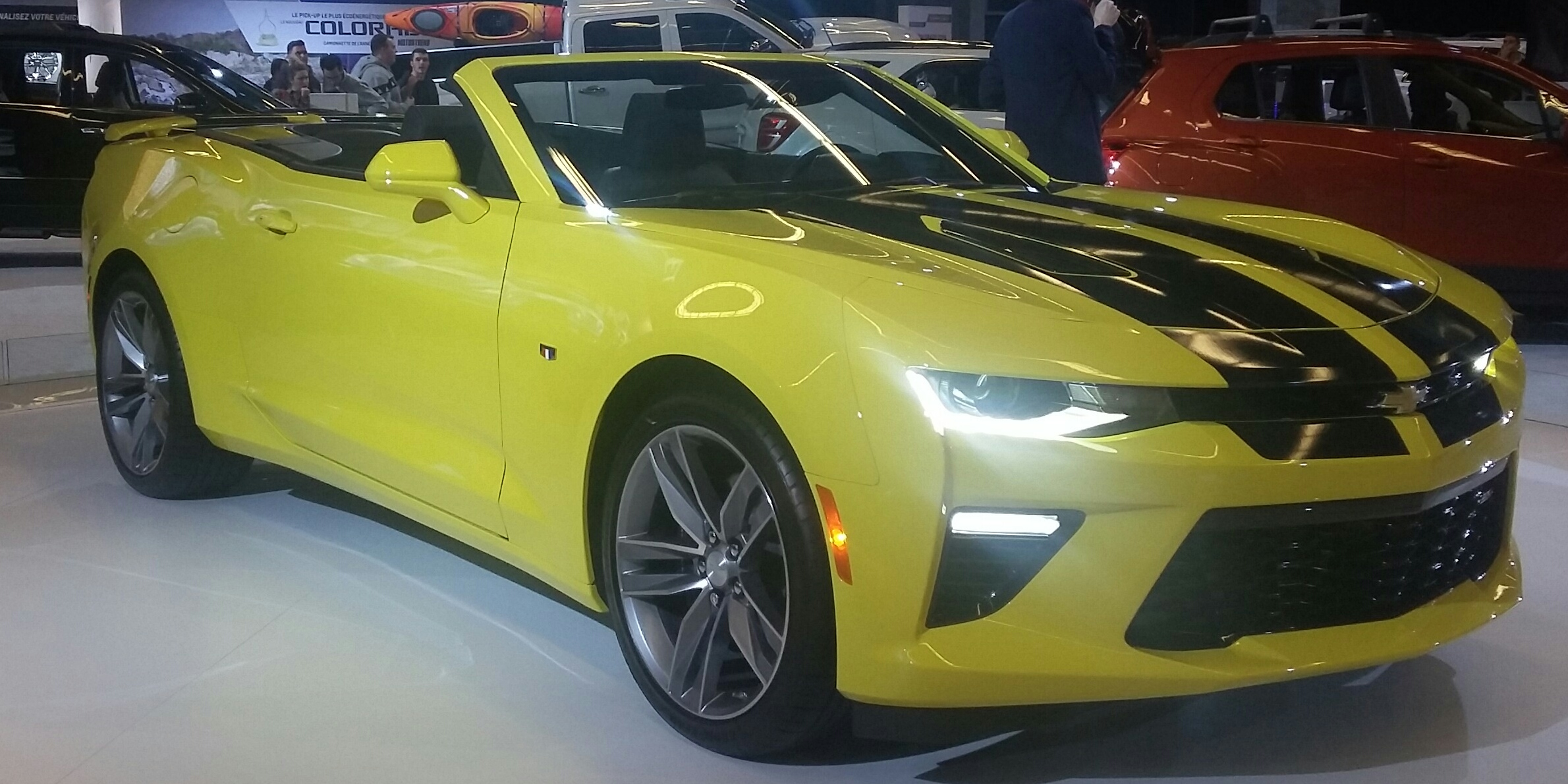
Chevrolet Camaro
"...akes a lot of sense. They steal it in a third gen Camaro. Yes."
The Chevrolet Camaro is a sporty American car with a strong performance reputation. Some Camaros from certain years have been more likely to be stolen, so people discuss which generations are at higher risk. “Third gen” just means a particular generation of Camaro made in a specific time period.
The Chevrolet Camaro is a long-running American muscle/pony car rival to other iconic performance coupes. It comes up in conversations about theft and security because certain model years and generations have been targeted more than others. The “third gen” reference points to a specific era that enthusiasts often recognize by body style and design details.
4.8, 6 to 60
"Two younger guys like 4.8, 6 to 60 doesn't seem like anything. That was such a huge deal in the late 90s."
“6 to 60” means how many seconds it takes to go from 0 to 60 miles per hour. Back then, those acceleration times were a big deal in car ads and reviews.
“6 to 60” is shorthand for acceleration time from 0 to 60 mph, a common performance metric in car magazines and marketing. The hosts are noting how big those numbers felt in the late 1990s.
4.5.2
"Oh, it says 4.5.2. Yeah. Which is the Porsche number, which makes me think you're right."
“4.5.2” is a number that car people associate with Porsche. In this conversation, it’s used to suggest the movie’s Porsche was chosen for its specific specs.
“4.5.2” is being used as a reference number tied to Porsche—specifically the engine displacement/engine family shorthand that enthusiasts recognize from Porsche’s numbering conventions. The hosts connect it to the idea that the Porsche provided the car for the movie.
zero to 60 time
"Like I can quote the road and track zero to 60 time of a new 996 from my head."
It’s a simple speed test: how many seconds it takes to go from standing still to 60 mph. Faster times usually mean quicker acceleration. It’s one of the most commonly quoted performance numbers for cars.
“Zero to 60 time” is the elapsed time it takes a car to accelerate from 0 mph to 60 mph. It’s a common performance metric because it reflects how quickly the car can put power to the road at low speeds. The host uses it to compare how a specific Porsche feels in real-world driving.
Civic SI
"which makes it modified SI, modified SI, which makes it feel very much like for a hot second."
“Si” is Honda’s label for a sportier Civic. It usually has upgrades that make it feel more responsive and fun to drive. The host is saying the movie’s Civic is an Si and also looks modified.
“Civic Si” is Honda’s “Si” performance trim for the Civic, typically tuned for sharper throttle response, firmer suspension, and more driver-focused driving than the base model. In the segment, the host says it’s “modified,” suggesting the movie car is not stock. That matters because Si is already a performance starting point, and modifications amplify the street-racing vibe.

Honda Civic
"next to, I believe it's a blue Honda Civic, which makes it modified SI, modified SI, which makes it feel very much like for a hot second."
This is a Honda Civic Si, which is a sportier version of the regular Civic. The host is pointing out that the movie’s car looks and acts like a tuned-up Civic. It’s part of the scene where cars are racing and drawing attention.
The Honda Civic mentioned here is specifically the Civic Si, a performance-oriented trim known for a sportier setup than the standard Civic. In this segment, it’s used as a visual and driving-behavior reference point during the movie’s street-racing sequence. The host also calls out that it’s “modified,” implying changes beyond stock.
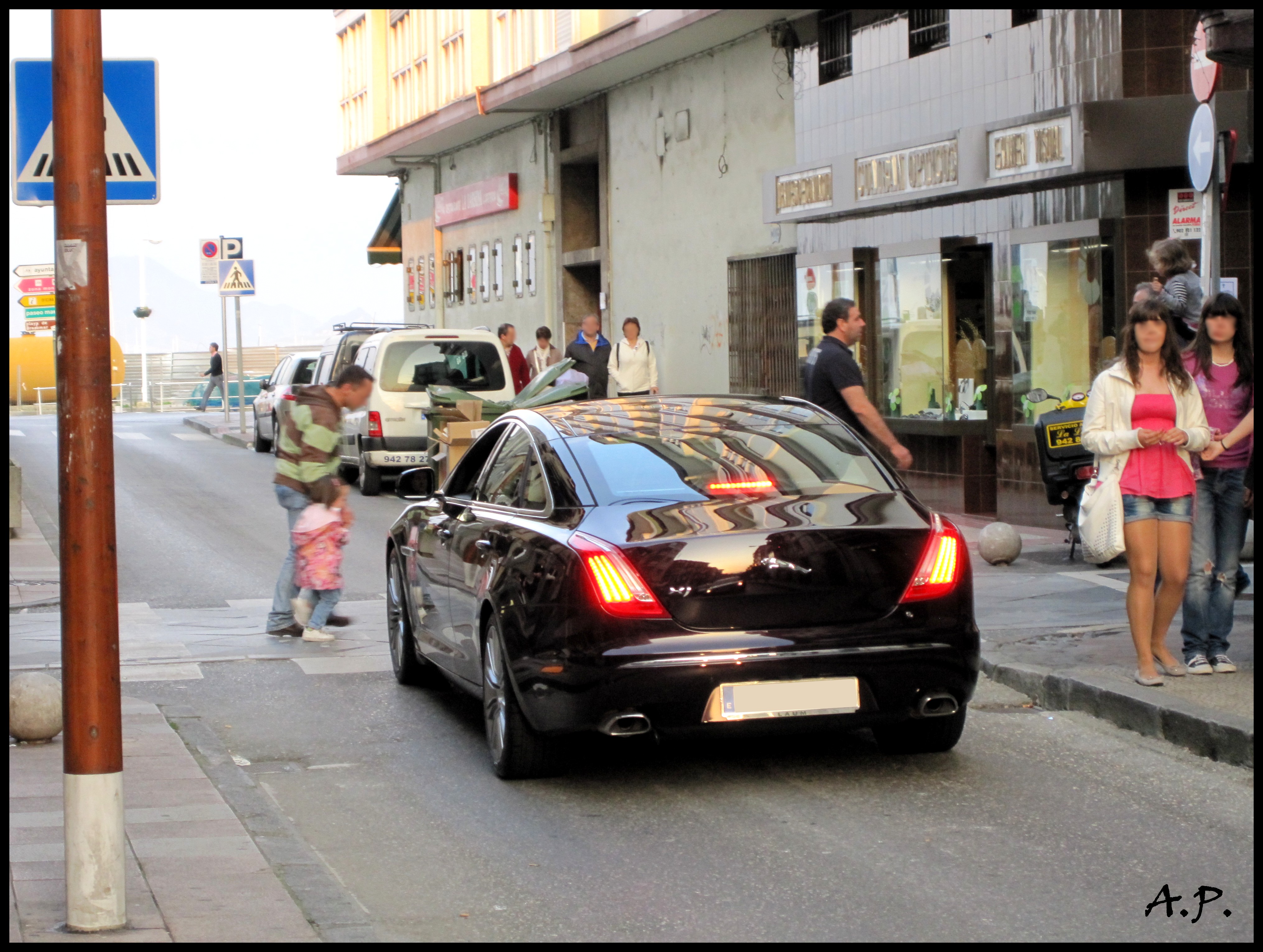
Jaguar XJ
"they're talking about stealing the Jaguar XJ and [1353.0s] it was like they went off with a four door sedan, but then he crossed off the XJ220 [1357.8s] on the board."
The Jaguar XJ is a luxury car model from Jaguar. Here it’s brought up because the movie talks about stealing one.
The Jaguar XJ is a long-running luxury sedan line from Jaguar, known for its smooth ride and upscale interior. In this segment, the hosts mention it in the context of a movie car theft, which is why it stands out to car fans.

Lexus Land Cruiser
"But the first car he shows up in the GX. [1636.8s] Yeah, Lexus Land Cruiser. [1637.9s] And a Land Cruiser, which I thought at the, when I first saw that, I was like,"
A Land Cruiser is a rugged SUV built to handle rough roads and last a long time. Here, they’re talking about the movie using a Land Cruiser as part of the casting, not necessarily a specific “Lexus” model you’d see in a showroom.
The Land Cruiser is a Toyota off-road SUV known for durability and body-on-frame toughness. In this segment, the host calls out a Lexus-branded Land Cruiser, which is a casting/film detail rather than a common factory badge—listeners should treat it as “Land Cruiser” for the vehicle identity.

Toyota Land Cruiser
"... the first car he shows up in the GX. Yeah, Lexus Land Cruiser. And a Land Cruiser, which I thought at the, when..."
The Toyota Land Cruiser is a tough SUV made for rough roads and long trips. It’s known for lasting a long time and handling difficult conditions. The “GX” part is a trim level, meaning a specific equipment/feature version.
The Toyota Land Cruiser is a rugged, long-distance capable SUV known for durability and off-road ability. In the podcast context, it’s mentioned alongside a “GX” and “Lexus Land Cruiser,” which points to Toyota’s luxury-oriented trim/market naming. It’s a common topic because Land Cruisers often have strong followings and can be significant collector or enthusiast vehicles.

E39
"But it switches to an E39 later on, which I thought, they just needed something [1648.0s] sportier for that. [1649.0s] Well, they needed something that could do the chase."
An E39 is a BMW 5 Series from the late 1990s/early 2000s. The point in this segment is that the movie swaps to a BMW because it fits the chase better than the earlier vehicle.
The E39 is the BMW 5 Series generation (1995–2003), and it’s often chosen in movies because it looks “sportier” than many older sedans while still being believable for real-world driving. Here, the hosts say the film switches to an E39 later because it needed something that could keep up during the chase.
CGI
"[1649.0s] Well, they needed something that could do the chase. [1650.8s] And thank God it's not CGI. [1653.5s] And someone else in that chase was driving the LX."
CGI (computer-generated imagery) is digitally created visuals used to simulate cars, stunts, or environments that would be too expensive or risky to film practically. The host is praising the production for using real vehicles instead of relying on CGI for the chase.

LX
"[1653.5s] And someone else in that chase was driving the LX. [1656.2s] So I think maybe that department had a couple of like, [1659.1s] What is that department?"
The Lexus LX is a big, luxury SUV related to the Land Cruiser. The hosts are saying another character in the chase had one, which helps sell the scene.
“LX” here refers to the Lexus LX, a full-size luxury SUV closely related to the Toyota Land Cruiser platform. In action scenes, it’s often used because it has the size and off-road/road-trip credibility of a Land Cruiser, but with more luxury cues.

Shelby GT500
"I think it depends on what the cars are. Like he's just the 67 GT 500. That's in 2000."
The Shelby GT500 is a high-performance version of a Ford Mustang. The podcast is talking about a specific GT500 from 1967, which is a particular year of that model. People mention it because it’s a well-known, powerful classic car.
The Shelby GT500 is a performance-focused version of the Mustang, known for stronger engines and a more aggressive track-oriented setup. The podcast references “the 67 GT 500” and also notes timing like “that’s in 2000,” which suggests discussion about a specific car’s identity and year. It’s a popular topic because GT500 models are highly sought after and have a strong performance legacy.
surveillance
"[1805.9s] That's at least 100 grand. [1806.9s] Also, it's way harder now with surveillance. [1809.3s] So from being the best car multiple times,"
Here, “surveillance” just means being watched by security systems (like cameras or tracking). The point is that it’s harder to steal cars today because you’re more likely to get caught.
In the context of car theft, “surveillance” means monitoring—like cameras, tracking, or watchful security—that makes it harder to steal cars without being detected. The hosts use it to contrast older theft conditions versus modern security.

Ferrari F40
"Maybe the Ferrari dealership or something, [1820.3s] but they steal a bunch of Ferraris and they leave the F40."
Ferrari F40 is a legendary high-performance Ferrari from the 1980s. People love it because it’s fast, loud, and built to be a serious driver’s car rather than a luxury one.
The Ferrari F40 is a mid-1980s supercar built around a lightweight, performance-first philosophy. It’s especially famous for its turbocharged V8 and for being one of the last “pure” Ferraris before the brand’s later, more comfort-focused era.

Ferrari 275
"And the 275 gets like no credit for being the best car, [1832.6s] which just got to be."
Ferrari 275 is an older Ferrari from the 1960s that’s famous for its V12 engine. It’s considered a classic today, even if it didn’t always get the spotlight compared to flashier cars.
The Ferrari 275 is a classic V12 grand tourer from the early 1960s, known for its elegant styling and high-revving engine character. In collector circles, it’s often viewed as more than just a “cool” car—its historical importance and desirability have grown over time.

Wagon R
"...ing to depreciate, right? Like a 2000 Volvo turbo wagon R, which is a cool car, but it's not worth it."
The Wagon R is a small car designed to be practical and easy to drive, especially in cities. The podcast is talking about its value—how much it’s worth compared to other cars. It’s the kind of car people consider when they want something simple and affordable.
The “Wagon R” refers to the Suzuki Wagon R, a small, practical hatchback/mini-wagon designed for easy city driving and efficient packaging. In the podcast, it’s mentioned in the context of depreciation and value, suggesting the conversation is about whether it’s worth buying compared to other options. It’s a common topic in used-car discussions because these cars can be inexpensive and straightforward to own.
Boosted?
"Boosted? That's number of favorites is that."
“Boosted” means the engine has a turbo or supercharger. That extra “boost” helps the engine make more power than it would without it.
“Boosted” is shorthand for an engine that uses forced induction—most commonly a turbocharger—to increase the amount of air (and oxygen) entering the engine. More air generally allows more fuel to be burned, which can raise power compared with a naturally aspirated setup.

1950 Mercury custom
"Okay, so a 1950 Mercury custom, like just a car that it's like, what? They scout that one."
They’re talking about a 1950 Mercury that’s been customized. “Custom” usually means it’s been modified to look and feel special, not like a stock factory car.
A 1950 Mercury custom is a vintage Mercury (a Ford brand) that’s been modified for a personalized “custom” look and feel. In car-culture terms, “custom” usually means bodywork and styling changes—often including upgraded wheels, paint, and interior—so it’s the kind of car that’s visually distinctive even decades later.

GMC Yukon
"I'm like, somebody's stealing mom's Yukon. It took me a minute."
The GMC Yukon is a big family SUV. In the conversation, it’s used as an example of the kind of vehicle that could be stolen because it’s common and practical.
The GMC Yukon is a full-size SUV from GMC, closely related to the Chevrolet Tahoe and sharing similar body-on-frame roots in many generations. The speaker uses it as an example of a common “mom’s car,” implying it’s a realistic target in a theft scenario.

Infiniti Q45
"You guys have the fullest in front of you. I mean, no 99 Infinity Q45. Yeah, I do."
The Infiniti Q45 is a luxury car, usually thought of as a comfortable, older-school sedan. Here it’s mentioned as a particular year/model that the speaker expected to see but didn’t.
The Infiniti Q45 is a luxury sedan known for its late-’80s/’90s-era V8-powered comfort and “executive” vibe. In the segment, it’s brought up as a specific car option, with the host joking about there being “no 99 Infiniti Q45,” implying a missing entry in the list they’re discussing.

Porsche 959
"There's some stuff. There's a Golding on the list, but they never show a Golding. Yeah, 959 was also."
The Porsche 959 is a famous, high-tech Porsche supercar from the 1980s. People love it because it was way ahead of its time, and the speaker is treating it like one of the standout cars.
The Porsche 959 is a landmark 1980s supercar built for high-tech performance, especially known for its advanced all-wheel-drive system and twin-turbo setup. The host mentions it alongside other “sick stuff,” signaling it as a highly desirable, exotic entry in the list.

Porsche Boxster
"Yes. Did I see a Boxster get pulled up? Yes, Boxster is Marsha."
The Porsche Boxster is a small two-seat sports car. It’s designed to handle well and feel fun to drive. “Boxster” is the model name, and it’s known for being a real sports car rather than a family car.
The Porsche Boxster is a mid-engine two-seat sports car built for balanced handling and an engaging driving feel. It’s often discussed because it’s one of Porsche’s most approachable models while still delivering a true sports-car layout. Seeing a Boxster “pulled up” is the kind of moment that highlights how recognizable and desirable the model is.

Lotus Elite
"There's a Lotus Elite body shell out in front [2163.1s] the whole time."
The Lotus Elite is an older British sports/grand touring car made by Lotus. Here, it’s just being pointed out as one of the specific cars shown in the movie’s shop location.
The Lotus Elite is a classic British grand tourer from Lotus, known for its lightweight design and distinctive styling. In this segment, it’s mentioned as a car that was visible outside the “Autos shop,” making it a recognizable period-correct prop car.
Pebble Beach
"I saw him when I was about 10 years old at Pebble Beach [2296.7s] and he was in a Miura, I think he was like in the back."
Pebble Beach is a famous car show in California. It’s known for rare, high-end cars, so it’s a place where collectors go to show off their best vehicles.
Pebble Beach refers to the Pebble Beach Concours d’Elegance in California, one of the most prestigious classic-car events in the U.S. It’s where collectors and manufacturers often show rare, high-value cars—so a Lamborghini Miura showing up there signals serious collector status.

Lamborghini Miura
"...bout 10 years old at Pebble Beach and he was in a Miura, I think he was like in the back. I mean, he's a ..."
The Lamborghini Miura is an older Lamborghini supercar. It’s famous for being one of the early cars that made the supercar category what it is today. The podcast mentions it because it’s a notable, collectible car that shows up at big car events.
The Lamborghini Miura is a legendary early supercar that helped define what modern supercars look and feel like. In the podcast, it’s mentioned in connection with Pebble Beach and a person being “in a Miura,” which points to its presence at major collector events. It’s discussed because the Miura is historically significant and highly collectible.
laser cut keys
"These are the laser cut keys for all the Mercedes. When he's about to go steal the Mercedes,"
Laser-cut keys are car keys made with very precise cutting, so they’re usually harder to copy than basic keys. In the movie, the type of key helps the characters figure out what car is involved.
“Laser cut keys” are high-security automotive keys whose blade shape is produced with precision cutting, often using a pattern that’s harder to duplicate than simple stamped keys. In the segment, the hosts treat the laser-cut key as a clue for identifying which Mercedes the character is targeting.

W140 coupes
"So I couldn't quite identify the laser cut key. Are they W140 coupes? Is that what they are?"
W140 is Mercedes’ internal code for a particular generation of big luxury cars. The hosts are guessing the coupes in the scene are from that W140-era Mercedes family.
W140 is the internal chassis code for a generation of Mercedes-Benz S-Class and related models, including the CL-Class coupes. When the hosts say “W140 coupes,” they’re trying to determine whether the cars in the scene are from that specific Mercedes generation.

Mercedes CL500
"I think they're 1,500. There is a CL500 in, I thought. But this is before the curved cars."
The Mercedes CL500 is a luxury coupe made by Mercedes-Benz. It’s the kind of big, comfortable Mercedes you’d expect to see in a movie—here they’re trying to figure out which exact Mercedes model it is.
The Mercedes-Benz CL500 is a V8-powered luxury coupe from Mercedes’ CL-Class lineup. In this segment, the hosts use it to identify the specific Mercedes model they’re seeing in the movie scene.

Audi S6
"...hey're not the curve. They're like the old school S6. That is like a forgotten car."
The Audi S6 is a faster, sportier version of the Audi A6. The podcast is saying the older S6 models don’t always get as much attention as some other cars. It’s still a performance car, just with a more low-key look.
The Audi S6 is a performance-oriented version of the Audi A6, typically tuned for quicker acceleration and sportier driving than the standard model. The podcast calls it “the old school S6” and describes it as “forgotten,” which suggests it’s a less-discussed performance Audi compared with more famous models. It’s brought up because these cars can be interesting sleeper options for enthusiasts who like understated performance.

Mercedes-Benz C140
"They may be called a C140, [2435.0s] but it's the 90s S-Class coupe."
This is Mercedes-Benz’s code name for a 1990s S-Class coupe. It’s a big, luxury-style Mercedes coupe that many people don’t talk about as much as newer ones.
The Mercedes-Benz C140 is the internal chassis code for the 1990s S-Class coupe. It’s the “big coupe” era of Mercedes-Benz luxury, and it’s often remembered less than later CL models.

Mercedes-Benz 560 SEC
"The one before it, the 560 SEC, [2442.5s] is that what it's called? [2443.4s] The big coupes."
This is a Mercedes-Benz S-Class coupe called the 560 SEC. It’s an older “big luxury coupe” model that came before the later 1990s S-Class coupes.
The Mercedes-Benz 560 SEC is a late-1980s/early-1990s S-Class coupe variant (SEC = “Sonderklasse” coupe). It’s part of the W126/W126-era “big coupe” lineage that the later C140 builds on.
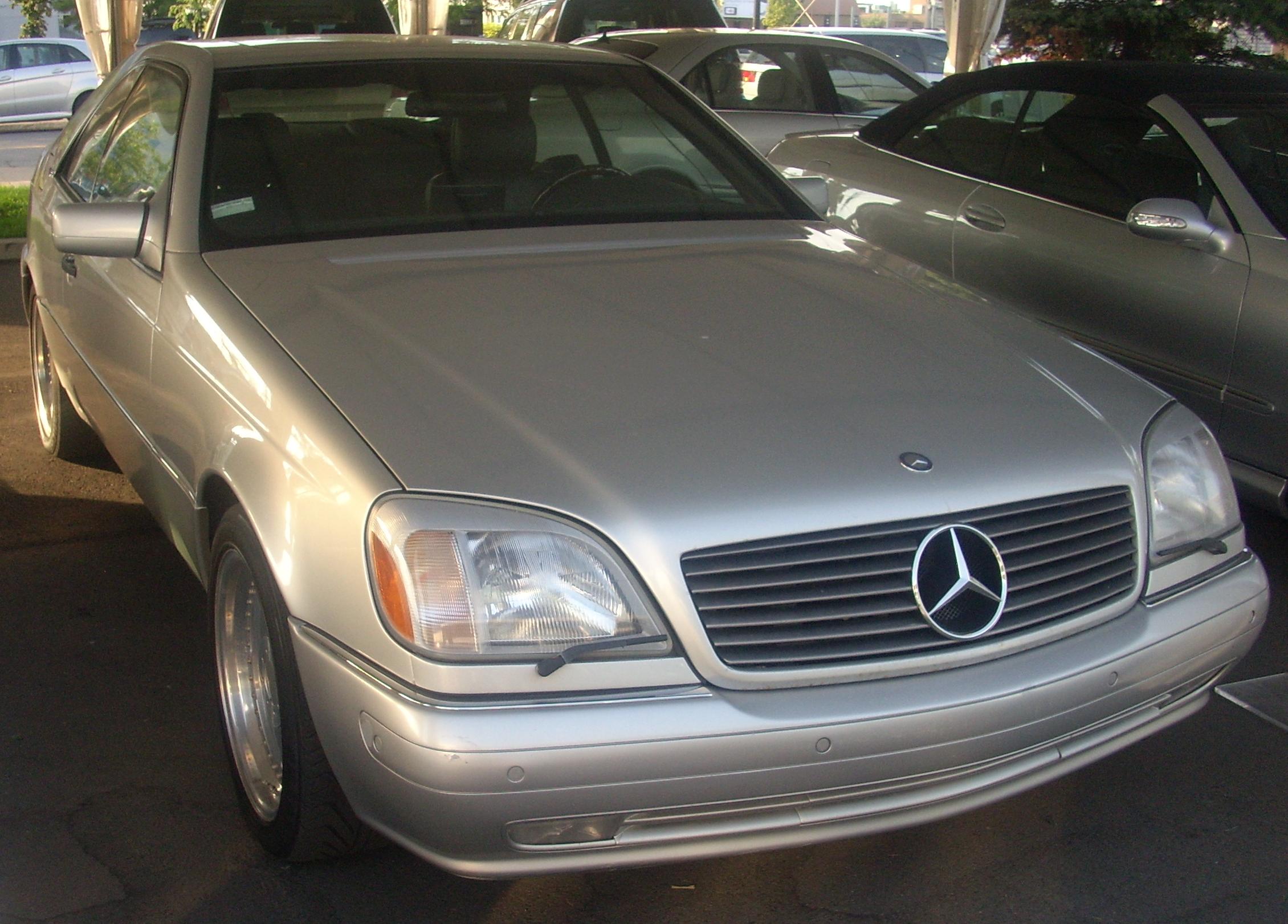
Mercedes-Benz CL600
"Right, and then people like the CL500 and 600s [2448.8s] from the 2000s."
The CL600 is a more expensive, higher-powered Mercedes-Benz luxury coupe from the 2000s. In this segment it’s mentioned as part of the “people remember these” later CL lineup.
The Mercedes-Benz CL600 is the higher-end CL-series coupe from the 2000s, typically associated with a larger V12 engine in that lineup. The hosts group it with the CL500 as later models that draw more attention than the earlier 1990s W140 coupes.

Fiat 600
"The 26. Right, and then people like the CL500 and 600s from the 2000s."
The Fiat 600 is an older small car made by Fiat. The podcast mentions it as one of the classic cars people talk about. It’s known for being compact and for having a dedicated following among vintage car fans.
The Fiat 600 is a small classic car that’s often discussed as a compact, early postwar-era model with a big following among vintage enthusiasts. In the podcast, it’s mentioned alongside other older cars, suggesting it’s part of a broader conversation about collectible or interesting classics. It comes up because the Fiat 600 is recognizable, historically significant, and often seen at classic-car events.
immobilizer
"Oh, like an immobilizer. An immobilizer. That's why they couldn't move it."
An immobilizer is a security feature that stops the car from starting with the wrong key. It usually checks for a special chip inside your key before allowing the engine to run.
An immobilizer is an anti-theft system that prevents a car from starting unless it recognizes the correct key. It typically uses a chip in the key (or key fob) to verify authorization before the engine can run.

Ferrari 550 Marinello
"He says a Ferrari 550 Marinello. [2604.7s] Oh, OK. [2605.3s] And then they steal a 550."
This is a specific Ferrari model: the 550 Marinello. It’s famous for having a big V12 engine and a very “classic Ferrari” look and feel. In the scene, it’s the car everyone is talking about and trying to get.
The Ferrari 550 Marinello is a V12-powered grand tourer from Ferrari’s 1990s lineup, known for its naturally aspirated performance and classic front-engine layout. In the movie scene being discussed, it’s a specific “target car” that helps sell the film’s high-end, car-heist vibe.

Ferrari 550
"What's he pointing at? He says a Ferrari 550 Marinello. Oh, OK."
The Ferrari 550 Maranello is a high-end Ferrari sports car. It’s known for having a powerful V12 engine and for being a grand touring car, meaning it’s built for fast driving and longer trips. The podcast mentions it because it’s a recognizable and desirable Ferrari model.
The Ferrari 550 Maranello is a V12-powered grand touring Ferrari known for its performance and classic Ferrari styling. The podcast references it directly (“Ferrari 550 Marinello”), which is a model people recognize as a meaningful part of Ferrari’s modern classic lineup. It’s discussed because it represents a specific era of Ferrari engineering and is often seen as a collectible driver’s car.
Ferrari 275 GTB 4-cam
"Well, then he asks, well, I wouldn't be a self-indulgent [2610.2s] wheeling wheeler if I was driving a 275 GTB 4-cam. [2613.9s] I would be a connoisseur."
The Ferrari 275 GTB 4-cam is a classic Ferrari from the 1960s. The “4-cam” refers to how the engine’s valves are controlled, and it’s part of why enthusiasts consider it special. In the dialogue, it’s basically a flex that the character has real car knowledge.
The Ferrari 275 GTB 4-cam is a legendary 1960s Ferrari sports car, famous for its 4-cam V12 cylinder-head design (the “4-cam” part) and its high-revving character. The host is using it as a shorthand for “serious collector” taste—someone who knows the difference between common Ferraris and the truly iconic ones.

67 GT 500
"Four of them in the original. They just need a 67 GT 500, which is what they need. It's on the list."
That “67 GT 500” is a 1967 Ford Mustang GT 500. It’s a famous, high-performance version of the Mustang, and people really want them, which is why it matters in the story.
“67 GT 500” refers to a 1967 Ford Mustang GT 500, one of the most iconic muscle cars from the late-1960s. The GT 500 trim is known for its performance-focused package and strong collector demand, which is why it comes up in a discussion about a specific “target” car in the movies.
louvers
"Cause I love the, I love the louvers. It needs louvers. But yeah, it's just a regular yellow sports roof"
Louvers are the slatted vents you can see on some car hoods or body panels. They can be partly functional, but a lot of the time they’re there to make the car look right for a certain model.
Louvers are slatted openings in a body panel, often used for styling and sometimes to help with airflow. On Mustangs, “louvers” commonly refer to the decorative/functional vents that can be associated with specific hood or body treatments.
body style
"73 was that the last year of the body style? Cause in the original, they refer to it as kind of the last of the Mustangs."
In car talk, “body style” refers to the specific vehicle configuration—like coupe vs. convertible vs. fastback—rather than the engine or trim. The host is asking whether 1973 was the last year of that particular Mustang body style, which matters for identifying the exact car shown in the film.
blue plates
"And also God, that movie, clean California blue plates [2923.4s] everywhere, it looks so freaking great. [2925.6s] Right? [2926.4s] There are a lot of blue plate nods in the remake too."
“Blue plates” means the license plates that look a certain way in California. The hosts are saying the movies use that visual detail to make the cars feel like they belong in California.
“Blue plates” refers to California’s distinctive license plate color scheme, which the hosts treat as a visual “nod” in the films. In car-movie terms, these plate details help sell authenticity by matching the setting’s real-world look.

GT 500, Eleanor
"I mean, I assume. [2952.9s] That GT 500, Eleanor, the one in the movie, [2956.8s] they made 11 of them for filming."
“Eleanor” is the famous car from the movie, and it’s based on a Ford Mustang GT 500. The hosts are talking about how rare the filming cars were—how many they made just for the movie.
The Ford Mustang GT 500 is the specific Shelby-tuned Mustang that’s most associated with the character “Eleanor” from the 2000 film. In that movie, Eleanor is portrayed as a highly modified, cinematic muscle car, and the hosts discuss how many were built for filming.
CVS
"they made 11 of them for filming. [2959.8s] CVS, which was, what's it called again? [2962.8s] I thought Chip Foos had a hand in it, didn't he?"
They mention “CVS,” but in this snippet they don’t say what it stands for. Without more context, we can’t reliably explain what they mean by it here.
“CVS” is mentioned as part of the discussion around the filming cars for Eleanor, but the transcript doesn’t provide enough context to identify what the acronym stands for. Because the meaning isn’t clear from this excerpt alone, it’s hard to confidently define it for listeners.
5 speed
"I got two different names. It's just 5 speed, it's got some cool things to it."
“5 speed” means the car has a gearbox with five forward gears. More gears can help the engine stay in the right rev range as you drive.
“5 speed” refers to a five-speed transmission, meaning the gearbox has five forward gear ratios. In practice, it affects how the engine revs at different speeds and how the car feels during acceleration and cruising.
trademark enforcement
"And so that was the trademark enforcement for a long time, which we dealt with that."
Trademark enforcement is how a company (or rights holder) stops other people from using a name that belongs to them. Here, it’s about whether shops can sell cars being marketed with the “Eleanor” name from the movie.
Trademark enforcement is the legal process of protecting a brand name or logo from being used without permission. In this context, it’s about stopping shops from selling cars marketed as “Eleanors” (a movie-associated name) without authorization.
VAT
"We had people who wanted to sell Eleanors on VAT for a long time, we just had a policy to just not do it"
VAT stands for value-added tax, which is a tax added to goods as they move through the supply chain. The point here is that tax rules can influence how shops sell cars marketed under the “Eleanor” name.
VAT is value-added tax, a consumption tax charged at each stage of production and distribution. The hosts are discussing how selling “Eleanors” interacts with tax/legal policy, which can affect whether certain sales tactics are allowed.
floodgates
"Yeah, eventually because of the latest court resolution, essentially it's opened the floodgates. And so we're back to selling,"
“Floodgates” means things start happening a lot more quickly. In this case, it’s saying a court decision made it easier for more shops to sell these cars under the Eleanor branding.
“Floodgates” is a metaphor for a sudden increase in activity once a legal or regulatory barrier is removed. Here, the hosts say a recent court resolution effectively removed restrictions, leading to more “Eleanor” sales.
GT500s
"[3118.4s] and this was our first time seeing that car, [3121.7s] yeah, it's hard not to love. [3123.2s] I mean, GT500s are sick."
The “GT500” is a special, high-performance version of the Ford Mustang made by Shelby. It’s the kind of car people get excited about because it’s built to be fast and look aggressive. The hosts are basically saying they love the car they’re seeing.
“GT500” refers to the Shelby GT500, a high-performance Mustang variant from Ford’s SVT/Shelby era. It’s known for big power and a muscle-car stance, which is why it shows up in a lot of car-movie hype. In this segment, the hosts are reacting to seeing one and calling it “sick.”
T-Lite
"[3123.2s] I mean, GT500s are sick. [3124.2s] Yeah. [3125.0s] And they still got the T-Lite. [3125.9s] But this rendition of it, also very sick,"
“T-Lite” sounds like a specific named feature or version of the car. The hosts are saying the car still has it, like it’s part of what makes that version recognizable. The exact meaning isn’t fully clear from this snippet alone.
“T-Lite” is being used here as a shorthand for a specific trim/variant name associated with the car being discussed. Without more transcript context, it’s unclear whether they mean a particular lighting package, model variant, or a nickname used in the movie/production. The key point is that they’re saying the car still has that identifiable “T-Lite” feature.
rev
"“...is this something that he'd be thrilled to do? To rev this...”"
To “rev” means to spin the engine faster by pressing the gas. People do it to hear the engine or show how responsive it is. In the scene, it’s part of the excitement about the car.
“Rev” is shorthand for raising engine speed (RPM) by pressing the accelerator. In car scenes, it often signals a character “showing off” the engine sound or performance. Here, the host is reacting to someone getting into the car and wanting to rev it.
electronic fuel injection
"“...it's the terrible four point one liter electronic fuel injection...”"
Electronic fuel injection is how a modern car puts fuel into the engine. Instead of using a carburetor, it uses sensors and computer-controlled valves to spray the right amount of fuel. That’s why people often talk about it when discussing what kind of engine a car has.
Electronic fuel injection (EFI) is a system that delivers fuel to the engine using electronically controlled injectors instead of a carburetor. It meters fuel more precisely based on sensors, which can improve drivability and efficiency. In the transcript, it’s used to describe the engine setup of the car in the scene.
Digital fuel injection
"“...but it's the one time. Digital fuel injection.”"
Digital fuel injection just means the car’s computer controls the fuel delivery. The computer decides when and how much fuel to spray so the engine runs right. It’s basically a more precise version of fuel injection control.
“Digital fuel injection” is a more specific way of describing EFI where the fuel delivery is controlled by digital engine management. In practice, it’s still fuel injection, but the key idea is that the engine computer precisely calculates injector timing and fuel quantity. The host is contrasting it with how people usually talk about the car’s engine.

Jaguar XJ220
"Apparently the reason they had an XJ220 on the list [3503.2s] was because they couldn't get a McLaren F1 [3506.0s] which would have been like the real halo car"
The Jaguar XJ220 is a legendary supercar from the 1990s. In this conversation, it’s brought up as the car they could get for the movie’s plan when a different “dream” car wasn’t available.
The Jaguar XJ220 is a 1990s supercar famous for being one of the fastest, most extreme British cars of its era, with a high-output V12 and a reputation for serious performance. Here it’s discussed as being on the movie’s “list,” with the hosts explaining why it replaced another more iconic choice.

Mclaren F1
"Apparently the reason they had an XJ220 on the list [3503.2s] was because they couldn't get a McLaren F1 [3506.0s] which would have been like the real halo car [3508.6s] in this, but there is no F1."
The McLaren F1 is one of the most famous supercars ever made, known for being extremely fast and special. In this segment, it’s treated as the top “dream car” that would have been the main headline pick if they could get it for the movie.
The McLaren F1 is a 1990s supercar celebrated for its “halo” status: a central driving position and a high-revving BMW-derived V12, plus an emphasis on outright performance. The hosts use it as the benchmark “real halo car” that the movie couldn’t include, and they speculate about what it would cost in the 2000 version.

pink Thunderbird
"The pink Thunderbird, I thought was a strong car choice. [3545.0s] That one's stolen outside the casino, I believe."
A Thunderbird is a Ford model that was popular as a stylish, comfortable American car. Here, the host is talking about a specific “pink” one used in the movie.
The Ford Thunderbird is a personal-luxury coupe/convertible that became a recognizable American icon in the 1970s. In this movie context, the “pink Thunderbird” is being discussed as a standout choice in the car lineup.
door popper button
"I saw them do the door popper button underneath the door. [3553.9s] That kind of, I didn't under..."
A “door popper” is a remote or trigger used to unlock and release a car’s door latch quickly—often associated with power door locks or aftermarket keyless/remote systems. In car-theft and movie scenes, it’s used to get the door open fast without a traditional key.
shaving door handles
"but it's before shaving door handles, right? [3561.1s] but it's before shaving door handles, right?"
“Shaving door handles” means removing or hiding the door handle so the outside of the car looks smooth. People do it to improve airflow and for a cleaner, more modern custom look.
“Shaving door handles” refers to modifying a car’s exterior so the door handles are removed or recessed, leaving a smoother body surface. Enthusiasts do this for aerodynamics and a cleaner look, especially on custom or track-focused builds.
remote controls
"Now it's all remote controls. Right, exactly."
Here, “remote controls” means using a remote to unlock or access the car instead of using a key. It’s the idea of electronic entry.
In this context, “remote controls” refers to keyless entry or remote-access systems that can unlock doors without a physical key. The hosts are contrasting older “mechanical” theft/entry ideas with modern electronic access.

Plymouth Barracuda
"A Barracuda is stolen by taking off the steering wheel. Did you remember that moment?"
The “Barracuda” is a classic Plymouth muscle car. It’s the kind of car movies use a lot because it looks cool and feels like a real performance car.
The “Barracuda” refers to the Plymouth Barracuda, a classic American muscle car. It’s a common movie prop because its 1970s styling and performance reputation make it instantly recognizable to car fans.
club
"Have any of you guys ever used the club? Yeah, back when I lived in New York, my dad would always club his Cadillac when he parked it on the street."
They’re talking about a steering-wheel lock. It clamps onto the steering wheel so the car can’t be steered if someone tries to steal it.
A “club” (in this context, a steering-wheel lock) is a theft-deterrent device that clamps around the steering wheel. It prevents the wheel from turning far enough to steer the car, and can also physically block the driver’s leg area so the lock can’t be easily removed while you’re in the seat.

Lamborghini Diablo
"...g to learn on that one. When they're stealing the Diablo from like the Super Bowl Diablo, last year of the..."
The Lamborghini Diablo is a very expensive, high-performance sports car. The podcast is bringing it up because it’s so valuable that people sometimes target it. It’s known for its extreme look and reputation as a supercar.
The Lamborghini Diablo is a high-performance supercar from Lamborghini’s era of dramatic styling and serious power. In the podcast context, it’s mentioned in a theft-related story (“stealing the Diablo”), which highlights how valuable and recognizable these cars are. It’s a frequent subject in car culture because it’s iconic, rare, and visually unmistakable.

Dodge Charger
" [3740.5s] Yellow Daytona, so charger Daytona on the background. [3743.6s] Oh yeah, the blue Daytona in the background."
The Dodge Charger Daytona is a classic American muscle car from the late 1960s. It’s famous for its racing heritage, and in movies it’s used because it looks like a real, recognizable performance car.
The Dodge Charger Daytona is a late-1960s muscle car variant built to compete in NASCAR-style racing and homologation rules. In car-movie context, it’s often used as a recognizable “period correct” fastback-style American icon, and it stands out visually in chase montages.
green screen
"It looks like no green screen. [3819.9s] Which like today, you would never get any of that. [3822.2s] They would be all fake."
A “green screen” is a filming trick where you film someone in front of a green background, then replace that green area with a different scene later. They’re saying this movie’s action looks like it wasn’t relying on that as much.
A “green screen” is a filming technique where actors or objects are shot in front of a solid color background, then that background is replaced digitally. The hosts are saying the movie looks like it avoided heavy green-screen compositing, which makes the action feel more authentic.
car is below the driver's sitting
"Or it would be what we've seen a lot of, [3825.5s] especially in Ford versus Ferrari, [3828.0s] which was the car is below the driver's sitting"
They’re describing a special stunt setup where the driver isn’t positioned like normal in the car. It’s done so the stunt team can control the car safely and the camera can get the shot they want.
This describes a stunt-car setup where the vehicle is modified so the driver’s seating position is effectively separated from the car’s normal layout. The point is to keep the driver safe and allow controlled camera angles while the stunt team moves the car.
driver sitting above on the roof of the car
"but the steering wheel does nothing. [3834.3s] And then there's a driver sitting above [3836.1s] on the roof of the car that has all the mechanical controls."
Sometimes stunt teams put the person controlling the car in a different spot than a normal driver seat. That can help with safety and also lets the filmmakers get the shot they want from inside or around the action.
This is a common motorsport/stunt filming technique: the driver (or a stunt operator) is positioned where they can access mechanical controls while the camera can capture the “in-car” perspective. By moving the control position, filmmakers can show dramatic angles while keeping the person operating the car in a safer, more controllable location.
stunt driver
"Or it's on the trailer sometimes. [3839.9s] Or a stunt driver, that too. [3840.7s] But like a stunt driver can essentially move the car around"
A “stunt driver” is a professional driver who does the dangerous driving scenes for movies. They can steer and control the car in ways that look intense on camera but are planned and executed safely.
A “stunt driver” is a professional who performs high-risk driving maneuvers for film or TV, often using specialized cars and control setups. In this segment, they’re credited with being able to move the car precisely while cameras are placed to capture the action.

Ferrari 250S
"I looked it up. [3880.1s] I mean, it's hard to believe the internet, [3881.3s] but he's got Diablos and Ferrari 250s."
Ferrari 250s are a set of classic Ferraris from the early days of Ferrari. They’re well-known because they have powerful V12 engines and a strong racing reputation, and they’re very collectible today.
The Ferrari 250 is a famous family of classic Ferraris from the late 1950s through the early 1960s, known for their V12 engines and racing heritage. When someone says “Ferrari 250s,” they’re usually referring to multiple variants within that 250 lineup that collectors obsess over.

Ferrari F355
"Yes. The Humvee and the F355, which you've never, I'm only borrowing it."
The Ferrari F355 is a sports car made by Ferrari. It’s known for being fast and for having a V8 engine. The podcast brings it up because it’s a well-known Ferrari model that many car fans recognize.
The Ferrari F355 is a V8-powered supercar from Ferrari’s 1990s era, known for its sharp styling and driver-focused performance. The podcast references it alongside another vehicle, and the mention suggests it’s part of a conversation about notable cars in a collection or scene. It’s a common topic because the F355 is both historically important and widely recognized among enthusiasts.
pursuit helicopter
"Then this leads them to the LA River, which has the dumbest use of a pursuit helicopter."
A pursuit helicopter is a police helicopter used to follow a car chase from the sky. From above, it can keep track of the cars when they turn, speed up, or go behind obstacles.
A pursuit helicopter is an aircraft used during a police chase to track the suspect vehicle from above. The key advantage is that it can maintain a high vantage point, helping keep the car in view even when the route gets complicated.
half a mile in the air
"The whole point of a helicopter is so that it can be half a mile in the air. So you don't lose the car."
They’re talking about how high the helicopter flies. Flying higher helps it see the chase better, so the police don’t lose track of the car.
The phrase refers to the helicopter’s altitude, emphasizing why aircraft are useful in chases: higher elevation improves line-of-sight. That helps prevent the chase from being “lost” when the road geometry or obstacles block ground-level views.
flatbed tow truck
"There's probably even a car crash. The flatbed tow truck is lowered down. Nick Cage stops his car cause he's stuck in traffic now."
A flatbed tow truck is a tow vehicle with a platform that can tilt down to the road. It lifts the car onto the platform so it’s safer than dragging it on its wheels.
A flatbed tow truck is a type of recovery vehicle with a platform (bed) that can be lowered to the ground. The car is driven or winched onto the flatbed, which helps prevent damage compared with towing with wheels on the ground.
nitrous
"Although there's a point at which the car is allegedly going like 170 or something and it's accelerating so hard. Well, yeah, that's what he hits the go baby. Yeah, oh, but go. He's like nitrous."
“Nitrous” is a special boost you can add to a car’s engine using a tank of gas. It gives the engine extra “oomph” for a short time, so the car speeds up much faster than it normally would.
“Nitrous” here refers to nitrous oxide, a system that injects gas into the engine to temporarily boost power. It increases oxygen availability and can dramatically improve acceleration for short bursts, which is why it’s often associated with “fast” driving in movies and performance cars.
Harley
"Sells parts from a Harley that allow him to afford. [4442.0s] Yeah. [4442.8s] Right."
“Harley” here means Harley-Davidson, a well-known motorcycle brand. The character sells motorcycle parts to get money. It’s a quick way to show how he’s trying to change and afford things.
“Harley” is shorthand for Harley-Davidson, the American motorcycle brand. The hosts mention selling parts from a Harley to raise money, which is a common movie shorthand for using motorcycle components as a cash source. It also helps set the character’s lifestyle and what kind of “parts” he’s dealing with.

Dodge Challenger
"... how you, they have this whole great scene with a challenger, I think, and they chop it. They like literally s..."
The Dodge Challenger is a muscle car, meaning it’s built for strong acceleration and a bold look. The podcast mentions a Challenger that was modified in a dramatic way, like cutting or reshaping parts of it. People talk about these cars because the Challenger has a lot of enthusiast attention and many customization options.
The Dodge Challenger is a muscle car known for its powerful engines and classic “retro” styling cues. In the podcast, it’s mentioned in the context of a scene involving a Challenger being “chopped,” which suggests a custom or modified example. That kind of modification is often discussed because it changes how the car looks and how it’s built for a specific purpose.
MV Augusta 750S
"Oh, yeah, she's on an MV, right? [4671.6s] Which is an MV Augusta 750S. [4673.7s] Okay."
This is a famous old Italian motorcycle. The “750S” tells you it’s the 750cc version, and the hosts are basically confirming which engine size it is by looking at the model name.
The MV Augusta 750S is a classic Italian sport motorcycle known for its high-performance inline-four layout and period racing pedigree. In this segment, the hosts use the “750” vs “1000” badge logic to identify the specific displacement model.
stunt double
"Yeah, that's not a stunt double, right? [4693.0s] She gets off at a turn or is it hard to tell? [4694.9s] It is definitely a stunt double, unfortunately, because it's like, it's really..."
A stunt double is a professional who does the dangerous action scenes. If you see someone doing extreme driving or riding, it’s often not the actor themselves.
A stunt double is a trained performer who does risky driving or riding scenes that the main actor can’t safely perform. In car-and-motorcycle movies, stunt doubles are used to execute controlled maneuvers like hard braking, fast cornering, and takeoffs that would be unsafe for the actor.

Ford Bronco
"... though, Beck, you haven't seen this, the big ole Bronco. Are you kidding me?"
The Ford Bronco is a rugged SUV made for driving off-road and handling rough terrain. The podcast is emphasizing a “big” Bronco, meaning a larger version that looks and feels more substantial. People talk about it because it’s a recognizable, classic SUV with a dedicated fan base.
The Ford Bronco is a classic American SUV known for off-road capability and a rugged, boxy design. The podcast calls it the “big ole Bronco,” which likely refers to a larger, more substantial generation that stands out visually. It’s discussed because Broncos have a strong enthusiast community and are often sought after in restored or modified form.

Rolls Royce
"So his Rolls Royce gets the stuff. That's right."
Rolls-Royce is a luxury car brand. The point here is that the movie uses a Rolls-Royce as the fancy, expensive car involved in the action.
“Rolls Royce” refers to Rolls-Royce luxury cars, which are strongly associated with wealth and status. In the scene being discussed, the host notes that the Rolls Royce “gets the stuff,” using the brand as a shorthand for high-end, high-security transport.
limousines
"There's a heavy preponderance of limousines and big town cars in both that are like, yeah, both of them have that."
A limousine is a fancy car used for VIPs or special occasions, usually with a driver. A “stretched” one is longer than normal so rear passengers have more room.
A limousine is a chauffeur-driven luxury vehicle, often associated with VIP transport. The host specifically calls out “stretched sedans,” meaning longer versions of a sedan body stretched to create extra rear passenger space.
stretched sedans
"Limousines in general, especially like stretched sedans, right? Not like nowadays where they're almost always."
A stretched sedan is a normal luxury car that’s been made longer. That extra length usually makes the back seat roomier, like a limousine.
“Stretched sedans” are luxury cars whose wheelbase has been extended to create more rear-seat space. This is a common way to turn a normal sedan into a limousine-style vehicle for comfort and status.

Cadillac Escalade
"A town car. Yeah, they're all escalades now. Right, escalades or I think much more popular is just a well done sprinter van."
A Cadillac Escalade is a big, luxury SUV. It’s the kind of modern “town car” people might think of, and the hosts are contrasting it with older movie vehicles.
The Cadillac Escalade is a full-size luxury SUV from Cadillac, known for its big, comfortable cabin and high-end styling. In this segment, it’s used as a modern example of what people might drive “now” compared to older movie cars.

Mercedes-Benz Sprinter van
"Yeah, they're all escalades now. Right, escalades or I think much more popular is just a well done sprinter van. Right."
The Mercedes-Benz Sprinter is a van that’s commonly used for work, but it can also be converted for passengers. The hosts are saying it can be more shared/communal than a typical car.
The Mercedes-Benz Sprinter is a popular commercial van platform used for everything from delivery work to passenger conversions. Here, it’s mentioned as a more “communal” alternative to a town car—something people can stand up in and share space.

De Tomaso Pantera
"I'm going to say 71 yellow Daytona Pantera. Oh, yeah. That was a very strong one. Pantera in the original one, too, as I recall."
The De Tomaso Pantera is a flashy Italian sports car with the engine mounted in the middle. The hosts are saying it’s one of the recognizable cars that shows up in the movie(s).
The De Tomaso Pantera is a mid-engine Italian sports car that became a cult favorite in the U.S. for its aggressive styling and performance. The hosts specifically connect it to the “original” movie car lineup, emphasizing how it appears in both versions.
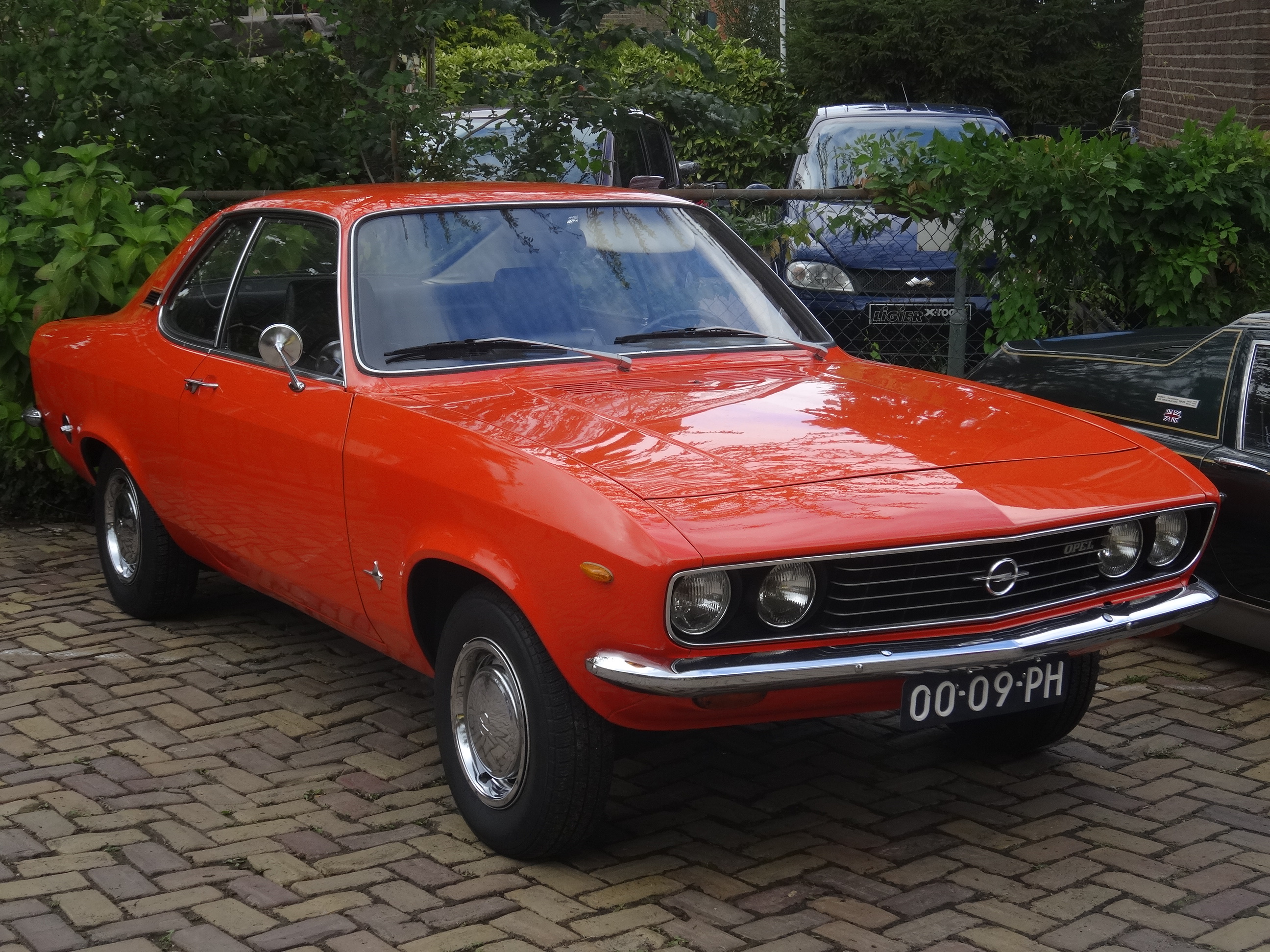
Opel Manta
"Yeah. And a Manta in the original. That's right."
The Opel Manta is an older European sports coupe. The podcast is talking about the original version, meaning the first generation of that model. People mention it because it’s a classic car that stands out from more modern designs.
The Opel Manta is a classic European coupe that’s become a recognizable part of Opel’s history. The podcast specifically mentions “the original,” which implies an earlier generation that’s often the one enthusiasts seek out. It’s discussed because older Mantas can be distinctive, and they’re frequently part of vintage car conversations and collections.
Long Beach
"[5204.5s] Oh, another connection between the two is the Eleanor car was stolen from... [5208.8s] I don't know if it was the same place physically, but it was the international towers in Long Beach. [5213.8s] So that was the same in both."
Long Beach is in Southern California. The host is saying the movie’s car-stolen scene is tied to a real location there, and that both versions of the story use the same area.
Long Beach is a city in Southern California, and the host specifically references the “international towers” there as a location tied to the movie’s car theft storyline. The point is that both versions of the film use the same real-world area as a narrative anchor.
oil crisis
"So we're right after 73 oil crisis."
They’re referencing the 1973 oil crisis, when gasoline got much more expensive and harder to get. Car companies responded by making cars that used less fuel, which often meant less power.
The “oil crisis” refers to the 1973 oil crisis, when oil supply and prices spiked. That shock pushed automakers toward smaller, more fuel-efficient engines and away from the big-displacement performance focus that defined earlier muscle cars.
Request an Explanation
Heard something you'd like explained? We'll add it to this episode.
Sign in to request explanations for terms you heard.
Want to learn more?
Browse our glossary for plain-English explanations of automotive terms, jargon, and concepts.
Help improve this episode
See something that's not quite right? Our annotations are AI-generated and can sometimes miss the mark. Click the flag icon on any annotation to suggest a correction.