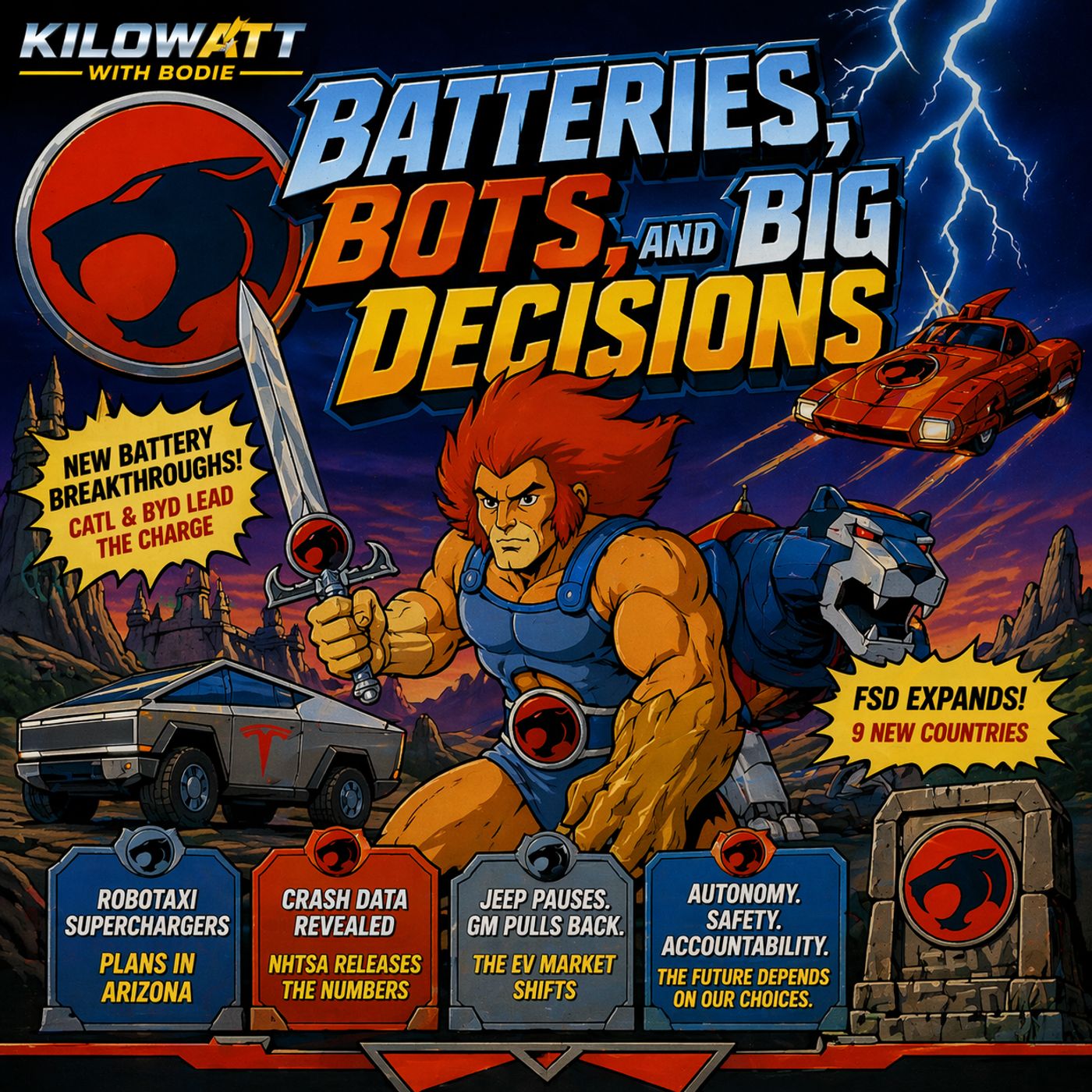
Batteries, Bots, and Big Decisions
About this episode
Battery and autonomy headlines take center stage, starting with a quick clarification on range calibration: NMC packs benefit from specific battery tips, while LFP mainly needs full charge cycles for accurate usability/range prediction. EV news then spotlights faster charging claims—BYD Blade 2.0 and CATL’s 3rd-gen “Shin Zing” LFP—plus CATL’s cold-weather self-heating approach. Tesla updates include hiring FSD “vehicle operators” across nine new countries, planning private RoboTaxi supercharger sites in Arizona, and reacting to an NHTSA crash report where Waymo shows detailed transparency while Tesla redacts descriptions.
In this episode of Kilowatt, I dive into Jeep's decision to pause the Wagoneer S EV and GM’s indefinite halt of its next-gen electric truck production. We explore CATL’s new LFP battery, which promises a full charge in just 6.5 minutes. Tesla's global expansion of FSD and the introduction of robotaxi-only Supercharger stations in Arizona. I also break down a critical NHTSA report on autonomous vehicle safety, calling for more transparency in how we measure road safety across the board. To wrap up, we preview the upcoming Tesla Q1 2026 earnings call and what it means for the future of the market. Join me for a comprehensive look at the tech and policy driving the EV revolution today.
Support the Show https://www.supportkilowatt.com/
Other Podcasts:
News Links:
- CATL one-ups BYD with new LFP EV battery that charges in 6 mins
- Tesla begins hiring FSD vehicle operators in nine new countries
- Jeep shelves its EV in the US for 2026, but promises improvements
- GM suspends next-gen electric truck indefinitely as it retreats to gas
- Tesla Arizona Robotaxi-only Supercharger stations
*Show Art Created By Dall-E
Hosted by Simplecast, an AdsWizz company. See pcm.adswizz.com for information about our collection and use of personal data for advertising.
NMC batteries
"...Joe gave us some really good information on battery tips and those battery tips were specifically for Nickelmanganese Colbald batteries or NMC batteries."
NMC is a type of battery chemistry used in many EVs. It’s known for giving a good mix of range and power, but it can cost more than some other battery types.
NMC stands for nickel-manganese-cobalt, a common lithium-ion battery chemistry used in many EVs. It generally offers a good balance of energy density (range potential) and performance, but it can be more expensive than some alternatives like LFP.
LFP batteries
"With the LFP batteries, he says, the caveat I need to put in there is that LFP batteries often do in fact need 100% charge cycles in order to accurately predict range..."
LFP is a different kind of EV battery. The key point here is that the car’s computer may need a full charge occasionally so it can estimate your remaining range correctly.
LFP stands for lithium iron phosphate, another major EV battery chemistry. The host notes that LFP packs often need full charge cycles for accurate range prediction because the battery management system calibrates its estimates based on how the pack is used.
100% charge cycles for range calibration
"...LFP batteries often do in fact need 100% charge cycles in order to accurately predict range, technically that holds true to some extent for all batteries, but not a health thing, it's a usability thing as far as that calibration goes."
Your EV’s range estimate is an educated guess based on battery readings. Doing a full charge sometimes helps the car learn the battery’s behavior so the guess is more accurate, not necessarily because it makes the battery healthier.
EV range estimates depend on battery state-of-charge and how the battery management system has learned the pack’s behavior. Full charge cycles can help calibrate those estimates, improving the accuracy of displayed range even if they don’t directly “improve battery health.”
Jeep Wagoneer SEV production pause for 2026
"Starting off Jeep is not going to be building the 2026 version of the Wagoneer SEV in the United States for 2026... So not a high demand vehicle... there’s still a lot of Wagoneer SEVs in inventory."
This part is basically EV business news: Jeep is stopping the 2026 version of its electric Wagoneer in the U.S. because demand looks weak, so there may be extra cars available.
This is a news segment about Jeep not producing a 2026 Wagoneer SEV in the U.S. The discussion focuses on sales figures and what that implies for inventory and demand.

Jeep Wagoneer
"... not going to be building the 2026 version of the Wagoneer SEV in the United States for 2026."
The Jeep Wagoneer is a big SUV meant for families and everyday driving. In the podcast, they’re talking about the Wagoneer SEV and whether the 2026 electric version will be built in the United States. That matters because it affects whether buyers can find it locally for that model year.
The Jeep Wagoneer is a large, family-oriented SUV, and the podcast context specifically references the Wagoneer SEV and production plans for the 2026 model year. It’s discussed because manufacturing and market availability can change, affecting when and where buyers can get the electric version. That makes it relevant for listeners tracking EV launches and regional production decisions.
Wagoneer S
"So for 2026, we're not going to get a model year 2026 Wagoneer S, but it is expected to come back in 2027."
This is a Jeep electric SUV called the Wagoneer S. The point here is that a 2026 version likely won’t happen, and the next chance to see it is in 2027. That affects when you can realistically buy one.
The Jeep Wagoneer S is a battery-electric SUV that’s being discussed here in terms of its model-year rollout. The hosts say a 2026 model year isn’t expected, but that it may return in 2027, which matters for buyers watching availability and ordering timelines.
SEVs
"they're claiming that GM is suspending their next gen electric trucks and SEVs. And they're saying that GM will be suspending them indefinitely."
SEVs means “specialty electric vehicles.” It’s GM’s way of talking about electric vehicles that aren’t the main everyday models. The segment says GM might pause future plans for these indefinitely.
SEVs here refers to “specialty electric vehicles,” a category GM uses to describe electric vehicles outside the core passenger-car lineup. The key point is that GM may be suspending next-generation SEV programs indefinitely, which affects future product variety and timelines.

Silverado EV
"So according to Crane's Detroit business, GM was set to do a big update in 2028 for the Silverado EV, the GMC Sierra EV, the Hummer EV, and the Cadillac Escalade IQ."
The Silverado EV is GM’s electric pickup truck. The hosts are saying GM may pause future versions of these electric trucks, which could change when (or if) the next updates arrive.
The Chevrolet Silverado EV is GM’s electric version of its full-size pickup line. In this segment, it’s mentioned as part of a set of next-generation EV trucks that GM may be suspending, which would directly impact future product planning and timelines.

Gmc Sierra
"GM was set to do a big update in 2028 for the Silverado EV, the GMC Sierra EV, the Hummer EV, and the Cadillac Escalade IQ."
The Sierra EV is GMC’s electric pickup truck. The discussion suggests GM might pause upcoming versions of these electric trucks, so it could affect future availability.
The GMC Sierra EV is GM’s electric pickup offering in the Sierra lineup. It’s grouped with other GM EVs as potentially affected by a suspension of next-generation electric truck and SEV programs, which is relevant for anyone tracking future EV releases.

Cadillac Escalade
"GM was set to do a big update in 2028 for the Silverado EV, the GMC Sierra EV, the Hummer EV, and the Cadillac Escalade IQ."
The Escalade IQ is the electric version of the Cadillac Escalade. The hosts are discussing possible delays or pauses in GM’s next electric-vehicle plans, and this model is included.
The Cadillac Escalade IQ is Cadillac’s electric Escalade, aimed at the full-size luxury SUV market. In this segment, it’s referenced alongside other GM EVs as part of a planned next-generation update that could be impacted by GM suspending future electric truck/SEV programs.

Hummer EV
"GM was set to do a big update in 2028 for the Silverado EV, the GMC Sierra EV, the Hummer EV, and the Cadillac Escalade IQ."
The Hummer EV is GM’s electric Hummer. The hosts are talking about possible changes to GM’s future electric vehicle plans, and the Hummer EV is included in that list.
The Hummer EV is an electric vehicle line from GMC/Hummer under GM’s umbrella. Here it’s mentioned as part of GM’s planned 2028 update cycle that may be delayed or canceled if next-gen electric truck plans are suspended.
next-generation battery electric trucks
"GM says that when asked for comment that they do not disclose any potential plans or timing for any next generation battery electric trucks, and it will not engage in speculation."
This means GM’s future electric pickup and truck plans, not the current ones. If those next plans are paused, it can change when new electric trucks arrive and how quickly the lineup grows.
“Next-generation battery electric trucks” refers to future EV pickup and truck platforms beyond the current model lineup. The segment highlights GM’s reported suspension of plans for these next-gen battery-electric trucks, which can signal a shift in investment priorities, engineering timelines, and charging/ecosystem readiness.
Blade 2.0 batteries
"BYD's new blade batteries, we've talked about this, the Blade 2.0 batteries will charge from 10% to 97% in less than 10 minutes, which is, you know, very impressive as long as you're on the right charger."
Blade 2.0 is BYD’s battery pack technology. They claim it can go from low charge to almost full very fast, but only if you’re using a charger that can deliver the required power. Otherwise, the charging will be slower.
BYD’s Blade 2.0 batteries are an evolution of its Blade battery pack design, aimed at improving charging performance and overall efficiency. The segment cites a specific fast-charge window (10% to 97% in under 10 minutes), but also notes it depends on using the right charger—because charging speed is limited by both the battery and the charger’s power/handshake.
BYD
"BYD's new blade batteries, we've talked about this, the Blade 2.0 batteries will charge from 10% to 97% in less than 10 minutes..."
BYD is a company that makes batteries and electric vehicles. In this segment, they’re credited with a battery design called Blade that’s claimed to charge very quickly.
BYD is a major Chinese battery and EV manufacturer known for producing its own batteries at scale. The hosts mention BYD’s “Blade” battery technology as the basis for very fast charging claims, which is important because battery chemistry and pack design strongly influence real-world charging behavior.
right charger
"...the Blade 2.0 batteries will charge from 10% to 97% in less than 10 minutes, which is, you know, very impressive as long as you're on the right charger."
This means you need a fast charger that can actually deliver the high power the battery wants. If you use a weaker charger, the battery will still charge, but it won’t be as quick.
“Right charger” refers to a fast-charging station that can supply enough power and communicate correctly with the vehicle’s battery management system. Even if a battery is capable of very fast charging, real-world results depend on charger output, battery temperature, and the charging curve as the pack approaches higher state-of-charge.
supercharger
"You don't get that for just being on a regular supercharger. You need their flash charger, which is a one and a half megawatt charger."
A supercharger is a fast EV charging station. It’s meant to add a lot of charge in a short time, much faster than plugging into a regular outlet or slower public charger.
A “supercharger” is a high-power DC fast-charging station designed to add a lot of energy quickly compared with standard charging. In EV discussions, it usually implies a specific charging standard and power level, which affects how fast the battery can accept charge.
flash charger
"You need their flash charger, which is a one and a half megawatt charger. But CATL has just introduced the third generation Shin Zing LFP battery, and it will charge from 10% to 98% in six minutes, according to CATL."
A flash charger is an extremely powerful EV charger. It’s designed to charge faster than normal fast chargers, but it only works well if the car’s battery can handle that high power.
A “flash charger” here refers to an ultra-high-power charging setup (described as 1.5 megawatts) intended to push EV charging speed beyond typical DC fast chargers. Charging at this power requires the vehicle battery and charging system to handle very high current safely.
CATL
"But CATL has just introduced the third generation Shin Zing LFP battery, and it will charge from 10% to 98% in six minutes, according to CATL."
CATL is a major company that makes EV batteries. Here, they’re talking about a new battery version and how quickly it can charge, even in very cold weather.
CATL (Contemporary Amperex Technology) is one of the world’s largest EV battery manufacturers. In this segment, CATL is presenting performance claims for a new LFP battery generation, including fast-charge and cold-weather charging behavior.
Shin Zing LFP battery
"But CATL has just introduced the third generation Shin Zing LFP battery, and it will charge from 10% to 98% in six minutes, according to CATL."
Shin Zing LFP is a type of EV battery CATL is promoting. “LFP” is a chemistry that’s generally considered safer and long-lasting, and this new version is supposed to charge much faster.
“Shin Zing LFP” refers to CATL’s LFP (lithium iron phosphate) battery chemistry and a specific generation/variant they’re marketing. LFP batteries are known for strong safety characteristics and long cycle life, and the key point here is improved fast-charging capability.
charging from 10% to 98%
"it will charge from 10% to 98% in six minutes, according to CATL. And it's actually six and a half minutes. But there, there's about a three minute improvement in CATL's battery in terms of, you know, the charging speed when you compare it to BYD."
Charging performance is often discussed as a state-of-charge window (for example, 10% to 98%) because EV batteries don’t charge at the same speed across the entire range. Near the top of charge, batteries typically slow down to protect cells and manage heat, so the “10% to 98%” metric highlights sustained fast charging plus controlled tapering.
cold-weather charging limits
"The other thing that I think is really cool here is that when it's really cold outside, I mean like really cold, CATL says at negative 30 degrees Celsius or negative 20 degrees Fahrenheit, it'll charge from 20 to 98% in as little as nine minutes. So if it's super cold outside and that, that battery is, you know, that batteries don't like the cold."
In very cold weather, EV batteries can’t always charge as fast. This is because the battery doesn’t “work” as efficiently when it’s frozen, so charging may slow down unless the battery design handles cold better.
EV batteries often charge more slowly in extreme cold because chemical reactions and internal resistance change at low temperatures. The segment highlights CATL’s claim that its LFP battery can still charge quickly even around -30°C (-20°F), which is important for real-world usability during winter.
fast charge
"They like it to be warm for them to accept a fast charge. You can do that in as little as nine minutes."
Fast charging means charging your EV quickly using a high-power charger. If the battery is cold, it may not be able to take the charge as fast, so the car may warm the battery first.
“Fast charging” is when an EV accepts high power from the charger to reduce charging time. Battery temperature matters because cold packs can’t safely take the same current, so charging may slow down until the battery warms up.
self-heating technology
"they use this really cool self-heating technology. They call it pulse, I think it's pulse technology, but what it is..."
Self-heating technology heats the battery using the car’s electronics. That helps the EV charge faster in cold weather because the battery is ready to accept power sooner.
Self-heating technology warms an EV’s battery using the vehicle’s own electrical system rather than waiting for the pack to heat naturally. In this segment, the method uses controlled electrical pulses to generate heat, improving cold-weather fast-charging performance and reducing the time needed to reach a chargeable temperature.
pulse technology
"They call it pulse, I think it's pulse technology, but what it is, this is directly off of CATL's website... The battery is quickly warmed up by the pulse current that forms in the high voltage loop."
Pulse technology uses quick bursts of electricity to heat the battery. Instead of waiting for the battery to warm up on its own, the car uses controlled electrical action to get it warm enough to charge faster.
Pulse technology refers to using short, controlled bursts of electrical current to warm the battery. Here, the idea is to create a weak short circuit between the battery and the electric motor while adjusting motor control, so pulse current in the high-voltage loop generates heat efficiently.
high voltage loop
"The battery is quickly warmed up by the pulse current that forms in the high voltage loop. It saves up to two thirds of the heating time compared to the conventional approach."
The “high voltage loop” is the EV’s main high-power wiring path. The hosts are saying the car uses pulses through this high-voltage system to heat the battery more quickly.
The “high voltage loop” is the EV’s high-power electrical path connecting major components like the battery and power electronics/motor control. The segment claims pulse current within this loop is used to warm the battery, which is why the approach can be faster than conventional heating.
Tesla
"All right, let's move on to our Tesla news. Tesla is hiring full self-driving vehicle operators in nine new countries... Tesla is looking to build two private supercharger stations in Arizona."
Tesla is the EV company behind the cars and software being discussed. Here, they’re adding people to test their self-driving features and also planning more fast-charging locations.
Tesla is expanding its electric-vehicle software and charging footprint. In this segment, the hosts discuss Tesla hiring “full self-driving” vehicle operators and pursuing additional private Supercharger stations in the U.S.
full self-driving
"Tesla is hiring full self-driving vehicle operators in nine new countries... If you don't know a vehicle operator, they basically drive Tesla owned vehicles around and they test FSD for each location."
“Full self-driving” (often abbreviated as FSD) refers to Tesla’s driver-assistance software package that aims to handle more of the driving task than basic autopilot features. In this context, Tesla is hiring operators to drive Tesla vehicles and evaluate the FSD behavior in specific cities and countries.
vehicle operator
"If you don't know a vehicle operator, they basically drive Tesla owned vehicles around and they test FSD for each location. That's that's effectively their job."
A vehicle operator is basically someone who drives Tesla cars in a particular city to see how the self-driving software performs. It’s like real-world testing in that location, not just lab work.
A “vehicle operator” is a role where a person drives Tesla vehicles around a specific area to test and validate the behavior of Tesla’s software features (here, FSD). The key point is that it’s location-specific testing—operators help collect real-world performance data for each region.
real-world software validation by local testing
"If you don't know a vehicle operator, they basically drive Tesla owned vehicles around and they test FSD for each location. That's that's effectively their job."
Self-driving software has to be tested where people actually drive. The podcast describes Tesla using drivers in each location to see how the system handles local roads and traffic.
The segment highlights a concept common in advanced driver-assistance development: validating software behavior in real-world conditions by testing in specific locations. Because roads, signage, traffic patterns, and regulations vary by region, Tesla uses operators to evaluate FSD performance city-by-city.
Robo Taxi service
"This will be the first supercharger stations specifically for their Robo Taxi service, meaning they're not open to the public public."
A Robo Taxi service is a self-driving taxi service. Since the cars have to keep running, they may need their own charging stations so they’re always available.
A Robo Taxi service is an autonomous ride-hailing operation where vehicles drive themselves to pick up and drop off passengers. Because the fleet needs predictable charging access, companies may build dedicated charging infrastructure instead of relying on public chargers.
Private vs public charging infrastructure
"This will be the first supercharger stations specifically for their Robo Taxi service, meaning they're not open to the public public."
They’re comparing chargers that are only for one company’s vehicles versus chargers anyone can use. Private chargers can be planned around the fleet’s needs.
The segment contrasts private charging stations (restricted to a specific fleet) with public chargers available to any driver. This matters for planning because fleet operators can optimize uptime, routing, and charging schedules.
56 V4 stalls
"what we do know is they're asking for 56 V4 stalls. So they're going to be building 56 version four superchargers."
“V4” is the newer generation of Tesla’s fast-charger equipment. “Stalls” are the number of spots where cars can plug in and charge at the same time.
“V4” refers to Tesla’s fourth-generation Supercharger hardware. “Stalls” are individual charging positions, so “56 V4 stalls” means the site is planned to have 56 separate charge points using that generation of equipment.
Waymo
"So looking just at the numbers and crashes, Waymo reported 697 crashes total, AV Ride reported 41 crashes, Zooks reported 32 crashes, and Tesla reported 18."
Waymo is a company that builds self-driving technology and runs robotaxis. They’re mentioned here because they report a lot of driving data, which affects how crash numbers look.
Waymo is Alphabet’s autonomous-driving company that operates a large robotaxi fleet in multiple cities. In this segment, the hosts use Waymo’s reported crash counts to illustrate how autonomous-driving performance is tracked.
AV Ride
"So looking just at the numbers and crashes, Waymo reported 697 crashes total, AV Ride reported 41 crashes, Zooks reported 32 crashes, and Tesla reported 18."
AV Ride is mentioned as another self-driving program in the crash-number comparison. The hosts don’t go deep on the company here, but they use it to illustrate why the numbers aren’t directly comparable.
AV Ride is referenced as one of the autonomous-driving operators in the crash-count comparison. The segment uses it to show how different companies report different totals, which the hosts attribute mainly to differences in fleet size and reporting scope.
Zooks
"...AV Ride reported 41 crashes, Zooks reported 32 crashes, and Tesla reported 18."
Zooks is included in the crash-count comparison among autonomous-driving providers. The hosts use it as an example of how reported crash totals can vary widely depending on operational scale and what driving modes are included.
fleet size
"Well, it really comes down to fleet size. So Waymo has, you know, thousands of cars driving millions of miles across varying locations."
If one company has way more cars and drives way more miles, it will naturally see more crashes in total. That doesn’t always mean it’s worse—just that it has more data.
Fleet size strongly affects crash statistics because more vehicles and more miles generally produce more opportunities for incidents. The hosts argue the discrepancy between companies’ crash counts is largely explained by how big each company’s fleet is and how much it drives.
FSD supervised
"...the data set does not include FSD supervised. So what you and I can buy for the Tesla, it isn't included in this data."
This means the car is driving itself, but a person is still supposed to watch closely and be ready to take over. The hosts say the crash numbers they’re using don’t include that human-supervised mode.
“FSD supervised” refers to Tesla’s Full Self-Driving capability when a human driver is expected to monitor and intervene if needed. The hosts emphasize that this supervised mode is excluded from the crash dataset, which changes how you should interpret the results.
unsupervised level for autonomous vehicle, aka RoboTaxi
"This is only for the unsupervised level for autonomous vehicle, aka RoboTaxi. None of the FSD level two stuff is in this report."
Unsupervised means there’s no human actively watching and ready to take over while the car drives. A RoboTaxi is basically a self-driving car used like a taxi service.
“Unsupervised” operation means the vehicle is intended to drive without a human monitoring the driving task in real time. “RoboTaxi” is the robotaxi use case—autonomous vehicles operating as a service—so crash reporting and performance metrics can differ from driver-assisted systems.
transparency gap
"So there is a little bit of a transparency gap when it comes to how the crashes are reported. So for example, Waymo and Zooks, when a vehicle crashes, they explained exactly what happened."
A transparency gap means companies don’t always explain crashes in the same level of detail. If one company tells you more about what happened, it’s easier to judge the situation than if details are missing.
A “transparency gap” here refers to differences in how companies describe and document crash events. The hosts note that some operators provide detailed explanations of what happened, while others are less clear, making comparisons harder.
lane changes
"They detail the lane changes, the intersection behavior, the actions of the human drivers..."
A lane change is when a vehicle moves from one lane to another. For self-driving systems, it’s a tricky moment because it has to judge whether there’s enough space and whether other cars will react.
Lane changes are a key maneuver for driver-assistance and autonomous systems because they require safe gap selection, signaling, and prediction of nearby vehicles’ behavior. The transcript suggests the reports include detailed descriptions of these maneuvers.
intersection behavior
"They detail the lane changes, the intersection behavior, the actions of the human drivers..."
Intersection behavior is how a car handles driving through intersections—like turning, going straight, and dealing with other cars. Intersections are hard for self-driving because lots of things can happen at once.
Intersection behavior refers to how an autonomous system handles complex right-of-way situations, turning, and merging at crossings. The hosts mention that detailed reporting includes these behaviors, implying they’re important for evaluating safety.
redact their reports
"And then Tesla, they redact their reports. So when you when you look in the description area, it just says redacted..."
To “redact” a report means to cover up parts of it before sharing it publicly. Here, the hosts argue that hiding details makes it harder for everyone to understand what the self-driving system did on real roads.
“Redacting” means removing or hiding sensitive details from published reports. In autonomous-driving testing, this can limit public scrutiny of how systems behave in lane changes and intersections, and it affects transparency around incidents and safety.
autonomous-driving testing on public streets
"...these vehicles are getting into minor accidents. If there's injuries, they're minor injuries... they are testing on public streets to be as transparent as possible."
Testing on public streets means the car is driving around in normal traffic, not just on a closed course. The hosts say that because it’s happening in public, the company should be open about what the system is doing.
Testing self-driving vehicles on public roads means the system is evaluated in real traffic with real pedestrians, cyclists, and unpredictable human drivers. The hosts connect this to the need for transparency, especially when events involve minor accidents or injuries.
minor accidents
"...these vehicles are getting into minor accidents. If there's injuries, they're minor injuries."
“Minor accidents” means small crashes or bumps. Even if injuries are minor, the hosts think the public should still know what happened during testing.
“Minor accidents” in the context of autonomous testing typically means low-severity collisions or contact events. The hosts use this to argue that even when incidents are small, the public should still be able to understand what occurred.
negative press
"So I don't I don't really dig that Tesla might experience some negative press..."
Negative press is when news stories are critical or unfavorable. The hosts are saying that this kind of coverage can happen when what people claim and what actually happens don’t line up.
Negative press is unfavorable media coverage that can shape public perception of a company’s technology, safety, or reliability. In the segment, it’s tied to how incidents and outcomes may not align with the story being told, which can lead to scrutiny and speculation.
C-suite promises
"...somebody in the C-suite makes promises that are maybe not 100% achievable... even though what they're doing is amazing."
The C-suite are the top leaders at a company. The point here is that sometimes big promises about what a technology can do don’t fully match what happens when you use it in the real world.
The C-suite refers to top executives (CEO, CFO, etc.) who set strategy and make public commitments. The hosts are suggesting that some promises about performance or capabilities may be overly optimistic compared to what’s achievable in real-world conditions, which can create a mismatch between marketing narratives and observed results.
heavy traffic
"So when a Waymo crashes in, it tends to be in heavy traffic. And it tends to involve other cars."
Heavy traffic means lots of cars close together and stop-and-go movement. That makes driving harder for both people and self-driving systems because other cars behave more unpredictably.
Heavy traffic is an operating condition where vehicles are packed closely together and speeds change frequently, increasing the complexity of driving decisions. For autonomous systems, this can matter because perception and prediction of other road users are harder when everything is moving unpredictably.
accidents involving other cars
"And it tends to involve other cars. Again, Waymo's in a lot more places than those other companies..."
If an accident involves other cars, it usually means the situation depends on how other drivers act. That can be a big factor for self-driving systems because they have to predict and react to human behavior.
Accidents involving other cars are important because they often depend on interactions with human drivers and unpredictable behavior. For autonomous-driving discussions, this distinction helps explain why incident context (who else is on the road and how they behave) can dominate safety outcomes.
required hospitalization
"“When we see required hospitalization, we need to be very careful… unless somebody is unconscious or altered in some way, you are not required to ever go to the hospital.”"
Sometimes after an accident, someone may be required or strongly expected to go to the hospital. The idea is that if the injury could be serious or the person’s condition seems unsafe, medical professionals want them evaluated right away.
“Required hospitalization” refers to situations where medical treatment in a hospital is mandated or expected by policy/regulations after an incident. In practice, it often hinges on severity indicators (like unconsciousness or altered mental state) rather than just the fact that someone was hurt.
altered mental state (e.g., low blood sugar, inebriation)
"“Or if you're altered in some way, if you have low blood sugar, you're inebriated or… makes you altered.”"
They’re talking about cases where someone isn’t thinking clearly—like from low blood sugar or being intoxicated. If you’re not fully alert, it’s harder to judge how serious an injury is, so medical help may be needed.
The transcript uses “altered” to describe when someone’s mental state is impaired in a way that could make them unsafe or unable to make informed decisions. Examples given include low blood sugar and inebriation, which can mimic or worsen injury symptoms and affect whether hospital evaluation is warranted.
stationary object
"So when Tesla had reported incidents, it was more often that they hit some sort of stationary object. You know, some of the things listed were curbs, poles, cyclists, animal, a bus."
They’re saying a lot of the crashes involved hitting things that weren’t moving, like curbs or poles. That can help explain what the car’s system struggled with.
The transcript notes that many Tesla-reported incidents involved impacts with stationary objects rather than moving vehicles. This distinction matters because it can point to different failure modes (e.g., detection/trajectory planning vs. interaction with other road users).
curbs
"You know, some of the things listed were curbs, poles, cyclists, animal, a bus."
A curb is the raised edge at the side of the road. Hitting curbs is a common kind of accident, especially when a car is turning or parking.
Curbs are common roadside obstacles that can be struck during low-speed maneuvers, lane departures, or automated parking/turning scenarios. Mentioning curbs as a frequent impact target helps characterize the types of incidents being reported.
cyclists
"You know, some of the things listed were curbs, poles, cyclists, animal, a bus."
Cyclists are people riding bikes, and they’re harder for cars to predict than cars. If a car system can’t detect them well, it can lead to dangerous situations.
Cyclists are vulnerable road users, and their inclusion in the incident list highlights scenarios where automated driving systems must correctly detect and respond to people moving unpredictably. This is especially relevant when discussing driver-assistance performance.
poles
"You know, some of the things listed were curbs, poles, cyclists, animal, a bus."
Poles are fixed objects along the road. If a car hits a pole, it usually means it didn’t avoid it or didn’t stay on the intended path.
Poles are fixed roadside objects that can be struck when a vehicle’s path planning or obstacle avoidance fails. In incident summaries, listing poles indicates impacts with rigid infrastructure rather than other vehicles.
animal
"You know, some of the things listed were curbs, poles, cyclists, animal, a bus."
Animals are a common source of unexpected obstacles on roads, requiring robust detection and conservative planning. Mentioning animals in the incident list indicates the system faced unpredictable, non-vehicle targets.
a bus
"You know, some of the things listed were curbs, poles, cyclists, animal, a bus."
A bus is a big vehicle that moves with traffic. If incidents involve buses, it means the car system was dealing with real-world traffic situations.
A bus represents a large, heavy moving vehicle that can create complex traffic interactions. Including buses in the incident categories suggests the automation system was operating in mixed traffic conditions, not only against fixed objects.
FSD unsupervised
"For all of all 18 of Tesla's crashes, the FSD unsupervised, the level four was activated."
FSD is Tesla’s driver-assist/automation system. “Unsupervised” means it’s supposed to handle driving tasks without you constantly watching and taking over.
“FSD unsupervised” refers to Tesla’s Full Self-Driving system operating without the driver actively supervising in the way required for lower automation modes. In the transcript, the hosts say that for Tesla crashes, this unsupervised mode (or an equivalent level) was activated.
level four
"For all of all 18 of Tesla's crashes, the FSD unsupervised, the level four was activated."
“Level four” is a way of describing how automated a car is. At this level, the car can drive itself in specific situations without you constantly controlling it.
“Level four” is a reference to SAE automation levels, where the vehicle can perform driving tasks under certain conditions without continuous human oversight. The hosts connect “level four” activation to the crashes they’re discussing, implying the automation mode was engaged.
distracted driving
"And she had two hands on her phone while she was driving. In that situation, I would much rather have her in an autonomous vehicle like a Waymo or a Tesla..."
Distracted driving means the driver isn’t fully paying attention to the road. Using a phone while driving is especially dangerous because it takes your eyes and attention off what’s happening around you.
Distracted driving is when a driver’s attention is diverted away from the road—often by using a phone, eating, or other activities. The host describes a high-risk scenario (two hands on a phone while driving) to emphasize how distraction increases crash likelihood and severity.
crosswalk
"I mean, she could literally blow through a crosswalk and take somebody out."
A crosswalk is where people are supposed to cross the road safely. The host is saying the driver’s inattention could seriously endanger pedestrians there.
A crosswalk is a designated pedestrian crossing area, typically marked on roads and controlled by signals or signage. The host mentions it to highlight the severity of distracted driving—blowing through a crosswalk can put pedestrians at immediate risk.
Request an Explanation
Heard something you'd like explained? We'll add it to this episode.
Sign in to request explanations for terms you heard.
Want to learn more?
Browse our glossary for plain-English explanations of automotive terms, jargon, and concepts.
Help improve this episode
See something that's not quite right? Our annotations are AI-generated and can sometimes miss the mark. Click the flag icon on any annotation to suggest a correction.