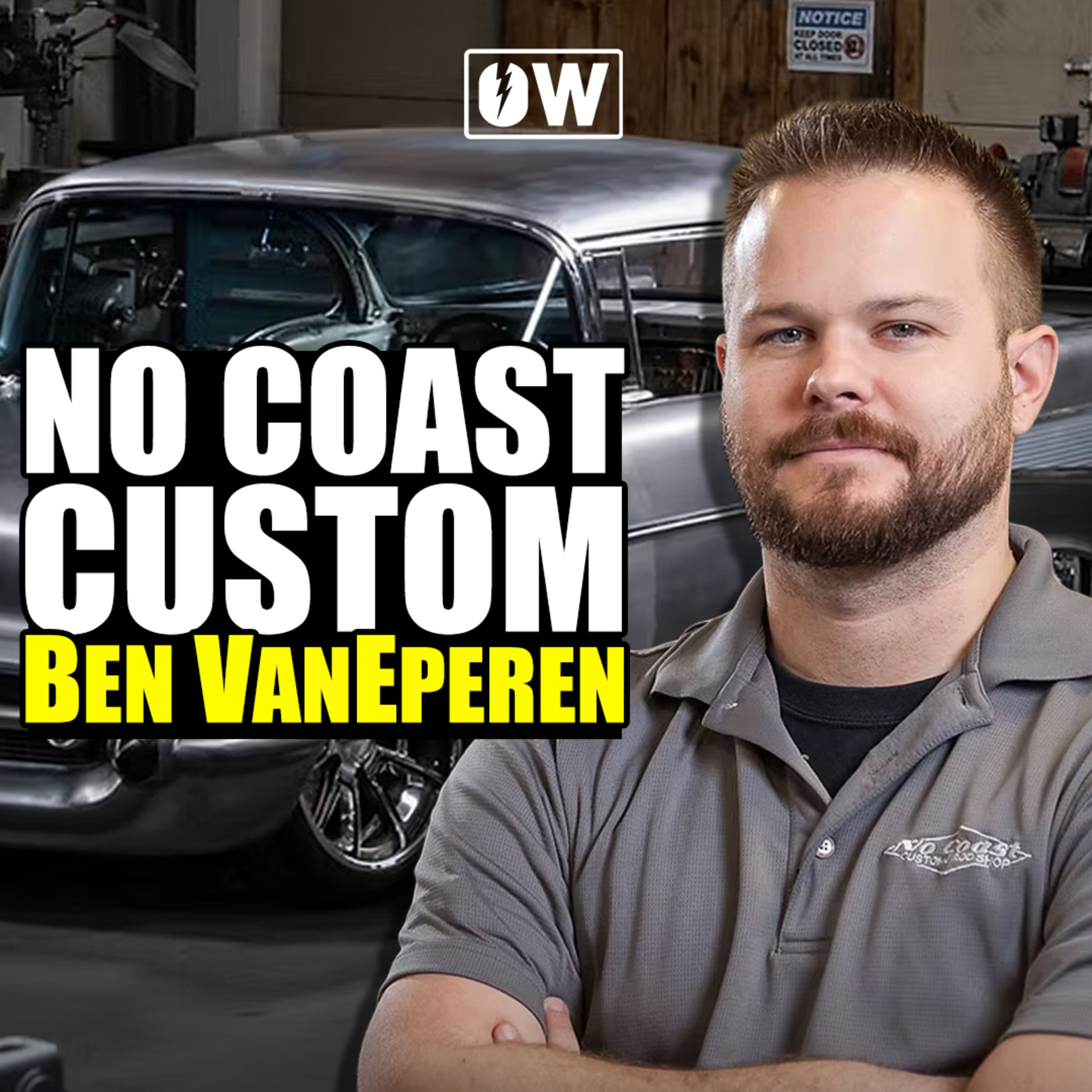
Ben VanEperen & Zach Raddatz of No Coast Custom & Rod Shop
About this episode
Ben VanEperen and Zach Raddatz trace how No Coast Custom & Rod Shop grew from collision and fleet work into full custom builds, with stories about a 55 Chevy, a month-long 69 AMX turnaround, and a pile of unusual fabrication jobs. They also dig into shop culture, paint mistakes, SEMA deadlines, and the realities of balancing customer work with personal projects. Along the way, the conversation veers through hot rod history, Japanese performance cars, and the cars that shaped their tastes.
This week on Oil & Whiskey, we sit down with Ben VanEperen and Zach Raddatz from No Coast Custom & Rod Shop.
Custom with a K
"“I look at it because when you spell Custom with a K, you are segmenting yourself to a certain type of built.” ... “And you can be Custom with a K if you build Customs with a K.”"
In custom-car circles, spelling “Custom” with a K can be a way to signal a certain style or community. The hosts are debating whether that spelling choice is meaningful or just a branding gimmick.
The phrase “Custom with a K” is a stylistic/branding convention used in custom-car culture. The hosts are arguing that spelling “Custom” with a K signals a particular subculture or type of build.
lead sleds
"“If you build lead sleds and bombs and custom car culture type of built.” ... “Don’t do it because the K looks cooler than a C.”"
“Lead sleds” are big, heavy classic cars that people modify for a custom look—usually with a lowered stance. The term is slang for how heavy those cars feel.
“Lead sleds” is a custom-car term for heavy, full-size cars—often from the 1940s–1970s—that are built to look tough and ride low. The name comes from their mass, which can feel like “lead,” and they’re commonly associated with hot-rod and custom aesthetics.
bombs
"“If you build lead sleds and bombs and custom car culture type of built.” ... “Don’t do it because the K looks cooler than a C.”"
“Bombs” is slang in car culture for a certain kind of modified car—usually one that looks low and mean. In this conversation it’s being used as a style label, not a specific make or model.
In custom-car slang, “bombs” typically refers to cars built with a low, aggressive stance and often a show/drag-inspired vibe. Here it’s grouped with “lead sleds” and other custom-car culture builds, indicating a style category rather than a specific car model.
Barris Customs
"“Who did that in the first place? Was it Barris, I guess?” ... “Oh, definitely. Barris Customs.”"
This is a reference to George Barris, a famous custom-car builder. The hosts are joking about whether his shop helped popularize the “Custom” spelling with a K.
“Barris Customs” refers to the custom-car shop associated with George Barris, a well-known name in American hot-rod and custom-car culture. In this context, it’s used as a reference point for where the “Custom with a K” branding idea might have originated.
Eric Black
"“I bet you Eric Black would know, or he would fake like he knew.” ... “You think?”"
They mention Eric Black as a person who might know the history behind the custom-car spelling joke. It’s a nod to a community insider rather than a technical car detail.
Eric Black is referenced as someone who would likely know the origin of the “Custom with a K” idea. In this segment, he’s treated as a knowledgeable figure within the custom-car culture community.
YouTube comments
"Oh, the enemies are the ones that get on YouTube. That's the ones that make hurtful comments about you on YouTube, that you're not friends."
They’re talking about mean comments people leave online. It’s not about car tech—just how they deal with criticism.
The hosts are discussing negative feedback left on YouTube, framing it as “enemies” compared with friends. This is more of a social-media topic than a technical automotive subject.
SEMA
"I got some teaser images of something that you're building for SEMA. You had it in bare metal at Grand National, right?"
SEMA is a big car show in the U.S. where custom shops and aftermarket companies show off new builds and parts. People go there to see what’s coming next in the car world.
SEMA (Specialty Equipment Market Association) is a major U.S. trade show focused on aftermarket automotive parts and custom builds. Builders often debut new projects there to attract attention from media and industry buyers.
bare metal
"You had it in bare metal at Grand National, right? Yep. We had it in 57."
“Bare metal” means the car’s body is stripped down to exposed metal, usually before paint and finishing. It’s commonly seen during restoration or custom-build stages when prep and fabrication are still in progress.
Grand National
"You had it in bare metal at Grand National, right? Yep. We had it in 57."
“Grand National” is a name people use for certain big events in racing or car shows. In this clip, they’re saying the project was shown there before it was finished.
“Grand National” here appears to refer to a motorsport event or show where the car was shown in a bare-metal state. Without more context, it’s unclear which specific series or venue the hosts mean.

Buick Grand National
"...e building for SEMA. You had it in bare metal at Grand National, right? Yep."
The Buick Grand National is a performance version of a Buick. The podcast is talking about one being prepared for a major car show, including being shown in a bare-metal or unfinished stage.
The Buick Grand National is a performance-focused variant of the Buick lineup that’s especially known among enthusiasts. The podcast mentions it in connection with SEMA and “bare metal,” which suggests a project car in a specific stage of restoration or preparation. It’s discussed because Grand Nationals are popular targets for builds and show appearances.
primer
"So now we're in final primer. Got the engine bay painted and everything this last weekend, underside done."
Primer is the first layer of paint you put on a car before the final color. It helps the paint stick better and protects the metal underneath.
Primer is the base coating applied before final paint. It helps the surface adhere properly and provides corrosion resistance, especially on bare metal or after bodywork.
engine bay
"Got the engine bay painted and everything this last weekend, underside done. So Chassis is getting assembled."
The engine bay is the space under the hood where the engine lives. People paint it too because it looks clean when you open the hood.
The engine bay is the compartment where the engine and related components sit. Builders often paint or detail it because it’s visible when you open the hood and it affects overall presentation.
underside
"Got the engine bay painted and everything this last weekend, underside done. So Chassis is getting assembled."
The underside is the bottom part of the car. Builders often clean and coat it so it looks good and helps protect against rust.
The underside refers to the bottom of the car—floorpan, suspension components, and other underbody surfaces. Finishing it (cleaning, coating, or painting) is common in restorations and custom builds to improve both appearance and protection.
jack stands
"[303.1s] You got a second. [304.4s] You're not going to believe what happened. [307.0s] These fucking jack stands, man."
Jack stands are the stands that keep a car safely lifted while someone works underneath. They’re important for safety so the car can’t fall.
Jack stands are safety supports used to hold a car off the ground while work is being done. They’re typically used in addition to a jack, and they matter because stability and safety are critical during fabrication and underbody work.
solvent pop
"“...everybody's battled this before, you know, you get something happens, you get a solvent pop, you get some fish eyes trying to figure out what happened.”"
“Solvent pop” is when fresh paint develops tiny bubbles or pinholes while it’s drying. It usually means something in the paint process (like trapped solvent or contamination) didn’t let the coating cure smoothly.
“Solvent pop” is a paint defect where solvent trapped in the coating or released too quickly forms small bubbles or pinholes as the paint cures. It’s often linked to surface contamination, improper flash time between coats, or environmental conditions in the booth.
fish eyes
"“...you get a solvent pop, you get some fish eyes trying to figure out what happened.”"
“Fish eyes” are little craters or spots where the paint doesn’t lay down evenly. Usually it happens because something on the surface (like grease, wax, or silicone) prevents the paint from sticking.
“Fish eyes” are paint defects where the coating pulls away in small craters or round spots, leaving a “fisheye” look. They’re typically caused by contamination on the surface—commonly silicone, wax, or other low-surface-tension materials.
paint booth
"“...I'd love to hear the rationale behind how that affected anything in the paint booth.”"
A “paint booth” is a special room where cars are painted. It’s designed to control airflow and keep dust and conditions from messing up the paint job.
A “paint booth” is an enclosed, controlled workspace for spraying and curing automotive coatings. It manages airflow, filtration, and sometimes temperature/humidity to help paint atomize correctly and cure without defects.
chemtrails
"[473.7s] And the issues I've heard over 25 years of where, I mean, it blame it on the chemtrails to the new factory that's 25 miles down the road to him. [485.6s] Never could it be, you know, a processor and application issue."
“Chemtrails” is a claim some people make about planes spraying chemicals in the sky. Here it’s mentioned as a joke or exaggeration, not as something that actually explains paint issues.
“Chemtrails” is a conspiracy theory claiming that certain aircraft release chemicals into the atmosphere for hidden purposes. In the transcript, it’s used as a humorous explanation for shop/painting problems rather than a real technical cause.
humidity
"[524.9s] Bill Nye, the science guy. [526.3s] Yeah. [526.4s] It's like, well, I actually looked at this, you know, in the Farmer's Almanac says, you know, that we're going to have a higher than standard humidity."
Humidity is how much moisture is in the air. In a paint shop, too much humidity can make paint dry differently and can lead to problems like bubbling or poor finish.
Humidity is the amount of water vapor in the air, and it can strongly affect paint curing and surface behavior. Higher humidity can slow drying, increase the chance of defects, and change how solvents evaporate during the painting process.
pressure drop
"[538.5s] It makes perfect sense. [539.7s] You look at that in coefficient with the pressure drop, you cross that out with the, you know, just the general shop air. [544.8s] Yeah."
Pressure drop is how air pressure changes as air flows through equipment like filters or ducts. In a paint shop, it matters because it affects airflow and how well the air stays clean.
Pressure drop refers to the reduction in air pressure as air moves through a system, such as ducting, filters, or airflow paths in a shop. In painting, airflow and pressure differences matter because they influence how air is filtered and how contaminants are controlled around the booth.
wheel hub thing
"We stayed there when we did the first wheel hub thing. Yeah. Pretty cool little town."
They’re talking about something they did before involving the wheel hub. That’s the part that helps the wheel spin and connects the wheel to the car, so it’s usually part of a repair or an upgrade.
The hosts reference a prior project involving a “wheel hub,” likely a wheel- or brake-related upgrade or repair. In car culture, hub work often ties into suspension/brake service or custom wheel fitment.
Street Scene
"Yeah, who was the guy that did all the bumpers and grills? Street scene. Yeah, Oh. Yeah, I think APC was another one."
They’re talking about Street Scene as a company that made aftermarket body parts. Think of it as a brand that sells things like bumpers and grilles to change how a truck looks.
Street Scene is mentioned as a company/brand associated with aftermarket styling parts like bumpers and grilles. In the late-1990s/2000s truck and SUV scene, it was known for catalog-style “street” appearance packages.
APC
"Oh, yeah. Yeah, I think APC was another one. APC had a bunch of street scene trends."
APC is being mentioned like a brand that made popular add-on parts for customizing trucks. The hosts are comparing it to other companies that advertised a lot in magazines.
APC is referenced as another company tied to “street scene” trends and magazine ads. In this context, it’s likely a brand known for aftermarket exterior styling and accessories that were heavily promoted in custom-truck culture.
Belltech
"Well, let's all face it. The Belltech ads were the best. The Belltech ads always won."
Belltech is a company that makes aftermarket parts for trucks, especially suspension parts that lower the ride height. The hosts are basically saying Belltech’s ads were the most memorable.
Belltech is brought up in the context of ads being the best and always winning. Belltech is a well-known aftermarket suspension brand, especially associated with lowering trucks and SUVs, which fits the “into trucks” theme of the conversation.
engine swaps
"So, being a buddy rented some apartment garages through high school. We were doing engine swaps, working on our own stuff, you know, out of these apartment garages."
An engine swap means replacing the engine in a car with a different engine. People do it to get more power or to build a project, but it’s a lot of work because you have to make the new engine fit and run correctly.
An engine swap is when you remove one engine from a vehicle and install a different one. It’s a common way to change performance, fix issues, or build a custom project, but it usually requires matching parts and wiring/controls to make everything work together.
Kawasaki
"We have Kawasaki there in Lincoln. So I worked there as a welder and then did that for a couple of years."
Kawasaki is a big company that makes a lot of industrial stuff. Here, it’s just where the speaker worked before getting into custom car work.
Kawasaki is a major industrial manufacturer known for motorcycles and a wide range of industrial equipment. In this segment, it’s mentioned as the workplace where the speaker worked as a welder.
roll bars
"Yeah, components, roll bars, the, yeah, the chassis. That's the actual manpower welding those, huh?"
Roll bars are safety bars that help protect you if the car tips over. They can also make the car feel more solid by strengthening the body.
Roll bars are structural safety components designed to protect occupants during a rollover or hard cornering. They’re also used in some builds to add chassis stiffness, especially when tied into the rest of the cage.
A-arms
"So one of the jobs that I did was A-arms. So robot, you'd assemble it in the robot, work robot, weld it."
A-arms are parts of the suspension that hold the wheel in place. They let the wheel move up and down while keeping it pointed the right way.
“A-arms” is short for control arms (often shaped like an A) that connect the suspension to the chassis. They help locate the wheel and allow the suspension to move while maintaining alignment.
plasma cutter
"And it just sounds like a plasma cutter, just slicing it."
A plasma cutter is a tool that cuts metal using a super-hot jet of gas. It makes a sharp, slicing sound when it goes through the material.
A plasma cutter uses an electrically heated, high-velocity jet of ionized gas to cut through metal. It produces a distinctive slicing sound, which the speaker compares to the robot’s operation.
auto body
"And I was on the wait list for the local community college to go for auto body. So my father-in-law also works at that college."
Auto body is the work of fixing the outside of a car after it gets damaged, like dents or crash damage. After the body is repaired, the car usually gets painted.
“Auto body” refers to repairing a vehicle’s exterior structure—things like dents, collision damage, and panel alignment—before paint. It’s a common trade path in collision repair shops and vocational programs.
body and paint program
"There's a two year wait for the body and paint program. So he got me bumped up and then started school about a week later, I think."
A body and paint program is school training for fixing crash damage and then painting the car. You learn how to prep the surface and apply paint so it looks right.
A “body and paint program” is a training track that teaches both collision repair/bodywork and how to apply paint correctly. The goal is to restore damaged panels and then finish them so the color and surface match.
welding
"Yeah, you haven't heard of him. That dude's welding hair. Somebody else dropped off, he's been opening."
Welding is how you attach metal pieces together by heating them until they fuse. In car repair, it’s used when parts of the metal frame or panels need to be replaced or fixed.
Welding is the process of joining metal parts by melting and fusing them, often used in collision repair and fabrication. In bodywork, it’s used to repair or replace damaged structural sections and brackets.
body program
"So went through the body program. That was 18 months or so."
A “body program” is training for fixing and preparing the car’s body. Before paint can look good, the panels have to be repaired and prepped properly.
A “body program” usually refers to a structured training track focused on vehicle bodywork—things like panel repair, prep work, and getting a car ready for paint. In collision and custom shops, it’s the step before painting because the surface quality largely determines the final finish.
collision center
"Collision center or a custom shop? He kind of did a little restoration, but he did some collision stuff too."
A collision center is a repair shop for cars that were in accidents. They fix damaged parts and then repaint so the car looks right again.
A collision center is a shop that repairs cars after crashes. Work often includes structural repairs, panel replacement, and refinishing, so painters and metalworkers are both heavily involved.
painter
"So then from there, I got a job at a collision center and I was a painter. So I was painting five, six cars a day."
A painter in a car shop prepares the car and applies the paint so it looks right and lasts. It’s more than just brushing on color—there’s a lot of prep and careful technique.
In automotive work, a painter isn’t just “someone who paints”—they’re responsible for surface prep, masking, mixing coatings, and applying paint so it cures correctly and matches the intended finish. The job quality is judged by things like smoothness, color match, and how well the clear coat holds up.
paint scale
"So that was, that was the thing that I didn't know anything about, you know, the, you'd [993.6s] see a paint scale and, you know, four to one, two to one, three, what the hell does this [997.2s] mean?"
In a body shop, a “paint scale” is basically a color-matching guide. It helps the painter figure out what paint mix to use so the new paint looks like it belongs on the car.
A “paint scale” is a reference system used in body shops to match and mix paint correctly. It helps technicians identify the right color formulation and sheen so the repaired area blends with the existing paint.
seal
"And I was paying a guy to work on a car that I had. [1004.6s] And I mean, he was just, it kept getting fucked up. [1007.9s] I mean, he didn't use seal or anything."
“Seal” means putting a protective layer on the car before painting. If you don’t seal it properly, the paint can fail or the repair can get messed up again.
In collision repair, “seal” usually refers to applying a sealing layer (like a sealer or primer) to prepare the surface and prevent issues like moisture intrusion or paint adhesion problems. Skipping proper sealing can lead to repairs that don’t hold up.
gun metal gray
"The car was red and I was trying to paint it like a gun metal gray. [1013.8s] You could see the red through the gray."
“Gun metal gray” is just a particular shade of gray paint that looks like metal. Painters use it to describe the exact look they’re trying to match on a car.
“Gun metal gray” is a specific paint color/finish description used in automotive refinishing. It typically refers to a darker, steel-like gray tone that can be achieved with particular basecoat colors and clear-coat settings.
hot rod shop
"And around the corner from us was a hot rod shop. [1046.9s] There'd always be cool stuff out there."
A hot rod shop is where people work on modified cars—usually older ones—to make them look cooler and drive better. It’s more about customizing than just fixing accident damage.
A “hot rod shop” is a performance-focused garage that builds, modifies, or restores older cars for a more aggressive look and driving feel. In practice, these shops often do custom fabrication, paint, and mechanical upgrades.
the car's got to go out the door
"Yeah, you usually want to have somebody kind of ready to roll. The car's got to go out the door. So I think it was one of those deals like he wanted me to beg."
“Out the door” just means the car is finished and ready to be picked up. The shop has to keep things moving so work doesn’t get stuck.
“Out the door” is shop shorthand for completing the repair and delivering the vehicle to the customer. It highlights the production/throughput pressure collision shops face—keeping enough staff and workflow ready so cars don’t stall.
prep and clean the cars
"But no, the deal was, so as a painter we were doing, we'd do prep and clean the cars. We buffed every single car."
Before a car gets painted, the shop has to clean and prep the surface. That way the paint sticks correctly and doesn’t peel or look bumpy.
Before painting, collision shops do surface prep and cleaning so the new paint can properly stick and look even. This usually includes washing, degreasing, and sometimes sanding or other surface conditioning depending on the damage and paint system.
buffed
"We'd do prep and clean the cars. We buffed every single car. So every day in the morning you get there at 7.30."
Buffing is polishing the car’s paint to make it smooth and shiny. It helps remove small flaws so the finish looks better.
“Buffing” is polishing the paint surface to remove minor imperfections and improve gloss. In a shop workflow, it’s often part of finishing after paint or between steps to get the surface looking right.
paint school
"Coming out of like paint school, they told you you just sit there with your hand. Somebody puts the gun in with the paint in."
Paint school is training where painters learn how to apply paint correctly. It’s usually about practicing the right steps and technique so the results are consistent.
“Paint school” refers to training programs that teach painters the workflow and technique for applying paint consistently. The transcript suggests they were taught a very controlled, step-by-step process for handling the spray equipment and paint.
the gun
"Coming out of like paint school, they told you you just sit there with your hand. Somebody puts the gun in with the paint in. And you just go back and forth, right?"
Here, “the gun” means the tool that sprays paint onto the car. One person handles the paint supply while the painter focuses on spraying evenly.
In this context, “the gun” is the spray gun used to apply paint. Painters coordinate with someone who loads or feeds paint into the spray gun so the painter can focus on consistent spray pattern, distance, and overlap.
blown
"So the first test was to paint like a blown small block. So did that, aced it."
“Blown” is slang for an engine that’s been boosted with a supercharger. That kind of engine makes more power, and people often use the word when talking about hot-rod builds and the classic look.
In hot-rod slang, “blown” means the engine is forced-inducted—typically with a supercharger—so it makes more power than a naturally aspirated setup. The term is often used in paint/build references because “blown” engines are strongly associated with classic drag-racing styling.
single stage
"It was a single stage concept PPG with 2021 mixed in. So I think I painted the front end of that car"
Single-stage paint means the paint does both the color and the shiny top layer in one go. It’s different from newer systems where you spray color first and then add a clear shiny coat.
Single-stage paint is a system where color and gloss are handled in one product layer, rather than separating basecoat color from a clearcoat. It’s often used for certain custom or restoration jobs because it can be simpler to apply, though it behaves differently than modern two-stage systems.
PPG
"It was a single stage concept PPG with 2021 mixed in. So I think I painted the front end of that car"
PPG is a well-known brand of car paint. They’re saying they used a specific kind of paint system from PPG for the job.
PPG is a major automotive paint brand. In this context, the speaker is describing a paint system they used—specifically a single-stage concept PPG setup—so it’s relevant to how the finish is achieved.
hot rod industry
"I learned quite a bit about the hot rod industry. You know, it was completely different than collision side of things."
The hot rod industry refers to the culture and trade of modifying older cars for performance, style, and craftsmanship—often with custom fabrication and paint. The speaker contrasts it with collision work, implying different skills, goals, and workflows.
metal fab
"Got into metal fab. That was where I learned how to take weld."
Metal fab means making and shaping metal parts—usually by cutting, fitting, and welding. It’s how custom parts get built in many car projects.
Metal fab (metal fabrication) is the process of cutting, shaping, and welding metal to build custom parts or repair structures. In a shop context, it often includes making brackets, panels, mounts, and other fabricated components for custom builds.
pancake the roof
"So me and the other guy pancake the roof and, you know, he's teaching me how to do that, made some wheel tubs, some floor stuff."
“Pancake the roof” is a rough way of saying the roof gets crushed flat. In a shop context, it usually means they’re tearing it down or reshaping it for a build.
“Pancake the roof” is shop slang for aggressively crushing or flattening the roof area, usually as part of a custom build or a demolition step before a new roof/fabrication. It’s not a standard repair term, but it signals a major body modification.
wheel tubs
"he's teaching me how to do that, made some wheel tubs, some floor stuff. You know, at that time, I'd never even heard of a pole max."
Wheel tubs are modified inner fender panels that make more space for the tires. People do this when they install wider wheels or want the tire to fit without rubbing.
Wheel tubs are shaped inner fender structures (often fiberglass or metal) that create extra clearance for the wheel and tire. They’re commonly used when a car is fitted with wider wheels/tires or when suspension changes require more room.
pole max
"You know, at that time, I'd never even heard of a pole max. He had a pole max and all that kind of stuff."
A “pole max” is a tool system collision shops use to measure and pull a car’s body back into the right shape. It helps make sure the frame and panels line up correctly after damage.
“Pole max” refers to a frame/structural repair measuring and pulling system used in collision repair. It helps technicians align and pull bent body structures back to specification using reference points and controlled pulling force.
car lot jobs
"So in the beginning, we just did whatever we could to stay afloat and we were doing a lot of car lot jobs"
“Car lot jobs” means work done for car dealerships to help cars get ready to be sold. It’s the kind of shop work that keeps the business running when things are slow.
“Car lot jobs” refers to service work done for dealerships or vehicle lots, often to get cars ready for sale. In this context, it’s part of how the shop stayed busy early on.
enterprise rental car account
"They had an enterprise rental car account, so..."
This means the shop was doing repair work for a rental company’s fleet. Rental cars get damaged and need fixing, so the shop had regular work.
An “Enterprise rental car account” means the shop had a contract to repair rental vehicles for Enterprise. That kind of account can drive steady volume because rental fleets need ongoing bodywork and maintenance.
bumper jobs
"Not a couple bumper jobs, huh?"
“Bumper jobs” are repairs where the bumper is damaged and needs fixing. It’s usually more straightforward than bigger body repairs.
“Bumper jobs” are body-repair jobs focused on the front or rear bumper area, typically involving damage assessment and replacement or refinishing. The speaker contrasts these with more involved repairs like roofs.
roofs
"No, we did roofs and I mean, it's crazy what we were doing."
“Roofs” means repairing damage to the top of the car. Roof repairs are often harder than bumper fixes because the roof has to fit correctly and seal up properly.
“Roofs” here refers to collision repairs involving the vehicle’s roof structure and body panels. Roof damage is usually more complex than simple bumper work because it can affect alignment, sealing, and structural integrity.
turn and burn
"Turn and burn. Yeah, I mean, then I was actually making money."
“Turn and burn” means they worked fast and tried to finish jobs quickly. The goal was to keep the shop moving so they could handle lots of cars.
“Turn and burn” describes a fast, high-throughput workflow—getting vehicles repaired quickly and moving them out to make room for the next job. In collision/body shops, it often implies tight scheduling and repeatable repair processes.
enterprise rental cars
"Those enterprise rental cars, they... When you're... I'm interested in this because I followed a very similar path"
They’re talking about rental cars from a rental company. When those cars get damaged, repair shops get work to fix them so they can be rented again.
“Enterprise rental cars” refers to rental vehicles supplied by Enterprise Rent-A-Car, which are often used as a steady source of repair work after accidents. In shops, rental-car fleets can create repeat business because damaged vehicles need timely repairs to get back into service.
collision background
"I'm interested in this because I followed a very similar path and there's some transitions, some major transitions in there of doing what you can to stay afloat, right? Especially when you have a collision background and you're doing stuff for all over,"
“Collision background” just means they’ve worked on cars after accidents. They’re used to fixing body damage and getting cars back together, which can help when doing custom projects.
A “collision background” means the person’s experience comes from repairing cars after crashes—often involving bodywork, insurance processes, and coordinating parts and labor. That kind of experience can translate well to custom builds because you understand damage repair and fabrication workflows.
build high-rots and custom cars
"...you've always got five or six cars at a time in there and make some money, but then you obviously want to build high-rots and custom cars, right?"
They’re basically saying they moved from selling a few cars at a time to building “hot rods,” which are cars that have been modified for a custom look and feel.
“High-rots” is almost certainly shorthand for “hot rods,” meaning modified classic or non-stock cars built for style and driving feel. The speaker contrasts small-lot car sales (staying afloat) with the bigger effort of building custom/hot-rod projects.
build me a riddler
"...until you do one like that, you're not... Nobody's just going to walk up and go, hey, build me a riddler out of this 1,500 square foot building."
A “Riddler” is a famous award for custom cars. The point is that most people won’t just walk in and ask for an award-winning build unless the shop is already known for that level of work.
A “Riddler” refers to the Riddler Award at the Detroit Autorama—one of the most prestigious custom-car trophies in the U.S. The comment highlights how rare it is for someone to request a top-tier, award-level custom build without the shop already having credibility and a pipeline of clients.
1,500 square foot building
"Nobody's just going to walk up and go, hey, build me a riddler out of this 1,500 square foot building. All this money that I know you're going to blow through and then want more,"
They’re talking about how small the shop space is. The smaller the building, the harder it is to fit all the work and keep cars and parts organized.
The “1,500 square foot building” is a reference to shop size—how much space a small custom shop has to store cars, stage parts, and perform fabrication/paint/bodywork. It underscores the scale challenge of producing high-end custom work from limited space.
paint and body
"[1660.6s] Full build? [1661.6s] Paint and body? [1662.5s] Paint and body. [1663.6s] It kind of turned into a full build,"
“Paint and body” means fixing the outside of the car and then painting it. It’s the part of the restoration that deals with dents, panel fitment, and the final paint job.
“Paint and body” is the shop work focused on restoring the vehicle’s exterior—repairs to sheet metal/body panels and applying paint finishes. It’s distinct from the mechanical work (engine, drivetrain, suspension) that may be handled by the owner or another shop.
full build
"[1658.3s] What was the scope of work to start? [1660.6s] Full build? [1661.6s] Paint and body? [1662.5s] Paint and body."
A “full build” usually means the project grew into a bigger, more complete car makeover. Here, it started as paint and body work, but it ended up becoming a whole build with mechanical work handled by the owner.
A “full build” generally means the project expanded beyond just paint and body into a more comprehensive restoration or customization. In this segment, they start with paint and body and then it “kind of turned into a full build,” with the owner handling much of the mechanical side.

69 AMX
"wanted to build a 69 AMX. But he wanted it done in a month."
They mean a 1969 AMX, which is a classic muscle car made by American Motors. They’re describing how they had to build it quickly.
“69 AMX” refers to a 1969 American Motors AMX. The AMX is a classic American muscle car, and this episode segment focuses on building/restoring one under a tight deadline.
sheet metal
"So, you know, being young and dumb. Hell yeah. So we were contracted to do the body. So the sheet metal body paint."
Sheet metal is the car’s outer metal body panels. If a car was damaged, the shop may replace or reshape these panels before painting.
“Sheet metal” here means the stamped metal body panels used to form the car’s outer structure—things like fenders, quarters, and other body sections. In collision/restoration work, replacing or reshaping sheet metal is often a major part of getting the body back to correct shape before paint.
body paint
"So we were contracted to do the body. So the sheet metal body paint. Had to do it in a month because he needed to get the car together."
Body paint is the process of painting the car’s outside so it looks right again. It usually takes careful prep and time to cure, which is why deadlines matter.
“Body paint” refers to the full paint process for the car’s exterior panels after bodywork—typically involving surface prep, priming, color coats, and clear coat. In restoration timelines, paint is a critical step because it depends on proper curing and careful surface finishing.
Bruno Masal
"“I don't know if you guys are familiar with Bruno Masal. The name sounds familiar. He was involved with it.”"
The hosts mention Bruno Masal as someone connected to the car work they’re talking about.
Bruno Masal is referenced as a person involved with the project discussed in the episode. The hosts mention his name as part of the story behind the car detailing work.
wet sand and buff
"“...they flew in like five guys to wet sand and buff the car that never wet sanded and buffed the car. Perfect. So Mike Phillips, and I had to teach him how to wet sand and buff this fresh car.”"
It’s a way to fix scratches and dull spots in a car’s paint. They sand the paint very gently with water, then polish it so it looks shiny again.
“Wet sand and buff” is a two-step paint-correction process. Wet sanding uses water with fine abrasive to level out surface defects, and buffing (usually with a polishing compound and machine) restores gloss and smoothness.
Mike Phillips
"“So Mike Phillips, and I had to teach him how to wet sand and buff this fresh car.”"
Mike Phillips is brought up as the experienced person helping with the paint work. The point is that someone knowledgeable had to show the process step-by-step.
Mike Phillips is mentioned as the person involved in teaching the wet-sanding and buffing process. In detailing circles, he’s known for paint-correction and detailing education, which is why the hosts frame it as “having to teach him.”
body line
"“Did you put a silver highlight on this body line? Because it's starting to really pop.”"
A body line is a shaped crease in the car’s body. Good paint finishing makes the light reflect along that crease so it stands out.
A body line is a raised crease or contour in a car’s sheet metal that helps define the car’s shape. When paint is corrected and polished, highlights along these lines become more pronounced (“pop”).
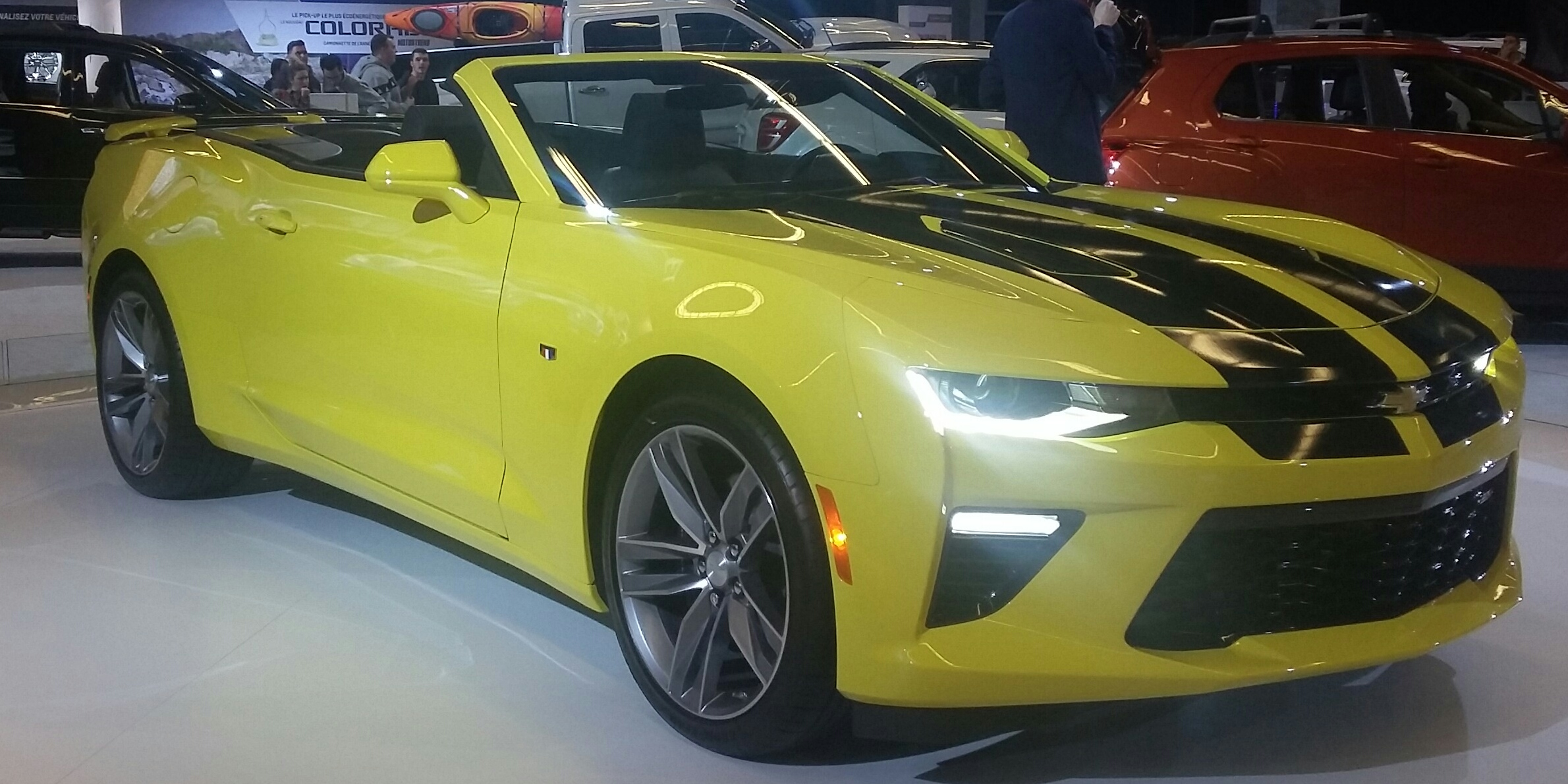
Chevrolet Camaro
"...we took that to a few other local shows and we ended up getting 69 Camaro that we're working on now, that little silhouette picture on the..."
They’re talking about a 1969 Chevrolet Camaro. It’s a classic muscle car from that year, and they’re currently working on it.
They’re working on a 1969 Chevrolet Camaro. The “69” is shorthand for the model year, and it’s a classic first-generation Camaro era.

Chevrolet C10
"hours or dollars, do you think you donated on that C-10? At my labor rate,"
The Chevrolet C10 is a classic pickup truck. People like them because they’re easy to work on and can be restored or modified for different uses.
The Chevrolet C10 is a classic pickup truck from the C/K series, widely known for its simple, customizable platform. The podcast mentions donating and labor rates in the context of a C-10, which points to how these trucks often show up in enthusiast events and projects. It’s a common base for restorations and modifications because parts and knowledge are widely available.
labor rate
"At my labor rate, probably 40 grand worth. Who paid more for that car?"
A “labor rate” is what a shop charges for the time spent doing the work. They’re using their hourly rate to estimate how much the project work would cost.
A “labor rate” is the hourly (or per-job) price a shop charges for the technician’s time. When they say “at my labor rate,” they’re estimating the cost of the work they put into the build.
redoing everything
"...we pretty much ended up redoing everything and that thing has grown into this crazy project."
“Redoing everything” means they didn’t just fix one thing—they basically rebuilt the truck’s setup and appearance from the ground up. That’s why the project can get very expensive.
“Redoing everything” implies a full restoration/customization approach rather than a small repair. That usually means multiple systems and finishes are reworked—parts replacement, reassembly, and re-finishing—so costs and labor add up quickly.
facing the bolts
"...now we're getting into machine in the bolts or facing the bolts, seracoding them."
“Facing the bolts” means they modify/finish the bolt heads so they look neat and uniform. It’s the kind of detail work you do when you want the build to look high-end.
“Facing the bolts” is shop talk for preparing fasteners so they look clean and consistent—often by machining, trimming, or finishing the bolt heads. It’s typically done to improve the visual “fit and finish” on a custom build.
seracoding
"...facing the bolts, seracoding them. So his deal with that car was he wanted everything black..."
“Seracoding” is a coating process that puts a protective finish on metal parts. They’re using it on the hardware so it looks right and resists rust.
“Seracoding” likely refers to a surface-coating process used to protect and finish metal parts, often for a durable, corrosion-resistant black look. In custom builds, it’s commonly used on hardware so bolts and brackets match the overall theme.
everything black
"So his deal with that car was he wanted everything black and I go, everything?"
“Everything black” means the owner wanted the whole truck to have a consistent black look. That affects what gets painted or coated and how details like bolts are finished.
“Everything black” describes a cohesive exterior/interior hardware finish goal—painting or coating many visible components to a uniform black. In custom truck builds, it drives decisions about coatings, trim, and even how fasteners are finished.
flush glass
"We moved the windshield frame down because it's got flush glass, so it lines up with the side windows. Yeah."
“Flush glass” just means the windshield is mounted so it sits nearly even with the car’s body. It’s often done for a cleaner look and to help reduce wind noise.
Flush glass means the windshield is mounted so its outer surface sits nearly even with the surrounding body panels. That alignment is usually done to improve appearance and reduce aerodynamic drag and wind noise compared with more recessed glass.
machine vents
"It's got some machine vents that are actually functional in the rear. It's kind of got a lower valence setup."
“Machine vents” are vents that are made very precisely, usually for a specific purpose. If they’re functional, they actually let air move through the car instead of being only for looks.
“Machine vents” are vents that are cut or fabricated with precision (often CNC-machined) rather than being simple stamped openings. When they’re described as functional, they’re intended to provide real airflow for cooling or ventilation, not just styling.
lower valence setup
"It's kind of got a lower valence setup. You can't see it in that picture because it's so dark, but..."
A valence is a panel near the bottom of the bumper area. When someone says “lower valence setup,” they mean the car has a specific fitted design there to help with airflow and cooling (and sometimes just the look).
A lower valence is the body panel area under the front or rear bumper that helps manage airflow around the car. A “setup” implies the valence has been shaped or fitted as part of the build, often to improve cooling, reduce turbulence, or enhance aerodynamics.
intake
"...we've done some machine work with the intake. He wanted a dual snorkel type intake... To be honest with you, it just looks like a plastic intake, but a lot of work went into that."
The intake is the route air takes to get into the engine. How it’s shaped and built can change how the engine performs.
In this context, “intake” refers to the air path from the intake opening through to where it enters the engine. Intake design affects airflow, throttle response, and how well the engine can breathe under different conditions.
3D scanner
"...and that was before he even had a 3D scanner, so we're plotting points and doing that, but we designed this four-piece intake..."
A 3D scanner is a tool that measures an object and creates a digital copy of its shape. That makes it easier to design new parts that line up correctly.
A 3D scanner captures the shape of a physical object and turns it into a digital model. In custom fabrication, it helps designers measure existing parts accurately and then design components that fit precisely.
welded together
"...but we designed this four-piece intake that I take welded together and everything. It's a little dual snorkel..."
They’re joining the intake parts by welding. That helps make the intake solid and sealed so air can flow where it’s supposed to.
“Welded together” indicates the intake pieces are joined by welding to create a sealed, rigid assembly. For intake manifolds and ducting, welding quality matters because leaks or poor alignment can hurt airflow and drivability.
one-off things
"The fact that you're capable of doing these one-off things to this custom level..."
“One-off things” implies custom, non-standard work—unique fabrication or bespoke modifications that aren’t repeatable like a common repair. In a shop context, that kind of work usually takes more time, planning, and skilled labor.
door and quarter
"It's like, yeah, but it's like door and quarter, and frame needs to be pulled..."
“Door and quarter” refers to body panels on a car: the door skin and the quarter panel (the rear side panel behind the door). Collision repair often involves removing, repairing, or replacing these panels to restore the car’s shape and alignment.
frame needs to be pulled
"...door and quarter, and frame needs to be pulled, and it's really bad, and we're going to do it too nice..."
They’re saying the car’s main structure got bent in the crash. Fixing that usually requires special equipment to pull the frame back into the correct shape.
“Frame needs to be pulled” means the car’s structure is bent and must be realigned using a frame-straightening setup (often with pulling chains/anchors and measurement points). This is common after more serious impacts and is a major driver of repair time and cost.

Cadillac CT6
"about it giving them... It was when CT-6 had just came out,"
The Cadillac CT6 is a luxury sedan, meaning it’s meant to feel more upscale and comfortable than a typical car. The podcast is referring to the time right after it was newly released.
The Cadillac CT6 is a luxury sedan from Cadillac, introduced as a flagship-style offering. The podcast mentions it “when CT-6 had just came out,” which suggests they’re talking about the early days of the model’s release and how it was received or used. It’s discussed because new-model timing often matters for features, ownership experience, and market perception.
rollback
"a bigger Cadillac, and a rollback came and dropped three of them off. Three black, brand new CT-6s,"
A rollback is a tow truck with a platform that lowers to the ground. It’s used to load and move cars that need to be transported.
A rollback is a type of tow truck with a hydraulic bed that can “roll back” to the ground for loading and unloading vehicles. Shops often use rollbacks to move cars that can’t be driven safely or need transport from a dealership or auction.
skirts
"needed these, [2208.4s] needed skirts put on the back of them, right? [2210.5s] That they didn't make skirts. [2211.8s] So we had to, you know, hand-form some aluminum skirts, [2213.9s] make a fasten and paint them, do some other little cool things on it."
“Skirts” here are side panels along the bottom of the car. The shop had to shape aluminum pieces by hand, attach them, and paint them so the vehicle matched the customer’s needs.
In custom bodywork, “skirts” usually means side skirts—panels added along the lower edge of a vehicle’s body. Here, the shop had to hand-form aluminum skirts, then fasten and paint them, to meet a specific requirement from a local funeral home.
diffuser
"And then it was like he wants to put a valance on the back or like a diffuser on the back. But he didn't want, and I just be like, well dude, let's buy like a bumper cover or like some body kit."
A diffuser is a part under the back of the car that helps air move the right way. It can make the car look more performance-oriented, and it can also help with aerodynamics.
A diffuser is an aerodynamic panel (usually at the rear underside) designed to manage airflow under the car. It can improve how the car’s rear end “flows” aerodynamically and is also a common styling cue on performance and custom builds.
valance
"And then it was like he wants to put a valance on the back or like a diffuser on the back. But he didn't want, and I just be like, well dude, let's buy like a bumper cover or like some body kit."
A valance is a decorative panel on the bumper area. People add it to make the car look more custom, and sometimes it also helps the airflow around the car.
A valance is an exterior trim panel—often on the front or rear bumper area—that helps shape airflow and visually “finishes” the bodywork. On custom builds, it’s commonly used to create a more aggressive, integrated look.
body kit
"well dude, let's buy like a bumper cover or like some body kit. Absolutely not. It had to be something that nobody else could have."
A body kit is a collection of exterior parts that change how a car looks. It often includes pieces like bumpers and side panels, and it’s usually sold as a package.
A body kit is a set of aftermarket exterior parts—like bumpers, side skirts, and spoilers—used to change a car’s appearance and sometimes its aerodynamics. The speaker contrasts generic kits with one-off fabrication to keep the build unique.
fabbing
"So dude, we were taking these Mercedes and like fabbing the craziest aluminum,"
“Fabbing” means making parts by hand or building them from materials. In this case, they’re creating custom pieces out of aluminum so the car can be truly one-of-a-kind.
“Fabbing” refers to fabrication—building parts from raw materials or modifying components to fit a specific vehicle. Here, the hosts describe custom metalwork (aluminum) to create unique exterior pieces rather than using mass-produced parts.

Mercedes SUV
"We took whatever the high-end Mercedes SUV was at the time. We took the middle row out at the back seat and moved it to the back row because he wanted more legroom."
They started with a Mercedes-Benz SUV and used it as the platform for the project. Then they changed the inside so there was more room for the people in the back.
They’re describing a build that started with a high-end Mercedes-Benz SUV as the base vehicle. The hosts then modified the interior layout to create more usable space for the customer’s goals.
means to an end
"And at the time, you're kind of like, it's a means to an end, right? All right, we're getting paid obviously."
They mean the work is mainly a stepping stone. The goal is to get to something bigger, not just do the job for its own sake.
In this context, “means to an end” describes treating the job as a step toward a bigger goal rather than enjoying the work for its own sake. It’s about motivation—getting paid now while aiming for a bigger dream later.
hot rod builder
"the dream or the internal mindset or the ego of like, I want to be the big time hot rod builder."
A “hot rod builder” is a person who custom-builds or modifies cars—often older or stripped-down platforms—to make them faster, more stylish, or more personal. The hosts are talking about the mindset/ego of wanting to reach the top tier in that craft.
comebacks
"And you also weren't screwing with a bunch of stuff where like, there was comebacks. Like it was, you built a bumper cover and painted it, got paid and"
“Comebacks” are when a job has to be fixed again after the customer already got it back. It usually means there was a problem with the repair or finish.
In a shop context, “comebacks” are jobs that have to be revisited because something didn’t come out right—like fitment issues, paint problems, or incomplete repairs. They’re costly because they tie up labor and can damage customer trust.
bumper cover
"Like it was, you built a bumper cover and painted it, got paid and Yeah, until some of them are like,"
A bumper cover is the outer “skin” on the front or back bumper. If it gets scratched or damaged, shops can replace it and paint it to match.
A bumper cover is the outer plastic (or composite) panel on a car’s front or rear bumper. It’s often removed for repairs, painted to match the car, and replaced if damaged—separate from the underlying bumper structure.
dash lights
"Dash lights up like a Christmas tree. The yellow ones are always airbags."
Those are the warning lights on the instrument panel. If a bunch of them turn on together, it usually means the car is detecting some kind of problem in its systems.
The dashboard warning lights are part of the car’s instrument cluster and are used to alert the driver to system status or faults. When multiple lights come on at once, it often points to an electrical or sensor issue rather than a single mechanical problem.
Request an Explanation
Heard something you'd like explained? We'll add it to this episode.
Sign in to request explanations for terms you heard.
Want to learn more?
Browse our glossary for plain-English explanations of automotive terms, jargon, and concepts.
Help improve this episode
See something that's not quite right? Our annotations are AI-generated and can sometimes miss the mark. Click the flag icon on any annotation to suggest a correction.