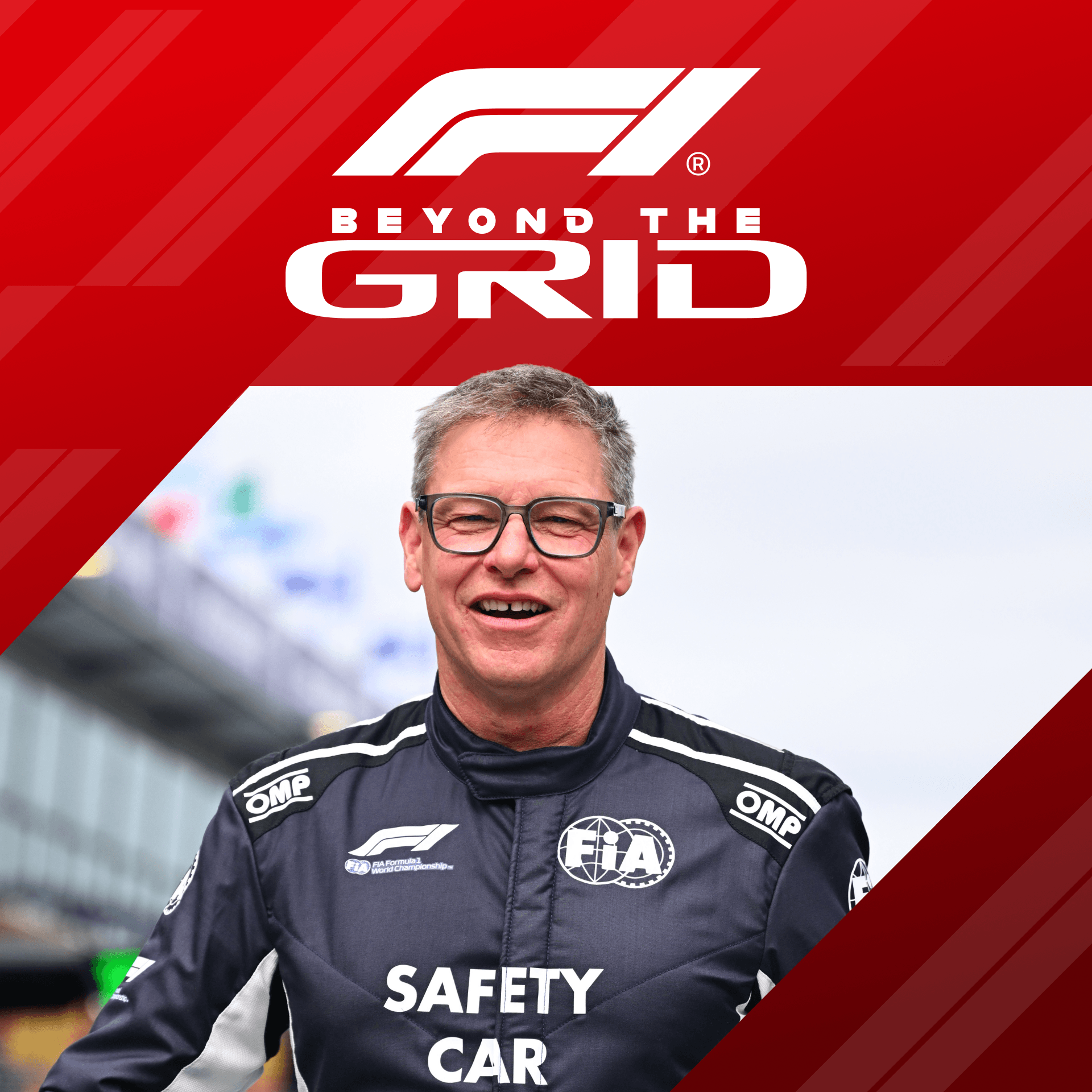
Bernd Maylander: 500 races in the Safety Car
About this episode
Bernd Maylander marks 500 Grand Prix as F1’s FIA safety car driver, reflecting on how the job has evolved since his first stint in 2000. He explains the modern safety car’s rapid AMG GT Black Series performance, the technical and procedural prep behind each weekend, and why he’s only crashed once in 500 races. Memorable moments include Fuji 2007’s relentless wet conditions, Montreal 2011’s long delay and aqua-planning checks, and Brazil 2016’s chaos. Maylander also discusses teamwork with co-driver Richard Darker, radio/GPS improvements, and why drivers still complain—then usually understand.
Speaking to Tom Clarkson, Bernd reflects on how the Safety Car and his job have evolved since his first race back in 2000 and some of the most iconic races he’s been involved in over the last 25 years.
He talks through what a Grand Prix weekend looks like for him, the role his co-driver Richard Darker plays and some of the challenges they face – like picking up the leader when the Safety Car is deployed and judging wet conditions.
Bernd also reveals what it feels like to have the fastest drivers on the planet right behind him and how he handles them complaining about his speed.
This episode is sponsored by:
Liquid I.V. - go to liquidiv.com and get 20% off your first purchase with code GRID at checkout
Saily - get an exclusive 15% discount on your first Saily data plans! Use code grid at
checkout. Download Saily app or go to to https://saily.com/grid
Safety Car
"What are the developments have there been since 2000 that have helped you do your job?"
The Safety Car is used in F1 to slow everyone down when something dangerous happens on the track. Drivers follow it carefully until officials say it’s safe to race normally again.
In Formula 1, the Safety Car is deployed to control the pace of the race when there’s danger on track (like debris or an accident). It neutralizes racing so drivers can follow the car at reduced speed until the track is safe again.
Cadillac
"Cadillac has entered Formula One, deepening the racing pedigree behind every V-series on the road. Discover a lineup that delivers pure adrenaline in the form of modern luxury."
Cadillac is a car brand. In this ad, they’re saying their brand is getting more involved with Formula One racing, and they’re linking that to their performance versions of regular Cadillacs.
Cadillac is a General Motors brand that’s positioning itself as a performance player in Formula One. In the segment, they connect that racing image to their “V-series” lineup, which is Cadillac’s performance-oriented trim family.
Formula One
"Cadillac has entered Formula One, deepening the racing pedigree behind every V-series on the road. Find out more about Cadillac's performance story in Formula One and our race-tested V-series lineup at Cadillac.com."
Formula One is the highest level of car racing in the world. Brands mention it to suggest their cars are inspired by racing know-how, even if your street car isn’t the same as an F1 car.
Formula One (F1) is the top tier of open-wheel motorsport, known for highly engineered race cars and strict technical regulations. When a brand claims an F1 connection, it’s usually about marketing “race-bred” technology and credibility, even if the road cars don’t share many parts directly.
V-series
"Cadillac has entered Formula One, deepening the racing pedigree behind every V-series on the road. Find out more about Cadillac's performance story in Formula One and our race-tested V-series lineup at Cadillac.com."
Cadillac’s “V-series” is their set of performance versions of their cars. It usually means the car is tuned to be quicker and more fun to drive than the regular versions.
Cadillac’s “V-series” is the brand’s performance trim family, used to mark models that are tuned for stronger acceleration, sharper handling, and a more aggressive driving experience. In this segment, Cadillac ties the V-series identity to its claimed Formula One involvement.
Cadillac Lyric V
"Experience the quickest Cadillac ever, the all-electric Lyric V, the peak performance of the CT5V Blackwing, the nimble agility of the OPTIQ V, and the legendary Roar of the Escalade V."
The Cadillac Lyric V is Cadillac’s electric performance model. “V” usually means it’s tuned to feel quicker and more exciting than a regular version of the same car.
The Cadillac Lyric V is presented here as an all-electric “V” model, meaning it’s part of Cadillac’s performance-focused V-series. The “V” branding typically signals sharper tuning and higher performance than standard trims, even when the powertrain is electric.
Cadillac CT5V Blackwing
"Experience the quickest Cadillac ever, the all-electric Lyric V, the peak performance of the CT5V Blackwing, the nimble agility of the OPTIQ V, and the legendary Roar of the Escalade V."
The Cadillac CT5V Blackwing is a high-performance version of the CT5. “Blackwing” is Cadillac’s way of saying it’s the most serious, most exciting performance trim in that lineup.
The Cadillac CT5V Blackwing is a performance version of the CT5, highlighted in the segment as the “peak performance” model. “Blackwing” is Cadillac’s performance sub-brand within the V lineup, historically associated with more aggressive engine tuning and track-oriented character.

Cadillac Lyric
"...ence the quickest Cadillac ever, the all-electric Lyric V, the peak performance of the CT5V Blackwing,"
The Cadillac Lyriq is a luxury SUV that runs on electricity instead of gasoline. It’s meant to deliver a smooth, high-end driving experience while using an electric powertrain. It’s mentioned because it’s one of Cadillac’s electric vehicles and is tied to performance talk.
The Cadillac Lyriq is an all-electric luxury SUV, positioned as a performance-oriented EV within Cadillac’s lineup. It’s significant because it represents Cadillac’s shift to electric power while still targeting comfort and tech-focused driving. In the podcast context, it’s brought up as part of a broader discussion of Cadillac’s quickest or peak-performance models.

Cadillac OPTIQ V
"Experience the quickest Cadillac ever, the all-electric Lyric V, the peak performance of the CT5V Blackwing, the nimble agility of the OPTIQ V, and the legendary Roar of the Escalade V."
The Cadillac OPTIQ V is a sportier version of the OPTIQ. The “V” label usually means it’s tuned to feel more responsive and fun to drive than a regular trim.
The Cadillac OPTIQ V is described as “nimble” within Cadillac’s V-series performance lineup. In general, a “V” trim designation is used to differentiate a sportier setup—typically including more performance-focused tuning and features—than the base model.

Cadillac Escalade
"Experience the quickest Cadillac ever, the all-electric Lyric V, the peak performance of the CT5V Blackwing, the nimble agility of the OPTIQ V, and the legendary Roar of the Escalade V."
The Cadillac Escalade V is the performance version of Cadillac’s big luxury SUV. The “V” label generally means it’s been tuned to feel more powerful and exciting than a standard Escalade.
The Cadillac Escalade V is positioned as the “legendary Roar” model in the V-series lineup. The Escalade is Cadillac’s large luxury SUV, and the “V” variant typically aims to add performance and more aggressive driving feel to an otherwise comfort-focused platform.
restar ts
"Everyone is looking forward for the restarts. If you ask me if I'm still nervous, yes, I am nervous."
A restart is when the race goes back to full speed after the Safety Car. Everyone watches closely because the first few laps after the restart can decide positions fast.
A restart is the moment racing resumes after the Safety Car period ends. Drivers typically anticipate the restart because it’s where gaps can be gained or lost quickly, and tire and brake temperatures can influence how aggressively they can attack.
500 Grand Prix
"Burt Maylander reached a monumental milestone in Melbourne earlier this year, when he completed 500 Grand Prix"
“500 Grand Prix” means 500 F1 race events. It’s a big milestone showing how long someone has been involved in F1.
“500 Grand Prix” refers to the number of F1 races a driver has participated in. In this context, it highlights Burt Maylander’s long career as a Safety Car driver across many race weekends.
Suzuka
"“Well, we're speaking at Suzuka, one of the great racetracks.”"
Suzuka is a famous F1 race track in Japan. It’s known for being tricky to drive, so it really tests how well the car handles and how good the driver is.
Suzuka is one of Formula 1’s most famous circuits, known for its challenging layout and high-speed corners. It’s a track where driver skill and car balance are especially important, which is why it’s a common venue for major F1 moments.
Melbourne, 2026
"“Can we wind it back a couple of races? Because Melbourne, 2026, was a big one for you, wasn't it?”"
Melbourne is where the Australian Grand Prix is held. Saying “Melbourne, 2026” means they’re talking about what happened at that F1 event in the 2026 season.
Melbourne hosts the Australian Grand Prix, a major F1 event that often features unique weather and track conditions. Referencing “Melbourne, 2026” frames the discussion around a specific recent season milestone for the Safety Car driver’s record.
race directors
"My co-drivers, the race directors, the people around me were supporting the job. And that was great."
Race directors are the officials who run the race from the control side. They decide what happens after incidents and help coordinate how the race is managed safely.
Race directors are officials who manage the sporting side of an F1 event, including decisions on incidents, flags, and procedures. They coordinate with the Safety Car operation and ensure the race follows the rules during changing track conditions.
Formula 3000
"So when I originally started 99 in Formula 3000, it was more or less a year to learn the whole procedure."
Formula 3000 was a racing series that many drivers used to get experience before reaching Formula 1. Think of it like a training ground for learning how race weekends work.
Formula 3000 was a feeder series that helped drivers move toward Formula 1. It was a common stepping stone for racers learning racecraft and procedures before stepping into F1.
Melbourne 2000
"And then you arrived in Melbourne 2000, standing on the grid. I recognized still a picture."
Melbourne 2000 is when he came to an F1 race in Melbourne and was actually on the starting grid. It highlights how big and formal race day is in F1.
“Melbourne 2000” refers to Bernd Maylander arriving in Melbourne for the 2000 Formula 1 season and standing on the grid. For listeners, it’s a reminder that F1 grid procedures and race-day routines are highly structured and memorable for drivers.
grid
"standing on the grid... But I was really, really nervous to go on the grid on the Sunday."
The grid is where the cars line up at the start of an F1 race. When you’re on the grid, you’re right before the race starts and everything has to be ready.
The grid is the starting lineup where cars wait in their assigned positions before the race begins. In F1, being “on the grid” means you’re at the exact point where pre-start procedures, timing, and readiness are critical.
shortcut on a track
"Whereas a shortcut, for example, there's a shortcut on a track. If that happens, maybe we can use a shortcut as a race driver and never think about that because that's up to your engineers and to your people around you."
A “shortcut” refers to a section of track where drivers might take a faster line or cut through a different path than the full racing line. The speaker contrasts how a race driver might use it intentionally versus how a Safety Car driver must follow procedures and avoid unpredictable shortcuts.
weather forecast
"...to looking more to the weather forecast for things like that as a race driver. OK, if it's raining, it's raining. But you're not really focused on the weather forecast."
Weather changes how slippery the track is and how well tires work. The forecast helps teams and officials prepare for rain or changing conditions, even though the Safety Car driver isn’t making strategy decisions.
Weather strongly affects grip, braking distances, and tire performance, so teams and officials monitor forecasts to anticipate changes. In the transcript, the Safety Car driver contrasts their focus with a race driver’s attention to weather-related strategy and conditions.
missing racing / scratching the itch
"Did you miss racing? Or does this still scratch that itch for you? Missing racing now with 54, I would say, at the competition sometimes."
They’re talking about how it feels to stop racing full-time and switch to Safety Car driving. Even though it’s different, they still get that competitive, focused feeling.
This segment is about whether the speaker misses racing after focusing on Safety Car duties. It frames Safety Car work as still “racing-adjacent” because it requires intense focus and correct execution on track.

GT3 car
"But sometimes to drive a nice GT3 car, like Max is doing this, for some races, yeah, that would be great."
“GT3” refers to a racing class of cars built to standardized rules for customer teams, not a single specific model. When the host says “a nice GT3 car,” they mean a purpose-built track car used in GT racing series, typically with a race-focused chassis, aero, and safety equipment.
protect something else
"because you have to protect something else. You're still driving a very high performance car, though, aren't you?"
This phrase points to the Safety Car’s primary job: not to race, but to protect people and manage track conditions. The concept is that the car must be capable of high performance while still prioritizing safety and controlled pace.

AMG GT Black Series
"For the last five years, the safety car has been the AMG GT Black Series, hasn't it? ... Yeah, the GT Black Series, it's the quickest safety car ever so far."
The AMG GT Black Series is a very serious, track-focused Mercedes-AMG. In F1, it’s used as the Safety Car, and the point is that it can still drive quickly and confidently even though it’s not racing.
The Mercedes-AMG GT Black Series is a high-performance version of the AMG GT built for track use. In this segment, Bernd Maylander describes it as the current Formula 1 Safety Car and emphasizes its race-track development, strong power output, and ability to stay fast while still serving the Safety Car’s purpose.
730 horsepower
"So we have 730 horsepower, big V8 engine. But the car is so nice drivable on the limits with full downforce."
Horsepower is basically how strong the engine is. The speaker says the Safety Car has a lot of power (730 hp) so it can still keep a strong pace.
Horsepower is a measure of engine power, and the segment cites 730 horsepower for the AMG GT Black Series. In the context of a Safety Car, higher power helps it maintain pace and respond quickly even while not racing.
big V8 engine
"So we have 730 horsepower, big V8 engine. But the car is so nice drivable on the limits with full downforce."
A V8 engine is an engine with eight cylinders. The speaker calls it “big” to emphasize it’s a powerful engine that helps the car feel quick and responsive.
A V8 engine is a configuration with eight cylinders arranged in a “V” shape, typically known for strong power delivery and smoothness. Maylander highlights the AMG GT Black Series having a big V8 to explain why it can be both powerful and controllable on track.
downforce
"But the car is so nice drivable on the limits with full downforce. So this car, you really feel the downforce, great balance."
Downforce is what presses the car toward the road using its shape and wings. More downforce usually means better tire grip, especially at high speed.
Downforce is the aerodynamic force that pushes the car’s tires harder onto the track, improving grip at speed. Maylander connects downforce to stability and “balance,” explaining why the Safety Car can feel like a race car when it’s equipped with the right aero setup.
slick tires
"So it's really driving like a little race car with slick tires. And that helps, for sure, that keeps up your performance."
Slick tires are race tires made for dry conditions, with smooth rubber instead of grooves. They usually provide more grip, which helps the car feel faster and more stable.
Slick tires are race tires with no tread pattern, designed to maximize contact patch and grip on dry track surfaces. Maylander notes that the Safety Car drives “like a little race car with slick tires,” linking tire choice to performance consistency.
trans-axle
"So the basics, front, middle, engine, trans-axle, the balance."
A trans-axle is basically the gearbox plus the rear-drive parts put together in one unit. Putting it in the right place helps the car’s weight distribution, which can make it handle better.
A trans-axle is an integrated gearbox and differential assembly, often packaged at the rear of the car. In racing layouts, it helps with weight distribution and drivetrain efficiency, which affects overall balance and handling.
road tires
"We have to use road tires. So the balance in the end, it's something different."
Road tires are the kind of tires you’d find on regular cars. They don’t grip or behave exactly like race tires, so the car has to be set up differently to stay stable and predictable.
Road tires are tires designed for street use rather than purpose-built slicks or race compounds. Using road tires changes grip levels, heat behavior, and wear, which in turn alters how the car’s balance and braking/acceleration performance work.
Nürburgring
"you've done a lot of racing at the Nurburgring. In fact, one of your first races was at the Nurburgring, right? ... It's a very difficult track. It's difficult to overtake."
The Nürburgring is a legendary race track in Germany. It’s hard to drive fast because the layout is complex and the track is very demanding, so it’s a great place to learn racing skills.
The Nürburgring is a famous German race circuit known for its long lap, elevation changes, and challenging corners. It’s a common proving ground for drivers because it rewards car control and bravery, but it can be unforgiving when you’re learning or pushing limits.
difficult to overtake
"It's pure racing. It's a very difficult track. It's difficult to overtake. So you need a lot of passion sometimes to get the right moment to overtake someone..."
“Difficult to overtake” highlights how track design and racing conditions affect passing opportunities. At circuits like the Nürburgring, limited straight-line braking zones and heavy traffic can make it hard to get alongside without losing too much speed.
in-car
"especially in the GT3 cars. I saw some of the in-car from his race the other day. It's fantastic. The way he was carving through the traffic."
“In-car” means you’re watching from the driver’s perspective inside the race car. It helps you see exactly how they line up, brake, and pass other cars.
“In-car” footage is camera video captured from inside the race car, typically showing the driver’s view of braking points, steering inputs, and traffic. It’s especially useful for understanding how a driver threads through slower cars without losing momentum.
carving through the traffic
"It's fantastic. The way he was carving through the traffic."
“Carving through the traffic” means the driver is passing and navigating around slower cars smoothly. Doing it well helps them keep their speed and avoid wasting time.
“Carving through the traffic” describes efficient driving through slower cars—choosing the right gaps, maintaining speed, and minimizing time lost. In racing, this is often as important as outright pace because traffic can decide your finishing position.
perfect lap
"You're always, you're looking for the perfect lap up there. And then you think, OK, even if you're on pole position, you know, OK, maybe there's still a half a 10 or something."
A “perfect lap” means you drive the track in the best possible way from start to finish. You brake, turn, and accelerate at the right times so you don’t lose speed anywhere.
A “perfect lap” is the idea of hitting every braking point, apex, and throttle application exactly right so the car stays in the best possible speed range through each corner. In racing, it’s less about one fast moment and more about the whole lap being optimized and consistent.
pole position
"And then you think, OK, even if you're on pole position, you know, OK, maybe there's still a half a 10 or something."
Pole position is where you start the race from the very front. It’s earned by being fastest in qualifying, but you can still be beaten during the race.
Pole position is the starting spot on the grid closest to the front, awarded to the fastest qualifier. It’s a big advantage because it helps you control the start and avoid traffic, but it doesn’t guarantee the fastest race pace or the best lap time.
more than 20 kilometers
"And because the track is more than 20 kilometers, only the Notch Life."
The track is over 20 kilometers long, so a lap takes a long time and covers lots of different corners. Because it’s so long, it’s harder to get a completely clear, uninterrupted lap.
The Nürburgring Nordschleife is famously long—over 20 kilometers—so a single lap involves many different sections and corner types. That length increases the chance of encountering slower cars, changing conditions, and “imperfect” timing for your best lap attempt.
Mercedes safety car supplier
"Now we've discussed the Black Series but since Mercedes got involved as the safety car supplier, they've had 13 different cars."
In F1, the Safety Car comes out when there’s danger on track, so everyone slows down safely. Mercedes-Benz has supplied the Safety Car for a long time, and over the years they’ve used different Mercedes cars for that role.
In Formula 1, the Safety Car is deployed to control the pace during hazards, and the supplier provides the specific car(s) used. When the host says Mercedes became the safety car supplier, they’re referring to Mercedes-Benz supplying the F1 Safety Car fleet over multiple seasons and updates.
DTM ITC
"I was racing for Mercedes at that time as a junior in DTM ITC and I get a phone call on a, I think it was a Monday or Tuesday morning"
DTM ITC is a touring-car racing series in Germany that Mercedes drivers competed in. The guest is using it to explain his early career path with Mercedes.
DTM ITC refers to the Deutsche Tourenwagen Masters (DTM) era and the ITC (International Touring Car) branding used in that period. The guest mentions racing there as a junior for Mercedes, providing context for his relationship with the brand before F1-era roles.
Monaco Grand Prix
"I get a phone call on a, I think it was a Monday or Tuesday morning after the Monaco Grand Prix, I was home."
The Monaco Grand Prix is a major Formula 1 race in Monaco, famous for being on narrow streets. In this story, it’s just used to say “right after that race,” when the call happened.
The Monaco Grand Prix is one of F1’s most famous races, held on the tight streets of Monaco where barriers and slow corners make incidents more likely. It’s referenced here as the timing point for when the host received a call about the Safety Car’s mileage.
kilometers on the car
"Norbert Tauk, assistant, he called me and said, Burnt, how many kilometers you have on your car? And I said, why are you asking me this question?"
Mileage on a race or support car matters because it correlates with wear items like brakes, tires, cooling components, and drivetrain stress. In a Safety Car context, teams track accumulated kilometers to manage maintenance schedules and ensure reliability.
French Grand Prix
"on Formula One from the French Grand Prix afterwards... A lap of mainly cool, you say the French Grand Prix,"
The French Grand Prix is a Formula 1 race used here as the reference point for when the Safety Car change happened. In F1, specific races often mark operational milestones like new procedures or vehicles entering service. The speaker connects his personal story to that event.
0-60 time
"And just give us an idea of how much quicker the Black Series is compared to that... how much quicker would you be now than back then?"
They’re talking about how much quicker one car is than another. In racing, the easiest way to measure that is usually lap time, because it reflects the whole driving experience—speed, braking, and cornering.
The guest compares how much faster the current Safety Car (the Black Series) is versus the earlier one by referencing lap-time differences. While not literally a 0–60 measurement, the idea is the same: quantifying performance change in a way listeners can grasp. In racing, lap time is the practical metric that reflects acceleration, braking, and cornering together.
280 horsepower
"It was the quickest, most sporty car, the C36 with 280 horsepower, I guess, at that time."
Horsepower is how much power the engine can make. More horsepower usually helps the car accelerate harder, especially on straight sections. But lap time also depends on grip, braking, and how well the car handles corners.
Horsepower is a measure of engine power output, and it strongly influences acceleration and overall performance. When the guest says the C36 had about 280 horsepower “at that time,” they’re giving context for why it was already considered very quick. In racing terms, power helps on straights, but lap time also depends heavily on tires, aerodynamics, and braking.
V6 engine
"So that was very powerful, V6 engine."
A V6 engine is an engine with six cylinders arranged in a V shape. It’s a common setup in performance cars because it can feel smooth while still making strong power. Here, it’s part of why the car was considered very powerful for its time.
A V6 engine has six cylinders arranged in a “V” configuration, which can provide a good balance of smoothness and performance. In the context of the Mercedes-AMG C36, the V6 layout helps explain the car’s power delivery and character for that era. Engine configuration matters because it affects weight distribution, packaging, and how the car responds under load.
double turbo
"But now we have a V8 engine, double turbo, 730 horsepower, flat grand shift."
A turbocharger packs extra air into the engine so it can make more power. “Double turbo” means there are two turbo units working to help the engine feel stronger.
“Double turbo” means the engine uses two turbochargers to force more air into the cylinders. This can improve responsiveness and peak power, especially across different engine speeds.
flat grand shift
"But now we have a V8 engine, double turbo, 730 horsepower, flat grand shift. So it's completely different."
This sounds like a description of how the car changes gears. The goal is usually to keep acceleration feeling smooth instead of jerky.
“Flat grand shift” appears to refer to a transmission/gearshift characteristic that keeps the power delivery feeling flat and consistent. In racing terms, it’s about how quickly and smoothly the car transitions between gears under load.

Ferrari F40
"And for sure, there are still some very special cars, I would say, like a Ferrari F40. This is an outstanding car in the 80s."
The Ferrari F40 is a famous supercar from the 1980s. People love it because it’s a very “real” driving experience—more hardcore than many modern cars.
The Ferrari F40 is a legendary 1980s supercar known for being a raw, driver-focused machine. When Maylander calls it “outstanding,” he’s pointing to how certain cars became milestones in their era—especially in how they felt fast and special.
Aston Martin
"but of course, Aston Martin was supplying the safety car for five years as well. Tell us about that period."
Aston Martin is the car company that supplied the F1 Safety Car for several years. That’s the car that leads the race at reduced speed when there’s an incident on track.
Aston Martin is discussed as the supplier of the Formula 1 Safety Car for five years. Maylander also describes his first real contact with the brand and notes the iconic styling/color association fans remember.
Italian Grand Prix at Monza
"One of the scariest things I've seen recently on the TV came in 2024 at the Italian Grand Prix at Monza. I think you know where I'm going with this. But we saw you in the barriers at the Parabolico."
Monza is famous for being extremely fast, with big speeds and hard braking. That’s why an accident there can be especially scary compared with slower tracks.
The Italian Grand Prix at Monza is one of Formula 1’s fastest and most high-energy circuits, known for long straights and heavy braking zones. Maylander’s story centers on an incident there, which is why the track context matters for understanding how serious the situation became.
Parabolico
"But we saw you in the barriers at the Parabolico. What happened? How scary was it?"
Parabolica is a key corner at Monza that drivers take very fast. If something goes wrong there—like braking or grip—you can end up hitting the barriers hard.
The Parabolica is the famous high-speed corner at Monza where cars brake hard and turn into a long, sweeping right-hander. Because it’s taken at significant speed, mistakes or mechanical issues can lead to very violent impacts with barriers.
brake issue
"What happens in the end? We had a brake issue. We find out immediately after the test"
A brake issue means the car didn’t slow down the way it should. In a race, that can be dangerous because you rely on brakes to make corners safely.
A “brake issue” means a problem with the braking system that can prevent the driver from slowing the car as intended. In racing, even a partial loss of braking can quickly turn a manageable situation into a barrier impact, especially at a track like Monza.
brake system
"And luckily, it was not a system failure of the brake system. So we could be sure that the brake will work in the future."
A brake system is everything that makes the car slow down—pads, rotors, hydraulics, and related controls. If it fails, you can’t slow down or stop safely, so drivers have to treat it as a major risk.
They’re talking about the car’s brake system as a whole, and specifically whether the issue was a mechanical/system failure versus something else. In racing, knowing the brakes are healthy is crucial because it affects confidence and safety under high loads.
working on the limit
"And yeah, it was a crash that can happen in racing because you're working on sometimes on the limit, especially on the track test."
It means driving as hard as the car can handle. At that point, the car is close to losing grip, so crashes are more likely if something goes wrong.
“Working on the limit” means pushing the car and driver to the edge of grip and performance during testing. That’s when mistakes or unexpected conditions are most likely, but it’s also how drivers calibrate their braking, turn-in, and traction for race pace.
no brakes
"If you think about with 270, no brakes. It's not really nice... I just tried to bring the car in a rotation to reduce the speed because if you have no brakes... you will go straight into the barrier."
“No brakes” means the car can’t slow down when you need to. You might still be able to steer, but if you can’t reduce speed, you can’t make the corner and you may hit the wall.
“No brakes” describes a worst-case scenario where the car can’t slow down normally, forcing the driver to rely on steering and car rotation to manage impact. The key point is that while you can still turn in, without braking you often can’t control speed into the corner, so the car can run straight into the barrier.
barrier
"500 races was the only time that they hit a barrier. And that was a big one... you will go straight into the barrier."
A barrier is the wall or crash protection along the track. It’s there to help stop the car safely if you lose control or can’t slow down.
The barrier is the track’s impact protection system designed to absorb crash energy and reduce the chance of a car penetrating further into the circuit. When drivers say they “hit a barrier,” it usually means the crash was severe enough that the car’s speed and trajectory couldn’t be corrected.
bring the car in a rotation
"I just tried to bring the car in a rotation to reduce the speed because if you have no brakes... nothing will happen... So you will go straight into the barrier."
This means the driver tries to make the car rotate (like starting a controlled skid) to slow down using tire grip. It’s a last-resort maneuver when braking isn’t available.
Bringing the car into a rotation is a driver technique to change the car’s direction and attitude so it scrubs speed rather than continuing straight. In a no-brakes situation, inducing rotation can help reduce impact energy, but it requires precise control to avoid worsening the crash.
standby situation
"it starts with the standby situation. So he's usually pressing the button, standby, reporting to race control."
“Standby” here means being on alert and ready to act immediately if something happens. The team is basically waiting for the next update and then relaying it fast.
A “standby” phase in F1 communications is when the co-driver is ready to relay information and coordinate with race control as soon as an incident occurs. It’s part of the structured workflow that helps the driver stay informed during neutralized periods like Safety Car operations.
race control
"So he's usually pressing the button, standby, reporting to race control. I'm listening to everything."
Race control is the F1 headquarters that runs the race. When there’s an accident or rule-related situation, they decide what happens next and tell the teams.
Race control is F1’s central command that monitors the race, manages incidents, and issues official instructions (like Safety Car deployments and restart procedures). Drivers and their teams receive key updates through communication channels managed by race control.
turn three accident
"For example, a turn three accident,"
This means a crash happened at a particular corner of the track—“turn three.” Where the crash is matters because it affects how dangerous the track is and how long the race needs to slow down.
“Turn three” refers to a specific corner on the circuit, and an “accident” there is an incident localized to that section of track. In F1, the exact location matters because it determines how quickly marshals can clear the scene and what safety measures (like Safety Car or red flags) are needed.
safety procedure
"So that's just for safety procedure... But it's good to have kind of a safety backup for your information."
A safety procedure is the official way teams and drivers handle an unsafe situation. It includes double-checking details (like where debris is) so the right information gets to the right people quickly.
A safety procedure is the agreed set of actions and communication steps used during incidents to keep everyone safe and informed. Here, the driver’s uncertainty about left vs right is resolved through backup reporting so the correct information is relayed without distracting race control.
track test on a Thursday
"You mentioned the track test on a Thursday earlier. Can you now talk us through what a Grand Prix weekend looks like for you?"
The Thursday track test is an early on-track session before the main weekend action. It helps the team and driver get the car and track understanding dialed in.
The “Thursday track test” refers to an additional on-track activity that happens before the main Friday/Saturday/Sunday rhythm of practice and qualifying. In modern F1, these sessions help teams validate setup and systems, especially as procedures evolve over time.
Grand Prix weekend
"Tell us about that track test on a Thursday. What happens on a Friday, Saturday and Sunday?"
A Grand Prix weekend is the whole multi-day event leading up to the race. It includes practice, qualifying, and the race, plus extra preparation like checking the track before cars go out.
A Grand Prix weekend is the full event schedule around an F1 race, typically spanning practice sessions, qualifying, and the race itself. Drivers also do preparation work like track walks and testing to understand grip, surface condition, and any changes to the circuit.
COVID changed procedures
"I have to say, since COVID more or less changed a lot. From the beginning onwards, from 2000 to now, the procedures are kind of the same"
He says COVID changed how the weekend is organized. Even though the race weekend still has the same basic steps, the rules and process around it became different.
Bernd Maylander notes that COVID-era changes altered how F1 weekends are run, even if the core structure stayed similar. This highlights how logistics, testing, and operational procedures can evolve due to health and safety requirements.
track walk
"So I'm arriving Wednesday evening at the hotel... The track walk where we analyze the track, where we look if the track is fully in shape"
A track walk is when the driver goes around the circuit on foot to look at it closely. They’re checking things like where the track might be rough or changed, so they can plan how to drive.
A track walk is when the driver (and team) walk the circuit to inspect it on foot and note details that matter for driving lines and braking points. It’s especially useful for spotting surface issues, repairs, or changes that may not be obvious from the pit lane.
braking point
"to find out where's the limit, how to drive every corner, where's the braking point and things like that."
The braking point is where you start slowing down before a turn. If you brake too early or too late, the car won’t turn in as well and you’ll lose time.
A braking point is the specific spot on the track where a driver begins braking for a corner. Finding the right braking point is crucial because it affects corner entry speed, tire load, and overall lap time consistency.
timing, TV
"But we're also testing all the technical things, timing, TV. So Formula 1 is really involved to set up the right places for the cameras."
“Timing” is how the race measures laps and positions accurately. “TV” is about setting up cameras so the broadcast matches what’s happening on track.
In F1, “timing” refers to the official lap timing and scoring system that tracks each car’s performance lap-by-lap. “TV” setup involves camera placement and broadcast timing, which must align with the race action.
Thursday afternoon
"Because Thursday is the day before Friday. And from Friday morning onwards, everything has to work in a perfect way... And that's what we are testing on a Thursday afternoon."
They’re talking about how Thursday is used to get everything ready so Friday can run without problems. By then, the cars are on track and the systems have to work perfectly.
This segment highlights the weekend schedule logic: Thursday testing and technical validation set up Friday and beyond. The key idea is that timing and operational systems must be fully reliable before cars and sessions begin.
FIA
"FIA-wise, we are practicing different procedures because now in the modern Formula 1, we have different procedures for our red flag, for our restart..."
The FIA is the organization that sets the rules for motorsport. In F1, it influences how things like race stoppages and restarts are handled.
The FIA (Fédération Internationale de l’Automobile) is motorsport’s governing body that sets many of the rules and procedures used in Formula 1. In this segment, it’s referenced in the context of practicing different procedures under FIA regulations.
standing start
"we have different procedures for our red flag, for our restart, for a standing start, for a rolling start."
A standing start means the cars are stopped on the grid and then launch from zero when the race begins. It’s a different kind of start than rolling, so drivers and teams practice it.
A standing start is when cars are stationary on the grid and accelerate from rest when the start is given. It changes launch technique and clutch/traction management compared with rolling starts, and it’s one reason teams practice multiple start procedures.
rolling start
"we have different procedures for our red flag, for our restart, for a standing start, for a rolling start."
A rolling start means the cars are moving as they line up, and then the race begins when the signal comes. Drivers have to keep the right distance and be ready to accelerate at the right moment.
A rolling start is when cars are already moving (typically behind a pace vehicle) before the start is signaled. Drivers must manage spacing and throttle control during the transition, and race control’s procedure dictates exactly when racing begins.
boarded start
"That's our procedure, what we always playing in different procedures, a boarded start, so many different things that we are practicing."
This sounds like a special kind of start procedure used for practice. The exact meaning isn’t fully clear from the wording here, but it’s about how the cars line up and get ready to go.
“Boarded start” appears to refer to a specific start procedure variant used in F1 practice, likely involving a controlled formation or instruction phase before the start. Because the transcript wording is unclear, it’s best treated as a procedural term rather than a standard public F1 category.
medical car
"During the track test on a Thursday, it's the safety car and the medical car. You're both out there."
The medical car is there so medical staff can get to an incident fast. During certain track situations, it can be out on track too, so drivers have to be extra careful.
The medical car is the vehicle used to reach the scene quickly and coordinate medical response during incidents. In F1 procedures, it can be on track during safety-related periods, and its presence affects how drivers manage risk and speed.
going on the limit
"And for sure, you're going on the limit. Let's say on that track test, if I have a free lap, you're bringing the car really on the limit."
“Going on the limit” means driving as hard as the car can safely handle. At that point, the tires are working near their maximum grip, so the car can start to slide or feel unstable if you push too far.
“Going on the limit” means driving at the edge of tire grip and vehicle control—where small mistakes can cause loss of traction or instability. In racing, this is tightly managed because the car’s behavior changes with track grip, temperature, and surface condition.
free lap
"Let's say on that track test, if I have a free lap, you're bringing the car really on the limit."
A “free lap” is when you have open track ahead, so you can drive as fast as possible without getting blocked by other cars. It’s the best chance to see what the car can really do.
A “free lap” is a lap where a driver has clear track space and isn’t constrained by traffic, allowing them to push for maximum performance. In testing or practice, it’s a key moment to evaluate the car’s true pace at the limit.
track grip level
"Usually you don't have that grip level then on a Friday or Saturday or even on a Sunday because the track conditions improved"
“Grip level” is how much the tires can stick to the road. If the track has more grip, you can drive harder with more confidence; if it has less grip, the car slides more easily.
Grip level refers to how much traction the tires can generate from the track surface. In F1, grip often changes over a weekend due to rubbering-in, weather, and temperature, which is why drivers may feel the car is easier or harder to push on different days.
track improves during that
"And for sure, on Thursday, maybe you start in the beginning of the track test two seconds slower than to the end because the track improves during that."
As more cars drive on the track, they lay down rubber that makes the surface stickier. So the track can feel faster and safer later in the session than it did at the beginning.
Race tracks often get faster over a session because rubber laid down increases grip and smooths the racing line. That’s why lap times can be quicker later than at the start of a test or practice.
keep the car on the limit
"But you always try to keep the car on the limit. Because I think one of the great misunderstandings about the safety car..."
Keeping the car on the limit means you’re driving as fast as the tires and grip will allow without spinning or sliding. It’s a careful balance—go a little too far and the car starts to lose control.
“On the limit” means driving at the edge of available grip, where the car is close to losing traction or stability. In F1, that balance changes constantly with tire temperature, fuel load, and track conditions.
debris in turn four
"Let's say if there is a lot of debris in turn four, there are marshals on the track."
If something is left on the track—like broken parts or loose debris—cars can hit it or get upset trying to avoid it. That’s why officials slow everyone down and manage the danger.
Debris on track is a common trigger for Safety Car deployment because it can damage cars or cause loss of control. The mention of a specific corner (turn four) highlights how localized hazards can affect the whole field’s pace.
marshals on the track
"Let's say if there is a lot of debris in turn four, there are marshals on the track."
Marshals are the officials who help when something goes wrong on track. If they’re out there dealing with an issue, it usually means the race has to be slowed for safety.
Track marshals are responsible for responding to incidents, such as clearing debris and assisting with recovery. Their presence indicates an active safety response, which typically requires controlled racing conditions.
track is clear when clean / passing this area
"OK, we have to give them time that the track is clear when clean, when we're passing this area. So we are not driving flat out."
They’re talking about making sure the dangerous part of the track is actually safe before going faster again. There are specific areas where drivers have to be extra careful. Once officials say it’s clear, the pace can increase.
This describes the operational requirement that the track be declared safe before drivers can return to higher speed. “Passing this area” implies there are specific sections where conditions are controlled and drivers must follow guidance until the danger zone is cleared. It’s a key part of how Safety Car procedures maintain safety.
not driving flat out / driving slower (200 to 120)
"So we are not driving flat out. For sure we're driving slower. Instead of 200, we're just going for 120."
During a Safety Car period, you can’t drive at full racing speed. The example “200 to 120” shows how much slower the cars have to go. That changes how you accelerate and how much room you need around other cars.
The speaker contrasts racing pace with Safety Car pace, emphasizing that drivers must reduce speed significantly during caution periods. The “200 to 120” example illustrates how braking and throttle behavior change to maintain safe spacing and control. It also affects how quickly drivers can respond once the track is cleared.
pressing the button
"...the drivers when they're pressing the button are the safety cars driving so slow. They don't have this information. We have it and we guide the drivers through this area and safely, that's my job."
This sounds like a specific action the Safety Car driver takes to trigger or communicate what’s happening on track. The key idea is that it helps coordinate when drivers should slow down and when they can start building speed again. It’s not just “driving slow”—it’s controlled signaling.
The phrase refers to the procedure where the Safety Car driver activates a system/communication to indicate or manage safety-car phases and pace. In practice, it’s about signaling the right timing and instructions so drivers know when to slow down or prepare to accelerate. It highlights how tightly choreographed Safety Car operations are.
leading car loses advantage
"And definitely the leading car is the most affected car because he loses advantage. He's the leader still from the pack, but still they're looking for their own performance..."
When the Safety Car is deployed, everyone slows down together, so the leader’s gap can disappear. Even if you’re still in front, you may lose the advantage you built. That’s why Safety Car moments can completely change the race.
When the Safety Car comes out, the race pace drops and gaps between cars can shrink quickly. That means the leading car can lose track position/advantage even though it’s still “the leader.” This is why Safety Car timing is so strategically important in F1.
tire temperatures
"[1999.9s] even I was saying, why is he driving that slow? [2002.7s] I have to keep to watch for my tire temperatures [2006.0s] to be in the right performance."
Tires work best in a certain temperature range. If they get too cold—like when you’re driving slowly under the Safety Car—they can grip less, so drivers watch their tire temps.
Tire temperatures are critical in racing because they determine grip and how quickly the tires respond to steering and throttle. Under Safety Car conditions, drivers often manage temps to avoid going too cold, since cold tires can reduce performance when racing resumes.
race driver job
"[2006.0s] to be in the right performance. [2007.4s] That's what a driver, what's the job of a race driver?"
The “job of a race driver” includes managing the car within changing track conditions—especially during Safety Car periods. That means balancing pace, communication, and tire/brake temperature targets so the car is ready to perform when the race goes back to full speed.
Energy saving (don't want to use the battery)
"No, because they don't want to use the battery, let's say on a long straight, I want to save energy. And that means you're driving a little bit slower."
F1 cars can store energy in a battery and use it later for extra power. If the driver uses too much of that battery energy too early, they may not have enough when it matters, so they sometimes go a bit slower to save it.
Modern F1 cars use hybrid power, where part of the performance comes from energy stored in a battery. Drivers manage battery energy to avoid exhausting it at the wrong time, which can mean driving slower on long straights to preserve usable energy.
long straight energy management
"No, because they don't want to use the battery, let's say on a long straight, I want to save energy. And that means you're driving a little bit slower."
On a long straight, it’s tempting to go flat out, but hybrid energy is limited. Drivers often pace themselves so they still have extra power when they need it later.
Energy management on long straights is about balancing speed with the hybrid system’s limited stored energy. If the driver spends too much battery power early, they may have less available later for acceleration zones or overtaking opportunities.
Vegas
"For example, in Vegas, we could go up to 300. That's the longest straight. That's the quickest track by high speed."
“Vegas” is the Las Vegas F1 track. Because it has long straight sections, it’s a place where drivers think carefully about how much power/energy to use.
“Vegas” refers to the Las Vegas Grand Prix circuit, known for long high-speed sections and a notably long straight. That track layout influences how much energy drivers want to spend versus save, especially under different race conditions.
lap cars
"when you come out of the pits, particularly late on in the race, if there are lap cars and things like that?"
Lap cars are cars that are not on the same lap as the leader. When the Safety Car is out, these cars can make it confusing to know who’s actually leading and where you should go.
“Lap cars” are cars that are on a different lap count than the leader, meaning they’re either ahead or behind the main battle. During Safety Car restarts or pit cycles, they can complicate who is effectively “in front,” because the leader may be temporarily obscured by traffic.
pit stop strategy
"But if they're going for a pit stop, if they're on a different strategy than many other cars, maybe it's not a leader anymore. And I get guided."
Pit stop strategy is when teams decide to come in for service and tire changes. Under Safety Car, timing matters even more, because different teams may pit at different times and the order can get confusing.
Pit stop strategy is how teams plan when to pit and what to do (like changing tires) to gain track position and manage tire wear. Under Safety Car conditions, different strategies can mean the “leader” on track isn’t the same as the leader in race control, making the timing especially tricky.
changing tires
"it starts to rain and they're changing tires. That's quite tricky moments, but that's the challenge."
Changing tires means swapping to a different set of tires, usually because the track conditions changed. If it starts raining, teams may switch to tires that work better on wet roads.
Tire changes are a core part of F1 strategy, especially when weather shifts. When it starts to rain, teams often switch to wet-weather or intermediate tires, and the timing can be critical during Safety Car periods and pit windows.
read a race
"And that's why you really have to understand and to read a race. And if you're really in that flow, you get the point"
“Reading a race” refers to interpreting evolving race conditions—traffic, pit timing, tire state, and Safety Car effects—to choose the correct move. It’s a skill of anticipating how race control and other teams’ strategies will play out in real time.
from 1993 onwards, it was in the rules
"And from 1993 onwards, it was in the rules. So it was really written down what is the safety car, what is the procedure, what you have to do, in which situation."
The speaker says that starting in 1993, the Safety Car became an official part of the rules. That means everyone—drivers, teams, and officials—knows exactly how it should work. It helps prevent confusion and makes race control more consistent.
This points to a regulatory milestone: starting in 1993, the Safety Car and its operating rules were formally included in the F1 rulebook. When safety systems become rule-based, teams can plan around them and drivers learn consistent behaviors. That reduces confusion and improves both safety and race management.
adapt the positive and important things for the next generation and for the next rules
"you're learning every race, you're learning every year and you adapt the positive and important things for the next generation and for the next rules."
They’re describing how F1 improves over time by learning from what happens on track. If something doesn’t work well—like how the Safety Car is handled—officials can change the rules. Over many races, the system gets better and more consistent.
This is about iterative rulemaking: F1 learns from each race and season, then updates procedures and regulations to improve safety and competition. Safety Car handling is a good example because real-world incidents reveal where guidance is unclear or incomplete. Over time, that feedback loop leads to more standardized and safer race operations.
ambulances
"I think the medical car was always a part of it. Let's say ambulances, I think."
Ambulances are the vehicles used to transport and treat injured people after crashes. The speaker is pointing out that, before the more formal F1 medical setup, emergency response likely relied more on standard ambulance procedures. Over time, F1’s approach became more organized.
The speaker mentions ambulances as part of the early medical response ecosystem around F1 incidents. This highlights how trackside emergency care evolved over time, moving from general ambulance support toward more specialized F1 medical coordination.
Sid Watkins
"I think since 1994, we all know who is Sid Watkins in raising what he has done. ... from 93 onwards when we had big accidents and Sid's job and also the safety and medical stuff"
Sid Watkins was an important medical person in Formula One. He helped push for better crash response and medical procedures so drivers could be treated faster and more safely. The host is saying his work became especially influential in the early 1990s.
Sid Watkins was a key medical figure in Formula One, widely associated with improving on-track medical care and emergency response. The speaker credits Watkins’ role with making medical and safety procedures more prominent from the early 1990s onward, especially after major accidents.
medical department
"And that's why we created also the safety department and the medical department to have more power to develop quicker, to develop better together"
The “medical department” refers to the formalization and empowerment of medical operations within F1’s safety structure. Creating a dedicated medical department is about improving coordination, response speed, and how medical planning works with other stakeholders like teams and the FIA.
safety department
"And that's why we created also the safety department and the medical department to have more power to develop quicker, to develop better together with everyone who's involved in Formula One."
The safety department is a dedicated group focused on improving how F1 keeps people safe. After serious crashes, they use what they learn to make changes. Here, the speaker says it became more effective once it had more authority and worked closely with teams.
The “safety department” is part of how F1 institutionalized safety improvements—turning lessons learned from incidents into structured development. In this segment, it’s linked to gaining “more power” to develop better safety measures in collaboration with teams.
Immola 1994
"Do you think the tragic events of Immola 1994 accelerated the need for a safety car? Absolutely."
“Immola 1994” is about a serious tragedy at Imola in 1994. The hosts are discussing how that pushed F1 to improve safety rules, including using a Safety Car.
“Immola 1994” refers to a major tragic incident at Imola in 1994 that influenced how F1 approached safety. The discussion connects that event to the acceleration of safety measures like the Safety Car system.
Oliver Gavin
"It was at that time, it was Oliver Gavin. Oliver Gavin is a former race driver, a very good GT driver and he did this from 96 to 99."
Oliver Gavin is the person the host says was the Safety Car driver for a stretch of years. They’re using his experience to explain why consistency and professionalism improved safety procedures.
Oliver Gavin is named as the Safety Car driver starting in the mid-1990s. The episode uses his career background to explain why having a consistent, professional driver mattered for Safety Car operations.
Request an Explanation
Heard something you'd like explained? We'll add it to this episode.
Sign in to request explanations for terms you heard.
Want to learn more?
Browse our glossary for plain-English explanations of automotive terms, jargon, and concepts.
Help improve this episode
See something that's not quite right? Our annotations are AI-generated and can sometimes miss the mark. Click the flag icon on any annotation to suggest a correction.