The Volvo EX30 is a small electric Volvo. It’s being talked about because where it’s built and how it’s imported can change the cost and whether buyers qualify for incentives.
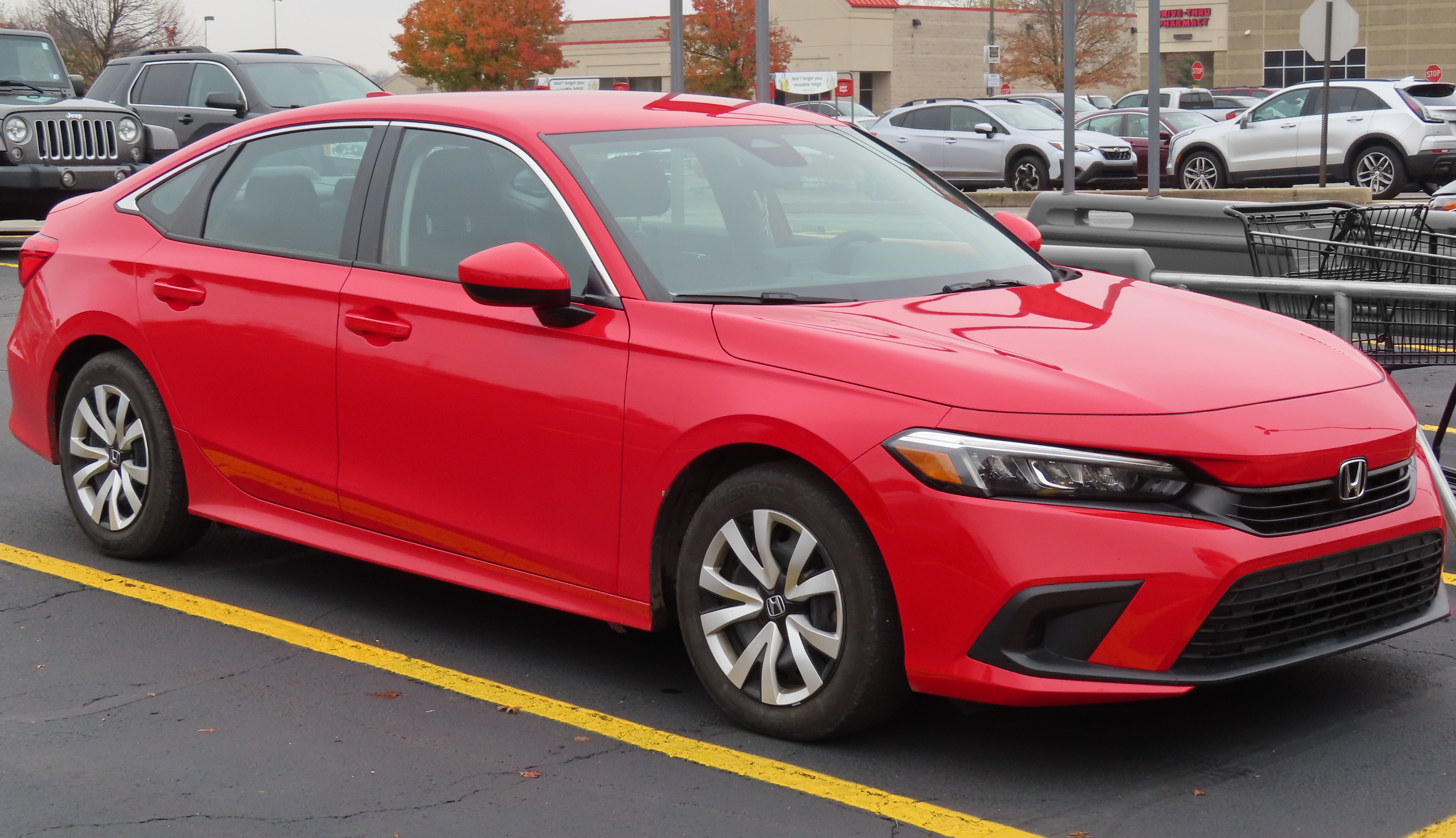
The Honda Civic is a common, affordable compact car. People like it because it’s easy to find and fix, and some versions are available with a manual transmission.
A manual transmission is the “stick shift” where you use a clutch pedal and choose the gears yourself. Some drivers like it because it feels more connected to how the car drives.
They’re talking about a 2016 Mazda 3 hatchback they bought new, and it had a manual gearbox. They’re using it to explain why newer manuals can be easier to live with day to day.
The clutch is what you press to shift gears in a manual car. They’re saying hill start assist helps you avoid having to juggle the clutch and parking brake on hills.
The handbrake is the parking brake you pull to keep the car from rolling. They’re saying you used to rely on it more with older manuals, but newer tech can reduce that need.
The Civic Type R is Honda’s high-performance version of the Civic. When roads are wet, the tires and traction system decide how much grip it has, so it can spin wheels more easily.
Many modern cars have their own built-in “cellular” connection. That’s how the car can send data and use online features, even when you’re not using your phone.
Warranty data comes from repairs that were covered by the carmaker’s warranty. It’s often the best clue to how frequently problems happen, but companies may not share all of it publicly.
Sony is known for electronics and PlayStation. The point here is that even if Sony helps with money and branding, that doesn’t mean they already have the car-specific know-how—especially for EV batteries.
They bring up Hyundai because it’s one of the brands selling a reasonable number of EVs. It’s part of the discussion about whether EV sales will keep growing.
EV sales just means how many electric cars are being sold. The point here is that buyers in Europe and elsewhere still want EVs, and sales are growing.
Stellantis is a big car company that makes lots of different brands. The point here is that they’re strong in Europe, so they understand what European buyers want.
Toyota is one of the biggest car companies. The host is saying Toyota has so much size and leverage that it dominates the industry, so other brands can’t easily move around it.
“800 pound gorilla” just means one company is so big it basically calls the shots. The host is using it to say Toyota has a huge advantage over other automakers.
“Body on frame” means the car’s body sits on a separate heavy frame underneath. It’s common on trucks and tougher SUVs because it’s built for hauling and rough roads.
A five-cylinder engine has five cylinders working together. People like it because it can feel smoother than a four-cylinder while still fitting in smaller cars.
Front-wheel drive means the front wheels do the work of moving the car. The host is saying they haven’t had one in a while and is wondering what they miss about that kind of driving.
“Third-party” testing means an independent organization evaluates vehicles rather than the automaker doing it themselves. This is often viewed as more credible because the testing standards and scoring aren’t controlled by the manufacturer.
Collision avoidance is when the car tries to help you avoid a crash. It can use sensors to detect danger and then warn you or automatically slow the car.
LIVE
Hello, and welcome to another Autobire's Guide podcast edition.
Today, we're in the backseat of the smallest and least
expensive Volvo in America, the EX30, which is also
the deadest Volvo in America now.
At least the moment.
It's gone.
Pretty roomy, though.
I have to admit, actually, I would
rather be in the backseat of this thing than the Chevy Bolt.
Very true.
Yeah, it's kind of sad that they didn't make this work.
It's all tariff related, of course,
in case you guys are wondering.
This is built in China.
They're moving production to Belgium, theoretically,
to avoid some of the China tariffs.
But now there's tariffs here and tariffs there,
and no tax credits.
And yeah, so future very uncertain.
Without further ado, let's get into some of our viewer
questions and comments that you all sent in here.
The first one here is from Andy.
Andy says he has a 20-year-old son,
wants to buy a manual as his first car.
He's driven a relative's manual truck a few times.
What would we suggest?
Budget would be less than $13,000.
He immediately thought Honda Civic,
but he then realized that Honda's manuals really
hold their value.
Actually, manuals tend to hold their value, I think,
relatively well, generally, because it just
aren't as many of them.
In the Craigslist market, at least,
for your Facebook marketplace, that sort of thing.
Also, perhaps maybe a used Jetta or Keep Savings
the Bank for something else.
And then he comments, even though I use an Android phone,
I left a five-star review on Apple Podcasts.
Oh, good.
Good. Thank you, Andy.
We so appreciate it.
Like someone I know still hasn't.
I don't know.
I'm sure there are a few.
Who could that be?
There's got to be more than one.
I can imagine.
Someone in this very car may be to blame.
This car.
This car here.
Hiding all the extra storage space we have here?
Yeah.
I think they're in the bin back there.
So manual transmissions.
This is funny, because especially in the enthusiast
community, everybody loves the manual, right?
It's the manual this.
I want a pristine manual that.
And save the manuals.
Why are there no more manuals, et cetera?
Well, this is the exact problem.
To have a used car with a manual,
someone had to buy that one new.
And new car shoppers, by and large,
are not interested in manuals.
Right.
The used car shopper who wants the manual
is not buying new vehicles.
So therefore, why would they build a manual for the person
that they're not really going to be benefiting from?
They'd be in the manufacturer.
So we're left with not only a scarcity of used manual vehicles,
but manual vehicles to begin with, because people who want them
aren't buying them brand new.
I can tell you, the last manual I bought
was a brand new 2016 Mazda 3 hatchback.
And I have to say, this is a perfect example
of the problem here with enthusiasts and new car buyers
is that there seems to be more people interested in used
manuals than new buyers interested in new manuals.
So that creates this disparity and the price premium
that you really do end up paying for that manual.
My last manual was in 2005.
I bought a V70R.
But you know what, I don't know if I would buy a manual today.
I'll tell you what, if you're looking under that $13,000
mark, that 2016 Mazda 3 hatch that I had
should probably fall right within there.
I had a base model, and that was a great little vehicle.
And especially manuals these days,
anything in the last 10 years nearly
is going to have a hill start assist.
So you don't necessarily have to do the handbrake, clutch,
all fit, which I'm cheating, but much nicer.
And if you want to save the manual,
make them a little bit easier for daily driving.
Millennials need their parking brake to help them up a hill.
It didn't happen soon enough, and now we
don't have manuals left.
So I would say go look at something like that Mazda 3.
That'd be a great option off brand, right?
Because it's not the Honda manual that everyone
is going to gravitate towards, but still out there.
No, I agree.
Mazda 3 manual, pretty decent option there.
The other thing I would say is the Volkswagen manuals,
I don't think it's a bad thing to go in the Volkswagen
direction, especially if it's going to be a lot less
expensive than a Civic.
And then of course, maintenance costs
are going to be a little higher on the Volkswagen.
Repair costs might be actual reliability.
That's going to depend on exactly how you're cross shopping
these.
Small Volkswagen turbos inherently
can have more maintenance costs, maybe a few extra worries
here longer term.
But there's not going to be a world of difference really
between the two.
A lot of concerns seemingly for some of those manual
transmission Volkswagen's tend to be related more towards like
GTI level things, where parts are going to be a lot more
stressed, people are going to be driving them harder.
As long as you're not talking GTI or GLI,
then I wouldn't be as worried about it.
Civic SI is a good, fun, reliable car with a manual.
The other thing that strikes me just on the manual transmission
front is, I think there are just too many cars now
that are too powerful for a manual.
Yeah, at least where manual development kind of ended.
If you look at high performance models, again,
over the last 10 years, they have not
been manual transmissions.
Right.
And I think there's a good reason for that,
because Cadillac manual black wing things,
we know the supercharged engine that they've
had for quite a while actually in Cadillacs.
I drove a Hellcat with a manual once, and that is not good.
There's so much power in this thing.
The one I drove was a modified one.
I can't remember where the transmission was from,
but it was not originally a manual transmission,
which kind of highlights the challenges here.
But even in a car like a Cadillac V,
with a supercharged V8 producing way over 600 horsepower,
lots of torque, there's no way for the traction management
system to gracefully intervene when you're the one controlling
the clutch and everything else.
So it's so much easier to get those things sideways.
Even a Civic Type R, right?
I drove one in slightly damp conditions,
and that traction control is trying so hard.
And again, you're the biggest variable.
Yeah.
I mean, Type R has the additional problem of,
I think the tires on the front should have been bigger.
So there's problem number one.
And number two, it's only two-wheel drive.
If it had been all-wheel drive, that
would have been a different story, or rear-wheel drive.
It's the front-wheel drive part of Civic Type R,
where there is so much wheel spin in the wet.
Actually, the last two times I've driven Type R,
at the launch event, the last time we had one here,
it was absolutely pouring rain both times.
Summer tires, which should be fine,
but it was a cool day on summer tires.
At the launch event, it was like 38 degrees
on summer tires in the rain.
It's a bad combo.
But I think that there rationally is
a limit for even rear-wheel drive vehicles in the manual.
350 horsepower, depending on the type of vehicle,
I wouldn't want a manual transmission
in much more than that for just daily livability.
And the ability to just shift and miss a shift
and just be lazy shifting, et cetera,
and not worry about spinning sideways on a road.
The more power you have in a manual,
the more you have to pay attention.
That's true.
You know, and there's something to be said
for the need to pay attention, I guess.
But moving on to the next question,
we have Daniel here, who's saying he's been
a long-time podcast listener,
currently considering a Silverado EV,
wow, you are one of the brave and the few.
It has been a clear GM.
It's been clear GMs against Apple CarPlay and Android Auto
and their new EVs, blah, blah, blah, blah,
who all shared our dislike for that one.
He's on the fence about it still as well.
The key point being, will they work long-term
without ongoing fees for data?
You've seen mention of on-star subscriptions
being required after a few years
for the mapping, navigation, charging, route planning,
yada, yada, yada.
If so, it's a huge deal breaker.
What would that cost, basically?
So, yeah, that's part of the problem
that I have with the lack of CarPlay as well, in a way.
You know, we have a Nissan Pathfinder
in the driveway right now, a RAV4.
Both of those have subscription services.
I probably wouldn't pay for them longer-term.
I have a Durango currently.
Its subscription service ended and I haven't renewed it
because I'm like, do I need the app unlock and lock
in a gas car?
You know, maybe it would be handy
if I locked my keys out so, you know,
pretend like it was the year 2000
and you didn't have that option.
Right.
She still did with on-star, but.
But you could maybe in short-term, log in, sign up,
get it activated, unlock, and then disenroll.
Perchance.
I don't know.
I think most of the Enroll services,
there's like some thing you have to do
with the instrument cluster, or sorry,
the infotainment system.
At least in the Durango, there's like a Uconnect code
that I think you need from the thing to make that all work
and make sure it's paired, et cetera.
But on the on-star front, so we did look this up.
If your vehicle is a pre-2024 that you're looking at,
so if you're looking to use Silverado EV,
then there are four different plans available for some reason,
ranging from $14.99 a month on up to $39.99 a month.
Supercruise is going to be $39.99 a month for that
after whatever period was included with the vehicle.
And GM is not so clear on some of their years on that,
so you have to look through the actual sales information
on your vehicle.
All 2025s, though, and forward have eight years in EVs
of the Protect package, which is going
to give you stolen vehicle assistance, safety services,
Anyway, so bet on $20.30 or $40 a month going forward
after that time period.
If you want supercruise, it's the $40 a month.
If you want the stolen vehicle and safety services,
that's the midline package.
I will caution you, though, eight years out's a long way to go.
And eight years ago, on-star was a lot cheaper.
I will say immediately my response, $40 a month theme,
seems like a lot of money,
to be constantly putting into your vehicle.
I went without a subscription for my Audi A3
because the same thing, I didn't need the remote disconnect
or the remote unlock.
I liked the remote start,
but it wasn't worth $15 a month to me.
My Tesla, currently, I don't pay any subscriptions,
but for $40 getting supercruise,
Tesla will give you full self-driving
for $100 a month.
So if I thought $40 hurt,
$100 is certainly more impactful.
So it's one of those things where I'm not on board
with all these connected services.
There is a point to it.
There is a, hey, this costs money
and you do have to pay for that.
So I understand it.
But everything being so connected these days,
that's where I'm having a hard time.
This is another one of those new vehicle
versus used vehicle shoppers.
The new vehicle buyer doesn't care
because eight years is way far out
in the future for them.
Or the three to five year that they're gonna own it,
it's either the whole window or most of the window.
The average new first car buyer keeps their car under eight
years.
So it's a huge percentage, actually.
It's like 90 something percent
to keep their car for under eight years.
So it doesn't matter to them at all.
And the second car buyer, actually this,
the first used car buyer, I should say maybe,
they're gonna get some use out of it.
It's really the future lifetime
because that second owner,
if the first owner keeps it for five years,
second owner keeps it for five years,
the last two, they're like, eh, car's getting old.
Do I really want the subscription?
Do I wanna pay for it?
Maybe they pay for it free year.
And then the last year they have it, they don't.
And then the third owner is like,
I'm not gonna reactivate that.
So you're left with a lot fewer features.
It's understandable why these have to exist
because there's a cell modem in the car
and your cell phone isn't free.
So your car's cell modem
isn't going to be free either logically, right?
But I do wish that there was some way to wrap
at least very basic connectivity
into your own cell phone plan.
That's always bugged me.
This car has a cell modem.
We all have eSIMs now.
Can I add a line for $10 or something like that?
We all have eSIMs these days.
Like my watch has an eSIM, my phone has an eSIM
and they can change vendors
because they've got all the antennas built in
and they support all the main line frequencies for the US.
So why can't I just go like, hey Volvo,
I want this Volvo to be on my ATT plan
and then we switch everything over to Verizon
or something like that.
Why can't it all go and be treated
as something different for the basics?
Right, I understand the need for connectivity
but the reason we're having this conversation at all
is not because all of a sudden
all these cars are getting the tech.
That Toyota RAV4 doesn't have supercruise.
So it doesn't need that same level of connectivity.
However, it has the same just basic range
of connectivity options and pricing for it.
And that's because the used car buyer
doesn't make Toyota, Chevy, Nissan, Volvo, any money
until they pay for a subscription.
And then that is immediate access
to a completely untapped revenue source
that they're operationally is gonna cost them very little.
So the return on that is enormous.
And if we're talking about the next generation
of over there, updateable EVs like this Volvo
that we're sitting in right now,
the theory here is that the customer's probably
gonna expect Tesla-like software updates
over the lifetime of this vehicle.
It's already received several major software updates
and improvements for the infotainment system up there
and some additional drive system updates as well,
things like the automatic high beams didn't work at launch
because that software wasn't done
and now they work fine, et cetera.
So features like that are being added
and upgraded and improved.
And the second owner's probably going to expect that.
It's like in the Tesla line, if you buy a used Tesla,
you expect these things to continue.
And there's money involved in still updating
and still supporting these older vehicle platforms
and older vehicle hardware.
The Volvo parallel I find really interesting
because they recently decided
that the previous generation infotainment system
got the upgrade to the full Android automotive experience
inside.
So if you have a several years old Volvo,
you could install that on a software update and hey presto,
it looks just like a brand new one.
I was really surprised by that.
I honestly did not expect them to do that.
Yeah, at that point, the number crunchers are going,
we could do this.
It's gonna cost us this much to do it.
Is there a return?
And honestly, satisfied customer could be the return.
It could have no specific dollar amount,
but it's gonna be, oh my gosh, my Volvo, my Volvo.
And then that might be the return.
I don't imagine they're going for goodwill
as the main return on investment, but...
One plausible return is if you bought a Volvo,
a wide variety of Volvos even currently have this problem
where they don't have adaptive cruise control by default.
It's a luxury segment problem really.
Which is strange,
because that's where it should be more standardized,
outside of Acura and Lexus,
a lot of luxury car companies
don't give you adaptive cruise control standard.
But in the Volvo line it because...
You mean European.
Well, not necessarily just European
because it took Cadillac a while to get there as well.
But in the European sets,
Volvo specifically,
they include a lot of the hardware,
actually all the hardware required for it
because they wanted to be able to do large animal detection
and pedestrian detection and other collision avoidance stuff
beyond what you can do camera only.
So in some manufacturers,
the reason that adaptive cruise control was additive
was because of the cost of the hardware
and that's logical, right?
You need to do that, right?
And if you didn't get adaptive cruise control
on those vehicles, it didn't have the hardware for it.
But Volvo, because of their adaptive safety systems,
the autonomous safety auto braking systems, et cetera,
they actually had all the hardware
that was necessary for adaptive cruise control.
And now with this software update,
now you'll be able to over the air buy adaptive cruise control.
So essentially they're tapping into their safety features
to make them convenience features.
Yeah, so I was surprised by that.
So maybe that's part of this calculus as well.
If we push this update,
this will give us the ability to unlock these features
over the air and then charge for them
and monetize the software development on this thing.
And our last question today comes from John
who's saying he's really interested
in a 2026 Buick Enclave.
However, he heaps reading about reliability concerns
specifically involving the transmission and electronics.
He's read consumer reports recently
and they downgraded the Enclave to no longer
being recommended in the second year of this generation
as well as its sister vehicles Traverse and Acadia,
perennially not recommended.
Do we have any information about these concerns
and would they dissuade us from making the Enclave
our next family vehicle?
I would say that there are a few factors here.
The first one is,
let's talk about what consumer reports says is wrong.
They are not overly specific, I will tell you.
It's transmission and in-car electronics.
But as you probably have noticed
if you're a consumer report subscriber,
when you really look into the details here,
you'll notice that we don't get the same ratings
in the same categories in Traverse, Acadia and Enclave.
And the three literally roll out of the same factory.
They show the same engine, they show the same transmission,
the same tuning, everything is the same under the hood.
So that's a problem.
I mean, I don't even say more under the skin
because they're probably running all the same computers
and the same hardware.
It's a software skin basically that differentiates the...
Yeah, seat frames are the same,
the seat controls are the same,
all the hardware electronics behind the scenes the same.
The three have different shapes of the infotainment screens.
The Buick's got the one piece
and the Traverse has got the really big screen
and the Acadia's got the more vertical oriented screen.
But they are really three identical vehicles
in almost every respect.
One thing that always bugged me
was that the Buick didn't get more power than the others.
Like, come on guys, you could have...
Different shapes somewhere, yeah.
At any rate, is it a real concern
and how concerned should you be?
I hate to tell you, there's no real good way of knowing
because consumer reports data is incredibly limited.
And this is something I've complained about before.
Consumer reports no longer has a minimum number
of vehicles in a category
in order to give their consumer report scores
for reliability, et cetera.
So we, to be honest, do not know whether this is
four or five Acadia's or whether this is...
45,000 Acadia's.
Yeah, it's definitely not 45,000 Acadia's.
We know that the sample sets of consumer reports
have been shrinking and shrinking and shrinking
over the last few decades.
They used to require over a hundred cars,
at least to make determinations in a single model year.
And now by rumors, because they won't confirm us
or deny this, the rumors that I have heard
is that they are allowing data to be crunched
and calculated on sample sets with under five units.
And that's just hard because asking...
It's as useful as asking your friend
how their experience with their car is gone.
And that's the other thing that I find hilarious
is even folks in the auto industry
that you and I interact with,
Ray or the Travis, we're all at around a table
and they're like, oh, I wouldn't buy a whatever
because I had one and it's whatever happened.
And you're like, oh, so one is...
There's a sample set, technically speaking, yeah.
And the problem with forums is that nobody collects
on the forum to say, hey, nothing happened to my car.
So we're in an information vacuum to be perfectly honest.
That's the biggest problem we have right now.
How reliable is it?
How unreliable is it?
No good measure exists for this.
The closest measure, and I know everybody hates it
when we start talking about this,
but the closest measure we have is gonna be JD Power,
but there's no useful data yet.
The VDS would be your best bet, very limited window.
It's the third year of ownership.
And there they do cast a wider net
because they actually submit surveys out
until they get the right number of statistical responses.
Consumer reports tends to skew very heavily
towards reliable brands, quote unquote, reliable brands
because it fits the mantra.
You believe in reliability,
so you subscribe to Consumer Reports,
so you buy what they recommend,
so you subscribe to Consumer Reports,
and it's a self-fulfilling prophecy,
which is why when you look at their detailed numbers
of which vehicles are included and not included
as far as what they have data for,
it has massive, massive gaps
from some very large volume products
that Consumer Reports consumers are just not buying
and reporting on in any great detail.
So on the Consumer Reports side,
I would say you've got high reliability of their data
when it comes to Grand Highlander versus Pilot.
You can use their data for that determination.
Big data sets there.
When it comes to Pilot versus Palisade,
smaller data set, but still pretty decent by all appearances.
Palisade versus Durango, God only knows.
There really aren't very many options there,
and it does appear that the Chevy, the Buick,
and the Cadia, and the GMC rather,
are probably closer in the size of their data set
to Durango, et cetera, than to Grand Highlander,
so that's available data.
I don't mind Consumer Reports
publishing the data that they have, right?
They bothered to gather it.
It's something that you and I don't have
off the top of our heads.
But if you could categorize it,
I do have an issue with them making any recommendation
without disclosing the sample set.
And even if it was a under 50, 100 to 200, 3,000,
if they had these numbers,
that you could at least weight the averages to,
that'd be great.
I just stood up, 2025,
US Enclave Sales 39,754.
I wanna know the sample size,
because yes, this is useful information.
This person, assuming they've reported correctly,
that's another key factor.
Hopefully that person has just been on,
as you can say, I understand that they had an issue
with in-vehicle electronics.
Can we get more specific?
Was it screens?
Was it lock mechanisms?
Was it window regulators?
Post what you have, that's great.
We appreciate that it's collected.
But give us an idea of how much we can actually
count on that data set.
And that is the ultimate problem,
is that we just don't know.
I've talked about this at length with Michael Koresh,
who runs True Delta.
He did his PhD thesis on reliability
and car reliability statistics and all of that.
I keep trying to convince him to come on an episode,
but he's not quite convinced
that this is the right format for him.
But at any rate-
We don't buy it.
The two of us have talked about this,
and he said that once upon a time,
Consumer Reports had more solid commentary on this,
but as their data set has shrunk and shrunk and shrunk,
you'll notice that they start talking about it
in very different ways.
And they recently stopped even saying
how many specific individual vehicles
they get in specific model years, et cetera,
because their data set's quite small.
It's somewhere just above 300,000 responses
across more than 20 model years of vehicles
and literally thousands of different individual models.
And actually over a hundred thousand different model year
and models have been in that window.
When you look-
And even just trims, right?
If you said civic has an issue,
do they mean civic, civic hybrid,
or civic SI, or civic type R?
Because there's gonna be a bunch of those things
if they're engine issues.
Those don't share any of those components
between that range.
The sad part of reliability metrics in North America
is that there is only one company that would know,
and that would be the company that built it
based on warranty data, and they will never tell us.
What a shame.
Yep.
Yeah.
Now, Alex, the day we're recording this,
I don't know if you knew,
but Acura emailed us and said it is their 40th birthday.
So happy 40th birthday to Acura.
Great news for them.
Yes.
Less good on the other side of the coin, the Honda side,
we, in our last podcast, talked a lot about Honda.
I don't know if any of you might have listened to it,
and we had some critiques and a few lingering questions.
One of them, unfortunately,
has been answered within the last week.
Yes, indeed.
It turns out nobody is a feeling
the hybrid combo, you know, mix up, mash up,
whatever you wanna call this joint venture thing with Sony.
And to be honest, I never understood it to begin with
because it was supposed to be basically
the Acura of EVs in a weird sort of way,
the Acura sedan, only it was gonna be branded a Fila
and sold without Honda and Acura dealers,
which upset those dealers to no end.
And the big thing that it was supposed to do was play games
and have some sort of autonomous driving capability.
And lots of screen and processing power.
Yeah, but then oddly enough,
not as much screen and processing power
as a number of other vehicles
that have subsequently launched.
But also, it just never really quite fit.
Like, I did not understand the Sony tie-up.
Is it Sony trying to build their brand recognition somewhere
by entering a segment that they haven't been in?
Are they actually trying to dip their toes
into vehicle manufacturing in, you know,
because there was all this talk about,
is there gonna be a Dyson car, is there an Apple car?
Maybe there's a Sony car.
And just like Honda dabbled with General Motors
for their last and seemingly last run of EVs,
is that Sony trying to say, hey, what does this look like?
Yeah.
My problem with it had always been,
what's the advantage to either of these players
in this collaboration?
Sony brings the cash and brought the PlayStation license,
right?
But other than that, Sony hasn't been at the forefront
of battery technology in quite some time.
They used to be, but nobody's out there going,
I want a Sony battery in my car.
Panasonic, sure.
LG Chem, absolutely.
BYD, yeah, bring it on, Samsung, et cetera.
But Sony, not so much.
Not as of late.
No, and then the whole lack of dealer network thing,
so it was supposed to be sold direct,
and again, dealers pursuing, et cetera.
But then with the zero series being canceled
and all of that, it just didn't really make a lot of sense.
It was also always gonna start at a strict premium, right?
This was not gonna be the affordable option.
This is going to go above Acura pricing, right?
Because it's not just-
Yes, it's a hundred thousand dollars.
It's not just this high-end driving experience.
It's this high-end virtual reality,
or just this technology experience,
and that does cost money.
And it did not feel a hundred thousand dollars.
The twice, two times that I've been in it,
just did not feel like a hundred thousand dollars worth
of car.
But since we were talking about our previous episode,
the interesting thing is when I'm rolling through
these comments, and thanks for watching,
and thanks for commenting on the previous episode,
it does appear that people were kind of agreeing
with what we were saying about Honda's seemingly lost vibe.
And even within that, a lot of those comments
are from people that go, I love Honda,
but, or I've had lots of Hondas, but.
So it's not, this is not just like a hate session.
This is a, what's going on over here?
And there are still answers left floating.
I mean, there are questions left floating, no answers.
The Afila thing shuts the door on Honda's
entire EV program right now,
at least in the United States, right?
So the Zero Series will live on somewhere,
and I would be so frustrated if a company put so much time
and development into something and then did nothing with it.
You don't want to ruin the work by putting out
an unfinished product here if that's really what the case is,
but the world, even though EV acceptance and adoption
is slowing, it's not going away,
especially not outside of the United States.
We might be slowing down, but nobody else
has really just pulled the emergency brake on this thing.
And that's what I worry about with Honda in a way
is that, like Mack was saying last week,
if they don't get the institutional knowledge
to be able to build things,
then it's a problem in the future for the US.
If the US does start going back to a growing EV segment,
which I suspect we will,
I think it's gonna be a slower growth curve
than it would have been if the tax credit continued.
But we'll see over the next few months how it goes.
It does look like Hyundai's EV sales
have actually been decent.
GM has definitely been still selling
a decent number of Altium things.
So will the sales momentum continue through 2026
into 2027, especially with high gas prices?
I have seen used electric vehicle prices
going up right now because now's the time
you do not want to be buying gas if you don't have to.
So there's a bit of a tricky thing here.
So like for Honda, because they're so, so reliant
on North American sales, a vast majority of Honda's,
and I have to again qualify this,
Honda's that Honda designed and built themselves.
And this is why we cannot include China really in this
because that is a whole different thing.
The vast majority of Honda's designed and built by Honda
around the world are designed and built
right here in the United States.
So for this market, honestly not having an EV,
not a problem for like five years, 10 years.
For right now.
Yeah, just check out, check out.
Well, actually Jeep has two.
So maybe they're not the one to check out.
Trust me, nobody's buying them.
But like it's not doing, if they went away tomorrow,
that would not hurt Jeep one, one cent at all, right?
But even Jeep has two EVs.
Right, we're going even Jeep has.
And that's before they have maybe the E rev situation.
Yeah, and Ford, Ford killing off the, the lightning
shortly here and having just a Maki for who knows
how long until maybe it's going to be gone.
Maybe they kill it, maybe they don't.
Probably not really a big problem in this market
at this moment.
But if they said, I want to bring it back,
I trust that they have the ability to know how to,
in short order, bring forward a good product,
even if it's a complete recycle of an engine
that already exists and the motors that come out
of the lightning, they already have that tech.
Honda, nothing that has hit market.
Yeah, but to put this in perspective, in Europe,
300 plus million people in Europe,
somewhere between 300 and 400 million people
in the European sales zone that includes the EU
and some of the other associated countries there
that form the European car market.
Honda sold so few cars in that market there
that I believe MDX in the US, I think,
outsold all of Honda's products.
Which is crazy because MDX sales are also not
skyrocketing right now.
And it's not like, it's not like this super small niche
nobody buys them, but MDX volume US, total volume.
Right, pretty not far off, let me put it this way.
But that's the part where the collaboration
actually makes sense and that's why I'm sad
that A, Honda didn't try and continue at least something
of this family for North America.
Apparently one model of the zero family
will continue on somewhere in the world,
but very, very, very limited.
But I'm sad that they didn't at least give it a whirl.
Just go, you know what, we can't build all of these.
We're just gonna focus on one.
The Honda or the Acura or one of them.
We're gonna slum it, trim it, whichever one.
We're gonna cancel the zeros, we're gonna do the RSX.
Yeah, something like that.
Just build one of them.
So at least you know how to do it.
And then there'd be chance of selling some of those
in the European market, which is really still interested
in EVs and other markets around the world,
still very focused on EV sales with EV sales increases.
Or to be honest, the collaboration with GM
made a lot of sense.
Like I know that sounds weird,
but GM has bought Honda engines in the past
and the two have worked together on vehicles in the past.
A collaboration goes against a lot of what Honda
believes in, really.
But for a company the size of Honda,
it makes sense to either work with a North American company,
a North American center company, or a European company
to develop things for that market too.
If it wasn't GM, and I know this is gonna be
very controversial, but the second best hookup for them
would have been someone like Stellantis.
I think not competing directly in the same categories
or head to head is a big part of that.
And what's-
And the European, it's the European market ability
that Stellantis has, cause they're a decently sized company
in Europe, got all the front side of things, right?
Like they know how to do cars for Europe.
In fact, they know how to do jeeps for Europe.
There's a Jeep Compass being produced in Italy right now
that we won't get for another, I don't know,
12 to 18 months here somewhere.
Which is wild, they're building a Jeep, not for us.
And it was designed in Italy too.
At any rate, the Italians love them some Jeeps.
Yeah, I've heard that just now.
But you know what they don't love?
They don't love Hondas at the moment.
So working with a manufacturer and a designer in Europe
that could help them, that would make a lot of sense to me.
And here's what's crazy to me.
The Prologue and the ZDX are products that I would lean
towards before their GM alternatives.
I really love the look of the Prologue outside.
Inside, no, not as big screen real estate,
but it does have Android Auto and Apple CarPlay.
So I would get a Prologue over a Blazer.
And I would also-
I think the Prologue just looks better at every respect.
And you were gonna pay more.
Yes.
But I would probably pay that premium.
Cause everything underneath, same same.
And everything inside, same same.
But I like the way it looks and I like the software.
I'm bummed that they got shortchanged
on the screen sizes.
Although I have this feeling
that that was more Honda than GM.
Maybe.
Because Honda doesn't have big screen implementation.
And if they put a huge screen in the Prologue,
then everything-
Now it's all about software or-
Well, but everything else in their lineup
would look even smaller than it is.
But then the ZDX got an air suspension
that you don't find in the competitive,
like, Cadillac Lyric.
And sure, it looked a little hearse-like right back here.
But I would be fine with that.
So yeah, it's a weird world where even though,
I think someone who's buying a Honda and a GM EV,
probably buy them cause that's the brand they shopped with,
I actually think Honda came out really well
in that comparison.
GM was going to sell more,
but I would have leaned toward the Honda.
I think that continuing that would have been
a better idea for a company like that.
I mean, if we go down the list of companies
that they could partner with,
they're not going to partner with Toyota,
Elephant in the room,
there's definitely some chest puffing.
I don't know if I told you,
I saw a great article that says,
Japan's three biggest manufacturers,
Toyota, Mazda, and Subaru.
And I went, we're not clicking that link
cause this is not relevant.
However, Toyota's involvement in Mazda and Subaru
is enormous,
which is also why Honda was,
I mean, I'm guessing Honda's like,
we're not going to,
and Toyota's like, we weren't going to let you anyway.
Well, I don't think they would have asked or worked together,
but Toyota's definitely the 800 pound gorilla there,
and it's not getting any smaller.
And their claws into Subaru and into Mazda
have made it such that there is the one industry,
the one giant,
and then there's Nissan and Honda and Mitsubishi,
if anybody still remembers them.
Who like they could partner up,
but it's not like any of them are flush with cash
and they're like,
would they really be able to capitalize on that?
Obviously we talked about that when Nissan was
and dire straits.
And it would have made sense for Nissan to be honest,
like outside of a North American view,
where we're looking at things going,
why would Nissan and Honda want to pair up?
Well, when you actually look at their product overlap
globally,
globally that makes more sense
because in Europe,
Nissan is significantly bigger than Honda.
I mean, a bazillion times bigger than Honda in Europe
with different products for that market
that makes sense there,
that don't necessarily make sense North America.
They have products designed for the Middle East
and for Australia that Honda does not have
have good answers for.
They've gotten trucks, most notably,
body on frame SUVs and truck platforms
that Honda's body on frame currently exists.
Nowhere, yeah.
And motorcycle, maybe somewhere, let's.
You put the seat on the frame.
So we could do the Nissan Z cycle.
Yeah, right.
So, the lack of collaboration and collaborative will,
I think is a little bit disappointing
because I could have seen a world where
it would have made sense to say,
you know what, we're gonna keep this collaboration
with the GM, but we're gonna change it.
And we're gonna, you know, the zero series
or you know, whatever we call it,
that could have just been like,
hey, we're gonna use GM's battery.
We have this joint venture with GM.
They're building a lot of batteries,
lowers costs for everybody,
makes repair parts easier to find.
We've got our own battery,
but we're gonna use their motors
because they've seemingly done a good job of.
I wouldn't use GM's motor, it's a little big and heavy.
But, you know, but the batteries are fine.
Battery is a battery.
And that's the funny part
that where I think we're getting to in this world finally
where it's like, the battery is almost a commodity item.
You know, Tesla has never even bothered
to try and do anything other than,
let's roll up some regular old cylindrical cells
that are used in other things and jam them in the battery.
Like that's how they started.
That's how they've continued.
They've pushed for the continued development
of different sized cylindrical cells,
but they're very in this whole commodity sized battery.
Like this cell.
Can go in so many things, including cars.
Exactly. And on the LFP side, it's a very similar thing.
I mean, it's like this,
batteries are popping at the factory
and there does not seem to be a huge world of difference
in long-term performance, et cetera.
Manufacturing capability and stability obviously changes,
but that's part of the problem with small companies
and big companies trying to compete.
You know, if we just had big commodity battery banks,
it could make things easier.
Yeah. And you know what you haven't heard is
anywhere, any relevance of Tesla and, oh gosh.
Now what's the battery tech that we're looking for?
It's the solid state.
Tesla and solid state never come together.
It's never been talked about.
You know why?
Cause they're just sticking to what they know
and what they know has been working.
Now, shifting gears big time.
To our right, we've got a Nissan Pathfinder.
And to our left, we've got a Toyota RAV4.
All hybrid, only V6.
And I was thinking about the other day
and driving this thing.
We're running into a world where I think hybrid
is the new go-to internal combustion option.
It's going to be a little bit more power.
It's going to be more fuel efficient.
It's going to be instant torque.
And it's like the modern turbo,
but of course a lot of these hybrids are turbo hybrids.
The V6 is on its way out, but there's something
about a V6 that I wish somebody would really
dedicate some time to a hybridization
that we could keep them around.
Where they could lumber along at whatever low RPM they wanted
and we could still get something out of it.
But Nissan and Honda are some of the few
sticking around with the V6 these days.
Yes.
I am intrigued to see if we do see more of a push on hybrid
V6's in some vehicles.
The question is, does it really make sense?
It depends on the vehicle size seems to be the answer.
Like Chrysler Pacifica with the V6
was actually really efficient.
And it wasn't just our testing
that basically regurgitated that number.
Pretty much every outlet that has done
a side-by-side comparison of Sienna
and Pacifica plug in hybrid
got better fuel economy on a regular driving cycle
in Pacifica, especially when loaded than Sienna.
The engine produces more power.
It produces more torque.
It's also better sounding.
It's smoother, et cetera.
Reliability, insert your own judgment here.
But Pacifica also, I mean, it's a fucking whale.
I mean, it has a big battery pack.
That thing is wicked heavy compared to the Sienna.
Still got better fuel economy in most driving situations.
And in the Sienna, you could tell that engine is really,
you're hearing a lot of it in there.
It's working.
It's really working.
Probably not the origin of the fuel efficiency problem,
but it does lend the vehicle a different character.
I'd say the other corollary is, of course,
the Lexus TX plug-in hybrid,
which went back to the old V6 hybrid-based system
that was in the old RX hybrid.
They resurrected that,
sort of jammed it in there with a bigger battery,
and that's all kinds of fantastic, too.
I really liked that TX.
And I kind of wish that on the Toyota side of things,
that had been more of a differentiator in TX.
Instead of the hybrid-max system,
which you can get there, basically,
I wish they had just gone with V6 hybrid
for good fuel economy,
and that V6 sound and V6 plug-in hybrid
simplified the line-up maybe a bit more,
something like that.
Because the hybrid is a little on the disappointing side.
The 2.4-liter turbo is just too gruff for a Lexus.
Yeah.
That makes sense.
It's okay in a 4-runner.
It's okay in a Tacoma,
but in the RX and in the TX,
and well, actually all of them,
the NX gets it, too, et cetera,
that 2.4-liter turbo,
it's not the smoothest thing.
It doesn't have,
even if the performance was amazing
and the fuel efficiency was amazing,
the experience.
And we are still in a world
where we have to meet all of these criteria.
The experience is part of it.
And that's why we're sitting in that Pathfinder,
which I think, fairly or unfairly,
a lot of people are gonna go,
this is not a premium vehicle.
And you're going,
ah, but this is a nice engine.
This sounds good.
You put your foot in it,
and you go, oh.
Yeah.
And it is a different beast these days.
So it's sort of a, I don't know.
And then the sad part is that
then we get the Infinity variant
of the Pathfinder,
which does not get the V6.
No, even this new sportier,
cupified version,
which sportier looking,
but the same 2-liter turbo
and not the V6.
And we were talking about that,
where the Palisade comes up,
which is not as quick as the Pathfinder over there.
But Palisade's a dog.
But the Palisade versus the Telluride,
we just looked at the 26th,
no, 27 Telluride.
And people are saying,
not interested,
it's got the turbo.
And even though it's,
I think on paper,
we look at the numbers,
better than what we get over in the Palisade,
people are interested,
not so much in the turbo.
Especially in bigger vehicles,
which is also funny.
There's an interesting divide there too,
because the Grand Highlander,
there's no V6 at all,
and it doesn't seem to be stopping its sales.
Palisade is selling really quite well.
I'm gonna be interested to see how Telluride sells
in this generation with the turbo,
because I did think that was an unusual choice.
We have not been able to 0-60 test it yet,
but according to Kia,
it's supposed to be notably swifter than the V6.
And that's why they wanted the turbo,
rather than the V6.
I feel like by the numbers,
but the day-to-day experience,
it can always be a little bit different.
You know, of course, GM has their 2.5-liter turbo
in their triplets,
and the performance is definitely good there.
And they've got that 2.7-turbo in their trucks.
It is interesting that for every V6 lover
that there are in the midsize SUV segment,
that there are at least twice as many people
that either A, don't care,
or B, like the turbo.
Because when you look at sales of Traverse Acadia Enclave,
Grand Highlander, Telluride's gonna be in that mix now soon,
Grand Cherokee with the 2.0-liter turbo,
and Grand Cherokee L with the 2.0-liter turbo, et cetera,
there are probably going to be more turbos sold
in 2026 in that segment than V6s.
Oh, almost without a doubt.
And sadly, there's no interesting five cylinders anymore,
you know?
We're just sticking with the even numbers,
unless it's tracks.
I am sad about that.
I'm sad about the loss of the five cylinder.
I had one.
But there are some logical reasons
for the five cylinders demise.
They're not as efficient as a four-cylinder engine.
Seems like people stopped caring as much.
Five cylinders were just the logical engine
for a front-wheel drive car that had enough room for them.
If you could make it half a liter per cylinder,
you could get a two-and-a-half-liter engine.
The Germans long ago supposedly decided
that half a liter was the most efficient displacement
per cylinder for efficiency.
That's why two liters for four cylinders,
two-and-a-half for five, three liters for six cylinders,
four liters for V8s.
That's why BMW's lineup and Mercedes lineup
look so much like each other, right?
Because a lot of research went into that,
and it seems like a really good blend of power
and efficiency, et cetera.
So that's why that's all in that direction.
But on the five-cylinder engine,
it's the first engine design
where there is no moment of silence
in the combustion cycle.
Because on a four-cycle engine,
one cycle happens after that.
There's gonna be one-cylinder compressing,
one-cylinder in the power,
one-cylinder in expansion, et cetera,
and one-cylinder in exhaust.
The five-cylinder is the first time
there's a little bit of an overlap
in the power cycle of the engine.
And that results in a slightly smoother engine
than a four-cylinder, but not as smooth as a six
where you have even more overlap and naturally balanced.
But it's more compact than a six
and theoretically more efficient as well.
And that's why they were,
that's why a number of companies actually spent,
like Audi had some five-cylinders,
of course Mercedes had them,
GM had some five-cylinder engines
in relatively recent history as well.
So there's logical reason for them around.
I just wonder, does anybody care anymore?
It feels cheap like it is in the U.S., generally speaking.
Still, even now, feels still pretty cheap in the U.S.
Why does it get the six-cylinder?
Why bother with the five-cylinder?
Now, I have an interesting question for you
and this is a personal question
that viewers tune in, be interested, I don't know.
So I have a list of vehicles that I've owned
in a different variety.
So eight-cylinders, six-cylinders, four-cylinders,
and plug-in hybrids and full electrics,
and obviously regular internal combustion.
But there are a few things that I'm missing
and I sort of would like to check that off the list.
I don't know if I'm the only completionist out here,
but five-cylinder has not been on that list.
I have not had a five-cylinder.
I have also not had a diesel.
And I don't think, I'm gonna do a quick thought,
I don't think I've had a regular hybrid yet,
but I might need to be switching out my Tesla Model 3
in the next year or so.
And the question is, if I was going to fill a gap,
so I think the hybrid can take a breather
because those are gonna be around a long time,
but the five-cylinder's not so much
and the diesels are obviously going farther and farther away
from just about anything else, what would be your thoughts?
I don't know, five-cylinder, nobody makes very many
compact, affordable diesels anymore.
Well, these have mostly been used cars, right?
Just because of the nature of what I'm looking for.
I've also never had a super-charged engine.
GM had some small diesels and some things here
and there, not that long ago.
Yeah, that could be entertaining.
Five-cylinder's also lovely.
I do find myself on bring-it-trailers
and cars and vids every once in a while going,
oh, that's interesting.
Best part of having a five-cylinder's
when people ask you what's under the hood,
you say half a V10.
There you go, there you go.
Yeah, it's just a thought.
And I keep drawing towards something like a Golf TDI
and then I realize there's a Beetle TDI.
I'm not saying that's a good thing to do,
but I'm pretty sure you can get a convertible Beetle TDI
and that ain't a manual and that crosses a lot of weird.
But if they've had the fix for the emissions
components, which they all would have,
then they're gonna be snow.
Yeah, well, they were never necessarily known
for their speed in the first place.
And in my personal life, don't tell anyone.
I'm not known for my speed either.
You get a Toureg V10 TDI across some other things
off your list.
Yes, that's true.
It'd eat you alive reliability-wise, but hey, you know.
And fuel costs at this point.
I mean, it's the diesel, but yeah,
I think diesel right now is taking the lead.
I'd love a manual, which is why the 328 wagon is out.
But anyway, no, 335D, I think that was the one.
Oh, yeah, that's yeah.
Which I have driven and it was a nice engine, but.
I'm just sad that BMW didn't bother to carb
an EPA certified diesel in this generation
because then the Grenadier could have had the diesel
and the Grenadier makes a lot of sense in Europe as the diesel.
So the first ones I drove in Europe were all diesels,
which is why I bought the one that we have.
And yeah, the inline 6 BMW engine's a little quicker
than the diesel, but the diesel personality
worked way better with that thing.
And you bought a personality car.
Right, I mean, it doesn't do anything quickly
and you shouldn't try and do anything quickly
in the Grenadier at all.
Anything.
Just don't do that.
So the diesel made more sense and it was more efficient.
So it would have gone longer on a tank.
Fair enough.
And actually, question for the viewers,
because on our last video we got a ton of feedback
and a ton of contributions.
So I appreciate all of that from you.
What's the one thing that you haven't owned
in this weird category, right?
Like I also haven't owned a green car
and I haven't had, oh, it's been awhile
since I had a front wheel drive.
Like what are the things that you go,
oh, I miss or I wish I had.
I'm just curious, because we have a lot of.
You could wrap your Tesla green.
I could have a green car.
You know what?
I did a little pricing on what a really nice purple wrap
would look like.
White interior, purple and white.
It's got to be the right shade, but we
could talk about that offline.
He's not judging, so that's good.
Your stage name's not Puff.
Oh, no, it's not.
No, no, no.
OK, OK.
No wrapper on the side.
Puffy under the eyes occasionally, but you know,
that's a sleep issue.
It's fine.
Sorry, I got us off track.
Our last bit of news today is on the safety side of things,
where the Insurance Institute for Highway Safety
says they're going to be testing larger and heavier vehicles.
If you've always wondered why you go out shopping for a three
quarter ton or one ton truck and they don't have safety ratings
and you can't find safety ratings for them,
that's because they're too heavy.
Their GVWR is too high and so they just
don't have to be tested.
Why would the manufacturer bother to do that?
They also don't have to have fuel economy numbers.
That's why we know it is the one that confused me.
Because if you're trying to buy for fleet purposes,
wouldn't you want to be able to calculate
some of these things in advance?
Yeah, so now we're going to actually get
some of this information.
I'm super curious, because they're
going to actually start including things like box trucks
and maybe Simi's in the future.
They're also going to be testing the bigger and heavier EVs
that have not had much scrutiny.
Hummers, Silverado and Sierra EVs.
That one's been weird, right?
And not saying it's been fine that these heavier vehicles don't
get tested.
Because by the way, again, most of these
are going to be work vehicles in a lot of instances.
Except for those hummers.
That's what I'm talking about.
And previously, wouldn't we want to know how safe our driver,
our employee, or whatever is in that vehicle, plus how much
they get in fuel economy.
But it's the EVs that really brought this forward for me,
which is, oh my god, why do we not know what a hummer's
efficiency rating is?
And what do you mean we don't have a crash test?
We have the numbers from GM, their internal numbers,
not verified as far as I understand it.
But we don't have the official ones.
Supposedly with GM's larger and heavier vehicles,
they did use the same standards testing agency,
they say, that does all their other EPA
validation and verification.
So I don't expect it to honestly be different.
I am surprised that they bothered to,
because they didn't have to.
Maybe it just made advertising easier.
But it'll be interesting to see how
they perform in an actual crash test.
Yeah, yeah.
And I'm curious how much development
we'll see in the next couple of years on these models
that are not on the same development cycles.
Obviously, manufacturers make money off of them,
but probably not large sums per unit.
So it doesn't make as much sense to do a lot of investing.
But in this case, if they start failing,
not only do I think or hope that individuals will
want to not purchase these models,
but I'm imagining the insurance company
that you're using for these vehicles
is going to have something to say about it as well.
But we just, I mean, right now,
this came up because the IHS test results are out.
They are indeed.
And I have a quote here from Consumer Reports
of the IHS President, David Harky.
It's disappointing that minivans continue to struggle
to provide the best available protection
for passengers in the back,
considering these are supposed to be family vehicles.
And as much as we like a minivan,
it is hard to argue that point.
That is definitely true.
You probably don't want to look at the crash ratings
for a Honda Odyssey in the moderate overlap test.
And to be fair, that does not mean
that any accident is going to cripple this vehicle
or anyone inside of it.
But we are talking about that they were basically built
for a different testing era.
And once they started adding
especially that Odyssey.
But adding in these extra testing parameters,
some manufacturers will go,
oh, we already thought about that
and we tested really, really well
in the first year that this came out.
And others go, oh, we hadn't done that one
and now we need to make some changes.
So, I mean, no doubt about it.
A minivan should be the,
because it's not the coolest,
it's not the most exciting.
It's not-
You'd hope it would be the safest.
You would hope it'd be the safest.
It's the most practical inside
and it should also be the safest.
Indeed.
And when we look at it,
it's like the safest among the minivans,
you know, might arguably be some version of the Pacifica.
It gets marginal on the moderate overlap updated test.
And when you look into the details of the tests,
some of that had to do with like,
head restraint design.
And it looks like,
I'll put it all up here.
Like the side impact was okay.
And they're complaining about the headlights
being acceptable.
The seat belt reminders,
they thought weren't good enough.
Child seat anchors were acceptable,
but not great.
So that lowered its score a little bit,
but like Odyssey like had structural deformation problems,
which is no bueno.
You don't want that.
Let's see how Sienna did here.
Anybody was confused.
You don't want that.
Sienna has basically the same score moderate for the,
sorry, marginal, sorry for the moderate overlap.
Margules never a score you want to hear
in your new people car.
And the awkwardly named Kia Carnival,
let's see what it came in.
It came in marginal as well.
And also got poor marks for seat belt reminders
and latch ease of use, et cetera.
You know, I am shocked.
And Carnival's the newest of the bunch.
So you'd assume it would score the best
as far as the crash test scores,
which it did generally speaking.
The structure was good.
Apparently the ratings got lower
because some of the head restraints
and dummy, dummy kinetic movements, et cetera,
were a problem, but like Sienna and Odyssey.
Oh my, oh my.
Again, the ones you would probably jump to first,
you go, oh, like, you know,
I spent lots of time in an Odyssey growing up.
Like that's what people had at Sienna's and Odyssey's.
Good thing you never got into an accident.
Well, at least the, at least the specific kind of accident.
And throughout these list,
the top safety pick and safety pick plus,
there are a few standouts.
I will say there are a number of small cars on here,
but not as many, but honestly,
that's because there aren't that many small cars anyway.
Huge showing for the mid-size SUVs.
That's great news.
Honestly, there's not a lot.
You can look out there that is going to be terribly unsafe.
So feel comfortable in there.
Large pickups, only two apparently made the list here.
At least the consumer reports one I have in front of me.
Tesla Cybertruck safety pick plus
and Toyota Tundra crew cab,
top safety pick and top safety pick plus.
I'm guessing that has to do with maybe a different trim
and something with maybe lighting.
That's, could be, could be something along those lines.
You know, it's worth noting that every year,
the IHS buys their vehicles.
They don't test everything.
Which is a little unfortunate,
but I mean, that also would be crazy.
Right.
That's how you get real third party unbiased testing.
But boy, the budget for that.
The budget for that would be astronomical.
Right.
So it's like, so how exactly do some of the competitors
measure up to this?
We don't really know because if we look, for instance,
there is no crash test data for like RAM 1500 yet.
So how does that compare against the others?
God only knows.
All we have is front crash protection,
the collision warning stuff.
We have collision warning ratings for the RAM 1500.
What about the F-150 here?
Let's see if F-150 has been tested.
It's kind of part of the problem.
It does have a test.
Ooh, did not do well in the moderate overlap.
Don't moderate overlap that.
But it's based on a 2021 F-150.
So that's a pretty old test.
And of course they've made improvements since then.
The moderate overlap was on a 2023 F-150.
I mean, we'll say for the list here,
some of them are pretty specific.
So for example, the large luxury cars,
Genesis G80 got top safety pick plus,
but that was highlighted as built after June, 2025.
Indeed.
And the Audi A6 is the 2027 model.
So not the 2026 model.
He has sported same thing built after May, 2025,
gets top safety pick plus.
So some of these are even changes
maybe within that model year.
Something that didn't change the vehicle functionally,
but structurally, something may have changed.
Or in this case, it could be, like I said,
an update in software that provides better traffic,
collision avoidance, or whatever that may be.
The delay here is part of why we don't always talk
about safety in our videos.
Because usually when we're driving new cars,
we don't know yet.
Because I would not go for the NHTSA numbers.
Everything gets a five star rating.
I think that's useless because of the way
the age of the test, what they're testing,
how you can still get a five star rating
and have some serious lower leg injuries in a NHTSA test.
I find that relatively useless.
I would not give that five stars, personally.
So the IHS is really the gold standard
in North America for crash worthiness.
But it's a lot of money and it's a lot of testing time.
Like when you look at these tests,
you would need three cars at least of every kind of car
to actually complete the complete crash profile.
Because you've got to do the small overlap.
Then you've got to do the moderate overlap.
And then you've got to do the side test.
And if you do a moderate overlap and you're
doing driver side and passenger side,
then you need extra ones there.
Small overlap, likewise.
If you're doing on just left side, right side, et cetera.
Because those can be different profiles.
We've noticed that performance difference in some vehicles
where the IHS has done that.
They had a whole bunch of them.
And they're like, bought five of them,
crashed one on the small side left,
small side of the right, et cetera.
And they performed differently.
So rather, unfortunately, that is part of the problem.
Like, who knows when we're going to get updated crash
worthiness numbers on the F-150?
I am surprised that the small overlap is based on the 2021
since, theoretically, some things have changed in F-150 cents.
And I would guess, though, that Ford
would try to communicate that to the IHS.
Again, especially based on volume,
they would prioritize that.
But that also means things might not have changed.
And I don't know that.
But that's just speculative.
They may not.
I mean, the frame probably hasn't changed.
But what has changed, what hasn't changed.
Silverado's still based on the 2019.
And of course, it's based on a two-wheel drive crew cab.
Obviously, the cab you choose.
And that's going to vary things around.
Number of things, yeah.
So that is kind of part of the problem,
and part of the rational reason that you really
don't hear about safety usually with new car reviews.
Usually, it's a thing that's separate
because you have to wait for it, find out how it goes.
And then your general just sort of brand intuition
is all you can really go by.
Like, you can go, well, based on what
we know, the Mercedes and the Volvo
are probably going to be the top performing things
in the segment.
And that's what we see time and time again,
is that generally speaking, those
are all getting really good scores right from the get go.
And when tests change, and their existing vehicles
are subjected to the new tests, I think
that's the more important part, they still perform well.
And that's not what we see in some safety-obsessed
mainstream brands.
So for instance, if we look at Subaru's and Honda's,
which have really spent a lot of advertising money
on the safety aspect of their vehicles,
when side impact or smaller overlap tests have come out,
those haven't performed as well.
When they started taking a look at dummy kinetic movements
in the backseat and crashes, where load limiters and automatic
retractors were more important, those didn't have them
until they were required by the test
or started getting monitored.
Now they have them, now they're better.
The Volvos and the Mercedes of the world
had had them for quite some time.
It makes business sense, but is it the best ultimate practice?
So it's like, if you are that safety-obsessed person
that wants the safest new car, and you
don't want to wait for the IHS numbers to come out,
just look at the statistically safety-obsessed brands
out there generally in the luxury segment,
unfortunately, because that's where the budget is
for these things.
And there's a logical reason that in an affordable vehicle,
you're not going to put the latest in everything
technology in all the seats.
Because then it's not an affordable vehicle.
Because then it's not an affordable vehicle, exactly.
So it's like the early inventions of pyrotechnic
pretensioning seat belts, the first stage of them.
And if you don't know what that's about,
I'll demonstrate with this shoulder belt here.
So in the event of an accident, if you are just sitting in this,
I can actually buckle this thing.
There we go.
Buckled.
You're just casually hanging out in the seat.
There's a little bit of slack in the seat belt.
If we suddenly get into an accident,
car crashes into something, hopefully it's not going to happen,
because it's a real long way down that hill right there,
there's going to be some motion forward as you're pulling
the slack out of the seat belt.
And what you really want to do in an accident
to protect the passenger the most is you
want to pull them into the seat and really get them
into position and then release the forces slowly.
So that's where we have the combination tensioners
and force limiters.
So the tensioners will actually pull the seat belt back.
And if you've ever been in a close call with a car
with the electronic pretensioners,
they get real grabby, real aggressive.
And they really do pull you into the seat.
And then from that point, as the accident's progressing,
then you want to not be so forcefully restrained,
because then you can end up with broken collar bones,
broken ribs, et cetera.
Remember that most crash safety stuff
was designed for the 80th percentile male frame.
And women have different bone structures.
Children especially have different bone structures,
which is why you put children in booster seats
and child restraints, et cetera.
And the booster seats to make sure that the load path
for the shoulder belt is in the right positions
that way you don't injure the child,
as well as the seat bottom belt
being at the proper place on the hip.
At any rate, as the accident progresses,
you then want to start releasing the forces.
Because if I can allow my body to go forward
in a controlled fashion,
not just like fleeing forward,
like some sort of crazy doll.
Yeah, not released, right?
In a controlled fashion, some of that force being released,
then you're reducing the load on your collar bone
and on your neck and your sternum, et cetera,
because you're not just hitting a brick wall.
You're sort of floating into a stiff mattress,
maybe something like that.
But again, they're expensive.
Initially, they actually had a pyrotechnic charge in them.
And you had to replace that if it went off.
If you were in an accident,
any seat belt in the vehicle that had that pre-tensioner
had to be completely replaced.
Now we have electronic versions,
electric versions, I have a little motor in there
that really yanks hard on these.
And that automatically resets itself.
So it's a little bit less expensive,
but still an extra cost.
And the load limiters are an extra cost.
So, you know, once upon a time,
you didn't find them in the backs of cars
or SUVs in the mainstream segment.
And you certainly didn't find them
in the center seat position,
where luxury vehicles have had them in more seats
for a lot longer.
And with that topic out of the way,
it's time to close our episode.
If you have questions or comments
that you want us to review,
especially those questions, we love the questions,
be sure and email us at hayatautobuyersguide.com.
You can also send us a voice memo on your phone,
just to click that record button
and email it to hayatautobuyersguide.com as well.
See you all over next week.
About this episode
Volvo EX30 production and tariff uncertainty kicks off the show, then the hosts tackle three big buyer questions. A parent hunting a <$13k first manual discusses why manuals are scarce, recommending options like a used Mazda 3 (and possibly VW), while debating how much power is too much for daily manual driving. The team then breaks down GM’s Silverado EV subscription/OnStar costs and the long-term risk of paying for connectivity features. Finally, they question Consumer Reports’ reliability rankings for the 2026 Buick Enclave/Traverse/Acadia, arguing sample sizes are too small to be definitive, and close with new IIHS crash-testing rules for heavier vehicles.
This week, we’re recording from the back seat of Volvo’s smallest EV while diving into your latest car-buying questions. We break down the reality of buying a budget manual car in today’s market, unpack the growing frustration around subscription-based features in EVs like the Silverado, and take a hard look at whether reliability ratings (especially from sources like Consumer Reports) actually tell the full story. Along the way, we discuss the future of manuals, hybrids vs. turbos, and what’s really going on behind the scenes with automakers navigating EV strategy.