Fresh off the New York Auto Show, the hosts compare standout debuts and what they mean for buyers. Volkswagen’s refreshed 3-row Atlas targets the “grown-up” family-hauler crowd with improved cabin tech and value, but the long-awaited hybrid is still years away. Kia’s EV3 aims at urban practicality with two battery options and 300+ mile potential, while the gas/hybrid Seltos adds more electrified choice near the $30k mark. Hyundai’s surprise body-on-frame off-road concept signals a Bronco/Wrangler-style push, plus Subaru’s show-floor “Wilderness” vibe and puppy adoption tradition steal attention.
"The show is not as big as it once was, but still plenty to see. Genuinely, a bunch of debuts and one significant surprise from Hyundai. Well worth the fatigue, well worth the effort."
The New York Auto Show is a big car event where companies show off new cars and future ideas. People go to see what’s coming next from different brands.
The New York Auto Show is a major annual event where automakers unveil new vehicles, concepts, and technologies. It’s a key place for first looks at upcoming models and design directions, especially for U.S. brands and global manufacturers with North American plans.
"But yeah, Volkswagen took us out a little bit early and gave us a sneak preview of the Atlas, which is a really big deal for them. I mean, that is their biggest, that is their cash cow."
The Volkswagen Atlas is a big family SUV with three rows of seats. It’s the kind of vehicle people buy when they need room for more passengers.
The Volkswagen Atlas is a three-row midsize SUV designed to fit more passengers and cargo than Volkswagen’s smaller models. In this recap, the host highlights it as a major U.S. product for Volkswagen.
"But yeah, Volkswagen took us out a little bit early and gave us a sneak preview of the Atlas, which is a really big deal for them. I mean, that is their biggest, that is their cash cow."
“Cash cow” is a business term for a product that reliably generates a lot of profit for a company. Here, the host uses it to describe the Atlas as Volkswagen’s biggest money-maker.
"of the Atlas, which is a really big deal for them. I mean, that is their biggest, that is their cash cow. That is their better work car. And a few years ago, Volkswagen, I mean, the brand, if you like me, you grew up in Europe. The Volkswagen brand in the US has"
The Volkswagen ID. Buzz is an electric vehicle shaped like a van. The podcast is talking about it as part of Volkswagen’s bigger EV plan. It’s mentioned because it’s one of the key electric models in their lineup.
The Volkswagen ID. Buzz is an electric van-style vehicle that Volkswagen uses to broaden its EV lineup beyond traditional cars. In the podcast, it’s discussed in the context of Volkswagen’s larger strategy and how important certain models are to the brand’s sales. It’s mentioned as part of the brand’s “big deal” EV direction.
"...rand and it was all about how cheap can you get a Jetta, how cheap can you get a Passat. And more recent..."
The Volkswagen Jetta is a smaller sedan meant for everyday driving. The podcast is talking about it in terms of how affordable it can be. It’s brought up as an example of a lower-cost Volkswagen option.
The Volkswagen Jetta is a compact sedan that’s often discussed as an affordable, practical entry in Volkswagen’s lineup. The podcast references it in the context of how low pricing can go, which highlights its role as a budget-focused model. It’s mentioned alongside the Passat as part of that “cheap can you get” theme.
"...eap can you get a Jetta, how cheap can you get a Passat. And more recently, they've kind of met in the mi..."
The Volkswagen Passat is a mid-size sedan, meaning it’s bigger than a small car but still meant for normal driving. The podcast is talking about it as an example of a Volkswagen model that can be priced more affordably. It’s brought up along with the Jetta in that comparison.
The Volkswagen Passat is a midsize sedan known for being a practical, value-oriented option in Volkswagen’s lineup. The podcast references it in the context of affordability and how low pricing can go. It’s mentioned alongside the Jetta to illustrate that strategy.
"So we've seen that with the Tiguan, which is, which is a really nice little small SUV. And now the Atlas, which is their three row, you know, follows that trajectory."
The Volkswagen Tiguan is a smaller SUV compared with the Atlas. It’s one of Volkswagen’s important models in the U.S.
The Volkswagen Tiguan is a compact SUV that’s been positioned as a key U.S. model for Volkswagen. The host mentions it as part of Volkswagen’s shift toward vehicles designed specifically for the U.S. market.
"And now the Atlas, which is their three row, you know, follows that trajectory. So it's built, it's built in Chattanooga in the US."
A three-row SUV has extra seats in the back. It’s usually bought for families because it can carry more people.
A three-row SUV has seating for up to seven or eight people, depending on configuration. It’s typically chosen for family use because it offers more second- and third-row space than two-row crossovers.
"...this is going headlong against Kia Telluride, Hyundai Palisade, Ford Explorer. You know, there's a lot of really, really good vehicles in that kind of three row, you know, 40 to 60 grand range."
The Kia Telluride is a family SUV with three rows of seats. They’re using it as a benchmark for what the Atlas is up against.
The Kia Telluride is a popular three-row midsize SUV that competes directly with other family haulers. The discussion frames it as one of the key rivals in the same price and size segment.
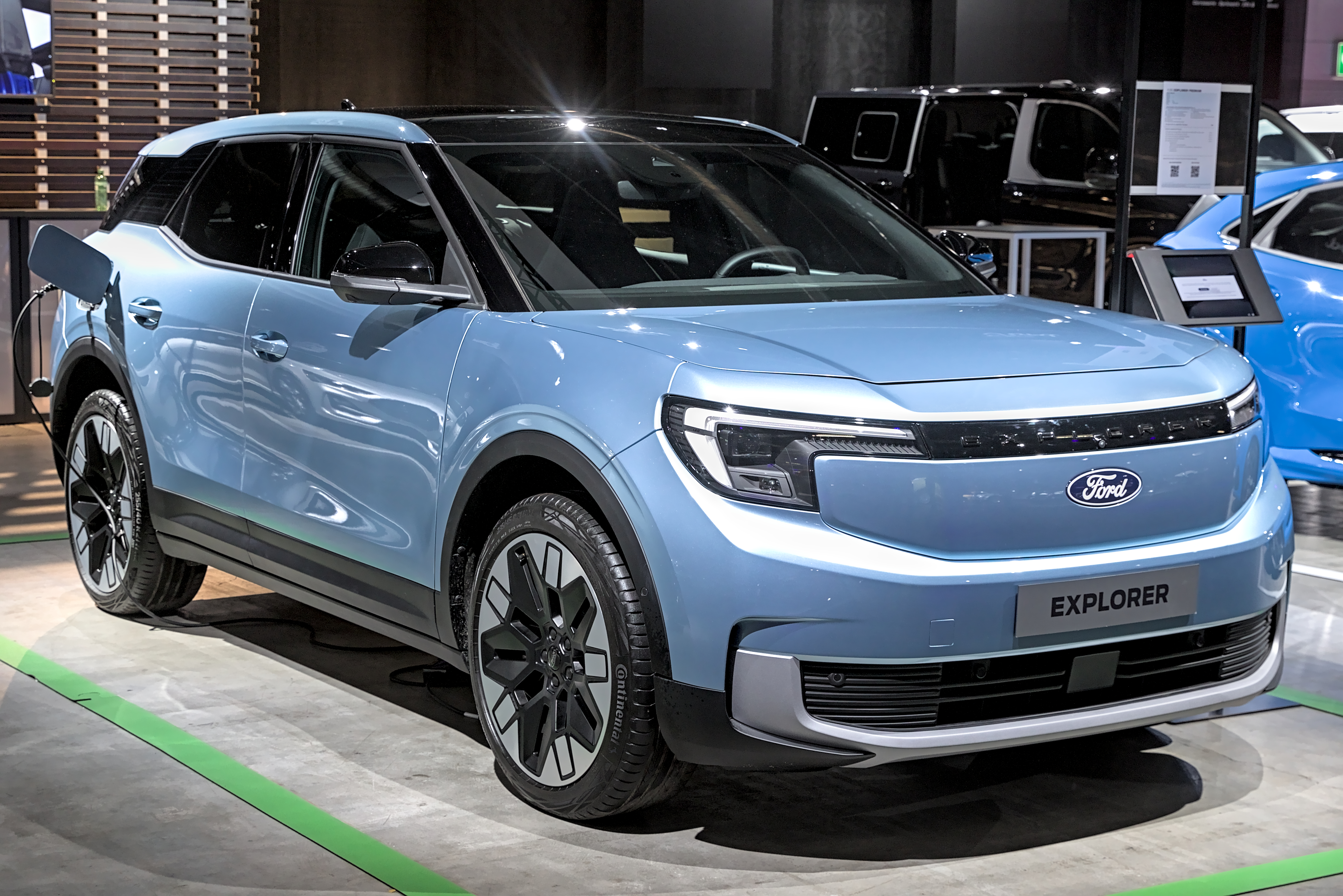
"...ng against Kia Telluride, Hyundai Palisade, Ford Explorer. You know, there's a lot of really, really good ..."
The Ford Explorer is a larger SUV that can carry people and gear, often with three rows of seats. It’s the kind of vehicle people compare when they’re shopping for a family car with room for more passengers. The podcast brings it up because it’s a well-known option in that category.
The Ford Explorer is a midsize three-row SUV built for family hauling and everyday driving. It often comes up in discussions because it competes directly in the same “big family SUV” segment as other popular three-row models. In the podcast context, it’s mentioned as part of a group of strong options.
"...we've talked a bit about the Hyundai Palisade, that being an Edmunds top rated award winner, but who's, who's dominating the sales in this segment, sort of this, this three row segment?"
The Hyundai Palisade is another big family SUV with three rows. They mention it because it’s highly rated and sells well.
The Hyundai Palisade is a three-row SUV known for comfort and value, and it’s frequently compared to the Telluride and other family-focused models. Here it’s mentioned as an Edmunds top-rated award winner and a major sales player.
"...lace in this market, obviously you've got, you've got Ford Explorer, GMC, Arcadia is a, is a, is a good veh..."
The Ford GT is a performance sports car made for fast driving. It’s designed to be more exciting than a normal everyday car. The podcast mentions it while talking about different vehicles in the market.
The Ford GT is a high-performance sports car built for serious speed and track-focused driving. It’s significant because it’s a halo vehicle that represents Ford’s performance engineering. In the podcast context, it appears in a list of vehicles being discussed in the broader market, including the Ford Explorer.
"you know, the big, the big place in this market, obviously you've got, you've got Ford Explorer, GMC, Arcadia is a, is a, is a good vehicle. Telluride, Palisade, Honda Pilot, of course, sells an awful lot. Atlas is, I think they did a hundred thousand a year of the old one. So,"
The GMC Acadia is a family SUV with space for more than two rows of seats. The podcast mentions it because it’s a common option people compare when shopping for a three-row vehicle. It’s part of the same group of popular family SUVs.
The GMC Acadia is a midsize three-row SUV aimed at families who want room without going to full-size dimensions. It’s brought up in the podcast alongside other popular three-row choices, highlighting how competitive that segment is. The context suggests it’s a well-known option in the same shopping set as the Explorer and other three-row SUVs.
"So at the moment, it's got a two liter turbo four, which has been updated. I think it's now got 285 horsepower"
That means the SUV uses a 2.0-liter engine with four cylinders, and it has a turbo to help it make more power. It’s a common setup for today’s cars.
“Two liter turbo four” refers to a 2.0-liter inline four-cylinder engine equipped with a turbocharger. Turbocharged four-cylinders are common in modern SUVs because they can deliver strong power while keeping packaging and fuel consumption relatively reasonable.
"And then Kia popped up with the EV3, which is a, in American terms, a small hatchback. I'll call it an SUV, but it's basically a hatchback. It is a small, subcompact EV for, you know, probably for urban use..."
The Kia EV3 is a small electric car from Kia. It’s meant for city driving and is likely to be cheaper than bigger EVs.
The Kia EV3 is Kia’s upcoming compact electric vehicle positioned for urban driving and shorter trips. The discussion frames it as a small hatchback/SUV-style EV meant to be affordable, and they compare its size and market slot to other EVs.
"...there was a video playing in the background and I was like, oh yeah, it looks really good. Then I realized that it was actually an EV9 I was looking at, not an EV3."
The Kia EV9 is Kia’s bigger electric SUV, meant for families. They thought they were looking at the smaller EV3, but it turned out to be the EV9.
The Kia EV9 is Kia’s larger, family-oriented three-row electric SUV. In this segment, the speaker initially thinks they’re looking at the EV3 but realizes it’s actually the EV9, highlighting how similar Kia’s EV design language can look across sizes.
"[828.1s] It uses a lot of the technology that they've got in the other Kia's. 81 kWh battery pack, that's pretty
[833.0s] big. You're talking about 300 mile range or over 300 mile range. So I'm quite excited about it."
That “81 kWh” number is how much energy the EV’s battery can store. More stored energy usually means you can drive farther before recharging.
A 81 kWh battery pack is the energy storage capacity of the EV’s high-voltage battery. Higher kWh generally means more potential range, though real-world range also depends on efficiency, speed, weather, and driving style.
"All right, so another Kia at the LA Auto Show. This is not the EV version. But no, this is the hybrid version... the Celtos has always been one of those almost forgotten Kiers... the Celtos sits below the Sportage."
The Kia Seltos is a small SUV from Kia. It’s meant to be a step down from Kia’s bigger Sportage, so it’s a bit easier to live with if you don’t want a larger SUV.
The Kia Seltos is a compact crossover SUV positioned below Kia’s Sportage in the lineup. In this segment, it’s discussed as a model that targets buyers who want a smaller SUV footprint than the larger mainstream compact offerings.
"[1210.2s] actually, this is pretty appealing. You'll now be able to get a hybrid as well. So, you know,
[1215.4s] if you are looking at something that starts a lower price point where you want decent gas mileage"
A hybrid uses both gas and electricity to help save fuel. The speaker is wondering whether people will pay extra for it.
A hybrid combines an internal-combustion engine with an electric motor/battery to improve efficiency. In this segment, the hybrid is positioned as a higher-priced option that may or may not be worth the extra cost depending on buyer demand.
"and a lot of time now, we talked before about democratization of technology. They put
these screens on everything from the tell your ride down, and then you can layer on all the"
This means tech that used to be only in expensive cars is now showing up in cheaper cars too. In this case, it’s about screens and phone-style features.
“Democratization of technology” is the idea that features once reserved for luxury cars are spreading into mainstream vehicles. The segment ties this to how infotainment screens and connectivity features are now offered broadly.
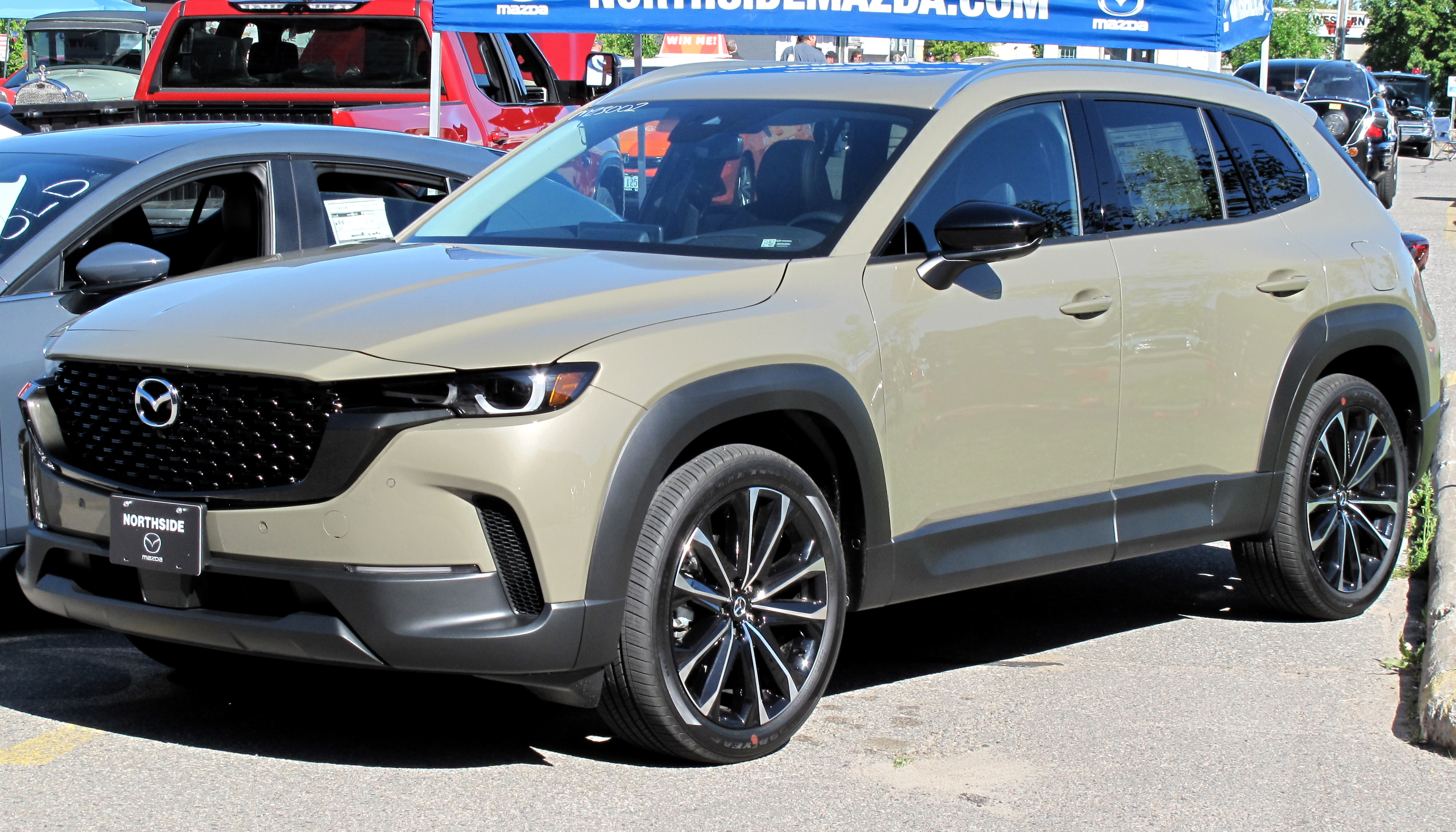
"You have a Mazda CX-5 and CX-50, which is just sort of some plastic cladding and maybe different tires, but it is leaning into that audience..."
The CX-50 is Mazda’s crossover aimed at people who want an outdoorsy vibe. Here it’s mentioned as an example of off-road styling more than hardcore capability.
The Mazda CX-50 is Mazda’s crossover positioned closer to outdoor/off-road buyers than the CX-5. The speaker notes that some versions are mainly about appearance and tires, illustrating the “weekend off-road” approach.
"It's like, well, hey, this is built here for the American market. Body on frame, we're coming for you."
Body-on-frame is a vehicle construction method where the body sits on a separate ladder frame. It’s common on trucks and many off-road SUVs because it can handle heavy-duty use and rough terrain well.
"We got 37-inch tires. We got massive fender flares."
“37-inch tires” refers to very large off-road tire diameter, typically used to maximize ground clearance and traction. In concept vehicles, this signals a serious off-road or truck-like stance and capability intent.
"We got 37-inch tires. We got massive fender flares."
Fender flares are the extra “extensions” around the wheel openings. They’re often used when a vehicle has bigger tires and needs more coverage.
Fender flares are extended coverings over the wheel arches, often used to accommodate wider tires and protect the body from mud and debris. “Massive” flares usually indicate an off-road-focused design with larger wheels/tires.
"Now we've seen that with BMW. So, that technology already exists."
BMW is referenced as having similar dashboard display technology already in production. The point is that the concept’s projected display isn’t brand-new tech—it’s something automakers have already implemented.
"because especially when you're off-roading or driving it all the time, you're always throwing gear around, right?"
Off-roading involves driving on rough surfaces where the vehicle is more likely to pick up debris and experience more vibration and impacts. The host uses this to argue that exposed controls (like a visible shifter area) could be more prone to getting jammed.
"And they've like shoveled off the front end to presumably improve the, the approach angles and stuff. And Subaru just know their audience."
Approach angle is how well a car can drive up to a hill or obstacle without scraping the front. A bigger approach angle usually means less chance of hitting the bumper when you go off-road.
Approach angle is the steepest angle a vehicle can climb toward an obstacle without the front bumper or underbody hitting it. Subaru’s “shoveled off the front end” comment implies they’re shaping the front fascia to improve how the vehicle handles steep entries onto trails.
"But you should be a Subaru owner. That's what you need. But this is it. This is the brand, you know, they know all the manufacturers that genuinely Subaru, I feel like it's just got a much better handle on who they are, their audiences, what they're manufacturing."
Subaru is a car brand that’s especially known for making cars that handle well in bad weather. The speakers are basically saying Subaru fits their kind of people better than some other brands.
Subaru is a Japanese automaker known for practical vehicles and its standard all-wheel-drive system on many models. In this segment, the hosts mention Subaru as a brand whose vehicles they associate with a good fit for certain owners and audiences.
"All these new cars are so small and he only does his push buttons and heaters going on and the auto start stop goes on and off and windows go down and all kinds of stuff."
Auto start-stop turns the engine off when you’re stopped, then turns it back on when you’re ready to go. It helps save fuel in traffic.
Auto start-stop is a system that shuts the engine off when the vehicle is stopped (like at a light) and restarts it when you’re ready to move. It’s designed to reduce fuel use and emissions in city driving.
Select text to request an explanation
Hello, welcome to the Edmunds Car Cast Podcast. I'm Matt, the moderator, D'Andrea. Before
we get started, I want to tell you about Bio Pro Plus. It's a 100% drug-free hormone
health formula. It's perfect for guys like me. I'm actually taking it, been taking it
for about a month and a half now. I was in the gym consistently, but I wasn't really
seeing progress. I wasn't gaining strength. I wasn't feeling motivated, but after a couple
of weeks on Bio Pro Plus, I felt the real difference. I felt more energy. It was pushing
harder and lifting heavier. This is definitely something you guys should check out. I recommend
it. Go to bioproteintech.com slash carcast for $100 off your first order. There's no
commitment and you can cancel at any time. That's bioproteintech.com slash carcast.
Back from New York Auto Show. How was it?
Yeah, pretty fatigued. I only landed back in LA about an hour ago. I don't know, maybe
I'm getting old, but I didn't sleep much. Hotel beds, time zone differences, going out in
the evening, early start. I'm feeling a little bit tonight, but it was a good trip. I loved
the Big Apple. It's always nice to spend a couple of days in Manhattan. The show is
not as big as it once was, but still plenty to see. Genuinely, a bunch of debuts and one
significant surprise from Hyundai. Well worth the fatigue, well worth the effort. Fun couple
of days.
I've been to New York Auto Show, but the New York trip is like, when you've got to do
the work trip and you're going to be there for 48 hours, it's like a little bit too far
for a short trip. It's not like like Detroit, you know, because we've been there a bunch
of times for car stuff. It's like, why don't you go to New York? It's like, ah, it's just
a little bit more, I don't know, sort of exhausting the travel portion of it.
Well, I think it's also like you've got to land, then you're at JFK and then you've
got to get your way into the city. But I love the energy of Manhattan. I went for a long
run. I had it like an hour window, so I went and did a lap of Central Park, and I actually
forgotten that that was six miles. So that nearly killed me. I mean, last time I came,
I was trying to eat training for the London Marathon. I remember doing like an 18 mile
training run around Central Park. This time I did one six mile lap and was like, oh, that's
actually quite a lot. So I'm still feeling it two days later. So that's not good. Some
mental know that I've got to try harder.
March is heating up, brackets, buzzer beaters, and big time matchups all week long. Get in
on the action with FanDuel. Download FanDuel and make every game count. Must be 21 and
over and present in select states. Gambling problem, call 1-800-GAMBLER.
All right, so lots of things happening actually at the New York Auto Show. Let's think about
where you want to start. So you went out specifically with Volkswagen. Was that the invitation initially?
Yeah, we had a couple of people on the ground. Myself, Nick Kicken from our news team was
out there. But yeah, Volkswagen took us out a little bit early and gave us a sneak preview
of the Atlas, which is a really big deal for them. I mean, that is their biggest, that
is their cash cow. That is their better work car. And a few years ago, Volkswagen, I mean,
the brand, if you like me, you grew up in Europe. The Volkswagen brand in the US has
always been a little bit confusing because in Europe, Volkswagen still maintains this
reputation of really being the default middle class choice. If you were affluent middle class
European, particularly German or perhaps British, the Gulf was the default hatchback. And yet,
when I moved to the US, suddenly Volkswagen is pitched very differently. It was very much
a value brand and it was all about how cheap can you get a Jetta, how cheap can you get
a Passat. And more recently, they've kind of met in the middle a little bit. And I think
what they've done well is to start design cars that actually are for the US market.
So they're for the US, they're built in the US. So we've seen that with the Tiguan, which
is, which is a really nice little small SUV. And now the Atlas, which is their three row,
you know, follows that trajectory. So it's built, it's built in Chattanooga in the US.
It's designed, developed for the US market primarily, and it also goes to Mexico and Canada
and a few others as well. So yeah, a nice, you know, a sensible evolution of what they had
before. A lot of the stuff underneath is carried over, but the whole every body panel is new. It
looks a bit more sophisticated. LED lights at the front that pretty much everybody has now. But
particularly inside, they've made a, you know, they've made a pretty big step in things like
cabin quality. It looks like a grown up Tiguan. You've got big focus on the center screen and
then another little digital dashboard in front of you. But it, it's, it now feels more at market,
which is what they were the telling us was the goal. So they've succeeded in that.
But it's also pitched into an incredibly competitive market. I mean, this is going headlong
against Kia Telluride, Hyundai Palisade, Ford Explorer. You know, there's a lot of really,
really good vehicles in that kind of three row, you know, 40 to 60 grand range.
I haven't really thought about, you guys probably have access to this data and not to put you on
the spot, but who are the best sellers like in volume of cars in that competitive group? I mean,
we've talked a bit about the Hyundai Palisade, that being an Edmunds top rated award winner,
but who's, who's dominating the sales in this segment, sort of this, this three row segment?
I wish you'd asked that question before on there, because I don't have the,
I don't have the figure. Don't quite pull them from the back of my brain. But I mean,
you know, the big, the big place in this market, obviously you've got, you've got Ford Explorer,
GMC, Arcadia is a, is a, is a good vehicle. Telluride, Palisade, Honda Pilot, of course,
sells an awful lot. Atlas is, I think they did a hundred thousand a year of the old one. So,
you know, you're talking about significant volume. And I think what's good about the
Atlusum of Volkswagen perspective is it's a lot of car for the money. You know, it's a big vehicle.
So it's the, it is the American family hauler. Certainly for the front two rows, you've got tons
of space. I mean, I can comfortably sit behind myself. Even in the third row, I'd be okay for
short distances. There's plenty of headroom, legroom's a little bit tight. So it's a, you know,
it's a proper American sized SUV, front wheel drive, plus all wheel drive. The one big thing
that they haven't gotten, we talked about this, and I actually had a meeting at lunchtime with
Volkswagen's US CEO, and this is something that we were talking about, is they, they are going to
do a hybrid, but it's not, it's not till the mid cycle refresh at this car. So it's still two or
three years away. So at the moment, it's got a two liter turbo four, which has been updated. I think
it's now got 285 horsepower, I think it is, or 286 maybe? 282. I'm trying to pull it from somewhere,
which is about, I think, 13, 14 horsepower more than it had before, but it's got less torque than
the opposition. And one of the, one of our big criticisms of the old model was that actually
it was quite thirsty. They're saying because it's an updated engine, it's actually going to be more
fuel efficient, but they haven't got the official figures yet. But there's an argument that, yeah,
the bulk of this market remains, you know, normal gas. But in a world where everybody's
starting to try and save money and reduce gas costs, well, actually hybrid is feels like a
really big growth area, and they're behind the curve on that. And they know it. But, you know,
they, they can't do much about it though, it's in development, but it's still two or three years
away. And that, that feels like the, the big sort of gray area with this car. And also the fact that
the opposition is, is so good. But I've always, I've always liked the outgoing Atlas. And this one
just seems like a sensible evolution. Yeah. And I, one of the other specs is that it,
even with the 282 horsepower, it tows 5,000 pounds, which is about average. I mean, it's not
exceptional, but that's, I mean, that's going to be a must for most, most people's needs, right?
That's, yeah, it's a bunch of toys. It's not really your, your, your track car and trailer,
you know, maybe with a lightweight racing trailer, you're, you're getting right close
at the 5,000 pound range possibly, depending on what you're racing. It's a really,
depends how big your boat is. It's a, yeah, it's a, it's a speedboat, not a yacht, isn't it? So.
Right. Right. It's a couple of jet skis and some motorcycles and some fun off-road toys for sure.
Yeah. I mean, it's not trying to be like a big, it's not trying to be a suburban or something.
It's not a body on frame. It's a, you know, it's a monocoque. It's a, it's a, it's an SUV. It's not
like a big body on frame, you know, domestic built for off-road and things like that. It's a,
you know, the off-road bit they're not doing because I said, you know, everybody talked about
it with Keir and Hyundai. I was like, are you going to do like an off-road trim with knobbly
tires and go faster stripes? And they're like, no, you know, the all wheel drive works. It's got
some snow modes and stuff. It's good for skiing. It's good for snow belt, but we're not trying to do
you know, we're not trying to pretend it's an off-road one.
And the positioning is interesting, right? Because you look at something like Taluride or
Palisade and they also, they go for a gas engine and they go for hybrid and hybrid's the better,
probably the better option overall. It's a little quicker. It's a little bit better gas mileage.
Then something like a Ford Explorer, they, they do have kind of off-road versions and they have
the high performance ST versions. They have 400 horsepower. They have all wheel drive. Like
they're, they're going after something a little bit different there. Probably because of that
trickle down effect of Raptor as well going, we have high performance off-road vehicles.
So if you want a high performance SUV or you want any of the tremor lineup, which is something that
they've been growing as well across different models of vehicles that I think Ford is playing
more into that off-road capable, you know, version of things compared to
compared to Hyundai and compared to Volkswagen and this, and this.
Yeah. I think that's been their brand pitch, isn't it? Like Ford does performance and off-road and
it's like everything is quite alpha. Volkswagen is saying that we were kind of,
they sort of describe it as like socially aspirational. They're trying to be,
they figure that they're not like the default choice. So they're trying to appeal to people who
are kind of like looking around a little bit, you know, maybe people working their way up the
career ladder. So, you know, maybe people with young families, it's kind of me really, but it's
people with young, you know, young families who are, you know, active lifestyle, that kind of thing.
And then, you know, Telluride and Palisade and those things are, you know, just built such a
great reputation for, you know, perception and, you know, perception of quality and material choices
and everything else. So it's a really interesting market right now. And, you know, the Atlas needed
a refresh. It's got it. I think we're driving it later this year. It's going to go on sale in fall,
started about 40 grand. So, you know, that's pretty good value for a vehicle of that size.
Yeah. Okay. Let's talk about the Kia's. There's an EV and there's a gas engine truck. Where you
want to start? Yeah, I mean, we were talking last week about what's going on with the EV market and
the fact that you can, you know, start leasing EVs for next to nothing. And then Kia popped up with
the EV3, which is a, in American terms, a small hatchback. I'll call it an SUV, but it's basically
a hatchback. It is a small, subcompact EV for, you know, probably for urban use if you live in
Manhattan or maybe it worked well as a sort of second car in, you know, in LA or something like
that. It's not your big family hauler, but it's going to be pretty cheap. It's tough to gauge the
size of the vehicle looking at it in pictures. Is this like Ioniq 5 or is this smaller? No,
it's Ioniq 5 big, so it's smaller than a, it's smaller than an Ioniq 5. I mean, they're kind
of peppering the market because you've got things like the Nero and everything else, but it's,
so probably bigger than a soul, smaller than, smaller than like the EV6. I mean, as the name
suggests, it sort of slips in there. In Europe, they've got an EV2, so they can go smaller still.
So it's kind of like, I haven't got the exact dimensions, but if you think like Volkswagen
Golf size, if you want to get some reference point, and it looks like a scale down EV9,
I actually think it looks really cool. It was funny because I was talking to the
some of their C-suite and we're asking questions about where Kia is and the sales and everything
else. And there was a video playing in the background and I was like, oh yeah, it looks
really good. Then I realized that it was actually an EV9 I was looking at, not an EV3. It does look
like a little facsimile, but I mean, I looked at it. I haven't had that much chance to sort of poke
around and find out how big like rear leg room is and things like that. But I did think it was
quite a cute thing and a really good car if you're in an urban area, in the Bay Area, LA,
New York, that sort of thing. Yeah, looking at some of the photos, looking at like kind of the back
and the quarter panel, it's throwing off a little Fisker vibe for me.
I can see what you mean. In fact, one of the weird things about being in New York is
there was a deal done when Fisker went bust to buy up a load of Fiskers and use them as
Ubers in New York. So I actually had a ride in a Fisker, which I hadn't been in for quite a long
time. So really, I mean, like I was staying around Central Park area, there was loads of Fiskers.
It was really quite odd. But this works better than the Fisker, I'm sure about that because it
uses a lot of the technology that they've got in the other Kia's. 81 kWh battery pack, that's pretty
big. You're talking about 300 mile range or over 300 mile range. So I'm quite excited about it. I
think they'll struggle to sell it because it's a small EV. And I think even they accept it's
going to be a relatively niche market because you've got the EV6, which is a bit bigger, the EV9,
which is a proper 3-row. So where is the US market for a subcompact electric car?
Right. But the two battery options are good because that effectively could lower the price. If you
don't need the larger amount of range, you can get the roughly whatever the 220 mile range
version of it is the 220, yeah, 220 mile range and the smaller battery and save some money.
But that's right. And I think that's the, that is kind of the appeal of this car that I've used
is something like me, you know, we have a long distance car or I tend to pull from the Edmunds
fleet to go on long distances. But then most of the time taking the kids to school, taking them
to dance class, that kind of thing, we use, you know, we use a small EV because that makes a lot
of sense. You can park it, you can nip it and out of traffic. So I think there is definitely a role
for it. And, you know, they are, they are persisting with the EV thing, both Hyundai and Kia are
probably more committed than most. BMW, I think is the other one and Mercedes to slightly lesser
degree who are continuing with the kind of EV charge. But Hyundai and Kia have said, you know,
we're in this for the long term, you know, we've got the production facility, but it's a flexible
production facility. So, you know, we're, we're going to do this because I think there's a lot of
talk of, are we actually going to see the EV three? Are they just going to cancel it because
they can't sell the EV six or, you know, the EV nine is a struggle as well. But I think, you know,
there's a lot of determination within that business that says, look, if the EV does park,
it does turn around, you know, we've got to be in the game. And I can see the merit of that.
I mean, I think pricing is going to be a big factor as well. If it starts around 35,000,
but that gets you the smaller battery in the roughly 220 miles of range, like what sort of
options can you get on it? How is it going to be equipped for 35,000? Is it going to go up to
45,000 for the fully equipped long range? Or is it going to be closer around that 40,
$41,000 range? Like, you know, the additional battery size. What does that do to it?
Yeah, I mean, I would have thought that they're going to be, it's going to start in the 30s.
And then, yeah, it's, I mean, that, that's the thing with something like the Nissan
Lee starts about 30 grand. And it sort of works for me at 30 grand. But when you get up to 40
grand, it starts to think, well, hang on a minute, now you're into IONIQ 5s and everything else,
we got a lot more space. And one of the things I said to the guy, you know, the, the team at
Kia, and I was talking to the head of sales, if you'll have such aggressive lease prices on an EV6
and even an EV9, if you're talking about, you know, 250 bucks a month to lease a EV6 and
350, 400 for an EV9, if you're in LA like I am, you're not going to like lease this for $150 a
month. So surely you've got a compression issue, all these cars on a, on a finance deal end up in
the same place. And they sort of agreed, but said, look, we need choice in the marketplace. And,
you know, this is, this is offering customers that choice. It's tough. I mean, I don't think
anybody is pretending that it's not tough to, to sell EVs at the moment. The only, the only caveat
being, you know, if gas prices keep going up, you know, people are looking at hybrid, yes,
but if people are going to, you know, look afresh at EVs and say, this is the way forward,
there'd be a great irony if, if Donald Trump ends up being the guy that saves the EV market,
wholly unintentionally. Yeah, right. Okay, so two more cars we want to get into that were
at the New York auto show, but let's take a quick break first.
Years ago when I was building one of my businesses, I remember interviewing candidates that really
stood out because they were passionate about working for me and really wanted the role.
If you're hiring, you want candidates who's passionate about your role,
but you can't get that insight from just a resume unless you post your job on Zip Recruiter. And now
you can try it for free at ziprecruiter.com slash audio. Zip Recruiter's power from
matching technology finds qualified candidates quickly. And Zip Recruiter has a new feature
that shows you the most interested qualified candidates so you meet the right people faster.
Four out of five employees who post on Zip Recruiter get a qualified candidate within the
first day. Try it for free at ziprecruiter.com slash audio. That's ziprecruiter.com slash audio.
Meet your match on Zip Recruiter. Quick reminder, if you're watching games this week,
jump on FanDuel, whether it's NBA spreads, player props, or same-gay parlays, FanDuel makes it easy
to get in on the action. Download the FanDuel app and place your first bet today. All right, so
another Kia at the LA Auto Show. This is not the EV version. But no, this is the hybrid version.
This is the hybrid version. Yeah, the Celtos has always been one of those almost forgotten
Kiers. I think it has its little niche, but it's never really in the consciousness. So
the Celtos sits below the Sportage. So the Sportage is your small SUV, the Honda CR-V,
RAV4, that kind of size. This sits below that. But it's kind of got a little bit bigger. You know,
although small SUVs aren't really very small anymore, like you look at a RAV4 today, that's
a pretty big vehicle. Yeah. So there is definitely space underneath for something that's more akin
to what small SUVs used to be. Again, handsome looking car, has that sort of family Kia look
about it, looks very modern, looks very fresh. Yeah, it does. Yeah, it has. And that's deliberate.
But you don't look at it and go, oh, that's an entry-level car. That's a cheaper option.
Both inside and out, the styling echoes, the larger cars, interiors nice, big focus on the
on the digital dashboard, materials are good. Again, it's another Kia that you look at and say,
actually, this is pretty appealing. You'll now be able to get a hybrid as well. So, you know,
if you are looking at something that starts a lower price point where you want decent gas mileage
as well, then, you know, we're talking about a car that's going to start probably just over 30 grand,
sorry, 25 grand, and then the hybrid somewhere around 30. So when you think that the average
transaction price is 50, you know, this looks on paper at least, we haven't driven it yet,
this looks like pretty good value to me. So you can get a naturally aspirated two-liter four cylinder,
or you can get a turbocharged 1.6 liter smaller engine, but more power, or you can get a hybrid
version. Yeah, that's yes, I think that's that's yeah, so this tends to be does it need three engine
options? Well, it always sounds a little bit counterintuitive where it's like, hang on a minute,
the bigger engine is the slower engine, but that's yeah, that's because basically they tend to use
older technology, you haven't got like the turbocharging and everything else. And so you end
up with a larger capacity, older technology engine with it normally with a CVT transmission,
which a lot of people hate me included. And then that sort of brings the price point in really low.
And then you have like a more sophisticated turbo engine, which tends to be not only faster,
but often has better fuel economy. And then on top of that, the layering on the hybrid,
I think maybe in this market, they're saying is, you know, is the hybrid really going to sell? Is
this you know, is it too early? Are people really going to pay extra for it? Because yeah, the hybrid
is the 1.6 gas engine, but has a six-speed dual clutch automatic transmission. So you're talking
about actually something that's now quite sophisticated and therefore quite expensive to
produce. Yeah. Okay. That's the problem now. I see the two-engine lineup. I don't know if it's
necessary for the three-engine lineup, but certainly someone over there in the accounting
department of Kia knows better than I do. I could see the 1.6 turbo and the hybrid lineup having
the two-liter naturally aspirated four-cylinder with less power overall, like unless there are
some significant cost savings. Obviously, naturally aspirated doesn't have turbos,
doesn't have intercooling, doesn't have a lot of things that add to the cost of just putting
turbos on the engine. But you know, maybe it just comes along in the price tag.
Well, that's it. I think you've got to remember with all these vehicles, and it was exactly the
same with the Atlas. They always do a stripped out base model to get the entry level price
point down. So they can say to us, oh, it's going to start at less than 40 grand, or in this case,
it's going to be under 25 grand. And then you look at what actually sells. And in the Atlas's case,
as they were saying, the base model doesn't have, it hasn't got some of the LED lighting. It is quite
stripped back. And they're like, well, it's 10% of sales if that, because what happens is people go
into dealerships and either dealers don't stock them a lot of the time, or if they're going to
deal. It's like, well, if it's on a finance package, or you're leasing it, or it's actually,
sir, it's a madam, it's only an extra 20 bucks a month, and look, you're going to have extra
LED lights, and your bottom will be ventilated and all that sort of thing. So a lot of these cars
barely exist. They put them into the market, get the price point in. If you're doing higher cars,
or Uber cars, or whatever it may be, there's a place for a base model. But the vast majority
of business is done in that kind of mid-range spec.
Yeah. I mean, looking at the interior, they're definitely playing on the theme that they've
been using recently, kind of that Range Rover-esque steering wheel going on, and the big screen that's
sort of connected and goes across from the gauge package to the entertainment system,
which we've seen even in the Palisades and stuff. They're using that kind of format.
It looks good. It seems to look good.
Yeah, and a lot of time now, we talked before about democratization of technology. They put
these screens on everything from the tell your ride down, and then you can layer on all the
functionality, wireless Apple CarPlay, Android Auto, and now you can also get things like
YouTube and Netflix and everything else. So basically, it's an Android screen. So it's like
just going to Best Buy and buying an Android tablet, really. So when they start hooking it
up with all the Google Ecosystems and everything else, then you can download these things as apps,
and suddenly, you can sit in your 25 grand car and watch telly. So this sort of thing's just
got better and better, really. And it makes sense to the manufacturing, because what they don't want
to do is have 20 different infotainment systems, 20 different pieces of switchgear. If they can go
to a supplier and say, right, we're going to buy millions of these screens, it makes a lot more
sense. Well, then you end up getting the same components from your $60,000 Palisade in your 30
or 28 or $27,000 Celtos. And they want to cut corners someplace to keep that cost down. But
like we've said, there's a few things that where you want to hide it, right? You don't necessarily
want it on some of the touch gear and your steering wheel and shifter and some of the buttons and
AC vents and things like that, where like, hey, if you can save the money someplace else and give
us those items that are front and center, then yeah, it's nice to see if you can get a $25,000
to $30,000 vehicle that feels much more luxurious. Yeah. That's been the big, for me, the big
progress in recent times is just that that sort of now everything has gone, the digital interface
is so much better and you know, they're fast responsive reactive screens. And I think there's
also a level of customer expectation because everybody pretty much everybody has a smartphone
now and they know how that operates and know what that costs or you have an iPad and that's a few
hundred bucks. So in your $30,000 car, it's perhaps not unreasonable to have a screen that
you know, feels like it's worth a few hundred bucks.
Okay. So moving on to the big surprise of the show from Hyundai is an off-roader.
They're going after Bronco, going after Jeep.
This was a surprise. There was lots of rumors about, you know, Hyundai were going to show
an EV concept and then they were to talk that actually they're not going to show an EV concept
because the EV market's a mess at the moment. So what are we going to do? Then there was like,
it's going to be a pickup truck and it's quite rare these days to go to an auto show and have
a genuine surprise. And Hyundai had a EV concept at the EV sort of off-road concept
at the LA Auto Show. But then this is quite different. They weren't talking about power
trains or whether it was going to be EV gas, whatever. This was all about debuting the body
on frame concept. So they are going, they've looked at the market and if you look at the U.S.
today, and this is something Volkswagen were talking about as well, you've basically got 60%
SUV, 30% truck, 10% everything else. And if you're not in that 30% or not in that 30% at scale,
you're missing a lot of the market. Now, Hyundai has the little truck, the Santa Cruz,
which is kind of like an SUV with a bed. But this is very different. This is them saying,
right, we're going to build a body on frame chassis. This is a, we're going to do a, you know,
we're going to do a Bronco, a Wrangler, a F-150, a Ranger, whatever you want to call it.
And it's funny, like every out of the world is saying, I've got to be the EVs and it's this
and it's that and it's software defined vehicles and blah, blah, blah. And then the biggest news
of the show is actually we're doing a lot of frame chassis. It's going to be a proper like
American off-roader headlong at Bronco, headlong at Jeep. And then it'll also spawn probably a
midsize and I would have thought in time, probably a full size truck as well. So, you know,
that's such an ambitious company and they just want a foot in every, a foot in every camp.
But off-road is, is what's happening right now. Like, I mean, obviously what Ford is doing with
things like Raptor lineup and Tremor lineup, but everybody has some sort of like little kind of
off-road trim package. You have a Mazda CX-5 and CX-50, which is just sort of some plastic cladding
and maybe different tires, but it is leaning into that audience like, hey, do you want to get away
for the weekend? Do you want to get off the grid a little bit? You know, Ram, of course, with TRX
and RHO and Toyota now doing what I guess the truck maybe is going to be called Hammer, sort of a
Raptor and TRX competitor. I don't know what the power plan is going to be, but some sort of hybrid
not necessarily a big supercharged V8, but with something off-road competitive. So,
it makes sense for Hyundai to kind of lean into this going, you know what, we're going to get you
something that's similar to a Bronco or a Jeep. It's going to be their take on it. You know,
a little bit of FJ Cruiser, a little bit of, yeah, it's got a few things. A little bit of
a Land Rover Discovery, right, with the little windows above the doors.
Well, you say Discovery, there's also like quite a lot of Defender, both original Defender and
current Defender in it. So, yeah, you can look at it and say, yeah, my only first impression,
look, I think it looks cool. It has that sort of Tonkatoi vibe about it. It's the sort of thing
you push around your living room when you were three years old. But the flip side is it's maybe
a little bit generic. I don't think you'd look at it and go, that's obviously a Hyundai. It could
have come out of Ford. It could have come out of Land Rover. So, that was the only slight
disappointment for me that it felt a little bit generic. But it's not even about what it looks
like. It's about what it's saying. It's basically saying, we're serious about this. It's going to
be built in America. We're building this big facility in America to do this. We've also
got about the steel in America. I think they're talking about like $29 billion investment or
something. So, you know, your Ford or Chevy or whatever, you can't even fall back on the,
hey, we're a domestic blah, blah, blah. It's like, well, hey, this is built here for the
American market. Body on frame, we're coming for you. It's a very, very sort of,
then, you know, it's a career company. They never sound very aggressive. They always sound
very kind of sweet and charming, but it's a pretty aggressive statement that we're coming for you.
Now, this one, this concept, right? First of all, interesting that it was silver, because I think
that was the Ford Bronco concept from like 04 or 07 or whatever it was that looked a lot like this.
But what do you think? How much of this do you think is going to end up in the production
vehicle? We got 37-inch tires. We got massive fender flares. We got suicide doors in the rear.
We've got a very kind of, there's not a lot of images right now up on the interior, but some
very, very cool, interesting interior with gauges on the dash and sort of exposed, not quite like
full Pagani, but like kind of exposed looking type of shifter, you know, treatment going on.
How much do you think ends up in a production vehicle? Well, if you, the way I tend to answer
this question is look at what they've done historically. So Ioniq 5 came out as a concept,
do you know what I mean? Yeah, it's not going to look like that. That's like just like an 80s
tribute concept. And it basically looks exactly the same. Ioniq 6, now they're not going to build
like a 30s inspired streamlined. Well, actually they did. You know, and they're quite open the
fact that they don't tend to do concept cars that don't see the light of day in some form. So, you
know, some of the, you know, I don't think you're going to see suicide doors, for example. And if
you don't know what suicide doors are, they're the ones like on a Rolls Royce that where the rear
doors are hinged at the back. I think that's highly unlikely. But you look at the rest of it,
you know, the wheel size will go up and down, depending, you know, like they have
Sasquatch, Sasquatch isn't it Ford? You know, you've got so, you know, inside you've got all
these little, as you said, like individual dials, which look a little bit like those like plug-in
and play things you get when you, you know, when you go hiking. Yeah. But there's nothing really
in there that looks like it couldn't make production. It's got sort of dashboard. It's got
like a kind of projection on the bottom of the dashboard. Now we've seen that with BMW. So,
that technology already exists. Yeah, right. There's not a lot in here. When you look at it,
there you go, that looks, that's not going to happen. It's got proper wing mirrors.
You know, it hasn't got little cameras. Yeah. There's not a lot there that you look at, Matt,
and you go, that's like wholly unrealistic. Right. Yeah. This kind of shifter linkage here
that you can see in this photo, if you guys are looking at it on YouTube that I was explaining,
it's cool and I like it. I don't know that the production version would be so exposed,
because especially when you're off-roading or driving it all the time, you're always throwing
See something that's not quite right? Our annotations are AI-generated and can sometimes miss the mark.
Click the flag icon on any annotation to suggest a correction.