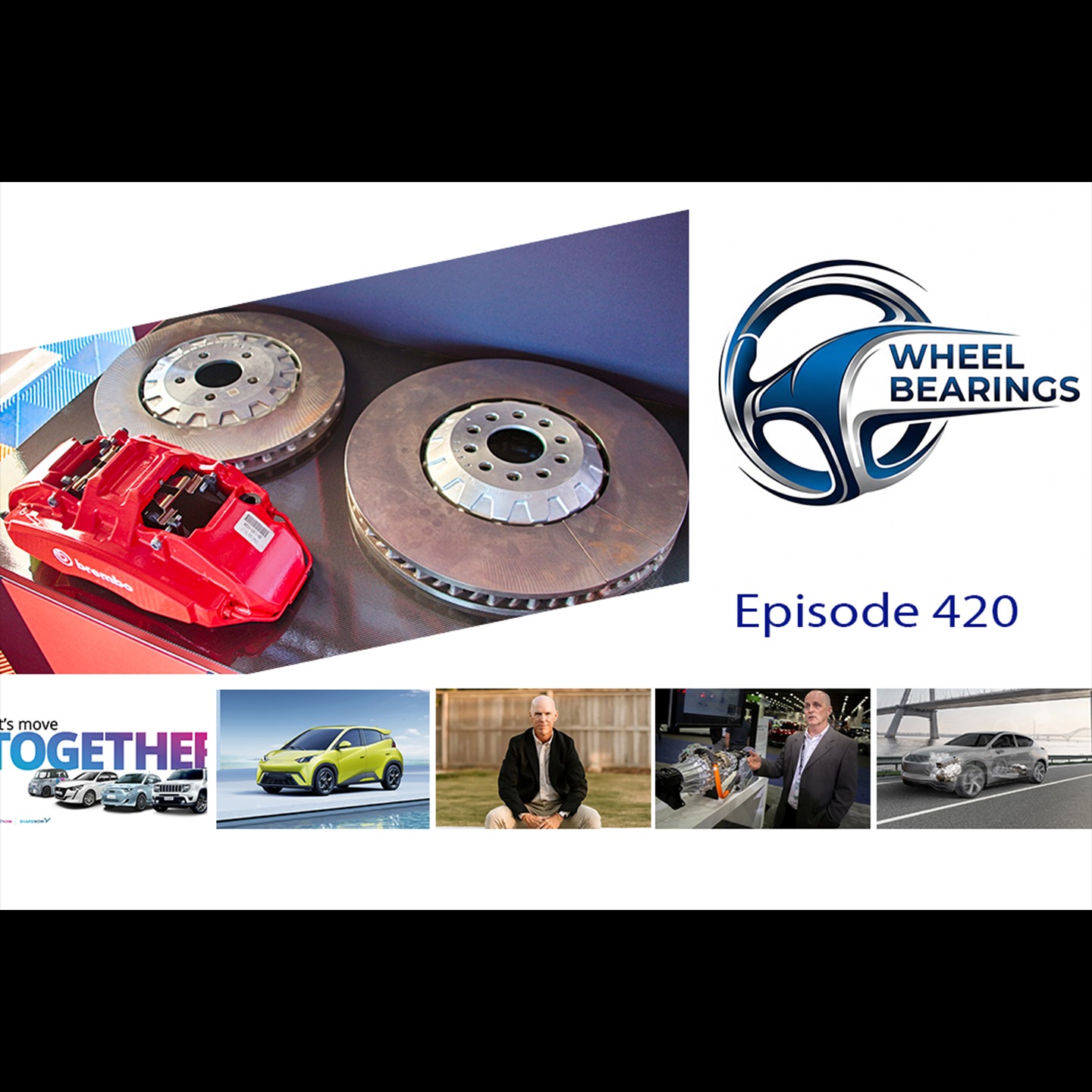
A deep dive into the evolving automotive landscape, featuring insights from industry experts on electrification, hybrid technology, and the competitive dynamics of the Chinese auto market. Mike Dalsett from Magna discusses the shift towards hybrids and the challenges of consumer adoption in North America. Brembo's representatives talk about their journey from niche performance brakes to mainstream applications, emphasizing the importance of technology and innovation. Michael Dunn shares his expertise on the rapid growth of Chinese automakers and their strategies to dominate the global market, highlighting the impact on Western manufacturers. The episode also explores subscription services in the automotive sector with Free To Move's Benjamin Millard.
This week Nicole and Robbie are both travelling so we've got four interviews that Sam did in the last couple of weeks starting Magna International's head of e-Drive systems Mike Dowsett. Then there is Caroline Fallara and Mike Messina from high performance brake manufacturer Brembo. Sam also talks about China with industry expert Michael Dunne and finally Benjamin Maillard discusses Free2Move's new Car on Demand micro-lease program.
"Enter Tesla. Q1 2020 starts manufacturing the Model 3 in Shanghai. And it's a transformative moment."
Select text to request an explanation
It's Gabriel Fluffy Ecclesius Live. When it comes to the Department of Cuddling, this is what I want. I prefer a big girl. I want a big girl. Oh yeah! This way, we both can agree on the temperature of the thermostat.
This isn't just a game. It's a once in a generation event. The Harlem Globetrotters 100 year tour. Celebrate 100 years of high-flying dunks, 100 years of show-stopping moves, and 100 years of changing the game. Bring the whole family and be part of the legacy. This game is once in a century. Be there at MotorCenter on January 24th. Go to Harlem Globetrotters.com for your tickets to the 100 year tour.
This is episode 420 of Wheel Bearings. I am Sam with Wheel Sam from Telemetry. And I'm the only one here right now because Nicole and Robby are both traveling this weekend. But I have had a bunch of conversations with people over the last couple of weeks at a couple of different conferences I attended. And these have all been already available to Patreon supporters.
But now everybody can listen in on these. I think there's some really good stuff here. So have a listen. We're going to start off with Mike Dalsett, who is the chief engineer head of development for electric drive systems at Magna International. Magna is one of the largest automotive suppliers in the world.
And they produce just about everything, almost every part that goes into a vehicle for some automaker or in many cases many automakers for similar components.
So I talked to Mike at the Center for Automotive Research Management briefing seminar in Detroit last week. And have a listen.
All right. Mike, let's talk about electrification.
I'm on David's subject. Yeah, I just listened to your panel over here. And I guess let's start off with the industry is in Tennessee state of flux right now trying to figure out what to do next.
From your perspective leading the EV and electric propulsion stuff from Magna, what are you seeing right now overall on the industry?
I think the consumers are making their voice heard. They weren't quite ready for the trajectory that we saw bevs. I think the whole industry was expecting a much faster growth.
And I kind of touched on it just now up on stage that certainly in North America, I do think we have some unique challenges and that is the vastness of the country.
There are a lot of Americans that don't live in a city, don't have access to a Maya with 10 superchargers in the parking lot.
There are many Americans that don't have a garage there. They can put their own charger.
So I think an adjustment was the right thing to do. I think that the demand we're seeing now for hybrids is real and I think it will continue for some time.
I do think again touched on it on stage briefly, but a plug-in hybrid with a reasonable size battery can deliver for the consumer some really exciting electric performance that they won't have been used to.
We'll see the difference between that and their combustion engine. If you can get a plug-in hybrid with 50-60 miles of range which they're trying to do a card, I think that's the way to go.
And then we're going to start to educate the masses that actually electric power trains are great to drive. They're exciting, less silent. They really do change the driving experience.
And I think that will boost the growth. But in the short term, hybrids, absolutely. And again, mentioned it briefly on the stage for Magna.
We have a very long heritage of combustion engine power trains. So world leader in all drive-fall, drive and manual transmissions DCTs, we've been doing that for decades.
Then we worked on electric vehicles and the power trains for electric vehicles for a decade almost.
And now we bring all of that together in a hybrid, which is a very natural place for Magna to be, it brings all of our experience and product knowledge together.
And hybrids are real. We're seeing an awful lot of interest on the, we call it DHD, is the dedicated hybrid drive, where we're actually put in one or two electric motors, high-voltage electric motors, into the transmission.
It gives real exceptional performance, and it can be a range extender, a parallel, a series hybrid.
Depending what we do with the clutch and the gearler clutches and the gears inside that transmission, we can give our OEM customers really any scenario, any driving scenario they like, whether it's combustion engine and electric together or one or both.
We can give any combination of those. And it's more complex. It's not an easy thing for some suppliers to do.
As I mentioned for Magna is a really natural place for us to be. We're using our same engineers, our same global skill set that we have in a real, true, global team to deliver these quite exciting hybrid transmission.
So certainly that's going to take up an awful lot of time for the coming years.
I do think we're seeing beds alongside it. I think the dates of the mic just presented is pretty accurate.
But in most of the hybrids for North America, we're going to put on electric drives on the rear axle, for example.
So we'll have a hybrid to do just through the road hybrids for those applications. We'll call it a P4, but yeah, that's an independent eDrive in the rear.
Very low cost, but it gives you that all we'll drive that you need when you get stuck or you can't get up your drive and you just need a little bit more or for that overtaking maneuver when you need more talk.
So it gives real extreme flexibility and our portfolio is so broad for electrification that also hybridization.
But we can supply a hybrid transmission up front, either longitude nor transverse. We have both in our portfolio.
A really low cost eDrive, a P4 in the rear axle.
Whether they want it, so that's the selection, the consumer can make if they want front-wheel drive or if they want all-wheel drive.
And all of that exists today in our portfolio.
So it sounds like it's interesting the way you've just described it, is that you kind of come at the hybrid side from the opposite direction of somebody like Toyota.
Yes, they've been doing a hybrid's the late 1990s and Magna focused more on Bev over the last decade.
And Toyota, Honda, they're taking what they've learned from Iberids to plug it into plugins and Bev.
They're in your going the opposite direction.
And so have you been able to leverage some of the lessons learned from developing Bev or pure electrified power trains to what you're doing on the hybrid side?
That's a great question and absolutely yes is the uneasy answer is yes.
So the application of high voltage electric motors into a transmission is not an easy task.
There have been a lot of lessons learned in our first programs using full EVs.
All of that cause into a hybrid transmission.
It's extremely compact. There's a lot going on in a hybrid transmission.
We're not given any more space in the vehicle than the original ice transmission.
So we have to get two big electric motors typically, a couple of clutches usually.
And we will get all of that into the existing drive.
And to do that we use all of our lessons learned.
So we've been working on hybrid transmissions a lot longer especially in Europe.
We started off with 48 volt only now up to 800 volt and 400 volt.
And because we're a truly global engineering team at least, we certainly transfer all those lessons learned for local engineering to support an individual customer.
So we've one business on hybrid transmissions in China and North America and in Europe.
So all we share those lessons learned on a daily basis.
We have a system just for lessons learned.
And they really go down into the absolute detail of designing one of these transmissions for our customers.
So one of the interesting things like from the conversation yesterday, I don't know if you're here yesterday,
but Cherry Wieckowski president of Chersoff talked about is the one of the things that's different in China for example.
One of the advantages they have versus the Western automakers is the Western automakers often, you know, they'll go to a supplier.
A supplier will have a product off the shelf, but they will want something slightly customized.
Yep. For their use case, yep. Whereas in China, the automakers are much more inclined to just take whatever's off the shelf.
And they get the benefit of lower costs because that supplier is selling two, three, four million of the same part to multiple OEMs.
Are you finding now with OEMs, Western OEMs that they are maybe more willing to take essentially an off the shelf component as opposed to something that's more bespoke,
especially because of the fact that they are now having to go back and invest down multiple pathways, whereas they were hoping to go all bad before.
I think there's a really strong desire from the big OEMs to do what you just described reusing what's there.
That typically, especially those with all that combustion engine heritage, they're struggling to do that.
They always want their unique spin on something, but there's a strong desire to do that to drive costs down.
A magnet, what we do is we have what's called building blocks.
So in every aspect of our powertrain, we have split up into building blocks, all the different aspects.
I'll give you one example, an oil pump, for example, that we would have in a transmission or an e-drive.
And we have a building block that looks after just the oil, they look after another actuator, but it focuses on that globally.
So if we've found either off the shelf's third-party oil pump that we can use, or if we're designed and developed on ourselves,
that will be owned and managed by a building block.
And we, in engineering, are charged to reuse as much as we can.
So before we ever sit down, we start with our clean-sheet paper.
No, we start with an existing e-drive or transmission.
And then we see how much of that we can reuse.
And that does include taking off the shelf components from other tier 234 suppliers, and trying very hard to reuse the addies.
Because we know if we change one thing, it has to be tested and validated, and it drives significant incremental costs.
So we're trying ever so hard with all of our drives, combustion engine, whether they're hybrid or EV, to reuse these standard components from across our building blocks.
And we're being more and more successful at that as we move forward.
And we also get into a point where we're now able to collaborate really closely with an OEM, and we can justify some of those standard components.
We will do, we will say, I understand you would like this oil pump, for example.
But however, if you use this oil pump, we can say you ex dollars, both in terms of engineering and peace price.
And we, I'm finding certainly that the OEMs are more and more open to that.
Some of them are still struggling with their legacy.
But there's a huge drive for affordable vehicles, especially EVs.
But actually, since so many of these components that do add that incremental cost, are not things that differentiate the product from the consumer perspective.
However, it doesn't care where that oil pump is.
As long as it were, I agree with you.
And in powertrain though, adjusting one widget in the overall, can affect the performance of the vehicle.
Whether it's torque or power or longevity, or even for an oil pump.
If you find an oil pump that doesn't quite deliver the volume of oil you need, or that cold viscosity when it's zero degrees,
that can impact the overall performance and then the consumer feel for the power.
We all feel the powertrain, whether we know it or not, you know, you feel it through the seat earpants.
So, that's all the factor.
And many of the OEMs, especially in BEVs, are looking for how do they transmit their brand now.
Most OEMs use to deliver their brand through their engine.
They own their engines, they tune them, they made them.
It's a lot harder to do with electric drive.
Exactly that.
So, when you start to suggest changes that could impact the drivability, the way it accelerates, the noise.
All of those factors come into that widget, unfortunately.
So, for the good news is, there's very much a two-way collaboration with the OEMs now to come up with the best overall solution.
Still hit their brand that they're looking for, their drivability, the way the vehicle feels.
But, try and reuse as much as we can.
You know, to validate any drivetrain is many, many millions of dollars.
You only have to change one aspect, but you have to test it.
A whole thing are going for a long time.
So, the pictures clear.
And in engineering, we're absolutely charged for maximum reuse.
And if we come up with something new, we're already thinking about the next programs and how adaptable and flexible that is.
So, I'm designing an eDrive now with my team in Troy.
And we're already looking, we're designing it primarily for the North America market and what we're seeing.
But we also know it's going to be in demand in China and Europe for slightly different reasons.
So, we're building into that flexibility.
And that's really important because overall, it's going to drive down the cost of our powertrains and make better business for Magnum.
Going back to hybrid drives for a minute.
What is Magnum's approach to the hybrid drive architecture?
Are you doing it combining the motors with a step ratio transmission or doing the ECBT type of architecture or are you doing both?
Both, okay.
Whatever our customer wants.
And we have them all in our portfolio.
So, there's an interesting demand from our customers and their consumers.
It's the full breadth of all of the different hybrid transmissions.
If you see our commercial depictions of DHD, dedicated hybrid drives, you see it's one motor to motor, series operation, parallel extended reins.
They're all in there and we can do all of those.
Usually, the biggest constraint is the package space.
How much space do we have to work with?
And sometimes that can dictate what type of hybrid drive it is.
And we're seeing all of those.
Literally the pull spectrum.
The best is when you can have a dedicated hybrid drive that has a generator in it and a traction motor that can operate in all of those different modes and give absolute flexibility to the OEM.
Cost a little more money.
Doesn't optimize one or the other but gives you a really good performance.
Pure electric.
It can give you electric and combustion engine if you're holding your boat out of the lake.
Absolute flexibility.
As long as the battery is big enough.
A kind of tups to let on the stage.
Heves with their tiny battery are very limited, electrically.
But the plug-in hybrids with a decent 20, 30 kilowatt battery can do some incredible things.
Did that answer your question?
No, I ran it.
It sounds like you're using that building block approach.
You've got the same, same basic motor designs that you can combine with different gear sets and different combinations depending on all the other constraints that you have in the vehicle.
It's a really good point.
We are trying to reuse all of our motors and the inverters that drive them as much as possible.
And there is quite a lot of flexibility in doing that.
So yes, absolutely.
We can reuse motors and the inverters that drives them.
And then just adjust within the gearing to give the OEM what they want.
That's what we do every day.
That's how it is.
Talks about hybrids, plug-in hybrids, e-revs is an area that's getting a lot of attention.
We've mentioned it up on stage.
So this idea of the extended range EV where the propulsion of the vehicle is exclusively from the electric drive units.
And you've got an engine, an internal combustion engine driving a generator to extend your range.
The first of those for the North American market should be arriving first happen next year from Stolantis.
But beyond that, how much interest are you seeing from OEMs or North America for e-revs applications?
Are they coming to you or are they doing it more in-house or what kind of applications?
It's funny, the answer is always yes, with Magnol here.
So big and we have such a depth of knowledge.
We've seen a lot of interest and North America is the primary market.
But we are getting interest in China and Europe as well.
But North America is the primary one.
There are a couple of ways you can do this.
And it doesn't have to be a combustion engine driving the range.
No, it could do it yourself.
There could be some other things.
So again, I come back to the thing I said earlier about the vastness of the US.
I have thought for more than a decade that a range extended battery electric vehicle is the ultimate solution for North America.
You may not use that range extended for three or four months.
But on the day you need it, it's there.
And you've got a salt tanker gasoline.
And that's the reassurance that many North American customers are looking for.
The range extended piece is not so expensive.
You know, I've been driving for a few years now.
And if there were an option to tick a box for $1,000 for a range extended, I would tick it every time.
I don't think I'd ever use it.
But I would still tick it.
Can you get the cost down to that point where it would be a thousand?
I think we have to.
I think it's in that old park.
It might be 1500. It might be 800.
It depends on how much power does that range extend to produce?
Yeah.
And I can see where something like what BMW did with the I3.
Yeah, absolutely.
You could just only get it down to that price point.
Yes.
But that vehicle was also extremely limited.
Once you were into a range extended mode, you only had about two gallons of gas.
And it was our limited speed limited.
So we've worked on lots of solutions from a small SUV to the big trucks.
A range extended for the big trucks is like a V6 usually.
Yeah.
It's a big engine.
And then we're not really emission free.
Are we?
That's the idea.
Even if you put really good after treatment on that.
I think the lowest cost range extender is one that will keep you running at 70 mile an hour.
You know, God, I think in these 4567 gallon to gas.
Yeah.
But it depends.
Again, it comes back to that OEM brand.
What do they want?
What are they looking for?
And we do see the entire range from our OEM customers.
There isn't a one system that's dominating.
They are all over the place.
Okay.
It appears that that piece of our technology hasn't found it.
It's no star.
It's silver lining.
They are all over the place.
But they're reusing what we know.
So the motors in there, the inverters in there, the gearbox that drives it for the optimum speed and efficiency.
All of that is what we do every day.
So it's coming.
Don't know that there's a one job that fixes all.
But we're seeing more and more interest in that.
So, and if you had to look forward five years, you know, at the North American market.
Yeah.
Yeah.
I mean, in China right now.
And we've got e-revs in all kinds of different vehicles.
Yes.
But where do you think we're most likely to see them?
Where do you think we're most likely to see them in North America?
Is it going to be the bigger trucks and utilities?
Or is it going to be that mix, you know, e-revs in different applications?
I think it's going to be the mix.
Okay.
We have such a diverse consumer base that there are so many different applications.
The range anxiety issue has not been fixed.
We're still suffering from that.
It needs a lot more work.
And I do think range extenders are a really good mid-term solution.
I think their future is limited.
There will be a transition to pure bev.
But I think the next decade is going to be full of range extenders.
In different formats.
Yeah.
Whether they're true range extender, very high electrical power.
Giving you full capability until you gas tank is empty.
Or whether ones that just keep you remote or freeway speed.
Until you can get to a charging station.
I think we'll see all of those.
And family SUVs are probably the highest anxiety of any.
They want that backup plan.
Should they forget to charge or as I get occasionally.
The app on my phone doesn't quite do what I asked it to do.
And you come out in the morning and your battery didn't charge overnight.
I think having the backup is a really good short to mid-term solution.
And as I say, we're seeing a lot of interest in that.
We're doing a lot of work.
Yeah.
I think what's the charging infrastructure is more built out.
And consumers are more comfortable with the reliability of it.
That they know that when they get to a charger, they're going to be able to charge reasonably quickly.
And the chargers are going to be working when they get there.
And I think the other thing, of course, is as people get accustomed, especially with plug-in hybrids.
Yeah.
And they realize, you know, my plug-in hybrids got 50 miles or 40 or 50 miles of electric range.
And I haven't put gas in it for six months.
Yeah.
Do I really need a pour?
If I got 100 mile pounds, you know.
And then I absolutely agree.
And then you throw in with that the fabulous driving experience that is a BEVS.
Their next vehicle will not have a combustion engine in it.
Yeah.
Most people with 50, 60 mile range is they're trying to push in California is enough for mostly.
I have a round trip of 180 miles in my BEVS to go to the office and home.
So my BEVS gets a really good workout.
And I've been on road trips and charged on road trips.
Never had a problem.
I have zero range anxiety.
But what do you drive?
A Tesla Model Y performance.
Okay.
And I had a Model Y before that all wheel drive for many years.
No complaints.
I mean, absolutely wonderful vehicle.
Land zero range anxiety.
Yeah.
And that includes pretty long road trips.
The supercharger network and the way it works for the GPS is very confidence and fiery.
So I keep pushing the EV button.
But in the meantime, hybrids.
They're great for those that aren't quite on board yet.
And as I say, I do think the next decade and a little bit more,
we're going to be dominated by hybrids.
When I talk to non-automotive people,
their first response is I want a hybrid.
They don't even really fully understand it.
But they're already convinced themselves.
Well, the cost differential between straight up gas engine and a hybrid has gotten so relatively small.
Yes.
And you get so much benefit out of it,
and it's in terms of fuel efficiency,
that it makes sense that that should really be kind of the default.
That's your starting point for pretty much everyone.
Makes a lot of sense.
And we've got your prices coming down.
That's going to get better and better and better.
Yeah.
Yeah.
In a lot of cases, you're only looking at $2,000, $2,500 premium for a hybrid version of the same vehicle.
And instead of 30 miles per gallon, you're getting 50.
Or if you have a shock to you.
100.
Yeah, no.
That should cost me.
That's it.
Yeah, agree.
So one more thing on pheavs versus e-rab.
Given that a pheav is fairly mechanically complex, the hybrid drive unit,
compared to an e-rab, an e-rab is mechanically simpler in a lot of the best.
Typically has a larger battery, but that doesn't necessarily happen that large.
Which one do you think is going to be the bigger factor in the North American market?
It's very hard to say, but based on the discussions I've had with some of our customers,
some of the vehicle maneuvers that define our industry, for example,
hauling a boat out of the lake up Davies Dam and continuing that for a couple of miles,
you can't do electric only.
So you really need the combination of the internal combustion engine
and the electric motor to achieve what we've been doing for years.
So I think that is going to probably push this pheav direction.
There are an awful lot of Americans that tow and haul huge trailers with huge loads
once a year or twice a year, but it doesn't matter.
If you're trying to haul that out of the lake and you haven't got enough talk,
that's a bad place to be.
When we design a powertrain, we're really driven by these specific vehicle maneuvers
that are still in demand from our customer, the OEM.
If we eliminate those, I see a different answer, but right now those are still very much required by our customers
and to meet those without being a crazy electrical system.
We use both the internal combustion engine and the electric motor in combination
to achieve those difficult maneuvers and it's not just hauling.
Some of the roads in the US go upkill for a long way, miles and miles and miles
and that's challenging for an electric drivetrain.
So I think pheav, but certainly the revs are a slightly lower cost
and less complex solution like you mentioned.
So it's that I didn't want to say it depends, that's the answer to everyone.
It really does depend on what does our customer want to do with this vehicle.
Any final thoughts we haven't talked about?
I don't think so.
I kind of touched on it in their magnet or in a wonderful place because we have,
we're receiving extensions on combustion engine business where the market's unsure.
We're getting a huge amount of hybrid business right now and we have a very, very strong
and bare full electrification portfolio.
So right now, whichever way it goes, we're in a very strong position to give our customers what they want.
Yeah, they have all the bases covered.
We do and I find that in this because the market is so volatile right now,
the OEMs are leaning on their big suppliers like Magna that they can trust
to deliver something really complex.
That's happening more and more.
In my time in the industry, I've seen OEMs spreading the net wide looking for the best solution.
But although there are a lot of suppliers out there right now,
I do find that because of the complexity and the need to be adapt and change direction quickly
and cost effectively, they're looking at people like Magna with a huge manufacturing experience,
localized manufacturing around the world.
It feels like all roads lead to Magna right now and that's what our customers are telling us
as well because of these adaptability, flexibility, the building blocks scenario
I mentioned and all of that puts this in a really strong position.
So that's all, I mean, I don't mind which way it turns personally.
I'm a vev's committed person and I will continue to try and push that outside of her.
You know, I sell my battery electric vehicle to anyone that asks the question.
I've been driving many bevs for many years and we're doing them.
But we actually did bought our first valve a couple of months ago.
Good, that's nice.
What do you get?
We bought a key at EV6.
My wife out drives it and she's loving it.
It's beautiful car.
Yeah.
Yeah.
All right.
Well, thank you so much for your time, Mike.
I appreciate it.
Thank you.
Right now, a car Subaru and Beaverton.
It's time for the 2025 Subaru share the love of it.
So much love.
We think about Subaru loves to care.
Subaru loves pets.
Subaru loves pets is one of our love promise pillars because we love pets.
And it's our way of giving back to the community.
Subaru loves learning.
Yeah, everybody should get the same opportunity and it feels really good to have supply that.
We did all these events throughout the year.
And now here we are at the 2025 Subaru share the love event at car Subaru and Beaverton.
It is a great time.
It's the culmination of everything that we've done to give back to the community.
And now, not only can you get a great new Subaru,
but you'll know that you're doing good for the community during this time.
$350 donation goes to some great national charities and a couple local ones here.
Providence Child Center and the Sunshine Division.
And now we're adding in the two-mounted fusion passes just in time for the ski season.
It's just a great time to get a car.
And you can't understate the love because that's really what it's all about.
It's a great way to end the year at car Subaru and Beaverton with you all the way.
Every mile, every day.
Mike and Mia had California closets designed their dream media room.
What was a bare wall is now Florida's ceiling functionality.
Backlit shelves displaying Mia's books, illuminated cabinets show off Mike's pickleball trophies.
And though they have surround sound, a turntable, and game console, there's not a wire in sight.
California closets makes space for what belongs.
We did it for Mike and Mia and we can do it for you.
Schedule your free design consultation now at 800 Cal closets or California closets.com.
This isn't just a game.
It's a once in a generation event.
The Harlem Globetrotters 100 year tour.
Celebrate 100 years of high-flying dunks.
100 years of showstopping moves.
And 100 years of changing the game.
Bring the whole family and be part of the legacy.
This game is once in a century.
Be there at Motor Center on January 24th.
Go to HarlemClobetrotters.com for your tickets to the 100 year tour.
Did you know you can support wheel bearings directly?
Head to patreon.com slash wheel bearings media and you can become a patron today.
Your contributions will help fund the platforms and tools we use to bring the podcast to you.
And exclusives and improvements are already on the way thanks to your generosity.
So if you want to be part of an automotive podcast like no other,
head to patreon.com slash wheel bearings media.
We've updated the wheel bearings merch store and now there's a whole bunch of new choices,
new colors, new styles, t-shirts, sweatshirts, hoodies, hats, mugs, travel mugs,
stickers, aprons, tote bags, you name it.
You can get your wheel bearings merch at shop.wheelbearing.media.
You go check it out.
That's shop.wheelbearing.media.
My next conversation is with Carolyn Felara and Mike Messina from Brembo.
Brembo is probably the world's pre-eminent manufacturer of high performance automotive braking systems.
They're involved in both production programs, increasingly high performance vehicles
from almost every brand have an option for Brembo brake systems.
And they are also obviously heavily involved in motorsports.
They supply all of the teams in Formula One and in many other series as well.
So have a listen.
So Brembo is obviously probably seen as the most high performance braking
manufacturer in the world.
Supply Formula One, supply many other racing programs.
But it's been interesting to watch over the last 30-40 years where it used to be,
I've been in the industry since the beginning of the late 1980s when I graduated.
And watching how Brembo has gone from being really a niche manufacturer
to being available on so many mainstream vehicles now.
And the evolution of the brand.
It's hard to find vehicles that don't offer a Brembo braking package on their performance models anymore.
Let's start up with where you see Brembo today overall.
This is for me.
So in terms of, you know, obviously my forte is motorsports and that's where I live.
And I think a big component.
One thing that we're always very sort of aware of is the reputation.
When you talk about being niche, we were niche because we were very specialized.
And only people that were also specialized knew our name.
And with that came a certain level of credibility.
And that credibility has transcended into that mainstream.
And one of the biggest priorities that we've had as a group and as a name is to maintain that level of credibility.
You know, I think a lot of times when you go mainstream, you tend to sort of dilute your name.
And that's something we've been really, really cautious to preserve.
And that comes through technical innovation.
So being the Brembo of whatever level you're at, so to speak.
You know, when you come sort of, you know, down category, so to speak, you know, you have always prestigious brands.
Then you have some other brands that are a little bit more, I don't say blue collar, but a little more mainstream.
You know, how do you become the Brembo of that break?
You know, in terms of breaking, you performance, how do you, how do you still hit a price point and offer a measurable difference?
And so that's been probably the biggest priority.
And as far as where I see us today, I think we've been able to do that because we are that next level of whatever it is you're driving.
If you have a Brembo options, it breaks notably different than the car that doesn't have it.
And people can feel that, they can see it.
So there's a technical aspect that's been preserved as well as the aesthetic.
And then if I can add to that, so if you look at the company today and just look at the financial reports,
I mean, obviously, passenger vehicles is the main part of our revenue generation right now.
And this is made out of, you know, we talk about the calipers a lot because this is what you see.
And this is our, it's very distinctive from a brand standpoint, but our disc business is also huge.
So there's a lot of cars that maybe you don't know because it doesn't say, but they have Brembo discs on them.
And this is, you know, this has been a very important growth for us and that's the reason why we are today also in terms of size.
So it's on not only calipers, but also discs.
And looking back at how we got there, I mean, so I've been with Brembo for 20 years now.
And in North America, so really saw the growth of the win on the market.
But definitely motor sports, you know, that's where we started.
And we talked about the history this year because it's our 50th anniversary motor sports.
We started in 1975 with Ferrari, right, in Formula One.
And everything we did in motor sports really helped us, you know, enter the road car sphere.
And we all, let's say, of, you know, technology and developing the aluminum monoblock calipers lightweight.
And that's why it also helped us, you know, get into this marketing on the US.
If you look at the Cadillacs, for example, so back, you know, 10, 12 years ago, they didn't have fixed aluminum calipers.
And so we were able to get into them all like your mid premium segments.
With that technology, offering, you know, some lightweight advantages.
And, you know, concur a little bit of that market here in the US.
So more mainstream.
And now it's like, let me talk about the color, right?
It's becoming more distinctive design aspects of the vehicle.
So I think the company did a good job in trying to go more mainstream with all the different assets.
And assets that we had between technology, branding and manufacturing.
Because we really expanded our footprint here in North America.
So we have manufacturing in the home of Michigan.
We had manufacturing in Mexico.
So we talked yesterday, produced local for local.
That's definitely that's been part of our strategy as well.
So all of these elements together really enabled us to get to where we are today.
I think another one that, you know, technology transfer as a term, you hear a lot.
And I think people sort of get, you know, desensitized to it that, you know,
is it real or is it really more of a marketing term?
And that's a real aspect in this company.
And if you consider, I think what do we have to, 16,000 employees globally now?
And if I'm not mistaken on average, it's about 10% of those employees are put into R&D.
Even gay, you've got 1,600 people waking up that are either in motorsports or there are an R&D,
they're developing, they're thinking of something.
And so motorsports has really helped us in that genetic aspect.
One of the things that the Carolina mission was weight, you know, obviously weight is ours of a critical importance.
But also drag is as another component of that.
And those are things that we've learned in various different forms of motorsports, which just so happens that, you know,
for many factors, they care a lot about weight and they care a lot about drag.
And so we've been able to adapt a lot of those technologies as well into our OE applications.
Yeah, I mean, I'm an engineer by training.
I spent the first seven, three years of my career working in, I'm a product development.
Working primarily on brake systems, you know.
Working on brakes ABS and then stability control.
So working on a lot of electronic control systems.
But I learned a lot about the core functionality of friction brakes during that time, especially early on.
And when I started in the early 1990s, you know, it was pretty rare to find anything on the, you know, in mainstream production with fixed calipers.
And, you know, the brakes just as back then were bad.
It was a really awful even the gallons.
Yeah.
Yeah. And, you know, it was pretty unusual.
And, you know, when we first started working with vehicles that had some sort of fixed calipers and, you know, later, you know, monoblock caliper,
like what Rembo produces.
You know, it was, it was transformative in the performance.
You know, not only just the core braking performance, the ability to control them.
As you mentioned, you know, you know, with that technology transfer, things like friction reduction.
You know, you, you know, with brakes, you, when you want the friction, you want it there now.
And you want to be able to control it.
But when you don't want it, you also want to eliminate that.
That's a period of the background on EV where you're, you know, very, or any electrified vehicle, even a hybrid, you know, where you want to recover as much of that kinetic energy as you can.
You want to make sure and, you know, looking at motorsports.
Yeah.
You know, I know one of the areas I follow is these Indie cars.
You know, and on ovals.
You know, they do a lot of work on, you know, and trying to make sure you own back those pads.
Or any, you know, any, any form of motorsports.
You sure don't want that drag.
Right. And the other thing about ovals too is it's ice cold when they go to stop on pit lane.
So to have a braking system that has no drag and then activates immediately on contact with no temperature in it, because it's been running around at 221 miles an hour for the last 30 minutes.
That's also another technical challenge that, you know, so there's materials that you use and those sort of things is also part of that equation.
And, you know, one of the interesting developments, especially in the last, let's say probably the last 15 years or so in production cars,
longer than that on race cars has been this adoption of carbon ceramic brakes.
Yeah, I think the first, probably the first car I ever drove with carbon ceramic brakes was the C6 ZR1.
Yes.
That's that had carbon ceramic brakes. I'm driving many others since then.
Yeah.
Talk a little bit about that.
What impact does that have?
And then, you know, maybe get into the announcement you've got was far as expansion of his capability.
So in terms of, I think, well, there's a couple of different ways to attack that.
In production standpoint, we've put a huge investment in the production process and owning every step of that.
There's, it's a very, if you think about cast iron, you know, you have a raw material, you melt the down your board into a mold, you have a shooting process, you know, and all those other things.
And it's pretty straightforward and we control that from, from top to bottom.
But when you get into carbon, if you're talking about carbon carbon and a racing standpoint or type of carbon ceramic in an OE standpoint, application should say,
there's a lot of steps to that process.
And so, I think the biggest investment, I've, I'm 21 years of Frembo now.
And we've literally built factories to build those materials, to eliminate the third party so that we can control all of that.
And so that's a big part of it.
You know, they always say it's difficult to build one ceramic disk that's really difficult to build 10,000.
And to make them all the same.
And so, quality control is a huge aspect of it.
But one of the other things that's, I mean, if you've driven them and you know that there's, there's, there's really nothing that drives quite like a high performance carbon ceramic setup.
And repeatability.
That's one of the, one of the biggest aspects of, of breaking.
Everybody thinks it's the brakes that stop the car.
It's really the tire that stops the car.
It's the brakes that stop the tires.
And tire technology has improved dramatically.
Suspension technology has improved dramatically.
Electronics have improved dramatically.
And so the, the beauty of the ceramic brakes is that you're able to capitalize on that lower rotating mass, which is pre-horsepower.
Better ride quality, but also unbelievable repeatability that they just feel the same every single time.
And that's what we really try to get to is where the brakes are really just taken for granted.
You know, you expect when you hit the gas pedal, something's going to happen and it's going to happen the same way every single time.
And really the, the brakes are, are there now.
You know, we've achieved that in a lot of those applications and we've been able to do that.
Because of the, the thermal properties of, of ceramics.
And so, you know, cost is managed to, to come down as, as volume is proliferated.
And, I think ceramics have been a, a, a great thing.
It, it's also sort of created an expectation too that, oh, they're just going to live forever.
And so there's an education component that we're catching up with.
There, you know, in terms of, you know, one of the questions earlier today was, you know, you start with the consumer.
The customer and work back.
And for us, those customers have always been the Oles.
And now, since our name was attached to it, we, we have to also have a line of sight to those end users too and educate them on what it is that they're living with there.
And, you know, it's, it's great.
But just like your tires, it requires a certain level of attention.
And so there's some things you should know.
You know, in order to maintain, you know, keep it optimized and understand about what you have.
Yeah, I mean, if you ask, you know, an average driver, you know, somebody who's not necessarily enthusiast.
Chances are that they probably won't be able to name a break system manufacturer.
But if they can, probably the one name that they know is Bramble.
Yeah. And that's, you know, we usually do some brand awareness survey.
And that's what comes out all the time.
It's like, Bramble is the top of mine, like we said, so exactly what you said.
So if they know it, if they know a brand that's the Bramble is the first one that they would mention.
And it's not only amongst breaks, like yesterday breaks that we also were a supplier.
And there aren't many tier one or below suppliers out in the world that people can just...
Yeah, I mean, they know that most people don't know the, or at least in certain, in the context of automotive suppliers,
they don't necessarily know the name Bosch, or they don't know if they make your ECU.
Yeah, they may know continental, you know, from the tires.
The tires are probably the one supplier that people know because they see that right now.
And they go buy them. But yeah, breaks, you know, Bramble is the one day in people know.
So how many, how many vehicles a year now are typically equipped with Bramble breaks and steps?
Yes, this one.
Wow.
That's a very good question.
A lot of.
Are we in the millions?
No, but it's like, yeah, how do we determine?
Because between, and again, we talk vehicles between...
You know, we, like we said, so we have vehicles that have only calipers, vehicles that have only the discs and some that have...
So maybe looking back at the volumes, we could try to make an estimate of volumes.
Yeah, well, we can, it's a good exercise for us, but we don't have the answer right now.
We could do a thigh model, or we could do a thigh units, right?
And those are two, and there's the motorcycles.
No, we have motorcycles. We have aftermarket too. So anyway, I have the line of aftermarket.
And now bicycle.
Now we have the mountain bag. It's great.
We've made like, probably, I don't know, six bikes that the specialized race team has, but...
But is there anything that's a little bit like fiasco for how much...
How much do you make on an F-150 when you sell it?
You know, nobody knows.
And we're getting to that point too, where how many cars have a brembo component on them now in the U.S.
Or, you know, globally, every year?
This shot, I don't...
It's a lot, it's a lot.
But, you know, certainly in motorsports, you know, F-1, I think everyone's using brembo brakes right now.
Every team on the grid, all 10 of these, brembo.
Rumble 11 next year.
Yeah.
Another McLaren uses AP racing.
But they...
Yeah, that's a part of Brembo.
I guess so.
Yeah, one way or another.
Every team on the grid.
Yeah.
And, you know, in other high-end motorsport sale, most of them are probably using...
At least some brembo components, if not a little brembo braking systems.
So, you know, brembo, you know, your focus, I think, has been on the hardware side.
Calipers, blindings, rotors.
Are you doing anything on the software side yet?
Yeah.
Or are you working with the companies on that?
Roughly, you should think we're, what, 10 years ago now, we started our first break-by-wire systems in F-1
when they introduced curves.
Okay.
And so, you know, integrating that regenerative braking in a seamless, transparent application
that the driver doesn't necessarily feel, was the first step.
And, you know, making the car feel like it's fricking normally, while it's regenerating, regenerating,
like, especially on the rear wheels.
Especially in something like an F-1 car, where you feel everything.
It can run over a quarter or a dime, and it can tell you which one it was.
And breaks, there is no compliance in the brakes system in F-1 car.
So, literally, everything that happens, all of that feedback goes right back to his foot, he feels it.
And so, that was, from the software development side of it, making that seamless integrations was a big step.
Now, we've moved on into other applications, where there's a level of adjustability in it.
And teams are starting to adjust that.
And so, for the software standpoint, in motorsports, break-by-wire has been a huge development mountain we've been climbing for the past 10 years.
And now you're seeing it on the OLE side, where some of that technology is starting to make its way over into, you know, obviously, a break-by-wire in the OLE.
But we recently announced, it was the last year of the year before I sensify, which is something that we're doing on the OEM side of things,
which is sort of, or what would we say that is, smart braking, intelligent braking, you know.
So, it's sort of the evolution that's the next level of ABS, where now you have the individual corners, speaking to a main computer,
and all acting independently of each other, instead of just adding one channel that's, you know, delivering signals from an axle, so to speak.
You have independent force channel now, and happening in real time.
And so, the software side of things is probably, I think it's, I was, it's our biggest, but it's definitely one of the biggest focuses internally that we have in the past three years.
Yeah, I spoke with David Salters from HRC US a couple of weeks ago, and we talked about what they're doing, and software, how they're utilizing software on the Acura Air XO6,
and on the IndyCar hybrid system, especially on the Acura, utilizing the software control of the hybrid to do things like pre-loading the differential,
and, you know, giving the drivers more control, you know, to tune on the fly, you know, so each driver, you know, especially in an endurance race,
when you've got multiple drivers, each one can make adjustments to their driving style.
Sure.
So, it affects the braking as well.
Yeah, and, you know, the last thing I worked on as an engineer, you know, when I, before I left engineering in 2007,
for the last couple of years, was working on software for, uh, break-by-wire systems for, for hybrids.
Uh, so, I'm very familiar with how hard that, uh, I'm all-ending regen and friction braking can be,
and, and that was, you know, that was on mainstream road cars, I hope, I could just imagine what it would be like trying to do that blending on something like an F1 system.
So, where, where you have, you know, you have the, the most specific, most accurate engineers, the most, the, the most highly technical guys,
looking at all of the data, and then you have a Lewis Hamilton, who's feeling it.
And so, there's a technical aspect that the technical guys are looking at.
Well, we like this curve and the data, we like what this is happening here, and then there's a subjective element, and the driver says,
you know, I don't like it.
Yeah.
You know, I don't like how that's the old one.
Well, and going back to what you said earlier about that, that repeatability, the predictability.
That was one of the earliest things I learned in my career from, from my boss at the time, was that, you know,
it's got to be absolutely predictable for a driver, even, even for a consumer on the road.
You know, especially for something like brakes, you, you want to know that when you hit the brakes, certain amount of pressure,
you're going to get certain amount of diesel, it's going to feel a certain way every single time.
Right.
And, you know, having that, you know, these kinds of brake systems where it's much more consistent in its behavior,
you don't have flexing of the calipers, you know, you've got, it's, it doesn't change as much with temperature,
and now, you know, the blending of friction and regen.
Yeah.
It's, it's incredible, the other thing that happens too, is that you see in racing, which you don't see as much on the elite side of it,
is, well, one of the things, one of the things we have to account for in racing is tire degradation.
You know, so now, it's, how does it feel when the tires are new and the car is full of fuel?
Versus, how does it feel an hour later, when it's out of gas, on old tires?
Yeah.
And so it's, it's, it's a weight distribution, it's balance, it's contact, it's, it's ability to grip the road,
has all changed from start to finish and how do you have a brake system that feels the same and, you know,
that follows that curve, and, you know, over the course of an hour and 10 minutes.
Yeah.
Is, is a really difficult.
Look, what, what about, I know, you know, for example, in endurance racing, you know, something like 24 hours a little more,
you know, they, they changed the brakes during the course of a race.
Sure.
You know, and see how, how do you deal with that?
Depends on the model.
In some, and some of the, yeah.
Yeah.
So, when, when I started, my first limon was in 05, and the top cars were, were all carbon.
And we had different carbon materials.
We had, we had one material for endurance, one material for spent race.
And to be able to finish that race without a change in carbon was a feat, even 20 years ago.
Now, I think we could run 41 hours at limon.
It's not even, it's, it's just, it's a boring conversation to have that.
Yeah.
From, from, it comes to car for the GT cars that are running.
We said, you know, our earn, we're still there.
Now, technically, we have friction compounds that will last and we've done it.
We've, we've done all 24 hours without a change.
Um, you know, and the question is, you know, just because you can't, doesn't mean you should.
Because there's probably going to be a gosh with some point.
You know, so we used to have an iron brakes.
We used to have a change window at Lemoff, for example, of anywhere from 13 to 16 hours.
That was your window.
You know, so somewhere in that first 13 to 16 hours, you, you're going to do a change.
You know, you need to make it first, fast, half way.
Now I think our change windows are 16 to 20.
Okay.
And so you have a big window.
Because you've got a race like where you have several hours of rain.
You're there.
They may not need to.
They're not needed.
And, and so it really becomes sort of a strategy thing now.
If the guy that I'm racing, that, that, you know, we're neck and neck and he comes in for a change.
Well, at the end of the race, I don't want my old brakes against just due brakes.
So I'm going to do a change.
We have a safety car.
Yeah.
It takes anywhere from 57 to 68 seconds to change an apple set of brakes now.
Um, it's just cheap insurance.
Why wouldn't you do it?
Yeah.
So I think it now, you know, it used to be more of a necessity.
It's becoming where we're getting to the point now where it's almost more of a, of a tactical decision or all, you know, we're moving towards luxury.
Where it's going to be a luxury, whether or not you have to do it.
Um, so just to wrap up kind of what's, what's the future for Brembo?
What's, what's next?
You know, like you're doing today.
Do you want to talk like motor sports specifically?
What you think it is?
And then we can,
the funny thing about that question is that I can't talk a lot about the future motorsports program.
We have a lot of it's going to be a good year.
I mean, you know, 50 years was great, but the one years is going to be better.
Yeah.
Well, I guess from a, from a technological standpoint, what, you know, where do you see things going?
I think the certainly friction materials.
And whether that's on the disc side or whether that's on the pad side.
Um, you know, we've, we've got a lot of optimization software when it comes to caliper design.
So we know where the loads are going.
You know, a caliper being clamped, obviously, you know, statically is one thing.
But dynamically, when the disc is spinning at 170, the loads that go into that thing are a lot different than what most people think.
Um, so the things that are improving or the optimization software, certainly,
AI is going to play a play a role in that in terms of, you know, where the load is going.
And how do you make that caliper?
Where do you put the material in that caliper so that you've got the perfect balance between stiffness and weight instead of just having to compromise all the time?
Um, so that's one aspect of it.
Friction materials, you know, you've got global regulations that are determining what kind of base metals or, or column pounds that you can use now.
And so looking for things that are, you know, environmentally sustainable and yet perform at the level that they need to.
Um, that's going to continue to be a big focus.
And, um, you know, we, we have a team in a basement right now that's working on some things that was shock you.
And, uh, shocks me.
And, um, so that's that I think, you know, over the next five to 10 years.
You know, and whether we see that in racing, you know, one of the things you have to think about erasing all the time is, is the sanctioning body of the rules.
Uh, you know, they're always focused on parity and bringing all the manufacturers in, but then controlling costs at the same time while also putting on a great show that everybody wants to come and see.
Yeah.
And that's a really tricky, tricky balance.
And so you're always in racing, you're always sort of working within those confines.
Um, and so in a certain way, that's what makes engineers creative.
That's right.
Exactly.
And, you know, and there's another component we were talking about this last night is, you know, with all of those rules.
Are we stifling that creativity?
If everybody has to work in the same kind of box now where it's no longer, you know, 30 years, four years ago in F1.
If you could build it, you could run it.
You could race it.
And that's starting to change just a little bit.
Um, so yeah, you, but I think, um,
certainly materials and maintaining sustainability.
I was watching the video on YouTube a few months ago.
Um, I came or who was I came or was Sam Collins or something.
I was somebody, uh, another guy, um, who does racing videos and he visited.
Brambo.
Oh, yeah.
Seeing all the, the different caliper as it is.
I mean, I'll always, yeah, that's it.
Um, all these different, yeah, they're, they're all Brambo calipers for F1 cars.
But they all look still very different.
Yeah.
So even though you got a lot of rules, uh, right.
You know, like I said, you know, the interest rate constraints forced.
Force engines are yours to create it.
Yeah.
Sure.
And we, you know, we see, I, I, something I learned really quickly when, um,
we, we got in the NASCAR was, how hard can it be?
There, all they do is turn left.
Yeah.
That's why it's so hard.
It's because all they do is turn left.
They have, they have honed that thing into a really specific piece of,
and so it's, it's, um, yeah.
But again, I, I think, I think the, the biggest, um,
leaps are going to be in, in just the material basis.
Um, that's what I think is going to be really,
really interesting and software.
Um, and as you have AI kind of playing a role in that too.
Um, it's going to get interesting.
I just, I wish I could talk more about it.
Yeah.
Um, but we just, we can't say yet.
Yeah.
Right.
Then on the production side means to simplify for us is, you know,
so the more mainstream applications of the technology will be obviously
our main goals for the next years to film.
Um, that and like, uh, offering the, um,
our customers, OEMs, like greener solutions, right?
So we had the green tail.
I don't know if you had received or saw that.
Uh, the green tail discs that we introduced speaking of the year, right?
So help, you know, the OEM is meeting the emissions, uh, regulations.
Study it obviously from Europe, but you were inside.
But, um, so I would say between those two,
that would be a focus for the next years to come.
Yeah.
Well, thank you both so much for that.
Thank you.
Shit.
Yeah.
This podcast is sponsored by Talkspace.
Last year, I went through many different life changes.
I needed to take a pause and examine how I was feeling in the inside to
better show up for the ones who need me to be my best version of myself.
When you're navigating life's changes, Talkspace can help.
Talkspace is the number one rated online therapy, bringing you professional support
from licensed therapists and psychiatry providers that you can access anytime, anywhere.
Living a busy life, navigating a long distance relationship, becoming a first step
father.
Talkspace made all of those journeys possible.
I could speak with my therapist in the office.
I could speak with my therapist in the comfort of my home.
I was never alone.
Talkspace works with most major insurers and most insured members have a zero-dollar
copay.
No insurance, no problem.
Now get $80 off your first month with promo code Space80 when you go to Talkspace.com.
Match with a licensed therapist today at Talkspace.com.
Save $80 with code Space80 at Talkspace.com.
This isn't just the game.
It's a once in a generation event.
The Harlem Globetrotters 100 year tour.
Celebrate 100 years of high-flying dunks.
100 years of show-stopping moves.
And 100 years of changing the game.
Bring the whole family and be part of the legacy.
This game is once in a century.
Be there at Moda Center on January 24th.
Go to Harlem Globetrotters.com for your tickets to the 100 year tour.
If you're the purchasing manager at a manufacturing plant, you know having a trusted partner
makes all the difference.
That's why hands-down you count on Granger for auto reordering.
With on-time restocks, your team will have the cut-resistant gloves they need at the start of their shift.
And you can end your day knowing they've got safety, well in hand.
Call 1-800-Granger-Click-Granger.com or just stop by.
Granger for the ones who get it done.
I also spoke with Michael Dunn.
I've been meaning to have Michael on the show for ages.
Michael is a real expert on the Chinese auto industry in particular.
He lived in China for a better part of 25, 26 years.
And as well as spending some time in Thailand and Malaysia.
And we talked a lot about what's going on with the Chinese auto industry.
All right.
Yeah.
Michael Dunn.
CEO of Gun Insights.
And one of the foremost American experts on the Chinese auto industry.
You lived in China for a long time, right?
Yes, I was there from 1990 through 2016.
So how many years is that?
26 years.
26 years.
With side bars in Thailand and Indonesia.
By face of the age of 26 years.
So, and you still, even now, you know, almost a decade later,
you still spend a lot of time in China.
You talk to a lot of the Chinese companies.
For those that are not familiar with the Chinese auto industry,
give us an overview of what's going on there.
And how has it changed in the last, well, in the last 20 years,
but especially in the last five?
For most of this century, global auto makers,
your Mercedes and Buick, Tandon, Toyota Hyundai,
just had goals in years in China.
Growth and profits, growth and profits.
Chinese consumers lug foreign brands.
And it looked like forever profit machines for global auto makers in China.
Until it did.
Yeah.
I mean, that's why Buick still exists today.
Exactly.
No China circa 2008, no Buick.
So, what happens?
2020.
Now, let's back up 2015.
Xi Jinping gathers with the Soutenance in Beidaiha,
this resort area on the coast.
And they put together a blueprint,
a master plan that they called Biden China 2025.
And the goal was, hey, we're tired of playing catch-up with the West
in autos and in everything.
And they've been not able to catch the West in tickler
on internal combustion engines.
Second thing was they're importing enormous amounts of oil.
They said, how do we change this game?
Let's lead in next generation technologies, not follow.
And let's get off this oil addiction before it happens.
So, the solution, batteries and electric cars.
And they began to heavily subsidize the manufacturer
and purchase of EVs inside China.
And that kind of grew gradually through the 2010s.
Because Chinese consumers are still not certain,
batteries, as safety, range, charging,
don't know question marks.
Enter Tesla.
Q1 2020 starts manufacturing the Model 3 in Shanghai.
And it's a transformative moment.
Chinese consumers suddenly go, wow, EVs are actually cool.
We want them.
And who else in this country makes EVs?
Well, there's a bunch of other Chinese companies.
And we saw EVs just take off from one million units a year
about 1% of the market.
To this year, 13 million or 50% of the market.
So it's like earthquake where EVs were not cool.
Chinese brands were not cool.
And suddenly they were everything to the Chinese consumer.
And guess what?
The global automakers have really taken it on the chin.
That's what's happening inside China.
You've got a massive dislocation.
You've got global automakers sitting on all kinds of extra capacity.
Chinese automakers flooding the zone with EVs,
price wars, brutal competition.
And then one more point, and then we'll go outside.
I'd like to keep it in tight.
What's happening?
The price wars are so intense inside China,
they've said we need a release felt.
What's that release felt?
Exports.
And so we've seen Chinese exports take off from a million in 2020
to this year close to 7 million cars.
Number one, export in the rule.
That's the picture, the earthquake that happened inside China.
And then the call it the tsunami waves
that are hitting the rest of the world out.
So you mentioned Tesla starting production in Shanghai in 2020.
It was kind of the pivot point.
Up to that point, Chinese EVs were mostly on the low end of the market.
Cheat they were cheap.
But they weren't anything to get excited about.
And in the last five years,
we've seen this real transformation of the industry.
I assume you've probably read the book Apple and China.
Yes.
And my understanding is that there's a lot of similar,
a lot of parallels between that and what's happened in the auto industry
where the foreign companies come in,
they teach the locals, they train the locals,
and then those people go on to start up,
work at other companies or start up new companies.
Is that the same thing that's happening in the auto industry?
Absolutely.
I'm glad you said that because not only did Tesla ignite consumers'
imagination around electric vehicles,
but Tesla also brought world-class supply chains to China.
And guess what?
Overnight, all of a sudden these other EVs start up
popping up like Neo and X-Pun.
Xiaomi, most recently, Huawei coming from the tech industry
just like Tesla entering the auto industry and saying,
wow, we have our supply chains right here in our backyard.
This is beautiful.
And they've been developed by Tesla.
We'll just copy-paste onto our cars.
It's not as simple as that.
The Chinese do their own work.
But by and large, the story is to follow a similar pattern.
Similar pattern.
Yeah.
And there's always a use-by date for any foreign company
operating in China.
You're useful to the Chinese for a period of time
and you're treated well.
If you're a foreign company and then one day
you're not asked to leave, but you're shown the door.
That's the exit if you'd like to use it,
because life is not going to be that wonderful
for you going forward.
So, first off, let's continue with the way Chinese automakers
are operating.
You were on the panel this morning, Terry Wieckowski,
president of Kersop.
And they carry was mentioning that one of the differences here
or in North America and Europe automakers will go to a supplier.
He used the example of wiper motors.
Everybody's got a proprietary wiper motor.
There's similarities, but everybody
wants something slightly different.
So, you got all these different variations of basically
the same product that from a consumer perspective,
they don't care.
But in China, it's very different.
It's like 20 automakers will go to a supplier
and they'll all buy the exact same part.
They don't want anything customized.
Why is that?
What have they figured out that we can't seem to figure out?
They see that cars are future will be differentiated
based on their software.
Everything else mechanical is standard, the commodity.
Yes, this wiper motor might be slightly better than who cares.
What really matters is the experience of the driver
or rider inside a cockpit.
That would be 80% of their effort to make it seamless, intuitive, fun,
and that's what sells in China.
So, in that regard, they look around and go,
let's be less dumb.
How do we source things as low cost as possible
for the standard parts?
The other thing worth mentioning is,
it is important is that margin in China are very, very thin.
Few companies make money, many lose money.
That's okay because their priority is to get scale,
take market share.
So, this is a problem for us in the West.
Oh, how do we compete with a company that doesn't care that much
about profitability?
They're all about how do I manufacture more and take share.
That's a problem that hasn't been solved yet for automates
for the West like, oh, without profits, what are we going to do?
Without the profits, I saw a study a few earlier this year
that estimated that currently is about 55% capacity
and utilization in China.
And most of the automates, most of the brands
have capacity utilization in the single digits
or in a 10 to 20% range, which, you know,
there's no way, how do you stay in business?
Only in China.
You call it the China Playbook.
They will say, we want to, we being the central government,
we want to utterly dominate a given industry.
Solar panels are the most famous example of that,
but there are other steel shipbuilding buttons
when I first came to China.
They're always going to do buttons and run everybody
on the world out of the button business.
So now it's cars and they'll say we want over capacity.
We accept over capacity, we'll accept price wars at home,
we'll accept hyper competition because that means
the fittest of our companies will be able to definitely
beat other automakers around the world.
And this is what scares the daylights
out of people in Europe, Japan, Korea, and the United States
right now.
How do we contend with a country that has the scale,
the supply chains, the speed, the software,
the subsidies, and the ambition to basically wipe
everyone else out?
How do we go up with Pinset?
And are we, you know, is there any chance
that we're reaching a point where the various levels of
government in China are going to start letting some of
the weaker players fall by the wayside?
Is that going to happen anytime soon?
That should happen.
I'm going to offer a big capital VUT.
But when I first got to China in 1990,
the government said our goal is to consolidate.
By the end of the decade, we'll only have three, four,
five, maybe five automakers.
In the ensuing 35 years,
the number of automakers is a several hundred.
So part of that is the way China's economy,
it's a, it's not a market economy.
The government and industry are working together
and each province wants to have its own auto industry.
And how come this Guangdong has it?
And we're on, on way can't have.
No, we want to hurry.
So there's a built-in inefficiency to the economy.
So China isn't necessarily the most efficient economy,
but it's very effective when the net result is,
oh, we're manufacturing 33 million cars a year.
We're exporting 6 million of them.
And we seem to be eliminating the competitors.
It's a formula that they're somehow comfortable with.
Yes, some players will go away.
But then some of us will want to pop up.
Yeah.
And ones that we thought were dead, come back to light.
It's like nothing else that we've seen in the world.
And of course, it's not just the western OEMs
that are in danger here, but also suppliers.
Yes.
You know, last year I was at a mobilized investor day
and I'm not sure what basically said.
Yeah, we're essentially decoupling from the Chinese market.
And I've heard the same thing from other suppliers.
They're basically giving up on China, you know,
where they hit and had a pretty strong presence.
Yes.
And now, you know, there's a shift towards local suppliers.
Definitely a shift.
Xi Jinping has this line that every Chinese knows.
He references it off and he said our goal in China is to make China
less dependent on the rest of the world
and the rest of the world more dependent on China.
So what does that mean?
In the extreme, China manufactures every single car in the world.
Yeah.
Okay.
How does that play out?
What about jobs in the West?
What about our own industries and technology and national security?
So there's a collision, we're on a collision course.
Something's going to give.
So, you know, right now, the US and Canada are basically
kind of isolated when it comes to Chinese cars.
You know, they've been exporting, you know, especially to Latin America.
But also in Houston, in Europe, Southeast Asia,
we're one of the only places where you can't buy a Chinese car.
How much longer do you think that lasts?
I could see it breaking.
I feel it's like a dam.
The dam is about to get about to break somewhere.
And I could see that happening as soon as next quarter.
I could see the trumpet registration waking up right or wrong
and saying, look,
DYD's offered to make a $7 billion investment
and employ 25,000 Americans
and build batteries.
Don't we need batteries here at America?
Okay, we don't know about it.
Let's bring them in.
It would be a great deal.
Or, he may not.
We don't know.
Yeah, because at the same time, they're openly antagonistic
to the whole idea of electric vehicles,
anything that doesn't burn fossil fuels.
So, yes.
And, you know, what we just saw last week in Georgia
and then in Georgia,
where ICE went in and rounded up Korean workers
that were installing equipment in a plant
that's ultimately going to employ thousands of Americans,
you know, they were rounded up and threw them out of the counter.
That makes no sense.
Yeah.
It's like the world turned upside down.
So, you know, given that,
do you see that potentially being something
that companies from other countries
look at that and say,
yeah, you know what?
It's not worth investing in the U.S.
Do you think, does it potentially play out that way
or do they look past that and look long-term and say,
you know, at some point we'll move past that.
Feeling when I talked to a manufacturer outside of the United States
is it used to be so easy to step into the U.S.
and sell into the U.S.
Whether you're exporting or manufacturing gear.
It's gotten harder,
but it's still the most profitable place in the world
to sell and serve his cause.
So, the Chinese in particular are starving for profits.
They can't find them at home.
They go to places like Southeast Asia, South America,
Middle East Africa,
in margins there.
You know what?
The U.S. is still the place to make money.
They kill to get in here.
They'll tolerate a lot of inconvenience
and exchange for access to this market.
So, that's our level.
Yeah, again, I think you might have been you or Terry
that said something like 60% of all the profit
in the auto industry is here in here in America.
So, they look at that and they go,
oh, we got to get in there.
So, that's if we're really smart as Americans
or in North America Canada,
we use that maximize that leverage
and say access to our market.
The Chinese would do the same.
They have done the same.
Access to this market will cost you a lot of money
and a lot of time and a lot of effort.
We want your money.
We want your IP.
We want training.
We want promises of more money
in exchange for getting that actually.
We shouldn't give it away.
Yeah.
So, where do you think the first Chinese auto plant
appears in the Americas?
Mexico, Canada, or the US?
No one knows.
But I, with guests,
Southern United States,
I'm going to say Georgia, Texas, or Louisiana.
Those would be my top three guesses.
Okay.
Yeah.
Somewhere in the South,
far from unions,
even with the antagonism towards China,
you think they'll still...
I mean, like, look, for example,
when Ford wanted to build their LFP plant,
but not just initially in Virginia.
Yeah.
And Glenn Young can say,
nope, we don't want anything related
to the Chinese company here.
You think that they'll look,
that the governors in those states
will look fast at?
It feels like it's going to land
with the Trump administration.
So, I don't know that governors
would on their own make that decision.
They'd want to look for some
interference from Washington.
Like, is this okay?
Is this okay?
Yeah, all right, let's go.
They'd go together.
Yeah.
Okay.
So, for the US auto industry,
is there any chance at all
for them to survive?
It would take a...
Absolutely.
There's absolutely a chance.
It's got great resource
in terms of talent,
experience, engineering,
recent...
You've got some of the best of the way
in terms of capabilities.
Where we fall down right now
is we're not cost-competitive.
So, how do we get cost-competitive?
I think we have to
align with Japan, Korea,
India, and Europe
and say,
as a group,
we are going to jointly
it's almost like a Manhattan project.
We have to find a way
to be competitive with the Chinese.
How do we do that?
Maybe we have
design engineering here,
manufacturing in India,
something else happening in Europe,
but it has to be an allied effort.
I think alone,
it'll be tough.
Look at Ford,
they recently announced
their next generation EV platform.
Bar scale casting,
structural battery,
the same pattern that Tesla started
with the Austin-built model-wise,
a lot of the Chinese
have adopted that architecture
can afford,
tail,
do it on their own,
doing that,
or do they have to partner
with a bunch of other companies
to potentially make that app?
It feels like,
at this juncture,
we need everybody in.
Working together,
because the competition
I would try to
is formidable.
It's not just low-cost,
it's high-tech,
it's high-quality,
it's advanced manufacturing,
it's really,
it's like
ten Japan's coming at us
at the same time.
Of course,
you know, at the same time,
you say that,
you know,
we've got a lot of policies
that are openly antagonized
in all of our traditional allies
and trading partners,
are they going to want to work
with us to make that a real ally?
I think,
it's sort of a situation
where it's the least worst option.
It's like,
it's better than that other option,
which is staying,
standing on their own,
and trying to contend
of the China.
So, they'll be willing to swap
to eat bitter
as the Chinese like to say,
in order to survive.
How do we survive?
How do we survive
into the next generation
and thrive?
Probably we have to find
a way to cooperate.
We should.
And the United States,
I would like to see
better behavior out of
the United States
in terms of
how we treat our allies.
It's there for us to
it's designed to work for us.
Now,
so I'm not,
I'm confused actually
about what's going on
and I'm hopeful that
it will all work out
in the coming months,
but who knows?
Can, can, can we do it
before the Chinese arrived
here, if you think?
Have to.
Yeah.
Yeah.
All right, one last thing
you mentioned earlier
and working on a book.
Uh-huh.
Can you just give us a hint
of what's coming?
Yeah.
Thank you.
Thank you for mentioning that.
I'm so
thrilled,
actually and terrified to be
writing a book.
It's called Car Wars
and it's the battle
for supremacy
and next generation cars
between the United States
and China.
It features a lot
of the key characters,
you, the guys
you imagine.
Elon Musk,
the chairman
of B.Y.D.
Wang Chongfu,
Li Shufu
from Gili,
uh,
Donald Trump,
and other players along
the way who have shaped
things
and will shape things
going forward.
Uh,
it'll be out next year
in 2026.
And it's designed
to be kind of like
a thriller.
But because
this stakes are sky high,
the uncertainty today
is also very high
and there will be winters
and losers.
No doubt.
Well,
we'll definitely have to
have a long conversation
about that when it comes
out.
I can't wait to read that.
Thank you.
There's so much,
some,
hey,
you know,
I've been in the auto
industry for,
you know,
40 years now.
You know,
the food is a
car type car
that has a
co-op in GNI
and this is,
by far,
the most
interesting
period of my career.
You're
terrifying,
but interesting.
Starif flood.
It's fast.
Everything's up
in the air.
There's
maximum uncertainty.
Yeah.
And so,
they say,
you can't
function a
businessman.
There's
about access to magnets.
Everything is sort of up in the air, yeah, yeah.
All right, thank you so much for your time, Michael.
Thank you, all was good to talk to you.
Enjoy it.
This isn't just a game.
It's a once in a generation event.
The Harlem Globetrotters 100 Year Tour,
celebrate 100 years of high-flying dunks,
100 years of show-stopping moves,
and 100 years of changing the game.
Bring the whole family and be part of the legacy.
This game is once in a century.
Be there at Moda Center on January 24th.
Go to Harlem Globetrotters.com for your tickets
to the 100 Year Tour.
And finally, I've got a conversation
I had at the Move America Conference in Detroit this week
with Benjamin Millard, who is the general manager
for North America at Freedom Move.
Freedom Move is a business unit of Stellantis.
Over the years, they have gotten into a lot
of different business areas, including car sharing
and aggregating different mobility services
through a single app so that riders could find,
figure out the best trip or best mode for each trip
they took, looking at different ride hailing
and transit services all in a single interface.
Their most recent endeavor is called Car On Demand,
which is a subscription service, really more
to microlease service, which is similar in concept
to what Hyundai is doing with their Evolve Plus.
But it's in addition to Stellantis products.
It can also work with any brand of vehicles
with dealers opting in to participate.
So have a listen to my conversation with Benjamin.
We are tech mobility company, always flexible,
always digital, that's what we do.
And that's what we do our best to provide to the dealers.
So historically, with dealers, what we do is we deal
with loners as well as trying to help them
getting some external revenue out of the loner fleet,
but what we do as well is we try to bring them new customers
for buying cars from them under the form of mobility solutions.
So we have a subscription program within Free To Move,
which is a microlease solution.
So you just pay monthly that's fully flexible.
And what we do for the dealer is we reference the program
at the dealership level and then the customer following
exactly the same customer journey as you buying a car
from a dealer.
If at the end, you don't want to sign for that piece
for the next three years or signing for that loan for the next,
I have to stop saying fight here is because now it's not
five years, it's six to seven years.
Yeah, a lot of loner or more.
So eight and some visitors are easy as it.
So what you can do is go for the mutual disoption
with Free To Move.
And basically what we're going to do is in the back end,
we're going to buy the car from the dealer.
So Free To Move buys the car from the dealer
and then you leave the car to the customer.
Is that on a month to month basis?
Yep, that's on a month to month basis fully flexible.
Works perfectly well, you know, for EVs.
I mean, look, getting the same test drive experience
for an EV that when you get for an IC is just,
I mean, just thousand broke.
Of course, you're going to fall in love with the car
because when you get at Accineration and everything
is just crazy, but then back home,
your partner is going to start asking,
hey, what did you do?
I know how do I get that thing charged and everything.
So you really need to see that.
It gives you an opportunity to exactly see what it's like
to live with what you're charging your children in.
Find an everything, exactly.
So that's very good for EVs, that's good for money.
I'm going to come to realize, wait,
I only have to charge this thing once a week.
Yeah, I only drive 40 miles a day.
Yeah.
Yeah, no, exactly.
And most of our customers are keeping the cars
for close to 12 months, who are in the 10, 11 months now.
So what we do after, of course,
is that we find another subscription customer,
OVSEL.CAR, can be retailed,
having true the dealer, or we can option that car,
but I mean, that's on the back end.
But all the customer experience that we really try to provide
is, as everybody, we started at the beginning by saying,
OK, it's all about charging the customer for premium
for getting access to flexibility
and doing everything online with a limited offer.
It just doesn't work.
The thing is, you start saying to the customer,
A, needs the customer, you know, subscription is freedom.
But then you say, OK, you cannot get access
to the entire lineup of that OEM.
It's going to be that specific car for that period of time,
that corner at that dealership.
And then the customer starts asking,
I mean, I was not freedom, my friend.
How's that different from the regular one?
It's just, I mean, so we try to really bring that technology
to the dealership without having, you know,
having hover lap with what the dealership can close as deals,
right?
True.
The normal, I would say, retail customer,
otherwise, you know, it just means no, I mean,
it's not additional incremental sales,
it's just I'm taking the sales that you were doing before.
It's not where we want.
So we really, we really placed that product
at the end of that customer journey,
unfortunately, not successful of the time.
I think the dealers saving you know on acquisition costs
or, you know, rationalizing those costs
and making sales that's, you know, what all was to ask.
Say, for example, somebody comes and leases a wagoner
or asks, you know, there's this little micro lease
of a wagoner or a 500D and they're designed after two months.
Yeah, you know, I like this.
I want to buy this.
And then you can make the arrangements
with the dealer to have purchased that same car.
They've been living with it for a hour long.
And what we do is, so with the freedom of forward
by DIA partnership we do, it's a, it's a least to home.
So basically on every single month's the payment you do,
there is a portion that helps building
what could be used as you're building equity.
Yeah, exactly, you're the link.
Yeah, yeah, that's right.
Yeah, okay, yeah.
So he mentioned subscription earlier,
is that the subscription program?
That's our subscription program, yeah.
So, and is that applied to any vehicle
in the Stellantis lineup or is it only for the EV?
Even outside San Andes, we do Nisense,
we do Avineos, we do whatever brands.
Of course, the brands we love the most
are the San Andes brands.
But I mean, talking with the dealers,
the thing is now they are most of them
are holding multiple franchises, right?
So they say, okay, look, I really love it.
But we'll disupply to that other brand, of course we can.
Yeah, I mean, it doesn't change anything
on the technology standpoint.
So you just, I mean, we get connected
with the dealer to move the DMS.
So we have an API in place.
We just gather organ voluntary, we price in the back end
and then we just send back that price
or to the dealer or directly to the customer
and then the customer replies online.
So just trying to understand the logistics that works.
So you get all that information from the DMS,
you have on your website,
you have a list of the inventory that's available out there.
And then customer goes to free to move,
is it free to move website?
Yeah, yeah, and then they look at the inventory list
and they say, oh, I want that car.
And then you make the acquisition from the dealer
and then exactly like that's what we do.
Yeah, okay.
So it's not, you're not buying a bunch of vehicles
that have those in your inventory, yeah.
Oh, no, we just outing you, you know,
moving movie and boundary.
So I mean, you can make your own selection
as the dealer saying that that one yes, that order not,
that that's absolutely possible.
But that's what we do, yeah.
So we just gathered the entire inventory.
Why?
Because really the idea behind is to say,
why should I offer different, I mean,
what I love when I go to a dealership is
paying about, you know, to choose among
that just huge inventory, you know, picking,
you know, the car that I own on that stream level,
that really specific car.
Then when I'm sitting down, you know,
looking at the numbers, usually this is
when, you know, this appointment can start to happen.
That's on part six.
So, you know, the monthly payment for that,
how does that, I would not compare to doing it,
going just knowing the dealer
and doing a standard list for that same vehicle.
So we try to be that close.
What we discovered, I mean,
we started doing subscription couple of years ago.
And once again, at the beginning we said,
that's not a problem.
Customer will be fine paying a premium
for all the operations, all the stuff
that just for gaining access to flexibility.
That's not true.
And the logistics of making that work.
Yeah, a bunch of companies are trying to, you know,
like the bad.
Exactly, but there is, I mean, there is a real cost,
especially if you try to get disconnected from the dealership.
What I mean, that is, if you say,
look, Mr. Deeter sent me the car
and I'm going to take care about everything.
You need logistics.
You need, you know, you need points, you know,
where you're going to concentrate those cars,
people for making delivery and everything,
thinks that dealers are doing well.
I mean, that's no problem.
So why not really helping the dealers setting more, right?
What are the same time relaying
on the dealers' logistics and everything?
That's what we do.
And that makes a big difference.
So, I mean, at the end, we don't apply a premium.
Of course, there is a calculation.
There is a margin on that and everything.
But we aim to be really close to a traditional,
traditional lease by 10, 15 crores and more.
But the huge benefit is that there is no down once again,
there is no commitment that's fully flexible.
And, yeah, that's so, how popular is this program been
so far, you know, roughly how many customers
have chosen this option?
Yeah, so now we have a couple of hundreds.
So we get close to a thousand to give you a sense of scale.
So we, we started with a dealer,
Shaftman Nissan in New Jersey, Nissan.
We, over two months, we achieved doing together
a little bit more than 50 units.
Okay.
So I mean, one little ship, Nissan 50 units,
two months, new program.
Yeah, that's not bad.
I mean, we just put it at the scale of the,
the country, the dealers and everything.
Yeah, so we get close to a thousand.
We have dealers in San Diego,
Dadas, so New Jersey, Miami, we do Jacksonville.
We have a couple of dealers.
Yeah.
And we're, we're, we're,
would people find this is on the freedomof.com website?
Yeah, you go on freedomof.com website.
We have a dedicated app for deafening,
which is free to move my trolley's app.
Okay, so in that app, you can,
you know, look at the entire inventory,
just make your selection.
Applying online, you get better,
get a, you get the, sorry, true approved.
You just go to the dealership and then you get your car.
Yeah.
Over the years, free to move is dabbled in a lot of different
things.
So, you know, part car sharing and, you know,
very, oh, yeah, I mean,
I mean, that's part of why the system was set up.
You know, with, with installantis,
originally within PSA, you're going to, you know,
to experiment with different business models.
That, you know, everybody learn, everybody's trying
to figure out, okay, you know, what,
what, how, what else can we do
beyond the traditional dealer consumer model?
And, you know, so it's, you know,
it's been interesting to watch,
you know, what works, what doesn't.
You know, and of course, you know,
installing is not the only one to do it.
I mean, that was, that was the, tried it.
But, does it, does it seem so far like
this is something that might stick?
I, I think it will, I mean,
I think that offering, you know, cars that way
is definitely something that's got to stick.
And I think that OEMs looking on that side
for addressing new, I mean,
I don't want to, I don't want to call it new needs
but new consumption patterns and everything.
Yeah, I think that this is definitely something
that's going to make sense.
But you're absolutely right.
Back in 2016, when Freedom of AdVinci created,
we started with connect to fleets.
So, flick management solution was the primary,
primary business of Freedom of AdVinci
then starting doing car sharing and seeing it.
And I wanted to add an aggregator app
that tied into multiple ride-long service areas.
I mean, I think that was only in Europe.
But, yeah.
Yeah.
Oh, I think that was the right first sort
of Freedom of AdVinci.
It was not done by your Freedom of Company,
was done by your company that we acquired.
It's okay.
And that company was using the Freedom of AdVinci
at the time without any authorization or nothing.
Oh, yeah, but the model behind was good model.
I mean, that was one of the first, you know,
flexible mobility marketplace on the market.
And do you know what?
Those guys, they were not taking any commission, nothing at all.
I mean, they were just doing it, you know,
for addressing customer needs,
which was, I just want to have all the offer,
you know, reference at the same place.
I had my finger there.
I just want to know to, okay, this morning,
should I go for a newer, should I go for car sharing,
but which car sharing, which company,
that type of that?
That was what the company, you know,
proposed at the time.
And we said, look, I mean, despite the fact
that they are using our brand,
made maybe sense, you know,
to have something on our hand and try, you know,
to see what can be built in terms of business model
out of that.
And then during car sharing,
we started covering cities.
Then we said, okay, look, now we have that nice technology.
We have a certain operation knowledge.
We have, we know how to buy cars,
doing insurance, how we can, you know,
get customers all of that.
Why not trying to spread that thing
over the standard is networks and even outside?
So now, we have this with a SaaS solution
that is installed over 3500 locations out of the world.
So here are companies that are using
the SaaS solution of freedom move
for offering mobility solutions to the customers
on the daily basis.
And we have 35,000 cars on that side of the business.
So all of that together,
those three to move to say, okay, look,
you go to Berlin, you can use a parchment,
you go outside burning,
you can get a car from free to move
or from one of the free to move partner for a week.
Swabbling to DC, something, all of that.
Anybody in your nut satisfy getting,
you know, just PCs of car,
you can do the my trolley solution
from trade-over trip dealerships.
That'll help you do, yeah.
Oh, well, that's great.
Thank you very much.
Sam, pleasure to be here.
Pleasure to see you.
Michael, thanks you.
Thanks for listening.
And Nicole, Robbie and I will all be back next week
with a regular show talking about the stuff we're driving,
including the Lexus LX-700H.
And I also had a chance to drive an extended range EV motor home
the last week.
So stay tuned next week for that.
And talk to you then, bye.
California closets just custom designed
Chloe's home office slash guest room.
Now she has a spacious desk
with built in charging for devices.
Sleekwood cabinets can seal a queen size Murphy bed for guests
and drawers deep enough to hide clean sheets
and a printer.
Now her spare room is perfect for work days
and weekend visits.
California closets makes space for what belongs.
We did it for Chloe and we can do it for you.
Schedule your free design consultation now
at 800 Cal closets or California closets.com.
This isn't just a game.
It's a once in a generation event.
The Harlem Globetrotters 100 year tour
celebrate 100 years of high-flying dunks,
100 years of show-stopping moves,
and 100 years of changing the game.
Bring the whole family and be part of the legacy.
This game is once in a century.
Be there at MotorCenter on January 24th.
Go to HarlemClubTrotters.com for your tickets
to the 100 year tour.
Are you seeing science of basement crawl space
or foundation problems like moisture,
cracks, or settling?
They won't go away on their own
and little problems just get bigger.
One call can be the answer.
Are you seeing science of basement crawl space
or 30 years of changing the game?
Go to HarlemClubTrotters.com.
It's a once in a generation event.
The Harlem Globetrotters 100 year tour.
Celebrate 100 years of high-flying dunks,
100 years of show-stopping moves,
and 100 years of changing the game.
Be there at Moda Center on January 24th.
Court of HarlemClubTraders.com for your tickets to the 100-year tour.
Request an explanation for:
6 cars
6 cars featured
Request an Explanation
Heard something you'd like explained? We'll add it to this episode.
Sign in to request explanations for terms you heard.
Want to learn more?
Browse our glossary for plain-English explanations of automotive terms, jargon, and concepts.
See something that's not quite right? Our annotations are AI-generated and can sometimes miss the mark.
Click the flag icon on any annotation to suggest a correction.