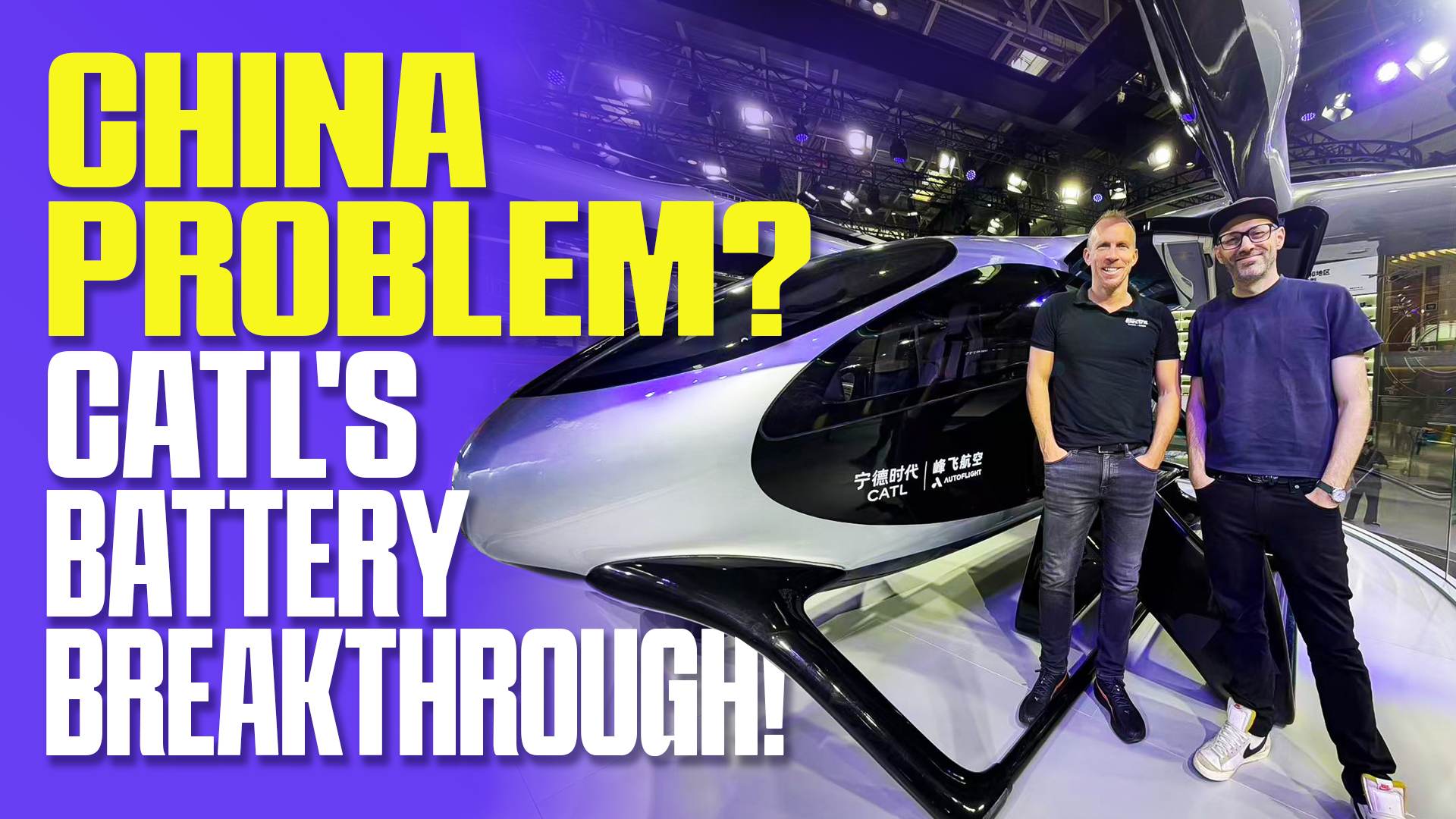
China EV Problem & Battery Breakthroughs by CATL
About this episode
Recorded at Auto Beijing on CATL’s stand, the conversation zooms in on how one battery giant shapes the EV market in China and beyond. The hosts cover CATL’s huge scale, its ties to Tesla, BMW and other automakers, and its latest claims around ultra-fast charging, cold-weather performance, and higher-voltage architectures. They also widen out to China’s price wars, market consolidation, sodium-ion batteries, and the shift toward larger, more premium vehicles.
EVents season kicks off in earnest, with the biggest car show ever held on planet earth. Where else, but in Beijing? But is its scale covering some cracks in the car market more generally and China specifically, Dan Caesar & Elliot Richards think it might be. From inside the cockpit of a CATL battery powered vertical take off and landing craft they predict take off for some, crash landings for others.
Want to see and test drive an array of battery EVs, but can't make it to the major autoshows overseas? Then come join us at our next Everything Electric expo: https://everythingelectric.show
THIS WEEK! - EE NORTH (Harrogate) - 8th & 9th May 2026
EE WEST (Cheltenham) - 12th & 13th June 2026
EE GREATER LONDON (Twickenham) - 11th & 12th Sept 2026
EE SYDNEY - Sydney Olympic Park - 18th - 20th Sept 2026
To partner, exhibit or sponsor at our award-winning expos email: [email protected]
Check out our sister channel Everything Electric TECH: https://www.youtube.com/@EverythingElectricShow
Support our StopBurningStuff campaign: https://www.patreon.com/STOPBurningStuff
Become an Everything Electric Patreon: https://www.patreon.com/fullychargedshow
Become a YouTube member: use JOIN button above Buy the Fully Charged Guide to Electric Vehicles & Clean Energy : https://buff.ly/2GybGt0
Subscribe for episode alerts and the Everything Electric newsletter: https://fullycharged.show/zap-sign-up/
Visit: https://FullyCharged.Show
Find us on X: https://x.com/Everyth1ngElec
Follow us on Instagram: https://instagram.com/officialeverythingelectric
#fullychargedshow #everythingelectricshow #homeenergy #cleanenergy #battery #electriccars #electric-vehicles-uk
B2B
"All events include a B2B EV day and commercial vehicles too and now back to the episode."
B2B means business-to-business. It’s about companies meeting other companies—more industry and partnerships than consumer sales.
B2B means “business-to-business,” referring to events or activities where companies sell to or partner with other companies rather than directly selling to consumers. The hosts mention a “B2B EV day,” implying industry-focused sessions for EV and commercial-vehicle stakeholders.
CATL
"Okay so let's cut straight to the chase. CATL is a company that if you're in the industry you will almost certainly have heard of but for the average person out there you might be unaware of who they are and what they do."
CATL is a company that makes the battery packs used in many electric cars. The episode highlights that it’s become one of the biggest EV battery suppliers in the world.
CATL (Contemporary Amperex Technology Limited) is a major battery manufacturer for electric vehicles. The hosts frame it as a “behind the scenes” supplier whose batteries are used widely across the EV market, including a large share of global EV battery production.
battery electric vehicles
"and a quick fact before I start asking Elliot questions is that of the batteries made for battery EVs around the world CATL are making 39% of them... CATL four out of ten battery electric vehicles are basically carrying their batteries"
Battery electric vehicles are fully electric cars that use a battery for power. They don’t rely on a gas engine to drive.
Battery electric vehicles (BEVs) are cars that run only on electricity stored in onboard battery packs, rather than using a gasoline engine. In the segment, BEVs are used to describe the market where CATL’s batteries are installed at scale.
battery supply share
"of the batteries made for battery EVs around the world CATL are making 39% of them... so between those two Chinese behemoths they're actually producing well over half the batteries"
Battery supply share means how much of the EV battery market a company provides. The episode uses it to show how big CATL is in the EV battery supply chain.
The segment discusses battery supply share—how much of the global EV battery market a manufacturer produces or supplies. This is used to argue CATL’s dominance, including the claim that a large fraction of BEVs use CATL batteries.
subsidies
"they had subsidies they had yeah many benefits from the Chinese government in order to then develop for for automotive in a big way"
In the EV context, subsidies are government financial incentives that reduce the cost and risk of building and buying electric vehicles and related supply-chain components. The segment argues that Chinese subsidies and benefits helped battery companies scale up and invest in automotive-grade battery development.
BYD
"so that really spurred on the innovation and then they invested heavily into research... who were like well we need batteries where do we go it's more BYD or CATL"
BYD is a Chinese company that makes electric cars. The discussion uses BYD as an example of the big car makers that need batteries and therefore push battery suppliers to innovate.
BYD is a Chinese automaker that competes in the EV market and is part of the ecosystem that drives battery demand. In the segment, BYD is mentioned alongside CATL as a key option for OEMs looking for battery supply.
battery tech
"they got something like 120,000 researchers working for their company... they're doing so much research into the latest and greatest battery tech"
Battery tech just means the engineering inside EV batteries—how they’re designed and improved. The episode is saying CATL is spending a lot of effort on newer battery designs and materials.
“Battery tech” refers to the evolving engineering of EV batteries—cell chemistry, design, manufacturing processes, and performance characteristics like energy density and durability. The segment emphasizes that CATL is researching the “latest and greatest” battery technology and that this R&D focus is central to its competitive position.
Tesla
"for those listening in the west it's important to say that CATL is supplying Tesla"
Tesla is a well-known electric car brand. The hosts are saying Tesla is one of the companies that buys batteries from CATL.
Tesla is an EV brand that uses battery cells and packs sourced from major suppliers. The segment highlights Tesla as one of the Western automakers getting batteries from CATL, illustrating CATL’s global reach.
BMW
"CATL is supplying Tesla I think BMW many other western automakers are getting their batteries from CATL as well"
BMW is a car brand. The episode says BMW is also using batteries supplied by CATL.
BMW is a major automaker that sources EV batteries from large cell suppliers. In this segment, BMW is mentioned as another Western brand that gets batteries from CATL, reinforcing the idea that CATL’s technology is used beyond China.
Shenzhen 3
"there's one called the Shenzhen battery they've just announced the Shenzhen 3 so now this comes with super fast charging"
“Shenzhen 3” is the name CATL gave to a new battery version. The host says it’s designed to charge very quickly, even in cold weather.
“Shenzhen 3” is the name of CATL’s newly announced battery platform in this segment. The host connects it to super fast charging performance and cold-weather charging behavior, suggesting it’s a step-change in battery capability.
super fast charging
"the Shenzhen 3 so now this comes with super fast charging so 10 to 80 percent in three minutes... and in minus 30 it only takes nine minutes"
Super fast charging means charging an EV battery much quicker than usual. The host is saying the new battery tech can still charge quickly even in very cold temperatures.
Super fast charging refers to EV charging at very high power so the battery can be refilled quickly. The host ties it to specific charge-time targets (10–80% in minutes) and also mentions cold-weather performance, which is a key challenge for EV fast charging.
cold-weather fast charging
"and then even in minus 30 it only takes nine minutes so you know we've heard the announcements from BYD with their flash charging"
Cold-weather fast charging means charging quickly even when it’s extremely cold. EV batteries don’t always like the cold, so doing it fast without damage is impressive.
Cold-weather fast charging is the ability to charge an EV quickly even when temperatures are very low. Batteries and charging systems often limit power in the cold to protect the cells, so achieving short charge times at -30°C is a notable engineering challenge.
high discharge rate charging
"is the roll out of this... super fast flash charging you know high discharge rate charging and for those cars to be able to enjoy those benefits"
This is charging that delivers a lot of power to the battery quickly. The point is that the battery has to be designed to accept that fast energy without getting damaged quickly.
High discharge rate charging (often discussed as high charge power) means pushing a lot of electrical energy into the battery in a short time. That requires battery chemistry and thermal management that can handle high currents without excessive stress or rapid degradation.
800 volt architecture
"they all have to upgrade to 800 watt a volt architecture 900 watt architecture 1000 volt architecture and all underpinned by the batteries"
800-volt architecture means the car’s electrical system runs at a higher voltage. That can make fast charging easier because it can deliver the needed power with less current.
An 800-volt architecture is an EV electrical system design that uses a higher voltage to reduce current for the same power. Lower current can help enable faster charging and reduce heat in cables and components, but it requires compatible battery packs, inverters, and charging hardware.
1000 volt architecture
"they all have to upgrade to 800 watt a volt architecture 900 watt architecture 1000 volt architecture and all underpinned by the batteries"
1000-volt architecture means the EV uses an even higher voltage system. That can help the car charge faster because the system can move more power with less current.
A 1000-volt architecture is an EV high-voltage system aimed at enabling very high power charging. It typically requires matching components—battery pack, power electronics, and charging interface—to handle the higher voltage safely and efficiently.
900 volt architecture
"they all have to upgrade to 800 watt a volt architecture 900 watt architecture 1000 volt architecture"
900-volt architecture is another step up in the car’s electrical voltage. Higher voltage can help the car accept faster charging without overheating as much.
A 900-volt architecture is a higher-voltage EV design intended to support higher charging power. Like 800V systems, the goal is to improve fast-charging capability by reducing current stress while keeping the battery and power electronics within safe operating limits.
battery health
"and for the super fast flash charging... they all have to upgrade... Shenzhen was one announcement so the super fast charging and the battery health for those batteries after a thousand charges still remains at 90 percent"
Battery health is how good the battery still is after lots of charging. The host is saying the new batteries keep most of their performance even after many charge cycles.
Battery health refers to how well a battery retains its capacity and performance over time, especially after repeated charge cycles. The host highlights that even after a thousand charges, the battery’s health remains high (around 90%), which is crucial for fast-charging technologies to be practical.
battery weight reduction
"if we reduce the size of the weight of the battery and give the same amount of range then it's going to benefit the handling the brakes the lifetime of the like the bearings the bushings and everything else"
Battery weight reduction means making the battery store more energy without getting heavier. A lighter battery can make the car feel better to drive and may reduce stress on parts over time.
Battery weight reduction is the strategy of using higher specific energy cells or improved pack designs so the same range requires less mass. Less battery mass can improve vehicle dynamics (handling) and reduce load on components, potentially extending wear life.
NCM battery
"they've got their Chilean the Chilean third generation battery which is an NCM battery starts with a Q Chilean yeah yeah with a Q and yeah yeah"
An NCM battery is a type of lithium-ion battery that uses nickel, cobalt, and manganese. It’s used in EVs because it can store a lot of energy without needing to be as heavy as some other battery types.
NCM stands for nickel-cobalt-manganese, a lithium-ion battery chemistry. It’s commonly used in EV packs because it can deliver relatively high energy density compared with some other chemistries, which helps with range for a given battery weight.
watt hours per kilograms
"it has 280 watt hours per kilograms that's pretty high but it means the battery for 125 kilowatt battery is 600 kilograms instead of 850 kilograms for a LFP battery"
Watt-hours per kilogram is a way to say how much energy the battery holds compared to how heavy it is. Higher numbers usually mean more range for the same weight.
Watt-hours per kilogram (Wh/kg) is a measure of specific energy—how much electrical energy a battery can store for each kilogram of weight. Higher Wh/kg generally means you can get more range without adding as much mass.
LFP battery
"it means the battery for 125 kilowatt battery is 600 kilograms instead of 850 kilograms for a LFP battery so they've shaved off 200 kilograms from that battery"
An LFP battery is a lithium-ion battery type that uses iron and phosphate. It’s often chosen because it can be tough and cost-effective, though it may be heavier than other chemistries for the same range.
LFP refers to lithium iron phosphate, another lithium-ion battery chemistry used in EVs. Compared with NCM, LFP packs are often heavier for the same energy, but they’re frequently favored for cost and durability characteristics.
flash charging
"if you have flash charging then do you need a car with a huge battery and so much rain"
Flash charging means charging an EV very quickly. If you can recharge fast, you might not need as big of a battery to still get practical trips done.
Flash charging is a marketing term for very fast EV charging, typically implying high charging power and short time-to-charge. The discussion here is about whether fast charging reduces the need for an especially large battery pack.
CLTC range
"which now means they can get a thousand kilometers from an EV like CLTC range but 800 kilometers maybe from a battery"
CLTC range is an official test-based estimate of how far an EV can go. It’s specific to China’s testing rules, so the number may not match other countries’ range tests.
CLTC range refers to the China Light-Duty Vehicle Test Cycle, a standardized test used to estimate EV driving range. It’s not the same as EPA or WLTP testing, so numbers can be higher or lower depending on the test method.
energy density
"having lighter batteries which have much more which are much more energy dense will really help the industry try and reduce its weight in general"
Energy density is how much “stuff” (energy) the battery can pack into its size or weight. Higher energy density helps EVs go farther without needing a bigger, heavier battery.
Energy density describes how much energy a battery can store in a given volume or weight. In EV discussions, higher energy density typically translates to more range (or more usable capacity) without increasing battery size and mass as much.
charging in the ground
"at the moment a lot of focus is downstream is people putting a lot of charging in the ground that maybe is slower maybe putting in the wrong type of charging maybe we'll end up with too much charging"
They’re talking about building charging stations in fixed locations. The point is that faster-charging, longer-range batteries could change how many chargers you really need and where they should go.
“Charging in the ground” refers to installing charging infrastructure (like chargers at fixed sites) rather than relying on other concepts such as swapping or alternative energy logistics. The hosts argue that if batteries charge faster and have longer range, the optimal charging network build-out could change.
sodium battery
"I'm quite interested I'm fascinated always by sodium oh yeah yeah yeah so I think then the Naxra battery is there that's right a sodium battery that's showing great promise as well yeah so then we went to the far north of China to see the Naxra battery"
A sodium battery is a type of EV battery that uses sodium instead of lithium. People are interested because it can be cheaper and may work better in very cold conditions.
A sodium battery uses sodium-based materials instead of the more common lithium-based chemistry. The big appeal is cost and supply-chain advantages, and it can perform well in cold weather depending on the specific design.
sodium ion battery
"they were releasing their new sodium ion battery with Chang'an and they're putting in one of their more affordable sedans like fairly plain sedan and they announced that that will be going to mass production in Q4 of this year"
A sodium-ion battery is an EV battery that moves sodium ions to store and release energy. It’s often discussed as a cheaper alternative to lithium batteries, and it can still work in cold weather.
A sodium-ion battery is a sodium battery chemistry where sodium ions shuttle between electrodes during charge and discharge. Compared with lithium-ion, sodium-ion can be cheaper and may offer better cold-weather practicality, though energy density (range per kg) is often lower.

Chang'an sedan
"they were releasing their new sodium ion battery with Chang'an and they're putting in one of their more affordable sedans like fairly plain sedan and they announced that that will be going to mass production in Q4 of this year"
Chang'an is a Chinese car brand, and they’re talking about putting the new battery into an affordable sedan. That matters because it suggests the battery could reach regular buyers, not just special cars.
Chang'an is a major Chinese automaker, and the hosts describe fitting the new sodium-ion battery into one of its more affordable sedans. Using a mainstream sedan is important because it signals the battery tech is aimed at mass-market EVs rather than only niche vehicles.
mass production
"and they announced that that will be going to mass production in Q4 of this year so slightly later than we originally thought"
Mass production means they’re planning to make a lot of these batteries and cars. Making them in bigger numbers is usually how prices come down.
Mass production means the battery and vehicle are planned for high-volume manufacturing, not limited pilot runs. For EV batteries, scaling manufacturing is a key driver of lower unit costs and faster deployment.
icy cold conditions
"it's I think 400 to 500 kilometers at the moment but it can work in icy cold conditions it's so much cheaper so much more affordable"
Cold-weather performance means how well the battery works when it’s very cold outside. EV batteries can lose range in winter, so this is a big deal for real-world usability.
Cold-weather performance is how well an EV battery maintains usable power and range when temperatures drop. Battery chemistry and thermal management affect how much capacity is available and how quickly the car can operate without severe range loss.
vertical integration around the supply chain
"the degree to which the Chinese manufacturers have built themselves around sort of vertical integration around the supply chain cost down advantages"
Vertical integration is when a company handles many parts of the process itself instead of relying on lots of separate suppliers. That can lower costs and make it faster to build batteries and EVs.
Vertical integration means a company controls multiple steps of the supply chain, from raw materials to manufacturing. In EV batteries, that can reduce costs and improve speed because fewer handoffs and dependencies exist between suppliers.
at scale and speed
"if they get to sodium ion at scale and speed that's going to give them if they get to sodium ion at scale and speed"
“At scale and speed” refers to the ability to manufacture a new technology in large volumes quickly. For batteries, that matters because costs typically fall and reliability improves only after production ramps up.
price wars
"you know we've seen some automakers not doing very well in europe and other markets and back home here there's the price wars so things are getting so competitive now so what's happened is these automakers have responded by saying..."
“Price wars” refers to automakers aggressively cutting prices to win market share, often forcing competitors to respond quickly. In this segment, the host says price wars at home and weak overseas performance push brands toward safer, copycat product strategies instead of taking risks.
Xiaomi
"so let's just do the Xiaomi copy we know big three-row SUVs with hybrid power trains in them are also selling really well so we'll just do that ... Xiaomi have made quite a lot of progress"
Xiaomi is being used as an example of a company whose EVs are popular, so other brands try to copy the same general approach. The host links that to how competitive and risky the market feels right now.
Xiaomi is discussed as a tech-driven automaker whose EVs sell well enough that other brands are copying their formula. In the segment, the host argues that this “copycat” behavior is driven by fear of losing sales in a competitive market.
hybrid power trains
"so let's just do the Xiaomi copy we know big three-row SUVs with hybrid power trains in them are also selling really well so we'll just do that"
A hybrid power train uses both a gasoline engine and an electric motor. The host is saying that hybrid SUVs with lots of seats are selling well, so other brands want to copy that approach.
Hybrid power trains combine an internal-combustion engine with an electric motor and battery to improve efficiency and drivability. The host mentions hybrid three-row SUVs as a proven sales formula that other automakers are trying to replicate.
Citroen
"who knows if that will sell Citroen are doing some interesting concepts whether they sell very well and that's really about it"
Citroën comes up as a brand that’s showing some creative ideas. The host contrasts it with other automakers that are being more cautious because competition is intense.
Citroën is mentioned as a brand that is trying “interesting concepts” rather than only following the safest, most copycat approach. The host frames this as rare experimentation amid broader caution and price wars.
battery EVs
"the political pendulum swings towards EV at one point maybe back towards hybrids in in in more recent times will swing inevitably back towards battery EVs because that is the better technology"
A battery EV is a car that runs on electricity stored in a battery. The hosts are saying battery-electric cars will likely become the dominant choice eventually.
“Battery EVs” are electric vehicles powered primarily by a rechargeable battery pack, with energy delivered to electric motors. The discussion contrasts them with hybrids and implies that battery-electric drivetrains are the “better technology” over time.
China EV market consolidation and competition
"there doesn't feel it's bigger than the Shanghai show yes so that belies the rumors that the chinese car industry is is on the floor but it doesn't seem quite as distinct to me there does seem to be some copycatting going on some herd mentality going on"
They’re talking about how EV competition in China is getting more intense and how companies may merge, shut down brands, or change direction. The overall theme is that the market is moving fast.
This segment discusses how the Chinese EV market is evolving through intense competition, copycat behavior, and consolidation among automakers. The hosts also reference major upcoming industry events and the idea that the market’s direction can shift quickly.
Geely
"i mean you look at um so geely for example closed down their gdu car brand after what's it two or three years"
Geely is a car company in China. The host says Geely closed one of its car brands (GDU) after only a few years, showing how tough and fast-changing the EV market is.
Geely is an automaker group that has tried multiple brand strategies in China, including launching and then shutting down a separate EV-focused brand. The host uses Geely’s decision to close its GDU brand as an example of how fast the market is consolidating and how risky EV brand bets can be.
GDU car brand
"so geely for example closed down their gdu car brand after what's it two or three years they cars on the streets"
The host mentions Geely’s GDU brand, which they say was shut down after a couple of years. It’s an example of how some EV brand launches don’t last when competition gets too intense.
The “GDU car brand” is referenced as a Geely sub-brand that was closed after a short period. Brand closures like this often reflect shifting demand, intense competition, and the difficulty of sustaining separate EV identities in a crowded market.
Honda
"got five ev almost at china market only right is it enough maybe not honda for example they just closed the factory i think last week in china"
Honda is a car brand from Japan. The hosts say Honda is changing its China plans and moving away from gas cars, which shows how EVs are taking over.
Honda is a Japanese automaker referenced here as an example of a company shifting its China strategy away from internal-combustion vehicles. The hosts claim Honda closed a factory because it no longer sells ICE vehicles in China, illustrating how quickly some automakers are pivoting to EVs.
ICE vehicles
"they don't sell ice vehicles anymore in china so yet legacy brands"
ICE vehicles are gas or diesel cars. The hosts are saying some automakers are stopping sales of gas cars in China and focusing on electric cars instead.
ICE vehicles are internal-combustion-engine cars, meaning they run on gasoline or diesel. The hosts use ICE vehicles to describe the shift in China away from gas cars toward EVs, including claims about factory closures tied to that transition.
Volkswagen
"legacy brands that the more agile legacy brands like vw they've built and designed a car with x-peng in china for china"
Volkswagen (VW) is a major global automaker that the hosts describe as partnering with a Chinese EV brand to develop a China-specific electric car. This highlights how legacy automakers are adapting their product strategy for the EV market.
Xpeng
"legacy brands that the more agile legacy brands like vw they've built and designed a car with x-peng in china for china it looks fabulous"
Xpeng is a Chinese company that makes electric cars. The hosts bring it up because some traditional automakers are working with Chinese EV brands to compete in China.
XPeng (Xpeng) is a Chinese EV brand associated with software-heavy vehicles and modern user experiences. The hosts mention it in the context of legacy automakers partnering with Chinese EV companies to build cars for the China market.
disposable income
"things are tightening so for example people are staying in their jobs for longer ... they have less disposable income so they're not buying as many cars"
Disposable income is the money people have left after paying for the basics. If that number drops, it’s harder for people to afford big purchases like a new car.
Disposable income is the money households have left after paying for necessities like taxes and basic expenses. The hosts connect it to EV demand by arguing that when disposable income falls, people buy fewer cars.
democratization of transport
"lots of smaller more affordable at these yes [1602.5s] cars about which our audience typically gets quite excited because it's about the democratization of [1607.7s] transport maybe cheaper vehicles maybe you don't need to lug around the big battery..."
“Democratization of transport” in EV context means making electric mobility accessible to more people, typically by lowering purchase price and reducing barriers like charging access. The hosts connect this to smaller, cheaper EVs that don’t require very large batteries.
kilowatt hour battery
"so many automakers had a small e-v like this is our small e-v it's 3000 pounds four [1682.1s] thousand pounds 20 kilowatt hour battery none of that i think there's two small cars here this year..."
A kilowatt-hour (kWh) is a measure of how much energy the battery can store. Bigger kWh usually means the car can go farther, but it’s not the only factor.
A “kilowatt-hour (kWh) battery” is the way battery capacity is measured. Higher kWh generally means more stored energy, which usually translates to more potential driving range (though real-world range also depends on efficiency).
over complicating the product
"maybe over complicating the product absolutely and i guess productising it making it more expensive than and taking it away from the average everyday person"
“Over complicating the product” refers to adding too many features, options, or layers of complexity so the end result becomes harder to understand and more expensive. The host connects this to EV marketing and product strategy, suggesting the industry may be pushing tech and larger vehicles that not everyone actually wants.
productising it
"absolutely and i guess productising it making it more expensive than and taking it away from the average everyday person"
“Productising” means turning something that might have been more flexible or niche into a standardized, packaged offering. In this segment, the host argues that productising EV/tech features can raise cost and make the result less accessible to everyday buyers.
Renault 5
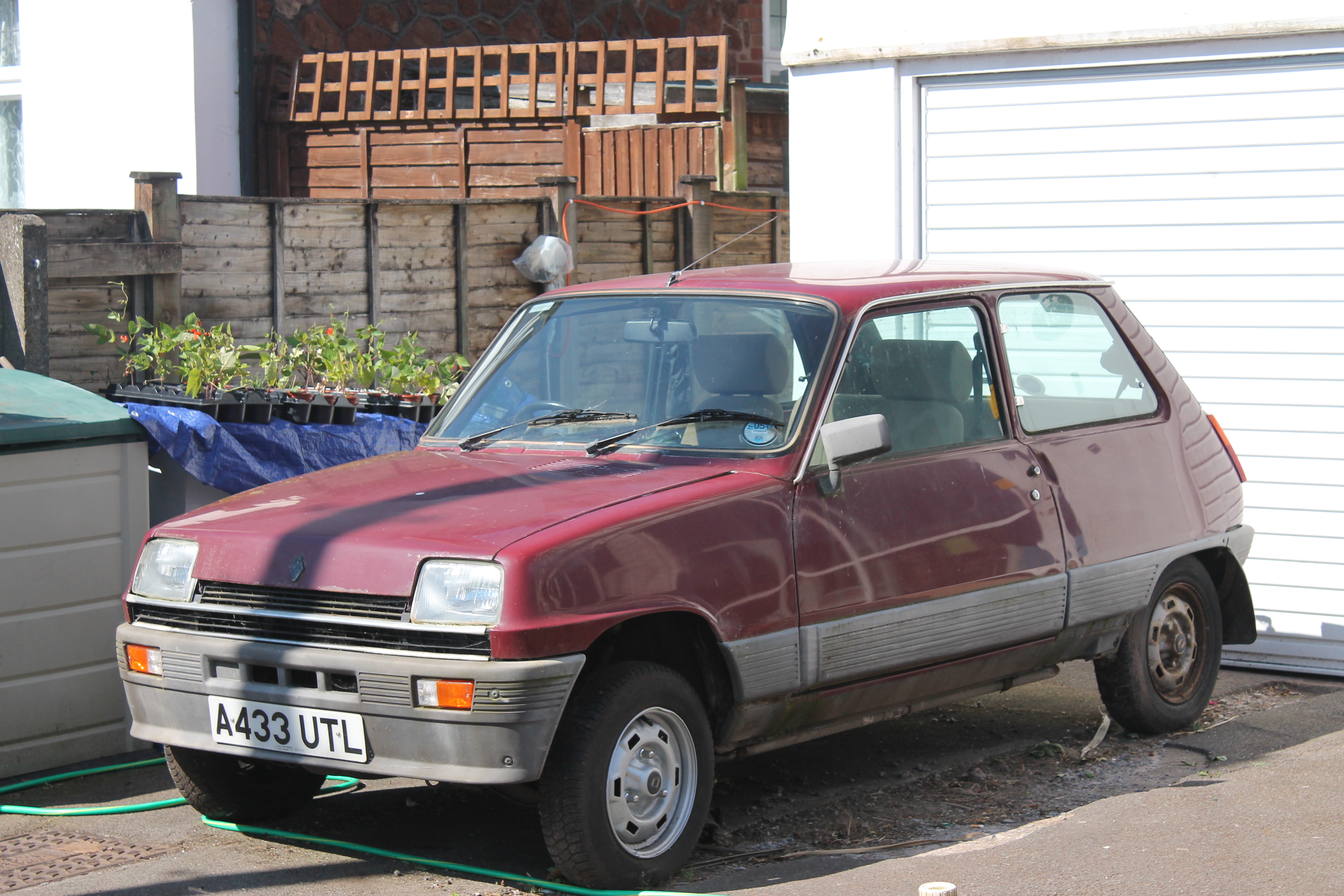
"but if the smaller vehicles aren't selling that well that's a problem like we talked quite extensively about reno five selling well in the UK and europe and that's a great little car at a reasonable price point"
Renault 5 is a small, everyday car. The host brings it up because it’s selling well, showing that smaller cars can still be popular if they’re priced right.
Renault 5 is a small, city-focused hatchback that’s often used as an example of a “reasonable price point” car. In this segment, the host cites Renault 5 sales in the UK and Europe to argue that smaller vehicles can still succeed when priced accessibly.
smart
"we mentioned the smart hashtag too which is yeah well they're going smart going back to its roots effectively which is which is good to see i hope it does sell well but my view is that people are are probably looking for those slightly bigger cars"
smart is a car brand that’s usually associated with small city cars. In this segment, the host is saying smart is trying a bolder new direction to win buyers back.
smart is a car brand known for compact, city-friendly vehicles. Here, the host discusses the “smart hashtag too” as a design-forward direction that’s intended to return the brand to its roots and appeal to consumers.

Land Rover Freelander
"you know i haven't been particularly excited about like the freelander looks cool but if you've seen the concept here it's huge it's like taller than me it's a concept of course freelander great to see that brand coming back but it's another suv they're going to go up market"
Freelander is a Land Rover SUV name. The host is using it as an example of how new models can look interesting, but they’re still part of the bigger-SUV trend.
The Land Rover Freelander name is associated with a compact-to-midsize SUV lineup. In this segment, the host mentions the Freelander’s look and then pivots to the idea that new launches are trending toward larger SUVs.
premium and luxury pricing strategy
"the problem with those small cars they don't make profit... they have to say well this car's premium so we're going to add another few thousand pounds of it it's luxury we're going to add another and that's how they're trying to make their money back"
They’re talking about companies trying to make money by selling mostly higher-end versions of cars. If the cheaper models disappear, buyers feel like they have no choice but to pay more. It’s basically a lineup-and-pricing shift toward premium/luxury.
The hosts describe a pricing strategy where automakers shift their lineup toward premium and luxury trims to recover profits. In practice, that can shrink the “entry-level” segment so buyers only have higher-priced options. This is especially relevant when companies are under financial pressure and need higher margins per sale.
motor shows
"when it comes to motor shows i've been to a i've probably got motor show fatigue... fascinating to see all the product launched in Shanghai flow through munich and brussels"
They’re talking about car expos and how useful they are for seeing what companies are planning. The speaker compares different show locations and suggests one show felt like a bigger sign of change. It’s about trends, not a single car.
The hosts discuss how auto shows function as a barometer for what brands are launching and how quickly the market is changing. They compare the scale and impact of events in Shanghai versus European venues. This is more about industry momentum and product announcements than a specific technical detail.
Audi
"i'm fascinated with how the Germans are presenting to the market last year in Shanghai Audi launched they've got a four ring strategy"
Audi is a German car brand. They’re talking about Audi’s China-focused strategy and whether it’s selling well. The discussion is about how brands reposition themselves in China’s EV market.
Audi is a German automaker and one of the “four rings” brands the hosts reference in the context of China strategy. The segment mentions Audi launching a China-focused “four letter” strategy/brand approach, and then questions how well it’s selling. The key takeaway is how German brands are adapting their lineup and branding for the Chinese EV market.
Polestar
"it's got the same problem as polestar so polestar has basically pulled out the market here even though they're still built here"
Polestar is an electric-car brand. The speaker says Polestar stepped back from China because it wasn’t selling as well as expected, even though cars were still being made there. It’s an example of how market demand and brand image matter.
Polestar is an EV brand that the hosts say has pulled out of the Chinese market despite still being built there. The implication is that brand perception and sales traction can be harder than manufacturing capacity alone. This is used as an example of why some premium EV strategies struggle in China.
Huawei
"they're moving faster than the japanese because they they're integrating Huawei tech into their cars so bmw are i think audi are doing it as well"
Huawei is a big tech company, and the host is saying BMW is using Huawei technology in its cars. The idea is that tech partnerships can help automakers move faster on EV features.
Huawei is referenced as a technology provider whose systems are being integrated into cars. In this context, the host is implying that partnering with a major tech company can speed up EV software and connectivity capabilities.
Hyundai
"i saw a new Hyundai launched yesterday didn't like the look i say that regretfully because i like i like the Hyundai kind of design language but actually it was chinese design"
The host talks about a new Hyundai and doesn’t like its design. They think it looks like it’s borrowing from Chinese styling trends, and they compare it to the new Prius.
Hyundai is referenced via a newly launched model and its design language. The host criticizes the look as being influenced by Chinese design trends and compares it to the new Prius, highlighting how quickly styling cues are converging in global EV markets.

Toyota Prius
"...t was chinese design it looked a bit like the new Prius as well that's right yeah a bit of a bit of a str..."
The Toyota Prius is a car that uses two kinds of power: a gas engine and an electric motor. The electric part helps the car use less fuel, especially in stop-and-go driving. It’s a well-known model, so people often compare other cars to it based on how it looks.
The Toyota Prius is a hybrid electric car known for using both a gasoline engine and an electric motor to improve fuel efficiency. It’s often discussed in podcasts because it helped popularize hybrid technology and because its design and powertrain are widely recognized benchmarks for “electrified” vehicles. Mentions like “it looked a bit like the new Prius” usually point to how recognizable the Prius styling has become.
Request an Explanation
Heard something you'd like explained? We'll add it to this episode.
Sign in to request explanations for terms you heard.
Want to learn more?
Browse our glossary for plain-English explanations of automotive terms, jargon, and concepts.
Help improve this episode
See something that's not quite right? Our annotations are AI-generated and can sometimes miss the mark. Click the flag icon on any annotation to suggest a correction.