About this episode
Constantin Buschmann, Brabus’ CEO, joins Bloomberg Hot Pursuit, and the conversation quickly turns into a BMW M2 vs M4 value debate—especially the idea that the M2 CS is “so good” that the M4 step-up may not make sense. They compare shared inline-six twin-turbo architecture, then argue about modern dashboard screens versus physical controls and the cost-cutting behind losing manuals. The show also pivots to tinnitus and hearing protection, before shifting back to Buschmann’s passion-driven, V12 “pure GT” coach-built projects and brand philosophy.
Brabus owner and CEO Constantin Buschmann joins the show to talk about his life running the company his father co-founded in Bottrop, Germany, in 1977 - and why it was time to debut the newest car from Brabus, the $1 million Bodo. Plus the BMW M2 versus the BMW M4 and why everyone in the car world needs to start talking about tinnitus.
See omnystudio.com/listener for privacy information.
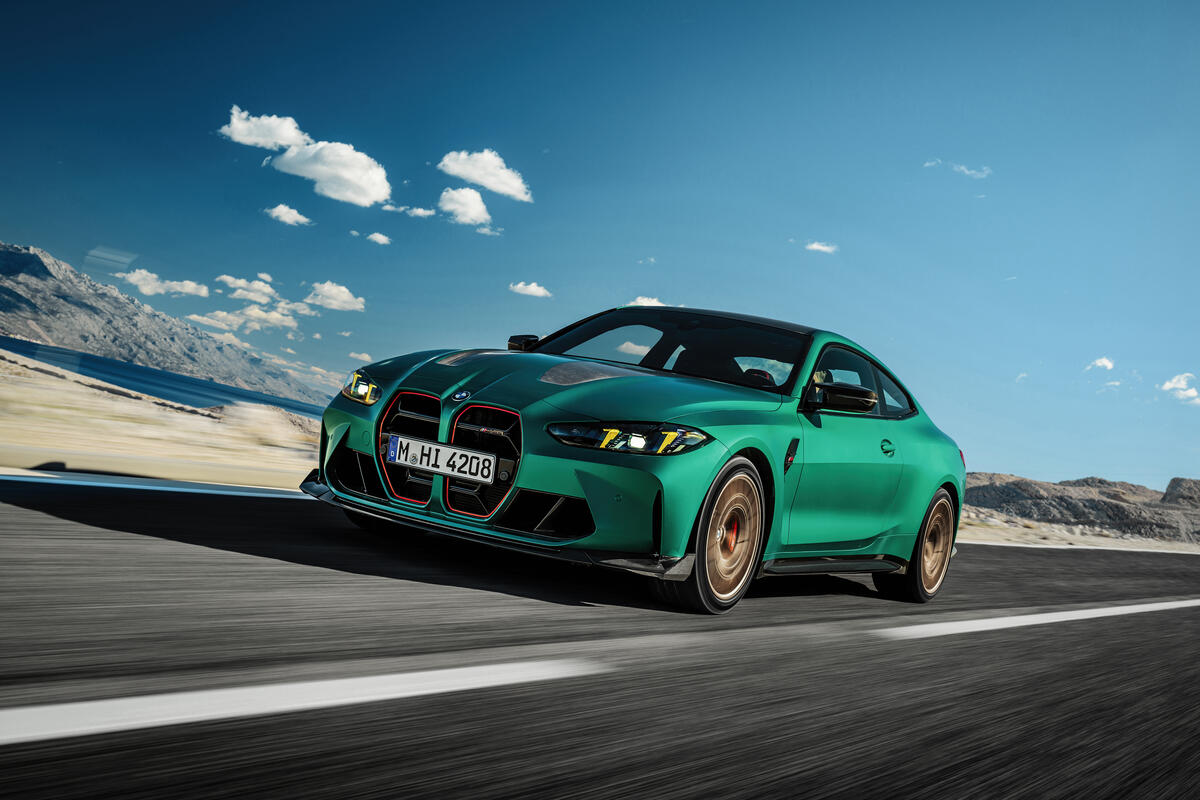
BMW M4
"I kind of think we don't need the M four. [94.7s] It's actually no shade to the M four. It's just [97.6s] that the M two, especially the CS, is so good."
The BMW M4 is BMW’s high-performance version of the 4 Series. It’s meant to be quick and fun to drive, and here they’re comparing it to a smaller BMW M car.
The BMW M4 is the performance coupe/convertible from BMW’s M division, built to deliver track-capable handling and strong straight-line power. In this segment, it’s brought up as a larger alternative to the smaller, more focused M2.
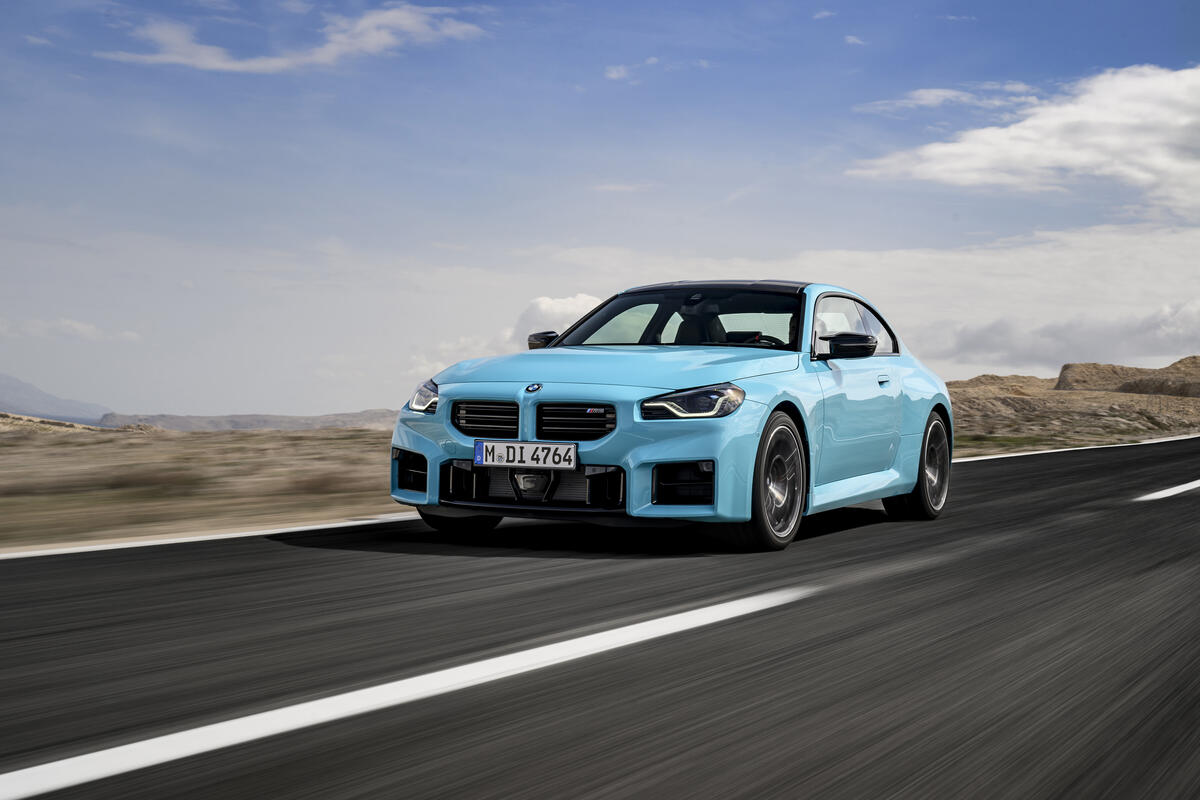
BMW M2 CS
"It's actually no shade to the M four. It's just [97.6s] that the M two, especially the CS, is so good. [103.3s] It's like, why do you need to pay more for an inferior car?"
The BMW M2 CS is a special, more aggressive version of the BMW M2. In the conversation, they’re saying it’s such a great driving car that you might not need to step up to a larger, more expensive BMW.
The BMW M2 CS is a more hardcore, higher-performance variant of the BMW M2, positioned as a lighter, sharper-feeling option within the M2 lineup. The hosts use it as the benchmark in this discussion, arguing it’s so good that paying for a bigger M car doesn’t make sense for many buyers.

BMW M8
"But in that case you could go with the M eight. I mean, I feel like you [118.0s] go one way or the other."
The BMW M8 is BMW’s big, powerful performance car. They mention it as the next step if you want something larger than the smaller M2.
The BMW M8 is BMW’s high-performance flagship in the M lineup, typically associated with the larger, more luxurious 8 Series platform. Here it’s mentioned as the “go one way or the other” alternative if you want more size than the M2.
twin turbo
"Now. They both both the M two [161.4s] and the M four have that three leader twin turbot in line six, so it's not like the M four gives you any real more performance."
“Twin turbo” means the engine uses two turbochargers to help it make more power. More air gets pushed into the engine, which usually makes the car feel quicker.
A twin-turbo setup uses two turbochargers to force more air into the engine, allowing higher power and stronger acceleration. In this segment, the host says both the BMW M2 and M4 use an inline-six with twin turbos, so the performance difference isn’t simply “more turbo.”
inline six
"Now. They both both the M two [161.4s] and the M four have that three leader twin turbot in line six, so it's not like the M four gives you any real more performance."
An inline-six is an engine with six cylinders lined up in a row. It’s a common layout in performance BMWs, and here the host is saying both cars share that same basic engine design.
An inline-six is an engine layout where all six cylinders are arranged in a single row. The host specifically ties this inline-six architecture to the BMW M2 and M4’s shared twin-turbo design, arguing that the engine fundamentals are similar.
bucket seats
"I [181.2s] also really liked the interior. I thought the bucket seats [185.7s] were actually I love that they cradle you and really hold you in."
Bucket seats are sport seats that wrap around you more than a normal seat. They help keep you positioned during cornering, and in this case they’re also adjustable and shaped to feel supportive.
Bucket seats are deep, contoured seats designed to hold your body in place during spirited driving. The host praises BMW’s bucket seats for cradling and supporting the driver, while also noting they’re adjustable and include side cutouts for hand placement.
screens
"I thought [210.6s] the screens were fine, not overpowering, very straightforward. Everything sinked. [220.1s] There weren't a lot of layers to get to essential controls. ... [271.4s] One place that I one place that I can't agree is the screens. I don't I don't understand you approved [278.8s] the installation of these screens. It looks like they're just [281.8s] like glued on to the dash."
“Screens” are the digital displays in the dashboard for things like navigation, media, and driver info. The host thinks they’re too visually “tacked on” rather than smoothly integrated.
In modern cars, “screens” usually refers to integrated infotainment and driver-display displays. The host comments on their usability and also criticizes the installation look, saying they appear “glued on” to the dash.
carbon fiber
"I even [231.4s] thought that the multiple textures inside with the carbon fiber, and you know some of these other details that and the colors can get a little well, usually they get a little too much, but here it just all felt very of a kind."
Carbon fiber is a strong, lightweight material that’s often used in sporty car interiors. It usually looks “techy” or premium, and the host is saying it fits the car’s interior style well.
Carbon fiber is a lightweight, high-strength composite material often used in performance cars to reduce weight and add a distinctive look. Here, the host mentions carbon fiber among the interior textures and finishes, emphasizing the overall design cohesion.
door cards
"But they have. [261.0s] This really sweet BMW kind of I don't know, it's not engraving or embossing. I don't know what it is. [267.8s] But on the on the door cards, that's great."
Door cards are the panels you see on the inside of the doors. They often include the armrest and controls, and here the host is praising their design.
Door cards are the interior trim panels on the inside of a car’s doors. The host specifically likes the way BMW’s door cards are finished, referencing a decorative surface treatment on them.
embossing
"This really sweet BMW kind of I don't know, it's not engraving or embossing. I don't know what it is. [267.8s] But on the on the door cards, that's great."
Embossing is when a design is pressed into a surface so it sticks out (or goes in) instead of just being printed. The host is saying the door trim has a look like that.
Embossing is a decorative process that creates raised (or sometimes recessed) patterns in a material. The host is trying to identify the specific surface effect on the BMW door cards, comparing it to embossing versus engraving.
M4 GTS
"which you know, my neighbor Eric had the old M two and now he has the M four GTS from twenty sixteen. That setup is just so much better."
The BMW M4 GTS is a high-performance, more track-oriented M4. The hosts bring it up while talking about whether big dashboard screens are a good idea or whether physical buttons are better for a driver-focused car.
BMW M4 GTS is a track-focused version of the M4, known for its more aggressive setup and driver-oriented feel compared with standard M4 models. In this discussion, it’s used as the example of a car whose cockpit layout—especially the screen vs physical controls—matters for usability and “racey” character.
physical buttons
"And physical buttons for the stuff that you're going to be doing often. I think they made a real mistake,"
Physical buttons are the real knobs and buttons you can press without looking at a screen. The speaker prefers them because they’re quicker and easier to use while you’re driving.
“Physical buttons” refers to real, tactile controls on the dashboard rather than touch-only controls or menu-driven screen interactions. The point here is that tactile controls can be faster and safer to use repeatedly while driving.
analog controls
"I wonder totally, and I know that we have seene automakers sort of revert back to analog controls. Multiple automakers have done this."
Analog controls are the traditional knobs and buttons you use directly, not touchscreen menus. The host is saying some brands have been returning to that style, but they don’t think the big screens will go away.
“Analog controls” means traditional, non-screen-based inputs like knobs, switches, and physical gauges. The speaker notes that some automakers have moved back toward these, but they don’t expect dashboard screen sizes to shrink again.
screen that rolls away
"And frankly, some companies like Bentley, you know they have that screen that rolls away. Yeah, so you flip screen, you don't."
A “screen that rolls away” is a dashboard display that can move out of sight. The idea is to keep the interior from looking dominated by a big screen when you don’t need it.
A “screen that rolls away” describes a retractable or motorized display that can disappear from view, typically to keep the dashboard looking clean or to reduce distraction. The speaker contrasts this with fixed, always-visible giant screens.
Bentley
"And frankly, some companies like Bentley, you know they have that screen that rolls away."
Bentley is a luxury car maker. The host mentions it because some Bentleys use a screen that can move away when you’re not using it, so it doesn’t dominate the dashboard all the time.
Bentley is a luxury car brand known for high-end interiors and distinctive infotainment approaches. Here it’s mentioned as an example of a system where the screen “rolls away,” reducing how much of the dashboard you see when you don’t need it.
manual option
"Well, I think it's mainly cost cutting, right, They won't want to make things cheaper. The reason that you don't [454.1s] have a handbrake, the reason that you don't have a manual option, the reason that you don't have physical buttons and knobs is that it's cheaper."
A “manual option” means the car can be bought with a stick shift. Some people like it because it feels more connected to driving, but manufacturers sometimes don’t offer it to save money or because fewer people buy it.
A “manual option” means the car is offered with a manual transmission (a stick shift) instead of an automatic. Enthusiasts often prefer manuals for the direct driver control and engagement, but automakers may avoid them due to cost, demand, and regulatory/packaging constraints.
M two
"So what did you [528.3s] think about the fact that there's no manual option with the CS on the M two. Is it all? [534.2s] Yes? And I don't have an ego attached to this."
The BMW M2 is a small, sporty BMW made for driving fun. Here, they’re talking about whether you can get it with a manual (stick shift) and how that changes what people want to buy.
The BMW M2 is a compact performance coupe from BMW’s M division, known for being relatively small and driver-focused. In this segment, the hosts discuss whether the M2 should be offered with a manual transmission and how that affects desirability and value.
manual transmission
"[534.2s] Yes? And I don't have an ego attached to this. [537.2s] I don't need like a stick shift to feel cool or whatever, and I don't think it makes sense to have it in a lot of cars, but this would be the car to have it in for sure as an option."
A “stick shift” is a car with a manual gearbox. You choose gears yourself with the gear lever (usually with a clutch pedal), and the host is saying that doesn’t automatically make a car cooler—it depends on the car.
A “stick shift” is the everyday name for a manual transmission, where the driver selects gears using a clutch pedal and a gear lever. In this segment, the host argues that needing a stick shift isn’t about ego—it’s about whether it makes sense for a particular car.
I shift transmission
"It would make a thousand just something very short, [549.6s] a very quick short shift transmission would be really really fun and would sort of be the cherry on top. [556.6s] I could imagine buying like for real and M two instead of you know, stepping up to a nine to eleven."
A “short shift transmission” is a manual setup that makes shifting feel quicker and more direct. Instead of moving the shifter a long way, it’s designed to move less for faster, smoother gear changes.
A “short shift transmission” is a setup designed to reduce how far and how long the gear lever moves between gears. The goal is quicker, more precise shifting feel, which can make a manual car more fun during spirited driving.
race livery
"And that also reminds me, like going back [610.6s] to the M four, the M four comes with you know, like an extra extreme looking race livery with Riviera blue color and like this anthracite detailing, and it's supposed to look really extreme, even more extreme than the M two."
A “race livery” is the sporty, racing-themed paint and graphics on a car. It’s mostly about looks—making the car look like it belongs on a track.
A “race livery” is a racing-style paint and graphics package—often with bold colors, stripes, and decals—meant to visually evoke motorsport. It’s an appearance package rather than a mechanical upgrade, but it can strongly influence how “track” a car feels.
Riviera blue
"the M four comes with you know, like an extra extreme looking race livery with Riviera blue color and like this anthracite detailing, and it's supposed to look really extreme, even more extreme than the M two."
“Riviera blue” is a specific named blue paint color. It’s not just “blue”—it’s a particular shade BMW uses on some models.
“Riviera blue” is a named paint color used by BMW on certain M models and special editions. Named colors matter because they’re specific shades that can be hard to replicate exactly with aftermarket paint.
anthracite detailing
"with Riviera blue color and like this anthracite detailing, and it's supposed to look really extreme, even more extreme than the M two. [629.8s] And they also charge more. The M four is like"
“Anthracite detailing” means dark gray (almost black) accents on the car. It’s used to make the design stand out, especially against a brighter color.
“Anthracite detailing” refers to dark gray, near-black trim or accents (like grilles, badges, or interior/exterior details) finished in an anthracite tone. It’s a common styling choice to create contrast against brighter paint colors.

Rolls-Royce Phantom
"... at least who has tonightis, which is a sort of a phantom ringing in your ears. It's ringing or humming or ..."
The Rolls-Royce Phantom is a very expensive luxury car, built as a large, comfortable sedan. It’s designed to feel smooth and quiet, with lots of high-end features. People bring it up when they want to talk about the most luxurious type of car.
The Rolls-Royce Phantom is a flagship luxury sedan known for its very high-end comfort, quiet ride, and bespoke-level features. It’s frequently referenced in media because it symbolizes top-tier prestige and a “grand touring” experience. In a podcast, it may be mentioned to evoke that sense of luxury and presence.
tinnitus
"It's ringing or humming or scratching that is not from an external source, and it's not hearing loss. It's related [710.5s] and the biggest cause of Tonight's is sound exposure."
Tinnitus is when you hear ringing or buzzing in your ears even when nothing is making that sound. The episode also points out that loud noise exposure is a major cause.
Tinnitus is a phantom ringing, humming, or scratching sound you perceive even though there’s no external noise source. The segment explains it’s commonly linked to sound exposure and distinguishes it from hearing loss.
FDA approved treatment
"There's [721.2s] only one FDA approved treatment for tonightas there's a lot of smoking, smoke and mirrors and snake oil out there."
“FDA approved” means a treatment has been reviewed by the U.S. government for safety and effectiveness. The host is saying that for tinnitus, there’s only one officially approved option, while many other products are questionable.
An FDA-approved treatment is a therapy that the U.S. Food and Drug Administration has evaluated and authorized for use. The speaker claims there’s only one FDA-approved treatment for tinnitus, contrasting it with other unproven products marketed as cures.
IFB
"[767.2s] You know what, I've always felt like it's time for me to start protecting my ears. You're right. TV news [772.6s] anchors get it a lot because we're always we have the IFB in our ears, the same as you know, musicians have a say"
IFB is the audio cue system used in TV and live events—basically a private earpiece feed for instructions. The point they’re making is that people in that environment may be exposed to audio in a way that affects their ears.
IFB (interrupted foldback) is an in-ear audio feed used in broadcast and live production so talent can hear instructions. The speaker compares it to the sound exposure musicians deal with, implying it can contribute to ear-related issues.
individualization
"as the mega trend of individualization. You know, today you can inspect your Dell computer with custom parts, you can customize your Nike shoe."
They mean making things more personal instead of standard. In cars, that usually means customizing details so it feels like it was made for you.
Individualization here means tailoring products—like cars—to a specific owner’s tastes rather than buying a one-size-fits-all configuration. In automotive terms, it points to personalization trends such as custom styling, wheels, and interior choices.
bonnet
"driving an sl R one twenty nine in the nineties without the bonnet, without the hood, you know, and on the highway in Germany"
A “bonnet” is just the hood of the car. They’re saying the photo was taken with it removed, which makes it look more dramatic.
“Bonnet” is the British term for the car’s hood. The transcript emphasizes that the photo was taken without the bonnet/hood, which is unusual and visually striking.

Jeep Renegade
"...e. And he was somebody that was a little bit of a renegade, typical first generation entrepreneur, typical p..."
The Jeep Renegade is a small SUV made by Jeep. It’s meant to be easy to drive in everyday traffic, while still having a rugged style. People might mention it because it’s a compact “Jeep” option.
The Jeep Renegade is a compact SUV from Jeep, designed for everyday driving with a more rugged, off-road-inspired look. It often comes up in conversations about “renegade” as a name, but the vehicle itself is significant as an entry-point Jeep model in the small-SUV segment. It may be discussed because it represents a practical, city-friendly way to get Jeep styling and capability.
Bodo
"If you if you look at cars like the Bodo, it is the most per the most passion driven project, not only of my life but of a large You know, almost everybody in the team"
They’re talking about the “Bodo,” a very special, custom supercar project. It’s described as rare and built for clients who really care about cars.
The “Bodo” is presented as a passion-driven, bespoke supercar project tied to the speaker’s family and brand ethos. The episode frames it as a rare, high-end individual car that’s built to perform and meet demanding client standards.
coach-built
"If I'm not mistaking that it's a Coach built Grant Turismo coop based on and Aston Martin with a Mercedes engine."
“Coach built” means the car is made in a more custom, specialist way instead of being mass-produced. It’s like a high-end custom build tailored to the buyer.
“Coach built” refers to a custom, low-volume vehicle body and build process where a specialist creates or assembles the car to a specific design rather than mass-producing it on a standard production line. In this context, it’s used to describe how the car is built as a bespoke supercar.
horsepower
"Coach built Grant Turismo coop based on and Aston Martin with a Mercedes engine. Am I getting that right? A thousand horsepower."
Horsepower is a number that tells you how much power the engine can produce. More horsepower usually means stronger acceleration and higher top-end potential.
Horsepower is a measure of engine power output, commonly used to compare performance between cars. When someone says “a thousand horsepower,” they’re emphasizing extreme power potential.

Botto
"So the Botto is a is a car that is a large granturismal coop that is both inspired but as we say, the bold nature of the automobiles. So it's got this long tail, gentle wear and at the same time a muscle car gt front, long bonnet, very high in the front, very stance and presence driven design, two plus two seater, very attitude forward."
The Botto is a luxury-style car meant for comfortable driving over longer distances, but it’s styled to look bold and aggressive. It’s also described as a two-plus-two, meaning it has seats for four people with a more sporty layout.
The Botto is described as a grand touring (GT) style car with a long bonnet and a very front-heavy, “stance and presence” design. The host also frames it as a two-plus-two seater, blending classic proportions with a modern, aggressive look.
grand touring
"So the Botto is a is a car that is a large granturismal coop that is both inspired but as we say, the bold nature of the automobiles."
“Grand touring” usually means a car designed for long drives. It aims to be comfortable, but it still looks and drives in a sporty way.
Grand touring (GT) refers to a car category focused on covering long distances comfortably while still feeling sporty. In this segment, it’s used to describe the Botto’s mix of classic proportions and performance-inspired styling.
two plus two seater
"got this long tail, gentle wear and at the same time a muscle car gt front, long bonnet, very high in the front, very stance and presence driven design, two plus two seater, very attitude forward."
“Two plus two” means there are four seats total. The back seats are usually smaller and best for short trips or smaller passengers, while the front seats are the main seats.
A “two plus two” seating layout means the car has four seats: two full-size front seats and two smaller rear seats. It’s common in GT and sports cars because it adds occasional rear seating without making the car a full four-seat sedan.
limited use vehicle
"This is a limited vehicle. Obviously, how many will you make?"
A “limited vehicle” means only a certain number of cars will be built. That’s usually done to keep the car rare and special.
A “limited vehicle” is produced in a capped quantity, which is often used to create exclusivity and manage production costs. Here, the host ties the limitation to how many will be made and to the car’s special meaning.
base price
"Well, sorry, Matt, what your question? One million euros base price plus options that will make it go to about one point two one point three million euros."
“Base price” is the starting sticker price for the car. Options and add-ons can increase the final cost.
“Base price” is the starting cost of a car before optional extras are added. In the segment, the host gives a one-million-euro base price and then says options can raise it to around 1.2–1.3 million euros.
twelve cylinder
"that this is a twelve cylinder vehicle. It's not a hybrid, [1354.2s] it's not an electric vehicle."
A “twelve cylinder” engine has 12 combustion chambers. It usually makes the car feel smoother and sounds special, which is why some people specifically want that kind of engine.
“Twelve cylinder” means the engine has 12 cylinders, typically arranged as a V12 in luxury grand tourers. More cylinders generally allow smoother power delivery and a distinctive sound, which is part of the appeal for some buyers.
hybrid
"that this is a twelve cylinder vehicle. It's not a hybrid, [1354.2s] it's not an electric vehicle."
A hybrid uses two kinds of power, usually a gas engine and an electric motor. In this conversation, they’re saying the car isn’t that kind of setup.
A hybrid vehicle uses more than one energy source—most commonly a gasoline engine plus an electric motor/battery. The speaker is contrasting this with a conventional V12 setup.
manual shifting
"Do they want manual shifting. Do they want evs? Do [1364.7s] they want twelve cylinders?"
Manual shifting means you choose the gears yourself instead of letting the car do it. Many drivers like it because it feels more connected and controllable.
Manual shifting means the driver selects gears themselves, typically using a clutch and gear lever (or a manual gearbox with a clutch). Enthusiasts often prefer it because it gives more direct control over engine speed and driving feel.
real-wheel drive
"those customers are very clearly telling us that they appreciate the fact that this is a twelfth cylinder, non hybrid, real wheel drive, old school grand tourism."
They’re basically saying it uses a traditional drivetrain feel rather than an electrified one. The point is that it’s meant to drive like an old-school grand tourer.
“Real wheel drive” is a colloquial way of emphasizing conventional drivetrain behavior—i.e., not an EV-style or hybrid-style setup. In context, it’s being contrasted with electrified drivetrains while highlighting a traditional grand touring character.
grand tourism
"non hybrid, real wheel drive, old school grand tourism. I mean, don't get me wrong, it's a [1437.8s] very very contemporary design."
A “grand touring” car is built for long drives—comfortable, smooth, and still quick. Here they’re saying the car is meant to feel like a classic GT, not a modern electrified one.
“Grand tourism” (often written “grand touring,” GT) refers to a style of car focused on comfortable long-distance cruising with strong performance. The speaker frames it as “old school” and “pure GT,” meaning the car is designed to feel like a classic touring machine rather than a modern EV or hybrid.
restore
"Do they typically buy the million dollar supercars, you know, the six by six or the incredible recreations of Mercedes and Porsie that you build, or do they buy the classics that you restore. [1492.0s] It's interesting to look at that"
“Restore” here means taking an older classic car and fixing it up so it’s in good shape again. It can involve mechanical repairs and bodywork.
In this context, “classics that you restore” refers to bringing older cars back to original or improved condition. Restoration is a specialized hobby/industry involving careful mechanical work and body/trim refurbishment.
aftermarket
"It was the beginning [1500.4s] of the car tuning scene, modifications, aftermarket everything that every picture that comes to your mind in terms of that from Germany is correct."
Aftermarket means parts that aren’t made by the car’s original manufacturer. It often includes upgrades and modifications.
Aftermarket refers to parts and modifications sold outside the original manufacturer’s lineup. The speaker connects the company’s origin to the tuning/modification culture and non-OEM upgrades.
three D
"I said, guys, I'm seeing a crew. I'm seeing a team that can design, [1530.6s] that can put it, that can take these designs and you know, realize them in three D."
“Three D” means they build a digital 3D model of the car or parts. It helps them design and test things before making real pieces.
“Three D” refers to 3D modeling, where designers create a digital, three-dimensional representation of a product. In automotive development, 3D models are used to design parts, create molds, and communicate fitment before physical production.
wind tunnel
"take your [1530.6s] designs to the wind tunnel or to a test track. [1537.2s] You can put a number plate on them."
A wind tunnel is a place where they test how air moves around a car. It helps engineers make the car more aerodynamic and efficient.
A wind tunnel is a testing facility that uses controlled airflow to study aerodynamics. Automakers use it to validate body shapes, reduce drag, and improve airflow around the car.
test track
"take your [1530.6s] designs to the wind tunnel or to a test track. [1537.2s] You can put a number plate on them."
A test track is a special driving course used for development. Engineers use it to see how the car behaves in real driving conditions.
A test track is a dedicated circuit used to evaluate vehicle performance and development results under controlled conditions. It’s where engineers can measure handling, stability, and real-world behavior.
molds
"You can make molds, [1537.2s] you can make parts."
Molds are like custom forms used to shape parts. Once you have the design, a mold helps you make the real component with the right shape.
Molds are tools used to shape materials into a specific form—commonly in manufacturing composite parts, cast components, or bodywork. The speaker is describing a workflow from design to physical production.
powertrain
"we do front side, rear, bumper, exhaust, interior, motor, et cetera."
A powertrain is the mechanical/electrical system that makes the car move. It includes the main driving components like the engine or motor and the parts that send that power to the wheels.
A powertrain is the set of components that generate and deliver propulsion—such as the engine/motor, transmission, driveshaft, and related systems. In the transcript, it’s listed alongside exterior and interior elements, implying a coordinated approach to how the vehicle is engineered and presented.
EV
"Something that Matt and I talk about a lot is the idea that cars are emotional... whether an electric car could ever be emotional? In your opinion, can an ev create one second wow?"
An electric vehicle is a car that runs on electricity stored in batteries. The discussion is about whether EVs can still feel exciting and emotional, not just practical.
An electric vehicle (EV) is a car that uses electric motors powered by a battery pack instead of a gasoline engine. The host is debating whether an EV can create the same “one second wow” emotional reaction as traditional cars.
A to B segment
"There is in a let me call it an A to B segment, kind of a very pragmatic... take my kids to school, go to work, drive back segment, and let me do that in the most cost effective, pragmatic way that I can."
The “A to B segment” is the market slice of drivers who mainly need transportation for everyday routines—commuting, school runs, and getting to work efficiently. The speaker claims this segment is likely to go fully electric first because it prioritizes practicality and cost-effective operation.
full electrification of car markets
"But that is what I'm what I'm feeling in the market is that this segment is going to be electric... obstacles geographically and politically to realize to realize full electrification of car markets across the world one hundred percent"
This means pushing car sales so that electric cars become the norm everywhere. The speaker thinks it won’t happen at the exact same speed in every country because of different barriers.
“Full electrification of car markets” refers to the idea that essentially all new cars in a region move to electric powertrains over time. The speaker argues that it will happen first in practical “A to B” use cases, but may vary by country due to geographic and political obstacles.
combustion engine
"buying something through that perspective, you're looking at combustion engines, you're looking at a segment of the market..."
A combustion engine is an engine that creates power by burning fuel (like gasoline or diesel) inside cylinders. The speaker contrasts this traditional setup with electric cars to argue that the “wow” and history tied to classics like the Porsche 911 may not transfer the same way to EVs.

nine eleven
"And it's because when I buy that watch, the same as when I buy a nine eleven, the same as when I buy a Ferrari."
“Nine eleven” is how some people refer to the Porsche 911. It’s a famous sports car model with a long history, and people often associate it with the classic gas-engine experience.
“Nine eleven” is a shorthand for the Porsche 911, Porsche’s iconic sports car. The 911 name is strongly tied to its long-running history and traditional combustion-engine identity, which is why it comes up in discussions about “history” and “wow” factor.
battery packaging
"Does that mean that there can be electric cars that are have a complete wow effect, that have beautiful design within the realms of what the technology offers you, of course, such as battery packaging and so on and so forth."
Battery packaging is how the car’s battery is laid out and built into the vehicle. It affects things like how much room you get and how the car is designed and balanced.
Battery packaging refers to how the battery cells/modules are arranged and integrated into the vehicle’s structure and body. It matters because it affects space, weight distribution, crash safety, and how designers can shape the car around the battery.
KTM
"I love the collaboration with KTM. How did you get so far as the design and island or two?"
KTM is a well-known company that makes motorcycles, and it can also partner on vehicle projects. In this segment, it’s brought up as part of how the design and engineering came together.
KTM is an Austrian manufacturer best known for motorcycles, and it’s also involved in automotive collaborations and engineering partnerships. Here, the host mentions a collaboration with KTM as part of the design story behind the cars being discussed.
Brabas
"Let me start off this way. I perceive Brabas as a design house. I'm looking at it from I'm getting up in the morning driving to exactly the company that I want to work on with..."
Brabas is a company that works on cars—often by tuning and styling them—so they feel more special and more performance-oriented. The host is describing it as a design-first outfit that works closely with teams.
Brabas (spoken as “Brabas” here) is a tuner/design house associated with Mercedes-Benz-based performance and styling projects. The host frames it as a design-focused company that drives the experience through collaboration, team-building, and iterative development.
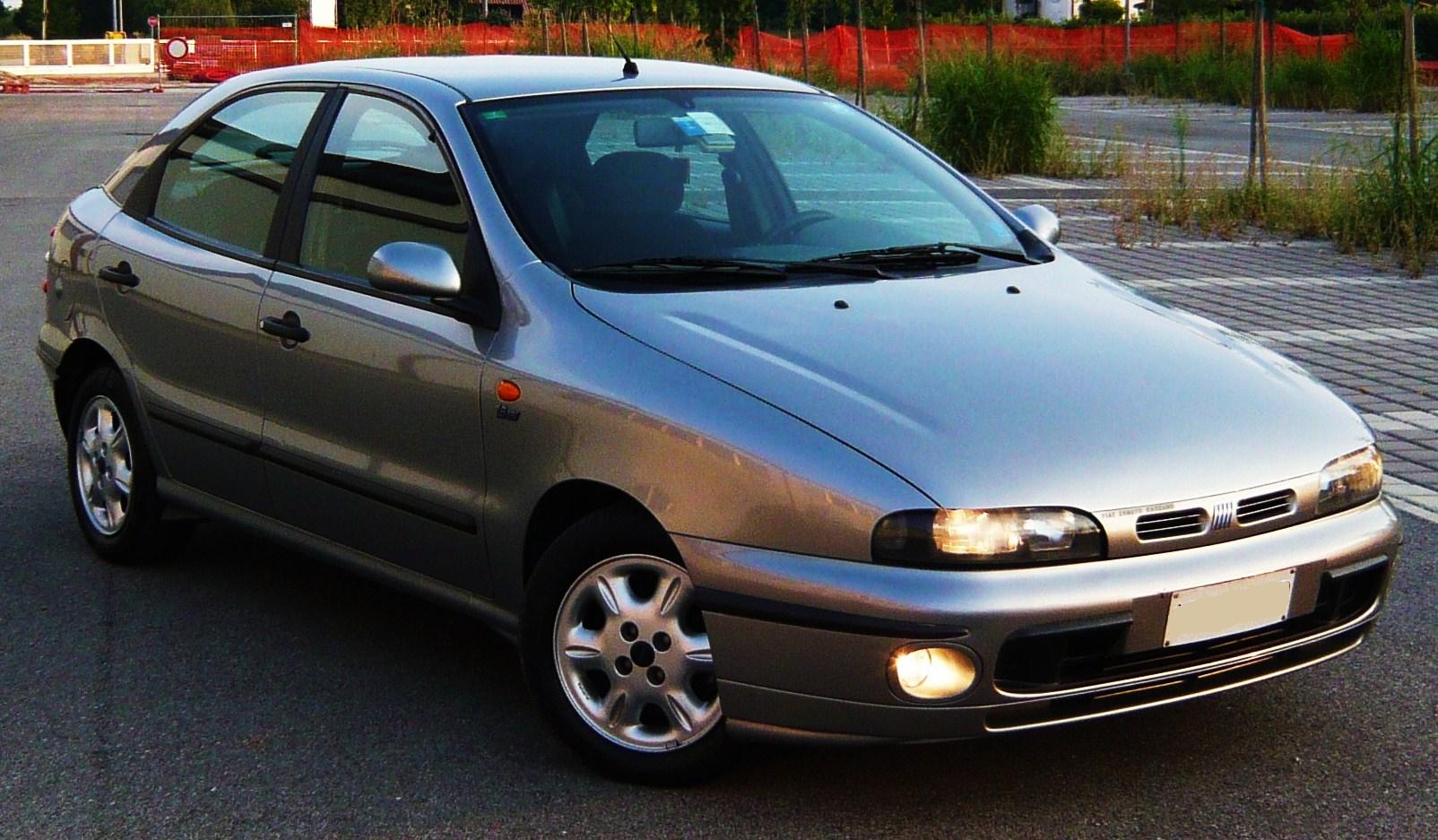
Fiat Brava
"...lly Are we going to do the Are we going to do the Bravas labeled water cooker? No, we're not. Okay, good g..."
The Fiat Brava is a small car made by Fiat, built mainly for everyday driving. It’s a hatchback, meaning the rear opens upward to give access to the cargo area. The podcast might mention it because the name “Brava” stands out.
The Fiat Brava is a compact hatchback produced by Fiat, known for being a practical, everyday car in its class. It may be mentioned in a podcast because the name “Brava” can be used as a playful reference or wordplay, even when the topic isn’t strictly about the vehicle. Still, as a model, it represents Fiat’s approach to small-car utility and affordability.
Request an Explanation
Heard something you'd like explained? We'll add it to this episode.
Sign in to request explanations for terms you heard.
Want to learn more?
Browse our glossary for plain-English explanations of automotive terms, jargon, and concepts.
Help improve this episode
See something that's not quite right? Our annotations are AI-generated and can sometimes miss the mark. Click the flag icon on any annotation to suggest a correction.