CVT Transmission Trouble, Take Care of Your Coolant, Suspicious Vehicle Sounds
About this episode
Nick Stoffel, an ASC-certified technician from Lloyds Automotive, breaks down common car issues and what to watch for before a shop visit. CVTs get a reality check: they’re efficient and improving, but still need fluid service at the manufacturer interval. Shocks/struts aren’t on fixed schedules—at ~10 years/100k miles they’re likely due, based on bounce/leak and tire wear. Coolant loss usually means a leak or burning. The show also covers tailgate button failures, lane-departure calibration, EV cooling complexity, radio/static troubleshooting, catalytic converter warnings, and why ignoring transmission slip or check-engine lights can get expensive.
CVT
"Podcast: WCCO's Car Care Episode: CVT Transmission Trouble, Take Care of Your Coolant, Suspicious Vehicle Sounds"
CVT means the car uses a transmission that can smoothly change “gears” without distinct steps. It’s designed to keep the engine running efficiently, but it can have issues if it isn’t maintained.
CVT stands for continuously variable transmission. Instead of fixed gear ratios, it uses a belt/chain and pulleys to keep the engine in a more efficient RPM range.
ball joints
"Even in some cases, suspension components like ball joints, control arms should become damaged, so wise advice is if you're driving down the road and you see a pothole..."
Ball joints are suspension joints that allow controlled movement between the steering knuckle and suspension arms. Pothole impacts can accelerate wear, leading to looseness, vibration, or uneven tire wear.
control arms
"Even in some cases, suspension components like ball joints, control arms should become damaged, so wise advice is if you're driving down the road and you see a pothole..."
Control arms are part of the suspension that holds the wheel in the right position. If they’re bent or worn from a pothole, the car can handle poorly and tires can wear faster.
Control arms are suspension links that help locate the wheel and control its movement. Damage from potholes can affect alignment and handling, and may require inspection or replacement.
adjust for acceleration, speed, load
"And as you increase acceleration, speed, load, it's going to adjust for that. I think it's a great technology."
The CVT constantly “decides” what ratio to use based on how hard you’re pressing the gas and how fast you’re going. That’s how it stays smooth while you accelerate.
CVTs use sensors and control logic to adjust the effective ratio based on acceleration demand, vehicle speed, and engine load. The goal is to keep the engine in a favorable RPM/efficiency range while delivering smooth drivability.
shocks
"I can't find, they say anything in the maintenance about changing shocks. How do you know when to change shocks on my vehicle?"
Shocks are part of your suspension that help smooth out bumps. When they wear out, the car can bounce more and feel less stable.
Shocks (shock absorbers) control how quickly the suspension moves after hitting bumps, helping keep tires in contact with the road. Worn shocks can lead to more bouncing, reduced ride comfort, and longer stopping distances due to reduced grip.
struts
"That's going to include the steering suspension, which is the shocks and struts. I would tell you that 10 year, a hundred thousand miles, it's probably due."
Struts are like shocks, but they also help support the suspension. If they wear out, the ride can get rough and the car may handle differently.
Struts are a suspension component that often combines the shock absorber with a structural mounting point. Many vehicles use struts instead of separate shocks, so inspection is important because worn struts can affect alignment and handling.
bounce return test
"See how the bounce return is. If you push down on the corner of the vehicle, does it just suddenly come back up and smooth or is a little more of a jostling to it?"
This is a simple way to check suspension health. If you push down and the car keeps bouncing or doesn’t settle smoothly, the shocks or struts may be worn out.
The bounce return test is a quick suspension check: you press down on a corner and watch how the vehicle settles. If it bounces or jostles instead of returning smoothly, it can indicate worn shocks/struts and may contribute to uneven tire wear.
changing the fluid
"they recommend 30,000 miles changing the fluid. Isn't that kind of, kind of still in? You know, personally, I think that might be a little bit early..."
Changing the fluid means replacing the transmission’s working fluid. For a CVT, clean fluid helps it shift smoothly and can help prevent expensive problems later.
“Changing the fluid” refers to replacing the transmission fluid (in this case, CVT fluid) at a scheduled interval. For CVTs, fresh fluid helps maintain proper lubrication and transmission control, which can affect longevity and smooth operation.
salt and snow corrosion
"You know, it's on the back of the vehicle, you know, salt and snow and stuff works its way into it over time."
Road salt and snow can get into the gaps around buttons and wiring. Over time that can cause corrosion and make the button stop working.
“Salt and snow” exposure is a common cause of corrosion on exterior electrical components and switch housings. When moisture and road salt get into button assemblies, it can lead to poor contact, sticking, or eventual failure.
circuit
"If the fob does work, but that button doesn't tell you, it's something with that part of the circuit. If those systems are working, we're not worried about a fuse."
A circuit is the car’s electrical “wiring network” for a feature. If one button doesn’t do anything, the problem is often in the wiring or the switch that sends the signal.
A circuit is the electrical path that carries signals and power to vehicle components. When a particular button or function doesn’t respond, technicians often trace the issue to a specific circuit section (wiring, connectors, or the switch controlling that function).
key fob
"So I would do a little testing if it's working with the key fob or if there's a button inside the vehicle, some vehicles have that also."
A key fob is the remote you use to control your car from a distance. If the remote works but one button or feature doesn’t, the issue is usually inside the car—like a switch or wiring—not the remote itself.
A key fob is the handheld remote that communicates with your car to lock/unlock and sometimes start the vehicle. When the fob works but a specific function doesn’t, it often points to a problem in the car’s control circuitry or a related switch.

Mazda Cx70
"“Here's a 2025 Mazda CX-70. Textor says, I have needed to add a little coolant after about 10,000 miles.”"
A Mazda CX-70 is the vehicle being discussed. They’re saying the coolant level drops and they have to add coolant after driving a while, and they want to know if that’s normal.
The Mazda CX-70 is a newer Mazda SUV, and the listener is asking about coolant loss on a 2025 model. Coolant level changes can indicate normal expansion/contraction, but repeated top-offs can also point to a leak or other cooling-system issue.
turbo
"“It's a 3.5 engine with the turbo. What do you think?”"
A turbo helps the engine make more power by pushing extra air in. Because it can run hotter, keeping the cooling system working properly matters.
A turbocharger increases engine power by forcing more air into the engine. Turbocharged engines can be more sensitive to cooling-system health because they generate more heat under load, so coolant issues are especially worth addressing.
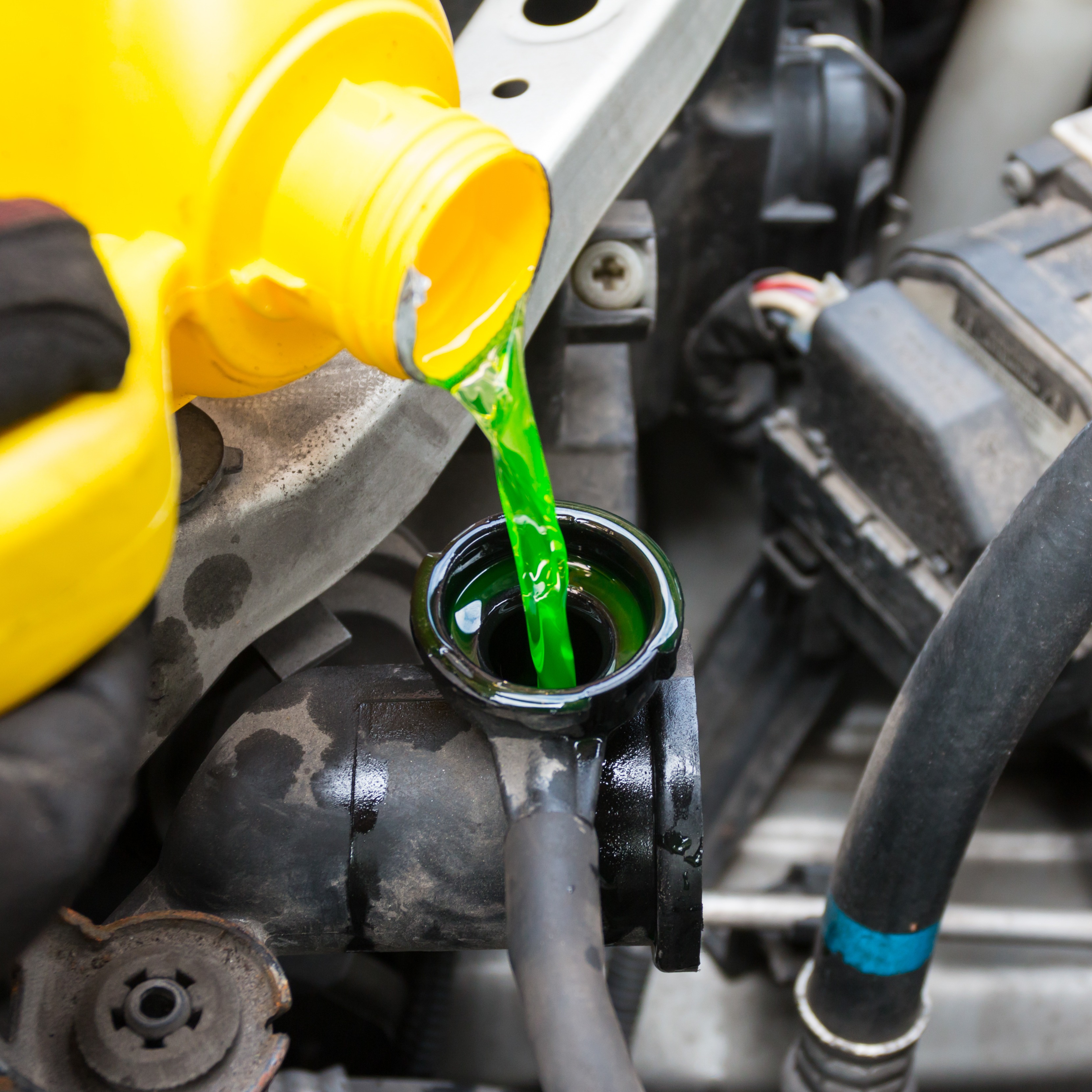
coolant
"As good as the question I have is, has coolant changed over the years? [626.4s] Oh, absolutely. [627.5s] And not just the coolants, the way they build the engines, a lot less blow by,"
Coolant is the fluid that keeps your engine from getting too hot. It also helps protect against corrosion, and it can wear out or change over the years.
Coolant (also called antifreeze) circulates through the engine to control temperature and prevent overheating. Over time, coolant chemistry and additives change, and modern engines are designed to run with longer service intervals.
hoses
"I think we mentioned a few weeks back that hoses don't blow out anymore. [644.4s] That's because the materials that they're making the hoses out of."
Coolant hoses are the rubber tubes that move coolant around the engine. Older hoses were more likely to fail, but newer materials usually last longer.
Radiator and coolant hoses carry coolant between engine and radiator. The discussion points to improved hose materials that resist cracking and failure, reducing sudden coolant loss.
hybrid vehicles
"Well, the the full EV vehicles becoming more common... we've had hybrid vehicles for a very long time... The battery is not as big, but it still has electric motors."
A hybrid uses both gas and electricity. The electric parts aren’t as big as in a full electric car, but the basic idea is similar.
Hybrid vehicles combine an internal combustion engine with an electric drive system. The speaker notes that hybrids have been around for a long time, and that their electric components make them “similar” in principle to EVs, even if the battery size differs.
battery
"The battery is not as big, but it still has electric motors. It still has cooling systems..."
The battery stores the electricity that powers the car. Keeping it at the right temperature is important, and that’s one reason EVs can be more complex to service.
In EVs, the battery is the energy storage system that powers the electric motors. The speaker implies that battery-related thermal management and sensor monitoring are central to EV reliability and repair complexity.
electric motors
"The battery is not as big, but it still has electric motors."
Electric motors are what move the car using electricity. They can get hot, so the car needs cooling and monitoring to keep everything working safely.
Electric motors are the primary drive units in EVs and a key part of hybrid systems. Because they generate heat during operation, they depend on the vehicle’s cooling strategy and sensor monitoring to stay within safe temperature ranges.
multiple fuses for related systems
"[1062.4s] So I'm not saying that the text is wrong, saying that to check the fuses, [1066.2s] but oftentimes there's more than one. [1067.8s] So I would probably look in that oftentimes owners manual will have a [1071.1s] description and location. [1073.1s] Check all those fuses."
Even if you check one fuse, the radio might still be powered through another fuse. That’s why it helps to check all the fuse spots listed for the radio in the owner’s manual.
Many vehicles split electrical functions across multiple fuses, even when they seem related (e.g., radio power, accessory power, and control modules). That’s why a technician may check more than one fuse location—often guided by the owner’s manual wiring/fuse chart.
owners manual
"[1067.8s] So I would probably look in that oftentimes owners manual will have a [1071.1s] description and location. [1073.1s] Check all those fuses. [1074.9s] If that doesn't do it, you're probably going to have to ask for a little more help."
The owner’s manual tells you which fuse goes with which system and where that fuse is located. It saves time because you don’t have to guess which fuse might be responsible.
The owner’s manual typically includes a fuse/relay layout chart showing which fuse protects which system and where it’s located. Using it helps avoid guessing and speeds up diagnosis when troubleshooting electrical problems.
isolate that rubber bushing, that grommet, that pivot point
"but if you get it up in the air or get a couple of people involved, you can try to isolate that rubber bushing, that grommet, that pivot point."
Noise diagnosis often focuses on suspension and body mounting points where rubber bushings, grommets, and pivot joints allow movement. If rubber dries out, wears, or loosens, it can create clinks, squeaks, or rattles—sometimes without major part failure.
catalytic converter
"Check engine light indicates catalytic converter. Very expensive to replace. So how long can a car be driven or what will happen if I keep driving it?"
The catalytic converter helps clean the exhaust. If it’s failing, the check engine light can come on, and repairs can be costly.
A catalytic converter is an emissions-control component that helps convert harmful exhaust gases into less harmful substances. When it fails, it can trigger the check engine light and is often expensive to replace because it’s a major part of the exhaust system.
transmission fluid
"If it's maybe it's just a little bit low on fluid. And if we get that repair or that leak fix and get the fluid topped up, you can save the transmission."
Transmission fluid lubricates and helps control hydraulic functions inside the transmission. When it’s low due to a leak, the transmission can overheat and suffer internal wear, which is why topping it up after fixing the leak matters.
swelled up
"You can look at the battery. If you see, um, it's swelled up or you can see that it appears that it looks different than it used to."
If the battery case looks puffy or swollen, that’s a warning sign. It usually means the battery is failing and should be replaced.
Battery swelling is a sign of internal failure, often caused by overcharging, age-related degradation, or damage. A swollen battery should be replaced because it can become unsafe and may not hold charge reliably.
oil viscosity
"Why does oil viscosity keep changing over the years? And we talk about this once in a while."
Viscosity is basically how thick the oil is. Thicker and thinner oils behave differently, especially when it’s cold, and that affects how well the engine protects itself and how much fuel it uses.
Oil viscosity is how thick or thin the oil is at different temperatures. Over the years, oil formulations and viscosity grades have evolved to improve cold starts, reduce friction, and support fuel economy and emissions goals.
oil filters
"Nick, uh, and we talk again about not only oil, but the filters, uh, given the changes in viscosity over the years, have you seen a change in the oil filters?"
An oil filter cleans the oil as it circulates through the engine. Eventually it gets clogged with dirt, so it has to be replaced on schedule.
Oil filters remove contaminants from engine oil to protect internal components. Over time, filter media and designs can improve, but the filter still has a finite capacity before it becomes less effective.
bypass
"Once that filter is full, it's full. It's going into bypass and that, that, that debris is floating around with the oil."
Bypass is a safety path that opens when the filter is too clogged. If that happens, some dirt may not get filtered out as well.
Oil-filter bypass is a protective feature that allows oil to continue flowing if the filter becomes too clogged. When bypass happens, unfiltered (or less-filtered) oil can circulate, which is why timely filter changes matter.
Request an Explanation
Heard something you'd like explained? We'll add it to this episode.
Sign in to request explanations for terms you heard.
Want to learn more?
Browse our glossary for plain-English explanations of automotive terms, jargon, and concepts.
Help improve this episode
See something that's not quite right? Our annotations are AI-generated and can sometimes miss the mark. Click the flag icon on any annotation to suggest a correction.