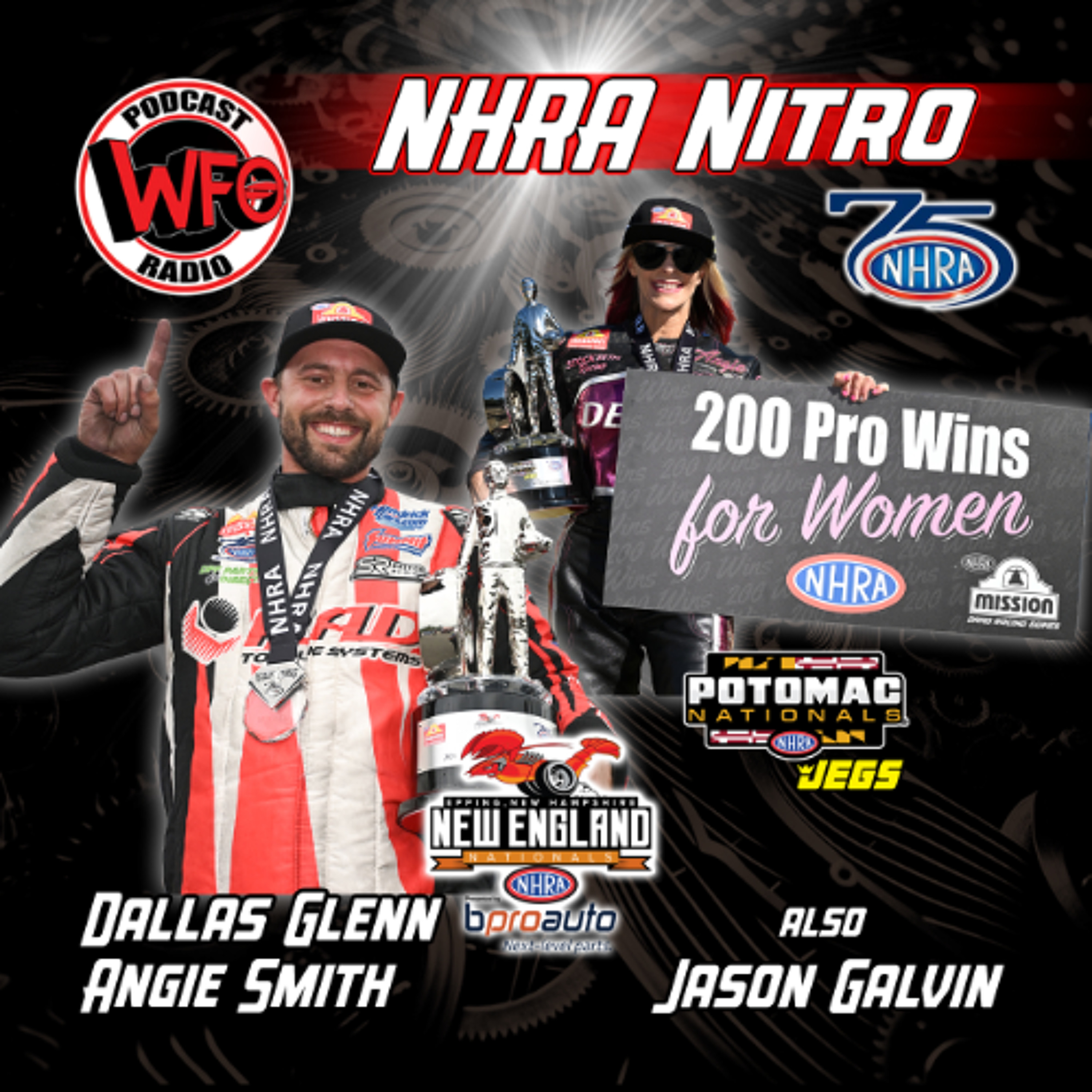
Dallas Glenn and Angie Smith join WFO Radio before NHRA Thunder Valley Nationals
About this episode
Dallas Glenn and Angie Smith stop by WFO Radio ahead of the NHRA Thunder Valley Nationals, with the show bouncing from Pro Stock and Top Fuel storylines to track-traction talk. Glenn’s “.002 light” nickname and recent staging tweaks lead into why rain, pollen, and lane choice can swing results—especially at Bristol’s new surface. The hosts also cover NHRA rule changes, clutch and reliability realities, and a few sponsor/partner segments, including emissions parts and consignment/restoration services.
diesel oxidation catalyst
"Looking to replace your OEM diesel particulate filter or diesel oxidation catalyst? Look no further than DPF X-Fit, a complete line of aftermarket diesel particulate filters and diesel oxidation catalysts designed as an exact fit OEM replacement"
A diesel oxidation catalyst is an emissions part that helps clean up exhaust gases. It works by using a catalyst to change some of the harmful stuff into less harmful byproducts.
A diesel oxidation catalyst (DOC) is an emissions device that uses a catalyst to convert certain exhaust pollutants into less harmful compounds. It’s commonly used alongside a DPF to help manage emissions and support regeneration strategies.
diesel particulate filter
"Looking to replace your OEM diesel particulate filter or diesel oxidation catalyst? Look no further than DPF X-Fit, a complete line of aftermarket diesel particulate filters"
A diesel particulate filter is a part that catches the smoky soot that diesel engines make. Over time it has to clean itself out (burn the soot off) so the exhaust can flow properly.
A diesel particulate filter (DPF) is an emissions-control device that traps soot (fine particulate matter) produced by diesel engines. It periodically burns off the collected soot through a regeneration process to keep exhaust flow from getting restricted.
DPF X-Fit
"Look no further than DPF X-Fit, a complete line of aftermarket diesel particulate filters and diesel oxidation catalysts designed as an exact fit OEM replacement with all makes coverage for light, medium and heavy duty trucks."
DPF X-Fit is a company/brand that makes replacement emissions parts for diesel trucks. They’re advertising filters and catalysts meant to install as direct replacements.
DPF X-Fit is an aftermarket brand that sells replacement diesel particulate filters and diesel oxidation catalysts. The pitch here is that their parts are designed to fit like original equipment (OEM) and cover a wide range of truck applications.
OEM replacement
"and diesel oxidation catalysts designed as an exact fit OEM replacement with all makes coverage for light, medium and heavy duty trucks."
“OEM replacement” means it’s made to replace the factory part. The goal is that it bolts up and works with the truck’s emissions setup like the original.
“OEM replacement” means the aftermarket part is intended to match the original equipment manufacturer’s fitment and function. In practice, that usually implies correct mounting, inlet/outlet connections, and compatibility with the vehicle’s emissions system.
reverse OEM lookup tool
"and be sure to check out our comprehensive reverse OEM lookup tool, always new, never remanufactured."
This is a tool that helps you find the right replacement part for your exact truck. Instead of guessing, it uses your vehicle info to match the correct OEM part.
A reverse OEM lookup tool helps identify the correct replacement part by starting from the vehicle’s details (often VIN or model/engine info) and mapping to the OEM part number. It reduces the chance of ordering the wrong emissions component for a specific truck configuration.
NHRA Nitro
"Hey, everybody. WFO Radio is back. Joe Costello here with you, NHRA Nitro, and we are about to have our third consecutive race coming from the Potomac Nationals to the New England Nationals"
NHRA Nitro is the nitro-fueled drag racing side of NHRA. It sets up that the show is about upcoming races and results.
This refers to NHRA’s nitro-fueled drag racing coverage/segment. It’s a framing topic for the episode’s discussion of upcoming NHRA events and race recap content.
Supergrip Thunder Valley Nationals
"to Thunder Valley and the Supergrip Thunder Valley Nationals. On this show, we're going to have our Mission Food Series winner, Dallas Glenn."
Supergrip Thunder Valley Nationals is the name of the NHRA race weekend at Thunder Valley. “Supergrip” is the sponsor attached to that event.
This is the branded event name for the NHRA race at Thunder Valley. The sponsor name (“Supergrip”) is part of the official title used for that specific race weekend.
Mission Food Series
"On this show, we're going to have our Mission Food Series winner, Dallas Glenn. Going to be joining us."
The Mission Food Series is referenced as a competition/series within the NHRA ecosystem, with Dallas Glenn identified as the winner. It’s mentioned as a key storyline for the guest segment.
copper head gaskets
"like Hussie performance.net, not just copper head gaskets or copper gaskets anymore. They've [173.5s] got composite gaskets."
A head gasket is the seal between the engine block and the cylinder head. A copper head gasket is a race-style version made from copper that’s often used when engines are pushed very hard and need a strong seal.
A head gasket seals the engine’s cylinder head to the engine block. “Copper” head gaskets are made from copper (often with a composite or multi-layer design) and are popular in high-boost or race engines because copper can tolerate heat and pressure well and can help with sealing under extreme conditions.
composite gaskets
"not just copper head gaskets or copper gaskets anymore. They've [173.5s] got composite gaskets. They've got contingency programs in the alcohol ranks."
A gasket is a seal that keeps fluids and gases from leaking. “Composite” gaskets use engineered materials (not just one metal) to seal reliably, especially in engines that run hot or change temperature a lot.
Composite gaskets are gasket designs made from composite materials (commonly fiber/graphite or layered composites) rather than a single metal. In racing, they’re chosen for sealing performance and durability across heat cycles, especially when engines see frequent temperature swings.
contingency programs in the alcohol ranks
"got composite gaskets. They've got contingency programs in the alcohol ranks. Reach out to [178.2s] David Allen and the team at Hussie performance.net."
A contingency program is a sponsor payout offered when a racer uses that sponsor’s parts and achieves certain results. “Alcohol ranks” refers to NHRA drag racing classes that run alcohol-based fuels (like methanol), where specific components and setups are commonly tuned for that fuel.
torque converters
"Our friends at FTI performance transmissions and torque [187.5s] converters down there in DeLand, Florida, automatic transmissions, pro mods, top sportsmen,"
A torque converter is a fluid coupling between the engine and automatic transmission that multiplies torque at launch and allows the car to stay in gear while the vehicle is stopped. In drag racing, converters are critical for controlling launch RPM and keeping the engine in its power band.
automatic transmissions
"torque [187.5s] converters down there in DeLand, Florida, automatic transmissions, pro mods, top sportsmen,"
Automatic transmissions shift gears without a clutch pedal, using hydraulics and control systems. In drag racing, automatic setups are often built for hard launches and rapid, repeatable shifts, and they’re frequently paired with purpose-built torque converters.
pro mods
"converters down there in DeLand, Florida, automatic transmissions, pro mods, top sportsmen,"
Pro Mod (Pro Modified) is an NHRA drag racing class for highly modified, typically front-engine cars running in a bracketed ladder of performance. The cars are known for advanced aerodynamics and powertrains, and they’re built to run consistent elapsed times down the strip.
top sportsmen
"automatic transmissions, pro mods, top sportsmen,"
Top Sportsman is an NHRA category for bracket-style drag racing with production-based vehicles that are modified but still within defined rules. It’s a competitive class where consistency and tuning matter as much as outright power.
top dragster
"top sportsmen, [192.9s] top dragster, super street cars like project Pontiac."
Top Dragster is an NHRA drag racing class for dragsters (open-wheel, purpose-built drag cars) competing under specific rules. It’s one of the premier categories for dragsters, where power delivery and traction are tightly managed for repeatable passes.
002 light
"But let's bring on 00 Dallas Glenn, who earned the nickname in the [250.8s] final round with a 002 light. What's up, Dallas? How's it going, Joe?"
In drag racing, the “light” refers to the electronic starting tree timing. A “.002” (spoken as “002”) indicates an extremely quick reaction time—so fast it’s near the threshold of what’s considered a perfect/near-perfect start.
nearly unwinnable final
"You're hard on Hartford. 002, great run, making it a nearly unwinnable final. That was to cap off [265.5s] the New England Nationals and become our only Mission Food series winner."
“Nearly unwinnable final” is a race context concept meaning the matchup conditions were so unfavorable that winning was extremely unlikely. In drag racing, this often comes from factors like traction, weather, track prep, or how well each car’s tune matches the conditions.
New England Nationals
"002, great run, making it a nearly unwinnable final. That was to cap off [265.5s] the New England Nationals and become our only Mission Food series winner."
This refers to an NHRA event called the New England Nationals. It’s the specific race weekend where the driver’s results and nickname moment happened.
pollen
"Like you said, you know, that pollen is the pollen was crazy. I mean, anytime the wind blew, it was just like a fog just went over the entire track."
Pollen can get onto the track and mess with tire grip. If it mixes with the sticky track treatment, it can make the surface feel slippery instead of grippy.
Pollen can dramatically affect drag-strip traction by contaminating the treated surface and changing how tires grip. When it mixes with the track’s sticky compound, it can create a slick layer that increases wheelspin and makes the car harder to keep straight.
VHT
"I mean, anytime the wind blew, it was just like a fog just went over the entire track. And, you know, that the pollen, it doesn't, it sticks to the track VHT and it just becomes super slick for us."
VHT is a special sticky coating put on the drag strip to make the tires grip better. It helps cars launch harder instead of spinning their wheels.
VHT is a track-surface treatment (a sticky, heat-activated compound) used in drag racing to improve tire grip. It’s applied to the racing surface so the tires can bite harder and launch with more traction.
the groove
"Well, exactly. Like the drive wheel is in the groove or one of the wheels is in the groove and the other is in the pollen. It makes sense that it would turn the car."
The “groove” is the worn-in track line where tires have already left rubber. That line usually has better grip, so drivers try to stay in it to keep the car going straight.
In drag racing, the “groove” is the rubbered-in racing line where tires have already laid down traction. When conditions change (like pollen or rain), the groove can still be the most predictable path to keep the car straight and hooked up.
drive wheel
"Well, exactly. Like the drive wheel is in the groove or one of the wheels is in the groove and the other is in the pollen. It makes sense that it would turn the car."
The drive wheel is the wheel that’s powered by the car’s drivetrain. If one powered wheel has good grip and the other doesn’t, the car can steer itself unexpectedly.
The drive wheel is the wheel(s) that receive power from the drivetrain (front-wheel drive, rear-wheel drive, or all-wheel drive). If one drive wheel is on the groove and the other is on a slick surface, traction can differ and cause the car to pull or turn.
tractors
"Yeah, you know, you can see the tractors go down and drag the track and you can actually see exactly the tire marks that they leave for you or the car in front of you when it goes down."
On a drag strip, tractors are used to clean and prepare the track between runs. They help keep the surface consistent so the tires can grip the same way.
In drag racing, track tractors are used to groom and prepare the racing surface between runs. They help spread and manage the treated surface so traction is consistent, and they can leave visible patterns that drivers use as references.
tire marks
"Yeah, you know, you can see the tractors go down and drag the track and you can actually see exactly the tire marks that they leave for you or the car in front of you when it goes down."
Tire marks are the visible rubber lines left on the track by cars running through a pass. In changing conditions, those marks can reveal where the surface is gripping well (or where it’s slick), helping drivers aim for the most consistent path.
Wilson manifolds
"right? Angie going to be back on as we get ready to head to Bristol. We'll get into that, but let's do your round by round Dallas in that it was a fun day at the races and you stormed through. You had to go up against Shane Tucker first round. You're 31. He's 32. That was a scare for you. Shane Tucker. So, listen, a lot of news has been coming out talking about, you know, Jason as a consultant on the team and Wilson manifolds as a consultant."
Manifolds are engine components that route exhaust gases (or intake air/fuel, depending on the setup) to the next stage of the system. In drag racing, “Wilson manifolds” likely refers to a specific aftermarket manifold brand used to improve airflow and engine response, which can matter a lot for making consistent runs.
proven engines
"like those engines in that car, those are proven, proven engines from the past. You know, I don't know if I'm supposed to say where they came from, but people are now telling me like, yeah, man, those are world championship engines from someone from the past that doesn't drag race anymore."
In drag racing, “proven engines” means powerplants with a track record of producing reliable, repeatable performance rather than just one-off results. The host is implying these engines have been used successfully before, which helps reduce uncertainty when tuning for a specific track.
making nice clean runs
"We've been slightly frustrated with the car. It just hasn't, we haven't quite hit that, that window of making nice clean, clean runs, you know, it'll go out there and it might make an okay run and we'll try to be a little bit more aggressive on it."
“Making nice clean runs” refers to drag-racing passes that are consistent and free of major problems like wheel lift, instability, or poor traction. It’s about repeating the same performance characteristics round after round rather than just going fast once.
wheelie bar
"And then it'll get on the wheelie bar too hard and try shaking. And then it just, we haven't quite got the balance of it figured out."
In drag racing, a wheelie bar is a small bar with a wheel on it that prevents the car from lifting the front wheels too much. It helps the car stay planted so it can go straight and run consistent times.
A wheelie bar is a drag-racing device mounted to the rear of a car to keep the front wheels from lifting too high under hard acceleration. It uses a small wheel (or wheels) that contacts the track to limit wheel lift and help the car stay stable and consistent.
front wheels
"And then it carried the front wheels almost to third gear. So I was like, yeah, I think they had a little too much, much wheel stand in it."
In drag racing, “front wheels” lifting or staying planted is a key part of launch and acceleration behavior. The host notes the car carried the front wheels almost to third gear, which implies significant weight transfer and wheel lift management during the run.
wheel stand
"I was like, yeah, I think they had a little too much, much wheel stand in it. So, you know, Dave's looking at the run, he's like, I don't know what we can really do."
A wheel stand is when the front of the car lifts up during a hard launch. Too much lift can make the car harder to control and can hurt traction and consistency.
A wheel stand is when the front wheels lift off the ground during acceleration, which can upset traction and steering. In drag racing, teams try to manage how much the car stands up so the car can transfer weight effectively without becoming unstable.
left lane
"taking the left lane. So, you know, we thought we were going to go to the left lane, which is a little bit worse down track, but the starting line seems to be a little bit better."
In drag racing, the left and right lanes can grip differently. Choosing the better lane can help the car launch faster and run quicker.
In drag racing, lane choice matters because the track can have different grip and surface conditions on the left vs right lane. That can change launch behavior and overall elapsed time, even if the cars are evenly matched.
Greg Anderson
"But then, you know, with Matt Latino shaking a little bit and, you know, being first pair, they in Greg Stamfield making a good run in the left lane, Erica jumped back over to the left. So, you know, then I get swapped over to the right again... It's crazy what's happening with Greg Anderson."
Greg Anderson is a drag racer. In this segment, they’re talking about how he races well and how his car can still perform even when his reaction time isn’t perfect.
Greg Anderson is a well-known NHRA drag racer, referenced here in the context of his performance and lane-to-lane competitiveness. The hosts discuss his ability to overcome less-than-perfect reaction times with the car’s performance.
Greg Stamfield
"with Matt Latino shaking a little bit and, you know, being first pair, they in Greg Stamfield making a good run in the left lane, Erica jumped back over to the left."
Greg Stamfield is part of the racing team they’re talking about. The segment suggests his side made a strong run, which points to good preparation and execution.
Greg Stamfield is referenced alongside a “good run,” implying a key role in the team’s performance. In NHRA-style drag racing, team members can influence setup and launch strategy, which affects how well the car performs in a given lane.
Erica
"Erica jumped back over to the left. So, you know, then I get swapped over to the right again... She's 25 on the starting line. You're 23 on the starting line."
“Erica” is one of the racers in this drag race. They’re comparing her launch and run performance to the other driver’s, and saying she’s tough to beat.
“Erica” is referenced as a top-level drag racer in the matchup, with specific starting-line numbers and performance comparisons. The segment frames her as a consistent threat who can still advance even when reaction times differ.
tree
"I made a little bit of a pedal move to try to get a little bit better on the tree and I went from that was at 31 to a 23."
The “tree” is the set of lights that tells you when to launch. Drivers try to time their start so they react quickly without getting a bad start.
The “tree” is the starting-light assembly used in drag racing to signal when the run begins. Drivers time their launch to the tree, and their reaction time is measured from the tree’s signal.
pedal move
"I made a little bit of a pedal move to try to get a little bit better on the tree and I went from that was at 31 to a 23."
A “pedal move” means the driver tweaks how much they press the gas right before and as the car launches. Tiny throttle changes can help the car get moving cleanly and on time.
A “pedal move” refers to adjusting the accelerator input during launch to improve timing and traction. In drag racing, small changes to throttle control can affect how the car responds to the tree and how consistently it leaves the line.
Shane Tucker
"But you go against Shane Tucker and then you go up against Erica, the flagship for elite motorsports, the Nemesis, and Erica is doing Erica things, right?"
Shane Tucker is another drag racer they faced earlier in the event. The hosts are basically saying the competition gets harder as the rounds go on.
Shane Tucker is mentioned as an opponent in earlier rounds, helping set the difficulty of the bracket. The hosts contrast him with later-round matchups to explain why the day gets tougher.
reaction times
"114 national event wins. It's crazy what's happening with Greg Anderson. You're on the inside and I'm sure there are fans who are just like over it, right? Like, flipping him off again and driving so well again. Not always. He's had some mediocre reaction times here and there, but the car has been able to bail him out a few times and you know how it goes,"
Reaction time is how fast the driver moves after the start signal. In drag racing, being quicker usually helps you get off the line, but being too quick can cause a foul.
In drag racing, reaction time is how quickly the driver responds after the starting light. Faster reaction times generally help you launch sooner, but they also increase the risk of a red-light if you react too early.
hood scoops
"…that whole workaholic thing that some have suggested that changing the rules next year does not benefit you guys because you guys are looking good already and we're going back to hood scoops and we're going to top mounted throttle body injection…"
Hood scoops are openings on the hood that help bring air into the engine area. In racing, getting the right kind of airflow can help the engine make power more consistently.
Hood scoops are openings on the hood that feed air to the engine bay. In drag racing, they’re often used to help deliver cooler, denser air to the intake system, which can support more consistent power and tuning.
top mounted throttle body injection
"…we're going back to hood scoops and we're going to top mounted throttle body injection and in my research, it seems like, you know, Greg doesn't really care"
Throttle body injection is a modern way of feeding fuel into the engine using a valve (the throttle body) that controls how much air goes in. “Top mounted” just means that throttle body is placed on the top side, and racing rules can require that specific layout.
Top mounted throttle body injection is a fuel-delivery setup where a throttle body meters air and fuel, and it’s positioned on top of the intake/engine rather than elsewhere. In NHRA drag racing, rule changes that specify this layout can affect how teams package components, tune airflow, and optimize performance.
new engine
"We'll just leave it. You know, I'm, I'm thinking that, you know, Hartford put a new engine in for the semis, and he went low for the round being first pair in, you know, first run in that thing, I'm sure that the tune up wasn't perfect."
A “new engine” means the car got a fresh motor. That can change how strong it feels and how well it matches the tune for the next race.
A “new engine” in drag racing usually means the team replaced the powerplant for a specific round or stage. Fresh components can change power delivery and how the car responds to tuning.
tune up
"I'm sure that the tune up wasn't perfect. So I was fully expecting him to go"
A “tune up” here means adjusting the engine settings to make it run right for that race. If it’s not dialed in perfectly, the car may not perform as consistently.
A “tune up” is the calibration of engine settings (fuel/air, ignition timing, and other parameters) to match track conditions and the car’s setup. In drag racing, even small tuning differences can affect launch and elapsed time.
routine
"if anybody has a problem, I usually have a pretty quick routine. So, you know, it can, we end up pre-stage about the same time."
In drag racing, a “routine” is the driver’s repeatable pre-launch checklist and timing sequence (e.g., how they stage, when they verify systems, and how they prepare to launch). It’s designed to keep performance consistent even if the other car has issues.
pre-stage
"So it all works out. But Hartford's one of those guys who's pretty quick and I know he's going to wait for me no matter what. So I usually just go ahead and fire up against him. ... So it can, we end up pre-stage about the same time."
“Pre-stage” means you’re lined up at the start and ready, but you’re not fully committed to the final start lights yet. It helps you time your launch so you can go as soon as the race officially starts.
“Pre-stage” is the first position on the starting line where the car is staged but not yet fully ready for the final start signal. It’s used to help synchronize timing so the driver can react quickly when the tree completes the sequence.
staged
"I don't even remember who got staged first. I think I don't even remember who it was. I think he might have gotten staged first."
“Staged” means your car is fully set at the start line and ready for the official start. The timing of when you stage can affect how fast you react when the lights go.
To be “staged” means the car is fully positioned on the starting line so the driver is ready for the final start sequence. In drag racing, staging timing affects reaction time and helps prevent false starts or red lights.
tap the chip
"Front end was up. I might have tapped the chip a little bit in low, maybe knocked a tower two out of it."
“Tap the chip” sounds like a quick, small adjustment during the launch—basically a brief input to the throttle or control. Even tiny changes right at the start can change how the car runs.
“Tap the chip” refers to a brief throttle input (or momentary control adjustment) that can affect how the car launches and shifts through the early part of the run. In drag racing, small changes at launch can show up as differences in elapsed time and how clean the run feels.
track was prep good
"But other than that, it was just nice clean run and the track was, was prep good. Didn't, you know, I got a little glance over there."
“Track prep” means how the track surface is prepared to give the tires good grip. If they say it was “prep good,” it means the track conditions were helping the car launch and run consistently.
“Track prep” is the preparation of the drag strip surface (rubbering, cleaning, and applying traction compounds) to control grip and consistency. “Prep good” means the surface conditions were favorable, helping the car hook up and run cleanly.
Bristol
"Yes, which would have been totally different. We'd be waiting for Friday and Bristol will talk about that in a second... Now we're going to the Supergrip Thunder Valley Nationals of Bristol. The all new Bristol, new surface."
This is the drag strip event location at Bristol. Because the track can grip differently in each lane, choosing the right lane and having the right setup can make a big difference in how fast you run.
Bristol refers to the NHRA drag strip at Bristol Motor Speedway, which is known for tight racing and lots of track-specific setup. In drag racing, small changes in traction and starting conditions can swing results, so track conditions and “lane choice” matter a lot.
dyno
"They've been, they've been working on it since the minute, maybe since before. On the dyno, keywords. I guess seen it though, right on the dyno, right?"
A dyno is a testing machine that lets teams run the car’s engine while measuring how much power it makes. It helps them tune the car without needing to do every test on the track.
A dyno (dynamometer) is a machine used to measure engine output and behavior under controlled load. Teams use it to tune and verify changes before track runs, especially for power and drivability.
NHRA Thunder Valley Nationals
"Now we're going to the Supergrip Thunder Valley Nationals of Bristol. The all new Bristol, new surface."
They’re talking about the next NHRA race weekend they’re heading to. Race weekends are where teams test and tune for the specific track they’ll run on.
This is the NHRA event being discussed as the next stop after the earlier race. It’s a specific race weekend that affects what teams are preparing for and how they’re talking about track conditions.
lane choice
"Bristol was one of those tracks that was... very, you need lane choice kind of place. You know, you're going to give up 200s if you lose lane choice."
In drag racing, you race in either the left or right lane. If one lane hooks up better than the other, choosing the better lane can help you launch and run faster.
Lane choice is the decision of which side of the track you run in a head-to-head drag race. Because drag strips can have different traction and surface conditions in each lane, picking the better lane can improve consistency and reduce the chance of losing by small margins.
200s
"You know, you're going to give up 200s if you lose lane choice. So there's a couple tracks like that,"
“200s” is shorthand for a tiny difference in elapsed time, like how much faster one car is than the other by a fraction of a second. They’re saying the track can be so sensitive that lane choice can cost you that kind of time.
In drag racing talk, “200s” usually refers to a small time gap—often hundredths of a second—between cars. The point here is that at Bristol, losing the better lane can cost you a measurable performance margin.
consignment
"They're buying and selling on consignment. It's a dealership is really what it is. But cars of consequence, not like your, you know, Honda Prelude from 1988..."
Consignment means you let a shop sell your car for you. The shop helps find a buyer, and you usually only get paid after the car actually sells.
Consignment is a selling arrangement where the owner places the car with a dealer/specialist to market and sell it, while the seller typically keeps ownership until it’s sold. For enthusiasts, it’s often used for “cars of consequence” because the shop can handle presentation, pricing, and buyer matching.

Honda Prelude from 1988
"But cars of consequence, not like your, you know, Honda Prelude from 1988, like cars of consequence to Honda people don't get mad."
A Honda Prelude is a Honda sports coupe. The host is basically saying that some older Hondas are common enough that collectors don’t treat them like rare “finds.”
The Honda Prelude is a Japanese coupe that became popular with enthusiasts in the 1980s and 1990s. The 1988 model is being used here as an example of a more common “everyday” classic compared to rarer, more valuable cars.
barn find
"If you've got something that is the future barn find, better to sell it on consignment at Bernie's, reach out to them and they can do the consignment agreement, etc."
A “barn find” is a car that’s been sitting unused in storage for a long time and gets discovered later. People like them because they can be rare or still have original parts, but they usually need work to bring them back.
A “barn find” is an old, often forgotten vehicle that’s been stored away for years—sometimes decades—before being discovered. In collector circles, barn finds can be valuable because they may have low wear and original parts, but they often need restoration.
Bernie's Speed Shop
"Or maybe you're looking to restore your amazing vehicle and you want someone who knows how to do it in the absolute proper way. That's Bernie's Speed Shop as well."
Bernie's Speed Shop is a local shop that helps people sell and restore cars. They’re being described as knowledgeable about doing restorations correctly.
Bernie's Speed Shop is presented as a specialist shop in Ocala, Florida that handles both consignment sales and restoration work. The hosts are emphasizing that they have the expertise to restore vehicles “the absolute proper way.”
transmission and converter
"For more than a decade, FTI has strived to become the leader in the aftermarket performance, transmission and converter industry."
A transmission is what sends power to the wheels. A converter (torque converter) helps the car launch hard by multiplying torque, which matters a lot in drag racing.
In drag racing, the “converter” usually refers to a torque converter, which multiplies engine torque at launch and helps the car stay in its power band. The segment pairs it with transmission because both are central to how a race car transfers power to the drivetrain.
FTI
"For more than a decade, FTI has strived to become the leader in the aftermarket performance, transmission and converter industry."
FTI is a company that makes performance parts for drag racing. In this segment, they’re mainly talking about transmission and converter parts.
FTI is described as a company focused on aftermarket performance parts for drag racing, specifically transmissions and torque converters. The segment frames FTI as expanding its reach by partnering with McLeod driveline components.
McLeod driveline components
"We've joined forces with McLeod driveline components under the leadership of top fuel funny car pilot Paul Lee..."
McLeod is a company that makes drivetrain parts used in performance cars. Here it’s mentioned as the partner company behind FTI’s expansion.
McLeod driveline components is named as the partner company that FTI “joined forces with.” In drag racing terms, driveline companies are typically associated with components like clutches, transmissions, and torque-converter-related hardware.
Paul Lee
"We've joined forces with McLeod driveline components under the leadership of top fuel funny car pilot Paul Lee..."
Paul Lee is a drag racer who competes in top fuel funny cars. The hosts are saying he’s involved in leading the companies behind these performance parts.
Paul Lee is referenced as a top fuel funny car pilot and the leadership figure behind the FTI/McLeod partnership. In drag racing, “top fuel funny car” is a premier class, so his involvement signals deep competition experience.
top fuel funny car
"We've joined forces with McLeod driveline components under the leadership of top fuel funny car pilot Paul Lee..."
Top fuel funny car is a drag racing category. These cars are built for maximum acceleration over a short race distance, and they’re among the fastest in drag racing.
“Top fuel funny car” is a drag racing class where cars use highly specialized, purpose-built engines and run extremely short, high-traction sprints down the strip. The term is used here to establish Paul Lee’s credibility in the drag racing world.
shift forks
"Chicago, Matt wins and was sad because that was your race, but the bike didn't go down the racetrack and we got to learn about dogs and shift forks and all that stuff."
Shift forks are parts inside the transmission that help move gears to change speed ratios. In racing, getting the gear changes right can make a big difference in how fast you accelerate.
Shift forks are internal transmission components that move the gears into different ratios. In drag racing, precise shifting matters because the bike or car has to hit the right gear at the right time to keep acceleration strong.
Potomac Nationals
"But you said, you know, like, all right, and you went out there to the Potomac Nationals, a new track and just on a mission."
The Potomac Nationals is a drag racing event. In this conversation, it’s the next race Angie and the team are talking about after Chicago.
The Potomac Nationals is a drag racing event on the NHRA schedule. It’s referenced here as the next race after the Chicago event, where Angie says they went in “on a mission” and won.
caboose
"I was just trying to make sure the, as I, as I tell the crew guys, make sure the caboose doesn't fall off the train."
“Caboose” is a metaphor for the back end of the train—meaning the rear part needs to stay secure. They’re saying they were focused on keeping everything stable so the car/bike could make passes safely.
Here, “caboose” is a racing metaphor for the rear portion of the setup—essentially the last part of the system that must stay stable and connected while the vehicle is making passes. The speaker’s point is about preventing a mechanical separation or instability that could ruin a run.
V-Twin
"Gianna probably has never raced. Well, she's never raced a V-Twin or whatever without Matt at the racetrack."
A V-Twin is a motorcycle engine with two cylinders arranged like a V. That engine layout helps determine how the bike makes power as it launches down the track.
A V-Twin is an engine configuration with two cylinders arranged in a “V” shape. In motorcycle drag racing, V-twins are common and their firing order and packaging affect how the bike delivers torque to the rear wheel during acceleration.
pressure
"So maybe it was the stress level of all the stress that I just had to hurdle through to get the win. That's it. Now we know you got to load. We got to load you down a little more. Load me up. That's it. I think you got about five more pressure to Angie"
“Pressure” here is about how hard you’re pushing the bike and tires. If you get the pressure/load right, the bike grips better and you can go faster.
In racing, “pressure” can refer to how hard the rider is pushing the bike and tires, or the load the bike is carrying under acceleration and braking. The context here sounds like they’re talking about adjusting setup/conditions so the rider can apply more effective force to the ground.
point standings
"So on that note, I'm looking at the point standings, right? Richard is leading the way. You're 26 back. Matt's 48 back."
Point standings are the rankings in the season based on race results. If you’re far behind, you need better finishes to catch up.
“Point standings” are the championship leaderboard based on how riders finish in each race. The hosts are discussing who’s leading and how far back others are, which affects pressure and strategy for upcoming rounds.
rules adjustment
"Then Clayton and Ryan like there's a lot of fast bikes. We just got a rules adjustment for the Suzuki's. So they get to take a little weight off"
A rules adjustment is when the race organizers change the rules for fairness. In this case, they’re changing the Suzuki rules so the bikes can be closer in speed.
A “rules adjustment” means the sanctioning body changes the regulations for a class, often to balance competition. Here it’s specifically about the Suzuki class getting a weight change, which can affect acceleration and handling.
Suzuki's
"We just got a rules adjustment for the Suzuki's. So they get to take a little weight off as I understand it."
Suzuki is the motorcycle brand being referenced. The hosts say there’s a rules adjustment for the Suzuki class, implying the bike’s competition setup (like weight) is being altered for the event.
Pomona
"Well, we'll see. I really don't focus on the points because at the end of the day, it comes down to Pomona in November."
Pomona is where a big NHRA race happens in California. They’re saying the championship picture really comes down to that event in November.
Pomona refers to the NHRA event held in Pomona, California, which is a major late-season stop. The hosts mention it because points and momentum often come down to how riders perform there.
over correcting
"whether it was from, you know, not a great light or, you know, me over correcting the bike when the bike didn't go straight."
Over-correcting means you try to fix the bike’s direction, but you do it too much. Instead of getting back on track smoothly, the bike wobbles and you lose speed.
“Over-correcting” describes steering or throttle/brake inputs that are too strong in response to the bike starting to deviate from its intended line. In racing, that can make the bike unstable and slow you down because you’re constantly chasing the correct path.
riding the bike
"I've really been trying to focus and do a really good job riding the bike and just really trying to focus really hard on giving it my best effort"
Here, “riding the bike” means how the rider controls the launch and power delivery. In drag racing, rider technique can make the bike work better, and it also helps the team know what to adjust.
“Riding the bike” is treated as a performance variable in drag racing: how the rider launches, shifts, and manages traction can strongly affect results. The speaker is emphasizing consistent technique so the tuner can interpret data and refine the setup.
Gainesville
"we started out the season pretty good in Gainesville and then Charlotte, we had some hiccups with my clutch"
Gainesville is where a big drag-racing event happens in Florida. Teams often use it as an early-season benchmark for how well their bike and tune are working.
Gainesville refers to a major NHRA drag-racing event held at Gainesville Raceway in Florida. It’s a common early-season stop where teams test setups and chase consistent performance.
clutch
"we started out the season pretty good in Gainesville and then Charlotte, we had some hiccups with my clutch and it was just nothing anybody did."
The clutch is what lets the rider smoothly connect the engine’s power to the bike’s wheels. If it’s not behaving right, the bike can launch poorly or feel inconsistent during runs.
In a drag-racing motorcycle context, the clutch is the friction device that connects the engine to the drivetrain when you launch. If the clutch isn’t working correctly, it can cause poor starts, inconsistent acceleration, or driveline slip—often showing up as “hiccups” during races.
Charlotte
"and then Charlotte, we had some hiccups with my clutch and it was just nothing anybody did."
Charlotte is the location of another NHRA drag-racing event. Riders and teams use it to see how their setup holds up under race conditions.
Charlotte refers to the NHRA event at zMax Dragway (near Charlotte, North Carolina). It’s another key stop where teams evaluate changes and try to fix issues that show up during competition.
Rockingham
"we went testing after, after Charlotte before Val Dosta, we went and rented the track at Rockingham and we got a couple laps in there"
Rockingham is a drag strip where teams can test outside of the race weekend. It helps them practice and adjust the bike so it runs better next time.
Rockingham refers to Rockingham Dragway, which is used for testing and track rental in drag racing. Renting the track lets teams run controlled sessions to dial in traction and drivetrain behavior after race issues.
Larisse Motorsports Insurance
"And if you're a drag racer or sportsman racer and you don't have your equipment covered, you should reach out to the fine folks at Larisse Motorsports Insurance."
This is an insurance company that focuses on race cars and race gear. The point is that it’s meant for racing situations, not just regular driving, so it’s less likely to deny coverage when you’re at the track.
Larisse Motorsports Insurance is a specialized insurance provider aimed at drag racers and sportsman racers. The hosts emphasize that it’s designed to cover racing equipment and offers options like on-track insurance, rather than treating racing as an add-on to normal auto coverage.
race fuel
"or you don't have race fuel in your trailer. How dare you racer put race fuel in your trailer?"
Race fuel is the special fuel racers use in their cars for competition. The host is saying some insurance plans get picky about it and may deny coverage if it’s handled differently than normal gas.
Race fuel refers to specialized fuels used for drag racing and other motorsport applications, chosen for performance and combustion characteristics. In the segment, it’s used to illustrate how some insurance policies may exclude coverage if race fuel is stored or transported in ways they don’t expect.
on track insurance
"And they even have on track insurance. Obviously, that's a little more pricey. But that's for you to decide."
This is insurance that’s meant for when you’re actually at the track. It helps cover racing-related problems that happen during events, not just everyday driving.
On track insurance is coverage specifically intended for incidents that happen while you’re at the race venue—during practice, qualifying, or competition. The host contrasts it with more general racing-equipment coverage and notes it can cost more.
Fogget
"I also want to mention our fine friends at Fogget, F-O-G-G-I-T Fogget.com ... In the end, it's for the inside of your engine to protect your cylinder finish."
Fogget is a product you put in/onto your engine to help protect the inside surfaces. The host says it helps protect the cylinder walls and is useful to have on hand when something needs lubrication.
Fogget is a product the hosts describe as being used on the inside of an engine to protect the cylinder finish. They position it as a lubricant/protectant you can keep on the shelf, and they recommend it as a way to help preserve engine surfaces.
cylinder finish
"In the end, it's for the inside of your engine to protect your cylinder finish."
Cylinder finish is the way the inside of the engine’s cylinder wall is machined. It matters because it helps the piston rings seal properly and reduces wear.
Cylinder finish is the surface texture/honing pattern inside an engine’s cylinders. That finish affects how well the piston rings seal and how the engine manages friction and wear, so protecting it matters for longevity and performance.
diesel particular filters
"Look no further than DPFX fit, a complete line of aftermarket diesel particular filters and diesel oxidation catalyst designed as an exact fit OEM replacement..."
This is a filter that catches the smoky soot from a diesel truck’s exhaust. If it gets too full, the truck can run worse, so it has to clean itself out periodically.
A diesel particulate filter (DPF) traps soot (particulate matter) from a diesel engine’s exhaust. Over time it needs regeneration (burning off the soot) so it doesn’t clog and reduce performance.
remanufactured
"Always new, never remanufactured. For more information, be sure to visit dpfxfit.com."
Remanufactured means the part is rebuilt from an older used one. The host is saying they sell brand-new units instead of rebuilt ones.
Remanufactured parts are rebuilt from used cores to restore them to a like-new or specified condition. In emissions components, the concern is whether the internal performance matches what the truck’s system expects.

Porsche 928
"...nutes. I left our hotel at 8 15. I rolled in like 928 cars are on the water box. I got to two miles fro..."
The Porsche 928 is a two-door sports car made by Porsche. It’s designed for comfortable driving over longer distances, not just short trips. People mention it because it’s a well-known older Porsche model with a unique look and character.
The Porsche 928 is a classic grand touring coupe built by Porsche, known for its long-distance comfort and performance-focused design. It often comes up in car conversations because it represents a distinctive era of Porsche engineering and styling, and it’s a recognizable “enthusiast” model. In a podcast, it may be referenced as a memorable example of a specific kind of Porsche ownership or driving experience.
sell out
"especially when they got that hill down in the back, there is a formula like within, like if the place holds 10,000, if it's got 10,000 seats, if you sell 9,980 seats, that counts as a sell out. But if you also sell 10,500, it's also still a sell out."
“Sell out” means the venue is considered fully booked. The host is saying it can be based on ticket sales numbers, not necessarily every single seat being used by a person.
“Sell out” is the idea that a venue has effectively reached its capacity through ticket sales. The host distinguishes between strict seat-by-seat occupancy and the broader accounting where selling slightly under or even over the stated seat count can still be labeled a sell out.
fire marshal
"It's like, well, and I also understand like what constitutes sold out because I don't think there's ever a point where the fire marshal is sending people with money away, like no money, you've got to leave."
The fire marshal is the person/office that makes sure buildings are safe from fire hazards. Here, they’re being mentioned because safety rules can limit how many people can be inside.
A fire marshal is an authority (often part of local government or fire services) that enforces fire-safety rules at venues. In this context, they’re used as the reference point for whether a venue is truly at capacity or if people would be turned away for safety reasons.
Dodger Stadium
"This is the United States of America. You don't have to use the seats. This is a Dodger hat. The Dodgers have sold out like 600 home games in a row. I guarantee you, I could walk into Dodger Stadium, their next home game by the cheapest ticket I want and find a seat behind home plate."
Dodger Stadium is a famous baseball stadium. The host uses it to explain that “sold out” can be more about ticket sales than every seat being filled.
Dodger Stadium is a major-league baseball ballpark in Los Angeles, used here as an analogy for how “sold out” ticket sales don’t always mean every seat is occupied. The host’s point is that even when a venue is labeled sold out, people may still be able to find seats.
Pro stock
"Yeah, yeah. We were in 345, a couple of 340s and like it was exciting. Pro stock was exciting. Like, I guess that was a good show if you're into like craziness, right?"
Pro Stock is one of the NHRA drag racing categories. The cars are built to be very fast, but they have rules that keep them tied to real production-car designs.
Pro Stock is a class in NHRA drag racing where cars are purpose-built for straight-line speed but are based on production models. The rules emphasize engine and drivetrain limits, so teams focus heavily on setup, tuning, and consistency rather than just raw power.

BMW 340S
"...ood show. Yeah, yeah. We were in 345, a couple of 340s and like it was exciting. Pro stock was exciting...."
The BMW 3 Series is a compact luxury car made by BMW, usually as a sedan. It’s meant to be comfortable for daily driving while still feeling sporty to drive. People bring it up because it’s a common, well-known BMW model.
The BMW 3 Series is a long-running compact luxury sedan (and sometimes wagon) line known for balancing everyday usability with sporty driving feel. It’s significant because it’s one of BMW’s most recognizable models and is frequently discussed when people talk about performance-oriented driving setups. In a podcast, it may be mentioned as part of a lineup or as an example of the kind of vehicles being driven or compared.
nitro cars
"But like the nitro cars did, it turned into a one lane track for whatever reason."
“Nitro cars” are drag racers that use nitromethane fuel. That fuel helps them make huge power for the short sprint down the track, and it’s why they look and sound so dramatic.
“Nitro cars” refers to NHRA’s nitro-fueled drag racing vehicles, most notably Top Fuel and Funny Car. They run on nitromethane, which allows extremely high power output and produces the characteristic flames and sound at the start line.
one lane track
"But like the nitro cars did, it turned into a one lane track for whatever reason. I don't believe it was as bad as with the racing showed, because I think we have a stubborn crew chief problem from time to time,"
A “one lane track” is when only one lane is gripping well. The other lane is slippery, so cars don’t accelerate as well there.
A “one lane track” means only one side of the drag strip has consistent traction, so cars in the other lane struggle to hook up. In practice, it can come from uneven rubbering-in, surface conditions, or how the track responds to weather.
crew chief
"I don't believe it was as bad as with the racing showed, because I think we have a stubborn crew chief problem from time to time, you know, the crew and rightfully, I understand the crew chiefs get paid more money than anybody in the sport,"
The crew chief is the team’s lead decision-maker for race setup. They help choose how to tune the car so it performs well on that specific track that day.
A crew chief in NHRA drag racing is the lead strategist for the car during competition. They coordinate tuning decisions, manage race-day setup, and direct how the team adjusts the car to match track and weather conditions.
grip meter
"Like if, if the air and the grip meter on the starting line, you know, which for as, as great as it is,"
A “grip meter” is a way to judge how sticky the track is. If the track has less grip, the car may spin instead of accelerating cleanly.
A “grip meter” is a track-side measurement used to estimate how much traction the surface is providing at the start line. Teams use that information to anticipate how the car will launch and how much power it can apply without spinning.
starting line
"So they're trying to do that everywhere. Like if, if the air and the grip meter on the starting line, you know, which for as, as great as it is,"
The starting line is where the car launches. If the track is slippery there, the car can’t get traction and won’t accelerate as well.
In drag racing, the starting line is the launch area where traction and timing determine how well the car can accelerate. Small changes in surface grip, tire behavior, and staging/launch conditions can strongly affect elapsed time and top speed.
computer with the weather station
"If the, the combination of the computer with the weather station and that box on the starting line says we can run 365 at 345, then dammit,"
They use computer systems that take weather readings and turn them into guidance for how the car should be set up. The idea is to adjust for the day’s conditions so the car runs its best.
Drag racing teams and track systems use a computer that combines data from a weather station (like temperature and humidity) to predict performance and help guide setup decisions. The goal is to match the car’s tune to the conditions so it can hit target speeds and times.
shortest concrete pad
"They were all worried about shortest concrete pad and 50 year old asphalt and this and that and people are taking videos of it being gummy on Thursday when it was 90 degrees out."
A “concrete pad” refers to a concrete section of the drag strip surface, typically near the start area. The length and condition of that concrete can change how the tires bite and how the car transfers power early in the run.
50 year old asphalt
"They were all worried about shortest concrete pad and 50 year old asphalt and this and that and people are taking videos of it being gummy on Thursday when it was 90 degrees out."
Asphalt is the main surface of the track. If it’s old, it can behave differently—especially when it’s hot—so the tires may not grip as consistently.
“Asphalt” is the rubbery, flexible track surface used on many drag strips, and its age can affect grip and consistency. Older asphalt can become uneven or change how it responds to heat, which can lead to traction problems like the “gummy” behavior they mention.
gummy
"and people are taking videos of it being gummy on Thursday when it was 90 degrees out."
“Gummy” means the track feels sticky. That can make the tires act weird, so cars don’t launch the same way in both lanes.
“Gummy” is track slang for a surface that feels sticky or tacky rather than clean and consistent. In drag racing, that can cause tires to behave unpredictably—either gripping too abruptly or not releasing cleanly—leading to lane-to-lane differences.
repaved
"We're going to get to, you know, some of these tracks, if the track is good in Bristol, they repaved and it's cool Friday night."
Repaved means the track gets resurfaced with new pavement. Fresh pavement can change how much grip the cars get, which can make races faster or more consistent.
When a track is repaved, the racing surface is resurfaced with fresh asphalt. In drag racing, that can significantly change traction and consistency, which affects how well cars hook up and how repeatable the runs are.
smoke the tire
"And they're like, man, this is cool. You know, it's not as smoke the tire and blow it up fast."
“Smoke the tire” means the car spins its tires instead of gripping the track. You’ll see smoke because the rubber is slipping, which usually isn’t the most efficient way to accelerate.
“Smoke the tire” is drag-racing slang for excessive wheelspin at launch, where the tire slips so much that it produces visible smoke. It’s often used as a shorthand for a car that’s struggling to put power to the ground, even if it still looks dramatic.
blow it up
"And they're like, man, this is cool. You know, it's not as smoke the tire and blow it up fast."
“Blow it up” means the car breaks badly during the run, like the engine fails. It’s the kind of failure you don’t want because it ruins the race and can cause expensive damage.
In drag racing, “blow it up” refers to a catastrophic mechanical failure—an engine or drivetrain lets go during a run. It’s a dramatic outcome that can end a race and often points to reliability or setup issues rather than pure speed.
Q two
"That said, we got fireworks after Q two on Friday night. Like that's going to be fun, man. It's going to be a fun deal at Bristol."
In drag racing, “Q” stands for qualifying. “Q two” is the second qualifying run/round where drivers try to post a fast time to earn a good spot in the bracket.
“Q” refers to qualifying sessions in drag racing, where drivers run to set their starting positions for eliminations. “Q two” means the second qualifying round of the event.
Sean Langdon
"So we're going to start off with top fuel where Sean Langdon is pursuing four consecutive wins. And it's not so much the numbers that impress me."
Sean Langdon is a pro drag racer in the NHRA Top Fuel class. The hosts are talking about how he’s doing well right now and aiming for a streak of wins.
Sean Langdon is a professional NHRA Top Fuel driver. In this segment, the hosts discuss his pursuit of four consecutive wins and how his mindset and car performance are coming together.
four consecutive wins
"So we're going to start off with top fuel where Sean Langdon is pursuing four consecutive wins. And it's not so much the numbers that impress me."
“Four consecutive wins” means winning four straight NHRA events (or eliminations rounds, depending on context) without a break in results. In drag racing, that’s a big deal because conditions, tuning, and competition vary from weekend to weekend.
defending champ
"And it's got me thinking, uh oh, they got a hundred point lead over the defending champ already."
A “defending champ” is the person who won the championship last time and is trying to win it again. The hosts are talking about how far ahead someone is compared to that previous winner.
A “defending champ” is the driver who won the championship previously and is returning to defend that title. The hosts compare current points/lead to the defending champion’s position.
hundred point lead
"And it's got me thinking, uh oh, they got a hundred point lead over the defending champ already."
A “hundred point lead” means one driver/team is scoring much more than the others in the season standings. The hosts are saying that kind of gap can signal someone is about to dominate.
In NHRA points standings, a “hundred point lead” indicates a substantial advantage over rivals in the championship race. The hosts use it to suggest a potential breakout season.
Coletta air car
"but just the same. This is a special thing going on for the Coletta air car."
“Coletta air car” is the name of a particular drag racing car/team. In NHRA, the car you’re watching is tied to a team identity, and fans use that name to follow who’s winning.
“Coletta air car” refers to a specific Top Fuel dragster associated with the Coletta team/crew. In drag racing, teams and their cars are often identified by the team’s name and sponsor/branding, and that identity matters for how fans track performance.
Qatar
"He, you know, he spent a couple months overseas in Qatar racing and, um, you know, spending time with, with the shake and with Khaled and his boys."
Qatar is where Sean Langdon spent time racing overseas. The hosts mention it to explain why he felt mentally ready for the season.
Qatar is referenced as the location where Sean Langdon spent time racing overseas. While not an NHRA term itself, it’s relevant to the hosts’ point about his preparation and focus coming into the season.
top fuel championship
"Uh, he's one of the great stragglers of all time. It's why he's on the top 75 list. He was one of the ones that I think got a couple eyebrows when that came out. They're like, Oh, you want to, you know, a top fuel championship."
“Top Fuel” is the fastest NHRA drag racing class. A “Top Fuel championship” means winning the overall points race for the whole season in that class.
In NHRA drag racing, Top Fuel is the premier class using nitro-burning dragsters. A “Top Fuel championship” refers to the season-long points title for that class, not a single race win.
super comp
"…he loads a super comp car up and goes big money bracket racing on the one week between five out of six weeks. He's running the top fuel car and kicks everybody's butt."
“Super Comp” is a drag racing class where racers often use a target time (“dial-in”) and try to hit it. It’s less about just going fastest and more about being consistent.
“Super Comp” is an NHRA bracket class (Super Comp) where cars compete based on elapsed time and dial-in targets rather than only raw speed. It’s typically run with a wide range of cars and tuning strategies, and consistency matters a lot.
big money bracket racing
"…he loads a super comp car up and goes big money bracket racing on the one week between five out of six weeks. He's running the top fuel car and kicks everybody's butt."
Bracket racing is a drag race where you pick a target time ahead of the run. You’re trying to be as close as possible to that target, and “big money” means the prizes are bigger.
Bracket racing is a drag racing format where racers try to match a pre-set “dial-in” time; the closer you are, the better your chance to win. “Big money” indicates higher-stakes events where prize purses are larger than typical local races.
top fuel car
"…he loads a super comp car up and goes big money bracket racing on the one week between five out of six weeks. He's running the top fuel car and kicks everybody's butt."
A “Top Fuel car” is the nitro dragster used in the fastest NHRA class. It’s built specifically to accelerate extremely hard over a short distance.
A “Top Fuel car” is the nitro-powered dragster used in NHRA Top Fuel competition. These cars are purpose-built for extreme acceleration and run on nitromethane with specialized fuel and engine systems.
AJ
"…Certainly goes back to, you know, the, the world title days with AJ. So, um, you're not wrong. I mean, they're, they're kind of beating the door knobs off people right now."
“AJ” is the main racing figure being talked about in this segment. The hosts are comparing how the team’s performance and leadership have changed around him.
“AJ” is referenced as a key figure tied to Top Fuel “world title days,” implying AJ as a central driver/identity in this racing context. The host contrasts other team leadership with AJ’s track record and how the team’s performance has evolved.
world title days
"…This is, this is as good of a race car. Sean Landon's ever had in his career and it's about as good as he's ever driven in his career. Certainly goes back to, you know, the, the world title days with AJ."
“World title days” means the time when a racer or team was winning the overall season championship. It’s based on points from lots of races, not just one event.
“World title” refers to winning the NHRA season championship in a class, which is determined by points across many events. “World title days” is shorthand for the driver/team’s peak championship era.
Brian Houston
"…the kind of unsold story of this entire season, I think, is the emergence of Brian Houston over the last three years. And we've seen these, these gradual steps, right?"
Brian Houston is the person being credited with improving performance over time. In drag racing, the team leader helps make the car faster and more consistent.
Brian Houston is discussed as a crew leader/leader figure whose role has grown over multiple seasons. In drag racing, crew chiefs and team leadership strongly influence car setup, strategy, and consistency.
campaign a nitro car
"It's of all the things that there are to learn and do is like how to successfully campaign a nitro car without melting the whoever"
To “campaign” a nitro car means to race it seriously over time, not just one event. The team has to keep tuning and maintaining it so it can keep running fast.
“Campaign a nitro car” means running the car competitively over a season—planning races, managing setup, and keeping the car reliable enough to make repeated passes. In nitro racing, it’s not just driving; it’s a continuous engineering and logistics effort.
full-time
"I miss the days of, you know, 20 full-time top fuel cars and 19 full-time funny cars."
Here, “full-time” means the team is actively racing most of the time during the season, not just showing up occasionally. Running that often requires a steady supply of parts and work.
In this context, “full-time” refers to teams running their cars on a regular schedule across the season rather than only occasionally. That matters because nitro teams need constant parts, maintenance, and crew time to stay competitive.
parts
"First off, where are we getting the parts? I mean, like that's the other thing we don't talk about enough, right?"
In nitro racing, “parts” means the special pieces the team needs to keep the car running and repairing it between runs. The point is that teams can’t just add more cars if parts aren’t available.
Here, “parts” refers to the specialized components nitro teams need to build and repair their Top Fuel and Funny Car cars. The host emphasizes that even if you add more cars to the schedule, teams can’t compete without access to the right parts in time.
TASCA
"I kind of, you know, lived through some of that transition transition over to TASCA."
TASCA is a name mentioned in the context of racing teams changing over time. The host is using it to explain how teams can get stuck waiting on parts.
TASCA is referenced as a racing-related organization the host mentions in connection with a team transition. The discussion is about how teams may have to replace or re-source parts when moving between programs.
rear ends
"A couple years ago, it was rear ends. You know, we've gone through it with spark plugs, right?"
“Rear ends” is a shorthand for the drivetrain parts in the back of the car—things like the differential and axles. If they’re not working right, the car can lose power or break during hard launches and runs.
In drag racing, “rear ends” usually refers to the rear differential and axle assembly (the drivetrain at the back of the car). Failures or setup issues there can hurt traction, acceleration, and reliability under repeated high-load runs.
spark plugs
"A couple years ago, it was rear ends. You know, we've gone through it with spark plugs, right? Last year, early in the year, it was spark plugs."
Spark plugs are what create the spark that lights the fuel in the engine. In drag racing, they can wear out or need the right setup so the engine keeps firing cleanly run after run.
Spark plugs are the ignition components that create the spark to ignite the fuel-air mixture in an engine. In high-boost, high-RPM drag racing, spark plug heat range, gap, and wear can strongly affect misfires and power consistency.
make a race car go 335 miles per hour, eight times in three days
"like we are Joe, just how incredibly difficult it is to make a race car go 335 miles per hour, eight times in three days and then load it up and put it on the road and tow it 4000 miles"
Drag racing isn’t just about one fast run. The car has to do it again and again over a weekend, staying fast and not breaking while doing it.
This describes the extreme repeatability demands of top-level drag racing: multiple full-throttle runs over a short weekend. It highlights how cars must not only be fast once, but survive repeated high-speed pulls with consistent performance.
tow it 4000 miles
"and then load it up and put it on the road and tow it 4000 miles and do it again next week."
Race teams don’t just drive to the track—they often haul the car hundreds or thousands of miles. The car still has to be ready to race when it arrives, not just survive the trip.
This points to the logistics side of professional drag racing: the team must transport the car long distances between events. That means the car has to handle travel stresses (vibration, temperature changes, setup shifts) in addition to track demands.
final four
"So the final four, well, at the final four was Langdon and Doug and Langdon got the job done."
The “final four” means there are only four cars left in the event’s elimination bracket. Winning at that stage puts you into the final round.
In NHRA-style eliminations, the “final four” is the last round of four remaining cars/teams. It’s a key milestone because each win advances you to the final race for the event.
Coletta Motorsports
"And that team with Neil, they are the best car that is not a Coletta Motorsports car more than likely."
Coletta Motorsports is a drag racing team. The speaker is using it as a benchmark for which teams are currently strongest.
Coletta Motorsports is a racing team name in NHRA drag racing. When the host says Leah’s team is “the best car that is not a Coletta Motorsports car,” they’re comparing team competitiveness and results.
consistency
"We're having a conversation with some friends about consistency of race cars and drivers and other stuff. And that car has low keep and consistently really good."
Consistency means the car and driver do well again and again, not just once. In drag racing, that usually comes from having a setup that works reliably and repeating good launches.
In drag racing, “consistency” refers to how reliably a team and driver can produce strong runs round after round, not just one standout pass. For Top Fuel, consistent performance often comes from repeatable setup, tuning, and driving habits that keep the car in the right operating window.
low keep
"And that car has low keep and consistently really good. Like we're talking the third or fourth best car from week to week getting down the track."
“Low keep” is basically about not needing constant changes to get good runs. It means the car stays working well instead of getting worse or needing lots of tweaking.
“Low keep” is shorthand used in drag racing for keeping the car’s performance stable with minimal “keeping”/adjustment needs—i.e., not requiring constant changes to stay on pace. In practice, it suggests the team can maintain good results without the car falling off between rounds.
60 foot
"Like, you know, I was watching him qualify and he was, you know, 68 71 with strong 60 foot times."
“60-foot” is how fast the car gets to 60 feet after the start. It’s a key early-race number because getting off the line well is crucial in drag racing.
In drag racing, the “60-foot” time measures how quickly the car accelerates from the start to 60 feet down the track. Because the first part of the run is where traction and launch control matter most, strong 60-foot times usually correlate with better overall elapsed time.
qualify
"Like, you know, I was watching him qualify and he was, you know, 68 71 with strong 60 foot times."
Qualifying is the timed part of the event where drivers try to set their best numbers so they can advance. It helps decide who goes into the next round and how they’re matched up.
Qualifying in NHRA determines which cars advance and their lane/positioning for eliminations. Drivers aim to post the best performance they can in timed runs, balancing speed with consistency and mechanical safety.
driver, it's very specific, driving a top dual car
"Billy's like, man, I was very rusty at the start of the season. And I'm starting to come out of it now. Like the driver, it's very specific, driving a top dual car."
High-level drag cars are extremely sensitive to how you drive. Even if the car is fast, you have to be precise with your inputs to get the best launches and repeatable runs—so a driver can feel rusty at the start of the season.
This is describing how “top” drag-racing cars (often in the top classes) require very precise, repeatable driving inputs. Small differences in throttle, timing, and how the car is staged/launched can change traction and shift behavior, so drivers can feel “rusty” early in the season until they’re back in the groove.
plan for that
"Now, you have to plan as a crew chief, like you're going to, nobody thinks it's going to win every round of every race, but you've got a plan for that. So that's four qualifying runs,"
Even though you can’t win every race, teams still plan ahead. They have to think about limited parts and how to set up the car so it’s strong across the qualifying runs and into the later rounds.
The hosts are talking about race-weekend and season planning in drag racing: teams set strategies around limited consumables and performance windows. Even though nobody expects to win every round, crews plan for multiple qualifying runs and how to manage parts and setup so the car peaks when it matters.
eliminations
"four eliminations runs. There's 12 races left. That's five qualifying runs at Indy."
Eliminations are the main bracket races where drivers race each other directly. If you win, you move on; if you lose, you’re done for that event.
Eliminations are the head-to-head bracket rounds in NHRA drag racing, where winners advance and losers are knocked out. The number of elimination rounds matters because teams must balance aggressive tuning with repeatability across multiple passes.
testing
"That's testing. Like nobody's going to run all that and then not go test, right? In between Brainerd and Indy."
Testing is extra practice where the team tries changes to the car and learns how it reacts. It helps them be more confident when the real races start.
In NHRA drag racing, “testing” refers to additional practice sessions where teams evaluate changes to the car and learn how it behaves under current track and weather conditions. Teams often schedule testing between major events to refine tuning and reduce uncertainty for upcoming rounds.
John Force Racing
"Funny car, John Force Racing, this Jordan Bandegriffe, man, this guy's got some star power."
John Force Racing is a well-known NHRA drag racing team, best associated with Funny Car competition. In this segment, they’re discussed in the context of a specific driver and team performance as they work through setup and consistency issues.
Jordan Bandegriffe
"Funny car, John Force Racing, this Jordan Bandegriffe, man, this guy's got some star power. I loved his number one qualifier interview."
Jordan Bandegriffe is a professional drag racer who drives a Funny Car. The hosts are talking about how he’s doing well and getting comfortable with the team and car.
Jordan Bandegriffe is a Funny Car driver associated with John Force Racing. The hosts reference his qualifying interview and how he’s building momentum and comfort in the car.
super gas
"Like we've seen him struggle to call super gas in the dead of night in Vegas."
Super Gas is a specific class in NHRA drag racing with its own rules. The comment is basically saying it can be hard to perform consistently when you’re under pressure or racing at odd hours.
Super Gas is an NHRA drag racing class (a bracket-style category) that uses specific rules for engine and vehicle setup. The host’s reference suggests the driver’s experience across classes and how challenging it can be to stay consistent when conditions and timing are tough.
E.T.
"Low E.T. of the event semifinals out of nowhere, right? That shouldn't happen. ... Why would it now be the time that you try to run low E.T., right?"
E.T. means elapsed time—how fast the car completes the race distance. A lower number usually means the car launched and accelerated better.
E.T. (elapsed time) is the time it takes a drag car to cover the measured race distance, typically a quarter-mile in NHRA. Lower E.T. means the car is accelerating harder and getting better traction off the line and through the run.
run low E.T.
"Why would it now be the time that you try to run low E.T., right? Just go out there and run 95 like you've been doing and win the race. 95 would have won in the round. No, let me run low."
“Run low E.T.” means they’re trying to make the car as fast as possible in terms of time. That usually requires the car to hook up well and not spin, while still accelerating hard.
“Run low E.T.” is drag-racing shorthand for tuning and driving to achieve the fastest elapsed time possible. It often involves balancing traction (tire grip) with engine power and shift/launch strategy—pushing for low E.T. can also increase the chance of spinning or losing speed.
spun
"it certainly looked like they, you know, they're living around the edge and it spun a little bit in the finals in Maryland, right? And it cost them, right?"
“Spun” means the tires slipped instead of gripping the track. When that happens, the car can lose speed and you’ll often see tire marks where it couldn’t hook up.
In drag racing, “spun” usually means the tires lost traction and rotated without converting that motion into forward acceleration. That typically shows up as slower speed and visible tire marks (black tracking), and it can be caused by tire pressure, track conditions, or a tune that’s too aggressive for grip.
black tracking
"you could see it kind of black tracking down there and the speed is down a little bit. That's pretty indicative that, you know, it started spinning."
Black tracking is the dark rubber marks left on the track when the tires slip. It usually means the car didn’t get good grip, which can slow it down.
Black tracking is the dark tire rubber left on the track when a drag car spins or scrubs traction. It’s a visual clue that the car didn’t hook up cleanly, which often correlates with reduced speed and higher E.T. than expected.
internal struggle
"And like Jordan's won, right? Like, I guarantee you there's an internal struggle there. Like, we don't want to get beat to the winner circle by Alexis."
They’re describing a team conflict about strategy. Do you play it safe to win, or push harder to try for the fastest possible run?
“Internal struggle” here refers to team dynamics and decision-making under pressure—balancing the desire to win with the temptation to chase a faster run. In drag racing, that can mean whether the team prioritizes consistency (winning rounds) or aggressive tuning (trying for low E.T.).
coin flip
"And now we've got this great wild card of, you know, Friday at Bristol, who knows. Right, coin flip kind of kind of takes it out of the that event, the context of that event,"
“Coin flip” means it feels like either side could win with no clear advantage. In racing, that usually happens when the cars are very evenly matched.
A “coin flip” is a metaphor for a situation where outcomes feel essentially unpredictable. In drag racing terms, it suggests the field is so close that small differences in qualifying position, track conditions, or tune-up can swing who wins.
points leader
"Point standings in funny car. Ron Kapps, the points leader, J.R. 15 back, Jordan 29 back, Hagen 71 back, Chad Green 72 back."
The “points leader” is the driver who has the most points in the season standings. It’s about the overall championship, not just winning a single race.
In NHRA-style racing, the “points leader” is the driver with the most championship points at that stage of the season. Those points come from finishing positions and performance across events, so being the points leader means you’re leading the overall championship race, not just winning one weekend.
Ron Kapps
"Point standings in funny car. Ron Kapps, the points leader, J.R. 15 back, Jordan 29 back, Hagen 71 back, Chad Green 72 back."
Ron Capps is a driver in NHRA Funny Car racing. Here, he’s being called the points leader, meaning he’s leading the season standings.
Ron Capps is an NHRA Funny Car driver and, in this segment, is described as the current points leader. The speaker lists him alongside other drivers to show how tight the championship is.
Jack Beckman
"You got five drivers within 100 points. Jack Beckman is the sixth driver. He'll move up this season."
Jack Beckman is an NHRA Funny Car driver. In this segment, he’s listed in the season points standings and the host expects him to climb higher.
Jack Beckman is an NHRA Funny Car driver mentioned as the sixth-place driver in the points standings. The speaker suggests he’ll move up during the season, reinforcing the idea that the field is bunched together.
Antron Brown
"When we came to the finals and Antron Brown came from six to win the world championship at the last race."
Antron Brown is a well-known drag racer in NHRA. The host mentions him because he recently won the world championship after making a big jump late in the season.
Antron Brown is a top NHRA drag racer known for winning championships in Top Fuel. In this segment, the speaker cites Brown’s last-race performance as an example of how a driver can surge from behind in points to win the world championship.
bonus point
"Pomona thinking this run could change the world championship, qualifying, just qualifying. [4993.2s] One bonus point to be the difference."
A “bonus point” is extra points you can earn in a race series for doing something specific well. Even one extra point can matter a lot when the championship standings are close.
In NHRA-style drag racing, a “bonus point” is an extra championship point awarded for specific performance during an event (often tied to qualifying or round results). Because it’s small but repeatable, one bonus point can swing who leads the championship after several races.
countdown
"championship points may matter at some point after six races in the countdown. [5012.2s] Did you read the update on that this morning by chance? No."
The “countdown” refers to the NHRA championship playoff-style phase where drivers’ positions and points determine who advances and ultimately wins the title. The hosts connect it to how early qualifying results can matter later, even if the standings feel less urgent at first.
Q3 and Q4
"You're going to run Q3 and Q4. You're going to do it. If you're a full-time championship competing team, you're running Q3 and Q4."
“Q3” and “Q4” are later qualifying rounds at an NHRA event. Teams run them to set their best times and to qualify for additional incentives.
“Q3” and “Q4” are qualifying sessions/rounds in NHRA events. The hosts emphasize that full-time teams typically run both, and that doing so unlocks bonus money tied to qualifying performance and participation.
Dallas Glenn
"We spoke with Dallas Glenn at the start of the show. Dallas and Hartford in the final round."
Dallas Glenn is a professional drag racer. In this part of the show, they’re talking about how he performed in the final round and how it affects the championship race.
Dallas Glenn is a NHRA drag racer discussed by the hosts in connection with his performance in the final round. The segment frames him as a championship contender heading into the NHRA Thunder Valley Nationals.
Matt Hartford
"And look, Matt Hartford, Matt Hartford, [5099.6s] Matt Hartford drove as good of a drag race as Matt Hartford's driven in the last three years"
Matt Hartford is another professional drag racer they’re discussing. They’re describing how well he ran and how his start timing looked.
Matt Hartford is referenced as the other finalist in the segment’s recap and is praised for his drag-racing performance. The hosts specifically comment on his launch timing as indicated by how he handled the starting “Christmas tree.”
Peter Rihondo
"And you got to Peter Rihondo once told me here on WFO, you got to race without fear. And when Dave Connelly tells Dallas that we're going to load it up for the final and Dallas was 11 and said, yeah, we're going to leave it as it is."
Peter Rihondo is a racing person being quoted here. The point is that you should race confidently instead of hesitating when it matters most.
Peter Rihondo is referenced as a racing voice who emphasized a mindset of taking risks without fear. In drag racing culture, that kind of quote usually points to making confident decisions at the start and in the final rounds.
Dave Connelly
"And you got to Peter Rihondo once told me here on WFO, you got to race without fear. And when Dave Connelly tells Dallas that we're going to load it up for the final and Dallas was 11 and said, yeah, we're going to leave it as it is."
Dave Connelly is being described as the team member who tells Dallas how to set up the car for the final race. The idea is to go for the win with an aggressive setup.
Dave Connelly is mentioned as the person advising Dallas Glenn about how aggressively to set up the car for the final. In drag racing, “loading it up” typically means making a more aggressive tune/launch setup to maximize performance.
Supercharger
"Did you see the rule change in Pro Mod? No, I didn't see that one. 25 pounds on to the. Yeah, yeah. Supercharger cars, right?"
A supercharger is a device that forces extra air into the engine. More air usually means the engine can make more power, which is why it’s popular in drag racing.
A supercharger is a forced-induction device that compresses incoming air before it enters the engine, allowing more oxygen to burn fuel and make more power. In drag racing, superchargers are common because they help deliver strong acceleration and repeatable performance.
World Series of Pro Mod
"And we obviously saw at the World Series of Pro Mod that Aaron Stamfield could drive a Pro Mod."
The World Series of Pro Mod is a major drag racing event focused on the Pro Mod class. It’s used as a high-profile proving ground for drivers and teams, since the cars and competition are among the best in that category.
25 pounds
"But like those cars, 25 pounds is a big deal in a Pro Mod. It really is."
In Pro Mod, “25 pounds” is about how much extra weight the car has to carry (or how much weight it’s allowed). Extra weight can make the car slower and harder to launch, so teams care a lot about it.
In Pro Mod, “25 pounds” refers to a weight allowance or added weight rule that teams must manage. Even small weight changes can significantly affect acceleration, traction, and overall elapsed time, so teams pay close attention to these regulations.

Ford F-150 Lightning
"...people go to NHRA racer to get the exact details. Lightning up those Suzuki's. We mentioned Joey, of course, ..."
The Ford F-150 Lightning is an electric pickup truck. Instead of using gasoline, it runs on a battery and electric motor. It’s the electric version of the F-150, and people talk about it when they discuss how quickly it can accelerate and how it fits into truck life.
The Ford F-150 Lightning is an all-electric version of the F-150 pickup truck, combining the practicality of a full-size truck with battery-electric power. It’s often discussed because it brings EV performance and instant torque into a segment that’s usually focused on towing and hauling. In a podcast, it may be referenced in the context of racing or performance talk, since electric trucks can deliver strong acceleration.
nitrile percentage
"Increase the nitrile percentage on the a fuel combination by .5."
“Nitrile percentage” means how much of a specific chemical component is included in the fuel mix. Changing it can change how the fuel burns, which can affect how fast the car runs.
“Nitrile percentage” refers to the proportion of nitrile-containing component(s) in the regulated fuel blend. In fuel-rule discussions, adjusting that percentage is a way to tune combustion behavior and manage performance within class limits.
a fuel combination
"Increase the nitrile percentage on the a fuel combination by .5."
In drag racing, the “fuel combination” is the exact mix of fuels the car uses. Changing the mix can change how the engine burns fuel and how strong the car feels on the track.
In NHRA drag racing, an “a fuel combination” refers to the specific blend used for the car’s fuel system under the rules for that class. Changing the blend can alter combustion characteristics, which affects power output and how the car performs under race conditions.
top alcohol
"enough to prevent hurting the engine just yet. That having been said, there was a top alcohol funny car record set down in Australia by 33 zero with a supercharged methanol burner."
Top Alcohol is a category in drag racing. The cars use alcohol fuel (usually methanol), and they’re built to make huge power for short, straight runs.
Top Alcohol is a drag-racing class where cars run on alcohol-based fuel (often methanol) and use specialized engines built for very high power. It’s known for extremely fast acceleration and for being a stepping-stone category between Pro classes and the top fuel/funny car world.
supercharged methanol burner
"funny car record set down in Australia by 33 zero with a supercharged methanol burner. But for those that are wondering, they are allowed more overdrive than our guys are allowed."
“Supercharged” means the engine uses a forced-induction system (a supercharger) to cram more air into the cylinders, boosting power. “Methanol burner” refers to methanol fuel, which is commonly used in top drag classes because it supports very high combustion temperatures and speeds.
overdrive
"But for those that are wondering, they are allowed more overdrive than our guys are allowed. Yes. Well, over 100% overdrive. So that's, you know, it's not apples to apples, but still kind of cool."
Overdrive here is about gearing that lets the engine spin faster relative to the car’s speed. Changing it can affect how quickly the car accelerates and how stressful the run is on the engine.
In drag racing, “overdrive” refers to running the engine at a higher effective speed relative to the driveshaft/wheels via gearing and/or transmission ratios. More allowed overdrive can change how the car accelerates and how hard the engine is worked during the run.
Winter Nationals, Willow Bank
"I think it was in the 60s previously, but they had a good event down there at the Winter Nationals, Willow Bank. But, you know, I guess it's that time of the year where we start making some adjustments with our rules."
Willowbank is a drag-racing track in Australia. The Winter Nationals is one of the big events there, and track conditions can affect how fast cars run.
Willowbank is a well-known drag-racing venue in Australia, and the “Winter Nationals” is a major event held there. Mentioning it matters because track conditions and rules can influence how records and elapsed times compare across countries.
Norwalk
"We leave Bristol this weekend. We've got Norwalk. We have two races, Western Swing. We get an extra week off for Brainerd this year because of the way the calendar shook out."
Norwalk is another race location on the NHRA calendar. It’s mentioned to show the order of events and how soon the next race is.
Norwalk is another NHRA race stop mentioned as following Bristol. Like other track locations in the schedule, it’s relevant because each venue can have different conditions that influence car setup and performance.
Western Swing
"We leave Bristol this weekend. We've got Norwalk. We have two races, Western Swing. We get an extra week off for Brainerd this year because of the way the calendar shook out."
Western Swing is a stretch of the season with multiple races in the western part of the country. It matters because it affects travel and timing for teams.
Western Swing is a named portion of the drag-racing season where multiple races are held in the western United States. It’s discussed here as part of the schedule flow, which impacts travel and how teams plan adjustments.
Brainerd
"We have two races, Western Swing. We get an extra week off for Brainerd this year because of the way the calendar shook out. And then we're the US Nationals."
Brainerd is a race stop, and the hosts say the schedule gives teams an extra week off there this year. That changes how much time they have to prepare between races.
Brainerd is referenced as a race weekend where the schedule provides an extra week off due to how the calendar shifted. This is a situational factor for teams because it affects preparation time and car adjustments between rounds.
US Nationals
"And then we're the US Nationals. I know, it's crazy. It's not far away. Bristol is this weekend, which means Norwalk is kind of next."
The US Nationals is a big NHRA race. The hosts mention it to show how close the major event is on the calendar.
The US Nationals is a major NHRA event referenced as the next big milestone after the earlier schedule stops. It’s a named race that teams target because of its prestige and the way points and preparation typically ramp up around it.
partways
"Is there anything else that we didn't talk about that you want to talk about? You want to put out there? You want to make sure everybody knows before we have partways?"
This word doesn’t clearly match a known racing term in the context shown. It may be a transcription mistake rather than something technical about the cars.
“Partways” appears to be a transcription error for “parting ways” or a phrase about separating/ending the segment, and it doesn’t map cleanly to a specific drag-racing technical term in this context. No reliable automotive meaning can be extracted from the provided excerpt.
car counts
"make sure everybody knows before we have partways? Good, good sportsmen racing and eping. Like that race historically has lower car counts just because the toe is hard."
“Car counts” just means how many cars show up for a race. If fewer cars enter, the event can feel different for teams and drivers.
“Car counts” refers to how many cars enter a given race session or event. In drag racing, lower car counts can change the event’s structure (like eliminations and how many rounds teams run), which is why the hosts discuss it as a historical pattern.
national points
"everybody in the division one loves. But I am hopeful that there were many racers who went to eping because they, they had to for a national points, right?"
National points are the scores drivers earn across the season. Teams may choose to race certain events to collect points toward the championship.
National points are the championship points accumulated across NHRA events. The hosts suggest racers may have gone to “eping” to earn points, which implies the points system can influence entry decisions even when conditions are tough.
Total Seal Piston Rings
"FTI Performance Transmissions and Torque Converters, of course, Total Seal Piston Rings, the leader in Ring Seal Technology,"
Piston rings are thin metal rings on the engine’s pistons. They help keep combustion pressure from leaking and also control how much engine oil gets into the combustion area.
Piston rings are the sealing rings on a piston that control compression and help manage oil consumption in an engine. Total Seal is a brand known for performance-focused ring designs, often used to improve sealing under high cylinder pressures.
Ring Seal Technology
"of course, Total Seal Piston Rings, the leader in Ring Seal Technology, Maurice Motorsports Insurance,"
Ring seal technology refers to design features that improve how piston rings seal the combustion chamber. Better sealing can reduce blow-by (combustion gases escaping past the rings) and support higher performance and durability.
catalytic converters
"Maurice Motorsports Insurance, and Jesse Converters. These guys, as in catalytic converters, these guys doing a great job."
A catalytic converter is an emissions device in the exhaust system. It helps turn some of the engine’s nasty exhaust gases into cleaner ones before they leave the car.
Catalytic converters are emissions-control devices that convert harmful exhaust gases into less harmful ones using catalysts. In drag racing contexts, people may still talk about “converters” because exhaust and emissions hardware can affect packaging, flow, and legality.
Request an Explanation
Heard something you'd like explained? We'll add it to this episode.
Sign in to request explanations for terms you heard.
Want to learn more?
Browse our glossary for plain-English explanations of automotive terms, jargon, and concepts.
Help improve this episode
See something that's not quite right? Our annotations are AI-generated and can sometimes miss the mark. Click the flag icon on any annotation to suggest a correction.