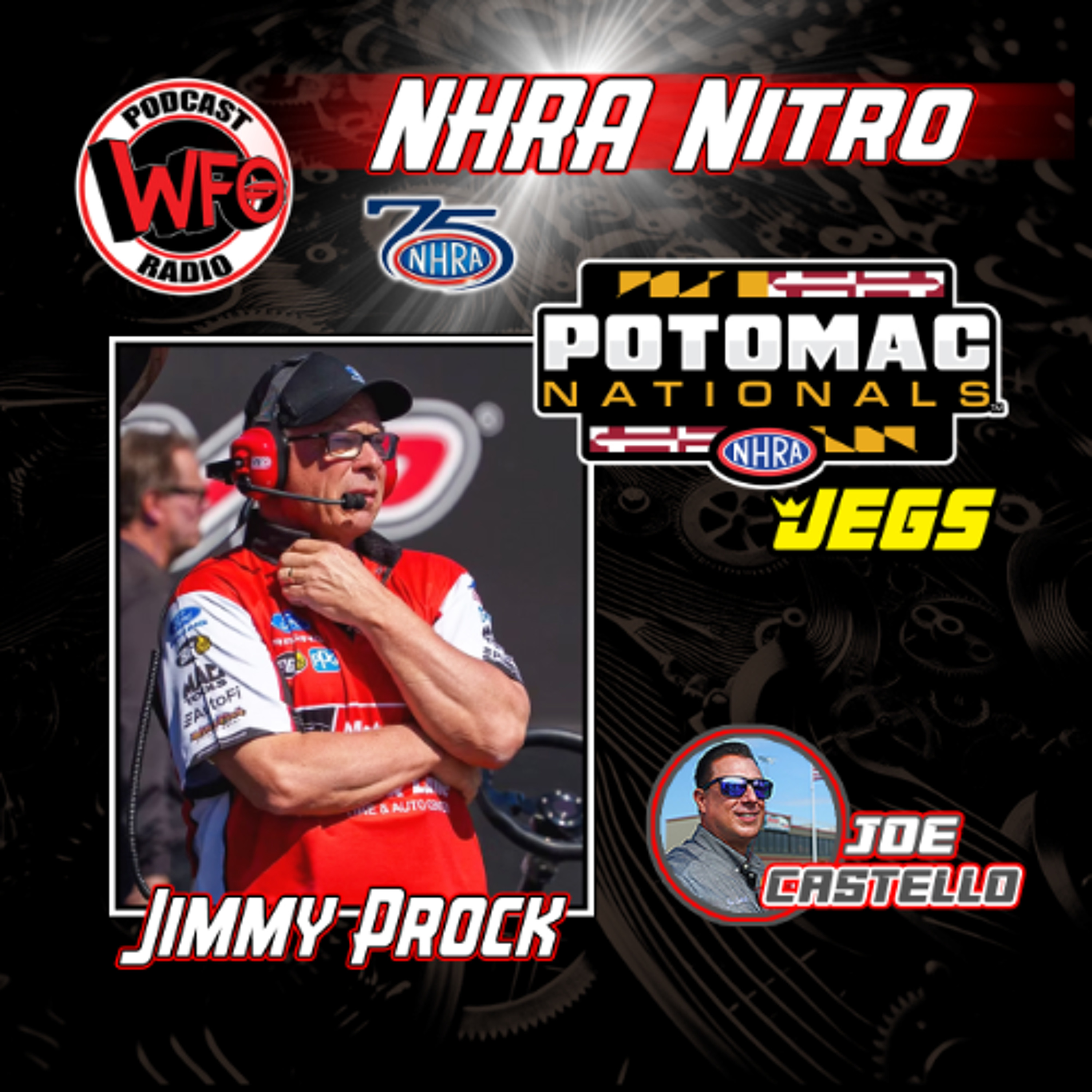
Jimmy Prock joins WFO Radio after winning the NHRA Potomac Nationals
About this episode
Jimmy Prock drops by WFO Radio after winning the NHRA Potomac Nationals, and the conversation moves from race recap to the grind behind the win. Prock talks about getting the car sorted after setbacks, why a new nitro operation changes tuning, and how Maryland’s concrete and lane behavior shaped a dead-heat final. The show also touches on team strategy, testing in Valdosta, and the broader NHRA season—points, momentum, costs, and upcoming stops.
FTI
"For more than a decade, FTI has strived to become the leader in the aftermarket, performance, transmission and converter industry."
FTI is a company that sells performance parts for cars, especially parts that help the engine’s power get to the wheels. In drag racing, those parts are often upgraded to handle more power.
FTI is an aftermarket performance-parts company focused on components used in drag racing, especially drivetrain-related parts like transmissions and torque converters. In this segment, they’re positioning themselves as a leader in the performance transmission and converter industry.
transmission and converter
"For more than a decade, FTI has strived to become the leader in the aftermarket, performance, transmission and converter industry."
These are drivetrain parts that help get power from the engine to the wheels. The torque converter is especially important for launches because it helps the engine deliver strong pull right from the start.
In drag racing, the transmission and torque converter are key drivetrain components that help manage how engine power is delivered to the wheels. The torque converter is a fluid coupling that multiplies torque and allows the engine to stay in its power band during launch.
McLeod driveline components
"We've joined forces with McLeod driveline components under the leadership of top fuel funny car pilot Paul Lee and now have a larger distribution network, more resources and more power."
McLeod is a performance-parts company that makes drivetrain components used in racing. The segment says FTI teamed up with them to grow their reach and capabilities.
McLeod driveline components is a performance aftermarket brand/company known for drivetrain parts used in racing applications. Here, the hosts describe FTI joining forces with McLeod to expand distribution and resources.
Paul Lee
"We've joined forces with McLeod driveline components under the leadership of top fuel funny car pilot Paul Lee and now have a larger distribution network, more resources and more power."
Paul Lee is a professional drag racer who competes in Funny Car. The hosts mention him because he’s connected to the performance-parts team behind this partnership.
Paul Lee is referenced as a top fuel funny car pilot, meaning he drives a Funny Car in the NHRA Top Fuel/Funny Car class. The segment ties his leadership to the FTI/McLeod partnership.
NHRA Nitro
"Hey, everybody. WFO radio is back. NHRA Nitro is on the air on Joe Castello. And we are following up"
NHRA Nitro is the NHRA drag-racing show/coverage for the nitro-fueled classes. The hosts are using it as the backdrop for talking about the weekend’s races.
NHRA Nitro refers to the NHRA’s nitro-fueled drag racing coverage/branding. In this segment, the hosts say they’re following up on the Potomac Nationals and are discussing the race results.
Maryland International Raceway
"the Potomac Nationals presented by JEGS, a blowout event at Maryland International Raceway."
Maryland International Raceway is the track where the NHRA Potomac Nationals were held. The hosts say it was packed and a big event weekend.
Maryland International Raceway is a drag racing venue in Maryland used for NHRA events. The segment describes the Potomac Nationals as being held there and emphasizes the large crowds and sold-out Saturday capacity.
Potomac Nationals
"And we are following up the Potomac Nationals presented by JEGS, a blowout event at Maryland International Raceway."
The Potomac Nationals is a drag racing weekend on the NHRA schedule. This segment is basically the recap of who won and what happened.
The Potomac Nationals is an NHRA drag racing event. The hosts recap the weekend’s results and highlight the winners in the Funny Car class.
JEGS
"the Potomac Nationals presented by JEGS, a blowout event at Maryland International Raceway."
JEGS is a company that sells car and truck performance parts. They’re mentioned as a sponsor/presenter for the race weekend.
JEGS is a well-known consumer-facing aftermarket parts retailer that sponsors motorsports events. Here it’s mentioned as the presenter of the Potomac Nationals.
Total Seal
"I got them on Project Pontiac, Larisse Motorsports Insurance, Total Seal, Jesse Converters, and FTI Performance."
Total Seal is a performance-parts brand that makes engine sealing components, commonly piston rings. They’re mentioned as one of the companies supporting the podcast.
Total Seal is an aftermarket performance brand associated with piston rings and related engine sealing products. The segment lists it among supporters/partners for the show.
Jesse Converters
"I got them on Project Pontiac, Larisse Motorsports Insurance, Total Seal, Jesse Converters, and FTI Performance."
Jesse Converters makes torque converters, which are drivetrain parts that help the engine deliver strong launch power. The host mentions them as a supporter tied to their projects.
Jesse Converters is a performance brand associated with torque converters used in racing and high-stress drivetrain applications. In this segment, it’s listed alongside other engine/drivetrain supporters.
nitro car
"to take a period of time, let alone a nitro car. And so you went into this operation. Bob's car"
In drag racing, a “nitro car” runs on nitromethane fuel instead of normal gas. That fuel burns differently, so the engine setup and tuning are very different.
A “nitro car” in drag racing uses nitromethane-based fuel (often called nitro) instead of regular gasoline. Nitro changes how the engine makes power and how it’s tuned, which is why it’s a big deal compared with other fuel types.
cylinder heads
"You know, obviously the cylinder heads are different. The intake manifold"
Cylinder heads are the top parts of the engine where the fuel and air burn. If you change them, the engine breathes and burns differently, so the tune has to change too.
Cylinder heads are the top housing of the engine’s cylinders, containing the combustion chambers and valve passages. In a forced-induction drag engine, swapping cylinder heads can change airflow and combustion characteristics, which then affects tuning and power.
Supercharger
"The intake manifold is different. Supercharger is different. You know, all those parts were, you know,"
A supercharger forces extra air into the engine. More air usually means more power, but it also changes how the engine needs to be tuned to run correctly.
A supercharger is a forced-induction device that compresses incoming air to increase the amount of oxygen available for combustion. In drag racing, changing the supercharger can significantly change boost levels and engine behavior, so the tuning (timing, fuel, and more) can’t be copied over directly.
intake manifold
"The intake manifold is different. Supercharger is different. You know, all those parts were, you know,"
The intake manifold is the passage that delivers air to the cylinders. If the manifold design changes, the engine gets air differently, so the car may need a different tune.
The intake manifold routes air (or air/fuel mixture, depending on the setup) from the supercharger to the engine’s cylinders. Different intake manifolds can alter airflow distribution and runner characteristics, which changes how the engine responds under boost and therefore how it must be tuned.
JFR
"we used to produce, we produced over there at JFR. So, you know, that was the biggest thing."
JFR is the name of the racing operation/team the speaker mentions as where they used to build or produce parts. When you switch teams, the engine parts and setup can be different, so the tune has to change.
JFR is referenced as the prior operation where the speaker says they produced parts. In drag racing, teams and engine builders often have their own component packages, so moving between operations can mean different cylinder heads, manifolds, and forced-induction hardware.
tune up
"but you got to run all these different components and, you know, it doesn't take the same tune up or settings or anything to make this engine run like the one that I was running"
Here, “tune up” means setting up the engine so it runs right—like timing and fuel. If you change major parts, you can’t just use the old settings.
In this context, “tune up” refers to the engine calibration—how ignition timing, fuel delivery, and other settings are adjusted to match the specific combination of parts. With nitro and forced induction, small changes in hardware can require a totally different tune to make power safely.
timing
"you just can't go in there the same timing, blower, compression, fuel. It ain't all the same from place to place."
Timing is when the engine fires (spark/ignition) during the cycle. On a boosted nitro drag engine, the “when” matters a lot, and the right timing depends on the exact parts.
Timing is the crank/ignition timing—when the spark (or ignition event) happens relative to piston position. On high-boost nitro engines, timing strongly affects power and safety; different hardware combinations require different timing strategies.
compression
"you just can't go in there the same timing, blower, compression, fuel. It ain't all the same from place to place."
Compression is how tightly the engine squeezes the air/fuel mixture before it ignites. Changing compression changes how the engine burns, so the tune has to change too.
Compression refers to the engine’s compression ratio (and related compression characteristics), which affects how the air/fuel mixture behaves before ignition. On forced-induction nitro engines, compression changes can require different ignition timing and fuel strategies to avoid knock and to hit the desired power.
blower
"you just can't go in there the same timing, blower, compression, fuel. It ain't all the same from place to place."
“Blower” is another word for the supercharger that forces extra air into the engine. If the blower setup changes, the engine needs different settings to run right.
In drag racing, “blower” is a common term for a supercharger (forced-induction unit). It’s referenced alongside timing, compression, and fuel because changing the blower’s characteristics changes boost and airflow, which then changes the engine’s required tune.
fuel
"you just can't go in there the same timing, blower, compression, fuel. It ain't all the same from place to place."
Fuel is what the engine burns, and in nitro racing it’s a huge part of how the car makes power. If the fuel setup changes, you can’t keep the same engine settings.
Fuel refers to the type and delivery of the fuel used to make power—especially important in nitro racing. Different fuel formulations and fueling setups change combustion speed and energy content, which then affects how timing and boost must be calibrated.
body
"D-Rail, the manufacturer change, I think is an interesting part of the story. You got a different body... Like, I'm happy with this body. Like, there's no, you know, it picks up, you know, good speed from, you know, in the last 300 and whatever, 20 feet of the run or 40 feet of the run."
The “body” is the car’s outer shape. In drag racing, that shape can change how the car moves through the air, which affects speed and stability at the end of the run.
In drag racing, the “body” refers to the exterior shell/shape of the car, which affects aerodynamics and how the car behaves at speed. Changes to the body can influence drag, stability, and how efficiently the car picks up speed downtrack.
qualifying
"You're having a good effort throughout qualifying and your reward is a four-time champ and one of NHRA 75 best, the last two guys to hoist the trophies."
Qualifying is when racers run timed passes to earn their spot in the bracket. Doing well helps you start in a better position for the elimination rounds.
Qualifying in drag racing is the session where cars run to set their starting positions for eliminations. Better qualifying typically means a more favorable lane/seed and can improve your chances of advancing round by round.
round one
"I observe that the Marquis matchup very often sends someone to the race winner of the final because you got to really bring it round one."
Round one is the first head-to-head race in the bracket. Winning early is important because it sets you up to keep advancing toward the final.
“Round one” is the first elimination round in a drag racing bracket. The speaker notes that this matchup often sends someone to the final, meaning early-round performance is critical.
countdown
"We need points. We got to get into the top 10. We need to move up, you know, hopefully into a more favorable, better position when the countdown starts."
The “countdown” is the final phase of the season where points matter most and the championship is decided. You want to be high enough in points before it starts.
In NHRA points racing, the “countdown” is the playoff-style stretch where the championship is decided. Drivers need enough points to be in the top positions when the countdown begins.
points
"we need points. We got to get into the top 10. We need to move up, you know, hopefully into a more favorable, better position when the countdown starts."
Points are how the series tracks who’s doing well over the season. More points usually means a better chance to reach the final playoff stage.
“Points” are the championship scoring units used to rank drivers over the season. In NHRA-style formats, accumulating points helps determine who qualifies for the playoff “countdown” and where they start in the standings.
track surface
"Let's take a second to talk about the track, the track surface in Maryland International. It was a very different approach, it seemed, than South Georgia Motorsports Park."
The “track surface” is what the racing surface is made of and how it’s conditioned. In drag racing, it affects tire grip, so it can change which lane runs quicker.
“Track surface” refers to the material and condition of the drag strip—commonly concrete or asphalt—and it strongly affects tire grip and how the car accelerates. Even small differences in surface texture, temperature, and transitions can change which lane is faster and how much traction the tires can generate.
South Georgia Motorsports Park
"It was a very different approach, it seemed, than South Georgia Motorsports Park. Everyone seemed to..."
South Georgia Motorsports Park is another drag strip in Georgia. The host is comparing it to Maryland to explain why their approach differed.
South Georgia Motorsports Park is a drag racing facility in Georgia that the speaker contrasts with Maryland International. The comparison highlights how different track surfaces and conditions can change driving and tire strategy from event to event.
smoked the tires
"You know, there's some bumps there at the transition. You know, we smoked the tires once going over in the right lane, the left lane was pretty much the lane of choice..."
“Smoked the tires” means the tires started slipping and spinning instead of gripping. In a drag race, that usually means the launch wasn’t getting enough traction.
“Smoked the tires” means the tires lost traction and spun enough to generate visible tire smoke. In drag racing, that’s a sign the car is exceeding available grip—often due to surface conditions, tire temperature, or launch setup.
right lane
"we smoked the tires once going over in the right lane, you know, the left lane was pretty much the lane of choice... but in the end... the right lane produced as quicker runs as, you know, the left lane did."
In drag racing, the left and right lanes can behave differently. The speaker is saying one lane was better at first, but later the other lane ran faster.
Lane choice matters in drag racing because track conditions can differ from lane to lane, especially on concrete strips or where the surface transitions. The speaker notes that the left lane was initially preferred due to a traction issue in the right lane, but later the right lane produced quicker runs.
dead heat
"The top fuel final was a dead heat. We made our best run of the weekend in the right lane."
A “dead heat” means both racers were so close that they effectively tied. It’s a very rare outcome in drag racing because the timing is extremely precise.
A “dead heat” means both cars crossed the finish line at essentially the same time, resulting in a tie. In drag racing, this is rare because timing is measured very precisely, so a tie usually indicates extremely close performance.
semis
"Beckman ran 92 or whatever he ran in the semis in the right lane. So all in all, I was really impressed with that racetrack..."
“Semis” means the semifinal round—one step before the final race. Winning in the semis gets you into the final.
In NHRA-style drag racing, “semis” refers to the semifinal round of eliminations, where the field is narrowed to the final two cars. Performance in the semis is critical because it determines lane choice and momentum heading into the final.
concrete
"I was impressed with that racetrack and I thought the concrete, the first 300 feet was for the temperature of that track and everything and how we ran..."
Concrete is one type of drag strip surface. It can change how well the tires grip and how the track temperature affects traction.
Concrete drag strips can have different grip and heat-transfer characteristics than asphalt, which affects tire temperature and how the car hooks up. The speaker specifically mentions the first 300 feet of concrete and how temperature influenced their runs.
high 390
"[783.5s] ...we're just trying to keep pace. We thought if we ran, drove good and ran [795.5s] another high 390, we had a good chance of winning the race, winning that round."
“High 390” is a shorthand performance number the team is aiming for. It’s basically them saying, “If we hit a really strong speed/time, we should be able to win this round.”
“High 390” is shorthand for a very specific drag-racing performance target—likely a high-390 mph or similar speed figure used to describe how fast they expected to run in that round. In NHRA conversations, teams often talk in these abbreviated numbers to communicate whether they’re in the ballpark to win a matchup.
final round
"[801.9s] And so then it was on to the final. On And that was wild. And guys, [807.8s] I'm noticing the numbers are going up."
The final round is the last race of the event. The two best cars left after earlier rounds race each other to decide the winner.
The final round is the last head-to-head race of an NHRA event, where the two remaining cars compete for the win. It’s the culmination of earlier elimination rounds where teams keep advancing by winning each matchup.
funny car
"[807.8s] I'm noticing the numbers are going up. Share the show, guys. Like, if you're a fan of funny car racing, NHRA, it's like going up in big bursts, Jimmy Prok on the show."
A funny car is a type of drag race car. It looks a bit like a regular car from the outside, but it’s built specifically to go as fast as possible in a straight line.
In NHRA drag racing, a funny car is a purpose-built dragster with a short wheelbase and a body that resembles a production car, but it’s not a street car. They’re known for very high acceleration and for running on drag-specific setups optimized for straight-line runs.
Jack Beckman
"[829.8s] ...In this case, though, it was Jack Beckman. You know, he's tough. You know, [840.5s] that team is tough."
Jack Beckman is a well-known NHRA drag racer. Here, the speaker is talking about him as one of the tough competitors in the final.
Jack Beckman is a prominent NHRA Funny Car driver known for competing at the top level with strong team support. In this segment, he’s referenced as a key opponent in the final-round matchup.
John Force
"[840.5s] that team is tough. How did you prepare for the final round against John Force Racing? [844.8s] Well, we just, you know, we were picking away at it."
John Force is one of the biggest names in NHRA drag racing. The speaker is saying the final was against John Force Racing, which is a very strong team.
John Force is a legendary NHRA Funny Car driver and team owner whose career spans decades of championships and wins. The segment frames the final-round challenge as coming against John Force Racing.
adjustments
"[844.8s] Well, we just, you know, we were picking away at it. I certainly, [849.5s] you know, felt like we needed to run better than we had, you know, to that point. And so we, you know, we made some adjustments to try to make a quicker run."
“Adjustments” are changes the team makes to the car between runs. The goal is to help the car launch and accelerate better so it can run faster and more consistently.
In drag racing, “adjustments” usually means changing the car’s setup between runs—such as tuning for traction, acceleration, and how the car behaves under power. Teams do this to improve elapsed time and consistency as conditions and opponent performance evolve.
quicker run
"[860.0s] we made some adjustments to try to make a quicker run. Unfortunately, it did it and Austin [865.8s] drove good enough and, you know, we won."
A “quicker run” means the car goes down the track faster. In drag racing, that usually refers to the time it takes to reach the finish line.
A “quicker run” in drag racing means improving the car’s time through the run, typically measured by elapsed time (ET) and often discussed alongside top speed. Teams aim for a quicker run by refining launch and power delivery so the car reaches the finish line faster.
swept back header
"Larry comes on, you know, Fairmount gave him the insight into the swept back header and he swept his header back and it worked big time."
A header is part of the exhaust system that collects exhaust gases from the engine. “Swept back” means the pipes are shaped/angled differently to help the exhaust flow work better, which can add power in drag racing.
In drag racing, a header is the exhaust manifold that routes exhaust gases from the engine into the exhaust system. A “swept back” header changes the shape/angle of those pipes to influence exhaust flow timing and scavenging, which can improve power and consistency.
Revell model kit
"This guy says, did Jimmy get to build the Revell model kit of his dad's custom body funny car?"
Revell makes model kits—small plastic replicas you put together yourself. Here, they’re talking about a kit version of a funny car Jimmy’s dad raced.
Revell is a model-kit brand, and a “Revell model kit” is a scale plastic kit that you assemble yourself. In this context, it’s being referenced as a way Jimmy’s dad’s funny car was turned into a buildable replica.
drag racing
"Um, you're on there and your life has been drag racing and you're still in the middle of it."
Drag racing is racing in a straight line to see who accelerates the fastest. The cars are tuned mainly for quick launches and strong acceleration over a short distance.
Drag racing is a motorsport where cars or motorcycles race in a straight line over a short, measured distance, typically focusing on acceleration and traction. It’s different from road racing because setup and tuning are optimized for launch and power delivery over that brief run.
racing the other driver
"And, you know, in my conversations with, you know, Ron Tobler, it's, it's not about racing the other driver, it's about racing Jimmy, what's Jimmy doing, all that kind of stuff."
Even though you’re competing against another racer, the real goal is to make your own car run its best. You can’t control everything, but you can focus on improving your setup and performance.
In drag racing, the competition is often described as “racing the other driver,” but the speaker reframes it as focusing on the opponent’s and your own performance variables. The idea is that you’re always trying to improve your own run—reaction, launch, and tune—while still accounting for what the other car is doing.
timeline
"But for the fans of TASCA out there, you know, is there a timeline and how much help would that be to you?"
In this context, “timeline” means a planned schedule for when the team could add a second car and get it fully supported. It’s essentially a project plan question: when can the resources, parts, and funding line up to make the plan realistic?
chassis shop
"Yeah, the chassis shop, which Bob has talked a little bit about, kind of under publicized. There's a lot of in-house stuff going on there at TASCA Racing and I'm very excited for it."
A chassis shop is a garage/workshop where the race car’s main structure and suspension mounting areas get built and adjusted. It’s where teams do a lot of the hands-on work to make the car handle and launch the way they want.
A chassis shop is a workshop focused on building, modifying, and maintaining the race car’s chassis—the structural frame and suspension mounting points. In drag racing teams, it’s where cars are set up for traction, stability, and consistent launches, often with lots of in-house fabrication and tuning work.
New England Nationals
"New England Nationals, let's talk about this third race of three in a row and or second race of three in a row. And this is a classic drag strip, another relatively small track."
The New England Nationals is a specific drag racing weekend/event. The hosts are talking about what the race is like and what the team hopes to do there.
This refers to a specific NHRA drag racing event called the New England Nationals. The hosts use it as the basis for a preview segment, discussing what to expect from the weekend and the team’s goals.
two 10,000th of a second
"like our top fuel final coming down to two 10,000th of a second nearly identical runs on both sides of the racetrack."
Drag races are timed super precisely, down to ten-thousandths of a second. That phrase means the winner was decided by an incredibly tiny difference in time.
Drag racing timing is measured to very fine precision—often to ten-thousandths of a second—because races can be decided by tiny differences. When the host says the final came down to "two 10,000th of a second," it means the winner was separated by an extremely small time gap.
water box
"the best thing is, you know, into the water box, and then once you hit the return road, it's covered."
In drag racing, a "water box" is where they spray water on the track to make it stick better. Better traction can help the car launch faster.
A "water box" is the staging-area setup in drag racing where track officials apply water to the racing surface to help create traction. Teams use it to improve launch grip, which can significantly affect acceleration and elapsed time.
key on track insurance
"into the water box, and then once you hit the return road, it's covered. You can get key on track insurance."
It sounds like a type of insurance that covers you when you’re actually using the car for track activity. The key idea is that coverage depends on what you’re doing and where the car is.
This refers to insurance coverage that’s tied to being actively on track (as opposed to being parked or stored). In motorsports, policies often define specific conditions—like where the vehicle is and what activity it’s being used for—so coverage can change depending on the situation.
return road
"into the water box, and then once you hit the return road, it's covered."
In drag racing, the "return road" is the path the car uses after completing a run to get back toward the staging area. It’s part of the track flow, and the host uses it to describe when insurance coverage applies during the event.
exemptions and exclusions
"The thing that makes them different is that they don't have all the exemptions, all the exemptions and exclusions."
Insurance policies often have rules about what they won’t pay for. "Exemptions and exclusions" are those exceptions—situations where coverage might not apply.
"Exemptions and exclusions" are policy language that lists what situations aren’t covered or are limited. The host is emphasizing that this insurance provider has fewer carve-outs/excluded scenarios, which matters a lot in racing where unusual events can happen.
buy run
"Sean Langdon gets a buy run first round goes up against Justin Ashley second round"
A buy run is when a driver gets to advance without racing that round. They still make a run, which helps the team keep the car and strategy on track.
A buy run is a pass a driver gets when they advance without having to race in that round due to bracket structure (often because of an odd number of cars). It lets the team use the run to gather data and keep the car moving forward in the event.
Max Pappas wheel
"Brian Houston letting the cat out of the bag if there even is a cat in the bag about the Max Pappas wheel ... JR Todd Was the first to have it that I know about in funny car."
They’re talking about a particular wheel setup from Max Pappas’ Funny Car team. In drag racing, the wheel/tire setup can change how well the car launches and how straight it runs.
The “Max Pappas wheel” refers to a specific wheel setup associated with Max Pappas’ Funny Car program, used here as a performance component. In drag racing, wheels and tire setup strongly influence how the car launches and stays stable under extreme acceleration.
PBRC car
"He said one. Yes the wheel but two the PBRC car He loves it and he just loves the feel"
They mention the “PBRC car” as part of the reason the car feels right and goes straight. Think of it as the particular race car/program they’re using, not just one single part.
“PBRC car” is shorthand for a specific drag-racing car program/team referenced in the conversation, and it’s treated as part of the overall setup that affects how the car feels and runs straight. The host credits both the wheel and the PBRC car combination for the improved straight-line behavior.
10,000 of a second
"It's a dead heat. It's a dead heat to 10,000 of a second That is insane"
They’re talking about timing measured in extremely tiny fractions of a second. That’s why two cars can look like they ran the same time, but the computer can still separate them.
Drag racing timing is often measured to very fine fractions of a second—here, “10,000 of a second” (one ten-thousandth). That level of resolution is why races can be decided by extremely small differences in ET.
dominance
"It's gonna be tough it is going to be tough and so Brian Hughes and Shawn Langdon keep their [2101.8s] You know, let's call it dominance going three in a row the hat-trick if you will that is very rare"
“Dominance” here means one driver or team is winning a lot and staying ahead. It’s basically the opposite of a close, unpredictable season.
“Dominance” in racing means one team or driver is consistently outperforming the field across multiple events. The host frames it as a streak that’s hard to replicate, emphasizing how strong the current frontrunners are.
hat-trick
"It's gonna be tough it is going to be tough and so Brian Hughes and Shawn Langdon keep their [2101.8s] You know, let's call it dominance going three in a row the hat-trick if you will that is very rare"
A “hat-trick” here means winning three races back-to-back. It’s a big deal because it’s hard to keep winning every time.
In motorsport, a “hat-trick” means winning three races in a row. The host uses it to describe a rare streak of consecutive wins by a driver.
pro stock
"Let's see what some of the comments are out there before we move into pro stock Here's one I didn't get to is there anything that Jimmy could would change to the funny car of the fuel classes as a whole I"
Pro Stock is a drag-racing class where the cars are based on production-car ideas, but heavily modified. The goal is to be fast and consistent in a straight-line sprint.
Pro Stock is another NHRA drag racing class, focused on cars that are closer in concept to production vehicles than Top Fuel/Funny Car. The cars use highly modified engines and transmissions to compete on consistency and elapsed time.
playing field is level
"Right now is exciting The playing field is level for the most part Look at formula one"
This means the competition feels fair—no one team has a huge built-in advantage. In racing, fairness usually comes from the rules being set up so cars have similar chances to win.
“Playing field is level” refers to the idea that rules and competition are balanced so no single team or manufacturer has an overwhelming advantage. In motorsport, this is often discussed in terms of regulations, parity measures, and how often the rulebook changes.
formula one
"The playing field is level for the most part Look at formula one You know, they change every couple of years to keep it interesting"
Formula One is a major world racing series. The speaker brings it up to explain how changing rules can keep racing competitive.
Formula One is referenced as an example of a top-level racing series that changes rules periodically to keep competition interesting. The host uses it as a comparison point for NHRA rule stability and parity.
George Russell
"They got it and nobody else does and so it's five wins for Mercedes One by George Russell four by Kimi Antonelli Does anyone want that? No, it's wide open."
George Russell is a race car driver in Formula One. In this segment, he’s mentioned as an example of who won races for a dominant team.
George Russell is a Formula One driver mentioned as part of the Mercedes win total. His name is used to illustrate how one team can dominate when rules favor them.
Kimi Antonelli
"One by George Russell four by Kimi Antonelli Does anyone want that? No, it's wide open. Don't change anything my pin my pin"
Kimi Antonelli is a Formula One driver. Here he’s mentioned because Mercedes had several wins, showing what happens when one team clearly has the advantage.
Kimi Antonelli is a Formula One driver mentioned alongside George Russell in the context of Mercedes winning multiple races. The speaker uses the example to argue against rule changes that create one-sided results.
WFO League
"Give us a year or two and we will figure out how to deal with the situation Mack is to you know in the WFO League. Good job. I was 10"
The “WFO League” appears to be a branded racing/competition group associated with the podcast’s community. “WFO” is commonly used in motorsports to mean “wide open,” i.e., full-throttle driving, though the exact league rules aren’t defined in this excerpt.
Pit podcast
"Mack is to you know in the WFO League. Good job. I was 10 Pit podcast had a blast with me on there. Thank you very much guys appreciate that honor to be on and you on your show on honor genuine"
A “pit podcast” is a show that covers racing with a focus on what’s going on around the track—like interviews and stories from the teams.
A “pit podcast” is a podcast format tied to motorsports coverage, typically focused on drivers, teams, and behind-the-scenes stories from the paddock/pit area. In drag racing contexts, it often means interviews and updates connected to what’s happening at the track.
wheels up
"Watching Michael Heiner get his round one win with to get biofuel car wheels were up. I love when pro stock cars launch wheels up"
“Wheels up” means the car’s front tires lift off the ground when it launches. That can happen when the car accelerates so hard that the tires can’t stay stuck to the track. It looks cool, but it can also make the launch less effective.
In drag racing, “wheels up” means the car lifts its front wheels off the ground during launch. It usually happens when traction and suspension load transfer can’t keep the tires planted under hard acceleration. It’s dramatic to watch, but it can cost time if the car loses effective grip.
launch
"It's super cool [2754.3s] I know it's not [2755.8s] the most efficient way [2758.0s] but [2759.3s] It's super cool [2760.5s] Kenny Delco beats Matt Hartford first round, you know Hartford and those guys have been helping Delco and"
In drag racing, “launch” is the moment the car leaves the starting line and transitions from staging to full acceleration. Teams manage clutch/shift timing (or torque delivery in the case of the class rules), tire pressure, and suspension behavior to maximize traction. A good launch is often the difference between winning and losing even when the cars have similar top-end speed.
hammer down
"But standing behind the car that thing was trucking right at the wall Matt active courage kept the hammer down [2778.9s] It set the tires down"
“Hammer down” means the driver is pressing the accelerator all the way. That usually makes the car accelerate hardest, but it can also cause the tires to lose grip. It’s a common way to describe full-throttle driving.
“Hammer down” is racing slang meaning the driver is fully applying the throttle. In drag racing, that’s typically the fastest way to make power, but it also increases the chance of wheelspin or instability if traction isn’t there. The phrase fits the moment described: the car is aimed at the wall but the driver keeps maximum acceleration.
groove
"It set the tires down [2780.7s] Inches from the wall and they brought it back into the groove lost too much time [2784.9s] Lost the race to KD KD has a problem second round Troy Coughlin goes up against Dallas Dallas wins that"
The “groove” is the part of the track where the tires get the best grip. If the car stays in that path, it can accelerate more effectively. If it moves away from it, traction drops and the car can lose time.
The “groove” in drag racing is the preferred racing line down the track where the surface provides the best traction. Staying in the groove helps the car transfer power efficiently without excessive wheelspin or instability. When the car drifts out of it, the run can slow down quickly.
ladder
"Lost the race to KD KD has a problem second round Troy Coughlin goes up against Dallas Dallas wins that [2792.3s] Dallas gets through Aaron and Shane Tucker [2796.5s] Other side of the ladder Greg and Greg in the semis great race Greg Stample got a really fast car"
The “ladder” is the tournament bracket in drag racing. It shows which cars race each other in each round and who advances. Following the ladder tells you how someone reaches the final.
In NHRA eliminations, the “ladder” is the bracket structure showing who advances through rounds. Each win moves a car to the next matchup, and the bracket determines potential opponents in later rounds. It’s a way to visualize the tournament path to the final.
horsepower
"So he wants to Be respectful to that by doing everything he can in his power To win races and it's working those guys They're acting different they're racing different and I'm quite certain they'll be in the winter circle at some point this year"
Horsepower is a way to measure how much power the engine makes. More horsepower usually means the car can go faster, especially in drag racing where acceleration matters most.
Horsepower is a measure of how much power an engine can produce. In drag racing, teams chase more horsepower because it helps the car accelerate harder down the track.
winter circle
"They're acting different they're racing different and I'm quite certain they'll be in the winter circle at some point this year"
The “winter circle” is where winners celebrate at an NHRA drag race. If someone says you’ll be in the winter circle, they mean you’re likely to win.
The “winter circle” is the celebratory area at an NHRA event where winners go after taking a race. It’s a drag-racing tradition and a shorthand for “winning the event.”

Chevrolet C5
"But who knows C5 Pete DC is a great experience another great WFO J..."
The Chevrolet Corvette is a sports car made by Chevrolet. It’s designed to feel quick and fun to drive, with a focus on performance. People talk about it a lot because different versions can drive and feel noticeably different.
The Chevrolet Corvette is a performance sports car from Chevrolet, known for its mid-engine or front-engine layouts depending on generation and for delivering strong driving dynamics. It often comes up in enthusiast discussions because different model generations offer distinct experiences and engineering approaches. In a podcast context, it’s likely mentioned as a standout car to drive or own, especially when someone highlights a specific Corvette generation or owner experience.
Moser engineering
"Like the segment you have in the stating lanes in the lanes brought you by [4046.9s] Moser engineering, I don't mind mentioning Moser on WFO. They're not a sponsor, but I'm I'm a client"
Moser Engineering is a company that makes performance parts for cars, like upgraded rear-end/axle components. The host says they installed Moser axles on their project car.
Moser Engineering is an aftermarket company known for drivetrain and rear-end components for performance cars, especially axles and related hardware used in drag racing builds. In the segment, they’re mentioned as the source of “axles” for the host’s project car.
axles
"I've put Moser axles on the back of project Pontiac this year, so I haven't driven the car yet [4057.9s] We'll get it. I"
Axles are the parts that send power from the rear differential to the wheels. If a car is making more power for racing, people often upgrade axles so they don’t break under acceleration.
In a drag-racing rear end, “axles” are the shafts that transmit torque from the differential to the wheels. Upgrading axles is common when a car makes more power than the stock parts can reliably handle, especially under hard launches.
Lucas oil series racer
"The appreciation and the understanding of what the Lucas oil series racer the sportsman racer is to NHRA [4073.7s] Cannot be overstated"
The “Lucas Oil series” is a drag-racing series for regular competitors (not just the top pro teams). The host is saying those racers really matter to NHRA.
“Lucas Oil series” refers to NHRA’s Lucas Oil-sponsored racing series for sportsman-level competitors. In this context, the host is praising how these racers support NHRA and the broader drag-racing ecosystem.
sportsman racer
"The appreciation and the understanding of what the Lucas oil series racer the sportsman racer is to NHRA [4073.7s] Cannot be overstated"
A “sportsman racer” is a drag racer who competes in the more entry-to-mid level classes. They’re not the very top pro teams, but they’re a big part of what makes NHRA events work.
A “sportsman racer” is a drag racer competing in the NHRA’s lower tiers compared to the top professional classes. These racers are often the backbone of events, showing up in large numbers and keeping local and regional racing vibrant.
Request an Explanation
Heard something you'd like explained? We'll add it to this episode.
Sign in to request explanations for terms you heard.
Want to learn more?
Browse our glossary for plain-English explanations of automotive terms, jargon, and concepts.
Help improve this episode
See something that's not quite right? Our annotations are AI-generated and can sometimes miss the mark. Click the flag icon on any annotation to suggest a correction.