They’re talking about the Volvo EX30 and saying it’s smaller than the other car. The point is that its size makes it feel like a good fit for certain buyers or situations.
“Plug-in” means the car can be charged by plugging it in. That usually lets you drive some distance using electricity instead of using gas the whole time.
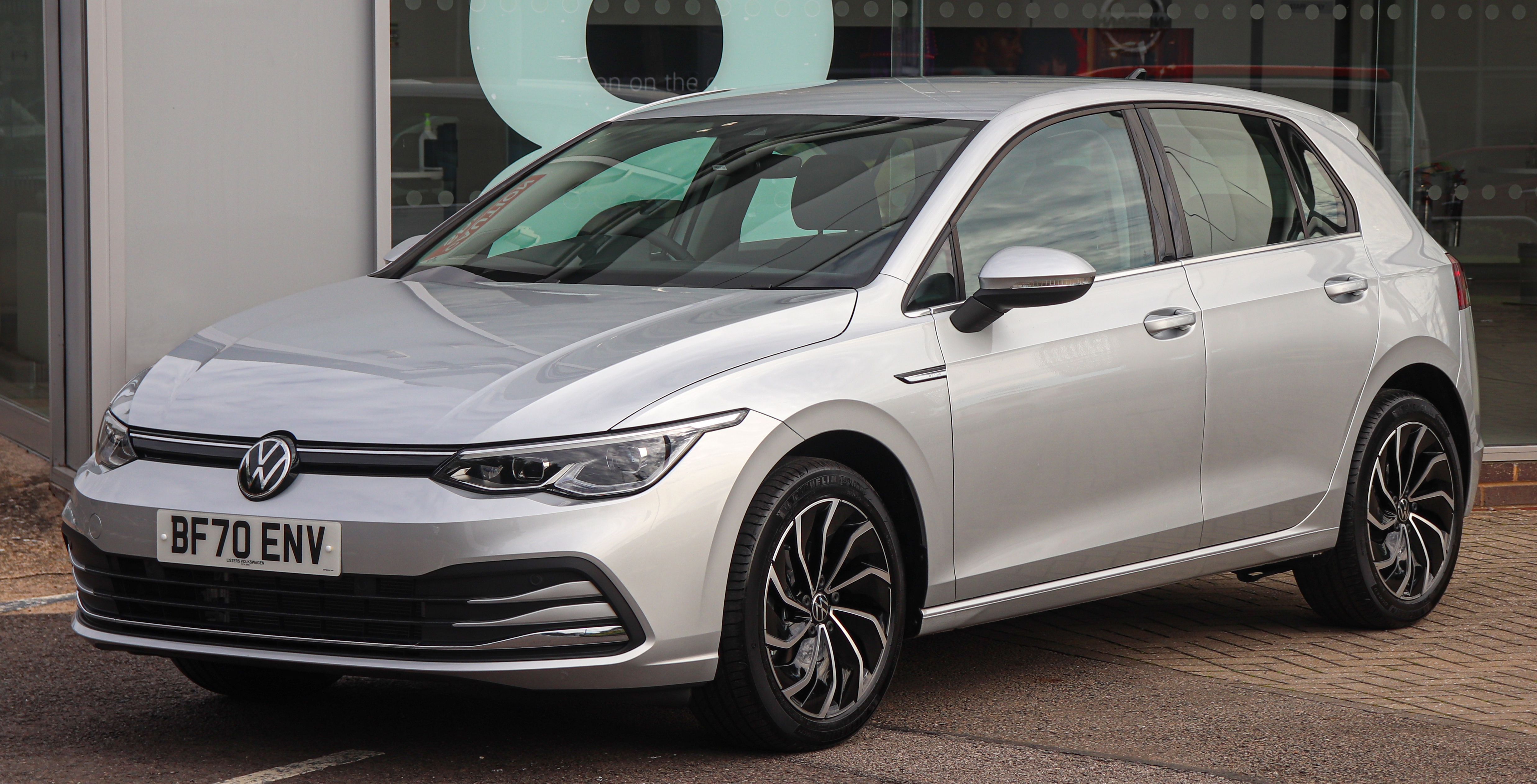
The Volkswagen Golf is a compact hatchback, meaning it’s a smaller car with a door that opens at the back. Wheel bearings help the wheels spin smoothly. When they wear out, you may hear noise while driving.
They mention the Toyota Corolla hatchback as another example of a small hatchback. The idea is that the Volvo feels even more compact than cars like this.
In a hybrid, “regenerates” usually means the car recharges its battery while you slow down. Instead of wasting all that energy as heat, the car turns some of it back into electricity.
A three-wheeler is a vehicle with three wheels instead of four. Because it has fewer wheels, it can feel less stable and steer differently than a normal car.
A three-wheeler is a vehicle with only three wheels instead of four. Because it has fewer wheels, the way it turns and drives is different. It still has wheel bearings that can wear out and make noise.
A differential is a part that helps the wheels turn at different speeds when you go around a corner. Without it, turning a multi-wheel vehicle gets tricky, so early designs sometimes used fewer wheels.
A single-cylinder engine has just one cylinder that does the work of making power. It’s simpler than engines with multiple cylinders, and it usually makes less power and can feel rougher.
“Pony car” usually means a small, sporty American performance car. The speaker is using the phrase more like a joke/comparison to describe how tiny the power output is here.
Recreations are copies made to look like an old vehicle from history. They’re often built so people can experience something similar without risking the original.
The Hyundai Pony was one of Hyundai’s early cars. The hosts mention it as an example of a very inexpensive, early model that wasn’t especially impressive.
The Ford Maverick is a small pickup truck that’s usually priced lower than most trucks. Here, the host is saying it’s an example of a cheaper vehicle that still feels solid.
The Nissan Kicks is a small crossover that’s usually priced to be affordable. The host points out that it uses a lot of plastic inside, but tries to make it look decent.
The Nissan Versa is a low-cost car that’s meant to be easy on your budget. The host is using it to explain how lease deals can drop the effective monthly cost.
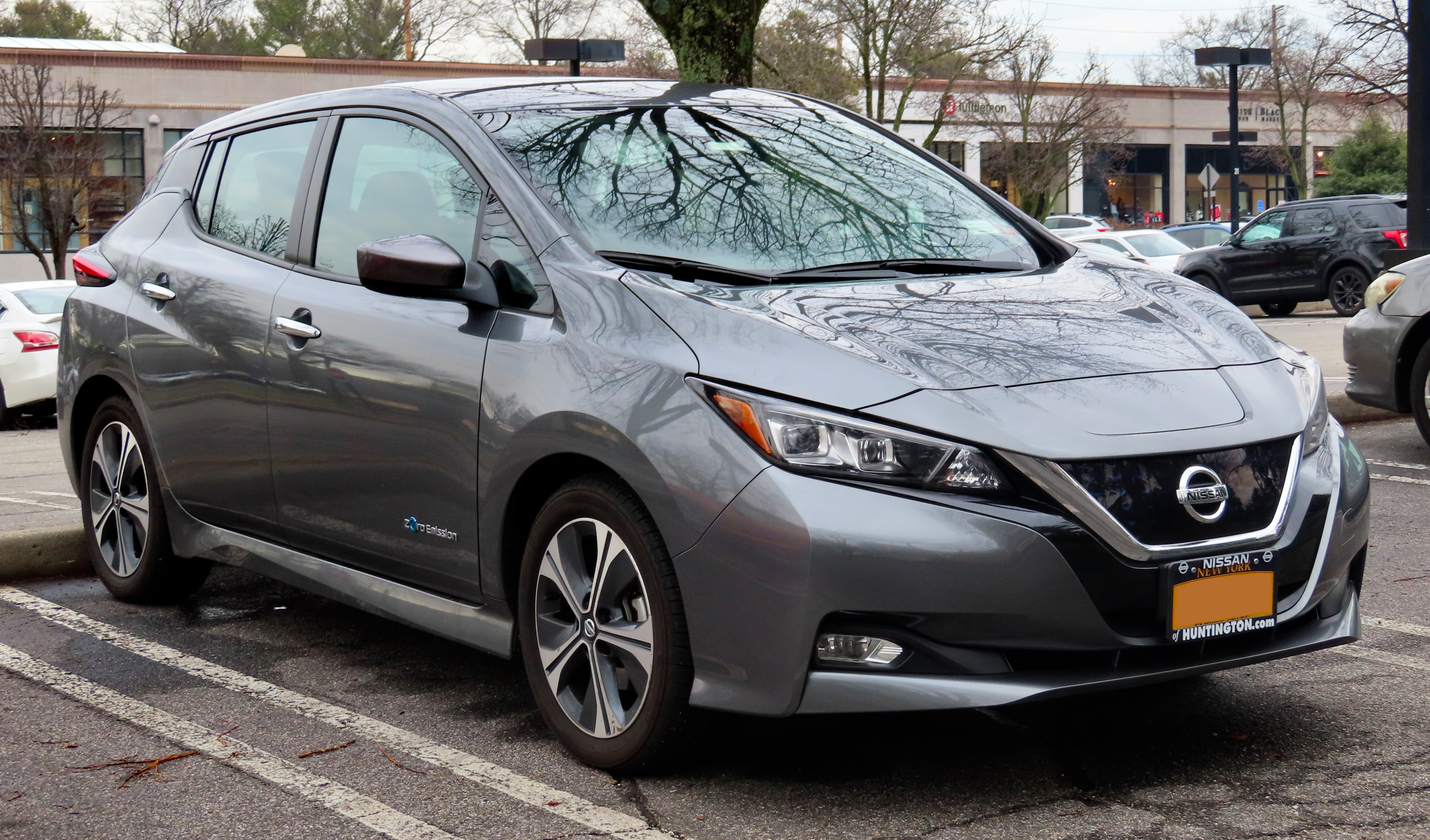
The Nissan Leaf is an electric car. The Platinum Plus is the higher-end version, and the host is saying the newer one feels much better and goes farther than earlier Leafs.
Front-wheel drive means the front wheels do the work of both steering and moving the car. It can change how the car feels on slippery roads compared to cars that drive the rear wheels.
For an electric car, “range” means how far it can go before the battery runs low. The host is saying the newer Leaf fits more battery and therefore can drive farther.
Tariffs are extra taxes on imported products. If they make a car too expensive to bring in, the automaker may decide not to sell a cheaper version in that market.
A liquid cooled battery pack uses fluid to keep the battery from getting too hot. Cooler batteries tend to last longer, particularly when the weather is hot.
An air cooled battery pack uses air to cool the battery. The hosts are saying older designs didn’t manage heat as well in hot weather, which can make the battery wear out faster.
The AC onboard charger is the part of the EV that turns regular AC charging power into the kind the battery can use. Higher charger power usually means faster charging.
AC charging is the common kind of charging you might do at home. The car has to convert that power before it can charge the battery, so it’s usually slower than fast charging.
A DC fast charger is the kind of charger that can refill an electric car quickly. It’s faster than home charging, and the hosts are saying the newer Leaf can take more power than the older one.
J3400 is a specific type of charging plug/standard. Here, it’s being used to explain which port lets the car charge at certain fast-charging networks like Tesla’s.
CCS is a widely used fast-charging type. The hosts are saying the Leaf can use CCS stations too, as long as you have the right adapter.
Concept
charging speed vs range for road trips
To plan longer EV trips, you need two things: how far the car can go on one charge, and how fast you can recharge when you stop. They’re saying the newer Leaf improves both, so trips are more realistic.
It’s a special glass/film that can change how dark it is using electricity. Instead of opening like a normal roof, it can “clear” only parts of the roof so you get light without as much glare.
It’s the software system inside the car that runs the screen and apps. Using Android Automotive can make the interface more modern, and it can still work with phone-based systems like CarPlay and Android Auto.
CarPlay lets you connect your iPhone to the car and use certain apps on the car’s screen. It’s mainly for navigation, music, and calling while you drive.
This is Nissan’s driver-assist tech that helps keep the car in the lane. It can steer to stay centered, but you still need to pay attention and keep your hands on the wheel.
ADAS are the car’s driver-assist features. They help with things like staying in the lane or controlling speed, but you’re still responsible for driving.
The Nissan GT-R is a fast sports car built for performance driving. When you drive it on twisty roads, you want everything to feel tight and smooth. If wheel bearings wear out, they can create noise or vibration that affects that feel.
A battery pre-heater is a device that warms the battery in advance. When it’s cold outside, a warmer battery can charge faster instead of slowing down.
Max charging speed is how fast the car can charge at its best moment. In very cold weather, the battery may not be able to take in energy quickly, so charging slows down.
Route planning is the navigation feature that helps pick a path to your destination and shows directions as you drive. Here, they’re saying some trims get it and others don’t.
Google Assistant is the voice assistant that can help with things like navigation and commands. The hosts are pointing out that some car trims don’t include it.
Battery state of charge is basically how full the battery is, shown as a percentage. The host says the navigation can read that information from the car.
EV routing is GPS that plans your drive for an electric car. It tries to tell you the best places to stop and charge, and how long those stops will take.
This is a Ford facility specifically for building and improving electric cars. The idea is to make the process faster by having the right people and equipment in one location.
An “electric vehicle platform” is the shared engineering foundation—like the architecture and major systems—that multiple EV models can be built on. Calling it “universal” suggests the goal is to reuse that base across different vehicles to reduce development time and cost.
A development cycle is the overall timeline for making a new vehicle—from the first planning work to when cars are actually ready to be delivered to customers.
A “skunkworks team” is basically a special group that works on something new with extra speed and flexibility. It’s meant to get early progress while the rest of the company follows normal processes.
The Chevy Bolt is an electric car that helped show EVs could be made at a more affordable price. The hosts bring it up to compare how long it took GM to develop and launch it versus newer EV projects.
The Hummer EV is GM’s electric version of the Hummer. The conversation uses it to talk about whether GM gave itself enough time to develop and launch these EVs well.
Lead time is how long it takes to get a prototype made and ready. The big point here is that they cut that waiting period from months down to about two weeks.
A five-axis mill is a CNC machine that can move a cutting tool (and/or the workpiece) along five different axes, allowing complex shapes to be machined in fewer setups. In the segment, it’s used to carve seat materials like foam and clay, speeding up prototype iteration.
CAD drawings are computer files engineers use to design parts. Instead of sketching and waiting, the design can go straight to the shop to make a prototype faster.
3D printing makes a physical part from a computer model, usually one thin layer at a time. It’s a fast way to create prototype seat parts so engineers can test them sooner.
A purchase order is an official paperwork step that tells a supplier what you want to buy. Approving those documents can add time before a prototype can be made.
They’re a company that studies cars by taking them apart and looking at parts and costs. The goal is to figure out what parts cost the most and how companies can improve designs.
Parts commonization means using the same parts in more than one car. That usually saves money because the company doesn’t have to make a bunch of different versions.
Bespoke here means “made specifically for that situation,” not a one-size-fits-all part. They’re saying some parts should be tailored, while others can be standardized.
Wiper motors are the motors that move your windshield wipers. The point here is that some companies design a special motor for their car, while others buy a standard one and fit everything around it.
“Off the shelf” means buying a standard part that already exists, not designing a brand-new one. They’re saying you can save money by using a common wiper motor and fitting the car around it.
A “skew” here means a specific version of a part. They’re saying they can use the same version for two spots in the car (by flipping it), instead of stocking two different versions.
Connectors are the plug-together parts that let wires connect to the car’s electronics. Using fewer, more standardized connectors can reduce complexity.
A wiring harness is the bundled set of wires and connectors that carries power and signals throughout the vehicle. The segment discusses building complete wiring harnesses in-house and reducing the number of different connector types to simplify assembly and design.
Instead of lots of separate computers spread all over the car, zonal architecture uses a main computer plus a few “zone” computers. Each zone handles wiring and signals for its area, which can simplify the car’s electronics.
ECUs are the car’s little computers that run different systems. Some cars have many of them in different places, while newer designs try to reduce how many there are.
Think of the central compute unit as the car’s main brain. It coordinates big-picture control, while smaller computers handle specific areas of the car.
Zone controllers are smaller computers responsible for one part of the car. They help route signals and manage power for that area so the main computer doesn’t have to handle everything directly.
NACS refers to the charging plug/port standard. Here, the car’s charging hardware is packaged together with the electronics that route power to the battery and coordinate with the car’s controllers.
The battery management system is the EV’s safety and control brain for the battery. It monitors the battery and helps prevent damage while charging and driving.
The Dodge Charger is a larger car that’s built for performance. If a wheel bearing wears out, it can make noise or cause vibration while driving. That’s why it might be discussed in a conversation about wheel bearings.
Instead of the battery just sitting inside the car, the battery box helps hold the car together. That can simplify construction and change how the car’s body is built.
Giga casting means making huge metal pieces in one shot instead of welding together lots of smaller parts. It can make building easier, but repairs after damage can be trickier.
It’s a big one-piece metal part that replaces several smaller pieces. The speaker is saying “unit casting” describes the idea more clearly than the broader “giga casting” term.
The Tesla Model Y is mentioned as an early example of building the battery pack into the car’s structure. That can make the car easier to assemble and change how the body is designed.
Breakaway parts are pieces that are designed to come apart in a crash in a controlled way. The benefit is that the damaged section can be replaced instead of replacing a whole big part.
The Tesla Cybertruck uses a very different body structure than most cars. The idea here is that if part of it breaks in a crash, it’s designed so a shop can replace just the damaged section instead of replacing everything.
Repairability means how easy it is to fix a car after it gets damaged. In this case, the design is meant to make crash repairs simpler and less costly.
A stamped component is a metal part made from sheet metal that’s pressed into shape. The point being made is that stamped parts often bend in crashes, while cast parts can be designed to break in a more repairable way.
Rivets and glue are two ways to attach parts together. Here, the idea is that after a crash breaks a section, the repair can put a new section back using rivets plus strong adhesive.
These “levels” describe how automated a car is. Level 2+ is mostly driver-assisted—your hands and attention are still expected—while Level 3 is more advanced, where the car can do more of the driving for longer periods in specific situations.
SAIC is a big Chinese car company. The episode says it’s working with Volkswagen on this EV, which usually helps the car get built and sold in China.
Company
Bementa
Bementa is named here as the company providing the driver’s “cyst software” (likely a transcription error for the driver-assist/ADAS software stack) used in the vehicle. The episode also links it to work with Mercedes and BMW, suggesting it supplies or develops software components for multiple automakers.
Hands-free mode is when the car can steer and drive without you gripping the wheel. It usually works best in certain conditions, and it’s not the same as the car being fully autonomous everywhere.
A range extender is a small engine that kicks in to recharge the battery. It helps the car keep going longer without you needing to plug it in every time.
CLTC is a testing method used in China to estimate how far an EV can go. The number can look better than what you’d see in everyday driving or other countries’ tests.
Homologation is the set of rules a car has to meet to be allowed to be sold in a country. The hosts say those rules can change from place to place, which can affect cost and how quickly a car can be sold.
Brand
VW
They bring up VW as a car company that could copy what other brands learned from making EVs in China. The idea is to improve future models with better range, cost, and software.
The Volkswagen ID. Buzz is an electric van. It uses batteries instead of a gasoline engine. Even though it’s electric, the wheels still use bearings that can wear out and make noise.
“TX” here is referring to an upcoming Lexus model called the TZ. It’s a car that’s expected to come to the US. Even brand-new cars have wheel bearings that can wear over time with use.
Because EVs don’t have an engine sound, some cars let you choose different driving sounds. They’re saying the Lexus TZ can play different sound themes when you press the accelerator.
LIVE
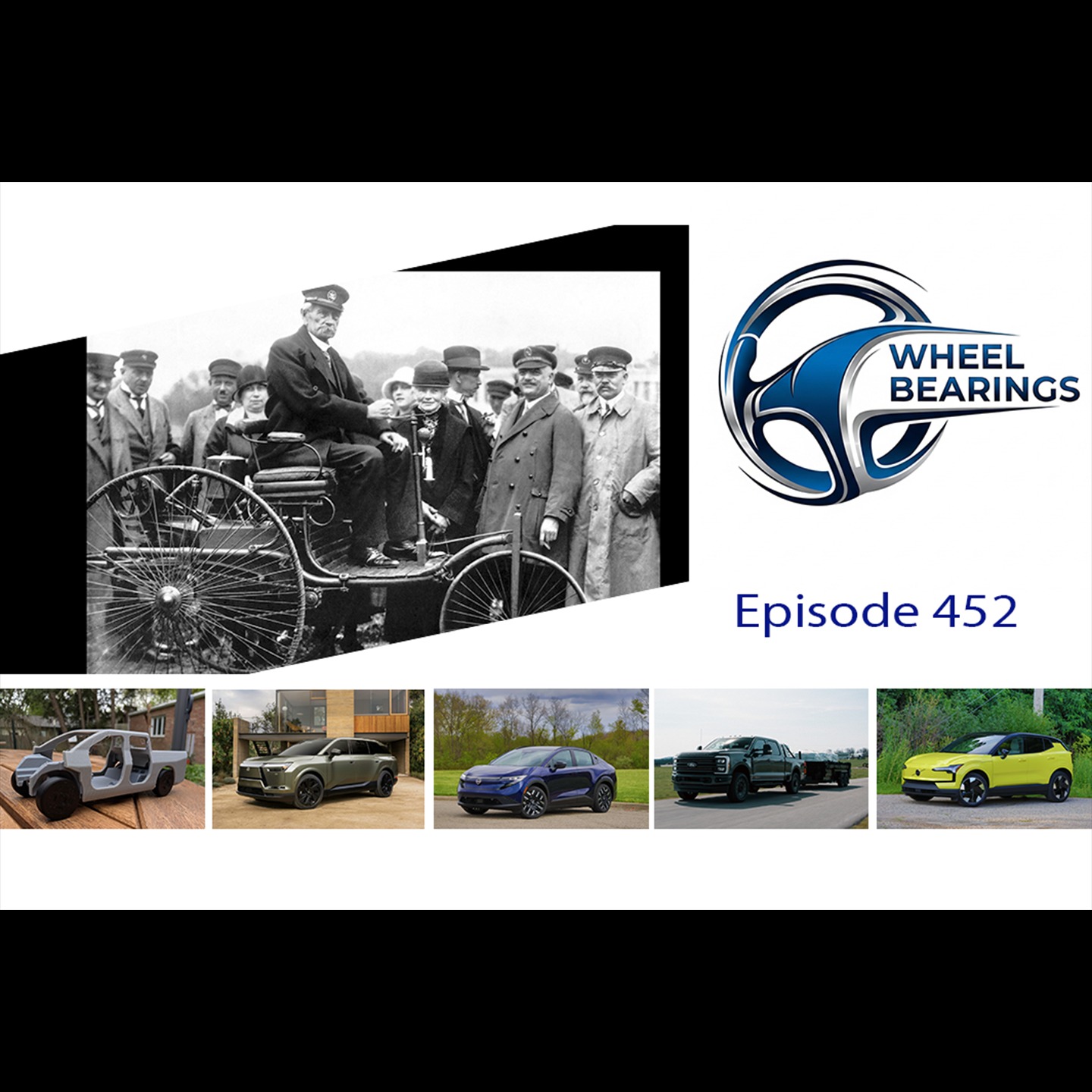
[SPEAKER_02]: This is episode 452 of Will Berings.
[SPEAKER_02]: I am Sam Aboual Samad from Telemetry.
[SPEAKER_03]: I am Roberto Baldwin from SAE International.
[SPEAKER_06]: And I'm Stephanie Brindley from SAP Global Mobility.
[SPEAKER_02]: and uh... Nicole is off uh... having fun at Disneyland for Mother's Day uh... is a Mother's Day this week or next week I can't wait it's today yeah so what what the kid's gone you know it's like everyday as Mother's Day around here so hard to keep track
[SPEAKER_02]: That's cute, but we will be hearing from the call later on at the end of the show because she did go to a four to vent this week and to try it and she got some interviews.
[SPEAKER_02]: So you will hear Nicole's voice on those interviews that I will introduce at the end of the show.
[SPEAKER_02]: But at the meantime, Steph, you've been driving anything this week?
[SPEAKER_06]: Well, I was thinking that, I mean, it was, but I was thinking, what I wanted to talk about.
[SPEAKER_06]: I had a Hyundai Tucson fluggin' hybrid this week and, you know, it's not necessarily something, you know, new is changed on it.
[SPEAKER_06]: So it was, [SPEAKER_06]: It was interesting, you know, it's still quieter, it's still smoother, and I still, like some of the things that I still really like about to sound as a package size, I think the package size is just terrific, it's just not too big and not too small, a little goally like it's kind of thing going on there, but I was also thinking about.
[SPEAKER_06]: couple of weeks before that, I had the full EX 30, which as we know, they've, they've set importing them, but they still have a few.
[SPEAKER_06]: So it's still on the website, right?
[SPEAKER_06]: And they could turn it back on if they felt like it, but tariffs sort of sort of killed that.
[SPEAKER_06]: But so I was thinking about, what am I going to talk about today?
[SPEAKER_06]: Am I going to talk about that day, Tucson, which I did like, which I just had or this EX 30, which was the first time I've had it.
[SPEAKER_06]: But you know, I enjoyed it a little bit more.
[SPEAKER_06]: I still really dislike the credit card size key thing for lacking in the liking the car.
[SPEAKER_06]: But it it's quick.
[SPEAKER_06]: It's smooth.
[SPEAKER_06]: It's quiet.
[SPEAKER_06]: It's cute.
[SPEAKER_06]: And then I pulled the [SPEAKER_06]: including destination.
[SPEAKER_06]: The Ron Roni on the Hyundai is $50,140.
[SPEAKER_06]: The Mon Roni and the Polkult EX30 was $40,445.
[SPEAKER_06]: I think the EX30 is slightly smaller, but it's made for an interesting little time.
[SPEAKER_06]: It's smaller, so it's not size for size.
[SPEAKER_06]: A good comparison, but just the dude that I was looking at.
[SPEAKER_06]: I did not necessarily expect to see the plug-in Tucson get quite that high, and I think the case could be made for both of them, honestly.
[SPEAKER_02]: So, you know, if you were shopping for yourself, what would be your preference?
[SPEAKER_06]: I think it would be the Volvo, just because it is a little bit smaller.
[SPEAKER_06]: I'm a little more curious.
[SPEAKER_06]: To try and even next, I think getting more and more curious about doing that.
[SPEAKER_06]: The trick part of that is I don't think that I'm buying utility vehicle anytime soon.
[SPEAKER_06]: So I've got to, you know, we've got to weigh that.
[SPEAKER_06]: But if I had to choose between these two, it wouldn't be easy, but I think I would pick the Volvo.
[SPEAKER_02]: Well, you know, they call the Volvo crossover, but you know, given it's a hatchback, it's a compact hatchback.
[SPEAKER_02]: Yeah, it is.
[SPEAKER_02]: And arguably more compact than the most of the compact hatches we have out there, you know, like a GTI or a Corolla hatchback, things like that.
[SPEAKER_06]: Yeah, yeah.
[SPEAKER_06]: It's for her in 20s, your first power.
[SPEAKER_02]: That's true.
[SPEAKER_02]: And that, that.
[SPEAKER_06]: That says something.
[SPEAKER_02]: Yeah, no, I'm not complaining about the performance.
[SPEAKER_02]: I've never had any issues with the performance of it.
[SPEAKER_02]: What do you think about the interior of the Volvo?
[SPEAKER_06]: It is not quite as good as the more expensive footballs, and you do sort of feel a little bit of that, but again, compared to the hard day, it was kind of on par.
[SPEAKER_06]: So that is one thing that is probably a little bit on the negative side.
[SPEAKER_06]: And I had the yellow seatbelts kind of over them.
[SPEAKER_06]: But if I was going to buy one, I could maybe not get the yellow seatbelts.
[SPEAKER_06]: So yeah, that is a little bit of it, but so it's 48,000.
[SPEAKER_06]: It's interior isn't quite the same as the $90,000 Volvo, but I feel like there's a reason why.
[SPEAKER_06]: And it still feels very much like a Volvo.
[SPEAKER_06]: It looks and feels like it.
[SPEAKER_06]: It's just you can find some bits that aren't quite the same material level, the more expensive cars.
[SPEAKER_02]: All right, and anything else, you know, how was your time with the, with the Tucson?
[SPEAKER_06]: It was very common.
[SPEAKER_06]: So one of the things that I don't have a charger in my house, so I didn't plug it in.
[SPEAKER_06]: But one of the things that I thought was interesting is that it regenerates and stuff.
[SPEAKER_06]: It regenerates more battery power for itself than I thought it would.
[SPEAKER_06]: I went from 16% battery to like 25% battery, just kind of driving it back and forth to work.
[SPEAKER_06]: So there seems to be more efficiency in that system than I feel like I've seen in others.
[SPEAKER_06]: So a lot of it, you know, not to the actual plug-in part, I drove it more as a hybrid than in the plug-in, but you do get a little bit more acceleration and the whole system operates a little bit more quieter than some of the regular hybrids with a smaller battery.
[SPEAKER_02]: OK. All right, cool.
[SPEAKER_02]: Any other thoughts on those two cars?
[SPEAKER_03]: Okay.
[SPEAKER_03]: I'm just trying not to cough up a lung.
[SPEAKER_03]: That's my that's my main uh my main job today is to not cough up uh one of my lungs or my head explode.
[SPEAKER_02]: Well well that's that's that's definitely a you know very valid thing to want to do.
[SPEAKER_02]: Yeah, I can I pick up in there and you know people've heard me in the not so distant past you know struggling to struggling to speak and so uh yeah that's not good um yeah what you know [SPEAKER_03]: I went to Germany, and I drove the S class that I can't talk about, and something else that I can't talk about.
[SPEAKER_03]: But I did also drive the Ben's Pat and Mordewaggan, who is essentially the first mass production produced vehicle.
[SPEAKER_03]: I mean, mass masses, for that time, it's very mass produced vehicle production, like car you can drive.
[SPEAKER_03]: You said they're an argue about the merits of what's first blah blah.
[SPEAKER_03]: I mean Alexander Graham Bell didn't expect to tell a phone supposed to write brothers didn't, you know, weren't the first.
[SPEAKER_03]: Yeah, there was always somebody like somebody in a backyard somewhere who did something first, but the reality is at the end of the day, you've got to if you have the paperwork and you're making a bunch of them, guess what?
[SPEAKER_03]: You get to be first.
[SPEAKER_03]: And that's pretty much what it comes down.
[SPEAKER_03]: Carl got the patent.
[SPEAKER_03]: You know, he got the patent.
[SPEAKER_03]: It's literally in the name.
[SPEAKER_03]: The patent motorway.
[SPEAKER_03]: Yeah.
[SPEAKER_03]: Anyway, so I got to drive it.
[SPEAKER_03]: It's essentially just a it's it's like almost a joystick to turn the wheel the wheel There's it's three wheels.
[SPEAKER_03]: It's a three wheeler because they're you know differential didn't really have any They didn't have any you know differential like technology back in 1886 Um and To drive there's just a there's a lever on the left and you push it forward to go forward and you pull it back to stop [SPEAKER_03]: And that's it.
[SPEAKER_03]: That's the whole car.
[SPEAKER_03]: It's a single cylinder.
[SPEAKER_03]: It's got 0.75 horsepower.
[SPEAKER_03]: It has a, oh, that I'm going to cough.
[SPEAKER_03]: So it's literally not a faster horse.
[SPEAKER_03]: It is not a faster horse.
[SPEAKER_03]: It is not a fa- it's a pony.
[SPEAKER_03]: It's like one pony.
[SPEAKER_03]: It's got one pony horsepower.
[SPEAKER_03]: It's the first pony car.
[SPEAKER_03]: A seeding for two if you want to sit out in the elements and you just want to hear it as, you know, the [SPEAKER_03]: And this is, these are recreations that we're driving.
[SPEAKER_03]: They're not given us.
[SPEAKER_03]: There's like, I know they have like number three that they gave to a museum in Germany.
[SPEAKER_03]: So, but they built some recreations of it, which is fine to be honest.
[SPEAKER_03]: I mean, I don't need to drive the one original and then have an anxiety attack.
[SPEAKER_03]: I mean, this car is kind of priceless.
[SPEAKER_03]: I probably shouldn't be driving it.
[SPEAKER_03]: I drove the Simplex.
[SPEAKER_03]: in a park once, and the whole time A, I was having the time my life be terrified.
[SPEAKER_03]: So, yeah, it's interesting because it's, you know, when you look at the car, it's like, oh, I could see where, this was a horse carriage and then we decided, you know what we should do, we should, you should put a motor in a single, one cylinder, 0.75 horsepower motor and just party.
[SPEAKER_03]: What's funny is they had, like, it's doing a loop and the loop was maybe 400 meters, not even, [SPEAKER_03]: probably.
[SPEAKER_03]: This looks like 300 meters of a loop in this this hotel this resort we were staying and after like three or four loops the car would overheat like they can and there's no gauges so they just touch like we're the water.
[SPEAKER_03]: The cooling system, we got to wait a little while before we do this again.
[SPEAKER_02]: Get a little, the temperature scanner, you know, just scan the the coolant tank and that they didn't do that.
[SPEAKER_03]: It was always just touching it.
[SPEAKER_03]: Like it was the 1880s.
[SPEAKER_03]: They were like, they would tap and they were like, put their hands on it.
[SPEAKER_03]: You know, like, oh, no, this is too hot.
[SPEAKER_03]: It was like, it was in the seven.
[SPEAKER_03]: It was a beautiful day by the way.
[SPEAKER_03]: It was like the perfect day to be driving this car.
[SPEAKER_03]: But it would be, you know, [SPEAKER_03]: Um, but uh, yeah, no, it was, it was really fun.
[SPEAKER_03]: I can talk about the, uh, the S class next week, um, and I, all I can say is that I drove it.
[SPEAKER_03]: Uh, but yeah, and then I also drove, um, some other cars, some other old cars, but I, you know, we, you know.
[SPEAKER_03]: whatever.
[SPEAKER_03]: This was, this one was sort of the highlight of the of the old cars that I was given the opportunity to drive.
[SPEAKER_03]: We're very, very, very, very fortunate in our jobs.
[SPEAKER_03]: We don't make a lot of money, but we get to drive really old cars.
[SPEAKER_03]: So kind of balance.
[SPEAKER_02]: So you get, you get paid kind of like what you would have, you know, at the time those cars were new.
[SPEAKER_03]: Yeah, we're making 1800s money driving these cars.
[SPEAKER_03]: So yeah, no, it was, I, I, I am a sucker for old cars.
[SPEAKER_03]: I don't care what it is.
[SPEAKER_03]: I don't care who made it.
[SPEAKER_03]: I don't care how bad it is.
[SPEAKER_03]: If there's an old bad car, I'm like, oh, if we went on a trip in some of the like, hey, you want to drive a you go?
[SPEAKER_03]: I'm like, you know what, I drove one in the 90s?
[SPEAKER_03]: 80s?
[SPEAKER_03]: Yeah.
[SPEAKER_03]: It's like 89, 90s.
[SPEAKER_03]: And any of them actually lasted into the 90s?
[SPEAKER_03]: I doubt they perhaps are recreated like that in order.
[SPEAKER_03]: But I would totally drive it and then just like laugh at how bad the transmission was those transmissions are absolutely trash I'm gonna try to drive like what is this thing that we're driving?
[SPEAKER_03]: A friend's dad bought her one because it was super cheap so I would totally That was the point.
[SPEAKER_03]: I think that is the primary reason anybody about those [SPEAKER_03]: Yeah, it's like buying the instead of buying a swan sent hungry man dinner.
[SPEAKER_03]: You buy like that really really cheap microwave dinner, and it's absolutely horrible.
[SPEAKER_03]: I mean, it's not that the swan sent hungry man dinner is some sort of you know Wonderful meal.
[SPEAKER_03]: It's just that there's something cheaper and I'm gonna eat that and then my bowels are gonna be like dude.
[SPEAKER_03]: Come on [SPEAKER_03]: That's what everyone knew about it you go.
[SPEAKER_03]: They bought it because it was cheaper than like, you know, not great cars.
[SPEAKER_03]: It was the worst of the worst.
[SPEAKER_03]: And your body and your soul were like, dude, come on.
[SPEAKER_02]: As you're driving down the road or in a Hugo, you can feel your soul seeping out of your body.
[SPEAKER_03]: Yeah.
[SPEAKER_03]: That's how it ran.
[SPEAKER_03]: That's what we kept it, you know, inexpensive as you had to sign a little paper and then say, Satan was show up.
[SPEAKER_03]: He's like, hi, I'm going to keep car, but it's the cheapest car ever built.
[SPEAKER_03]: Like, what?
[SPEAKER_03]: He's like, hi, hi, he disappears in a puff of brimstone.
[SPEAKER_03]: Yeah.
[SPEAKER_03]: And then you're stuck with the with a with a, a you go.
[SPEAKER_06]: Did you ever drive a user stuff?
[SPEAKER_06]: I did not drive a year ago.
[SPEAKER_02]: I did not either.
[SPEAKER_02]: I did, I did get to drive like the original Hyundai Pony.
[SPEAKER_02]: Oh, you know, that was not much better.
[SPEAKER_02]: Yeah, probably some of the old day was.
[SPEAKER_02]: Yeah.
[SPEAKER_02]: Oh, yeah.
[SPEAKER_02]: Oh, I actually worked on breaks for some of those old day was in my first job at a college.
[SPEAKER_03]: The woo is for woo!
[SPEAKER_03]: Woo!
[SPEAKER_03]: Yeah, they were just things to stop.
[SPEAKER_03]: The Hyundai Excel was... You could talk to Hyundai and they'll be like, that was a great.
[SPEAKER_06]: No, now they can say that.
[SPEAKER_03]: Yeah, but the Excel was just up forward from the pony.
[SPEAKER_03]: Yeah, but I think what helped Sunday so much is that the Excel came out around the same time as the you go And so people are like well, it's not the worst car And when you can say well, it's not the worst car.
[SPEAKER_03]: They're like, I mean, we're doing okay We're doing all right as long as vintest is around anyone who comes out with a bad car can be like, well, I got to be just a little bit better And vintest and we'll be good It's kind of like being in formula one this year and being catalach and just being able to say well, at least we're not asked in Martin [SPEAKER_03]: Exactly, at least we're not asked in Marvel.
[SPEAKER_06]: There's always a comparison one.
[SPEAKER_06]: It's interesting thinking about affordability and that coming thread that we always have and joking around about how when cars were really bad and they are really cheap.
[SPEAKER_03]: There's no way we're eagerly how cheap do we want our cars there's a $50,000 There's a thin line like between like inexpensive and well built like you just you just have to I think the Maverick is a good example of an ex-well it was initially the Maverick was a good example of an inexpensive car that it was well built [SPEAKER_03]: That was well built.
[SPEAKER_03]: It was what it was and you know you got it is it was a good value and you're like Oh, I got a nice hybrid.
[SPEAKER_03]: It's pretty much the gallon.
[SPEAKER_03]: The interior is plastic but they made it look sort of nice I think the Nissan kicks is another example of the kicks.
[SPEAKER_02]: Well especially the Versa [SPEAKER_03]: We need some verse that Nissan makes a great inexpensive car, yeah, but then you get like, okay, well, but then you can get a VINFAS for like $5 a month on the lease and you're like, oh, that's where it drops.
[SPEAKER_03]: And so, you know, I again, I would, and I've said this before, as soon as the VF3 comes out, I'm going to get one of those no matter what.
[SPEAKER_03]: It's going to be like $7 and it's going to break down as soon as I get it home.
[SPEAKER_03]: But I love that little, the idea of driving [SPEAKER_03]: I'll make bad decisions with all of with with with with our with our audience.
[SPEAKER_03]: I've got some bad decisions.
[SPEAKER_02]: You want to give me a call I'm ready to rock feed back at wheelbarrowing.media send in your bad decisions for Robbie.
[SPEAKER_02]: Yeah, so I mean your bad decisions All right Anything else on your from your Germany trip that you want to share?
[SPEAKER_02]: I can share [SPEAKER_03]: nothing I can share now.
[SPEAKER_03]: Okay.
[SPEAKER_03]: Sorry.
[SPEAKER_03]: It's, I, yeah, let me think.
[SPEAKER_03]: I, oh, if you go to Germany, you should have a wide asparagus in the spring.
[SPEAKER_03]: Oh, yeah.
[SPEAKER_03]: I have done that.
[SPEAKER_03]: It's really good.
[SPEAKER_03]: It's so good.
[SPEAKER_06]: And it's a one like two weeks or some particular experience that you can see it.
[SPEAKER_03]: It was wide, it's wide asparagus season right now.
[SPEAKER_03]: So it's so good.
[SPEAKER_03]: It's, you're like every year, like, oh, light asparagus.
[SPEAKER_03]: Okay.
[SPEAKER_03]: Yeah.
[SPEAKER_03]: It's this pretty good need like, oh, man.
[SPEAKER_03]: This is smooth.
[SPEAKER_02]: When my wife and I first got married, shortly after we got back from Hawaii, getting married, got assigned, I had to go over to Germany for three months, and Julie and our daughter came with us, came with me, and they set us up in an apartment, their south of minds.
[SPEAKER_02]: And just outside, you know, like we were in this little town and just outside of the building we were living in where these fields of asparagus.
[SPEAKER_02]: And so, you know, they're growing white asparagus.
[SPEAKER_02]: It was amazing.
[SPEAKER_02]: I bet.
[SPEAKER_02]: All right, but well, I had the 2026 Nissan Leaf Platinum Plus, which I'm looking at them in Roni here.
[SPEAKER_02]: And it says 2026 Nissan Leaf Platinum Plus front wheel drive, 259 miles plus plus plus plus.
[SPEAKER_02]: And I'm not sure why there's three plus signs after miles.
[SPEAKER_03]: Well, you get Disney plus, you get Paramount plus, you get Peacock.
[SPEAKER_03]: You get all the plus, okay.
[SPEAKER_02]: Well, that by streaming services, so, you know, this is the newest generation leave and, you know, this is the high end version of it.
[SPEAKER_02]: And, you know, I drove the Leaf last September, I think, yeah, September when they first launched and was really impressed with it.
[SPEAKER_02]: And so, you know, driving it around last week, you know, I'm still impressed with this car.
[SPEAKER_02]: It is so much better than the first two generation, the first generation and a half.
[SPEAKER_02]: Because the second, what they call the second generation Leaf wasn't, you know, it was more of a refresh.
[SPEAKER_02]: You know, then a full redesign, you know, because it still had the same structures, same platform, you know, they managed to squeeze more battery into it and give it more range and they, you know, they made the design a little less weird, but, you know, still basically the same car.
[SPEAKER_02]: This one is just so, you know, heads and shoulders above, and it's actually quite a decent car.
[SPEAKER_02]: And the base model, you know, they dropped plans to import the base leaf S model, which was going to have a little bit smaller battery.
[SPEAKER_02]: range of probably somewhere around 23240 miles because they, you know, with tariffs and everything, they, you know, they came to the conclusion that they weren't going to be able to get it down to the price point.
[SPEAKER_02]: They wanted to, you know, and maintain some level of margin and given Nissan's financial challenges, you know, selling a car like that at a loss, you know, would have been [SPEAKER_02]: s plus model, which has the same, it's mechanically identical to the plot and plus that I drove.
[SPEAKER_02]: but it starts at 29,990, plus the 1495 destination charge.
[SPEAKER_02]: The platinum plus has more stuff in it, but it's not necessarily stuff that you actually need.
[SPEAKER_02]: And this one came to $41,835, including destination.
[SPEAKER_02]: So, the thing is even in the base S model, the interior is actually surprisingly nice, you know, a lot of the stuff they did to the interior of this car, and again, we were talking about this earlier, you know, technically, you know, they call this a crossover.
[SPEAKER_02]: It's not really crossover.
[SPEAKER_02]: It's a compact hatchback, which is fine.
[SPEAKER_02]: I mean, call it whatever you want to, you know, just let it out.
[SPEAKER_02]: Yeah.
[SPEAKER_02]: Everything, everything is crossover.
[SPEAKER_06]: It's a rules actually change.
[SPEAKER_06]: I bet it came to that.
[SPEAKER_02]: That's true.
[SPEAKER_02]: Yeah.
[SPEAKER_02]: Probably we'll see those see some of those change, although maybe not, you know, because, you know, I mean, they, they may classify them for certification purposes as cars, instead of like truck, whatever.
[SPEAKER_02]: But, you know, they'll still call it a crossover because that's what American consumers seem to think they want for some reason.
[SPEAKER_02]: But, you know, the, you know, the interior is actually surprisingly nice, you know, you've got some nice touches on, you know, like this fabric across part of the dashboard, you know, some decent soft touch surfaces, it's, it's really good.
[SPEAKER_02]: There's a 75 kilowatt hour liquid cooled battery pack now, the previous Leafs all had air cooled battery packs and that's why Leafs had a tendency to have some degradation of especially early ones, degradation of the battery, especially if you use them in hot weather environments.
[SPEAKER_02]: So this one should hold up a lot better.
[SPEAKER_02]: But the 75 kilowatt or liquid cool battery on this one.
[SPEAKER_02]: It's 214 horsepower electric motor on the front wheels.
[SPEAKER_02]: So it's front wheel drive only, kind of like the bolt.
[SPEAKER_02]: And [SPEAKER_02]: Yeah, and that's fine, you know, for this classic car, you don't really need, you know, probably don't really need all wheel drive.
[SPEAKER_02]: The AC onboard charger is only 7.2 kilowatts, which, you know, is better than, again, better than old bolts.
[SPEAKER_02]: are better than the old leafs I should say, but you know, not not not quite in the same class as a lot of other newer vehicles.
[SPEAKER_02]: So a charge is a little bit slower at home.
[SPEAKER_03]: If you charge overnight, I think seven.
[SPEAKER_02]: Yeah, you'll still get a full charge, you know, over here.
[SPEAKER_02]: Seven.
[SPEAKER_03]: Yeah.
[SPEAKER_03]: Fine.
[SPEAKER_03]: Unless you like drive 18 hours a day, seven spying.
[SPEAKER_03]: Yeah, we don't, we don't turn on our charging till midnight for our car because of prices.
[SPEAKER_02]: Yeah, I mean, it's done by like two if it's, if we, yeah, we only plug in our car, you know, like once or twice a week anyway.
[SPEAKER_02]: So, you know, it doesn't, it doesn't really matter.
[SPEAKER_02]: Um, that this one does have, you know, one of the things you get in the Platinum Plus, you get vehicle to load capabilities like you do in a lot of the Hyundai's and Kia's.
[SPEAKER_02]: So you can get in a adapter that plugs into the charging port.
[SPEAKER_02]: And this, this is one of the other peculiar things about the new leaf.
[SPEAKER_02]: It's actually got two charging ports.
[SPEAKER_02]: Um, they old leaves also had two charging ports, but they had the charging ports were in the front, uh, right in the middle of the nose and you had a 1772 charger for, uh, AC charging at home, uh, and then, um, a Chattamo DC fast charger.
[SPEAKER_02]: And of course, that was only good for 50 kilowatts.
[SPEAKER_02]: And Chattamo Chargers are slowly disappearing being replaced.
[SPEAKER_02]: Um, so this one, they moved the charging ports to the front fenders.
[SPEAKER_02]: But now you have a 1772 charger on the driver's side front fender and on the passenger side you get a J3400 Nax charging port.
[SPEAKER_02]: So you can charge at Tesla superchargers and you also get this one came with the adapter.
[SPEAKER_02]: So you can also plug it in charging on a CCS charger.
[SPEAKER_02]: That's Nissan charges 170 bucks for that.
[SPEAKER_02]: But when you're charging on a DC charger now, it'll charge it up to 150 kilowatts, so it's dramatically faster, so you can, you can get, I think, 10 to 80% charge in about about 30 minutes and, you know, full charge in under an hour.
[SPEAKER_02]: So that's, that's good.
[SPEAKER_02]: Much, much better in the old one.
[SPEAKER_02]: So you actually can realistically use this between the combination of the range and the charging speed.
[SPEAKER_02]: You can realistically use this for longer trips now, which you couldn't, couldn't do in any kind of practical sense with the old one, because even the longest range of the previous gen leave was only about 220 miles and 50 kilowatt charging, you know, was, was not great.
[SPEAKER_02]: So big improvements there, the interior in general is really nice.
[SPEAKER_02]: The platinum plus does have the glass roof and it's got an electric chromic coating on there and it's kind of funky, you know, so the switch, like you have in a lot of cars that have moon roofs that have a shade, power shade that goes back and forth, you get the same kind of switch but with this one when you push the switch one way or the other, [SPEAKER_02]: It opens up the electrochromic coating in segments.
[SPEAKER_02]: So it's kind of like having a shade that goes back, but you're just clearing parts of the roof and in segments as it goes from front to back, which is kind of cool.
[SPEAKER_02]: It's a nice touch.
[SPEAKER_02]: So people in the back seat want to have a little bit more shade.
[SPEAKER_02]: They get a little more shade, or at least less direct sunlight.
[SPEAKER_02]: You can't it's translucent.
[SPEAKER_02]: So you can't actually see through it when it's closed.
[SPEAKER_02]: But, you know, at least it blocks some of the direct sunlight from you.
[SPEAKER_02]: Let's see the infotainment system.
[SPEAKER_02]: You get the at Nissan's latest Android Automotive based infotainment still has support for car play and Android Auto, which work while on this thing.
[SPEAKER_02]: And those, again, these are parts that you find even on that base S plus model.
[SPEAKER_02]: You don't have to spring for the platinum plus to get that same screen.
[SPEAKER_02]: So you get all the same interior hardware from the base model to the top end model.
[SPEAKER_02]: You don't, you know, the S plus you're not going to get the glass roof.
[SPEAKER_02]: this one also had heads up display, but you get all the same ADAS features across the board so you get Nissan's pro pilot assist which is their hands-on lane-centering system.
[SPEAKER_02]: It's a really nice car to drive too.
[SPEAKER_02]: When I first drove it, I was impressed at the steering feel on this thing, the overall driving dynamics were surprisingly good.
[SPEAKER_02]: You're not going to mistake this for a Z or a GTR, but it's quite pleasant to drive on curvy roads.
[SPEAKER_02]: It's great on the highway.
[SPEAKER_02]: It's got enough ride compliance to not get beat up on Michigan roads.
[SPEAKER_02]: So it's a nice car.
[SPEAKER_02]: I, you know, what I would probably recommend for most people if they're considering this car is to maybe go for the mid range SV plus, which is usually the best choice, but even if you go for the base S plus, you know, the base, the base model actually because it's got smaller wheels.
[SPEAKER_02]: I think 18 inch wheels, 18 or 19 inch wheels on the base model.
[SPEAKER_02]: That's the one that gets the most range to get like 303 miles of range.
[SPEAKER_02]: with the 21 inch wheels that are on the Platinum Plus and bigger tires that the official range rating drops to 259 miles but you know I was I was averaging about 3.2 miles per kilowatt hour which comes out to
[SPEAKER_02]: somewhere around 275 to 280.
[SPEAKER_02]: And I think, you know, depending on your driving conditions, the one, one addition that, you know, if you live in a cold weather environment that you probably do want to get is the battery pre-heater, which for whatever reason is not, [SPEAKER_02]: It's not standard on any of the trims, that's 300 bucks and if you live in a cold weather environment, that's probably a good 300 bucks to spend because somebody who was reviewing one of the reviewing a leaf this past winter in Canada near Montreal, when it got really really cold which it does in the winter time in Montreal.
[SPEAKER_02]: The charging speed dropped off the max charging speed dropped off to about 55, 60 kilowatts.
[SPEAKER_02]: So having having a battery heater on there to pre-worm the battery will make a big, big difference.
[SPEAKER_02]: Other than that, you know, I like the new leaf, you know, it's got reasonable amount of room inside even in the back seat, you know, I didn't have sitting behind myself.
[SPEAKER_02]: I didn't have a huge amount of excess leg room, but, you know, my knees were not touching the front of the backs, the back of the front seats.
[SPEAKER_02]: My head was nowhere near the roof, you got plenty of cargo space, no, no fronk in this thing.
[SPEAKER_02]: But it's, you know, it's, it's, I think it's an attractive, uh, attractive car.
[SPEAKER_02]: It's a decent size, you know, so it's not, it's not too huge.
[SPEAKER_02]: So if you live in a city or you have to, you know, drive in a city on a regular basis, it's going to be relatively straightforward to park.
[SPEAKER_02]: It's, it's a good car, and, you know, I think people, you know, if you're looking for an affordable new EV, this should, this is definitely something that should be on your list.
[SPEAKER_03]: Yeah, one of the things for the S-plus of a sort of weird to me, which I feel like the problem should be, is it doesn't have Google, it doesn't have Google system, so it doesn't have Google Assistant, it doesn't have Google, it doesn't have the drive, or I'm sorry, route planning.
[SPEAKER_03]: So you have to use like a better route planner if you get the S-plus.
[SPEAKER_03]: If you get the S-V-plus, you can get route planning and all this stuff, so [SPEAKER_03]: You know, if you're getting the S plus, you're saving like 5 grand, but you know, there's some weird little things in there.
[SPEAKER_02]: Yeah, and the same thing is true, like on the kicks and some of the other models were Nissan's not putting the Google services on the base models.
[SPEAKER_02]: Because they...
[SPEAKER_02]: Android operating system is free.
[SPEAKER_02]: That's open source.
[SPEAKER_02]: I can use that for free.
[SPEAKER_02]: But for the Google services for Google Assistant and Maps and all that stuff, they do have to pay a licensing fee on every vehicle to Google for that.
[SPEAKER_03]: Yeah.
[SPEAKER_03]: But it has wireless Android Auto and it has car play like standard on the S Plus and all the entire lineup.
[SPEAKER_03]: So, [SPEAKER_02]: Yeah, and if you're using Google Maps through Android Auto, it will read the battery state of charge from the car.
[SPEAKER_02]: So, you know, and you can do a lot of the routing right in Google Maps now, too.
[SPEAKER_02]: It does a pretty good job with EV routing.
[SPEAKER_02]: You know, you put it in a destination.
[SPEAKER_02]: It'll show you best places to stop, you know, how long, you know, how long to stop.
[SPEAKER_02]: So, you don't necessarily have to have the built-in Google services.
[SPEAKER_02]: Bam!
[SPEAKER_06]: You know, and I think with this car too, it's more likely to be something that you're driving more urban and maybe suburban, but in that space, it's not necessarily the car that somebody is going, okay, I do, you know, four road trips a year.
[SPEAKER_06]: I'm going to buy a leaf.
[SPEAKER_06]: This is probably not going to be their primary use case.
[SPEAKER_06]: It's more getting back and forth to school, to work, and kind of around town.
[SPEAKER_06]: So while all that stuff, [SPEAKER_06]: for route planning isn't is important in general to have and have done well.
[SPEAKER_06]: I feel like this has a much more natural, more sort of city use case vibe to it.
[SPEAKER_03]: It's just your regular car because most people that's all they do.
[SPEAKER_03]: They rarely go road trips.
[SPEAKER_03]: Again, the American road trip was killed by cheap airline bears, which I think those are going the way now that spirits.
[SPEAKER_03]: Now, while the wing store, I don't know how it would happen, but I know they're not going to hurt anyone.
[SPEAKER_02]: Yeah, they're just going to park the the yellow spirit planes and parking lots now and certainly with the fort Halloween party stores.
[SPEAKER_03]: That's I mean, hey, if you got to make that you got to make money somehow.
[SPEAKER_03]: So it's leasing out plans to the spirit Halloween people.
[SPEAKER_06]: Yeah, yeah.
[SPEAKER_06]: But yeah, the Nissan Leaf is a nice, and I saw a little alternative in that space.
[SPEAKER_06]: And all of that makes sense.
[SPEAKER_06]: The translucent roof, yeah, I could look about that.
[SPEAKER_02]: Yeah.
[SPEAKER_02]: It's nice, but it's a cool touch.
[SPEAKER_02]: If you want to spend the extra money for the platinum plus, it's a nice little thing, but yeah, it's not necessary.
[UNKNOWN]: Yeah.
[SPEAKER_02]: So, yeah, almost 42,000 for this one, but you know, get the S plus or the Sv plus and you'll be down in the low thirties for those.
[SPEAKER_02]: All right, let's carry on.
[SPEAKER_02]: So, stuff last week, you and I were both out in Long Beach.
[SPEAKER_02]: Yes, we were.
[SPEAKER_02]: And we visited the new Ford EV development center, which speaking of airplanes, the site where that facility is used to be the McDonald Douglas aircraft factory where they built DC 10s and DC 9s and C17 cargo planes and actually goes all the way back to 1940 when they built C47s, which were the military version of the DC 3.
[SPEAKER_02]: And, you know, that factory closed, I don't know, but 15 years ago, and they've been redeveloping that site.
[SPEAKER_02]: So it's right on the north side of Long Beach Airport.
[SPEAKER_02]: And so we get to see some stuff.
[SPEAKER_06]: Yeah, we saw some stuff.
[SPEAKER_06]: Yeah.
[SPEAKER_06]: It's super, it's very interesting.
[SPEAKER_06]: See, it was cool to see, sorry, everybody's excitement about it.
[SPEAKER_06]: And we'll get into kind of the sort of what, the most important thing about this space and this facility is the ability to do things really fast and to put everybody in the same place and bring some development stuff in house.
[SPEAKER_06]: And just cut a lot of development time in theory.
[SPEAKER_03]: We'll see, you know, it's wonderful that you couch it at the end.
[SPEAKER_03]: And there you go.
[SPEAKER_06]: Well, I mean, because I think because this facility is new, because it's a whole process of new, because the whole development of the universal electric vehicle platform is new.
[SPEAKER_06]: I mean, we were still talking, you know, 20, 32 when they kind of put this group together, [SPEAKER_06]: And we're still talking, you know, mid 27.
[SPEAKER_06]: So we're still looking at a for your development cycle on this vehicle.
[SPEAKER_06]: So maybe the next one will be a little bit faster.
[SPEAKER_06]: But I think all of the front loading thing you need to do with this.
[SPEAKER_06]: I think I think they're setting it setting it up to be able to do future things faster.
[SPEAKER_06]: But everything they need to do to get this far means this one isn't coming a lot faster.
[SPEAKER_02]: Yeah, you know, I think they started to assemble this, you know, that what's been called the Skunkworks team, later 2022, you know, so almost four years ago now, and, you know, the first product is scheduled to go into production towards the end of this year, you know, and then start deliveries sometime in the first half of next year.
[SPEAKER_02]: And that's, this is the, the $30,000 electric pickup that they've talked about.
[SPEAKER_02]: Yeah.
[SPEAKER_02]: And.
[SPEAKER_02]: You know, I think the first year probably year plus, you know, that they were starting to assemble this team was mostly just spent, you know, studying the industry, trying to figure out what we have to do to build a affordable EV and make money on it.
[SPEAKER_02]: And, you know, so they spent a lot of time studying what Tesla was doing, what Rivian and Lucid were doing and what the Chinese were doing.
[SPEAKER_02]: And they seem to have picked up a lot of the lessons, you know, they've done, they've [SPEAKER_02]: Yeah, and this is, this has always been the problem.
[SPEAKER_02]: Oh, Lord.
[SPEAKER_03]: Can they get out their own way?
[SPEAKER_03]: That's the question.
[SPEAKER_03]: Can they get out of your own way and do this?
[SPEAKER_03]: I mean, the Chevy Bolt, it was a big deal.
[SPEAKER_03]: They're like, oh, yeah, we came up with this, we developed this 18 months.
[SPEAKER_03]: And that was gosh, how many years ago in EV times?
[SPEAKER_03]: 20, 100 years ago?
[SPEAKER_03]: 16, they launched it?
[SPEAKER_03]: 16.
[SPEAKER_03]: Yeah, that was a long time ago.
[SPEAKER_06]: And then they said the same thing about, I think, the Hummer EV was that 18 months time frame [SPEAKER_02]: Yeah, Hummer EV, and the rest of the full size electric truck line up at GM could have probably used a little more time to the right way.
[SPEAKER_03]: I like the bolt everything else felt like giant heavy it's like yeah, you want to drive around some lead?
[SPEAKER_03]: Yeah, that's a fit.
[SPEAKER_06]: Yeah, so the basis is there to be able to go a little bit faster on the next thing if they can execute it well and and how to, you know, so as we were walking through the studio that the facility and they were showing us the design space and the fabrication space and the engineering space and the trim shop and.
[SPEAKER_06]: mills and access and battery testing facilities and everything is right there that that works really well when you're working on one so basically one product and then I don't know how easily that translates when you're working on a full range or if you're [SPEAKER_06]: materials out very quickly, you know, if you're working on a vehicle with multiple seat, sort of coverings, like where does that that same fast?
[SPEAKER_06]: And the other thing that I do think does seem to be really exposed in this scenario is that what they were talking about with the lead time for getting suppliers to build prototypes.
[SPEAKER_06]: cutting that down from several months to being able to build a new prototype of the seat in two weeks was pretty amazing.
[SPEAKER_02]: Yeah, you know, that was one of the key examples that they gave us, you know, because they've got a fabrication shop there, and, you know, they've got a trim shop, they've got the design studios, all in one building, and so the designers can come up with something, you know, the engineers can drop the, they do the CAD drawings, they can send that down to the fabrication shop, they've got a giant five-axis mill that can work in foam and clay [SPEAKER_02]: aluminum and carve out seats, you know, fabricating, you know, they can 3D print frames for the seat and, you know, what would typically take 2 to 3 months, you know, from coming up with the design for a seat, having to go out to suppliers, you know, get the peos approved, you know, get the quotes, get the peos, the purchase orders approved, the
[SPEAKER_02]: get it done and get it back in to test, you know, it would be two to three months and they say they can do it in two weeks internally, you know, which is pretty impressive.
[SPEAKER_02]: But it is.
[SPEAKER_02]: You know, like you said, you know, if once you're working on multiple different vehicles and you've got different seat configurations and [SPEAKER_02]: Yeah, I mean, that's just one piece of the vehicle, I mean, there's a whole, there's, you know, thousands of parts that go into there.
[SPEAKER_02]: But it's interesting, you know, it'll be interesting to see how much they can really benefit from this.
[SPEAKER_02]: And at how much of that, they can translate into the rest of Ford Motor Company.
[SPEAKER_02]: Yes.
[SPEAKER_02]: Yeah.
[SPEAKER_03]: The tools are there.
[SPEAKER_03]: Like additive manufacturing scenes, like quick CNC, quick, you know, prototyping is there.
[SPEAKER_03]: It's available.
[SPEAKER_03]: people are using it.
[SPEAKER_03]: It's just again, like these large, especially the American automakers, they're just their lumbering beast and there's people within these beasts that sort of get in sort of getting away of change and getting away of something new and they're like, and you have, you know, battling, management and it's, it's, it's, yeah, everyone just needs to get, hey, everyone, let's, let's scale the same team and work together, and value criticism is great, [SPEAKER_06]: Yeah.
[SPEAKER_06]: Some of the sort of just philosophical approach to it, I think, is what needs to come back, and I don't know how quickly that necessarily will.
[SPEAKER_06]: That's a big challenge.
[SPEAKER_02]: Well, I mean, you know, Saturn transformed the rest of General Motors, right?
[SPEAKER_06]: Absolutely.
[SPEAKER_06]: That's how that went.
[SPEAKER_06]: Yeah.
[SPEAKER_06]: So yeah, it's, I'm very curious.
[SPEAKER_06]: When they, when they look at the Chinese, I mean, from what I'm [SPEAKER_06]: about a lot of the Chinese vehicles that are coming together.
[SPEAKER_06]: Part of that speed isn't necessarily just that it's in house, it's that they're just the suppliers instead of saying, hey, Lear, make me a seat to the specifications.
[SPEAKER_06]: They're like, hey, Lear, send me a seat.
[SPEAKER_06]: I'll figure out how to bolt it in.
[SPEAKER_06]: Yeah.
[SPEAKER_06]: So that's two to three months.
[SPEAKER_06]: Or breaks or whatever.
[SPEAKER_06]: So that's two to three months that Ford was talking about some Chinese automakers are skipping that by just using what's off the shelf.
[SPEAKER_02]: Yeah, these do that for a lot of the components.
[SPEAKER_06]: Yeah, so that that that that's it can be kind of interesting to see how that plays the room.
[SPEAKER_06]: I don't know that I'm a legacy automaker is being really quite comfortable going off the shelf.
[SPEAKER_06]: I mean, you know, it's been 80 years and and and want to and you know who knows what happens when, you know, after the shelf doesn't work quite in that's an evolution as well because I don't think that some of the paths that some of the Chinese automakers are taking now to get really fast.
[SPEAKER_06]: I think there's a natural evolution where they start saying, okay, wait a second, now we're now we're all about the same level because we all got the same breaks, but I've got the same seats and then people with what are people complaining about?
[SPEAKER_06]: I don't know what they're complaining about yet, are they complaining about the seats?
[SPEAKER_06]: Are they not like you start to evolve to your product and you start to ask different questions and you sort of naturally build in [SPEAKER_06]: more time to make it more your own to make it a little bit special to figure out where those improvements are.
[SPEAKER_06]: So there's just a, I think a natural development time and a development process with with automakers and with vehicles.
[SPEAKER_06]: I mean, we were talking about you go earlier, which didn't succeed, but we were talking about honey.
[SPEAKER_06]: And, and what, and they took these started with cheap cars and evolved and figured out how to do that.
[SPEAKER_06]: That's still true.
[SPEAKER_06]: Like you come up when you figure out how to make this product, you figure out how to develop and put it in there.
[SPEAKER_06]: And then over time, you start to want to do things differently.
[SPEAKER_06]: Just to make it better.
[SPEAKER_03]: Yeah.
[SPEAKER_03]: But at some point, what's the differentiation between your product and someone else's product in China?
[SPEAKER_03]: And if you're all using the same thing, at some point, someone's going to be like, you know what, what if we built this part?
[SPEAKER_03]: So we can be a little bit better than these, these competitors.
[SPEAKER_03]: Exactly.
[SPEAKER_03]: You know, autom, you know.
[SPEAKER_03]: the rise of the middle class in China is relatively new.
[SPEAKER_03]: The rise of being able to afford a car, you know, on a mass scale is relatively new.
[SPEAKER_03]: So we'll see how that sort of evolves over time.
[SPEAKER_03]: I mean, because they're so used to moving quickly, they're, you know, they're, like, again, they're prototyping might be a lot quicker and like, okay, we need this and two weeks, you know, seat maker do it and the seat maker like, okay.
[SPEAKER_03]: Well, I think yeah.
[SPEAKER_02]: You know, from a couple of visits I've paid to a company here in the Troy area called Caresoft that among other things does benchmarking, you know, they take cars and they turn down to every single part and they evaluate all those parts and they do costing analysis on those parts.
[SPEAKER_02]: And, you know, one of the things that they've talked about is, you know, a lot of the parts commonization, and, you know, maybe things like seats, you know, need to be a little bit more bespoke for individual manufacturers.
[SPEAKER_02]: You know, you want to particularly feel for your seats, but there are still a ton of parts in a vehicle.
[SPEAKER_02]: that the consumer does not care about, that make no difference to the consumer experience as long as it works, you know, so, you know, things like Wiper Motors, you know, traditionally, you know, at a legacy automaker, you know, the legacy automaker will, you know, they'll, they'll design a vehicle, design a vehicle structure and say, okay, we got to put Wipers on this saying, okay, here's the volume where we've got to put the Wiper Motors.
[SPEAKER_02]: Um, and they'll go to the supplier and say, okay, we need, we need a Wiper motor to go in this package space.
[SPEAKER_02]: And then the, the, the supplier will have to design a custom Wiper motor for them.
[SPEAKER_02]: They, in China, they're kind of doing it the opposite way around.
[SPEAKER_02]: It's like, the, the consumer does not care what, what the Wiper motor looks like or what volume it fits in.
[SPEAKER_03]: I don't, I don't care what the, I have a customized Wiper motor.
[SPEAKER_02]: Yeah, they, they just don't want to know that it's going to wet the windshield.
[SPEAKER_02]: And so, you know, they will take an off the shelf-lipper motor and then design the other stuff around it.
[SPEAKER_02]: You know, so it's kind of coming out from the opposite direction.
[SPEAKER_02]: So I think, I think you're right stuff.
[SPEAKER_02]: I think, you know, there's going to be a mix of, you know, some stuff is going to get more bespoke.
[SPEAKER_02]: And, you know, and then the industry needs to, you know, also be willing to adopt things that are not, they're not going to make a difference to the customer perception of your car.
[SPEAKER_02]: Take those off the shelf.
[SPEAKER_03]: That's, I mean, I think that's what Slate is doing, is they're, they're looking at like, what's available?
[SPEAKER_03]: What can we just get?
[SPEAKER_03]: Well, we can get this part, we can flip it over.
[SPEAKER_03]: So we don't have to get like two versions of, two skews.
[SPEAKER_03]: We get the same skew, save money, and just make it upside down and put that as the other part.
[SPEAKER_03]: And so that's, you know, that's how they're saving money to build this vehicle.
[SPEAKER_03]: It's May.
[SPEAKER_03]: So, you know, they just did a whole thing about how they've put in a bunch of robots and everything, so they got their, they're, they're, they're, they're, they're, they're, they're, they're, they're, they're, they're, they're, they're, they're, they're, they're, they're, they're, they're, they're, they're, they're, they're, they're, they're, they're, they're, they're, they're, they're, they're, they're, they're, they're, they're, they're, they're, they're, they're, they're, they're, they're, they're, they're, they're, they're, they're, they're, they're, they're, they're, they're, they're, they're, they're, they're, they're, they're, they're, they're, they're, they're, they're, they're, they're [SPEAKER_03]: I mean, yes, slay this filled with people who have been building cars, so they have that going for them.
[SPEAKER_03]: It's not some sort of like, I, I, in Silicon Valley, I, I come up, I mean, a lot of people who like, well, we never built a car, but we got some good ideas on the way down.
[SPEAKER_03]: And it never works out.
[SPEAKER_03]: It always is a crash.
[SPEAKER_06]: That's a way to burn money fast.
[SPEAKER_03]: Yeah, they just burn through money.
[SPEAKER_06]: But yeah, I agree.
[SPEAKER_06]: Like those sort of shared components need to settle down and and and hopefully that's something that the wider industry does learn from.
[SPEAKER_06]: They were talking it forward.
[SPEAKER_06]: They could they were talking how they can build like almost wiring connectors.
[SPEAKER_06]: They can build connectors that do anything any size.
[SPEAKER_06]: Yes, that was one of those last thinking, well, what point do you just figure out the size works and you just use that size all over the car?
[SPEAKER_06]: How can you, I mean, still have a meat or at least, at least come and I is more of that.
[SPEAKER_06]: And I don't think their goal is to have, you know, 15 different sizes for the car or whatever that number might be.
[SPEAKER_06]: But it was interesting to see how they were going to play and trying to figure out what the best one was and the ability to build everything.
[SPEAKER_02]: Yeah, and I think, you know, with something like that with the, you know, the connectors for the wiring harness, you know, they can, they can build complete wiring harnesses there in the shop and one of the shops that they have, and, you know, if they need to design a new connector, they can do that, but I think, you know, as much as possible, they want to compromise the connectors and, you know, part of that is, you know, or just reducing the number of connectors, you know, part of that is the new electronic architecture of this thing.
[SPEAKER_02]: going to a zonal architecture and one of the interesting details they showed us, so a zonal architecture for those who don't know.
[SPEAKER_02]: You've got instead of 50 to 100 or more electronic control units scattered around the vehicle, start consolidating all those have a central compute unit that handles most of the computing for the driver's systems, the propulsion battery control.
[SPEAKER_02]: You know, in some cases three or four zone controllers that are somewhere around the perimeter of the vehicle that do power distribution and signal routing between sensors and actuators on the central compute and so on this this UAV platform, they've got three zone controllers, they've got two in the front, one on each side in the front and then there's one in the rear.
[SPEAKER_02]: which they combined it with the NACS charging port.
[SPEAKER_02]: So you've got one unit that has the NACS charging port in there, the routing from there to the battery management system for the power and the zone controller, all in that single unit.
[SPEAKER_02]: So when it comes to assembly, they just bolt this thing on the inside of the fender.
[SPEAKER_02]: And again, fewer parts, fewer connections to that.
[SPEAKER_02]: And because they're going fewer connectors, in some cases, they're going to have larger connectors for the wire bundles.
[SPEAKER_03]: But it's a single connection as opposed to like 15.
[SPEAKER_02]: Yes.
[SPEAKER_06]: Right.
[SPEAKER_02]: Yeah.
[SPEAKER_06]: And in theory, if they've got this done right, then they can use that on the others.
[SPEAKER_06]: And that should be something that basically is done.
[SPEAKER_06]: for the other vehicles that are on this platform as well.
[SPEAKER_06]: One of the things that I mean for this type I've been talking about this platform for a little while.
[SPEAKER_06]: I think Sam, we've been on some other calls about this.
[SPEAKER_06]: But part of it is rethinking vehicle design in terms of, [SPEAKER_06]: I think Alan Clark, who's running this program, has said the idea is that you don't look at just getting a part cheaper, but you look at what the impact of that part is on the entire vehicle.
[SPEAKER_06]: So if you get something cheap, but it ends up having a cost someplace else that has to compensate whatever that part came or cannot do, or to not have a part at all to the point of the charger and having the ECU in there, just having fewer parts, that scrutiny and that thought process [SPEAKER_06]: And if they can get that into the system a little bit more, that I think can make a big difference in speed and in cost and it's just that thinking about the vehicle holistically instead of taking off into your little divisions and in somebody trying to save five dollars on something that's another department has to then fix or do something else to compensate.
[SPEAKER_02]: And, you know, we saw some of the major components of this vehicle in one room, you know, so they had, we walked in, you know, they had the battery pack, which is a structural battery pack, which is forms the floor of the cab, you know, and it was sitting there on a rack.
[SPEAKER_02]: It had the carpet on it, it had seats bolted down, at least the front seats bolted down onto it, you know, so what they'll be able to do is assemble most of the interior.
[SPEAKER_02]: of the vehicle right on the battery pack where it's out in the open so you're not reaching through door openings trying to get door trying to get seats in there and then steering columns and all the other stuff just assemble it out in the open on this battery pack and then that whole thing slides into [SPEAKER_02]: the body shell.
[SPEAKER_02]: And then you've got the rear casting, you know, calling it a unit casting, which is like a better term than giga casting, because at least it's somewhat descriptive of what it actually is.
[SPEAKER_02]: That holds the reverse suspension and the rear drive units, the brakes.
[SPEAKER_02]: All of that stuff can be assembled.
[SPEAKER_02]: Again, outside of the vehicle where you've got a lot easier access to it.
[SPEAKER_02]: plug that into the the rear body shell under the bed and then the front the front casting you know again you know one big casting that replaces 146 stamped parts that they would have to weld together and the assembly of that things like the pedal assembly.
[SPEAKER_02]: You know, traditionally, you know, again, putting the pedal assembly, you've got somebody who's kind of working their way in through the driver's door side, getting in there, bolting that up underneath the dash, which is really, you know, it's it's ergonomically difficult and, you know, hard to get consistency with that.
[SPEAKER_02]: All of that stuff is mounted on this this front casting, which then.
[SPEAKER_02]: goes back and gets bolted on to the rest of the body shell and so I thought you know that there's a lot of interesting stuff there and again they're not the first to do a lot of this you know Tesla really was first with with the model Y a few years back when they went to structural battery pack [SPEAKER_02]: A lot of the Chinese are doing the same thing now, you know, Ford is the first legacy automaker to adopt the approach, you know, and it'll make the assembly process a lot easier.
[SPEAKER_02]: But, you know, one of the concerns around using these big castings has been with repairability after a crash, and that's something that they also addressed.
[SPEAKER_06]: Right.
[SPEAKER_06]: Yeah, they put those breakers, those are break sections almost, you know, let let this part be able to come off and be repaired in sections and to the point that while it's it's super cool to forge doing it, they're not the only one.
[SPEAKER_06]: This is, there's some of the things that Lucid was talking with us about at their investor day and March.
[SPEAKER_02]: Yeah, March is probably also like that.
[SPEAKER_06]: something like that, but the repair ability was one too that Ford was talking with us about the other day, and also was one that Lucid mentioned as well and making that front casting.
[SPEAKER_06]: You kind of know where cars are going to break.
[SPEAKER_06]: in various crashes and making it so you can take a section out and put a section back in.
[SPEAKER_03]: Yeah, if you don't have those, what happens is your insurance goes up like the Tesla is very higher.
[SPEAKER_03]: Yeah, your insurance is already higher now it's going to go up because you have a single section that can't be fixed and so having these sort of breakaway parts that can be, you know, replaces very, very important and we'll save you money in the long run.
[SPEAKER_03]: They're like, well, the auto maker saving money, and you're going to buy the car for less money, but your insurance is going to go up like a hundred bucks a month.
[SPEAKER_03]: They're like, well, you're not really saving money.
[SPEAKER_03]: Everyone, the only person saving money is the auto maker.
[SPEAKER_05]: Right.
[SPEAKER_05]: Right.
[SPEAKER_02]: Yeah, so, you know, Tesla actually, you know, did something very similar with the Cybertruck, you know, much as like, just like the Cybertruck.
[SPEAKER_02]: They did some of this kind of stuff with the Cybertruck as well, you know, to build in repairability for those castings.
[SPEAKER_02]: You know, so when it, you know, when something, when a casting fractures in a crash, which is what it'll do instead of bending like a, like a traditional stamped component.
[SPEAKER_02]: You know, then, you know, they have the lines where they can basically do a clean cut, you know, so they've got several zones for each of the castings, and they cut it off at the line, take that section away.
[SPEAKER_02]: They have a replacement part that they then rivet and glue, you know, these, you know, these, these industrial adhesive on there, and I'll include, there's a video from, [SPEAKER_02]: Jerry rig, everything where he had his cyber truck, you know, through some of the ridiculous testing that he did, you know, broke the rear, they were casting and the hitch off the back of the truck.
[SPEAKER_02]: But then, you know, they took that and he shows how they actually did the repair.
[SPEAKER_02]: And I think Ford is doing something pretty much the same with this platform.
[SPEAKER_02]: And, you know, when they tested it afterwards, you know, they found that the repair section was actually stronger than the original one.
[SPEAKER_02]: And, you know, they're going to be training all of their, all their body shops on how to do these kinds of repairs.
[SPEAKER_02]: So it will be, it should be more repairable than a lot of traditional vehicle systems.
[SPEAKER_02]: And then we did see in the design studio, they had some covered-up play models of other stuff that they're working on.
[SPEAKER_02]: They've last year when I was at the Visiting the Marshall Battery Plant Lisa Drake.
[SPEAKER_02]: Talked about as many as eight different body styles off this architecture, I think it'd be, if you several, at least probably five or six years before we see that many, but we saw, [SPEAKER_02]: You know, clearly several different types of body styles in the studio there covered in silks.
[SPEAKER_02]: You know, including one that looked very much like a sedan and sitting sitting adjacent to that was an old Mark 14 escort rally car.
[SPEAKER_02]: Maybe they're going to bring back the escort name on it.
[SPEAKER_06]: That would be interesting, for sure.
[SPEAKER_06]: Yeah, and there's more products are coming and for needs them.
[SPEAKER_06]: And it's good to see that there's something out there.
[SPEAKER_06]: You know, there's there's noise about sedans.
[SPEAKER_06]: Maybe that necessarily becoming super popular again, but a little bit more popular enough to to consider that.
[SPEAKER_06]: And you know, it's it's interesting, because I think there's still space for sedans somewhere down the road.
[SPEAKER_06]: And, you know, for as much as they talk about leaning into trucks, you know, I don't know how many trucks they can sell.
[SPEAKER_06]: Yeah.
[SPEAKER_06]: And in terms of every segment, you know, you get to that that four or five trucks in your line-up, and it's got to be stepping on your other trucks chose feels too many for that.
[SPEAKER_06]: So they, I think there needs to be something in there, whether it's another sedan or a, [SPEAKER_06]: whatever kind of vehicle it is.
[SPEAKER_06]: I think they need to have something else rolling around.
[SPEAKER_02]: Yeah, well, I mean, this thing is obviously going to be very much a competitor for the Maverick.
[SPEAKER_02]: Yeah, it's, yeah, it's, oh, this one.
[SPEAKER_02]: Yeah, very, you know, very close to the same starting price, you know, and I'm, unlike a cyber truck, this is actually a truck-shaped truck.
[SPEAKER_02]: So, uh, do truckings with their truck?
[SPEAKER_03]: Yeah, that's all I want to, that's all people want to do.
[SPEAKER_03]: There's one do truck things.
[SPEAKER_03]: I mean, that's all they think they're going to do through truck things with their truck.
[SPEAKER_02]: That's exactly, you're gonna haul quite a few bags of mulch in this thing.
[SPEAKER_02]: Um, we did, we did get an ever so brief look at one of the prototypes from the distance across the, yeah, the parking lot, uh, while we were there.
[SPEAKER_03]: They give you like, like binoculars, they're like, almost, uh, over there in the hay, they got a smoke machine, they're like, over there in the haze.
[SPEAKER_02]: Yeah, I mean, this is a vlog of war is another car as well as, as we finished, as we're finishing up the tour, [SPEAKER_02]: You know, as I'm walking, you know, when I walk across this courtyard, I always like to look around.
[SPEAKER_02]: You never know what you're going to see.
[SPEAKER_02]: You know, and, you know, next thing you know, you know, somebody's turning around and, you know, across the side of the parking lot going, driving into the garage that we just walked out of.
[SPEAKER_02]: Just one of the prototypes, you know, wrapped in camo.
[SPEAKER_02]: And so we just got an ever-so-blink glimpse of it.
[SPEAKER_02]: Yeah, subtle.
[SPEAKER_02]: Yeah.
[SPEAKER_02]: Real subtle.
[SPEAKER_06]: It was moving.
[SPEAKER_02]: And there was also, you know, on the other side of the parking lot, there wasn't Maverick, you know, with LightR and a bunch of other sensors on there, a lot of 2-day eye logo on it.
[SPEAKER_02]: So, you know, they're doing work on the next generation, you know, levels 2 plus and level 3 driving systems that are going to, they're going to appear on this vehicle and on others from the UEV platform as well.
[SPEAKER_02]: Um, any other thoughts on on the Ford EV development center?
[SPEAKER_02]: Okay.
[SPEAKER_05]: I think that's I think we, we're wrapped that one up pretty well.
[SPEAKER_02]: All right.
[SPEAKER_02]: Um, so speaking of Chinese EVs, um, I saw a video the other day from Kyle Connor on the out of spec channel, um, he went over for the the Beijing motor show and then was checking out some stuff afterwards.
[SPEAKER_02]: He got a chance to check out the VW ID era 9X, which is a 3-row crossover that they've just launched in China.
[SPEAKER_02]: And this is one of the new VW EVs we saw.
[SPEAKER_02]: We saw several of these as concepts last year, I think, from the Shanghai show, and this is one of the ones that they showed.
[SPEAKER_02]: This one they're doing in partnership with SAIC, and I don't know if either of you had a chance to watch any of this video.
[SPEAKER_02]: But this thing looks extremely impressive.
[SPEAKER_02]: You know, it's really, really nice looking vehicle and, you know, roomy lots and lots of range.
[SPEAKER_02]: Very fast charging.
[SPEAKER_02]: He went out and tried out the, it's got the driver's cyst software in there is from a company called Bementa.
[SPEAKER_02]: who are also working with Mercedes and BMW, and they basically drove around Beijing for quite a while, just around the city in hands-free mode, pretty much all the time, looked like the performance was really impressive.
[SPEAKER_02]: It's quite something.
[SPEAKER_06]: It is.
[SPEAKER_06]: It'll be, you know, in China for China is still where we're at, unfortunately, like some of that cool stuff is going to take a time to get over here.
[SPEAKER_03]: Yeah, in a different way.
[SPEAKER_03]: Not enough buttons.
[SPEAKER_03]: Not enough buttons.
[SPEAKER_03]: Yeah, that's my big takeaway.
[SPEAKER_03]: And like, oh, this is really impressive.
[SPEAKER_03]: Most of the stuff most people don't use.
[SPEAKER_03]: And I would like some buttons for stuff.
[SPEAKER_06]: the end car software seems to remove really fast.
[SPEAKER_03]: Yeah.
[SPEAKER_06]: And that's like we stopped so much laggy software.
[SPEAKER_06]: Right.
[SPEAKER_06]: I feel like.
[SPEAKER_03]: Yeah, they put the software and they don't optimize it and then they get a CPU or GPU that's not really quite future proof.
[SPEAKER_03]: And you're like, well, let's wait for this to load 20 minutes.
[SPEAKER_05]: Exactly.
[SPEAKER_02]: Yeah, so this one, the idea here in 9X actually is an E-REV.
[SPEAKER_02]: It's not a full-bath.
[SPEAKER_02]: And so it's got a 1.5-liter 4-cylinder engine that acts as the range extender, mounted up front.
[SPEAKER_02]: It's got about 150 miles, that's almost 200 miles of electric range.
[SPEAKER_02]: And then they're claiming 994 miles total range with the range extender.
[SPEAKER_02]: You know, realistically it's probably more like, you know, 800 or so miles because that's on the CLTC cycle, but, you know, still very impressive.
[SPEAKER_02]: That's.
[SPEAKER_02]: I think what's going to be interesting to see, you know, I mean, they've got all these EVs and e-rebs that they're working on for the Chinese, you know, they're developing their team in China as developing these and building them for the Chinese market.
[SPEAKER_02]: The question is, will Volkswagen take any of the lessons learned from this and apply it to vehicles that they're building in Europe and North America and other regions and selling outside of China?
[SPEAKER_03]: that's that's just a question yeah and we shall see and remember even though like you look at this and it like other fully loaded demos 51K the base is $45,000 that's for a Chinese vehicle that's not for a homologated for US people right so you're not if they just brought this over to the United States [SPEAKER_02]: It really gets more, more like 70, 70, 75, yeah, at least.
[SPEAKER_03]: Because it has to be, come on again, it's for US market, regulatory, blah, blah, blah, all that stuff keeps you from, you know, dying in your car.
[SPEAKER_03]: So just a reminder that just because you see a $5,000 Chinese EV, doesn't mean it's going to cost $5,000 when it gets to the US after it's made, you know, safer.
[SPEAKER_06]: Well, and to be fair, it's not necessarily that the Chinese standards are safe as they're different from other countries.
[SPEAKER_06]: They're different, they're county.
[SPEAKER_06]: Yeah, there's differences in that and we're nowhere to go.
[SPEAKER_06]: global homologation, but yeah, and even, and not only just the, the homologation element up as well, but there's, there's, um, component cost, um, advantages that that won't translate as well.
[SPEAKER_06]: Once you start labor cost, yeah, yeah, it would not be, um, it would be priced normally, I guess, um, [SPEAKER_06]: here, but it's still, you know, it's an impressive looking thing and that's going to be the challenge.
[SPEAKER_06]: You know, it's how do we get this technology and learnings out of the country?
[SPEAKER_02]: Yeah, well hopefully hopefully VW will take some lessons from their colleagues in China You know, and apply it maybe to a next generation ID buzz that has some respectable range and you know, maybe cost a little less and has better software Yeah [SPEAKER_06]: all those things.
[SPEAKER_06]: I mean, you know, the work he was reviewing, they fit that.
[SPEAKER_06]: Yeah, everything that they hold down a little bit.
[SPEAKER_06]: And I just, that is pretty significant.
[SPEAKER_06]: And just taking time to, to get there.
[SPEAKER_02]: Yeah, still.
[SPEAKER_02]: All right, there is a three-row electric, another three-row electric SUV that we are going to get here in the US, which is the new Lexus TZ.
[SPEAKER_02]: You know, we've been expecting this one to get revealed for a while now.
[SPEAKER_02]: This is basically Lexus's version of the Subaru Getaway and Toyota Highlander coming around the end of the year.
[SPEAKER_02]: It's based on the same components that is the BZ and Sultara, Sultara and the CHR and the BZ Woodland.
[SPEAKER_02]: So, you know, I think this has been interesting to watch Toyota and Subaru, you know, really with their EV strategy over the last couple of years.
[SPEAKER_02]: you know starting off with a couple of very underwhelming vehicles and then thoroughly revamping nose and then using the same components that across surprisingly wide range of vehicles you know that you know they're so by the end of this year between Toyota and Lexus they will have seven EVs on the market on the US including the new ES that we're going to be driving next week [SPEAKER_02]: So, you know, they haven't, you know, from the reveal of the TZ, you know, they didn't provide any specs, at least at least perform its specs, you know, they talked about, you know, 300 mile range on the top one or the one with the longest range, I don't know if you
[SPEAKER_02]: One interesting detail is not in the press release that came up during the reveal presentation is because it's an EV, you know, they can put different sound profiles in there.
[SPEAKER_02]: So one of the sound profiles you can pick is the sound of a Lexus SLAF A.
[SPEAKER_02]: So you're three-row electric family SUV, you know, as you step on the accelerator, it sounds like an LFAV tag.
[SPEAKER_06]: and love it.
[SPEAKER_02]: Yeah.
[SPEAKER_06]: I don't know that I would do it, but it's crazy.
[SPEAKER_06]: Then it's there.
[SPEAKER_03]: I continue to be impressed with the Lex Toyota's efficiency numbers on these things.
[SPEAKER_03]: I mean they don't give us a, you know, but if you have three of the 300 miles of range and you got 95.82 kilowatt hour battery pack, that's three miles per kilowatt hour for something this large for a three row.
[SPEAKER_03]: That's that's really nice.
[SPEAKER_03]: That's a that's that is a great number for something this big.
[SPEAKER_03]: Again, if you if you if you if you want like sort of a almost a comparison That's like your big SUV getting about 30 miles per gallon Which is like, oh, could you imagine?
[SPEAKER_02]: So, you know, that's probably going to be the front wheel drive version with the big battery, you know, getting a 300 miles, you know, just about the same as the Highlander.
[SPEAKER_02]: And I would expect that the Lexus is probably going to offer the more powerful 422 horsepower all wheel drive configurations that's in the Subaru.
[SPEAKER_06]: That's what I think.
[SPEAKER_06]: And that's what I thought it was sort of hinted at in this, in the release, [SPEAKER_06]: because the super coming out with more power than the Toyota, that's kind of awkward.
[SPEAKER_06]: Now I get it, now I get it, now I get it.
[SPEAKER_06]: Makes sense to put that in the Lexus.
[SPEAKER_06]: Yeah, it looks great, it will be interesting.
[SPEAKER_06]: And I think that we've Toyota got sort of derided for a long time for not being fast enough or whatever, and they were just doing their work in the background.
[SPEAKER_03]: Yeah, when ready, when ready, we'll be ready.
[SPEAKER_03]: They were doing the work in the background while Akia Toyota was like, Eevee's a dumb.
[SPEAKER_06]: Yeah.
[SPEAKER_06]: That's all right.
[SPEAKER_03]: We know that.
[SPEAKER_03]: Come on.
[SPEAKER_02]: Let's talk back in the day when Steve Jobs said, Who would ever want to watch video on an iPod right before he introduced an iPod video?
[SPEAKER_03]: With a video.
[SPEAKER_03]: Yeah.
[SPEAKER_03]: We'd never want to watch something like this.
[SPEAKER_06]: But you know, they're going to see some scale benefits from the having the three brands on here and from as much sharing as they're doing I think it's going to make a bit of difference from them for them and just trying to break through and trying to figure out where to be profitable because we're not yet.
[SPEAKER_06]: So that's still struggle and the Subaru and the Toyota versions will be produced in the US and the TZ will be imported, which I thought was interesting.
[SPEAKER_02]: Oh, they're not producing the TZ in Georgetown.
[SPEAKER_06]: What they said was Japan, which I was expecting some, I'll just look into that a little bit more, but they were talking about, yeah, they were talking about Japan production for the swatchel, which doesn't necessarily mean never you asked, but that was something that stuck out at me, a little bit too.
[SPEAKER_02]: I like the direction you're going with the styling on some of these latest Lexus models.
[SPEAKER_02]: Moving away from the enormous spindle grill.
[SPEAKER_02]: So you still have a little bit of echo of the spindle in the black trim on the front fascia, but getting rid of most of it.
[SPEAKER_03]: It always reminds me of a whale shark.
[SPEAKER_02]: Everyone will look up an image of a whale shark and you'll see the Lexus girl Yeah, no, I think this is a good-looking vehicle And oh and actually the 300 miles that will be with all-wheel drive because all-wheel drive is standard on the teaser on this one The Highlander is front driver all-wheel drive, but the TZ is all-all-wheel drive [SPEAKER_03]: That's three miles per kilowatt hour with an all-wheel drive three row SUV.
[SPEAKER_03]: Yeah, I mean, someone needs to give those people a high five for that.
[SPEAKER_02]: Absolutely.
[SPEAKER_02]: Okay, let's see.
[SPEAKER_02]: Oh, another thing with China and Japan.
[SPEAKER_02]: They have been working for the last few years on a new charging standard.
[SPEAKER_02]: So, you know, Japan.
[SPEAKER_02]: Having different charging connectors in different parts of the world, I think it's not actually that big of an issue because, you know, not many people drive their cars from, you know, say Seattle to Tokyo, you know, or to Beijing.
[SPEAKER_03]: That's so much.
[SPEAKER_03]: I've tried.
[SPEAKER_03]: It doesn't work.
[SPEAKER_02]: You know, or, you know, to Paris, so, you know, most vehicles tend to spend their entire life in one region of the world.
[SPEAKER_02]: So as long as the standard is consistent in that region of the world, you know, whatever it is in different countries is fine.
[SPEAKER_02]: That's right.
[SPEAKER_02]: You know, there's a new charging standard being developed with Japan and China called, [SPEAKER_02]: can't find it now.
[SPEAKER_03]: Chaoji.
[SPEAKER_03]: Chaoji.
[SPEAKER_02]: Chaoji.
[SPEAKER_02]: Chaoji.
[SPEAKER_03]: Which, you know, to be honest, this article has a lot of old information in it.
[SPEAKER_02]: Yeah.
[SPEAKER_03]: I know.
[SPEAKER_03]: What I read the article earlier is like, nope, but I just closed it.
[SPEAKER_03]: I'm like, if you're going to write this article, you really should do your research.
[SPEAKER_02]: Yeah.
[SPEAKER_02]: And it did look up.
[SPEAKER_03]: It's wrong on so many levels.
[SPEAKER_02]: Yeah.
[SPEAKER_02]: I did look up in some other places, you know, found additional information on that.
[SPEAKER_02]: But, you know, key things about this is that, you know, it's going to support megawatt charging standard or megawatt charging from day one, you know, which is becoming increasingly common in China.
[SPEAKER_02]: And, you know, Chinese companies like BYD are starting to build out, you know, [SPEAKER_02]: megallot chargers in Europe as well where you know they're allowed to sell their cars Yeah, we talked we talked about that in previous shows But you know what what they're doing, you know, they're gonna use a common connector between Japan and China [SPEAKER_02]: And in China, they will continue using the GBT communication protocol.
[SPEAKER_02]: So it will be backward compatible with existing chargers within a adapter.
[SPEAKER_02]: So it's the same communication protocol.
[SPEAKER_02]: In Japan, they're going to use Chattamo 3.0, but it'll just be a lot, a lot faster.
[SPEAKER_02]: This uh, you know, of course articles really bad.
[SPEAKER_02]: Yeah.
[SPEAKER_03]: It is as someone who works at SAEs and has written about 3400.
[SPEAKER_03]: I'm like, well, this is wrong.
[SPEAKER_02]: Yeah.
[SPEAKER_03]: This is wrong.
[SPEAKER_03]: And this is wrong.
[SPEAKER_03]: I'm like, you're talking about J-3400 as a Tesla standard.
[SPEAKER_03]: Yeah.
[SPEAKER_03]: It's like, you know, four years old.
[SPEAKER_02]: Yeah, I'll find a different link for the show notes.
[SPEAKER_03]: Yeah, but as you know, we, the J-3400s, you know, it has, we'll have megawatt.
[SPEAKER_03]: I mean, there's a physical, they've been physical changes to the design.
[SPEAKER_03]: There's, it's, it's a lot more than this, because, wow, this must be really fast and I read the thing.
[SPEAKER_03]: I'm like, oh, it's not, no.
[SPEAKER_03]: Yeah.
[SPEAKER_03]: No, it's, it's, this person just doesn't know how to do research.
[SPEAKER_02]: Of course.
[SPEAKER_02]: You know, to be able to utilize megalot charging, we would actually have to have vehicles here and chargers.
[SPEAKER_03]: Yeah.
[SPEAKER_02]: And the fastest chargers we have, at least for light duty vehicles are 400 kilowatts right now.
[SPEAKER_02]: Yeah.
[SPEAKER_06]: And it's going to be a lot of, you know, the trick will be, you know, how when can you when it's time to put bring that technology here, how quickly can it be done?
[SPEAKER_03]: Yeah, the standards out, the states are 100 slash views.
[SPEAKER_03]: So it's there.
[SPEAKER_03]: We can, it'll do bi-directional 1000 watt charging, you know, I don't know what [SPEAKER_03]: Bill, oh, we need it.
[SPEAKER_03]: Yeah.
[SPEAKER_03]: Yeah.
[SPEAKER_03]: It's fine.
[SPEAKER_03]: We're not getting left behind by, it's the cars that are the problem at this point.
[SPEAKER_03]: Yeah.
[SPEAKER_03]: The cars on the bottleneck and the batteries.
[SPEAKER_03]: Yeah.
[SPEAKER_06]: And are willingness to buy them?
[SPEAKER_03]: Yeah, exactly.
[SPEAKER_06]: I don't know.
[SPEAKER_06]: There's a thing out there with that.
[SPEAKER_02]: All right.
[SPEAKER_02]: And then BMW.
[SPEAKER_02]: So a couple of things from BMW.
[SPEAKER_02]: They announced pricing and range for the US bet version of the new IX3, which is the first of their NOAA class EV models.
[SPEAKER_02]: And this vehicle is roughly the same size as an X3.
[SPEAKER_02]: pricing for the U.S. starts at $61,500 with $13.50 destination charge, and goes on, I think deliveries are going to start in about September, but what's really impressive, $434 miles on the EPA range for this thing, for the, on the, the 20 inch summer tires.
[SPEAKER_02]: Um, and then, you know, the various other trims, uh, range from 383 to 399 miles, uh, which, that's not that it's odd that the, the, the longest range is actually on the summer tires, the 20 inch summer tires, and not on all seasons.
[SPEAKER_02]: The all seasons.
[SPEAKER_02]: I like it.
[SPEAKER_03]: I do like it.
[SPEAKER_03]: They broke it out by tires because no one else is doing that.
[SPEAKER_03]: I really appreciate that because they're like, oh, and you're like, oh, it's super tires.
[SPEAKER_03]: Cool.
[SPEAKER_03]: You're like, oh, wait.
[SPEAKER_03]: It's it rains here.
[SPEAKER_08]: Right.
[SPEAKER_03]: Oh, that.
[SPEAKER_03]: If I lived in Phoenix, this is going to be awesome.
[SPEAKER_02]: So I was looking at the pricing for the X3.
[SPEAKER_02]: So the X3 is currently available in two variants.
[SPEAKER_02]: The X3, I've 30 with the four cylinder engine.
[SPEAKER_02]: And then the M50 X3, which is actually similar [SPEAKER_02]: But it's a little bit lighter, so it gets, you know, slight ever so slightly quickers that are 60.
[SPEAKER_02]: The pricing on the 30 is about 52, starts at about 52,000.
[SPEAKER_02]: The AM50 starts at 65, 5.
[SPEAKER_02]: So this is cheaper than the AM50, similar performance, you know, lots of range.
[SPEAKER_02]: And, you know, this will support 400 kilowatt charging on suitable chargers, you know, so, you know, this is, you know, pretty comparable, you know, in terms of pricing compared to where you would be for a similarly equipped, it's a good value.
[SPEAKER_06]: I feel like this is a really interesting case because all of that is true and I remember when the Dodge director of Daytona AB was coming out and the power for the SCAT pack and for the RT was similar to [SPEAKER_06]: upper levels.
[SPEAKER_06]: And it was priced.
[SPEAKER_06]: It's still as price because it's not gone.
[SPEAKER_06]: But the Characters of Daytona was priced closer to those upper level versions of the V8s.
[SPEAKER_06]: And when when that was happening, and I was like, but like it's the same price is the roughly the same price is the, you know, power that the old one was getting it.
[SPEAKER_06]: If you want, yeah, that's still too expensive.
[SPEAKER_06]: a year and a half later.
[SPEAKER_06]: People are like, isn't this awesome?
[SPEAKER_06]: This is priced about the same price as the same power of the gasoline one.
[SPEAKER_06]: I'm like, attitudes are changing just a little bit and it's a BMW.
[SPEAKER_06]: So people are accepting things a little bit.
[SPEAKER_03]: The charger, the the people of my chargers are not.
[SPEAKER_03]: Yeah.
[SPEAKER_03]: It's like people by full size trucks.
[SPEAKER_03]: It's the same group of people who are like, I want room room car.
[SPEAKER_06]: I'll let it give it that.
[SPEAKER_06]: But, and of course, looking at these range figures for the PMW are amazing.
[SPEAKER_06]: So, there's, there's, there's differences going on there as well.
[SPEAKER_06]: But, I, I, I found that, I found that charming.
[SPEAKER_06]: Yeah, well, it's got the reaction was quite different on the, on the, on the sort of media conversations about the pricing and this one.
[SPEAKER_02]: Yeah, I mean, you know, this, this is going to have, you know, twice as fast, at least twice as fast charging as the charger, um, you know, more range.
[SPEAKER_02]: Yeah, I wasn't going to do that.
[SPEAKER_02]: Yeah, and BMW, you know, has had a much higher penetration of EVs, you know, much higher take rate for their EVs to cross their line up than, you know, most other manufacturers to date, um, yeah.
[SPEAKER_06]: So Dave, I'm pretty consistent about it.
[SPEAKER_03]: Yeah.
[SPEAKER_03]: So they're, they're, they're very good EVs.
[SPEAKER_03]: Yeah, the amount of engineering to do it again without rare earth magnets in their motors.
[SPEAKER_03]: Yeah, the efficiency and the performance are getting out of those motors is bonkers.
[SPEAKER_03]: I don't know if they trapped like a group of people in a room and then those folks are just like constantly like working on this and they're not allowed to see the light of day until they get it right.
[SPEAKER_03]: But it's it's it's really impressive and let's show the person trapped in the room who doesn't [SPEAKER_06]: That's, but yeah, it is, it is, I'm pressing, I'm pressing, I'm pressing about, but all the way around on that, and it looks pretty cool too.
[SPEAKER_02]: Yeah, it's the design direction you're taking with the, the Noya class, you know, shrinking the kidneys back down to, you know, a more reasonable size, you know, it's a pretty good looking vehicle.
[SPEAKER_02]: Yeah.
[SPEAKER_06]: And it needs to, it needs to be this impressive, you know, since there's so much coming behind it.
[SPEAKER_03]: Yeah.
[SPEAKER_03]: And it needs more buttons.
[SPEAKER_03]: I know that's the whole other thing.
[SPEAKER_06]: I have everybody needs more buttons.
[SPEAKER_06]: Yeah.
[SPEAKER_06]: I don't disagree with that statement, but I feel like you can just put asterisk needs more buttons.
[SPEAKER_06]: But anything more buttons, please.
[SPEAKER_02]: And then the other thing that BMW dropped this week is they're what they're calling their.
[SPEAKER_02]: emignite ignition for all their six cylinder engines, which for those that have been paying attention, this is basically exactly the same thing that Stalantis recently announced for their new hurricane four turbo, pre-chamber system, two spark plugs, you know, it's a passive pre-chamber system.
[SPEAKER_02]: basically the exact same concept, and their BMW's just putting it on all of their 6 cylinder engines starting the summer.
[SPEAKER_02]: So they'll get more power, better efficiency, and less likely [SPEAKER_06]: And BMW's are more expensive, so they can sort of drop that and it can make that sort of big leak and all there's more quickly, I think then Solana's could do, but yeah, I did not see that was pretty cool.
[SPEAKER_03]: You know, he's got a lot more money than Solana's.
[SPEAKER_03]: I might have more money than Solana just to be honest.
[SPEAKER_03]: It's entirely possible.
[SPEAKER_02]: I'm looking at the stage.
[SPEAKER_03]: That's $3.
[SPEAKER_03]: Who wants a new Fiat?
[SPEAKER_02]: Well, there is, and we took last week, but they raised the price on the $500 E by $5,000.
[SPEAKER_02]: So, you know, clearly they run out of cash to give away $3,500 E's.
[SPEAKER_03]: Yeah, I don't know how well that vehicles doing it.
[SPEAKER_02]: Not well, yeah.
[SPEAKER_02]: It wasn't doing well in the first place.
[SPEAKER_03]: At least that original one was a compliance car.
[SPEAKER_03]: And you're like, OK, I can sort of, you know, they're kind of giving them away.
[SPEAKER_03]: And it was the best fiat.
[SPEAKER_03]: And I drove the new 500E.
[SPEAKER_03]: And it's like, this is really nice, except for cost $32,000.
[SPEAKER_03]: Yeah, except for I can buy a lot of car from literally anyone else.
[SPEAKER_03]: Yeah, this much money.
[SPEAKER_02]: Unless you happen to live in Colorado and you could lease one for $0.00 down and $0.00 a month for two years.
[SPEAKER_03]: I need to move a Colorado.
[SPEAKER_03]: I feel like they're getting all the sweet deals for other EVs.
[SPEAKER_02]: Yeah.
[SPEAKER_02]: Well, I mean, they don't have that anymore because they don't have the federal tax credits anymore.
[SPEAKER_02]: They still got some good lease deals, but still got some good deals.
[SPEAKER_02]: Not that, not that crazy.
[SPEAKER_03]: Yeah.
[SPEAKER_02]: All right.
[SPEAKER_02]: Last one is Ford had a little event here and Detroit a few days ago.
[SPEAKER_02]: They, again, took advantage of the Michigan Central Station to unveil the 2027 Super Duty Carhartt package.
[SPEAKER_02]: uh... because you know car hearts based here in Detroit uh... for you know here in the Detroit area and so they decided to collaborate on a car heart version of the superduty trucks and uh... the coal was there and we got some interviews that she did with the designers but any thoughts on this
[SPEAKER_03]: Sorry.
[SPEAKER_03]: If you're going to go Detroit, little Caesar's pizza.
[SPEAKER_03]: If you're going to, little Caesar's is based out of Detroit.
[SPEAKER_03]: I want a little Caesar's F250 XLT.
[SPEAKER_03]: That's what I mean.
[SPEAKER_03]: I like a little pizza oven in the backseat.
[SPEAKER_03]: A little pizza guy.
[SPEAKER_03]: I mean, it makes just as much sense as this to be honest.
[SPEAKER_03]: I mean, with it.
[SPEAKER_03]: It's like the Harley Davidson forge.
[SPEAKER_03]: Remember those the truck.
[SPEAKER_03]: It all just has a heart of Davidson.
[SPEAKER_03]: I don't think they're gone.
[SPEAKER_03]: Yeah, they're probably.
[SPEAKER_06]: Yeah, this is just like they're gone.
[SPEAKER_06]: Now I think it I think it works in the sense that it's the car heart and the relationship is there.
[SPEAKER_06]: The image is there.
[SPEAKER_06]: And, you know, if you get a few more people to spend a little bit more on it, they're happy if they like her heart because there's some of them that do it right and it's all the way to school at least, at least for work, right, that's a whole hell don't wear.
[SPEAKER_02]: I'll just incorporate the the car heart orange color into this more.
[SPEAKER_03]: Yeah, that's kind of a bummer like I was I have more dickies like almost exclusively for like 15 years because they last I still I'm wearing a pair of dickies shorts that I bought in like 1997.
[SPEAKER_03]: They just do not die like dickies clothes I think that's probably yeah So if yeah So there you go, that's where that's where we're talking about when you buy like these these sort of I don't know if you want to cut the working man's Clothing line And yeah [SPEAKER_03]: It's going to cost you a lot of money.
[SPEAKER_03]: I don't know how many like working class dudes can afford a car heart XLT crew cab But if you can, there you go.
[SPEAKER_03]: And if you again, I'm really looking forward to that.
[SPEAKER_02]: Now if you're, if you're a little more electrician carpenter [SPEAKER_02]: you know, using this truck for work.
[SPEAKER_03]: It's a general contractor.
[SPEAKER_02]: This is the boss's car.
[SPEAKER_03]: You're the general contractor.
[SPEAKER_02]: Well, I mean, this is the boss's car.
[SPEAKER_02]: This is the F-cell tea.
[SPEAKER_02]: It's not like a platinum or limited.
[SPEAKER_02]: Yeah.
[SPEAKER_02]: So, you know, this is, you know, this is one of the trims that, you know, the working guys, you know, or, I mean, if you own your own plumbing business or, you know, electrician business, you're probably going to be driving something like this.
[SPEAKER_03]: Did they have a prize?
[SPEAKER_06]: It's been a worthwhile as a night edition of something, you know?
[SPEAKER_06]: It's little, it's a little bit more personalized and it's really relatively easy to do for the automaker and the primary steps for it, they're gonna like it.
[SPEAKER_03]: If you buy this, I'm not gonna judge you because I have a Hello Kitty Fuzz Pedal from Fender.
[SPEAKER_03]: So, there you go.
[SPEAKER_06]: And yeah, I'm not gonna do that.
[SPEAKER_03]: I passed the same, I think as the regular Fuzz Pedal, I think it's maybe $5 more.
[SPEAKER_06]: We started out saying, and I probably wasn't going to buy utility vehicle.
[SPEAKER_06]: I feel like an effort to super-duity is probably not real high on my driveway list.
[SPEAKER_06]: But these are easy, relatively easy things to do, that lean into where that customer base is.
[SPEAKER_06]: I, I think it's nice.
[SPEAKER_06]: I don't know what I'm saying.
[SPEAKER_02]: I will soon have to see if I can borrow one of these for a long, because I'm in the process of rebuilding my deck right now.
[SPEAKER_02]: So I've got a lot of stuff that's going to need to be hauled away to the dump in the coming weeks.
[SPEAKER_02]: So I'll have to.
[SPEAKER_06]: Oh, there's a time with the, I was almost waiting for you to say you're going to use the [SPEAKER_06]: Well, I think it detached the whole thing.
[SPEAKER_02]: No, no, no.
[SPEAKER_02]: The frame is still in good shape, but just redoing the top part, top surface.
[SPEAKER_03]: Are you getting like the fake wood?
[SPEAKER_03]: No, no, it's real wood.
[SPEAKER_03]: No, but it's a replace it.
[SPEAKER_03]: Because you can get the fake wood last like a thousand years.
[SPEAKER_02]: No, no, no, no, no.
[SPEAKER_02]: I'm sticking with real wood.
[SPEAKER_03]: All right, take that trees.
[SPEAKER_02]: Yeah.
[SPEAKER_02]: Well, you know, I mean, as a decomposes, you know, it returns nutrients back into this soil and gives the chipmunks something [SPEAKER_02]: So where are you going to get rid of this wood that you're Earthed to take it out to to the the the township compost and Composite.
[SPEAKER_06]: Yeah, yeah, yeah, yeah, it works.
[SPEAKER_02]: Yeah, it's all looked you know the circle of organic life The circle of life.
[SPEAKER_03]: Yeah, come on.
[SPEAKER_03]: I'm trying to find this card price [SPEAKER_02]: Oh, for the car.
[SPEAKER_03]: Oh, it's in the price either.
[SPEAKER_03]: The car heart, yeah, that's one of the things that we're now pricing for yet.
[SPEAKER_03]: Yeah, it's one of the Ford's press side is almost completely worthless.
[SPEAKER_03]: Oh, yeah.
[SPEAKER_03]: I know.
[SPEAKER_03]: Yeah.
[SPEAKER_03]: Yeah.
[SPEAKER_03]: Sorry, Ford, but, oh, no.
[SPEAKER_02]: Exactly.
[SPEAKER_03]: We like to be able to do our jobs.
[SPEAKER_02]: They've heard this from us repeatedly in person.
[SPEAKER_02]: I've told them my numerous occasions, you know, that I don't know what they're thinking, but, you know, it certainly wasn't about us.
[SPEAKER_02]: Yeah.
[SPEAKER_05]: No, no, I think it was thinking they don't need us.
[SPEAKER_05]: I think it was actually one.
[SPEAKER_08]: Yeah.
[SPEAKER_03]: We got influencers.
[SPEAKER_03]: It'll just say things that we paid them to say.
[SPEAKER_03]: That by the way, that's the secret of influencers.
[SPEAKER_03]: A lot of them get paid by the automakers.
[SPEAKER_03]: Oh, yeah.
[SPEAKER_02]: Oh, yeah.
[SPEAKER_02]: I mean, not just automakers, but whatever they're covering.
[SPEAKER_03]: Yeah, they're getting, yeah, it is, I mean, I'm not going to shade on influencers.
[SPEAKER_03]: Hey, that's a job.
[SPEAKER_03]: You figured it out.
[SPEAKER_03]: They work really hard.
[SPEAKER_03]: I've been around some influencers, but they're also not journalists.
[SPEAKER_03]: They are paid marketing people.
[SPEAKER_02]: Yeah.
[SPEAKER_02]: So, just for reference, the 2020-26 F-250 XLT starts at $49,175.
[SPEAKER_03]: All right, so this was probably like 60.
[SPEAKER_03]: Yeah.
[SPEAKER_03]: 60, 50.
[SPEAKER_03]: Maybe more.
[SPEAKER_03]: And that's nice.
[SPEAKER_03]: I'm a big fan of just getting, oh, Stephanie's going to tell you.
[SPEAKER_06]: No, I've not seen the price.
[SPEAKER_06]: It might not be 10 grand more.
[SPEAKER_05]: It's wheels and it's trim.
[SPEAKER_03]: It's got rubber mats which I'm a big fan of.
[SPEAKER_03]: I actually just take all carpet out of any car that isn't a luxury car and just put rubber in.
[SPEAKER_02]: There obviously have to pay a licensing fee to car heart for every one of these.
[SPEAKER_02]: Yep.
[SPEAKER_02]: So, as you're probably looking about five grand extra for the car.
[SPEAKER_06]: That's what I would think.
[SPEAKER_06]: I would thank you for being about five grand.
[SPEAKER_03]: And you get to put your car hard jacket on, which by the way, a really nice jacket, it's very expensive, but the last forever.
[SPEAKER_03]: I'm all, I'm a, by worker's clothes that's, it's gonna last forever.
[SPEAKER_03]: That's fast fashion.
[SPEAKER_03]: You can, you can do wonderful things.
[SPEAKER_03]: Throw it down a hill.
[SPEAKER_02]: So, actually, for, for the, the crew cab F 250 XLT, those started 57,000.
[SPEAKER_03]: All right, so I wasn't, I saw price 65.
[SPEAKER_02]: That's what the six and three quarter foot bed saw.
[SPEAKER_03]: Yeah, because they got the, they got the wheels, they got the rubber mats, which they're going to charge like an extra $500 for for no reason.
[SPEAKER_03]: You can just go to, what's the weather tech?
[SPEAKER_03]: Yeah, you just go to weather tech.
[SPEAKER_06]: Yeah, but you know, you don't have to do that.
[SPEAKER_06]: You can just buy the truck and it'll already be on that.
[SPEAKER_03]: I don't know, you're not to do anything.
[SPEAKER_03]: You should come with a jacket.
[SPEAKER_03]: Let's come with a jacket.
[SPEAKER_03]: Oh, there you go.
[SPEAKER_03]: And Shane, if it just comes the jacket, I'm all happy.
[SPEAKER_03]: And we're pretty funny.
[SPEAKER_03]: Me, that's very bad.
[SPEAKER_03]: That's a jacket.
[SPEAKER_03]: That's why I make bad financial decisions as a human.
[SPEAKER_03]: I'm like, well, it's $5,000, but it comes with a $150 jacket.
[SPEAKER_03]: So I should do that.
[SPEAKER_02]: So yeah, you take the jacket and then you resell the truck.
[SPEAKER_03]: Yeah, there you go.
[SPEAKER_02]: My car is tired.
[SPEAKER_03]: All right, I've got to go to Ace Hardware and buy.
[SPEAKER_03]: I have too many jackets, like three.
[SPEAKER_03]: Yeah, I don't need any more jackets.
[SPEAKER_02]: All right, well, Stephanie, thank you for joining us again today.
[SPEAKER_02]: Appreciate it.
[SPEAKER_06]: Thanks for having me there.
[SPEAKER_02]: Yeah, Stephanie.
[SPEAKER_02]: We'll talk to you all next time.
[SPEAKER_02]: Bye.
[SPEAKER_02]: Bye.
[SPEAKER_07]: Bye.
[SPEAKER_07]: All right.
[SPEAKER_07]: Okay, so.
[SPEAKER_07]: Here we go, give me your name and your title please.
[SPEAKER_04]: I'm Steve Gilmore, I'm the Chief Designer for Ford customization department.
[SPEAKER_07]: So for Ford customization and we're here talking about the car heart super duty.
[SPEAKER_04]: Yes.
[SPEAKER_07]: Tell me a little bit about how that partnership came.
[SPEAKER_04]: So we were talking about this that I look back.
[SPEAKER_04]: My first email that popped up in my inbox was late in the fall of 23.
[SPEAKER_07]: Wait, 20, that's three years ago.
[SPEAKER_04]: Yes it is.
[SPEAKER_04]: OK.
[SPEAKER_04]: These type of partnerships don't happen quickly.
[SPEAKER_04]: So when we did hear about this, we didn't want to just jump in and start sketching.
[SPEAKER_04]: You know, doing this, we wanted to actually [SPEAKER_04]: what we were getting into was the right type, how cool ship.
[SPEAKER_04]: So my design team and I decided to take a day and go to a car heart store hearing Detroit, and actually just spend a lot of time with their product.
[SPEAKER_04]: and really understand it.
[SPEAKER_04]: You know, I've won par hearts since I was a kid.
[SPEAKER_04]: I understand it to that degree, but I really wanted to get more in depth with it and take a look at all their product because they have stuff that is just much more far reaching than I understood for my type of wear.
[SPEAKER_04]: So after we did that, though, we really realized that Super Duty was the right customer.
[SPEAKER_04]: And then even more so after we started talking about the marketing information, really looking at the end up to our customers, we're with them.
[SPEAKER_04]: We noticed, hey, we have the same images.
[SPEAKER_04]: They have four trucks and their stuff.
[SPEAKER_04]: It was the right type of a partnership.
[SPEAKER_04]: And then even after that, when we started working with their design team, which was two miles away.
[SPEAKER_04]: Isn't it that close to where you're going to start?
[SPEAKER_04]: It is that close.
[SPEAKER_04]: Wow.
[SPEAKER_04]: We got to spend a lot of time with them.
[SPEAKER_04]: They invited us over to their facility, showed us what they were doing.
[SPEAKER_04]: We brought them in for reviews.
[SPEAKER_04]: A lot of stuff, you know, that you could touch and feel.
[SPEAKER_04]: understanding what the truck was, you know, they got to come in and take a bunch of our super duties and really understand that, you know, this is the right kind of thing.
[SPEAKER_07]: And what do you think, because there's lots of companies you could have chosen to partner with, like I remember back in the day, the Ford Explorer Eddie Bauer, way back, that's what I think of when I, that's the one that sticks in my head.
[SPEAKER_07]: What?
[SPEAKER_07]: I mean, car heart, the best one, because there's other companies that make workware and rugged stuff.
[SPEAKER_07]: Why car heart?
[SPEAKER_04]: It was simple.
[SPEAKER_04]: Detroit, we're both Detroit owned and operated and have been here for a long time.
[SPEAKER_04]: And that was one of the big foundations.
[SPEAKER_04]: Like I said, when we really looked at who we were targeting and why with our products, it was the same team.
[SPEAKER_04]: And when you get something that is just [SPEAKER_04]: that close of a, you know, relationship, it just makes sense.
[SPEAKER_07]: And as you started meeting with them, two miles away from your offices and seeing what they have and they're seeing what the Super Duty is, what was the most exciting thing as you started this out?
[SPEAKER_07]: You thought, oh my gosh, I'm gonna get to do this.
[SPEAKER_04]: Well, it was.
[SPEAKER_04]: The whole thing, because I think our initial thoughts were probably bigger and we were talking about this that [SPEAKER_04]: You know, tar hurts more reserved and how they handle and how they handle their products.
[SPEAKER_04]: Ford is a little bit more bold.
[SPEAKER_04]: We're very intentional on what we do, but we might be a little more bold.
[SPEAKER_04]: So I think our first proposals were probably a bit too bold.
[SPEAKER_04]: Okay.
[SPEAKER_04]: And you kept Demly, we really talked about it.
[SPEAKER_04]: It's like if it doesn't serve a purpose on the truck, it doesn't belong there.
[SPEAKER_04]: So we started removing.
[SPEAKER_07]: And that seems like crazy.
[SPEAKER_07]: That's a very different thing.
[SPEAKER_07]: I don't think just for for, but for everyone because you look at trucks these days and it's like more and more and more and more and more.
[SPEAKER_07]: Like, there's still much stuff.
[SPEAKER_07]: You open the top trims of for trucks or any truck and you're like, wow, this is like insane.
[SPEAKER_07]: There's so much stuff.
[SPEAKER_07]: How hard was it for you to say, nope, take that away.
[SPEAKER_07]: Take that away.
[SPEAKER_04]: Actually, it wasn't because only let me really start focusing on who the customer was.
[SPEAKER_04]: You know, we're not focusing on the highest end customer.
[SPEAKER_04]: We're focusing on somebody who is going to work with that truck every day.
[SPEAKER_04]: That might not lead all the, all the bright and, you know, the flashy stuff.
[SPEAKER_04]: They want the vehicle that really works hard.
[SPEAKER_04]: So, you know, when we took on that philosophy, it actually made it very easy to say, is that belong?
[SPEAKER_04]: Does that belong?
[SPEAKER_04]: And, you know, we would weigh it out.
[SPEAKER_04]: And, you know, as I was shown, we removed stuff from this truck, just because it didn't feel like it was necessary.
[SPEAKER_07]: It does it is interesting because if you're talking about the 4x4 sticker is not on this because they're all 4x4, it doesn't need it.
[SPEAKER_07]: But you've got the little car heart logos, which lets you know is car heart, but you don't have all these crazy graphics, which is not only something that comes along when you do some kind of customized track.
[SPEAKER_04]: No, and our department actually does a lot of those big graphics on vehicles, but yeah, this didn't feel right.
[SPEAKER_04]: And even the graphics that are on it, there are more of a protection and then just a pure graphic, you know, they have a higher level durability, they're protecting the paint, they have a texture to them.
[SPEAKER_04]: They even they even have this [SPEAKER_04]: as we call the mezzo tint.
[SPEAKER_04]: So it's got two tones of gray in it and also let's see the body color through it.
[SPEAKER_04]: So even if that chips up or anything happens to that, you don't notice it.
[SPEAKER_07]: It's hidden.
[SPEAKER_07]: What do you most proud of if you had to pick a thing that you did?
[SPEAKER_07]: You're like, I love that we were able to pick one thing.
[SPEAKER_07]: You can't say the whole truck.
[SPEAKER_04]: Oh, I know.
[SPEAKER_04]: It's rough because when the exterior, I think you've heard the story about the wheel, the manual covered with that we saw, and it was, we walked out of the store and just, we were standing there talking, and it was cold.
[SPEAKER_04]: life, man will cover.
[SPEAKER_04]: That's interesting.
[SPEAKER_04]: Take a picture of that, and C.C.
[SPEAKER_04]: then, you know, built this beautiful wheel out of it as the inspiration.
[SPEAKER_04]: So that, you know, on the exterior, it's that, but the interior just getting to understand car parts philosophy and their materials.
[SPEAKER_04]: And then taking that philosophy and putting it to a triple stitch and construction material, it was a big number for all the way through.
[SPEAKER_04]: It was just a wonderful experience getting to understand.
[SPEAKER_07]: Excellent.
[SPEAKER_07]: Thank you very much.
[SPEAKER_04]: Thank you.
[SPEAKER_07]: Okay.
[SPEAKER_07]: So first tell me your name and your title.
[SPEAKER_00]: Hi, I'm Benny A.V.
[SPEAKER_00]: I'm the distinct honor and pleasure to be Vice President of Global Product Design at Carhartt.
[SPEAKER_00]: I've been with the company for 11 years now.
[SPEAKER_07]: Okay, and we're here at, I told you you could look sloppy.
[SPEAKER_07]: You can't cough.
[SPEAKER_07]: So, you can't.
[SPEAKER_00]: Where's the cough then?
[SPEAKER_07]: Exactly, I need to end the little button for you.
[SPEAKER_07]: So, we're here with the Carhartt Ford Super Duty.
[SPEAKER_00]: Sure.
[SPEAKER_07]: Tell me a little bit about why you at Carhartt thought Ford would be the right [SPEAKER_07]: check company to do this at.
[SPEAKER_00]: I mean, it's funny because when we started this relationship we're like, why are we doing this?
[SPEAKER_00]: And then it went to how can we not do this?
[SPEAKER_00]: Because Ford and Carhartt are both.
[SPEAKER_00]: found it in Detroit.
[SPEAKER_00]: They're both still family on companies.
[SPEAKER_00]: And even though they make trucks and we make a pair up, we both serve hardworking people by giving them the gear that they need to get their job done.
[SPEAKER_00]: And the more that we work together, the more we realize just how closely we were aligned.
[SPEAKER_00]: And it's been an incredible process.
[SPEAKER_00]: It was a true collaboration.
[SPEAKER_00]: We worked directly, we'll perform a team.
[SPEAKER_00]: Of course, our focus was on what makes car hard important, which is functional durable, protecting hardworking people and Ford had the same mantra.
[SPEAKER_00]: And so it was a joy to work with them.
[SPEAKER_00]: We came up with something we think that was better than either one of us could have done alone.
[SPEAKER_00]: And we created, we'll be believed to be an incredible hardworking truck.
[SPEAKER_07]: So looking at the way the car heart logos are on this, sometimes when you see branded things like this, it screams at you.
[SPEAKER_07]: There's huge things.
[SPEAKER_07]: There's giant decals.
[SPEAKER_07]: It's colorful.
[SPEAKER_07]: It's in your face.
[SPEAKER_07]: There's no way you can miss that there is some collaboration.
[SPEAKER_07]: It's on there and it's not there at a lot of spots, but it's kind of muted.
[SPEAKER_00]: You're exactly right, but we said as we wanted a whisper, not shout, we wanted people to lean into the truck and not lean back.
[SPEAKER_00]: And it was very important to us to be subtle with it because what we wanted was the functionality of the truck, what it does, how it performs, the authentic small details to tell you that it was a car hard forward truck, and we didn't want to just blast your big logos on it.
[SPEAKER_00]: We thought it was a more subtle way.
[SPEAKER_00]: It's how we prefer to make our apparel.
[SPEAKER_00]: We underbrand when we can.
[SPEAKER_00]: Again, we want to do what we call the thumb test to car heart.
[SPEAKER_00]: Can I put my thumb over the logo and still know that it's car heart product?
[SPEAKER_07]: Would you really do that?
[SPEAKER_07]: Is that something like your thumb on a shirt or whatever it's like, no, that's too big?
[SPEAKER_00]: well it's it's it's more like if I didn't see the logo yeah what I still know what's car hurt so it's the DNA and there is it functional is it authentic so what makes it look like so you come up the car her logo and I'm just looking at it what makes what makes let's me know it's a car her product well we have five things that we like we actually have this shirt now we want it to be functional [SPEAKER_00]: We want it to be durable, we want it to be authentic, we want it to be versatile because it's important not just to be able to wear it at the beginning of the day at the end of the day.
[SPEAKER_00]: We go on job sites where there's a temperature swing of 60 degrees during the day.
[SPEAKER_00]: We have to be able to layer up and layer it out.
[SPEAKER_00]: We want that versatility.
[SPEAKER_00]: But we also want people to be able to be facing their clients and looking professional at what being able to go back to the back of the house and do the work.
[SPEAKER_00]: And then we have this really important concept that we call enduring value.
[SPEAKER_00]: Car her product might not be the cheapest up front from the dollars in cents but when you think about the length the lifetime value of the product how much you should get out of it how functionalism how safe it keeps you we think there's no better value than common heart we think that same value extends into this truck that we're building with Ford [SPEAKER_00]: Because of the fact that it's so purpose-built, that it's built from the ground, from a job site up, we know that people will use this truck, cherish this truck, we see this as being a generational product, the same way that we do with our autoware and the clothes that we make.
[SPEAKER_07]: when you see the finished product here, which actually looks really cool, which you can't see in a podcast, and it does look cool.
[SPEAKER_07]: What is your favorite element of this truck?
[SPEAKER_00]: Pick one.
[SPEAKER_07]: You got to pick anything that you look at it and you think, man, that captures Carhartt and Ford, and I love it.
[SPEAKER_00]: you know it's a great question and actually i do have one you do it's the all weather formats okay and what i like about the all weather formats is that it is keeping the truck clean and safe and it's a protected element [SPEAKER_00]: and the ones on the front actually have the car heart logo in Boston as well as the Super Duty logo and because it's a protective element because it's something to add durability to it to make it more long lasting and to have our logos locked up that's me just tells everything you need to know about the truck that this is again these are functional things that we have done to the truck to make it better for hardworking people.
[SPEAKER_01]: Excellent, thank you very much.
[SPEAKER_00]: Yes, you.
[SPEAKER_01]: What's your name in title?
[SPEAKER_01]: I am Babnana, I'm a pilot in materials design, Senior Vislana, working for Ford Customization Group.
[SPEAKER_01]: Um, do you like it?
[SPEAKER_01]: Yes.
[SPEAKER_07]: OK, so we're talking about today is the car heart Ford Super Duty, which you put a lot of work into the interior of this inside and out.
[SPEAKER_01]: Exactly.
[SPEAKER_01]: Everything you touch and feel and see.
[SPEAKER_01]: Oh, so it's not just everything.
[SPEAKER_01]: Well, the color story, the textures story, so the color of the wheel, they've serial grilled into your materials, the background thing you're doing, all of that.
[SPEAKER_01]: I sometimes thought you were just interior, but you're all, yeah, we, I mean, it perhaps might be designed by people, but I do the whole color texture and the material story for the entire vehicle.
[SPEAKER_07]: Oh, my gosh.
[SPEAKER_07]: Well, it looks fantastic.
[SPEAKER_01]: Thank you very much.
[SPEAKER_07]: I truly do like it.
[SPEAKER_07]: Thank you.
[SPEAKER_07]: Talk a little bit about...
[SPEAKER_07]: I think you're last name.
[SPEAKER_07]: Which I know is a weird thing to ask you when I'm talking to a truck.
[SPEAKER_07]: Tell me your last name.
[SPEAKER_07]: And why it's relevant.
[SPEAKER_01]: Okay.
[SPEAKER_01]: I will tell you.
[SPEAKER_01]: It's very, very...
[SPEAKER_01]: It's has been a very fulfilling project for me.
[SPEAKER_01]: My last name is Mr. MISTRY.
[SPEAKER_01]: It basically means I come from a community of people who worked with wood, whether they were a pop interest or a sculptor, but people who worked in wood.
[SPEAKER_01]: But my two sides of the family, one side was a wood maker, wood workers and the other side was a blacksmith, maternal-sized blacksmith.
[SPEAKER_01]: So this project was like paying a much tribute to my grandfather.
[SPEAKER_01]: So I remember some like grandfather's a blacksmith and when I was a little I have a vivid memory of going to his workshops.
[SPEAKER_01]: and I was fascinated as little child, a little kid when he's seen the real tool like specs flying through as the camera hit the red hot metal.
[SPEAKER_01]: I was like, whoa, and then it would fly onto his clothing and he'd work all the way and it would sing just clothing to and I was like, wow, he's amazing, he's so brave, like my superhero, you know?
[SPEAKER_01]: And I saw the hardship and the perseverance for his real, you know?
[SPEAKER_01]: He had a smile on his face and then went, [SPEAKER_01]: And then, you know, like, the more I remember, I remember they used to be key of people waiting for the tools to be done, they were farmers or people who work in automotive workshops and they needed their tools done or something.
[SPEAKER_01]: But it kind of was like who's working and serving to another community of people who work, but their hands and they were all about work as well.
[SPEAKER_01]: And now if you're made to work on this track, I feel like there's a complete circle.
[SPEAKER_01]: I could finish the circle and also he passed away a couple of years ago and sorry.
[SPEAKER_01]: So for me, I felt like it's a tribute to him, definitely.
[SPEAKER_01]: And they excited me here.
[SPEAKER_01]: I haven't told anybody, but I haven't told my mom about this.
[SPEAKER_01]: I just wanted to keep it until the embargo is lifted and I will send her the link and they're going to be tears, they're going to be tears, they're going to be tears.
[SPEAKER_01]: It's going to be amazing.
[SPEAKER_07]: I love the idea that this big burly truck is going to cause sentimental.
[SPEAKER_01]: I'm serious, it's amazing, I love the story, yeah and it's also a lot of love and respect for people who work at every day of their life and keep going and build a community around this country.
[SPEAKER_07]: So you really get on a very personal level, what things to have to have a super duty try to get through your work day and also the apparel like hard to get you through the things like your grandfather with the sparks.
[SPEAKER_07]: out.
[SPEAKER_07]: Yeah, absolutely.
[SPEAKER_07]: What was your biggest challenge when you looked at this and you said, okay, we're going to take our great Big Burley truck and apply this really well-known company's apparel ideals to it.
[SPEAKER_01]: Yeah.
[SPEAKER_01]: There were challenges.
[SPEAKER_01]: There were a lot of learnings as well.
[SPEAKER_01]: I mean, at Ford, when we do the trucks, we like to make the statement to us.
[SPEAKER_01]: He said, Big and Burley, right?
[SPEAKER_01]: And one of the more core things they told us like the main statement was we wanted to be a whisker and not a screen.
[SPEAKER_01]: and I completely was aligned with that because that is how I think my name had a humble beginning.
[SPEAKER_01]: So for that it made a lot of sense to me.
[SPEAKER_01]: I got it straight away.
[SPEAKER_01]: So the challenges were we wanted to bring the iconic duck canvas and we also wanted it to be recognizable as then pointed out.
[SPEAKER_01]: If you had the tongue test, could you tell us until you were scar-hat?
[SPEAKER_01]: That was my personal mission.
[SPEAKER_01]: I wanted it.
[SPEAKER_01]: And we worked as a team tirelessly.
[SPEAKER_01]: We worked as a team to make that happen.
[SPEAKER_01]: It wasn't just me or Steve.
[SPEAKER_01]: It's a team effort.
[SPEAKER_01]: And I think it's one of the best collaborations we've had.
[SPEAKER_01]: But team worked seamlessly together.
[SPEAKER_01]: So the challenges we had was I wanted to work on a duck canvas that is their iconic material for yellow jackets that say, right.
[SPEAKER_01]: I was like, I want to get that.
[SPEAKER_01]: I want to get that feeling.
[SPEAKER_01]: I want that construction.
[SPEAKER_01]: I want that rugged durability for this customer.
[SPEAKER_01]: But I also want them to feel comfortable when they're sitting in the car.
[SPEAKER_01]: It's one thing to wear a duck and this jacket.
[SPEAKER_01]: It's another thing to sit on.
[SPEAKER_01]: It's something that's very rugged, right?
[SPEAKER_07]: It couldn't be that.
[SPEAKER_07]: Yeah.
[SPEAKER_07]: Did you make a seat?
[SPEAKER_07]: Or did you?
[SPEAKER_01]: Yeah.
[SPEAKER_01]: We wanted to make a seat.
[SPEAKER_01]: And you sat down and then thought this is not right.
[SPEAKER_01]: Yeah.
[SPEAKER_01]: Absolutely.
[SPEAKER_01]: We make several prototypes.
[SPEAKER_01]: Okay.
[SPEAKER_01]: So what it we did is we developed the construction, um, we applied on this seat.
[SPEAKER_01]: We made prototypes.
[SPEAKER_01]: We even made prototypes up all the triple stitch.
[SPEAKER_01]: Oh, that was a big, big challenge.
[SPEAKER_01]: Because it's very iconic to a car hat.
[SPEAKER_01]: Yeah.
[SPEAKER_01]: To be purposeful.
[SPEAKER_01]: You cannot just have a fabric just plow through three stitches and make it look good, you know, to be purposeful.
[SPEAKER_01]: Okay, for a reason.
[SPEAKER_01]: Okay, so for now, let's go back to the seat.
[SPEAKER_01]: So when I was sitting on the seat, I was like, okay, it needs to feel comfortable.
[SPEAKER_01]: So we've seen another product, a few other products in their shop that had like the old Walnut's had a fabric that felt soft and comfortable, right?
[SPEAKER_01]: And it also didn't look as [SPEAKER_01]: solid, you know, like a, it wouldn't stick out.
[SPEAKER_01]: Like, you had multiple.
[SPEAKER_01]: It was more complex.
[SPEAKER_01]: It's just, it's one common color.
[SPEAKER_01]: Yeah.
[SPEAKER_01]: Right.
[SPEAKER_01]: And here I wanted the environment reflecting into the seat as well.
[SPEAKER_01]: Bring all the elements in the environment and then weave it together onto the seat and make it feel comfortable at the same time.
[SPEAKER_01]: So it kind of married the two sticks [SPEAKER_01]: kind of married it to that construction, the top surface of it to make it more softer feel.
[SPEAKER_01]: But at the same time we were working in the with the materials engineering to make sure that we're not compromising on the quality of the fabric and the durability and the soil [SPEAKER_01]: I think we were able to accomplish that, which is absolutely where you're very, very excited.
[SPEAKER_07]: It looks fantastic.
[SPEAKER_07]: We need to talk about durability, so that's part of the thing about the car jackets.
[SPEAKER_07]: They just hold up to correct.
[SPEAKER_07]: All sorts of abuse, correct.
[SPEAKER_07]: How durable is that interior guys are still in their coffee or beer?
[SPEAKER_07]: Yeah, that's a bit.
[SPEAKER_01]: Yeah.
[SPEAKER_01]: So soil repellency is hard, absolutely takes pride and focuses on.
[SPEAKER_01]: And it's very important for a truck like that, right?
[SPEAKER_01]: So the liquid can lead up to 13 minutes.
[SPEAKER_07]: That's what I saw in my stuff.
[SPEAKER_07]: And three minutes to get off the floor before it's so thin.
[SPEAKER_01]: Just push it off.
[SPEAKER_01]: Okay.
[SPEAKER_01]: Okay.
[SPEAKER_01]: Absolutely.
[SPEAKER_01]: And it has got way more abrasion resistance as well.
[SPEAKER_01]: So you tend to be in your tools or something.
[SPEAKER_01]: It's not going to snag or do anything.
[SPEAKER_01]: So that's very, very durable.
[SPEAKER_07]: So what are you most proud of this more able to accomplish into your exterior?
[SPEAKER_01]: What do you think this looks like?
[SPEAKER_01]: So the one thing I'm very proud of is...
[SPEAKER_01]: a color story of the whole thing.
[SPEAKER_01]: Color stand and the construct, are we were able to achieve the triple stitch?
[SPEAKER_01]: I'm super proud of because we've never been in it.
[SPEAKER_01]: We've never done it before before.
[SPEAKER_00]: No, this would be unique.
[SPEAKER_01]: It's just the first time chords done at the whole stitch.
[SPEAKER_01]: Some very proud that we were able to bring that feature into the automotive ground is very proud of that.
[SPEAKER_01]: But the color story I'm very proud of, and obviously the material is valid.
[SPEAKER_01]: The reason I say color story is because I was able to take once the construction we established the construction of the fabric.
[SPEAKER_01]: I was able to pick the color from every element.
[SPEAKER_01]: So when you see the exterior wheels and the grille, right, I have this tarnished dark and a diced color on the wheel and the grille.
[SPEAKER_01]: Now, I took that color and we made a graphic that is two-tone that has one of the color is the real color and the other color is what's on the seat.
[SPEAKER_01]: So there is some limbo connection with everything you see.
[SPEAKER_07]: So it's more tight in everything.
[SPEAKER_01]: Everything works together.
[SPEAKER_01]: It's funny because though I just met another journalist and she was saying, [SPEAKER_01]: I was wondering why it looked so perfect and so well-executed.
[SPEAKER_01]: But now that you're telling you all these details, I know my brain style is connecting all the dots and it works together.
[SPEAKER_07]: And once you say it, like, it looks very cohesive when you said, oh, I don't know, yeah, but this is the same as that.
[SPEAKER_01]: Yeah, yeah, it's an even the badge that you see that's reflective over the fender badge.
[SPEAKER_01]: Yeah, it has the texture at the back.
[SPEAKER_01]: So, it's a reflective logo, so it's a texture, and that texture is the same as what you see on the floor mat inside.
[SPEAKER_07]: You know, I'm going to have to go up to the track after it.
[SPEAKER_07]: Yeah.
[SPEAKER_01]: Yeah.
[SPEAKER_07]: Yeah.
[SPEAKER_01]: Thank you very much, Nicole.
[SPEAKER_01]: Thank you.
[SPEAKER_01]: Lovely tapping with you.
[SPEAKER_01]: Thank you.
About this episode
The hosts bounce from “driving old cars” to modern EV tech, using real test drives and practical comparisons to frame what matters. Hyundai plug-in behavior gets attention—battery regen without plugging in—then the conversation shifts to early vehicles, museum recreations, and even overheating on a Simplex. The episode also digs into EV evolution via the 2026 Nissan Leaf: liquid-cooled packs, faster DC charging, cold-weather limits, and EV routing. Along the way, they connect design choices to real-world usability and repairability.
Nicole is spending mothers day at Disney World so our friend Stephanie Brinley has stepped in again. Steph drove the Volvo EX30 and Hyundai Tucson PHEV. Robbie drove the oldest car any of us has ever been in (or on) the Benz Patent Motorwagen and Sam had the new Nissan Leaf.
Sam and Stephanie both got to visit the Ford EV Development Center in Long Beach, home of the skunk works. VW has launched the ID Era 9X, a very impressive 3-row EREV built only for China. Lexus announced the new TZ 3-row electric crossover. BMW announced pricing and range for the US spec iX3 and the addition of a pre-chamber ignition system for its six-cylinder engines. The Japanese and Chinese are developing a new joint charging connector called ChaoJi.
Ford unveiled a new Carhatt edition Super Duty truck and Nicole went to see it and spoke with designers Steve Gilmore and Bhavna Mistry from Ford and Ben Ewey from Carhatt.