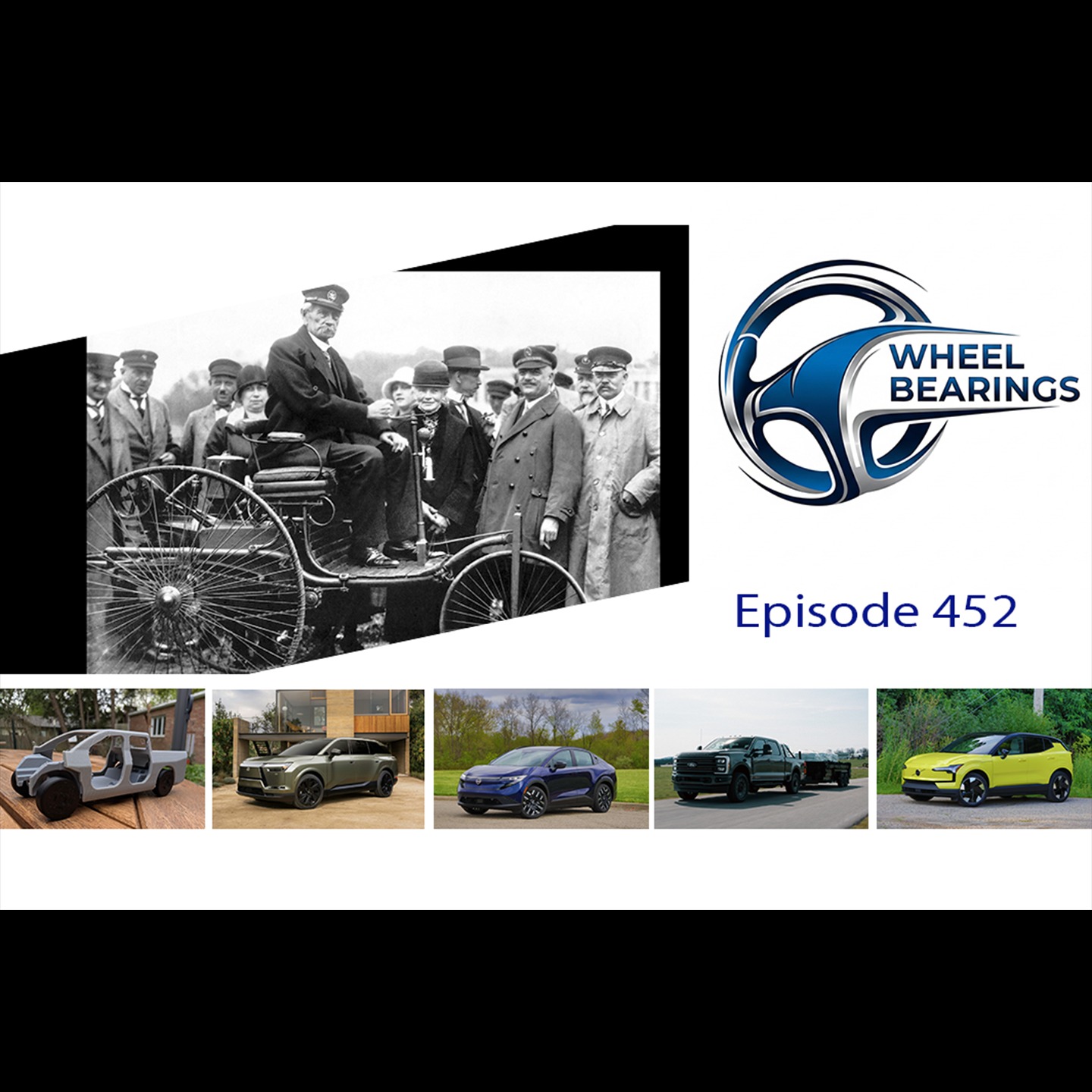
About this episode
The hosts bounce from “driving old cars” to modern EV tech, using real test drives and practical comparisons to frame what matters. Hyundai plug-in behavior gets attention—battery regen without plugging in—then the conversation shifts to early vehicles, museum recreations, and even overheating on a Simplex. The episode also digs into EV evolution via the 2026 Nissan Leaf: liquid-cooled packs, faster DC charging, cold-weather limits, and EV routing. Along the way, they connect design choices to real-world usability and repairability.
Nicole is spending mothers day at Disney World so our friend Stephanie Brinley has stepped in again. Steph drove the Volvo EX30 and Hyundai Tucson PHEV. Robbie drove the oldest car any of us has ever been in (or on) the Benz Patent Motorwagen and Sam had the new Nissan Leaf.
Sam and Stephanie both got to visit the Ford EV Development Center in Long Beach, home of the skunk works. VW has launched the ID Era 9X, a very impressive 3-row EREV built only for China. Lexus announced the new TZ 3-row electric crossover. BMW announced pricing and range for the US spec iX3 and the addition of a pre-chamber ignition system for its six-cylinder engines. The Japanese and Chinese are developing a new joint charging connector called ChaoJi.
Ford unveiled a new Carhatt edition Super Duty truck and Nicole went to see it and spoke with designers Steve Gilmore and Bhavna Mistry from Ford and Ben Ewey from Carhatt.
Links
Somebody Put 223,000 Miles on a 3-Year Toyota Camry Lease and Walked Away
Ford's Secret California Outpost Where It's Rethinking Its EV Strategy
Ford's Next Model T: Inside the UEV Program
Volkswagen ID. Era 9X Is On Another Planet From Any Other VW Sold! You Have To See This
ALL-ELECTRIC THREE-ROW LUXURY: THE ALL-NEW 2027 LEXUS TZ
2027 Ford Super Duty Carhartt Package: Built to Take the Same Abuse as Your Carhartt
BMW M Ignite technology: Innovative new technology for all six-cylinder in-line engines from BMW M.
BMW Officially Announces Pricing and Range for 2027 BMW iX3 50 xDrive.
Advertising Inquiries: https://redcircle.com/brands
Privacy & Opt-Out: https://redcircle.com/privacy

Volvo EX30
"I think the EX30 is slightly smaller, but it's made for an interesting little time. It's smaller, so it's not size for size."
They’re talking about the Volvo EX30 and saying it’s smaller than the other car. The point is that its size makes it feel like a good fit for certain buyers or situations.
The Volvo EX30 is described as slightly smaller, and the discussion frames it as a compact option that’s still “made for an interesting little time.” The comparison is about size/packaging rather than a specific performance metric.

Hyundai Tucson
"I did not necessarily expect to see the plug-in Tucson get quite that high, and I think the case could be made for both of them, honestly."
They mention the Hyundai Tucson in its plug-in form. That means it can use electricity for some driving, and they’re comparing it to a Volvo option.
The Hyundai Tucson is being discussed here specifically as a plug-in version, meaning it can run using electricity in addition to its gasoline power. The hosts are comparing how high the plug-in Tucson’s appeal is versus the Volvo they’re considering.
plug-in
"I did not necessarily expect to see the plug-in Tucson get quite that high, and I think the case could be made for both of them, honestly."
“Plug-in” means the car can be charged by plugging it in. That usually lets you drive some distance using electricity instead of using gas the whole time.
“Plug-in” refers to a vehicle that can be charged from an external power source (like a home charger), not just generated by the engine. In practice, plug-in models typically allow a meaningful amount of electric-only driving before the engine takes over.
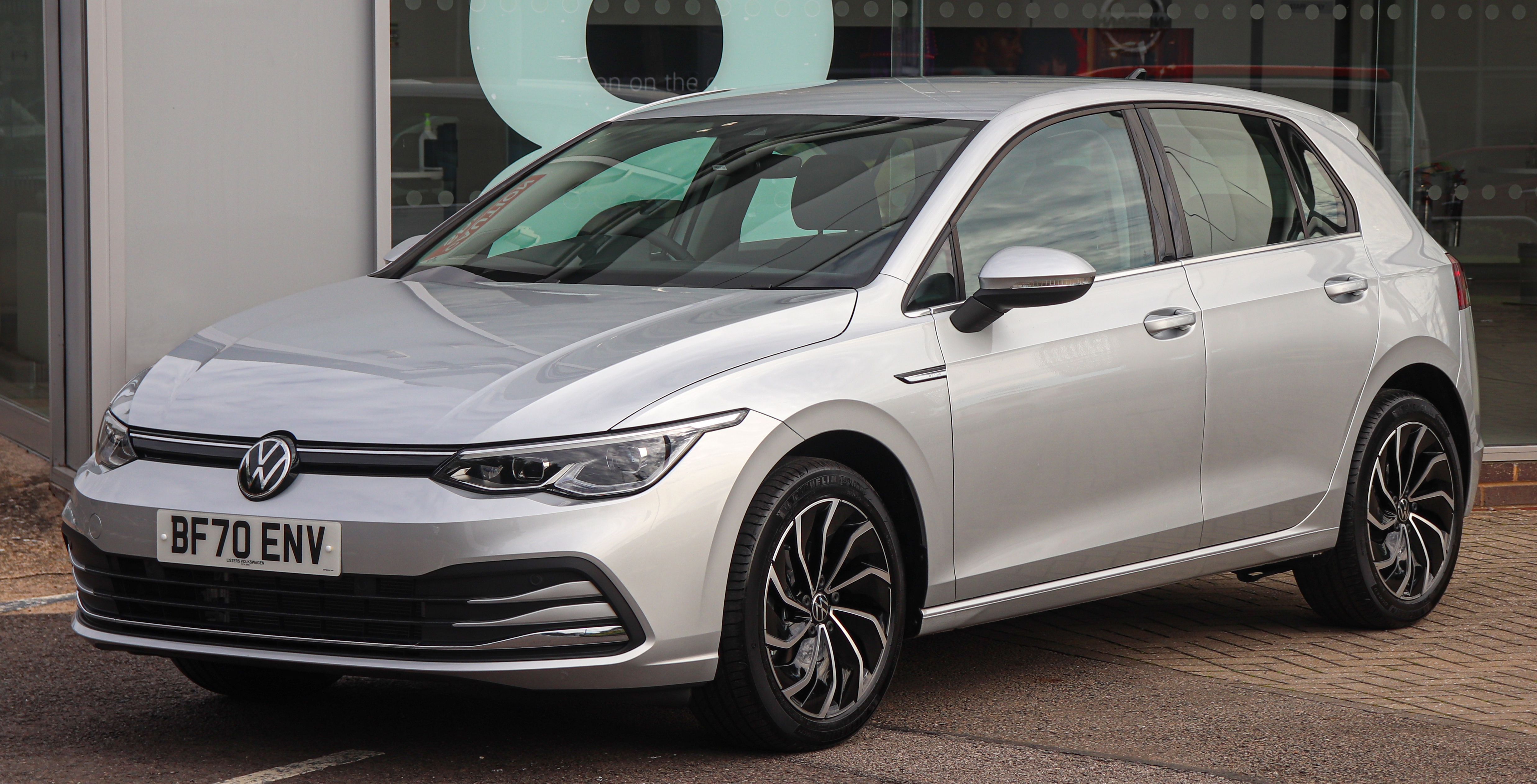
Volkswagen Gti
"...mpact hatches we have out there, you know, like a GTI or a Corolla hatchback, things like that. [SPEAKE..."
The Volkswagen Golf is a compact hatchback, meaning it’s a smaller car with a door that opens at the back. Wheel bearings help the wheels spin smoothly. When they wear out, you may hear noise while driving.
The Volkswagen Golf is a compact hatchback platform, and the podcast references the kind of cars people compare it to in the compact segment. Wheel bearings are a common maintenance topic across compact cars because they can develop noise and vibration as they wear. The Golf is often discussed because it’s a widely driven, everyday vehicle where these issues show up in real ownership.

Toyota Corolla hatchback
"And arguably more compact than the most of the compact hatches we have out there, you know, like a GTI or a Corolla hatchback, things like that."
They mention the Toyota Corolla hatchback as another example of a small hatchback. The idea is that the Volvo feels even more compact than cars like this.
The Toyota Corolla hatchback is used as another example of a compact hatchback category. The speaker’s point is that the Volvo they’re discussing may be even more compact than typical cars in this class.
regenerates
"[305.9s] [SPEAKER_06]: But one of the things that I thought was interesting is that it regenerates and stuff. [310.4s] [SPEAKER_06]: It regenerates more battery power for itself than I thought it would. [314.9s] [SPEAKER_06]: I went from 16% battery to like 25% battery..."
In a hybrid, “regenerates” usually means the car recharges its battery while you slow down. Instead of wasting all that energy as heat, the car turns some of it back into electricity.
In hybrid and plug-in hybrid cars, “regeneration” (regenerative braking) converts some of the car’s motion back into electrical energy. That energy is stored in the battery to help power the electric motor later, which is why the speaker can see battery percentage rise while driving.
three-wheeler
"It's essentially just a it's it's like almost a joystick to turn the wheel the wheel There's it's three wheels. [446.0s] [SPEAKER_03]: It's a three wheeler because they're you know differential didn't really have any"
A three-wheeler is a vehicle with three wheels instead of four. Because it has fewer wheels, it can feel less stable and steer differently than a normal car.
A three-wheeler is a vehicle with only three wheels instead of the usual four. With fewer wheels, stability and steering feel different, and many early vehicles used simpler layouts.

3 Three Wheeler
"...l There's it's three wheels. [SPEAKER_03]: It's a three wheeler because they're you know differential didn't real..."
A three-wheeler is a vehicle with only three wheels instead of four. Because it has fewer wheels, the way it turns and drives is different. It still has wheel bearings that can wear out and make noise.
A three-wheeler is a vehicle with one wheel in front and two in back (or vice versa), which changes how it handles and how power is delivered. The podcast mentions it being a three-wheeler because of a differential-related detail, which is part of how wheels share drive. Wheel bearing discussions still apply because each wheel hub uses bearings, and uneven loading can affect wear.
differential
"It's a three wheeler because they're you know differential didn't really have any They didn't have any you know differential like technology back in 1886 Um and To drive there's just a there's a lever on the left and you push it forward to go forward and you pull it back to stop"
A differential is a part that helps the wheels turn at different speeds when you go around a corner. Without it, turning a multi-wheel vehicle gets tricky, so early designs sometimes used fewer wheels.
A differential is the gearbox mechanism that lets the left and right wheels rotate at different speeds when turning. Early vehicles often lacked advanced differential technology, which pushed designers toward simpler wheel layouts like three-wheel configurations.
single cylinder
"That's the whole car. [467.8s] [SPEAKER_03]: It's a single cylinder. [468.8s] [SPEAKER_03]: It's got 0.75 horsepower."
A single-cylinder engine has just one cylinder that does the work of making power. It’s simpler than engines with multiple cylinders, and it usually makes less power and can feel rougher.
A single-cylinder engine has one combustion cylinder, meaning it fires once per engine cycle for that cylinder. Compared with multi-cylinder engines, it typically feels rougher and makes less power, but it’s mechanically simpler—common in very early vehicles.
horsepower
"It's a single cylinder. [468.8s] [SPEAKER_03]: It's got 0.75 horsepower. [471.3s] [SPEAKER_03]: It has a, oh, that I'm going to cough."
Horsepower is a way to describe how much power the engine makes. Lower horsepower usually means the vehicle won’t accelerate or pull very strongly.
Horsepower is a measure of engine power—how much work the engine can do over time. In this segment, the speaker emphasizes the extremely low horsepower to highlight how slow and simple the early vehicle is.
pony car
"It is not a faster horse. [481.0s] [SPEAKER_03]: It is not a fa- it's a pony. [484.4s] [SPEAKER_03]: It's got one pony horsepower. [488.2s] [SPEAKER_03]: It's the first pony car."
“Pony car” usually means a small, sporty American performance car. The speaker is using the phrase more like a joke/comparison to describe how tiny the power output is here.
“Pony car” is a term for a specific style of American performance car—typically smaller, affordable, and focused on sporty driving. The speaker uses it as a historical comparison, but the modern “pony car” category is much later than the 1880s.
recreations
"A seeding for two if you want to sit out in the elements and you just want to hear it as, you know, the [SPEAKER_03]: And this is, these are recreations that we're driving. [501.1s] [SPEAKER_03]: They're not given us."
Recreations are copies made to look like an old vehicle from history. They’re often built so people can experience something similar without risking the original.
Recreations are replicas built to resemble an original historical vehicle. They’re often used when the original is preserved in a museum or too fragile to drive, so the experience is “period-correct” but not the original machine.

Hyundai Pony
"I did, I did get to drive like the original Hyundai Pony. Oh, you know, that was not much better."
The Hyundai Pony was one of Hyundai’s early cars. The hosts mention it as an example of a very inexpensive, early model that wasn’t especially impressive.
The Hyundai Pony is an early Hyundai model that helped establish the brand in the global market. In the context of this episode, it’s brought up as a very basic, early-generation “cheap car” experience.
brakes
"Oh, yeah. Oh, I actually worked on breaks for some of those old day was in my first job at a college."
Brakes are what help a car slow down and stop. The host is saying they worked on the braking system on older cars early in their career.
Brakes are the vehicle system that slows or stops the car by converting kinetic energy into heat at the friction surfaces. In the episode, the host mentions working on brakes as part of their early job experience with older cars.

Hyundai Excel
"The Hyundai Excel was... You could talk to Hyundai and they'll be like, that was a great. No, now they can say that. Yeah, but the Excel was just up forward from the pony."
The Hyundai Excel is a later Hyundai economy car. In this conversation, it’s used as the step up from the earlier Pony—still cheap, but better.
The Hyundai Excel is a later, more refined economy car than the earlier Hyundai Pony. Here, the hosts compare it directly to the Pony and suggest it improved enough that people could view it as “not the worst car.”

Ford Maverick
"There's a $50,000 There's a thin line like between like inexpensive and well built like you just you just have to I think the Maverick is a good example of an ex-well it was initially the Maverick was a good example of an inexpensive car that it was well built"
The Ford Maverick is a small pickup truck that’s usually priced lower than most trucks. Here, the host is saying it’s an example of a cheaper vehicle that still feels solid.
The Ford Maverick is a compact pickup known for being relatively affordable compared with traditional trucks. In this segment, it’s used as an example of a low-cost car that still feels “well built,” and the host contrasts that with cheaper cars that feel flimsy.

Nissan Kicks
"The interior is plastic but they made it look sort of nice I think the Nissan kicks is another example of the kicks."
The Nissan Kicks is a small crossover that’s usually priced to be affordable. The host points out that it uses a lot of plastic inside, but tries to make it look decent.
The Nissan Kicks is a subcompact crossover that’s often positioned as an affordable, easy-to-live-with option. The host mentions its interior being mostly plastic but says Nissan tries to make it look nicer, highlighting the tradeoff between cost and materials.

Nissan Versa
"Well especially the Versa [SPEAKER_03]: We need some verse that Nissan makes a great inexpensive car, yeah, but then you get like, okay, well, but then you can get a VINFAS for like $5 a month on the lease and you're like, oh, that's where it drops."
The Nissan Versa is a low-cost car that’s meant to be easy on your budget. The host is using it to explain how lease deals can drop the effective monthly cost.
The Nissan Versa is a budget-focused compact car that’s commonly chosen for low purchase and running costs. In this segment, it’s paired with lease pricing to illustrate how incentives can make an inexpensive car feel even cheaper month-to-month.
lease
"but then you can get a VINFAS for like $5 a month on the lease and you're like, oh, that's where it drops."
A lease is like renting a car for a fixed time with monthly payments. The host is saying that lease deals can make a car seem much cheaper each month.
A lease is a financing arrangement where you pay to use a car for a set period, rather than buying it outright. The host is pointing out that lease incentives can make a car’s monthly cost look dramatically lower than its sticker price.
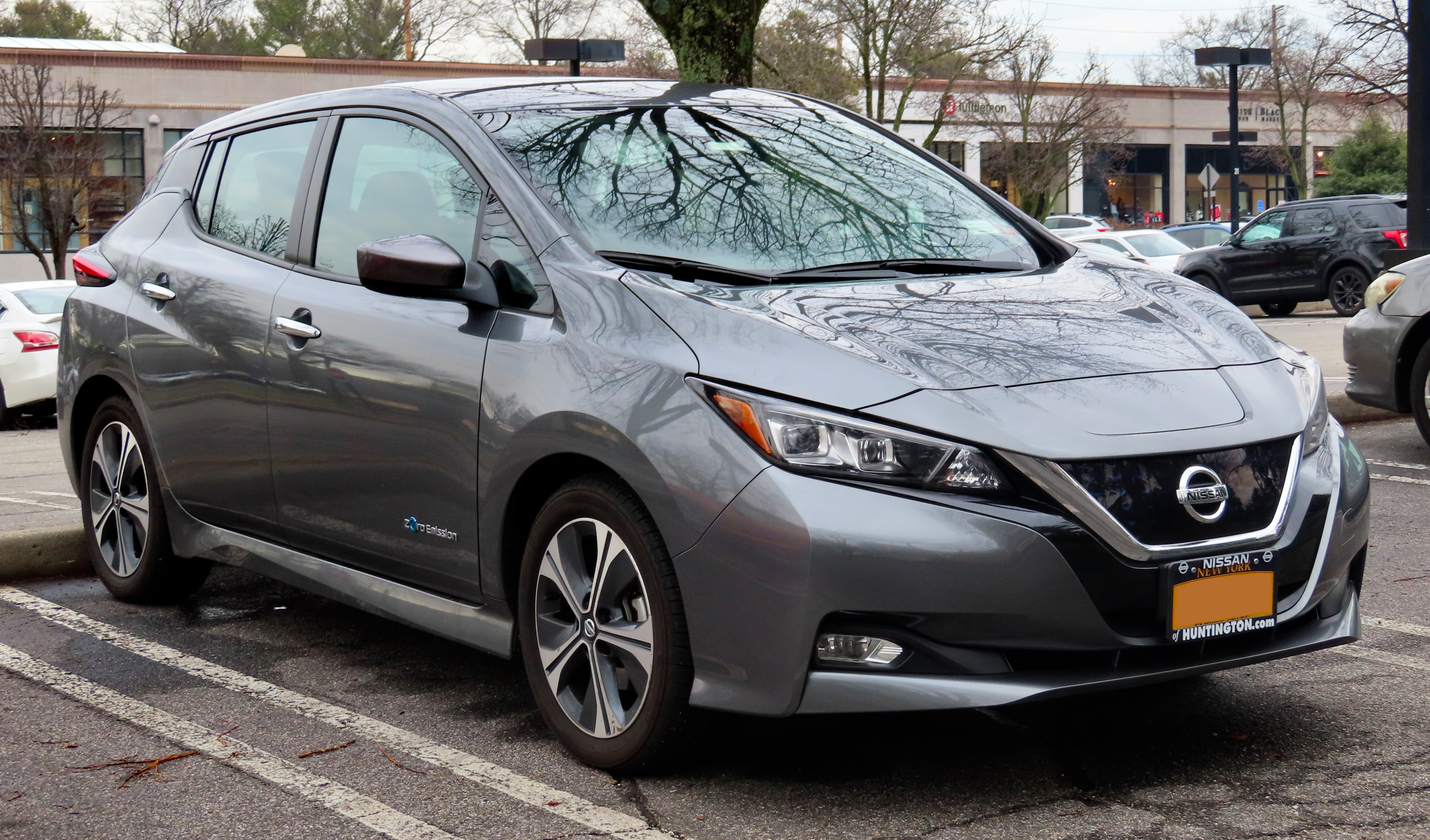
2026 Nissan Leaf Platinum Plus
"All right, but well, I had the 2026 Nissan Leaf Platinum Plus, which I'm looking at them in Roni here. And it says 2026 Nissan Leaf Platinum Plus front wheel drive, 259 miles plus plus plus plus."
The Nissan Leaf is an electric car. The Platinum Plus is the higher-end version, and the host is saying the newer one feels much better and goes farther than earlier Leafs.
The Nissan Leaf is an all-electric compact car, and the 2026 Leaf Platinum Plus is positioned as the top trim. In this segment, the host focuses on how the newest Leaf generation improves range and overall refinement versus earlier versions.
front wheel drive
"And it says 2026 Nissan Leaf Platinum Plus front wheel drive, 259 miles plus plus plus plus. And I'm not sure why there's three plus signs after miles."
Front-wheel drive means the front wheels do the work of both steering and moving the car. It can change how the car feels on slippery roads compared to cars that drive the rear wheels.
Front-wheel drive (FWD) means the engine’s power is sent to the front wheels, which handle both steering and propulsion. On an EV like the Leaf, that layout affects traction feel and how the car packages components.
battery range
"Because the second, what they call the second generation Leaf wasn't, you know, it was more of a refresh. You know, then a full redesign, you know, because it still had the same structures, same platform, you know, they managed to squeeze more battery into it and give it more range"
For an electric car, “range” means how far it can go before the battery runs low. The host is saying the newer Leaf fits more battery and therefore can drive farther.
“Range” is how far an EV can travel on a full battery charge, and it’s largely determined by battery size and efficiency. The host explains that Nissan increased usable battery capacity to improve range while also changing the design and packaging.
tariffs
"range of probably somewhere around 23240 miles because they, you know, with tariffs and everything, they, you know, they came to the conclusion that they weren't going to be able to get it down to the price point."
Tariffs are extra taxes on imported products. If they make a car too expensive to bring in, the automaker may decide not to sell a cheaper version in that market.
Tariffs are taxes on imported goods, and they can raise the cost of bringing vehicles or components into a country. Here, the host ties tariffs to Nissan’s decision not to import the lower-cost Leaf S trim.
destination charge
"but it starts at 29,990, plus the 1495 destination charge. "
A destination charge is the cost to ship the car to the dealership. It’s usually added on top of the sticker price.
A destination charge is a fee added to the vehicle’s price to cover shipping the car to the dealer. It’s commonly listed separately from the base MSRP and can affect the “out-the-door” cost.
liquid cooled battery pack
"There's a 75 kilowatt hour liquid cooled battery pack now, the previous Leafs all had air cooled battery packs and that's why Leafs had a tendency to have some degradation of especially early ones, degradation of the battery, especially if you use them in hot weather environments."
A liquid cooled battery pack uses fluid to keep the battery from getting too hot. Cooler batteries tend to last longer, particularly when the weather is hot.
A liquid cooled battery pack uses coolant to move heat away from the battery cells. Compared with air cooling, it can better control battery temperatures, which helps slow performance loss and capacity degradation—especially in hot weather.
air cooled battery packs
"There's a 75 kilowatt hour liquid cooled battery pack now, the previous Leafs all had air cooled battery packs and that's why Leafs had a tendency to have some degradation of especially early ones, degradation of the battery, especially if you use them in hot weather environments."
An air cooled battery pack uses air to cool the battery. The hosts are saying older designs didn’t manage heat as well in hot weather, which can make the battery wear out faster.
Air cooled battery packs rely on airflow (often from fans and vehicle motion) to remove heat from the battery. The segment claims earlier Nissan Leaf designs used air cooling, which could contribute to faster battery degradation when used in hot climates.
kilowatt hour
"There's a 75 kilowatt hour liquid cooled battery pack now, the previous Leafs all had air cooled battery packs..."
Kilowatt hour (kWh) tells you how big the battery is—how much energy it can store. Bigger battery capacity usually means you can drive farther.
Kilowatt hour (kWh) is the unit of energy capacity for an EV battery—how much electrical energy the pack can store. A larger kWh number generally means more potential driving range, assuming similar efficiency and conditions.
electric motor
"But the 75 kilowatt or liquid cool battery on this one. It's 214 horsepower electric motor on the front wheels."
An electric motor is what actually moves the car using electricity from the battery. Here they’re saying the motor drives the front wheels.
An electric motor is the traction power source in an EV, converting electrical energy from the battery into motion. In this segment, the hosts specify a 214-horsepower electric motor driving the front wheels, which ties directly to how the car feels and how it’s packaged.
AC onboard charger
"The AC onboard charger is only 7.2 kilowatts, which, you know, is better than, again, better than old bolts."
The AC onboard charger is the part of the EV that turns regular AC charging power into the kind the battery can use. Higher charger power usually means faster charging.
The AC onboard charger converts alternating current (AC) from the home or public charging station into direct current (DC) suitable for charging the EV battery. Charger power (in kW) strongly influences how long it takes to replenish the battery at home.
7.2 kilowatts
"The AC onboard charger is only 7.2 kilowatts, which, you know, is better than, again, better than old bolts... So a charge is a little bit slower at home."
7.2 kilowatts is how fast the car can charge from an AC outlet. If it’s limited to 7.2 kW, charging at home takes longer.
7.2 kilowatts is the charger power level the EV can accept from an AC source. Lower kW means the battery charges more slowly at home, which the hosts connect to the idea that overnight charging may be needed.
vehicle to load capabilities
"one of the things you get in the Platinum Plus, you get vehicle to load capabilities like you do in a lot of the Hyundai's and Kia's. So you can get in a adapter that plugs into the charging port."
Vehicle to load means the car can act like a power outlet. With the right adapter, you can plug in devices and use the car’s battery to run them.
Vehicle to load (V2L) is a feature that lets an electric vehicle power external devices using its battery. In practice, you plug an adapter into the car’s charging port to run things like appliances or tools—turning the car into a power source.
AC charging
"the charging ports were in the front... and you had a 1772 charger for, uh, AC charging at home, uh, and then, um, a Chattamo DC fast charger."
AC charging is the common kind of charging you might do at home. The car has to convert that power before it can charge the battery, so it’s usually slower than fast charging.
AC charging is when the electricity from the charger is alternating current, and the car converts it internally for charging the battery. It’s typically used for home charging and is usually slower than DC fast charging.
DC fast charger
"and then, um, a Chattamo DC fast charger... And of course, that was only good for 50 kilowatts... But when you're charging on a DC charger now, it'll charge it up to 150 kilowatts"
A DC fast charger is the kind of charger that can refill an electric car quickly. It’s faster than home charging, and the hosts are saying the newer Leaf can take more power than the older one.
A DC fast charger delivers direct current to the car at high power, so the car can charge much faster than with AC charging. This segment compares older Leaf charging (limited to about 50 kW) versus the newer Leaf’s higher DC fast-charging capability.
J3400
"now you have a 1772 charger on the driver's side front fender and on the passenger side you get a J3400 Nax charging port. So you can charge at Tesla superchargers"
J3400 is a specific type of charging plug/standard. Here, it’s being used to explain which port lets the car charge at certain fast-charging networks like Tesla’s.
J3400 is a charging connector standard used for DC fast charging in some markets. In this segment, it’s mentioned as the port on the passenger-side front fender that enables charging at Tesla Superchargers.
CCS charger
"So you can also plug it in charging on a CCS charger. That's Nissan charges 170 bucks for that."
CCS is a widely used fast-charging type. The hosts are saying the Leaf can use CCS stations too, as long as you have the right adapter.
CCS (Combined Charging System) is a common DC fast-charging standard in North America and Europe. The segment explains that the newer Leaf can use a CCS charger via an included adapter, which broadens where you can fast-charge.
charging speed vs range for road trips
"So you actually can realistically use this between the combination of the range and the charging speed. You can realistically use this for longer trips now, which you couldn't... with the old one, because even the longest range... was only about 220 miles and 50 kilowatt charging... was not great."
To plan longer EV trips, you need two things: how far the car can go on one charge, and how fast you can recharge when you stop. They’re saying the newer Leaf improves both, so trips are more realistic.
For EV road trips, usable travel depends on both range (how far you can go on a charge) and charging speed (how quickly you can refill). The segment argues that the newer Leaf’s faster DC charging makes longer trips practical, whereas the older Leaf’s limited range and slower 50 kW charging made it harder to do in a real-world schedule.
electrochromic coating
"The platinum plus does have the glass roof and it's got an electric chromic coating on there... when you push the switch... it opens up the electrochromic coating in segments. So it's kind of like having a shade that goes back, but you're just clearing parts of the roof and in segments..."
It’s a special glass/film that can change how dark it is using electricity. Instead of opening like a normal roof, it can “clear” only parts of the roof so you get light without as much glare.
An electrochromic coating is a smart glass technology that changes tint when you apply an electric current. In this case, the roof opens by clearing the coating in segments, so you get partial transparency instead of a traditional fully open/closed sunroof.
Android Automotive based infotainment
"You get the at Nissan's latest Android Automotive based infotainment still has support for car play and Android Auto, which work while on this thing."
It’s the software system inside the car that runs the screen and apps. Using Android Automotive can make the interface more modern, and it can still work with phone-based systems like CarPlay and Android Auto.
Android Automotive is an in-car operating system that runs apps and the vehicle’s infotainment interface. When a car uses it, features like navigation and media can feel more like a modern smartphone/tablet experience, and it can also support integrations such as Apple CarPlay and Android Auto.
Apple CarPlay
"Nissan's latest Android Automotive based infotainment still has support for car play and Android Auto, which work while on this thing."
CarPlay lets you connect your iPhone to the car and use certain apps on the car’s screen. It’s mainly for navigation, music, and calling while you drive.
Apple CarPlay is a phone-to-car integration that mirrors compatible iPhone apps onto the vehicle’s infotainment display. It’s commonly used for navigation, music, calls, and messages while keeping the driver focused on the car’s screen and controls.
Nissan ProPILOT Assist
"This one also had heads up display, but you get all the same ADAS features across the board so you get Nissan's pro pilot assist which is their hands-on lane-centering system."
This is Nissan’s driver-assist tech that helps keep the car in the lane. It can steer to stay centered, but you still need to pay attention and keep your hands on the wheel.
Nissan ProPILOT Assist is an advanced driver-assistance feature that helps keep the car centered in its lane. The host specifically describes it as a hands-on lane-centering system, meaning it supports steering to maintain lane position but still expects driver supervision.
ADAS features
"You get all the same ADAS features across the board so you get Nissan's pro pilot assist which is their hands-on lane-centering system."
ADAS are the car’s driver-assist features. They help with things like staying in the lane or controlling speed, but you’re still responsible for driving.
ADAS stands for Advanced Driver-Assistance Systems, which are technologies designed to assist with driving tasks. These can include functions like lane centering, adaptive cruise, and other safety/comfort aids that reduce workload but don’t replace the driver.
heads up display
"This one also had heads up display, but you get all the same ADAS features across the board..."
A heads-up display shows important info on the windshield. That way you can glance at it without taking your eyes off the road.
A heads-up display (HUD) projects key driving information onto the windshield so you can see it without looking down at the instrument cluster. Common items include speed, navigation prompts, and driver-assist status.

Nissan Gtr
"...2]: You're not going to mistake this for a Z or a GTR, but it's quite pleasant to drive on curvy roads...."
The Nissan GT-R is a fast sports car built for performance driving. When you drive it on twisty roads, you want everything to feel tight and smooth. If wheel bearings wear out, they can create noise or vibration that affects that feel.
The Nissan GT-R is a high-performance sports car known for strong acceleration and confident handling. It’s mentioned in the context of driving on curvy roads, where steering feel and suspension components matter. Wheel bearings can be especially important on performance cars because aggressive driving and higher loads can accelerate wear and make noise more noticeable.
battery pre-heater
"depending on your driving conditions, the one, one addition that, you know, if you live in a cold weather environment that you probably do want to get is the battery pre-heater... So having having a battery heater on there to pre-worm the battery will make a big, big difference."
A battery pre-heater is a device that warms the battery in advance. When it’s cold outside, a warmer battery can charge faster instead of slowing down.
A battery pre-heater warms the EV’s battery before driving or charging. In cold weather, this helps the battery reach a temperature where it can accept higher charging power, so max charging speed doesn’t drop as much.
max charging speed
"The charging speed dropped off the max charging speed dropped off to about 55, 60 kilowatts... So having having a battery heater on there to pre-worm the battery will make a big, big difference."
Max charging speed is how fast the car can charge at its best moment. In very cold weather, the battery may not be able to take in energy quickly, so charging slows down.
Max charging speed is the highest power level an EV can draw from a charger at a given time. Cold batteries often can’t accept as much power, so the max charging speed drops until the battery warms up.
route planning
"it doesn't have Google Assistant, it doesn't have Google, it doesn't have the drive, or I'm sorry, route planning... If you get the S-V-plus, you can get route planning and all this stuff"
Route planning is the navigation feature that helps pick a path to your destination and shows directions as you drive. Here, they’re saying some trims get it and others don’t.
Route planning is the in-car ability to choose and display an itinerary for navigation, including turn-by-turn guidance. In this segment, the hosts compare how different trim levels include or exclude Google-based navigation features.
Google Assistant
"it doesn't have Google Assistant, it doesn't have Google, it doesn't have the drive, or I'm sorry, route planning."
Google Assistant is the voice assistant that can help with things like navigation and commands. The hosts are pointing out that some car trims don’t include it.
Google Assistant is a voice assistant that can control and interact with in-car features like navigation and media. This segment discusses trim differences where some versions lack Google Assistant integration.
battery state of charge
"if you're using Google Maps through Android Auto, it will read the battery state of charge from the car."
Battery state of charge is basically how full the battery is, shown as a percentage. The host says the navigation can read that information from the car.
Battery state of charge (SoC) is the percentage of energy currently stored in the EV battery. Navigation apps can use SoC to help with routing decisions, like estimating remaining range and whether you’ll need charging stops.
EV routing
"It does a pretty good job with EV routing. You know, you put it in a destination."
EV routing is GPS that plans your drive for an electric car. It tries to tell you the best places to stop and charge, and how long those stops will take.
EV routing is navigation that plans a trip around an electric vehicle’s real-world constraints, especially charging stops and time. Instead of only optimizing distance, it estimates how long you’ll spend stopping to recharge and where it’s best to stop along the way.
translucent roof
"The translucent roof, yeah, I could look about that. Yeah."
A translucent roof is a roof panel that lets light through. It’s more of a nice-to-have feature that makes the cabin feel brighter.
A translucent roof is a roof panel (often glass or a glass-like material) that lets more light into the cabin. The speaker treats it as a “cool touch” feature that can be included on certain trims, implying it’s an option rather than essential.
Ford EV development center
"So, yeah, stuff last week, you and I were both out in Long Beach. And we visited the new Ford EV development center, which speaking of airplanes, the site where that facility is used to be the McDonald Douglas aircraft factory..."
This is a Ford facility specifically for building and improving electric cars. The idea is to make the process faster by having the right people and equipment in one location.
The Ford EV development center is a dedicated facility where Ford works on electric-vehicle (EV) engineering and product development. These centers are typically set up to speed up design, testing, and coordination by bringing teams and tools together in one place.
universal electric vehicle platform
"Well, I mean, because I think because this facility is new, because it's a whole process of new, because the whole development of the universal electric vehicle platform is new... And we're still talking, you know, mid 27."
An “electric vehicle platform” is the shared engineering foundation—like the architecture and major systems—that multiple EV models can be built on. Calling it “universal” suggests the goal is to reuse that base across different vehicles to reduce development time and cost.
development cycle
"I mean, we were still talking, you know, 20, 32 when they kind of put this group together, And we're still talking, you know, mid 27... So we're still looking at a for your development cycle on this vehicle."
A development cycle is the overall timeline for making a new vehicle—from the first planning work to when cars are actually ready to be delivered to customers.
A development cycle is the end-to-end timeline from early engineering through production readiness and delivery. The hosts are discussing how long it takes to get an EV program to the point where it can be built and shipped.
Skunkworks team
"Yeah, you know, I think they started to assemble this, you know, that what's been called the Skunkworks team, later 2022, you know, so almost four years ago now, and, you know, the first product is scheduled to go into production towards the end of this year..."
A “skunkworks team” is basically a special group that works on something new with extra speed and flexibility. It’s meant to get early progress while the rest of the company follows normal processes.
A “skunkworks team” is an internal group organized to move quickly and experiment with new technology outside the usual corporate pace. In this context, it refers to Ford’s EV team that was assembled to develop the next product faster than a traditional program timeline.

Chevy Bolt
"I mean, the Chevy Bolt, it was a big deal. They're like, oh, yeah, we came up with this, we developed this 18 months."
The Chevy Bolt is an electric car that helped show EVs could be made at a more affordable price. The hosts bring it up to compare how long it took GM to develop and launch it versus newer EV projects.
The Chevrolet Bolt is an EV that became a notable reference point in the U.S. for proving that a relatively affordable electric car could be built and sold. In this segment, it’s used as an example of GM’s earlier EV development timeline and how long it took to get from concept to launch.

Hummer EV
"And then they said the same thing about, I think, the Hummer EV was that 18 months time frame [SPEAKER_02]: Yeah, Hummer EV, and the rest of the full size electric truck line up at GM could have probably used a little more time to the right way."
The Hummer EV is GM’s electric version of the Hummer. The conversation uses it to talk about whether GM gave itself enough time to develop and launch these EVs well.
The Hummer EV is General Motors’ electric supertruck, known for its large size and EV powertrain. Here it’s mentioned as another GM EV program that, like the Bolt, was discussed in terms of development timing—specifically whether the team had enough time to execute properly.
lead time
"what they were talking about with the lead time for getting suppliers to build prototypes. cutting that down from several months to being able to build a new prototype of the seat in two weeks..."
Lead time is how long it takes to get a prototype made and ready. The big point here is that they cut that waiting period from months down to about two weeks.
Lead time is the time it takes to get something done or delivered—here, specifically how long it takes suppliers to build prototypes. The segment highlights reducing lead time from several months to about two weeks, which can dramatically speed up development and iteration.
five-axis mill
"they do the CAD drawings, they can send that down to the fabrication shop, they've got a giant five-axis mill that can work in foam and clay..."
A five-axis mill is a CNC machine that can move a cutting tool (and/or the workpiece) along five different axes, allowing complex shapes to be machined in fewer setups. In the segment, it’s used to carve seat materials like foam and clay, speeding up prototype iteration.
CAD drawings
"the engineers can drop the, they do the CAD drawings, they can send that down to the fabrication shop, they've got a giant five-axis mill..."
CAD drawings are computer files engineers use to design parts. Instead of sketching and waiting, the design can go straight to the shop to make a prototype faster.
CAD (computer-aided design) drawings are digital engineering models used to design parts and products. Here, the hosts describe how engineers can send CAD work directly to fabrication so prototypes can be built quickly.
3D print frames
"they can 3D print frames for the seat and, you know, what would typically take 2 to 3 months..."
3D printing makes a physical part from a computer model, usually one thin layer at a time. It’s a fast way to create prototype seat parts so engineers can test them sooner.
3D printing (additive manufacturing) builds parts layer-by-layer from a digital model, which is useful for rapid prototyping. The hosts mention 3D printing seat frames so the team can test and refine designs faster than traditional tooling and supplier lead times.
purchase orders
"what would typically take 2 to 3 months, you know, from coming up with the design for a seat, having to go out to suppliers, you know, get the peos approved, you know, get the quotes, get the peos, the purchase orders approved..."
A purchase order is an official paperwork step that tells a supplier what you want to buy. Approving those documents can add time before a prototype can be made.
Purchase orders (POs) are formal documents a buyer sends to a supplier that specify what will be purchased, in what quantity, and under what terms. The hosts list PO approval as part of why prototype timelines can stretch to 2–3 months when work has to go out to suppliers.
benchmarking
"…called Caresoft that among other things does benchmarking, you know, they take cars and they turn down to every single part and they evaluate all those parts and they do costing analysis on those parts."
Benchmarking is basically “compare and measure.” They look at parts from cars, compare them, and figure out what they cost and how they stack up.
Benchmarking is a process of comparing products or components against targets or peers to find performance and cost gaps. Here, it’s used to evaluate each vehicle part and run costing analysis to see where money is being spent.
Caresoft
"You know, from a couple of visits I've paid to a company here in the Troy area called Caresoft that among other things does benchmarking, you know, they take cars and they turn down to every single part and they evaluate all those parts and they do costing analysis on those parts."
They’re a company that studies cars by taking them apart and looking at parts and costs. The goal is to figure out what parts cost the most and how companies can improve designs.
Caresoft is described as a company in the Troy area that does benchmarking for automotive parts. In this context, benchmarking means breaking vehicles down and comparing parts and costs to understand what drives manufacturing expenses.
parts commonization
"And, you know, one of the things that they've talked about is, you know, a lot of the parts commonization, and, you know, maybe things like seats, you know, need to be a little bit more bespoke for individual manufacturers."
Parts commonization means using the same parts in more than one car. That usually saves money because the company doesn’t have to make a bunch of different versions.
Parts commonization is the strategy of using the same components across multiple vehicle models or trims. The benefit is typically lower cost and simpler sourcing, since fewer unique parts need to be designed and produced.
bespoke
"…maybe things like seats, you know, need to be a little bit more bespoke for individual manufacturers. You know, you want to particularly feel for your seats…"
Bespoke here means “made specifically for that situation,” not a one-size-fits-all part. They’re saying some parts should be tailored, while others can be standardized.
In manufacturing, bespoke means custom-made to a specific manufacturer’s needs rather than shared across many models. The speaker contrasts bespoke items (like seats) with more standardized parts that don’t affect the customer’s experience much.
Wiper Motors
"…things like Wiper Motors, you know, traditionally, you know, at a legacy automaker, you know, the legacy automaker will, you know, they'll, they'll design a vehicle, design a vehicle structure and say, okay, we got to put Wipers on this saying, okay, here's the volume where we've got to put the Wiper Motors."
Wiper motors are the motors that move your windshield wipers. The point here is that some companies design a special motor for their car, while others buy a standard one and fit everything around it.
Wiper motors are the electric motors that drive the windshield wiper arms. The segment uses them as an example of how suppliers can either design a custom motor for a specific packaging space or use an off-the-shelf motor and design the rest of the system around it.
off the shelf
"…they will take an off the shelf-lipper motor and then design the other stuff around it. …Take those off the shelf."
“Off the shelf” means buying a standard part that already exists, not designing a brand-new one. They’re saying you can save money by using a common wiper motor and fitting the car around it.
“Off the shelf” refers to using a standard, already-designed component instead of commissioning a custom part. In the transcript, the idea is that the wiper motor can be sourced as a common product, while the rest of the vehicle packaging and design is adapted to fit it.
skews
"…they're looking at like, what's available? What can we just get? …So we don't have to get like two versions of, two skews."
A “skew” here means a specific version of a part. They’re saying they can use the same version for two spots in the car (by flipping it), instead of stocking two different versions.
In automotive sourcing, a “skew” is a specific variant of a part (often tied to a particular supplier configuration, spec, or fitment). The speaker describes reducing cost by using the same skew for two applications—by flipping it—so the company doesn’t need two different part versions.
connectors
"“...they can build connectors that do anything any size... reducing the number of connectors... they're going to have larger connectors for the wire bundles.”"
Connectors are the plug-together parts that let wires connect to the car’s electronics. Using fewer, more standardized connectors can reduce complexity.
Connectors are the mating electrical interfaces that join wires to modules and sensors. The discussion focuses on standardizing connector sizes and reducing the total number of connectors to simplify the vehicle’s electrical architecture and assembly.
wiring harness
"“...with the connectors for the wiring harness, you know, they can... build complete wiring harnesses...”"
A wiring harness is the bundled set of wires and connectors that carries power and signals throughout the vehicle. The segment discusses building complete wiring harnesses in-house and reducing the number of different connector types to simplify assembly and design.
zonal architecture
"“...the new electronic architecture of this thing. going to a zonal architecture... start consolidating all those have a central compute unit... propulsion battery control.”"
Instead of lots of separate computers spread all over the car, zonal architecture uses a main computer plus a few “zone” computers. Each zone handles wiring and signals for its area, which can simplify the car’s electronics.
Zonal architecture is an electronic design approach where vehicle functions are grouped by zones instead of having many scattered electronic control units. A central compute unit handles major computing, while zone controllers manage local tasks like power distribution and communication between sensors and actuators.
electronic control units
"“You've got instead of 50 to 100 or more electronic control units scattered around the vehicle, start consolidating...”"
ECUs are the car’s little computers that run different systems. Some cars have many of them in different places, while newer designs try to reduce how many there are.
Electronic control units (ECUs) are computers in a vehicle that control specific functions. In older designs, ECUs are often scattered around the car, but zonal architecture consolidates them into fewer, more centralized modules.
central compute unit
"“...start consolidating all those have a central compute unit that handles most of the computing for the driver's systems, the propulsion battery control...”"
Think of the central compute unit as the car’s main brain. It coordinates big-picture control, while smaller computers handle specific areas of the car.
A central compute unit is the main processing computer that handles a large share of the vehicle’s electronic control tasks. In a zonal architecture, it coordinates functions like driver systems and battery-related control while zone controllers handle local routing and power distribution.
propulsion battery control
"“...the central compute unit that handles most of the computing for the driver's systems, the propulsion battery control...”"
In an EV, the propulsion battery control is the system that manages the main battery. It helps keep the battery working safely while powering the car.
Propulsion battery control refers to the electronic management of the high-voltage battery that powers an EV. It includes monitoring and regulating battery behavior so the car can deliver power safely and efficiently.
zone controllers
"“...in some cases three or four zone controllers that are somewhere around the perimeter of the vehicle that do power distribution and signal routing...”"
Zone controllers are smaller computers responsible for one part of the car. They help route signals and manage power for that area so the main computer doesn’t have to handle everything directly.
Zone controllers are localized electronic modules that manage communication and power handling for a specific area of the vehicle. In the described setup, multiple zone controllers sit around the perimeter and route signals between sensors/actuators and the central compute unit.
NACS charging port
"“...they combined it with the NACS charging port. So you've got one unit that has the NACS charging port in there...”"
NACS refers to the charging plug/port standard. Here, the car’s charging hardware is packaged together with the electronics that route power to the battery and coordinate with the car’s controllers.
NACS is a charging connector standard used by Tesla and adopted by other EV makers. In this design, the charging port is integrated into a single unit that also handles routing to the battery management system and the zone controller.
battery management system
"“...the routing from there to the battery management system for the power and the zone controller...”"
The battery management system is the EV’s safety and control brain for the battery. It monitors the battery and helps prevent damage while charging and driving.
The battery management system (BMS) is the electronics that monitor and control the EV battery. It manages charging/discharging behavior and protects the battery by tracking parameters like temperature and cell conditions.

Dodge Charger
"... or to not have a part at all to the point of the charger and having the ECU in there, just having fewer pa..."
The Dodge Charger is a larger car that’s built for performance. If a wheel bearing wears out, it can make noise or cause vibration while driving. That’s why it might be discussed in a conversation about wheel bearings.
The Dodge Charger is a full-size American sedan known for strong performance and a long-running model history. In a discussion about wheel bearings, it may come up because bearing wear can affect steering feel, noise, and vibration—especially on heavier, higher-power trims. It’s also mentioned in the context of parts/ECU-related topics, which can tie into how components are packaged and serviced.
ECU
"or to not have a part at all to the point of the charger and having the ECU in there, just having fewer parts, that scrutiny and that thought process"
An ECU is the car’s control computer. It helps run systems like the powertrain and other electronics by following programmed logic.
ECU stands for Electronic Control Unit, a computer that manages vehicle functions like powertrain operation and many control systems. The transcript frames ECU placement/packaging as part of reducing parts and rethinking vehicle architecture.
structural battery pack
"they had, we walked in, you know, they had the battery pack, which is a structural battery pack, which is forms the floor of the cab, you know, and it was sitting there on a rack."
Instead of the battery just sitting inside the car, the battery box helps hold the car together. That can simplify construction and change how the car’s body is built.
A structural battery pack is a battery enclosure designed to carry structural loads, not just store electricity. In practice, it can form major parts of the vehicle floor/cab structure, which can reduce the number of separate body parts needed.
giga casting
"you've got the rear casting, you know, calling it a unit casting, which is like a better term than giga casting, because at least it's somewhat descriptive of what it actually is."
Giga casting means making huge metal pieces in one shot instead of welding together lots of smaller parts. It can make building easier, but repairs after damage can be trickier.
Giga casting refers to using extremely large castings—often for major body sections—to replace many smaller stamped parts. The goal is fewer parts, faster assembly, and potentially lower cost, but it raises questions about crash repair and serviceability.
unit casting
"you've got the rear casting, you know, calling it a unit casting, which is like a better term than giga casting, because at least it's somewhat descriptive of what it actually is."
It’s a big one-piece metal part that replaces several smaller pieces. The speaker is saying “unit casting” describes the idea more clearly than the broader “giga casting” term.
Unit casting is a large, integrated casting used to replace multiple separate components in the vehicle structure. In this discussion, it’s described as a more accurate label than “giga casting” because it better matches what the part actually does and how it’s built.

Tesla Model Y
"Tesla really was first with with the model Y a few years back when they went to structural battery pack"
The Tesla Model Y is mentioned as an early example of building the battery pack into the car’s structure. That can make the car easier to assemble and change how the body is designed.
Tesla Model Y is highlighted here as an early mainstream example of using a structural battery pack to form major body structure. That approach can simplify assembly and reduce the number of separate parts needed in the vehicle.
breakaway parts
"Yeah, your insurance is already higher now it's going to go up because you have a single section that can't be fixed and so having these sort of breakaway parts that can be, you know, replaces very, very important and we'll save you money in the long run."
Breakaway parts are pieces that are designed to come apart in a crash in a controlled way. The benefit is that the damaged section can be replaced instead of replacing a whole big part.
Breakaway parts are designed to separate or fail in a controlled manner during a crash. The hosts argue that if a vehicle uses replaceable breakaway sections, insurers and repair shops can fix the damaged area without replacing an entire large assembly.

Tesla Cybertruck
"Yeah, so, you know, Tesla actually, you know, did something very similar with the Cybertruck, you know, much as like, just like the Cybertruck. They did some of this kind of stuff with the Cybertruck as well, you know, to build in repairability for those castings."
The Tesla Cybertruck uses a very different body structure than most cars. The idea here is that if part of it breaks in a crash, it’s designed so a shop can replace just the damaged section instead of replacing everything.
The Tesla Cybertruck is known for its unusual stainless-steel, cast-metal body structure. In this segment, the hosts discuss how Tesla designed certain castings to fracture in a controlled way in a crash so repair shops can replace a section instead of scrapping the whole part.
repairability
"They did some of this kind of stuff with the Cybertruck as well, you know, to build in repairability for those castings. ... So it will be, it should be more repairable than a lot of traditional vehicle systems."
Repairability means how easy it is to fix a car after it gets damaged. In this case, the design is meant to make crash repairs simpler and less costly.
Repairability is how easily a vehicle can be repaired after damage. Here, the hosts connect repairability to crash behavior and body-shop procedures—designing parts so a damaged section can be removed and replaced.
stamped component
"when something, when a casting fractures in a crash, which is what it'll do instead of bending like a, like a traditional stamped component."
A stamped component is a metal part made from sheet metal that’s pressed into shape. The point being made is that stamped parts often bend in crashes, while cast parts can be designed to break in a more repairable way.
A stamped component is a sheet-metal part formed by pressing metal into shape using dies. The hosts contrast stamped parts that tend to bend in crashes with cast parts that fracture in a way that can be cut and repaired by replacing sections.
rivet and glue
"They have a replacement part that they then rivet and glue, you know, these, you know, these, these industrial adhesive on there, and I'll include, there's a video from, [SPEAKER_02]: Jerry rig, everything where he had his cyber truck..."
Rivets and glue are two ways to attach parts together. Here, the idea is that after a crash breaks a section, the repair can put a new section back using rivets plus strong adhesive.
Riveting and adhesive bonding are joining methods used to attach replacement sections. In this segment, the hosts describe a repair approach where a replacement casting section is riveted and glued back in using industrial adhesive, enabling structural repairs after a controlled fracture.
level 2 plus and level 3 driving systems
"So, you know, they're doing work on the next generation, you know, levels 2 plus and level 3 driving systems that are going to, they're going to appear on this vehicle and on others from the UEV platform as well."
These “levels” describe how automated a car is. Level 2+ is mostly driver-assisted—your hands and attention are still expected—while Level 3 is more advanced, where the car can do more of the driving for longer periods in specific situations.
“Level 2+” and “Level 3” refer to SAE-style driving automation levels. Level 2+ typically means the car can handle steering and speed with the driver still responsible for supervision, while Level 3 is more capable automation where the system can manage driving in certain conditions and the driver may not need to constantly intervene.
SAIC
"This one they're doing in partnership with SAIC, and I don't know if either of you had a chance to watch any of this video."
SAIC is a big Chinese car company. The episode says it’s working with Volkswagen on this EV, which usually helps the car get built and sold in China.
SAIC is a major Chinese automaker that’s described here as partnering with Volkswagen on the vehicle being discussed. In EV projects, these partnerships often cover manufacturing, local supply chains, and software/feature integration for the China market.
Bementa
"He went out and tried out the, it's got the driver's cyst software in there is from a company called Bementa. who are also working with Mercedes and BMW, and they basically drove around Beijing for quite a while, just around the city in hands-free mode, pretty much all the time, looked like the performance was really impressive."
Bementa is named here as the company providing the driver’s “cyst software” (likely a transcription error for the driver-assist/ADAS software stack) used in the vehicle. The episode also links it to work with Mercedes and BMW, suggesting it supplies or develops software components for multiple automakers.
hands-free mode
"who are also working with Mercedes and BMW, and they basically drove around Beijing for quite a while, just around the city in hands-free mode, pretty much all the time, looked like the performance was really impressive."
Hands-free mode is when the car can steer and drive without you gripping the wheel. It usually works best in certain conditions, and it’s not the same as the car being fully autonomous everywhere.
Hands-free mode means the vehicle can steer and control driving without the driver actively holding the wheel, usually relying on sensors and driver-assist software. It’s often demonstrated in limited geofenced or well-mapped conditions, and it doesn’t necessarily mean fully autonomous driving.
range extender
"And so it's got a 1.5-liter 4-cylinder engine that acts as the range extender, mounted up front. It's got about 150 miles, that's almost 200 miles of electric range."
A range extender is a small engine that kicks in to recharge the battery. It helps the car keep going longer without you needing to plug it in every time.
A range extender is an engine (often gasoline) used to generate electricity for the battery in an E-REV or similar electrified vehicle. It’s not meant to directly drive the wheels; instead, it helps maintain battery charge to extend driving range.
CLTC cycle
"You know, realistically it's probably more like, you know, 800 or so miles because that's on the CLTC cycle, but, you know, still very impressive."
CLTC is a testing method used in China to estimate how far an EV can go. The number can look better than what you’d see in everyday driving or other countries’ tests.
CLTC (China Light-Duty Vehicle Test Cycle) is a standardized driving test used to estimate EV range. Because different regions use different test cycles, a “claimed” range on CLTC may not match real-world or EPA-style results.
homologation
"global homologation, but yeah, and even, and not only just the, the homologation element up as well, but there's, there's, um, component cost, um, advantages that that won't translate as well."
Homologation is the set of rules a car has to meet to be allowed to be sold in a country. The hosts say those rules can change from place to place, which can affect cost and how quickly a car can be sold.
Homologation is the approval process a vehicle must pass to be sold in a specific country, including meeting safety, emissions, and other regulatory requirements. The hosts argue that differences in homologation rules can affect pricing and timelines when bringing EVs to the US.
VW
"Yeah, well hopefully hopefully VW will take some lessons from their colleagues in China You know, and apply it maybe to a next generation ID buzz that has some respectable range and you know, maybe cost a little less and has better software"
They bring up VW as a car company that could copy what other brands learned from making EVs in China. The idea is to improve future models with better range, cost, and software.
VW (Volkswagen) is mentioned as a company that could learn from Chinese EV development and apply those lessons to future products. In this context, it’s about transferring engineering and software learnings across markets.

Volkswagen Id Buzz
"...You know, and apply it maybe to a next generation ID buzz that has some respectable range and you know, may..."
The Volkswagen ID. Buzz is an electric van. It uses batteries instead of a gasoline engine. Even though it’s electric, the wheels still use bearings that can wear out and make noise.
The Volkswagen ID. Buzz is an all-electric version of the classic microbus concept, built around electric power and modern battery technology. It’s mentioned in terms of a future next-generation model with more respectable range, which is a key ownership factor for EVs. Wheel bearing discussions can still apply because tires and wheel hubs are mechanical components that wear regardless of being electric.

TX Lexus Tz
"...are going to get here in the US, which is the new Lexus TZ. [SPEAKER_02]: You know, we've been expecting thi..."
“TX” here is referring to an upcoming Lexus model called the TZ. It’s a car that’s expected to come to the US. Even brand-new cars have wheel bearings that can wear over time with use.
In the podcast context, “TX” refers to the new Lexus TZ that’s expected to arrive in the US. It’s being discussed as an upcoming model, and wheel bearing topics can still be relevant because any new vehicle will eventually need routine maintenance as it accumulates miles. The mention likely ties into broader ownership expectations like range, durability, and service intervals.
sound profiles
"One interesting detail is not in the press release that came up during the reveal presentation is because it's an EV, you know, they can put different sound profiles in there."
Because EVs don’t have an engine sound, some cars let you choose different driving sounds. They’re saying the Lexus TZ can play different sound themes when you press the accelerator.
On EVs, sound profiles are selectable audio outputs used to create different driving sounds. The segment suggests the Lexus TZ can be configured to produce a specific “Lexus” style sound as you accelerate, since EVs don’t naturally generate engine noise.
Request an Explanation
Heard something you'd like explained? We'll add it to this episode.
Sign in to request explanations for terms you heard.
Want to learn more?
Browse our glossary for plain-English explanations of automotive terms, jargon, and concepts.
Help improve this episode
See something that's not quite right? Our annotations are AI-generated and can sometimes miss the mark. Click the flag icon on any annotation to suggest a correction.