A BDC agent is someone at a car dealership whose job is to follow up with people who show interest. If they don’t respond quickly or consistently, those leads can go elsewhere.
A service drive is the entry area where customers pull in to get their car serviced. The host is saying timing matters a lot—if you’re slow, customers may choose another shop.
An independent repair shop is a regular auto shop that isn’t the brand’s dealership. The episode says customers may go there if the dealership doesn’t respond fast enough.
“White glove service” means treating customers like they’re getting top-tier, extra-care service. The episode says luxury customers expect that level of attention right away.
This phrase means “install it and don’t worry about it.” The host’s point is that dealerships can’t just set up a system and ignore it—they have to keep adjusting and responding.
This means using AI to customize dealership messages for each person, instead of sending the same generic follow-up. The host says it helps dealerships respond in a way that feels personal and timely.
Proactive messaging means contacting people first, with helpful updates, instead of waiting for them to come back. The host says this will matter more for dealerships aiming to feel premium.
A digital assistant is an automated tool that can talk to customers online and help with next steps. The episode says it can respond faster and more consistently than people alone.
Sprinter is a type of Mercedes-Benz van used for business. The guest is saying their dealership group handles different kinds of customers, not just regular passenger cars.
“Overnight leads” means customer requests that come in after hours. The problem is customers want a quick reply, but most teams can’t be staffed all night.
This is about using AI to respond to customers in a more personal way, automatically. The idea is to keep replies fast and relevant even when there are lots of inquiries.
This means using AI tools to help the dealership respond to customers and book appointments faster. Even then, people on the team still play an important role.
Service advisors are the people you talk to at the service desk. They help set up your service work and communicate what needs to be done.
Term
AI
AI is computer software that can do tasks that normally take people—like helping respond to customers faster or organizing work. In a dealership, it’s usually used to automate parts of sales or service follow-up.
A DMS is the main computer system a dealership uses to run day-to-day work. It keeps track of customers and service jobs, so other tools have to connect to it properly.
CDK is another dealership software system, and in this case it’s used for service work. New tools have to connect to it well to automate service-related tasks.
A Chevy Tahoe is a big SUV that a lot of people buy. The point here is that even if you offer a good price, you still have to make the service experience feel great.
Service intervals are the scheduled time or mileage-based periods when a vehicle needs maintenance (like inspections, oil service, or other routine checks). The segment notes that even within the same AI service approach, the timing and details can vary by brand or model because service intervals aren’t identical.
An AI agent is like a smart assistant that can talk to customers and help with questions. In this case, it’s being used to make service support faster and smoother than making people wait to call.
Scheduling friction is the extra steps, confusion, or delays that make it harder for customers to book service appointments. The segment argues that high scheduling friction pushes customers toward quick-lube alternatives and reduces dealership repeat business.
A service schedule is the list of maintenance your car needs and when it needs it. The host says the dealership process for using that schedule is too complicated for many customers.
A transmission issue refers to problems in the car’s transmission system, which can affect shifting, drivability, and sometimes require specialized diagnostics. The speaker’s point is that the dealership booking flow forces customers to pick from limited options, even when the real concern is something like a transmission problem.
Jiffy Lube is a quick-lube chain that competes with dealerships for routine maintenance like oil changes. The segment argues that when dealership service booking is hard, customers will default to quick-lube options they can reach easily.
Company
Monroe Muffler
Monroe Muffler is mentioned as another place people might take their car for service. The idea is that if the dealership is hard to book with, customers pick easier alternatives.
An oil change is when the car’s engine oil is replaced. The point here is that quick-lube places make it fast and easy, so customers don’t bother with the dealership.
Customer retention is how often customers keep coming back for service or purchases over time. The speaker claims dealerships struggle with retention because of communication and booking problems, and that AI could help address those major causes.
Topic
customer experience vs price competition
They’re saying customers will choose the dealership that treats them best, not just the cheapest option. The idea is to respond quickly and make the experience feel personal.
LIVE
Hey everybody, welcome back to another episode of the Cardiola Ship Guy Industry Spotlight.
I'm your host, Sam Dark, and coming up today, if you ask a BDC agent how they manage 200
leads a day, they'll often point to a process that's overwhelmed, reactive, and prone to
human error. But in 2026, relying on manual follow-up, it's a recipe for leaked retention.
Customer engagement has become a high-stike race where a nine-minute whole time in the
service drive is enough to drive your clients straight to the independent repair shop down the
street. Between the impossible expectation of white glove service at scale and the challenge of
capturing overnight leads, dealerships are fighting a battle for loyalty they can't win without an
assistant that never sleeps. In this episode, we discuss why the set-it-and-forget-it mentality
for technology is a myth and how AI-powered personalization is the only way to deliver
the best or nothing experience across both sales and service. We break down why the staff plus AI
model is delivering outsized returns and how one group handled over 100,000 leads with a digital
assistant and also why proactive messaging will define the luxury of dealership of the future.
Joining me today are Rebecca Business Development, Director for Walter's Auto Group and Art
Desson, Vice President of Sales at Impel. Props to Impel for supporting today's content. Now,
let's get into it. Becky, welcome to the Cardulorship Guy Industry Spotlight podcast.
Tell everybody for those who don't know you. Tell us who you are and what you do out there.
Good morning, Sam. Thank you. Good morning. I'm the Business Development Director for
Walter's Auto Group. We're a luxury group here serving brands Porsche, Mercedes, Audi and Sprinter
for six different rooftops. I've got a busy day. You have a very busy day. Actually,
you have a high level of expectation as it relates to your brands. Mercedes-Benz, we have one.
It's the best or nothing. Before we talk about the solution that you're bringing to share with
our audience today, tell us about the problem that preceded it. What is the challenge of servicing
high-end luxury brands from a BDC standpoint today? That challenge of starting the experience for
the customer. Our customers expect that white glove experience from the start. From whether
they're filling out that form and waiting for a reply via text or email or over the phone
till they walk into the dealership and take their vehicle home. It's a challenge to provide that on
a mass level and to make sure that it's personalized and that it's going to get the engagement of our
customer. The solution you're bringing for us today has to do with an AI-infused tool that's
helping you to deliver the best or nothing to your customers. Before we go to that tool,
walk us through what the challenges were of being a BDC manager for these brands.
How many leads were you handling? What was your lead response time looking like? What was the
challenge to achieving that high-level standard back then? Yeah, a lot of leads. Each rep at that
time was handling about 200 leads per individual. The challenge was just being able to get a
personalized response and keep up with the follow-up because we wish all our customers
responded to us day one, but we know that doesn't happen. We've got to continue with that.
There's a high expectation not just from our group to provide that high-level experience,
that luxury experience to our customers, but also from our brands. They vary a little bit
different per brand. It's really important for us to just stay on top of everything,
be professional, be personalized, and really just engage that luxury experience for them.
And prior to infusing it with AI, who was training your BDC team on how to deliver that
experience? From a practical standpoint, how does one manager, and I think there's a lot of BDC
managers out there that can relate to this, how does one BDC agent handle 200 leads in one day
and do it efficiently, effectively, and quickly? Yeah, it's a challenge, right? And some things,
unfortunately, I have to say, would fall by the wayside. But as far as training goes, it started
out with myself. Every once in a while, we would bring another vendor in. I'm thankful to have an
assistant manager that now takes on the brunt of that training. But it's excessive. It is a lot.
And our reps were feeling a bit overwhelmed as well. We're just after them to stay on process.
That's a big key to get the results that we want. But there's still limitations with that as well.
Yeah. And you know, that human element, though, that's what we crave, that connection with customers,
that can be a challenge too, because to your point, mood, life, everything that's going on in the world
kind of dictates whether we connect well or not. So Becky, was there a moment then? Did something
happen? Was there a, you know, a lead that fell through a follow up that didn't happen that led
you to say, Hey, there's got to be a better way. We've, if we're going to be best or nothing,
Mercedes Benz, we've got to up our game somehow. Yeah. I think one of the biggest challenges
we had was ensuring that we were getting to the customers as soon as possible, just with the quickest
but best response, making that personalized to their inquiry. And another challenge we had was,
you know, the overnight leads that would come in. This level of customer, they expect an immediate
response. They want their answers and they want them now or whatever information they were looking
for. And so that was a challenge. Obviously, we can't have people work, you know, in the middle
of the night. We're not going to do that. But we needed to really solve that. And we needed to
make sure that we're staying ahead of our, you know, competitors as well. It's a very, very
competitive market out here in SoCal, very flooded. Yeah. So enter art and impel. So art, how common
is what Becky's sharing with us? A ton of leads per agent, a ton of activity per agent, a super
high level of expectation, not only from the consumer, from the OEM, from the dealer group
themselves. Really an impossible situation in today's world art. Yeah. I mean, it's very much
like any kind of large business that handles, you know, thousands of customers. I mean, think about
who wants to call a customer service line at your health insurance company or who wants to call
Delta Airlines, unless you have status, right? But if you don't, you're going to be in a queue,
you're going to have a ticket, you're going to call back. It's, it's incredibly complex and
complicated. And it's, and it's not a great experience. And it's because they're handling so
many consumers and they only have a limited amount of staff to handle all those consumers. So the
experience on a per customer basis as they grow, as Walters grows, ends up being, ends up being
hurt. And, and what we found is with AI, you can actually give much more personalized experiences
scale that was previously impossible. Like no longer should a BD agent need to handle 200 leads.
Because if a BD agent will handle 200 leads from A to Z, they will by and large not handle those
leads very well. And the same thing extends for service. There should be no service BDC that has
to reach out to 50,000 consumers will bought a car in the last five years, like try to get them in
for service, which is obviously the most profitable part, most important part of the, of the business.
And so AI has transformed the way that, that dealerships can engage and, and, and deliver
meaningful relationships with consumers. Yeah. And actually let's, you mentioned service, Becky.
Does your BDC handle services? Well, you do, right? You handle both sides? Yes. Yeah. So,
so there's this statistic that I'm always quoting on the live show from CDK. It says the average
hold time for a customer who's trying to contact the service department for whatever to make an
appointment to fall upon their status of their car is nine minutes, according to CDK. This is a
fact from last year, 2025. That's crazy. To your point, Art, even if you have no one with status,
no one with anything is going to wait that long. And that's for, that's for people who wait. Yeah.
You have the problem with people who just don't wait and they end up leaving. And you know what
they do is they end up calling the next dealership or the independent repair shop of which there's,
I think 190,000 in the US and that's who the stores are competing with.
Which by the way, that's another trend that we've identified on the show is revenue into
service departments is up because of inflation. Actual customer count and RO count is down.
We're seeing a huge, a massive deflection off to independent shops and maybe that nine minute
stat is part of it and the ability to run towards that. But here's the challenge though, Becky.
And I'm curious about this. You reached out to Art. You reached out to him, Pell. You said,
hey, I'm interested in an AI infused solution that will help us level our game up. But you've
still got the human element of your team of BDC agents. When you went to them and you said,
hey, I got a great idea. We're going to bring in some AI to help level us up.
What was some of the pushback initially that you got? How did that idea float initially?
I think obviously there's always a concern you bring in AI or a tool like this, a very
powerful tool. And I think it's going to replace me. Or I'm going to lose out on income opportunity
as well. So we really had to reassure them that no, for once you are going to have an assistant
instead of just being the assistant always. It took a minute for them to get used to it and
you go through normal, just learning curve when you're launching a new tool. But they realized
very quickly that this is there to help them. We ensured that they were not going to miss out on
any opportunity. And they're able to learn from AI as well. Just with some of the verbiage and the
consistency is helpful to the entire team. I think the automotive industry is not an
early adopter of AI technology. We're definitely a little bit of a laggard. How common is it that you
see employees or agents competing against or trying to compete against the AI technology
rather than collaborating? Seeing it as a job replacement tool rather than something that
helps enhance how we deliver in an impossible world because we can't deliver to the level that
we could with it. As Becky had mentioned, if you are a BD agent and your job is to respond to leads
and convert those leads and moreover, if you're getting paid by say the number of appointments
you set and you have a piece of technology that can do a lot of the work that you're currently
doing or can go all the way to booking the appointment, which takes away some of the compensation
that you otherwise would have made. But I think what we've learned is you should align the interest
of the BD agents, the BDC with the interest of the consumer using AI. So there's things that you
can do and you can change their call plans. You can repurpose some of the time that they used to spend
chasing a consumer for 29 days when it wasn't really worthwhile and they can maybe spend more
time on vehicle acquisition in a service drive or they can spend more time in equity mining.
We've learned the lesson the hard way over the last few years that this can actually one plus one
could equal three and AI plus staff could deliver outsize returns. Again, this is not just a variable,
it's also fixed, but the technology needs to align with how that particular dealership operates.
Yeah. So Becky, talk to us about the implementation phase for the dealers listening that are like,
hey, you know what? I see the need for something like this. I've thought about it for a long time.
My average call time is that nine minutes in service. I need to take that weight off the service advisors.
What are some tips that you would give BDC departments in implementing AI as a tech?
And then I'd love to talk about the results that you've seen since you've done that. So
what are some tips or lessons learned during the conversion, Becky?
I think is just, you know, listen to your vendor. You know, Impel was great. They brought in a great
team to guide us through that implementation process. We were a little bit difficult. We have
two DMS systems, so it makes it a little bit challenging. Who are they before? Who are the
two? We utilize Advent for sales and then CDK for service. Okay. And does it plug in well to both?
Oh, yeah. Yeah, absolutely. Absolutely. We had to do some work, but
just a little bit. But you know what? Hey, we helped you learn something new.
True. You know, so, but they were great in getting that implemented. They have, you know,
a great set of verbiage already set up the cadence. We had to adjust our cadence on our side because
we do have some automation as well. And then taking some of those tasks off of the reps plate
for the day too. So it was just a little bit of an adjustment that way.
I've had a theory for a long time. I don't know if this is true or not,
that the better the AI technology or the better the tech in a tool,
the worse the field staff is generally. You look at, I get,
Becky, you probably get the same. I probably get hit up by a hundred companies weekly trying
to sell us a new tech. The bigger the promises and the cooler the tech they say it is,
the worse the field support is. And I have a theory and I don't,
I think in 2026 for you to successfully implement tech in automotive,
you have to have an outrageous balance between tech and field capability. You have to have people
that can speak automotive and plug that in and get buy in. So you're not competing,
you're clabbering and you're understanding how to plug it in as well as elite technology.
And you kind of pointed that out. Talk to us about the value of having really good people
on the Impelside to support that product launch and to support continuing product development
through the course of, because it's not a one and done. You don't plug it in and walk away.
Yeah, very much so. We are extremely lucky to, and I'm going to name drop here, Art, sorry,
but extremely lucky to have an experienced manager, Sierra, and she has been there from
the beginning with us. And we weren't always the easiest, especially in the implementation phase.
She did not bat an eye. She just stood by our side, stood strong, guided us through the process.
I get texts from Sierra every day, and I can reach out to her with any concern, any question,
and she answers right away. And she is flying all over the country all the time,
and she's got a lot on her plate too. I never feel it as a customer. I don't feel like I'm any
less because she has multiple dealers and she's traveling everywhere. And then also the support
team, if I ever need to open a ticket, I get a response right away. So the Impel team is very,
very responsive, which makes this process a lot easier. We expect that instant service as well,
and that is something that Impel has been able to provide. So Art, you're head of sales for the
company. I've actually spent time with you. Your travel schedule is outrageous. You've got a
tech that you would say is elite in automotive and its ability to deliver on the promises made.
Talk to us about your field staff strategy and what it means to you to be able to have
talented people sitting side by side with dealers. And then I want to make a personal unveil,
which I have not done yet. But you go ahead first. Talk to us about your strategy as it relates to
people. I would say in the first couple years, we struggled with how do we implement AI at the
dealership, change management, how do you get people bought in, right? It's actually fairly
complex. Given an Impel, we use Salesforce for CRM. I think we pay somebody, we pay Salesforce
consultant six figures to help us design our Salesforce and get what we need within. That's
how most large organizations deploy products, right? You deploy the product and then you need a
consultant that needs to come in there and they need to make sure that it's tooled properly to fit
the way that your organization runs. And so for the first couple years, we were deploying it and
it works fairly well. But we never had an amazing field staff that, you know, the team that could
go in the dealership work hand in hand, not only with the GM and the BDC director, but the end
users, right? In this case, either the sales BDC or the service advisors, if
it's cradle the grade that the sales people and more importantly, or equally as importantly,
the CRMs and the DMS is themselves and figure out like, do we need additional integrations
that can make their lives or the BDC is easier, they could be more efficient, more productive.
So along with the field team and the technology itself, the integrations with your systems of
records are just as important, right? You don't like, we don't want, for instance,
a BDC agent to have two dashboards to work a single lead. We certainly don't want the service
department who probably already have three dashboards open to have yet another one. So it's
really important for us to develop integrations that are important to the dealerships themselves
and that will make the lives of the end user a lot easier. So I think it's kind of the
confidence of getting staff trained properly so they understand how a dealership operates across
variable and fixed, getting the integrations so that it can operate smoothly inside the dealership
and obviously having technology that actually works in providing these concierge-like experiences
for consumers. As an AI company, if you plug in an AI tech and you walk away and you have
that competition, not collaboration, it's going to fail and people are going to say, hey, it didn't
work and I think it's cool. interesting Impel's commitment to those people and putting
them in the spot. I know one of your reps pretty well and he was talking to me about how he's
traveling around working with dealers and I'm like, Zach, why are you going in and talking to
people? Why don't you pick up the phone, do Zoom, do more remote? He's like, it's part of the culture
here, right? And that kid, I got to admit this, Becky. Full disclosure, he's my son, Zach. So
he had time in a car dealership many years ago that he went into some tech security sales
and he's like, Dad, I need a place that I can go be successful selling and I'm like, dude, you've
got it. AI is the wave. You're a knowledge of automotive, tied with AI is going to be elite
and I was talking with Devin, CEO of Impel and he's like, you know, let's give him a shot here
and I got to tell you, he's loving it and I'm learning things from my COO role about how great
field reps can service dealerships to even in a world of tech. You've got to be there, Becky.
It is so important for a technology partner to stand side by side with you in servicing.
Agree or disagree? And you can disagree, by the way, even though he's my kid.
No. Well, no, I 100% agree. You know, I've dealt with some other vendors and trying to do just
training remotely or, you know, installs remotely doesn't always go over so well with all of the
staff, you know, someone else can do it, but we also require that personal touch, you know, for
sure. So we definitely have that. And, you know, as far as like just turning AI on and just set
and forget it, you can't do that. You do have to continue to personalize it just like we would
if we were just training our people. Impel has a great knowledge bank that we are able to personalize
communication based on a lead source. We can relay a certain message to a customer or to all
customers if we want. So if we're, you know, going after acquisitions, you know, we can give them a
link in there to praise their vehicle. So it's really, really helpful, really strong.
So Becky, you and your team were early adopters of the tech. You've been on it for years. Tell us
how long you've been on it and then how do you quantify the impact of implementing this technology
tool since inception up to today? Yeah. So we've been on with them hell for three years, almost
four now. We rolled out service at first and then not too long after rolled out sales. It's
100 leads versus that 200 range where they were struggling as well. Impel has, you know,
handled 107,000 leads for us since we launched with sales. Yeah, over 600,000 messages they've
sent, they're capturing our overnight appointment volume, engaging those customers. And it actually
has decreased our days to sale, you know, as well. So we have seen that drop dramatically. Our show
rates have not dropped either. If anything, they've increased since then. Have you ever thought
about a monetary number to put on the value of the tech tool on an annual basis? You know,
it's hard. I mean, one of the ways that you can look at it is, you know, how much do our people
cost us, right? You know, which is it's valuable investment. We have to do it. But
basically, Impel is saving me is 10 reps, you know, per se. So it's able to just provide that much
effort and energy. That's one way we can quantify it. We can say, hey, it's doing the work of 10
people. What does that cost savings to us? But here's the interesting part. How many
BDC reps do you currently have? I currently have 12 for sales and I have 10 for service. Plus,
you have system management. So you basically have 22 reps. You haven't killed the BDC department,
which by the way, maybe that's the future of. But I think this is the fascinating part. You've
taken that nine minute average whole time, not saying that was your groups, but it's gone to
probably, I don't know if you track whole time in service, because that may not be your area,
but do you track the whole time in service? We do. We do definitely. And we've never been
in a nine minute hold, you know, but the nice thing where we really see the difference on the
service side is that Impel is going after our customers for us in the way of keeping them
engaged to get that next service appointment, that first service appointment. And they're taking
on some of that communication, the back and forth that our reps would have to do. So that
does allow them to get to the phones quicker, any leads that are coming in as well. So that's a
big improvement right there. If you think about most operations that a dealership, really most
organizations all reactive, like it's very hard for a dealership, for instance, and Sam, you have
40 plus stores, I think, but like I said, how many people next month are coming due for their
factory recommended interval? Yeah. No one can answer that. It's impossible. But yet,
if I ask a store, how many internet leads do you get? And I always get a precise 818 leads.
All right, so they know the exact number of internet leads they get, but they never know the
number of customers who are coming due for their next service appointments because the number of
hundreds in their DMS. That's a lead art, right? But think about it, right? Like it's much more
profitable to retain a customer because you know, 27% will repeat purchase at your dealership. But
it's really hard because the scale is so huge. If you're selling Chevy,
it's a Chevy Tahoe, it's a Tahoe. You can compete on price. What you need to compete with
is delivering amazing experiences. And what you can't quantify is what happens when you don't
give that amazing experience. And Sam, you said at the beginning of the call, I think,
you stay in hotels and things because you get rewards. Yeah. And so my question would be why?
And it's of course, well, because I'm going to get status. And with that status, I'm going to get
my personalized phone number that I can call and I don't have to wait. I'm not, you know, the masses.
I'm going to be in my own class of people. And that's what you can do with AI cross variable and
fix is you can give that level of, I think it's Delta, Platinum, Medallion, or whatever it might
be or United Global Hotline. You can get every single consumer. I don't know the number of customers
with services coming due across the group. And that's a problem, I think, because those are
leads. And actually, you're connecting something that someone else on this show said, we had the
service director for Longo Toyota, Becky, they may be a competitor, maybe not, I don't know,
apologize. But he said the moment a customer in 2026 has to pick up the phone and call your service
department, you've done a disservice. Or sure. You should anticipate that need and be there for
them where they are, when they are, which leads me to another question. Becky, there's a difference
between the way you service that Mercedes customer and that Porsche. How do you configure that AI
differently for Mercedes versus Porsche? Or is it kind of a one size fits all for your different OEMs?
It's not a one size fits all. I mean, obviously, you know, some of the service intervals can be a
little bit different. You know, and we've had to adjust to that, you know, and Pell has helped us
with that as well. You know, Porsche clients, you know, don't necessarily drive their vehicles.
It's often, I would say, our Mercedes are Audi dealer. I wish it's more of that trophy car.
Still needs servicing, though. But what's nice with Impel, though, is the across the board,
they want that experience. They want to feel special. Waiting for them to call us is not the
answer. And Impel solution has worked wonderfully for us. We've had customers actually think
the AI agent, because it was the best customer service that they've received,
and they don't know that they're speaking with AI, you know, the conversation is so natural,
that it makes a huge difference for us. Or is that a goal in 2026 is to create an
interaction with the AI where the customer isn't even aware that's what they're having?
You know, our view is I don't think the consumer cares anymore, as long as they get to the outcome
that they want quickly, you know, and if you I mean, it's it's crazy that if you think about it,
if I buy an $80,000 Mercedes, if I can even buy an $80,000 Mercedes these days, but like,
if I want to service it, like two ways I can service it, I call the dealership,
which is kind of a pain, right? I got to find the number, I got to call, I'm going to be on
hold, I'm going to be bounced around and then, or I got to go through the service schedule and
every single service schedule is the same issue, which is 80% of consumers who try to book through
the service schedule or end up abandoning it because it's too complicated. They don't know
what they click on is that the transmission issue, it takes 24 clicks on average. Those are the only
two ways that you can book service. So inevitably, the consumer who's driving from work to home is
driving past Jiffy Lou and head boys and whatever might be in California here, we have Monroe
Muffler and break like they're going to end up going there because in addition, they're not getting
predictably message to say, Hey, Sam, your car is coming due next month. Let me get you booked.
And so you're losing all this business simply out of the inability to text effectively or email
or communicate effectively or make the scheduling frictionless. And so the consumer ends up driving
at Jiffy Lou and then they realize they can get a 15 minute oil change and not get out of their car
and then forget it, right? Now you're going to spend years and thousands of dollars trying to
regain that consumer's trust. And by the way, that consumer will not buy a car from you because
he's no longer servicing your dealership. So you've lost their loyalty that you could have
cultivated. So there's all sorts of downstream effects. And we think AI can solve a lot. It's
not going to solve everything, but we think it's going to solve a lot of the major issues that
exist as to why retention isn't higher for dealerships. So I've heard you say in other places
that AI is really restoring what the BDC was supposed to be in the first place. What does
that mean to you in practice? Yeah, I mean, like, I mean, why were BDCs created? I think it was,
no, I wasn't around when BDCs were created, but I would assume that it's because
the general manager or the business owner didn't feel like the sales rep should be handling
elites and selling cars. If you're selling a car, should you be responding to a lead? No,
you should be focused on the consumer because you need to deliver great experience. And so BDC
was created. The answer leads quickly and convert them in a higher rate. But I think what's happened
is the same thing. It's really hard to get in touch with consumers. Email delivery rates are
really low. A disproportionate amount of the BDC's time is spent on email. Consumers are
submitting eight different leads at eight different dealerships. You have the inability to text them
through various mini TCPAs depending on which state your dealership falls in. It's really hard
to connect with eight on phones. I get probably 50 phone calls a day. Now it says spam, or if it
doesn't say spam, it's a number you don't recognize, so you don't pick it up. And then guess what? The
consumer calls you back, and then you have call overflow issues in which you then have to buy
more software to fix. So it hasn't solved some of the issues that they were met to simply because
the technology wasn't there for the staff to be efficient. And by the way, it's a high turnover
position. And so you got to retrain. And as you train, what gets hurt is the consumer, the
relationship, the experience. And then it's kind of the same thing. It repeats itself over and over
again. And AI has allowed the staff to connect with consumers much more consistently and much
faster. And so the staff can spend time doing what they do best. So Becky, it's interesting.
You've been on this for years now. You've seen the growth of the technology and the capability of
the technology improved drastically. How would you best describe kind of that inflection point
where it just overwhelmed what you thought you might expect from it to what it's doing today?
The nice thing is that Impel is always thinking forward as well. So I mean, we're getting ready
to actually launch a new version of like the Knowledge Bank, you know, it's going to be much
more personalized and customized for our customer. I don't know if I can tell you that aha moment,
but it happened pretty quickly. It really did where everything just felt comfortable. And we
were seeing the results from it, you know, with our customers engaging. And nobody is saying,
are you AI? That's that doesn't come up in the conversation. Interesting. Yeah. Yeah. So where
do you where and your auto group go from here? What's the next big challenge
you're looking to solve? What's the next frontier for you to be better than the rest and stay ahead
of everyone? We are always looking at new solutions or new features and solutions as well. And that's
just something we've got to keep doing. We are very innovative as a group. We've dove into AI,
a few of us ourselves and they're building applications and trying to, you know, just find
better efficiencies for ourselves. But I mean, you have to jump on the AI bandwagon.
If you don't, you're, you're, you're not going to make it honestly. All right. Art, what does the
AI powered luxury dealership look like over the next two years? Who's going to get left behind in
this transition? There's two ways to think about it. One is, you know, can you operate a lot more
efficiently? You know, we think the car market, you know, the vehicles, the market isn't going to
grow substantially. It might be the same. You have super high gas prices now. You still have
tariffs. I mean, you have all these variables that you can't count on and yet you can't predict.
And so for us, it's simple. It's dealerships should, and this is the only way they can
compete dealerships should personalize the experience as much as possible. I was just on a
flight, Sam, you've been on those flights and Becky too, where you get on your United Flight
or Delta and there's your name already on the screen. They are and then you could skip. Yes.
Yeah. You've been the air thing about it. The airlines are personalizing the seat that you're
in, which like one would think might not be that useful, but like they understand that
that is the way that they can compete and they sell a commodity, right? They sell a flight seat.
The dealership sells a commodity. It's a car and every dealership sells the same Mercedes C class.
And so it's all about if, especially if you're a high line dealership, which Becky, I don't know
if you have this, but I just walked into a Audi dealership and they were talking about their
$20,000 cappuccino machine. Like why? Because they want to deliver amazing experiences when you
walk in, right? It's like, why not do that when somebody submits a lead? Why make them wait? Why
not deliver the information quickly? Why not predictably alert them their cars do and make
scheduling easy, right? Just like if they're checking into a Marriott and you can get the
mobile key and go right to your room. Like that's what you can do. So we think dealerships that
don't focus on the consumer and personalizing the consumer experience will, will generally be
left behind, maybe not left behind, but they're generally not going to be able to compete. And a
consumer is going to go where the best experience is, period. As price is price, generally we think
most cars are going to be priced the same way. You probably don't want to compete on price solely.
So you got to compete on, on relationships and you got to compete on experiences.
And Becky, what's your advice as we wrap up today? Last question. What's your advice for that
dealer principle that's listening to the show? They're like, ah, you know what? I've got a full
BDC. Things are working well. It's not broken. Like I'm not sure if I want to really take the leap
and jump into this right now. What would you say that dealer principle listening who's on the fence
today in May of 2026? Well, something doesn't have to be broken to make it better. I think if you
stop wanting more, you need to really evaluate what you're doing, especially in this business. But
I think with AI, it comes to the question of it's, it's not if it's how fast, how fast can we get
it implemented? How fast is it going to help us grow? If you want to continue moving forward and
continue to be a driving force, you've got to jump in. Becky Shusler, BDC director,
Walters Auto Group and Art Dessen, vice president of sales and Pell. Thank you both for joining us
today for this Cardiola ship guy industry spotlight. Thank you, Sam. Yeah, Becky. Thanks.
Appreciate it.
About this episode
Dealerships lose customers when follow-up is slow, manual, or hard to personalize—especially when leads arrive overnight or when service scheduling is confusing. The hosts connect long service phone hold times and frictiony booking flows to defection toward quick-lube chains like Jiffy Lube. Across sales and service, they argue AI-powered personalization and proactive messaging help teams respond “as soon as possible” with the “quickest but best response,” while still keeping humans in the loop.
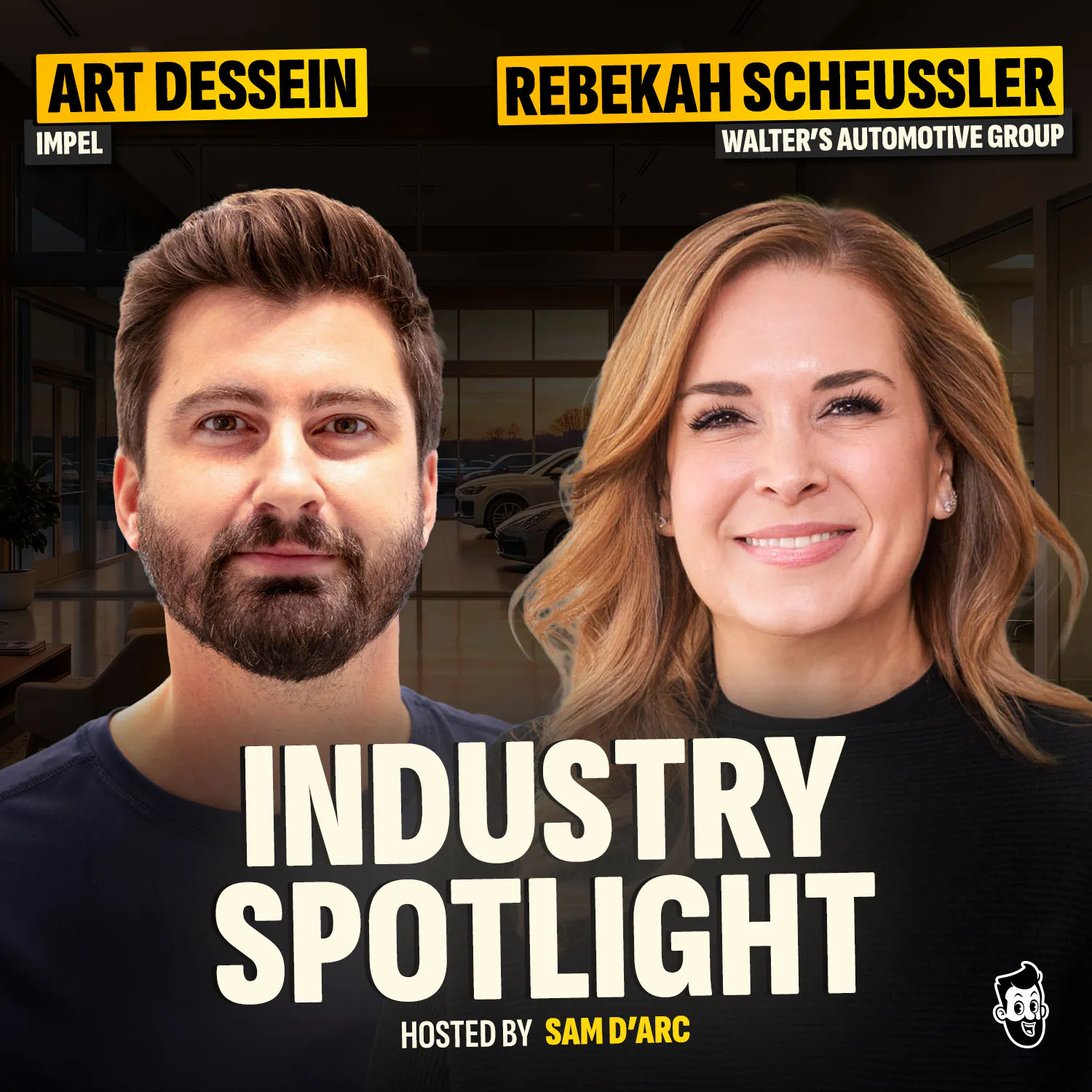
In this episode of the Industry Spotlight, joining host Sam D'Arc are Art Dessein, Vice President of Sales at Impel, and Rebekah Scheussler, Business Development Director at Walters Auto Group to discuss why luxury dealers are quietly losing service customers to independent shops and how AI is rebuilding the personalized experience at scale across both sales and service.
This conversation surfaces the silent retention leak inside fixed operations: a nine-minute average service hold time, an 80% abandonment rate on the online service scheduler, and 190,000 independent shops siphoning loyal owners away.
Walters has run 107,000 leads and over 600,000 messages through Impel, lifted per-rep capacity from 200 leads to 300-400, watched show rates climb, and seen days to sale drop.
Customers are even thanking the AI agent for the best service experience they have ever had, without knowing it isn't human. The takeaway for any dealer on the fence: it isn't if, it's how fast.
This episode of the Car Dealership Guy Podcast is brought to you by Impel.
Topics:
03:15 200 Leads Per Agent.
05:40 The Overnight Lead Problem.
08:00 The 9-Minute Hold Time.
09:20 Will AI Replace Me?
13:20 The Better The Tech, The Worse The Support.
17:55 Why Zach Travels (My Son's Secret).
19:10 Why Set It And Forget It Fails.
20:05 107,000 Leads Handled.
21:00 The 10-Person Savings.
23:00 27% Repeat Purchase Rate.
25:10 When Customers Thank The AI.
32:55 Something Doesn't Have To Be Broken.
GetImpel - Dealers are caught between rising customer expectations and the math of meeting them without staffing every problem. Impel's AI Operating System unifies the entire customer lifecycle — sales, service, voice, chat, marketing, merchandising — engaging, qualifying, and scheduling every shopper and customer in seconds, in the dealer's brand voice, at unlimited scale. The human team focuses on what builds loyalty: the relationships. Visit https://impel.ai/ to learn more and experience the power of Impel.
Check out Car Dealership Guy’s stuff:
For dealers:
CDG Circles ➤ https://cdgcircles.com/
Industry job board ➤ http://jobs.dealershipguy.com
Dealership recruiting ➤ http://www.cdgrecruiting.com
Fix your dealership’s social media ➤ http://www.trynomad.co
Request to be a podcast guest ➤ http://www.cdgguest.com
For industry vendors:
Advertise with Car Dealership Guy ➤ http://www.cdgpartner.com
Industry job board ➤ http://jobs.dealershipguy.com
Request to be a podcast guest ➤ http://www.cdgguest.com
Car Dealership Guy Socials:
X ➤ x.com/GuyDealership
Instagram ➤ instagram.com/cardealershipguy/
TikTok ➤ tiktok.com/@guydealership
LinkedIn ➤ linkedin.com/company/cardealershipguy
Threads ➤ threads.net/@cardealershipguy
Facebook ➤ facebook.com/profile.php?id=100077402857683
Everything else ➤ dealershipguy.com