
Episode 562: FSD v14 Lite Will Go Global for Hardware 3 Owners
About this episode
Tesla is expanding Full Self-Driving v14 Lite beyond the US, with the rollout planned for additional international markets for Hardware 3 owners, though timing depends on “technical verification, regional adaptation and relevant regulatory approvals.” The hosts also dig into Tesla’s fresh blue paint options—Frost Blue and Marine Blue—with trim- and price-specific availability. They connect Tesla loyalty and demand to FSD rather than the old Supercharger “moat,” then pivot to EV market moves like Nissan pulling back on US EV plans and Rivian scaling the R2.
Tesla confirms that the upcoming FSD v14 Lite for Hardware 3 vehicles will be rolling out globally. Plus: Tesla introduces not one but two new blue paint options for Model 3 and Model Y, Rivian had a better-than-expected first quarter, Nissan becomes the latest legacy automaker to pull the plug on EVs in the US market, and more!
If you enjoy the podcast and would like to support my efforts, please check out my Patreon at https://www.patreon.com/teslapodcast and consider a monthly or (10% discounted!) annual pledge. Every little bit helps, and you can support for just $5 per month. And there are stacking bonuses in it for you at each pledge level, like early access to each episode at the $5 tier and the weekly Lightning Round bonus mini-episode (AND the early access!) at the $10 tier! And NO ADS at every Patreon tier!
WIN AN EV WHILE GIVING TO A GREAT CAUSE: For your chance to win your dream EV in the 2026 ChesedChicago raffle, head to https://tinyurl.com/CCraffleRTL -- Hurry, tickets are limited and only 9,999 tickets will be sold, get your tickets today and use code RTL for $25 off 2 tickets or $500 off 15 tickets. Whether you win or not, you're helping a great organization help families in need.
Also, don't forget to leave a message on the Ride the Lightning hotline anytime with a question, comment, or discussion topic for next week's show! The toll-free number to call is 1-888-989-8752.
INTERESTED IN A FLEXIBLE EXTENDED WARRANTY FOR YOUR TESLA? Be a part of the future of transportation with XCare, the first extended warranty designed & built exclusively for EV owners, by EV owners. Use the code Lightning to get $100 off their "One-time Payment" option! Go to www.xcelerateauto.com/xcare to find the extended warranty policy that's right for you and your Tesla.
P.S. Get 15% off your first order of awesome aftermarket Tesla accessories at AbstractOcean.com by using the code RTLpodcast at checkout. Grab the SnapPlate front license plate bracket for any Tesla at https://everyamp.com/RTL/ (don't forget the coupon code RTL too!). Enhance your car with cool carbon-fiber upgrades from RPMTesla.com and use the promo code RTLsale for 5-10% off your next purchase. And make your garage door foolproof with the Infinity Shield – get yours at https://www.infinity-shield.com and use the promo code RTL at checkout for a $35 discount.
FSD v14 Lite
"Tesla confirms that the upcoming FSD version 14 Lite for hardware 3 vehicles will be rolling out globally."
“FSD v14 Lite” is Tesla’s newer driver-assistance software. It’s like an updated autopilot package, but “Lite” usually means it’s not the most advanced version yet.
FSD v14 Lite is Tesla’s “Full Self-Driving” software version 14 in a lighter/less-capable rollout tier. It’s designed to bring more automated driving features to supported cars, but with limitations compared with the full FSD stack.

Tesla Model 3
"Plus, Tesla introduces not one but two new blue paint options for Model 3 and Model Y."
The Tesla Model 3 is one of Tesla’s main electric cars. This segment is just saying Tesla added new blue paint choices for it.
The Tesla Model 3 is Tesla’s mass-market electric sedan, and it’s a key volume model for software and feature rollouts. New exterior paint options are a common way Tesla refreshes demand and personalization without changing the powertrain.

Tesla Model Y
"Plus, Tesla introduces not one but two new blue paint options for Model 3 and Model Y."
The Tesla Model Y is Tesla’s electric SUV. Here, the hosts are noting Tesla added new blue paint options for it.
The Tesla Model Y is Tesla’s compact electric SUV and one of its highest-selling vehicles. Like the Model 3, it often receives software and availability updates, while paint options are a straightforward way to offer new looks to buyers.
Nissan
"Nissan becomes the latest legacy automaker to pull the plug on EVs in the US market and more."
Nissan is a traditional car company. The host says Nissan is stopping its EV push in the US market.
Nissan is a legacy automaker making strategic decisions about where to invest in EVs. Pulling back on EVs in the US market typically reflects shifting demand, cost pressures, and product-planning priorities.

Tesla Model X
"to discuss the legacy of the Model S and the Model X. [250.0s] It will be totally about that."
The Tesla Model X is Tesla’s electric SUV. The hosts are planning to discuss its role in Tesla’s history.
The Tesla Model X is Tesla’s electric SUV, notable for its distinctive design and for bringing EV tech to the SUV segment. This episode segment frames it as part of Tesla’s “legacy” to be discussed with Tesla leadership.

Tesla Model S
"to discuss the legacy of the Model S and the Model X. [250.0s] It will be totally about that."
The Tesla Model S is Tesla’s well-known electric sedan. Here it’s brought up because the show is planning to talk about what made it important for Tesla’s history.
The Tesla Model S is a flagship electric sedan from Tesla, known for helping define the modern EV performance-and-tech template. In this segment, it’s mentioned as part of the “legacy” topic the hosts plan to discuss with Tesla’s leadership.
light bar
"the Model 3... doesn't have a front and rear light bar on it. Because we've got the Model Y front and rear light bar..."
A light bar is a continuous strip of LEDs used for exterior lighting, typically spanning the width of the vehicle’s front or rear. In EV design, it’s often used as a signature styling element and can also improve visibility by creating a uniform light pattern.

Tesla Cybercab
"Cybertruck front and rear light bar, Cybercab front and rear light bar, even the Tesla Semi..."
The Tesla Cybercab is a future Tesla vehicle mentioned in the show. The host says it’s expected to use the same front-and-rear light-bar look as other newer Teslas.
The Tesla Cybercab is discussed as a future Tesla vehicle, and the host claims it would also follow the same front-and-rear light-bar design language. In this segment, it’s used to reinforce the idea that Tesla’s current styling cues are spreading across the lineup.

Tesla hardware 3
"It's good news for those of you who own a hardware 3 Tesla outside of the US... you will be getting the FSD version 14 light update... Following future rollout of FSD version 14 light for hardware 3 vehicles in the US, we plan on expanding version 14 light to additional international markets."
Hardware 3 is the computer inside certain Tesla cars that powers advanced driving features. If your Tesla has Hardware 3, you’re more likely to be able to install newer FSD software updates when Tesla rolls them out.
“Hardware 3” is Tesla’s in-car computer platform used to run driver-assistance and Full Self-Driving (FSD) features. In this segment, the hosts say owners with Hardware 3 outside the US will receive FSD version 14 light, meaning the car’s compute capability is what determines eligibility for the software rollout.
FSD version 14 light
"you will be getting the FSD version 14 light update that Tesla is currently working on... Following future rollout of FSD version 14 light for hardware 3 vehicles in the US, we plan on expanding version 14 light to additional international markets."
“FSD version 14 light” is Tesla’s update for its driver-assistance system. It’s a specific software release, and Tesla is rolling it out to more countries over time depending on approvals and testing.
“FSD version 14 light” is a specific, lighter-weight release of Tesla’s Full Self-Driving software. The segment frames it as a rollout that will reach Hardware 3 cars outside the US, but with timing dependent on technical verification, regional adaptation, and regulatory approvals.
technical verification, regional adaptation and relevant regulatory approvals
"Since international rollout is subject to several factors, completion of technical verification, regional adaptation and relevant regulatory approvals. We can't provide definitive dates at the moment, but we'll provide updates on a rolling basis end quote."
Tesla has to test and adjust the software for each country, and it also needs permission from local regulators. That’s why rollout dates can be uncertain outside the US.
For advanced driver-assistance software like FSD, Tesla can’t simply push the same build everywhere. It must complete technical verification, adapt the behavior to local requirements and road rules, and obtain regulatory approvals before enabling the feature in each region.
supervised
"So you're going to get to jump from the no FSD supervised that you have now all the way up to version 14 light."
“Supervised” means the car can help drive, but you’re still expected to watch closely and be ready to take control. It’s not fully hands-off automation.
In Tesla’s FSD context, “supervised” refers to driver-assistance behavior where the system can handle driving tasks but the human driver remains responsible and must monitor readiness to take over. The host describes a jump from “no FSD supervised” to “version 14 light,” implying a change in what level of supervised automation the car can run.
trim specific color
"Now to my knowledge, again I've been following this stuff for a long, long time, I think this is the first time that Tesla has ever offered a trim specific color here in the US. I say here in the US because Tesla is in fact doing this right now, just not here, at least not yet."
“Trim-specific color” means the paint color depends on which version of the car you buy. In this segment, the host says Tesla is starting to offer certain blues only on specific Model 3/Model Y trims.
A “trim-specific color” means a paint color is restricted to certain versions (trims) of a model rather than being universally available across the lineup. The host argues this is a notable change for Tesla in the US because Frost Blue is tied to performance trims, and Marine Blue is tied to Premium trims.
upgrade
"It is a $1,000 upgrade for the 3 premium or Y premium. So you do have to pay for it on those cars."
An “upgrade” is an add-on option you pay extra for. The host says Marine Blue costs $1,000 on the Premium versions of the Model 3 and Model Y.
In car ordering, an “upgrade” is an optional feature or option package that costs extra beyond the base configuration. Here, Marine Blue is described as a $1,000 upgrade on the Model 3 Premium and Model Y Premium.

Cadillac SRX
"We know what frost blue looks like if you've had the chance to see a frost blue SRX."
The Cadillac SRX is a luxury SUV. Here, the host mentions it because it’s one example of a car color (“Frost Blue”) they’ve seen before.
The Cadillac SRX is a compact luxury SUV from Cadillac. In this segment, it’s used as a reference point for what the “Frost Blue” paint color looks like in real life.
Giga Berlin
"I mean, granted, my European listeners have, and maybe even I think my Canadian listeners, because I believe the Canadians are getting their Model Ys from Giga Berlin."
Giga Berlin is Tesla’s factory in Germany. The host uses it to explain why some car colors are only available on cars built there.
Giga Berlin is Tesla’s Gigafactory in Berlin, Germany. In this segment, it’s referenced as the source of Model Y cars for Europe/Canada, which is why certain paint colors are described as “exclusive” to that region.
Giga Shanghai
"And the still active, still available, but not available in the U.S. Glacier blue, the giga Shanghai makes available on their cars."
Giga Shanghai is Tesla’s factory in China. Here it’s mentioned because it’s where cars get certain paint colors (like Glacier blue).
Giga Shanghai is Tesla’s Gigafactory in Shanghai, China. The host says it makes “Glacier blue” available on cars, highlighting how paint offerings can vary by production location.
tax credit
"And that could very, very well be because of the tax credit. [1469.9s] With the tax credit, the people are willing to make that leap and say, [1474.5s] okay, all right, I'll treat myself to the performance version."
A tax credit is money off your taxes from the government. In this discussion, it’s being used to explain why more people might buy the pricier performance versions when the incentive is available.
A tax credit is a government incentive that reduces the amount of tax you owe, effectively lowering the purchase price for eligible vehicles. Here, the hosts argue the availability of a tax credit can change buyer behavior—making it more likely people choose the higher-priced “performance” trims.

Chevrolet Equinox
"The complete list of 2025 winners includes GM for overall loyalty to manufacturer, Tesla for overall loyalty to make, Chevrolet Equinox for overall loyalty to model,"
The Chevrolet Equinox is a popular SUV model. In this segment, it’s mentioned because the awards say people are loyal to that specific model.
The Chevrolet Equinox is a mainstream compact SUV used here as an example of “overall loyalty to model” in S&P Global Mobility’s vehicle-registration-based awards. It’s mentioned not for driving dynamics, but as a data point in how buyers stick with a specific model.
FUD
"And by outsiders, I mean of course people who are aware of Tesla and may have some opinion of Tesla about the cars of the company based on something real or maybe something FUD based."
FUD means people spread fear, confusion, or doubt about something. Here it’s used to talk about negative stories about Tesla that may not be based on facts.
FUD stands for “fear, uncertainty, and doubt,” a phrase used to describe negative messaging intended to undermine confidence in a product. The host uses it to contrast “real” concerns with rumors or negative narratives about Tesla.
free software updates that add new features throughout the year
"Where the fuel costs more, the cars are louder, they don't have FSD, the user interface typically isn't as fully featured. It doesn't get free software updates that add new features throughout the year."
Tesla can update the car’s software remotely, and sometimes those updates add new features. The point is that the car can improve after you buy it, not just stay the same.
This refers to Tesla’s approach of delivering new functionality via over-the-air software updates rather than requiring owners to visit a shop for each change. The episode contrasts this with typical gas-car and some EV experiences, where features may not be added continuously after purchase.
moat
"And really I think it's FSD in particular that has become the moat that surrounds Tesla these days. It used to be the supercharger network, right?"
A “moat” is an advantage that makes it hard for competitors to steal customers. In this case, they’re saying Tesla’s software (FSD) is what keeps people choosing Tesla.
In business terms, a “moat” is a durable advantage that helps a company keep competitors from taking customers. Here, the hosts use it to describe how Tesla’s FSD (and previously its charging network) creates customer pull that rivals struggle to match.
supercharger network
"It used to be the supercharger network, right? That used to be Tesla's moat. That would be why you would choose Tesla over another EV brand, but now it's FSD."
The Supercharger network is Tesla’s network of fast charging stations. The hosts are saying it used to be Tesla’s big advantage for getting people to buy.
Tesla’s Supercharger network is its fast-charging infrastructure for Tesla vehicles. The hosts frame it as Tesla’s earlier “moat,” meaning it helped attract buyers by reducing charging anxiety compared with other EV brands.
Superchargers
"Tesla's opened up the superchargers obviously, which I do absolutely think is a good thing."
Superchargers are Tesla’s fast charging stations for electric cars. The host is saying Tesla opening them up is good because it makes EV charging easier for more people.
Superchargers are Tesla’s fast-charging network for EVs, designed to reduce “range anxiety” by enabling quicker top-ups on road trips. In the segment, the host says Tesla opened up access, which can help the broader EV market by making charging more convenient.
days on the market
"lasting just 25.6 days on the market on average, [2101.9s] two days better than that of the second place, Lexus RX 350H."
“Days on the market” is how many days a car stays listed for sale before someone buys it. Fewer days generally means the car is selling faster.
“Days on the market” measures how long a vehicle typically sits for sale before it sells. Shorter days on market usually indicate stronger demand or faster pricing-to-market, which is why it’s used here to compare Tesla and non-Tesla used-car performance.
year-over-year (YoY) price change
"while the average price of a one to five year old non-Tesla EV fell 10.3% in Q1 year over year, [2130.3s] the average price of a used Tesla was essentially flat at just 0.1% lower"
Year-over-year means “compared to the same time last year.” They’re using it to show whether car prices are going up or down versus last year.
Year-over-year (YoY) price change compares pricing in the current quarter to the same quarter one year earlier. This segment uses YoY comparisons to show how used EV prices (and traditional gas prices) moved differently for Teslas versus non-Tesla EVs.
vehicle value retention
"Used electric vehicles without a Tesla badge have lost more than 10% of their value in the past year. [2161.9s] This compares to stable values for Teslas and hybrids and a modest 2.8% drop for traditional gasoline vehicles."
Value retention is how well a car keeps its resale value. They’re saying non-Tesla EVs dropped a lot more than Teslas and hybrids over the past year.
Value retention describes how well a vehicle holds its resale value over time. In this segment, the host cites data suggesting non-Tesla used EVs lose more than 10% of value in a year, while Teslas and hybrids are described as more stable.
Tesla wall connector
"Plus, a new thing this year, you can supercharge your entry for $10 per ticket to add a Tesla wall connector, including an installation from a professional electrician."
A Tesla wall connector is a dedicated home EV charging unit that mounts on a wall and charges your Tesla from standard household power. Compared with plugging into a basic outlet, a wall connector is typically designed for higher, more reliable charging and is installed by an electrician for safe, code-compliant wiring.
EV-approved repair facilities
"It gives you the flexibility to use EV-approved, excuse me, approved EV repair facilities, not necessarily just the manufacturer."
Some repair shops are specifically set up to work on electric cars. That matters because EVs use high-voltage parts and need different tools and training than regular gas cars.
“EV-approved” repair facilities are shops that have been vetted or authorized to service electric vehicles. The idea is that EVs require different diagnostic tools and procedures than gas cars, especially around high-voltage systems.
rear-wheel drive
"remember the long-range rear-wheel drive Cybertruck that was introduced about a year ago for $70,000"
Rear-wheel drive means the power goes to the back wheels. That can change how the truck accelerates and handles compared with versions that drive all four wheels.
Rear-wheel drive (RWD) means the vehicle’s drive power is sent to the rear wheels. On EVs like the Cybertruck, that affects traction behavior, stability control tuning, and how the vehicle feels compared with all-wheel drive versions.
recall
"there was a recall affecting specifically this very long-range rear-wheel drive trim of the Cybertruck"
A recall is when the company says there’s a problem that could affect safety or proper operation. Owners are usually told what to do to fix it.
A recall is an official action where a manufacturer notifies owners that a safety-related issue exists and provides a remedy. Here, Tesla is described as issuing a recall tied to a specific Cybertruck trim and a brake-related component risk.
brake rotors
"So according to Tesla, according to the recall, stud holes in the brake rotors may crack,"
Brake rotors are the discs that your brake pads squeeze to make the vehicle slow down. If the rotor’s mounting holes crack, braking can become less safe.
Brake rotors are the metal discs the brake pads clamp onto to slow the vehicle. The segment says stud holes in the brake rotors may crack, which is a safety concern because it can compromise braking performance.
wheel stud
"This could cause the wheel stud to detach from the hub, potentially leading to a crash. [2592.2s] Tesla claims there has been no accident or injuries traceable to the potential fall."
A wheel stud is the metal bolt that helps hold your wheel to the car. If it comes loose from the hub, the wheel could become unstable, which is a serious safety concern.
A wheel stud is the threaded bolt that the wheel mounts to, typically passing through the hub so the wheel can be secured with lug nuts. If a wheel stud detaches from the hub, the wheel can loosen or separate, which is why the segment frames it as a potential crash risk.
hub
"This could cause the wheel stud to detach from the hub, potentially leading to a crash. [2592.2s] Tesla claims there has been no accident or injuries traceable to the potential fall."
The hub is the central part of the wheel assembly that the wheel mounts to and that connects to the vehicle’s axle. In this segment, the hub is important because the concern is a wheel stud detaching from the hub under rough roads or sharp turns.

Tesla Cybertruck
"The recall notice states that only 173 Cybertrucks need to be brought in, [2612.3s] meaning the company only sold 173 units of this variant."
The Tesla Cybertruck is Tesla’s pickup truck. Here, the hosts talk about a recall affecting only 173 Cybertrucks of one variant, which is why they call it a rare “unicorn.”
The Tesla Cybertruck is Tesla’s angular, stainless-steel pickup that’s known for its unusual exterior design and high-profile rollout. In this segment, it’s central because a recall is discussed, with only 173 units of a specific variant needing service.
Tesla Unicorn
"If you've got one, congratulations, you've got a Tesla Unicorn. [2623.0s] Because 173 units definitely qualifies these as a Tesla Unicorn in my book,"
“Unicorn” is a slang term for something very rare. They’re calling this Cybertruck variant a “Tesla Unicorn” because only 173 units are said to exist.
“Unicorn” is enthusiast slang for an extremely rare car or configuration that most people never see. Here, the hosts apply the label to a Cybertruck variant with only 173 units recalled/sold, arguing it’s exceptionally uncommon compared with the broader Cybertruck population.

Volvo S40
"...drive Cybertruck a run for its money is the Model S40. The 40 was offered in the very early, the very b..."
The Volvo S40 is a smaller car model made by Volvo. In the podcast, it’s brought up as a comparison point when talking about different kinds of cars. The “40” refers to the early naming of that model line.
The Volvo S40 is a compact car model that the podcast references as a comparison point, with the “S40” name tied to early model offerings. It’s mentioned in the context of someone trying to “drive Cybertruck a run for its money,” which suggests the S40 is being used as a reference for what a smaller car can do. The key relevance here is the podcast’s historical naming and model context rather than performance specs.
software locked
"And those cars, the 40s, were in fact 60s, 60kWh battery cars that were software locked [2766.8s] to only have 40kWh of usable battery."
It means the car’s computer limits what you can use. In this case, the battery was physically bigger, but the software only let you use part of it.
“Software locked” means the car’s battery capacity (or other capability) is restricted by the vehicle’s software rather than by physical hardware. Here, the host claims the Model S40 had a larger battery but was limited to a smaller usable portion.

Tesla Semi
"Tesla just got a massive order for the Tesla Semi, and it's largest one by a long shot. [2836.6s] an order for 370 Tesla Semis, valued at approximately $100 million. [2855.7s] Deliveries are set to begin with the first 50 of those Tesla Semis this year, [2861.2s] with the full fleet operational by the end of next year."
The Tesla Semi is an electric big rig for hauling goods. The host talks about a huge order and when the first trucks will start delivering, along with charging plans.
The Tesla Semi is Tesla’s electric Class 8 semi-truck aimed at long-haul freight. This segment highlights a major order—370 trucks—plus delivery timing and deployment plans tied to charging and port logistics in California.
electric class 8 trucks
"What EV, a leading provider of electric freight operations and charging electric class 8 trucks in California? [2821.5s] Excuse me, I totally lost my place. Let me try that again. [2830.3s] They've announced one of the largest deployments of electric class 8 trucks in California history,"
Class 8 trucks are the biggest commercial trucks used for hauling loads over long distances. This phrase means those heavy trucks are being electrified.
“Class 8” is a U.S. trucking weight class for the heaviest commercial trucks, typically used for long-haul freight. Calling them “electric class 8 trucks” means the segment is about electrifying the biggest, most demanding category of freight vehicles.
charging infrastructure
"A leading provider of electric freight operations and charging infrastructure in the US, there we go. [2830.3s] They've announced one of the largest deployments of electric class 8 trucks in California history,"
Charging infrastructure is the network of places and equipment where electric vehicles plug in to recharge. For big trucks, it has to be fast and reliable so they can keep running.
“Charging infrastructure” refers to the network of charging stations and related equipment that enables electric vehicles to recharge. For heavy trucks, this is especially important because they need high-power charging to keep routes moving.
zero-emission long-haul freight
"This marks the state's biggest single electric truck order to date, [2850.0s] and signals accelerating momentum for zero-emission long-haul freight."
It means shipping goods over long distances with no exhaust pollution coming out of the vehicle. The idea here is electric trucks doing long-haul work.
“Zero-emission long-haul freight” describes transporting goods over long distances using vehicles that produce no tailpipe emissions. In practice, this usually means battery-electric trucks, supported by charging and route planning to meet duty cycles.
What EV
"Salim Yusefzadi, CEO of What EV, said at the annual ACT Expo Industry Event that the Semi was the easiest choice. We selected the Tesla Semi based on cost, performance, and availability"
What EV is the company being quoted that helps fleets adopt electric trucks. They’re described as handling not just the vehicles, but also charging and the leasing setup.
What EV is the company referenced in the segment as a vertically integrated EV deployment and leasing model provider. The hosts describe its approach as combining vehicle deployment, high-power charging infrastructure, and leasing to help carriers adopt EV trucks.
request for proposals
"We selected the Tesla Semi based on cost, performance, and availability after issuing a public request for proposals."
An RFP is a formal way for a company to ask suppliers to compete for a contract. It usually means the buyer sets requirements and compares the submitted offers.
A request for proposals (RFP) is a formal procurement process where an organization asks vendors to submit bids or plans for a project. Here, it’s used to describe how What EV selected the Tesla Semi based on criteria like cost, performance, and availability.
full service leasing
"megawatt class charging infrastructure, and full service leasing offers a turnkey path for carriers without any capital risk."
Full service leasing is a financing structure where the customer pays for vehicle use while the leasing provider handles more of the operational burden (often including maintenance/service and sometimes related logistics). In the segment, it’s positioned as reducing risk for carriers adopting new EV fleets.
Rivian
"According to Rivian's shareholder letter, the electric vehicle maker posted Q1 2026 revenue of $1.38 billion... The company also reported a net loss of $416 million... On the manufacturing front, Rivian is increasing the planned initial capacity of its upcoming Georgia plant..."
Rivian is a company that builds electric trucks and SUVs. Here, they’re talking about Rivian’s latest quarterly business results and its plans to build more cars in the future.
Rivian is an electric-vehicle company that reports quarterly financial results and production plans to investors. In this segment, the hosts reference Rivian’s shareholder letter to discuss revenue, losses, cash, and scaling manufacturing capacity for future vehicles.
Wall Street
"significantly better than the deeper losses Wall Street had anticipated."
“Wall Street” means the finance world—people who follow companies and make predictions about their results. The hosts are saying Rivian did better than those predictions expected.
“Wall Street” is a shorthand for the financial industry—analysts and investors who forecast company performance and react to results. In this segment, it’s used to describe expectations for Rivian’s losses and how the actual numbers compared.
ramping up production
"once they've successfully completed the very difficult task of ramping up to actually make 300,000 cars a year."
Ramping up production means getting a new factory to build cars at the big target numbers. It’s hard because the factory has to learn how to make the cars reliably and quickly.
Ramping up production means increasing a factory’s output from early builds to the planned high-volume rate. It’s difficult because it involves manufacturing process maturity, staffing, supplier readiness, and quality control—especially when launching new vehicles.
Volkswagen
"Drivetest LeCanada also reports that Volkswagen has overtaken Amazon as Rivian's largest single shareholder with a nearly 16% stake... With this partnership, Volkswagen is effectively outsourcing part of that challenge to Rivian..."
Volkswagen is described here as becoming Rivian’s largest shareholder via a growing equity stake. The segment also frames VW’s investment as a way to accelerate EV software and vehicle technology through a joint venture.
joint venture
"The increased stake follows Volkswagen's latest $1 billion investment tied to the Rivian VW technology's joint venture."
A joint venture is when two companies team up to work on the same project. In this case, it’s connected to EV technology and software development.
A joint venture is a formal partnership where two companies collaborate under a shared structure to develop or deliver a specific project. Here, VW’s investment is tied to a joint venture connected to EV technology and next-generation software progress.
next generation EV software
"The funding was triggered after the partnership reached another key milestone linked to progress on next generation EV software and electrical architecture."
This means the newer, improved computer software that runs EV features. The hosts say the investment was released after progress milestones on that next software.
“Next generation EV software” refers to the next major evolution of the software stack that controls EV systems like driving functions, energy management, and user features. In the segment, funding is described as being triggered by milestones tied to progress on this software.
electrical architecture
"The funding was triggered after the partnership reached another key milestone linked to progress on next generation EV software and electrical architecture."
Electrical architecture is how the car’s electrical parts are organized and connected. It affects how well the EV can run and how easily new software can work with the hardware.
Electrical architecture is the overall design of how the car’s electrical systems are laid out—what modules exist, how they communicate, and how power flows. The segment links it to EV software milestones, implying both hardware layout and software integration are progressing together.
equity
"Unlike a traditional cash infusion, this latest funding came in the form of equity, meaning Volkswagen's influence over Rivian continues to grow with each milestone achieved."
In this context, equity means Volkswagen is putting money into Rivian and getting ownership shares in return. That’s different from a loan or a simple cash investment.
Equity here means funding provided in exchange for ownership shares, not just cash. That structure increases the investor’s influence because the investor’s stake grows as the company issues or transfers shares.
software-defined vehicles
"The two companies have agreed to invest up to $5.8 billion in total as part of the collaboration, which is focused on developing software-defined vehicles for Western markets."
A software-defined vehicle is one where the car’s features are controlled mostly by software. That can make it easier to improve the car over time with updates.
Software-defined vehicles are cars where key functions and features are primarily controlled by software rather than fixed hardware. The segment ties this to developing EV software for Western markets, implying faster updates and more flexible feature development.
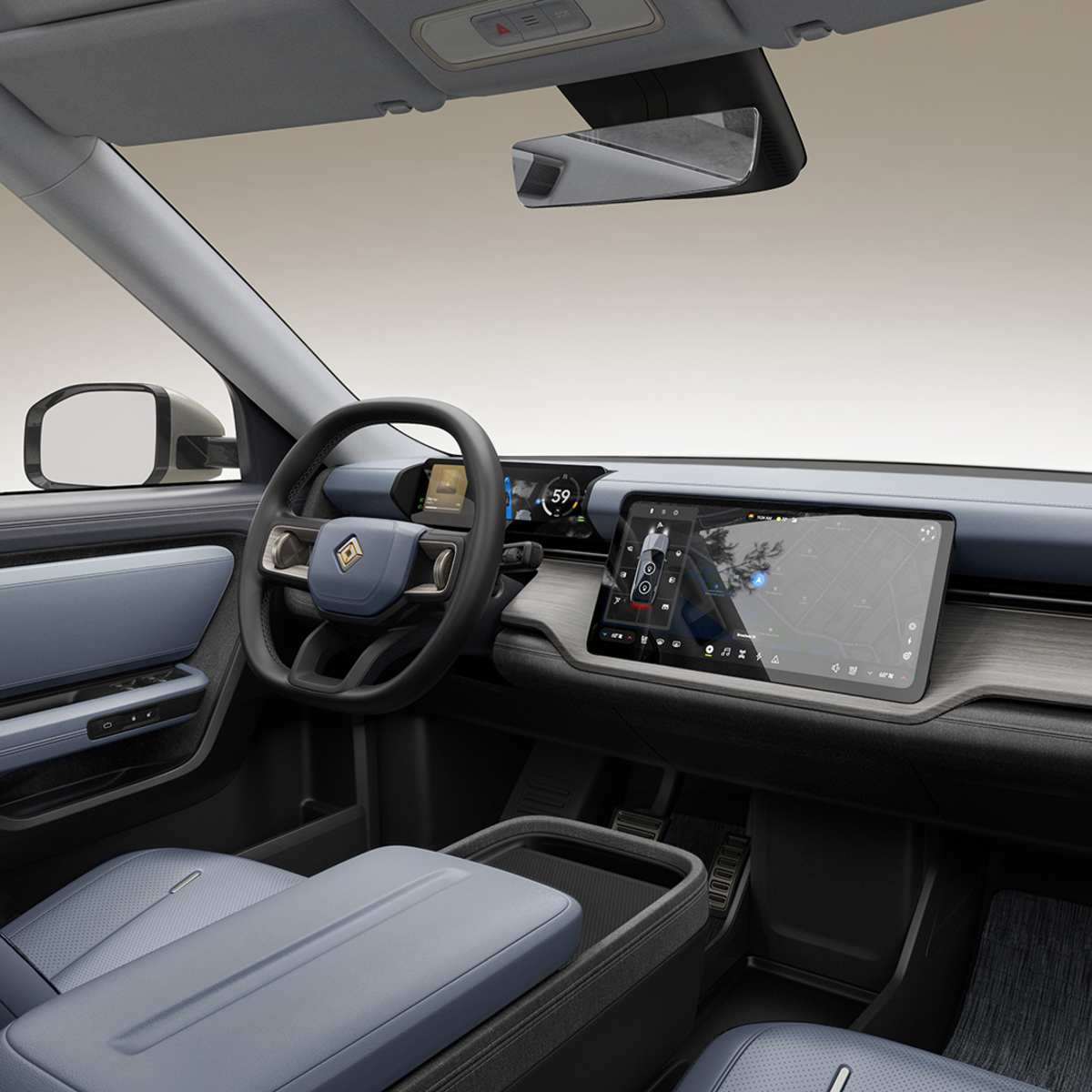
Rivian R2
"Anyway, one more piece of Rivian news for you and it's more good news. As Rivian starts volume production of R2, CEO RJ Scarridge is already hinting at additional variants that may be released in the future."
Rivian R2 is an upcoming electric Rivian model that the company is starting to build in larger numbers. The discussion here is about different versions of the same basic vehicle coming later.
Rivian R2 is the next-generation electric vehicle Rivian is moving into volume production for. In this segment, the hosts discuss how Rivian is planning future R2 variants beyond the initial launch configuration.
volume production
"As Rivian starts volume production of R2, CEO RJ Scarridge is already hinting at additional variants that may be released in the future."
“Volume production” means the factory is making the car in large numbers, not just a small batch. The host is saying Rivian is now at the point where it can think about more versions of the R2.
Volume production means moving from limited early builds to high-rate manufacturing intended to supply many customers. In the segment, it’s used to signal that Rivian R2 is entering the stage where variants and future models can be planned around scalable production.
Rivian R3X
"However, based on the interview, it seems like a pickup variant and a performance variant like the R3X crossover could be coming for the R2."
Rivian R3X is mentioned as a sportier Rivian model. The point is that Rivian might make a similar “performance” version of the R2 later.
Rivian R3X is referenced here as a performance-oriented crossover variant. The host is suggesting it could be used as a template for a performance version of the Rivian R2 (i.e., an R2 performance variant).
production facility
"An interesting tidbit is that variant production would not occur at the company's normal Illinois facility where the launch package R2 is being built. Instead, Rivian will use its Georgia-based facility to support the production of variants of the new vehicle."
A production facility is the factory where the cars are built. The host is saying Rivian plans to make some R2 versions at a different factory (Georgia instead of Illinois).
A production facility is the specific factory location where a vehicle (or parts of its assembly) is built. The segment explains that R2 variants wouldn’t be made at Rivian’s Illinois plant, but instead at its Georgia-based facility, which affects logistics and long-term manufacturing strategy.

Rivian R1T
"It really would be interesting to see a more affordable, smaller pickup truck on the R2 platform and R2T, although I have to wonder where it would fit in the marketplace. Because the reason I mention that is because the R1T isn't a full-size truck."
Rivian R1T is Rivian’s electric pickup truck. The host is saying it’s not a “full-size” truck, so a smaller R2-based pickup might not compete the same way as the biggest EV trucks.
Rivian R1T is Rivian’s electric pickup, and the host uses it as a baseline for how the company’s lineup fits into truck size categories. Here, they note that the R1T isn’t a full-size truck, which affects whether a hypothetical R2T would make sense in the market.

Ford F-150 Lightning
"It's not technically in the same class as the F-150 Lightning, the Chevy Silverado EV, the GMC Sierra EV, and of course the Cybertruck."
The Ford F-150 Lightning is Ford’s electric pickup truck. It’s used here as an example of the larger EV trucks that a smaller Rivian pickup would be compared against.
Ford F-150 Lightning is Ford’s electric version of the F-150, positioned in the full-size EV pickup segment. The host compares it to the Rivian R1T/R2T idea to discuss how truck “class” and size affect where a new EV pickup would compete.

GMC Sierra EV
"It's not technically in the same class as the F-150 Lightning, the Chevy Silverado EV, the GMC Sierra EV, and of course the Cybertruck."
The GMC Sierra EV is GMC’s electric pickup truck. It’s mentioned here as another big EV truck that a smaller EV pickup would be compared against.
GMC Sierra EV is GMC’s electric pickup, also aimed at the full-size truck segment. The host uses it as part of the comparison set when discussing where a smaller Rivian pickup might land.

Chevrolet Silverado EV
"It's not technically in the same class as the F-150 Lightning, the Chevy Silverado EV, the GMC Sierra EV, and of course the Cybertruck."
The Chevy Silverado EV is Chevrolet’s electric pickup truck. The host mentions it to show what other full-size EV pickups exist in the same general market.
Chevy Silverado EV is General Motors’ electric pickup entry in the full-size truck market. In this segment it’s grouped with other EV pickups to frame the competitive set for any potential Rivian R2T.

Ford Maverick
"but then again, maybe could it compete price-wise against the likes of, say, the Ford Maverick gasoline-powered truck"
The Ford Maverick is a smaller pickup truck that’s generally positioned as more affordable than the biggest trucks. The host is using it as an example of a price/size target for a possible Rivian R2T.
Ford Maverick is a smaller, more affordable pickup compared with full-size trucks. The host uses it as a reference point for what a hypothetical Rivian R2T could compete against if priced more aggressively.
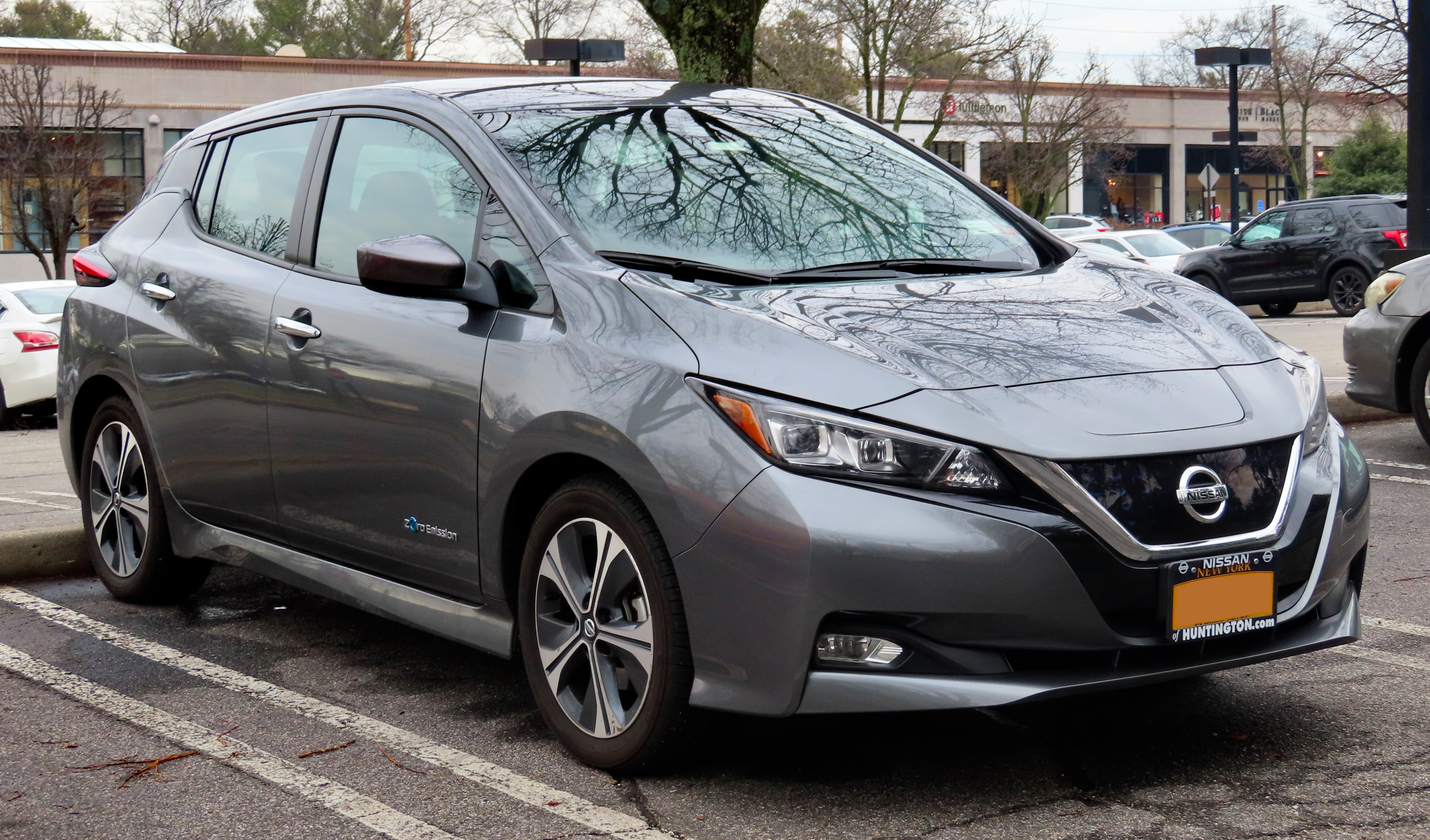
Nissan Leaf
"In unfortunately far worse news this week, Nissan, the Japanese car maker that of course helped pioneer the modern EV with the Leaf all the way back in 2010,"
The Nissan Leaf was one of the first widely sold electric cars. The host brings it up to show Nissan used to be a big early EV player.
The Nissan Leaf is one of the earliest mass-market modern EVs, and it helped popularize the idea of a practical battery-electric daily driver. Mentioning it here frames Nissan as an early EV pioneer before this Canton, Mississippi EV plan cancellation.
TheStreet.com
"I want to say tip of the cap to long-time listener and generous Patreon backer Michael Gallo who sent this story to me and it comes via TheStreet.com who writes,"
TheStreet.com is a news website. The host is saying they got the EV cancellation story from there.
TheStreet.com is a business/market news site, and the host says the story comes via TheStreet.com. It’s a source attribution rather than a technical automotive detail.
Bloomberg
"as part of a broader recalibration of its product strategy as the Japanese car maker seeks to conserve cash, according to Bloomberg."
Bloomberg is a business news outlet. The host is citing it as the source for why Nissan changed plans—mainly to save money.
Bloomberg is a major business news organization, and here it’s cited as the source for the claim that Nissan is recalibrating product strategy to conserve cash. This helps listeners understand the reporting basis behind the EV program cancellation.
body-on-frame
"Instead of the two electric SUVs, Canton will build a V6 engine-powered hybrid version of the X-Terra SUV plus other body-on-frame trucks and SUVs."
Body-on-frame means the car’s body sits on a separate heavy frame. It’s a common design for trucks and rugged SUVs because it’s built to handle tougher jobs.
Body-on-frame is a vehicle construction method where the body is mounted on a separate structural frame. It’s commonly used for trucks and SUVs because it can handle heavy-duty use and towing more easily than unibody designs.
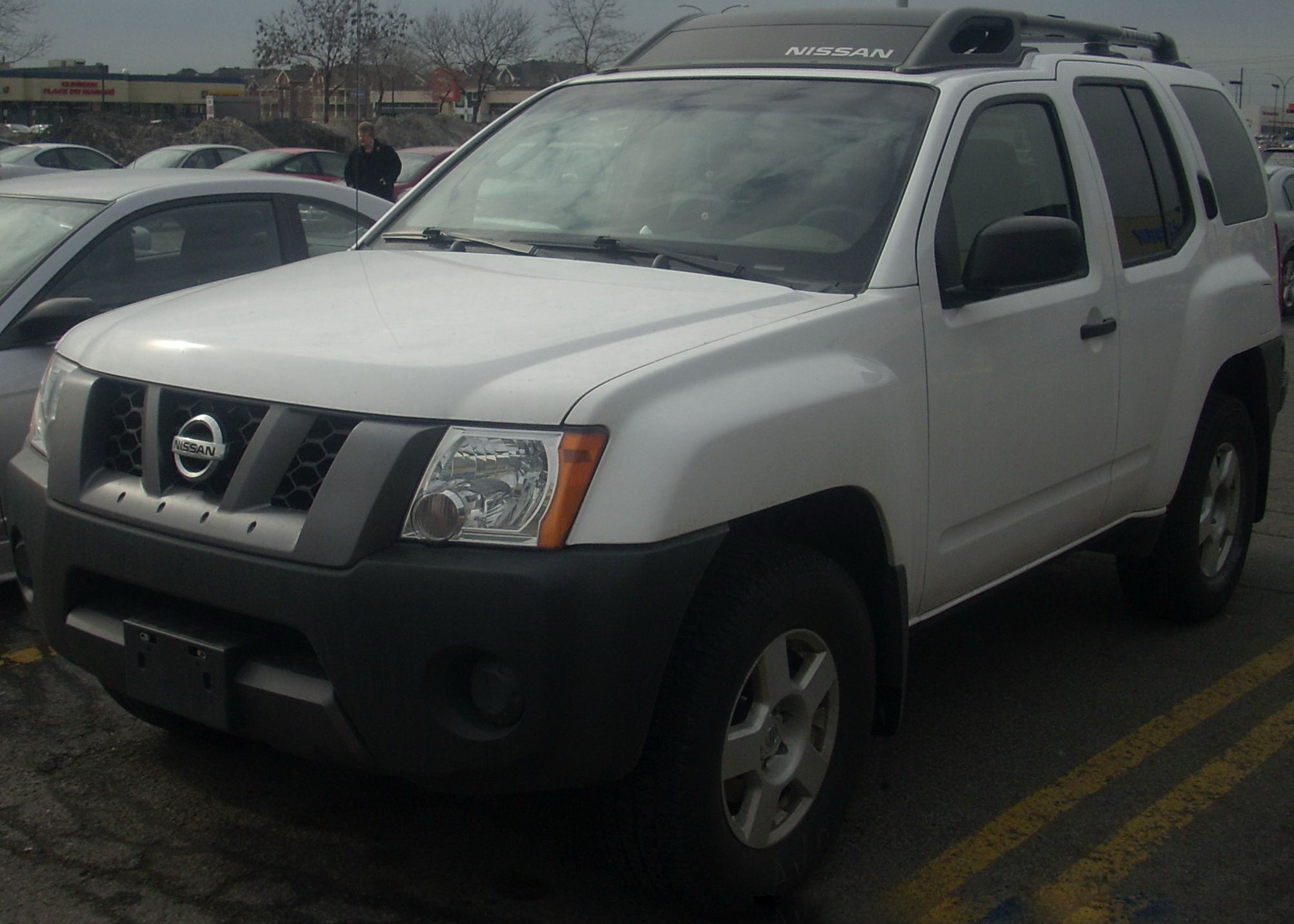
Nissan X-Terra
"Instead of the two electric SUVs, Canton will build a V6 engine-powered hybrid version of the X-Terra SUV plus other body-on-frame trucks and SUVs."
The Nissan X-Terra is an SUV built on a sturdier frame style. Here, the host says Nissan will make a hybrid version of it instead of building electric SUVs at that factory.
The Nissan X-Terra is a body-on-frame SUV, meaning it uses a separate frame for strength and towing capability. In this segment, Nissan is shifting the Canton plant to build a V6 hybrid version of the X-Terra instead of two fully electric SUVs.

Nissan Frontier
"The plant currently produces the Frontier pickup and the Altima sedan and employs roughly 3,200 workers."
The Nissan Frontier is a pickup truck. The host mentions it because the Canton factory already builds this truck, not the canceled EV SUVs.
The Nissan Frontier is a mid-size pickup truck, and it’s one of the vehicles currently produced at Nissan’s Canton, Mississippi factory. The segment uses it to show what the plant is already set up to build while EV plans are canceled.

Nissan Altima
"The plant currently produces the Frontier pickup and the Altima sedan and employs roughly 3,200 workers."
The Nissan Altima is a regular passenger sedan. The host brings it up to show the Canton plant mainly makes cars like this, not the canceled EV models.
The Nissan Altima is a mainstream mid-size sedan, and it’s also produced at Nissan’s Canton, Mississippi plant. In this context, it highlights that the factory is primarily focused on conventional vehicles rather than the planned EV SUVs.
Lucid
"They're now going to be years behind Tesla and Rivian and Lucid and to give credit to the legacy automakers who are not taking their ball and going home."
Lucid is another electric-car company. The host lists it to say Nissan’s EV timeline is falling behind other EV brands.
Lucid is grouped with Tesla and Rivian as an EV maker that Nissan will be behind. Here, Lucid represents the broader competitive set of EV companies pushing technology forward.
BMW
"Nissan's going to be years behind the Volkswagen group, meaning VW, Audi, Porsche. [3827.0s] They're going to be years behind BMW."
BMW is another major car brand. The host is listing it as part of the EV competition Nissan is expected to lag behind.
BMW is included in the competitive comparison, with the host saying Nissan will be years behind BMW as well. It reinforces the segment’s theme: legacy automakers are falling behind in EV execution.
electric vehicle prototypes
"They have begun testing electric vehicle prototypes to replace the ride vehicles on the Autopia attraction."
An electric vehicle prototype is a test version of an EV. It’s built to make sure the design works before they roll it out for real use.
Electric vehicle prototypes are early, pre-production EVs built to validate design, safety, and performance before mass production. In this segment, Disneyland is testing prototypes to replace Autopia’s ride vehicles.
electrification effort
"I think August is probably when we'll find out more about the electrification effort happening at Autopia."
An electrification effort means replacing gas-powered equipment with electric power. In this case, it’s about changing Autopia’s ride cars from gas engines to electric vehicles.
An electrification effort is the process of switching a system from internal-combustion power to electric power. Here, the hosts discuss plans to convert Disneyland’s Autopia ride vehicles from gas to electric.
zero to 60 time
"Unveil it, you know. I know originally back in I think 2017 when it was announced it was, you know, the zero to 60 time. I forget the numbers."
“Zero to 60” means how quickly a car can go from stopped to 60 mph. Faster times generally mean stronger acceleration in everyday driving and drag-style tests.
“Zero to 60 time” is the elapsed time for a car to accelerate from a standstill to 60 mph. It’s a common shorthand for straight-line acceleration performance and is often used to compare different vehicles and trims.
battery capacity
"Like for instance, they said it would have 600 miles, you know, battery capacity."
Battery capacity is basically how much energy the EV can store. More capacity often means you can drive farther, but driving conditions still matter a lot.
Battery capacity is the amount of energy stored in an EV’s battery, typically measured in kilowatt-hours (kWh). Higher capacity usually supports more driving range, though real-world range also depends on efficiency, speed, temperature, and vehicle weight.
cold rocket thrusters
"I'm just wondering your thoughts on how many you think will actually be true or which ones you think may even be improved, you know, with the cold rocket thrusters."
Cold rocket thrusters are a way to add extra push to a vehicle using a rocket-like thrust system. The idea is to get a short acceleration boost without the same kind of hot-burning rocket engine.
Cold rocket thrusters are a propulsion assist concept where a system expels propellant to generate thrust without the high-temperature combustion of a traditional rocket engine. In EV performance discussions, they’re often mentioned as a way to deliver short bursts of extra acceleration for record-style runs.
Tesla Model S Plaid
"In 2021, Tesla itself matched that stated 1.99 second zero to 60 time with, of course, the Model S Plaid."
The Tesla Model S Plaid is Tesla’s fastest Model S. Here it’s mentioned because it hit a very fast 0–60 mph time that Tesla had claimed for an earlier target.
The Tesla Model S Plaid is Tesla’s high-performance version of the Model S, known for extremely quick acceleration. In this segment it’s used as a real-world benchmark for Tesla’s claimed “zero to 60” performance.

Lucid Air Sapphire
"In 2023, the Lucid Air Sapphire beat that zero to 60 time."
The Lucid Air Sapphire is the high-performance version of the Lucid Air. In this discussion, it’s used to show that other EVs have already surpassed earlier “0–60” expectations.
The Lucid Air Sapphire is a performance-focused trim of the Lucid Air, built to compete with the quickest EV acceleration times. The hosts bring it up as another example of how EV performance targets have improved over time.

Chevrolet Corvette ZR1X
"Rimock has also surpassed it and even a gas car, the Corvette ZR1X, which is I've watched a bunch of videos on this car by all means an absolute monster."
The Chevrolet Corvette ZR1X is a very high-performance Corvette. The point here is that it’s so fast it can beat the earlier EV “0–60” target too.
The Chevrolet Corvette ZR1X is referenced as an “absolute monster” that can beat the earlier Tesla acceleration benchmark. It’s also used to highlight that even gas cars are now in the same performance territory as top EVs.
quarter mile time
"the ZR1X also topped the originally stated quarter mile time of the next gen Tesla Roadster that was announced in 2017."
Quarter mile time is how long it takes to drive one quarter mile from a stop. It’s a common “drag strip” way to compare acceleration and power.
Quarter mile time is the elapsed time to cover a distance of one quarter mile (about 402 meters), typically measured from a standing start. It’s a standard drag-racing metric that captures how well a car accelerates over a longer distance than 0–60.
SpaceX thruster
"the placard for the museum display said it would be 1.1 seconds zero to 60 with the SpaceX cold gas thruster package."
“SpaceX thruster” here means a rocket-style thrust system linked to SpaceX. The claim is that it could give the Roadster a big temporary acceleration boost.
A “SpaceX thruster” in this context refers to thruster technology associated with SpaceX, discussed as an acceleration assist for the Tesla Roadster. The key idea is that it’s being treated like a rocket-style thrust source to help achieve extreme performance numbers.

Gordon T50
"The patent application from Tesla that was brought to light several months ago about fans. I remember the patent on the about fans on the bottom of the car and I speculated at that time that this is going to be a fan car like the McMurtry spiraling or the Gordon Murray T 50. In addition to having a quad motor powertrain and the SpaceX thruster, so I am fully confident that the performance metrics that this car ultimately delivers."
The Gordon Murray Automotive T.50 is a very high-performance sports car. The podcast mentions it while talking about a technical idea involving fans. The point is that the discussion connects vehicle design features to how cars can manage airflow or cooling.
The Gordon Murray Automotive T.50 is a high-performance supercar, and the podcast references a Tesla patent related to fans. That connection implies the episode is discussing cooling or aerodynamic concepts and how they might be applied to vehicle design. The T.50 is mentioned as part of that broader technical conversation.
quad motor powertrain
"In addition to having a quad motor powertrain and the SpaceX thruster, so I am fully confident that the performance metrics that this car ultimately delivers."
A quad motor powertrain means the car uses four electric motors. More motors can help the car put power down more effectively for faster acceleration.
A quad motor powertrain uses four electric motors to drive the vehicle. With more motors, engineers can potentially improve traction and acceleration by distributing torque more precisely to the wheels.
range
"The only figure that I am skeptical that they're going to be able to match from the 2017 announcement is the other one that you cited, James, and that's the range. ... I'm skeptical about 620. ... So we'll see about that one, but hopefully we will find out in the next 30 days or so."
Range is how many miles an EV can drive on one full battery charge. The hosts are questioning whether Tesla’s big announced number is believable.
In EV discussions, “range” means how far the vehicle can drive on a full charge under a specified test method. This segment compares Tesla’s announced range targets (e.g., 620 miles) against earlier Tesla figures to judge whether the Roadster’s claims are realistic.
battery pack
"I'm just not sure that Tesla in the end are going to want to put a 200 kilowatt hour battery pack in a sports car because it's so much weight. Unless they've got a battery breakthrough that can literally lighten the load, but the giant battery is what would get the car to 620 miles of range as stated at the 2017 reveal."
A battery pack is the big set of batteries inside an EV that stores the electricity. The hosts are debating whether putting a huge battery in a sports car would be too heavy.
A battery pack is the large, modular assembly of cells and electronics that stores energy in an EV. Here, the discussion centers on how a very large battery pack (200 kWh) could add weight in a sports car, potentially affecting design tradeoffs like range versus mass.
Full Self-Driving (FSD)
"However, I do still agree with you. I am not expecting the Roadster to get FSD whenever it finally comes out. ... If I'm taking that car out for a drive, I don't want it driving me, the whole fun is me driving it myself, ... then okay, yeah, long straight road, maybe I'd want FSD for that."
FSD is Tesla’s self-driving software package. They’re discussing whether the Roadster will get it, and whether owners would even want it for a car meant to be driven manually.
Full Self-Driving (FSD) is Tesla’s software suite for advanced driver-assistance and automated driving features. In this segment, the hosts debate whether the Tesla Roadster will ever receive FSD, and they connect that to platform design choices like manual controls and steer-by-wire.
steer by wire
"It's going to be a whole different platform, like a bespoke one-off custom platform with steer by wire, super low volume. ... especially if it's got steer by wire and it's going to be a thrill to drive."
Steer-by-wire replaces a traditional mechanical steering linkage with electronic control, typically using sensors and actuators to move the steering system. The hosts suggest the Roadster could use steer-by-wire, which could make it easier (or at least different) to integrate automated driving functions like FSD.
foam inserts on the tires
"talking about the foam inserts on the tires of the Model 3 ... I had the same issue on both of my rear tires, took it to Tesla, and they in fact replaced both tires for free because they said it was a manufacturer error,"
Some tires use foam inserts inside them to make the ride quieter. If something goes wrong with those inserts, it can cause tire issues—and the speaker says Tesla replaced his tires at no cost.
Foam inserts are noise-damping materials placed inside certain tires to reduce road noise. If there’s a manufacturing or fitment issue, it can lead to uneven wear or other problems, and in this case the speaker says Tesla replaced the tires for free after calling it a manufacturer error.
tire tread warranty
"because I didn't for quite a while, and that's tire warranty, tire tread warranty rather. People who drive EVs, you should know if you drive anything like I do, your tires will never reach the,"
A tire tread warranty is a guarantee about how long the tire tread should last. If your tires wear out early, the warranty can reduce the cost of new tires based on how much tread you got.
A tire tread warranty is a promise from the tire manufacturer that the tire will wear down to a certain tread depth over an expected mileage. If the tire wears out sooner, the warranty can provide a prorated discount toward replacement tires.
prorated discount
"they will offer, if you push them on it, a tire tread warranty, which is a prorated discount off your next purchase of tires,"
A prorated discount means you don’t get “all or nothing.” If you used only part of the tire’s expected life, you get a discount that matches that partial usage.
A prorated discount means the warranty reimbursement is calculated proportionally to how much of the expected tire wear you actually used. So if you only get part of the mileage the warranty assumes, you receive a partial discount rather than a full replacement price.
foam inserts in the tires
"he was responding to a previous caller about foam inserts in the tires, so Travis, yes, this applies to all EVs, not just Teslas"
These are foam pieces you put inside a tire. They can help make the ride quieter by reducing vibration and road noise.
Foam inserts are aftermarket pieces placed inside a tire to change how it behaves. They’re commonly used to reduce road noise and sometimes improve ride comfort by damping vibrations.

Rivian R1S
"they've got a million great aftermarket parts and accessories for your Tesla and other EVs as well, namely the Rivians, the R1S, the R1T, they're in there."
The Rivian R1S is an electric SUV. It’s included because some aftermarket companies make accessories for it too.
The Rivian R1S is Rivian’s electric SUV, built for family-friendly space with off-road capability. It’s mentioned here because aftermarket accessory makers support it alongside Tesla and other EVs.
PPF door edge guard protection
"we've got the Expel PPF door edge guard protection,"
PPF (paint protection film) is a clear protective layer applied to painted surfaces. Door-edge guards help protect against chips and scratches from things like parking-lot impacts and keys.
Request an Explanation
Heard something you'd like explained? We'll add it to this episode.
Sign in to request explanations for terms you heard.
Want to learn more?
Browse our glossary for plain-English explanations of automotive terms, jargon, and concepts.
Help improve this episode
See something that's not quite right? Our annotations are AI-generated and can sometimes miss the mark. Click the flag icon on any annotation to suggest a correction.