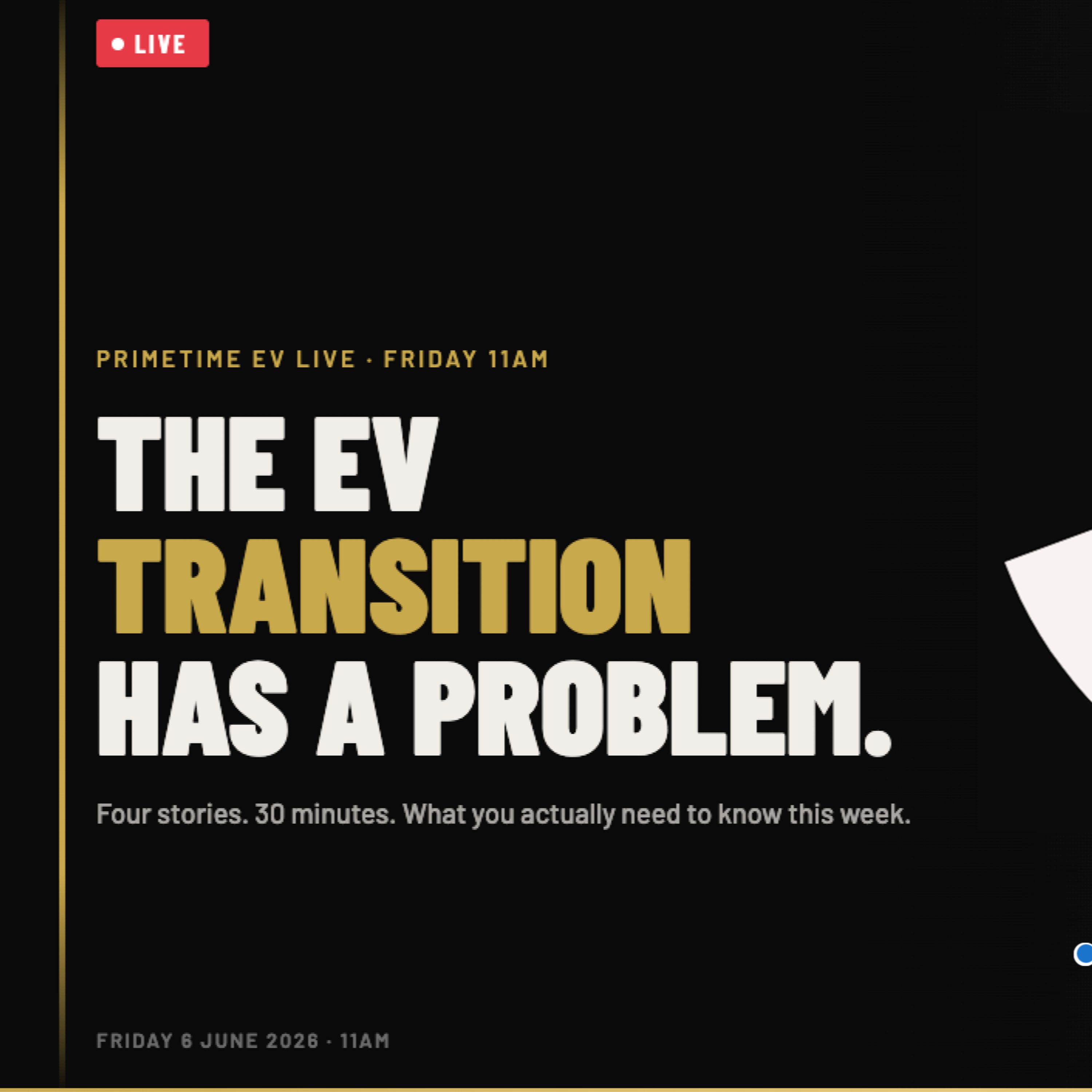
EV transition leaving millions behind, Kia EV4 vs EV3 grant gap & cross-pavement charging lottery | Primetime EV Live
About this episode
The hosts argue the UK EV transition is leaving people behind—especially renters and low-income drivers—because charging access and costs are uneven. They connect that “two tier system” risk to public charging price gaps, a still-maturing used EV market, and home-charging barriers like lack of off-street parking. Then they break down Kia EV4 vs EV3 pricing through grant bands, and preview a cross-pavement charging “postcode lottery” shaped by council rules, safety objections, and wildly different installation subsidies.
00:00:00 Introduction
00:01:30 Is the UK EV transition leaving millions of drivers behind?
00:08:30 Why is the Kia EV4 now cheaper than the smaller EV3?
00:14:30 Can you charge at home without a driveway. Does your council allow it?
00:20:30 Is salary sacrifice still worth it for an electric car in 2026?
00:26:30 Is the electric car grant disappearing at the end of June?
00:27:30 Q&A
00:28:00 Subscribe & Join the Club
UK EV transition 2026. Kia EV4 price UK 2026. Cross-pavement EV charging UK. EV salary sacrifice UK 2026/27. Electric car grant UK June 2026. This week on Primetime EV Live - five stories in 30 minutes.UK EV TRANSITION - WHO'S BEING LEFT BEHIND. EVA England launched "Putting the Driver First" in Parliament on 3 June 2026, backed by evidence from 2,400 drivers. The finding: the transition works but only for households with driveways, above-average incomes and reliable charging access. 40% of UK homes have no off-street parking. The report calls on ministers to act on public charging costs, second-hand EV access and home-charging barriers ahead of the government's upcoming public charging review. Co-sponsored by AutoTrader, Zapmap and EVCI.KIA EV4 CHEAPER THAN THE EV3 - THE GRANT EXPLAINED. The Kia EV4 now costs £30,995 after the full £3,750 government grant making it £560 cheaper than the smaller EV3, which only qualifies for £1,500 under Band 2. The reason: the EV4 is built in Slovakia; the EV3 is built in South Korea. The UK Electric Car Grant factors in supply chain carbon emissions. Build location creates a £2,250 difference in the consumer's pocket. EV4 Long Range: 388 miles from £33,245.CROSS-PAVEMENT CHARGING POSTCODE LOTTERY. 42% of UK councils 56 of 134 surveyed in a Vauxhall FOI request will permit cross-pavement EV charging gullies by end of 2026. The other 58% have no confirmed scheme. Installation costs range from free (Stoke-on-Trent, Reading) to over £1,000 with no subsidy. Westminster, Hackney, Islington and Ealing have explicitly blocked them. We've built a free postcode checker at primetimeev.com type your postcode to see your council's current position, with source links and a Club alert if it changes.EV SALARY SACRIFICE - BIK PAYROLLING MANDATORY APRIL 2026. From April 2026 all UK employers must payroll Benefits-in-Kind in real time - the annual P11D form is being replaced. For salary sacrifice EV drivers: BiK tax now appears on your monthly payslip rather than arriving as a year-end tax code adjustment. The savings are unchanged. EV BiK rate: 4% in 2026/27, rising to 9% by 2029/30 still under a third of the 25–37% rate for a comparable petrol car. Every £1 sacrificed costs 55–72p in take-home pay depending on tax bracket.ELECTRIC CAR GRANT JUNE 30TH DEADLINE. Several manufacturer grant contributions expire June 30th: Kia EV4 full £3,750 grant on orders by 30 June, Hyundai Inster £3,750 manufacturer contribution, Dacia Spring 0% APR plus £1,500 contribution. The government's own scheme continues after this date. Order confirmation by 30 June required. Delivery date doesn't matter.───────────────────────────⚡ FREE: Join the Primetime EV ClubCheapest public charging rates every month · best lease deals · weekly EV digest
👉 primetimeev.com/club 📧 [email protected]
Check out the free council checker to see if you can fit a cable gully.───────────────────────────
EVA England
"That's EVA England's words, and in a white paper launched in Westminster on Wednesday. And it matters because it's the most authoritative summary I've seen of the structural problem"
EVA England is a group that published a report about EVs in England. The hosts use it to explain why some people can switch to EVs more easily than others.
EVA England is the organization behind the white paper the hosts cite as evidence for the UK’s EV transition problem. In this segment, it’s presented as an authoritative voice because it summarizes the structural barriers to EV adoption.
Westminster
"That's EVA England's words, and in a white paper launched in Westminster on Wednesday. And it matters because it's the most authoritative summary I've seen of the structural problem"
Westminster is the area in London where the UK government and Parliament are based. The report being launched there suggests it’s meant to influence policy.
Westminster refers to the UK’s political center in London, where government and Parliament-related events happen. The segment notes the white paper was launched there, signaling it’s aimed at policymakers and public-sector decision-making.
cross-pavement charging
"We've got a deep look at the cross-pavement charging postcode lottery and a tool we've built to help you check where your own council stands."
Cross-pavement charging is the UK practice of installing EV charge points across or near the public pavement area, typically to serve drivers who don’t have off-street parking. The segment frames it as a “postcode lottery,” meaning access can vary widely by local council and location.
benefit-in-kind payrolling change
"Salary sacrifice and what the benefit-in-kind payrolling change means for you guys. And a June 30th grant deadline you need to know about."
Benefit-in-kind is the tax on non-cash perks from your employer, like a company car. A payrolling change means the tax for that perk may be handled differently through your regular paycheck.
Benefit-in-kind (BIK) is the tax treatment for non-cash perks provided by an employer, such as a company car. “Payrolling” refers to how that tax is collected through the payroll system, and a “payrolling change” means the timing or method of taxing the benefit can shift for employees.
grant deadline
"Salary sacrifice and what the benefit-in-kind payrolling change means for you guys. And a June 30th grant deadline you need to know about."
A grant deadline is the last day you can apply for or qualify for a government subsidy. The hosts are warning that June 30th is an important date for EV-related funding.
A grant deadline is the cutoff date by which eligibility or applications must be completed to receive government funding. The segment highlights a “June 30th grant deadline,” implying EV buyers or installers need to plan around administrative timing to avoid missing support.
electric car grant
"But underneath it tells you something about how the electric car grant actually works that most people don't know. The EV4 hatchback is qualified for the top tier of the UK government's electric car grant, Band 1."
This is the UK government’s program that gives money off certain electric cars. The key point here is that which discount you get depends on rules about emissions from making and shipping the car, not only what it does while driving.
The UK electric car grant is a government discount program that can reduce the purchase price of qualifying EVs. In this segment, the host emphasizes that eligibility is tiered (Band 1 vs Band 2) and depends on factors like supply-chain carbon emissions, not just tailpipe emissions.
Band 1
"The EV4 hatchback is qualified for the top tier of the UK government's electric car grant, Band 1. Meaning that it now gets the full £3,750 off."
Band 1 is the best discount tier in the UK EV grant. If a car qualifies for Band 1, it gets the biggest amount of money off.
Band 1 is the top tier of the UK electric car grant, which determines the size of the discount. Here, qualifying as Band 1 is what lets the EV4 receive the full £3,750 off.
Band 2
"The Kiri EV3 ... only gets £1,500 off under Band 2. So the EV4 is now £560 cheaper than the EV3..."
Band 2 is a lower discount tier in the UK EV grant. Cars in Band 2 get less money off than cars in Band 1.
Band 2 is a lower tier of the UK electric car grant that results in a smaller discount than Band 1. In the segment, the EV3 is placed in Band 2 and therefore only gets £1,500 off.
supply chain emissions
"The UK grant factors in supply chain emissions, shipping from East Asia disqualifies cars from the top brand. ...the UK electric car grant 2026 takes into account the carbon emissions from the vehicle supply chain, not just the tailpipe."
This means the pollution created to make and transport the car before you ever drive it. The host says the UK EV grant looks at this, not just emissions from driving.
Supply chain emissions are greenhouse-gas emissions associated with producing and delivering a vehicle, including manufacturing and shipping. The host explains that the UK grant 2026 accounts for these emissions, which can penalize cars shipped from farther away even if their driving emissions are similar.
tailpipe
"Because the UK electric car grant 2026 takes into account the carbon emissions from the vehicle supply chain, not just the tailpipe."
Tailpipe emissions are pollutants produced when a vehicle is driven and burns fuel (or, for EVs, the concept is used as a contrast). The host’s point is that the UK grant considers supply-chain carbon instead of focusing only on tailpipe emissions.
supply chain carbon footprint
"A car built in Slovakia, close to the UK, has a lower supply chain carbon footprint than the same car shipped from South Korea. The grant bans reward that."
This is a measure of how much climate pollution is created by making and delivering the car. The host says building closer to the UK can lower that number and help a car qualify for a better grant.
A supply chain carbon footprint is the total climate impact (in carbon-equivalent terms) from the vehicle’s upstream activities—like manufacturing and shipping. In this segment, the host argues that building in Slovakia reduces this footprint versus shipping from South Korea, which affects grant eligibility.
grant ceiling
"The EV4 Fastback ... doesn't get the grant at all because its price puts it above the grant ceiling..."
A grant ceiling is the maximum price limit for the government discount. If a car costs more than that limit, it may not qualify for the grant even if it’s otherwise eligible.
A grant ceiling is the maximum price threshold a vehicle must be under to qualify for a given EV grant tier. In this segment, the EV4 Fastback is said to miss the grant because its price is above that ceiling.

Kia EV2
"Kiri's smaller EV2, also built in Slovakia, is expected to qualify for the full £73,750 grant when it arrives later this year, potentially bringing it to around £24,245."
The EV2 is the smaller Kia EV2 mentioned as being built in Slovakia and expected to qualify for the full UK grant when it arrives later in 2026. The host uses it to extend the same grant logic—manufacturing location and eligibility tiers—into future pricing.

Kia EV3
"If you're shopping in the 30 to £35,000 bracket and Kiri's on your list, the EV4 is now arguably the better buy than the EV3 on price alone."
The Kia EV3 is another Kia electric car. The hosts are using it as a comparison to explain why the EV4 might be the better buy for people shopping in a certain price range.
The Kia EV3 is Kia’s electric car model used here as the comparison point for the EV4. The host focuses on how the EV3’s price and range stack up in the UK market, especially after considering the electric car grant system.
layered assessment
"It's not simply a car, it's not simply is this car electric. It's a layered assessment of where the car is built, what the supply chain looks like, and what the final price is."
Here, “layered assessment” means the grant isn’t decided by one simple rule. Instead, it’s based on several factors—like where the car is made and what it costs you at the end.
In this context, a “layered assessment” means the grant decision is built from multiple criteria rather than a single checkbox. The host lists those layers as manufacturing location, supply-chain characteristics, and the resulting final price.
domestic tariff under nine peer unit
"For those households, the route to cheap home charging, plug in overnight, domestic tariff under nine peer unit isn't available unless their council permits a cable gully across the pavement."
A domestic electricity tariff is the per-kilowatt-hour rate households pay for power, and “under nine pence per unit” is a specific price threshold. The host uses it to explain why some non-driveway households can’t access cheap overnight home charging unless their council permits the pavement cable route.
cross-pavement EV charging gully
"Across pavement EV charging gully UK for anyone new to this is a recess channel set in the pavement that lets you run your charging cable safely from your home to your car on the street."
This is a small channel put into the pavement that lets you route an EV charging cable safely to a car parked outside. It’s meant to be flat with the ground so it’s less likely to cause trips and to make home charging possible for people without a driveway.
A cross-pavement EV charging gully is a recessed channel installed in the pavement that allows a charging cable to run safely from a home to a car parked on the street. The host describes it as flush with the ground to reduce trip hazards and as a way to enable home charging for people without off-street parking.
Kerbo charge
"The brands doing this in the UK include Kerbo charge, gully, charge gully and pave cross. There are some good systems out there."
Kerbo charge is named as one of the brands offering cross-pavement EV charging gully systems in the UK. In this segment, it’s part of the practical “who’s doing it” list rather than a technical deep dive.
charge gully
"The brands doing this in the UK include Kerbo charge, gully, charge gully and pave cross. There are some good systems out there."
“Charge gully” is mentioned as one of the brands providing cross-pavement EV charging gully solutions in the UK. The segment uses it to show there are multiple commercial options for enabling street-side home charging.
pave cross
"The brands doing this in the UK include Kerbo charge, gully, charge gully and pave cross. There are some good systems out there."
“Pave cross” is listed as a brand offering cross-pavement EV charging gully systems in the UK. The host is using it to illustrate that multiple vendors are already supplying these installations.
cross pavement charge UK EV charging gullies
"In 2026, 42% of UK councils, 56 out of 134 surveyed in a freedom of information request by voxel, either permit or plan to permit cross pavement charge UK EV charging gullies."
This is a way to install an EV charger where the cable has to go across the sidewalk area, not just inside your own driveway. Because it uses public space, local councils have to approve it. The episode is talking about which areas allow it and which don’t.
A “cross pavement” EV charging setup is when an EV charger is installed so the cable/connection runs across the public sidewalk area (pavement) rather than only within private property. In the UK, this is often done using a “charging gully”/duct-like installation that requires council permission because it affects public space. The segment focuses on which councils permit or plan to permit these installations.
freedom of information request
"In 2026, 42% of UK councils, 56 out of 134 surveyed in a freedom of information request by voxel, either permit or plan to permit cross pavement charge UK EV charging gullies."
A freedom of information request is a formal way to ask the government or a public agency for information. In this case, it’s how the hosts got data about which councils allow certain EV charging installations.
A freedom of information request is a legal process used to obtain information from public bodies. Here, it’s being used to survey how many UK councils permit or plan to permit cross-pavement EV charging installations. It’s essentially the method behind the episode’s dataset.
cross-pavement EV charging permissions by UK councils
"In 2026, 42% of UK councils... either permit or plan to permit cross pavement charge UK EV charging gullies... There is no national standard. So it's a postcode lottery at the moment."
This part of the show explains which local councils allow a certain kind of EV charger installation across the sidewalk, and which don’t. It also talks about the reasons for refusals and why the costs can vary a lot by location.
This segment is primarily about which UK councils permit, trial, block, or have no confirmed plans for cross-pavement EV charging installations. It also covers why councils block them (safety, accessibility, parking practicality) and how costs/subsidies vary widely. The episode frames it as an access issue affecting EV adoption.
public charging
"Because at the moment, if you're having to go out and charge on public charging all the time, it's prohibitively expensive compared to having a very low cost EV at home."
Public charging is when you charge your EV at charging points that anyone can use, usually outside your home. The hosts say it can cost a lot more than charging at home, which is why these council permissions are important.
Public charging refers to EV charging stations available to the general public, typically on streets or at dedicated charging networks. The segment contrasts this with home charging, arguing that relying on public charging can be prohibitively expensive for many drivers. This is used to explain why permission for cross-pavement charging matters.
electric shock risk from damaged cables
"Westminster, Hackney, Islington, Ealing all blocked for various stated reasons. Kent has cited electric shock risk from damaged cables."
Some councils say they won’t allow these chargers because if cables get damaged in public areas, it could be dangerous. They’re worried about electrical safety for people walking nearby.
This refers to a safety concern councils cite when deciding whether to allow cross-pavement charging installations. The idea is that if cables in/near public space are damaged, there’s a risk of electrical hazards to pedestrians and nearby users. The segment uses this as one example of why certain councils block schemes.
parking guarantee problem
"Kent has cited electric shock risk from damaged cables. Leicester has flagged the parking guarantee problem in terrace streets."
In some street layouts, councils worry that you can’t reliably guarantee where cars will park. If the charger depends on a particular spot being available, it may become unusable or unsafe when parking changes.
In terrace streets, councils may require assurance that a charger installation won’t be blocked by inconsistent parking behavior. The “parking guarantee problem” is the practical difficulty of guaranteeing that a specific space will remain available for the charger’s cable reach and safe use. The segment cites this as a reason some councils (e.g., Leicester) have flagged objections.
postcode lottery
"Some councils are fully subsidizing it... There is no national standard. So it's a postcode lottery at the moment."
A “postcode lottery” means your chances and costs depend on your local area. In this episode, it’s about whether your council will allow a certain kind of EV charger installation and how much it will cost you.
“Postcode lottery” describes how outcomes (here, whether you can get permission for cross-pavement charging) vary dramatically depending on where you live. The segment argues there’s no national standard, so council-by-council rules and subsidies create uneven access and costs. It’s a policy/access concept rather than a technical EV term.
benefit in kind rate
"So that's EV salary sacrifice in 2026, 2027 attracts a 4% benefit in kind rate compared to 25 to 37% for petrol diesel. The trajectory of electric car BIK rates UK 4% this year, rising to 5% in 2027-28, then 2% up a year, up to 9% in 2029-2030."
BIK rate is the percentage the government uses to work out how much tax you owe on a company perk. Here, it’s comparing EVs versus petrol/diesel cars—EVs get a much lower percentage, so the tax bill can be smaller.
A “benefit in kind” (BIK) rate is the percentage used to calculate the taxable value of certain employer-provided perks, including company cars. In this segment, the host compares EV BIK rates (e.g., 4% in 2026/2027) against much higher petrol/diesel BIK rates, which is why EV schemes can be more tax efficient.
EV salary sacrifice
"So that's EV salary sacrifice in 2026, 2027 attracts a 4% benefit in kind rate compared to 25 to 37% for petrol diesel. From April 26, all employers must payroll benefits in kind in real time, rather than via an annual P11D form."
Salary sacrifice is when you trade some of your paycheck for a company-provided benefit. With an EV scheme, that benefit is usually a company car lease, and the tax is calculated using a special EV tax rate instead of treating it like normal pay.
“Salary sacrifice” is an arrangement where an employee gives up part of their cash salary in exchange for a benefit provided by the employer. For EVs, the benefit is typically an electric car lease, and the tax treatment is often expressed as a benefit-in-kind (BIK) rate rather than taxing the full cash value.
payroll benefits in kind in real time
"From April 26, all employers must payroll benefits in kind in real time, rather than via an annual P11D form. For employers, employees, the practical effect is that the BIK tax appears on your monthly pay slip rather than arriving as a lump sum tax code adjustment."
This means your employer takes the tax for the company perk through your monthly payroll. Instead of you getting a big tax adjustment later, it shows up on your payslip as it happens.
“Payrolling benefits in kind in real time” means the employer reports and deducts the employee’s tax on benefits through the payroll each month, rather than waiting for an end-of-year tax adjustment. This changes when the BIK tax shows up on payslips and can reduce the “lump sum” effect at year end.
P11D
"From April 26, all employers must payroll benefits in kind in real time, rather than via an annual P11D form. The P11D, that document used to arrive once a year until the HMRC, what company benefits you'd received is effectively being retired as a primary mechanism."
P11D is a UK tax form employers used to send to report employee perks. The change described here is that employers will handle the tax through payroll instead of relying on the annual P11D process.
P11D is a UK HMRC form employers use to report certain benefits and expenses provided to employees. The segment explains that, for payrolling BIK, the P11D is being retired as a primary reporting mechanism for these benefits.
BIK tax
"For employers, employees, the practical effect is that the BIK tax appears on your monthly pay slip rather than arriving as a lump sum tax code adjustment. For most people, that should actually be simpler."
BIK tax is the tax you pay on a company-provided benefit. In this case, it’s the tax on the EV perk, and the big change is that it shows up each month on your payslip.
“BIK tax” is the income tax due on a benefit-in-kind, calculated using the applicable BIK rate for the perk (here, an EV company car scheme). The host notes that with payrolling, this tax appears on monthly payslips rather than being collected via an end-of-year tax code adjustment.
salary sacrifice electric car scheme
"What does this mean for someone on a salary sacrifice electric car scheme UK? The practical effect is that your BIK tax now appears on your monthly pay slip in real time, rather than being collected via a tax code adjustment at the end of the year."
It’s a workplace arrangement where you get an electric car through your employer, and your pay is adjusted so the tax is handled as a special “benefit” rather than normal salary. The host explains that the tax will be taken through payroll each month after the April 2026 change.
A “salary sacrifice electric car scheme” is a workplace EV benefit setup where the employee’s compensation is structured so the EV lease is treated as a taxable benefit-in-kind. The segment focuses on how the payrolling change affects employees’ monthly payslips and how employers must update payroll systems to report BIK correctly.
salary sacrificing
"That's worth knowing if you've been on the fence about salary sacrificing when employers offer it. A note on the grant interaction, we were just talking about how the Kia EV4 qualifies for the full £3750 grant."
Salary sacrifice is when you trade part of your pay for a benefit instead. In this case, it can make the EV lease cheaper each month, so you keep more of your money overall.
Salary sacrificing is an arrangement where you agree to give up part of your pre-tax salary in exchange for a benefit—here, an EV lease. For EVs, it can change how the grant is reflected in your monthly lease cost, which affects your net savings.

Kia EV4
"A note on the grant interaction, we were just talking about how the Kia EV4 qualifies for the full £3750 grant. If you're accessing a car through salary sacrifice, the grant is typically passed through in the form of a lower lease cost,"
The Kia EV4 is an electric car from Kia. In this episode, they’re using it as an example of a car that can get the full £3,750 UK grant if you order within the June 1–June 30 window.
The Kia EV4 is a Kia electric vehicle discussed here specifically for UK grant eligibility. The host says it qualifies for the full £3750 grant for qualifying orders placed between June 1 and June 30, confirmed on Kia’s own website.
grant interaction
"A note on the grant interaction, we were just talking about how the Kia EV4 qualifies for the full £3750 grant. If you're accessing a car through salary sacrifice, the grant is typically passed through in the form of a lower lease cost,"
“Grant interaction” here refers to how the UK EV grant is handled when you obtain the car via salary sacrifice. The host explains that the grant is typically passed through as a lower lease cost, which reduces the monthly amount you pay and therefore reduces the salary you sacrifice.
lease cost
"If you're accessing a car through salary sacrifice, the grant is typically passed through in the form of a lower lease cost, meaning the monthly payment is lower, which means the amount you sacrifice is lower."
Lease cost is what you pay each month to use the car under a lease. If the grant reduces the lease price, your monthly payment goes down too.
Lease cost is the total monthly (and sometimes fees/terms-dependent) amount you pay to use the car under a lease agreement. In this segment, the host ties lease cost to how the EV grant is passed through—lower lease cost means a lower monthly payment and can make salary sacrifice more attractive.
BIK rate advantage
"The BIK rate advantage is enormous for the car itself. The charging cost advantage depends entirely on your access to home charging,"
BIK is how the UK taxes certain benefits you get from your employer, like an employer-provided car. The “BIK rate advantage” means the EV can be taxed more favorably, making it cheaper for you overall.
BIK (benefit-in-kind) is the UK tax treatment of employer-provided benefits, including company cars. The host says the BIK rate advantage is “enormous for the car itself,” meaning the tax benefit can significantly reduce the effective cost of the EV when compared with other arrangements.
UK Electric Card Grant
"Quick one before we go through any questions this week and and it has a date attached to pay attention to it. The UK Electric Card Grant in June 2026 has a June 30th cutoff for several manufacturer contributions that are running alongside the government."
This is the UK government EV incentive that can lower the price of certain electric cars. The host warns that some deals also depend on the car maker’s own time-limited discounts, so the details matter.
The “UK Electric Car Grant” is the UK EV incentive that can reduce the cost of buying or leasing qualifying electric cars. The host emphasizes that there are also manufacturer contributions with their own deadlines, and that press coverage can mix these together.
June 30th cutoff
"The UK Electric Card Grant in June 2026 has a June 30th cutoff for several manufacturer contributions that are running alongside the government. So in scheme, I want to be specific about what this actually is and what what's actually expiring"
A cutoff date is the last day you can qualify for a discount or incentive. Here, June 30 matters because some EV savings only apply if you order by then.
A “June 30th cutoff” is the deadline for eligibility for certain EV incentives and manufacturer contributions. The host stresses that some numbers reported in the press refer to time-limited manufacturer incentives rather than the ongoing government grant, so the cutoff date determines what you can still get if you order in time.

Dacia Spring
"Dacia Spring has 0% APR finance plus a £1,500 manufacturer contribution also June 30."
The Dacia Spring is a small, low-cost electric car. Here they’re talking about a deal that can make it cheaper to buy, using a 0% interest finance offer plus extra money from the manufacturer.
The Dacia Spring is Dacia’s budget-friendly electric city car, aimed at making EVs affordable. In this segment, it’s mentioned in the context of a specific UK-style finance offer (0% APR) and a manufacturer contribution that can materially lower the effective purchase cost.
0% APR
"Dacia Spring has 0% APR finance plus a £1,500 manufacturer contribution also June 30."
APR is the interest rate on the money you borrow to buy the car. “0% APR” means you pay no interest, so the finance cost can be much lower than usual.
APR (Annual Percentage Rate) is the interest rate charged on a loan or finance plan, expressed as a yearly percentage. A “0% APR” deal means you’re not paying interest on the financed amount, which can significantly reduce the total cost compared with typical car finance.
manufacturer top up deals
"That's not going anywhere but the manufacturer top up deals make some of these cars exceptional value right now. But their time limited and June 30 is the date so keep an eye out practical message if you've already in conversations with a dealer about any of these models push for a confirmed order before June 30."
A manufacturer top-up deal is extra discount or money from the car brand itself. It can make the car cheaper than you’d expect, but it usually only lasts until a specific deadline.
“Manufacturer top up deals” are additional incentives added by the carmaker on top of any government support. The host’s point is that these time-limited offers can make certain EVs unusually good value, but they depend on the deal window ending on June 30.
off street parking
"The EV transition has been led by policymakers manufacturers and commentators who have off street parking and can access home charging."
Off-street parking refers to having a dedicated place to park at home or nearby that isn’t on public roads. The host argues the EV transition has favored people with off-street parking because it makes home charging easier, creating a structural disadvantage for renters and terrace street dwellers.
charging checker
"And that's why we've built this charging checker with your council and whether you can put a payment calling in your street on salary sacrifice."
A charging checker is a website/tool that helps you figure out if you can get the right kind of charging where you live. In this segment, it’s connected to council rules and whether your employer supports salary sacrifice.
A charging checker is a tool that helps determine whether a driver can install or use public on-street charging arrangements in their specific location. Here, it’s described as being built with a council and tied to whether residents can set up “payment calling in your street” via salary sacrifice.
national insurance contributions
"If your employer doesn't offer it, the most useful thing you can do is flag it to HR and make the case. The employer saves on national insurance contributions too."
National Insurance contributions are taxes connected to payroll in the UK. The host is saying employers may save money when they offer this EV charging benefit through salary sacrifice.
National Insurance contributions are UK payroll taxes paid by employers and employees. The host notes that an employer can save on these contributions when participating in the salary sacrifice arrangement, creating a commercial incentive for employers to offer the benefit.
NSUV
"The EV3 is an NSUV body style and the EV4 is a hatchback and they suit different buyers."
NSUV is a type of car shape—basically a crossover that’s not quite a full SUV. It’s designed to give you SUV-like space and position, but in a smaller, easier-to-live-with size.
NSUV is a body-style label the host uses for the EV3, meaning a near-SUV/crossover-like vehicle. It’s a marketing and design category that sits between a traditional hatchback and a full-size SUV in terms of height, packaging, and driving feel.
platform
"The price flip is real, but the cars aren't interchangeable just because they share the platform. Try both before you decide on the style and then let the grant maths work in your favour."
In car development, a shared platform means multiple models use the same underlying architecture (hard points, mounting locations, and major structural components). The host’s point is that even with a shared platform, the EV3 and EV4 can still feel and fit differently because their body styles and packaging differ.
parity with petrol
"The short answer is yes, eventually. That's the explicit plan to phase it out as the market matures and prices reach parity with petrol. Whether that's 2027 or 2030, nobody knows."
“Parity with petrol” means EVs should end up costing roughly the same as petrol cars. If that happens, the government incentive is less necessary, which is why the grant is expected to be phased out.
“Price parity with petrol” means EVs are expected to cost about the same as comparable petrol cars, removing the need for incentives. The host ties this to the government’s plan to phase out the electric car grant once that cost gap closes.
home charging
"OK, just the council checker, live now at primetimeev.com. Home charging section, type in your postcode, takes 10 seconds. If your council's blocks will tell you, if it's permitted, will point you in the right direction."
Home charging means plugging your EV in at your house to charge it overnight or whenever you need. The host is saying local rules can affect whether you’re allowed to install or use charging there.
Home charging refers to charging an EV at your residence, typically using a wallbox or charging point. The host’s “council checker” is framed as helping determine whether home charging is permitted in a given area, which affects how practical the EV is day-to-day.
Request an Explanation
Heard something you'd like explained? We'll add it to this episode.
Sign in to request explanations for terms you heard.
Want to learn more?
Browse our glossary for plain-English explanations of automotive terms, jargon, and concepts.
Help improve this episode
See something that's not quite right? Our annotations are AI-generated and can sometimes miss the mark. Click the flag icon on any annotation to suggest a correction.