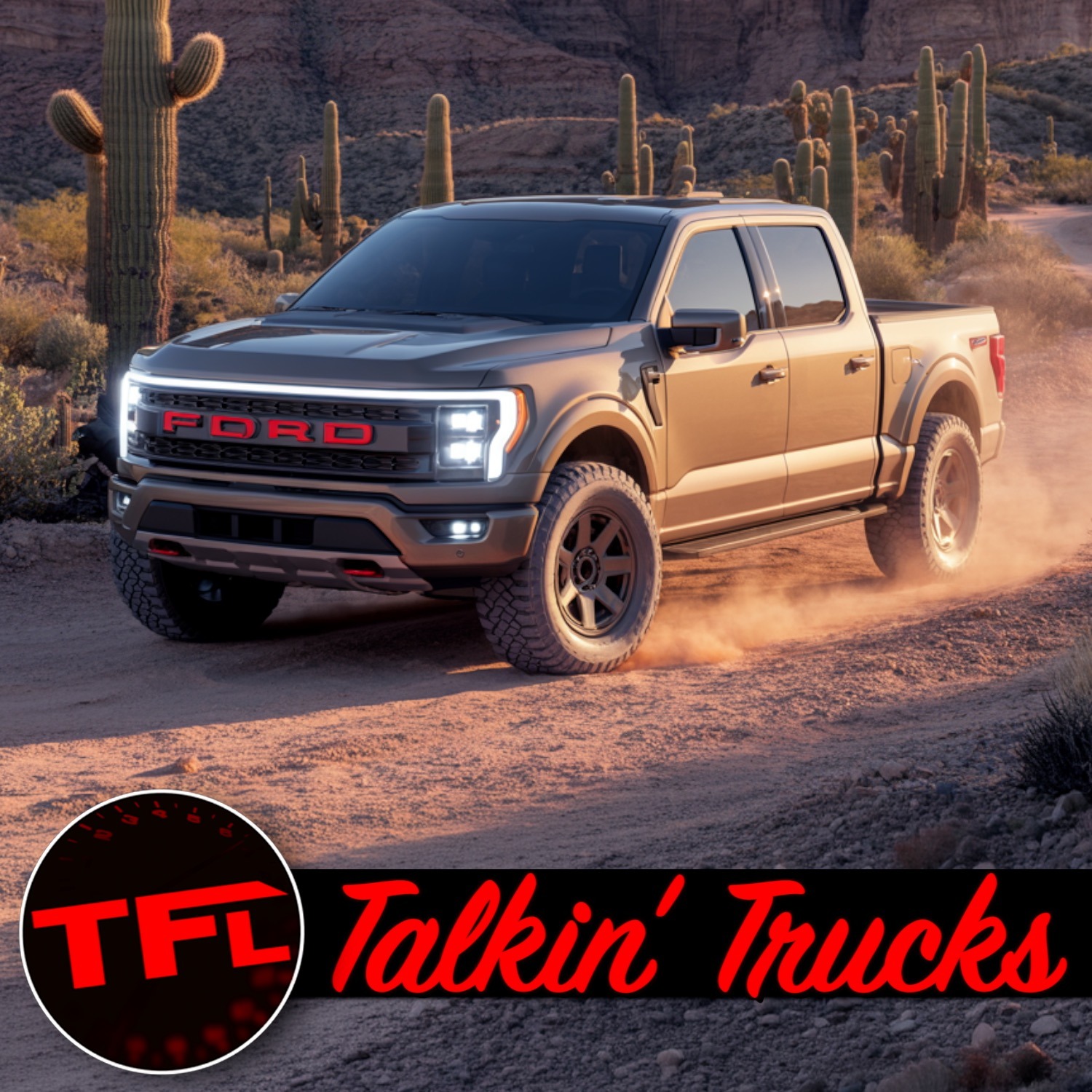
Ford Has HUGE Plans For The Next F-150, Super Duty, And Other Trucks! | Ep. 328
About this episode
Ford’s “massive portfolio renewal” is the headline: the next 2.5 years bring up to four new trucks, including a mid-size EV on the Universal EV platform, the next-gen F-150, and a heavily refreshed Super Duty by 2029. The hosts debate a sketch-based electric pickup rendering—efficient in theory, but oddly bulbous in shape. Between Ford talk, there’s a Yellowstone family trip in a Chrysler Pacifica (surprisingly efficient) and a deep dive on the pricey, capable Ineos Grenadier Quartermaster, including its quirky “toot” horn button. Manual-transmission nostalgia and future Ram rumors round it out.
( https://www.alltfl.com/ ) Check out our new spot to find ALL our content, from news to videos and our podcasts!
The future of Ford trucks is here, and it is more massive than we expected! In this episode of TFLtalkin' Trucks, Andre and Jen break down Ford’s bombshell "portfolio renewal" plan. By 2029, Ford is refreshing 80% of its North American lineup, including a brand-new universal electric platform (UAV) designed for an affordable $30,000 mid-sized truck. We dive into the cryptic renderings, discuss the next generation of the F-150 and Super Duty, and speculate on whether Ford’s bold new aerodynamic designs are a win or a "bulbous" mistake.
The adventure continues as Andre shares the highlights from a 600-mile family road trip through Yellowstone. We discuss why the Chrysler Pacifica might actually be the ultimate tool for a seven-person national park expedition (29 MPG!) and recount the incredible "once-in-a-lifetime" moment where Andre's father captured a daytime meteor on camera during an eruption of Old Faithful. Plus, we welcome the Ineos Grenadier Quartermaster to the TFL studio for a long-term loan. From its BMW B58 heart to the quirky "Toot" button and aircraft-inspired cockpit, we analyze if this $100,000 French-built beast can truly take the fight to the Jeep Gladiator and the G-Wagon.
( http://www.patreon.com/tflcar ) Visit our Patreon page to support the TFL team!
Advertising Inquiries: https://redcircle.com/brands
Privacy & Opt-Out: https://redcircle.com/privacy
burning out
"In a world where business owners everywhere are burning out I just can't do it anymore and are losing their identities to AI..."
They’re talking about feeling exhausted and overwhelmed. It’s just the intro before they switch back to truck talk.
“Burning out” is a human concept, but it’s being used here as a framing device for identity and fatigue. In a truck-focused episode, it signals the hosts are starting with a personal/relatable intro before getting into automotive news.
Ford Has HUGE Plans For The Next F-150, Super Duty, And Other Trucks!
"Ford Has HUGE Plans For The Next F-150, Super Duty, And Other Trucks! | Ep. 328"
The hosts are talking about what Ford wants to do with its next trucks. It’s basically a preview of what changes might be coming to the lineup.
This episode segment is part of a broader discussion about Ford’s upcoming plans for its truck lineup. The key idea is how Ford is thinking about the next generation of popular work and lifestyle pickups.
press releases
"Every corporation and every company puts out press releases almost every day, of course And Ford has a site they call I think they call it from the road."
Press releases are official statements companies send out to announce news. The hosts are basically saying Ford’s announcement stands out even though companies publish a lot of updates all the time.
Press releases are official announcements used by automakers to communicate product plans, timelines, and corporate updates. In this segment, the hosts contrast constant press-release activity with the significance of Ford’s truck refresh news.
from the road
"And Ford has a site they call I think they call it from the road. So it's a little bit not tradition ... Okay, so from the road They said and there's a quote"
“From the Road” appears to be Ford’s branded news/communications channel rather than a traditional media outlet. The hosts use it to explain where the quote about the truck plan came from.
massive portfolio renewal
"And they're calling it a massive portfolio renewal. Whoa, which is what it sounds like Yeah, I mean pretty much getting all new trucks with the next two and a half years"
“Portfolio renewal” just means Ford is planning big changes across many of its vehicles. Instead of minor tweaks, they’re aiming to bring out mostly new trucks over the next few years.
“Portfolio renewal” means Ford plans to refresh a large portion of its lineup rather than making small updates. The hosts connect it to a multi-year schedule where most of Ford’s truck volume is expected to be replaced with newer vehicles.
refresh 80% of its North American portfolio by volume
"Ford says by 2029 Ford Ford will refresh 80% of its North American portfolio by volume and 70% of its Global portfolio by volume"
“By volume” means they’re talking about the vehicles that sell the most. So it’s not just a few niche models getting updated—Ford is aiming to refresh the trucks that make up most of their sales.
“By volume” indicates Ford is targeting the majority of its sales volume, not just the number of models. This matters because it signals which vehicles are most important to Ford’s business and likely to receive the most investment.
Universal Electric Vehicle platform
"...this includes the first vehicle on the Universal Electric Vehicle platform you EV a mid-sized pickup truck and the next generation F-150 and F-series super duty."
A universal EV platform is like a shared “building plan” for electric vehicles. Instead of designing every EV from scratch, automakers reuse the same core structure so they can make different electric models faster and cheaper.
A “Universal Electric Vehicle” (UEV) platform is a shared vehicle architecture designed to underpin multiple electric models. Using a common platform can speed up development and reduce costs while allowing different body styles (like pickups) to share key EV components.
slanted tailgate
"Especially EVs are going for that kind of slanted tailgate But just as we experienced with the grenadier today, that isn't always the greatest especially when you're trying to reach over the side"
A slanted tailgate is a rear door shape that’s angled instead of flat. It can help the truck cut through air, but it may make it awkward to reach into the bed.
A slanted tailgate changes the rear shape of a truck to improve aerodynamic efficiency. The tradeoff is that it can make it harder to reach into the bed or climb/lean over the side when loading and unloading.
EV range / efficiency tradeoff
"Especially EVs are going for that kind of slanted tailgate But just as we experienced with the grenadier today, that isn't always the greatest especially when you're trying to reach over the side"
EVs often get shaped to be more efficient, which can help them go farther. But those same shapes can make everyday tasks—like reaching into the bed—more annoying.
The segment highlights a common EV design tradeoff: optimizing shape for efficiency (and likely range) versus maintaining easy usability. When rear geometry is optimized for airflow, it can limit how comfortably you can reach over the bed or use the truck like a traditional pickup.
aerodynamics
"I know it's for aerodynamics, but Yeah, so if you're joining us on just listening to us we're kind of looking at the rendering of a pickup truck"
Aerodynamics is about how smoothly the air moves around the truck. Better airflow can improve efficiency, but the “slick” shapes can sometimes make the truck less convenient to use.
Aerodynamics is how air flows around a vehicle, affecting drag and efficiency. Truck designers often chase better aerodynamics for EV range and highway fuel economy, but the shapes that help airflow can sometimes reduce practicality (like access to the bed).
rendering of a pickup truck
"Yeah, so if you're joining us on just listening to us we're kind of looking at the rendering of a pickup truck That doesn't look traditional. It's a little bit more cap forward."
A rendering is basically a computer picture of what a new truck might look like. They’re using it to talk about the truck’s shape and whether it still looks like a real pickup.
A rendering is a visual concept drawing used to preview a vehicle’s design before it’s built or tested. The hosts are evaluating the proposed truck’s proportions—like a more cab-forward stance and a short hood area—to discuss how it might differ from traditional pickup styling.
cab-forward design
"That doesn't look traditional. It's a little bit more cap forward. Yes So the cab is a little bit more towards the front axle. There's has a very short hood area"
Cab-forward means the cab (where people sit) is pushed forward compared to a traditional truck. That can make the hood look shorter, and it can change the whole “truck” look.
A cab-forward design moves the passenger compartment closer to the front axle, which can shorten the hood and change the vehicle’s overall proportions. On EVs especially, packaging the battery and motors can enable different layouts, but the resulting look may feel less “truck-like” to some buyers.
Model T moment
"They came out with this news and they called it their model T moment, which is supposed to be their very big Push to create an affordable electric vehicle not a hundred thousand dollar one, but that's thirty thousand dollar vehicle well"
Ford is using “Model T moment” to mean “a big breakthrough that makes EVs affordable for regular people.” It’s like the original Model T made cars common, and Ford wants a similar impact with an EV.
Ford’s “Model T moment” is a branding phrase for a major push to make an affordable electric vehicle at mass-market pricing. The idea is to replicate how the original Model T helped popularize cars by focusing on cost, scale, and broad accessibility.

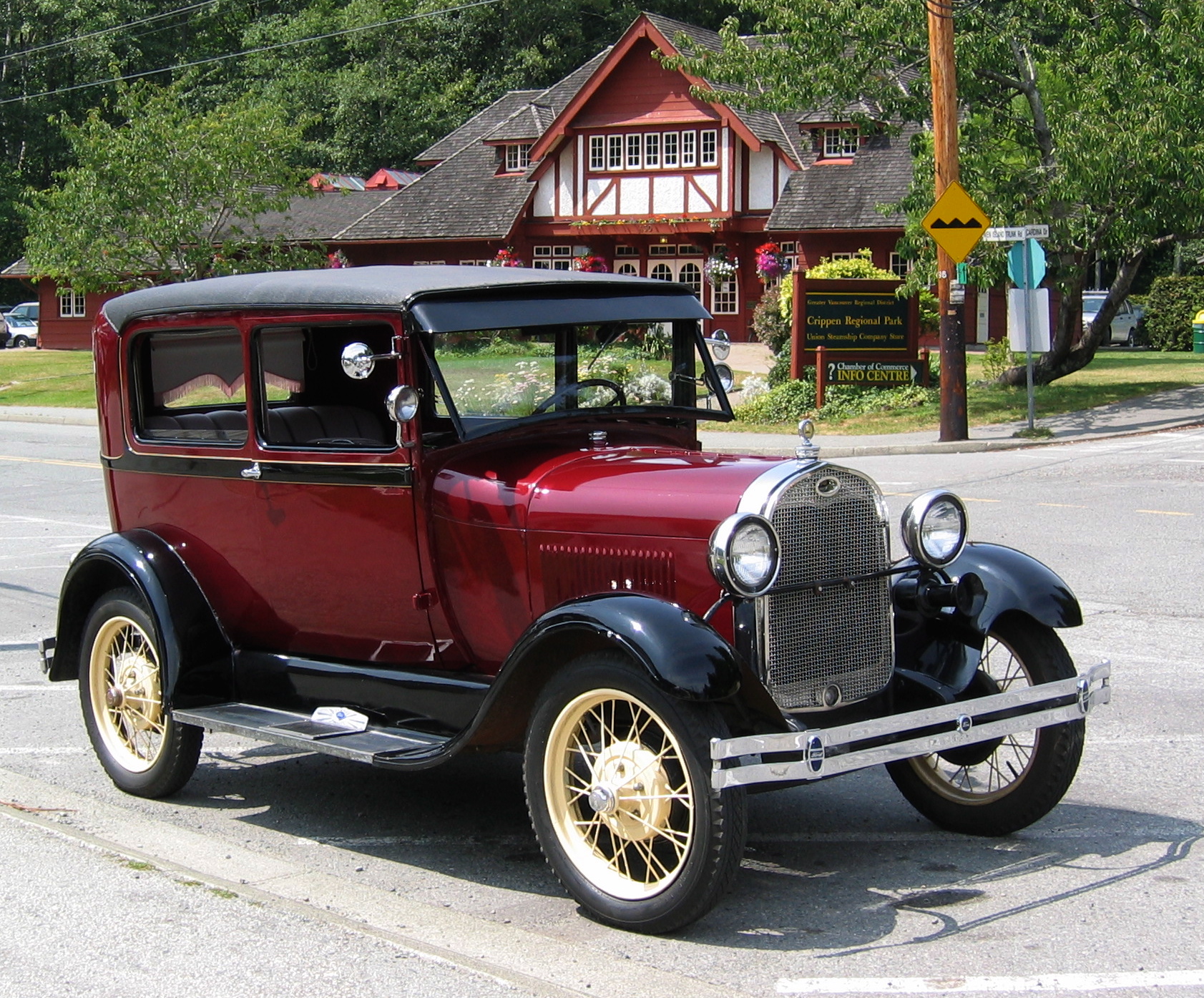
Ford Model T
"... came out with this news and they called it their model T moment, which is supposed to be their very big P..."
The Ford Model T is a very old car from the early days of mass-produced vehicles. People use it as a comparison when they talk about a big change that makes something widely available. In the podcast, it’s used as a metaphor for a major breakthrough.
The Ford Model T is a historic early mass-produced car that helped popularize affordable personal transportation. The podcast references a “Model T moment,” using it as a metaphor for a major, industry-changing shift. That’s why it comes up: it represents a turning point in how widely cars could be made and sold.
electric platform (Ford EV platform timeline)
"So we know the electric thing is happening, right and I listened to a lot of [439.5s] Statements that Ford put out about the electric platform... [448.6s] So they said it's coming sometime in the middle of 20 27"
An “electric platform” is the basic design plan for building electric trucks and SUVs. It affects how the battery and motors fit, and it’s why the first real production models show up on a specific schedule.
When Ford talks about an “electric platform,” it usually means a dedicated vehicle architecture designed around electric motors, batteries, and packaging from the ground up. The hosts are focusing on Ford’s timeline—mid-2027 for vehicles, with production and sales following—so it’s about when the company’s EV strategy becomes real in the market.
midsize truck segment
"But what's what's let's judge it by is it's supposed to be affordable. It's supposed to be really super efficient [494.4s] Aerodynamic it's supposed to be a midsize truck, which means it's supposed to compete against the likes of [500.1s] Like the Tacomas right out there, which means it could tow a decent amount"
A midsize truck is a pickup that’s not as big as the biggest trucks, but bigger than the smallest ones. It’s usually chosen for a good mix of hauling ability and everyday drivability.
A “midsize truck” sits between full-size pickups and smaller compact trucks, typically offering a balance of size, payload, towing, and maneuverability. The hosts connect this segment definition to expectations like towing capacity, payload, and practical bed features.
aerodynamic efficiency
"But what's what's let's judge it by is it's supposed to be affordable. It's supposed to be really super efficient [494.4s] Aerodynamic it's supposed to be a midsize truck, which means it's supposed to compete"
Aerodynamic efficiency is about making the truck “slice” through the air with less resistance. Less resistance usually means better efficiency—so an electric truck can go farther on the same battery.
Aerodynamic efficiency means reducing drag so the vehicle needs less energy to move, which is especially important for electric trucks where range depends on energy use. Hosts are using “super efficient” and “aerodynamic” together to suggest the design will help maximize real-world efficiency.

Toyota Tacoma
"Aerodynamic it's supposed to be a midsize truck, which means it's supposed to compete against the likes of [500.1s] Like the Tacomas right out there, which means it could tow a decent amount"
The Toyota Tacoma is a popular midsize pickup truck. When they compare Ford’s new truck to the Tacoma, they’re basically saying it’s aiming at the same kind of truck buyers are already shopping for.
The Toyota Tacoma is a midsize pickup that’s commonly used as a benchmark for what buyers expect in the segment. By saying Ford’s midsize truck will compete with the Tacoma, the hosts are framing the target size, capability, and buyer expectations.
tow and payload expectations
"Like the Tacomas right out there, which means it could tow a decent amount [505.2s] It could have some payload could have a really clever bed solution"
Towing is how much a truck can pull behind it. Payload is how much stuff you can put in the truck itself—like tools or gear.
“Towing” and “payload” are two key capability metrics for pickup trucks. Towing refers to how much weight the truck can pull, while payload is how much weight it can carry in the bed and cabin—both strongly influence how useful a truck is for work and recreation.
clever bed solution
"It could have some payload could have a really clever bed solution [505.2s] "
A “clever bed solution” refers to pickup bed designs that add functionality beyond a standard flat cargo area—like modular tie-downs, storage compartments, adjustable surfaces, or integrated utility features. These details can matter as much as towing/payload for buyers who use the truck regularly.

GM Sierra
"On their Silverado and Sierra trucks and we know they're coming this year with 20 27 models"
The GMC Sierra is another major GM full-size pickup. The discussion groups it with the Silverado as part of GM’s upcoming model plans.
The GMC Sierra is GM’s counterpart to the Silverado, also in the full-size pickup segment. The hosts group Silverado and Sierra together to emphasize GM’s near-term 2027 truck rollout.
V8 engines
"That's exciting. So 20 27 months. So new V8 engines. We talked about it in previous shows"
A V8 engine is a type of gas engine with eight cylinders. More importantly here, they’re saying new versions are coming, which could drive when new trucks arrive.
V8 engines are internal combustion engines with eight cylinders arranged in a “V” shape. The hosts mention “new V8 engines” as part of the timeline, implying a major powertrain change that would affect how quickly trucks like the F-150 can be updated.
truck competition
"Yeah, they have to be in line with this competition. So unfortunately for Ford"
Truck competition means the big truck brands are constantly trying to outdo each other with newer trucks and better features. The hosts are saying Ford can’t fall behind GM’s updates.
Truck competition is the ongoing market pressure between major automakers to refresh models, update powertrains, and add features to win buyers. The hosts frame Ford’s timing and updates as needing to match GM’s plans to stay competitive.
production slowdown
"There was a big fire at one of their plants aluminum plants that produces aluminum for their truck Bodies and construction and so they were had a bit of a slowdown in their production and some sales"
A production slowdown means the factory can’t build as many vehicles as planned. In this case, a fire affected aluminum used for truck bodies, so Ford had less production and fewer sales.
A production slowdown happens when manufacturing is interrupted—often by equipment issues, supply shortages, or plant incidents. Here, a fire at an aluminum plant reduces output for truck body materials, which can cut production and lead to lost sales.
aluminum plant
"There was a big fire at one of their plants aluminum plants that produces aluminum for their truck Bodies and construction"
An aluminum plant is where aluminum is made in bulk for other factories to use. If something goes wrong there, truck makers may not get enough material to build as many trucks.
An aluminum plant produces aluminum used to make parts—here, aluminum for truck bodies and construction. The segment highlights how disruptions at a supplier/production site can ripple into vehicle manufacturing schedules and sales.
first quarter
"They lost some sales in the first quarter. We did a story about this already"
“First quarter” just means the first few months of the year. They’re saying Ford’s sales were down early on, likely because production was disrupted.
“First quarter” refers to the first three months of a year, often used in business reporting to compare performance year over year. The hosts mention Ford losing sales in the first quarter, tying it to the production issues.
Ford Super Duty
"So then super duty So there's an image all this on this post if you scroll a tiny bit"
Ford’s Super Duty is the heavier-duty version of their trucks, built for big towing and work use. They’re talking about what might change in the next model year—especially the cabin.
Ford Super Duty refers to the heavy-duty pickup lineup (commonly used for towing and work). The hosts discuss Ford’s 2027 Super Duty direction, including expectations that the exterior may stay similar while the interior and other elements change.
new interior
"But look at this. They're looking at the new interior Yeah, they're looking at a lot of new things."
A “new interior” means the inside of the truck gets updated—like the dashboard, screens, and materials. They’re saying the next Super Duty may change more on the inside than the outside.
A “new interior” usually means updated cabin design, materials, seating, and infotainment/controls. In this segment, the hosts suggest Ford’s 2027 Super Duty could keep much of the outside similar while focusing changes inside.
eight liter power stroke
"Like larger displacement diesels. There's supposed to be an eight liter power stroke eight liters eight liters not seven three Not six seven but but eight because bigger is better"
Power Stroke is Ford’s diesel engine line. If the rumors are true about an “eight liter” diesel, it would likely be built to make more pulling power for heavy towing.
The “Power Stroke” is Ford’s diesel engine family used in Super Duty trucks. Rumors about an “eight liter” version suggest a larger-displacement diesel aimed at higher torque and better heavy-duty performance.
emission systems
"Right, so so there's a lot of rumors about different emission systems bigger diesels. So Ford didn't announce anything yet Okay, all right, so"
Emission systems are the parts that clean up exhaust so the truck meets pollution rules. Bigger engines can require different or updated systems to control smoke and other exhaust gases.
Diesel “emission systems” are the hardware and software used to reduce pollutants like NOx and soot before they leave the exhaust. When Ford changes engine displacement or calibration, the emission system strategy often changes too (e.g., different aftertreatment components or control logic).

Ford Ranger
"And also they mentioned the midsize truck. I'm assuming it's a ranger. I would assume I mean, I can't imagine they're gonna add another midsize truck to their lineup Yeah, so there may be some confusion Maybe that ranger the midsize truck they talked about was electric or maybe it's in addition to But the ranger was refreshed in 24. So by 20 29, it will need something."
The Ford Ranger is Ford’s midsize pickup truck. The hosts discuss how Ford refreshed it in 2024 and may need another update by 2029 to stay competitive in the midsize segment.
HECA
"So that's that means that the next two to three years are gonna be HECA Exciting that's I think so. Hello. I think so"
HECA sounds like a code name for Ford’s next big truck plan. The hosts are saying the next couple of years will bring major changes because of it.
“HECA” appears to be an internal or program name for Ford’s upcoming truck platform or product plan. In this context, it’s being used to describe the next major wave of updates over the next two to three years.

disco 5
"Yes, then you you currently you actually bought a disco 5 I did from Land Rover from the company "
“Disco 5” is short for the Land Rover Discovery 5, which is a family-sized luxury SUV. They’re just saying it’s what they currently drive.
“Disco 5” is a shorthand reference to the Land Rover Discovery 5 (the Discovery generation often called “L462”). It’s mentioned as the speaker’s current vehicle, showing they’ve owned a luxury SUV alongside sporty cars.

Chevrolet C10
"But I have wanted a 1972 c10 ... like Ever a Chevy c10. Yes. I have wanted one forever ... get that 402 cubic inch 300 horsepower back in the day."
The 1972 Chevy C10 is an older pickup truck that a lot of enthusiasts love. Because it’s so popular, it’s also easier to find parts and upgrades if you want to modernize it.
A 1972 Chevrolet C10 is a classic first-generation C/K pickup from Chevrolet. It’s known for its simple, old-school layout and huge aftermarket support, which is why people often talk about upgrading drivetrains and transmissions on these trucks.
two-wheel drive
"Just strictly like a two-wheel drive little Not an off-roader not a big giant."
Two-wheel drive means the truck only drives two wheels instead of all four. It’s usually simpler and more efficient, but it won’t handle rough terrain as well as a four-wheel-drive truck.
“Two-wheel drive” (2WD) means power is sent to only one axle, typically the rear axle on many classic pickups. Compared with four-wheel drive, 2WD is usually simpler, lighter, and cheaper to maintain, but it’s less capable in deep snow or off-road conditions.
402 cubic inch
"...get that 402 cubic inch 300 horsepower back in the day. Oh my gosh"
“402 cubic inch” is the engine’s size. Bigger numbers usually mean the engine can pull strongly at low speeds, which is why old trucks feel torquey.
“402 cubic inch” refers to engine displacement, meaning the total volume swept by the pistons in the engine. In classic V8 trucks like the 1972 C10, larger displacement typically means strong low-end torque and a big, old-school power feel.
three or four speed manual
"And then you know, they came with like a three or four speed manual So that is something I'd like to update and do like a five or six speed manual"
That phrase means the truck had a manual transmission with only a few forward gears. Fewer gears can mean more shifting and less flexibility compared to newer transmissions.
A “three or four speed manual” describes the number of forward gears in the manual transmission. Older trucks often used 3- or 4-speed gearboxes, which can require more shifting and may feel less relaxed than modern multi-gear setups.
five or six speed manual
"So that is something I'd like to update and do like a five or six speed manual that would be pretty cool"
This is the idea of adding more gears to the manual transmission. More gears usually makes the truck easier to drive day-to-day and can lower engine noise on long drives.
A “five or six speed manual” means the transmission has more forward gears than older 3- or 4-speed units. More gears can improve drivability by keeping the engine in its best power/efficiency range and reducing engine RPM on the highway.
three pedals
"But so three pedals that okay pedals are always more fun. Yes, but that has been a truck"
“Three pedals” usually means a manual car: one pedal is for the clutch, and the other two are brake and gas. Driving a manual can feel more engaging because you control the gears yourself.
“Three pedals” is shorthand for a traditional manual transmission setup: clutch, brake, and accelerator. Enthusiasts often prefer it because it gives more direct control over engine speed and gear selection.

1984 190 e
"So my first car was was a 1984 190 e and that was a little five speed manual ... But I don't I don't think I realized how awesome it was"
The 1984 Mercedes-Benz 190 E is an older Mercedes sedan. The speaker is pointing out that it was a manual, which makes it more fun to drive.
The 1984 Mercedes-Benz 190 E is a compact sport-sedan from Mercedes-Benz’s 190-series. In this context, the host mentions it specifically as a manual-transmission car, which helps explain why they liked it even if it wasn’t a “truck.”
Nürburgring 24-hour race
"Oh, yeah, and when I went to the Nurburgring for the 24 hour race last year, that's right They were everywhere and I just had a little tear every time of what what could have been."
They mention going to the Nürburgring 24-hour race. It’s an endurance event where cars run for a full day, so it’s all about reliability and consistency, not just speed.
The Nürburgring 24-hour race is referenced as a major event the speaker attended. It’s a grueling endurance race at Germany’s Nürburgring circuit, where cars must survive long stints, heat cycles, and driver changes.

Chevrolet Malibu
"Then I had to get just kind of a normal car. I think I had like a Malibu"
They’re talking about a Chevrolet Malibu, which is a pretty common everyday car. In this context, they mean it was more practical than exciting.
The Chevrolet Malibu is mentioned as a “normal car” the speaker had after the Mercedes. The Malibu is a mainstream midsize sedan, often chosen for comfort and practicality rather than enthusiast performance.

Buick Regal GS
"Okay, and I was boring, but then I got a a 2012 um The Buick Regal GS that was a six speed manual"
They had a 2012 Buick Regal GS, and it was a six-speed manual. That’s a more fun, driver-involved setup than an automatic.
The speaker calls out a 2012 Buick Regal GS with a six-speed manual. The “GS” trim generally indicates a sportier setup than base models, and the manual transmission makes it more engaging than most mainstream sedans of that era.

Ford Mustang Cobra
"Okay, and I was boring, but then I got a a 2012 um The Buick Regal GS that was a six speed manual Okay, that's a little bit more fun. It was a little fun. Yeah, uh one point. I had uh 97 Cobra"
They mention a “97 Cobra,” which is likely a performance Mustang from 1997. Cobras are usually the sportier versions meant to be more exciting to drive.
The transcript mentions “97 Cobra,” which strongly suggests a 1997 Ford Mustang Cobra. The Cobra name typically refers to a performance-oriented Mustang variant, and the speaker groups it with other “fun cars.”

Chevrolet C5
"Yeah, uh one point. I had uh 97 Cobra I had a c5 manual Um, so some fun cars"
They had a C5 Corvette with a manual. That’s a sports car setup where you shift gears yourself, and it’s generally considered more fun than an automatic.
The speaker says “I had a c5 manual,” referring to a C5-generation Chevrolet Corvette with a manual transmission. The C5 Corvette is known for being a relatively affordable way to get a true sports car experience, and the manual adds driver engagement.

Cupra Born
"well So I liked it before he was born probably so i'm gonna say I liked it fighting wor..."
The Cupra Born is an electric hatchback, meaning it runs on electricity instead of gasoline. It’s a smaller car designed for everyday driving. The podcast brings it up in a pricing discussion about how it fits into the electric market.
The Cupra Born is an electric compact hatchback from the Cupra brand. In the podcast context, it’s mentioned as part of a discussion about pricing and market positioning, including how it might affect or reflect costs. That makes it relevant when talking about what buyers can get in the electric segment.
low lope
"And those are the trucks where [986.2s] You know going slow and feeling that that low lope like it's about to die."
A “low lope” is that uneven, choppy sound an engine makes when it’s idling. It usually means the engine has a more aggressive setup that makes it sound and feel more exciting at low speeds.
“Low lope” describes a rough, uneven idle that sounds like the engine is “chugging” at low RPM. It’s often associated with performance camshafts that create a choppier idle, which can feel more alive and characterful than a smooth stock idle.
engine practically shaking you a cruiser
"It's about just the engine practically shaking you a cruiser a cruiser. Yes. Yes true and true"
They’re talking about how the truck feels alive while you drive slowly. Instead of being smooth and quiet, it vibrates a bit in a way that makes it feel more connected and fun.
This is describing “cruising feel”—the sensation of vibration and mechanical presence at low speeds. Some trucks and performance builds are tuned to be felt through the chassis and steering, which can make the driving experience more visceral even if it’s not about high-speed performance.
Yellowstone
"So like I was mentioning just switching gears just a little bit. Uh, yep. There you go. Uh, we switched it. Um [1049.0s] So I went to Yellowstone."
They mention a trip to Yellowstone. In this part of the conversation, it’s mostly personal background rather than truck talk.
Yellowstone is mentioned as the speaker’s travel destination, but it’s not tied to any specific vehicle or technical truck discussion in this excerpt. It functions more as personal context than an automotive topic.

Chrysler Pacifica
"But we rented One of the best vehicles of all time. She had some light. What'd you rent? Yes? We rented A new chrysler pacifica."
A Chrysler Pacifica is a minivan. It’s designed to carry lots of people at once, so it makes sense when you need to fit a big group in one vehicle.
The Chrysler Pacifica is a minivan built for family hauling, with seating meant to fit multiple passengers comfortably. In this segment, it’s rented as a practical way to move a larger group together rather than using a truck for everyone.

Chrysler New Chrysler
"...ad some light. What'd you rent? Yes? We rented A new chrysler pacifica. I was not expecting you to say that Th..."
The Chrysler New Yorker is a Chrysler vehicle name that’s generally associated with a larger, comfortable car. In the podcast, it’s brought up because it relates to what someone rented or discussed. The key point is that it’s a Chrysler model name used for bigger, comfort-focused vehicles.
The Chrysler New Yorker is a nameplate associated with larger, more traditional Chrysler vehicles, typically positioned as a comfortable, full-size option. In the podcast context, it’s mentioned in the same rental conversation as the Pacifica, suggesting discussion about what people are driving or renting. That makes it relevant as part of a broader look at common vehicle choices.
minivan vs truck for family hauling
"There comes a time in every trucker's life Where they need to put seven of their family in one In in one vehicle that's fair. That's a fair point and and actually go for a drive"
This segment highlights a common use-case tradeoff: trucks are great for towing and rugged tasks, but minivans can be more practical when the priority is fitting multiple family members in one vehicle. It’s a reminder that “truck life” doesn’t always mean using a truck for every trip.
Bozeman, Montana trip context
"Yeah, we flew into bozeman Which is by itself an amazing city. Oh, yeah, uh bozeman montana Um, a lot of our friends and people we work with are are there, you know"
The hosts connect the rental and driving plans to a trip into Bozeman, Montana, framing it as a base for friends and local truck/overland culture. For listeners, this helps explain why they’re talking about choosing the right vehicle for the trip.
overlanding / overland-type people
"Aeve is from oh, yeah Gfc campers a sella truck I mean X overland team is you know is based out there near bozeman Um, a lot of just fun Overland type people which makes sense or trucky people camping people are there"
Overlanding refers to long-distance, self-reliant travel—often with camping gear—typically on mixed pavement and rough roads. The segment ties Bozeman to an “overland” community, which is relevant because vehicle choice (and comfort for passengers) matters for these trips.
fuel efficiency while road-tripping
"Cole I gave Cole a little snippet [1205.2s] Of my dashboard because I wanted to show my efficiency [1210.9s] Does that say 28 28.8 get out of me... ... [1259.6s] And [1261.1s] Something like 29 mpg in the very end."
When you drive far, your fuel economy changes based on things like hills, how fast you go, and how full the car is. So the MPG you see on a trip can be different from what you’d get in normal city driving.
Road-trip fuel efficiency is heavily influenced by terrain, speed, weather, and vehicle load. Even with efficient powertrains, long climbs and mountain driving can reduce MPG, while steady cruising can improve it.
mpg
"And [1261.1s] Something like 29 mpg in the very end. And so it's a very but you know the downside is it's about it's about three inches off the ground"
MPG means how many miles you can drive on one gallon of gas. Higher MPG generally means you spend less on fuel for the same distance.
MPG (miles per gallon) is a fuel-economy measure that tells you how far a vehicle can travel on one gallon of fuel. The hosts use it to compare how their minivan performed during a long drive around Yellowstone’s hills and mountains.
ground clearance
"it's about it's about three inches off the ground [1269.9s] Oh, yeah, there's there's not a lot of ground clearance on a pacifica. No, especially when you put seven folks in there"
Ground clearance is how high the car sits off the ground. If it’s low, you can hit the bottom on uneven roads or rough trails.
Ground clearance is the distance between the road surface and the lowest part of a vehicle’s underbody. Lower ground clearance can increase the risk of scraping on bumps, ruts, or steep driveways—especially when you’re driving off smooth pavement.
Old Faithful
"Yeah, and we spent like I said, our [1286.4s] Transiting between geysers and stuff like that. Do you see any like actually go off? Yes old faithful, of course [1296.9s] This is a picture not of old faithful, but they have"
Old Faithful is one of Yellowstone’s most famous geysers. It erupts on a schedule that makes it a popular attraction to plan around.
Old Faithful is Yellowstone National Park’s famous geyser, known for relatively regular eruptions compared with other geothermal features. The hosts reference it as a must-see stop during their Yellowstone driving route.

Chevrolet Tahoe
"...the other vehicle that's really popular is like a Tahoe, right? You go into the rental place It's full o..."
The Chevrolet Tahoe is a large SUV. It’s often used by families and for longer trips, and it shows up a lot in rental car fleets. That’s why it’s mentioned as a very common vehicle.
The Chevrolet Tahoe is a full-size SUV that’s popular for family use, road trips, and rental fleets. The podcast context points out that rental lots are often “full of” Tahoes, which highlights how common it is. That kind of ubiquity makes it a frequent reference when talking about real-world demand and vehicle availability.

Chevrolet Suburban
"...right? You go into the rental place It's full of suburbans. There's a suburban everywhere. There's also a je..."
The Chevrolet Suburban is a big SUV designed to carry lots of people and gear. It’s commonly used by families and for trips. The podcast mentions it because it’s very common, especially in rental fleets.
The Chevrolet Suburban is a full-size SUV known for its large passenger and cargo capacity, making it a go-to choice for families and groups. The podcast notes that rental places are “full of suburbans,” emphasizing how frequently it’s seen in everyday use. That makes it a useful example when discussing which vehicles are most common on the road and in rentals.

Jeep Grand
"...ns. There's a suburban everywhere. There's also a jeep grand wagon near there was stacked up like I don't kno..."
The Jeep Grand Cherokee is an SUV made by Jeep. It’s designed to be comfortable for everyday driving but also capable on rougher roads. The podcast brings it up because it’s a vehicle people commonly rent or see around.
The Jeep Grand Cherokee is a midsize-to-full-size SUV from Jeep, typically known for a mix of comfort and off-road capability. In the podcast context, it’s mentioned alongside other common rental vehicles, suggesting it’s frequently seen in the same real-world settings. That makes it relevant when discussing what drivers and rental customers tend to choose.
People mover (minivan use case)
"[1376.8s] So I think a minivan is still one of the key [1380.4s] People movers. I think yeah, you know, I have I have a friend that um, he sports a [1387.1s] Toyota sienna"
A “people mover” is basically a vehicle meant to carry a lot of people comfortably. Minivans are popular for families because they’re easy to load, have lots of space, and work well for trips and activities.
“People mover” is a common way to describe minivans: vehicles optimized for transporting multiple passengers comfortably. The hosts connect this to real-world family needs—fitting kids, gear, and activities—while also comparing rental cost and fuel economy versus larger SUVs and trucks.
sliding door
"he said hey dad, I think a sliding door makes a lot of sense. It does. I was like, what? [1438.0s] It but it does you can't argue with it [1440.2s] It does you park and the door opens wide"
A sliding door is a door that opens by sliding sideways. It’s handy in parking lots because it doesn’t swing out into the space next to you.
A sliding door is a side door that moves horizontally along the vehicle body. It’s especially useful in tight parking spaces because it opens wide without needing extra clearance like a traditional hinged door.
air suspension
"How nice it would be I just but you can slam your disco five down on that air suspension. No, I can it's pretty sweet [1470.1s] You could or you could lift it. I can you could lift it up. I mean, yeah quite a bit of ground clearance"
Air suspension is a suspension system that can change ride height. It can lower the vehicle to make it easier to get in and out, and raise it when you need more clearance.
Air suspension uses air-filled bags instead of traditional steel springs. It lets the vehicle lower for easier entry/exit or loading, and raise for more ground clearance when needed.
minivan stigma
"But it's it's hard to pull the trigger because I don't know why but minivans always kind of have this [1482.7s] Stigma bar the stigma that like you just kind of gave up your life [1487.2s] And now it's over, but maybe it shouldn't maybe it doesn't have to be that bad"
They’re talking about the idea that minivans have a bad reputation. The point is that a minivan can still be a smart, family-friendly choice even if people judge it.
“Minivan stigma” refers to the social perception that buying a minivan means you’ve “given up” on a more exciting or aspirational vehicle choice. The hosts argue that modern minivans can be practical and even enjoyable, especially for families.

Sienna
"By the way, sienna you can get as a no-wheel drive also as a hybrid. Yes. Um, so all the good things, right? [1511.1s] All the good things. I'm looking at my phone because"
They’re talking about the Toyota Sienna minivan. It’s available as a hybrid, and you can also get it with all-wheel drive, which makes it more appealing for families.
Toyota Sienna is a minivan that’s offered with hybrid powertrains. In this segment, the host mentions you can get it with all-wheel drive and as a hybrid, positioning it as a practical family alternative to the “minivan stigma.”
no-wheel drive
"By the way, sienna you can get as a no-wheel drive also as a hybrid. Yes. Um, so all the good things, right? [1511.1s] All the good things. I'm looking at my phone because"
They likely meant “all-wheel drive.” That means the car can send power to more wheels for better grip, especially on slippery roads.
“No-wheel drive” is almost certainly a transcription error for “all-wheel drive” (AWD). AWD means power can be sent to more than just the front or rear wheels, improving traction in rain, snow, and uneven conditions.

Ineos Grenadier Quartermaster
"[1749.1s] Ineos grenadier quarter master. Wow [1751.8s] What a truck. It's a long name. It is but not a long wheelbase ... [1801.5s] So we can do many things. Yes towing trailers going off-road [1806.5s] Comparing it to other vehicles."
This is a rugged off-road truck from Ineos. The “Quartermaster” version is meant to be especially useful for towing and adventure-style driving. The hosts are getting it for a longer test so they can compare how it handles real-world tasks.
The Ineos Grenadier Quartermaster is a special variant of the Ineos Grenadier built around a more utility-focused, expedition-style mission. In this segment, the hosts are excited about having it for an extended period so they can run towing and off-road comparisons. It’s essentially a “do everything” truck concept aimed at buyers who want rugged capability and practicality.
extended loan vehicle testing
"[1761.2s] Thank you to ineos. We're having it for actually did you say six weeks? That's what I heard. ... [1773.3s] Over six weeks. We often get loan vehicles for like a week [1776.9s] Sometimes if it's a pickup truck sometimes we get two weeks with it because we need to do a towing test ... [1801.5s] So we can do many things. Yes towing trailers going off-road"
Instead of driving a truck for just a day or a week, they’re getting it for a longer time. That means they can try more situations—like towing and off-road driving—so the review is based on real use, not just a quick test.
Extended loan testing is when a media outlet or reviewer gets a vehicle for longer than the typical short press window, allowing more complete real-world evaluation. Here, the hosts say they can do towing tests, off-road driving, and comparisons over about six weeks, which helps reveal how the truck behaves across multiple use cases rather than just one short drive.
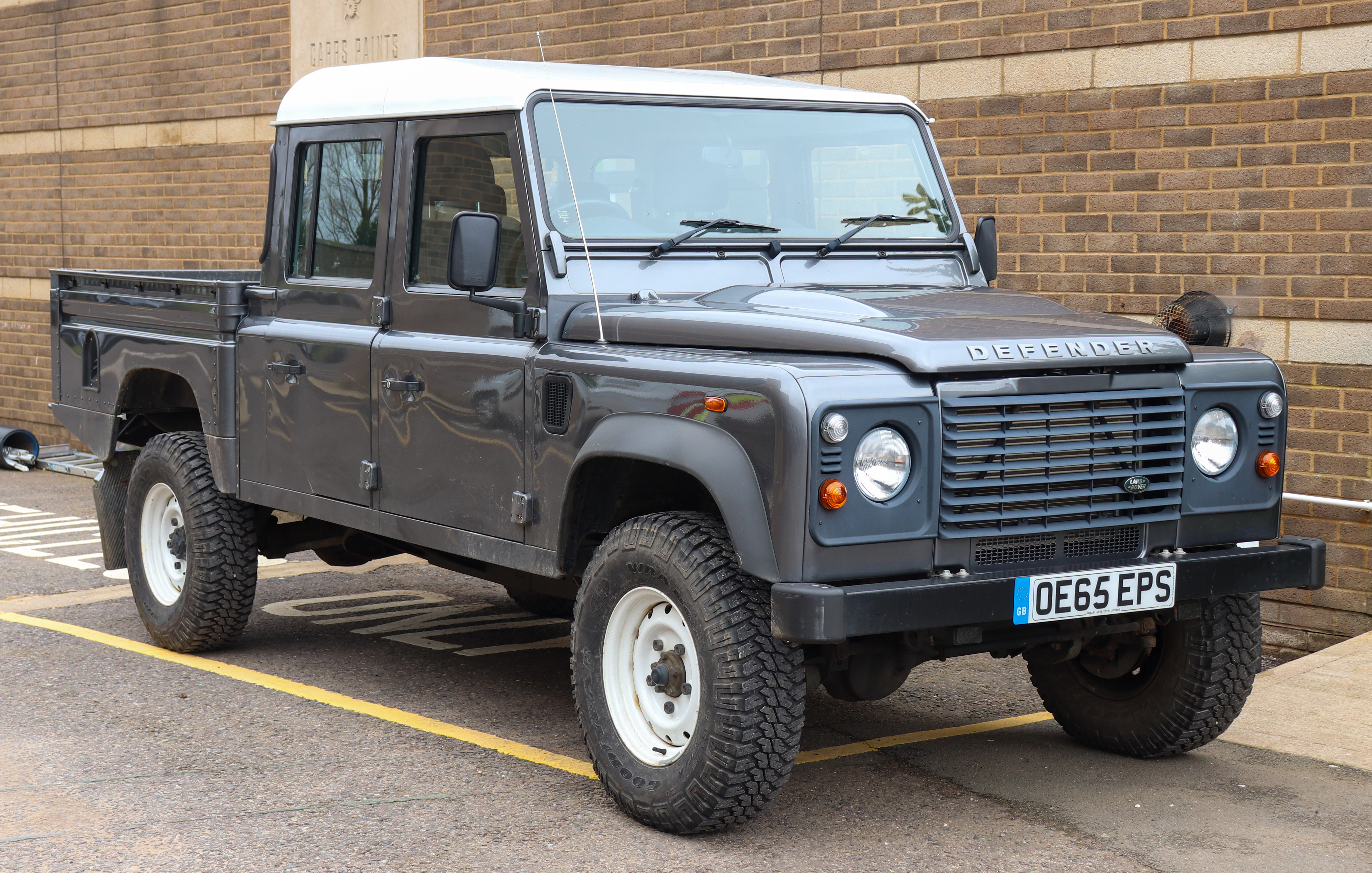
Land Rover Defender 130
"[1806.5s] Comparing it to other vehicles. Yeah, I think this is going to be awesome because I would really like to compare this to our defender [1813.4s] We have a defender 130"
The Defender 130 is a Land Rover Defender with a longer wheelbase. That usually means more room for passengers or cargo. They’re comparing it to the Ineos to see how both trucks stack up for towing and off-road use.
The Land Rover Defender 130 is the longer-wheelbase version of the Defender lineup, designed to carry more people or gear. The hosts mention it as a comparison point for the Ineos Grenadier Quartermaster, which signals they’re evaluating space, towing ability, and off-road behavior between two rugged, body-on-frame-style competitors. The “130” generally refers to the longer wheelbase.

G-Class Gwagon
"I just wish we had a g-wagon because I'd like to compare it against that too because here's a message to our listeners... But but they don't make pickup trucks, but you know, they made like six by sixes."
The Mercedes-Benz G-Class is a famous, rugged-looking SUV that’s built to go off-road. The hosts are saying they’d like to compare it to another truck/SUV so listeners can understand the differences in size and driving vibe.
The Mercedes-Benz G-Class (often called the “G-Wagon”) is a luxury off-road SUV known for its boxy styling and serious 4x4 capability. In this segment, the hosts want to compare it against another off-road-oriented vehicle to see how they stack up in size, feel, and features.

Jeep Gladiator
"Okay, oh wow, okay... We also have a Gladiator oh even better. Yes. I mean also at the same time... you'd think a gladiator and this grenadier are essentially within the same area right the same class."
The Jeep Gladiator is a pickup that’s designed for off-roading, not just commuting. The hosts mention it because it’s the kind of vehicle people cross-shop when they want a rugged truck.
The Jeep Gladiator is a midsize pickup built on Jeep’s Wrangler-based off-road platform. Here it’s used as a comparison point because it competes in the same general “go-anywhere” lifestyle category as other rugged, boxy off-road vehicles.
Ineos Grenadier
"So it's weird because you'd think a gladiator and this grenadier are essentially within the same area... this from just the looks of it looks so much bigger... Loved all the switches... It's the gear selector... because this is powered by bmw. You know, it's got that b58 inline 6... But it also has a bmw transmission... But this pokes out and that does not make sense with the rest of the basically the console shifter"
The Ineos Grenadier is a tough off-road SUV with a very old-school, boxy look. The hosts are pointing out that it feels different inside too—especially the dashboard and the way the gear selector is set up.
The Ineos Grenadier is a modern, rugged off-road SUV designed to feel like a traditional 4x4, with a very upright, boxy stance and a distinctive interior. In this segment, the hosts focus on its big, tall proportions and its unusual dashboard and gear selector layout, plus the fact that it uses BMW powertrain components.
B58 inline 6
"...because this is powered by bmw. You know, it's got that b58 inline 6... Uh, which is a phenomenal engine..."
The B58 inline-six is a type of engine BMW makes. The hosts are saying it’s a really good, capable engine, which matters because it affects how the vehicle drives and feels.
“B58” refers to BMW’s B58 family of inline-six engines, known for strong performance and smooth power delivery. In the Grenadier discussion, the hosts highlight it as a “phenomenal engine,” implying the vehicle benefits from a proven BMW powerplant.
BMW transmission
"...it also has a bmw transmission, which is also great... But this pokes out and that does not make sense with the rest of the basically the console shifter"
The transmission is what sends power from the engine to the wheels. The hosts are saying this vehicle uses a BMW transmission, which usually means it’s a well-developed setup.
A “BMW transmission” here means the Grenadier uses a gearbox sourced from BMW rather than a generic or bespoke unit. The hosts connect it to the idea that the vehicle’s drivetrain is built from established BMW components, which can influence shift feel and reliability.
locking differential front and rear
"Yes, I mean the color alone is nearly a thousand dollars and we have locking differential front and rear Front and rear"
A differential lets wheels turn at different speeds when you’re turning. A locking differential “locks” that behavior so both wheels on the axle spin together, which helps when the ground is slippery.
A locking differential forces the left and right wheels on an axle to rotate at the same speed. Having it on both the front and rear axles greatly improves traction when one wheel loses grip, like in mud, snow, or rock crawling.

Wrangler Rubicon
"So it's basically kind of like a rubicon on steroids like a jeep rubicon or rubik you or um"
The Jeep Rubicon is a Jeep trim made for off-roading. They’re using it as a comparison to say this truck is built with similar tough-terrain capability.
The Jeep Wrangler Rubicon is a trim known for off-road-focused equipment, including traction aids like locking differentials. Mentioning it here is shorthand for “serious off-road hardware,” which the hosts say the truck resembles.
rubicon on steroids
"So it's basically kind of like a rubicon on steroids like a jeep rubicon or rubik you or um"
They’re basically saying the truck feels like a supercharged version of an off-road Jeep. It’s a way of saying it’s built for tougher terrain than a typical truck.
This is a comparison to the Jeep Wrangler Rubicon, which is known for off-road hardware like locking differentials and strong traction systems. “On steroids” implies the truck’s off-road capability is dialed up beyond what you’d normally expect.
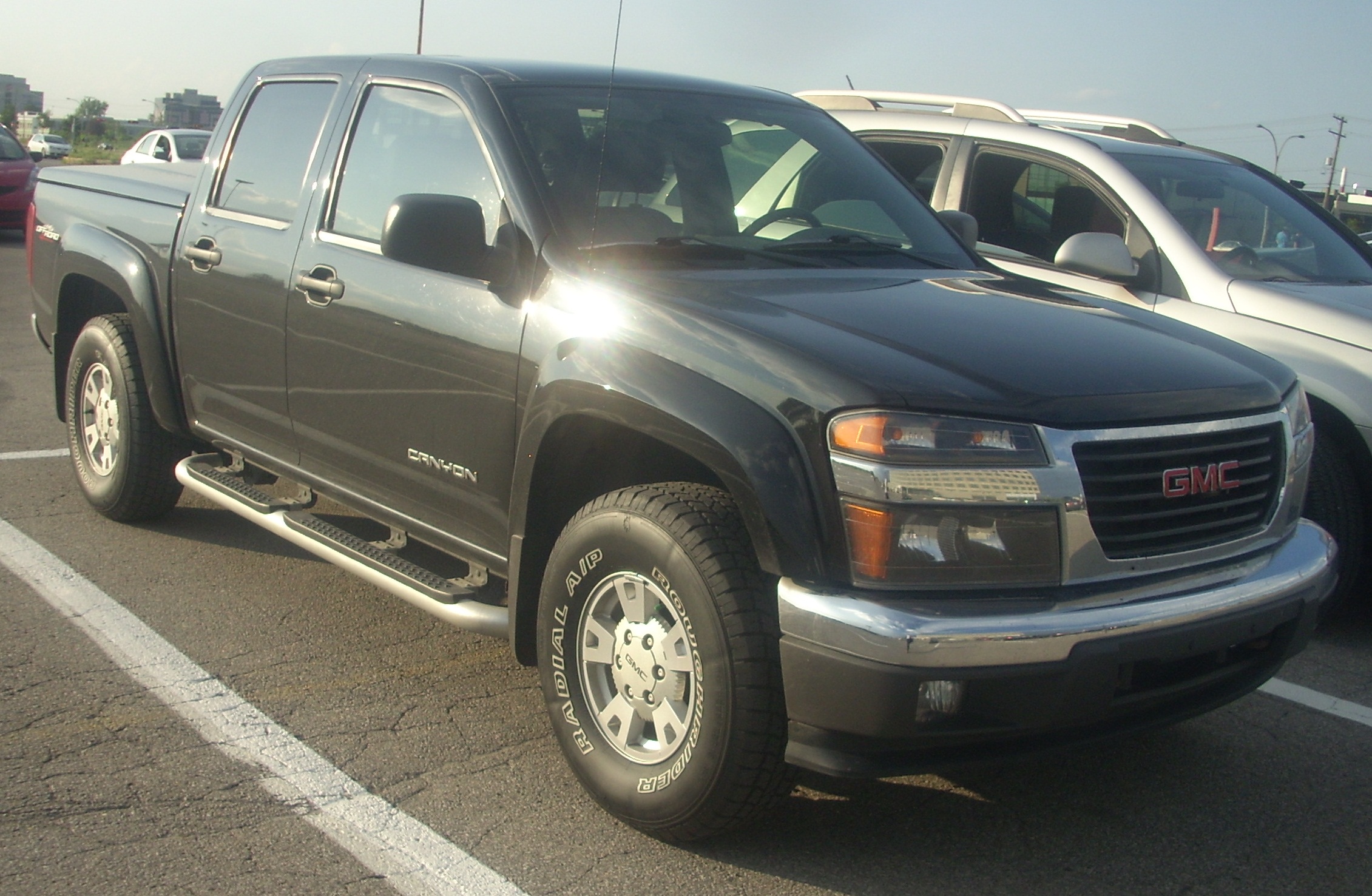
Gmc Canyon
"You know, what else I was thinking about, uh, one of the more expensive midsize trucks is a gmc canyon 84x Kind of like the one we own."
The GMC Canyon is a mid-size pickup. They’re using it as a reference point for how pricey some midsize trucks can get.
The GMC Canyon is a midsize pickup truck. In this segment, it’s referenced as one of the more expensive midsize trucks, setting up a comparison to the truck they’re discussing.
snorkel
"We've done too many videos with The snorkel. Yeah the snake, right? Yes. Yeah Yeah the snorkel That was 72 000"
A snorkel is a raised air intake. It helps the engine breathe when you drive through deeper water, reducing the risk of water getting into the engine.
A snorkel is an intake extension that raises the air intake above the normal engine-bay height. It helps prevent water ingestion during deep water crossings and can be part of an off-road package on trucks.
Built in France (manufacturing location and pricing)
"So partially I think it's where it's built has a lot to do with the price because it's built in france. Yeah at an older I mean repurposed mercedes factory"
Where a car is built can change its cost. The host is saying building in France (and using an older Mercedes plant) likely affects the price you pay.
Manufacturing location can affect vehicle pricing through labor costs, supply-chain logistics, and trade rules. The speaker links “built in France” and a repurposed Mercedes factory to higher costs, implying that where it’s built influences the final price.
Mercedes-Benz
"I mean repurposed mercedes factory Um, which is near germany."
Mercedes-Benz is the German automaker referenced here as the company whose factory was repurposed for another vehicle’s production. The speaker uses this to explain why the manufacturing setup and location might be tied to pricing.
Tariffs
"Um, but there's also chicken tacks. There is also tariffs I mean, I think that that's inflating the price"
Tariffs are taxes a government places on imported goods. In pricing discussions, tariffs can raise the cost of vehicles and parts, which can push MSRP and dealer pricing higher.

Volkswagen Eos
"...nk that that's inflating the price and I think in eos is eating some of that price also to make"
The Volkswagen Eos is a Volkswagen car with a convertible-style design. The podcast mentions it while talking about pricing and how it affects the overall cost picture. The main point is that it’s a specific model being discussed in that context.
The Volkswagen Eos is a Volkswagen model known for its convertible-style design. In the podcast context, it’s mentioned in relation to pricing and how it may be “eating” some of the cost, suggesting it’s part of a lineup discussion. That kind of mention typically relates to how a specific model impacts overall pricing or value perception.

Mercedes-Benz G-Wagon
"But I think because there is no g-wagon pickup truck and because there is no like a premium like brand like lexus maybe or"
The Mercedes-Benz G-Wagon is a luxury SUV that also looks and drives like it can handle rough terrain. The host is saying there isn’t a luxury “G-Wagon-style” pickup that fills that niche.
The Mercedes-Benz G-Wagon (G-Class) is a luxury off-road SUV with a strong status reputation. Here, the speaker argues that there’s no direct “G-Wagon pickup” alternative, which affects how premium truck buyers think about the market.

Porsche Panamera
"No, because I was a little upset when Porsche came out with the Panamera I'm like and then the cayenne and then the cut."
The Porsche Panamera is Porsche’s luxury four-door sedan. The host is saying they didn’t like Porsche expanding into that kind of body style at first.
The Porsche Panamera is Porsche’s four-door luxury sedan, designed to bring Porsche performance into a more practical body style. The speaker mentions it as the start of a perceived “wrong direction,” contrasting it with Porsche’s more traditional lineup.

Porsche Cayenne
"and then the cayenne and then the cut. Well, you know what? I liked the cayenne because you know the earlier ones had Lockers and that was pretty cool and capable"
The Porsche Cayenne is Porsche’s SUV. The host liked the earlier ones more because they were more capable off-road.
The Porsche Cayenne is Porsche’s SUV, and it’s known for combining luxury with real off-road capability. The speaker says they liked earlier Cayenne versions because they had lockers, implying better traction off-road.
Lockers
"Well, you know what? I liked the cayenne because you know the earlier ones had Lockers and that was pretty cool and capable but when they brought up four doors in a sedan"
Lockers are traction devices that help both wheels on an axle work together. If one wheel starts slipping, lockers help keep the car moving instead of spinning in place.
“Lockers” refers to locking differentials (or differential locks) that force the left and right wheels on an axle to rotate together. This improves traction when one wheel loses grip, which is why the speaker calls them “pretty cool and capable.”
Status symbol
"it would be the ultimate Like status symbol in my mind. Okay, but I guess"
A status symbol is an item (like a car) that signals wealth, taste, or social standing beyond its practical function. The speaker frames a hypothetical Bentley pickup as an “ultimate status symbol,” emphasizing how branding and price perception drive buyer behavior.
off-roading
"They're not going to take it through the desert. They're not going to take it off-roading But they're going to feel like they can but they're just going to be crawling walls"
Off-roading means taking a vehicle on rough ground instead of normal roads. It can be anything from dirt paths to rocks and sand.
Off-roading refers to driving on unpaved or uneven terrain like dirt trails, rocks, sand, and mud. The hosts are contrasting true off-road use with a more limited, “crawling” style of capability that still feels adventurous but may not involve full desert-style driving.
crawling walls
"But they're going to feel like they can but they're just going to be crawling walls But that's okay for a meter a hundred thousand dollars."
“Crawling walls” means going up something really steep very slowly. It’s the kind of driving where the truck has to grip well and move carefully, not race.
“Crawling walls” is slang for very slow, controlled climbing—typically on steep obstacles—where traction and low-speed control matter more than power. It’s often associated with off-road setups like low-range gearing, traction aids, and tires that can grip at low speed.
used ones
"Well, eventually there'll be some used ones But for the new quarter masters or the new graniteers, I think what could happen if they're successful"
As more people buy a new truck and then later sell it, more used ones enter the market. That usually makes prices drop compared to buying brand-new.
The hosts are describing how new high-priced vehicles often become cheaper over time as used inventory increases. Once enough units are on the road, the market price can “creep down” due to supply and depreciation.
production in 2022 or 2023
"They started the production in like 2022 or 2023 So it wasn't very long ago and they're still kind of getting going and"
They say the vehicle started being built only recently. When something is new, there usually aren’t many used examples yet, so prices stay high.
They’re noting that production started around 2022–2023, which implies the vehicle is relatively new to the market. New models often have higher prices early on due to limited supply, ramp-up costs, and fewer used units.
chicken tax
"Then they can avoid a lot of the chicken tax problems and other Possible tariffs. That's true. Um, and if that happens, which chicken tax is 25 percent So all of a sudden you're not looking at the haunted grand all of a sudden it's now 75"
The “chicken tax” is a widely known U.S. tariff that historically targeted imported light trucks, making them more expensive to bring into the country. In this segment, they argue that moving production to North America could avoid those tariff costs, which would lower the final price.
move production to a facility in North America
"If they can get going and move production maybe to a facility in north america, us Then they can avoid a lot of the chicken tax problems and other"
If a company builds the truck closer to where it will be sold, it can sometimes avoid extra taxes and shipping costs. That can help the truck end up cheaper for buyers.
Moving production to North America can reduce import-related costs and lead times, especially when tariffs apply to imported vehicles. The hosts connect this to potentially lowering the final retail price by avoiding those extra charges.
British car made with a heavy influence by Germans, produced in France
"It's just a sub model. Okay. Yeah, and then it has other you know, they have some cute names. So it's a british car made with a heavy influence by germans. Yes, but produced in france"
This describes a common modern automotive pattern: a brand’s origin (British) plus engineering influence (German) with manufacturing in another country (France). It’s relevant because it ties into how supply chains and production locations affect pricing, tariffs, and availability.
solid axles front and rear
"But I think there is a place for it because it's super rugged. It has solid axles front and rear. It's a of course. It's a body on frame"
A “solid axle” is a heavy-duty suspension setup where one axle assembly connects the wheels. It’s common on trucks because it’s tough and works well when you’re hauling or driving on rough roads.
“Solid axles” means the front and/or rear axle is a single rigid assembly rather than independent suspension. That setup is often chosen for durability and load-carrying because it can handle rough terrain and heavy use with fewer complex moving parts.
body on frame
"It has solid axles front and rear. It's a of course. It's a body on frame. It has a unique style to it that you won't expect"
“Body on frame” means the truck’s body sits on a sturdy internal frame. It’s used on many trucks because it helps the vehicle handle towing, hauling, and rough terrain.
“Body on frame” is a truck construction method where the body is mounted to a separate ladder-like frame. It’s popular for heavy-duty trucks because it’s strong for towing/hauling and can better tolerate impacts and flex over rough roads.
towing is what capable up to 77 hundred pounds
"But it's also capable. I mean it's towing is what capable up to 77 hundred pounds. That's not bad for a mid-sized truck very it's on the highest end because that's kind of the limit of and we'll test it"
They’re talking about how much weight the truck can pull safely. That number depends on the truck’s power, cooling, and how it’s set up for towing.
This is referring to a maximum towing capacity (here, up to “77 hundred pounds,” i.e., 7,700 lb). Towing capacity depends on the vehicle’s drivetrain, cooling, hitch setup, and how the truck is configured.
brake controller
"It has a hitch. It has a hitch. I mean it's already equipped ready to go and and why well, it doesn't have a brake controller. Okay, so that's already so so we'll have to get that for a hundred thousand dollars"
A brake controller tells the trailer brakes when and how hard to slow down. It helps the trailer stop safely when you brake.
A brake controller is an electronic device that applies the trailer’s brakes in proportion to the truck’s braking. Without it, many trailers can’t slow effectively, especially heavier loads.
Request an Explanation
Heard something you'd like explained? We'll add it to this episode.
Sign in to request explanations for terms you heard.
Want to learn more?
Browse our glossary for plain-English explanations of automotive terms, jargon, and concepts.
Help improve this episode
See something that's not quite right? Our annotations are AI-generated and can sometimes miss the mark. Click the flag icon on any annotation to suggest a correction.