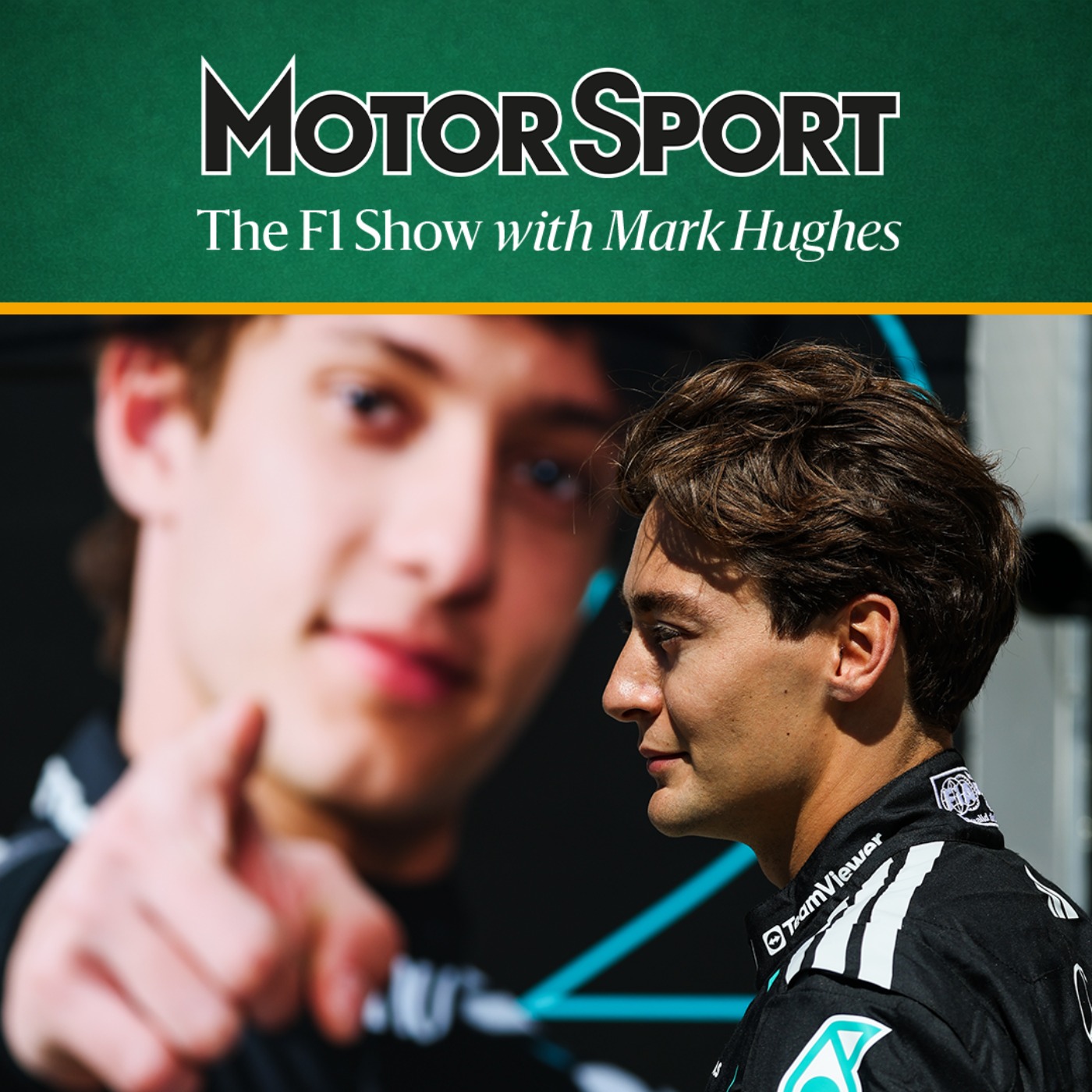
George Russell's worst fear... Kimi Antonelli's on his level
About this episode
Fresh off the Canadian Grand Prix, the Motor Sport F1 Show with Mark Hughes digs into a Mercedes weekend defined by a Russell-versus-Antonelli headline battle. Russell’s “worst fears” are tied to reliability and retirement disappointment, while the hosts weigh whether his comments are genuine or “a massive mind game.” They compare driving styles, track-limit aggression, and how Toto Wolff tries to keep Antonelli grounded. The discussion widens to stewards, fair racing, and the direction of 2027 power-split rules.
George Russell saw the Canadian Grand Prix as a chance to relaunch his F1 world championship campaign but instead his worst fear was realised. Not only did he retire with engine issues, his team-mate Kimi Antonelli was bang on his pace — at one of Russell's strongest circuits.
Mark Hughes and Bryn Lucas explore the gripping Montreal team-mate brawl we saw before Russell bowed out and what it means for a title race which the teenage Antonelli leads by 43 points.
They also take an in-depth look at how the Mercedes team-mates' driving styles differ, including how Antonelli creates extra margin over Russell, but only under specific circumstances in races.
Should Russell despair about his position? Will his greater experience give him the edge over the season? And can Mercedes keep the duo from destroying each other on the track?
All this and more — including Lewis Hamilton looking back to his best in Canada and why this season really could be Max Verstappen's last in Formula 1
Mark also answers your questions on the excitement of Montreal and the fairness of Russell's defence of Antonelli.
More on the stories that really matter, in the latest episode of the Motor Sport F1 Show.
Subscribe now for every weekly episode and tell us what you want to know from Mark. Send us a message on social media or find this podcast at https://go.motorsportmagazine.com/49uvWpY and drop your questions in the comments. He'll answer a selection of the best every week.
Read Mark's column every Wednesday at https://go.motorsportmagazine.com/49uvWpY
Hosted on Acast. See acast.com/privacy for more information.
Kimi Antonelli
"It's putting the pressure more on Kimmy Antonelli than if he said, [337.5s] yeah, I'm determined I'm going to keep on going."
Kimi Antonelli is a Formula 1 race driver. In this discussion, they’re saying the pressure of being the one everyone expects to win can weigh on him more than on someone who’s already “in control.”
Kimi Antonelli is a Formula 1 driver being discussed here as the championship contender. The hosts are framing his situation as being especially pressure-heavy, because others’ expectations and rivals’ tactics can affect how a driver performs.
mind games
"It's yeah, it could well be. [346.1s] It's George's capable of playing mind games."
“Mind games” means trying to get inside another driver’s head. It’s about making them doubt themselves or feel extra pressure, not about changing the car.
“Mind games” in racing is using psychological tactics—through interviews, body language, or messaging—to affect how a rival thinks and feels. In a championship fight, even small shifts in confidence or focus can change risk-taking and decision-making.
team rivalry drivers
"Do drivers into team rivalry drivers? [366.6s] Do they approach things in similar ways?"
They’re discussing what happens when two drivers are on the same team but still competing for the championship. The question is whether teammates think the same way, or whether the team has to step in with instructions.
This segment is about how drivers who are teammates can still be championship rivals. It explores whether they mirror each other’s mental approach, and how teams manage the tension when both drivers are competing for the same top result.
team orders
"Who's also the championship rival? [377.9s] Or do team orders come in the way a little bit [379.5s] when it comes to that sort of situation?"
Team orders are messages from the team to the drivers about who should race who. For example, one driver might be told to let their teammate through to help the team’s overall championship chances.
Team orders are instructions from an F1 team telling drivers how to behave relative to each other—such as holding position or letting a teammate pass. They’re often used when the team wants to maximize points for a championship goal, but they can also create tension between teammates.
Toto
"We've seen it before, even within that team, I'm sure Toto's learned a lot over the years. The way Toto talks to Kimmy Antonelli,"
Toto refers to the team boss in Formula 1. Here, they’re saying he’s learned how to talk to the driver so it doesn’t turn into team conflict.
Toto is shorthand for Toto Wolff, a key figure in Formula 1 team management. In this context, the host is talking about how Wolff communicates with Kimi Antonelli to maintain team harmony.
Kimmy Antonelli
"The way Toto talks to Kimmy Antonelli, actually, first of all, let's just get your thoughts on Kimmy Antonelli's performance."
Kimi Antonelli is an F1 driver. They’re talking about how he drives—how aggressive he is, how smoothly he carries speed, and how close he gets to the limits of the track.
Kimi Antonelli is a Formula 1 driver being discussed in terms of his on-track driving style and race approach. The host compares his smooth, flowing style and aggression to George Russell’s, including how he manages grip and cornering under different conditions.
peak loads
"If you watch his car, he's not putting such big, sudden peak loads on the car as George. George has got his own way of doing it, Kimmy's got his own way of doing it."
Peak loads are the biggest “stresses” the car tires and suspension feel at the most intense moments. The point here is that one driver applies those forces more smoothly, while the other can spike them more suddenly.
Peak loads are the highest forces the car and tires experience during moments like hard braking, rapid steering inputs, or aggressive cornering. The host suggests Antonelli avoids large sudden peak loads compared with George, which can affect tire behavior and consistency.
George
"If you watch his car, he's not putting such big, sudden peak loads on the car as George. George has got his own way of doing it, Kimmy's got his own way of doing it."
George Russell is another F1 driver. They’re comparing how his driving style affects the car differently than Antonelli’s, depending on track conditions.
George refers to George Russell, another Formula 1 driver used here as a comparison point. The host contrasts Russell’s driving approach—especially how he loads the car—with Antonelli’s style, and links that difference to performance on hot vs cold circuits.
Miami
"And that probably explains a lot of why George struggled a little bit on a hot surface in Miami. But you come to Montreal where it's typically quite cold"
Miami is one of the F1 race locations. They’re using it to say that on warmer track conditions, one driver’s style didn’t work as well.
Miami refers to the Formula 1 race held at the Miami circuit, which is typically associated with warmer conditions. The host uses it as an example of where George Russell’s style struggled on a hot surface.
tire temperature
"But you come to Montreal where it's typically quite cold and you've got to push up to get the tire temperature. Then George's style works perfectly okay."
Tire temperature is how warm the tires are. If the tires are too cold, they don’t grip well, so drivers have to work the car harder to get them into the right operating range.
Tire temperature is how hot the tires are operating, and it strongly affects grip and how quickly the car responds. In colder conditions, drivers often have to “push” to bring the tires up to the temperature range where they work best.
track limits
"It's slightly scary because he's clearly, really, really pushing the edge in terms of where he's positioning the car, where he's putting the car relative to the track limits, the grass, but also on corner entry in particular."
Track limits are the rules about how far you’re allowed to go onto the grass or beyond the painted edge. They’re saying Antonelli is driving right up to that line, which is risky but can be fast.
Track limits are the boundaries of the circuit that drivers are allowed to use; going beyond them can trigger penalties or require the driver to give back positions. The host says Antonelli is pushing close to these limits, including where he positions the car relative to the edge of the track.
corner entry
"It's slightly scary because he's clearly, really, really pushing the edge in terms of where he's positioning the car, where he's putting the car relative to the track limits, the grass, but also on corner entry in particular."
Corner entry is the moment you start turning into a corner. They’re saying Antonelli is being especially aggressive right at that turning-in phase.
Corner entry is the phase when the car turns in and transitions from braking/straight-line setup into the corner. The host highlights that Antonelli’s aggressive approach on corner entry is part of what makes his driving feel “scary” and high-risk.
grass
"It's slightly scary because he's clearly, really, really pushing the edge in terms of where he's positioning the car, where he's putting the car relative to the track limits, the grass, but also on corner entry in particular."
Grass is the area off the racing line. It usually grips way worse than the track, so going there is risky—especially if you’re trying to stay within the rules.
In F1, “grass” refers to driving onto the non-paved runoff area, which usually has much less grip than the racing surface. The host implies Antonelli is operating extremely close to the edge where the car could end up on grass, increasing the risk of losing control or triggering penalties.
margin
"You see how close you sort of Miami as well, where you had a comfortable margin, [869.2s] how close he gets to the wall on corner entry or the white line or the grass or whatever"
In racing, “margin” means how much room you leave before you’re right at the edge of grip or the track boundary. Less margin usually means you’re going faster, but it’s also easier to make a mistake.
In racing, a “margin” is the safety buffer between the car and the limit—like how much space you leave to the wall, kerb, or track edge. A smaller margin means the driver is operating closer to the car’s grip and track boundaries, which can improve lap time but raises the risk.
track width
"whatever defines and it's maximizing the track width, which obviously makes it the corner [881.4s] potentially faster."
“Track width” is how much side-to-side space you have on the track. Using more of it can make the corner feel less sharp, helping you go faster.
“Track width” here means the usable lateral space across the circuit that the driver can exploit. Maximizing it can reduce how tight the car has to turn, which can help maintain speed through the corner.
tire bulge of the sidewall
"because if he was given it like you sometimes saw the tire bulge of the sidewall on Kimmy's car [912.8s] on the rear tire, it's actually overhanging the grass."
Tires flex when they’re heavily loaded in a corner. The “sidewall bulge” is the visible shape change of the tire, and it can hint at how hard the driver is pushing near the track edge.
The “tire bulge of the sidewall” refers to how the tire deforms under load—especially at the outer edge when the car is pushed close to the limit. In this context, the bulge indicates how much the tire is being used laterally, and it can show how close the car is to the grass or kerbs.
contact patch
"So the contact patch wasn't on the grass, but you could see that the bulge is actually [921.3s] overhanging."
The “contact patch” is the part of the tire that’s touching the ground. If that area is on the right surface, the car grips well; if it’s on the wrong surface, grip drops.
The “contact patch” is the small area of the tire that’s actually touching the road at any moment. Even if the tire’s outer edge overhangs grass, the performance depends on whether the contact patch stays on the correct surface.
Monaco
"So, you know, and George maybe was half an inch. [928.8s] So there will be a performance advantage there if you're able to commit to that level of accuracy [934.1s] and if you're able to use all the extra of that small amount of extra track width that's given you. [942.8s] In Monaco, it will be really interesting to see just how finally he runs those margins."
“Monaco” is the Monaco Grand Prix, run on very narrow streets with walls close to the track. That makes it hard to be aggressive, so being precise about how close you run and how you use the track matters a lot.
“Monaco” refers to the Monaco Grand Prix, famous for being the slowest and most unforgiving Formula 1 race due to its narrow streets and close barriers. Because there’s little room for error, drivers’ “margins” and how they use track width become especially critical.
overtake maneuver
"And I guess as you're saying as well, you know, when things are going, I'm going to say wrong, [953.6s] a maneuver, an overtake maneuver that Kimmy tries goes wrong."
An “overtake maneuver” is the move where one driver tries to pass another. It’s tricky because you have to time it perfectly and place the car precisely to avoid a mistake.
An “overtake maneuver” is the specific driving sequence used to pass another car—often involving a planned braking point, a chosen side of the track, and timing relative to the other driver’s position. In F1, these are high-stakes because small errors can lead to contact or losing control.
Team Radio
"Toto Wolf has invested a lot of his time, a lot of his energy into bringing Kimmy Antonelli through... particularly over Team Radio that we heard time after time, old time in Montreal."
Team Radio is the two-way radio between the driver and the team during the race. The team uses it to give instructions and strategy while you’re driving.
Team Radio is the live communication channel between a Formula 1 driver and their pit wall/engineers during a session. It’s used for strategy calls, incident instructions, and real-time coaching.
sprint
"And, you know, we heard it very clearly in the sprint, where after the contact and Kimmy was, you know, complaining about it, you just told pretty sharply, stop whining, talk about this later."
A sprint in F1 is a shorter race on the weekend. It affects where drivers start for the main race, and drivers still race aggressively because points are on the line.
In Formula 1, a sprint is a shorter race format held on a race weekend that determines the starting grid for the main Grand Prix. It also awards points, so drivers often push hard even though it’s not the full-distance race.
tire choice
"And I think they were able to indulge in that because they had so much performance and hand over the next fastest cars, especially once the McLaren's disappeared through their tire choice."
Tire choice means deciding which tires to run and when to change them. In F1, the tires strongly affect grip, so the decision can make you faster or slower.
Tire choice refers to selecting which tire compound to run (and when to switch) based on grip, temperature, and track evolution. In F1, the wrong choice can drop performance quickly, while the right one can create a big advantage.
inders
"I mean, putting the inders on at the start and it was dry. And that meant that the next cars down were the Ferrari and Red Bulls."
“Inters” are special tires for when the track is wet but not pouring rain. They’re designed to work better than full-wet tires as the track starts to dry.
“Inters” (spoken here as “inders”) are intermediate tires used in damp conditions—typically when the track is wet but not fully flooded. They sit between full wet tires and slicks, aiming to provide grip as the surface dries.
Montreal
"And if there is nothing to split them, like at Montreal, then that's going to put more pressure on Antonelli's approach than it will on George's."
This is the Montreal F1 track (Circuit Gilles Villeneuve). It’s known for places where cars can pass, so track position and timing matter a lot.
“Montreal” refers to the Circuit Gilles Villeneuve in Montreal, Canada, a track known for heavy braking zones and frequent overtaking opportunities. It’s also a circuit where qualifying and race execution can strongly affect who can pass and who gets stuck in traffic.
overtaken range
"But if Kimmy can be a 10th or two 10th quicker and get out of that overtaken range of the boost, the one second boost range,"
This is basically the “catch-up” zone. It’s when one driver is close enough to try to pass, or close enough that they’re being slowed by the other car.
In Formula 1, an “overtaken range” is the window where one driver is close enough to attempt passing or to be held up by traffic. When the cars are in that range, small differences in pace and strategy can decide who gets clean air and who gets stuck behind.
boost range
"But if Kimmy can be a 10th or two 10th quicker and get out of that overtaken range of the boost, the one second boost range,"
In F1, “boost” is a temporary power boost the driver can use. The “boost range” is the specific window where that extra power is available, so it can help you pull away or set up an overtake.
“Boost range” refers to the limited, time-based power mode in F1 that drivers can deploy for extra acceleration. Because it’s constrained, teams try to time it so the driver gains track position—especially when they’re close to another car.
heat of battle
"But in the heat of battle, if the performance between them is close enough that he can't get George out of his hair or George can't get him out of his hair,"
This just means the intense part of the race where two cars are fighting for position. When it’s that close, small mistakes or small differences in grip can decide who wins the duel.
“Heat of battle” describes the on-track phase where drivers are actively contesting positions, often with repeated attempts to gain or defend. In that situation, tire temperature, braking consistency, and how cleanly a driver can exit corners become more critical than in calmer laps.
Shanghai
"Shanghai is another one and we've just had two of the last four races of two of his special tracks,"
Shanghai is one of the F1 race tracks. The hosts are saying some drivers are especially good there, so results at that track can be a useful clue—but not the whole story.
Shanghai is a recurring Formula 1 venue, and the segment treats it as a track where a particular driver has historically been strong. In F1 analysis, certain drivers and cars match up better with specific circuit characteristics.
tyre switched on
"He just could not get the tyre switched on, no matter what he tried. If you can't get the tyre switched on, you're just wasting your time."
It means the tires finally start working the way they’re supposed to. If they never “wake up,” the car feels slow and slippery, so you can’t drive at your usual pace.
In Formula 1, “tyre switched on” means getting the tires into their working temperature and grip window so the car feels fast and consistent. If a driver can’t get the tires to come in, the car won’t generate the grip needed for braking, cornering, and acceleration.
soft tyres
"it wasn't as soon as they switched tyres and the Ferrari was better on the soft tyres than the Red Bull, the medium tyres than the Red Bull was, then it was game on."
Soft tires usually grip more, so the car can go faster. The trade-off is they often wear down faster than harder tires.
“Soft tyres” are the higher-grip tire compounds in F1. They generally provide more traction and faster lap times, but they tend to wear out sooner than harder compounds.
medium tyres
"the Ferrari was better on the soft tyres than the Red Bull, the medium tyres than the Red Bull was, then it was game on."
Medium tires are kind of the compromise option: not as grippy as soft tires, but they usually last longer. That helps you stay quick for more laps.
“Medium tyres” are a middle compound in F1’s tire range—typically less grip than softs, but with better durability. Teams often choose them to balance pace with how long the tires last during a stint.
Canada
"He wasn't. But Canada, I think we can say that's a fair question for the first time."
They’re talking about the Canadian Grand Prix. It’s one of the Formula 1 races, and they’re using it as the latest example of how well a driver is doing.
“Canada” here refers to the Canadian Grand Prix weekend, where the hosts are discussing a driver’s recent form. In Formula One, each race weekend is treated as its own performance snapshot, so “Canada” becomes shorthand for what happened on track there.
Canadian Grand Prix
"He says, I was still coming down from watching the intense first 30 laps of the Canadian Grand Prix, two brilliant drivers on the edge and not backing down."
The Canadian Grand Prix is one of the Formula 1 races. They’re pointing to the first part of the race—about the first 30 laps—as a great example of close, exciting driving.
The Canadian Grand Prix is a Formula One race where the hosts reference “the intense first 30 laps” as a specific on-track example. In F1 coverage, early-race wheel-to-wheel action is often used to judge driver skill and how competitive the field is.
Suzuka 2000
"How does this 30 laps compare to past examples of intense racing between championship contenders such as Hakenan and Schumacher in Suzuka 2000 and do you rate it as highly for excitement and driver skill?"
Suzuka 2000 is a specific Formula 1 race from the year 2000 at Suzuka. They’re using it as a comparison point for how exciting and close racing was.
Suzuka 2000 refers to a Formula One race at Suzuka Circuit in 2000, used here as a benchmark for intense racing. The hosts compare a modern battle to that era’s famous championship-contender duels.
wheel to wheel
"In terms of excitement, I think it eclipses those because it just went on for so long, wheel to wheel, didn't it?"
“Wheel to wheel” means two cars are driving right next to each other. It usually indicates very close, competitive racing.
“Wheel to wheel” describes racing where two cars run side-by-side with minimal gap, often leading to repeated overtakes or defensive driving. It’s a key phrase in F1 because it signals genuine on-track competition rather than processional racing.
regenerator brake
"So yeah it was just never-ending and the way that the regenerator brake and was working down at the head pin combined with a tailwind into there was making the leader throw the locking up whether"
It’s a braking system that doesn’t just slow the car—it also recovers energy. That saved energy can be used later to help with passing.
In Formula 1, a regenerator brake is part of the car’s energy-recovery system that slows the car while converting some of that braking energy into electrical energy. That recovered energy can then be used later for acceleration, so braking and energy management are linked to overtaking strategy.
locking up
"the head pin combined with a tailwind into there was making the leader throw the locking up whether that leader was George Russell or Kimi Antonell."
Locking up is when the tires stop turning while you’re braking. That can make the car slide and harder to steer, which is bad when you’re trying to brake late for a corner.
“Locking up” refers to the wheels stopping rotation under braking, usually because the driver is braking too hard for the available grip. When that happens, the car loses steering control and braking efficiency can drop, which is especially important when trying to defend or set up a pass.
battery charge and recharge
"It was a classic dice and all the battery charge and recharge things were doing was allowing the car behind to be a little bit faster using the boosty the overtaking boost button to be a a little bit faster than the car in front"
This describes how F1 cars manage stored electrical energy: harvesting it during braking (recharge) and then using it for acceleration (charge). Because energy is limited, drivers time when to deploy power to maximize speed for overtakes without running out at the wrong moment.
car positioning out braking corner exit
"It was a proper driver skill contest. It was a car positioning out braking corner exit type dice."
It means where the driver puts the car when braking and then how they aim to leave the corner. A good exit gives you more speed for the next straight, which helps you pass.
This is a description of how overtakes are set up by placing the car to maximize advantage at the end of a braking zone and into corner exit. By choosing the best line and braking point, the driver can get better traction and speed out of the corner, making it easier to attack on the following straight.
boosty the overtaking boost button
"It was a classic dice and all the battery charge and recharge things were doing was allowing the car behind to be a little bit faster using the boosty the overtaking boost button to be a a little bit faster than the car in front"
It’s an extra power button the driver can use to accelerate harder for passing. Using it at the right time helps you get close enough to overtake at the next corner.
That “overtaking boost” is the driver-controlled deployment of stored energy to gain extra acceleration for passing. In close racing, the timing of when the button is used can decide whether the car behind can pull alongside into the next braking zone.
racing line
"Why is running your rival off the road by taking the racing line fair racing? If they did this at Baku or Monaco,"
The racing line is the best path through a corner to go faster. If you force another driver off that line, it can make the situation dangerous and unfair.
The racing line is the ideal path through a corner that balances speed, braking points, and traction. In F1, taking a rival off the racing line can be seen as unsafe or unfair because it can force the other driver into a compromised position.
stepping into the barrier
"If they did this at Baku or Monaco, one car would end up in the barrier and there would be a penalty for causing an avoidable accident."
They’re describing a crash outcome—someone hits the barrier. In racing rules, if your move causes an avoidable crash, you can get penalized.
The transcript describes a scenario where a rival ends up in the barrier, which is used to illustrate when a move crosses the line from racing into causing an avoidable accident. In stewarding terms, that’s the kind of outcome that can trigger penalties if the action wasn’t justified by fair positioning.
Baku
"Why is running your rival off the road by taking the racing line fair racing? If they did this at Baku or Monaco, one car would end up in the barrier and there would be a penalty for causing an avoidable accident."
They’re using Baku as an example track where the rules about safe, fair passing are applied. The point is how stewards decide if a move was acceptable.
Baku is referenced as an example location for how F1 stewards would judge whether a move was fair or caused an avoidable accident. It’s used here to illustrate that the same on-track behavior can be treated differently depending on context and positioning.
stewards
"There doesn't have to be a penalty when there's an accident, when there's a collision. There can be but it's up the stewards to decide was that clearly his fault."
Stewards are the officials in F1 who look at crashes and close calls after the fact. They decide if someone did something wrong and whether that should lead to a penalty.
In Formula One, the stewards are the officials who review incidents and decide whether penalties or race-direction actions are warranted. They interpret the rules in context—like whether a driver caused a collision or ignored the driver guidelines.
runoff
"When you've got a little bit of runoff, obviously the driver who's defending and take a little bit more liberty because he's not guaranteeing the other driver is going to crash,"
Runoff is the extra paved area next to the track. It’s there to help if a car leaves the racing line, and it can change how officials judge who caused a crash.
Runoff is the track area beside the racing surface designed to give drivers a margin for error if they go off-line. In F1 incident analysis, the presence of runoff can affect how aggressively a driver can defend a position and how fault is interpreted.
codifying the regulations
"It's not as black and white as the words. That's a problem with codifying the regulations. It makes it seem like, right, this is absolutely how it is black and white in every single situation"
Codifying the regulations means turning racing rules into fixed, written wording that’s applied the same way every time. The host argues that this can make outcomes feel “black and white,” even though real racing incidents vary infinitely in detail.
commercial management
"I think it's got itself into this situation through optimism. I've talked about this before through the commercial management, assuming that the engineering side of the sport would solve the problems"
Commercial management is the business planning side—how the sport is run to satisfy sponsors, teams, and other stakeholders. The host thinks that side made assumptions that engineering couldn’t realistically deliver on.
Commercial management refers to how F1’s business side plans and prioritizes revenue, stakeholders, and operational decisions. The host suggests that an overly optimistic commercial approach assumed the engineering side could solve problems quickly, which he calls an intractable mismatch.
electrical energy
"It's Europe against hard physics and just how much less dense the electrical energy can be than a tank full of fuel."
He’s talking about how much usable energy you can carry and use. Fuel in a tank is energy-dense, while electrical energy (stored for hybrid use) can be less dense, which affects how the power system works.
The host is contrasting energy storage/availability between electric energy and a tank of fuel. In F1, this matters because the car’s hybrid system and power delivery depend on how much usable energy can be stored and deployed versus conventional fuel.
agile performance equalization
"Ferrari, they're feeling, well, we're getting this agile performance equalization, [2339.8s] and we're not going to get the benefit of that because you're bringing a completely new set [2344.1s] of rules in."
It’s a set of rules meant to keep teams from getting too far ahead. If one team is much faster, the system tries to bring performance closer so racing stays competitive.
“Agile performance equalization” describes a Formula 1 mechanism intended to reduce performance gaps between teams by adjusting technical or regulatory levers. The idea is to keep competition closer by making it easier to correct imbalances as the season evolves or as rules change.
energy split
"Max Verstappen has been very, very clear, [2366.3s] that he doesn't like these regulations, doesn't really, I don't think he minds driving the cars, [2371.2s] but doesn't like the fact that he has to deal with the energy split all the time"
It’s how the car decides when to use stored energy. Because the rules limit how and when you can deploy it, the driver has to manage it during the race.
In Formula 1, “energy split” refers to how the car’s hybrid energy (from the battery/ERS system) is divided between different uses during a lap. The FIA sets targets for how much energy can be deployed and when, so teams and drivers must manage it continuously rather than using all available power freely.
60-40 split
"Yeah, he's basically saying, great, I'm glad they've attended to the problem and what they're [2395.1s] talking about for 27 with his 60-40 split. I'm happy with that."
It’s a specific rule change that changes how the car’s stored energy is used. The “60-40” means one part gets more of the energy than the other, which affects how the car feels to drive.
The “60-40 split” is a specific allocation ratio for how hybrid energy is distributed under the revised 2027 rules. It implies a larger share (60%) goes to one usage mode and the remaining share (40%) goes to another, changing how the driver experiences power delivery and energy management.
V8s
"We have spoken about Max Verstappen before saying maybe he come back in 2030, 2031, V8s were suddenly appearing on the grid."
V8s are a type of engine with eight cylinders. The way the engine delivers power can feel different, so changes like this can affect how drivers drive the car.
V8s refers to engines with eight cylinders arranged in a “V” shape. In Formula 1 discussion, mentioning V8s signals a shift in engine configuration on the grid, which can change how cars deliver power and how drivers manage the car.
Lewis Hamilton
"And although people seem to be talking about him retiring all the time is Lewis Hamilton. He said, I'm here for some time. I'm not going anywhere."
Lewis Hamilton is a top Formula 1 driver who has won the World Championship multiple times. Here, the host says Hamilton’s main goal is to get back to his best and keep fighting for wins and titles.
Lewis Hamilton is a seven-time Formula 1 World Champion (and one of the sport’s most successful modern drivers). In this segment, Mark Hughes discusses Hamilton’s focus on regaining form and winning races/championships, plus how he’s adapting to the current generation of F1 cars.
energy management
"yes, he doesn't like these cars, the energy management aspect of these cars any more than any of the others do."
In today’s F1 cars, the power isn’t just “full throttle all the time.” Energy management is how the team and driver decide when to use stored energy so the car stays within the limits of the rules.
In modern Formula 1, energy management is how the driver and team control the flow and use of limited energy from the hybrid power unit. It affects throttle use, deployment of energy, and how the car is driven lap-to-lap to stay within the rules.
power unit management
"he enjoys this car, just the power unit management thing that he doesn't like, but he's enjoying driving this car, it's doing all the things that he needs it to do."
In F1, the “power unit” is the engine plus hybrid energy system. “Power unit management” means controlling how you use that power during the race so the car stays quick and doesn’t run into limits.
“Power unit management” in Formula 1 refers to how teams and drivers control the hybrid power unit’s output—balancing engine performance with energy deployment and thermal limits. It’s often about managing throttle/boost and energy usage so the car stays fast without overheating or wasting usable power.
podiums
"I guess for Lewis Hamilton, he's still getting podiums, isn't he? Podiums are happening now, so that's a good enticement for him."
A “podium” is when a driver finishes in the top three of a race. It matters because it usually means the car was fast and the driver did well.
In Formula 1, a “podium” means finishing a race in the top three positions (1st, 2nd, or 3rd). Podium finishes are a key measure of competitiveness because they award points and signal strong car performance.
Nelly
"they were very sort of congratulatory... to Kimmy and to Nelly. But up in the cooldown room as well, they seem to be really enjoying talking about the racing."
They mention “Nelly” as another person who was congratulated after the race. The excerpt doesn’t say who exactly Nelly is, but it’s clearly part of the same post-race celebration.
“Nelly” is mentioned alongside “Kimmy” as someone both drivers congratulated after the race. The transcript doesn’t give a full name in this excerpt, so the annotation can only reflect that Nelly is a fellow driver/figure in the same race context.
Max Verstappen
"there's an edge that's gone between Lewis Hamilton and Maxwell Stappen. They seem to be much more kind of chilled out with each other... But I don't think their relationship is frozen in the animosity of the late stages of that season."
Max Verstappen is a top Formula 1 driver from the Netherlands. In this part, they’re saying his relationship with Lewis Hamilton is less hostile than it was during their big 2021 championship battle.
Max Verstappen is a Dutch Formula 1 driver and multiple-time World Champion, central to the modern era’s top-team competition. Hughes references the Hamilton–Verstappen rivalry and how their on-track intensity (especially around the 2021 title fight) has changed into mutual respect.
2021 title contest
"Yeah, well, the race, the relationship, I guess, is frozen in people's mind by their 2021 title contest."
The “2021 title contest” is the big championship battle in Formula 1 between Lewis Hamilton and Max Verstappen. They’re saying people still remember it as very intense, but the drivers are acting more respectful now.
The “2021 title contest” refers to the championship fight between Lewis Hamilton and Max Verstappen during the 2021 Formula 1 season. Hughes uses it as context for why their relationship is remembered as tense, even though he argues it’s less adversarial now.
Formula One
"because he has said that the very best drivers are in Formula One. Not all seats have got the very best drivers, but the very best drivers are in Formula One."
Formula One is the highest level of car racing with the biggest teams and most advanced technology. They’re saying the best drivers tend to be in F1, even if not every seat has the very best person.
Formula One (F1) is the top tier of international open-wheel racing, featuring teams that develop highly advanced hybrid power units and aerodynamics. Hughes uses it as the benchmark for “the very best drivers,” contrasting F1 seats with other motorsport categories.
team partner than just a gun for hire
"The task, you know, it becomes much more of a... He becomes much more of a team partner than just a gun for hire. And he's having to..."
This is basically saying the driver can’t just show up to be the fastest by themselves. In endurance-style or multi-driver racing, they have to work with the team and other drivers so the whole group can do well.
“Gun for hire” is a motorsport metaphor for a driver hired mainly to chase individual results. The host contrasts that with being a “team partner,” meaning the driver’s job includes working with engineers and teammates to optimize the car setup and strategy for the group’s shared goal.
combined time of the three drivers or the four drivers
"We talked about this when we talked about the nerve over in 24 hours, how you've got to get the best combined time of the three drivers or the four drivers or whatever you've got."
In some racing formats, multiple drivers share the car, and the team’s result is based on the total time from all of their stints. So it’s not just about one person being fastest—everyone has to help the team get the lowest overall time.
This describes a multi-driver format where the team’s result depends on the total time across multiple stints (here, three or four drivers). Instead of one driver “owning” the pace, each driver has to contribute to minimizing the overall time, including how the car is set up for different driving styles.
regulation changes for 2027 and beyond
"It's all about Max Verstappen leaving, Lewis Hamilton staying, and those pesky regulation changes for 2027 and beyond. A really nice read."
They’re talking about new F1 rules coming in the late 2020s. When the rules change a lot, teams often have to redesign their cars, and that can change who’s fast.
The host is referring to upcoming Formula 1 rule changes that are expected to reshape how teams design cars and manage race strategy. In F1, major regulation updates can significantly alter performance relationships between teams and drivers.
Request an Explanation
Heard something you'd like explained? We'll add it to this episode.
Sign in to request explanations for terms you heard.
Want to learn more?
Browse our glossary for plain-English explanations of automotive terms, jargon, and concepts.
Help improve this episode
See something that's not quite right? Our annotations are AI-generated and can sometimes miss the mark. Click the flag icon on any annotation to suggest a correction.